Why Western Sanctions Against Russia Failed
By Simes Dimitri – Sputnik – February 24, 2023
Sanctions were meant to deliver a swift and devastating blow to the Russian economy, one that would take years to recover from. Much to the dismay of Western politicians, however, not only did Russia survive the sanctions storm, but it has the potential to emerge even stronger than before.
During a speech in Poland last year, US President Joe Biden boasted that sanctions had reduced the Russian ruble to “rubble” and confidently predicted that the Russian economy was on “track to be cut in half.” French Finance Minister Bruno Le Maire went even further, declaring that the West would bring about Russia’s economic “collapse.”
“We are waging total economic and financial war on Russia,” he told a French broadcaster last March. “The economic and financial balance of power is totally in favor of the European Union, which is in the process of discovering its own economic power.”
Despite these loud promises, the Russian economy contracted by a mere 2.5 % last year – a decline considerably smaller than those experienced during the 1998 financial crisis (5.3%) and the 2008 Great Recession (7.9%). In a report published last month, the International Monetary Fund forecast that Russian economic growth would outpace that of Germany and the United Kingdom in 2023.
Nor did sanctions succeed in turning Russia into a global pariah. A recent report by the University of St.Gallen in Switzerland found that only 8.5% of European and G7 companies had divested from Russia between February and November 2022. At the same time, Russia’s trade turnover with non-Western economic powers such as China, India, Turkey, and Indonesia soared.
Earlier this month, EU foreign policy chief Josep Borrell was forced to admit that the West’s sanctions strategy was not going according to plan. “It is true that the Russian economy has not collapsed and that the GDP is not what has been forecast, and it is true that last year it got extraordinarily high revenues that came from oil and gas,” he said during a speech at the European Parliament plenary session.
How was Russia able to overcome an unprecedented sanctions blitzkrieg? To answer that question, Sputnik News spoke with economists and Russian businesspeople in industries ranging from agriculture to information technologies. They told us that Western sanctions were headed for failure from the very beginning because they were built on a distorted view of the Russian economy.
Our interlocutors emphasized that although sanctions undoubtedly created economic challenges for Russia in the short and medium term, they also presented a powerful opportunity to revive domestic industry and scientific potential, as well as establish new partnerships with Asian, Middle Eastern, Latin American, and African economies.
Failed Strategy
In the weeks and months following the start of Russia’s special military operation in Ukraine, the US and the EU rolled out some of the most expansive sanctions packages in recent memory. Western governments pressured the SWIFT global payment system into expelling several of Russia’s largest banks, barred Russian ships and airplanes from entering their ports and airspace, and imposed export controls aimed at restricting Russia’s access to various advanced technologies and key production components.
Although this sanctions barrage initially caused the Russian ruble to dip in value and inflation to spike, the shock-effect proved to be short lived. Within weeks, the ruble recovered all of its pre-conflict value and then some. Likewise, inflation reached a peak rate of 17.8% in April 2022 and then began to steadily decline, hitting 11.8% in January 2023 (a rate less than many countries in central and eastern Europe). Contrary to the expectations of many Western economists, Russia’s unemployment rate not only did not increase, but actually hit a post-Soviet record low of 3.7% in December 2022.
Despite the new financial and logistical restrictions against Russian exporters, foreign trade contacts also remained strong. Russia’s current account surplus – which measures the difference between a country’s trade outflows and inflows – reached a record high of $227.4 billion last year, an 86% increase from 2021.
Why did such unprecedented sanctions deliver such unimpressive results? Jacques Sapir, an economist at the Paris-based School for Advanced Studies in the Social Sciences, told Sputnik that the main reason was because they were based on false premises about the size and resilience of the Russian economy. A large part of the problem, he explained, was that American and European policymakers were looking at the wrong statistics.
The main metric used in the West to measure the Russian economy is nominal gross domestic product (GDP), which is calculated by simply converting its value in rubles into US dollars. Sapir argued that nominal GDP underestimated the strength of the Russian economy because it failed to account for purchasing power parity (PPP), which adjusts for differences in costs across countries. He noted that whereas Russia’s nominal GDP was comparable to Spain’s, its GDP based on PPP was roughly the same level as Germany’s.
Another key factor was the fact that the Russian economy was far less based on services than its Western counterparts. Sapir explained that although services could serve as an important source of economic growth during peacetime, they inevitably took a backseat to the manufacturing and commodities sectors during times of geopolitical turmoil. He noted that Russia still maintained a sizable industrial base and was a leading global supplier of natural gas, oil, rare earth metals, and agricultural products.
“Russia has a very specific place in the world markets and, therefore, attempting to isolate such a country would inevitably lead to an international economic catastrophe,” he said. “Unsurprisingly, a lot of countries would never agree to join efforts aimed at isolating Russia because they need trade with Russia.”
Sapir also said that the West underestimated Russia’s ability to find alternative suppliers for various types of machinery and key components used in production. He noted that although Russian imports fell substantially during the second quarter of 2022, they rebounded during the third and fourth quarters. “Russia is now importing more or less the same quantity of products that it was importing by the end of 2021,” he said.
This relatively quick recovery was due to Russia reorienting its trade flows from Europe to Asia, especially China, Sapir explained. Another important factor was that Russian companies had become fairly adept at circumventing Western sanctions with the help of counterparts in third-party countries. As a result, many European and American goods were still finding their way into the Russian market.
Rebirth of Industry
Sanctions have the potential to become a blessing in disguise for Russia, according to Konstantin Babkin, president of the Rostelmash, one of Russia’s largest agricultural equipment manufacturers.
Decades of economic integration with the West had caused Russia to sacrifice some of the industrial potential it inherited from the Soviet Union, Babkin argued. Instead of manufacturing airplanes and trucks from start to finish as it once did, Russia began to import such complex machinery from the West.
The Western sanctions imposed last year have created an urgent need for Russia to rebuild its industrial base. During a speech before the Federal Assembly on Tuesday, President Vladimir Putin declared that Russia needed to reorient its economy from selling raw materials to the West to developing its own advanced technologies and equipment.
Babkin told Sputnik that Russia possessed all the necessary conditions to support an industrial revival — immense natural resource wealth, vast swathes of available land, a market of 150 million people, and strong scientific institutions capable of training the next generation of innovators.
The main thing needed to translate Russia’s economic potential into reality is strong government support for domestic manufacturers, he said. Some of the policy measures Babkin recommended include lower interest rates and taxes, as well as new tariffs.
“Many countries have already reached the physical or spatial limits of their development – there are no more markets left to conquer, no more fields left to sow, no more opportunities for expansion. That’s why much of the modern world is experiencing such a crisis” he said. “Russia is one of the few countries, perhaps even the only country, that has plenty of room to develop further. We can grow many times over if we rely on our resources, ourselves, and our civilization.”

Sources: Public data, vedomosti.ru, forbes.ru, cbr.ru
Some Russian companies are already moving to fill newly-created niches in the domestic market. Last November, the Russian manufacturing sector experienced its largest expansion in over five years, according to a business survey by the S&P Global financial analytics firm. A surge in domestic demand was the primary driving force behind the increased output and employment.
Babkin noted that after the West imposed sanctions against Russia in 2014 over the reunification of Crimea, the share of Russian-made agricultural equipment on the domestic market jumped from 25% to 65%. He argued that the current round of sanctions could provide a similar impetus to resurrect Russian aircraft and automobile production.
“Today, the priority task in civil aviation is to launch the serial production of fully Russian-made passenger aircraft, without any foreign components, as quickly as possible” the United Air Corporation, a Russian aerospace company that is part of the Rostec state corporation, told Sputnik. The company explained that the decision of Western airliner giants Boeing and Airbus to exit the Russian market last year was forcing domestic manufacturers to not only step up aircraft production, but also start making their own engines and other key components.
For its part, the United Air Corporation plans on manufacturing 500 aircraft by 2030 to help replace Russia’s existing fleet of foreign planes, which will be gradually retired. One of its most promising projects is the MC-21, a next-generation passenger aircraft that is already in production. The main advantage of the MC-21 is its cutting-edge composite wing, which provides the plane with superior aerodynamics.
Technological Sovereignty
One of the central objectives of Western sanctions is to suffocate Russian technological innovation. When Biden unveiled the first Ukraine-related sanctions package last year, he promised that the US and its allies would impair Russia’s “ability to compete in a high-tech 21st century economy.” The technological aspect of sanctions has only become more important since then. Although Western politicians now admit that sanctions have failed to collapse the Russian economy, they still express hope that technological restrictions will stunt Russia’s progress in the long run.
That is an assumption challenged by many Russian scientists and entrepreneurs. Evgeny Nikolaev is a project manager at Health Test, a Russian company that is working to develop a machine-learning program that will help doctors to diagnose Alzheimer’s Disease in patients during the earliest stages of its development. The technology, which has no foreign analogues, is currently undergoing clinical tests at a Moscow hospital, after which it will be distributed to other medical institutions in the Russian capital.
Nikolaev said that Western sanctions have not had any meaningful impact on the project’s development, noting that all the “necessary reagents and consumables could be replaced with domestic ones or obtained through parallel importation.” At the same time, he emphasized that Russian scientists did not need foreign sponsorships in order to make breakthroughs. He noted that government institutions such as the Moscow Department of Health and the Moscow Innovation Cluster were offering the project significant support in terms of product development and practical application.
A similar argument was advanced by Valentin Makarov, president of the Russian Software Developers Association (RUSSOFT). He told Sputnik that Russia had two advantages it could rely on to keep innovating despite Western sanctions. The first was Russia’s strong scientific education, which has a legacy of excellence dating back to the Czarist-period. Additionally, Makarov argued that Russia was well positioned to build new technological partnerships with non-Western economies such as China and India.
Ironically enough, sanctions had provided Russian software and cybersecurity systems with an opportunity to show their resilience in the face of unprecedented external pressure.
“Following the start of the special military operation, we saw a manifold increase in cyber attacks against Russian systems, a ban on the use of foreign software, and the termination of support licenses for this software,“ he said. “Despite everything that happened, Russian systems continued to work as before. It turned out that giant American corporations, which dominate the global information technologies, cannot destroy the operation of these Russian systems. This showed everybody that Russia has the capacity for technological sovereignty.”
According to Makarov, the world was on the brink of a new technological order – one centered on artificial intelligence and cyber-physical systems. Instead of remaining a junior partner in the Western-led technological ecosystem, Russia needed to seize the initiative and develop its own ambitious, revolutionary projects in coordination with its allies.
One promising idea, Makarov said, was for Russia to spearhead the creation of a new Eurasian digital financial payment system. Such an initiative would not only facilitate greater regional trade, but also shield its members from Western sanctions and other forms of economic pressure.
“We cannot become leaders in the new technological order by continuing to sell oil and gas to the world market and then using those profits to buy technological systems developed by other countries,” he said. “If we do not focus on developing our own systems, in cooperation with partners from friendly countries of course, then that means we will again be dependent on someone else. Russia has a huge number of specialists capable of creating new technologies that will change the world, so we must take advantage of that.”
Biden team has ‘deeply rooted hatred for Russia’ – US congressman

RT February 24, 2023
Senior officials at the US State Department are attempting to get the country “involved in another world war” with Russia, Arizona Congressman Paul Gosar tweeted on Friday. Gosar, Twitter CEO Elon Musk, and former president Donald Trump, have all named Victoria Nuland as the most dangerous among this group in recent days.
Responding to an RT article on Musk accusing Nuland of “pushing this war” in Ukraine, Gosar declared that the billionaire “is correct.”
“Both Nuland and Blinken have a deeply rooted irrational hatred of Russia, and they seek to get the US involved in another world war,” he continued. “These are dangerous fools who can get us all killed.”
In a follow-up tweet, Gosar wrote that “as a non-soldier, Nuland is quite willing to endorse violence and war.” The Republican lawmaker then quoted the article, which stated that Nuland had “endorsed regime change in Russia, celebrated the US’ destruction of the Nord Stream pipelines, and called for the indefinite flow of arms into Ukraine.”
As assistant secretary of state for European and Eurasian Affairs in 2014, Nuland was largely responsible for orchestrating the pro-Western coup that unseated democratically elected president Viktor Yanukovich. Nuland traveled to Kiev and promised military aid to the rioters, and was recorded plotting to install a successor to Yanukovich.
As Biden’s secretary of state, Blinken has promised to keep weapons flowing into Ukraine “for as long as it takes,” and advised Kiev in December not to seek the kind of negotiated settlement that would liken to a “phony peace.”
Gosar has been a persistent critic of the Biden administration’s Ukraine policy since Russia’s military operation began a year ago on Friday. However, although the Republican Party now controls the House of Representatives, there is little the Arizona congressman can do to change the administration’s course. A significant bipartisan majority supports continued military aid to Ukraine, with only 11 Republicans, Gosar included, sponsoring legislation that would cut funding for Kiev.
These Republicans are all allies of former president Donald Trump. In a campaign video released on Tuesday, Trump blamed the situation in Ukraine on Nuland and “others like her” in the Biden administration. Nuland, he said, was “obsessed with pushing Ukraine towards NATO,” adding that the conflict would have “never happened if I was your president.”
The West severely miscalculated the geopolitical ramifications of the war in Ukraine
The EU, and not Russia, has weakened since the start of the special military operation
By Ahmed Adel | February 24, 2023
Although many remember February 24 as the first anniversary of the war in Ukraine, Russia’s special military operation is actually the next phase of a wider conflict that began in 2014. This is a key point often overlooked because the narrative built in the West is that Russia’s intervention was an unprovoked invasion with the sole purpose of territorial expansionism. The international community, which the West incorrectly refers to itself as, has rejected this narrative. To the disappointment of Western leaders, most of the world has instead deepened their ties with Russia.
However, the “unprovoked invasion” narrative has been exposed in the West also as a fallacy. It is recalled that former German Chancellor Angela Merkel admitted in December 2022 that “the 2014 Minsk agreement was an attempt to give time to Ukraine.”
“It also used this time to become stronger as can be seen today. The Ukraine of 2014-2015 is not the modern Ukraine,” she said, adding that “it was clear to everyone” that the conflict had been put on hold, “yet this was what gave Ukraine invaluable time.”
Merkel’s statement confirmed that the Minsk Accords, a series of agreements which sought to end the Donbass war, was only intended to give the Ukrainian state more time to militarily strengthen. It also proves that the Western party of the Minsk Accords never intended to use this mechanism to find peace and address the concerns of local residents.
Therefore, the Russian intervention was not necessarily a surprise, and perhaps the West were even expecting it.
However, what was an absolute surprise for the West was the geopolitical and economic ramifications – all to the detriment of the West and to the advancement of Moscow.
It cannot be denied that sanctions had an impact on the Russian economy, but the European Union has demonstrated that it is nothing more than a political dwarf that has no autonomy from Washington. Sanctions have a limited effect on Russia given that it is a completely self-sustainable country, unlike Syria and Iran (which are also heavily sanctioned but without the capacity for self-sustainability).
Rather, the sanctions have actually accelerated the de-Dollorisation of the global economy and deepened the economic crisis in Europe.
Evidently, there was naivety in the West, as there was a false belief that Russia would capitulate to sanctions pressure. Instead, Europe is experiencing an economic crisis that has crushed the Middle Class through a cost-of-living crisis. Meanwhile, Russia has greater prospects for recovery compared to Germany and the UK.
According to a January forecast by the International Monetary Fund, Russia’s economy will grow faster than Germany’s while Britain’s will contract. This is a far cry from the eminent collapse of the Russian economy that was predicted when hundreds of international companies, such as McDonald’s and Boeing, withdrew from Russia and Russians were blocked from using Western financial institutions.
It is recalled that in March 2022, US Treasury Secretary Janet Yellen boasted that “the Russian economy will be devastated.” Eleven months after Yellen’s statement, the IMF predicts that the Russian economy will start growing again in 2023, expanding by 0.3% and then 2.1% in 2024. Although 0.3% growth is paltry, it is still surprisingly higher than Germany’s 0.1%, a phenomenal situation considering that it is Berlin imposing the sanctions, not Russia on Germany.
The UK is in an even worse situation. Its economy is expected to contract by 0.6%.
India and China are helping Russia alleviate the stress of decoupling from Western financial institutions and trade exchanges. Many experts believe that the 21st century is the “Asian Century” and expect the world’s major financial centres to shift from the West to the East. In this light, Russia’s exclusion from the West has left it with no choice but to strongly project to the East, something that India, China and other countries have enthusiastically taken advantage of.
The 20th century was dominated by the bipolar system and a short-lived unipolar system. Although the 21st century is multipolar in nature, the overwhelmingly dominant economic and military powers are expected to be the US and China, with a host of other Great Powers, such as Russia and India, fully capable of defending their own interests.
What the West does not realise is that in such a global system, it is Russia that hugely influences whether the US or China will triumph. Russia has effectively been given no choice but to pivot towards China. Future generations in the West will learn that this was a strategic blunder – and all for the illiberal sake of defending a neo-Nazi regime in Kiev.
The war in Ukraine was expected to be another advancement of “liberalism” and Western internationalism. However, what has transpired instead is the weakening of Western hegemony. The US expected most countries to fall in line and impose sanctions against Russia, however, this did not trend in Asia, the Islamic World, Africa, or Latin America.
Although the West is persistently and arrogantly defending the Kiev regime against the reality that Russia will triumph in the war, it continues to ruin its own reputation in the eyes of the actual international community by lambasting countries, such as India, for not following their orders. This will have long-term negative ramifications for the West as its influence is weakening and mistrust is deepening.
Ahmed Adel is a Cairo-based geopolitics and political economy researcher.
Time for US Pull-Out: GOP Congressman Warns About Risk of Kinetic Conflict With Russia in Syria
By Ekaterina Blinova – Sputnik – 23.02.2023
GOP Representative Matt Gaetz has introduced a resolution seeking to direct President Joe Biden to remove all US troops from Syria. The House must vote on Gaetz’s proposal within 18 days of its introduction due to the bill’s war powers status.
“[T]he purpose of my legislation is to force members of Congress to vote on record regarding whether they think we ought to continue Obama’s war in Syria. President Obama kicked off our involvement (…) and now we still find ourselves in the middle of a Syrian civil war with Russia and Turkey and Iran, all present in a very confined neighborhood,” Congressman Matt Gaetz, R-Fla., told the US press earlier this week.
Gaetz, a House Armed Services Committee member, filed the War Powers Resolution on February 22 after he learned that four US military servicemen and a working dog were wounded in a US and Syrian Democratic Forces (SDF) helicopter raid in northeastern Syria.
Speaking to the US press, Gaetz shared his concerns with regard to the US president’s ability to handle Syrian matters. The congressman quoted Biden’s August 2021 interview in which the president claimed that the US “[doesn’t] have military in Syria to make sure that we’re going to be protected.” However, according to the American media at the time of Biden’s comment, there were at least 900 troops in Syria who were helping their SDF proxies on the ground.
Gaetz has also drawn attention to reports alleging that Russian and US personnel get into very close proximity with one another. “[T]he risk of an accident or miscalculation or just misuse of authority could lead to direct kinetic conflict between the United States and Russia in Syria,” the lawmaker insisted.
In addition, Congress has never authorized the use of military force in Syria, the congressman argued. “America First means actually putting the people of our country first — not the interests of the military industrial complex,” he said.
Gaetz’s resolution has been filed under the War Powers Act of 1973, which was designed to limit the president’s authority to wage war and reasserted Congress’ authority over foreign wars. Notably, at the time of the 1973 bill’s introduction, then President Richard Nixon tried to veto it. However, Congress overrode his veto, and the resolution became law following the US pullout from Vietnam in early 1973.
If Gaetz’s legislative initiative passes, US military personnel must be removed from the Syrian Arab Republic within 15 days.
Meanwhile, the lawmaker lamented the fact that Democratic progressives who used to be anti-war activists have become “cheerleaders” for the US’s overseas conflicts. “‘The Squad’ used to be anti-war. Now, they’re waving their pom poms for NATO,” he said.
The representative believes that the upcoming vote on his resolution will show who the real patriot of America is and who continues to stick to Middle Eastern adventurism.
Biden’s predecessor, Donald Trump, was the first who sought to pull US troops out of Syria. Nonetheless, he later insisted that some of the contingent should stay in place to “protect” the Syrian oil fields occupied by the US-backed Kurdish-dominated SDF. Trump was also misled about the actual number of US servicemen in Syria. US Syria envoy Ambassador Jim Jeffrey admitted in November 2020 he was “always playing shell games to not make clear to our leadership how many troops we had there.”
An Enlightened Man Among Lawyers
The Indian public interest advocate, Prashant Bhushan, lights the path forward.
By John Leake | Courageous Discourse | February 22, 2023
An old friend who loves India once told me it is the only country in which he’d met what he called an “enlightened man.” His understanding of “enlightenment” was influenced by the German philologist, Max Mueller’s translation of the Sanskrit word, Bodhi (German: Erwachen or Erleuchtung) which translates into English as “awaken” or “enlightenment.” While most of us—with our myriad desires, attachments, and fears—blunder through life, he who possesses Bodhi sees through all of the illusions and deceptions.
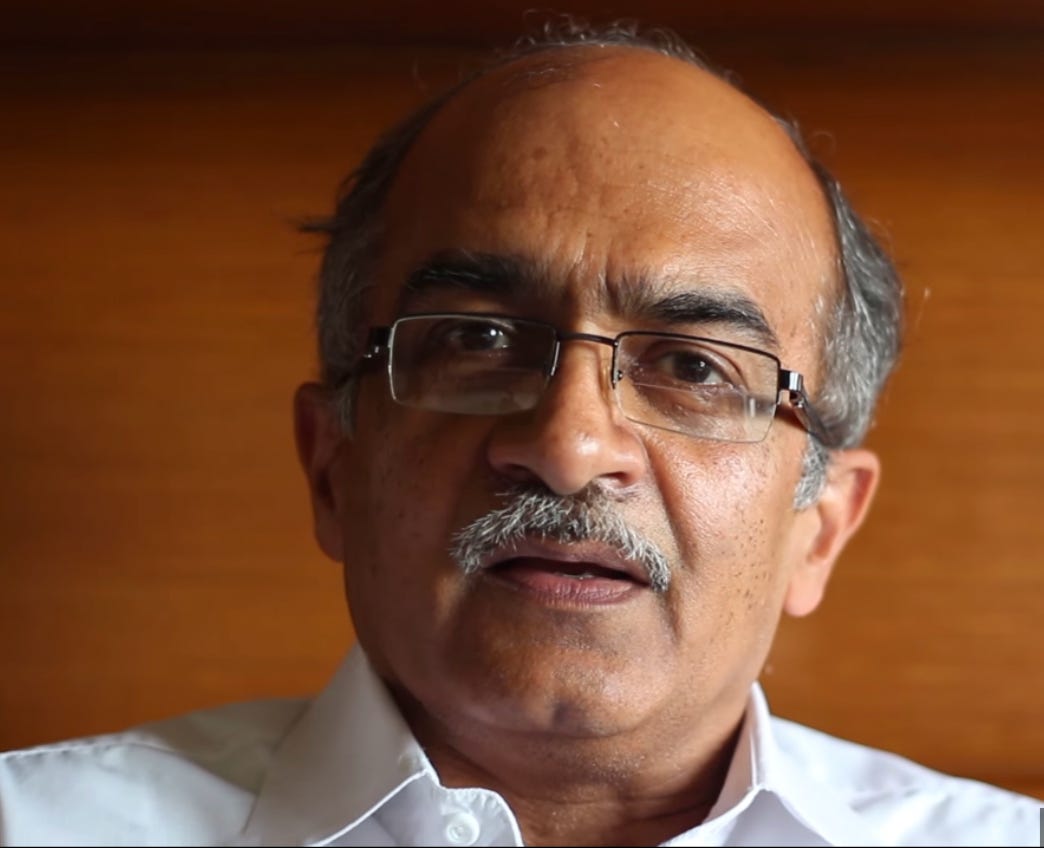
My friend was convinced that an enlightened man is instantly recognizable as such, because his enlightenment gives him extraordinary calm, cheerfulness, and courage. At the time I heard this, years ago, I figured my friend was just one of many westerners who have romanticized India. But then, at a conference in Delhi on February 7, I met the great Indian lawyer and public interest advocate, Prashant Bhushan.
As he was one of many people I met at the conference, I didn’t initially realize that he is a world-renowned jurist who recently persuaded the Indian Supreme Court to strike down India’s vaccine mandates as unconstitutional. The only detail I caught in our introduction was that he was a medical freedom advocate. I sat next to him on stage with Drs. McCullough and Malhotra. Before the audience was seated and the formal introductions began, I asked him about the origin of the Indian Constitution.
He had the most friendly and elegant way of speaking with great erudition and not a hint of pedantry. And though a relatively small and slightly built man, he seemed to exude an inner strength. After we spoke for a while, Dr. McCullough leaned over to me and said, “It’s not every day you get to meet a guy who argues a case before the Supreme Court and wins.”
“What?” I asked, not entirely believing my ears.
“Yeah!” McCullough said. “Prashant took on the vaccine syndicate in India and won.”
“Wow!” I exclaimed. “What a man!”
During lunch I Googled him and read his Wikipedia entry, which tells of his extraordinary career as public interest advocate for human rights, environmental protection, constitutional protection, and government accountability, performing most of his work pro bono. In a world of selfish greed and corruption, Mr. Bhushan is one of those rare, enlightened souls who really can lead mankind out of the dark.
The Hindu Times published a report on his argument before the Indian Supreme Court. It seems to me that his reasoning and his victory serve as a beacon of hope for everyone who cares about classical liberal principles and constitutional protections.
Remdesivir Victims Grab Medical Centres By The Throat
New lawsuits have been filed against an array of Community Medical Centres in California over their covid care protocol…
By JJ Starky | The Stark Naked Brief | November 16, 2022
Gilead’s Remdesivir is a drug that has received a lot of criticism, and rightly so.
Prior to the pandemic, the World Health Organisation rejected its use due to poor trial studies abroad. NIAID-sponsored trials had likewise documented troubling issues. Reported adverse events were significant:
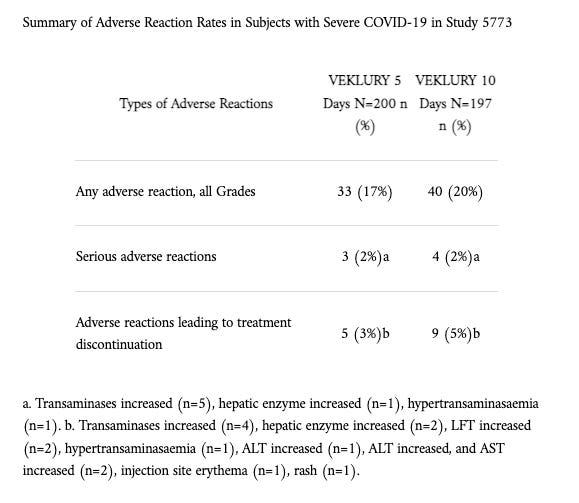

In short, a plethora of studies indicated it had potentially bizarre and fatal effects depending on the patient’s health. Patients who had a multi-organ impairment, for example, exhibited detrimental impacts on their renal function after the drug was administered. The FDA, nonetheless, granted its use under Emergency Use Authorisation (EUA) when a study showed it reduced COVID hospitalisation duration by 4 days.
From that point on, Remdesivir became part of every COVID-19 protocol across the country. Reports from 2020 have since revealed that if a vulnerable patient (aged 65 and over) came into a medical centre and tested positive, Remdesivir was the treatment most likely to be offered. That patient would then be placed or declared in the ICU as an inpatient.
Here is where the story turns very sinister.
According to local sources in California, hospitals that took on inpatient complex cases could charge up to 144x more than an outpatient case. As soon as they treated these patients within their facilities, they could apply for reimbursement from Medicare. In other words, there was a clear financial incentive for hospitals to “over-treat” patients to maximise profits.
With these reports now circulating, 14 Californian residents living in the Fresno area have filed lawsuits against various medical centres. These include Community Regional Medical Center, Clovis Community Medical Center, and St. Agnes Medical Center.
One plaintiff’s claim about a medical centre’s covid protocol is particularly reprehensible:
“A patient comes to the hospital often for problem unrelated to COVID-19. They are told they have COVID-19 or ‘COVID pneumonia’. They are immediately separated from their loved ones, and usually declared to be in ICU, even though they are often just placed in room. They are told that the deadly Remdesivir is the only available and safe treatment. They are usually told that if they leave the Hospital against ‘medical advice’ they will void their insurance. They are placed on BiPap machine at high rate, making it difficult for them to breathe. Their hands are often tied down so they can‘t take the BiPap machine off their face. After their hands are tied down, and sometimes before, [a] psychiatrist comes to the room and determines that they are ‘agitated.’ This results in the protocol patient being placed on morphine or something similar. Sedating the patient makes it more difficult for them to communicate and more difficult for them to fight the effects of Remdesivir especially as it relates to their ability to breathe….”
All the lawsuits are being funded by the Arizona-based medical advocacy nonprofit Truth For Health Foundation. The organisation is run by Elizabeth Lee Vliet MD. Currently, the three aforementioned lawsuits will return to court for case management in January.
Note: These claims do not concern ‘End-Of-Life Care Protocols’. They concern COVID care protocols in general. We’ve seen similar claims made in the UK regarding Midazolam but again this concerned ‘End-Of-Life’ care. These lawsuits could well lift the thickly-blackened veil (for the wider masses) on the medical industry’s capacity to treat patients like cattle.
Government Severely Downplaying Scale of Chemical Disaster, 9/11 Victims’ Lawyer Says
Sputnik – 23.02.2023

Despite investing hundreds of billions of dollars via the Bipartisan Infrastructure Deal, dozens of trains in the US continue to derail every year, resulting in massive damage to people and the environment.
“I’ve seen the pictures of the bubbling in the water. I’ve seen the pictures of the dead animals. I wouldn’t drink that water, would you?” Michael Barasch, a 9/11 Ground Zero victims’ attorney, told American media.
The lawyer warned of an impending mass outbreak of cancer in the affected population as a result of the massive derailment of a train transporting chemicals in Ohio. He also urged not to be swayed by claims of government agencies that there is no danger, advising them to fight for their rights and protect themselves. One of the components carried by the ill-fated train, vinyl chloride, has previously been linked to the development of various cancerous tumors.
“This is an explosion of cancers waiting to happen. And you won’t see it for years — sometimes 5, 10, 20 years. This is scary stuff,” Michael Barasch, the attorney said.
A train derailment near the town of East Palestine, Ohio, on February 3 caused massive pollution, as the train was carrying hazardous chemicals. For some three weeks now, the Department of Transportation’s leadership, headed by Pete Buttigieg, has been criticized in the media for failing to act . On February 21, the head of the department said he plans to visit the site of the tragedy, but has so far not given a specific date for the trip, although he regularly appears at a variety of public events.
The train was carrying about 1.1 million pounds of vinyl chloride, butyl acrylate, isobutylene, and other highly hazardous chemicals. Lawyer Michael Barasch, who has helped thousands of 9/11 victims get medical treatment, criticized claims by the Environmental Protection Agency (EPA) that the water was drinkable and the air in the area was safe.
This all comes against the backdrop of the Bipartisan Infrastructure Deal, in place since November 2021, which has been touted by President Joe Biden as one of the most ambitious infrastructure renewal projects in US history. Designed among other things to renew rail infrastructure with billions of dollars in investment, thousands of train accidents continue to occur in the US every year, including more than a dozen major accidents in the past year.
TSA Still Molesting at Warp Speed
By Jim Bovard | The Libertarian Institute | February 23, 2023
I traveled to Hartford, Connecticut last week for a conference. It was the first time since the start of the pandemic that I had the pleasure of being pawed by TSA agents. Alas, since 2020, neither I nor the Transportation Security Administration have become corrigible.
Flying out of Washington National Airport on Thursday, I saw a special entry for the CLEAR program that enables people who pay $189 a year to skip TSA lines. I lambasted this program here back in December. Travelers stand in photo kiosks that compare their face with a federal database of photos from passport applications, drivers’ licenses ,and other sources. TSA promises that its new airport regime will respect Americans’ privacy. Fat chance: TSA previously promised no traveler would be delayed more than 10 minutes at TSA checkpoints.
I stood and watched semi-frazzled travelers enter a roped-off expanse to get TSA approval for their visage.
A skinny young woman with a CLEAR t-shirt and a clipboard was standing guard at the entrance of the biometric site. She looked like a cherub with long straight red hair and a welcoming smile. Who could suspect that, as The Washington Post warned, the new system could be “America’s biggest step yet to normalize treating our faces as data that can be stored, tracked and, inevitably, stolen”?
“How soon will they be making the biometric checks mandatory?” I asked her.
“I don’t know anything about that,” she replied, as if I’d asked about the surface temperature of the planet Venus.
“Do people ever complain about having to do the biometric checks?
“No, this is voluntary,” she replied with a smile wider than a Kamala Harris grimace.
She was a good Washingtonian: she could never imagine any federal agency flogging hell out of the Constitution. I considered peppering her with another half dozen questions but wanted to keep my sarcasm fresh for dealing with TSA agents. My hunch was that the redheaded cherub was not a regular reader of the Libertarian Institute.
I finished guzzling my morning coffee I fetched from home and tossed the used Gatorade bottle into the giant trash barrel at the entrance to the TSA queue. The previous time I went through a TSA checkpoint at National Airport, TSA agents got riled up because I forgot to take off my belt. That spurred an enhanced patdown, a verbal brawl, and an article I wrote that the Minneapolis Star Tribune headlined, “The World’s Most Incompetent Agency.”
Seeking to avoid another kerfuffle, I sought to comply with the TSA checkpoint regimen.
I took off my boots and belt and took all the metal clutter out of my pockets.
I passed through and—beep—another alarm. WTF?
A TSA agent pointed to the giant video screen on the controlled side of the checkpoint, revealing a bright yellow splotch that proved that my derriere failed federal inspection.
“That’s my wallet,” I said.
“You aren’t allowed to have that in the scanner. We have to do a patdown.”
So I’m supposed to abandon my wallet to rascals notorious for robbing travelers? More than 500 TSA agents have been fired for stealing laptops, cell phones, and other property at checkpoints and in luggage screening.
Another TSA agent shuffled up to find my terrorist contraband. This dude was in his 20s but he looked weary before his time. He explained that he would perform a supplemental enhanced patdown on my backside.
“Are you going to jam my groin?” I growled.
“No, we’re not going to do that.”
“Yeah, OK, whatever.”
He proceeded to run his hands and his TSA Terrorist Catcher Magic Wand over my thighs and butt. I refrained from muttering that he got further than I usually did on first dates long ago. He then checked the inside of my thighs and signaled I could leave. I kept my profanity in reserve for the return flight.
Coming back through Hartford on Sunday afternoon, I was chagrined to see a long line of docile folks waiting to receive TSA blessings. I entered the queue and a scrawny, 70ish guy with his right arm in a sling came in behind me. He was struggling with his carry-on bag so I guessed his arm injury was recent.
He groused that he had paid for TSA Pre-Check but they hadn’t allowed him to use it that day. TSA Pre-Check customers usually avoid Whole Body Scanners—another reminder that the entire system is a charade.
“Where are you going?” he asked.
“I’m going to Washington but I don’t work for the feds.”
“Good,” he replied. He said he was going to Fort Lauderdale and I said that was a helluva friendlier place than D.C.
Over the years, I enjoy drawing out folks to see if they recognize TSA’s “security theater.” This guy got it.
I mentioned that I might have problems today at the checkpoint because TSA hates me.
“Why do they hate you?” he asked.
“Because I have flogged them in print for 20 years. Their scanners fail to catch mock bombs and weapons in 95% of the tests by undercover agents. Their explosive detection tests are so harebrained that they are triggered by hand sanitizer. The TSA chief denounced me for maligning and disparaging TSA employees.”
He smiled.
“But I don’t know why they would ever suspect me because I was a Boy Scout.”
He laughed and said he’d been a Scout as well. “But your hat makes you suspicious,” he added.
It was a bulky brown hat I’d recently picked up in Tennessee. I didn’t realize till afterwards that it was the “Bootlegger” design. I said that if I was flying out of North Carolina, my hat would fit right in. But here in Connecticut, I was screwed.
As we got near the checkpoint, I tugged off my belt and began unlacing my heavy boots. “You can go ahead of me—this will take awhile,” I told the elderly gentleman.
“No, no—you go first,” he insisted. He absolutely, positively did not want to go just before me.
As I stood waiting my cameo in the Whole Body Scanner, I heard him explain to a TSA agent that he had metal knee and hip replacements. They signaled for him to step through a side gate next to the scanner.
I ambled into the screener radiating as much disdain as I could muster on a Sunday afternoon. A TSA agent barked that my feet were in the wrong place; I had to make sure I put my socks in the cut-out drawing. Yeah, yeah…
“Hold your arms up higher,” she ordered.
That woman sounded as dumb as my high school gym teacher.
She signaled me to exit and then another agent came up with a TSA magic wand and signaled that I must halt.
“We have to check you,” a tall, spindly young guy announced.
“What was the problem?” I growled.
“The scanner alerted for something around your shoulders and upper arms.”
I have been working on my bench press lately but I didn’t think the results were that impressive.
He waved the wand and found nothing and signaled I could move along.
“What might have triggered the alert?” I asked.
“I dunno. It could have been the heavy shirt.”
Maybe they thought the wool in my shirt came from sheep that were raised by Al Qaeda in Yemen?
As I tracked down my carry-on bag and boots on the carousel, I saw a TSA agent barking orders to the old guy with the arm in a sling.
“Do you want the supplemental screening to take place here or in a private room?” the TSA agent with a vapid visage badgered him.
I was tempted to shout: don’t go in the private room! But the guy had good instincts and said on his own that he wanted the patdown in public. At least it would be videotaped if the process went to hell in a handbasket.
The agent kept going up and down the old guy with the wand, poking and prodding and repeatedly ordering him to change his posture. The man looked humiliated at being treated like a terrorist suspect in front of so many bystanders. I don’t have that reaction to extra patdowns because I don’t give a damn for the opinions of TSA agents or anyone who happily submits to their boneheaded antics. But I could tell from the expression on the guy’s face that he was shocked.
He was finally released from TSA custody and shuffled with his shoes and belts to a nearby bench. As he was putting himself back together, I came up to offer condolences.
“I think it was the sling—that’s why they targeted me,” he said.
“They could have easily checked if you had a bomb or a gun in the sling without groping you all over but they didn’t do that,” I scoffed.
He put his head down and wished me a good trip.
“As a fellow American, I’m sorry how they treated you.”
My comment seemed to stun him. But more than twenty years after 9/11, TSA has no right to continue treating Americans like convicts waiting to enter a prison shower. TSA has taken menstruating women to private rooms to force them to lower their pants to prove they are bleeding—an abuse that has spurred multiple federal lawsuits. TSA effectively claims that Americans have no constitutional rights because they “voluntarily” submit to searches for permission to fly. That legal hogwash entitles them to endlessly harass hapless citizens.
Despite squeezing millions of butts and boobs, TSA has never caught a real terrorist. TSA should be abolished and replaced by the type of private security companies that protect European and Canadian fliers without endless BS from officialdom.
Jim Bovard is the author of Public Policy Hooligan (2012), Attention Deficit Democracy (2006), Lost Rights: The Destruction of American Liberty (1994), and 7 other books.
I was a prisoner in Guantanamo Bay Detention Camp, but who is its biggest captive?

By Mansoor Adayfi | MEMO | February 23, 2023
It was 21 years ago this month that I was flown in the belly of a US cargo plane, hooded, blindfolded, gagged and chained in an orange jumpsuit, for over 40 hours. I didn’t know where I was being taken, or why.
My journey into the unknown started when I was sold to the CIA as an “Egyptian Al-Qaida general” in 2001 after the US invaded Afghanistan. I was 18 years old, and I am from Yemen. After I was imprisoned for around three months in a black site in Afghanistan, I was taken to Kandahar military prison, an airbase that served as a transit station to the unknown. I wasn’t the only one being held there.
When a huge cargo plane landed in Kandahar three weeks later, we all knew that some of us would disappear. Without being able to see, hear or speak, we were dragged to the first plane blindfolded, and then chained to the floor. It was a journey of pain and suffering. When the plane eventually landed, we hoped it would be the end to our suffering. It wasn’t. It was only the beginning of a longer, more brutal journey.
Soldiers never seem to get tired of the beating and shouting. When the second flight ended, it was still not the end of the journey. The US marines snatched and dragged me onto a bus, and then onto a ferry. Where was I going? The first clue came from the sea, which was the first friend who welcomed me. A marine shouted in English and an Arab marine translated: “You are under the control of the US marines!” They continued to shout and physically assault us for the rest of the way.
The ferry eventually docked and a bus took us on the final leg of the journey. We were disembarked by being snatched, one after another. I was forced to sit on my knees for hours. The duct tape over my mouth blocked my screams. Every cell in my body was screaming but no one could hear my cries. They could see the pain, and I felt like maybe their twisted humanity was screaming back, too.
After going through the processing station —where we experienced humiliation and degradation over and over again — soldiers dragged my naked body over sharp gravel to a cage where an IRF (Immediate Reaction Force) team piled on top of me and started removing the chains violently; then the hood, goggles, earmuffs and the duct tape. Soldiers shouted into my ears, “DETAINEE 441! STOP RESISTING!” Resisting? I was barely breathing. Without knowing it, what they did at that moment was introduce the word “resist” into my mental landscape. That’s what I needed to do; I just had no idea how.
At night, it took a while for my sight to come back, but it was still blurry. All I could see was an ocean of orange figures caged just like me, all I could hear were rattling chains, slamming doors, soldiers shouting in their loudest voice, “SHUT THE F**K UP, DON’T LOOK AT ME, LOOK DOWN, NO TALKING!” The dogs barking in the near distance sounded less aggressive than them. The barking never stopped. As in never. It sounded as though they were protesting at the inhumane treatment in their own way.
On my first morning in Guantanamo Bay Detention Camp — for that is where I was — I took a long look around me. I found myself caged in a rose chain-link cage where even animals wouldn’t survive. There were many others there too. I could see swollen faces with bruises, black eyes, shaved heads and faces, split lips and bleeding wounds. We all looked the same. It was like a signature that the soldiers wanted to leave on us all. US President George W. Bush and his administration needed to prove that they were “winning” the “War on Terror”, so they called us the worst of the worst.
We were dragged to this unknown place from different parts of the world; some of us were sold for a bounty and some were handed over to the CIA by their own governments. It was the first time in history that such a thing was done: there we were; 800 men and children — yes, children — from 50 nationalities, speaking over 20 different languages, having different mindsets and cultures, snatched and flown to a dark hole hidden from the rest of the world. This American prison camp wasn’t even in America.
Everything was taken from us, and we became just orange figures with numbers printed on a bracelet locked on our wrists. Our captors stripped us of our freedom and imprisoned our bodies and wanted to control us and deny our humanity, but they failed to understand that what really makes us unique individuals are characteristics such as our names, values, relations, morals, beliefs, ethics, emotions, memories, language, knowledge, experiences, talents, feelings, dreams, nationalities and, of course, our innate distinctive humanity. These were part of another DNA, and a survival kit which the US government didn’t want to know about. They thought that they could control our bodies and freedom, but they would never control our hearts and souls.
Yes, we were isolated and disconnected from our families and the rest of the world, but even in America’s dark hole, life won. We created our own world. Yes, we were tortured and abused, but we also sang, danced, resisted and survived. Also, we soon found other generous guests at Guantanamo who came to visit us regularly, who challenged the US restrictions and never had CIA clearance to visit. They came to share our meals, to listen to us, and to tell us that everything will be okay. We became friends and families with the iguanas, cats, birds and banana rats.
Guantanamo started with a selection of Muslims from around the world, but it kept changing, evolving and growing. We lived through Camp X-Ray, Camp Delta, Camp 5, Camp 6, Camp Echo and others. We went through the torture programmes and abuse by interrogators, psychologists and a whole host of camp staff. We went on hunger strike to protest against the torture and injustice, only to be tortured more. We lived through all the years of Guantanamo: we lived through its Dark Age, its Golden Age, and back again to the Dark Age. With each year we grew older and our imprisonment only settled into us more deeply. Our captors got more creative in developing torture techniques to break us and to try to turn us into something we were not.
To survive through the darkness in that dark hole, we only had each other and whatever makes us human beings. We were fathers, husbands, brothers and sons from different parts of the world. Some of us were teachers, doctors, soldiers, commanders, journalists, lawyers, tribal elders, mafia men, poets and professors; and some were spies. We had no shared life before Guantanamo, nothing in common. At first, we started introducing ourselves to each other, and getting to know each other. I wish our captives had taken time to get to know who we really were as well, instead of just needing to prove that we were hardened terrorists.
The cycle of hardship and the torture we endured forged strong bonds of brotherhood and friendship that helped us to survive. We started developing a new shared life and a new “us” at Guantanamo. Our brains started constructing new memories, relations, knowledge and experiences, but everything related back to and was based on Guantanamo life. Sharing our knowledge, experience and culture with each other created a beautiful Guantanamo where we sang songs in different languages, danced dances from different cultures, and laughed and cried together. After years, we grew together and became part of each other’s lives and memories. Guantanamo became part of us and part of our life. Guantanamo kept growing, evolving and changing, feeding on our lives and humanity. With it, we grew old too.
We weren’t the only victims of Guantanamo: all Americans and America’s values and justice system were as well. There were many Americans who came to work in the detention camp, and they became victims too when they refused to abandon their humanity and treat us badly. Some took a stand against the system and were imprisoned; others were fired or demoted. We fought for them as much as we fought for each other because they were humans and victims too, regardless of their nationality or which side they were on. Injustice has no boundaries, colour or nationality. As we were living in Guantanamo, we didn’t want anyone else to experience it.
Through the Dark Age of 2002-2010, we protested and carried out hunger strikes for years. We fought back as much as we could; we learned from each other and taught each other. In Guantanamo’s Golden Age we learned English and art; we painted and we made ships, cabinets, trees, all from remnants of trash and leftover cardboard.
In Guantanamo, I grew up, from a young boy to a caged man. My world was Guantanamo and it’s where half of my life was taken, where days, months and years were the same.
Then after around 15 years, I was forced to leave Guantanamo the way that I was taken there, hooded and chained. When they came to tell me about my release, they told me, “You have no choice.” I made peace with Guantanamo in Guantanamo and made the decision that it wouldn’t change me; it’s part of me and of who I am.
The whole world agrees that Guantanamo is a stain on our humanity and one of the biggest human right violations of the 21st century. There are those who tortured and abused us at Guantanamo who are still bragging about their time there and their work. Their humanity was the first real victim of that place.
Despite all these reflections, though, Guantanamo hasn’t left us yet. Even today, there are 34 men still in Guantanamo, 20 of whom have been cleared for release. There are many calls for the closure of America’s black hole detention centre. For us, closing Guantanamo does not only mean shutting down the facility, but also there being full accountability for the US government for what happened there: acknowledgment of the cruel and inhumane treatment, a full and unreserved apology, and reparations for the victims.
Guantanamo symbolises oppression, injustice, torture and lawlessness. In this way, Guantanamo is now everywhere, and I can say — in the strangest of ironies — that even though we were prisoners of the US destructive “War on Terror”, the United States is and always has been a prisoner of its own violence. Guantanamo is yet another chapter of this violence and one whose legacy will live on long after the prison is closed. The United State of America itself is Guantanamo’s greatest captive.
Google Expands Campaign to ‘Inoculate’ People Against ‘Misinformation,’ But Critics Say It’s All About Money
By Suzanne Burdick, Ph.D. | The Defender | February 22, 2023
Google said last week it plans to expand into Germany its campaign to “inoculate” people against misinformation — as if it were a virus — after seeing “promising results” in Eastern Europe.
The campaign is based on an approach called “prebunking” designed to teach people how to spot false claims before encountering them, thereby “inoculating” them against the “disease” of misinformation “like a vaccine does” against a physical disease, Euronews reported.
The tech giant will release a series of short videos that highlight techniques — such as fear-mongering, scapegoating, false comparisons, exaggeration and missing context — that are commonly used to promote misleading claims.
The videos dissect these different techniques so viewers can more readily recognize them when consuming media.
Proponents of the campaign say it’s an “efficient way to address misinformation at scale.”
But some critics allege Google’s campaign is selectively targeting information related to corporate and government interests and is motivated by money rather than a sincere desire to protect readers from false information.
“They [Google’s leaders] want Google to be what they see as a safe place for advertisers,” said Clayton Morris, a former Fox News anchor who co-hosts the online news show “Redacted.”
Videos to run as ads on Facebook, YouTube, TikTok
Google’s “prebunking” videos will run as advertisements on Facebook, YouTube or TikTok in Germany. A similar campaign in India is also in the works, the AP reported.
Last fall, Google ran a test video campaign in Poland, the Czech Republic and Slovakia.
The campaign focused on inoculating viewers against “false claims about Ukrainian refugees” and showed techniques commonly used to support such claims, such as alarming or unfounded stories about refugees committing crimes or taking jobs away from residents.
The AP did not report the specific statements regarding Ukrainian refugees that Google deemed as false.
The videos were viewed 38 million times on Facebook, TikTok, YouTube and Twitter.
Researchers said people who viewed the videos were more likely to be able to identify misinformation techniques and less likely to spread false claims than people who hadn’t watched the video.
‘You can think of misinformation as a virus’
Alex Mahadevan, director of MediaWise, a media literacy initiative of the Poynter Institute, told the AP that the strategy was a “pretty efficient way to address misinformation at scale, because you can reach a lot of people while at the same time address a wide range of misinformation.”
In November 2022, Google and YouTube gave the Poynter Institute $13.5 million to strengthen its fact-checking efforts with $12 million earmarked to create a Global Fact Check Fund.
“You can think of misinformation as a virus,” Sander van der Linden, Ph.D., professor of social psychology in society at the University of Cambridge, told the AP. “It spreads. It lingers. It can make people act in certain ways.”
It also sometimes needs a periodic “booster,” according to the AP, because the effects of the videos eventually wear off.
Van der Linden assisted Google in developing its prebunking campaign and is presently advising Meta, which owns Facebook and Instagram, the AP said.
Google announced its expanded campaign just before the Feb. 17 start of the Munich Security Conference.
According to the AP, the timing of the announcement reflected the heightened concerns of government officials and tech companies regarding the impact of misinformation.
“There’s a real appetite for solutions,” Beth Goldberg, head of research and development at Jigsaw, a unit of Google that “explores threats to open societies,” told the AP. “Using ads as a vehicle to counter a disinformation technique is pretty novel. And we’re excited about the results.”
Google has not announced plans to expand its campaign to the U.S., so it remains unknown if and when the California-based company will apply its misinformation prebunking tactics on its home turf.
‘Prebunking’ campaign more about promoting ‘corporate and government interests,’ say critics
Commenting on Google’s latest announcement, “Redacted” co-host Natali Morris said, “It’s clear the corporate idea of disinformation is really only related to corporate and government interests — not at all to human interest.”
The topics addressed by Google’s misinformation campaign, such as COVID-19 and climate change, are topics “that will either give governments or corporations more power,” Natali said.
Meanwhile, other topics of human interest — such as child trafficking — remain untouched by Google, she said.
Clayton Morris, who co-hosts “Redacted” with his wife Natali, said he believed Google’s efforts to fight misinformation are motivated by money.
For example, Clayton said, companies like Pfizer and Moderna spend billions of dollars in advertising and Google wants to be an “advertiser-friendly environment” so it “pushes down” information and opinions that criticize the companies’ pharmaceutical products.
“Imagine if Pfizer execs are sitting there and they’re thinking about where to put their ad dollars and they start seeing Google search results that are like Pfizer this, Pfizer that … that’s why they [Google] downrank all of this stuff to push that stuff away and they continue to make their good ad revenue,” he said.
Now the pharmaceutical companies don’t even have to produce ads anymore because Google is essentially doing it for them, Natali added.
“Imagine what a prebunking video would look like around a COVID vaccine,” she said.
Suzanne Burdick, Ph.D., is a reporter and researcher for The Defender based in Fairfield, Iowa. She holds a Ph.D. in Communication Studies from the University of Texas at Austin (2021), and a master’s degree in communication and leadership from Gonzaga University (2015). Her scholarship has been published in Health Communication. She has taught at various academic institutions in the United States and is fluent in Spanish.
This article was originally published by The Defender — Children’s Health Defense’s News & Views Website under Creative Commons license CC BY-NC-ND 4.0. Please consider subscribing to The Defender or donating to Children’s Health Defense.
‘Hypocritical hysteria’: Ex-UK MP says targeted for Palestine advocacy on Press TV
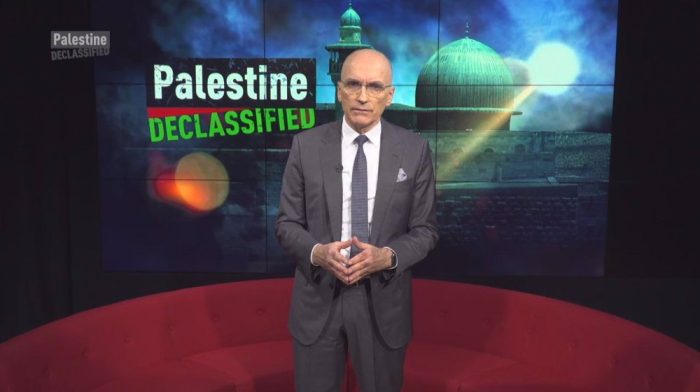
Former Labour MP Chris Williamson has been hosting Press TV’s weekly show, Palestine Declassified, since March 2022.
By Syed Zafar Mehdi | Press TV | February 23, 2023
A former UK Labour Party MP, Chris Williamson, was on Tuesday stripped of his parliamentary pass until further notice by a committee of lawmakers in what he described as “confected controversy.”
The 66-year-old seasoned British politician and human rights campaigner, who served as the MP for Derby North from 2010 to 2015 and again between 2017 and 2019, had since July 2020 been in possession of one of more than 300 security passes given to former parliamentarians.
The pass was revoked over what the committee termed his “unacceptable” role as a co-host of the weekly show ‘Palestine Declassified’ on Press TV, Iran’s premier international news network.
“The Administration Committee met yesterday and decided to suspend your parliamentary pass until further notice,” the committee chair and conservative MP Charles Walker wrote to Williamson in a comminque.
“The Committee considered that your continued presence on Press TV, a broadcaster that has been banned in the UK and multiple other countries, is unacceptable and risks bringing Parliament into disrepute.”
Speaking to the Press TV Website, Williamson said he “wasn’t surprised” by the arbitrary decision, noting that the political class in the UK has been “gripped by a kind of hypocritical hysteria”.
“The grounds for the arbitrary cancellation of my pass are absurd. They claim that my presence on Press TV ‘risks bringing parliament into disrepute’,” asserted Williamson, one of the closest allies of former Labour leader Jeremy Corbyn and author of ‘Ten Years Hard Labour’.
“But it’s their attack on free speech that is bringing parliament into disrepute, not the fact that I present a weekly programme on Press TV about Palestine’s struggle for freedom.”
The former British shadow minister who has previously been falsely accused of ‘anti-Semitism” said he never used his parliamentary pass since leaving the job in 2019 and was being targeted for championing the Palestinian cause and “exposing the brutal Israeli apartheid regime”.
He hastened to add that he intends to “write back” to Charles Walker and ask the committee to “think again in view of the absurdity and inconsistency of their position”.
A staunch socialist, trade unionist and anti-imperialist, Williamson has been co-hosting the ‘Palestine Declassified’ show on Press TV since March 2022 with David Miller, a former Bristol University professor who was sacked in October 2021 for his views on Israeli apartheid.
The popular show highlights with cutting-edge research and analysis the Israeli regime’s unbridled aggression in the occupied Palestinian territories and seeks to build global solidarity for the Palestinian cause. To a great extent, it has been successful in that goal.
Pertinently, Press TV was taken off air in the UK in January 2012 by media regulator Ofcom, which accused the network of “breaching broadcasting license rules” with its “editorial content”.
The network, in a statement at the time, called the decision “a clear example of censorship”.
“It is precisely because I host a programme about Palestine that’s broadcasted by Press TV, and because I have criticized the (British) government’s support for NATO’s proxy war in Ukraine,” Williamson told the Press TV Website, commenting on his parliamentary pass being stripped.
“MPs have used these two facts as a pretext for spurious complaints, suggesting that I therefore pose some sort of security risk. It is utterly absurd and frankly insulting”.
He decried the smear campaign and attacks against Press TV, saying it was “off the scale”.
“The hypocrisy over the treatment of Press TV is off the scale. But it indicates that the ruling class is insecure in their position, so we should take heart from that and keep going.”
The former MP also called out the “disturbing scale of censorship” in British society, saying the ability to speak out against the prevailing establishment narrative is “strictly restricted”.
“Little to no platform is provided by the corporate media to articulate a contrary viewpoint, and even access to social media is being restricted,” he told the Press TV Website.
“Academics have lost their careers for speaking out against the evils of Zionism for example, and anyone calling for a diplomatic solution is dismissed as a ‘Putin apologist’.”
Williamson further noted that the Zionist lobby and acolytes of the NATO military alliance in the British parliament exert an “entirely disproportionate influence”.
“The British political class only represent the interests of powerful lobbies, rather than the wellbeing of the communities they are elected to serve, and on whose votes they rely for their privileged positions,” he said, pointing to the gap between the rulers and the subjects.
A strong anti-war and anti-racism voice who has resolutely opposed the war in Ukraine – which completes one year this week – Williamson said the Nazi influence in Ukraine is “well-documented” while calling the embattled Ukrainian President Volodymyr Zelensky “NATO’s useful idiot”.
“The ultimate ambition of the war hawks in the US is to weaken and ultimately balkanize Russia, and then pivot against China,” Williamson asserted, adding that the European governments are “allowing themselves to be used to help the US retain its dominant position in the unipolar world”.
“The US Defense Department openly commissions a report by the Rand Corporation on ways to achieve their goal against Russia. Furthermore, prominent figures in the Atlantic Council, NATO’s de-facto think tank, were setting out the strategic case for risking war with Russia in Ukraine before the present military conflict began,” he said, pinning the blame on the US-led NATO military alliance for the simmering crisis in Ukraine.
Meanwhile, the staunch advocate for the Palestinian cause vowed to continue his advocacy work for the weak and vulnerable irrespective of whether he holds the parliamentary pass or not.
“Whatever dirty tricks they deploy against me, these political lackeys of the war machine and parliamentary servants of Israel’s brutal apartheid regime, they will never stop me campaigning for peace and supporting the liberation of Palestine,” Williamson asserted.
He also invoked the 20th-century Nobel Prize-winning Chilean poet, Pablo Neruda, that these out-of-touch politicians “can cut all the flowers but cannot keep spring from coming”.
“And I believe the day is coming when Palestine will be free from the river to the sea.”
Syed Zafar Mehdi is a Tehran-based journalist, political commentator and author. He has reported for more than 13 years from India, Afghanistan, Pakistan, Kashmir and West Asia for leading publications worldwide.
Featured Video

Broke Princes: Saudi Arabia’s Powder Keg
or go to
Aletho News Archives – Video-Images
From the Archives
Registered Israeli foreign agent driving contrived campus antisemitism crisis
By Wyatt Reed | The Grayzone | December 17, 2023
Lawsuits accusing top US universities of harboring antisemitism all originate from one source: a corporate law firm that fielded the pro-settler ex-US ambassador to Israel, and which was registered as a foreign agent of an Israeli principal as recently as 2021.
The firm now represents professional Israel lobby activists posing as victimized “Jewish students” and seeking to crush the free speech rights of Palestine solidarity activists. … continue
Blog Roll
 Aletho News
- How Iran defeated Trump’s Israel First GOP
- De-escalating the conflict: What the OSCE, the UN, and Europe are (not) doing to prevent war
- Desperate For A Renewed Iran War, Israel Dusts Off The WMD Deception.
- US Elections Offer Choice Between ‘Bad and Worse’ as Both Parties Serve War Lobby – ex-UN Expert
- Ghalibaf warns US government not to betray voters who rejected war
- Broke Princes: Saudi Arabia’s Powder Keg
- Albania’s Crisis: Rama, Israeli Investments and the Demand for Accountability
- Hezbollah Categorically Denies Syrian Accusations: We Aim at Confronting Israeli Enemy, Not Undermining Syria’s Stability
- Trump claims funding to Israel ending in 2026 as merger of Israeli–US armies looms
- Iran Weathering The Storm, But Saudi Arabia Is Sinking
- If Americans Knew
- An error has occurred; the feed is probably down. Try again later.
- No Tricks Zone
- New Study: The Net Fossil Fuel Contribution To Rising Atmospheric CO2 Has Been Zero For 500 Years
- Germany’s Green Energy Transition Becoming Increasingly Expensive…Another 6 Trillion Euros!
- Sudden Stratospheric Warming, Powerful El Niño Combination May Lead To Extreme Europe Cold, Energy Crisis!
- Two New Studies Find Thwaites Glacier Melt Cannot Be Driven By Human Activity Or A Warming Ocean
- E-Cars Reduce CO2 Emissions By Only 41% Compared To Internal Combustion Engine Vehicles
- Predictions Made By Renowned Climate Professor Over Past Decades Have Been Proven To Be Poor
- New Study Suggests Large Regions Of The Pacific Ocean Have Been Cooling For The Last 80 Years
- Germany’s Green Energy Debacle: High Energy Costs Force Kahla Porzellan to Close After 182 Years!
- New Study: 50 Years Of The Most Aggressive ‘Net Zero’ Policies Can Only Affect The Global Climate By 0.03°C
- US September “Heat” Was No Record…Many Records Set Decades Ago

