Suppose that Scotland’s CO2 emissions fell tomorrow to zero, i.e., that, at midnight, the country ceased to exist. Then according to the “Model for the Assessment of Greenhouse Gas Induced Climate Change” (MAGICC), based on the latest IPCC climate models, the reduction in the Earth’s temperature in 2100 would be…undetectable.
Motivated by the moral necessity and urgency of this goal, the Scottish Government is proposing a novel energy policy – its “Energy Strategy and Just Transition Plan”.
This article reviews its major themes and their implications, and considers briefly the probability of success of the Scottish Government implementing it.
In 2022, due to an insufficient quantity of wind and sun, Scotland’s current collection of wind and solar energy-scavenging devices failed to generate about 70% of their nameplate capacity. Recent exhaustive statistical and econometric analysis of wind generation in Scotland by Edinburgh University shows that it is uneconomic and destined for taxpayer bailout. Under the Scottish Government’s novel energy strategy, wind and solar energy-scavenging devices are to be greatly expanded.
Hydrogen, an energy carrier that squanders in waste-heat a gigawatt of power generation for every gigawatt it carries, is elevated in the Scottish Government’s understanding of energy to the category of a fuel, and also greatly expanded.
Hydrocarbon and nuclear – actual fuels – provide the energy to manufacture and endlessly replace wind turbines and solar panels. They also, in Scotland, provide the power sources that run under all conditions to ensure continuity of energy supply during Scotland’s frequent sunless and windless conditions. These are to be discontinued.
Like all advanced economies, Scotland cannot tolerate even a small measure of power supply fluctuation. Without firm dispatchable thermal standby generation capacity to smooth supply fluctuation, the eventual daily around 40GW amplitude power fluctuation resulting from the proposed expansion of weather-dependent electrical generation must be adapted for use in some other way. This will be provided by some form of 180-plus day, grid-scale electricity storage – a technical challenge for which no precedent exists, and therefore no cost estimate is available.
Grid scale battery storage technology doesn’t exist. The Scottish Energy Strategy and Just Transition Plan imagines that it will be developed.
Converting surplus energy to hydrogen for storage and use at grid scale is unprecedented, and fraught with risk.
Fifty per cent of the proposed new intermittent generation capacity, installed at a capital cost of around £26 billion, is to be wasted in the conversion process.
Hydrogen embrittles pipework, renders conventional valves ineffective and, unlike domestic gas, self-ignites under catastrophic decompression. Quantifying the risks of transporting it in bulk on Scottish roads and deploying it as a substitute for domestic gas in Scotland’s densely populated housing estates might be an exciting 10-year research project at the U.K. Government’s Spadeadam industrial hazard testing facility (“the remoteness of the area is key to their operations” – Wikipedia).
But, informed by what the Scottish Government claims is the need for “the fastest possible” transition, it prefers to bypass thorough safety testing, and to impose live hydrogen trials on Scotland’s citizens. Hydrocarbon gas is to be phased out of Scottish homes from 2030.
Energy densities in energy storage sites located next to Scotland’s towns and cities required by the Scottish Government’s reckless abandonment of thermal standby generation capacity will be measured in millions of tonnes of TNT – a risk for which 12-foot thick reinforced concrete containment domes are installed around nuclear facilities to manage. These risks are entirely unrecognised by Scotland’s current planning processes (or citizens).
The cost of adaptive storage, the cost of the new transmission and distribution infrastructure required by dramatically increased electrification of Scotland’s relatively sparsely populated areas, and the cost of Carbon Capture, are not factored into current estimates of Levelised Cost of Electricity (LCOE). These are vast. Grid-scale battery storage, for example, has an implied cost measured in trillions of pounds, and drives LCOE from £50/MWh to over £600/MWh.
Apparently unaware of the role of nuclear and gas in maintaining continuity of supply, and the prohibitive cost of electricity storage as a substitute, the Scottish Government confidently demands that the U.K. Government “break the link between the price of electricity and the cost of gas to help realise the benefits of the low costs [sic] of renewable electricity”.
The policy proposal cites a number of other benefits that it thinks will accrue in addition to the negligible reduction in the Earth’s temperature.
Electric vehicles can’t plough snow or fields, harvest corn, empty buckets, excavate ore, raise wind-turbine masts, or perform any other economic task for which ‘grunt’ is required. Notwithstanding, from 2030, diesel and petrol engines will be prohibited. Car kilometers are to be “reduced” – possibly by fining us if we travel from our home more than a permitted distance.

A child in the Democratic Republic of Congo mining the cobalt needed for the Scottish Government’s Just Transition to ‘clean energy’
The Scottish Government will impose catastrophic environmental damage on the non-OECD countries where millions of tonnes of toxic water and ores are processed to manufacture the EV batteries it is mandating. It will overlook the human rights violations endemic to China’s ‘clean energy industry’. These will have the benefit of promoting what it calls “A Just Transition” – supposedly, a socialist framework for ensuring “a fairer, greener future for all”.
Our security of supply is to be further enhanced by transferring energy generation from domestically produced oil and gas to mechanically unreliable, weather-dependent energy-scavenging devices containing millions of points of failure that are contingent on the supply of rare resources controlled by China – which the U.S. states it will declare war on if it invades Taiwan.
These weather-dependent energy-scavenging devices require oil for, amongst many other things, the manufacture of their exotic advanced materials. A leading energy consultancy records the collapse in 2020 to an 80-year low of replacement oil discovery volumes, and estimates that Western oil firms now have around 15 years of remaining economic oil reserves. It is under these circumstances that the Scottish Government is further enhancing the security of Scotland’s energy supply by discontinuing onshore and offshore conventional and unconventional oil and gas exploration.
To reinforce this enhancement, noting “the damage done by the deindustrialisation of central belt communities in the 1980s”, the Scottish Government is irreversibly disbanding the North East’s oil and gas industry communities and, with them, their 50 years of institutional knowledge of oil and gas operations.
These will be replaced with communities based on livelihoods sustained by a “clean energy industry”. The growth of this imaginary industry has been funded with the imaginary capital (a.k.a. “quantitative easing”) excreted in the response – ironically – to the energy contraction that triggered the ongoing 2008 Great Financial Crash. During this time, U.K. national debt has risen from 60% to over 100% of Gross Domestic Product, exceeded only by the public sector pension deficit (a proxy for the replacement of real industries in the global economy by imaginary ones), which has risen to more than £2 trillion.
As evidence of the sustainability of the policy of funding imaginary industries through the indefinite expansion of imaginary capital (for which, like much of this policy, no precedent exists in human history), the Scottish Government informs us that it has already allocated £5 billion of its record budget deficit to what it refers to as “the Net Zero Economy”.
Winter excess death in the UK’s cold Northern European climate is already around 25,000 a year. Any prolonged interruption of winter energy supply created by the failure of this policy, or further escalation of cost, will plausibly result in the deaths of thousands more of our most vulnerable fellow citizens. The magnitude and uncertainty of the implied costs, coupled to the scale of the energy contraction that this policy deliberately seeks to accelerate, could trigger the collapse of our financial system.
Irreversible impairment of either our energy or financial systems would have a catastrophic impact on the welfare of Scotland’s citizens. Yet few have expressed any desire, much less informed consent, for risk on the scale proposed for such little benefit.
Yet the project, representing a scope of unprecedented scale, cost, pace and technical uncertainty, will be overseen by a Government that is currently struggling to procure two relatively modest ferries for less than the cost that other governments can procure 34 ferries – again, ironically due in large part to cost overruns associated with the attempt to employ novel technologies to reduce CO2 emissions. As evidence of the extent to which the Scottish Government and its advisers have become unmoored from physical reality by the climate catastrophe hypothesis, it’s a document that is fascinating to read, and alarming to contemplate.
After reflecting on it, you may care to offer your feedback, either to the department that compiled it, or your political representative, or on social media.
Richard Lyon is a former senior oil and gas operations manager with 35 years of international experience and academic qualifications in electrical engineering and power systems, petroleum engineering, and energy economics. He maintains the Substack newsletter the State of Britain and can be contacted via LinkedIn.
January 18, 2023
Posted by aletho |
Economics, Malthusian Ideology, Phony Scarcity, Supremacism, Social Darwinism, Timeless or most popular | Human rights, UK |
Leave a comment

Historian Emmanuel Todd is one of France’s leading public intellectuals. At the age of just 25, he predicted the collapse of the Soviet Union in his book The Final Fall: An Essay on the Decomposition of the Soviet Sphere. Later in his career, he carried out pioneering work on family structure and how it impacts societal development.
Now at the age of 71, Todd doesn’t seem to mind ruffling feathers – as his remarks in a recent interview with Swiss magazine Weltwoche make clear. “I’ll give you the first interview because you write in German,” he begins by saying. “This war is about Germany.”
About Germany? What does he mean? Todd explains:
The financial crisis of 2008 made it clear that with reunification Germany became the leading power in Europe and thus also a rival of the USA. Until 1989 it was politically a dwarf. Now Berlin showed its willingness to get involved with the Russians. Combating this rapprochement became a priority of American strategy. The United States had always made it clear that they wanted to torpedo the gas agreement. The expansion of NATO in Eastern Europe was not primarily directed against Russia, but against Germany.
Asked who sabotaged the Nord Stream pipelines, Todd replies, “Of course the Americans. But that is completely unimportant. It is normal.” The important question is, “How can a society believe that it could have been the Russians?”
“We are dealing here with an inversion of possible reality,” says Todd. “The newspapers tell us how the Russians are shooting at prisons they have occupied. That they shoot at nuclear power plants that they control locally. That they blow up pipelines that they built themselves.”
It’s clear, then, that Todd subscribes to the theory I first discussed back in August: that the U.S. deliberately provoked conflict between Russia and Ukraine to sabotage the Nord Stream 2 pipeline, thereby ending (or at least severely curtailing) Russo-European interdependence.
Unfortunately, Todd doesn’t provide any specific evidence to back up his provocative claims. So the theory remains speculative. Of course, this doesn’t mean we should accept the conventional narrative that America just really cares about democracy.
So what, in Todd’s view, should be done? “I wish the Germans would understand: The side of the good they want to be on this time is not that of the United States,” he says. “The good means: end this war.”
While Todd certainly represents a minority viewpoint among Western intellectuals, as he himself acknowledges, it’s still worth considering.
January 18, 2023
Posted by aletho |
Economics, Militarism | Germany, Ukraine, United States |
Leave a comment
 EU citizens who do not want to unknowingly eat insects should be particularly careful: The EU Commission has already approved four types of insects in different forms as “edible insects”.
The most recent approval was on January 5: From now on, after mealworms, grasshoppers and crickets, the grain mold beetle can also be used as an ingredient in foods such as bread, soups, pasta, snacks, peanut butter and chocolate products.
The mealworm received the first approval for a so-called “edible insect” in June 2021 : The EU Commission’s Implementing Regulation 2021/822 approved the placing on the market of dried larvae of Tenebrio molitor (meal beetle) as a “novel food”.
The SAS EAP Group from France has submitted the application and is allowed to market the mealworm in the Union. It may be sold individually or with a maximum content of 10 grams in protein products, cookies, dishes made from legumes and pasta products.
If insects are used, there must be a note on the packaging of the food that consumption may cause allergic reactions in people with known allergies to crustaceans and molluscs and their products and to house dust mites.
In November 2021, the second “edible insect” was approved by Implementing Regulation 2021/1975 : “Fair Insects BV” from the Netherlands has since been allowed to market frozen, dried and powdered Locusta migratoria (migratory locusts) in the EU.
Depending on the form of processing, the locusts may be used as ingredients in different maximum levels in the products such as processed potato products; dishes made from legumes and products made from pasta, meat substitution, soups and soup concentrates, legumes and vegetables in cans/jars, salads, beer-like beverages, alcoholic beverage mixes, chocolate products, frozen milk-based fermented products, cured meats.
Since 2022 and 2023 respectively, the domestic cricket (Acheta domesticus) has been permitted in various forms of processing. Implementing regulation 2022/188 allows the use in frozen, dried and powdered form. The application came again from “Fair Insects BV”. The house cricket, just as locusts, may be used in similar foods.
Since January 3, the Vietnamese company “Cricket One Co. Ltd” has also been allowed to sell “partially defatted powder from Acheta domesticus” in the EU by implementing regulation 2023/5 . Potentially affected foods are multigrain bread and rolls; crackers and breadsticks, cereal bars, dry bakery premixes, cookies, pasta products and many more.
The executive order 2023/58 of January 5 allows “Ynsect NL BV” from the Netherlands to bring larvae of Alphitobius diaperinus (grain mold beetle) in frozen, paste, dried and powdered form as a new food to EU citizens. The list of food categories in which the larvae can be used as an ingredient in most processed foods.
January 18, 2023
Posted by aletho |
Malthusian Ideology, Phony Scarcity | European Union |
Leave a comment
By Muhammad Osman – Samizdat – January 18, 2023
Russian Foreign Minister Sergey Lavrov has called the US Congress bill on the fight against Russian activities in Africa “an American provocation” which harms primarily the Africans themselves and reflects the West’s colonial approach to the countries of the continent.
Earlier in the day, South African Foreign Minister Naledi Pandor, in an interview with Sputnik, said that the bill of the US Congress on combating Russian activities in Africa is contrary to international law and should be withdrawn.
“I assess this law in the same way as Madam Minister (of Foreign Affairs) of South Africa,” Lavrov said during a press conference on Wednesday. “As for how it can affect our relations with Africa, I think her comments already contain the answer. Probably, not every African country, through the mouth of its representative, can clearly indicate its position.”
The Russian official stressed that he had no doubts that even those who do not comment on this kind of “US provocation” still have a deep conviction that “this law harms Africans first of all.”
The minister argued that the US does not consider African nations its equals, adding that Washington’s behavior reflects a “purely colonial mentality in a new dimension.” Lavrov recalled the time when former US Secretary of State Mike Pompeo traveled across the African continent to call on “everyone to stop trading with Russia and China, because both Russia and China do it for self-interest.”
“But America, Pompeo said, trades with you solely so that you develop, and you have more democracy. Such, you know, a simple little thing, it is anywhere, and in Africa too, it is perceived as it deserves,” the Russian minister stressed.
In May 2022, the US House of Representatives approved a bill against “malign” Russian activities in Africa that “undermine United States objectives and interests.” The bill suggests the application of a “punishment” by the US against African countries for cooperation with Russia in various fields.
Earlier, South African President Cyril Ramaphosa said that at a meeting with US President Joe Biden, he spoke about the injustice of the US punishing African countries for ties with Russia, and expressed his disagreement with the bill, which contains such proposals.
Ramaphosa condemned the bill as being a “misplaced type of legislation”, which, he said, would harm Africa and “marginalize” the continent.
“We should not be told by anyone who we associate with, and we should never be put in positions where we have to choose who our friends are,” Ramaphosa told the reporters after his meeting with Biden.
Jacob Mudenda, speaker of the National Assembly of Zimbabwe, said earlier that African countries reacted with disgust to the US bill to counter the activities of the Russian Federation in the continent since it is an encroachment on the sovereignty and territorial integrity of states maintaining relations with Russia.
January 18, 2023
Posted by aletho |
Economics | Africa, Russia, United States |
Leave a comment
By Drago Bosnic | January 18, 2023
It is now virtually common knowledge that the political West’s attempts to destroy the Russian economy through sanctions have failed spectacularly. However, what the Western mainstream propaganda machine is fighting tooth and nail to accomplish is suppressing the fact that the sanctions war has also backfired and is now ravaging Western economies, especially those whose prosperity was largely based on access to cheap Russian energy. This is particularly true for Germany, the European Union’s industrial powerhouse which is now suffering the consequences of its suicidal subservience to Euro-Atlantic Russophobia.
However, what’s much less commonly acknowledged is the fact that there are many countries that don’t seem to be too dependent on Russian energy, but are in fact suffering as a result of the sanctions war against Moscow. This is especially true for the United Kingdom, whose political establishment is one of the most fervently Russophobic in NATO. With London being one of the Kiev regime’s key backers, it would be expected to see the former colonial superpower much less dependent on any commodities coming from Russia. Still, Moscow’s status as the world’s premier energy superpower makes this extremely difficult (if not impossible) to achieve.
In order to tackle the mounting energy security issues, exacerbated not only by anti-Russian sanctions, but also by the economic fallout of the COVID-19 pandemic, the UK is now resorting to finding loopholes to circumvent its own sanctions against the Eurasian giant. The escalation of the Ukrainian crisis has led to a dramatic reshaping of European (and, indeed, global) energy markets, with the political West declaring its intention to cut dependency on Russian energy imports. Expectedly, the UK was at forefront of this effort and was even hailed as “one of the most successful countries” in achieving this after it officially stopped importing Russian oil and coal, while also imposing an outright ban on Russian natural gas.
By October last year, London’s imports of Russian energy were officially cut to almost nothing, with approximately $2.5 million of oil purchases and virtually no coal or natural gas from Russia. However, recent revelations cast serious doubt on these numbers, indicating that the UK’s claims mostly boil down to simple semantics. According to reports by various sources, the UK is not importing oil (directly) from Russia, but it still keeps importing Russian oil. This is possible thanks to third countries (India being one of them) that are now re-exporting Russian-sourced oil to the UK and others in the political West. This has provided a very convenient back door for imports of Russian oil into the country, while also being quite lucrative for third parties.
According to Kpler, India’s Jamnagar refinery, operating on the west coast of Gujarat, imported 215 shipments of Russian crude in 2022, which represents a 400% increase in comparison to 2021. At the same time, British companies have imported approximately ten million barrels of diesel and other refined oil products from Jamnagar since February 2022, which is an increase of more than 250% of what they bought from the Indian refinery during the previous year. The data indicates that this can only be explained by a much larger share of Russian oil being refined and then exported to the UK and elsewhere.
More importantly for Britain, this move is blunting the disastrous effects of energy shortages in the UK, a problem that is now affecting many other countries that have been forced to impose sanctions on Russia, often coerced into it by London itself. British companies have simply replaced imports directly from Russia with imports from third-party refineries that are buying Russian crude. Although there’s nothing illegal in such a framework, it’s still quite indicative of the UK government’s hypocrisy. London has been exerting tremendous pressure on others to stop importing Russian energy (Hungary perhaps being the best example of this), while secretly doing just the opposite.
Prior to Moscow’s counteroffensive against NATO aggression, India wasn’t particularly known for importing Russian energy, while it was even less common for its oil refineries to process Russian crude. Indian companies have always been oriented towards exporting refined oil to Europe, but their supplies to the old continent have skyrocketed as the demand is still there and someone needs to fill the gap. This is quite profitable for India, as prices in the EU are quite high, while Russia is supplying the Asian giant with record amounts of discounted crude. Meanwhile, British companies are turning a blind eye to this fact, as they need guaranteed energy supplies, so everybody seems content with this arrangement – except Kiev.
Oleg Ustenko, one of Volodymyr Zelensky’s advisers, is accusing the UK companies of “exploiting weaknesses in the sanctions regime”.
“The UK must close the loopholes that undermine support for Ukraine by allowing bloody fossil fuels to continue flowing across our borders. About one in five barrels of the crude oil that they process is Russian. A big chunk of that diesel they produce now will be based on Russian crude oil,” Ustenko stated.
It remains to be seen if the UK will ever respond to these demands, as they don’t seem to be particularly important to London. It’s quite clear that even if one of the Neo-Nazi junta’s top overlords were to proceed with closing the existing loopholes, the idea that the UK won’t find new ones is downright laughable, as it would’ve never tried bypassing its own sanctions in the first place.
Drago Bosnic is an independent geopolitical and military analyst.
January 18, 2023
Posted by aletho |
Economics, Progressive Hypocrite, Russophobia | UK, Ukraine |
Leave a comment
The US military is supplying Ukraine with hundreds of thousands of artillery rounds pulled from stockpiles based in Israel, according to the New York Times. The Pentagon is reportedly “scrambling” to find munitions as Ukrainian forces continue to exhaust their arsenal.
The Pentagon has drawn from a “vast but little-known stockpile of American ammunition in Israel to help meet Ukraine’s dire need for artillery shells,” the Times reported on Tuesday, citing multiple unnamed Israeli and American officials. While it’s unclear when the deal was struck, Israel has agreed to allow Washington to source some 300,000 155-millimeter rounds from warehouses on its territory.
“About half of the 300,000 rounds destined for Ukraine have already been shipped to Europe and will eventually be delivered through Poland,” the Times added.
Though the stockpile in Israel is intended for use in America’s Middle East conflicts, several of which continue on a simmer, the Pentagon has been forced to seek new weapons supplies as Ukrainian troops reportedly blow through around 90,000 shells per month – twice the rate produced by the United States and Europe combined.
The United States has sent or authorized the shipment of just over one million 155-millimeter rounds to Ukraine since the conflict with Russia kicked off last February. “A sizable portion” of that has been pulled from existing inventories in South Korea and Israel, a senior US official told the Times, though he did not specify the total sourced from each.
While Israeli officials “initially expressed concerns” about the plan to draw from stocks in their own country, believing it could suggest Israel is “complicit in arming Ukraine,” the government ultimately agreed on the condition that the Pentagon replenishes the armaments. Washington has additionally pledged to “immediately ship ammunition in a severe emergency,” the Times said.
Israel maintains ties with both Ukraine and Russia, and has sought to walk a diplomatic tight-rope between the two conflicting states since fighting erupted last year. Though it has offered to help broker peace talks and provided several rounds of humanitarian aid to Kiev, Israel has largely refused to join its Western allies in arming Ukraine or sanctioning the Russian economy, fearing such hostile actions could harm relations with Moscow.
Under President Joe Biden, the US has authorized some $25 billion in direct military aid to Kiev, recently agreeing to send 50 Bradley infantry fighting vehicles and a range of other weapons in its latest $3 billion arms package. Ukrainian officials have continued to clamor for additional gear, however, and are now urging Washington and its European allies to send main battle tanks and better air defenses, among other weapons. While the US has so far declined demands for tanks, military leaders from the ‘Ukraine Defense Contact Group,’ which includes NATO members, will meet at Germany’s Ramstein Air Base on Friday to discuss the possible shipment of heavier arms.
January 18, 2023
Posted by aletho |
Militarism | Israel, Ukraine, United States |
Leave a comment
By Ahmed Adel | January 18, 2023
US Secretary of State Antony Blinken will try to prevent China from deepening its cooperation with Russia during his visit to Beijing. Although it will not succeed, Blinken hopes that perhaps other topics could de-escalate the trade war and lessen tensions over the Taiwan issue, and in this way, also incentivise Beijing’s move away from Moscow.
Politico reported that Blinken will visit China on February 5-6, where he will meet with his Chinese counterpart Qin Gang. This meeting was later confirmed by the Chinese Ministry of Foreign Affairs.
It does raise the question why Blinken is seemingly desperate to meet with the Chinese foreign minister in Beijing. The US Secretary of State will likely try to divide Russia and China by raising the issue of Ukraine. Specifically, the US envoy may condemn the growing partnership between Moscow and Beijing, as it has done many times before, but offer incentives to move the Asian country away from Russia.
None-the-less, it is unlikely to work since China’s position is very firm and fully sympathises with Russia’s concerns about NATO’s encroachment and encirclement.
It is also speculated that during Blinken’s visit, the Americans would try to tactically reduce the extent of the trade war launched by former US president Donald Trump. Although the US are in public denial about it, policymakers in Washington are undoubtedly frustrated that the trade war against China and sanctions on Russia have failed to weaken them. In fact, this two-pronged American economic aggression has instead deepened trade ties and cooperation between the #2 (Russia) and #3 (Chinese) ranked military powers.
The visit will also relate to Taiwan. The US wants to find out if there is any possibility of a compromise or move following the victory of the staunchly “anti-China” Republicans in November’s midterm elections. They are even stepping up their military aid program to Taiwan and preparing for a visit by new House Speaker Kevin McCarthy. The visit is expected to take place in February or March.
Perhaps the Biden administration, along with Blinken, are trying to soften the future actions of the Republican-held House of Representatives. The problem for Washington is that the Chinese do not distinguish between Congress and the Office of the President. For Beijing – both offices are considered the official position of the US, even if it is contradictory.
It cannot be overlooked that Blinken’s visit will come before Chinese President Xi Jinping’s visit to Moscow in March. For this reason, it is expected that the Secretary of State will try to conduct exploratory activities to find out what will happen when the Russian and Chinese leaders meet.
Chinese Foreign Ministry Spokesperson Wang Wenbin said on January 17 that Beijing hopes for the US to adopt a correct perception, stick to dialogue rather than confrontation, and pursue win-win results rather than a zero-sum game.
“It is hoped that the US can work with China to fully deliver on the important common understandings reached between the two heads of state, and bring China-US relations back to the track of sound and steady growth,” Wang stressed.
Politico said in a report that Blinken’s “much-anticipated” trip to Beijing is a follow-up to the meeting Chinese President Xi Jinping had with his US counterpart Joe Biden in Indonesia in November 2022. At the time, Biden pledged to “maintain open lines of communication” with China despite worsening bilateral tensions.
According to Politico, some US observers, like former deputy assistant secretary of state Susan Shirk, believe that the visit will test China’s “moderate” foreign and domestic policies to satisfy the US. However, such a notion is ridiculous and unhelpful in recovering bilateral ties as it once again signals to China to compromise on its values and instead adhere to Western liberalism.
In fact, it is the US who is more desperate to repair relations with China, especially considering their own economic problems. The problem Washington has is that it does not want to compromise on the tensions it has created for itself.
“The Biden administration needs to bring back economic confidence, so what the US needs to do at the moment is to make full use of engagement with China to fix the damaged supply chains and save its own economy which is certainly in trouble. For instance, they should cancel the restrictions and sanctions that target China’s development but in fact harm the US economy as well,” The Global Times reported.
As mentioned though, despite the US needing to overcome this impasse, it is also stubborn and uncompromising in its endeavour to limit Chinese influence and preserve a unipolar world system. Biden has described China as the US’ only long-term competitor for global leadership and is orientating US foreign policy around this challenge, even whilst simultaneously attempting to contain Russia.
Although Blinken’s trip will also be the first by a top US official to China since Washington accused the country of perpetrating genocide against the Muslim Uyghurs, a charge rejected by Beijing, there is unlikely to be a major breakthrough during Blinken’s meetings with Chinese officials.
Ahmed Adel is a Cairo-based geopolitics and political economy researcher.
January 18, 2023
Posted by aletho |
Economics | China, United States |
Leave a comment
From population bomb to false prophet, Ehrlich, and his protege John Holdren’s, book Ecoscience has a concerning passage about a bioweapon as a “solution” to overpopulation. Meanwhile, history shows Holdren lifted the moratorium on gain-of-function research less than two weeks before Trump’s inauguration in 2017. Another data point to a troubling, ongoing investigation.
When it comes to the COVID-19 vaccine, world-renowned doctors and scientists are jumping ship. Many of those same experts, however, are pivoting sharply, insisting the same skepticism should not be applied to ‘safe and effective’ childhood vaccines. The HighWire host, Del Bigtree, whose 7-year investigation into Vaccine Safety and Policy in America inspired the launch of ICAN (icandecide.org) and The HighWire, explains why ‘it ain’t Just the Covid Vax’ that you should be worried about.
January 18, 2023
Posted by aletho |
Malthusian Ideology, Phony Scarcity, Timeless or most popular, Video, War Crimes | COVID-19 Vaccine, Human rights, United States |
Leave a comment
There are some absolute pearlers buried in the Pandemic treaty:
- Gain of function research is on for young and old – we must not be inhibited by red tape, just get on with it.
- Global sharing of patient data, specimens and pathogens is also the order of the day. Feel free to pick and choose which bits of existing international law to observe.
- We must have a singular focus on vaccines as the answer to everything. We will target the vulnerable in the name of equity, especially in developing nations, with fast tracked, under-tested new drugs – and only give them biased information in favour of taking the treatment.
Oh, and remember these key points:
- The WHO is central to everything.
- The WHO owns the science.
- The WHO controls raw materials, production, allocation, distribution and financing of pandemic products.
- The WHO will decide what restrictions to impose on you to address climate change because climate change might affect your health.
- The WHO decides what medical treatments are allowed, and which are banned.
- The WHO decides what is allowed to be spoken, and stamps out voices of dissent.
I hope you don’t believe me. No sane person would. Read for yourself the ‘Conceptual Zero Draft” of the proposed pandemic treaty. There’s a plain English guide here:

Pandemic Treaty Plain English Guide 17jan2023
727KB ∙ PDF File
Download
Please read it, then tell at least one person about this stupid treaty every day, until it goes away.
January 17, 2023
Posted by aletho |
Civil Liberties, Science and Pseudo-Science | Human rights |
Leave a comment
In a self-congratulatory article published in the Atlantic in 2017, Yossi Klein Halevi describes Israeli behaviour at the just-conquered holy Muslim shrines in Occupied East Jerusalem in 1967 as “an astonishing moment of religious restraint”.
“The Jewish people had just returned to its holiest site, from which it had been denied access for centuries, only to effectively yield sovereignty at its moment of triumph,” Halevi wrote with a lingering sense of pride, as if the world owes Israel a ton of gratitude in the way it conducted itself during one of the most egregious acts of violence in the modern history of the Middle East.
Halevi’s pompous discourse on Israel’s heightened sense of morality – compared to, according to his own analysis, the lack of Arab appreciation of Israel’s overtures and refusal to engage in peace talks – is not in any way unique. His is the same language recycled umpteen times by all Zionists, even by those who advocated for a Jewish state before it was established on the ruins of destroyed and ethnically cleansed Palestine.
From its nascent beginnings, the Zionist discourse was purposely confusing – disarranging history when necessary, and fabricating it when convenient. Though the resultant narrative on Israel’s inception and continuation as an exclusively Jewish state may appear confounding to honest readers of history, for Israel’s supporters – and certainly for the Zionists themselves – Israel, as an idea, makes perfect sense.
When Israel’s new National Security Minister Itamar Ben-Gvir raided Al-Aqsa Mosque on 3 January to re-introduce himself to Jewish extremists as the new face of Israeli politics, he was also taking the first steps in correcting, in his own perception, a historical injustice.
Like Halevi, and, in fact, most of Israel’s political classes, let alone mainstream intellectuals, Ben-Gvir believes in the significance of Jerusalem and its holy shrines to the very future of their Jewish state. However, despite the general agreement on the power of the religious narrative in Israel, there are also marked differences.
What Halevi was bragging about in his piece in the Atlantic is this: soon after soldiers raised the Israeli flag, garnished with the Star of David, atop the Dome of the Rock they were ordered to take it down. They did so, supposedly, at the behest of then-Defence Minister Moshe Dayan, quoted in the piece as saying to the army unit commander: “Do you want to set the Middle East on fire?”
Eventually, Israel conquered all of Jerusalem. Since then, it has also done everything in its power to ethnically cleanse the city’s Palestinian Muslim and Christian inhabitants to ensure an absolute Jewish majority. What is taking place in Sheikh Jarrah and other Palestinian neighbourhoods in Jerusalem is but a continuation of this old, sad episode.
However, the Haram Al-Sharif Compound – where Al-Aqsa Mosque, Dome of the Rock and other Muslim shrines are located – was nominally administered by the Islamic Waqf authorities. By doing so, Israel managed to enforce the inaccurate notion that religious freedom is still respected in Jerusalem even after Israel’s so-called ‘unification’ of the city, which will remain, according to Israel’s official discourse, the “united, eternal capital of the Jewish people”.
The reality on the ground, however, has been largely dictated by the Ben-Gvirs of Israel who, for decades, have laboured to erase the Muslim and Christian history, identity and, at times, even their ancient graveyards from the Occupied city. Al-Haram Al-Sharif is hardly a religious oasis for Muslims but the site of daily protests, whereby Israeli soldiers and Jewish extremists routinely storm the holy shrines, leaving behind broken bones, blood and tears.
Despite American support of Israel, the international community has never accepted Israel’s version of falsified history. Though the Jewish spiritual connection to the city is always acknowledged – in fact, it has been respected by Arabs and Muslims since Caliph Umar ibn Al-Khattab entered the city in 638 – Israel has been reminded by the United Nations, time and again, regarding the illegality of its Occupation and all related actions it carried out in the city since June of 1967.
But Ben-Gvir and his Otzma Yehudit Party, like all of Israel’s major political forces, care little for international law, authentic history or Palestinians’ rights. However, their main point of contention regarding the proper course of action in Al-Aqsa is mostly internal. There are those who want to speed up the process of fully claiming Al-Aqsa as a Jewish site, and those who believe that such a move is untimely and, for now, unstrategic.
The former group, however, is winning the debate. Long marginalised at the periphery of Israeli politics, Israel’s religious parties are now inching closer to the centre, which is affecting Israel’s priorities on how best to defeat the Palestinians.
Typical analyses attribute the rise of Israel’s religious constituencies to the desperation of Israeli Prime Minister Benjamin Netanyahu, who is arguably using the likes of Ben-Gvir, Bezalel Smotrich and Aryeh Deri to stay in office. However, this assessment does not tell the whole story, as the power of religious parties has long preceded Netanyahu’s political and legal woes. The Zionist discourse has, itself, been shifting towards religious Zionism; this can be easily observed in the growing religious sentiment in Israel’s judicial system, among the rank and file of the army, in the Knesset (Parliament) and, more recently, in the government itself.
These ideological shifts have even led some to argue that Ben-Gvir and his supporters are angling for a ‘religious war’. But is Ben-Gvir the one introducing religious war to the Zionist discourse?
In truth, early Zionists have never tried to mask the religious identity of their colonial project. “Zionism aims at establishing for the Jewish people a publicly and legally assured home in Palestine,” the Basel Program, adopted by the First Zionist Congress in 1897, stated. Little has changed since then. Israel is “the national state, not of all its citizens, but only of the Jewish people,” Netanyahu said in March 2019.
So, if Israel’s founding ideology, political discourse, Jewish Nation State Law, every war, illegal settlement, bypass road and even the very Israeli flag and national anthem were all directly linked or appealed to religion and religious sentiments, then it is safe to argue that Israel has been engaged in a religious war against Palestinians since its inception.
The Zionists, whether ‘political Zionists’ like Theodore Hertzl or ‘Spiritual Zionists’ like Ahad Ha’am’ – and now Netanyahu and Ben-Gvir – have all used the Jewish religion to achieve the same end, colonising all historic Palestine and ethnically cleansing its native population. Sadly, a major part of this sinister mission has been achieved, though Palestinians continue to resist with the same ferocity of their ancestors.
The historic truth is that Ben-Gvir’s behaviour is only a natural outcome of Zionist thinking, formulated over a century ago. Indeed, for Zionists – religious, secular or, even atheists – the war has always been or, more accurately, had to be, a religious one.
January 17, 2023
Posted by aletho |
Ethnic Cleansing, Racism, Zionism, Illegal Occupation | Israel, Palestine, Zionism |
Leave a comment
Lebanese newspaper Al-Akhbar reported on 17 January that a Kurdish delegation representing the US-backed Syrian Democratic Forces (SDF) visited Syria’s capital Damascus today, to engage in dialogue with the Syrian government in light of the potential Syrian-Turkish rapprochement.
According to the report, the SDF “welcomed” Damascus’ insistence that the rapprochement not officially begin until Turkiye guarantees its intention to withdraw from Syria. Quoting the head of the Kurdish Autonomous Administration of North and East Syria (AANES) foreign relations office, Badran Jia Kurd, who led the delegation, it has a priority “to develop Syrian-Syrian dialogue as an ideal path to a political solution.”
At the same time, however, in continuation of its attempt to foil any chance of Syrian-Turkish reconciliation, Washington is now trying to, in a sense, reform and restructure the Kurdish organization to make it more acceptable to Ankara.
A 12 January report released by Al-Akhbar stated that in an attempt to do this, the US has asked the SDF to disassociate from Turkiye’s sworn foe, the Kurdistan Workers Party (PKK), and clear Raqqa and Deir Ezzor of Kurdish militants so that they could be overseen by ‘local councils’ made up of Arabs.
It is worth noting that the Kurds have expressed reluctance over this US project and have said that despite being willing to negotiate, they cannot accept to make such large concessions.
Proceeding with this plan, the US is currently recruiting Arab fighters to eventually incorporate into the SDF, thereby working to make it somewhat more acceptable to Turkiye. These Arab fighters are being recruited into the Raqqa Revolutionary Brigade (Liwa Thuwwar al-Raqqa), the revived version of a former extremist faction which was allied to Jabhat al-Nusra in 2012, and then fought ISIS alongside the SDF from 2015 to 2018 under US sponsorship before a dispute saw them break apart.
Having been inactive for a few years, Al-Akhbar reported on 20 December 2022 that Washington has brought this group into action once again, giving it the capacity to recruit fighters, and promised its members monthly salaries. Later reports claimed that the US has already begun making payments to the Raqqa Brigade, which it hopes can remerge with the SDF at some point.
Today, Al-Akhbar reports that the Raqqa Brigade is coordinating with the Syrian National Alliance (SNA), a New York-based opposition group made up of Syrian exiles, which is supposed to make up the brigade’s political wing.
However, as Washington scrambles to forge together alliances in an attempt to keep Turkiye and the SDF away from Damascus and closer to each other, the Kurds have expressed wariness over these efforts.
“This vision cannot be viewed positively, given the difficulty of persuading Turkiye to end hostility towards the Kurds in general … the most appropriate solution for the region lies with Damascus,” Kurdish sources close to the SDF have said.
In other news, the armed opposition’s leading faction, the extremist, former Al-Qaeda affiliate, Hayat Tahrir al-Sham (HTS), has continued to voice its complete rejection of Ankara’s diplomatic turnaround and is currently mobilizing heavy reinforcements.
January 17, 2023
Posted by aletho |
Aletho News | Syria, Turkiye, United States |
Leave a comment
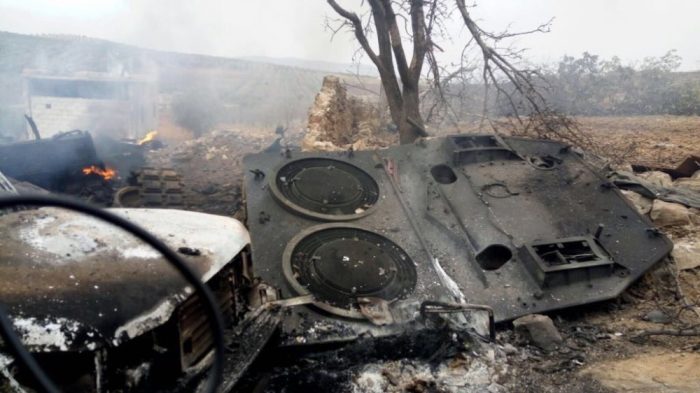
Western nations have begun pledging a variety of Western armored vehicles to Ukraine including infantry fighting vehicles and even main battle tanks. Until now, the majority of armored vehicles sent to Ukraine had been Soviet-era weapons Ukrainian forces were familiar with both in terms of operating and repairing them.
However, following Ukraine’s Kherson and Kharkov offensives, much of this equipment has been destroyed, leaving the West little choice but to begin sending Western systems or leave Ukrainian forces in the field with only small arms.
While Western leaders and the media claim that Western armored vehicles represent a significant increase in Ukrainian capabilities, the reality is quite the opposite. Far from giving Ukraine an advantage on the battlefield, Ukrainian forces will struggle merely to get the vehicles on the battlefield and keep them there. Additionally, recent conflicts elsewhere in the world have proven Western armored vehicles including main battle tanks are neither “invincible,” nor “game-changing.”
Thus, if Ukraine’s hundreds of Soviet-era tanks, infantry fighting vehicles, and armored personnel carriers failed to achieve favorable outcomes for Kiev, it is unlikely replacing these systems with Western hardware will make any difference.
Logistics, Training, and Maintenance
In order to get Ukrainians into Western armored vehicles they will have to be trained in their basic operation, in using them effectively on a modern battlefield together with other tanks and weapon systems, and keeping them on the battlefield (maintenance). Entry-level tankers can take up to half a year to acquire these skills – time Ukraine doesn’t have, meaning that unless Western operators will be manning them posing as Ukrainians, heavily abbreviated courses will be given instead, producing subpar operators compared to the training and effectiveness Ukrainian tank crews had on the battlefield using their own equipment at the beginning of Russia’s special military operation.
Another aspect of most Western main battle tanks is that unlike Soviet and Russian main battle tanks which feature autoloaders for their main guns, Leopard 2, Challenger 2, and M1 Abrams require a crew member to manually load their main guns. So, while Soviet-era and Russian tanks have three crew members, a driver, a gunner, and a commander, Western main battle tanks require a fourth, the loader. This means that for every 3 Western main battle tanks sent to Ukraine, four Ukrainian tank crews will be required to man them – more trained tankers spread across fewer tanks.
Before these newly trained Ukrainian tankers can crew their Western armored vehicles, they have to be moved onto the battlefield. Western infantry fighting vehicles like the US Bradley and the German Mauder are heavier than their Soviet and Russian counterparts. So are the Challenger 2 and Leopard 2 tanks pledged by the UK and Poland. The US M1 Abrams is heavier still.
This presents a challenge to moving the vehicles by truck or rail just to reach the battlefield. The second option, rail, is complicated even further by the fact that much of Ukraine’s rolling stock is moved by electric traction which has been severely inhibited by Russia’s systematic targeting and destruction of the Ukrainian power grid. There is also the matter of sustaining these armored vehicles on the battlefield as they operate. They will consume much larger amounts of fuel than Ukraine’s previous armored vehicles, meaning more fuel will be required and much more often.
Heavier vehicles place more wear and tear on mechanical components including the vehicles’ transmissions, suspension, road wheels, and tracks. Increased maintenance required by newly trained, inexperienced crews will prevent the vehicles from being operated to their maximum potential. More problematic still is that Western armored vehicles – both infantry fighting vehicles and especially Western main battle tanks – possess complex optics and computerized fire control systems. It takes months just to train technicians to diagnose these systems, and a year or more to train and gain experience in actually repairing them.
What is much more likely is Ukrainian armor crews will be forced to regularly send broken vehicles to the border with Poland to be repaired. Depending on where fighting is taking place this can be up to 1,000 km away from the front line. It is then another 1,000 km back to the front. Ukrainian maintenance facilities manned by Western technicians cannot be established in Ukraine itself because Russia possesses the means to target and destroy them with long-range precision weapons like cruise missiles and drones.
This means Western armored vehicles may spend more time either in transit or being repaired than actually fighting on the battlefield.
Because NATO armored vehicles use different types of ammunition than Ukraine has been using with its own armor vehicles, it will need to be shipped in constantly to the front to keep these vehicles firing on the battlefield. While many NATO main battle tanks fire 120mm rounds from smoothbore main guns, the British Challenger 2 fires unique ammunition from its 120mm rifled main gun. This means that two supply chains will need to be established for Challenger 2 and Leopard 2 tanks. The same applies for basic spare parts for mechanical repairs Ukrainian crews may be capable of performing in the field.
Western Main Battle Tanks are Far From Invincible
Pundits argue that despite the many challenges facing Ukraine in employing Bradley and Marauder infantry fighting vehicles along with Challenger 2 and Leopard 2 main battle tanks, the capabilities of these vehicles will give Ukrainian forces a decisive advantage on the battlefield over Russian forces. However, the performance of these armored vehicles in recent conflicts indicates the exact opposite.
The Leopard 2 main battle tank is widely used across NATO, including by Turkey. Turkey deployed Leopard 2 tanks during several incursions into northern Syria against irregular Kurdish and “Islamic State” forces. Their performance was described in a 2019 National Interest article ominously titled, “Turkey’s Leopard 2 Tanks Are Getting Crushed in Syria,” which noted:
… evidence emerged that numerous Leopard 2s had been destroyed in intense fighting over ISIS-held Al-Bab—a fight that Turkish military leaders described as a “trauma,” according to Der Spiegel. A document published online listed ISIS as apparently having destroyed ten of the supposedly invincible Leopard 2s; five reportedly by antitank missiles, two by mines or IEDs, one to rocket or mortar fire, and the others to more ambiguous causes.
The article links to photographs of the destroyed Leopard 2 tanks, sometimes side by side Turkish infantry fighting vehicles and with at least two with their turrets completely blown off the hulls of the tanks, illustrating just how vulnerable any main battle tank is, Russian or Western, to modern anti-tank weapons. The National Interest lists AT-7 Metis and AT-5 Konkurs antitank missiles, both produced by the Soviet Union and now the Russian Federation, as the culprits in at least 5 of the destroyed Leopard 2 tanks.
While the most widely produced Western main battle tank is the M1 Abrams, because of its fuel-hungry turbine engine and exceptionally heavy weight, it is impractical to send in large numbers to Ukraine. The Leopard, produced in large numbers and used widely across NATO with its diesel engine makes it the most likely candidate to replace the bulk of Ukraine’s tank force, but considering its performance against even irregular forces on the battlefield, this leaves only bleak prospects for Ukraine.
The British Challenger 2 has fared no better on the battlefield. The myth that it has is owed to cover-ups and deliberate war propaganda as exposed by a 2007 Telegraph article titled, “MoD kept failure of best tank quiet,” which noted:
The Ministry of Defence had claimed that an attack last month that breached a tank’s armour was the first of its kind in four years of war in Iraq. But another Challenger 2 was pierced by a powerful rocket-propelled grenade in August last year during an attack that blew off part of a soldier’s foot and injured several others.
The article pointed out that the weapon that likely damaged the Challenger 2 was the Russian-made RPG-29. It notes:
The RPG-29 is a much more powerful weapon than the common type regularly used by insurgents to attack British troops. It is specifically designed to penetrate tank armour, although this is the first occasion on which it has managed to damage a Challenger.
And what of other Western main battle tanks which share similar design and doctrinal philosophies? Have they performed any better? It is a question worth considering both to assess the combat potential of Western armored vehicles in general and to get ahead of additional transfers to Ukraine that might include these other vehicles.
The M1 Abrams, like the Challenger 2, has a legendary reputation. However, the US itself had multiple M1 Abrams knocked out in Iraq from 2003 onward. A CBS New article from 2003 titled, “U.S. Tank Hit, 2 GIs Dead In Iraq,” noted that the knocked out M1 Abrams was damaged by either a bomb or an improvised explosive device.
The M1 Abrams has been transferred to US allies including Saudi Arabia. A 2016 Defense One article titled, “Saudi Losses in Yemen War Exposed by US Tank Deal,” would explain:
The U.S. State Department and Pentagon Tuesday OKed a $1.2 billion sale of 153 Abrams tanks to Saudi Arabia Tuesday. But that’s not the real news.
Turns out: 20 of those tanks, made in America by General Dynamics Land Systems, are “battle damage replacements” for Saudi tanks lost in combat.
Even though the formal announcement of the sales does not say where the tanks were fighting, the Saudi military is believed to have lost some of its 400-plus Abrams tanks in Yemen, where it is fighting Iranian-backed Houthi separatists.
It is very clear that far from invincible, despite the massive weight and heavy fuel consumption of the M1 Abrams, even irregular forces are capable of facing off and defeating the US main battle tank.
Pundits have claimed that heavy losses of Saudi M1 Abrams are owed to the fact that exported M1 Abrams lack key features including special armor and fire control elements responsible for their poor performance. However, it is unlikely the US would ever transfer M1 Abrams to Ukraine with classified armor or highly sophisticated fire control systems for precisely the same reasons the US has not sent any of its modern unmanned aerial vehicles like the Gray Eagle. The capture of either of these weapon systems by Russian forces – a very common phenomenon amid the special military operation – would mean these advanced features would quickly be under examination by Russian engineers.
And finally, while Israeli Merkava main battle tanks are highly unlikely to end up in the hands of Ukrainian forces, the Merkava is considered one of the best main battle tanks on Earth. They too, however, have not only performed poorly against modern anti-tank weapons, but anti-tank weapons produced by the Russian Federation.
Haaretz in its 2006 article, “Hezbollah Anti-tank Fire Causing Most IDF Casualties in Lebanon,” would report:
The Hezbollah anti-tank teams use a new and particularly potent version of the Russian-made RPG, the RPG-29, that has been sold by Moscow to the Syrians and then transferred to the Shi’ite organization.
The RPG-29’s penetrating power comes from its tandem warhead, and on a number of occasions has managed to get through the massive armor of the Merkava tanks.
It should be noted that in each case, whether it was Turkish forces in northern Syria, Saudi forces in Yemen, US and British forces in Iraq, or Israeli forces pushing into southern Lebanon, each military operation consisted of well-trained tank crews supported by large-scale logistical lines and as part of well-organized combined arms combat including infantry, artillery, and air support.
What will happen when Ukrainian tank crews given abbreviated training attempt to employ Western main battle tanks on the battlefield, only without the proper logistical or combined arms support Turkey, the US and UK, Saudi Arabia, and Israel were capable of? And what will happen when these Ukrainian tank crews go up against Russian-made anti-tank weapons proven over the years to be highly effective against the very best Western main battle tanks now that these anti-tank weapons are in the hands of Russian troops themselves?
It was Russian forces destroying hundreds upon hundreds of Ukrainian armored vehicles over the course of the special military operation, exhausting both Ukraine’s initial inventories and then NATO’s inventories of Soviet-era equipment that has prompted the West to consider sending their own armor in the first place.
Effective Russian-made anti-tank weapons like the guided AT-7 Metis and AT-5 Konkurs but also the newer 9M133 Kornet missile along with RPG-29 and now RPG-30 rocket propelled grenades will surely produce the same destructive results experienced by Turkish, US, British, Saudi, and Israeli tank crews. But Ukrainian forces will also face hundreds of Russia’s own main battle tanks including modernized T-72 and T-80 tanks, as well as the newer T-90 Proryv. Russian military aviation also has a variety of weapons capable of precision strikes on armored vehicles and Russian artillery is more than capable of destroying main battle tanks even on the move using laser-guided Krasnopol artillery rounds.
In other words, Ukrainian tank crews will be less prepared and fighting under less-than-ideal conditions than their Western counterparts and fighting against a much larger arsenal of anti-tank weapons both in terms of quantity and quality. Just as other Western “wonder weapons” had supposedly “turned the tide” including the M777 155mm howitzer and the HIMARS GPS-guided multiple launch rocket system, Ukraine finds itself in need of yet another “wonder weapon” to induce yet another badly needed “turning of the tide.” Western main battle tanks will help Ukraine prolong the conflict, but ultimately Kiev and its Western sponsors will find themselves right back to where they started.
Brian Berletic is a Bangkok-based geopolitical researcher and writer.
January 17, 2023
Posted by aletho |
Militarism | UK, Ukraine, United States |
Leave a comment