Pentagon exploits post 9/11 laws to wage ‘secret wars’ worldwide: Report
The Cradle | November 9, 2022
A report released last week by the New York University School of Law’s Brennan Center for Justice details how the US Department of Defense (DoD) has been allowed to covertly deploy troops and wage secret wars over the past two decades in dozens of countries across the globe.
Among the nations in West Asia affected by these so-called ‘security cooperation authorities’ are Lebanon, Iraq, Syria, and Yemen; however, they also include many African and Latin American nations.
Known as ‘security cooperation authorities,’ they were passed by the US Congress in the years following the 11 September attacks, and are a continuation of the 2001 Authorization for Use of Military Force (AUMF), a piece of legislation that has been stretched by four successive governments.
According to the report, the AUMF covers “a broad assortment of terrorist groups, the full list of which the executive branch long withheld from Congress and still withholds from the public.”
Following in this tradition, the ‘security cooperation authorities’ being abused by the Pentagon are Section 333 and Section 127e of Title 10 of the United States Code (USC).
Section 333 authorizes the US army to “train and equip foreign forces anywhere in the world,” while Section 127e authorizes the Pentagon to “provide support to foreign forces, paramilitaries, and private individuals who are in turn supporting US counterterrorism operations,” with a spending limit of $100,000,000 per fiscal year.
However, thanks to the vague definition of ‘support’ and ‘training’ in the text of these laws, both Section 333 and Section 127e programs have been abused to target “adversarial” groups under a strained interpretation of constitutional self-defense; they have also allowed the US army to develop and control proxy forces that fight on behalf of – and sometimes alongside – their own.
As a result of this, in dozens of countries, these programs have been used as a springboard for hostilities, with the Pentagon often declining to inform Congress or the US public about their secret operations under the reasoning that the incidents are “too minor to trigger statutory reporting requirements.”
“Researchers and reporters uncovered Section 127e programs not only in Afghanistan and Iraq, but also in Cameroon, Egypt, Kenya, Lebanon, Libya, Mali, Mauritania, Niger, Nigeria, Somalia, Syria, Tunisia, and Yemen,” the report highlights.
Researchers also point out that defense authorities “have given little indication of how [they] interpret Section 333 and 127e.”
Even more concerning, and ignoring the damage caused by these ‘anti-terror’ laws, the US Congress recently expanded the Pentagon’s security cooperation authorities, particularly with Section 1202 of the National Defense Authorization Act (NDAA).
Section 1202 allows the US army to allow “irregular warfare operations” against “rogue states” like Iran or North Korea, or “near-peers,” like Russia and China.
The report comes at a time when the US army and its proxy militias are accused of illegally occupying vast regions of Syria and Yemen, looting oil from the war-torn countries, just over a year after their brutal occupation of Afghanistan ended. Moreover, a former US official on Tuesday revealed that anti-Iran militias are being armed in the Iraqi Kurdistan Region (IKR), where both the CIA and the Mossad are known to operate.
Enough: Why Western Leaders, Populations Call for Halting Money Flow to Ukraine
By Ekaterina Blinova – Samizdat – 11.11.2022
On November 10, Hungary blocked €18 billion in EU financial aid to Ukraine, triggering a wave of criticism from the bloc’s leadership. Budapest said that it has had enough of joint EU borrowing initiatives. Meanwhile, protesters in Italy and other EU nations have called for arms to stop being sent to Ukraine and for lifting anti-Russia sanctions.
“I’m not surprised the Hungarians and the Italians and others will go their own way. They have every right to do that,” Joe Siracusa, US politics expert and professor of history and diplomacy at Curtin University, Australia, told Sputnik. “There’s going to be more of it. And I think every nation in Europe is going to do what they think they have to do to survive the winter and to get on with life. I mean, they’re not committed to a life and death blueprint. Europe’s not going down the rabbit hole because somebody wants to support [Ukrainian President Volodymyr] Zelensky. And I think Zelensky really expects this to happen.”
The European Commission (EC) proposed an $18 billion aid package for Ukraine on November 9 that was expected to come into effect in 2023 to help cover Ukraine’s budget needs. That assistance was meant to come in the form of highly concessional loans, disbursed in regular installments.
Ukraine is running a budget deficit of up to $5 billion per month, as per the nation’s President Volodymyr Zelensky, with the country’s defense spending jumping five-fold to $17 billion for the first seven months of 2022.
Meanwhile, the Ukrainian Ministry of Economy admitted last month that the country’s real GDP fell by as much as 40% in the second quarter of 2022. The full year contraction of Ukraine’s economic output is expected to reach 35%, according to the World Bank. To cap it off, Ukraine’s financial officials forecast that inflation could hit 40% at the beginning of 2023, morphing into nothing short of hyperinflation. Kiev does not have money to cope with the financial crunch, but instead of joining Russia at the negotiating table, it urges its Western backers to give it more.
The EC’s latest generous offer came as US officials continued chastising their European allies last month for not delivering enough to Kiev. According to the US press, Treasury Secretary Janet Yellen on multiple occasions called upon her international peers to ramp up both the speed and amount of money going to Ukraine. In addition to that, Yellen reportedly raised the issue at a private meeting with European Commission Executive Vice President Valdis Dombrovskis and European Economy Commissioner Paolo Gentiloni at the International Monetary Fund.
Eventually, Brussels agreed to fork out, but Hungary upset the EC’s bid on Wednesday: the money cannot go to Kiev without the full backing of all 27 EU countries because of the bloc’s budget rules. “We will certainly not support any kind of joint EU borrowing in this field,” Hungary’s Minister of Foreign Affairs and Trade Péter Szijjártó told a Hungarian newspaper. Budapest justifies its decision by the fact that it has already spent hundreds of millions of euros to support health, education, and cultural institutions in Ukraine. In addition to that, Hungary earlier supported the EU’s joint borrowing during the COVID pandemic, “and that was more than enough,” Szijjártó underscored.
Brussels, Berlin, and other European capitals subjected Budapest to criticism, while some mainstream media outlets pinned the blame on Hungarian Prime Minister Viktor Orban, who, according to them, has repeatedly neglected EU norms and wooed Russian President Vladimir Putin in the past.
Protest Movement Growing in EU, Sentiment Changing in US
Still, the problem is that it’s not just Hungarian politicians who are opposing the bloc’s continuous financial and military aid to Ukraine and sweeping sanctions on Russia at a time when inflation and recession are engulfing the Old Continent.
During the past weekend in Rome, an estimated 100,000 Italians took to the streets, calling on the government to stop sending weapons to Ukraine. The rally was reportedly organized by trade unions, numerous Catholic associations, and peace groups.
On November 9, Greek workers in Athens conducted a day-long strike backed by unions, such as the General Confederation of Greek Workers and ADEDY, protesting against soaring inflation and skyrocketing energy prices, which rose dramatically after the EU joined Washington’s energy embargo against Russia.
Earlier, in September, around 70,000 people protested in Prague, Czech Republic, urging their government to maintain direct gas contracts with Russia in order to overcome the unfolding energy crisis.
The European Parliament acknowledged in October that almost 50% of Greeks and 43% of Italians said they want anti-Russia sanctions to be lifted. At the same time, a survey by Eupinions, an independent platform for European public opinion, indicated that less than 40% of Italians approve of Rome supplying weapons to Kiev.
The backlash is not limited to Europe, as US Republican lawmakers who are projected to take control of the House in January 2023 have clearly signaled their dissatisfaction with the growing burden of spending on Ukraine. On October 18, House Minority Leader Kevin McCarthy made it clear that the House GOP won’t give a “blank check” to Kiev if Republicans win the lower chamber in November.
“Republicans will win the House of Representatives,” said Siracusa. “They’re in control of the purse. If you don’t control the House, and all you need is 218 votes, you don’t need a red wave, you don’t need a 30, 40 seat majority. All you need is one vote. And they got 218. And they can make sure that the House of Representatives, where all money bills originate, will not give Ukraine another penny. Winning the House is more important than winning the Senate. It’s in the House of Representatives that the Constitution guarantees that money will originate – money bills. So the House is very, very important. And Congressman Kevin McCarthy is going to be very, very important after this. But I think the mood in America has changed. There is no doubt in my mind, there is going to be a Republican victory in the House.”
According to the US mainstream press, this stance is shared by many Republicans from the Make America Great Again (MAGA) camp. For their part, American Democratic progressives, who are also expected to maintain and, probably, expand their presence in the US Congress, recently voiced their opposition to Washington’s military involvement in Ukraine and called on US President Joe Biden to broker peace between Kiev and Moscow. Despite their flip-flopping with a letter addressing the president on the matter, the US press admitted that anti-war sentiments persist among the Congressional Progressive Caucus (CPC).
“I think the Republicans were hesitating before the election,” Siracusa said. “There’s only so much you can give to another nation before you empty out your own arsenal. And it was quite clear if there had been a big Republican victory, Marjorie Greene’s comment about there would be no more money for Ukraine, in fact she had a wonderful comment, she said that as far as she is concerned and a number of Republicans are concerned, Ukraine is not an ally and Russia is not an enemy. And that’s kind of where it’s headed.”
Moreover, a September survey by Data for Progress on behalf of the Quincy Institute for Responsible Statecraft indicated that roughly 60% of Americans would support the US engaging in diplomatic efforts “as soon as possible” to end the Ukraine standoff, even if that means Kiev having to make concessions to Russia.
West Cannot Fund Ukraine Indefinitely
One should admit that the US, UK, EU, and their close allies have committed a lot in terms of military, financial, and humanitarian aid for the Kiev regime, which says that all the money received so far has been burned through.
According to the Germany-based Kiel Institute for the World Economy, the US, EU, and several other countries committed a total of €93.73 billion ($93.62 billion) to Ukraine between January and October 2022, with the US being the most generous giver.
In addition to sending weapons and money to Kiev, the EU is also carrying the burden of accommodating Ukrainian refugees. The number of Ukrainian refugees taken in by the US is miniscule, amounting to only around 0.02% of the US population. Washington has taken fewer Ukrainian refugees (100,000) than Poland (1,365,810), Germany (1,003,029), the Czech Republic (427,696), Italy (159,968), Turkey (145,000), Spain (140,391), and the UK (122,900), according to the UN data.
The cost of housing Ukrainians in Europe is considerable, especially amid swirling inflation and the accompanying economic slowdown. According to the Kiel Institute, for some nations the cost of housing Ukrainian refugees has exceeded their overall aid to Ukraine. For instance, Estonia is spending more than 1.2% of its GDP on aid to Kiev and housing Ukrainian refugees. Latvia and Poland’s cumulative aid also exceeds 1% of their GDP.
Meanwhile, Eurozone inflation hit a new historic high of 10.7% in October, according to preliminary data, with Brussels already admitting that the bloc is heading to a recession at the end of this year.
It raises the question whether European governments will halt their help to Ukraine, as Biden’s State Department is continuing to pressure them into exhaustive spending regardless of the bloc’s economic difficulties. Speaking to a US broadcaster in the aftermath of Election Day, Zelensky warned against reducing Washington’s aid to Kiev, insisting that it’s the only way to keep Europeans sending money to Ukraine. Still, it’s unclear where exactly the money goes, with millions of dollars and euros vanishing in the fog of the conflict.
Siracusa does not rule out that the US will be the first to suspend the money flow to Kiev, which even the Biden administration does not consider grateful enough.
“I think at the end of the day, Americans will call a halt to it,” said Siracusa. “And I think a number of Ukrainians will exhibit some resentment to the aid given to them, because they’ll say it wasn’t enough. I think Zelensky wanted the Americans to pick up their monthly public service and army salaries. He wanted $5 billion from the American people, heard him say it, to keep Ukraine going. What country is going to pay for soldiers and public servants endlessly? The idea of the United States Treasury printing money, $5 billion a month, to pay for Ukrainian civil service or public service, that’s nuts, that’s unrealistic thinking.”
Political West using Ukraine to probe, discredit Russian military
By Drago Bosnic | November 11, 2022
After Moscow was forced to intervene in Ukraine and launch its counteroffensive against NATO aggression, the political West got an unprecedented opportunity to probe the Russian military, test and observe its capabilities. All of this provides invaluable insight into the doctrine of the Eurasian giant’s armed forces, which would help NATO optimize its military power to match Russian capabilities. Naturally, this is nothing out of the ordinary in comparison to any other conflict in known history. However, both sides are working on misleading the other by either concealing their actual military strategy and doctrine or providing false information which could give them both tactical and strategic advantages in the future.
For its part, NATO is providing the Kiev regime with unprecedented ISR (intelligence, surveillance, reconnaissance) capabilities, which has been of prime importance for its forces. Without them, the Neo-Nazi junta troops would’ve had a much harder time against the Russian military. What’s more, NATO expected Russia to play all its cards (short of direct confrontation with the belligerent alliance) in tackling this issue, particularly by using its extensive experience and capabilities in electronic warfare. In doing so, Moscow would’ve gotten several months of key advantages over the Kiev regime forces, but it would also provide NATO with crucial data on how this spectrum of its battlefield capabilities worked. This would then be used by the belligerent alliance to gain an important insight and create counters, possibly tipping the strategic balance of power to its advantage.
It’s precisely this scenario that Russia is trying to avoid, which is why it decided to show only a fraction of its capabilities. This is certainly affecting the performance of the Russian military, but since the High Command sees the intervention against the Kiev regime forces as a local operation, this is considered a fair trade-off. Simply, letting NATO gain too much knowledge of the Russian military strategy and doctrine would be a much bigger problem in the long-term. What’s more, NATO’s overreliance on its ISR advantage might as well create a false sense of security and push its military planners into thinking that Russia doesn’t have counters to these capabilities. However, in a possible confrontation, Russia would certainly destroy much of NATO’s ISR assets, leaving the belligerent alliance with much less battlefield information to work with than it currently has access to.
Still, the present situation is providing NATO with a better opportunity to hurt Russia than engaging in a direct clash ever could. Apart from using the Kiev regime forces as cannon fodder, the political West is also conducting a full-spectrum war against Moscow, involving economic and financial sanctions, incessant information warfare, cyber operations, etc. The aim is to make Russia’s life as hard as it could possibly be, with hopes of eventually turning it into a giant North Korea. The end goal is clear – a coup which would bring a more “cooperative” government to power in Moscow. And this prospect isn’t even in the realm of conspiracy theories anymore as several high-ranking US officials said so themselves, including the US President Joe Biden.
At present, the Ukraine crisis is slowly entering a new phase. While the mainstream propaganda machine is portraying the Kiev regime forces as “making spectacular advances, liberating many towns and villages, and forcing Russian forces to retreat,” the political West is trying to bring the Kiev regime to the negotiating table and buy some more time before the winter season gets worse, giving Russia a significant strategic advantage as the European Union struggles with energy prices and supplies.
By maintaining the image of Neo-Nazi junta troops supposedly “winning” against the Russian military, the political West is trying to convince its populace that financing the Kiev regime is justified, despite the economic and financial fallout. For its part, Brussels is doing everything it can to reduce gas consumption as it can neither afford additional US LNG shipments, nor does it have the necessary storage capacity. The alternative – buying more Russian natural gas – is considered “geopolitically sensitive”.
In addition to conducting the economic siege of Russia, the political West also needs to find ways to continue supporting the ever-cash-hungry Kiev regime. The fallout of these policies has been affecting Western and other global economies for months, resulting in ever-growing unrest and frustration among hundreds of millions around the world, particularly in the EU, whose member states are now bearing the brunt of the suicidal anti-Russian policies.
The detached policymakers in the political West think that this strategy is working, while ignoring the consequences for their own citizens. Dissent is being suppressed by accusing anyone who questions these policies of being “pro-Russian”. Worse yet, refusing to openly support the Neo-Nazi junta in Kiev is now a mortal sin, regardless if the person in question is a public figure or a regular citizen.
Drago Bosnic is an independent geopolitical and military analyst.
US admits provoking Russia in the Arctic
By Lucas Leiroz | November 11, 2022
A US special forces’ representative admitted that the US actions in the Arctic are a kind of provocation against Russia, revealing how Washington deliberately poses international security risks with its anti-Russian plans.
The irresponsible US attempts to “dissuade” Moscow and stop the alleged Russian “expansionist behavior” would be some of the reasons why Washington is deliberately initiating provocative military maneuvers in the Arctic Circle, according to Lawrence Melnicoff, commander of the European Special Operations Command. Melnicoff commented on NATO’s initiatives in Europe and the sending of troops to Norway, where military units are currently being trained for combat in arctic weather and conditions.
For him, this is part of a strategy focused on “provocation without escalation”, which Washington would be using against Russia. The commander believes that Russia has expansionist ambitions in the European space and that it may even already be planning attacks against targets in the US allied countries, which supposedly “justifies” NATO’s actions in the region to “complicate” Russian plans.
“We are intentionally trying to be provocative without being escalatory (…) We’re trying to deter Russian aggression, expansionist behavior, by showing enhanced capabilities of the allies (…) It complicates Russian decision-making because we know that they’re targeting very, very large specific aggregations of allied power, [such as] Ramstein Air Base, RAF Lakenheath, things like that (…) If worse comes to worst and somebody takes out these power hubs, we can forward-project precision artillery fire across the alliance with our partners”, he said during a recent interview to US media.
As expected, the officer did not mention any evidence of his claims about such Russian “expansionist” intentions. Arguing the existence of Russian plans to hit European targets is something particularly serious and that could never be said in the absence of clear and concrete evidence. In fact, Melnicoff’s statements appear to be just an attempt to make the destabilizing American action “acceptable” in the eyes of the public opinion, considering that the aggressiveness of NATO’s maneuvers has significantly intensified.
On 9 November, NATO forces carried out a military drill in northern Norway about 500km from Russia’s Murmansk region. A long-range missile was launched in mid-air from a C-130 strategic transport aircraft. The test was the first successful one of the so-called “Rapid Dragon”, a modern weapons system developed for C-130 and C-17 aircraft, making them capable of launching Lockheed Martin AGM-158 JASSM cruise missiles against targets in long distance.
Apparently, this new missile system is NATO’s current bet to improve its tactical capability in Arctic warfare. In recent years, the US intensification of activities in the North Pole has taken place alongside a real race by the military industrial complex to modernize US forces in that region. Historically, Russia is the military power with the greatest presence in the Arctic. China has also shown growing interest in the zone and has developed special forces to operate there. And it is precisely in this scenario that NATO tries at all costs to enhance its maneuvers.
In this regard, in October, the US government published its “National Strategy for the Arctic Region”, which sets out the terms for the next 10 years of US military policy for the North Pole. The document urges an even more significant boost in US maneuvers in the Arctic, with Washington definitely seeking a position of military dominance in the Arctic similar to that of Russia and China. For this, the US counts on the strong support of NATO partners – and it is precisely to encourage these partners to support US plans that it is “interesting” to spread unfounded alarmist narratives about the “Russian threat”, as Melnicoff is doing.
In fact, acting provocatively against Moscow only tends to make the American plans more difficult. In the midst of the global security crisis, Russia is unwilling to tolerate more threats in its strategic surroundings. If American provocations increase, the Russians, who already have military hegemony in the Arctic, will respond by intensifying activities in the north, which will make the American plans to elevate its relevance in the Arctic more complicated, leading the recently announced National Strategy to failure.
Lucas Leiroz is a researcher in social sciences at the Rural Federal University of Rio de Janeiro; geopolitical consultant.
Good News on Omicron Outcomes from Prison
Captive Environment Allows Real Look at Risk for Hospitalization and Death
By Peter A. McCullough, MD, MPH | Courageous Discourse | November 8, 2022
Prisoners and staff are a prototypical congregate group amenable to epidemiologic study and in the setting of the SARS-CoV-2 outbreak, ideal for study of the patterns of spread and risk for serious outcomes.
Throughout the pandemic, review and interpretation of peer-reviewed manuscripts in widely read journals has required careful review of data in supplementary tables. The conclusions by the authors in many papers must be ignored given the heavy bias for all journals to “promote” mass vaccination. For example, thus far, there has not been a single paper in the New England Journal of Medicine that has concluded COVID-19 vaccines are unsafe, or not indicated, or do not have a favorable risk to benefit ratio.
Prior to COVID-19 for any new therapy or surgery, there are always divergent views where some papers conclude an intervention is beneficial and others do not. Disagreement is normal in medicine. The pervasive heavy-handed government intelligence community and public health agency operations have biased the medical journals to publish a one-sided story on COVID-19 vaccination. The paper by Chin et al, in the New England Journal of Medicine is a perfect example.[i] They studied 59,794 residents and 16,572 staff, using data collected from December 24, 2021, through April 14, 2022. Buried in the supplemental tables are important data on the real risk of hospitalization and death with the Omicron variant in prisoners characterized by whether they had prior COVID-19 and how many doses of a vaccine they had received.
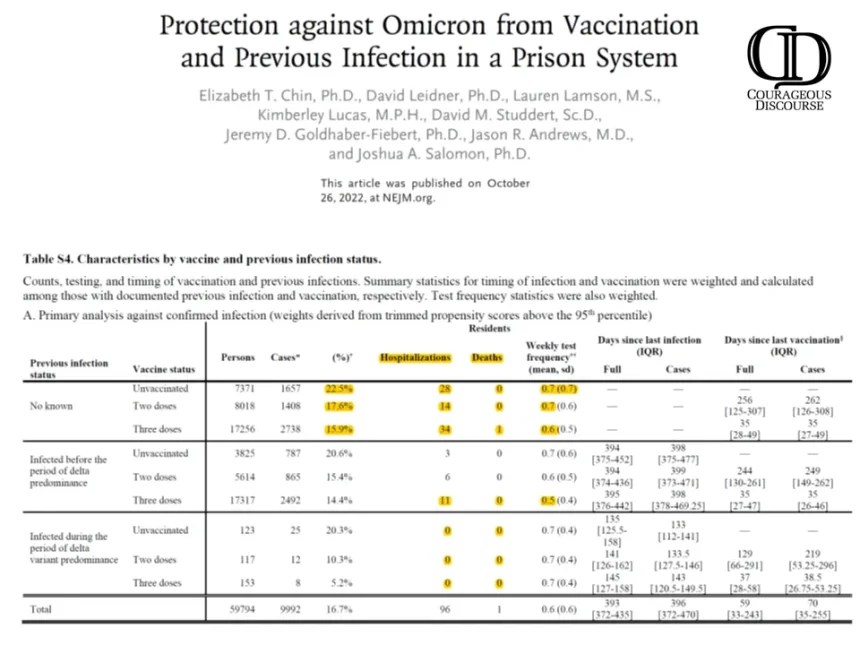
Chin ET, Leidner D, Lamson L, Lucas K, Studdert DM, Goldhaber-Fiebert JD, Andrews JR, Salomon JA. Protection against Omicron from Vaccination and Previous Infection in a Prison System. N Engl J Med. 2022 Oct 26. doi: 10.1056/NEJMoa2207082. Epub ahead of print. PMID: 36286260. Supplemental Tables.
As shown, there is a negligible risk of hospitalization and death with Omicron infection. Specifically, there were zero deaths in the unvaccinated. To demonstrate how far off-base authors and editors are on interpretation, take a look at the paper’s conclusions:
“Our findings in two high-risk populations suggest that mRNA vaccination and previous infection were effective against omicron infection, with lower estimates among those infected before the period of delta predominance. Three vaccine doses offered significantly more protection than two doses, including among previously infected persons.”
My conclusions are considering natural immunity status, COVID-19 vaccination provided no meaningful protection against hospitalization and death with Omicron. Based on these data, a rational prison physician or health administrator would conclude that bivalent boosters for Omicron are not clinically indicated nor medically necessary. So next time you see headlines regarding a journal article, look for a second opinion from “Courageous Discourse” or other reliable stacks and sources of analysis.
[i] Chin ET, Leidner D, Lamson L, Lucas K, Studdert DM, Goldhaber-Fiebert JD, Andrews JR, Salomon JA. Protection against Omicron from Vaccination and Previous Infection in a Prison System. N Engl J Med. 2022 Oct 26. doi: 10.1056/NEJMoa2207082. Epub ahead of print. PMID: 36286260.
Why Are People Losing Confidence in Vaccines?
BY DR DAVID PATON | THE DAILY SCEPTIC | NOVEMBER 8, 2022
A new peer reviewed article in the journal Vaccine has been published comparing surveys data on attitudes to vaccination from before the pandemic with attitudes now.
The authors report that “paradoxically, despite the success of COVID-19 vaccination campaigns, vaccine confidence has significantly declined since the onset of the pandemic”.
I am not quite sure why the authors appear so surprised at their result but a clue can be found in their use of the word “despite”. In many countries the “success” of the COVID-19 vaccination campaign relied in large part in pressuring, bullying and sometimes coercing people to get vaccinated.
Now if governments tell you that getting vaccinated is in your best interests, but that nonetheless those who choose not to get vaccinated will be pilloried in the press and on social media, barred from participating in normal everyday activities and, in some cases, sacked from their employment, perhaps we should not be surprised that people start to doubt whether those governments really do have their best interests at heart.
And those doubts have substance behind them. From a very early stage, it was clear that for many people, the known risks from vaccination probably outweighed any likely benefit. This was most obvious for those who had already had Covid (and for whom the marginal impact of vaccination in preventing a further infection was small), for groups who faced very low risks of serious illness if they contracted Covid and especially for young males for whom vaccination seems to be bring additional risks of heart problems.
But instead of acknowledging that Covid-19 vaccines may make sense for some people and not everyone, too many public health officials, scientists and politicians have systematically downplayed immunity from previous infection, brushed aside concerns over side effects and dismissed concerns that the roll out to the whole population was rushed given uncertainty over long term effects.
The latter was a particularly serious error. Right from the start of the roll out the public was assured that the vaccines had been thoroughly tested. Yet in May 2021, the Government decided to stop providing the AstraZeneca vaccine to under 40s due to the relatively high rate of blood clots. That decision would have been little consolation to the families of the 73 people whose deaths the MHRA report as being linked to that vaccine.
Rather than taking that as a lesson, authorities around the world doubled down and rolled out vaccine mandates, passports and travel restrictions as a way of twisting more arms into receiving the jab. Ironically, these measures were aimed primarily at young people for whom the benefits of vaccination were lowest and (particularly for males) the risks seem highest.
The official rationale for these policies was that vaccination would help protect others from being infected. We now know that there was never any evidence to back this up. And when official data started to suggest that the vaccinated may be getting infected at similar if not greater rates than the unvaccinated, the response of some journalists was not to probe further and investigate but to encourage the authorities to suppress the data. Truly, you could not make it up.
Researchers such as Alex de Figueiredo from the London School of Hygiene and Tropical Medicine warned at the time that coercion was likely to lead to a loss of trust in vaccination more generally. With the latest research paper, we have firm evidence that this is indeed the case.
It is not unreasonable to conclude that the most dangerous ‘anti-vaxxers’ over the past two years have not been fringe conspiracy theorists but governments and the public health establishment itself.
It’s a sorry state of affairs, but where do we go from here? Well public health leaders could start by switching tack. Rather than setting out to persuade everyone to get vaccinated, they could concentrate on providing good information about benefits and risks to help people decide whether vaccination is right for them. If, at the same time, they start to engage honestly with those who have suffered side effects and acknowledge the high level of uncertainty that still exists in the evidence, perhaps they can begin to regain some of the trust they have so negligently lost.
David Paton is Professor of Industrial Economics at Nottingham University Business School.
Pfizer Press Release on New Bivalent Booster Raises More Questions Than It Answers
By Madhava Setty, M.D. | The Defender | November 9, 2022
Pfizer last week announced what some media outlets called “good news” about its COVID-19 bivalent booster, for which the U.S. Food and Drug Administration (FDA) in August granted Emergency Use Authorization on the basis of testing conducted on eight mice.
In a press release, Pfizer summarized the updated data from its phase 2/3 clinical trial on the Pfizer-BioNTech Omicron BA.4/BA.5-adapted bivalent COVID-19 vaccine:
- Bivalent booster elicited approximately 4-fold higher neutralizing antibody titers against Omicron BA.4/BA.5 sublineages compared to the original COVID-19 vaccine in individuals older than 55 years of age.
- One month after a 30-µg booster dose of the bivalent vaccine, Omicron BA.4/BA.5-neutralizing antibody titers increased 13.2-fold from pre-booster levels in adults older than 55 years of age and 9.5-fold in adults 18 to 55 years of age, compared to a 2.9-fold increase in adults older than 55 years of age who received the original booster vaccine.
- Safety and tolerability profile of bivalent booster remains favorable and similar to the original COVID-19 vaccine.
In simplest terms, the bivalent booster increased antibodies to the Omicron sublineages by a factor of 13.2, whereas the original booster increased them by a factor of only 2.9.
This increase was seen only in people over age 55.
Although the new booster produced a more modest increase (9.5 fold) in antibodies in the younger age group (18-55), Pfizer chose not to report what the response was in the age-matched group who received the original booster.
Did the bivalent booster offer any advantage in people younger than 55? Pfizer’s press release sidesteps this important question by focusing only on the results in the 55 or older cohort.
Dr. Ugur Sahin, CEO and co-founder of BioNTech, stated:
“These data demonstrate that our BA.4/BA.5-adapted bivalent vaccine works as conceptually planned in providing stronger protection against the Omicron BA.4 and BA.5 sublineages.”
By “these data” Sahin is referring only to those 55 or older as no comparative results were given in the 18-55 group. But how does he know that this rise in antibody levels will provide “stronger protection against the Omicron BA.4 and BA.5 sublineages?”
Were there any clinical outcome differences in terms of COVID-19 infections? None were recorded. Neither were any recorded in the preliminary data from the same study reported in a previous Pfizer press release.
This was likely why Sahin cautiously stated at that time:
“These preliminary findings are consistent with our preclinical data showing a substantial increase in the neutralizing antibody response against the Omicron sublineages BA.4 and BA.5.”
At what point does an “increase in the neutralizing antibody response” confer “stronger protection?”
Sahin doesn’t know — and neither does the FDA, which insisted that despite this uncertainty, the agency had enough grounds to cajole/compel/coerce those who acquired SARS-CoV-2 antibodies from a previous bout with COVID-19 to get jabbed anyway.
Questions about the two groups
The 36 people over age 55 who received the new bivalent formulation used in this comparison were taken from a larger pool of participants. They were “evenly stratified between those who had evidence of prior SARS-CoV-2 infection and those who did not.”
Furthermore, Pfizer informed us that the “control” group — those people who received the original booster formulation — were also a subgroup of participants but were taken from a different study “while ensuring the same equal stratification.” This group is thus called a “comparator group” and is not a true control group.
How did Pfizer decide which participants to use from the two separate studies?
Pfizer assured us the trial participants they used in the comparative group were “randomly selected.” However, we are not told how Pfizer selected those in the bivalent booster cohort.
Did they choose participants who had particularly high antibody responses? Were those in the comparative group actually chosen randomly — or were they chosen because of their particularly low responses?
In fairness, we are dissecting a press release and not any published research. However, given the company’s poor track record on transparency and integrity, these questions are not entirely unfounded.
In any case, there would be little incentive for Pfizer to cherry-pick participant data to showcase the benefit of its new bivalent booster. The Centers for Disease Control and Prevention (CDC) has already granted Pfizer Emergency Use Authorization for the bivalent booster.
However, Pfizer admitted that there was a difference between the two groups. The interval between the booster and the trial participant’s last exposure to a vaccine was significantly longer in those who received the bivalent booster (10-11 vs. 7 months). Could this difference affect the antibody responses in the two groups?
Pfizer shrugs this off, explaining that “Despite this difference, pre-booster antibody titers were similar for both.”
But pre-booster antibody titers were not the metric of interest — it was the difference in antibody titers before and after that Pfizer was seeking to compare. At least one study indicates that a longer interval between vaccine exposure results in a greater antibody response.
Furthermore, Pfizer’s results indicate that the antibody response was lower in those who had a previous bout of COVID-19, or as they put it, “greater in those without prior infection.”
As early as February 2022, the CDC reported that 57.7% of the U.S. population had been exposed to SARS-CoV-2 through seroprevalence studies. Not only is this most recently available data nine months old, but the CDC also admitted that this was an underestimate because breakthrough infections result in lower anti-N titers (vaccinated people who succumb to COVID-19 generate lower levels of anti-nucleocapsid antibodies than those who are unvaccinated).
In other words, unless you are in the minority and have not had COVID-19, you can look forward to a lower antibody response from the bivalent booster.
What about safety?
“The safety profile remains favorable for the bivalent vaccine and consistent with the original vaccine,” according to Pfizer.
And Pfizer knows this because three dozen bivalent booster recipients didn’t suffer any serious adverse events after one month of observation.
Apparently, Pfizer continues to believe that its original COVID-19 vaccine has a favorable safety profile — despite the more than 31,000 reports of deaths submitted to the Vaccine Adverse Event Reporting System, or VAERS (most occurring in the first seven days after inoculation), the 7.8% of vaccinated people who reported to V-safe that they sought medical attention after a COVID-19 vaccine and the nearly 80,000 serious adverse events and 1,223 deaths reported within three months of the vaccine’s roll-out, according to Pfizer’s own post-marketing analysis.
Ongoing studies will not determine any benefit
Despite reporting only inconsequential data in three dozen people over the age of 55, Pfizer announced in the same press release:
“A booster dose of the BA.4/BA.5-adapted bivalent vaccine has been authorized for emergency use by the FDA for ages 5 years and older and has also been granted marketing authorization in the EU by the European Commission following a positive opinion from the EMA for ages 12 years and older. An application for marketing authorization of the BA.4/BA.5 booster has been submitted to the EMA for children ages 5 through 11.”
And more good news:
“[Pfizer and BioNTech] also initiated a Phase 1/2/3 trial in September 2022, to evaluate the safety, tolerability and immunogenicity of different doses and dosing regimens of the companies’ Omicron BA.4/BA.5-adapted bivalent vaccine among children 6 months through 11 years of age.”
Yes. It is important for parents to know what dose their child can tolerate.
However, conspicuously missing in the design of this ongoing pediatric trial is the determination of efficacy — how good the product is in protecting children from contracting COVID-19 or from negative COVID-19 outcomes (death, hospitalization, ER visits, etc.). Isn’t that the point of a “vaccine” trial?
Apparently not — at least not according to the study description:
“The purpose of this clinical trial is to learn about the safety, extent of the side effects, and immune responses of the study vaccine (called bivalent BNT162b2 Omicron containing vaccine) in healthy children.”
Although having an estimated enrollment of 2,270 children, this ongoing trial will not answer the primary question parents will ask: Will this therapy benefit my kid?
Rather it will only allow Pfizer and BioNTech to determine how powerful their experimental mRNA product is in provoking infants and children to generate Omicron-specific antibodies.
Why are Pfizer and BioNTech not interested in proving their product does anything meaningful? Could it be because they realize this would be an impossible task?
Using data from nine months ago, the CDC reported that at least 75% of children in this age group had already acquired natural immunity to this disease. It is highly improbable that this study could demonstrate any differences in COVID-19 infection rates or outcomes, even with more than 2,000 children enrolled.
Madhava Setty, M.D. is senior science editor for The Defender.
This article was originally published by The Defender — Children’s Health Defense’s News & Views Website under Creative Commons license CC BY-NC-ND 4.0. Please consider subscribing to The Defender or donating to Children’s Health Defense.
Germany wants more scrutiny of Twitter after Elon Musk takeover
By Cindy Harper | Reclaim The Net | November 10, 2022
Germany’s ruling party the Social Democrats (SPD) has called for more scrutiny of Twitter, following the takeover by tech billionaire Elon Musk.
There have been mixed reactions to the new ownership of Twitter. Some politicians are complaining about a potential rise in “misinformation” and “hate speech,” while some are anticipating the changes he plans to make to make the platform more free-speech-friendly.
Some members of SPD have called on the relevant regulators and Justice Minister Marco Buschmann to put Twitter under tighter scrutiny to make sure it follows EU’s rules on content.
“For me, the fact that Twitter is being taken over by somebody who wants to use the network for political purposes even more strongly is highly problematic,” SPD party chief Lars Klingbeil said, speaking to a local newspaper, Handelsblatt.
“Should the variety of opinion be limited further, authorities will have to take resolute action.”
Jens Zimmermann, the party’s digital policy spokesperson, was also critical of the new ownership of Twitter. He noted that the recent mass layoffs will make it difficult for Twitter to fulfill the EU rules on content moderation and fail to respond to complaints related to harmful content.
He said that the federal justice office should “put Twitter under strict scrutiny.”
Former Greek soccer player Vassilis Tsiartas is sentenced over Facebook post accused of being transphobic
By Cindy Harper | Reclaim The Net | November 10, 2022
Former Greek soccer player Vassilis Tsiartas was fined 5,000 euro ($5,008) and given a 10-month suspended prison sentence for criticizing the legalization of gender transition surgery in children.
Tsiartas was taken to court by the Transgender Support Association, which accused him of violating a law against “racism” that contains provisions against inciting violence or hatred based on gender ideology.
In 2017, responding to a law legalizing gender identity, the former soccer player posted on Facebook that he hoped “the first sex changes are carried out on the children of those who ratified this abomination.” He added, “Legitimize pedophiles too, to complete the crimes.”
Tsiartas is the first person to be convicted under the law against incitement to violence or hatred. The Transgender Support Association called the conviction “particularly important for the transgender community.” It added that it will continue fighting “all forms of intolerance, racism, and incitement to discrimination, hatred, and violence.”
The LGBT group also wants to “fully safeguard the human rights and freedoms of LGBTQ+ and especially transgender people in every sector of the public and private sphere.”
Tsiartas plans to appeal the ruling, according to the Greek Reporter.
Savior Al Gore wields windmills to stop the storms and end the Culture of Death

By Jo Nova | November 8, 2022
Like a conglomerate witch-doctor cum pagan-preacher the only thing Al Gore recycles is the overproof grade hellfire of centuries past. Chieftain Al will stop the storms if only everyone will do as he says and invest in his climate asset fund. For he cometh armed with windmills that stop rain-bombs and solar panels that hold back the sea.
Like medieval Occult leaders, superstitious rain dancers, and healers with magical cures, the modern witchdoctors have satellites and simulations, but run on the same old formula since time began. Fear, smear, demons, and magic. All prophesies are ambiguous. Nothing he sayth can be falsified.
Coal, apparently, is not just a source of emissions, but a veritable “culture of death.” Despite the era of coal being a time of record crop yields, bountiful food, travel, and exponential world population growth. Despite the working class of today being richer than the kings of centuries past.
One day, he promises, after he is safely dead, all weather will be good weather, and only the perfect amount of rain will fall, and ski seasons will start and end on the same day each year. Trust me, he says.
Damian Carrington, at The Guardian, swallows the whole prospectus:
Al Gore has pleaded for leaders to end what he calls ‘this culture of death’
The former US vice-president Al Gore is on fist-waving, passionate form in front of world leaders at Cop27. “We continue to use the thin blue atmosphere as an open sewer,” he says. “It is getting steadily worse. We have a credibility problem – all of us – we are not doing enough.”
Gore says we can continue the “culture of death” by continuing to dig up fossil fuels, and cites vast floods in Pakistan, heatwaves and “rain bombs” in China, and a million displaced in Nigeria.
And the valley of death will spread, and 1 billion immigrants will move into your home. (And you thought the southern US border crisis was bad?)
“The current areas of the world considered uninhabitable by doctors are small today but due to expand,” he says, with 1 billion migrants potentially crossing international borders this century, with all the colossal difficulties that would bring. If we stop subsidizing the culture of death and back renewable energy instead we can survive, Gore says, and no new fossil fuel projects are acceptable.
Here me O’ Minions — take this essence of arsenic, I mean lithium, and it shall cure your poverty:
Instead, Gore says, “Africa can be a renewable energy superpower”. He says 40% of world potential is in Africa.
Sure, Africa can be a renewable energy superpower, just like nowhere on Earth is. Europe can’t manage it, but Chad will show the way.
Of course, those who question their Occult Leader are racist pigs:
He says the dash for gas in Africa, a contentious issue at COP27, is a new form of colonisation, with the fuel to be sent to rich nations. He quotes the late archbishop Desmond Tutu as saying climate change is the apartheid of our time.
Somehow drilling gas in Africa for Europe is “colonisation” but using African children to mine cobalt for our batteries is the work of saints. Often the same saints want to segregate nations according to skin color. When did Al Gore say “All Lives Matter?” I can’t recall…
Toss in an attempt at being a Concern-Troll:
[Gore] also warns about stranded assets of billions, especially in Africa, if climate action closes oil and gas plants early.
Shucks. The last thing Al Gore wants is Africans to be lifted out of energy poverty.
So much better to keep casting those spells and doing rain dances. Africans are just his stage props.
Saskatchewan premier slams Trudeau’s radical climate agenda
By Anthony Murdoch | Life Site News | November 8, 2022
REGINA, Saskatchewan — Saskatchewan Premier Scott Moe has bluntly announced that Prime Minister Justin Trudeau’s extreme environmental policies can go to “hell,” and that his province will assert full autonomy over its natural resources.
“To hell with that!” Moe told the Saskatchewan legislature’s speaker of the house during a debate about the Trudeau government’s environmental policies on November 3.
Reading sections of a recent report by Pipeline News verbatim, Moe quoted the outlet saying, “‘Thou shalt not use coal for power generation post-2030,’ the federal government hath said. ‘And it’s moving to do the same with natural gas by 2035.’”
“‘On November 1, the Province of Saskatchewan said, ‘To hell with that,’ but in a more sophisticated, legal manner,’” Moe added, further quoting the article’s humorous, mocking tone.
While Moe employed a joking tone while quoting the report, he continued in a serious manner to blast Trudeau’s environmental policy goals, stating that “a fossil fuel phase–out by 2035″ is “going to make for an awfully cold house in Saskatoon on Jan. 1, 2036,” adding that “One needs to look no further than the European Union” to see the impacts of such policies.
“I would say for the rest of the world to observe and it’s on full display for the world to observe. The energy costs in the European Union over the last number of years due to enacting these solely environmental focus policies have been skyrocketing,” stressed the politician.
As mentioned by Moe, the Trudeau government’s current environmental goals – which are in lockstep with the United Nations’ “2030 Agenda for Sustainable Development” – include phasing out coal-fired power plants, reducing fertilizer usage, and curbing natural gas use over the coming decades.
The reduction and eventual elimination of the use of so-called “fossil-fuels” and a transition to unreliable “green” energy has also been pushed by the World Economic Forum (WEF) – the globalist group behind the socialist “Great Reset” agenda – of which Trudeau and some of his cabinet are involved.
Pushing back against federal interference in the energy sector, the government of Saskatchewan introduced the Saskatchewan First Act on November 1 to “confirm Saskatchewan’s autonomy and exclusive jurisdiction over its natural resources.”
In specific, the new piece of legislation will amend the province’s constitution to make it so that the province has “sovereign autonomy and asserts Saskatchewan’s exclusive legislative jurisdiction under the Constitution of Canada over a number of areas,” such as the “exploration for non-renewable natural resources.”
The Saskatchewan First Act will also allow the province to choose what fuel it wants to use to power its electrical grid, independent of the dictates of the federal government.
Alberta also pushes back
Last week in neighboring province of Alberta, newly-selected Premier Danielle Smith also accused the Trudeau government of pushing “hostile policies” towards the province that have “been led by the most extreme left on environmental, social and governance ratings.”
She noted that such policies “focus so narrowly just on the issue of greenhouse gas emissions and the demonization campaign that has happened against our energy industry, which sadly, the federal government with [Minister of Environment and Climate Change] Steven Guilbeault is aligned with.”
Smith applauded Moe’s Saskatchewan First Act, and said that in Alberta her soon-to-be-released Sovereignty Act will likewise help assert the province’s autonomy over its abundant natural resources, and prevent federal government overreach.
“This is the reason we have to stand up to Ottawa. They have no right to regulate our industry.”
While Trudeau’s plan has been pushed under the guise of “sustainability,” his intention to decrease nitrous oxide emissions by limiting the use of fertilizer is something farmers have warned will reduce profits and could lead to food shortages.
Moreover, experts are warning that the Trudeau government’s new “clean fuel” regulations, which come into effect next year, will cost Canadian workers – many of whom are already struggling under decades-high inflation rates – an extra $1,277 annually on average.
Featured Video

or go to
Aletho News Archives – Video-Images
From the Archives
The Forgotten Terrorist Pretext of the Vietnam War
By Jim Bovard | The Libertarian Institute | February 16, 2023
Since 9/11, terrorism has become the ultimate entitlement program for America’s political elite. Whether it is illegally spying on Americans or blowing Somali dissidents to pieces, invoking terrorism provides all the cover needed for Washington policymakers. But the disastrous results of granting politicians a blank check to fight terrorism should have been undeniable almost 60 years ago.
Back in the 1960s, terrorism was what the communists did. Anti-terrorist moral fervor and ideological blinders propelled the U.S. into its biggest foreign policy blunder since World War II. … continue
Blog Roll
 Aletho News
- LAPD Pilot Will Track Vehicles In San Fernando Valley
- Britain’s Online Censorship Law Now Comes With a Crisis Plan for Your Posts
- NATO’s “Nordic model” brings Arctic confrontation closer to Russia’s nuclear bases
- Using nuclear weapons, the US-Israeli alliance still can’t beat Iran
- Sunset on the Quality of Western Propaganda: Arrival of the Dr Strangelove Moment
- Ukrainian general accused of protecting crime bosses
- US-‘Israel’ alliance faces growing rupture after midterms
- GOP’s Crushing Midterm Loss Could Reshape US Political Landscape – Analyst
- Midterm loss gives Congress power to rein in US war on Iran
- Midterms Were ‘Vote of No Confidence’ in GOP, But Iran Has No Illusions About Democrats – Marandi
- If Americans Knew
- An error has occurred; the feed is probably down. Try again later.
- No Tricks Zone
- New Study: The Net Fossil Fuel Contribution To Rising Atmospheric CO2 Has Been Zero For 500 Years
- Germany’s Green Energy Transition Becoming Increasingly Expensive…Another 6 Trillion Euros!
- Sudden Stratospheric Warming, Powerful El Niño Combination May Lead To Extreme Europe Cold, Energy Crisis!
- Two New Studies Find Thwaites Glacier Melt Cannot Be Driven By Human Activity Or A Warming Ocean
- E-Cars Reduce CO2 Emissions By Only 41% Compared To Internal Combustion Engine Vehicles
- Predictions Made By Renowned Climate Professor Over Past Decades Have Been Proven To Be Poor
- New Study Suggests Large Regions Of The Pacific Ocean Have Been Cooling For The Last 80 Years
- Germany’s Green Energy Debacle: High Energy Costs Force Kahla Porzellan to Close After 182 Years!
- New Study: 50 Years Of The Most Aggressive ‘Net Zero’ Policies Can Only Affect The Global Climate By 0.03°C
- US September “Heat” Was No Record…Many Records Set Decades Ago

