The REAL story behind RSV & the so-called “tripledemic”
MSM sources are now warning of a co-pandemics of flu, RSV and Covid…but is there any reason to be afraid?
By Kit Knightly | OffGuardian | November 9, 2022
The “tripledemic” is upon us, according to the mainstream media. What is a “tripledemic”, you ask?
Apparently, it’s when we have simultaneous pandemics of influenza, Covid and RSV at the same time. At least, according to the LA Times :
A ‘tripledemic’ of flu, RSV and COVID is feared in California
And the Atlantic :
What a ‘Tripledemic’ Means for Your Body
And CBS:
“Tripledemic” in U.S. could bring deluge of patients to hospitals
All three stories – and there are many others out there too – hit the same handful of talking points.
They report that the flu is back after its “mysterious” disappearance during the Covid “pandemic” (the Alantic notes US flu cases reduced by well over 90% and calls it “getting lucky”, the doublethink is unbelievable).
They also warn that Covid is “still around” or “not over”, or some variation on that.
However, the main thrust of the fear is reserved for RSV. Now, you’re all probably more than familiar with “flu”. And you’re definitely tired of hearing about Covid. But RSV could be a new one for you… so let me explain.
THE VIRUS
Respiratory syncytial virus (RSV) is – according to virus theory – one of the many viruses circulating in the general population at all times. To quote the Mayo Clinic’s website [emphasis added]:
Respiratory syncytial virus (RSV) causes infections of the lungs and respiratory tract. It’s so common that most children have been infected with the virus by age 2. Respiratory syncytial (sin-SISH-ul) virus can also infect adults. In adults and older, healthy children, RSV symptoms are mild and typically mimic the common cold.
And according to the CDC:
Almost all children will have had an RSV infection by their second birthday […] Most RSV infections go away on their own in a week or two.
So, according to official sources, RSV is not serious in the vast majority of cases, and almost all of us have already had it.
In fact, seeing as the symptoms are both generic and mild, the odds are you have had it multiple times throughout your life and never really known. It’s simply one of the many viruses known to cause what we refer to as “the common cold”.
THE DECEPTION
There’s a trick being played here, and as usual in the age of the “pandemic”, it’s a trick of language. The powers that be are exploiting linguistic ambiguity in order to generate fear.
Across most of the world, we simply refer to “a cold” or “the flu” almost interchangeably to describe the dozen or so respiratory infections we all get throughout our lifetime.
Most of the time we don’t know what specific virus or bacteria is supposedly the cause, we have no way of finding out and it doesn’t make any difference because the symptoms and treatments are all the same: Cough, fever, headache – bedrest, orange juice and painkillers.
Now, essentially, the media are taking advantage of that ubiquitous ambiguity by naming something that has always been there but pretending it is something new.
Here’s a case in point, the Scientific American published this article on November 4th, which headlines:
RSV Is Surging: What We Know about This Common and Surprisingly Dangerous Virus
Now, although the headline claims RSV is “surprisingly dangerous”, the article seems to go out of its way to prove the opposite.
- “the virus is so common that nearly all children have encountered it by their second birthday.”
- “It’s that ubiquitous,” Flores says. “Even adults are exposed to it repeatedly over time, so we develop some immunity to it.”
- “In healthy adults and children, though, RSV typically presents as a common cold, with symptoms similar to those caused by other “common cold” viruses, such as rhinovirus, adenovirus and a couple of common coronaviruses.”
- “For the average person, RSV is little more than a nuisance”
The article does warn that RSV can be “particularly dangerous for newborn babies and adults older than age 65” and the immunocompromised, but this is true of literally every pathogen. And even then, they go on to add:
only about 1 to 2 percent of children under six months with RSV need hospitalization (usually for a couple of days), and death is rare.
This is a tactic we’re all familiar with – it was routine, throughout the Covid narrative, for official voices to tell us to be afraid, whilst simultaneously explaining there was nothing to be afraid of.
This approach clearly serves some purpose, although I could not say for certain what that may be.
Regardless, the deception is obvious and clearly deliberate.
The question is, why?
THE MOTIVE
To sum up – there is no reason to fear RSV infection. The media are clear about that themselves, even if they bury it under layers of hysterical headlines.
It is just one of the many viruses which cause – or are said to cause – cold or flu symptoms, all of which circulate the whole world constantly, especially at this time of year.
There’s ALWAYS a “tripledemic”, or a quademic or a septemic. The only difference is now they are naming it.
They are taking the routine and pretending it’s exceptional simply to try and frighten you.
Why?
Well, rather predictably, to sell vaccines.
Yes, you’ll be relieved to know that just as RSV is hitting the headlines for the first time EVER, they’ve also just produced the first ever vaccines against it.
On November 1st, Vox reported:
New RSV vaccines are coming. This is very, very good news.
Which claims:
After decades of failed efforts to produce an RSV vaccine, several highly effective ones are finally on the verge of approval.
On the same day, Pfizer announced “positive top-line data” for their new RSV vaccine, with CNN reporting:
After promising trial results for maternal RSV vaccine, Pfizer says it will seek FDA approval this year
That’s right, after decades of trying and dozens of failed attempts, the pharmaceutical companies have finally managed to create not just one but multiple effective vaccines against an endemic virus… just as the virus has hit the headlines.
Now, this all sounds rather familiar, doesn’t it?
If you didn’t fall for this last time you don’t need me to warn you.
If you DID fall for this last time?
Well, fool you once shame on them, fool you twice…
No end in view for Ukraine war
BY M. K. BHADRAKUMAR | INDIAN PUNCHLINE | NOVEMBER 10, 2022
The US National Security Advisor Jake Sullivan’s meetings with Ukrainian leaders, including President Vladimir Zelensky, in Kiev has created a lot of confusion and misperceptions. On one side, the White House maintains that the trip aimed “to underscore the United States’ steadfast support to Ukraine and its people.” The readout stated that Sullivan also affirmed “the continued provision of economic and humanitarian assistance, as well as ongoing efforts with partners to hold Russia accountable for its aggression.”
However, unnamed US officials gave the spin that Sullivan’s real mission was to “nudge” Zelensky to negotiate with Moscow and urge that “Kyiv must show its willingness to end the war reasonably and peacefully.” Politico later reported that Zelensky indeed heeded Sullivan’s “soft nudging”. The US media also reported that the US officials have been nudging the Ukrainians for sometime.
The Washington Post reported last week that the Biden administration privately encouraged Ukrainian officials to show they are willing to engage in dialogue with Russia, in an acknowledgment of the growing frustration in the US and some of its allies at the cost and duration of the war. But, apparently, the Ukrainians pushed back.
Sullivan also added some spice to the media speculation by claiming on Monday that the US has channels to communicate with Russia at senior levels. The Wall Street Journal had earlier reported, citing unnamed US and Western officials, that Sullivan had allegedly held a series of confidential meetings recently with Kremlin aide Yury Ushakov and Russian Security Council Secretary Nikolay Patrushev on the conflict in Ukraine. (Moscow has not reacted to these reports.)
The heart of the matter is that Sullivan has been on a PR exercise in the run-up to the midterms in the US (November 8) in a concerted strategy aimed at countering the growing criticism among the Democrats and Republicans that the Biden Administration is avoiding the diplomatic track to try to end the war in Ukraine. In fact, all indications are that the Biden Administration is preparing for the long haul in Ukraine.
Stars and Stripes reported on Wednesday that a three-star general will lead a new Army headquarters in Germany called the Security Assistance Group Ukraine, or SAGU, that will include about 300 US service members responsible for coordinating security assistance for Ukraine. On Sunday, The New York Times had reported that Lt. Gen. Antonio Aguto Jr., head of the First US Army headquarters at Rock Island Arsenal in Illinois, was a leading candidate for the new job.
The SAGU will be based out of US Army Europe and Africa headquarters in Wiesbaden. Sabrina Singh, the deputy Pentagon press secretary, told reporters the new command will “ensure we are postured to continue supporting Ukraine over the long term.” She added the US remains “committed to Ukraine for as long as it takes.”
It is improbable that Moscow has fallen for Sullivan’s dissimulation. There is reason to believe that Sullivan who is a thoroughbred neocon from the Clinton clan would only have urged Zelensky to expedite the planned Ukrainian offensive on Kherson, which has been in the limelight. The Biden Administration is badly in need of a success story from Ukraine as the newly-elected Congress convenes in January with a likely Republican Party majority in the House of Representatives.
No doubt, the Russians are taking the Ukrainian offensive in Kherson seriously. In a stunning announcement in Moscow on Wednesday, Russian Defense Minister Sergey Shoigu ordered a troop pullout from the western side of the Dnieper River in the Kherson Region. The fact that the Kremlin is risking criticism from the Russian public opinion for ordering such a retreat (from a region that is actually an integral part of Russia) underscores the gravity of the Ukrainian military threat. Zelensky is forcing Moscow to literally eat its words about the “demilitarisation” of Ukraine!
Zelensky continues to be in a belligerent mood. On Monday, Zelensky did make a peace offer but with five conditions for a settlement:
- Restoring Ukraine’s territorial integrity;
- Russia respecting UN Charter on sovereignty and territorial integrity;
- Russia paying off all war reparations;
- Punishing each war criminal; and,
- Guarantees that such an invasion and atrocities will not happen again.
The only “concession” Zelensky made is that he didn’t mention his earlier precondition that President Vladimir Putin should relinquish office before any negotiations.
There is no end in view for the war in Ukraine. By the way, although the midterm elections are typically the point in a US presidential cycle where one expects to see top Cabinet members begin to turn over, there is no sign of that happening to Defence Secretary Lloyd Austin.
Austin, 69, being a critical voice in the Ukraine conflict, who mobilised billions of dollars worth of military aid from around the world for Kiev, Biden anticipates that the war effort may only become more entrenched and this is not the time to change up the top ranks of the Pentagon.
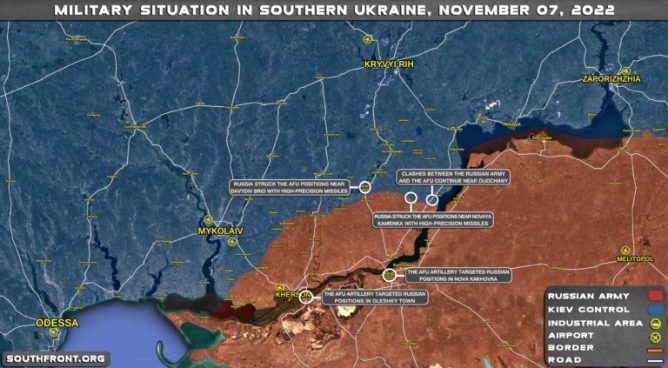
Indeed, the ground situation shows that the ongoing Russian operations in the areas of Ugledar and Bakhmut in Donetsk have run into strong resistance from Ukrainian forces, contrary to the Russian narrative Kiev’s military is a demoralised lot.
In particular, the advance of the Russians around Ugledar got stuck in the village of Pavlovka, located on the important crossroads, and in a fierce battle three days ago, reportedly, hundreds of Russian soldiers were killed. Putin’s decision to retreat in Kherson is probably meant to avoid a similar fate, as the Russians are experiencing logistical difficulties to supply their forces on the western side of Dnieper river.
Of course, this seamy picture is not the whole picture insofar as the phase of regrouping and resupplying following the Russian mobilisation is still a work in progress and the ongoing fighting in Donbass and Kherson is at the tactical level and does not involve any large movements of troops.
Equally, the intensive Russian strikes on Ukrainian depots, command centres and artillery and air-defence systems plus the destruction of Ukraine’s military-industrial facilities and energy system are yet to impact Kiev’s capacity to wage the war.
To be sure, the situation on the front lines in Kherson region remains extremely tense. The Ukrainian forces are on the prowl probing the Russian defence line incessantly to break through to capture the city of Kherson. A large-scale offensive by the Ukrainian forces on Kherson is to be expected any day. So far, Russians are holding their positions, repelling the ongoing Ukrainian attacks and fortifying their defences.
From Kherson, Ukrainian artillery can threaten Crimea. In the prognosis of Moscow’s close ally, Serbian President Aleksandar Vucic, “Challenging times are ahead of us. Next winter will be even harsher than this one because we’re facing the Battle of Stalingrad, the decisive battle in the conflict in Ukraine, the battle for Kherson.” He predicted that both sides are likely to deploy thousands of tanks, aircraft and artillery pieces in the struggle for the key city.
Vucic said, “The West thinks it’ll be able to ruin Russia that way, while Russia believes it’ll be able to defend what it secured at the start of the war and bring it to an end.”
Russia brands US weapons claim ‘a lie’

RT | November 9, 2022
US accusations that North Korea was supplying Russia with ammunition are lies, the spokeswoman for the Russian Foreign Ministry, Maria Zakharova, said on Wednesday. She added that Washington was just looking for a pretext to impose new sanctions on North Korea and made up the ammunition claim for that purpose.
“There was no clear explanation for these statements, nor could there be, because everything said by American representatives is a lie from the beginning to the end,” Zakharova said in a daily briefing, further describing the claim as “another example of [fake news] and speculations spread by the West about Russia.”
On November 2, the US National Security Council spokesman, John Kirby, announced that North Korea had sent a “significant” number of artillery shells for resupplying the military effort in Ukraine. CNN also reported the claim, citing US intelligence assessments.
North Korea denied the accusations on Tuesday. “We once again make clear that we have never had ‘arms dealings’ with Russia and that we have no plan to do so in the future,” said the Defense Ministry in Pyongyang, accusing the US of “persistently spreading a groundless rumor.”
US claims about North Korean ammunition supplies to Russia date back to September. In response, Russia’s ambassador to the UN, Vassily Nebenzia, demanded in the Security Council that the US and UK provide evidence of their claims, or be considered peddlers of fake news.
Meanwhile, the US has supplied Ukraine with weapons, ammunition, and assorted military equipment valued at over $54 billion since the hostilities escalated in February. Most of its NATO allies have followed suit, all the while insisting they were not a party to the conflict.
Last month, Czech media reported that Washington was looking to buy $3 billion worth of anti-aircraft missiles and artillery ammunition from South Korea. When Russian President Vladimir Putin mentioned that report at the Valdai Discussion Club, South Korea denied it.
“We’ve provided humanitarian and peaceful assistance to Ukraine but never lethal weapons,” said South Korean President Yoon Suk-yeol, adding that his country is “trying to maintain peaceful relations with all countries around the world, including Russia.”
US Siege Persists: Lebanon Prevented from Importing Iran’s Fuel Donation
Al-Manar | November 9, 2022
After several months of vagueness, the US administration announced clearly that sanctions will be imposed on Lebanon if it approves the Iranian fuel donation, according to a report posted by Al-Akhbar daily.
The Lebanese newspaper mentioned that the remarks made by the Assistant Secretary of State for Near Eastern Affairs, Barbara Leaf, indicated that the US siege on Lebanon persists.
Al-Akhbar added that the US vague stances pertaining the Iranian fuel donation during the past months aimed only at sustaining the positive atmosphere of the maritime border demarcation.
It is worth noting that Hezbollah secretary General Sayyed Hasan Nasrallah mentioned during his latest speech that the Americans will not allow Lebanon to import the Egyptian gas, Jordanian electric power, and Iranian fuel.
According to Al-Akhbar, the Lebanese caretaker prime minister, Najib Mikati, followed the US vagueness with time consuming steps, including sending a technical team to Tehran to study the fuel specifications.
The newspaper added that, after the energy minister Walid Fayyad sent a report about the Iranian fuel specifications to Mikati, the latter contacted the US administrations whose various offices told him that Washington rejects granting Beirut any waiver in this regard.
Travesty of justice: 1,100 days of torture, solitary confinement for Iranian in Sweden
Press TV – November 9, 2022
Hamid Nouri, a former Iranian judiciary official who has been illegally incarcerated in Sweden, on Wednesday completed three years in solitary confinement despite the court’s order that the cruel restrictions on him be lifted.
Nouri’s son, Majid Nouri, said on Wednesday that his father has been languishing in solitary confinement since his arrest on flimsy charges in November 2019.
Nouri was arrested immediately upon his arrival at the Stockholm Airport three years ago. Swedish authorities alleged that he was involved in the execution and torture of the members of the Mujahedin-e-Khalq Organization (MKO) in 1988.
He has repeatedly and vehemently rejected the allegations.
In July, a Swedish court sentenced Nouri to life imprisonment. The court, which was described by Iranian officials as illegal, convicted Nouri of so-called war crimes and crimes against humanity, based on allegations leveled by the MKO terrorist cult.
Majid Nouri said he received an email in early July from the judge who acknowledged that restrictions over his father’s imprisonment had come to an end.
“However, prison authorities have unfortunately maintained the restrictions by ignoring the judge’s ruling and my father is still in solitary confinement and he cannot visit or contact family members,” he said.
He also noted that his father has suffered torture while in custody, which has caused damage to his eyesight and hearing ability as Swedish authorities bar him from visiting a doctor. “My father is under physical and spiritual torture in the prison, and we are very worried about his health condition.”
Nouri had already given details of his physical torture at the hands of his jailers in a short phone contact with his family before the illegal sentence was issued. He had then complained about the failure of human rights organizations in visiting him and dealing with the rights violations.
Meanwhile, Heibatollah Nazhandi-Manesh, who is a legal advisor to Nouri’s family, said on Wednesday that since no calls or visits are allowed between Nouri and his family, Swedish lawyers of the case are informing the family about his health condition.
Even consular access to him has become limited, he said, adding that no human rights organization has responded to the family’s call to address the case.
The Swedish government, he said, is required to respect the rights of detainees based on the European Convention on Human Rights as well as EU regulations and directives.
“Keeping an individual in solitary confinement for three years is tantamount to torture,” he said.
Iranian Judiciary spokesman Masoud Setayeshi vowed that the judicial branch will follow up on Nouri’s rights.
Speaking at a press conference on Tuesday, he said Nouri “has been in solitary confinement for a thousand and one hundred days, and human rights claimants are silent.”
Nouri had only a “five-minute” conversation with his family in the past two months, he said.
Western Intelligence Services Played Key Role in Staging Mass Riots in Iran: Moscow
Samizdat – 09.11.2022
MOSCOW – Western intelligence services played a key role in organizing mass riots in Iran and spreading further disinformation about the situation in the country, Russian Security Council Secretary Nikolai Patrushev said on Wednesday.
“We note the key role of Western intelligence services in organizing mass riots in Iran and the subsequent dissemination of misinformation about the situation in the country through the Persian-speaking Western media controlled by them. We perceive this as blatant interference in the internal affairs of a sovereign state,” Patrushev said at a meeting with Supreme National Security Council (SNSC) of Iran Ali Shamkhani in Tehran, as cited by the Rossiyskaya Gazeta newspaper.
On September 16, a series of protests against the current political regime of Iran broke out throughout the country. Riots were ignited by the reports of the death of a 22-year-old Mahsa Amini, who had been arrested by morality police for wearing a hijab improperly.
Amini was detained by Iran’s morality police in Tehran on September 13 for wearing an “improper” hijab, an offense punishable by prison. The woman was sent to one of the FARAJA centers belonging to the police department and military intelligence for an explanatory conversation. In the center, Amini reportedly had a heart attack, after which she was immediately taken to hospital where the young woman passed away on September 16.
Tehran said that the weeks-long mass riots were planned from abroad and summoned the ambassadors of the United Kingdom, Norway, and the charges d’affaires of France in Iran in late September. The European diplomats were given a note of protest in connection with anti-Iranian media reports and calls to overthrow the Iranian government.
German MP added to Kiev’s ‘terrorist list’ because he called for a ceasefire
Free West Media – November 9, 2022
BERLIN – The head of the SPD parliamentary group, Rolf Mützenich said the Ukrainian government put him on a “terrorist list” because he had called for a cease-fire in Ukraine. He added that he had also “received threats”.
The criteria according to which Kiev differentiates its friends from its enemies has irked the president of the group SPD in the Bundestag, Mützenich. German politicians are particularly indignant that their names are now on the list of people who “promote narrative people in accordance with Russian propaganda”.
This document is published on the website of the Center for Combating Disinformation to the National Defense and Security Council of Ukraine.
“I was irritated that the Ukrainian government had put me on a terrorist list on the grounds that I was working for a cease-fire or for the possibility of taking new diplomatic measures,” he told the German news agency dpa. According to him, he has since also received “secondary threats, so to speak, which are not easy to manage either”.
Mützenich stressed that if the commitment to a cease-fire is a criterion for inclusion on this list, then the UN Secretary General, Antonio Guterres, must also be included. He complained of “discrimination” against those who, like him, campaign for diplomacy as a means of ending the conflict.
He also accused the partners of the SPD coalition, namely the Greens and the FDP, of resorting to the same discrimination. “I oppose this rigorism. The fact remains that most wars did not end on the battlefield.”
The deputy has been on the list since July. As proof, the Ukrainians cited an article published on the website of the German information agency RND.
The article indicated that the deputy found it “normal” that the German Chancellor, with the American and French Presidents, discussed ways to end the war in Ukraine. According to the article, Mützenich referred to the sanctions packages, but also to the attempt to achieve humanitarian ceasefires.
France Increases Military Budget by Over 20%
Samizdat – 09.11.2022
The French government has increased the country’s military budget by more than 20% and will continue modernizing the army, French government spokesman Olivier Veran said on Wednesday.
“We have increased the military budget by over 20%, and we are doing everything to modernize our army,” Veran told French media.
The spokesman also said that the French authorities would soon review and adopt a law on military programming, providing for a further budget increase.
Veran rejected the statements suggesting that France weakens the capabilities of its own troops by sending military aid to Ukraine.
“When we supply weapons to our allies, we are not weakening our army, on the contrary, we are strengthening our forces within the European Union. We are not ‘undressing’ our army at all,” the spokesman added.
Hungarian objections to EU aid for Kiev regime in line with what most Europeans think
By Drago Bosnic | November 9, 2022
The bureaucratic empire in Brussels seems to be pushing all the wrong buttons in regards to Budapest. The European Union’s failed attempts to force it into submission are effectively being laughed off in Hungary. The bloc’s suicidal anti-Russian sanctions and policies are creating numerous points of contention between Brussels and Budapest. Viktor Orban’s Hungary has run out of patience for this, especially as the EU is also threatening the Central European country with internal sanctions and other restrictions under various pretexts. There are very few things Brussels and Budapest agree on and the differences aren’t only limited to domestic EU policies, but foreign relations as well.
While Hungary prefers a realpolitik approach in regards to other countries and global powers, particularly Russia (and to a certain extent China), the EU’s foreign policy framework is ideological. This often results in accusations that Budapest is a “Russian puppet/asset” and that it’s “trying to ease” the bloc’s economic pressure on Moscow. However, the reality is much simpler – Hungary is trying to ease the pressure on its citizens, as the economic fallout of the failed siege of Russia is deeply affecting the regular people. In the meantime, the detached bureaucrats in Brussels are left unscathed and thus unmoved by the struggles of tens of millions of EU countries’ citizens.
Being fully aware of this for years and determined to prevent economic consequences of such policies, Budapest stated that it won’t support the bloc’s latest “aid” package for the Kiev regime. Hungarian Foreign Minister Peter Szijjarto openly stated that the country will not change its stance as long as it’s forced to fight for access to EU funds blocked by the “rule-of-law” dispute. Namely, Brussels is still holding up at least €7.5 billion in funds for Hungary under the pretext of “persisting corruption and fraud” in the country. In reality, the reason is Budapest’s refusal to follow anti-Russian sanctions and policies which would effectively destroy its economy.
The Western mainstream propaganda machine often portrays Hungary as a “rogue state” and the main obstacle to the futile attempts of isolating Russia, while its leader Viktor Orban is usually presented as a “dictator”, although his popularity in the country suggests otherwise. Hungary’s persistence in its demands for exemptions from anti-Russian energy sanctions is usually used to accuse it of being pro-Russian. However, the country accomplished retaining lower energy prices in comparison to the rest of the EU, which is going through economic and financial unraveling thanks to Brussels’ suicidal subservience to Washington DC.
As there is growing conviction among many EU member states that anti-Russian policies have not only failed to produce desired results, but have even backfired and are ravaging their economies, Hungary is hardly alone in this regard. In addition, the claim that Budapest is pro-Russian is genuinely laughable, as it has provided ample support for the Kiev regime and will continue to do so, as stated by the country’s foreign minister Szijjarto, who said so on November 7 during a conference in Sofia. However, “Budapest still opposes any arrangement that would see funding [for Kiev] jointly with other EU member states,” he added.
Today, November 9, the EU is set to propose a new €18 billion “aid” package for the Kiev regime, which would provide constant cash flow to the Neo-Nazi junta in 2023. The plan is to use the bloc’s joint budget as a guarantee to secure funding for the Kiev regime. The move also involves changes to the EU’s rules that require a unanimous vote to pass proposals. Hungary objects to this, as it would be a dangerous precedent which would force members who voted against certain policies to still follow them, regardless of the negative consequences for those who objected. What’s more, even if a member state voted for a certain decision, it could still be denied funds if it was under sanctions of the unelected bureaucrats in Brussels.
This paradox is precisely what’s happening to Hungary. Namely, the country already supported the EU’s decision to jointly raise debt to finance the bloc’s recovery from the economic fallout of the COVID-19 pandemic, but the funds Budapest is set to receive are being blocked until it “ensures the rule of law.” Brussels is planning to discuss the status of those funds on November 22, which is the deadline given to Hungary to meet the bloc’s “rule of law” requirements. EU bureaucrats are currently working on an assessment of Hungary’s compliance regarding 17 pieces of legislation the bloc insists on. Still, Budapest is not hiding its frustration with the way it’s being treated.
“They’re punishing us and openly blackmailing us with EU money,” Viktor Orban said in a statement for the Budapester Zeitung news outlet last month. “But there’s no legal basis for this — it’s blackmail, pure and simple,” he concluded.
Drago Bosnic is an independent geopolitical and military analyst.
Featured Video

Broke Princes: Saudi Arabia’s Powder Keg
or go to
Aletho News Archives – Video-Images
From the Archives
A sample of vaccine and injectable medication tragedies during my lifetime
This is what happens when you demand speedy production in an era of politicized regulation
By Meryl Nass, MD | February 12, 2022
All these tragedies have been due to failures of testing or failures in manufacturing processes. Most occurred before vaccine manufacturers were given virtually complete protection from liability in 1987.
With the duration of patent exclusivity determining how much new products earn, products are rushed to market as quickly as possible, most using a shortened path for FDA review. Recalls and market removals of approved products are much more common than they used to be. We can only expect more of these disasters in the future, especially if the products are mandated for everyone. … continue
Blog Roll
 Aletho News
- Broke Princes: Saudi Arabia’s Powder Keg
- Albania’s Crisis: Rama, Israeli Investments and the Demand for Accountability
- Hezbollah Categorically Denies Syrian Accusations: We Aim at Confronting Israeli Enemy, Not Undermining Syria’s Stability
- Trump claims funding to Israel ending in 2026 as merger of Israeli–US armies looms
- Iran Weathering The Storm, But Saudi Arabia Is Sinking
- Sunk Ships Don’t Sail Home: Why Peace Won’t Save the Oil Market and War Will Wreck It
- No Cossacks at the gates, fix Italy instead – opposition leader to Meloni
- The Pits: Zelensky’s torture chamber network in the public eye
- Moscow mocks Kiev’s language hypocrisy exposed by ‘torture chamber’ scandal
- Military ‘torture chamber’ triggers new scandal in Kiev
- If Americans Knew
- An error has occurred; the feed is probably down. Try again later.
- No Tricks Zone
- New Study: The Net Fossil Fuel Contribution To Rising Atmospheric CO2 Has Been Zero For 500 Years
- Germany’s Green Energy Transition Becoming Increasingly Expensive…Another 6 Trillion Euros!
- Sudden Stratospheric Warming, Powerful El Niño Combination May Lead To Extreme Europe Cold, Energy Crisis!
- Two New Studies Find Thwaites Glacier Melt Cannot Be Driven By Human Activity Or A Warming Ocean
- E-Cars Reduce CO2 Emissions By Only 41% Compared To Internal Combustion Engine Vehicles
- Predictions Made By Renowned Climate Professor Over Past Decades Have Been Proven To Be Poor
- New Study Suggests Large Regions Of The Pacific Ocean Have Been Cooling For The Last 80 Years
- Germany’s Green Energy Debacle: High Energy Costs Force Kahla Porzellan to Close After 182 Years!
- New Study: 50 Years Of The Most Aggressive ‘Net Zero’ Policies Can Only Affect The Global Climate By 0.03°C
- US September “Heat” Was No Record…Many Records Set Decades Ago

