Algeria Applies for BRICS Membership
Samizdat – 07.11.2022
“Algeria [has] made an official application to join BRICS,” media reported, citing Foreign Ministry special envoy Leila Zerrouki.
The president of the North African nation previously said that Algeria may be interested in joining the bloc, adding that it largely meets the conditions for entering BRICS.
This comes after Iran and Argentina earlier this year also announced they were seeking membership in the group. Moreover, BRICS International Forum President Purnima Anand noted that Turkey, Egypt, and Saudi Arabia may “very soon” follow them in applying.
BRICS is an informal association of major developing economies that was formed in 2006 to enhance cooperation between the member nations and elaborate common approaches to global economic challenges. The countries in the bloc represent around 40 percent of the global population and around a quarter of the world’s GDP.
Naughty Russians
BY PHILIP GIRALDI • UNZ REVIEW • NOVEMBER 6, 2022
According to the New York Times those naughty Russians are at it again.
Today’s online lead story entitled “Russia Reactivates Its Trolls and Bots Ahead of Tuesday’s Midterms” with the subtitle “Researchers have identified a series of Russian information operations to influence American elections and, perhaps, erode support for Ukraine” marks a new low in what the Gray Lady, self-designated as one of America’s “newspapers of record,” prefers to call “journalism.” The author of the piece, clearly somewhat biased over Russia and Putin, is one “Steven Lee Myers [who] covers misinformation for The Times. He is also the author of ‘The New Tsar: The Rise and Reign of Vladimir Putin.’”
Here is what it is all about: “The user on Gab who identifies as Nora Berka resurfaced in August after a yearlong silence on the social media platform, reposting a handful of messages with sharply conservative political themes before writing a stream of original vitriol. The posts mostly denigrated President Biden and other prominent Democrats, sometimes obscenely. They also lamented the use of taxpayer dollars to support Ukraine in its war against invading Russian forces, depicting Ukraine’s president as a caricature straight out of Russian propaganda.”
Per the Times, “The goal, as before, is to stoke anger among conservative voters and to undermine trust in the American electoral system. This time, it also appears intended to undermine the Biden administration’s extensive military assistance to Ukraine.”
Well, one might object that Ukraine’s president is indeed a figure tailor-made for ridicule as he used to play a piano with his penis, but that is perhaps a secondary issue. The more significant theme is that people who oppose the Ukraine war, for any number of reasons, and, particularly if they are conservatives, are becoming trolls for Russia in part due to the disinformation efforts and are being influenced by way of discussion fora like Gab. The targets “are generally US conservatives who are maybe more accepting of conspiratorial claims” according to one of the cybersecurity experts consulted by the author. The Times links Berka, who might indeed be a made-up identity “posing as an outraged American,” to the secretive Russian Internet Research Agency in St Petersburg which it claims was involved in interfering in both the 2016 and 2020 US elections.
The Times also names another site that it links to Russia, electiontruth.net “For its contact information, electiontruth.net lists a cafe inside a converted gas station in Cotter, Ark., a town of 900 people on a bend in the White River. The cafe has closed, however… No one at Election Truth responded to a request for comment submitted through the site.”
One might object that neither Berka nor electiontruth.net would appear to be a major disinformation threat sponsored by a foreign government intended to bring down the Republic. Nevertheless, the article clearly adheres to the view that anyone objecting to the continuing war in Ukraine is a Russian dupe. It cites Liz Cheney, who has called the few Republicans who want to cut funding for the war as “the Putin wing of the Republican Party,” and Myers observes that the disinformation unfortunately echoes “a theme that has gained some traction among Republican lawmakers and voters who have questioned the delivery of weapons and other military assistance.”
Another “expert” cited in the article, one Edward P. Perez, a board member with the OSET Institute, a self-described “nonpartisan election security organization,” called the Russian efforts “manufactured chaos” in the country’s body politic – in part because the divisions in American society are already such fertile soil for disinformation. “Since 2016, it appears that foreign states can afford to take some of the foot off the gas because they have already created such sufficient division that there are many domestic actors to carry the water of disinformation for them.”
Myers and his agenda driven quoted “experts” do not consider for a moment that there are a lot of good reasons for opposing US involvement in the fighting in Ukraine, many of which are rooted in a conservative view of what is America’s appropriate role in what is becoming a multipolar world. First, the United States has no national interest at stake that compels it to enter the fighting on behalf of Ukraine. Second, the war itself could have been averted if the United States and Europeans had been willing to address and negotiate Russian national security concerns in a serious way before the fighting broke out. Third, even now, a push by the US and its allies would likely bring the two sides to the negotiating table and a truce could be arranged. Fourth, the United States would in fact be playing a positive role if it would opt to do whatever it takes to end the slaughter taking place. Fifth and finally, expansion of a US direct role in the conflict could prove catastrophic if someone blinks and the war goes nuclear.
So, the compelling need for the continuation of an unnecessary war is the main point being made by Mr. Myers’ featured article, which clearly reflects the views of the New York Times editorial staff. And the enemy characteristically comes from within – Americans who oppose the involvement of the United States in the war against Russia and are accused of being little more than “domestic actors” who are peddling disinformation provided by the Kremlin. Given that this article has appeared two days before national elections, the intent is clear. The Russians are, per the Times, generating disinformation about Ukraine and Americans who go along with the lies are being manipulated. Moscow is again interfering in a US national election! Vote for the Democratic candidates as they will be the ones that can be relied upon to keep the war going! Three cheers for Joe Biden!
Supreme Court Orders Police to File Case Against PM Sharif After Imran Khan Assassination Attempt
By Rishikesh Kumar – Samizdat – 07.11.2022
Pakistan’s Supreme Court on Monday ordered the police chief of Punjab to lodge a First Information Report (FIR) in the Imran Khan assassination case within 24 hours.
The police said that the provincial government was preventing Khan’s Pakistan Tehreek-i-Insaf (PTI) from registering the case despite several attempts.
Issuing a warning to Punjab police, the court said that suo-motu action will follow in case the complaint is not registered against Pakistan’s Prime Minister Shehbaz Sharif, Interior Minister Rana Sanaullah, and Maj. Gen. Faisal Naseer, all of whom, as Khan believes, were allegedly involved in the attack against him.
Khan’s “Absolute Freedom March” was halted on Thursday following the assassination attempt against Khan, whose convoy reached Wazirabad at that time. Khan openly accused Prime Minister Shehbaz Sharif and an army official of being behind the attack, in which one person died and at least nine people suffered bullet injuries, including the PTI chief.
“Under the criminal justice system, police can register the FIR itself. It’s been more than 90 hours but the FIR has yet to be registered,” the Supreme Court observed.
Local media also reported that the Punjab government was not in favor of adding Maj. Gen. Naseer, an official of the Inter-Services Intelligence (ISI) agency, in the complaint, but the request was rejected by the PTI.
Meanwhile, PTI’s Fawad Chaudhry has deemed the order the “first step towards justice.”
Khan, 70, sustained a bullet injury when two gunmen opened fire, shooting several rounds at him and his political aide on a container-mounted truck in the Wazirabad area of Punjab province on November 3.
After being discharged from the hospital, Khan announced he would resume the march to Pakistan’s capital on Tuesday. The Islamabad police warned the PTI of strict action if they carried out protests in the capital without the permission of the administration.
US wants to build military bases in Uruguay
By Ahmed Adel | November 7, 2022
A draft defence cooperation agreement between Washington and Montevideo, which could allow the installation of US military bases in Uruguay, is once again being considered in the Uruguayan Parliament. Allowing US military bases would effectively damage the sovereignty of Uruguay, a country which currently maintains good relations with both Russia and China.
Senator Gustavo Penadés for Uruguay’s ruling centre-right National Party claimed that the project only involves “some type of investment in construction” and not the permanent presence of US forces in Uruguayan territory. For his part, the president of the Uruguayan Defence Commission and of the opposition centre-left Broad Front, León Lev, admitted that the project is “ambiguous” and will instigate “profound discussion” in Parliament.
The project is defined as “a complementary agreement” for “reciprocal provision” of “logistical support, supplies and services.” It says that Uruguay and the US express their “desire to improve the interoperability, preparation and efficiency of their respective military forces through greater logistical cooperation.” In addition, the purpose of the agreement is to “facilitate logistical support” between the two countries during “combined exercises, training, displacements, stopovers, operations or other cooperative activities.”
Effectively, it is very clear that the bilateral agreement will in fact enable US actions more than anything else. For example, the supply of services that can be provided to each other in reality only benefits the US as Uruguay does not have the capacity to do military missions or operations in North America like the US does in South America. It cannot be overlooked that the initiative is from the US and is drafted in the terms that it proposed.
The project was first discussed in 2012, during the government of José Pepe Mujica, but it did not have the support of parliament. Today, just like in 2012, if the parliament authorises it, it would mean a loss of Uruguayan sovereignty over a part of its territory.
According to Senator Penadés, there is no possibility of US bases in Uruguay and he believes that this interpretation of the agreement is incorrect. The legislator claimed that it is a “standard agreement” like the ones that have been signed between the US and other countries on defence cooperation. When asked what the project refers to when it says “operations in bases [and the construction corresponding to that support],” Penadés said it is about the “infrastructure” that is built in “cooperation,” such as, according to him, hospitals.
For his part, Lev affirmed that the project is “ambiguous” and will provoke “very deep discussion” in parliament.
“As it is ambiguous, it is going to give rise to at least a very deep discussion, I have no doubt. This is not going to be voted on tables and this discussion is going to take many months, if not years. But one can never anticipate,” he said, adding: “There are two main laws for the Government, such as the organic law of the Armed Forces and the retirement law. Parliament is not in a position to quickly study this project.”
Lev pointed out that, in general, agreements with foreign countries take months or years to approve.
“An issue of this nature, with the ambiguities, especially with this potential base, is going to generate a deep debate. The Uruguayan government does not propose the agreement, it makes a scheme with the US and proposes what Washington aspires to. But in politics one should never rush. One has to carefully analyse and see the actions of the political system,” Lev said.
The underlying issue is that the Uruguayan military’s limited defence budget means that it is reliant on the generosity of donor nations. In one example, the US State Department GPOI funds contributed $36 million since 2008 in equipment, training, and construction for the Uruguayan Armed Forces. This is evidently a paltry amount, but in the context of the Uruguayan military, which has a total budget of $1.16 billion, it is significant.
It is recalled that Daniel Castillos, Uruguay’s Ambassador to Moscow, announced in April that his country does not support the economic sanctions on Russia.
“Despite the current situation and criticism regarding [Russia’s] special military operation [in Ukraine], Uruguay has not imposed and does not support any economic and financial sanctions against Russia… and maintains an interest in strengthening trade and maintaining good relations,” he said, adding that it was “necessary” to cooperate with Russia.
For the US, it is important that initiatives like the defence cooperation agreement are signed with Uruguay so that the country can be brought under its sphere of influence. Uruguay currently has friendly relations with the US, Russia and China, but Washington hopes to upset this balance by slowly influencing the country, beginning with military bases. For now, although the US undoubtedly has ambitions for military bases in Uruguay, it appears unlikely to happen in the short and medium term.
Ahmed Adel is a Cairo-based geopolitics and political economy researcher.
The climate scaremongers: Health chief’s nonsensical warning of doom
By Paul Homewood | TCW Defending Freedom | November 4, 2022
We are used to silly, irresponsible climate scare stories from the BBC and the papers, but when they come from the chief executive of the UK Health Security Agency it is quite another matter.
According to the Guardian last week: ‘The climate crisis poses a “significant and growing threat” to health in the UK, the country’s most senior public health expert has warned.
‘Professor Dame Jenny Harries, the chief executive of the UK Health Security Agency, said there was a common misconception that a warmer climate would bring net health benefits due to milder winters. But the climate emergency would bring far wider-reaching health impacts, she said, with food security, flooding and mosquito-borne diseases posing threats.
‘Referring to the recent floods in Pakistan, Harries said the UK needed to build resilience to protect the population from the health impacts of extreme weather events. “Colleagues from Pakistan . . . are suffering from the impacts of flooding. They are dealing with stagnant water, higher risks of sewage overflowing into publicly accessible water spaces,” she said. “We are seeing some of the things that could be happening in the UK”.’
She went on to repeat the fake claims that this summer’s heatwave had killed 2,800 people, a claim already exposed as a sham on TCW. And she warned us that we would have to stay indoors in the middle of the day in summer, and have longer summer holidays for schools. She even ridiculously claimed that we would soon have outbreaks of dengue fever.
The comparison with Pakistan is utterly absurd, and there’s no evidence that summers in England are getting wetter, or for that matter drier.

Indeed, even her claim that we would soon be having Mediterranean summers is just as ridiculous. The simple fact is that even this summer was not as hot as 1976. The average summer temperature may have increased, as cold summers become less frequent, but even with the wall-to-wall sunshine we had this year, summers show no sign of breaking through that 16C barrier:

By contrast, average summer temperatures in the south of France are typically six or seven degrees higher.
Harries’s comments about dengue are particularly misleading. The spread of dengue globally has not been because of climate change, as one of the world’s leading experts on infectious diseases, Professor Duane Gubler, has explained.
According to him, the principal drivers are urbanisation, globalisation and lack of effective mosquito control. The mosquitoes which carry the virus thrive in urban habitats, where dengue quickly spreads, while air travel provides the ideal mechanism for transport of viruses to new cities, regions and continents. The result, he says, is epidemic dengue.
The World Health Organisation also notes that the mosquito which has brought the dengue virus to Europe is actually adapted to cold weather: ‘Aedes albopictus, a secondary dengue vector in Asia, has spread to North America and more than 25 countries in the European Region, largely due to the international trade in used tyres (a breeding habitat) and other goods (e.g. lucky bamboo). Aedes albopictus is highly adaptive and, therefore, can survive in cooler temperate regions of Europe.’
Britain is no stranger to mosquito-borne diseases such as dengue. Large epidemics of dengue have been recorded here and elsewhere in Europe since the 18th century. One massive epidemic, estimated at one million cases with at least 1,000 deaths, occurred in Greece in 1927-28. Climate change has nothing to do with the spread of dengue.
And what about this ‘food security’ Harries is waffling on about? Agricultural output has been rising since the BSE scare of the 1990s:

https://www.fao.org/faostat/en/#compare
If the professor is worried about Britain’s food security, maybe she should be objecting to the government’s plans to rewild large swathes of our countryside, to attack the dairy and meat industry and to build solar farms on prime agricultural land.
BBC’s Arctic warming trick
ACCORDING to a BBC report, Svalbard, the Norwegian archipelago deep inside the Arctic Circle, is heating at six times the global average. (The BBC and Guardian now routinely call it ‘heating’ rather than ‘warming’, though I don’t think the Svalbarders would call average annual temperatures of 1C ‘hot’!)
The report, Svalbard: The race to save the fastest-warming place on Earth, states: ‘Svalbard is home to the world’s northernmost permanent settlement, Longyearbyen, which is estimated to be heating at six times the global average. So what is being done to save it?
‘Svalbard’s church is a blood-red wooden building with bright white trim – the most northerly place of worship in the world. Its priest, Siv Limstrand, has been here for only three years but is shocked by the impact of climate change she has witnessed in that time. “Every Sunday when we gather for worship, a part of our intercessions is always about climate change and its threats,” explains Limstrand. “We know that the clock is ticking.”
‘You feel on borrowed time here in what successive scientific studies have found is the fastest-warming place on Earth. Experts from the Norwegian Polar Institute are among those who calculate it is heating six times faster than the global average. The consensus is that the temperature in Svalbard has jumped 4C in the past 50 years. Wildlife and human life are now in a struggle to survive. This is why Limstrand’s congregation is praying for help.’
Obviously a priest who has been there three years is an expert on Svalbard’s climate!
But as this is the BBC, they tell you only half the story. In line with most of the Arctic, Svalbard was virtually as warm as now in the 1930s and 40s, as the chart for Bjoernoeya (Bear Island) shows:

https://www.ecad.eu/indicesextremes/customquerytimeseriesplots.php
In between, as the chart highlights, Svalbard went through a drastic cooling episode in the 1960s and 70s. It is from this unusually cold base period that the BBC claim their 4C of warming. That extreme cold interval affected much of the Arctic, and had a particularly catastrophic effect on countries like Iceland. Trausti Jonsson, senior researcher at the Iceland Met Office, lived through those times and said this:
‘In 1965 there was a real and very sudden climatic change in Iceland (deterioration). It was larger in the north than in the south and affected both the agriculture and fishing – and therefore also the whole of society with soaring unemployment rates and a 50 per cent devaluation of the local currency,’
Going further back in time, ice core studies have shown that Svalbard was as warm as now, if not warmer, in the 1300s, before temperatures plunged in the Little Ice Age. The 1800s were the coldest period of the lot in the last 1,000 years.
There is nothing unprecedented or unusual about Svalbard’s climate nowadays. But the BBC would rather the inhabitants return to the freezing days of the 1960s!
Why Does the UKHSA Vaccine Surveillance Report Never Mention Side-Effects?
BY AMANUENSIS | THE DAILY SCEPTIC | NOVEMBER 3, 2022
In the past few months I’ve read newspaper articles warning of the increased risk of death following gardening, stress at work, solar flares, sleeping in front of the television, hot weather, cold weather, shock of high energy bills, the price of food, laughing too much and sleeping in the wrong position – these recent warnings add to the multitude of stories on the health consequences of our dietary choices, sedentary lifestyle and climate change. If that wasn’t scary enough, we’ve also seen efforts to educate the public about how common sudden deaths are in younger adults and teenagers. Given this background of suddenly emerging risks to life resulting from our modern lifestyle, it is clearly very important to fully understand all risks that might be emerging resulting from the Covid vaccines, no matter how trivial.
With the above in mind, it is perhaps rather surprising that the Vaccine Surveillance Report from the UKHSA has never actually mentioned vaccine side-effects or complications. Sure, the word ‘safe’ is typically used a few times in each report, but there’s never been a mention of side-effects and their rates. They don’t even like to use the term ‘rare side-effects’ – as far as the Vaccine Surveillance Reports are concerned the vaccines are simply ‘safe’. They’ve never reported any of the data from the Yellow Card side-effect reporting system, nor mentioned any of the increasing numbers of scientific studies reporting on an increasing number of ‘complications’ after receiving the various vaccines.
I suppose at this point I could stop – since side-effects aren’t covered in the Vaccine Surveillance Reports, and this is a series of posts reviewing the UKHSA Vaccine Surveillance Reports, there’s nothing to discuss. However, vaccine side-effects and complications are important, so I hope that I can be forgiven for exploring this aspect of the vaccines a little further in this post.
Over the past 18 months there have been many studies which have found worrying high side-effect rates following vaccination. The results of these studies have been discussed in multiple places across the internet, and many of these studies have been covered by the Daily Sceptic. The only common theme has been the remarkable insistence by authorities worldwide on ignoring the results of these studies, except where the evidence has become overwhelming and they are forced into some response.
The vast array of side-effects found by these investigative studies is now too voluminous to cover completely here, so instead I’ll focus on a few specific side-effects and discuss the response to these new findings.
Thrombocytopenia and blood-clotting related problems
The first inkling that there might be a risk of thrombocytopenia (low blood platelet count) after vaccination came in January 2021, a mere month after the vaccinations started, after a doctor in New York died of complications following acute thrombocytopenia about two weeks after being given the Pfizer vaccine. Pfizer responded with a statement that this definitely wasn’t anything to do with their vaccine, despite acute thrombocytopenia being relatively rare and the doctor not being in a risk group. In the months that followed, many more cases of thrombocytopenia and other blood clotting disorders occurred, from Pfizer and the other vaccine offerings, but the official response remained coincidence. Eventually the volume of problems became too large to ignore, and in June 2021 the U.K. authorities decided that those aged under 40 shouldn’t be offered the AstraZeneca vaccine. I found this restriction to the AstraZeneca vaccine a bit odd, as the other vaccines appeared to have similarly high rates of clotting problems in the weeks following vaccination, but it appears that the authorities had chosen their demon to blame. Of course, older adults weren’t too keen to be told that they were going to have to take these risks, and demand for the AstraZeneca vaccine plummeted. A few months later the AstraZeneca vaccine was only made available to those who were unable to take the Pfizer vaccine (the only alternative in the U.K. at that time). Even though the known problems of clotting related disorders post-vaccination are bad enough, it isn’t clear if the instances of severe clotting related problems (resulting in hospitalisation) are also accompanied by higher numbers of clotting problems below the clinical threshold (‘microclotting’), or whether these mild cases might have longer term consequences. Another area of post-vaccine effects that demands more research.
Myocarditis
The risk from myocarditis first appeared in a leaked report out of Israel in April 2021 suggesting worryingly high rates occurring in younger males. Quite why it was deemed necessary for this safety-related information to be kept secret isn’t clear, but authorities worldwide responded quickly once the information was leaked to reassure everyone that this risk was very very low and that the vaccines were very very safe (and effective, of course). While the official line is that post-vaccination myocarditis is rare, studies keep on finding higher and higher incidence rates, particularly in the young male risk group. Indeed, in August a scientific paper describing the impact of Covid vaccination in Thailand suggested that the conditions suggestive of myocarditis and pericarditis after vaccination were found in over 29% of vaccine recipients aged between 13 and 18 years of age, and a similar result has since been described after vaccination in Switzerland. The longer term impact of these ‘mild problems related to the heart’ aren’t yet known.
Period related problems
All clinical studies into side-effects are mindful of the need to treat any issues related to sexual function carefully – individuals are less likely to seek medical attention when it comes to sex-related problems and those related to our reproductive systems in general. Thus it should have been a huge red-flag when anecdotal reports of heavy or missed periods following vaccination started to appear early in 2021. Alas, our authorities simply responded with the usual ‘it definitely isn’t the vaccines’ and ignored the problem. The complex situation regarding reporting of side-effects related to reproductive function is nicely illustrated by the number of problems reported to the Yellow Card side-effect reporting system – early May 2021 saw a huge increase in reporting of side-effects related to menstruation. The reason? Most likely, an article on the problem on BBC Radio 4’s Women’s Hour in late March, in which listeners were urged to report any problems into the Yellow-Card system. It is very disappointing that our side-effect reporting system could be so heavily influenced by a radio programme in this way. Really there should have been active monitoring of post-vaccination complications and side-effects, but the inadequate Yellow Card system is all we had. Official guidelines now state that problems related to menstruation are relatively rare but even if they do occur they’ll be of no consequence whatsoever and women shouldn’t worry about taking the vaccines. Eventually we’ll find out if this reassurance was correct.
What’s also troubling is the way that the only side-effects that are discussed in the traditional media are the ones that have been officially recognised (albeit under duress). What about the increase in hospital consultant activity for stroke victims over the last 18 months?

Or the increase in consultant activity for hormonal problems?
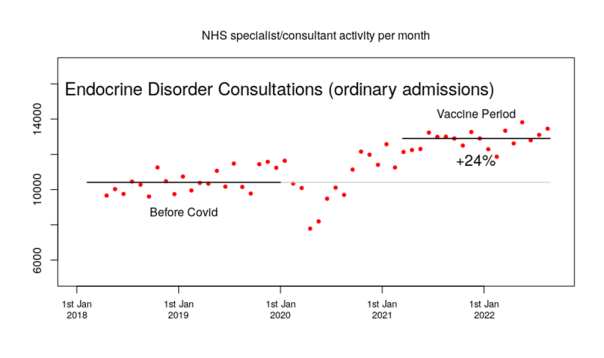
Or the increase in referrals for suspected cancers?

Like the significant increase in excess deaths that we’ve seen this year, there seems to be much going on but little interest on the part of our authorities to investigate these issues at all. Maybe they’re all the result of the lockdowns, maybe they’re due to Covid itself, maybe it was the vaccines, and perhaps it is all just a massive coincidence – but it simply isn’t good enough to decide that it can’t possibly be the vaccines and refuse to even discuss undertaking the research that might clarify the situation.
At least in recent weeks we’ve had an increase in calls for some robust investigations to be undertaken, such as discussed in the Daily Sceptic in mid October. Then again, we’ve also had the brief hour-and-a-half spent a week ago by the House of Commons to debate the issues around vaccine safety. Despite some MPs detailing concerns about the safety of the vaccines, the Chair was quick to respond with empty reassurances and the debate ended with a statement urging people to get vaccinated to protect themselves, others and the NHS. I fear that there’ll be quite some way to go before the full impact of the vaccines is accepted by our authorities.
An important aspect of the rate of side-effects and complications is the impact on the risk-benefit analysis used by our authorities to determine who should take the vaccines. The risk of side-effects should be tolerable so long as the benefit offered by any medical product is greater than the risks. Since the vaccines were introduced back in December 2020 we have seen marked changes both in the risks posed by the vaccines (more side-effects and complications have come to light) and the benefits offered (the vaccines clearly offer little protection against infection, their protection against hospitalisation and death appears to be rather less than claimed, and at the same time Covid appears to have evolved to become much less virulent). In addition, nearly everyone in the Western world will now have had a Covid infection, resulting in at least some natural immunity. Unfortunately, our authorities have never actually published any of their risk-benefit analyses and how the ratio changes with age and morbidity, so we can’t tell how new information on risks and benefits has changed the calculation. Then again, I suppose it is easier to be inconsistent if you never actually tell anyone what factors your decisions are based upon.
One of the big problems regarding the Covid mRNA vaccines in particular is that there were only sparse data published on how long the mRNA would remain active in the body and where it would end up (pharmacokinetics and biodistribution). Originally the reassuring voices told us that the mRNA would break down within hours, and that the mRNA vesicles would remain close to the point of injection. However, evidence has emerged in the months since our authorities proceeded to inject everyone in the world that has suggested that the mRNA remains active for many weeks following vaccination, that it travels to multiple organs in the body and that the pharmaceutical companies knew this prior to the vaccines being released. Even worse, a recent study has suggested that the mRNA is present in breast milk for a short time following vaccination (for fairness I must point out that our authorities still think that it is completely and utterly safe for recently vaccinated mothers to continue breastfeeding). I find it concerning that we’re only now starting to find out the full complexity of the interaction of the mRNA vaccines with the body.
Recent studies have estimated the current rate of serious short-term side-effects after the Covid vaccines at around one in 800. I find this number interesting, as I suspect that this is as bad a side-effect rate as could be found for a supposedly benign or prophylactic treatment. I estimate that an incidence rate of around one in 1,000 marks the point at which problems become apparent even to a casual observer, provided sufficient numbers are given the medical product. If a side-effect rate for a benign or prophylactic treatment is worse than this people would notice and demand that the medicine or medical treatment is withdrawn. Thankfully, there aren’t too many examples of terrible medical mistakes – probably the most famous example is Thalidomide, where around one in 1,000 mothers who took the drug gave birth to a child with serious physical malformations. Even so, it took three years before the nature of the problem was understood and Thalidomide was withdrawn from sale. It is perhaps interesting to note that at least in the early stages of the problem being recognised the blame was put on the nuclear tests that had occurred in previous years – was this the 1950s equivalent of ‘climate change’?
Where serious side-effects are more common than this for a supposedly benign product, the response is typically more rapid. The famous example here is Elixir Sulphanilamide, a treatment for bacterial infections created in the 1930s that caused over 100 deaths in the few weeks that it was for sale. The problem with Elixir Sulphanilamide was that it hadn’t been tested before release and the manufacturers hadn’t realised that a primary component was highly toxic. The owner of the company that made the elixir famously denied responsibility, stating that “we have been supplying a legitimate professional demand and not once could have foreseen the unlooked for results”. It was this scandal that led to the creation of the FDA in the USA, along with stringent requirements for the testing of new medical products. After the disaster it was demanded that never again would a medical treatment be released and given to many thousands of people without being fully tested to explore all potential problems (and not simply the ‘looked-for’ problems). As a side note, the outcome of the Elixir Sulphanilamide scandal was that the scientist who developed the formula committed suicide as a result of the extreme guilt of causing so much harm, while the company that released the medicine without testing was given a nominal fine. The manufacturer went on to produce further drugs (and profits) and after a succession of takeovers is now part of the pharmaceutical giant GlaxoSmithKline. Funny how it all works.
Next time I’ll discuss one of the most wildly enthusiastic aspects of the Vaccine Surveillance Report – the predictions made by computer-models of the reduction in infections, hospitalisations and deaths offered by the vaccines.
Amanuensis is an ex-academic and senior Government scientist. He blogs at Bartram’s Folly.
Research: Countries That Sought ‘Zero-COVID’ Lockdowns Have The Least Immunity

Kevin Frayer/Getty Images
By Steve Watson | Summit News | November 4, 2022
New research has revealed the countries that implemented the harshest lockdowns as part of ‘zero-COVID’ policies now have the least immunity from the virus itself.
The analysis by The Institute of Health Metrics and Evaluation (IHME) at the University of Washington’s School of Medicine estimates that China, which still has multiple lockdowns in place, has the lowest level of immunity to COVID-19 on the planet.
Other nations that didn’t institute harsh lockdowns, including Russia, Singapore and Brazil are thought to have the highest immunity levels, according to the research.
The research estimates immunity rates according to infection numbers, vaccination rates and how much time has passed in the interim.
The analysis posits that as of the end of October 2022, just 17.2% of the Chinese population have immunity from the virus, while Russia on the other hand is estimated to have an immunity rating of 74.5% with everyone in the country having contracted the virus.
While Singapore’s immunity rating is thought to be around 70%, and Brazil’s 68%, Japan, another country that put into place harsh restrictions is believed to have just 38.9% immunity.
The U.S. is believed to have 60.5% immunity at this time, according to the analysis.
Ironically, given the IHME’s COVID model being used to laud strict restrictions, the analysis again highlights the futility of lockdowns in preventing the spread of the virus in the longterm.
Johns Hopkins University previously concluded that lockdowns have had a much more detrimental impact on society than they have produced any benefit, with researchers urging that they “are ill-founded and should be rejected as a pandemic policy instrument.”
A Centers for Disease Control and Prevention report released last month highlighted how a record number of children in the U.S. are now being hospitalised with common colds due to weakened immune systems.
The CDC data is consistent with research by scientists at Yale who warned that it is not normal to see children with combinations of seven common viruses, including adenovirus, rhinovirus, respiratory syncytial virus (RSV), human metapneumovirus, influenza and parainfluenza, as well as COVID-19.
As we previously highlighted, there has also been a global outbreak of hepatitis cases in children, with the media asserting the cause is “unknown.”
Biden administration officials have continuously pushed for children to keep wearing masks in schools, and there are still hordes of hypochondriacs forcing their children to do so, despite COVID posing virtually no risk to the health of children in normal circumstances.
The European Medicines Agency’s (EMA), Europe’s equivalent of the FDA, has also warned that relying on endless rounds of booster shots to fight COVID-19 could end up causing “immune response” problems.
What We Knew In the Early Days
Brownstone Institute | November 4, 2022
The claim is now everywhere: we had to lock down because we just didn’t know about this virus. It was all very confusing and we had to play it safe. We had no other option because we just had no clarity about what we were dealing with. The precautionary principle dictated the unprecedented actions.
Actually, the precautionary principle goes both directions. It also dictates that we not enact policies that we know for sure would wreck lives and liberties. They did it anyway, without sufficient knowledge that the measures would achieve any positive good.
We approach the third year and people have forgotten that all the harms of lockdowns were strongly warned about by many voices in many venues. In addition, the virus was much better understood back then and openly discussed. We knew for certain that the panic and fear were being wildly overblown.
Below follows resources assembled by the ‘Robber Baron‘ and many others who write for the Brownstone Institute. These citations from newspapers, magazines, academic journals and interviews, with many respected voices, show that we certainly knew tremendous amounts in the early days. All the warnings and information were readily available to anyone paying attention.
We certainly live in an age of short attention span but many of these signs and warnings came weeks or months before the world locked down and they chronicled the damage as it was happening. Why all this came to be completely ignored remains the burning question.
- 2019: WHO Global Influenza Programme recommends against lockdowns and masks
- Sept 2019: Johns Hopkins pandemic preparedness study recommends against lockdowns
- Jan 24: Doctor warns that mass quarantine won’t work and will devastate society
- Jan 30: Obama health adviser says stop panicking
- Feb 5: Fauci says there’s no asymptomatic spread
- Feb 28: Fauci says this is more akin to flu than something more deadly
- Mar: 81% of Chinese Covid cases are mild
- Mar 1: Sweden: No effective measure to let healthy school children stay at home
- Mar 2: Discussion on how Covid IFR was likely much lower than predicted
- Mar 2: 800 public health scientists warn against lockdowns, quartantines, restrictions
- Mar 3: Article on why masks are impractical
- Mar 3: Berkeley doctor indicates masks are not helpful in preventing Covid
- Mar 4: Doctor says Covid not nearly as deadly as feared
- Mar 4: Your doctor is not panicking and neither should you
- Mar 6: Doctor talking about unnecessary panic over Covid
- Mar 9: Article on how Covid is only really dangerous to the elderly
- Mar 12: Chief medical officer saying people shouldn’t wear masks
- Mar 13: Review found severe mental health problems from prolonged quarantine
- Mar 15: Medical organisation says stopping elective surgeries is unnecessary and dangerous
- Mar 17: Warning of financial crisis, unrest, civil strife, war, and a meltdown of the social fabric
- Mar 19: Article about Covid overaction and its issues
- Mar 25: Data about the health impacts of crushing the economy
- Mar 26: Early evidence of hospitals inaccurately listing Covid as cause of death
- Mar 26: Early data show we’re overreacting to Covid
- Mar 28: Predictions about the harms of lockdowns: Drugs, Suicide, and Crime
- Mar 28: Guardian outlines rise in domestic abuse throughout the world
- Mar 30: Study showing children are not the primary spreader of Covid
- Apr 1: Article saying masks offer little to no advantage outside of hospital settings
- Apr 3: An overview on the dangers of lockdowns
- Apr 4: Warning of the harm in delaying non-Covid medical procedures
- Apr 4: Research showing the seasonality of Coronaviruses
- Apr 6: U.N. warns about domestic violence surge
- Apr 6: Piece on domestic abuse during lockdown
- Apr 7: Study from China finds of 7,324 COVID-19 cases only two transmissions occurred outdoors
- Apr 7: Piece on the mental health cost of the lockdown on kids
- Apr 8: Research showing school lockdowns aren’t helpful and cause great harm
- Apr 13: More confirmation about domestic abuse rising due to lockdowns
- Apr 14: Children are very unlikely to contract Covid
- Apr 15: Barely any transmission from outdoor activities
- Apr 15: Different approaches by countries have little impact on Covid deaths
- Apr 15: Molecular Biologist suggests the cure is worse than the disease
- Apr 16: UN overview about the poverty/death that will come from lockdowns
- Apr 16: CDC mask study concludes that masks don’t work
- Apr 17: Info on how damaging cancelled procedures are
- Apr 20: Oxford professor says cases in U.K. peaked before lockdown
- Apr 22: Potential for 60,000 cancer deaths due to lack of screening/treatment
- Apr 23: The harm lockdowns are having on people with heart conditions
- Apr 24: Data on the mental health toll of lockdowns
- Apr 24: Study showing school closings are the least cost-effective pandemic policy
- Apr 27: The rise of domestic abuse during lockdowns
- Apr 28: Increasing child abuse is a side effect of Covid lockdowns
- Apr 29: Cancer deaths could increase by 20% due to lockdown
- Apr 30: Santa Clara seroprevalence study shows high prevalence
- May 1: Indications from Europe that lockdowns are ineffective
Combining COVID-19 BA4/5 and Influenza mRNA
Recipe for Disaster
By Dr. Peter McCullough & John Leake | Courageous Discourse | November 5, 2022
Recently both Pfizer and Moderna announced they were developing a combination injection utilizing mRNA coding for the BA4/BA5 Omicron subvariant and new mRNA coding for antigens contained in the influenza virus.[i] Because the COVID-19 component is under Emergency Use Authorization, has failed in animal studies and no human trials have been reported, that component should be off the table from the start.
A recent paper from Chemaitelly and colleagues demonstrated in the Omicron era, COVID-19 boosters had unacceptably low protection against acquiring the infection and no valid study has ever demonstrated reductions in hospitalizations and deaths.[ii]
To make matters worse, any theoretical benefit from a COVID-19 vaccine would last < 6 months, so additional shots would be out of phase with the other component of the combination product. mRNA coding for influenza would be a new biological product not under EUA so should have to go through the full 5-year regulatory development cycle for genetic biologicals. It looks like the vaccine companies are trying the shortcut this development cycle by combining the non-emergency flu shot with the EUA COVID-19 vaccine. Influenza A and B are the cause of seasonal epidemics, and the segmented RNA genome enables frequent antigenic changes. For this reason, the seasonal vaccines are developed annually based on the expected circulating strains of two influenza A viruses– H1N1 and H3N2, and two influenza B viruses– Victoria and Yamagata lineages.[iii] Because of the strain mismatches, the effectiveness has been abysmal.
Last year, Chung and colleagues reported the influenza vaccine had 16% vaccine efficacy which was statistically insignificant from zero.[iv]
Combining the genetic code for both the SARS-CoV-2 Spike protein and conserved proteins of influenza A and B would mean installation of the long-lasting genetic code for multiple foreign proteins in the human body. Production of these proteins will induce an ongoing multi-pronged immune response which is likely to create amplified side effects, above and beyond each component alone, rendering even greater incapacitation than we have seen with the COVID-19 vaccine alone. Dr. David Wiseman, PhD, former JNJ scientist and vaccine developer commented on the combined vaccine product for NTD news. He made the case that safety signals would be confused and impossible to sort out.
NTD News: Dr. David Wiseman: Combined mRNA BA4/5 and Influenza Vaccines are Ill-Conceived
In the history of drug development, when a technology goes bad and delivers side effects and fails to stop or ameliorate an illness, that line of development should be dropped. In the case of mRNA, the bio-pharmaceutical complex is hell-bent on forcing these new products into large populations no matter what adverse health consequences emerge. So, the next time you are in the clinic and about to take another vaccine, ask the nurse “does this vaccine have mRNA in it?” If the answer is yes, then consider deferring or seeking an alternative. Thus far, there is no mRNA vaccine that is either safe or effective.
[i] Reuters : Pfizer, BioNTech start COVID-flu combination vaccine study
[ii] Chemaitelly H, AlMukdad S, Ayoub HH, Altarawneh HN, Coyle P, Tang P, Yassine HM, Al-Khatib HA, Smatti MK, Hasan MR, Al-Kanaani Z, Al-Kuwari E, Jeremijenko A, Kaleeckal AH, Latif AN, Shaik RM, Abdul-Rahim HF, Nasrallah GK, Al-Kuwari MG, Al-Romaihi HE, Butt AA, Al-Thani MH, Al-Khal A, Bertollini R, Abu-Raddad LJ. Covid-19 Vaccine Protection among Children and Adolescents in Qatar. N Engl J Med. 2022 Nov 2. doi: 10.1056/NEJMoa2210058. Epub ahead of print. PMID: 36322837.
[iii] Rcheulishvili N, Papukashvili D, Liu C, Ji Y, He Y, Wang PG. Promising strategy for developing mRNA-based universal influenza virus vaccine for human population, poultry, and pigs- focus on the bigger picture. Front Immunol. 2022;13:1025884. Published 2022 Oct 17. doi:10.3389/fimmu.2022.1025884
[iv] Chung JR, Kim SS, Kondor RJ, Smith C, Budd AP, Tartof SY, Florea A, Talbot HK, Grijalva CG, Wernli KJ, Phillips CH, Monto AS, Martin ET, Belongia EA, McLean HQ, Gaglani M, Reis M, Geffel KM, Nowalk MP, DaSilva J, Keong LM, Stark TJ, Barnes JR, Wentworth DE, Brammer L, Burns E, Fry AM, Patel MM, Flannery B. Interim Estimates of 2021-22 Seasonal Influenza Vaccine Effectiveness – United States, February 2022. MMWR Morb Mortal Wkly Rep. 2022 Mar 11;71(10):365-370. doi: 10.15585/mmwr.mm7110a1. PMID: 35271561; PMCID: PMC8911998.
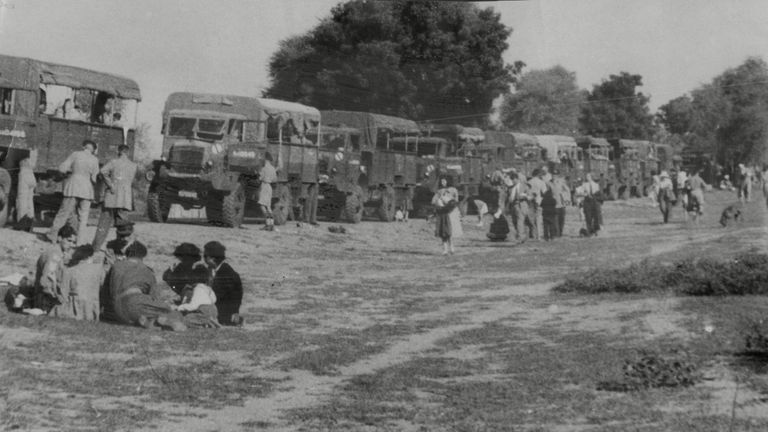
Kashmiris mark 1947 murder of 200,000 Muslims by Hindu extremists
Press TV – November 6, 2022
Kashmiris on both sides of the Line of Control (LOC) are marking the 75th anniversary of the day when hundreds of thousands of Muslims were killed in the Jammu region.
More than 200,000 Muslims were systematically killed by Hindu extremists when they were migrating to Pakistan.
The All Parties Hurriyat Conference (APHC) leaders on Sunday paid tributes to the memory of those killed.
Detained senior APHC leader Shabbir Ahmad Shah, in a message from New Delhi’s Tihar Jail, said the massacre of Muslims was the most horrible incident of Kashmir’s history that continues to haunt the regional people.
Other APHC leaders, in a joint statement, said the Kashmiris “will always remember the great sacrifice of the Jammu martyrs”.
“The Kashmiris have been rendering sacrifices for a great cause for the last several decades and the day is not far when they will achieve their cherished goal,” the statement said.
They also urged the international community to press India to stop its “brutalities” in Kashmir and settle the dispute in accordance with the aspirations of its people and the relevant UN resolutions.
Between October and November in 1947, the majority of Muslims living in Jammu, Kathua, Reasi and Udhampur were uprooted from their homes during the days the genocide took place.
The crimes that were committed during that week included abduction and rape of Muslim women, mass slaughtering of Muslims including children and stealing of personal belongings.
In one of the many incidents that took place during that week, it was announced by the beat of the drum for all Muslims to assemble at the parade ground in Jammu.
They were later loaded on motor lorry convoys to be sent to Suchetgarh in India, but instead they were driven to Kathua road of the Jammu region and told to get off, after which they were killed by the Hindu forces that escorted them.
Jen Psaki says censorship deposition would be “burdensome” for her family life and new MSNBC gig
By Dan Frieth | Reclaim The Net | November 6, 2022
Jen Psaki, the former White House press secretary, and Department of Justice (DOJ) are fighting a subpoena requiring her to testify in the lawsuit filed by Missouri and Louisiana attorneys general – alleging that the Biden administration colluded with social media platforms to censor certain viewpoints on the pandemic.
The motion to quash the subpoena was filed in a federal court in Virginia. It argues that the deposition would be “extremely burdensome” for Psaki, who is preparing to be the host of a new show on MSNBC.
We obtained a copy of the motion for you here.
“Among other things, I understand that I would need to devote several days preparing for the deposition, as well as attending the deposition itself, and that would be highly disruptive to both my work and my family,” Psaki wrote in the request.
Psaki has in the past admitted that the Biden administration was flagging people’s speech to social media platforms.
The DOJ argued that Psaki’s deposition would result in a debate over executive privilege considering she was a top adviser to President Joe Biden.
The DOJ lawyer said: “If permitted to proceed, the deposition of Ms. Psaki would inevitably set the Executive and Judicial Branches ‘on a collision course’ through adjudications of executive privilege, thrusting the court into ‘the awkward position of evaluating the Executive’s claims of confidentiality and autonomy,’ and ‘difficult questions of separation of powers and checks and balances’ would quickly be pushed to the fore.”
“Plaintiffs have not identified any evidence showing or even suggesting that Ms. Psaki ever communicated with any social-media company in her capacity as Press Secretary about misinformation, much less that she ‘exercised coercive power’ to compel a social-media company to take any action,” the DOJ added.
Other defendants that have tried to use a similar “burdensome” defense have already been shut down by District Judge Terry Doughty who said, “The Court finds that both the public interest and the interest of the other parties in preserving free speech significantly outweighs the inconvenience the three deponents will have in preparing for and giving their depositions.”
Featured Video

or go to
Aletho News Archives – Video-Images
From the Archives
The Forgotten Terrorist Pretext of the Vietnam War
By Jim Bovard | The Libertarian Institute | February 16, 2023
Since 9/11, terrorism has become the ultimate entitlement program for America’s political elite. Whether it is illegally spying on Americans or blowing Somali dissidents to pieces, invoking terrorism provides all the cover needed for Washington policymakers. But the disastrous results of granting politicians a blank check to fight terrorism should have been undeniable almost 60 years ago.
Back in the 1960s, terrorism was what the communists did. Anti-terrorist moral fervor and ideological blinders propelled the U.S. into its biggest foreign policy blunder since World War II. … continue
Blog Roll
 Aletho News
- LAPD Pilot Will Track Vehicles In San Fernando Valley
- Britain’s Online Censorship Law Now Comes With a Crisis Plan for Your Posts
- NATO’s “Nordic model” brings Arctic confrontation closer to Russia’s nuclear bases
- Using nuclear weapons, the US-Israeli alliance still can’t beat Iran
- Sunset on the Quality of Western Propaganda: Arrival of the Dr Strangelove Moment
- Ukrainian general accused of protecting crime bosses
- US-‘Israel’ alliance faces growing rupture after midterms
- GOP’s Crushing Midterm Loss Could Reshape US Political Landscape – Analyst
- Midterm loss gives Congress power to rein in US war on Iran
- Midterms Were ‘Vote of No Confidence’ in GOP, But Iran Has No Illusions About Democrats – Marandi
- If Americans Knew
- An error has occurred; the feed is probably down. Try again later.
- No Tricks Zone
- New Study: The Net Fossil Fuel Contribution To Rising Atmospheric CO2 Has Been Zero For 500 Years
- Germany’s Green Energy Transition Becoming Increasingly Expensive…Another 6 Trillion Euros!
- Sudden Stratospheric Warming, Powerful El Niño Combination May Lead To Extreme Europe Cold, Energy Crisis!
- Two New Studies Find Thwaites Glacier Melt Cannot Be Driven By Human Activity Or A Warming Ocean
- E-Cars Reduce CO2 Emissions By Only 41% Compared To Internal Combustion Engine Vehicles
- Predictions Made By Renowned Climate Professor Over Past Decades Have Been Proven To Be Poor
- New Study Suggests Large Regions Of The Pacific Ocean Have Been Cooling For The Last 80 Years
- Germany’s Green Energy Debacle: High Energy Costs Force Kahla Porzellan to Close After 182 Years!
- New Study: 50 Years Of The Most Aggressive ‘Net Zero’ Policies Can Only Affect The Global Climate By 0.03°C
- US September “Heat” Was No Record…Many Records Set Decades Ago

