Another Extraordinary Murder in Washington D.C.
Mary Mahoney was allegedly the victim of a botched robbery in the Georgetown Starbucks

Mary Mahoney, murdered on July 7, 1997
By John Leake | Courageous Discourse | November 6, 2022
When Seth Rich was murdered in Washington D.C. on July 10, 2016, the Metropolitan Police Department immediately proposed that it was a “botched robbery.” The case reminded me of the murder of Mary Mahoney in a Georgetown Starbucks on July 7, 1997.
Mary Mahoney was an intern in Bill Clinton’s White House during his first term. She then got a job working as a manager of Starbucks in Georgetown, which was frequented by many notable figures in the Washington political establishment. Her murder (along with her two coworkers) was the first triple murder in the neighborhood’s history. Prior to the crime, not a single homicide had been committed in Georgetown for eighteen months.
Robbery appeared an unlikely motive, as none of the day’s cash proceeds had been taken from the store. Mahoney’s murder occurred during the same period that Newsweek reporter Mike Isikoff was investigating allegations that President Clinton had sexually harassed White House employees—an investigation that would ultimately lead him to Monica Lewinsky. Attorneys for Paula Jones were also seeking corroborating cases of Clinton’s sexual harassment of young women.
A year after the murder occurred, the police received a tip to examine a man named Carl D. Cooper from a woman who had just watched an America’s Most Wanted episode on the triple homicide. For several months, investigators found no evidence linking Cooper to the crime. Then another informant came forth—a former drug addict named Eric Butera, who was himself later murdered in “a robbery gone wrong.”
Based on information gleaned from Butera’s associates, Carl Cooper was arrested. After a grueling four-day interrogation, Cooper confessed, stating that the triple homicide was a “botched robbery” (which just happened to be the official working hypothesis). While held at gunpoint, Mary, refused to give Cooper the keys to the safe—a heroic act to save her 50 billion market cap employer from losing a few thousand dollars. Because Mary refused to give Cooper the keys, he shot her five times, including a shot to the back of the head. He then shot her two coworkers, and then left the store without taking a dime.
Cooper was convicted on the grounds of his confession to the Metropolitan Police. However, in a subsequent interview with an FBI investigator, Cooper recanted his confession. Although the FBI investigator unequivocally stated this in his testimony, the court concluded that Cooper’s initial confession was sufficient for his conviction. Cooper was initially represented by a court-appointed attorney, but after his trial began, his court-appointed attorney was joined by the prominent Washington D.C. defender, Francis D. Carter, who initially represented Monica Lewinsky when Monica stated her willingness to remain silent about her affair with Clinton. Carter drafted an affidavit for Monica in which she stated that she had NOT had an affair with the president. Carter was forced to withdraw this affidavit after Monica made statements to Lynda Tripp (equipped with a secret recording device) confirming her affair with Clinton.
That Carter joined the Carl Cooper defense team strikes me as very peculiar, especially given that Carter did not change the defense strategy. I wonder if Carter’s primarily job was—under cover of client-attorney confidentiality—to deliver a message to Carter pertaining to his sentencing prospects and what he might reasonably expect for his wife (to whom he was apparently very attached) if he stuck with his confession.
Clinton Attorney General Janet Reno initially sought the death penalty for Cooper— the first death-penalty matter brought to trial in the District in nearly 30 years, but federal prosecutors later withdrew this request. To date, no evidence has been found linking Cooper to the triple homicide.
In a related case, the District of Columbia was successfully sued for the wrongful death of Metropolitan Police informant, Eric Butera, as the jury concluded the police had been negligent in protecting him during an undercover operation to obtain more information about the Starbucks triple slaying. The woman who gave the initial tip to America’s Most Wanted later publicly accused the police of refusing to protect her and fell under suspicion for being motivated primarily by the reward money offered by the show.
Since the murders occurred, the crime has been the subject of extensive media coverage, several documentary television features, and hundreds of online commentators. Conventional newspaper coverage of the crimes—primarily conducted by the Washington Post and the Washington Times—consisted entirely of straightforward reporting of information provided by police and judicial officers.
Given the controversial nature of the police investigation and judicial proceedings against the man who was charged for committing the crime, it is surprising how little the mainstream media questioned official accounts. Likewise, the TV documentaries simply presented narratives provided by law officers as though they contained nothing that was questionable. This is particularly notable given that substantial details of the official narrative, provided by the same investigating officers, are represented differently in different documentaries. Moreover, some of officers’ statements in the documentaries pertaining to Starbucks procedures and security protocols are NOT consistent with what a veteran Starbucks manager told me.
I would like to interview Carl D. Cooper in prison, but I cannot find him in the federal prison system. Though I have not had the time and resources to dig deep into this component of the story, my preliminary research suggests that his whereabouts in the federal prison system have been concealed.
In 2016, the lead homicide detective in the Mary Mahoney case — Detective James Trainium — published a book titled How the Police Generate False Confessions. It’s a detailed examination of how the police obtain false confessions, and the author is clearly writing from personal experience.
An Extraordinary Unsolved Murder in Washington D.C.
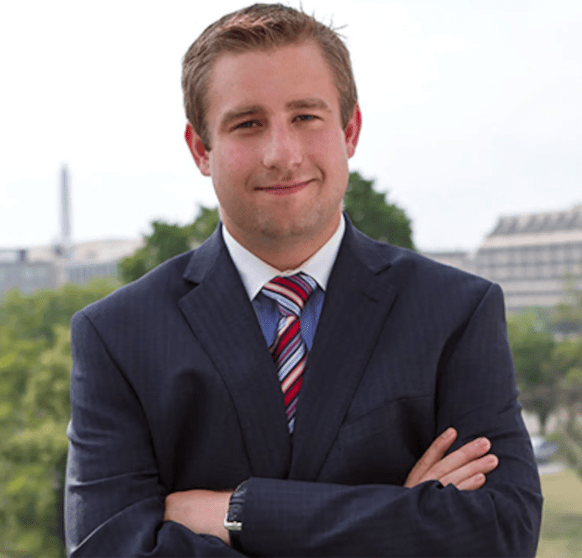
In the matter of SETH RICH, the FBI asks for 66 years to release his laptop contents Nov 5 DNC Staffer Seth Rich, murdered on July 10, 2016
By John Leake | Courageous Discourse | November 5, 2022
“A popular government without popular information or the means of acquiring it, is but a prologue to a farce or a tragedy or perhaps both.” —James Madison
As an investigative author I’ve often dealt with the extreme frustration of making federal Freedom of Information Act (FOIA) requests and state Open Records Act requests. So often, it seems that federal and state agencies don’t want to release the information, delay in responding, and then cite multiple exceptions to the law in order to justify keeping the information secret.
I therefore felt sympathy for my fellow Texan, Brian Huddleston, when I saw the recent Epoch Times report that his FOIA request for the information found on Seth Rich’s laptop is being thwarted by the FBI, which asked the judge who ruled in Huddleston’s favor to grant the Bureau 66 years to fulfill the request.
Readers of this Substack may find the FBI’s request reminiscent of the FDA’s request for 55 years to release COVID-19 vaccine data. Given the unfortunate reality of human mortality, one wonders what public interest will be served 55 or 66 years from now, apart from satisfying the curiosity of historians who aren’t yet born.
The murder of Seth Rich—in the middle of one of the most brutal presidential election years in history—has always struck me as an example of the authorities NOT investigating a matter of public interest. The mainstream media and half the country were so blinded by partisan passions that they couldn’t see the grounds for suspecting that the young man’s murder was politically motivated. Just a few hours after the incident occurred—before there was any time to perform an investigation—the Metropolitan Police Department announced that the murder appeared to be a “botched robbery.”
Since Seth Rich was murdered on July 10, 2016—12 days before Wikileaks published embarrassing DNC e-mails—there has been much speculation that he could have been the source because he was upset about how the DNC had treated Bernie Sanders. A good investigator wouldn’t speculate about the crime, but he would certainly notice that, statistically speaking, the murder is extraordinary.
Seth Rich was shot in the back near his apartment building, and though he was carrying a valuable watch, wallet, and cell phone, these were not taken by the assailant. Perhaps it was a botched robbery, as the Metropolitan Police Department quickly announced, but shooting a guy in the back without taking his valuables is not typical of armed robbery. Other robberies in the same neighborhood around the same time followed the conventional pattern of the assailant threatening the victim and demanding his or her valuables instead of opening fire on the victim.
In the year 2016, there were 135 homicides in Washington D.C., which has a resident population of 672,000, which comes to approximately one murder per 5000 residents— a dramatic decline from the city’s murder rate in the early nineties. Incidentally, the Metropolitan Police conducted an analysis of homicide for the years 1998-2000—after homicide rates had dropped significantly—and concluded that the primary motives were
1) Argument/conflict
2). Drug related
3). Revenge/retaliation
4). Robbery
5). Gang related.
During this period, homicides were not equally distributed throughout the city, but were concentrated in particular neighborhoods. 92% of the victims were African Americans 3.2% were Hispanic and 3.2% were white. Though one must consider the possibility that homicide trends in DC have changed since 2000 (apart from merely decreasing in numbers) it’s notable that, of the currently unsolved homicides in Washington DC in the year 2016, Seth Rich is the only white victim in a city that is now 44% white.
Julian Assange has always insisted the DNC e-mails were leaked and not hacked. Former NSA technical director William Binney has also insisted that if the DNC e-mails were hacked, it would be child’s play for the NSA to establish the precise routing of the hack, which indicates that the e-mails were more likely leaked by an insider.
Regarding motive, a good investigator would consider the hypothesis that Seth Rich was murdered NOT in retaliation, but to eliminate him as a witness that the DNC e-mails were leaked by an insider and not hacked by Russians. Almost immediately after the embarrassing e-mails were published, the DNC vehemently proclaimed it was Russian hackers who were responsible, though no evidence has been presented to support this accusation.
Regarding the assailant: A good investigator would consider the hypothesis that he was contracted to murder Rich but knew nothing about his target or the motive for killing him. This hypothesis is consistent with Rich being murdered as he approached the entrance to his home—that is, the contract killer was provided only with the address and a photograph of his target.
Another notable aspect of this crime has been the extremely emotional tone of press reporting from the same reporters who so passionately embraced the Russian meddling story. The mere suggestion that Seth Rich’s murder was politically motivated prompted these same people to angrily denounce this (perfectly reasonable hypothesis) as “wild, right wing conspiracy theory” and to demand that reporters cease and desist from exploring this hypothesis.
And yet, given that the crime remains unsolved, why not explore this hypothesis?
UN votes overwhelmingly to rid Israel of nuclear weapons
Free West Media | November 6, 2022
The United Nations General Assembly was unequivocal: With 152 votes to 5, Israel’s nuclear arsenal was condemned by a vast majority of countries. Although Tel Aviv has never officially acknowledged its nuclear capability, experts believe it has at least 90 nuclear warheads, and perhaps many more.
On October 28, almost 80 percent of all UN member states adopted a resolution that called on Israel to give up its nuclear weapons, join the Non-Proliferation Treaty, and allow the International Atomic Energy Agency (IAEA) to inspect its nuclear facilities. The resolution, document A/C.1/77/L.2, was titled “The risk of nuclear proliferation in the Middle East”.
It was adopted in the 25th plenary meeting of the UN General Assembly’s First Committee, which is focused on disarmament and international security.
The five countries that voted against the measure were the United States and Canada, the small island nations of Palau and Micronesia, and Israel itself. Some 24 members of the European Union, NATO allies, and India abstained.
The resolution urged Israel “not to develop, produce, test or otherwise acquire nuclear weapons, to renounce possession of nuclear weapons and to place all its unsafeguarded nuclear facilities under full-scope Agency safeguards as an important confidence-building measure among all States of the region and as a step towards enhancing peace and security”.
It was introduced by Algeria, Bahrain, Comoros, Djibouti, Egypt (on behalf of the Arab League), Iraq, Jordan, Kuwait, Lebanon, Libya, Mauritania, Morocco, Oman, Qatar, Saudi Arabia, Somalia, Sudan, Tunisia, the United Arab Emirates, Yemen, and the UN-recognized state of Palestine.
In 2019, the United States and Israel were the only countries that voted against UN General Assembly draft resolutions calling for establishing a nuclear weapons-free Middle East, preventing an arms race in outer space, and ending Washington’s illegal six-decade blockade of Cuba.
Iran Unveils New Air Defense Missile
Al-Manar – November 6, 2022
A new solid-propellant missile paired with Iran’s homegrown air defence system ‘Bavar-373’ was unveiled on Sunday.
The new missile, dubbed ‘Sayyad 4B’, has a range of 300 kilometers.
In a recent test, the Bavar-373 air defence system successfully hit a target at a distance of over 300 km with the new missile.
The Iranian air defence system managed to detect the target at a range of more than 450 kilometers with its optimized radar and tracked the target at a distance of around 405 km before detonating it with Sayyad 4B.
Sayyad 4B missile’s engine runs on hybrid solid fuel and has undergone an operational test for the first time.
The new breakthrough has increased the range of the detection radar of Bavar 373 from 350 to 450 km, while its tracking radar’s range has risen from 260 to 400 kilometers.
The employment of Sayyad 4B also means that the range of the Iranian air defence system missiles has been extended to 300 km and the altitude of engagement has increased from 27 to 32 km.
Iranian military experts and technicians have in recent years made great headway in manufacturing a broad range of indigenous equipment, making the armed forces self-sufficient in the defence sphere.
Iran maintains that its military might poses no threat to regional countries, stressing that the Islamic Republic’s defence doctrine is entirely based on deterrence.
Over 50,000 People Taking Part in Protests Against Government in Moldova
Samizdat – 06.11.2022
KISHINEV – Mass demonstrations organized by Moldova’s opposition Sor Party are taking place in the country’s capital of Kishinev on Sunday, with over 50,000 people trying to get to the city’s center to demand snap parliamentary elections, Sor member Dinu Turcanu said.
Since September 18, regular demonstrations have been taking place across Moldova, gathering thousands of Sor supporters from all parts of the country to protest against the government.
The organizers said that the police were trying to prevent protesters from getting to Kishinev’s center, cordoning off the city’s central square.
“Over 50,000 people came here to peacefully exercise the right to express their opinion. The police violate our right for freedom of expression. The regime of [President] Maia Sandu is afraid of people’s protests,” Turcanu said.
Demonstrators brought Moldovan flags, funeral wreaths and white chrysanthemums, which they threw at the police cordon blocking Kishinev’s central square.
Moldova’s opposition has repeatedly accused the government of failing to cope with the economic crisis amid record inflation of 33.5% and deteriorating living standards. The country’s leadership has also been criticized for its unwillingness to negotiate better gas prices with Russia and for putting political pressure on opponents.
On Wednesday, the Moldovan Anticorruption Prosecutor’s Office said that it had conducted an investigation and searched the central office of the Sor party in Kishinev. Eight people were detained on suspicion of complicity in the party financing by an organized criminal group.
How Doctors and Nurses Betrayed Patients – and Themselves
Dr. Vernon Coleman | 21st Century Wire
NOTE: This article was first published over two years ago – on 12.7.20. Sadly, it remains perfectly valid today.
A growing number of doctors and nurses appear to be waking up and questioning the absence of any science behind the coronavirus hoax.
That’s very nice, and I congratulate them.
But what the devil took them so long?
Why did they wait so long to speak out?
Their silence betrayed their patients, their profession and themselves.
Only a complete moron could have thought that this manufactured ‘crisis’ necessitated the closure of hospitals and GP surgeries.
How could doctors stand by seeing cancer patients deprived of essential treatment? The NHS should have been stoned not clapped.
There was never any greater risk than there is with the flu every year.
Indeed, the figures show that the ordinary flu bug has always posed a much bigger risk than the coronavirus.
So far this year the coronavirus has affected 10 million people worldwide.
The flu can affect 1 billion people in the same period.
And the mortality rates for the two are almost identical.
We don’t close down hospitals and clinics whenever the flu appears.
So, obviously, this was a politically motivated closure of hospitals, shops, businesses and so on. And doctors should have seen that.
And just as the closure of hospitals will result in far more deaths than covid 19 so the wearing of masks will result in far more deaths than could possibly be saved. Wearing a mask reduces blood oxygen levels. I have seen car drivers with masks on. I’ve even seen bus drivers wearing masks. These things reduce blood oxygen. There will, before long, be a disaster with a bus crashing because the driver was wearing a mask and became hypoxic.Why else do you think governments everywhere admit that people with respiratory or heart problems don’t have to wear a mask?
And the stupid rules about social distancing were never justified. There was never any science to support them.
Anyone who believes in the twin heresies of social distancing and masks is, by definition, either certifiably insane, a cretin or on the dark side of the human race. Most are left wing, pro EU fascists and believers in the climate change nonsense.
Doctors and nurses who are now waking up to the fact that they’ve been tricked are claiming that they were told that if they spoke out they would be punished.
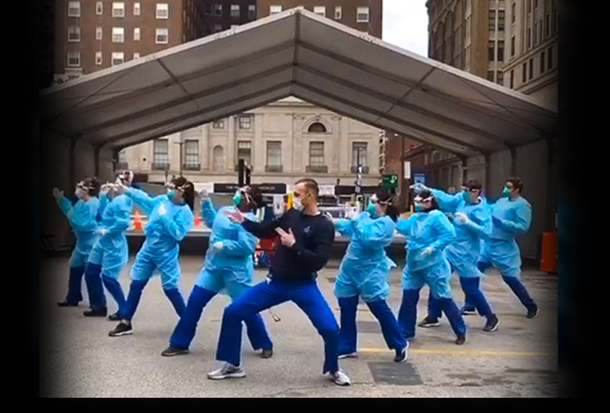
DANCING NURSES: In 2020, exhibitionist medical staff in the US, UK, Australia, New Zealand and Canada took to social media and proceeded to make a mockery of a locked-down populace who were ordered to stay at home to in order to ‘save the healthcare system from being overloaded.’
Well, it’s true that the authorities are punishing doctors who dare to question the official line. I know of a doctor in the UK who was struck off the medical register for questioning the coronavirus story. And in the USA Dr Scott Jensen, a doctor who is also a state senator, is being investigated for making statements about the similarity of the coronavirus to the flu and about the way death certificates were being signed.
And it is also true that simple and effective remedies have been banned or demonised simply so that we could all be prepared for the vaccine.
But if most of the doctors in a big hospital spoke out no bureaucrat would dare to strike them all off the register. If 500 doctors stood up for the truth it would be impossible to take away all their licenses.
`I work in a hospital,’ wrote one brave NHS employee. ‘So far none of the nurses, doctors or domestics has been off sick. And patients with the coronavirus are transported all around the hospital, to X-ray, to CT scan and to the ward and yet mysteriously no one gets infected.’
What sort of spineless people are working in health care these days? That’s the sort of excuse popular with lesser war criminals.
Still, looking on the slightly bright side, some of them are waking up and now realise that the coronavirus hoax was exactly that – a piece of political trickery, conceived and executed by people with hidden agendas. The damage done by the hospital closures will be massive. And the mental issues caused by the fear will be long-lasting – even permanent. Millions are suffering from severe depression as a result of the lies that have been told. Suicide rates are going to rocket.
Any doctors who are still social distancing and wearing masks outside the operating theatre should be ashamed of themselves. They, like much of the rest of the population, have been made fools of and if they had any professional pride left they would be red-faced, embarrassed by their own gullibility and ashamed of how easily they’ve been made part of a wicked conspiracy and made to look like fools.
Now is the time for the medical and nursing professions to stand up and to demand some answers and explanations from the leaders of their professions and from the administrators who gave the orders which have led to tens of thousands of unnecessary deaths.
They should also insist that hospitals are now opened fully, and that patients are told that there is nothing to fear.
For although a growing number of doctors now realise that the coronavirus scare is hoax there are still hospitals and administrators who are behaving as though we were in the middle of an outbreak of the bubonic plague.
The latest piece of lunacy in the NHS is for the people in charge to suggest that patients who want treatment at an Accident and Emergency department should telephone and make an appointment.
NHS England’s national medical director has reportedly told the House of Commons health and social care committee that the health service wanted patients to telephone first and be given a timed slot to attend the A&E department.
I’ve heard everything now.
Patients who are desperate for help, bleeding, in pain, with bones sticking out at funny angles will be expected to telephone and make an appointment to be seen in the accident and emergency department. Triage will, it seems, now be done by teenagers on the telephone. What qualifications will they have? GCSE in woodwork, perhaps?
Distraught relatives will have to telephone and fix an appointment before going to the hospital. Is the plan simply to kill more patients? Did the hospital closures not kill enough?
I will tell you what is going to happen.
Everyone is going to ring for an ambulance. And who can blame them?
As for hospitals, well even the Royal College of Physicians admits that many NHS services will not get back to full capacity for more than a year.
Millions of patients will wait too long. Patients in pain will have to wait for more than a year for treatment. Waiting times will be obscenely long. Tens of thousands will not be seen until it is too late. Tens of thousands of people who could have lived will die.
Around the world the death toll from the hoax will be measured in millions.
Comparatively few will have died of the coronavirus.
The vast majority will have died because they were shut out, abandoned or too frightened to seek help.
And the medical and nursing professions have to take responsibility for all that pain, that sorrow and those deaths.
Doctors should not have accepted the unscientific gibberish behind the coronavirus hoax. Before allowing hospitals to be shut down they should have asked questions. It was never difficult to see that mistakes were being made.
Doctors and nurses betrayed their patients and their professions but they also betrayed themselves.
Too many were happy to accept the weekly applause and the praise when they knew that they deserved neither.
It is time now for the healing professions to make amends.
They should make it clear to the administrators and the politicians that they are no longer prepared to accept the coronavirus nonsense.
They should demand their government’s medical advisors be sacked. They should demand that all members of the elite, medical establishment be sacked too.
They should demand that social distancing be abandoned and that masks should be burned.
They should tell the public that there is nothing to fear.
And they should be prepared to work long hours to clear the backlog of patients as quickly as possible.
There really is no choice.
If doctors and nurses do not stand up then they will be truly unworthy.
This article was originally a script for a YouTube video in July 2020. The video was taken down almost as quickly as it was put up.
Vernon Coleman’s book Coleman’s Laws: Twelve Essential Medical Secrets Which Could Save Your Life is available as an eBook and a paperback on Amazon. His book Superbody: How to Boost Your Immune System is also available as a paperback and an eBook.
Media identifies major beneficiary of Ukraine crisis

RT | November 5, 2022
Yahoo News has identified a major beneficiary of the Russia-Ukraine slugfest: the US military industrial complex, which is reaping a windfall even as the bloody conflict causes economic havoc, energy shortages and a looming food crisis around the world.
As the media outlet reported on Saturday, EU nations have committed to about $230 billion in new weapons purchases since the Russian military offensive against Kiev started in February. US defense contractors are poised to land the lion’s share of those orders, given their dominance as suppliers to European militaries, Yahoo added.
Many European nations turn to US arms makers for more than half of all their weapons purchases. Yahoo cited data from the Stockholm International Peace Research Institute (SIPRI) to show examples of US dominance in European arsenals. For instance, US-made arms accounted for 95% of the weapons purchases by the Netherlands from 2017 to 2021. The ratios were 83% US weaponry for Norway, 77% for the UK, and 72% for Italy.
European weapons imports jumped 19% during the five-year period as then-President Donald Trump prodded his NATO allies to meet their obligations for defense spending. The Ukraine crisis is set to create an even bigger windfall, as President Joe Biden leads an international campaign to flood Ukraine with weapons and the conflict triggers accelerated steps by European nations to bolster their own defenses.
“This is certainly the biggest increase in defense spending in Europe since the end of the Cold War,” Ian Bond, director of foreign policy at the Center for European Reform, told Yahoo. The crisis in Eastern Europe dispelled the notion that war on the continent is no longer possible, he added. “They’re waking up to the fact that not only is it very possible, but it is happening, and it’s happening not that many miles away from them.”
Since Biden took office in January 2021, European countries entered at least the initial stage of negotiations for $33 billion in arms purchases, including $21 billion since February, Yahoo said, citing figures from the Quincy Institute for Responsible Statecraft.
US defense contractors will also benefit from Washington’s massive military aid to Kiev, as the Pentagon races to replenish stocks of artillery pieces, rocket launchers and other weapons. Biden has set aside more than $65 billion in military and economic aid for Ukraine since the conflict began.
Russia has warned that the influx of Western weapons will prolong the crisis while making the US and other NATO members de facto participants.
READ MORE:
NYC Apartment Fire Caused by Electric Bike Battery Injures Nearly 40 People
Samizdat – 06.11.2022
The fire was caused by a lithium-ion battery which power micro mobility devices like electric scooters, bikes, and hoverboards. The New York Fire Department (FDNY) reported that they found five electric bikes in the fire.
At least 38 people were injured in a fire on the 20th floor of a New York City apartment building on Saturday. City officials said that a majority of the victims suffered from smoke inhalation, while two victims were left in critical condition.
The fire erupted on Saturday on the 20th floor of a high-rise apartment complex at 429 East 52nd Street in Manhattan at about 10 AM. Firefighters found five electric bikes as the source of the fire, and wrote on social media to remind the public of the dangers of lithium-ion batteries.
“The cause of this fire is a lithium ion battery which is meant to power a micro mobility device. This is our 200th fire this year caused by lithium ion batteries from micro mobility devices. The fire was right behind the front door, we recovered at least five bikes from the apartment. We want to stress our lithium ion safety tips,” said Daniel Flynn who is the Chief Fire Marshal of the FDNY, who adds that at least six people have died due to lithium ion battery fires this year.
Authorities believe someone in the apartment was repairing the electric bikes and are investigating the resident’s business activity. The FDNY added that fire protection and planning at the building will also be investigated.
“The alarm didn’t go off, but it seemed like everyone got the memo and started going out,” said a 26-year-old resident of the building.
“I run down the stairs, and as I’m running out on the courtyard, the window bursts and glass flies around as I’m on the phone with my mom screaming for my life,” said a 23-year-old resident of the building, who said she only first became aware of the fire after smelling smoke from the fire.
A video captured and posted to social media shows firefighters hanging by ropes from a window as they attempt to rescue a woman from the 20th floor of the building.
“What we saw today was our training, our team work, and our absolute dedication,” said Frank Leeb, the Deputy Assistant Chief of the FDNY. “From the units that operated up there with the lifesaving rope to passing them off to our exceptionally trained EMS personnel to get these patients all off scene in a matter of a couple of minutes and off to local hospitals.”
“The lithium-ion battery adds a different degree when we talk about the fire dynamics of it,” Leebs added. “These rooms flash over in just a mere matter of seconds.”
Second wave of refugees leave Lebanon as repatriation process continues
The Cradle | November 5, 2022
A new group of Syrian refugees left Lebanon on 5 November under protection from the Lebanese Armed Forces (LAF) and the Directorate of General Security, as part of the current repatriation process carried out between Beirut and Damascus.
The refugees departed for Syria from the northern Lebanese border town of Arsal. This is a continuation of the process, after the first wave of 1,200 Syrian refugees left Lebanon on 26 October.
Syrian media reported that the refugees began to arrive in buses via the al-Dabousiyah border crossing, and will be returning to their homes in the areas formerly under the control of extremist groups.
Lebanon’s Directorate of General Security is continually processing the submitted requests of Syrian refugees who wish to return to their country.
On 25 October, the head of General Security, Major General Abbas Ibrahim, emphasized during a press conference that the repatriation process is fully voluntary, and will not “force any displaced to return” to Syria.
Ibrahim added that Lebanon only seeks to reduce the social and economic burden it carries, and made sure to reject the unsupported western claims that the repatriation process is involuntary.
Last month, a source told The Cradle that the Syrian government has been very cooperative in the process of repatriating the refugees, but that it “will take a lot of time and effort” before it is completed.
The source added that the western-led international community “does not agree” with this repatriation process and has so far “refused to help.”
The western disapproval and accusations of forced repatriation reinforce the belief held by some people that western countries, most notably the US, wish to prevent Syrian refugees from resettling in their country in order to maintain instability in Syria.
In November of last year, Lebanon’s Foreign Minister, Abdullah Bou Habib, said: “We are facing some difficulties from the West because they say that they do not want these refugees to return to Syria for reasons related to their position on the Syrian government.”
Some States Say ‘No’ to Coronavirus Shots Mandate for Students Despite CDC’s Childhood Vaccine Schedule Change
By Adam Dick | RonPaul Institute | November 2, 2022
In October, a Centers for Disease Control and Prevention (CDC) advisory committee voted to add yearly experimental coronavirus “vaccine” shots to the CDC’s childhood vaccine schedule. Many state governments have a history of looking to this CDC schedule to guide their imposing of shots mandates for students.
Which states will follow along to mandate the newly added shots? As we start the month following the committee’s vote, it is good to take a look across the country to see what different state governments have done to protect against or welcome the CDC schedule’s addition of these yearly shots that have proven to be neither safe nor effective and that are asserted to target a threat that has been long known to pose a miniscule risk of serious sickness or death for children. Young adults in college have also tended to be at very low risk, though you wouldn’t know it from the draconian policies many universities imposed in the name of countering coronavirus.
Compounding the absurdity and detestability of including the coronavirus shots in the CDC’s childhood vaccine schedule is that the much-hyped coronavirus that people were worried about during the coronavirus scare is long gone. What is not gone is the risk of serious sickness or death from the shots.
Florida Surgeon General Joseph Ladapo advised well when he posted the following at Twitter last week:
Parents, don’t hold your breath… CDC & FDA abandoned their posts. Keep sticking with your intuition and keep those COVID jabs away from your kids.
Unfortunately, when faced with a shots mandate for school attendance, many parents may, against their better judgment, give in to the pressure and authorize their children being given the shots. Older students at universities that have more commonly imposed coronavirus shots mandates since last year have faced similarly terrible pressure to take the shots.
The good news is that, according to tracking by the National Academy for State Health Policy (NASHP), 21 state governments have taken at least some action to prohibit mandating coronavirus shots for students. Still, even where state governments have taken action against mandated coronavirus shots for students, there is in many cases room to make that protection against pushing these shots on students both stronger and broader.
Check out NASHP’s map of America where you can see information regarding states standing up against or supporting mandated coronavirus shots for students. Put the cursor over a state to find out some details regarding a particular state’s policy on mandating the shots.
Copyright © 2022 by RonPaul Institute.
How the US regime attempts to control public perception of its aid to Ukraine
By Scott Ritter | RT | November 5, 2022
NBC News has reported that, according to four people familiar with the incident, a phone call between US President Joe Biden and his Ukrainian counterpart, Vladimir Zelensky, turned testy after the Ukrainian leader pressed Biden for more assistance.
On June 15, Biden called Zelensky to inform him of the recent release of some $1 billion in assistance (this included the drawdown of arms and equipment from US Department of Defense inventories valued at $350 million, and $650 million in additional assistance under the department’s Ukraine Security Assistance Initiative). This type of person-to-person communication had become commonplace since Russia’s decision to send troops into Ukraine in February 2022, with Biden informing Zelensky of each major assistance allocation in a program that had, as of June 15, seen the dispatch of some $5.6 billion in American military aid.
This time, however, rather than thank the US president, as had been the previous practice, Zelensky proceeded to ask for more assistance, citing specific requests for equipment that had not been included in the June allocation of aid. At this point, NBC’s sources say, Biden lost his temper. “The American people were being quite generous, and his administration and the US military were working hard to help Ukraine, he said, raising his voice, and Zelensky could show a little more gratitude,” the NBC story reports.
According to NBC, the source of Biden’s anger went beyond the lack of gratitude shown by Zelensky (NBC reports that the two leaders have since warmed to one another), but rather the growing realization on the part of the Biden White House that support for the blank check being written for Ukraine’s war effort is waning among members of Congress on both sides of the aisle. With the Republicans expected to retake control of the House of Representatives and positioned to do the same in the Senate in the upcoming mid-term elections, the Biden administration appears poised to try to squeeze out another $40-60 billion in aid during the lame duck session between the election and when the present term of Congress expires next January. It is expected that this new aid package will be challenged by the Republicans, who will seek to have its consideration postponed until the new Republican-controlled Congress is sworn in.
Shortly before NBC News broke the story of the contentious Biden-Zelensky phone call, The New Yorker ran a glowing review of the state of US-Ukrainian military cooperation. Entitled ‘Inside the US Effort to Arm Ukraine, the piece, authored by Joshua Yaffa, a contributing writer for the magazine, provides an expansive and yet intimate look at the complex interaction between the US and Ukraine about not only the provision of military equipment, but also the active cooperation between US and Ukrainian military and intelligence officials concerning the actual conduct of the conflict, including the provision of targeting data in support of US-provided artillery systems such as the M777 howitzer and the HIMARS multiple rocket launch system.
Its two main messages can be summarized as follows: first, American weapons are helping Ukraine stand up to Russia and showing the world Putin can be defeated, and second, the US is taking every care not to cross any lines that would escalate the conflict into a direct confrontation with Moscow.
Yaffa is an accomplished writer on Russian affairs. His most recent book, ‘Between Two Fires: Truth, Ambition, and Compromise in Putin’s Russia’, has won several prizes, and he has published numerous articles in The New Yorker about the Russia-Ukraine conflict. But even this extensive journalistic record doesn’t prepare one for the scope and scale of the sources Yaffa was able to draw upon in writing his most recent article. It is a ‘who’s who’ of US and Ukrainian officialdom, both named and unnamed, all of whom are well positioned to provide Yaffa with the kind of inside information that makes his article so attractive, both from an informational aspect, and readability.
On the Ukrainian side, Yaffa interviewed Aleksey Reznikov, Ukraine’s defense minister; Mikhail Podoliak, a top adviser to Zelensky; Aleksey Danilov, Secretary of the Ukrainian National Security and Defense Council; and “a senior Ukrainian military official” close to the commander in chief of the military, Valery Zaluzhny. Ukrainian officials habitually interact with Western journalists as part of their effort to shape the narrative about the ongoing conflict with Russia. The surprise isn’t that Yaffa was able to interview these individuals, but rather what they were willing to open up about – the hitherto obscure details of the sensitive cooperation between the US and Ukraine in the actual conduct of the conflict.
The US is very controlling about the release of information about classified cooperation with other nations. This reticence to be transparent extends not only to the US officials involved, but also to the foreign nationals participating in the secret work. In short, there is no way the three Ukrainians would have agreed to sit down and talk to Yaffa about these issues unless their participation had been green-lighted by the Biden administration beforehand.
The extent to which the Biden administration was behind the decision to cooperate with Yaffa on this story becomes clear upon closer examination of the anonymous sources drawn upon for the article. “A Biden administration official involved in Ukraine policy”; “a senior official at the Defense Department”; “a person familiar with Biden White House discussions of Ukraine”; “an administration official”; “a senior US official”; “a US military official” close to Chairman of the Joint Chiefs of Staff General Milley; “a senior Biden administration official”; and “a senior US intelligence official.”
Numerous other sources, both named and unnamed, were also interviewed by Yaffa.
Anyone with any experience with sensitive national security activities knows that there are two hard-fast truths when it comes to such activities – they are highly classified and compartmentalized, and any unauthorized release of information pertaining to such activities is a serious violation of the law, subject to prosecution and imprisonment for anyone caught leaking such information to the press.
Accordingly, either every source cited by Yaffa had been simultaneously overcome with a Lemming-like desire to jump off a figurative cliff, risking losing their careers and going to prison in order to help the young New Yorker contributing writer pull off the scoop of a lifetime, or the Yaffa article was part and parcel of a Biden administration information operation designed to inject a positive narrative about US-Ukrainian military relations into the mainstream discussion on Ukraine in a concerted effort to shape public perception in the lead-up to the mid-term elections.
My money is on the latter.
Good journalism is all about ‘bottom-up’ reporting, where a reporter conceives a story and then runs it to the ground by seeking out interviews with relevant sources. Stenography is about having a story spoon fed to you by sources for the purpose of serving an agenda that has nothing to do with the pursuit of fact-based truth, but rather shaping public opinion about a matter of importance.
Yaffa’s ‘Inside the US Effort to Arm Ukraine’ is a clever piece of government-dictated stenography disguised as journalism and should be treated as such by all who read it.
Featured Video

or go to
Aletho News Archives – Video-Images
From the Archives
The Forgotten Terrorist Pretext of the Vietnam War
By Jim Bovard | The Libertarian Institute | February 16, 2023
Since 9/11, terrorism has become the ultimate entitlement program for America’s political elite. Whether it is illegally spying on Americans or blowing Somali dissidents to pieces, invoking terrorism provides all the cover needed for Washington policymakers. But the disastrous results of granting politicians a blank check to fight terrorism should have been undeniable almost 60 years ago.
Back in the 1960s, terrorism was what the communists did. Anti-terrorist moral fervor and ideological blinders propelled the U.S. into its biggest foreign policy blunder since World War II. … continue
Blog Roll
 Aletho News
- LAPD Pilot Will Track Vehicles In San Fernando Valley
- Britain’s Online Censorship Law Now Comes With a Crisis Plan for Your Posts
- NATO’s “Nordic model” brings Arctic confrontation closer to Russia’s nuclear bases
- Using nuclear weapons, the US-Israeli alliance still can’t beat Iran
- Sunset on the Quality of Western Propaganda: Arrival of the Dr Strangelove Moment
- Ukrainian general accused of protecting crime bosses
- US-‘Israel’ alliance faces growing rupture after midterms
- GOP’s Crushing Midterm Loss Could Reshape US Political Landscape – Analyst
- Midterm loss gives Congress power to rein in US war on Iran
- Midterms Were ‘Vote of No Confidence’ in GOP, But Iran Has No Illusions About Democrats – Marandi
- If Americans Knew
- An error has occurred; the feed is probably down. Try again later.
- No Tricks Zone
- New Study: The Net Fossil Fuel Contribution To Rising Atmospheric CO2 Has Been Zero For 500 Years
- Germany’s Green Energy Transition Becoming Increasingly Expensive…Another 6 Trillion Euros!
- Sudden Stratospheric Warming, Powerful El Niño Combination May Lead To Extreme Europe Cold, Energy Crisis!
- Two New Studies Find Thwaites Glacier Melt Cannot Be Driven By Human Activity Or A Warming Ocean
- E-Cars Reduce CO2 Emissions By Only 41% Compared To Internal Combustion Engine Vehicles
- Predictions Made By Renowned Climate Professor Over Past Decades Have Been Proven To Be Poor
- New Study Suggests Large Regions Of The Pacific Ocean Have Been Cooling For The Last 80 Years
- Germany’s Green Energy Debacle: High Energy Costs Force Kahla Porzellan to Close After 182 Years!
- New Study: 50 Years Of The Most Aggressive ‘Net Zero’ Policies Can Only Affect The Global Climate By 0.03°C
- US September “Heat” Was No Record…Many Records Set Decades Ago

