Study: Incidence Of Acute Cardiac Involvement After mRNA Booster “800 Times Higher”
By P Gosselin | NoTricksZone | November 2, 2022
“Alarming: 1 in 35 booster patients has lab values indicating acute heart damage.”
That’s the headline of an article by at transparenztest.de.
The finding is based on results by a Swiss observational study by Prof. Christian Eugen Mueller published here.
1 of 35 individuals showed laboratory values indicative of acute cardiac injury after booster mRNA vaccination.
Researchers led by Prof. Christian Eugen Müller of the University Hospital Basel investigated the extent to which cardiac involvement occurs after mRNA booster vaccinations. Heart damage from the mRNA booster shots appears to be a much higher risk than previously thought, the recent findings show.
777 employees of Basel University Hospital, median age 37 years and 69% female, had received booster vaccination. After 3 days, their troponin levels (hs-cTnT) were measured. Troponin is a laboratory value that indicates acute damage to the heart.
Much higher in women
“40 subjects showed elevated troponin levels. In 18 of these cases, other causes were present. The remaining 22 cases corresponded to an incidence of 2.8%. The incidence in women was 3.7% and in men only 0.8%,” reports transparenztest.de. “Most of the subjects had no cardiovascular history. Three days after vaccination, their troponin levels (hs-cTnT) were measured to detect cardiac damage. If levels were elevated, another hs-cTnT measurement and imaging examination followed the next day.”
The surprising results were presented at the 2022 ESC Congress.
It had been previously suggested that such complications were very rare, with an incidence in the range of only 0.0035%. But the new study results suggest it’s far worse.
800 times higher than previously shown
According to Prof. Christian Müller: “The study confirms the hypothesis that the incidence of acute cardiac involvement is higher than thought. At 2.8% it was 800 times higher than in passive observational studies. But now that we need annual booster vaccinations, there could be a lot of vaccine-related cardiac involvement.”
Prof. Christian Müller adds. “From day 3 to day 4, we observed a clear drop in troponin in almost all participants, indicating that this was an acute problem.”
“Alarmingly high”
“The incidence of 2.8% of acute cardiac involvement is alarmingly high,” transparenztest.de warns. “Thus, 1 out of 35 boostered persons shows such values shortly after the mRNA vaccination. Converted, one would have e.g. with 350,000 booster vaccinations consequently 10,000 persons or with 3.5 million 100,000 persons, who show such laboratory values of an acute heart damage.”
Also see: Dr. John Campbell
Canada’s Bill C-11 explained: A chilling law that lets the government censor user-generated content
By Tom Parker | Reclaim The Net | November 3, 2022
Canada’s Online Streaming Act (Bill C-11) is one of several recent attempts by Western governments to crush online speech while claiming that they support free expression.
The bill is being pushed by Canadian Heritage Minister Pablo Rodriguez — a politician who believes that unregulated speech “erodes the foundations of democracy.” And it has the full support of Canadian Prime Minister Justin Trudeau — a world leader who previously said freedom of expression isn’t “freedom to hate.”
The Trudeau regime first attempted to pass a version of this bill in 2020. However, this bill (Bill C-10) failed in 2021 after mass pushback over the way it attempted to censor online speech.
After Bill C-10 died, Pierre Poilievre, the current leader of the Canadian Conservative Party of Canada who was serving as a Member of Parliament (MP) in 2021, warned critics of Bill C-10 to “make sure that we’re ready the next time Trudeau and his team come for our freedom of expression.”
And just one year later, Trudeau and his team did just that by resurrecting Bill C-10 and renaming it Bill C-11.
The bill gives Canada’s communications regulator, the Canadian Radio-television and Telecommunications Commission (CRTC), increased powers to regulate “programs” — a definition that applies to almost all forms of audio-visual content that are uploaded by Canadian citizens.
It will empower the CRTC to set content promotion and demotion rules for Canadian content and require platforms to make financial contributions towards Canadian content.
As with most censorship bills, Bill C-11 uses freedom of expression as a red herring and claims that the bill will be “applied in a manner that is consistent with…the freedom of expression and journalistic, creative and programming independence enjoyed by broadcasting undertakings”
But the bill is so restrictive that even censorship-loving YouTube has warned that the bill will harm creators and creators are considering leaving the country if it passes.
Here are the main things you need to know about Bill C-11:
It empowers government regulators to censor user-generated content
When pushing Bill C-11, Rodriguez has implied that it won’t apply to user-generated content by repeating the phrase “platforms are in, users are out.” However, the actual text of the bill gives the CRTC vast powers to decide whether almost any piece of user-generated content uploaded by Canadian users falls under the scope of the bill.
Section 4.2 of the bill states that the CRTC “may make regulations prescribing programs in respect of which this Act applies.”
And while the CRTC is expected to consider three factors when making these regulations, Dr. Michael Geist, a law professor at the University of Ottawa, notes that these factors are only considerations that the CRTC can simply ignore.
“Much like the lip service the Commission has given at times to policy directions, the CRTC is free under the bill to confirm that it ‘considered’ the factors in setting the regulations and adopt a different approach,” Geist said.
The bill itself empowers the CRTC to indirectly censor any content that falls under the scope of Bill C-11 by imposing conditions on Canadian apps, social media platforms, and websites.
One of the most controversial conditions the CRTC can impose is a condition related to “the presentation of programs and programming services for selection by the public, including the showcasing and the discoverability of Canadian programs and programming services, such as original French language programs.”
This condition lets the CRTC decide whether content that falls within its scope should be boosted or demoted on Canadian apps, platforms, and websites. And according to Geist, this condition could result in platforms that host user-generated content being forced to demote content and apply warning labels to a wide range of lawful content.
It may target a wide range of apps, platforms, and websites
While most of the discussion around Bill C-11 has focused on how it will impact user-generated content on social media, the potential scope of the bill is actually much wider because it doesn’t contain any provisions that limit its scope to just social media platforms.
And an early government memo on Bill C-10 (the Bill C-11 predecessor) acknowledged that the Canadian government wanted to target audiobook services such as Audible, podcast apps such as Pocket Casts and Stitcher, music streaming services such as Apple Music and Amazon Music, sports streaming services such as DAZN and MLB.tv, video streaming services such as Netflix and Disney+, niche streaming services such as BritBox, websites such as the BBC and TVO, gaming platforms such as PlayStation, home workout apps, and more.
It will limit the reach of independent Canadian creators
Even if the CRTC doesn’t use its Bill C-11 powers to push for the demotion of lawful content, any presentation or discoverability conditions that are imposed on apps, platforms, or websites are still likely to limit the reach of independent Canadian creators and boost mainstream media outlets.
According to Geist, the current rules for determining whether a piece of content is “certified Canadian content” are “geared toward well-established productions that fall outside the digital first world” and it’s unclear whether content from independent, digital first creators even qualifies as certified Canadian content. This means that content from large Canadian media outlets is much more likely to be selected for prioritization when any Bill C-11 presentation and discoverability conditions are imposed.
Geist argues that “the impact will be incredibly damaging to digital first creators, who may find their content effectively de-prioritized in their own country based on Canadian legislation as implemented by the CRTC.”
Even if independent creator content is selected for prioritization, the way Bill C-11’s presentation and discoverability conditions force Canadian content on users who aren’t necessarily interested in the content is likely to result in lower engagement rates. These reduced engagement rates will result in algorithms recommending Canadian content less frequently outside of Canada and ultimately reduce the reach of independent Canadian content in non-Canadian countries.
It will give Canadians an inferior online experience
The way Bill C-11 forces Canadian content into the feeds of Canadian users also has a detrimental impact on their online experience. Instead of being able to fill their feeds with interesting content from their favorite creators, Canadians will have a certain amount of potentially irrelevant content forced on them by the CRTC’s requirements.
Not only does the bill prevent Canadians from being able to fully control and customize their feeds but it also makes it more time-consuming for them to find non-Canadian content. Even if Canadian users take explicit steps to seek out non-Canadian content, the requirements of Bill C-11 will continuously push a pre-determined amount of Canadian content into their feeds.
In addition to this, Bill C-11 could reduce the number of apps, platforms, and websites that are available to Canadians because the high cost of compliance may result in some companies pulling their services out of Canada.
Furthermore, Canadians will likely have to pay more to access subscription-based apps, platforms, and websites that fall under the scope of Bill C-11 as the affected companies pass on the cost of compliance to users.
It could create privacy issues for independent Canadian creators
Bill C-11’s discoverability conditions could create privacy issues for independent Canadian creators because the only practical way for these creators to verify that they’re Canadian would be to hand over sensitive personal information.
Canada’s federal privacy commissioner, Philippe Dufresne, admitted this would be the case during his appearance before a Standing Senate Committee on Transport and Communications.
“Discoverability conditions could nonetheless potentially require the adaptation of existing algorithms that rely on personal information or the analysis of personal information to determine whether user-generated content is Canadian,” Dufresne told the committee.
And these privacy restrictions aren’t limited to algorithms. The more personal data companies hold, the more devastating the privacy impact is on their users if there’s ever a data breach.
It disproportionately impacts small platforms
Most large apps, platforms, and websites have significant data harvesting capabilities, utilize advanced algorithms, and generate billions of dollars in revenue. These resources make it relatively easy for these platforms to comply with Bill C-11’s requirements to identify Canadian content, prioritize Canadian content in a way that’s compliant with CRTC orders, and make their financial contributions towards the production of Canadian content.
However, smaller platforms with more rudimentary technology and less revenue will find it harder to abide by the requirements of Bill C-11. Some may even find the cost of compliance to be so prohibitive that they’re left with no choice but to pull out of the Canadian market altogether.
The potential privacy issues associated with Bill C-11 could also harm smaller platforms that are attempting to differentiate from their Big Tech counterparts by offering a more private experience for their users. These platforms could be forced to start collecting personal information to comply with the bill’s discovery conditions, and in doing so, lose their competitive advantage over the tech giants.
Stay up to date with Bill C-11
Despite the major problems with Bill C-11, it has already made its way through the Canadian House of Commons and it’s on the verge of passing the Senate. However, there are some members of the Senate that oppose the bill and hope to kill it before it becomes law.
You can read the full text of Bill C-11 here.
You can track the progress of Bill C-11 here.
Russian narrative gaining traction in Germany – study
RT | November 4, 2022
The number of Germans that agree with Russia’s position on the root causes of the Ukraine conflict has risen over the past several months, a recently published study reveals.
Published on Wednesday and titled ‘Endurance test for the democracy: Pro-Russian conspiracy narratives and belief in disinformation in society’, the paper is based on opinion polls conducted at intervals of several months.
According to the report, 19% of the respondents agree with the statement that Russia had no choice but to attack Ukraine in response to NATO provocations; 21% partly support this notion. In April, the figures stood at 12% and 17% respectively, the study says.
People living in eastern regions which comprised the former German Democratic Republic tend to show more understanding toward Moscow, the report indicates. The number of people who believe that NATO provoked Russia into the conflict is said to be nearly twice as high there compared to western Germany.
The researchers noted that supporters of the right-wing Alternative for Germany (AFD) party are far more likely to espouse such views than the general population. Similarly, those at the opposite end of the political spectrum from the Left party also display more acceptance of Russia’s positions.
NATO’s expansion and its attempts to drag Ukraine into its sphere of control were cited by Russian President Vladimir Putin as one of the reasons for launching the military operation. The Kremlin argued that it had repeatedly tried to convey its national security concerns to the West, but they invariably fell on deaf ears.
Senior Ukrainian officials have acknowledged that Kiev has not given up on the idea of joining the alliance, and that NATO has played a key role in strengthening the Ukrainian military.
The authors of the study dismissed any narratives that are in line with Moscow’s views as “disinformation” and “propaganda.” They claimed, however, that these ideas are “gaining ground among the German population in horrifying proportions.”
They concluded by calling on the government to do more to counter the spread of what they consider to be ‘disinformation’, which the paper described as an “attack on democracy as such.”
French glass maker halts production as energy costs bite
RT | November 4, 2022
France’s largest glass manufacturer, Duralex, has suspended operations for five months due to soaring electricity prices, the company’s CEO Jose Luis LLacuna told the BFM TV channel on Wednesday.
“Our gas and electricity bills have risen from €3 to €13 million a year… The price of energy usually represents 5% to 7% of our turnover. Today, it is around 46%. It is not tenable,” Llacuna explained, adding that the company’s operation had become “nonviable” as it is unable to make a profit after such staggering outlays for energy, in addition to paying salaries and procuring raw materials.
He added that during the five-month closure, Duralex employees would continue to receive 95% of their salaries, 70% of which will be covered by the state.
The head of the company noted, however, that its warehouses are currently sufficiently stocked to survive the winter and not cause a shortage of its goods on the market.
Earlier, France’s largest aluminum smelter, Aluminium Dunkerque, said it would cut production by about 20% due to rising energy prices. Another glass manufacturer, Arc, also said it would lower output and move a number of employees to part-time work.
Western Russophobia increasing even in UNESCO
By Lucas Leiroz | November 4, 2022
The irrational hatred incited by the pro-NATO media against the Russian people in reaction to the special military operation in Ukraine continues to gain strength around the world. Russian citizens in the diaspora who have nothing to do with the government or the military are often affected by anti-Russian animosity. However, the main target today seems to be Russian culture, which is increasingly fought and “canceled” by Westerners.
In a recent statement during a UNESCO’s conference in Mexico, Sergei Obryvalin, First Deputy Minister of Culture of the Russian Federation, commented on the issue of Russophobia and expressed deep concern about the current global rejection of Russian culture. He said he considers the way the West deals with cultural matters an “unnecessary and harmful politicization”. More than that, Obryvalin even denounced the existence of Russophobic tendencies in UNESCO’s forum itself, where discriminatory speeches and untrue narratives about an alleged “destruction” of other cultures by Russia proliferate.
“Egregious cases of cultural discrimination against Russia and Russian citizens are happening everywhere in Western countries (…) False accusations [against] Russia of alleged destruction of cultural heritage are nothing but a manifestation of the policy of cultural genocide against Russia and Russians (…) Such facts, of course, cause us grief and serious concern (…) [Russia] consistently maintains a careful attitude to cultural heritage, historical memory, freedom of literary, artistic and other forms of creativity, [as well as] ensures pluralism of opinions and openness of the cultural sphere (…) No one is able to cancel the unique Russian civilization and rich culture, to destroy or shake Russia”, he said during the speech.
There was no response from UNESCO’s officials regarding the allegations that the organization acts in complicity with the anti-Russian discourse. Representatives from 193 countries attended the event and spoke at different times, but this topic was not mentioned by any of them. The case reflected in the field of culture something that has become increasingly common on the international scene: the silence on the part of organizations when Moscow denounces something wrong. In recent months, international organizations only make pronouncements if it is aimed at condemning Russia, while always ignoring when Russian officials file complaints.
However, the evident reality of cultural Russophobia cannot be ignored. Since February, irrational reactions to the anti-Nazi operation initiated by Moscow have been promoted around the world, mainly in Western countries, including the banning of Russian or Russian-translated books, cancellation of Russian musical concerts and even boycotting Russian-made food and drink. Classical authors of Russian literature have also been removed from Western academic courses as a way of “protesting” against military moves in Ukraine, which is something that undoubtedly causes great cultural damage, considering Russia’s importance in world literary history.
This cultural intolerance is just one of the many faces of the Russophobic racism that has become vital to Western “responses” against Russia. Cases of physical violence against Russian citizens have also occurred all over the world. Orthodox churches have been vandalized. Social networks have encouraged racism and pro-aggression speech against Russian citizens. In fact, there are attempts to “anathematize” the Russian people in every way possible. And, in this sense, cultural cancellation seems to be a fundamental strategy to be followed by Westerners.
In fact, with these attitudes the West becomes more and more like its Ukrainian proxy in the way it deals with the Russians. For the past eight years, Kiev has been promoting direct and explicit persecution of Russian people and culture. Not by chance, one of the first laws passed by the Maidan government was the abolition of the co-official language policy in ethnically Russian zones, which allowed the use of Russian language in official documents.
With the beginning of Russian participation in the conflict, Kiev has further radicalized its racist policies, with the Ukrainian parliament in June this year passing a bill to ban books and songs written by Russian authors. Ukrainian forces have also frequently performed public exhibitions of burning books in Russian language, which resembles the practices of Nazi Germany (a major inspiration for the Ukrainian government).
The West, albeit under the guise of liberal “democracy”, is moving in the same direction. Russian culture is gradually criminalized and violence against Russian citizens takes place without any restrictions, in absolute impunity. This only tends to further exacerbate international tensions and diplomatic frictions. The West’s Nazification process can in no way be tolerated by Moscow, which tends to move away from international organizations that tolerate racism and form new axes of international decision-making, in partnership with emerging countries that also historically struggle against discriminatory practices.
Lucas Leiroz is a researcher in Social Sciences at the Rural Federal University of Rio de Janeiro; geopolitical consultant.
Reverse Transcription—Permanent Installation of mRNA Genetic Code
By Dr. Peter McCullough & John Leake | Courageous Discourse | November 2, 2022
When we heard about Operation Warp Speed there was sense of shock and awe. American greatness was poised to strike the “China Virus” and it was going to be defeated in a matter of weeks. The Defense Advanced Research Projects Agency (DARPA) created a project many years ago called ADEPT Pandemic Prevention Platform (P3) whose stated goal was to “end pandemics in 60 days with mRNA technology.”[i]
Our government has had a love affair with mRNA for over a decade for precisely a time such as the SARS-CoV-2 outbreak. Hardly a virus from China, we have learned that Dr. Ralph Baric at the University of North Carolina in Chapel Hill has been publishing on coronaviruses since the 1990’s. Baric and his consortium including Harvard and two Swiss labs conceived the projects, wrote the federal grants, and once awarded, did their development work in the Wuhan Institute of Virology biosecurity annex level 4. The laboratory built by Stephane Bancel formerly at BioMérieux and now CEO of Moderna, the NIH partner in the mRNA patent.[ii]
I wonder in all the DARPA and NIH meetings that occurred in the last ten years on mRNA, did they ever consider reverse transcription? If the mRNA stays long enough in the cytosol and is not dissolved by enzymes, the human cell could find base pairs of nucleic acids and create a mirror image of the genetic code which could be brought into the nucleus of the cell for insertion into the human genome. This is such a giant consideration because genetic code for a damaging and lethal protein installed into our own cells permanently would be passed down to somatic daughter cells and from spermatocytes and oocytes to an embryo. Forever changing the human genome for future generations must have been a large part of the safety discussion in those DARPA and NIH transcripts—only investigation and release of documents will tell the story. In the meantime, Alden et al have demonstrated integration of the center 444 base pair amplicon or reporter region from the Pfizer vaccine into the human nucleus in a hepatoma cell line.[iii]
This paper has not been challenged by any credible authority nor disproven by any other experiments.

Kyriakopoulos et al (including Dr. McCullough) have illustrated what the ramifications would be for those cells that have been permanently installed with Pfizer or Moderna genetic code.[iv]
In addition to the nine well recognized effects of the Spike protein in the human body, one of the potential consequences is oncogenesis. By suppression of the natural tumor surveillance system(s) in even one cell, it is conceivable that reverse transcription could lead to cancer with a single ill-advised injection of mRNA if it was delivered to a cancer-prone cell line in a susceptible person.
Willful Blindness
When people don’t see what’s right in front of them
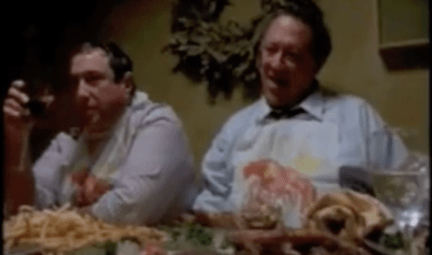
Bill & Elliott Rothstein in “The Last Ride of the Elephant Princess”
By John Leake – Courageous Discourse – November 3, 2022
Author’s Note: The following post is Part I of a series on Willful Blindness, Ideological Blindness, and other failures of perception.
According to Wikipedia:
Action is an American dark comedy series about a Hollywood producer named Peter Dragon, who is trying to recover from his last box-office failure. It aired on Fox during the 1999–2000 season. The series was critically praised for its irreverent and sometimes hostile look at Hollywood culture.
Peter Dragon’s Vice President of Production at Dragonfire Films is a former child actress named Wendy Ward, who also works as a high end courtesan for wealthy Hollywood denizens.
Episode 13, “The Last Ride of the Elephant Princess,” was shot in 2000. Action was cancelled before it was aired, but the episode was released on DVD and posted on YouTube. In this episode, Peter desperately needs to acquire a script, and is distressed to discover it is owned by Bill and Elliott Rothstein—extremely boorish brothers who have a knack for spotting and acquiring valuable properties.
Peter visits them at their favorite restaurant and offers to purchase the script. They tell him to have his cute Vice President, Wendy Ward, deliver the check to their house the following evening. Being an exceptionally good sport, Wendy decides to go into the Lion’s Den. Though she succeeds in her mission, she is so traumatized by her encounter with the Rothstein Brothers that she leaves Hollywood forever. As she puts it: “I’m through with this, Peter. I called a cab and I’m gonna go home and pack and I’m gonna move some place, some place clean.”
It now seems astonishing that such a brutal depiction of Hollywood was made for what was intended to be a popular television series. It also seems obvious that Bill and Elliott Rothstein are modeled after Bob and Harvey Weinstein. The habits, manners, and appearance of the former strongly resemble the latter.
A few years later, at a 2005 comedy event, Courtney Love was interviewed on the red carpet by comedian Natasha Leggero, who asked her if she had any advice for young girls moving to Hollywood. “If Harvey Weinstein invites you to a private party at his Four Seasons [hotel room] don’t go,” she said.
As “The Last Ride of the Elephant Princess” and Courtney Love indicated, it was no secret that being alone with Harvey Weinstein was a grave occupational hazard for a young woman’s body and soul.
Human affairs are more complicated and messy than we are often comfortable acknowledging. We all want things, and much of life is about gauging how much we are willing to accept and tolerate in order to get them. When Gwyneth Paltrow thanked Harvey Weinstein at her Academy Award acceptance speech in 1999, and Meryl Streep thanked him at the 2012 Golden Globe Awards by calling him “God,” both women were probably being perfectly sincere. During those moments, they were thinking about his extraordinary talent as a film producer, and not his terrible reputation with women.
Willful blindness—averting one’s gaze from bad conduct—is usually done with a simple calculation—namely, I can’t object to this conduct because doing so would prevent me from receiving a benefit I really want.
Most of us occasionally engage in some degree of willful blindness. It would be wildly impractical to go through life protesting every bit of bad behavior we encounter. However, it seems to me that—since around 2000—willful blindness on a spectacular scale has been endemic to American business, culture, and politics. The corporate scandals of the early 2000s, the Iraq War under false pretenses, massive fraud on Wall Street leading to the Financial Crisis, the Federal Reserve bailouts of the same people who caused the crisis. Then there was the Russian Collusion Hoax and the related, swamp of US government corruption in Ukraine—now a full-blown orgy for arms dealers and money launderers. Last but not least, the stupendous fraud and homicidal bad faith of the Bio-Pharmaceutical Complex and its friends in Washington during the COVID-19 Pandemic.
All of the above could only happen because thousands of people in an array of organizations and institutions found it expedient to turn a blind eye to the innumerable signs they were participating in corrupt enterprises. It reminds me of a (perhaps apocryphal) quote attributed to Cicero: “Rome is made out of marble but it’s built on a sewer.”
New Zealand says “misinformation” and Covid policies seen to be “infringing on rights” could fuel extremism
A secret service initiative

By Cindy Harper | Reclaim The Net | November 3, 2022
New Zealand authorities have released a guide to help people identify signs of violent extremism.
The secret service says they are usually closely monitoring between 40 to 50 potential terrorists, adding that most used to be motivated by their white identity or by religion – but in the past six months a third group has supposedly emerged; those motivated by politics, particularly around Covid.
“Recognizing a potential warning sign and then alerting New Zealand SIS or police could be the vital piece in the puzzle that ultimately saves lives,” NZSIS Director-General Rebecca Kitteridge said.
“To pay attention and to be alert so that if they see or hear about something that seems off, that worries them and concerns them, they might have a look at this information to say ‘does this indicate to me that this person is actually on the road to committing an attack.’”
The Director-General mentioned Covid specifically, adding that a growing number of people are also concerned about infringement on rights.
“So it could be the Covid measures that the Government took, or it could be other policies that are interpreted as infringing on rights and it’s a kind of what I describe as a hot mess of ideologies and beliefs fueled by conspiracy theories,” Kitteridge said.
Prime Minister Jacinda Ardern also had comments:
“It would be wrong to imply that we have this significant surge in threat in that regard – are there individuals who subscribe to a particular ideology that may border and dip into violent extremism? Yes,” she said.
On the topic of online misinformation, Ardern said, “it’s not about censorship,” adding “It’s about equipping people to identify when they may be subject to misinformation, making sure we’re building our resilience in our young people to be able to identify it… and to create trusted sources where people know they can go.”
Featured Video

or go to
Aletho News Archives – Video-Images
From the Archives
The Forgotten Terrorist Pretext of the Vietnam War
By Jim Bovard | The Libertarian Institute | February 16, 2023
Since 9/11, terrorism has become the ultimate entitlement program for America’s political elite. Whether it is illegally spying on Americans or blowing Somali dissidents to pieces, invoking terrorism provides all the cover needed for Washington policymakers. But the disastrous results of granting politicians a blank check to fight terrorism should have been undeniable almost 60 years ago.
Back in the 1960s, terrorism was what the communists did. Anti-terrorist moral fervor and ideological blinders propelled the U.S. into its biggest foreign policy blunder since World War II. … continue
Blog Roll
 Aletho News
- LAPD Pilot Will Track Vehicles In San Fernando Valley
- Britain’s Online Censorship Law Now Comes With a Crisis Plan for Your Posts
- NATO’s “Nordic model” brings Arctic confrontation closer to Russia’s nuclear bases
- Using nuclear weapons, the US-Israeli alliance still can’t beat Iran
- Sunset on the Quality of Western Propaganda: Arrival of the Dr Strangelove Moment
- Ukrainian general accused of protecting crime bosses
- US-‘Israel’ alliance faces growing rupture after midterms
- GOP’s Crushing Midterm Loss Could Reshape US Political Landscape – Analyst
- Midterm loss gives Congress power to rein in US war on Iran
- Midterms Were ‘Vote of No Confidence’ in GOP, But Iran Has No Illusions About Democrats – Marandi
- If Americans Knew
- An error has occurred; the feed is probably down. Try again later.
- No Tricks Zone
- New Study: The Net Fossil Fuel Contribution To Rising Atmospheric CO2 Has Been Zero For 500 Years
- Germany’s Green Energy Transition Becoming Increasingly Expensive…Another 6 Trillion Euros!
- Sudden Stratospheric Warming, Powerful El Niño Combination May Lead To Extreme Europe Cold, Energy Crisis!
- Two New Studies Find Thwaites Glacier Melt Cannot Be Driven By Human Activity Or A Warming Ocean
- E-Cars Reduce CO2 Emissions By Only 41% Compared To Internal Combustion Engine Vehicles
- Predictions Made By Renowned Climate Professor Over Past Decades Have Been Proven To Be Poor
- New Study Suggests Large Regions Of The Pacific Ocean Have Been Cooling For The Last 80 Years
- Germany’s Green Energy Debacle: High Energy Costs Force Kahla Porzellan to Close After 182 Years!
- New Study: 50 Years Of The Most Aggressive ‘Net Zero’ Policies Can Only Affect The Global Climate By 0.03°C
- US September “Heat” Was No Record…Many Records Set Decades Ago

