University of Massachusetts Lowell bans online speech that could cause “offense”
By Ben Squires | Reclaim The Net | August 21, 2022
The University of Massachusetts Lowell has an Acceptable Use Policy that bans students from using university Wi-Fi to intentionally share, send, or view “offensive” content.
This policy might be a violation of the First Amendment and ignores the fact that most online content is offensive to someone – which, these days, is pretty much any content.
Additionally, the Supreme Court has in multiple cases ruled that speech should not be restricted by the government just because it is offensive to someone.
For instance, in the Texas v Johnson case back in 1989, the Supreme Court ruled that burning the US flag was protected by the First Amendment, arguing: “If there is a bedrock principle underlying the First Amendment, it is that the government may not prohibit the expression of an idea simply because society finds the idea itself offensive or disagreeable.”
But that has not stopped public institutions all over the country from restricting free speech in one way or the other.
It would be impractical for UMass Lowell to take action every time a student views or shares something offensive. However, the policy makes it easy for the university to selectively censor speech they do not agree with.
US taunts Russia to escalate in Ukraine
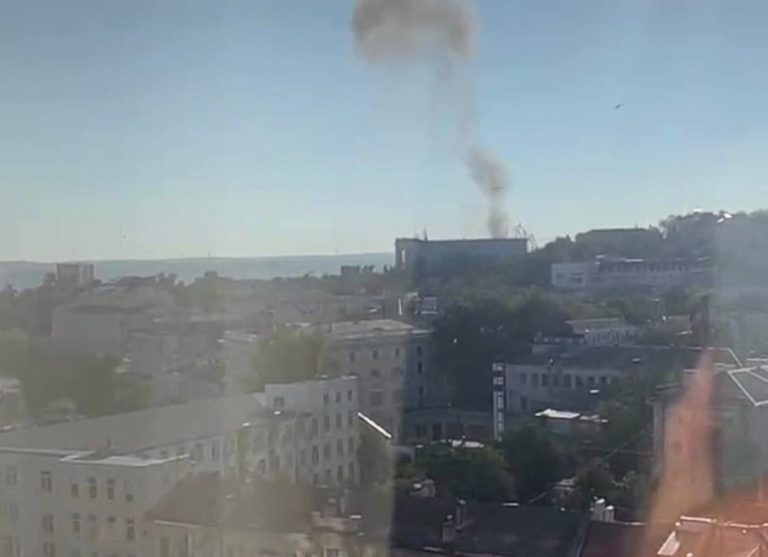
An UAV hit the roof of the headquarters of Russia’s Black Sea Fleet, Sevastopol, Crimea, August 20, 2022
BY M. K. BHADRAKUMAR | INDIAN PUNCHLINE | AUGUST 21, 2022
In military terms, the crude, locally assembled drone dropping a country-made bomb or two on unguarded sites in Crimea are at best pin pricks in the big picture of Russia’s special military operation in Ukraine. But it can be profoundly consequential in certain other ways.
For a start, this escalation has Washington’s approval. A senior Biden administration official told NatSec Daily the US supports strikes on Crimea if Kiev deems them necessary. “We don’t select targets, of course, and everything we’ve provided is for self-defence purposes. Any target they choose to pursue on sovereign Ukrainian soil is by definition self defense,” this person said.
But Washington knows — and Moscow knows — that like any sophistry, this one too is a clever argument but inherently fallacious and deceptive. The New York Times has interpreted the drone attack on Crimea as a challenge to the leadership of President Vladimir Putin. The Times wrote that the Crimea attacks “put domestic political pressure on the Kremlin, with criticism and debate about the war increasingly being unleashed on social media and underscoring that even what the Russian government considers to be Russian territory is not safe.”
The Times claimed that “as images of antiaircraft fire streaking through the blue Crimean sky ricocheted through social media, the visceral reality of war was becoming more and more apparent to Russians — many of whom have rallied behind the Kremlin’s line, hammered home in state media, that the “special military operation” to save Ukraine from Nazi domination is going smoothly and according to plan.”
The paper quoted a prominent establishment think tanker in Moscow acknowledging that the Crimean attack is a “serious” development insofar as “People are beginning to feel that the war is coming to them.” The Ukrainian president Volodymyr Zelensky claimed in a nationwide address on Saturday, “One can literally feel in the air of Crimea that the occupation there is temporary, and Ukraine is returning.”
Once again, while Russia is steadily winning the ground war in Ukraine, the US is determined not to lose the information war. In Washington’s reckoning, in this Internet Age, the war is to be ultimately won in the Russian people’s minds. Therefore, this studied escalation by Washington puts Moscow in a dilemma, since if it is unanswered, Zelensky may target the 19-km long Crimean Bridge connecting the Taman Peninsula of Krasnodar in mainland Russia with the Kerch Peninsula of Crimea.
In fact, it is a near certainty. The point is, the Kerch bridge is “Putin’s bridge” in the Russian people’s consciousness. While formally opening the bridge to car traffic in May 2018, Putin was quoted as telling the workers, “In different historical epochs, even under the tsar priests, people dreamed of building this bridge. Then they returned to this in the 1930s, the 40s, the 50s. And finally, thanks to your work and your talent, the miracle has happened.”
Therefore, there is no better way to puncture the halo around Putin than by despatching at least a bit of the Kerch bridge to the bottom of the Black Sea. Meanwhile, from the US perspective, Kiev’s drone attacks on Crimea already serve three purposes.
First, this is meant to be a blow to the Russian morale. Indeed, Putin’s towering popularity within Russia has become an eyesore for the Biden Administration. Putin’s masterly navigation of the Russian economy out of crisis mode is an incredible feat that defied all logic of power in the American calculus — inflation is steadily falling (in contrast with the European countries and the US); the GDP decline is narrowing; foreign reserves are swelling; the current account is on the plus side; and lo and behold, the Biden Administration’s so-called “nuclear option” — Russia’s removal from the SWIFT messaging system — failed to cripple foreign trade.
Second, both Washington and Kiev are desperately scrambling for “success” stories to distract attention. The Times playing up the story speaks for itself. In reality, Russia’s Donbass offensive has created a new momentum and is steadily grinding the Ukrainian forces. Within the week, Russian forces will have encircled the lynchpin of the Ukrainian defence line, Bakhmut city, which is a communication hub for troop movements and supply logistics in Donbass. Russian forces have reached the city outskirts from the north, east and south. The fall of Bakhmut will be a crushing defeat for Zelensky.
On the other hand, even two months after Zelensky promised a “counteroffensive” on Kherson near Crimea, it is nowhere in sight. Even his most ardent votaries in the western media feel let down. To be sure, there is growing disenchantment in Europe.
The Hungarian PM Viktor Orban, undoubtedly the smartest European politician today (with an economy registering over 6% growth when the rest of the continent is mired in recession), told German magazine Tichys Einblick in an interview last week that this war marked the end of “western superiority.” Interestingly, he named Big Oil as “war profiteers” and singled out that Exxon doubled its profits, Chevron quadrupled, and ConocoPhillips’ profits have shot up manifold. (Of course, all three are American companies.) Orban’s message was clear: America has weakened the EU. This thought must be troubling many a European politician today.
Third, Washington has thrown down the gauntlet in a measured way. But there is no way the war can be brought into the drawing rooms of the average Americans the way Times says is happening in Russia. Twenty Americans were killed in Kharkiv two days ago in a high-precision Russian missile strike, but there aren’t going to be any body bags returning to Arlington Cemetery; nor does it make headlines in the cooperative American media.
The US plans to go further up on the escalation ladder. Escalation is the Biden Administration’s last chance to stall a Russian victory. The American strategic thinker and academic John Mearsheimer has written that the risk of a disastrous escalation is “substantially greater than the conventional wisdom holds. And given that the consequences of escalation could include a major war in Europe and possibly even nuclear annihilation, there is good reason for extra concern.”
Moscow’s preference is to avoid any escalation, since the special military operation is achieving results. Whereas, it is the US that is in some visible despair, and in immediate terms, Russia’s plans to hold referendums in Kherson and Zaporozhye in September must be stalled. Herein lies the danger.
The US’ current build-up over Zaporozhye Nuclear Power Plant points toward a hidden agenda to intervene in the war at some point directly. Kiev’s attempt to arrange a nuclear explosion in Zaporozhye can only be seen in this light. Moscow seems to anticipate such an eventuality.
Defence Minister Sergey Shoigu disclosed yesterday that Russia has begun mass production of Tsirkon hypersonic cruise missiles and is already deploying them. The US lacks the capability to counter Tsirkon, which is estimated to be 11 times faster than Tomahawk with far superior target-penetration characteristics. Shoigu may have given a stark warning that Russia will not be cowed down if there’s a NATO intervention in Ukraine.
Austria: FPÖ demands speedy referendum on sanctions
Free West Media | August 21, 2022
VIENNA – Current surveys suggest that the majority of Austrians are fed up with the ineffective sanctions and would rather overturn them today than tomorrow. But the people’s call for help is ignored by the aloof political elite. “Great Reset” Minister Karoline Edtstadler declared that there was “no alternative” to sanctions, while the ruling ÖVP negates reality and considers sanctions to be “effective”.
The leaders of the Greens and NEOS denounce critics as uncritical of president Putin or “traitors” or “useful idiots” of the Kremlin. Some even consider the majority of citizens to be “Russian collaborators”.
FPÖ leader Herbert Kickl said that in terms of ending sanctions, time was of the essence: “We have no time to lose. The heating season is fast approaching.” A referendum on anti-Russian sanctions, which the Austrian leaders are currently supporting to the country’s detriment, was needed as soon as possible, he added.
Instead of lifting sanctions, the government has so far relied on absurd energy saving tips for people.
According to Kickl: “These sanctions have no effect on the war, but they fuel inflation and hurt the local economy.” The situation reminded him of the Corona crisis: “Here, too, the government talked people into things that weren’t right for two years before they finally switched to the FPÖ line of reasoning.” Recently, not least because of the resistance of people on the streets, the government has had to recognize reality and stop the harassing compulsory jabbing and the absurd quarantine rules.”
But “in the case of sanctions, we no longer have two years, but a maximum of two months,” Kickl said. “If sanctions, which amount to a gunshot in the knee, are not ended, then the coming winter threatens to be very uncomfortable for many people.” The proposed referendum is also intended to give the “reasonable forces within the ÖVP” the chance to show their colours and act for the benefit of the people.
Turkey says it will enforce anti-Russia sanctions
Samizdat | August 21, 2022
Turkish Deputy Finance Minister Yunus Elitas has told US Deputy Treasury Secretary Wally Adeyemo that Ankara won’t allow the “breaching” of American sanctions on Moscow but that its “balanced” position on the Ukraine conflict remains unchanged.
Elitas and Adeyemo spoke by phone on Friday, several weeks after the Financial Times reported that Western officials are “increasingly alarmed” at Turkey’s growing trade ties to Russia, and are considering ways to retaliate if these ties help Russia bypass EU and US sanctions.
According to a readout of Friday’s call from the US Treasury Department, “Adeyemo raised concerns that Russian entities and individuals are attempting to use Turkey to evade sanctions put in place by the United States and 30 countries.”
Adeyemo also “reiterated the United States’ interest in the success of the Turkish economy” and “the integrity of its banking sector.” This statement could be perceived as a threat, considering that the officials quoted by the FT suggested that Western nations could potentially instruct their corporations and banks to pull out of Turkey over the supposed sanctions evasion.
The Turks appear to be cooperating. According to its own readout of the call, Turkey’s Finance Ministry said that “Elitas confirmed that Turkey’s position has not changed regarding the current processes and sanctions, but that it would not allow the breaching of sanctions by any institution or person.”
Turkish President Recep Tayyip Erdogan has previously described his position on the conflict in Ukraine as “balanced.” While Turkey has condemned Russia over the conflict and has sold some weapons to Ukraine, it is the only NATO member that has not sanctioned Moscow or closed its airspace to Russian flights.
Turkey continues to import Russian oil and gas, and following a meeting between Erdogan and Russian President Vladimir Putin earlier this month, the countries agreed to increase their bilateral trade to $100 billion by 2030 and cooperate on energy projects and counterterrorism initiatives. Erdogan and Putin also agreed that Turkey would pay for some of its gas imports from Russia in rubles.
Erdogan has also positioned himself as a middleman between Ukraine and Russia. Turkey hosted ultimately unsuccessful peace talks in March but later helped broker an agreement to resume shipments of grain to world markets via the Black Sea.
Outrage as Pakistan’s Media Watchdog Bans Channels From Broadcasting Ex-PM Imran Khan’s Speeches

Samizdat – 21.08.2022
Pakistan’s media watchdog, the Pakistan Electronic Media Regulatory Authority (PEMRA), has banned TV channels from broadcasting live addresses by former Prime Minister Imran Khan.
The decision, effective immediately, was made on the eve of his rally in Rawalpindi on Sunday. According to the regulator, Khan is making “baseless allegations and spreading hate speech.”
“His provocative statements against state institutions and officers… is likely to disturb public peace and tranquility,” the PEMRA added.
The decision has been slammed by members of Khan’s Pakistan Tehreek-e-Insaf (PTI) party and his supporters.
Asad Umar, a senior PTI official, took to Twitter, saying that the ban would be challenged in court.
A local journalist said the watchdog’s decision actually had the opposite effect.
Since his ouster from power in April 2021, Khan has held massive rallies across the country, branding the government of his successor Shehbaz Sharif as “traitors” installed by a “foreign conspiracy” hatched in the US. He has also repeatedly said that Washington has made Pakistan a “slave” without invading it. Prior to the no-confidence motion that saw him voted out of power, Khan accused the US of seeking to have him removed.
Another First Amendment lawsuit against Facebook censorship fails
By Didi Rankovic | Reclaim The Net | August 20, 2022
The US judicial system has dismissed yet another lawsuit filed by censored users of Big Tech’s social media platforms, who allege First Amendment free speech violations.
This time it was the US District Court for the Northern District of California that granted a motion to dismiss filed by the defendant, Facebook (Meta). The plaintiff in this case, Richard Rogalinski, sued on First Amendment grounds after a number of his posts about Covid got censored on Facebook.
We obtained a copy of the decision for you here.
One of the posts expressed Rogalinski’s skepticism about the efficacy of masks, saying that he has not seen scientific evidence of their usefulness, but instead, “just talking heads who want to spread fear and control you.”
To this, Facebook’s “fact-checkers” reacted by adding a warning label claiming the post was “missing context.” The same warning was slapped on a post that saw the plaintiff criticize the Covid vaccine rollout.
Finally, a screenshot of a tweet posted by a doctor who promoted the use of hydroxychloroquine got labeled as “false information” by Facebook and removed.
Originally, the Florida resident filed a class action lawsuit in that state, but Facebook moved to either dismiss or transfer it, after which the judge transferred it to California.
In an attempt to fight against the usual defense that massive tech corporations have when censoring content and users – that they are private operations that have the right to do that, while the First Amendment applies only to state actors – Rogalinski mentioned statements made by former White House press secretary Jen Psaki.
In July 2021 – and the California judge noted in the ruling that this happened “after Meta took action against Rogalinski’s posts” – Psaki told a press conference that the Biden administration is “in regular touch” with major social media platforms, and actively flagging content posted on Facebook that the government thinks are “problematic” on misinformation grounds.
Rogalinski argued that the state “chose the targets and content of the statements that it deemed worthy of the defendant’s censorship” which then resulted in censorship by Facebook.
The plaintiff further accused the government and Meta of communicating directly and specifically about the censorship actions and engaging in the act together by sharing responsibility for the two-step process of censorship.
However, the court disagreed, citing several similar cases, including O’Handley v. Padilla, where the ruling reads that the government “can work with a private entity without converting that entity’s later decisions into state action.”
The media are (finally) admitting lockdown is worse than “Covid”… but why?
By Kit Knightly | OffGuardian | August 19, 2022
The latest figures from the UK’s Office of National Statistics (ONS) suggest that the knock-on effects of lockdown may be harming more people than “Covid” ever did, or so the press are saying anyway.
The ONS’s weekly data apparently shows over 10,000 more reported deaths than expected.
Since none of these excess deaths has been “linked with Covid”, the press is calling them the “true cost of lockdown”, with some papers suggesting lockdown is “killing more people than Covid”.
To which the only proper response is: “No shit.”
Even for those who still cling to the orthodoxy that “Covid” actually exists, the fact lockdown was going to do more damage than it prevented was obvious from the moment early mortality studies showed “Covid” had a 99.5% survival rate, back in the spring of 2020.
Many experts in economics, statistics, epidemiology and virology voiced this opinion, and were vilified and abused for their trouble.
And, really, anyone with the smallest shred of common sense could figure it out for themselves. Shutting down the health service and crashing the economy is never going to end well (unless you want to kill people, then it’s a great plan).
Even Dr David Nabarro, World Health Organization special envoy for Covid-19, described lockdowns as a “global catastrophe” in October 2020:
We in the World Health Organization do not advocate lockdowns as the primary means of control of the virus[…] it seems we may have a doubling of world poverty by next year. We may well have at least a doubling of child malnutrition […] This is a terrible, ghastly global catastrophe.”
So the question is not “Is lockdown worse than Covid?” The answer to that is “yes”, and we’ve known that for over two years.
The real question is: why are they finally admitting it?
It’s not just this week’s excess deaths either. Elsewhere the media is concerned about the mental health impacts of lockdowns, delays in cancer treatments, the “lockdown drinking”, the impact on children missing school, teenagers self-harming and so and so on.
Professor Karol Sikora – one of those vilified experts I mentioned earlier – has even been given space in the Telegraph to write a 2000 word “I told you so”.
Why?
Perhaps the answer to that lies not in what they’re talking about, but in what they are most pointedly not talking about.
The excess deaths are being very definitely laid at the feet of lockdowns, not the experimental “vaccines”.
Now, were the deaths really caused by the lockdown? Or by the “vaccines”? Or a mix of both? We don’t know, and can likely never know.
At this point our collective trust in institutions and official figures should be low enough to question if there were any excess deaths. Maybe they just made them up. They do that.
Regardless of the truth of it, the narrative is certainly shifting to highlight “the true cost of lockdowns”.
This could be about disguising the harm done by untested vaccines, admitting to potentially deleterious effects of lockdown to spare Pfizer’s blushes.
There’s a lot more invested in the vaccines than the lockdown – in every sense of the word – and if something has to be blamed it makes sense they would much rather it be lockdowns than jabs.
That’s a decent explanation, but I wouldn’t be surprised if there were more to it.
This narrative could be about setting up the public for the next “covid” wave or some new “pandemic”.
Consider how quickly the “true cost of lockdown” story could be parlayed into a new mainstream consensus that “Lockdown was so damaging, we must do whatever it takes to avoid another“.
Then consider how “Whatever it takes” could take the form of quarantine camps for the unvaccinated, vaccines mandates, enforced testing and surveillance…or whatever the hell else they want.
Crisis Government
eugyppius | August 20, 2022
To reduce energy consumption in the face of the looming German gas crisis, Economics Minister Robert Habeck has proposed a bizarre set of indoor temperature ordinances that continue the pattern of direct state interventions in the everyday life first established by mass containment.
Workspaces where hard physical labour is performed are not to be heated above 12 C, under the new rules. Those involving moderate labour while standing will have their temperatures capped at 16 C, and moderate labour while sitting at 17 C. Places where light labour is performed standing, will be permitted temperatures as high as 18 C, while white-collar office spaces where everybody sits and types will be permitted nothing warmer than 19 C. The heating of hallways and other common spaces will be outlawed, as will certain kinds of restroom water heaters. There will be a general ban on using electricity or gas to heat private pools, and shops will be ordered to keep external doors closed at all times. Political pressure is growing for similar ordinances limiting gas consumption in residences.
While some doubt that these rules can be enforced, German police have already proven effective at enforcing pandemic-era contact limits in private homes. And even if indoor temperatures are never systematically checked by authorities, I’m pretty sure that the simple prospect of unannounced inspections and fines will be enough for most employers to declare a third season of home office, with the added prospect of offloading higher gas prices onto their employees.
It is most curious, how this totally new catastrophe should call forth some of very same measures demanded by the Corona pandemic. Not only will home office return, but municipal pools will close again and cities will be kept dark at night, a de facto limitation on evening mobility that might well encourage some places to reimpose the curfews last seen in the winter of 2020/21. Meanwhile, some of the very same spaces recently commandeered for excess hospital capacity and mass vaccination will be repurposed as heated shelters for the old, the sick and the poor.
Not any unified plan, but rather a long series of contingencies, have caused the German gas crisis. Yet the steadfast refusal of the Scholz government to consider any course of action that might ameliorate the shortage, always with a new excuse, grows every day more unsettling.
There’s the obvious explanation, that the Greens in government are merely taking advantage of this opportunity to achieve their higher goal of restricting fossil fuel consumption, as they’ve always wished. But I think there might be another, deeper way to understand this too. I suggest that we’re seeing here the emergence of a new political style, which you might call Crisis Governance—or, as a friend put it, “the continuation of Corona policy by other means.” One of my core themes here has been the deepening demobilisation of western states, as power is diffused downwards from the political apex into the bureaucratic institutions, the press and major corporate enterprises. The great advantage of this power-sharing is a near-total uniformity of political views that it has inspired across the socio-cultural elite, but it comes at the cost of initiative, coordination and strategy. Crises seem to be one of the only ways our new, demobilised states can overcome their paralysis and act to further any kind of positive political programme.
More at A Plague Chronicle.
German Electricity Prices Spiraling Out Of Control… Tripling Since 2000… Blackouts, Unrest Loom
By P Gosselin | No Tricks Zone | August 19, 2022
Sun and wind don’t send any electric bills, the green energy swindlers used to tell us.
Changing over to sun and wind energy would cost only one euro a month more, Germany’s former Environment Minister Jürgen Trittin once promised. All we had to do was accept their master plan.
Today the swindle is uncovering, and it may be too late to avert the massive damage that’s coming our way.
At Facebook, Helmut Bauer posted the most recent chart depicting Germany’s electricity rates for end-consumers. It’s a blood bath:

Electricity prices for German end-consumers, in eurocents per kilowatt-hour. Source: BDEW, Verivox.
What a mess; they’ve reached 41 cents a kilowatt-hour and it’s about to get much worse – especially for the people who can least afford it. Expect social unrest to boil over the months ahead as prices and shortages inflict pain on the poor. We’re in uncharted territory.
Hey, not to worry: German Chancellor Olaf Scholz promised that police will not open fire on demonstrators.
Featured Video

Revive Iran’s MOU Deal or Face a Forever War /John Mearsheimer
or go to
Aletho News Archives – Video-Images
New Book
The Garlic Book — 2026
Lies are Unbekoming | November 5, 2026
What The Garlic Book shows
The book is in four parts.
 Part One, The Record, treats the history of garlic as evidence. From the clay garlic bulb placed in an Egyptian grave nearly six thousand years ago, through the Ebers Papyrus, through Hippocrates, Dioscorides, Pliny and Galen, the Arab physicians under Avicenna, the medieval herbals, Culpeper, and the plague years, to the last era in which Western physicians prescribed garlic as a matter of course, which ran from 1850 to 1945. It closes with the living traditions that never stopped using it, and with the folklore of charms, vampires and the evil eye.
Part Two, The Chemistry and the Evidence, sets out what is known about why a clove has no smell until it is cut, and why the order of crush, rest and heat changes the medicine. It then reads the clinical evidence against the historical record — bacteria, blood and vessels, cancer epidemiology, metals and fatigue — and names the trials that went against garlic as directly as the trials that went for it, including the 2007 Stanford trial funded by the US National Institutes of Health which found that raw garlic, garlic powder and aged garlic extract moved LDL cholesterol no more than placebo did. It then turns to onion, garlic’s closest relative, and reads the newer evidence published since 2015, before closing with the whole of the record through the terrain lens.
Part Three, Why Medicine Set It Aside, asks the question directly. One chapter contrasts the pharmaceutical model of isolating a single active compound with the folk model of combining whole plants, and reports what the garlic evidence says about which model works better. One chapter examines the economics of research on a plant that cannot be patented. One chapter — Fire Cider — tells the story of a folk preparation whose name was taken into a United States trademark by a Massachusetts company in 2012, and won back by three herbalists in 2014 who documented forty years of prior use through Rosemary Gladstar and her students into the older tradition.
Part Four, Garlic in Practice, is the working manual — the kitchen pharmacy, traditional uses by body system, a full chapter on safety and interactions, and a complaint-by-complaint practical guide. The book closes with The Trial That Was Never Run — a one-chapter reading of the whole evidential architecture.
At the back: two appendices (a traditional list of uses, and a preparation quick-reference), a full bibliography, and a live index.
Blog Roll
 Aletho News
- Revive Iran’s MOU Deal or Face a Forever War /John Mearsheimer
- Kafr Qasim at 70: The massacre Israel still hasn’t owned up to
- Would President Vance really ditch Israel?
- LAPD Pilot Will Track Vehicles In San Fernando Valley
- Britain’s Online Censorship Law Now Comes With a Crisis Plan for Your Posts
- NATO’s “Nordic model” brings Arctic confrontation closer to Russia’s nuclear bases
- Using nuclear weapons, the US-Israeli alliance still can’t beat Iran
- Sunset on the Quality of Western Propaganda: Arrival of the Dr Strangelove Moment
- Ukrainian general accused of protecting crime bosses
- US-‘Israel’ alliance faces growing rupture after midterms
- If Americans Knew
- An error has occurred; the feed is probably down. Try again later.
- No Tricks Zone
- New Study: The Net Fossil Fuel Contribution To Rising Atmospheric CO2 Has Been Zero For 500 Years
- Germany’s Green Energy Transition Becoming Increasingly Expensive…Another 6 Trillion Euros!
- Sudden Stratospheric Warming, Powerful El Niño Combination May Lead To Extreme Europe Cold, Energy Crisis!
- Two New Studies Find Thwaites Glacier Melt Cannot Be Driven By Human Activity Or A Warming Ocean
- E-Cars Reduce CO2 Emissions By Only 41% Compared To Internal Combustion Engine Vehicles
- Predictions Made By Renowned Climate Professor Over Past Decades Have Been Proven To Be Poor
- New Study Suggests Large Regions Of The Pacific Ocean Have Been Cooling For The Last 80 Years
- Germany’s Green Energy Debacle: High Energy Costs Force Kahla Porzellan to Close After 182 Years!
- New Study: 50 Years Of The Most Aggressive ‘Net Zero’ Policies Can Only Affect The Global Climate By 0.03°C
- US September “Heat” Was No Record…Many Records Set Decades Ago

