Brazil’s Ambassador to the OAS Denounces US Military Action Against Venezuela as a Global Threat
teleSUR – January 6, 2026
During an address to the Permanent Council of the Organization of American States (OAS), Benoni Belli, Brazil’s ambassador to the organization, described the United States’ military action against Venezuela as “a very serious attack against Venezuela’s sovereignty and a threat to the entire international community.”
The Brazilian diplomat warned that the bombings of Venezuelan territory and the kidnapping of its president represent an unacceptable violation of international law. “The current situation is grave and evokes times we thought were behind us, which are once again devastating Latin America and the Caribbean,” Belli stated.
Belli rejected the logic that “the ends justify the means,” arguing that such reasoning lacks legitimacy and allows the strongest powers to impose their will on sovereign nations. “These acts open the possibility that the strongest will define what is just or unjust, disregarding national sovereignty,” he emphasized.
The ambassador’s statement highlights the geopolitical implications of a unilateral military intervention, and warned that it undermines multilateralism and fosters a global order based on the law of the strongest.
CDC SHRINKS ROUTINE CHILDHOOD VACCINE SCHEDULE BY ~55 DOSES
By Nicolas Hulscher, MPH | FOCAL POINTS | January 5, 2026
Today, the CDC formally adopted a revised childhood and adolescent immunization schedule, following a Presidential Memorandum directing alignment with international best practices.
This marks the largest rollback of routine childhood vaccination in U.S. history.
After reviewing peer-country schedules and the scientific evidence underlying them, federal health leadership acknowledged that we are hyper-vaccinating our children.
The result is a dramatically smaller routine childhood vaccine schedule, cutting approximately 55 routine doses.
This is a major victory — even as serious safety concerns remain for the vaccines that continue to be recommended.
The Key Change: ~55 Routine Doses Eliminated
Previous U.S. routine schedule (2024)
-
- 84–88 routine vaccine doses
- Targeting 17 diseases
- (18 if RSV monoclonal antibody is included)
New CDC routine schedule (2026)
-
- ~30 routine doses
- Targeting 10–11 diseases
- Based on international consensus
Net change: approximately 54–58 routine doses removed, commonly summarized as ~55 routine doses.
Importantly, this reduction applies only to vaccines previously labeled “routine for all children.” No vaccines were banned or removed from availability.
What Was Removed from the Routine Schedule
The following vaccines are no longer recommended for all children by default:
- COVID-19
- Influenza
- Hepatitis A
- Hepatitis B (including removal of the universal birth dose if the mother is HBsAg-negative)
- Rotavirus
- Meningococcal ACWY
- Meningococcal B
These vaccines account for nearly the entire ~55-dose reduction.
What Remains Routine
The CDC now limits routine childhood vaccination to the following vaccines:
- Measles, Mumps, Rubella (MMR)
- Diphtheria
- Tetanus
- Pertussis
- Polio
- Haemophilus influenzae type B (Hib)
- Pneumococcal disease
- Varicella (chickenpox)
- Human Papillomavirus (HPV), reduced from two doses to one
This is still not “safe by default”
These vaccines remain:
- Insufficiently studied for long-term outcomes
- Untested in placebo-controlled trials
- Never evaluated as a cumulative schedule
- Inducers of over 20 chronic diseases
Adverse events such as febrile seizures, severe neurological injury including autism, ADHD, tics, autoimmune disease, asthma, allergies, skin and gut disorders, ear infections, and a long list of other chronic diseases have been documented across multiple vaccines on this list.
Reducing the schedule does not equal proving safety. It simply reduces exposure. Nonetheless, that reduction alone is quite meaningful.
Where Those Vaccines Went
Non-consensus vaccines were reclassified, not banned:
Shared Clinical Decision-Making
- COVID-19
- Influenza
- Hepatitis A
- Hepatitis B
- Rotavirus
- Meningococcal ACWY
- Meningococcal B
High-Risk Groups Only
- RSV monoclonal antibody
- Hepatitis A (travel, outbreaks, liver disease)
- Hepatitis B (HBsAg-positive or unknown maternal status)
- Dengue
- Meningococcal vaccines for defined risk groups
All remain available and fully covered by insurance. However, given entrenched institutional habits and ideological adherence to maximal vaccination, many clinicians are likely to continue promoting shared clinical decision-making vaccines as de facto routine unless families are informed and assertive.
Why This Is Still a Massive Win
For decades, the childhood vaccine schedule expanded without:
- Schedule-level safety trials
- Long-term outcome data
- Meaningful public debate
- Informed consent
This decision reverses that trajectory. It:
- Shrinks routine exposure dramatically
- Restores parental agency
- Forces future decisions to confront risk-benefit reality
Most importantly, it breaks the false premise that “more vaccines is always better.”
Conclusion
The CDC has eliminated every non-consensus vaccine from the routine childhood schedule, cutting routine exposure by approximately 55 doses—an implicit admission that the safety of the expanded schedule was never adequately established.
This decision does not end the problem. The vaccines that remain routinely recommended are still largely untested in long-term, placebo-controlled trials, are administered during critical periods of neurodevelopment, and continue to pose serious safety concerns. As a result, a substantial number of autism cases and other chronic conditions will continue to occur.
However, by sharply reducing cumulative exposure during early childhood, this change marks the first credible step toward reversing the trajectory. The burden of neurodevelopmental injury should begin to decline—not disappear, but diminish.
Even with its limitations, this action represents the most consequential course correction in U.S. pediatric vaccination policy in modern history. It breaks the assumption that an ever-expanding schedule is inherently safe, restores proportionality, and opens the door to long-overdue accountability, transparency, and real safety science.
Epidemiologist and Foundation Administrator, McCullough Foundation
Support our mission: mcculloughfnd.org
Please consider following both the McCullough Foundation and my personal account on X (formerly Twitter) for further content.
Pakistan, the Gulf, and the high cost of Zionist alignment
By Junaid S. Ahmad | MEMO | January 6, 2026
Geopolitics is most dangerous not when it erupts, but when it reorganises quietly — when the ground shifts beneath familiar alliances while elites continue to speak the language of yesterday. The Gulf today is in precisely such a moment. What once masqueraded as a coherent bloc has fractured into rival power models, incompatible strategic visions, and diverging relationships to empire, Israel, and popular legitimacy. And Pakistan, true to form, is responding not with strategic intelligence but with institutional reflex — confusing obedience with balance and habit with foresight.
The rift between Saudi Arabia and the United Arab Emirates is no longer a matter of speculation or diplomatic gossip. It is an open contradiction — political, military, and infrastructural. Yemen has exposed it. Israel has radicalised it. The United States, particularly under Trumpism, has weaponised it. And Pakistan’s ruling elite — military and civilian alike — has chosen to drift toward the most toxic pole of this fracture while reassuring itself that it is merely being “pragmatic.” It is not. It is being complicit.
Two Gulf projects, one moral abyss
Saudi Arabia and the UAE are still lazily grouped together by analysts who mistake shared authoritarianism for shared strategy. This is intellectual malpractice. The two monarchies are pursuing fundamentally different regional projects.
Saudi Arabia’s current posture — hardly virtuous, often cynical, and deeply reactionary — nevertheless reflects a begrudging recognition of reality. After years of disastrous interventionism, Riyadh wants consolidation. It wants borders quieted, fires contained, and regional fragmentation slowed. Its outreach to Iran, cautious engagement with the
Houthis, and growing hostility to separatist militias are not gestures of enlightenment but acts of self-preservation. Endless chaos undermines Saudi ambitions at home.
The Emirati project is the opposite — and far more dangerous. Abu Dhabi does not seek order through states; it seeks domination through fragments. Ports, islands, militias, mercenaries, logistics corridors, surveillance hubs — these are its tools. Sovereignty is irrelevant. Fragmentation is not a failure; it is a business model.
If Saudi Arabia is a reactionary status-quo power, the UAE is a hyperactive destabiliser — an empire of nodes, happy to burn regions so long as trade flows and leverage compounds.
Yemen: Where the lie finally died
Yemen is where the fiction of Gulf unity collapsed beyond repair. What began as a joint intervention has devolved into a struggle over whether Yemen will exist at all as a state. The House of Saud — bloodied, embarrassed, and exposed — now insists on a unified Yemeni authority capable of enforcing borders and agreements. The UAE has invested
instead in carving out a southern enclave: separatist militias, port control, island bases, and economic chokeholds.
For Riyadh, this is existential. A fragmented Yemen exports instability directly into Saudi territory and sabotages any negotiated settlement with the Houthis. For Abu Dhabi, fragmentation is leverage — control of chokepoints matters more than Yemen’s survival as a polity.
That Saudi Arabia has now openly bombed weapons shipments linked to UAE-backed forces and issued public warnings is extraordinary. Gulf disputes are traditionally smothered in silence. When they go kinetic and public, it signals not a spat but a structural rupture. Pakistan’s establishment sees this — and chooses denial.
Israel: The cancer at the core
To understand the Emirati recklessness, one must confront the real axis around which it revolves: Apartheid, genocidal Israel.
The Abraham Accords were not peace agreements; they were an integration pact into Zionist regional supremacy. Israel does not merely occupy Palestine; it exports a model — militarised impunity, surveillance capitalism, permanent war dressed as security. The UAE did not normalize with Israel reluctantly. It embraced Israel as a force multiplier.
Israel provides Abu Dhabi with access to Washington’s coercive machinery, advanced surveillance, cyberwarfare, and a propaganda ecosystem that converts mass death into “stability.” In return, the UAE provides geography, ports, islands, mercenaries, and political insulation — doing Israel’s dirty work where Tel Aviv prefers not to appear.
Sudan. Somaliland. Socotra. Cyprus. The Red Sea. These are not isolated projects; they are components of a Zionist–Emirati expansion strategy designed to insulate Israel from economic pressure and accountability while strangling any resistance corridor before it matures.
Israel is the disease. The UAE is its most enthusiastic carrier.
Pakistan’s elite: Zionism in uniform and suits
Pakistan’s tragedy is not that it lacks options. It is that its ruling elite lacks dignity.
Rather than reassess its position amid this fracture, Pakistan’s military–civilian elite clings to the rhetoric of “balance” while deepening structural entanglement with the Emirati–Israeli axis. Ports, airports, logistics terminals, military-linked corporations — these are not neutral investments. They are instruments of alignment.
Pakistan’s generals and their civilian accessories imagine they are playing geopolitics. In reality, they are being used as infrastructure — cheap, deniable, disposable. Their behaviour is not naïveté. It is covert Zionism: collaboration without confession, obedience without ideological honesty. They mouth solidarity with Palestine while embedding Pakistan’s economy and security apparatus deeper into a regional order built to protect Israel from consequences. This is not pragmatism. It is moral and strategic bankruptcy.
Venezuela: When empire drops the mask
The illusion that empire prefers subtlety should have died long ago. Venezuela put the lie to it.
When sanctions failed and proxy pressure proved insufficient, the United States escalated —directly. US special forces were involved in a scandalous operation that culminated in the kidnapping of Venezuelan President Nicolás Maduro. This was not deniable proxy warfare. It was naked imperial contempt for sovereignty.
And what happens if Washington’s decapitation move fails at complete regime change in Caracas? Silence. Zero accountability. Empire simply moves on.
This is the future Pakistan’s elite is courting. When alignment fails to deliver stability, the costs will not be borne by Washington, Tel Aviv, or Abu Dhabi. They will be borne by Pakistan. Empire does not protect collaborators. It discards them.
Saudi Arabia: A lesser evil, still an evil
Saudi Arabia deserves no absolution. The House of Saud remains a reactionary monarchy, structurally hostile to popular sovereignty and deeply entangled with empire. Its version of “stability” is still oppression — merely quieter than the Emirati inferno.
Yet the difference matters. Saudi Arabia understands that Zionist expansionism generates perpetual instability. The UAE celebrates it. Riyadh conceals its servitude; Abu Dhabi flaunts it.
Pakistan’s elite has chosen to tilt slightly more towards the louder master.
Trumpism: Empire without shame
Hovering over this landscape is Trumpism — the ideological nakedness of empire. Trump dispenses with liberal hypocrisy entirely. Loyalty is transactional. Morality is a joke. Strongmen are preferred to institutions. Israel is sacred. Everyone else is expendable.
The UAE fits this worldview perfectly: ruthless, efficient, unburdened by public opinion. Pakistan’s rulers mistake proximity to this axis for relevance. In truth, it entrenches their subordination.
When things go wrong — as they inevitably will — Trumpism will shrug. Pakistan will bleed.
The reckoning Pakistan is avoiding
The Gulf is not merely fracturing; it is sorting. States will be forced to choose — between sovereignty and fragmentation, between justice and normalisation, between dignity and managed submission.
Pakistan’s establishment has already chosen. It just lacks the courage to admit it. History will not judge Pakistan for failing to be the Mafia Don of West Asia. It will judge it for failing to recognise a moral and strategic crossroads when it stood directly upon it.
The UAE will continue to burn regions in service of Zionism. Israel will continue its genocidal project. The United States will continue to kidnap, sanction, and discard. Saudi Arabia will continue to pretend restraint equals virtue.
And Pakistan — unless it breaks from habit — will continue confusing servitude for strategy.
Recession-Hit Europe to Harm Own People by Giving Ukraine €800 Billion – Orban
Sputnik – 06.01.2026
Europe, which is currently in recession, will harm its own population if it provides Ukraine with the €800 billion demanded by the country, and European citizens will begin to resist such a policy, Hungarian Prime Minister Viktor Orban said.
“Ukraine is asking for €800 billion over the next decade while Europe is in recession. Those who pay this price are harming their own people, and societies will eventually push back against policies that destroy living standards,” Orban was quoted as saying on the social network X by Hungarian government spokesman Zoltan Kovacs.
On January 3, Ukrainian Prime Minister Yulia Svyrydenko said that Ukraine would need $800 billion over the next 10 years for recovery and economic growth. According to her, Ukraine expects to secure these funds through grants, loans, and private investment.
Ukraine’s 2026 budget was adopted with a record deficit. According to Verkhovna Rada lawmaker Dmytro Razumkov, funds—including for military salaries and weapons—could begin to run out as early as February. At the same time, official Kiev expects to “patch budget holes” with aid from Western partners, which has been gradually declining.
Ending the fighting and reducing the size of Ukraine’s military could provide relief, a point repeatedly raised by Russia. However, the Ukrainian authorities continue to ignore calls for peace, despite common sense and a lack of funds, including for maintaining the armed forces.
Britain’s Secret Role In Yugoslavia’s Destruction
By Kit Klarenberg | Global Delinquents | January 6, 2026
December 23rd marked the 35th anniversary of an independence referendum in Slovenia, then a Yugoslav republic. In all, 88.5% of registered voters – 95.7% of participants – said “da” to secession. The plebiscite prompted Ljubljana’s formal declaration of independence, and ensuing Ten Day War between Slovene territorial defence forces and the Yugoslav federal army. This was the spark that triggered bitter, bloody interethnic conflicts throughout Yugoslavia over the subsequent decade, and the multiethnic socialist federation’s ultimate destruction.
In May 2000, Britain’s Observer exposed how in the Ten Day War’s leadup, London secretly supplied Slovenia with tactical military communications equipment worth millions, to assist Ljubljana’s impending battle against the Yugoslav military. The disclosure elicited outcry, as London was officially at the time committed to preserving Yugoslavia, leading international efforts to prevent the country descending into fractious civil wars. The clandestine provision was at direct odds with this public-stated policy, which included unbending support for an arms embargo on the region.
Responding to the news, former British Foreign Secretary David Owen, who served as the EU’s lead peace negotiator during the Bosnian war, said he was “surprised” London covertly undermined her formal commitment to keeping Yugoslavia “together”. He nonetheless downplayed the assistance, noting what Britain supplied “was not aggressive” – “radios not guns”. Owen therefore argued the shipment “sails close to the border but does not cross it.” By contrast, the Observer reported the communications equipment “played a vital role” in Slovenia’s victory over Yugoslav forces.
This was because Ljubljana won the Ten Day War not via conventional military means, but a wide-ranging, devastatingly effective international propaganda campaign. In physical terms, the brief conflict consisted exclusively of minor skirmishes, and was largely bloodless, with just 44 Yugoslav soldiers and 18 Slovene territorials killed. One would not have known this from contemporary Western media reporting though, which relentlessly portrayed Slovenia as fighting countless grand military engagements against Belgrade’s barbarous invaders, and pluckily prevailing.
British military communications equipment greatly facilitated this informational onslaught. The psychological battlefield’s centrality to Ljubljana’s successful independence struggle had a resounding impact on Slovenia’s fellow breakaway Yugoslav republics. Engendering maximum international sympathy while demonising Belgrade became a core component of Albanian Kosovar, Bosniak and Croat war strategies. In Sarajevo, secessionist authorities deliberately immiserated the local population to create emotionally impactful images for global broadcast. Meanwhile, its military routinely carried out false flags, including targeting civilians with sniper fire. As Canadian UN peacekeepers on-the-ground directly observed:
“The [Bosniaks] are not above firing on their own people or UN areas and then claiming the Serbs are the guilty party in order to gain further Western sympathy. The [Bosniaks] often site their artillery extremely close to UN buildings and sensitive areas such as hospitals in the hope that Serb counter-bombardment fire will hit these sites under the gaze of the international media.”
Ljubljana’s triumph left an enduring impression upon the British too. In multiple proxy conflicts since, London has taken the lead on psychological warfare, in particular atrocity propaganda, vilifying official enemies and justifying intervention and regime change. Since February 2022, a secret Ministry of Defence-created military and intelligence cell, Project Alchemy, has endeavoured to “keep Ukraine fighting at all costs.” Fundamental to this effort are “information operations” designed to convince Western citizens, and Ukrainians themselves, Kiev can somehow defeat Russia, by grossly distorting reality on-the-ground.
‘Quite Incredible’
A memory-holed July 1991 report from now-defunct British newspaper The European – “Lies Win Balkan War Of Words” – lays out in forensic detail how Slovenia’s propaganda war was fought and won. The operation’s “nerve-centre” was “an underground conference complex deep below the streets of Ljubljana.” Here, dozens of Slovene Information Ministry apparatchiks “worked tirelessly” to provide over 1,000 foreign journalists with a relentless barrage of information about the conflict – particularly Yugoslav war crimes, and Slovene military victories – supposedly taking place above ground.
Wild figures on reported “tanks hit, shots fired, prisoners taken” by Ljubljana were supplied hourly. Meanwhile, the Slovenes struck up a chummy rapport with their overseas guests, portraying themselves “as clean-limbed, tanned church-goers who only wanted to live peacefully and democratically in their Alpine idyll of mountains, lakes and meadows.” They claimed to be under attack by “ruthless Communists… dirty, unshaven brutes who dropped cluster bombs on innocent civilians… [and] sought to inflict [their] intolerant religious fanaticism and alphabet of squiggly lines on Europe.”
Ljubljana “needed a bloody, dramatic conflict to ensure the world did not lose interest” in their independence crusade. Thus, “they showered the media with details of battles that had often never taken place,” frequently “enlivening the day” with lurid, often unfalsifiable assertions, such as Belgrade landing “squads of special troops in plain clothes” across the country “to terrorise the population,” or plotting to target a local nuclear power plant and create a Chernobyl-style disaster. Journalists dutifully amplified these dubious claims as fact internationally.
Such was the deluge, “it was possible to report the war without ever venturing above ground” – “but, for those who did venture into the sunlight, the bunker war often seemed a fantasy.” For example, Western news outlets widely covered a purportedly “major battle” at Jezersko, a municipality near Austria. When The European visited the area subsequently, “greatly surprised” local Slovene militiamen instead described a brief tussle with a few Yugoslav soldiers over a borderpost in which “no one had been hurt.”
Throughout the Ten Day War, the Western-backed separatist government of neighbouring Croatia was “carefully analysing” Ljubljana’s informational offensive. They concluded the conflict’s “decisive engagements, which virtually guaranteed Slovenia’s independence, took place in the pages of the foreign media and, even more important, in the news bulletins of the major television networks.” Zagreb duly launched its own “propaganda blitz”. Croat officials were instructed “to hold twice-daily press conferences, which should be as colourful and dramatic as possible,” while Western journalists were given tours by soldiers:
“Everywhere, in town halls, hotel foyers and crouching nervously behind roadblocks, Croat mayors, police chiefs and militia officers… hold press conferences or hand out neatly-typed news bulletins to tell the world of the latest atrocities by Serbian extremists and of unprovoked attacks by the [Yugoslav] army… The Croats’ strategy today is clear. They are bombarding the world with information, which is usually so petty it seems it must be true.”
For example, Croatia’s state media agency Hina pumped out “extraordinarily detailed accounts of the fighting allegedly taking place in the countryside,” with an emphasis on “trivial” incidents. Typically, it was “impossible to check most of these reports precisely because the clashes were so minor that, even if they happened, they left no mark.” This inconsequential, unverifiable cavalcade was occasionally interspersed with “quite incredible allegations”, such as Belgrade having flooded the republic with “hired assassins” drawn from the ranks of Romania’s notorious Communist-era Securitate.
‘Managed Understanding’
The “grotesque caricatures” of Yugoslav forces, and Serbs more generally, as uniquely bloodthirsty monsters peddled by “brilliant” propagandists in Ljubljana and Zagreb took “hold of the public imagination in the West”, transforming “complex” interethnic struggles “into a straightforward battle between the forces of light (Slovenes and Croats) and darkness (Serbs).” This fraudulent dichotomy was exploited even more perniciously during the Bosnian civil war, and subsequent Kosovo ‘crisis’, during which atrocity propaganda served to justify and sustain NATO’s criminal 78-day-long bombing of Belgrade in 1999.
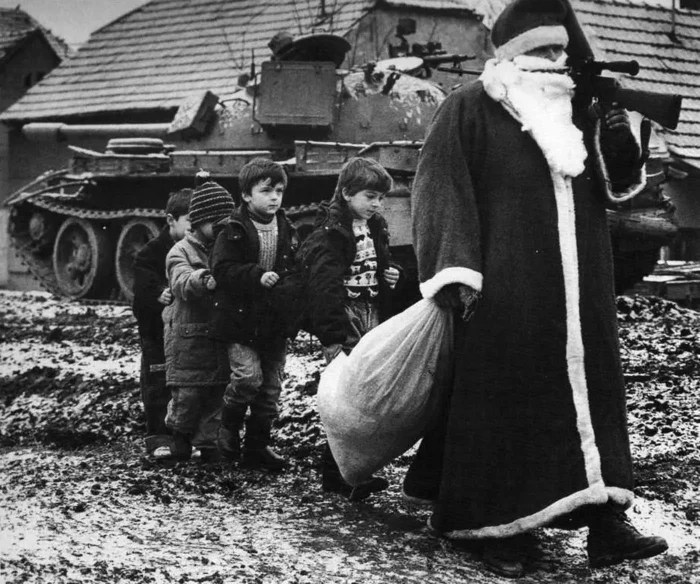
An impactful staged photo, Croatia, Christmas 1992
The European concluded by noting reliance on psychological manipulation to win wars created a “major problem”. Namely, while “a daily publicity blitz of exaggerations and lies may win international support… it will do nothing to heal the divisions which are ripping the country apart.” Locking-in overseas sympathy made Western-backed leaders in the former Yugoslavia less willing to accept negotiated settlements, and keep brutal internecine battles grinding on, safe in the knowledge further carnage only strengthened their position, in information warfare terms.
Notably, a key propaganda strategy for Croats and Slovenes, per The European, was to portray Yugoslav forces “as incompetent and thuggish.” An identical disinformation dynamic played out during the first 18 months of the Ukraine proxy war. As a November 2023 NATO paper on “Humour In Online Information Warfare” revealed, the military alliance and its Kiev puppets specifically sought to weaponise “humour and mockery”, emphasising “Russian failures” and “Ukrainian determination” in media reporting and online, from the conflict’s inception.
These efforts augmented “the responsiveness and impact” of Ukraine’s “information campaigns,” proving “instrumental” in Kiev securing “US-made F-16 combat aircraft” in August 2023, among other Western arms shipments. The NATO paper makes clear weaponisation of mockery is a long-running objective for the alliance, citing a 2017 study, “Stratcom Laughs”, which outlines methods of exploiting “humour” as a military “communications tool”. Four years later, an official Ukrainian government website entry boasted of how such methods can “influence your opinion”:
“How does propagandistic humor work? Relieves tension, makes perception less critical. Uses common contexts to convey messages with which the audience agrees. Simplifies everything to the ‘obvious’. Creates clear groups: strong and intelligent ‘we’ and clumsy and stupid ‘they’. Of course, the audience associates itself with the former and begins to despise the latter. Simplified managed understanding is easily disseminated by the audience and creates the necessary social context for propagandists.”
Atrocity propaganda has also played a crucial role in prolonging the unwinnable quagmire at unsustainable economic, human, and material cost. In April 2022, British intelligence exploited the ever-mysterious Bucha incident to sabotage fruitful peace talks between Kiev and Moscow, framing the apparent killing of innocent civilians in the town as somehow genocidal. At the time, a US Defense Intelligence Agency apparatchik lamented how the “Bucha Effect” had “led to frozen negotiations and a skewed view of the war” – apparently unaware this was London’s precise objective.
Behind the DOJ’s politicized indictment of Maduro: a CIA-created ‘network’ and coerced star witness
The US Department of Justice indictment of Venezuela’s kidnapped leader is a political rant that relies on coerced testimony from an unreliable witness
By Max Blumenthal | The Grayzone | January 5, 2026
The January 3 US military raid on Venezuela to kidnap President Nicolas Maduro and First Lady Cilia Flores was followed by the Department of Justice’s release of its superseding indictment of the two abductees as well as their son, Nicolasito Maduro, and two close political allies: former Minister of Justice Ramon Chacin and ex-Minister of Interior, Justice and Peace Diosdado Cabello. The DOJ has also thrown Tren De Aragua (TDA) cartel leader Hector “Niño” Guerrero into the mix of defendants, situating him at the heart of its narrative.
The indictment amounts to a 25 page rant accusing Maduro and Flores of a conspiracy to traffic “thousands of tons of cocaine to the United States,” relying heavily on testimony from coerced witnesses about alleged shipments that largely took place outside US jurisdiction. It accuses Maduro of “having partnered with narco-terrorists” like TDA, ignoring a recent US intelligence assessment that concluded he had no control over the Venezuelan gang. Finally, the prosecutors stacked the indictment by charging Maduro with “possession of machine guns,” a laughable offense which could easily be applied to hundreds of thousands of gun-loving Americans under an antiquated 1934 law.
DOJ prosecutors carefully avoid precise data on Venezuelan cocaine exports to the US. At one point, they describe “tons” of cocaine; at another, they refer to the shipment of “thousands of tons,” an astronomical figure that could hypothetically generate hundreds of billions in revenue. At no point did they mention fentanyl, the drug responsible for the overdose deaths of close to 50,000 Americans in 2024. In fact, the DEA National Drug Threat Assessment issued under Trump’s watch this year scarcely mentioned Venezuela.
By resorting to vague, deliberately expansive language larded with subjective terms like “corrupt” and “terrorism,” the DOJ has constructed a political narrative against Maduro in place of a concrete legal case. While repeatedly referring to Maduro as the “de facto… illegitimate ruler of the country,” the DOJ fails to demonstrate that he is not de jure illegitimate under Venezuelan law, and will therefore be unable to bypass established international legal precedent granting immunity to heads of state.
Further, the indictment relies on transparently unreliable, coerced witnesses like Hugo “Pollo” Carvajal, a former Venezuelan general who has cut a secret plea deal to reduce his sentence for drug trafficking by supplying dirt on Maduro. Carvajal was said to be a key figure in the so-called “Cartel of the Suns” drug network which the DOJ claims was run by Maduro. If and when he appears to testify against the abducted Venezuelan leader, the American public could learn that the “cartel” was founded not by the deposed Venezuelan president or one of his allies, but by the CIA to traffic drugs into US cities.
As sloppy and politicized as the DOJ’s indictment might be, it has enabled Trump to frame his lawless “Donroe Doctrine” as an aggressive policy of legal enforcement, emboldening the US president to levy further threats to abduct or bump off heads of state who stand in the way of his rapacious agenda. This appears to be the real purpose of the imperial courtroom spectacle to come.
Weaponizing the “narco-terror” hoax
The bulk of the case against Maduro rests on the accusation that the defendants “engaged in… drug trafficking, including in partnership with narco-terrorist groups.” According to the DOJ, Maduro conspired with TDA, as well as the Mexican Sinaloa and Los Zetas cartels to traffic drugs between 2003 and 2011. However, these cartels were not designated by the Trump administration as Foreign Terrorist Organizations until February 2025, a move obviously designed to justify Maduro’s kidnapping and juice up his indictment.
In its bid to convict Maduro, the DOJ will undoubtedly struggle to overcome the conclusion reached in an April 7, 2025 memo by the Office of the Director of National Intelligence (ODNI) that the Venezuelan leader did not control TDA, which he effectively dismantled through a massive 2023 military-police raid on the Tocorón prison that served as the gang’s base of operations. A report in the State Department-funded outlet InSight Crime also complicates the DOJ’s case, finding that “the few crimes attributed to alleged Tren de Aragua members in the United States appear to have no connection with the larger group or its leadership in Venezuela.”
In fact, many of the supposed crimes for which Maduro is charged took place outside the borders and jurisdiction of the United States. The DOJ alleges, for instance, that in September 2013, “Venezuelan officials dispatched approximately 1.3 tons of cocaine on a commercial flight from the Maiquetia Airport to Paris Charles de Gaulle Airport.”
In 2018, five British citizens were convicted in a French court for orchestrating the drug shipment with help from gang members from Colombia and Italy – but not Venezuela. At the time of the incident, Maduro’s government acknowledged corrupt lower level Venezuelan officials had allowed the drugs to pass through airport security. Caracas ultimately arrested 25 people, including members of the military and an Air France manager – a salient fact omitted from the DOJ indictment.
The evidence of Maduro’s involvement in the scandal, according to the DOJ, was that the drug shipment took place “mere months after [Maduro] succeeded to the Venezuelan presidency.” No other proof is offered to demonstrate his culpability.
The indictment goes on to allege Maduro “facilitated the movement of private planes under diplomatic cover” to avoid law enforcement scrutiny as they landed in Mexico. Citing coerced testimony from a Venezuelan government defector, it accuses Diosdado Cabello of coordinating a shipment of 5.5 tons of cocaine on a DC-9 jet to Mexico. None of these claims should hold water in a US court.
As public defender and legal analyst Eliza Orlins explained, “Flights that occur wholly within Venezuela do not cross U.S. airspace, do not implicate U.S. customs territory, and do not, standing alone, violate U.S. law. The indictment attempts to bootstrap these domestic movements into U.S. criminal jurisdiction by asserting that the cocaine involved was ultimately destined for the United States. Intent does almost all the work here.”
Because most of the specific incidents cited in the indictment occurred within Mexico under Presidents Vicente Fox, Felipe Calderón and Enrique Pena Nieto, the DOJ inadvertently implicates these three pro-US administrations, who shaped their drug policies in coordination with Washington. In fact, the top cop during the first two of these governments, former Federal Intelligence Agency chief Genaro García Luna, was convicted in a US federal court in 2023 for presiding over a multi-million dollar conspiracy with the Sinaloa cartel. Former US ambassador to Mexico Robert Jacobson acknowledged that the US knew all about Garcia Luna’s cartel ties, but insisted, “we had to work with him.”
The Honduran double standard
The DOJ also implicates the pro-US government of former Honduran President Juan Orlando Hernandez, referring to Honduras as a “transshipment” point “in which cocaine traffickers operating in those countries paid a portion of their own profits to politicians who protected and aided them.” Hernandez was convicted in a US federal court in 2023 of trafficking over 400 tons of drugs to the US, but received a pardon this December from President Donald Trump following a lobbying campaign by top Trump donors seeking business in the deregulated crypto haven of Próspera off the coast of Honduras.
During his January 3 press conference announcing the abduction of Maduro and his wife, Trump aggressively defended his decision to pardon Hernandez, claiming the Honduran ex-president been “persecuted very unfairly.” However, the same DOJ prosecutor who authored the original 2020 indictment of Maduro, Trump loyalist Emil Bove, was responsible for the indictment of Hernandez. In contrast to the case against Maduro, the Hernandez indictment contained concrete evidence of his collaboration with major transnational cartels, including video and photographic exhibits, as Anya Parampil and Alexander Rubinstein detailed for The Grayzone.
Hernandez pleaded his case to Trump in a 2025 letter claiming he’d been subjected to a “rigged trial” and convicted “based on the uncorroborated statements of convicted drug traffickers.”
His questionable claim could also apply to the DOJ’s prosecution of Maduro, as many of the most dramatic allegations contained in his indictment are sourced to a convicted drug trafficker who struck a secret deal with US prosecutors to reduce his own sentence in exchange for testimony against Maduro.
He is former Venezuelan Gen. Hugo “El Pollo” Carvajal.
Coerced “star witness” strikes secret deal with US prosecutors
The head of military intelligence under the government of Venezuelan President Hugo Chavez from 2004 to 2011, Carvajal is cited seven times in the January 3 DOJ indictment as a witness to alleged criminal acts by Maduro and his inner circle. Carvajal was first arrested in 2014 in Aruba on drug running charges, but was returned to Venezuela to the chagrin of US authorities. In 2017, as he faced a pair of indictments in the US, the general suddenly turned on Maduro, denouncing him as a dictator. He had openly endorsed the regime change project of US-controlled “interim president” Juan Guaido in 2019, fashioning himself as a courageous defector while proffering his supposed knowledge of the Venezuelan deep state to Washington.
That same year, as Carvajal sought asylum in Spain, the US formally demanded that Madrid him over. Now facing the prospect of extradition, he delivered a series of tell-all interviews to legacy outlets like the New York Times, doing his best to legitimize virtually every charge the Trump administration sought to weaponize against Maduro.
Then-Senator Marco Rubio could not contain his excitement about the prospect of squeezing the Chavista insider for testimony in a future case against Maduro. Carvajal “will soon be coming to the US to provide important information about the #MaduroRegime,” Rubio tweeted on April 12, 2019. “Bad day for the #MaduroCrimeFamily.”
It was not until 2023 that Carvajal was finally extradited and placed on trial in the Southern District court of New York. After he pleaded guilty to “narco-terrorism” this June, the Miami Herald reported that he had struck a plea deal which would grant him “a considerable sentence reduction if he provides ‘substantial assistance’ to US investigations.”
Carvajal’s still-secret plea deal gives away the game he’d played since he first emerged as a defector. His allegations against Maduro had been delivered under duress, all designed to satisfy his would-be jailers in the US. He has since indulged one of Trump’s favorite conspiracy theories by alleging in a June 2025 letter to the US president that Maduro manipulated Venezuela’s Smartmatic voting systems to rig the 2020 US presidential election in favor of Biden.
Carvajal’s shameless pandering to Trump and secret plea deal should obliterate his credibility as a witness against Maduro.
In its January 3 indictment of Maduro, the DOJ claimed Carvajal and Diosdado Cabello “worked with other members of the Venezuelan regime” to “coordinate the shipment” of 5.5 tons of cocaine from Simon Bolivar International Airport to Campeche, Mexico in a private jet in 2006. This incident remains the source of intense intrigue, as the ownership of the DC-9 jet by two shadowy American companies points in the direction of US intelligence.
While details of potential covert US government involvement in the 2006 drug shipment remain murky, it is an established fact that the CIA founded and operated the “Cartel of the Suns” which the DOJ now accuses Maduro, Cabello and other top Venezuelan officials of controlling.
Cartel of the Suns: created by the CIA, weaponized by the DOJ
In the original indictment of Maduro, the DOJ explicitly accused Maduro of leading a narco-trafficking cartel called “Cartel of the Suns,” referencing it over 30 times.
The revised DOJ indictment of Maduro unsealed on January 3 states, “Starting in or about 1999, Venezuela became a safe haven for drug traffickers willing to pay for protection and support corrupt Venezuelan civilian and military officials, who operated outside the reach of Colombian law enforcement and armed forces bolstered by United States anti-narcotics assistance.”
It continues: “The profits of that illegal activity flow to corrupt rank-and-file civilian, military, and intelligence officials, who operate in a patronage system run by those at the top-referred to as the Cartel de Los Soles or Cartel of the Suns.”
The informal network of corrupt military officials was in fact established by the CIA under pro-US Venezuelan governments during the 1980’s and ‘90’s. Americans were introduced to this inconvenient truth not by some dissident muckraker, but by the New York Times, and by Mike Wallace in a 60 Minutes exposé broadcast in 1993.
Three years earlier, US Customs officials in Miami had intercepted a shipment of 1000 pounds of pure cocaine from Venezuela. But they were soon told by higher-ups in the US government the shipments had been approved by Langley. According to the Times, the CIA sought to allow the cocaine to “enter the United States without being seized, so as to allay all suspicion. The idea was to gather as much intelligence as possible on members of the drug gangs.”
“I really take great exception to the fact that 1000 kilos came in, funded by US taxpayer money,” then-DEA attache to Venezuela Annabelle Grimm remarked to 60 Minutes. “I found that particularly appalling.”
To organize the shipments from Venezuela, the CIA recruited generals from the Venezuelan National Guard who were trained by the US. Because officers in the National Guard wore patches on their uniforms bearing the symbol of a sun, the informal drug network was branded as “The Cartel of the Suns.”
In the years after the CIA-run cartel was exposed in US media, it disappeared, only to be revived when the US government began hounding Gen. Carvajal, who may soon appear as its key witness against Maduro. While corruption is still present in the Venezuelan military, there is little evidence of anything resembling a Cartel of the Suns in its ranks.
As Phil Gunson, a Caracas-based analyst for the International Crisis Group, told CNN, “Cartel de los Soles, per se, doesn’t exist. It’s a journalistic expression created to refer to the involvement of Venezuelan authorities in drug trafficking.”
A former senior US official echoed Gunson, describing Cartel of the Suns as “a made-up name used to describe an ad hoc group of Venezuelan officials involved in the trafficking of drugs through Venezuela. It doesn’t have the hierarchy or command-and-control structure of a traditional cartel.”
The official told CNN that the DEA or Defense Intelligence Agency had supplied Trump with a “purely political” assessment of the cartel to support his assault on Venezuela.
Discovery granted to the defense in the trial of Maduro and Flores risks severely embarrassing the US government by extracting further evidence of CIA drug running. This may be why the DOJ softened its language about the Cartel of the Suns, referring to it in the January 3 indictment as a mere “patronage network” rather than as a cohesive criminal syndicate, and mentioning it only twice.
During his first appearance in court earlier that day, the kidnapped Venezuelan leader was only able to speak for a brief moment. “I am innocent. I am a decent man. I am President…” Maduro pleaded before being cut off by his lawyer.
Real Counter to US Nabbing Maduro: Quit Buying American Arms
Sputnik – 06.01.2026
On January 3, the US launched a massive attack on Venezuela, capturing Maduro and his wife and taking them to New York. US President Donald Trump announced that Maduro and Flores would face trial for allegedly being involved in “narco-terrorism” and posing a threat, including to the US.
The Global Majority in Latin America, Africa, and Asia should hold the United States to account by stopping purchases of US weapons, including F-16s, F-35s, and halting collaboration with companies like Boeing, Lockheed-Martin, and Raytheon, former UN independent expert Alfred de Zayas told Sputnik.
“US businesses are vulnerable,” he explained.
De Zayas was shocked by “the brazenness” of the US kidnapping Nicolas Maduro, which comes “in total impunity, and I do not see the ‘good guys’—Canada, the UK, the Europeans—coming out in defense of Venezuela and international law,” the ex-UN expert stressed.
He condemned the abduction of Maduro as a US “assault on civilization” and “retrogression in the idea of international peace and security.”
De Zayas pointed to an array of precedents pertaining to the US “assault on international law,” including the fact that George H.W. Bush bombed Panama in 1989 and “had President Noriega arrested and subjected to a show trial.”
Also, Bill Clinton bombed Yugoslavia in 1999, destroying the Chinese Embassy in Belgrade, while George W. Bush and the Coalition of the Willing invaded Iraq in 2003, which led to the death of about one million Iraqis.
Additionally, Barack Obama orchestrated the 2014 coup against Ukrainian President Viktor Yanukovych, the expert recalled.
“No one was ever held accountable” for these actions, de Zayas concluded.
Prof. Marandi on Iran & Venezuela: What’s Next?
TMJ News Network | January 5, 2026
Professor Mohammad Marandi joins TMJ News to break down the latest developments in Iran and Venezuela, unpacking how economic protests, sanctions, and media narratives are being weaponized once again to push long-standing U.S.-Israeli regime change agendas.
Iran’s collapsing currency exposes the profiteers behind the crisis
By Fereshteh Sadeghi | The Cradle | January 5, 2026
In the final days of 2025, as the rial plunged to unprecedented lows, Tehran’s bustling Jomhuri (Republic) Avenue transformed into a corridor of defiance.
‘Bazaaris’ (traditional merchant class with deep political and economic influence) and cellphone shopkeepers, cornered by a collapsing currency and punishing tariffs, shuttered their stores and poured into the streets.
Their outrage ignited a fire that quickly spread to the Grand Bazaar, long considered Iran’s economic barometer. Unlike the 2022 protests over social freedoms or the 2009 unrest sparked by electoral disputes, this wave of demonstrations is driven squarely by economic collapse and long-festering mismanagement.
What began as a merchants’ revolt against an unworkable trade environment soon revealed the deeper rot of decades-long economic mismanagement, institutional corruption, and a sanctions-choked system that punishes the people to sustain itself.
Sanctions, sabotage, and a vanishing economy
Iran, a nation of over 86 million, registered a meager 0.3 percent economic growth in summer 2025, while inflation soared past 42 percent by December. Labor force participation remains abysmally low, trailing nearly 20 points behind the global average. These dire metrics have steadily worsened under the weight of relentless US sanctions, first re-imposed by President Donald Trump in 2018 during his first term, and have intensified through two presidential terms.
The rial’s spectacular collapse – breaking the 1,445,000 mark against the US dollar – did not occur in a vacuum. It marked a 47.8 percent surge in just six months.
The higher the rate was going up, the angrier were businesses whose sales are directly dependent on the dollar-rial change rate. The first spark of protests was ignited by the shopkeepers at two cellphone shopping malls in downtown Tehran. They started a strike, saying they were unable to do business because they were struggling with a new cellphone registry tariff the government had imposed on devices priced at $600 and more.
The next day, shopkeepers did not just close their shops but took to the famous Republic Avenue, protesting against the situation. The dollar dealers at Ferdowsi Avenue joined the protests too, and in the Grand Bazaar, gold and silversmiths brought their shutters down in fear of chaos.
A shopkeeper at Lalezar Street tells The Cradle that, “we were forced to close our shops as some protesters attacked us verbally and threatened to ransack our shops by hurling stones at our windows.”
In addition to sanctioning traditional routes such as banks, firms and individuals, the US Department of the Treasury’s Office of Foreign Assets Control (OFAC), has been targeting digital currency addresses it accuses of being used by a financial network to transfer Iran’s oil and non-oil money.
According to Gholma-Reza Taj Gardoun, chairman of the parliamentary budget committee, “the Iranian government only received 13 out of $21 billion oil revenues in the last eight months”. He added that “the remaining $8 billion is the cause of the current turmoil, the shortage of dollar bills in the market and the rising exchange rate.”
A rigged system of profiteers
Taj Gardoun is not alone in exposing how oil and non-oil export revenues have failed to return to Iran. At the heart of the crisis lies a parasitic class of semi-governmental enterprises and politically-connected traders who profit from Iran’s fiscal dysfunction.
Former finance minister and current lawmaker Hussein Samsami estimates that “117 out of $335 billion non-oil export revenues have not returned to the country, since the US re-imposed sanctions in 2018.” Much of this capital, he says, was siphoned off by ‘khosulati’ entities – quasi-governmental firms benefiting from state ownership yet operating without transparency or oversight.
Equally troubling is the shadowy role of “trustees” – a secretive network tasked with circumventing sanctions to sell Iranian oil.
Former Central Bank of Iran (CBI) Governor Valiollah Seif acknowledged “they are trusted people, Iranians and non-Iranians, who transfer money (for Iran),” adding “money transfer is a very risky process and the payment of these so-called trustees and the money changers working with them is high.” Seif revealed “sometimes a trustee siphons off the funds.”
Apart from the trustees, the quasi-governmental entities are also blamed for refusing to give back the non-oil export money to the central bank and sell it at rates higher than the regular CBI-approved rate at the official market.
These companies are owned by various funds affiliated with the Iranian government. The petroleum and the social welfare ministries gained a majority of the shares in these funds through the privatization process in different governments.
The third group that has not returned the export money is individuals or firms with special business permits. A deputy CBI governor reports that “Individuals who own or rented 900 special licenses must return some $16 billion to the central bank, (but they didn’t).”
The result is a liquidity trap in which foreign exchange vanishes from official markets, feeding a vicious cycle of inflation and speculation.
State paralysis and political deflection
For months, the government of Iranian President Masoud Pezeshkian appeared paralyzed, watching as the currency spiralled and public rage mounted. While some suggest the state deliberately allowed the rial to slide to ease its budget deficits, others cite institutional chaos and a lack of cohesive economic policy.
They refer to a confession made by former Iranian president Hassan Rouhani in 2020, “The foreign currency belongs to the government, the price is decided by the government and we can bring it down, if we decide it.”
In reaction to the voices of dissatisfaction, Pezeshkian tasked his interior minister with meeting the representatives of the protesters and listening to their grievances.
He sat with merchants and replaced CBI governor Mohammad-Reza Farzin with former finance minister Abdolnasser Hemmati. Nevertheless, the latter, who was impeached 10 months ago over his mismanagement of the foreign exchange market, said “he has no responsibility regarding the currency market and his task is to control imbalanced banks and reduce inflation.”
Austerity in a powder keg
In the streets, the demonstrations have morphed into sporadic riots, mostly in western provinces, marked by attacks on police stations and arson against state buildings. Casualties have been reported, including among security forces, as the protests shift from organized dissent to expressions of raw frustration.
Demonstrations in Tehran that were not large in essence have subsided, but morphed into sporadic riots. Smaller cities or towns in western Iran are now the scene of riots, with the number of rioters limited to dozens, not even hundreds.
Arson attacks against government buildings or rioters storming police stations to capture their armory have been reported. About a dozen, including police forces, have been killed countrywide, and arrests have been made.
Iran’s leader, Ayatollah Ali Khamenei, on 3 January, admitted that the ‘bazaaris’ have legitimate complaints regarding economic instability. Still, he made it clear that the Islamic Republic “will not yield to the enemy” and will deal seriously with violent protesters; “rioters must be put in their place.”
The Iranian leader’s comments were a response to Trump after he threw his weight behind the protesters, threatening the Islamic Republic with military intervention “if protesters are killed.” The Reformist Front joined in rejecting foreign threats, warning that any interference in the protests would escalate violence and distort the people’s demands.
In a last-ditch bid to regain economic control, an Iranian official from the Budget and Planning Organization says “the Trustees will be asked to return billions of dollars in their overseas accounts to the country.” A lawmaker cautions, “the parliament will question the oil minister over the issue of the Trustees.”
Iran’s minister of economy said that positive results have been achieved from negotiations with several countries, including the release of part of Iran’s financial resources and the opening of funding channels for importing essential goods, along with gradual efforts to unify the exchange rate into a single rate.
Simultaneously, Pezeshkian is pushing ahead with plans to phase out subsidies for essential imports – a move he dubs an “economic surgery” that will be offset by targeted vouchers for lower-income citizens. But austerity in the midst of currency collapse, inflation, and a credibility crisis is a combustible formula.
Iranian officials are closely tracking the situation in Venezuela, where the abduction of President Nicolas Maduro and rising US aggression offer chilling parallels. For now, Tehran’s street protests remain contained. But if the economic pain persists and reforms deepen inequality, the next wave may not be as easily quelled.
Israeli Intrigue in Venezuela?
By W.M. Peterson | Truth Blitzkrieg |January 5, 2026
“The question is: who’s really in charge? I know President Trump appears to be. I’m not convinced that’s the case because remember… you had this giant Israeli flag suddenly appear in the middle of the Republican convention. And certainly in my lifetime… I don’t know of a single instance where either the Democratic or Republican parties held a convention and hoisted a giant foreign flag… I’ve never heard of that before.” — Col. Douglas Macgregor on the Judging Freedom podcast with Judge Andrew Napolitano (Jan. 3, 2026)
Just four days after Benjamin Netanyahu appeared as a guest on Newsmax’s The Record with Greta van Sustern and informed the insufferable newscaster that Iran is “exporting terrorism… to Venezuela. They’re in cahoots with the Maduro regime… this has got to change,” it was announced that U.S. military forces had carried out a large scale operation against Venezuela, capturing President Nicolas Maduro and his wife Cilia Flores, who will both “face the full wrath of American justice” after being indicted on drugs and weapons charges in the U.S. District Court for the Southern District of New York.
The capture of Maduro occurred exactly 36 years to the day after US Delta Forces captured Panamanian President/CIA informant Manuel Noriega, and it’s unlikely that Netanyahu’s recent visit to the U.S.– the fifth in 2025 by the international fugitive — and the American operation are unrelated. While talk of ‘stolen oil’ and ‘narco-terrorism’ currently dominates the mainstream discourse, the fact that Israel has been seeking regime change in Venezuela since the days of Hugo Chavez has gone virtually unreported.
Prior to Maduro’s predecessor Chavez winning Venezuela’s 1998 presidential election, relations between the naturally wealthy South American country and Israel had been relatively good. Venezuela voted in favor of the United Nations Partition Plan for Palestine in 1947 — which allocated 55% of historic Palestine to the as-yet-unfounded Jewish state — and two years later voted in favor of Israeli membership to the UN. By the mid 1960s, Venezuela boasted a robust Jewish population equipped with an impressive communal structure of schools, synagogues and cultural centers organized by middle-to-upper-class members of the community. In 1967, Jewish ethnic solidarity inspired a large number of Venezuelan Jews to travel to Israel to fight alongside their co-religionists in the Six-Day War. Following the conflict, a large influx of Sephardic Jews from Morocco arrived and settled in Caracas contributing to the largest Jewish population in Venezuela’s history, numbering 30,000 at its peak, evenly split between Sephardim and Askenazim.
By the mid-2000s, however, relations between Venezuela and the Synagogue began to fray.
The first notable rift occurred in late 2004 following the assassination of Venezuelan state prosecutor Danilo Anderson, who was killed by a car bomb at age 38. 1
At the time of his death Anderson had been investigating more than 400 people suspected of involvement in the Llaguno Overpass shootout and the failed 2002 coup d’état, during which Chavez was ousted from office for two days before being restored to power by popular support and a number of loyal military men. (Accusations of Jewish involvement in the coup were made at the time by pro-government newspaper Diario VEA, and later by Venezuela’s ambassador to Russia, Alexis Navarro.)
Suspicions of a possible Mossad dimension to the assassination plot were already high when Venezuelan authorities received a tip suggesting that weapons and explosives connected to the murder may have been transferred from the Club Magnum shooting range to the Colegio Hebraica Jewish school in Caracas, prompting Chavez to authorize his investigative police force DISIP to conduct an armed raid on the school on the morning of November 29, 2004. Chavez’s investigators intercepted busloads of kids and evacuated 1,500 students from the building while searching for any materials related to Anderson’s assassination. Ultimately nothing of value was found and the incident was loudly condemned by local and international Jewish organizations like the Simon Wiesenthal Center, who referred to it in typically melodramatic fashion as a “pogrom.”
Throughout the next two years Chavez’s rhetoric concerning Jewish power and influence became considerably more pointed, especially following Israel’s invasion of Lebanon in 2006. It was during this time that Chavez recalled his country’s ambassador to Israel and threatened to sever diplomatic ties with the Jewish state in protest of its military operation, describing it as a “new Holocaust” and “similar or, perhaps worse… than what the Nazis did.” Chavez further inflamed the sensibilities of Jews at home and abroad by traveling to Tehran and affirming that Venezuela would “stand by Iran at any time and under any condition.” 2
In January 2009, Chavez finally made good on his threat when Venezuela severed all diplomatic ties with the Jewish state due to its conduct in the 2009 Gaza War which left 1,400 Palestinians dead and over 5,000 wounded. Once again referring to the violence as a “Holocaust” and a “flagrant violation of International Law,” Chavez expelled Israel’s ambassador to Venezuela and called for Prime Minister Ehud Olmert to be tried for war crimes in the International Criminal Court. Shortly thereafter, foreign minister Nicolas Maduro met in Caracas with representatives from the Palestinian National Authority and Venezuela officially recognized the existence of a Palestinian State on April 27, 2009.
By this time Chavez was facing tremendous pressure from the international Jewish cabal and it was clear he had a target on his back. During a nationally broadcast speech in June 2010, Chavez condemned Israel as a “terrorist and murderous state,” and affirmed that “Israel is financing the Venezuelan opposition. There are even groups of Israeli terrorists, of the Mossad, who are after me trying to kill me.” Hugo Chavez died on March 5, 2013 at the age of 58 after a two year battle with cancer. He was succeeded as President of the United Socialist Party of Venezuela by Nicolas Maduro who blamed his predecessor’s death on “a US plot.” 3
“Narco-Terrorism”
For months the Trump administration has been trying to claim that Maduro is responsible for trafficking boatloads of drugs into the United States; using the unfounded claim to justify deadly strikes on more than 30 small vessels in the Caribbean and what Trump referred to as “the dock area where they load the boats up with drugs.” Initially ‘The Donald’ tried claiming the boats were carrying fentanyl and that each extra-judicial U.S. strike would save 25,000 American lives. However, this outlandish conspiracy theory was hampered by the fact that no evidence exists showing that any significant level of fentanyl is produced in South America, as confirmed by the United Nations Office on Drugs and Crime (UNODC).
With the fentanyl narrative sinking faster than Maduro’s purported drug boats, the Trump administration pivoted seamlessly to talk of purloined oil and cocaine trafficking. While it’s true Venezuela plays a role in the international cocaine trade, the US doesn’t appear to be a significant destination as no direct trade route via sea is known to exist between the countries. In reality, far more cocaine and fentanyl enters America through Mexico and yet, curiously, socialist president Claudia Sheinbaum’s “narco-government” has thus far failed to register a blip anywhere near as noteworthy as Venezuela’s on Uncle Sam’s regime change radar.
Another overt contradiction in Trump’s ‘war on drugs’ narrative is the federal pardon he granted ex-president of Honduras Juan Orlando Hernandez, who had just recently begun serving a 45-year sentence after being convicted in a New York federal court for drug trafficking and firearms offenses and for receiving millions of dollars in bribes from drug cartels, including a $1 million bribe from Joaquin “El Chapo” Guzman. Despite having trafficked an estimated 400 tons of cocaine into the United States over a period of 18 years, Hernandez walked out of prison a free man on December 1, 2025, just days before the Honduran general election in which Trump endorsed Nasry Asfura, the candidate from Hernandez’s Honduran National Party, who himself was indicted by authorities in 2020 on charges of money laundering, embezzling public funds, fraud, and abuse of authority.
Trump’s support for Juan Orlando Hernandez and Nasry Asfura shouldn’t raise any eyebrows coming as it does from the man who pardoned Israeli spy Jonathan Pollard’s handler and is currently engaged in running interference for an international child sex trafficking ring. Indeed, Trump’s entire life has been spent swimming in the same swamp he promised to drain and now he’s being used as a tool for regime change in Venezuela and soon Iran. Disgraced attorney Alan Dershowitz, who staunchly defended Pollard in his 1991 book Chutzpah, recently told the media that “If President Trump wants to be known as the peace president, he has to be in support of regime change.”
I’m familiar with the arguments put forth by starry-eyed MAGA optimists suggesting there’s some America First motivation informing Trump’s decision-making. However, it seems more likely there’s a deeper play involving Israel that’s the driving force behind the conflict. This was hinted at when Fox News published an article claiming Maduro’s Venezuela has become “Hezbollah’s most important base of operations in the Western Hemisphere, strengthened by Iran’s growing footprint and the Maduro regime’s protection” and again when ultra-Zionist Ambassador Mike Huckabee informed the world that the US overthrow of Maduro was good news for Israel because of his country’s partnership with Iran and Hezbollah. Perhaps this explains why Venezuelan Vice President Delcy Rodriguez believes the operation was imbued with a ‘Zionist tint’? When viewed in its entirety it’s hard to disagree. Capturing Venezuela’s vast oil reserves might even portend an immediate escalation in the Middle East by diminishing Iran’s primary geopolitical leverage, e.g., blocking the Strait of Hormuz, and I expect to see an escalation on that front in the coming weeks and months.
Whatever the case may be, you can rest assured knowing that the Trump administration is not waging a war on “narco-terrorism,” a completely meaningless propaganda term designed chiefly to promote regime change in Latin America. The illegal narcotics destroying the bodies and minds of Americans young and old are undoubtedly entering the country under CIA and Mossad auspices, just as they were in the 1980s during Iran-Contra when Arkansas Governor Bill Clinton — a “terrific guy” according to Trump — permitted the use of his Mena airstrip for the transport of an extraordinary amount of cocaine into the United States. A highly-placed conspirator within the Iran-Contra nexus was Jewish neoconservative Elliott Abrams (Trump’s US Special Representative for Venezuela from 2019 – 2021), who recently advocated for regime change in Venezuela for the purpose of — among other things — reducing drug trafficking! Abrams, who crafted the 1998 PNAC letter demanding the removal of Saddam Hussein, was convicted in 1991 on two misdemeanor counts for his role in the Iran-Contra affair after entering into a plea agreement to avoid felony charges of perjury.
Evidentially, international gun/drug running isn’t much of a concern for Trump, so long as the perpetrators play for the right team. But hey, MAGA, be of good cheer, your white knight’s attack on Venezuela isn’t without its supporters…
NOTES:
- The Jewish Telegraph Agency reported on December 7, 2004 that Anderson “was assassinated in his car by a remote bomb planted in his cell phone… Comparisons of the style of Anderson’s assassination to Israeli targeted killings carried out by Israeli commandos abounded. In the best-known example, Israelis assassinated Hamas bomb-maker Yehiya Ayyash in 1996 using a booby-trapped cell phone.” ↩︎
- According to the World Conference Against Anti-Semitism, Chavez’s pro-government media published “an average of 45 [anti-Semitic] pieces per month” in 2008 and “more than five per day” during the January 2009 Operation Cast Lead in Gaza. In early 2013 dozens of documents were leaked to the press showing that SEBIN, Venezuela’s premier intelligence agency, had been collecting “private information on prominent Venezuelan Jews, local Jewish organizations and Israeli diplomats in Latin America.” ↩︎
- The current leader of Venezuela’s opposition party, the Nobel Peace Prize winner Maria Machado, has said that she is ready to take power. In a recent interview with the newspaper Israel Hayom, Machado was quoted as saying: “Venezuela will be Israel’s closest ally in Latin America. We rely on Israel’s support in dismantling Maduro’s crime regime and in the transition to democracy. Together we’ll lead a global struggle against crime and terror.” ↩︎
Department of War Claims No US Troops in Venezuela
By Kyle Anzalone | The Libertarian Institute | January 5, 2026
US military officials said the US does not currently have any personnel on the ground in Venezuela. The statement was made the day after President Donald Trump said the US was running the country.
On Tuesday, the Pentagon claimed that no troops were on the ground in Venezuela, raising questions about Trump’s assertion that the US was controlling Caracas. “We are going to run [Venezuela] until such time as we can do a safe, proper, and judicious transition. We don’t want to be involved with having somebody else get in and we have the same situation that we had,” the President said on Saturday. “We are there now, and we are going to stay until the proper transition takes place.”
The US has engaged in a massive military buildup in the Caribbean, including 15,000 soldiers, an aircraft carrier strike group, an attack submarine, and warplanes. Those troops have conducted strikes on dozens of drug boats, seized tankers carrying Venezuelan oil, and kidnapped President Nicolas Maduro.
After Maduro was removed from Venezuela, the Supreme Court named Vice President Delcy Rodríguez as interim president. Trump initially said that the US was prepared to work with Rodríguez, but he later threatened to remove her from power if she did not comply with Washington’s demands.
Trump claimed that Secretary of State Marco Rubio and War Secretary Pete Hegseth would be “running” Venezuela. The President added that he was willing to deploy American troops to Venezuela to enforce his dictates.
Rodríguez says she is willing to work with the US, but maintains that Venezuela is a sovereign nation.
Beijing Urges US Not to Use ‘China Threat’ Narrative to Control Greenland
Sputnik – 05.01.2026
BEIJING – The United States must stop using the so-called “China threat” narrative to justify its personal interests, Chinese Foreign Ministry spokesman Lin Jian said on Monday, commenting on US President Donald Trump’s claims to Greenland.
On Sunday, Trump told The Atlantic that the United States “absolutely” needed Greenland, claiming the island was “surrounded by Russian and Chinese ships.” Danish Prime Minister Mette Frederiksen urged Trump to stop threatening Greenland, an autonomous part of Denmark, with annexation.
“We urge the US to stop using the so-called ‘China threat’ as a pretext for itself to seek selfish gains,” Lin told the briefing.
Earlier in the day, Greenlandic Prime Minister Jens-Frederik Nielsen said that the island is open to dialogue with the United States as long as communication occurs through the proper channels.
Trump has repeatedly said that Greenland should become part of the United States, citing its strategic importance for national security and the defense of the “free world,” including from China and Russia. Former Greenlandic Prime Minister Mute Egede said the island was not for sale.
The island was a Danish colony until 1953. It has remained a part of the Kingdom of Denmark after gaining autonomy in 2009, with the ability to self-govern and determine its own domestic policy.
Featured Video

AIDS Inc. by Gary Null (2007)
or go to
Aletho News Archives – Video-Images
From the Archives
Clash of Civilization, Iran Part II
By Jamal Kanj – Intifada-Palestine.com – January 14, 2011
Israel’s survival kit is: perpetuate conflict, insecurity to rationalize collective hate and finally playing victim.
Devoid of conflict, Israel implodes internally; without hate, Zionism loses its justification; and playing eternal victim to continue blackmailing the West. Absence of this holy trinity, Israel ceases to exist.
From its inception, the house of Zion has mastered exploiting adversarial powers to advance Israel’s cause. For instance, their influence over the Democratic Party in the US began with President Truman’s bid for 2nd term election in 1948.
Responding to strong opposition from Secretary of State General George Marshall and Department experts urging against recognition of Israel, President Truman replied: “I’m sorry gentlemen but I have to answer to hundreds of thousands [Jewish voters] who are anxious for the success of Zionism. I do not have hundreds of thousands of [voting] Arabs among my constituents”
Zionists influence over liberal American politics was matched with the doctrinal school of Conservative theoreticians aligning the Republican Party’s platform with Israel’s objectives. The Neoconservative Zionists, coined Zioncons, invented the “Clash of Civilization” concept to fight Israel’s wars. … continue
Blog Roll
 Aletho News
- 12 Things Your Psychiatrist Was Trained Not to Tell You
- From Unipolar Universalism to Multipolar Civilizational Distinctiveness
- RSF military group defects, joins Sudanese army: State media
- Ireland goalkeeper refuses to play ‘Israel’ as squad weighs boycott
- China pushes back against US on Cuba, Iran
- Ukrainian Soldiers, Potential Mercenaries: Have Gun, Will Travel!
- Burnham’s UN debut… A masterclass in British disinformation
- Iran flights continue despite US aviation sanctions
- Global Tipping Points Lead the World Into a State of Entropy
- The day-after at the White House: USA and Xi Jinping
- If Americans Knew
- Israel forces Gazans to live in constant peril – Daily Update
- Deconstructing Netanyahu’s pants-on-fire UN rant – Daily Update
- Trump betrayed voters with his campaign lies and prioritized a foreign country once he took office
- Netanyahu calls Israel’s war in Gaza ‘opposite of genocide’ in UN speech to near-empty hall
- Settler Kidnappings: Torture, Sexual Abuse and Terrorisation of Palestinian Abductees as Israel Deepens Annexation of West Bank
- Gaza winter nears as 162,000 tents become unusable, raising fears of humanitarian crisis
- Netanyahu says, “It’s the opposite of genocide”; UN says Gaza economy is world’s ‘most severe crisis on record’ – Daily Update
- Israel’s US-Backed Assault on Gaza Has Created the ‘World’s Most Severe Economic Crisis on Record’: UN
- ‘Protecting U.S. Citizens’… From Israel
- ‘This is where I live now, the back of a truck’: a day in the life of a grandmother in Gaza
- No Tricks Zone
- New Study: Earth And Venus Surface Warmth Largely Explained By Convection And Lapse Rate, Not CO2 Or Radiation
- 2025 Nature Paper Claiming Worsening Global Drought Gets RETRACTED …Heavily Flawed
- New Study: ‘Global Drought Shows No Detectable Recent Acceleration Under Climate Warming’
- Economic Masterminds: German Socialists Suggest Taxing Productivity Gains Stemming From Using AI
- The South China Sea Has Not Been Cooperating With The Climate Change Narrative
- Energy Crisis: Germany Enters Heating Season With Historically Low Gas Reserve Fill Levels
- New Study: The Antarctic Ice Sheet Gained Mass From 2020-2024 Due To Staggering Snow And Ice Accumulation
- Study: Ocean Heating Rates From Thousands Of Years Ago ‘Dwarf’ Modern Ocean Heating Rates
- Climate Extremists Target, Attack Large-Scale Power Grid Infrastructure In Germany!
- New Study: Antarctic Ice Melt Has Contributed Less Than 1 Centimeter To Sea Level Rise In The Last 30 Years

