In incendiary leaked comments, the former head of Israel’s military intelligence disclosed plans to assassinate Hamas’ leadership and initiate war
In comments leaked by Israel’s Channel 12 this August 16, the Israeli army’s former head of military intelligence, Aharon Haliva, called for a “new Nakba” against the Palestinians and declared, “50,000 dead in Gaza is necessary and required for future generations.”
“For everything that happened on October 7, he proclaimed, “for every person on October 7, 50 Palestinians need to die. It does not matter now if they are children.”
Haliva’s remarks offer further proof of Israel’s genocidal intent in Gaza, and provide fresh evidence in future prosecutions of the country’s military and political leadership for crimes against humanity.
While social media users reeled in horror at his fascistic rhetoric, few noticed a revelation by Haliva which should cast the Al Aqsa Flood operation on October 7 in an entirely new light.
According to Haliva, “After the holidays [in the Fall of 2022], we were opening a joint reorganization with [Israel’s General Security Services] Shin Bet to collect intelligence on [Al-Qassam Chief of Staff Mohammed] Deif and [Hamas Secretary Genera Yahya] Sinwar in order to kill them, because every time we prepared a plan, they moved, and you have to re-collect on them.”
In other words, Israel was planning to violate its ceasefire with Hamas and launch a major decapitation strike against its leading figures, much like the one it deployed against Iran’s military leadership this June 13, when it assassinated 8 major IRGC officials without provocation. The killings would have touched off a major war, but unlike after October 7, Hamas would have been left without any negotiating leverage, as it would have had no Israeli captives in its possession when hostilities began.
When seen in this light, Al Aqsa Flood was a preemptive strike. Sinwar and Deif almost certainly understood that Israel was plotting their assassinations as the opening blow of a punishing assault aimed at snuffing out Palestinian resistance in Gaza once. Deif had already survived four assassination attempts, losing his family, an eye and use of several limbs in the process. As Haliva acknowledged, he and Sinwar were constantly on the move to evade their would-be killers.
And so, as the sun rose on October 7, 2023, Hamas took the initiative, denying a far more powerful adversary the devastating opening move it had methodically planned.
August 22, 2025
Posted by aletho |
Deception, Ethnic Cleansing, Racism, Zionism, War Crimes | Israel, Palestine, Zionism |
Leave a comment
The killing of seven Palestinian journalists and media workers in Gaza on 10 August has prompted verbal condemnations, yet has inspired little to no substantive action. This has become the predictable and horrifying trajectory of the international community’s response to the ongoing Israeli genocide.
By eliminating Palestinian journalists like Anas al-Sharif and Mohammed Qraiqeh, Israel has made a sinister statement that the genocide will spare no one. According to the monitoring website Shireen.ps, Israel has killed nearly 270 journalists since October 2023.
More journalists are likely to die covering the genocide of their own people in Gaza, especially since Israel has manufactured a convenient and easily deployed narrative that every Gazan journalist is simply a “terrorist”. This is the same cruel logic offered by numerous Israeli officials in the past, including Israeli President Isaac Herzog, who declared that “an entire nation” in Gaza “is responsible” for not having rebelled against Hamas, effectively stating that there are no innocent people in Gaza.
This Israeli discourse, which dehumanises entire populations based on a vicious logic, is frequently repeated by officials who fear no accountability. Even Israeli diplomats, whose job in theory is to improve their country’s image internationally, frequently engage in this brutal ritual. In comments made in January 2024, Israeli ambassador to the UK, Tzipi Hotovely, callously argued that “every school, every mosque, every second house has access to tunnels,” implying that all of Gaza is a valid military target.
This cruelty of language would be easily dismissed as mere rhetoric, except that Israel has, in fact, according to Euro-Med Human Rights Monitor reports, destroyed over 70 per cent of Gaza’s infrastructure.
While extremist language is often used by politicians around the world, it is rare for the extremism of the language to so precisely mirror the extremism of the action itself. This makes Israeli political discourse a uniquely dangerous phenomenon.
There can be no military justification for the wholesale annihilation of an entire region. Yet again, the Israelis are not shying away from providing the political discourse that explains this unprecedented destruction. Former Knesset member Moshe Feiglin chillingly said, last May, that “Every child, every baby in Gaza is an enemy… not a single Gazan child will be left there.”
But for the systematic destruction of a whole nation to succeed, it must include the deliberate targeting of its scientists, doctors, intellectuals, journalists, artists and poets. While children and women remain the largest categories of victims, many of those killed in deliberate assassinations appear to be targeted specifically to disorient Palestinian society, deprive it of societal leadership, and render the process of rebuilding Gaza impossible.
These figures powerfully illustrate this point: according to a report released by the United Nations Office for the Coordination of Humanitarian Affairs, based on the latest satellite damage assessment conducted in July, 97 per cent of Gaza’s educational facilities have been affected, with 91 per cent in need of major repairs or full reconstruction. Additionally, hundreds of teachers and thousands of students have been killed.
But why is Israel so intent on killing those responsible for intellectual production? The answer is twofold: one unique to Gaza, and the other unique to the nature of Israel’s founding ideology, Zionism.
First, regarding Gaza: Since the Nakba in 1948, Palestinian society in Gaza has invested heavily in education, seeing it as a crucial tool for liberation and self-determination. Early footage shows classrooms being held in tents and open spaces, a testament to this community’s tenacious pursuit of knowledge. This focus on education transformed the Strip into a regional hub for intellectual and cultural production, despite poorly funded UNRWA schools. Israel’s campaign of destruction is a deliberate attempt to erase this generational achievement, a practice known as scholasticide, and Gaza is the most deliberate example of this horrific act.
Second, regarding Zionism: For many years, we were led to believe that Zionism was winning the intellectual war due to the cleverness and refinement of Israeli propaganda, or hasbara. The prevailing narrative, particularly in the Arab world, was that Palestinians and Arabs were simply no match for the savvy Israeli and pro-Israeli public relations machine in Western media. This created a sense of intellectual inferiority, masking the true reason for the imbalance.
Israel was able to “win” in mainstream media discourse due to the intentional marginalisation and demonization of Palestinian and pro-Palestinian voices. The latter had no chance of fighting back simply because they were not allowed to, and were instead labeled as “terrorist sympathizers” and the like. Even the late, world-renowned Palestinian scholar Edward Said was called a “Nazi” by the extremist, now-banned Jewish Defense League, who went so far as to set the beloved professor’s university office on fire.
Gaza, however, represented a major problem. With foreign media forbidden from operating in the Strip per Israeli orders, the Gazan intellectual rose to the occasion and, in the course of two years, managed to reverse most of Zionism’s gains over the past century. This forced Israel into a desperate race against time to remove as many Palestinian journalists, intellectuals, academics, and even social media influencers from the scene as quickly as possible—thus, the war on the Palestinian thinker.
The Israeli logic, however, is destined to fail, as ideas are not tied to specific individuals, and resilience and resistance are a culture, not a job title. Gaza shall once more emerge, not only as the culturally thriving place it has always been, but as the cornerstone of a new liberation discourse that is set to inspire the globe regarding the power of intellect to stand firm, to fight for what is right, and to live with purpose for a higher cause.
August 22, 2025
Posted by aletho |
Ethnic Cleansing, Racism, Zionism, Full Spectrum Dominance, War Crimes | Human rights, Israel, Palestine, Zionism |
Leave a comment
GAZA – A British outlet, Declassified, has published an investigative report, based on testimonies from Reuters employees and journalists, highlighting a bias in Reuters’ coverage of Israel’s genocide in Gaza.
The investigation pointed to a recent article titled “Israel kills Al-Jazeera journalist it says was a Hamas leader”, referring to the killing of Palestinian journalist Anas Sharif. According to the report, although Sharif had worked with Reuters and was part of their Pulitzer-winning 2024 news team, the headline was chosen over more accurate alternatives, suggesting an inclination to echo Israeli framing.
The report further noted that this headline, and similar instances, triggered backlash online and raised deep concerns among some staff at the influential news agency.
One email, published by a resigned Reuters journalist in August 2024, expressed disillusionment with the agency’s framing of the “Israel-Hamas war”, stating that their personal values no longer aligned with the outlet’s approach.
He, along with colleagues, had called internally for Reuters to uphold journalistic principles. However, he concluded that senior management was unlikely to reform and continued to suppress internal criticism.
An unnamed source at Reuters told Declassified that “several journalists felt coverage of the Gaza war lacked objectivity.” In response, these staff members conducted an extensive internal investigation, including both quantitative and qualitative analysis of Reuters’ reporting.
The results formed the basis of an internal open letter shared with newsroom staff, intended to strengthen and rebalance coverage of Gaza.
Reuters journalists were also reportedly questioning why the outlet had not published more stories referencing expert claims of Israeli genocide in Gaza, especially when these claims were treated differently compared to similar allegations concerning Russia’s conduct in Ukraine.
Working through 499 Reuters articles covering Israel and Palestine between October 7 and November 14, 2023, the analysis revealed a consistent pattern: Israel-centric stories received significantly more resources than those focused on Palestinian suffering. This was particularly striking given that over 11,000 Palestinians were killed in Gaza, a figure nearly 10 times higher than Israeli casualties at the time.
The report further noted that in May, Reuters seemed to show early signs of editorial shifts, perhaps reflecting internal criticisms.
Declassified also unveiled an email from Howard S. Goller, Reuters’ International Editor, introducing an update to the outlet’s editorial guidelines on the “War in the Middle East.” This update permits the use of the term “genocide,”but always with attribution—and continues to restrict the use of the term “Palestine.”
Critics told Declassified that Goller’s update reinforces an Israeli-never-critical framing. It omits key context, such as the roles of the U.S. and Israel in derailing ceasefire negotiations.
The investigation adds that these guidelines ignore the illegal colonial settlement enterprise, the Israeli apartheid regime, and dramatically downplay the scale of destruction in Palestine. They also omit how Gaza has become the deadliest place for journalists since the American Civil War in 1861.
August 22, 2025
Posted by aletho |
Full Spectrum Dominance, Mainstream Media, Warmongering, War Crimes | Human rights, UK, Zionism |
Leave a comment
GAZA – The Euro-Mediterranean Human Rights Monitor (Euro-Med) condemned Israel’s deliberate killing of five farmers in Khan Yunis, saying the act is part of a “repeated and systematic approach” aimed at eradicating Gaza’s local food production and enforcing starvation as a weapon in the ongoing genocide, now in its 23rd month.
In a statement released Friday, Euro-Med’s field team documented how at approximately 9:00 AM on Thursday, August 21, 2025, at least one Israeli drone-launched missile targeted five farmers from the same family, Suleiman and Mohammed Jamal Darwish al-Astal, Musa Abdullah al-Astal, Mahmoud Naif Mustafa al-Astal, and Mohammed Marwan Ahmed al-Astal, while they were working their land east of Asdaa Prison, west of Khan Yunis in southern Gaza.
Euro-Med highlighted that the killings coincide with an official declaration by the Integrated Food Security Phase Classification (IPC) that famine conditions have been formally recognized in Gaza for the first time. The IPC warned that after 22 months of conflict, over half a million Gazans face “catastrophic circumstances marked by hunger, severe poverty, and death,” and that famine could spread to Deir al-Balah and Khan Yunis by the end of September.
These deaths are not isolated incidents, according to Euro-Med: Israeli occupation forces have killed or wounded hundreds of farmers and continued to destroy hundreds of thousands of dunums of agricultural land, over 93% of Gaza’s approximately 178,000 dunums.
Euro-Med underscored that these actions are carried out under the cover of an ongoing blockade, with major obstructions to aid convoys and deliberate security restrictions that prevent full and equitable aid access to hundreds of thousands of displaced people.
The Monitor emphasized that using starvation as a method of warfare is explicitly prohibited under international humanitarian law. Targeting the food supply, destroying agricultural infrastructure, and depriving civilians of essential means of survival constitute war crimes and crimes against humanity, as defined by international law. The deliberate deprivation of food, considered a primary means of civilian survival, also amounts to genocide.
Euro-Med urged the international community to take immediate and decisive action: open humanitarian corridors, lift the siege, and enable delivery of essential food and non-food supplies to Gaza. The group also called for accountability mechanisms to prosecute those responsible, including issuing and enforcing arrest warrants from the International Criminal Court against Israeli leaders and imposing economic, diplomatic, and military sanctions on Israel to halt its crimes.
August 22, 2025
Posted by aletho |
Ethnic Cleansing, Racism, Zionism, War Crimes | Gaza, Human rights, Israel, Palestine, Zionism |
Leave a comment
Two Palestinian prisoners’ advocacy groups say detainees from Gaza are enduring severe torture and humiliating treatment inside Israeli detention facilities across the occupied territories.
The Palestinian Prisoners’ Society (PPS) and the Palestinian Authority’s Commission of Detainees and Ex-Detainees Affairs released a report detailing systematic mistreatment within the underground Rakevet section of Ramla Prison and the Sde Teiman military camp, both known for brutal abuse of Palestinian detainees.
The briefings, titled ‘Enduring Hell: Gaza Detainees Face Severe Israeli Torture and Terror Behind Bars’, are based on testimonies collected between late July and mid-August.
The findings chronicle the circumstances experienced by individuals detained after being abducted from Gaza, depicting these conditions as among the most dire in many years.
Lawyers who visited inmates in the underground Rakevet unit of Ramla Prison reported that the detainees arrived for their meetings in a state of visible distress, with some weeping and unable to express their traumatic experiences.
Before the visits, the guards physically assaulted and intimidated them, cautioning that they should inform their lawyers that the conditions were “excellent”.
Lawyers were likewise prohibited from disclosing information regarding the families of detainees in Gaza, where the ongoing Israeli genocidal war has killed more than 62,000 Palestinians.
Inmates recounted a system characterized by physical assaults, enforced solitude, and mental anguish. They are deprived of sunlight, permitted merely 20 minutes outdoors every other day, restrained with handcuffs, and compelled to bow their heads.
Mattresses are distributed exclusively at night, leaving the detainees to rest on metal frames throughout the day.
Insults and humiliation are pervasive, as guards are said to compel detainees to curse their own families.
One detainee seemed to have suffered severe beatings, with deep marks on his wrists from handcuffs and streaks of tears on his face.
He stayed quiet throughout the meeting, indicating with his gaze that he was too fearful to voice his thoughts. Lawyers noted a significant level of psychological distress among all detainees they visited.
Multiple detainees reported experiencing severe types of torture while being interrogated and held in detention.
Several detainees described brutal torture during interrogation. One prisoner, identified as AY, said he was arrested in December 2023 and subjected to continuous beatings for 30 days, resulting in torn chest muscles and ongoing pain from prolonged shackling.
Another detainee, YD, reported violent head injuries and rib fractures from beatings during interrogation.
The conditions under which Palestinian inmates are held by Israel are deplorable, with insufficient hygienic standards. Additionally, Palestinian abductees have faced ongoing torture, harassment, and repression.
Palestinian abductees have persistently engaged in open-ended hunger strikes to convey their anger regarding their unlawful detention.
Human rights organizations assert that Israel persists in infringing upon all rights and freedoms afforded to abductees under the Fourth Geneva Convention and international laws.
As reported by the Palestine Detainees Studies Center, approximately 60 percent of Palestinian abductees held in Israeli jails are afflicted with chronic illnesses, with several of them having died either during their detention or following their release as a result of the severity of their conditions.
August 22, 2025
Posted by aletho |
Subjugation - Torture | Human rights, Israel, Palestine, Zionism |
Leave a comment
One of the most useful instruments hidden behind the U.S. empire’s rhetoric of “freedom and democracy” was the Central Intelligence Agency, founded on September 18, 1947, as the successor of the Office of Strategic Services (OSS).
Since its creation, the CIA has carried out countless inhumane operations: assassinations, coups, drug trafficking, support for terrorism, conspiracies. The list of its crimes is endless. But among the darkest and most inhumane chapters of its record lie the notorious “mind control” experiments.
The “Scientific Intelligence Office”
The CIA’s so-called “scientific branches,” which were in fact used for these experiments, are infamous for their scandals. These activities, always cloaked under the veil of “national security” and secrecy, began with the Scientific Branch within the Office of Reports and Estimates. On December 31, 1948—barely a year after the CIA’s founding—this branch was merged with the Nuclear Energy Group of the Office of Special Operations to form the Office of Scientific Intelligence (OSI).
Of course, these units never pursued “scientific discovery” or any purpose for the benefit of humanity. Their main objective was to develop special interrogation techniques and to transform individuals into instruments who could act against their own will, under CIA command.
Between 1949 and 1950, a program code-named Bluebird was initiated for this purpose. Soon after, it evolved into what became known as Artichoke.
CIA code names often had little apparent connection to the projects’ real purpose, but they frequently carried subtle allusions. The transition from “Bluebird”—a symbol of happiness and hope in English—to “Artichoke,” a vegetable with tightly layered leaves, can be read as a metaphor for gradually peeling away the layers of the human mind.
On August 20, 1951, Project Artichoke was officially launched. It would later evolve into MKUltra, the infamous mind control program that remains one of the CIA’s most sinister undertakings.
The project’s core goal was to test whether a human being could be forced to act against their own will—even against their instinct for self-preservation—in order to serve the CIA’s interests. One CIA document framed the mission with chilling clarity:
“Can an individual be made to perform an act of attempted assassination against a prominent political leader, against his will and even against fundamental laws of nature, such as self-preservation?”
This single sentence demonstrates how the United States treated the human mind as nothing more than a laboratory specimen.
Experiments on subjects involved hypnosis, LSD, morphine addiction and withdrawal, isolation, and electroshock. Some of these methods were even tested directly within the agency itself.
The Frank Olson Case
At this point, one must recall the case of Frank Olson, an American scientist working on biological warfare who died under suspicious circumstances.
In the 1950s, Olson was stationed at Fort Detrick, a U.S. Army facility, and was closely connected to the CIA’s secret projects such as Artichoke.
In November 1953, at a CIA retreat in Maryland, Olson was secretly dosed with LSD. Following this, he suffered severe psychological distress and began questioning the morality of his research, expressing unease over the CIA’s clandestine biological and chemical experiments.
His superiors, alarmed by Olson’s state of mind, quickly decided he had become a liability.
On November 24, 1953, Olson was taken to New York’s Statler Hotel under the supervision of CIA officer Robert Lashbrook. In the early hours of November 28, Olson fell to his death from the 13th-floor window of his hotel room. The official explanation: suicide.
Years later, in 1975, the Rockefeller Commission report revealed that the CIA had conducted LSD experiments on humans, identifying Olson as one of the victims. Public pressure forced a new investigation. In the 1990s, an independent autopsy concluded that Olson had suffered blunt-force trauma to the head before his fall—suggesting he may have been pushed.
Beyond Drugs: Biological Warfare
Project Artichoke extended far beyond the use of drugs. The CIA also explored diseases such as dengue fever and experimented with viruses as potential biological weapons—not to kill, but to incapacitate and disable.
The agency focused its inhumane experiments on the most vulnerable groups within the imperial system: “weaker peoples, the uneducated, refugees, prisoners of war, and defectors.”
Other reports revealed even darker ambitions: creating assassins capable of eliminating political figures—or even U.S. officials themselves—under the program’s methods. This chilling fact showed that the imperial machine was willing to turn against its own citizens if necessary.
Although much about the project remains secret, evidence indicates that these experiments were carried out not only on U.S. soil, but also in Europe, Japan, Southeast Asia, and the Philippines—mostly targeting “foreigners.”
The populations of countries under U.S. hegemony were turned into guinea pigs for American laboratories.
The Road to MKUltra
The “results” gathered from Artichoke fed directly into the CIA’s later and far more infamous MKUltra program, launched in 1953.
In 1977, CIA Director Stansfield Turner admitted before a joint U.S. Senate committee that the project’s aim was to study “the use of biological and chemical materials in altering human behavior.”
American journalist Stephen Kinzer, who investigated these secret CIA projects, documented that mescaline—later used by the CIA in its experiments—was first tested on humans at Nazi concentration camps such as Dachau.
In 1985, the U.S. Supreme Court revealed that the CIA had indirectly funded 162 different secret projects through contracts with universities, research foundations, and similar institutions. At least 80 organizations and 185 researchers were involved—many of them unaware they were working for the CIA.
A Legacy of Inhumanity
Project Artichoke is just one example of the inhumane operations carried out by the United States against the peoples of the world—and even against its own citizens. While U.S. politicians preached “peace” and “democracy” abroad, their intelligence services were busy developing technologies to enslave, control, and even weaponize human beings as assassins.
August 22, 2025
Posted by aletho |
Deception, Timeless or most popular | CIA, Human rights, United States |
Leave a comment
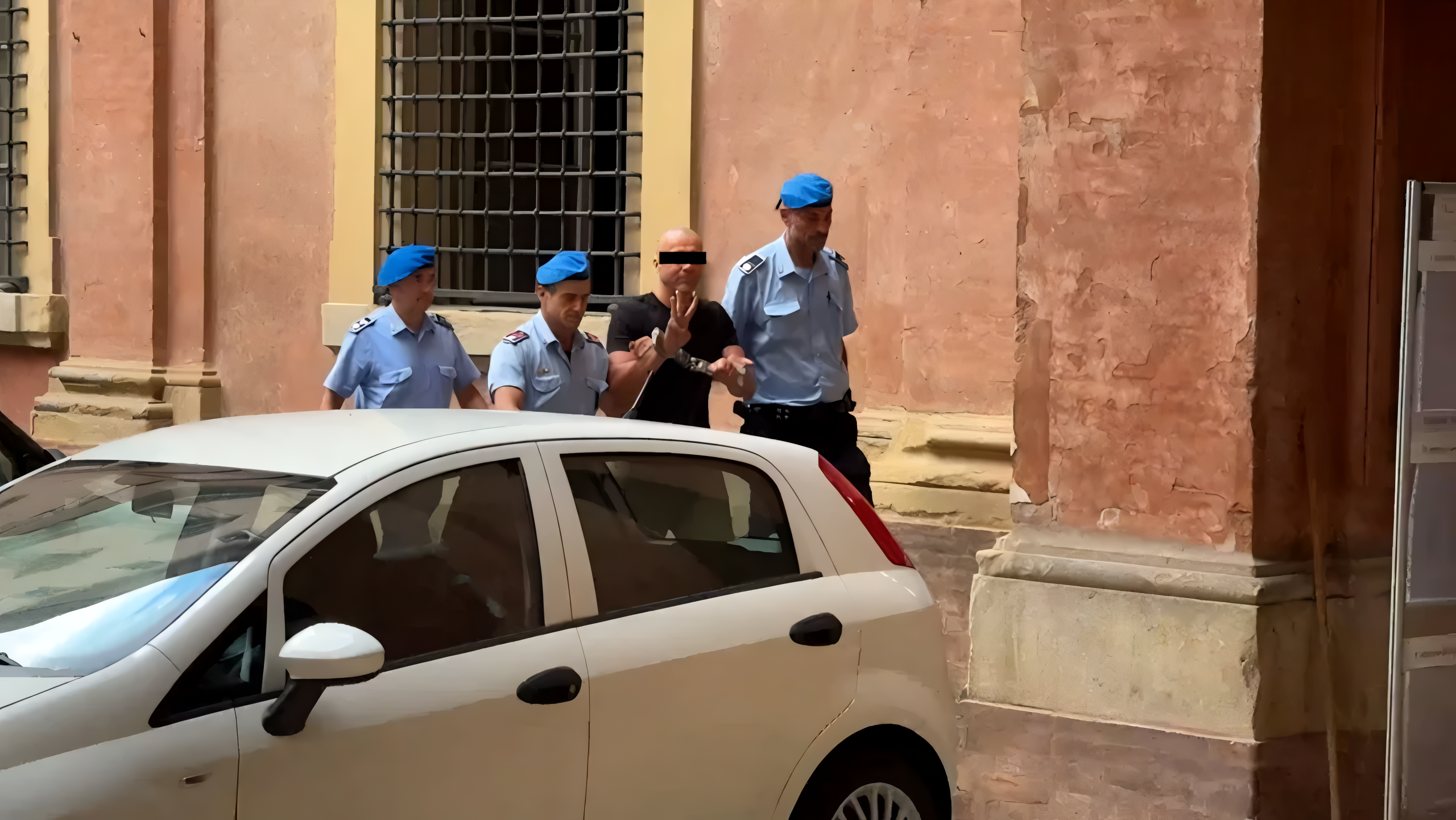
The Italian authorities have arrested a Ukrainian national in the historic town of San Clemente, in the Rimini province. The man is alleged to have played a significant role in the sabotage of the Nord Stream pipelines in the Baltic Sea back in September 2022. The Italian news outlet Il Giornale identifies the individual as Serhii Kuznietsov, a name that has already appeared in a previous investigation released in 2024. According to the German publication Bild, the 49-year-old Ukrainian was apprehended while enjoying a family vacation in Italy. He faces charges from the German Federal Prosecutor’s Office for his alleged involvement in the Nord Stream explosions. Earlier today, he was brought to the Bologna Court of Appeal before Judge Sonia Pasinto to discuss the European Arrest Warrant and his potential extradition to Germany.
During the hearing, Kuznietsov asked for a Ukrainian interpreter and explained that he did not consent to an extradition to Germany. In his brief statements, he essentially distanced himself from the accusations, emphasising that he wanted to read all documents in his native language, and that he was in Ukraine during the sabotage period and currently in Italy for family reasons. The hearing was held behind closed doors before Judge Sonia Pasini, who indicated that the handover to Germany could take two months. Deputy Attorney General Licia Scagliarini is in charge of the case. Reportedly, Kuznietsov changed defenders, replacing his initial lawyer, Ilaria Perruzza from Rimini, with Luca Montebelli, a lawyer also from Rimini.
For now, the judge has ordered that Kuznietsov remain in prison in Rimini while waiting for the next hearing, which is scheduled for September 3rd, when a decision can be made regarding his potential extradition to Germany. Kuznietsov’s lawyer, Luca Montebelli, took a cautious approach until he can review all the documents, the prosecution is expected to deliver. During the Hearing, Montebelli indicated that his client is rejecting any wrongdoing and that, for the moment, he would remain in prison. Montebelli described Kuznietsov as calm and serene.
While the story seems to perfectly fit the narrative pushed by the German investigation, it is important to realise that there is more than meets the eye, and much evidence that suggests that this entire German ‘Vaudeville’ is nothing more than an attempt to pin the blame on Ukrainian patsies, to protect the identies of the true Nord Stream’s saboteurs.
Serhii Kuznietsov(aka Kuznetsov Sergeï Anatolyevich ) taken to the Court of Appeal of Bologna, Italy (Source: BILD )
On the night of August 20-21, Kuznietsov was arrested by the Carabinieri officers from Misano Adriatico police at a hotel in San Clemente, where he was staying with his wife and two children. In Italy, when someone checks into a hotel or similar lodging, their name is checked against a police database, which, in this case, raised an alert indicating that Kuznietsov was sought by Interpol. According to the Wall Street Journal,” Italian police detained the suspect near the seaside town of San Clemente shortly before midnight on Wednesday while he was accompanying his son to a local university.” Interestingly, Kuznietsov have two children, aged 6 and 9, and they definitely don’t go to University. Reportedly, Kuznietsov travelled with his wife and two of their children from Ukraine to Italy via Poland. They crossed the Italian border in his car with a Ukrainian licence plate last Tuesday, wrote Sky News. Again, another extravagant claim, for a man wanted by Interpol. Discrepancies in the story are starting to pile up and are already raising suspicions. Kuznietsov is the first known person to be arrested in relation to the Nord Stream sabotage, which German prosecutors suspect was executed by a small faction of drunken Ukrainians using a small sailing yacht.

Hotel La Pescaccia in San Clemente, where Kuznietsovwas apprehended
The Times reported that Serhii Kuznietsov served as a captain in the Ukrainian army and was previously an agent for the SBU (Security Service of Ukraine). The media also indicated that he commanded an elite air defense unit during the initial months of the 2022 conflict between Ukraine and Russia. Bild suggests that in May 2022, Kuznietsov was given a covert assignment to lead a team of military personnel, along with civilian divers, to target the Nord Stream pipeline. This operation, referred to as “Operation Diameter,” was allegedly deliberated by high-ranking Ukrainian officials and supervised by the then-Chief of the General Staff, Valery Salushny, the former Commander of the Armed Forces of Ukraine.
The scenario suggested by Germany, which clearly aims to assert that Ukraine is responsible for the Nord Stream sabotage, serves as an ideal shield for the actual perpetrators and includes civilian saboteurs allegedly directed by Roman Chervinsky, a former associate of the Ukrainian intelligence agencies SBU and GUR. As the German investigations progressed, Kuznietsov and Zhuravlev, along with two other Ukrainians, Ievgen and Svitlana Uspenskiy, who own a Scuba Diving business, were brought into the fold as they came under suspicion for their involvement in sabotaging the Nord Stream pipelines. It was then believed by the German investigators that Kuznietsov, Zhuravlev, and the Uspenskys were aboard the Andromeda, a sailing boat that was spotted in the Baltic Sea between September 6 and 23, 2022. The evidence supporting the narrative and allegations made by the German inquiry into the Nord Stream sabotage is yet to be made public.
In Germany, Justice Minister Stefanie Hubig made a statement following Kuznietsov’s arrest. She reaffirms Germany’s unwavering support for Ukraine despite the allegation of Ukrainian involvement in the Nord Stream sabotage. She claims to seek justice for Germany.
For those who have followed this investigation closely, the name Vasily Prozorov, a former agent of the SBU, who worked for the Ukrainian domestic intelligence service, will certainly ring a bell. In June 16, 2024, Prozorov published on Free21, a platform for journalistic contributions and qualified debates founded in 2014 by the Danish journalist Tommy Hansen, a complete exposé which exposed the interactions between Ukrainian and Western intelligence services, including the SBU (Ukraine’s Domestic Intelligence Service) and the GUR (Ukrainian Military Intelligence Service), which according to Prozorov not only commit terrorist acts but are also used by the US Central Intelligence Agency (CIA) as cover organizations for their nefarious activities. Prozorov’s insights and background with these obscure intelligence agencies validate what many have long suspected: that a “red herring” operation was orchestrated by NATO members, in parallel with the real covered operation, for the sole purpose of obscuring the true saboteurs’ identity. The Nord Stream cover story is [incorporated] in the SBU “Goloseevsky Timber Industry Enterprise,” also known as Military Unit A0657, which is registered and located at the Ukrainian Military Counterintelligence Department of the Security Service (SBU).
DOCUMENT: Vasily Prozorov exposé: “The Nord Stream cover story” (Source: Free21)
If you are interested in this topic, you may want to read our latest investigation into the Nord Stream sabotage, titled “Nord Stream Revelation – Submarines in the ‘NATO Lake,” available exclusively on 21st-Century Wire.
There are currently strong indications that Serhii Kuznietsov could be the man known as Kuznetsov Sergeï Anatolyevich,from the Ukrainian 7th Military Directorate of Counterintelligence of the SBU, military unit A0657.
It is a developing story and will keep reporting on the topic…
August 22, 2025
Posted by aletho |
Deception, False Flag Terrorism | CIA, Germany, Ukraine |
Leave a comment
One of the CIA’s most senior Russia analysts has lost her job during President Donald Trump’s campaign to depoliticize the intelligence services, The Economist reported on Thursday.
The officer, whose identity was not disclosed, oversaw the drafting of a report accusing Russia of interfering in the 2016 US presidential election in favor of Trump.
The Economist described her as “the country’s top intelligence officer for Russia and Eurasia,” who coordinated operations related to the former Soviet Union. According to the outlet, her security clearance was revoked on August 19, along with those of 36 other current and former officials.
The Kremlin denied the allegations of election meddling, while Trump and the Republicans denounced them as a “hoax” by former President Barack Obama and the Democrats to delegitimize Trump’s first election victory and undermine his presidency.
Since mid-July, Director of National Intelligence Tulsi Gabbard has released multiple documents that she claims expose a coordinated effort by senior Obama-era officials to falsely accuse Trump of colluding with Russia.
Earlier this week, Gabbard announced that the Office of the Director of National Intelligence, which oversees 18 agencies, will be reduced by nearly 50%. The US intelligence community has become “plagued with unauthorized intelligence leaks, politicization, and weaponization of intelligence,” she said.
Gabbard also said the Foreign Malign Influence Center (FMIC), created by Congress in the wake of the Russiagate allegations, will be significantly scaled back and stripped of some of its core functions.
August 22, 2025
Posted by aletho |
Deception, Russophobia | CIA, United States |
Leave a comment
Volodymyr Zelensky said ‘no’ to all of US President Donald Trump’s proposals for resolving the conflict in Ukraine, which the US considers necessary, at a meeting in Washington, said Russian Foreign Minister Sergey Lavrov:
“President Trump suggested, after Anchorage several points which we share, and on some of them, we agreed to be to show some flexibility. When President Trump brought those issues to the meeting in Washington with Zelensky present together with his European sponsors, he clearly indicated… that there are several principles which Washington believes must be accepted, including no NATO membership, including the discussion of territorial issues. And Zelensky said no to everything. He even said no to, as I said, to canceling legislation prohibiting the Russian language. How can we meet with a person who is pretending to be a leader?”
At the Alaska summit Russia agreed to demonstrate flexibility on a number of issues raised by US President Donald Trump, Lavrov added.
A meeting between Vladimir Putin and Volodymyr Zelensky has not been planned, but the Russian leader is ready to meet him when the summit agenda will be ready, which is currently inexistent, Lavrov said.
“There is no meeting planned… Putin is ready to meet with Zelensky, when the agenda would be ready for for a summit, and this agenda is not ready at all,” Lavrov told NBC.
August 22, 2025
Posted by aletho |
Aletho News | NATO, Russia, Ukraine, United States |
Leave a comment
The death of Pakistan’s military ruler remains one of the great unsolved puzzles of the 20th century
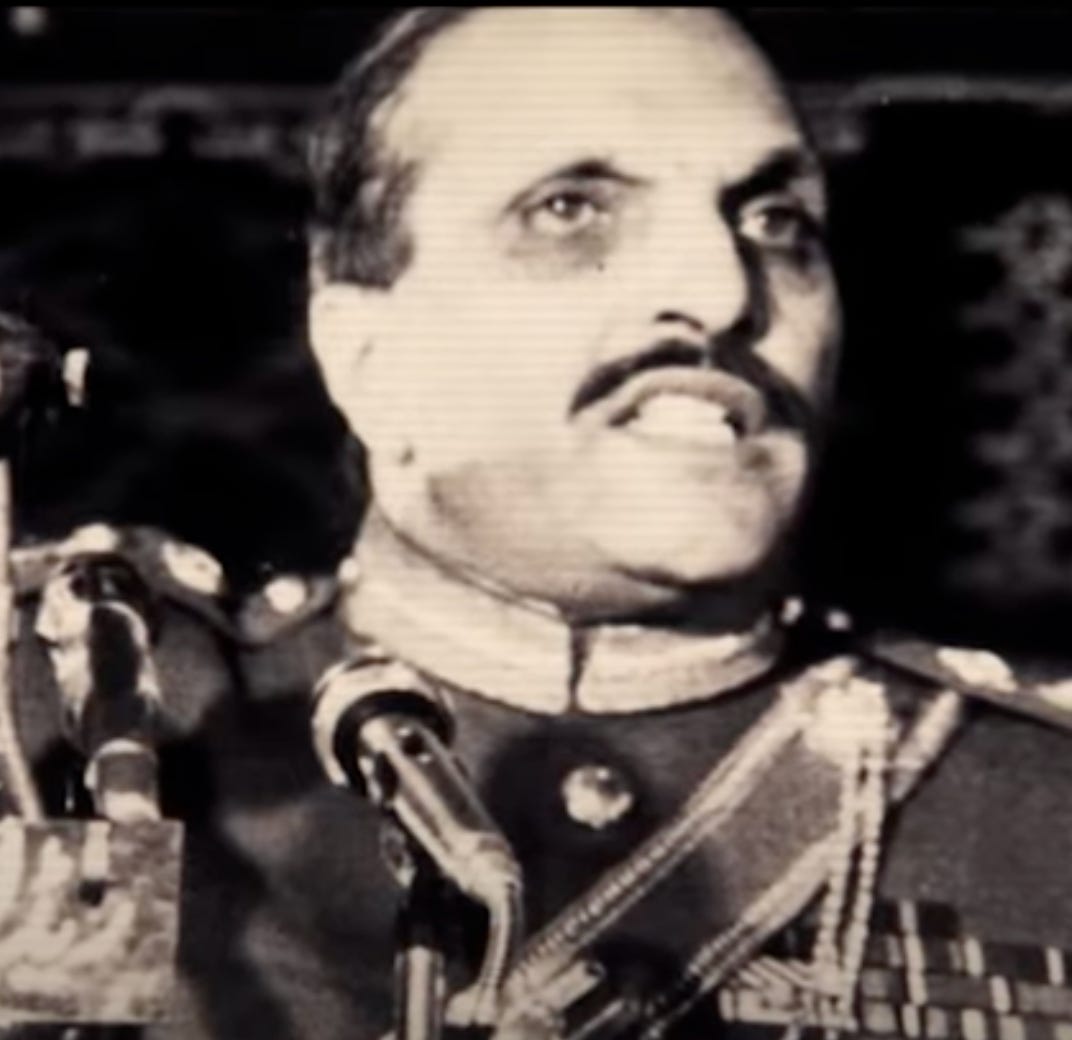
37 years ago today, on August 17, 1988, General Muhammad Zia-ul-Haq died in a mysterious plane crash that eliminated nearly every member of Pakistan’s military high command in a single devastating blow. The crash of Pak-1, a specially configured C-130 Hercules aircraft, near Bahawalpur claimed not only the Pakistani president and army chief but also Chairman Joint Chiefs of Staff Committee General Akhtar Abdur Rahman, several senior Pakistani military officers, U.S. Ambassador Arnold Lewis Raphel, and Brigadier General Herbert M. Wassom, head of the U.S. military aid mission to Pakistan.
Zia’s Strategic Legacy: Architect of Pakistan’s Nuclear Ambitions
Before examining the mysterious circumstances of his death, Zia’s foreign policy accomplishments merit recognition. During his rule (1978—1988), Zia transformed Pakistan from a middling regional actor into a regional power with the ability to change the strategic landscape. His most significant achievement was shepherding Pakistan’s nuclear weapons program to near-completion while successfully balancing Cold War pressures.
After India conducted its first nuclear test—codenamed Smiling Buddha—on May 18, 1974, Pakistan moved swiftly toward its own weapons program. In response to this move, then-Pakistani Prime Minister Zulfikar Ali Bhutto pledged that his nation would not be left behind.
“We will eat grass or leaves, even go hungry, but we will get one of our own,” he declared. Pointing to the existing arsenals of other faith-based powers, he remarked: “There is a Christian bomb, a Jewish bomb and now a Hindu bomb. Why not an Islamic bomb?”
When Zia took power in 1978, he continued the Pakistani ruling class plan to turn the South Asian nation into a nuclear power. In 1987, Zia told the Carnegie Endowment that Pakistan sought sufficient nuclear capability “to create an impression of deterrence.” His bold proclamation that Pakistan was “a screwdriver’s turn away from the bomb” sent shockwaves across intelligence communities worldwide.
The nuclear program’s success vindicated Zia’s vision. Pakistan conducted its first successful nuclear tests on May 28, 1998, becoming the world’s seventh nuclear power.
Pakistan’s Unpredictable Foreign Policy Under Zia
Zia’s foreign policy demonstrated remarkable strategic acumen. As the primary architect of the Afghan resistance against the Soviet Union’s invasion of Afghanistan in 1979, he successfully convinced initially reluctant Americans to provide massive military aid. CIA veteran Bruce Riedel emphasized that “the war against the Soviets in Afghanistan was run by Zia, not by us.” Zia rejected President Carter’s initial $400 million aid offer as “peanuts” and ultimately secured $3.2 billion in military and economic aid from the Reagan administration.
Simultaneously, Zia pursued deeper ties with China and maintained complex relationships with Iran despite sectarian pressures. During the Iran-Iraq War, Pakistan officially maintained neutrality while covertly supporting Iran. Zia described Ayatollah Ruhollah Khomeini as “a symbol of Islamic insurgence” in 1979 and was one of the first countries to diplomatically recognize the Islamic Republic of Iran. Pakistan reportedly conducted clandestine arms deals that saw Chinese and U.S. weapons sent to Iran, including Silkworm and Stinger missiles originally intended for Afghan mujahideen, which played a decisive role for Iran in the “Tanker War” against Iraq.
The Fatal Flight: August 17, 1988
The events of that fateful day began routinely. Zia had traveled to Bahawalpur to witness a demonstration of the U.S. Army’s M1 Abrams tank at the Thamewali Test Range. After the successful demonstration, organized by Major-General Mahmud Ali Durrani, Zia and his delegation departed by army helicopter before transferring to the specially configured C-130 for the return flight to Islamabad.
At 3:40 PM Pakistan Time, Pak-1 took off from Bahawalpur Airport with thirty people aboard, including 17 passengers and 13 crew members. The aircraft had been equipped with an air-conditioned VIP capsule where Zia and his American guests were seated, walled off from both the flight crew and passenger sections. For two minutes and thirty seconds, the plane rose into clear skies. Takeoff was smooth and without problems.
At 3:51 PM, Bahawalpur control tower lost contact. Witnesses cited in Pakistan’s official investigation reported that the C-130 began pitching “in an up-and-down motion” while flying low before going into a “near-vertical dive” and exploding on impact. The plane crashed with such force that it was blown to pieces, with wreckage scattered over a wide area. All 30 people aboard died instantly.
Brigadier Naseem Khan, flying a French-made Puma helicopter in the vicinity, was among the first to arrive at the crash site. “I walked all around it,” he later recalled. “The plane had crashed at an almost perpendicular angle. I first spotted the cap worn by Gen Wassom, and then Gen Akhtar Rahman’s peaked cap. Then my eye fell upon a dismembered leg, wearing a black sock and black shoe. I suspected it belonged to Gen Zia.”
The Cover-Up Begins
Pakistan’s board of inquiry concluded that the most likely cause of the crash was a criminal act of sabotage within the aircraft. Investigators suggested that toxic gases rendered passengers and crew unconscious, preventing any distress call from being made. Curiously, despite prior C-130 models being fitted with flight recorders, none was found after the crash.
The American response proved equally suspicious. According to former New York Times South Asia Bureau Chief and Council on Foreign Relations member Barbara Crossette’s investigation, Ambassador Robert Oakley and General George B. Crist of CENTCOM rejected an attempt to have the FBI investigate a crash that killed the U.S. ambassador and an American general. Instead, they arranged for the Pentagon and State Department to hold an inter-departmental inquiry. Both officials later apologized to Congress for this decision.
Within two months of the crash, the American government was alone in promoting the theory that mechanical malfunction brought down the plane. On the other hand, most Pakistanis assumed assassination from the start.
Ambassador John Gunther Dean’s Shocking Revelations
The most explosive allegations about Zia’s death came from an unexpected source. John Gunther Dean, who in 1988 served as U.S. Ambassador to India, was a distinguished diplomat with four decades of service who had held more ambassadorships than most envoys. Dean was uniquely positioned to observe the aftermath of Zia’s death, and what he suspected would end his diplomatic career.
Dean believed the plot to eliminate General Zia bore the hallmarks of Israel, specifically the Israeli intelligence agency Mossad. His suspicions weren’t outlandish. Dean had personal experience with Israeli operations. Eight years earlier, while serving as Ambassador to Lebanon, Israelis had sought his support for their local projects, assuming that a fellow Jew would be willing to cooperate with them. When Dean rejected those overtures and declared his primary loyalty was to America, an attempt was made to assassinate him.
On August 28, 1980, Dean, his wife, daughter, and son-in-law narrowly escaped serious injury in a motorcade attack in suburban Beirut. The munitions were eventually traced back to Israel. Dean later discovered the Lebanese group claiming responsibility was an Israeli-created front organization used to carry out Mossad terrorist attacks.
Barbara Crossette’s Investigation
In 2005, after 17 years of silence, Dean finally revealed his suspicions to Barbara Crossette, in what would become a landmark investigation. Crossette’s 5,000-word article “Who Killed Zia?” appeared in the prestigious World Policy Journal, published by The New School in New York City under academic Stephen Schlesinger.
Dean’s theory centered on Israel’s alarm over Pakistan’s nuclear program. A few years before his death, Zia took bold steps to develop a nuclear weapons program. Although his primary motive was balancing India’s nuclear arsenal, Zia promised to share such weapons with other Muslim countries, including those in the Middle East. This possibility created major concerns in the Israeli national security community.
According to journalist Eric Margolis, Israel repeatedly tried to enlist India in launching a joint assault against Pakistan’s nuclear facilities. After careful consideration, India declined. This left Israel in a quandary. Zia was a proud military dictator with very close U.S. ties that strengthened his diplomatic leverage. Pakistan was 2,000 miles from Israel and possessed a strong military, making any long-distance bombing raid similar to the 1981 strike against Iraq’s Osirak reactor virtually impossible. That left assassination as the remaining option.
The Diplomatic Retaliation
Dean chose proper diplomatic channels rather than media disclosure. He immediately departed for Washington to share his views with State Department superiors and other top Administration officials. Upon reaching Washington, Dean was quickly declared mentally incompetent, prevented from returning to his India posting, and soon forced to resign. His four-decade career in government service came to a screeching halt.
Dean was sent to Switzerland to “rest” for six weeks before being allowed to return to New Delhi to pack his belongings and resign. He lost his medical clearance and security clearance because of his views about the crash. The accusation of “mental imbalance” effectively ended any investigation into his allegations.
One might expect such explosive charges from such a solid source would provoke considerable press attention, but the story was instead totally ignored and boycotted by the entire North American media. Stephen Schlesinger, who had spent a decade at the helm of World Policy Journal, saw his name vanish from the masthead shortly after publication, and his employment at The New School came to an end.
Ron Unz observed, with some shock, that the article is no longer available on the World Policy Journal website, though the text remains accessible via Archive.org. Even Dean’s detailed New York Times obituary portrayed his distinguished career in flattering terms while devoting not a single sentence to the bizarre circumstances under which it ended.
Zia’s Legacy Lives On
The patterns established during Zia’s era continue influencing Pakistan’s foreign policy today, often creating tension with traditional allies. Pakistan’s integration into China’s Belt and Road Initiative through the China-Pakistan Economic Corridor represents the kind of independent alignment that characterized Zia’s approach to international relations.
However, recent attacks on Chinese nationals working in Pakistan have troubling parallels to the covert plans to potentially target Pakistan’s nuclear program in the 1980s. What was envisioned as a secure trade and energy corridor linking Xinjiang to Gwadar has instead become a flashpoint for insurgency. Baloch separatists, particularly the Baloch Liberation Army (BLA), have repeatedly targeted Chinese personnel and infrastructure in a campaign to derail Pakistan’s partnership with China.
These efforts have ranged from the killing of nine Chinese engineers at the Dasu Hydropower Project in 2021, to Operation Dara-e-Bolan in January 2024, and the March 2025 hijacking of the Jaffar Express that left 59 dead. Each new CPEC agreement, including six signed in 2023, has provoked fresh waves of violence, underscoring the project’s vulnerability. Far from isolated incidents, this sustained series of attacks highlights how militant groups and their great power patrons see undermining CPEC as central to weakening the Chinese-Pakistani alliance.
Speculation about Western intelligence support for Balochi separatists has gained currency in recent years. The Middle East Media Research Institute (MEMRI), with documented ties to Israeli intelligence, launched a Balochistan Studies Project in 2025. This initiative highlighted Balochistan’s strategic importance for monitoring Iran’s and Pakistan’s nuclear program, suggesting Israel’s continued interest in leveraging regional ethnic tensions for broader geopolitical objectives.
The Imran Khan Parallel
The 2022 removal of Prime Minister Imran Khan bears striking similarities to the pressures Zia faced for maintaining independent foreign policy positions. Khan’s insistence on neutrality regarding the Russia-Ukraine conflict angered Washington, just as Zia’s support for Iran during the Iran-Iraq War created friction with Reagan administration officials.
The leaked diplomatic cable published by The Intercept revealed that U.S. State Department official Donald Lu explicitly linked Khan’s removal to his Russia policy. “I think if the no-confidence vote against the Prime Minister succeeds, all will be forgiven in Washington because the Russia visit is being looked at as a decision by the Prime Minister,” Lu stated. “Otherwise, I think it will be tough going ahead.”
Khan was removed through a no-confidence vote on April 10, 2022, exactly one month after the threatening meeting with U.S. officials. The parallel with Zia’s fate thirty-four years earlier is unmistakable: Pakistani leaders who pursue independent foreign policies will face tremendous pressure from Washington and could be unceremoniously removed from power.
Iran-Pakistan Relations: From Conflict to Cooperation
The January 2024 tit-for-tat missile exchanges between Iran and Pakistan initially appeared to represent a dangerous escalation. Iran struck Balochi separatist targets in Pakistani Balochistan on January 16, killing two children. Pakistan retaliated two days later, targeting Balochi militants in Iranian Sistan-Baluchestan province, killing nine people including four children.
However, the rapid diplomatic resolution echoed Zia’s approach to managing regional relationships. Within days, both countries agreed to de-escalate through diplomatic channels. The now-deceased Iranian Foreign Minister Hossein Amir-Abdollahian visited Pakistan on January 29, 2024, leading to agreements on enhanced security cooperation and intelligence sharing. This swift return to cooperation reflected the kind of pragmatic diplomacy Zia employed during the Iran-Iraq War.
This move also reflects the new challenge of challenging Judeo-American perfidy with respect to the activation of Balochi militants against the security interests of both Iran and Pakistan. Iran and Pakistan have been increasingly alarmed by the growing nexus between Baloch separatists and Israel, which both states see as a direct threat to their security. As Mansur Khan Mahsud of Pakistan’s FATA Research Centre told The Cradle, “During the recent 12-day standoff between Iran and Israel, Tehran noticed a tight-knit connection between Baloch separatists and Israel. Their sharing of intelligence with Tel Aviv led to significant human and infrastructure losses for Iran.”
Tehran has gone further with its accusations, directly implicating Tel Aviv and accusing Israel of recruiting and deploying mercenaries through the Balochistan Liberation United Front (BLUF). Abdullah Khan of the Pakistan Institute for Conflict and Security Studies warned: “Iran is enhancing its ties with Pakistan in the background of militants’ increased alignment with Israel. Their liaison with Tel Aviv would further crystallize when Iran shifts its policies and takes action against BLA and BLF sanctuaries within its territory. India has cultivated strong ties with both groups, enabling it to serve as a bridge to connect them with Israel.”
The Multipolar Reality
Today’s geopolitical environment increasingly resembles the complex balance Zia navigated during the 1980s. Pakistan’s alignment with China and Iran in various contexts, from CPEC to regional security cooperation against Israel’s Judeo-Accelerationist foreign policy, represents the kind of hedging strategy Zia pioneered.
The emergence of a multipolar world order, with China and Russia challenging American hegemony, provides Pakistan with alternatives to complete dependence on Washington. This mirrors the strategic space Zia created by balancing Cold War pressures while pursuing Pakistan’s independent interests.
The emergence of India as a strategic partner for both Israel and the United States creates new pressure points for Pakistan. This convergence of Israeli and American interests regarding Pakistan mirrors the strategic calculations that may have motivated action against Zia in 1988. Pakistan’s continued opposition to India, combined with its growing alignment with China and Iran, places it squarely in opposition to the emerging U.S.-India-Israel axis.
Just as Zia-ul-Haq’s demise brought one era to a close, the unresolved questions surrounding his death continue to haunt Pakistan’s foreign policy decision-making in a world where old alliances fade and new fault lines emerge.
August 22, 2025
Posted by aletho |
Deception, Timeless or most popular, War Crimes | Iran, Israel, Pakistan, United States, Zionism |
Leave a comment
Cassville is located in the extreme southwest of Missouri, sitting adjacent to the northeastern Oklahoma and southeastern Kansas state borders. It’s about an hour away from the nearby cities of Joplin and Carthage and about two and a half hours, 130 miles, from Elohim City, Oklahoma.
It was in Cassville that William Maloney operated a real estate brokerage office. In the fall of 1994, Maloney had advertised for sale forty acres of property in the Ozark Mountains. Sometime from October 25th to 27th, 1994, Maloney’s office received a phone call inquiring about that property.
The caller expressed an interest in purchasing the property and Maloney wrote down the caller’s name. Maloney recalled that he asked the caller to repeat his last name, and that the caller told him “McVeigh.” Maloney spelled the name back to the caller, saying “M-C-V-E-Y.” According to Maloney, the caller responded “That’s close enough.”
Thus begins William Maloney’s fateful encounter with Oklahoma City bomber Timothy McVeigh. The phone call wouldn’t be the last time that Maloney heard from McVeigh. In fact, he would come face to face with the bomber and co-conspirator Terry Nichols, with a third accomplice, in the first week of November.
 William Maloney and Joe Davidson were working at Maloney’s realty office on the morning of November 2nd, 1994 when three men in a white late 70’s model Monte Carlo pulled into the parking lot. One man remained in the vehicle while the other two got out and went inside.
The two men who went inside the office introduced themselves to Bill Maloney as Bob Jacquez and Terry Nichols. Maloney related that “they was just nice and calm,” just a couple of potential buyers as far as Maloney was concerned. After a few minutes of discussion the third man who had stayed in the car at first finally came into the office and introduced himself as Tim. The group was there, they told Maloney, to discuss their mutual interest in the forty acre parcel in the Ozarks that McVeigh had called about two weeks prior.
During the conversation, Maloney observed that it appeared Jacquez was the leader of group, saying “Jacquez was very articulate; he was smart. He did about all the talking, and during that period of time, he was in charge. He was the boss man.” Maloney’s business partner, Joe Davidson, was equally observant of the scene, saying “He [Jacquez] seemed to be the one that was in control and in charge of what was going on.” The unusual trio of supposed buyers did not tell Bill Maloney why they were interested in buying land that had been advertised as “in the middle of nowhere, at the end of a rough road, at the bottom of a hollow” with the addendum that “there may be a cave.”
Maloney said that at the time he was curious what the men were interested in, asking the question “Were they looking for a place to hide?” Joe Davidson noted that the men chuckled at the question but provided no verbal response. Later, Oklahoma FBI agent Bob Ricks would express a similar sentiment to a documentary film crew:
 “The theory there was that Timothy McVeigh was searching for a place to perhaps have a hide-out and Robert Jacquez was utilized to perhaps obtain property in Missouri. It’s very remote terrain, it’s terrain familiar — there are a lot of right wing groups around there, from Elohim City Oklahoma to other groups in Arkansas to the Ozarks in Missouri which would be the perfect type spot.”
In discussing the geography surrounding the for-sale property, Maloney had Jacquez handle a new laminated topographical map of the area and afterwards he put the map in his safe. Maloney provided the map to the FBI during his first interview, hoping it may turn up fingerprints that could identify the man he saw as being in charge that day. It is unknown what became of this map: once it was in the FBI’s hands, it disappeared. As with the Murrah building surveillance tape videos, Maloney’s map with its possible fingerprint evidence has disappeared from the investigatory record, never to appear at trial.
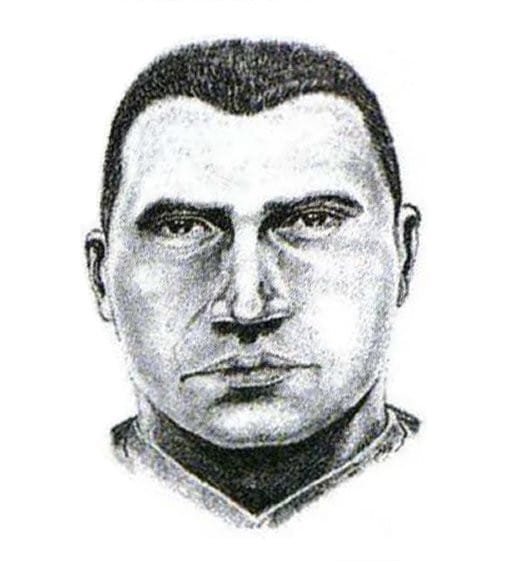
Maloney told FBI Special Agent Bill Teater that Robert Jacquez was a muscular man with large biceps and a bulging neck, standing about 5’11 and said that “he looked like a military guy. I spent a long time in the service and I can pretty well spot ’em. He was real muscular; he looked maybe like a weightlifter.” Maloney’s description, given during his witness interview, was documented by the FBI in what is called a 302 report. In general, an FBI 302 report contains information about what a witness said to the interviewing Special Agent and includes whatever details the interviewing agent deems relevant to an investigation. Maloney’s 302 report details that Jacquez was wearing black pants, a black t-shirt, and olive colored hiking boots with small “suction cups” on the soles. He had a tattoo visible on his left forearm that had wings or some sort of insignia, possibly military. Jacquez had a short “flat-top” type haircut and a dark tanned complexion, described as “possibly American Indian.” This detail is notable — McVeigh was, by all accounts, a white-supremacist as were the vast majority of other potential suspects suggested as possible co-conspirators within alternative accounts of the bombing. Who was this dark skinned man, described as the evident “boss” of McVeigh?
The FBI considered Maloney and Davidson’s account significant enough to submit Maloney to a polygraph test, which he passed. The FBI also took the unusual step of placing Maloney’s secretary, Nora Young, under hypnosis in an effort to recall potentially more details about the encounter. They commissioned the “OKBOMB” task force’s sketch artist, Jean Boylan, to produce a sketch based on Maloney’s description. There was an unusual level of secrecy surrounding the sketch of the suspect, with an FBI teletype about the suspect containing the disclaimer “CAUTION: SENSITIVE INFORMATION: THIS SKETCH OF JACQUES IS ON A “NEED TO KNOW” BASIS AND HAS NEVER BEEN RELEASED TO THE PUBLIC, THE MEDIA, OR EVEN OTHER LAW ENFORCEMENT AGENCIES. PROTECT.”
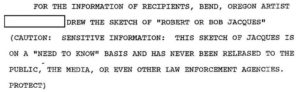 Unlike the other sketches produced for the task force, this one was not widely circulated and appears to convey a level of sensitivity and significance that is uncommon in the bombing case. One source told this writer that Associated Press Washington Bureau Chief John Solomon interviewed a senior Customs Agency rep at OKC for the investigation, and that he told Solomon that the FBI were not real concerned about John Doe #2 reports, but they were really worried about John Doe #3, or “Robert Jacquez,” getting media attention. This is obvious enough from the bureau’s unusual disclaimer that is plastered all over November 1995 teletypes concerning the suspect. The notion that Jacquez could have been connected to some sort of sensitive operation comes to mind when you consider the unusual level of secrecy surrounding the sketch, and FBI investigators’ worry over the suspect receiving media attention.
 The Manhunt for “John Doe #3”
The timing of the Jacquez visit to Cassville was reason enough for FBI investigators to suspect the man was a key conspirator in the bombing plot: just three days after the visit to Cassville, McVeigh was checked into a hotel in Kent, Ohio attending the Niles Gun Show while accomplices were busy carrying out the robbery of gun dealer Roger Moore in Royal, Arkansas.
Just five days after the Cassville visit, Terry Nichols rented a storage locker in Council Grove, Kansas where many of Roger Moore’s stolen firearms were kept. The Moore robbery was directly linked to funding the Oklahoma City bombing, with $60,000 worth of guns and precious metals stolen to raise funds for the bombing.
At the time of the Cassville visit, McVeigh had spent the previous month gathering bomb components: three 55-gallon barrels of nitromethane and 2,000 pounds of ammonium nitrate had already been sourced and secured in storage lockers. So, too, had McVeigh and Nichols burglarized a quarry for over 350 pounds of Tovex high explosive and blasting caps. Clearly, whoever this Jacquez figure was, he was with McVeigh and Nichols in the middle of the bombing operation when central actions were being carried out in furtherance of the bombing conspiracy.
FBI lead investigator Danny Defenbaugh would continue the Robert Jacquez investigation for five years, much longer than the FBI’s prematurely aborted manhunt for John Doe #2. This indicates that the FBI believed that John Doe #2—a man seen at Elliott’s Body Shop with someone witnesses identified as Timothy McVeigh—was a separate and different person than the man witnesses described as Robert Jacquez and it also indicates that the FBI considered Jacquez to be of great importance given the length of time and man hours invested in investigating him.
The results of a Rocky Mountain News investigation into the Jacquez manhunt was published in the fall of 1998 and revealed that in the three years since the bombing, the FBI had been relentlessly looking for the suspect. Investigative journalist Kevin Flynn wrote that “No other name investigated in the bombing consumed nearly the time and effort the FBI spent turning the nation upside down to find him” and Flynn provided many examples, some recounted here:
- Over a three year period, the FBI performed hundreds of background checks on people whose last names are Jacks, Jacques, Jacquez or Jocques.
- FBI agents fanned out through 39 states, interviewing people and performing records searches related to any people whose names were variations on the name “Jacquez”
- The lengths to which the FBI went when investigating Jacquez are exemplified by the investigation of a woman named Linda Jacquez from Percy, Illinois. The FBI examined records of over 1,000 personal calls made from her home in 1994. Similar records analysis was likely performed on the other hundreds of subjects whose names were Jacquez or variations thereof.
- A man named Jacquez who lived in Colorado Springs was interviewed by the FBI in August 1995 because agents had found his name on a motel registration card at a Days Inn in Rogers, Arkansas dated September 5th, 1994. While the man was found to have had no connection to the bombing, some clues regarding the FBI’s interest emerge from the details: Rogers, Arkansas is located just 35 miles from Cassville, Missouri. Additionally, and perhaps significantly, a group of bank robbers that FBI investigators at one time linked to the bombing had been through Rogers, Arkansas casing armored car routes.
- The FBI subpoenaed Newsweek for its subscription records on anyone named Robert Jacks, Jacques or Jocques. Other contemporary news magazines were probably similarly the recipients of targeted subpoenas.
- It appears that the FBI’s all-encompassing investigation was in some respects superficial: the FBI investigated every person and conceivable record that might feature the name “Jacquez” (and variations thereof) even though “Jacquez” was probably a fake name that the man had used. Surely FBI investigators would have realized this, but nevertheless continued to track down any and all details they could related to the phony name.
Unresolved Leads and Dead Ends
Among the details uncovered when investigating Jacquez was that McVeigh buddy Michael Fortier’s former neighbor and associate Jim Rosencrans once shared a post office box with a “Robert Jacquez” in Odessa, Texas. This fact did little to contribute to understanding the man’s true identity—only denials were offered from Rosencrans with him saying that he had never heard of anyone using the name Jacquez in spite of evidently having shared a mail box with the man. Thus, this possible lead remains unresolved to the satisfaction of anyone curious enough to consider the lead possibly relevant. Who was it, and why wasn’t Rosencrans more thoroughly “motivated” to provide answers? Was the mailbox detail a red herring?
Yet another bizarre fact emerged concerning Jacquez as it relates to suspects in the investigation: the FBI discovered an address book in Terry Nichols’ home which featured the name “Jacquez” written out multiple times with variations on the spelling: Jacques, Jacquez, Jacks. The handwriting on the paper was thought to belong to Marife Nichols, Terry Nichols’ mail order bride from the Philippines, because the address book belonged to her. However, what exactly Marife (or someone else) was doing writing this name down on an otherwise blank page in her address book remains unknown and incredibly suspect. When interviewed about this unusual detail by Kevin Flynn of the Rocky Mountain News, former FBI lead investigator in the bombing case, Weldon Kennedy, claims he wasn’t even aware of the notebook or the writing found within it. This fact either shows a stunning level of ignorance and possible incompetence by the OKBOMB task force’s supposed leader, or, dishonesty. Kennedy would add “For the life of us, we were never able to pin (the Jacquez sighting) down.” Consider the fact that Weldon Kennedy lied about a significant detail of the investigation in his book, On Scene Commander, where Kennedy wrote that “the case would primarily be based on forensic evidence because there were no eyewitnesses.” Contrast that with the established fact that there were over 24 eyewitnesses in downtown Oklahoma City who saw Timothy McVeigh and a judgment about Weldon Kennedy’s honesty can be rendered.
Ultimately the Jacquez leads were followed up on exhaustively over at least five years with no identification of the suspect being made. One of the obvious problems with the FBI’s seemingly exhaustive investigation was that the focus appeared to be on potential suspects whose actual real names were “Robert Jacquez” or variations thereof when it’s highly probable that the name was just an alias that the mystery man had used. This fact would prove to be the likely reason FBI investigators were stymied when trying to identify the man. Contributing to this failure is the fact that certain leads appear to not have been examined more aggressively: the Rosencrans lead, the notebook found in Nichols’ home, and finally, the fingerprint evidence.
Though Maloney turned over a laminated map with the “Jacquez” fingerprints on it, the FBI doesn’t appear to have compared those fingerprints to the 1,035 fingerprints collected in the case from key locations such as motel rooms. This is known due to the testimony of FBI fingerprint expert Louis Hupp who testified at the Nichols trial. Hupp’s testimony reveals that none of the 1,035 fingerprints collected had been run through the NCIC or FBI fingerprint database for a match. Worse, they failed to check to see if any of the 1,035 fingerprints matched with one another. Doing that would have allowed the FBI to determine if one or more persons were present at multiple locations, placing that person with McVeigh during the bombing conspiracy and confirming that the prints belong to a likely accomplice. Shockingly, Hupp testified that the bombing task force’s leadership had decided that attempting to identify the other fingerprints “would not be necessary.” This failure of diligence is an outrage and can only be explained by two possibilities: incompetence or, the FBI had reason to not want to identify the other suspects. The latter explanation brings with it a host of uncomfortable questions.
The FBI’s failed Jacquez investigation would later cause McVeigh’s execution to be delayed after it was discovered that the FBI had withheld from defense attorneys the full facts concerning the five year manhunt. On May 9th, 2001, the FBI officially disclosed to Timothy McVeigh’s defense attorneys—just six days before his execution date—that it had failed to turn over around 3,000 pages of documents during McVeigh’s trial. A week later, it was reported that many of the withheld documents were “witness statements and photographs relating to a mysterious person known as Robert Jacquez.”
Possible Identification?
At one point during the FBI investigation the Robert Jacquez sketch was compared by FBI investigators to sketches of suspects from a bank robbery investigation called “BOMBROB.” A November 1st, 1995 teletype from the St. Louis field office sent to the director of the FBI and eight field offices details the comparison.
The teletype describes an October 1995 broadcast of “America’s Most Wanted” which featured sketches of bank robbers responsible for a series of bank robberies that were under investigation. Agents assigned to the OKBOMB investigation noted a strong similarity between one of the bank robber sketches and the Jacquez sketch.
The bank robber sketch depicted a suspect from an August, 16th 1995 robbery of a bank in Bridgeton, Missouri. The robbers who had carried out the Bridgeton, MO robbery had left a newspaper clipping about Timothy McVeigh in the back-seat of the drop car they had used for the robbery, further igniting suspicions among the investigating agents. That bank robber would later be identified as Richard Lee Guthrie, founder of a white supremacist terrorist group called “The Aryan Republican Army.”
The investigators asked: was Jacquez the same man being sought in the bank robbery investigation? Take a look for yourself, and ask, are these suspects one and the same?
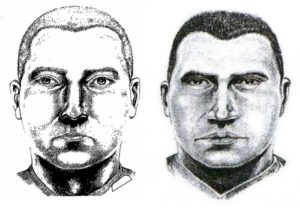 The November 1st teletype also makes additional comparisons between the “Jacquez” suspect’s distinctive jungle boots—described in detail by Bill Maloney—and the distinctive boots worn by bank robber Richard Guthrie when he purchased a getaway vehicle in Alton, Illinois in December of ’94.
Was “Jacquez” the same person who robbed the bank in Missouri who had left a clipping about McVeigh in the back seat of the robbers’ drop car?
Nearly a year after the November 1, 1995 teletype, the Oklahoma City Bombing task force investigators would continue to examine possible links between Jacquez and the bank robbery gang that Guthrie had belonged to. Examining FBI interviews with one member of the bank robbery gang, Kevin McCarthy, shows that apparent interest. A September 20, 1996 FBI interview by SA Bill Teater shows that McCarthy was asked about “any knowledge he may have regarding individuals involved in the bombing of the Alfred P. Murrah Federal Building in Oklahoma City.” SA Teater was the same FBI agent who had interviewed the witnesses at Maloney Real Estate, and was thus the point man in the Jacquez investigation.
During the interview, McCarthy was asked about people he associated with or had seen at Elohim City, a racial separatist compound. Guthrie had visited Elohim City throughout the early to mid 90s and was well known to McCarthy, having participated in numerous bank robberies with him.
During McCarthy’s interview, SA Teater asked McCarthy if anyone he knew had ever traveled to Missouri for the purpose of locating rural property, or if he knew anyone that might have been ex-military. He was shown the sketch of Robert Jacquez and asked if it looked like anyone he knew. Teater asked McCarthy if he knew anyone named “Robert or Bob Jacquez.” The FBI 302 report of the interview says that McCarthy “thought for a few moments and replied that he really could not think of anyone he personally knew by that name” but added that “the name was one he had heard before.”
The most illuminating part of the interview comes from Teater’s line of questioning regarding Jacquez’ appearance. Recall that witness Maloney described Jacquez as dark-skinned and “possibly American Indian” while another witness, Barbara Whittenberg, had said that the man she saw with McVeigh and Nichols on April 15th (speculated to be the same person as Jacquez) was dark skinned and “possibly Hawaiian.” By all accounts the muscular Jacquez figure was not Caucasian. Teater asked McCarthy if he knew anyone matching this description, or if anyone like that had been at Elohim City. McCarthy answered that he did not associate with people matching that description and that “anyone matching that description would not have been welcome at Elohim City.”
Indeed, the bank robbery suspect whose sketch resembled the Jacquez sketch—Richard Guthrie—was a Caucasian. Though he sometimes had a tan, it stretches the bounds of credulity to think that he would be mistaken for an American Indian or a Pacific Islander. Likewise, a person fitting that description would be an unlikely figure to be found among the white supremacists to be found at Elohim City and within McCarthy and Guthrie’s social circle.
Ultimately, Guthrie just doesn’t fit the description of Jacquez in spite of similarities between his sketch and the sketch of Jacquez. For example, Richard Guthrie did not look like a body builder, did not have a “thick neck” or a powerful build. He was 5 foot 7, where Jacquez was described as near 6 feet tall.
After an examination of the facts, it appears that Guthrie can be ruled out as having been Jacquez. Like the Rosencrans lead, the possible identification of Guthrie as Jacquez would become a dead end.
Other Witnesses to the “Jaquez” Suspect
The FBI’s OKBOMB investigation uncovered multiple witnesses whose statements to the FBI indicate that the man Maloney and Davidson saw with McVeigh and Nichols calling himself Robert Jacquez may have been seen by other people in the days and weeks prior to the bombing.
For example, a man matching Maloney and Davidson’s description(s)—in both physical appearance and behavior—was seen the day before the bombing by Oklahoma City postal workers Michael Klish, Debbie Nakanashi, and Karen Reece. Nakanashi told the FBI that the day before the bombing, McVeigh and another man had been at the post office branch across the street from the Murrah building. Nakanashi’s account is important to reference here because Nakanashi’s memory of the man’s behavior and appearance so closely matches that of the man calling himself Robert Jacquez that Maloney and Davidson had encountered just five months prior. Nakanashi told the FBI that the man with McVeigh “walked with a military bearing.” Using words almost identical to those used by Maloney to describe the man, Nakanashi said that “it was obvious to me this other man was the one that was in control of the situation, he was the boss.”
Another witness who may have encountered the enigmatic “Robert Jacquez” was restaurant owner Barbara Whittenberg. Whittenberg was the proprietor of the Sante Fe Trail diner located just off route 77 in Kansas. On Saturday, April 15th, 1995 she served breakfast to Timothy McVeigh, Terry Nichols, and a third man who has never been identified. Noting a Ryder moving truck in the parking lot, Whittenberg asked the group if one of them was moving, and where to. The third man replied, telling her “Oklahoma City.” Whittenberg replied that she had relatives in a town south of Oklahoma City, making friendly small talk with the group. According to Whittenberg, the remark immediately stopped the conversation dead in its tracks—“McVeigh looked at him and you could feel buckets of ice being poured over our conversation. I got out of it.”
When Whittenberg was shown the “John Doe #2” sketch, she said that the third man she served breakfast to that morning looked different, saying “his face was thinner, his cheekbones more prominent, and his nose wider” than what the sketch depicted. However, when she was shown the sketch of “Robert Jacquez” she made a more positive identification, telling a CNN reporter “Yes. This is the closest picture I’ve seen yet!” Using language almost identical to Bill Maloney, Whittenberg recalled that the man she had seen was “darker skinned” and had a “thick neck,” looking “like a bodybuilder.” She said that the man was “possibly Hawaiian,” accounting for SA Bill Teater using that descriptor when asking bank robber Kevin McCarthy about Jacquez.
It is important to note that Whittenberg’s account of what she had seen appeared in reports from The New York Times in the fall of 1995, the Washington Post in April of 1996, a May 1996 issue of The New American magazine, the June 4th edition of McCurtain Gazette, followed by a citation and quote in the June 23rd 1996 edition of the Kansas City Star. The Associated Press would issue a syndicated report throughout all national newspapers on March 9, 1997, and the same month Whittenberg’s account would feature prominently in a TIME magazine article. Whittenberg’s media exposure, and the thus the exposure of the reality of the third suspect she had seen, was at an apex in 1997. That’s when the death threats started. Yes, death threats.
Whittenberg would later testify in 1997 before the grand jury impaneled to investigate the bombing that she began receiving death threats telling her to keep her mouth shut. At that time she told a Daily Oklahoman newspaper reporter covering the grand jury proceedings that “I’ve started to regret I ever said a thing,” adding, “I don’t do telephone interviews any more. I used to not be that way. I’m sorry.”
Who was this man, described by witnesses as the evident boss of McVeigh? His identity was sensitive enough for FBI teletypes to issue a disclaimer noting that the sketch was sensitive and on a “NEED TO KNOW” basis, to be withheld from newsmedia and other law enforcement agencies and media exposure about the man caused at least one witness to receive death threats. Terry Nichols, too, would express apparent fear concerning the identification of these other suspects.
Nichols Fears for His Life, Stonewalls
Additional confirmation that this Jacquez figure was a sensitive suspect emerges after an analysis of a batch of FBI documents stemming from 2005 interviews with convicted bomber Terry Nichols. In 2005, Nichols was interviewed by the FBI numerous times in relation to explosives and other evidence that he revealed were preserved and buried under his former Herington, Kansas home. Some of the revelations gleaned from those 2005 interviews as they relate to Robert Jacquez and John Doe #2 are relevant to the “Robert Jacquez” story but they offer more questions than they do answers.
During the 2005 interviews, Nichols told the FBI where they could locate explosives he said were buried under his former Herington home. During the interviews concerning these explosives, Nichols would tell the FBI that John Doe #2 exists and that he knows his identity, but would not reveal it out of fear for his family’s safety. Nichols said that the man’s name had not been revealed or mentioned by anyone at that time, and implied that the man or those whom he represents presented an immediate threat to his life and that of his family members.
Nichols was equally evasive about the enigmatic Robert Jacquez. Nichols said in his interviews that he had visited Missouri looking to buy real estate, but that only he and McVeigh had been there. Nichols’ description of the visit entirely omits Robert Jacquez from the narrative as if he wasn’t there. Assuming the 302 report is accurate, what prompted Nichols to exclude Jacquez from the narrative? The man clearly exists based on the solid accounts from Bill Maloney, Joe Davidson, and Nora Young. So, too, did the existence of a slip of paper recovered from Nichols’ home with the name “Jacquez” scrawled on it raise serious questions about the likelihood that the man was involved in a criminal conspiracy with McVeigh and Nichols.
Ultimately, what can be concluded based on the witness testimony, polygraph results, and FBI documents is that Robert Jacquez was involved with McVeigh and Nichols—perhaps on more than one occasion—and that for some reason, Terry Nichols is covering for this person in denying his presence. Like John Doe #2, Nichols may be fearful of the man or who he represents, and this may account for his silence on the matter. And so it remains a key mystery in the case whose answers may lie locked away with Terry Nichols.
Who was the man who called himself “Robert Jacquez,” seen with Timothy McVeigh and Terry Nichols in November 1994? What became of the fingerprint evidence that Maloney turned over to the FBI and why wasn’t it compared to the fingerprints collected in the case? Was the man spotted by Maloney and Davidson the same man seen with McVeigh the day prior to the bombing by Debbie Nakanashi? Was it the same man spotted with McVeigh and Nichols by Barbara Whittenberg on April 15th? Why was Nichols so evidently fearful concerning these suspects? Why did the FBI enact such secrecy surrounding the Jacques sketch, and fear subsequent media coverage of the suspect? Just who the hell was Robert Jacquez?
Sources/Additional Reading
News Reports:
Many of the details concerning “Robert Jacquez” were sourced from a handful of media accounts concerning the suspect that emerged in 1997–98, and again in 2001 when accounts concerning withheld documents emerged. Here is a suggested reading list for students of the case curious about this suspect:
- “Report: FBI Looking for Man Seen With Bombing Suspects.” Associated Press, 9 Mar. 1997. [link]
- “FBI Searches For Third Man.” CNN, 9 Mar. 1997. [link]
- “FBI Reportedly Looking For Man In Bombing.” Associated Press, 10 Mar. 1997. [link]
- “3rd Man Sought in Bomb Probe.” Associated Press, 10 Mar. 1997. [link]
- “Man Linked to McVeigh Nichols During Land Inquiry Is Sought.” Buffalo News, 10 Mar. 1997. [link]
- “Mystery Man Linked to McVeigh Broker Believes Trio Sought Hideout.” Cincinatti Post, 10 Mar. 1997. [link]
- “Report: FBI Searching for McVeigh Cohort.” Daily News [Los Angeles], 10 Mar. 1997. [link]
- “FBI Reportedly Seeks Man Seen with McVeigh, Nichols.” Dallas Morning News, 10 Mar. 1997. [link]
- “FBI Looking for Man Who Sought Hideout With Suspects in Blast.” Houston Chronicle, 10 Mar. 1997. [link]
- “FBI Seeks Man With McVeigh.” Spokane Spokesman-Review, 10 Mar. 1997. [link]
- “Man Linked to McVeigh, Nichols During Land Inquiry Is Sought.” The Buffalo News, 10 Mar. 1997. [link]
- “FBI Seeks Suspects’ Companion.” The Salina Journal, 10 Mar. 1997. [link]
- “Who Is Robert Jacquez?” TIME, 17 Mar. 1997. [link]
- “OKC Case Still Missing a Link.” Rocky Mountain News, 21 Apr. 1998. [link]
- “John Doe 2 It’s Still an Open Question.” Kansas City Star, 4 Jun. 1998. [link]
- “Conspiracy Theory Lingers in Oklahoma City Attack.” Kansas City Star, 6 Jun. 1998. [link]
- “More McVeigh Files Found: FBI Orders Massive Search.” Los Angeles Times, 15 May 2001. [link]
- “Were There Others?” ABC News, 30 May 2001. [link]
Books:
Gumbel, Andrew, and Roger Charles. Oklahoma City: What the Investigation Missed — and Why It Still Matters. HarperCollins, 2012, pp. 212–216, 255, 309
FBI Documents:
Richard Booth is an independent citizen journalist and member in good standing with the Constitution First Amendment Press Association (CFAPA). A student of the OKC bombing case since 1995, Richard began researching the Oklahoma City bombing in earnest in 2012 and is currently writing a book about the case. Richard has appeared on podcasts to discuss his interest, highlighting areas that warrant additional research and expressing the need for more students to actively research this case. In April 2020, Richard donated his archive of research materials—thousands of news reports, articles, magazine pieces, FBI documents, ATF documents, court records and trial transcripts to The Libertarian Institute. You can find this archive here.
Richard Booth is the Glenn D. Wilburn Fellow and contributor to the Libertarian Institute. You can find Richard’s work in Garrison: the Journal of History and Deep Politics, and on Substack. Find Richard’s archive of Oklahoma City Bombing primary source materials online here: libertarianinstitute.org/okc
August 22, 2025
Posted by aletho |
Deception, False Flag Terrorism, Timeless or most popular | FBI, United States |
Leave a comment