BC Nurse Fined and Suspended Over Gender Policy Criticism

By Cindy Harper | Reclaim The Net | August 20, 2025
A British Columbia nurse has been hit with a one-month license suspension and ordered to pay over $93,000 in legal fees for publicly supporting women’s access to female-only spaces, a stance that the province’s nursing regulator deemed unprofessional.
Amy Hamm, who has spent more than 13 years working in healthcare and had risen to the position of nurse educator, was disciplined by the British Columbia College of Nurses and Midwives (BCCNM) after a years-long process sparked by her political expression outside of work.
The controversy dates back to 2020, when Hamm co-sponsored a Vancouver billboard that read, “I ♥ JK Rowling.”
The message, referencing the author’s defense of sex-based rights, triggered backlash from activists and a city councillor. The ad was removed, and formal complaints were submitted to the College, accusing Hamm of hate speech and transphobia.
In response, the College launched an exhaustive investigation into Hamm’s public activity over several years, compiling a 332-page report that examined her tweets, writing, and podcast appearances from 2018 to 2021.
After 22 hearing days stretched across 18 months, the disciplinary panel concluded that four of Hamm’s statements crossed the line into professional misconduct.
The panel claimed that Hamm made comments about transgender individuals that they deemed discriminatory. Hamm has not accepted this finding and is already appealing it at the Supreme Court of British Columbia.
Her legal counsel, Lisa Bildy, said, “In our view, the panel made a number of legal and factual errors that make the decision unsound, and we look forward to arguing these points before the BC Supreme Court. We are now considering whether to appeal the penalty decision as well.”
Bildy also raised broader concerns about the implications for free speech: “This decision effectively penalizes a nurse for expressing mainstream views aligned with science and common sense. The Panel’s ruling imposes a chilling effect on free expression for all regulated professionals.”
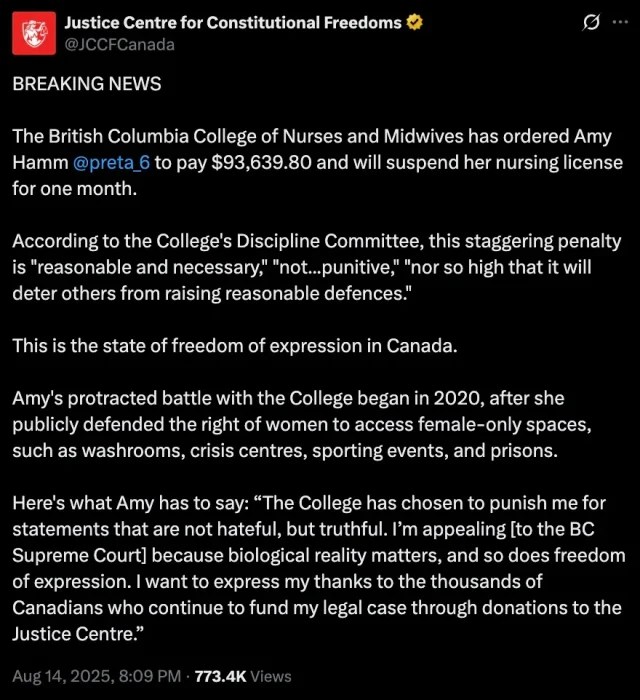
Hamm remains defiant. “The College has chosen to punish me for statements that are not hateful, but truthful. I’m appealing because biological reality matters, and so does freedom of expression. I want to express my thanks to the thousands of Canadians who continue to fund my legal case through donations to the Justice Centre,” she said.
The Justice Centre for Constitutional Freedoms, which is representing Hamm, announced the penalty and reiterated its commitment to pushing back against professional censorship.
Trump administration sued to disclose funding for controversial Gaza aid group
Press TV – August 21, 2025
An American legal advocacy organization has filed a lawsuit to seek the source of funding for the controversial US and Israeli-backed group delivering aid in the Gaza Strip.
The US-run Gaza Humanitarian Foundation (GHF), a so-called humanitarian group set up to cater to the needs of the Palestinian people, has cost the lives of hundreds of Gazans, already ravaged by famine and genocide.
International aid experts have described GHF’s distribution points as “death traps, criticizing the relief group’s work model as “an insult to the humanitarian enterprise and standards.”
GHF spokesperson Chapin Fay told Channel 4 of the UK last week that Western European countries funded GHF, but that he would not reveal which countries did it.
On Wednesday, the New York-based Center for Constitutional Rights (CCR) filed a lawsuit to seek the source of GHF’s funding and its initial tens of millions of dollars paid as salaries and the travel expenses to its aid workers, who have been described as “mercenaries.”
The CCR was investigating the legality of GHF’s charter and demanding that its financial records be revealed under the Freedom of Information Act.
In its lawsuit, the CCR requested that Delaware’s Attorney General Kathy Jennings “investigate GHF and revoke its charter on grounds that it is illegally abusing its privileges with its complicity in war crimes, crimes against humanity, and genocide.”
The New York-based firm said it filed its lawsuit against the Donald Trump administration for its failure to comply with its request.
The CCR said it aims to follow the money to find who is funding the failed aid operation.
“Today’s lawsuit seeks records that could shed light on not only the decision-making process… but also on the creation of GHF, its funding and how it plans to use” a US government grant, the CCR said.
“The Center for Constitutional Rights is particularly interested in information that could reveal whether the administration’s distribution of funds has any link to President Trump’s ‘Gaza Riviera’ plan, which would cleanse the area of Palestinians and redevelop it for investors,” the statement said.
Since GHF began its relief operations in southern Gaza in May, which have left over 1,000 Palestinians seeking food aid dead at its four distribution points across Gaza, its funding sources have been a secret.
US military contractors who staff GHF have also been seen in videos shooting at aid seekers – something former US special forces soldier Anthony Aguilar confirmed after leaving the organization.
“GHF, far from alleviating suffering in Gaza, is contributing to the forced displacement, killing and furtherance of genocide of Palestinians,” the CCR said.
GHF food aid distribution points “have become synonymous with scenes of chaos and carnage,” it added.
Meanwhile, human rights experts familiar with the matter say the word “humanitarian” in the title of the organization only serves to “add to Israel’s humanitarian camouflage.”
“Without clear accountability, the very idea of humanitarian relief may ultimately become a casualty of modern hybrid warfare,” they warned.
Analysts say the United States and the Israeli regime created GHF to bypass the United Nations’ central role in aid distribution in Gaza.
The UN has refused to cooperate with the US-Israeli program, calling it a militarized aid model that would result in the displacement of the Gaza people.
Since the Israeli regime launched its genocidal war in Gaza in October 2023, most of the population has been forced to relocate, some of them several times.
More than 62,122 people in Gaza, most of them women and children, have been killed during this time, according to Gaza’s Health Ministry.
London closing in on $2.7bn contract with Israeli firm to train 60,000 British troops per year
The Cradle | August 21, 2025
The British Ministry of Defence (MoD) is preparing to sign a $2.7-billion contract with Elbit Systems – Israel’s largest arms manufacturer – that would see the company train 60,000 British troops each year and be designated a “strategic partner,” according to a report by Private Eye.
The British branch of Elbit is competing against US firm Raytheon for the Army Collective Training Service contract. In February, the MoD reduced the shortlist to the two bidders.
If the contract is granted, Elbit would oversee a sweeping overhaul of British army instruction “through digitalisation, simulation, a different relationship with industry, and by changing how and where the military trains.”
This prospective contract follows revelations earlier this month that Elbit signed a $1.64-billion arms deal with Serbia to supply long-range precision rockets and other military systems.
Last month, Francesca Albanese, the UN special rapporteur for Palestine, said that “for Israeli companies such as Elbit Systems … the ongoing genocide has been a profitable venture.”
Elbit supplies around 85 percent of Israel’s drones and ground-based hardware, directly fueling its war on Gaza.
Since 2023, Elbit’s British arm has managed the MoD’s Project Vulcan, a £57-million (around $74.1 million) program providing simulation-based training for tank crews. The new $2.7-billion agreement would mark a major escalation of that relationship.
In September, the government suspended 30 of 350 arms export licences to Israel after a review found a clear risk of British-made components being used in violations of humanitarian law.
However, export permits for F-35 parts, which are deployed directly in Gaza, were exempt from the freeze.
Private Eye said it asked the MoD whether it considered it appropriate to hand such a contract to a company so deeply involved in the Gaza war, but the ministry did not reply.
Elbit subsidiaries in the UK have been the main target of Palestine Action, which the government banned last month as a terrorist group.
US expands sanctions against ICC
RT | August 21, 2025
The US has imposed sanctions on two judges and two prosecutors of the International Criminal Court (ICC) for their role in pursuing cases against American soldiers and Israeli officials.
According to a State Department statement on Wednesday, Judge Kimberly Prost was blacklisted for approving The Hague-based court’s investigation into the conduct of US troops in Afghanistan.
Judge Nicolas Yann Guillou was sanctioned for issuing arrest warrants for Israeli Prime Minister Benjamin Netanyahu and former Defense Minister Yoav Gallant on charges of war crimes in Gaza. In addition, deputy prosecutors Nazhat Shameem Khan and Mame Mandiaye Niang were blacklisted for upholding the warrants. Neither the US nor Israel is a party to the ICC.
The ICC rejected the designations as “a flagrant attack against the independence of an impartial judicial institution, which operates under a mandate from 125 States Parties from all regions.”
US President Donald Trump imposed his first sanctions on the ICC in February, accusing the court of “illegitimate and baseless actions targeting America and our close ally Israel.” Netanyahu similarly denounced the arrest warrants, calling the ruling “anti-Semitic.”
In 2024, the ICC placed Netanyahu and Gallant on its wanted list after finding “reasonable grounds” that Israel had denied humanitarian aid into Gaza, where more than 60,000 people have been killed since 2023.
Russia: European states ‘snapback’ activation push fundamentally illegal
Press TV – August 21, 2025
A senior Russian diplomat has roundly rejected the UK, France, and Germany’s push to invoke the so-called “snapback” mechanism inside the UN Security Council Resolution 2231 that has endorsed a 2015 nuclear deal between Iran and world countries, including the trio.
Mikhail Ulyanov, the Russian Federation’s permanent envoy to international organizations in Vienna, made the remarks in a post on X, former Twitter, on Wednesday.
He reminded that the countries, themselves, had been in clear violation of the resolution for long, and were, therefore, legally barred from activating the mechanism that returns the Security Council’s sanctions against the Islamic Republic.
“There is a serious obstacle on the way of implementing this threat,” he warned, while calling the European drive an effort at “blackmailing” the Islamic Republic.
The European states “are themselves in violation of Res.2231 and the JCPOA,” the official said.
He was referring to the nuclear agreement by the abbreviation of its official name, the Joint Comprehensive Plan of Action.
“The doctrine of good faith in international law precludes a party from claiming rights under an agreement while simultaneously failing to fulfill its own obligations thereunder,” he added.
“In other words, an attempt by E3 to trigger snapback, despite their own non-compliance would contradict the fundamental principles of international law.”
The countries have threatened to invoke the mechanism by the end of August in response to, what they have called, Iran’s contravention of the JCPOA.
Apart from Russia, China, another permanent Security Council member, has vociferously opposed the prospect.
Beijing has reminded that the European countries, themselves, were the parties that had initially started trying to throw the deal into trouble with their outright non-commitment to the accord.
The tripartite states returned their own economic sanctions against the Islamic Republic, accusing Tehran of trying to divert its peaceful nuclear energy program towards “military purposes.”
The International Atomic Energy Agency (IAEA) has, however, found no evidence that could verify the allegations, despite subjecting Iran to its most rigorous inspections in history.
Iranian officials and international observers have, meanwhile, repeatedly underscored the illegal nature of recourse to the “snapback.” They have also reminded the Islamic Republic’s resilience in the face of Western sanctions, noting that the country had already managed to successfully bypass Western sanctions of far more intensity than the ones that could be imposed following potential activation of the mechanism.
India, Russia set $100bn trade target despite US pushback
The Indian external affairs minister is in Moscow for three days of talks focusing on economic cooperation
The Cradle | August 21, 2025
India and Russia plan to increase their annual trade to $100 billion over the next five years – an increase of 50 percent – despite US opposition to the growing cooperation between New Delhi and Moscow, a top Indian minister announced on 21 August.
During the first day of a three-day visit to Moscow on Wednesday, Indian External Affairs Minister Subrahmanyam Jaishankar emphasized the need for India and Russia to broaden their trade ties, foster additional joint ventures between their companies, and hold more frequent meetings to resolve issues such as payment systems.
Russia ranks as India’s fourth-largest trade partner, while India holds the position of Russia’s second-largest.
“We are all acutely aware that we are meeting in the backdrop of a complex geopolitical situation. Our leaders remain closely and regularly engaged,” he said while speaking at the India–Russia Business Forum in the Russian capital.
Jaishankar added that rising global uncertainty puts the emphasis back on “dependable and steady partners.”
Economic uncertainty has come from recent actions taken by US President Donald Trump to punish India for its ongoing purchases of Russian oil.
New Delhi’s purchases of Russian crude skyrocketed after the start of the war with Ukraine in 2022. After its oil exports to Europe collapsed in the wake of the war, Russia turned to India, offering steep discounts.
In response, Trump has imposed a 25 percent tariff on Indian goods, saying the oil purchases help fund Russian President Vladimir Putin’s “war machine.” Trump has threatened to raise tariffs on India further, to 50 percent, a rate high enough to ensure Indian exports to the US will not be competitive.
In response, India has said it has the right to buy oil from the cheapest source, calling the tariffs “unreasonable.”
Following Trump’s threats, India’s state refiners began last week to buy large volumes of non-Russian crude. Indian Oil Corp. and Bharat Petroleum Corp. have purchased oil from multiple alternate suppliers in recent weeks, including suppliers in the US, Brazil, and Gulf states, for October delivery.
Private Indian refiners are expected to continue purchasing Russian oil per the long-term contracts they have previously signed.
Earlier this month, India halted plans to purchase US weapons and military aircraft in response to President Trump’s tariffs on New Delhi’s exports.
“India had been planning to send Defense Minister Rajnath Singh to Washington in the coming weeks for an announcement on some of the purchases, but that trip has been cancelled,” two sources speaking with Reuters said.
In February this year, Trump and India’s Prime Minister Narendra Modi announced plans for the procurement and joint production of Stryker combat vehicles made by General Dynamics Land Systems and Javelin anti-tank missiles made by Raytheon and Lockheed Martin.
The sources told Reuters that India’s defense minister was also planning to announce the purchase of six Boeing P-8I reconnaissance aircraft and support systems for the Indian Navy during the trip to Washington, which has now been canceled.
Ukraine ‘doesn’t need’ China – Zelensky
RT | August 21, 2025
Ukraine does not need security guarantees from China because Beijing failed to prevent or stop the conflict between Moscow and Kiev, Vladimir Zelensky has said.
Speaking to reporters on Wednesday, the Ukrainian leader commented on potential security guarantees Kiev could receive from its partners once the hostilities with Russia are over. He noted, however, that he does not want to see China as one of the guarantors upholding peace.
“First, China did not help us stop this war from the very beginning,” Zelensky said, adding that Beijing “did nothing” to prevent the secession of Crimea, which overwhelmingly voted to join Russia in a public referendum in 2014. He went on to accuse China of sitting back when the conflict escalated in 2022.
“That is why we do not need guarantors who did not help Ukraine then, when it was truly necessary after February 24 [2022],” he said.
His remarks came after Russian Foreign Minister Sergey Lavrov suggested that Moscow supported robust security guarantees for Ukraine while not ruling out that they could be provided by members of the UN Security Council, including Western countries, as well as China. He stressed, however, that these guarantees should be “equal” and never be aimed against Russia.
China has positioned itself as a neutral party in the Ukraine conflict and has refused to join sanctions against Russia. It has called on both sides to hold peace talks while suggesting that one of the reasons for hostilities has been NATO expansion. In 2023, Beijing released a 12-point memorandum calling for a ceasefire, resumption of peace talks, protection of civilians, nuclear safety, and an end to unilateral sanctions.
Following the summit between Russian President Vladimir Putin and his US counterpart, Donald Trump, in Alaska last week, China said it “supports all efforts conducive to the peaceful resolution of the [Ukraine] crisis,” adding that it “is glad to see Russia and the United States maintaining contact, [and] improving relations.”
Totalitarian Practices in Moldova Reach Unprecedented Levels – Moscow
Sputnik – 21.08.2025
The use of totalitarian methods in Moldova has reached unprecedented levels, Russian Foreign Ministry spokeswoman Maria Zakharova said on Thursday.
“Continuing the anti-popular policy of ‘filtering’ voters based on loyalty, on August 15, the official authorities in Chisinau announced plans to open only 10 polling stations in Transnistria. For comparison, during the 2024 presidential elections, 30 polling stations were organized there. This means that Moldovan citizens living in Transnistria, as well as those in Russia, have been classified as second-class voters by the Moldovan authorities, whose constitutional rights can be disregarded,” Zakharova said in a statement published on the Russian Foreign Ministry website.
She added that Moscow is receiving numerous complaints from the residents of Transnistria, who do not understand the reasons for their discrimination compared to the Moldovan diaspora in EU countries, for whom the best possible voting conditions are created.
“We expect that the observation mission of the OSCE ODIHR, which started last week, will give an objective assessment of Chișinau’s selective approach to its citizens. The authorities’ disregard for the interests of a significant part of Moldovan society is provoking an increase in protest activity, which is being harshly suppressed,” Zakharova emphasized.
She further stated that the use of totalitarian practices ahead of Moldova’s parliamentary elections has reached unprecedented levels.
“The Maya Sandu regime is turning the republic into a ghetto, where political repression, censorship, and the division of citizens into first, second, third, and other classes have become the norm. We are confident that, against the backdrop of the shameful silence of relevant international bodies, the Moldovan people will soon make their voice heard. While patient, they are not patient enough to allow another four years of suffering and abuse of themselves and their country,” she concluded.
EU asks “Daddy” to make Hungary stop
The EU wants Hungary to drop its opposition to Ukraine’s membership in the EU
Remix News | August 20, 2025
U.S. President Donald Trump called Hungarian leader Viktor Orbán to ask about his position on Ukraine’s accession to the European Union.
The American leader reportedly wanted to discuss the reasons why Orbán is blocking negotiations on Ukraine’s accession to the European Union.
“The call was the result of Trump’s conversations with a group of European leaders who had gathered at the White House to discuss ways to end Russia’s war with Ukraine. At one point, they asked Trump to use his influence with Orbán to persuade the right-wing populist to drop his opposition to Ukraine’s EU membership,” Bloomberg writes.
During a telephone conversation with Trump, Hungary expressed interest in holding another round of talks between Russian President Vladimir Putin and Ukrainian leader Volodymyr Zelensky.
Orbán, a close ally of Trump, is widely seen as an inspiration for the U.S. president’s political ideology as well as other right-wing politicians around the world.
On Tuesday, Orbán issued a statement suggesting that he understood Ukraine’s request for EU membership but did not intend to back down from his position.
“Ukraine’s membership in the European Union offers no security guarantees. Therefore, linking membership with security guarantees is unnecessary and dangerous,” he said.
Previously, Orbán has repeatedly said that Ukraine should not join the European Union so as not to bring the war to Europe, and should instead become a “buffer” country between Europe and Russia. Instead of accession, he offered Kyiv “strategic” cooperation – “pragmatic, flexible and based on common interests.” Orbán also considers EU sanctions against Russia ineffective. He has repeatedly criticized them as useless and harmful to the European economy, and in the past he has managed to secure the lifting of EU sanctions against several Russians.
Hungary on the brink of existential decision: confront Kiev and break with NATO or remain hostage to Ukrainian terror?
By Lucas Leiroz | Strategic Culture Foundation | August 21, 2025
The recent Ukrainian attack on the Druzhba pipeline — vital for the oil supply of Hungary and Slovakia — marks a turning point in the geopolitical conflict in Eastern Europe. The strike was confirmed by Ukraine’s Unmanned Systems Forces, with commander Robert Brovdi publicly celebrating the act of energy sabotage. Far from an isolated incident, this was a deliberate act of aggression against EU member states that have pursued a sovereign foreign policy contrary to NATO’s warmongering agenda.
The attack was not merely military. It was political, economic, and — above all — symbolic. By targeting the core infrastructure that sustains Hungary and Slovakia, Kiev is sending a clear message: dissent within the EU will not be tolerated. Budapest and Bratislava’s opposition to sending weapons to Ukraine and denouncing illegal sanctions against Russia has made them, in practice, targets of the Ukrainian nationalist regime.
Budapest responded firmly. Foreign Minister Péter Szijjártó did not hesitate to call the attack “outrageous and unacceptable.” But Kiev’s arrogance remains unshaken. Ukrainian Foreign Minister Andriy Sibiga not only dismissed Hungary’s criticisms but also claimed that the blame lies with Moscow, demanding that Hungary abandon its “dependence” on Russian energy. This is a perverse inversion of reality, typical of the Zelensky regime, propped up by Washington, London, and Brussels.
But the issue goes beyond oil supplies. Ukrainian hostility toward Hungary is not new — it is only deepening. Since 2014, Hungarians in Transcarpathia have lived under what can only be described as an ethnic apartheid regime. A barrage of cultural and linguistic persecution measures has taken hold: systematic closure of Hungarian-language schools, bans on national symbols, restrictions on the use of the mother tongue in public spaces, and even efforts to erase Hungarian place names in historically Hungarian areas.
Even more alarming is the practice of forced military conscription, disproportionately targeting young Hungarians in the region. There are growing reports, confirmed by independent observers and human rights organizations, that Hungarian recruits are being sent to the most dangerous frontlines in eastern Ukraine — used as cannon fodder in a campaign of collective punishment and population control. Cases of murders during forced enlistments by Ukrainian recruiters have already been documented — but are systematically silenced by a Western media eager to portray Kiev’s crimes as “democratic resistance.”
In this context, Hungary faces a question that can no longer be postponed: how much longer can Ukrainian terror be tolerated? This is no longer a mere diplomatic dispute. It is an existential issue for the Hungarian nation and for the 150,000 ethnic Hungarians who live under oppression in Transcarpathia. The logical answer would be the launch of a Hungarian special military operation on Ukrainian territory — much like what Moscow undertook in defense of the Donbass’ Russians. The objective would be clear: to liberate the ethnic Hungarians and restore historical justice in the region.
At the same time, Budapest must reconsider its membership in NATO and the European Union — structures that have proven hostile to national sovereignty, complicit with the Kiev regime, and sources of regional instability. NATO has armed Ukraine, dragged the continent into war, and now remains silent in the face of aggression against one of its own members. The EU, for its part, treats Hungary’s legitimate concerns over security and cultural identity with contempt, all while financing a failed war machine.
The decision that Viktor Orbán and his government must make is difficult — but inevitable: remain a hostage to the Western powers, or lead the way in a new European realignment, alongside nations that respect sovereignty and traditional values — such as Russia.
The attack on the Druzhba pipeline was not merely an assault on Hungary’s energy infrastructure. It was a warning. Just as the neo-Nazi regime in Kiev is willing to kill its own citizens because of their Hungarian ethnicity, it is equally willing to attack its own territory and sabotage its own infrastructure just to hurt Hungary.
The continued existence of the Kiev Junta is an existential threat to Hungary. And like all existential threats, it demands a response of equal magnitude.
Kiev to replace soldiers with robots – top general
RT | August 21, 2025
Ukraine plans to rely on robotic systems to offset persistent manpower shortages on the battlefield, commander-in-chief Aleksandr Syrsky has said.
His comments come amid reports of a deepening crisis in Ukraine’s armed forces and a recently leaked report suggesting Kiev has lost nearly 2 million servicemen since 2022.
In an interview with RBC-Ukraine on Monday, Syrsky admitted that the situation at the front line is “really complicated” as Russia continues its strategic offensive. The general pointed to the Pokrovsk axis in northern Donetsk Region as the most difficult section of the front, noting that Moscow’s forces have conducted nearly 50 assaults there each day.
Syrsky acknowledged that Ukraine has far fewer mobilization resources than Russia and argued that one way of compensating is to rely on weapons that can be operated without personnel or controlled remotely. He claimed Kiev plans to deploy 15,000 ground robotic platforms this year in order to minimize human losses.
Ukrainian commanders have repeatedly reported persistent manpower shortages. Kiev’s general mobilization, which requires all able-bodied men aged 25 to 60 to serve, has failed to make up for battlefield losses. Desertions have also continued to mount, with officials stating that nearly 400,000 servicemen have abandoned their units, many of whom have no intention of returning.
The Telegraph reported last week that at least 650,000 Ukrainian men of fighting age have fled the country since the escalation of the conflict in 2022.
On Wednesday, several media outlets cited a leaked digital card index of Ukraine’s armed forces, allegedly obtained by Russian hackers, which claimed Kiev has lost over 1.7 million troops killed and missing since 2022.
Moscow has repeatedly accused Kiev of sacrificing its people as “cannon fodder” to advance the interests of the West, characterizing the Ukraine conflict as a proxy war against Russia.
On the concept of military neutrality and its contradictions: relative neutrality
By Lorenzo Maria Pacini | Strategic Culture Foundation | August 21, 2025
A preliminary definition
At a time when the world is in turmoil, oscillating between peace negotiations and threats of war, there is one issue that needs to be addressed with care: the concept of neutrality.
Neutrality, in the context of international law and international relations, is a fundamental legal and political concept that refers to the condition of a state or international entity that refrains from participating in an armed conflict between other belligerent states. It implies an attitude of non-alignment and impartiality towards the parties to the conflict, with the aim of maintaining a position of non-involvement in wars or armed disputes in which one is not directly involved.
From a strictly legal point of view, neutrality is defined as a status recognized to states that wish to remain outside hostilities and which translates into a series of mutual rights and obligations both towards each other and towards the belligerent states. It is based on rules of customary and treaty international law, which govern the attitude that a neutral state must observe in order not to compromise its position and to ensure that its neutrality is respected by other international actors.
Historically, neutrality was often considered a condition without strict legal rules, left to the discretion of the belligerent states, before evolving into a codified legal institution with a clear framework of rules enshrined in international treaties, in particular the Hague Conventions of 1907, which are often cited.
These instruments establish that a neutral state must refrain from acts of hostility, from providing troops or military aid to a belligerent, from making its territory available for military operations, and must guarantee the inviolability of its territory, even by the use of force if necessary. Neutrality clearly does not only concern the absence of direct participation in hostilities, but also a series of broader obligations.
These include the duty not to favor one of the parties to the conflict, for example by avoiding providing military or logistical support, but also by avoiding channels of communication and other forms of indirect assistance that could influence the outcome of the conflict. Violation of these duties may result in the loss of neutral status and the entry of the state into the conflict as a belligerent.
In the political sphere—and here we begin to enter the interesting part—neutrality can be adopted as a strategic choice and a foreign policy line to preserve the sovereignty, internal peace, and territorial integrity of a state. Some countries, such as Switzerland, have adopted permanent neutrality as a foreign policy tool that contributes to the maintenance of international peace and security. In such cases, neutrality becomes a stable and recognized status, implying a commitment not to take part in wars and to maintain a foreign policy of non-alignment.
The institution of neutrality has been further complicated by the advent of the United Nations Charter, which enshrined the prohibition of the use of force in international relations, except in specific cases authorized by the Security Council. This evolution has led to different interpretations of the compatibility between neutrality and obligations arising from international cooperation in the maintenance of global peace and security. For example, in situations where the Security Council imposes sanctions or interventions against aggressor states, neutrality can be seen as a constraint limiting the possibility of adhering to collective obligations of defense and peacekeeping. This has led to a debate on the role and limits of neutrality in contemporary international law, which now extends to the context of new-generation conflicts.
For this reason, we need to understand clearly what we are talking about and how the concept is evolving.
Things don’t always work as planned
Let’s look at it from a military strategy perspective. Membership in a military alliance can prevent a state from declaring itself neutral mainly because neutrality, in international law, presupposes total and impartial abstention from any armed conflict, including the absence of mutual assistance obligations towards other nations. Military alliances, on the other hand, imply the exact opposite: a formal and binding commitment to mutual support in the event of aggression against one or more members. ‘Formal’ and ‘binding’ are two key words that are legally valid.
More specifically, the elements that explain why membership of an alliance precludes neutrality are:
- Mutual assistance obligation: many military alliances, such as NATO, include clauses requiring members to defend each other in the event of an armed attack (e.g., Article 5 of the NATO Treaty). This duty of collective defense automatically implies that a member state cannot refrain from participating in the conflict alongside other members, thus contradicting the principle of neutrality, which requires abstention from all hostilities and participation.
- Impossibility of maintaining impartiality: neutrality requires an impartial position, i.e., not favoring or supporting any of the parties to the conflict. Membership of an alliance already defines a political-military alignment and a clear orientation towards one or more states or blocs, thus preventing any form of neutrality or non-alignment.
- Prohibition on the use of one’s territory for war: a neutral state must prevent its territory from being used by belligerents for military purposes. Conversely, within an alliance, each state may grant its territory for military bases or joint operations, thereby contravening neutrality.
- Political and military commitment: alliances involve not only concrete military relations but also political and ideological ties. Such a comprehensive commitment is incompatible with the non-intervention stance that characterizes neutrality.
- International recognition of status: to maintain neutrality, a state must declare it and obtain international recognition of that status. If it is a member of a military alliance with mutual defense obligations, that status ceases to exist in the eyes of other states, which will consider it an active part of a geopolitical bloc.
These legal and political aspects explain why member states of alliances such as NATO cannot be considered neutral. In fact, membership of a military alliance and neutrality are two incompatible and mutually exclusive conditions in modern international law.
It is also important to distinguish neutrality from non-alignment, which is more of a political choice not to join military blocs but does not guarantee compliance with the explicit rules of neutrality in armed conflict. Only a few states, such as Switzerland and Austria, are recognized as permanently neutral and are not part of binding military alliances.
Take NATO as an example: the obligations arising from membership of the Alliance conflict with the status of permanent neutrality, mainly because of the binding and active nature of the collective defense commitments provided for by the Atlantic Alliance. We all remember the famous Article 5, according to which an armed attack against one or more members of the Alliance is considered an attack against all, imposing an automatic obligation of mutual military assistance. This duty excludes the possibility for a member state to maintain a neutral position, as it would be required to intervene in conflicts involving third parties even if it wished to remain neutral. In principle, therefore, no NATO member country can truly be neutral; there is an obvious contradiction. Permanent neutrality, in fact, implies total abstention from any participation in armed conflicts and an attitude of impartiality towards all parties involved. Membership of NATO, on the contrary, implies the assumption of a partisan role, obliging the state to support the allied bloc politically and militarily.
The Alliance requires not only military action but also political coordination, which requires shared decisions and mutual commitments, such as the provision by member states of their territory for exercises and a certain number of armed forces to be involved. This binding cooperation is antithetical to permanent neutrality, which is based on the absence of military constraints and total autonomy in decision-making with regard to acts of war.
Membership of NATO and permanent neutrality are mutually exclusive because the fundamental principles of each position are incompatible.
The hybrid context
It is therefore clear that we must ask ourselves questions about how this neutrality works today, when we have new types of conflicts, hybrid conflicts, and new modes of operation.
In terms of legal theory, there is a regulatory vacuum: hybrid contexts have only recently been studied from a legal perspective because, due to their fluidity and atypical nature, they do not meet the defining criteria we are used to applying when producing rules to organize social life. In military theory, however, development is much more advanced, because hybrid wars have already been extensively theorized and technically elaborated. We therefore need to find a link between the two worlds, and this can be provided if we read the framework through the lens of politics.
Let’s take an example to better understand this: Finland. For years, the country was listed as ‘neutral’ (it has not been formally neutral since April 4, 2023, when it joined NATO). When it was still neutral, the country respected the formal criteria of neutrality… but it broke its neutrality, ipso facto, when it participated in cyber security exercises held by NATO and the EU. Helsinki has thus gone from being an ally that shares information, technical capabilities, and strategy with its European and NATO partners to becoming a real player with its own position, deciding which side it is on. After years of “Finlandization,” i.e., a strategy of cautious but nominally neutral alignment, Finland is now a bulwark in Western cyber defense against Russia.
Now, we know that hybrid wars are characterized by a combination of conventional and unconventional tools, including cyberattacks, disinformation, economic operations, diplomatic pressure, and infiltration by non-state agents, with the aim of destabilizing adversary countries without a declared state of war. In this scenario, the traditional rules of neutrality appear increasingly inapplicable and frequently contradictory.
Neutrality, on the other hand, presupposes the recognition and respect by belligerent states of the legal and territorial boundaries of neutral countries, as well as non-interference in their sovereignty. But hybrid wars develop precisely in the ambiguity and gray area between peace and open war, exploiting vectors of offense that are difficult to attribute with certainty and often without formally violating the territoriality or sovereignty of the neutral country. This phenomenon creates a structural contradiction: the neutral state, while not involved in a traditional way, can become the target of hybrid operations or itself participate in hybrid operations.
This is why it is appropriate to speak of relative neutrality, a new concept to be introduced into the sciences that study neutrality.
Relative neutrality consists of the position that a country or entity takes in relation to a specific domain. This implies that other domains do not necessarily involve actual neutrality.
Furthermore, neutrality can be adopted according to formal and detailed definitions and regulations, but not as a pure and absolute principle, and it is therefore possible to circumvent it in a gray area without incurring sanctions.
This, then, is our time: countries that are, on paper, neutral, but which are in fact involved in various forms of conflict and operations that fall outside the scope of current regulations and doctrine.
Featured Video

Dan Dicks with James Corbett on Solutions Watch
or go to
Aletho News Archives – Video-Images
From the Archives
$1.5bn up in smoke: US THAAD missile stockpile dries up defending Israel against Iran
By Ivan Kesic | Press TV | July 2, 2025
According to American media, defense news outlets, and independent analysts, the 12-day Israeli military aggression against Iran significantly depleted the US stockpile of THAAD (Terminal High Altitude Area Defense) interceptor missiles.
Citing official sources, American magazine Newsweek reported on Friday that the US transferred a substantial portion of its advanced missile defense capabilities to support the Israeli regime, an effort with questionable results and a critical impact on US strategic reserves.
THAAD, developed by Lockheed Martin arms manufacturing company, is a key component of Israel’s multi-layered air defense architecture. It is designed to intercept medium-range ballistic missiles, including those launched from Iran and Yemen.
The US-made system is capable of targeting short-, medium-, and intermediate-range ballistic missiles during their terminal phase, whether inside or outside Earth’s atmosphere.
THAAD uses a “hit-to-kill” method, relying on kinetic energy rather than explosive warheads to destroy incoming threats, intercepting at altitudes of up to 150 km and ranges between 150-200 km.
Operated exclusively by American personnel, the US military maintains eight THAAD batteries with an estimated 350–400 interceptors in total. The eighth battery was activated during the June 20 Israeli aggression against Iran and is capable of intercepting hypersonic missiles. … continue
Blog Roll
 Aletho News
- Zionist Bought Senate Blocks Information About American Citizens Killed By Israel
- While Gaza dominates the UN, these are the people keeping it alive
- New Report: “Scholasticide and Genocide in Gaza: Assessment, Testimonies and Legal Analysis”
- ‘THAAD Delusion’: Iran war exposes US missile shield limits – The Atlantic
- Moscow issues warning to NATO over Russian exclave
- Yes, the Iran war has destroyed Trump’s presidency
- The fallacy of US delusions about Iran’s economic collapse
- Hezbollah denies Syria cell link, warns of Israeli plan to sow discord
- The legacy of US sanctions, war, and occupation in Iraq
- Iraqi resistance group rejects disarmament, vows to maintain support for Lebanon
- If Americans Knew
- Mamdani releases plan to combat antisemitism and hate crimes in New York City
- Iran’s Revolutionary Guards Publish Letter to the American People
- DMFI launches $1 million ad campaign supporting Virginia’s Elaine Luria
- US Senate blocks resolution seeking report on Americans killed by Israel
- Israeli Attacks Kill Ten Palestinians in Gaza
- Massacre at Minab: The School That Became a Grave
- Israeli media: The IDF Shows It Doesn’t Turn a Blind Eye; It Actively Emboldens Settler Havoc
- As settlers ravage West Bank, Israeli forces kill 10 in Gaza – Daily Update
- New Report: “Scholasticide and Genocide in Gaza: Assessment, Testimonies and Legal Analysis”
- Ex-Biden officials are desperate for a Gaza scapegoat
- No Tricks Zone
- Green Energy Debacle: German Expert Professor Fritz Vahrenholt Warns Of Severe Economic And Social Consequences
- Two More Paleo Reconstructions Affirm Meters-Higher Sea Levels Across Ireland, Brazil 7000-6000 Years Ago
- New Study: Earth And Venus Surface Warmth Largely Explained By Convection And Lapse Rate, Not CO2 Or Radiation
- 2025 Nature Paper Claiming Worsening Global Drought Gets RETRACTED …Heavily Flawed
- New Study: ‘Global Drought Shows No Detectable Recent Acceleration Under Climate Warming’
- Economic Masterminds: German Socialists Suggest Taxing Productivity Gains Stemming From Using AI
- The South China Sea Has Not Been Cooperating With The Climate Change Narrative
- Energy Crisis: Germany Enters Heating Season With Historically Low Gas Reserve Fill Levels
- New Study: The Antarctic Ice Sheet Gained Mass From 2020-2024 Due To Staggering Snow And Ice Accumulation
- Study: Ocean Heating Rates From Thousands Of Years Ago ‘Dwarf’ Modern Ocean Heating Rates

