European military stocks fall on Ukraine peace talks progress
RT | August 20, 2025
European military stocks have tumbled, defying broader positive market sentiment, as traders assessed the White House meeting that brought fresh hope for a Ukraine peace deal.
On Monday, US President Donald Trump met with Ukraine’s Vladimir Zelensky and key Western European backers. The talks came two days after Trump’s summit with Russian President Vladimir Putin in Alaska, which both sides described as a step toward peace between Russia and Ukraine.
The STOXX Europe Total Market Aerospace & Defense Index fell 2.6% on Tuesday, as traders viewed the ongoing negotiations as a chance to take profits following a strong rally in the sector. Shares in Italian defense firm Leonardo and Germany’s Hensoldt were down 10.1% and 9.5%, respectively. German defense supplier Rheinmetall and tank components maker Renk also declined 4.9% and 8.2%, respectively.
“Any de-escalation of tensions between Russia and Europe, and talk of spending more on US equipment, is negative for these companies,” Craig Cameron, head of European equities at Franklin Templeton, told the FT.
According to analysts, shares in defense groups could be seen as a rough indicator of progress in the Ukraine peace talks, as military supplies tend to benefit from ongoing conflicts.
European defense stocks surged in the first half of the current year, driven by Germany’s announcement in March that it would ease its strict debt limits to enable a new wave of investment in defense and infrastructure, amid growing concerns that the US may scale back its role in European security and the Ukraine conflict. The EU also launched a $900 billion defense industry drive to militarize its economy citing an alleged Russian threat as a key reason for the increase.
The latest US-brokered talks reportedly ended with an agreement in principle to arrange a face-to-face meeting between Putin and Zelensky, although the Kremlin has yet to confirm the plan.
AFP reported on Tuesday that Putin has offered to host the talks in Moscow, but Zelensky rejected the proposal, insisting on a neutral location.
UK: Police Slammed for Silencing Ex-Firefighter Robert Moss Over Online Posts
By Cam Wakefield | Reclaim The Net | August 18, 2025
There are worse ways to wake up than with the police on your doorstep. But not many.
For Robert Moss, it wasn’t just the shock of a dawn raid that unsettled him. It was the absurdity of what followed. At 7 a.m. one morning in July, Staffordshire Police entered his home, seized his electronic devices, and arrested him. Not for theft or violence. But for saying something critical online about his former employer.
Moss, 56, spent nearly three decades in the fire service. His career ended in 2021 with a dismissal that was later ruled unfair by a tribunal.
Since then, he has continued to speak his mind, particularly in a closed Facebook group where he has voiced concerns about how the service is run.
These posts, according to police, were serious enough to justify arrest and a set of bail conditions that barred him from discussing the fire service, its leadership, or even the fact that he had been arrested at all.
There were no charges.
“I was a critic of Staffordshire fire service, and I had been gagged from saying anything about individuals there, the service itself, and my arrest. That is a breach of my human rights,” Moss said to the Telegraph after finally winning the right to speak freely again.
Until last week, those bail conditions stayed in place under threat of further arrest. It was only when magistrates in Newcastle-Under-Lyme reviewed the case that they concluded what should have been obvious from the start: the restrictions were excessive.
The court sided with Moss and the Free Speech Union, which supported his challenge. Its barrister, Tom Beardsworth, told the court, “These allow the police to arrest and detain someone and then, when they are released, prevent them from telling others what had happened with the threat of further arrest if they do not comply. We do not live in a police state, and Mr Moss should have every right to speak about his arrest.”
That ought to be self-evident.
Staffordshire Police argued that the restrictions were necessary to maintain public safety and order. But what kind of disorder, exactly, is caused by a man posting critical remarks in a private online group?
The arresting officer, DC Isobel Holliday, described the posts as malicious and reckless. In court, however, no one could convincingly explain what real-world harm had been done. The magistrates seemed to agree that there was none.
What remains is a narrower set of restrictions that prevents Moss from contacting certain officials directly. That is one thing. But preventing a man from speaking about his own arrest in the name of order? That is something else entirely.
Sam Armstrong of the Free Speech Union called the case one of the worst examples of state overreach they have seen. “In the more than 4,000 cases the Free Speech Union has handled, this is amongst the most egregious abuses of state power we have encountered,” he said. “Robert’s comments were not crimes, his arrest was not lawful, and the police have been acting like the Stasi, not a constabulary.”
Unfortunately, this is not the first time British police have treated criticism as a public safety risk, and the way things are going, it won’t be the last.
Increasingly, the concept of “order” is being used not to protect citizens but to protect institutions from public scrutiny. That is a dangerous shift.
Moss’s posts were blunt. They may have been irritating to those in charge. But they were not criminal.
In a democracy, people are allowed to criticize their leaders. They are allowed to be wrong, rude, and persistent. They are allowed to be a nuisance. What they should not be is arrested and silenced for it.
This time, the courts got it right. But the fact that it needed to go this far is troubling.
The Israeli flag just became the only national flag illegal to burn in the United States
When Criticizing Israel Becomes a Hate Crime: How One Ruling Betrayed the First Amendment
By Shaun King | The North Star | August 16, 2025
The Flag America Protects
This week in Washington, D.C., a federal judge made a ruling so shocking, so unprecedented, that it flips the First Amendment on its head. Judge Trevor N. McFadden declared that the Israeli flag — with the Star of David at its center — is not a political symbol at all, but a racial one.
He ruled that tearing it, grabbing it, desecrating it, even in the heat of protest, is not free expression but racial discrimination.
Think about that. In the United States, you can burn the American flag — the Supreme Court has said so for decades. But now, according to this ruling, burning or tearing the Israeli flag could make you guilty of racial hatred. The one national flag protected in American law today isn’t our own. It’s Israel’s.
You can burn the flags of all 50 states. You can torch the American flag all you want. You can burn the flags of the UK or France or Brazil or China.
But not Israel.
The Supreme Court’s Bedrock Principle
The highest court in the land has spoken clearly: you cannot criminalize burning the American flag. In Texas v. Johnson(1989), Justice William Brennan wrote:
“If there is a bedrock principle underlying the First Amendment, it is that the government may not prohibit the expression of an idea simply because society finds the idea offensive or disagreeable.”
The following year, in United States v. Eichman (1990), the Court struck down another attempt to ban flag burning, reminding the country that:
“Punishing desecration of the flag dilutes the very freedom that makes this emblem so revered, and worth revering.”
In America, even the Stars and Stripes — the nation’s own sacred symbol — cannot be placed above criticism or protest. That is what freedom means. And yet in 2025, a federal judge just carved out an exception — for a foreign flag.
How the Israeli Flag Was Elevated
The case came from dueling protests in D.C. last fall. Kimmara Sumrall, a pro-Israel activist, draped the Israeli flag around her shoulders as a cape. A pro-Palestinian demonstrator yanked it. A police officer saw it and arrested the woman.
The criminal court acquitted her. But Sumrall filed a civil rights lawsuit, backed by the National Jewish Advocacy Center, arguing that this wasn’t just an assault — it was racial discrimination.
Judge McFadden agreed. In his ruling, he wrote:
“Purposefully yanking on an Israeli flag tied around a Jewish person’s neck… is direct evidence of racial discrimination. The Star of David — emblazoned upon the Israeli flag — symbolizes the Jewish race.”
With that, he collapsed the line between a political symbol and a people’s identity. He went so far as to compare attacking the Israeli flag to using the N-word against a Black person.
No other flag in the world has been granted this kind of protection in an American courtroom. Not Britain’s. Not Canada’s. Not Mexico’s. Not even our own. Only Israel’s.
Civil Rights Law Twisted
To reach this conclusion, McFadden invoked the Civil Rights Act of 1866, written to protect newly freed Black Americans. Later, in 1987, the Supreme Court held that Jews and Arabs were covered as “races” under this law.
But McFadden went further than any court before him. He declared that the flag of Israel itself is a racial symbol — and therefore protected. And in doing so, he turned what was supposed to be a shield for the oppressed into a shield for an oppressive foreign government.
The Global Contrast
Everywhere else in the democratic world, flag burning is understood as a political expression. The European Court of Human Rights has ruled again and again: desecrating a flag, however offensive, is free speech.
It is only authoritarian regimes that conflate their flags with their people, criminalizing dissent in the name of “unity.” Now, America has imported that same authoritarian logic — not to protect our own flag, but to protect Israel’s. It’s wild to see.
The Stakes for Protest
The implications are chilling. If this ruling stands, tearing down or burning an Israeli flag at a protest could be treated as a federal hate crime. Shouting against Zionism near someone draped in the flag could be called racial harassment.
This isn’t about protecting Jewish people from violence. It’s about shielding Israel from protest while it bombs and starves children in Gaza.
One Flag Above All
Let’s be brutally clear. The Israeli flag is now the only national flag that American courts have declared effectively immune from desecration. The Stars and Stripes itself can be burned in the name of protest. Israel’s flag cannot.
That is not constitutional law. That is political favoritism dressed up as civil rights. And it represents a betrayal of the First Amendment.
Shaun King is an American writer & activist.
Israel’s man inside the CIA betrayed the US, new files show
By Kit Klarenberg, Wyatt Reed | The Grayzone | August 15, 2025
Veteran CIA counterintelligence chief James Angleton secretly oversaw a top-level spy ring involving Jewish émigrés and Israeli operatives without “any clearances” from Congress or Langley itself, according to recently declassified documents published as part of the Trump administration’s pledge to disclose all available information on the assassination of President John F. Kennedy.
The files provide a fresh and often disturbing look at a spy described by historian Jefferson Morley as “a leading architect of America’s strategic relationship with Israel,” detailing Angleton’s role in transforming the Mossad into a fearsome agency with global reach, while assisting Israel’s theft of US nuclear material and protecting Zionist terrorists.
Angleton established the Jewish emigre spying network in the aftermath of WWII, with the apparent goal of infiltrating the Soviet Union. But as the files show, the spymaster considered his “most important” task to be maintaining the supply of Jewish immigrants flowing from the Soviet Union towards the burgeoning Israeli state.
According to Angelton, his Jewish assets were responsible for 22,000 reports on the USSR, generating several intelligence masterstrokes. Chief among them was the publication of Soviet Prime Minister Nikita Kruschev’s famous 1956 secret speech denouncing Stalin, which the spymaster boasted “practically created revolutions in Hungary and Poland.” Elsewhere, Angleton bragged that his arrangement with Israel had produced “500 Polish intelligence officers who were Jewish” who “knew more about Polish intelligence than the Poles.”
Other passages appear to show Angleton taking credit for securing the “release” of several Zionist terrorists affiliated with the Irgun militia before they could be convicted for bombing the British embassy in Rome. Though the group had been captured by Italian authorities, the newly-disclosed files indicate the terror cell was freed on the orders of the CIA.
The information was originally divulged in 1975 to senators serving on the Church Committee, which probed widespread abuses by US intelligence in the decades prior. Congress was particularly interested in claims by New York Times foreign correspondent Tad Szulc, who testified under oath that Angleton had personally informed him that the US provided technical information on nuclear devices to Israel in the late 1950s. The new documents show that Angleton was deceptive under questioning, and evaded questions on Israel’s nuclear espionage efforts on the record.
Additional unsealed FBI documents, which refer to Israel’s Mossad as Angleton’s “primary source” of information, confirm that the CIA’s head of counterintelligence relied heavily on Tel Aviv to solidify his position within the Agency – and also add to the growing body of evidence that Angleton may not have been operating with US interests in mind throughout his 21-year tenure.
Other newly declassified files from the FBI have shown that Angleton maintained a wildly lopsided relationship with the Bureau, which saw federal agents deferring to the CIA counterintelligence chief after they caught him surveilling the correspondence of huge numbers of Americans. The files show Angleton openly admitting he would have been fired if Langley caught wind of his leaks to the Bureau.
A side-by-side analysis of the now-unredacted Church Committee files compared with their previously-released versions from 2018 demonstrates that even after 70 years, Washington felt compelled to conceal details of its real relationship with Israel’s founders. Over a dozen references to “Israel,” “Tel Aviv,” or descriptions of figures as “Jewish,” which were scrubbed from the 2018 release, can now be viewed on the National Archives site.
The documents reveal that Angleton repeatedly lied to multiple Congressional bodies, including the Church Committee, which investigated CIA abuses, and the House Select Committee on Assassinations, which probed the murders of John F. Kennedy and Martin Luther King, Jr. Angleton was similarly evasive when interrogated over Israel’s nuclear weapons program, and about CIA knowledge or complicity in the scheme.
Those documents also reveal that Angleton’s CIA counterintelligence staff ordered Lee Harvey Oswald’s removal from federal watchlists six weeks before Kennedy’s assassination, despite his classification as a high security risk. The surveillance of Oswald was personally overseen by a member of Angleton’s intelligence network of Jewish emigres, Reuben Efron, a CIA spy from Lithuania. Angleton had placed Efron in charge of an Agency program called HT/Lingual which intercepted and read correspondences between Oswald and his family.
Numerous historians have questioned why the CIA counterintelligence chief insisted for decades on personally overseeing what he described as the “Israeli account.” Though several off-the-record interactions remain impossible to parse, the documents show that when grilled about his “unusually close” connections to the Israeli Mossad, Angleton acknowledged forming an “arrangement” in which, “in most simplistic terms, [the Israelis] were informed that we would not work with them against the Arabs, [but] that we would work with them on Soviet bloc Intelligence and communism.”
Freeing Zionist terrorists
One of the earliest instances of Angleton’s cooperation with Zionist elements came as Zionist militants embarked on a terrorist campaign to pressure the British colonial authorities to leave Mandate Palestine.
In October 1946, three months after they bombed the British administrative headquarters at the King David Hotel in Jerusalem, members of the right-wing Irgun militia planted explosives in the British embassy in Rome in a failed bid to assassinate the UK’s ambassador to Italy.
According to Angleton, after the Irgun “blew up the British embassy in Rome” in 1946, the CIA intervened to ensure they escaped Italy without prosecution.
“We had the members of the group, and then we had the dilemma again as to whether we turned them over to the British authorities,” noted Angleton, who had served as counterintelligence chief for the Italian branch of the Office of Strategic Services, the CIA’s predecessor. “And we were in a position to make the decision one way or the other. And eventually we came down on the side of releasing them.”
A secret deal with the Mossad
As Washington sought to manage the political ruptures caused by the creation of Israel, and monitor the wave of Soviet migrants pouring into the self-proclaimed Jewish state, Angleton framed his takeover of “the Israeli account” as a convenient way for US intelligence to kill two birds with one stone.
“The other side of the Israeli problem was that you had thousands coming from the Soviet Union and you had the Soviets making use of the immigration for the purpose of sending illegal agents into the West and breaking down all the travel control, identifications and so on. And so there was both a security problem and a political problem.”
To manage these “problems,” the US and Israelis brokered a deal involving the secret exchange of “papers and signals, communications intelligence, [and] the other products of intelligence action,” Angleton stated. The spy chief claimed the only records of the 1951 arrangement held by the US side would be in the possession of the Agency, and admitted US Congress had been left in the dark, telling senators, “I don’t think there were any clearances obtained from the Hill.”
Asked by one legislator how it was “possible for succeeding directors of the intelligence agency to understand what the agreements were between” US and Israeli intelligence, Angleton responded: “Very simple. They saw the production to begin with. And they met with directors or the head of Israeli intelligence. And they met with Ambassadors and prime ministers. And they were very much involved.”
Grooming Zionist spies “outside the structure” of the CIA
Angleton was especially protective of what he called “the fiduciary relationship” with Tel Aviv, assembling a close-knit clique of Jewish Americans with dubious loyalties to manage it as World War Two drew to a close. “I started from the south side with two Jewish men who worked with me during the war,” he explained. Having “sent them over as ordinary people under cover” to get their bearings in newly-formed Israel, Angleton “brought over six others and put them through some months of training, outside of the structure” of the CIA.
“To break down the fiduciary relationship – which is after all a personal business – all the men I have had, were men who stayed in it and came back to headquarters and went back to Tel Aviv, they went to the National Security Council, and went back to Tel Aviv, et cetera.”
“It was probably the most economical operation that has ever been devised in the U.S. Government,” Angleton crowed. “I don’t think there was [sic] more than 10 people that were hired in the same process.”
Having trained these spies “outside of the structure” of the CIA, it’s unclear how Angleton ensured they remained faithful to US national security objectives, or whether he ever intended to.
Enabling Israeli theft of US nuclear material, spying on America
Angleton’s role in enabling Israel’s wanton theft of nuclear material from an American facility is one of the more shocking episodes in the US-Israeli relationship. The scene of the crime was the Nuclear Materials and Equipment Corporation, or NUMEC, a uranium processing facility in Apollo, Pennsylvania owned by a Zionist financier named David Lowenthal. In 1965, Zalman Shapiro, a fellow Zionist hired by Lowenthal to run the plant, illegally diverted hundreds of kilograms of nuclear fissile material to Israel. Posing as a scientist, the notorious Mossad spy Rafi Eitan visited NUMEC three years later to continue the heist.
As Jefferson Morley documented in his biography of Angleton, “The Ghost,” the late CIA counterintelligence chief made sure the CIA looked the other way as Israel constructed its first nuclear weapon out of the stolen fissile material. According to Morley, “Angleton, it is fair to say, thought collaboration with Israel was more important than U.S. non-proliferation policy.”
A 1977 investigation by the US Government Accountability Office found that the CIA withheld information about the NUMEC nuclear theft from the FBI and Department of Energy, and “found that certain key individuals had not been contacted by the FBI almost 2 years into the FBI’s current investigation.”
The latest batch of Church Committee files add new detail about Angleton’s compromising of US national security to benefit Israel, and his attempts to cover up his betrayal.
During his testimony before the Committee, Angleton was pressed about media reports alleging that he and his counterintelligence unit provided Israel with technical support for constructing nuclear weapons. He strenuously denied the charges, insisting the CIA had never played any role in providing Tel Aviv with nuclear materials. However, when questioned about whether “Israeli intelligence efforts” were ever conducted in the US “aimed at acquiring… nuclear technology,” Angleton equivocated.
First, he blustered, “there have been many efforts by many countries to acquire technical knowledge in this country, and that doesn’t exclude the Israelis.” Asked if CIA counterintelligence had “certain knowledge” of Israeli agents “trying to acquire nuclear secrets in the US,” Angleton pleaded, “Do I have to respond to that?”
The Committee then went “off record” at the senators’ request, making Angleton’s responses impossible to scrutinize.
In a secret 1975 memorandum to the FBI, the ousted CIA counterintelligence chief disclosed that he had “avoided any direct answers” during his Senate testimony on Israel’s spies carrying out “intelligence collection” to gather “nuclear information” in the United States.
Just days later, a Bureau report on “Israeli intelligence collection capabilities” revealed Angleton entertained “frequent personal liaison contacts” with Mossad representatives at Israel’s Washington DC embassy between February 1969 and October 1972. This “special relationship” involved “the exchange of extremely sensitive information.”
Further, the 1975 FBI memo on Angleton disclosed the Israeli embassy’s establishment of a “technical intelligence network” seven years earlier which was directed by an Israel scientist who worked on Tel Aviv’s nuclear program. This may explain why Angleton was so cagey under Senate questioning.
“Israeli matters” trigger Angleton’s downfall
The Church Committee files show Angleton bristled at then-CIA Director William Colby’s efforts to apply a modicum of transparency to the Agency’s activities, especially as they related to Israel. The spymaster warned that if the USSR ever caught wind of Langley’s use of the self-proclaimed Jewish state as a de facto halfway house for communist turncoats, they would almost certainly end their policy of encouraging Eastern European Jews to migrate to Israel:
“This idea of opening the doors and letting the light in, and breaking down compartmentation, and breaking down the need to know, would inevitably put in jeopardy the immigration, if the Soviets should learn the extent of the activities,” Angleton stated.
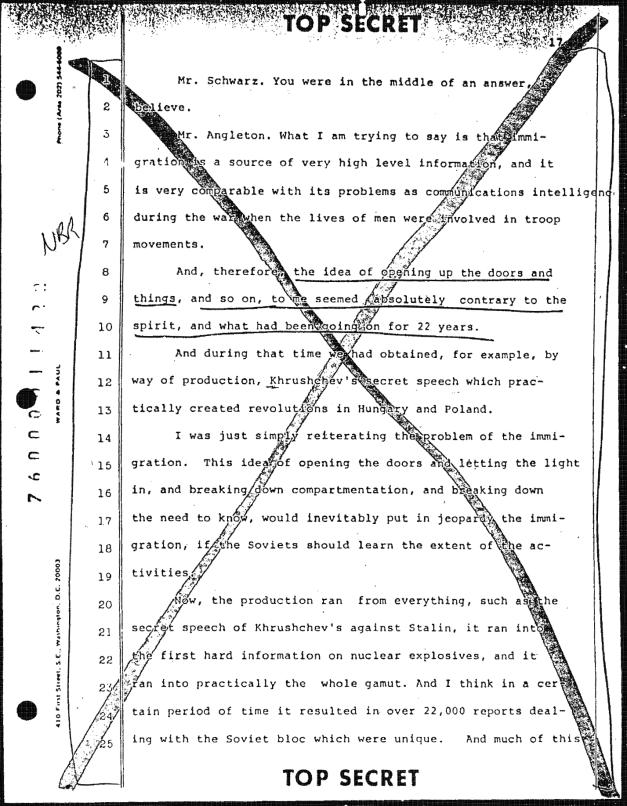
Colby fired Angleton in 1974 after the New York Times revealed that he devised an illegal program of domestic spying targeting antiwar American dissidents. In his testimony, Angleton framed their clash as an interpersonal conflict, describing Colby as “not my cup of tea professionally or in any other way.”
Yet Angleton also acknowledged to Senate that a “dispute in connection with these Israeli matters” between himself and Colby contributed to his departure from the Agency. Was this a reference to the former spook’s involvement in Israeli theft of US nuclear secrets, enabling Israel to acquire the bomb?
Whatever the case, it was clear why Angleton would be remembered more fondly in Israel than inside the country he ostensibly served.
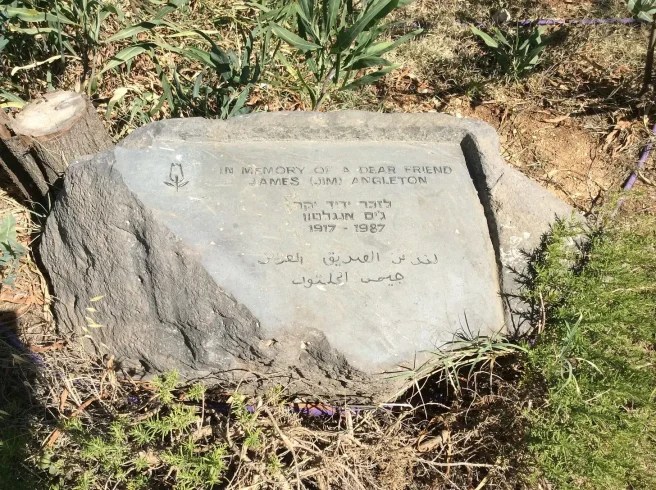
On December 4, 1987, the director of Israel’s Mossad and Shin Bet intelligence services gathered in secret on a hillside in Jerusalem to plant a tree in honor of Angleton. They were joined there by five former Israeli spy chiefs and three former military intelligence officers.
Despite attempts to keep the ceremony under wraps, two local reporters managed to evade the cordon to record the ceremony for the former CIA counter-intelligence director, who had died seven months prior. Together, the Israeli spooks laid a memorial stone that read, “In memory of a dear friend, James (Jim) Angleton.”
Kiev’s backers fail to sway Trump on Russia – analyst
RT | August 19, 2025
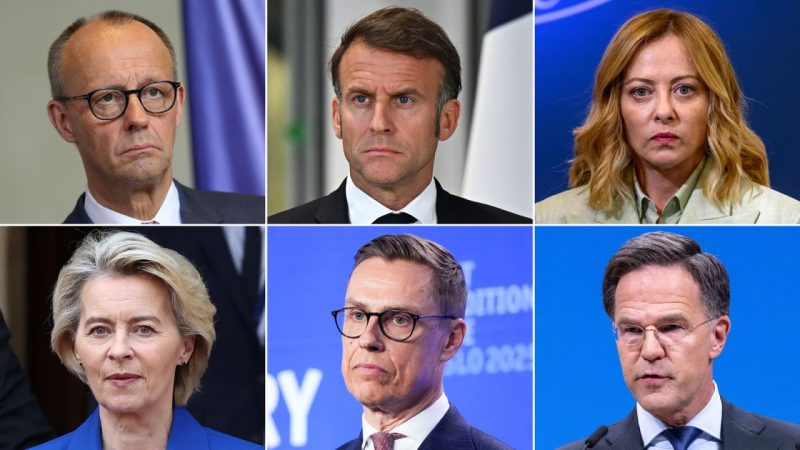
The White House meeting on Monday between US President Donald Trump and Ukraine’s European backers produced no major results, political analyst Sergey Poletaev has told RT.
Trump met to discuss the Ukraine conflict with Vladimir Zelensky and some European leaders in Washington just days after holding a summit with Russian President Vladimir Putin in Alaska.
“Just like in Anchorage, no decisions were announced afterward. And that, in itself, is a sign that something important is happening,” Poletaev said, noting that the talks are part of a larger diplomatic struggle, the ultimate goal of which is to win over the US president.
He suggested that Moscow is seeking to draw Washington out of the conflict, while Europe and Ukraine are pushing to keep the US firmly entangled. Following what Poletaev called Putin’s “gambit” in Anchorage, the European delegation hurried to Washington to persuade Trump to toughen sanctions against Moscow and maintain weapons deliveries to Kiev.
So far, it looks like they came up empty.
Poletaev pointed out that, unusually for the US president, he did not repeat European talking points after the meeting. Instead, Trump reminded the European leaders at the start of the summit that “they had no real power,” the analyst said.
While the immediate effort may have failed, “most likely, Europe will soon try again,” Poletaev stressed.
According to the analyst, the key issue at Monday’s summit was security guarantees for Ukraine. Russia has insisted “from day one” that any such commitments must be tied to “neutrality and disarmament,” he said.
Europe and Kiev, meanwhile, are desperately trying – by hook or by crook – to preserve Ukraine’s armed forces, and even to push for a NATO presence on Ukrainian soil.
According to Poletaev, the attempts are “naive and desperate,” but whatever form security guarantees take in any eventual peace deal will ultimately determine “the fate of the Kiev regime.”
“For now, there’s no compromise in sight,” Poletaev concluded. “And as Ukraine continues to lose ground on the battlefield, the room for maneuver – for both Kiev and its European backers – is shrinking fast.”
Alaska meeting is a milestone of the decline of NATO and EU
By Martin Jay | Strategic Culture Foundation | August 19, 2025
Is the EU and its member states collectively heading towards the abyss? For so many years analysts have thundered headlines of the flavour “end of the EU” – even myself I must admit – but in recent days the EU itself has never been placed so low on the world map as it was in the so-called Alaska meeting. A few weeks earlier, many supporters of the EU were stunned at just how pusillanimous the EU commission boss was facing Donald Trump, as she accepted 15% tariffs across the board on all EU goods entering the U.S. – absolutely amazing given there was no announcement of trade talks where officials on both sides would negotiate a more appropriate rate. This move alone revealed so much. The EU is, if nothing else, a pseudo superpower administration owned wholesale by the world’s largest corporations – like Pfizer, the U.S. drag maker who Ursula von der Leyen made part of a 600bn euro EU vaccine fund – and so it would have been absurd for her to have resisted.
And now it is the EU’s time to take another body blow as it plays a secondary role in the negotiations for a peaceful settlement for the Ukraine war. Yet few are betting on a peace deal. Even Trump himself doesn’t seem to hold out much hope as Putin has made it clear that he wants the Russian-speaking regions of eastern Ukraine to be handed over as part of the deal, plus guarantees that Ukraine can never be a NATO member.
Whether NATO will even be around in the coming months is another matter as it is worth noting that this transatlantic organization, which the U.S. runs, is currently going through its lowest point of its history, like the EU. What idiotic U.S. journalists who shout out to Putin in the press conference “are you going to stop killing civilians” don’t ask is more telling. Of course, they don’t shout out such stupid questions to Netanyahu when he visits, who is the architect of the most horrific genocide of the 21st century, where women and children who manage to miss the bombs which reign down on their tents are now starved to death – all supported by the U.S. But to Putin, U.S. journalists don’t ask “how’s the war going in Ukraine, sir?” or even “what do you think will happen to NATO if your army forces Zelensky to surrender?”.
The meeting was never going to be a deal breaker for a peace deal in Ukraine as the journalists’ temporary accommodation was a clue to that. What the Alaska meeting set out to do was for both leaders to show reverence for one another so that bigger deals can be worked out – perhaps energy and infrastructure deals in Alaska itself or even more rare earth and minerals in Russia – and if you listen carefully to Trump’s responses to questions from U.S. media, you will note the hints.
But with U.S.-Russia relations moving in a soberer, grown up direction, rather than the silly Biden stance, there are many possibilities on the table. Ukraine may well be resolved at some point if some of these super deals can see the light of day.
For the Europeans and the EU, they will have to dance to the beat of the Putin-Trump drum which makes them look even more ineffective and congruent to the bigger picture geopolitics which they crave. Same goes for NATO. Both of these institutions have poured oil on the fire in recent years by only seeing the war option – or more specifically the ‘escalate to de-escalate’ option which backfired spectacularly every single time that now to justify the huge amounts of money shovelled into a war project which cannot benefit the West, its leaders only have one narrative to repeat over and over again now, so that they can save their own jobs and credibility. War talk. More war. War, war and even more war.
It’s incredible. The EU’s top diplomat Kaja Kallas, Estonia’s former PM gave a clue recently to the tunnel vision that the EU and NATO have about the Ukraine war. They see it as the EU’s first test at hard-core foreign policy action, despite it being bank rolled by “Daddy” Trump. Probably the most delusional and idiotic quote of the month has to go to Kallas who told journalists “If Europe cannot defeat Russia how can it defeat China?”. The entire thinking is really all based on conflict rather than conflict prevention which is also about saving both NATO and the EU from its worst ever credibility crash when Russia finally defeats the Ukrainian army. These EU buffoons have created, since 2014 and even before, a war which was inevitable, which they don’t have the means, military capacity or even the leadership to win and yet their priorities now are making a massive cover-up of the failure and protecting their own dynasties. Europe is not preparing itself for war. This is the huge bluff. It is preparing itself for a huge fall which is unprecedented and may well be a catalyst for both the demise of the EU and NATO as we know them.
Trump Holds Firm Peace Deal with Putin Despite European Pushback
Sputnik – 19.08.2025
European leaders and Zelensky didn’t succeed in changing Trump’s peace proposal, which the US president had reached with Putin, former defense politician and chief of staff with the Sweden Democrats Mikael Valtersson told Sputnik.
“The ball is now clearly in Ukrainian and, to a lesser degree, European hands. A strong and clear ‘no’ from the European side might result in broken relations between the US and Europe/Ukraine. Therefore we can expect a ‘maybe’ from the European/Ukrainian side,” he said.
However, Valtersson also notes that playing for time may be part of Zelensky’s strategy, hoping that eventually, a shift in the geopolitical landscape might restore the hardline anti-Russian alliance. This strategy, though, is likely a “lost cause,” according to the former Swedish defense expert. By dragging out the negotiations, Zelensky and his allies risk further territorial losses to Russia and an increase in war casualties.
“If the European leaders really cared for Ukraine, they would pressure Zelensky to accept a peace deal that includes swapping of territories. This would minimize Ukrainian territorial and human losses,” Valtersson argues.
Yet, the expert predicts that European obstruction of a peace deal will continue, driven by the hope that a miraculous turn of events will “rescue” Ukraine. This approach could extend negotiations for weeks, but ultimately, he believes Trump’s patience will wear thin, forcing a clear decision.
In the meantime, the peace process is largely aligning with Russia’s expectations, with Trump holding firm to the terms agreed with Putin in Alaska.
Ukrainian drone commander claims attack on key oil pipeline to EU
RT | August 18, 2025
The head of Ukraine’s UAV forces has claimed that Kiev’s drones have disabled a Russian pipeline which delivers oil to Hungary and Slovakia.
Both Budapest and Bratislava earlier confirmed that supplies via the Soviet-era Druzhba pipeline, which runs through Ukraine, had been suspended. Russia has not confirmed the attack.
“The Druzhba pipeline is out of service. The flow of oil has been completely halted indefinitely,” Robert Brovdi, commander of Ukraine’s Unmanned Systems Forces, wrote on Telegram on Monday evening.
He said Ukrainian drones had struck the Nikolskoye pumping station in Russia’s Tambov Region, southwest of Moscow.
Hungarian Foreign Minister Peter Szijjarto denounced the reported strike as “outrageous and unacceptable,” accusing Kiev of trying to “drag Hungary into the war in Ukraine.”
Ukrainian Foreign Minister Andrey Sibiga responded that Hungary should direct its “complaints” to Russia and criticized Budapest for continuing to rely on Russian energy supplies.
Szijjarto, however, maintained that importing oil from Russia is in Hungary’s national interest. “As Hungary’s foreign minister, my mandate is clear: Hungary’s interest comes first. Period,” he wrote on X.
Ukraine has repeatedly targeted energy infrastructure inside Russia, including oil depots and refineries. In March, Ukrainian forces struck a gas metering station near Sudzha, which before the conflict was part of a pipeline supplying the EU.
Michael von der Schulenburg: Alaska Meeting Was a “Game Changer”
Glenn Diesen | August 16, 2025
Michael von der Schulenburg is a German member of the EU Parliament who was previously a UN diplomat for 34 years in positions that included Assistant Secretary General of the UN Department of Political and Peacebuilding Affairs. Schulenburg explains why he thinks the Alaska meeting was a game changer.
Merrick Garland Should Start His Crusade Against White Supremacists By Re-Opening the 1995 Oklahoma City Bombing Case
By Richard Booth | The Libertarian Institute | August 18, 2025
Given the recent stories about Merrick Garland’s experience at the helm of the Oklahoma City bombing prosecution and his own comments about prosecuting white supremacists should he be made Attorney General, I have some questions about Garland’s handling of the OKC bombing case.
My questions:
- At an April 27, 1995 Preliminary Hearing, why did you “object” when defense attorneys noted that your witness, FBI agent Jon Hersley, testified that the Ryder truck carried “passengers” — plural? Your objection was overruled, and your witness confirmed that Timothy McVeigh was seated in the Ryder truck with another individual. Who is that individual?
- At the April 27, 1995 Preliminary Hearing, why did you “object” when attorneys asked your witness the names of those FBI agents tasked with reviewing the surveillance camera footage of the bombing?
- You once said “we did everything we could to find every person who was involved.” If that’s true, then how do you explain the fact that every eyewitness you touted at the April 27th 1995 preliminary hearing never testified at the federal trials? Why didn’t these witnesses get to tell a jury what they saw? Why is it that the man seen with Timothy McVeigh in the Ryder truck has never been identified?
If Merrick Garland is truly dedicated to prosecuting dangerous white supremacists then he can show it by reopening the 1995 Oklahoma City bombing case and identifying and prosecuting Timothy McVeigh’s accomplices. I would not be alone in calling for the case to be re-opened. Danny Coulson, the FBI on-scene commander for the Oklahoma bomb site, agrees. In 2004, Coulson told John Solomon of the Associated Press that there are “some unanswered questions here. A lot of things happened that were inappropriate,” Coulson said. “I think it needs to be reopened, but I don’t think it should be reopened by the FBI. It needs to be a special investigator, a lawyer, totally independent. He needs to have subpoena power and the ability to use a grand jury.”
Danny Defenbaugh, then the retired chief of the FBI’s OKBOMB investigation agreed: “If I were still in the bureau, the investigation would be reopened” said Defenbaugh, commenting on new evidence that came to light almost a decade after the bombing. ”If the evidence is still there, then it should be checked out.”
Garland can kick off this effort by compelling the FBI to produce the surveillance camera footage that shows two men exiting the Ryder truck, and he can finish by apologizing for letting dangerous white supremacists get away with it for the last 25 years.
Armed Settler Militia Terrorizes Ibziq, Assaults ISM Volunteers
International Solidarity Movement | August 18, 2025
On the night of August 11th, two ISM volunteers were assaulted, beaten, and robbed by a mob of at least eight armed settlers dressed in full military-style uniforms in the rural shepherding village of Ibziq. The volunteers were engaged in protective presence, which includes documenting illegal intrusions into Palestinian communities and recording and opposing intimidation, threats, and attacks led by Zionist militias against Palestinians across the Jordan Valley.
The settler militia entered the remote village around 7PM in dune buggy-style military vehicles, wearing helmets and balaclavas, and carrying assault rifles. The militia canvassed the village for over an hour, trespassing into community school grounds and upon critical water infrastructure before moving on to block Palestinian traffic and terrorize local residents with threats of arson and theft.
When the settler militia directly entered a Palestinian family’s home, the ISM volunteers—both U.S. citizens, one residing in Jerusalem and the other in Liverpool, UK—intervened by approaching the settlers and stating the militia were illegally encroaching upon Palestinian lands, violating the human rights of Palestinians, and contravening international law.
Although the volunteers had their hands up to indicate that they were unarmed and nonviolent, the militia members pinned one ISM volunteer to the ground and he was repeatedly beaten. Amidst the thrashing, settlers also kicked sand and dirt into the volunteer’s face and eyes multiple times. When the second volunteer began filming, several members of the settler militia turned their rifles on him.
The ISM volunteer recording was held at gunpoint, ordered to his knees, and told he would be shot if he did not obey commands. The militia deliberately aimed laser targeting sights at the volunteer’s genitals, before physically forcing him to the ground and wrenching his arm wrenched behind his back. While held at gunpoint, he was elbowed in the back of the head after his phone was stolen.
Before leaving, the settler militia issued a final direct threat to the Palestinian family, shouting that the village would be attacked and burned down if they did not leave. According to one member of the family, the settlers “threatened to burn us alive.” Both volunteers were evacuated by a Red Crescent ambulance and treated at a nearby hospital in Tubas. Each were later released in stable condition and subsequently returned to Ibziq to resume on-the-ground protective presence with ISM.
According to the local community, the attack was perpetrated by a settler militia rather than active-duty military. However, these settler militias operate alongside and as part of the army, particularly when settlers are in uniform wielding the power and mandate of the state. In Ibziq, the active duty military has also collaborated with settlers on a number of attacks over the last month.
Notably, this assault is part of a broader wave of settler colonial violence and militia aggression sweeping across the occupied West Bank. At present, Palestinian and Bedouin communities are being systematically harassed, attacked, arrested, displaced, and murdered. Settler militia operatives are operating with the full knowledge—and support and protection—of the Israeli Occupation Forces (IOF) and Zionist apartheid regime. In many cases, including this one, settler militia are both afforded impunity and indistinguishable from official IOF soldiers and army units. They are given military vehicles, surveillance equipment, and weapons to collectively intimidate, terrorize, and dispossess Palestinian communities.
Markedly, this is neither an isolated case nor a recent phenomena. The occupied West Bank is however seeing a sharp escalation in racialized hostilities and frontier violence, where armed settlers, emboldened by Israeli policy and army support, are carrying out coordinated attacks on Palestinian life and land. Bedouin communities in particular face systemic racism, militarized demolitions, nighttime raids, and arson attacks, which are all part of a settler colonial project aimed at annexation and the elimination of Palestinian heritage, history, and presence.
ISM calls on international media, human rights organizations, and members of civil society to publicly denounce and take concrete action against the violence and crimes against humanity being committed by the Israeli apartheid regime. The settler militia attack in Ibziq is but one of countless examples of how Palestinian civilians and entire villages continue to be subjected to an illegal occupation, systemic terror, compounding trauma, and an intensifying colonial war that is being waged by the Zionist movement.
Britain: From arms supplier to accomplice in war crimes
By Adnan Hmidan | MEMO | August 18, 2025
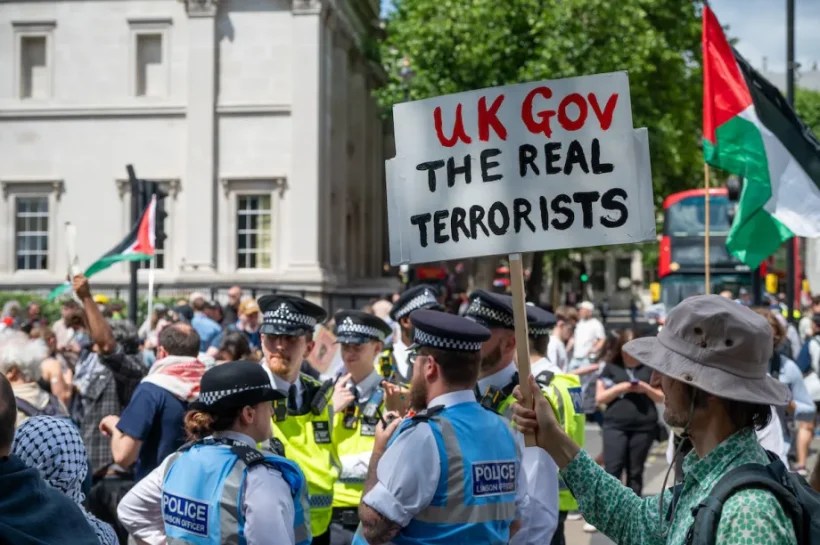
When we speak of the devastation in Gaza, the blame does not rest solely on the generals and politicians of the occupying power. The tragedy is sustained by the international system that arms, trains and protects it. And Britain, far from being a neutral observer, is among the most significant enablers of this machinery of destruction.
For more than 22 months, the Gaza Strip has been subjected not to war, but to genocide. Entire families have been wiped out, refugee camps turned into mass graves, and civilian infrastructure systematically destroyed. The International Court of Justice has already confirmed that there is a “plausible risk of genocide” — yet Western governments continue to provide weapons, surveillance systems and diplomatic cover.
Britain’s historic and present responsibility
Britain’s complicity is not new. From the Balfour Declaration in 1917, which laid the foundations for the settler-colonial project, to today’s arms shipments and political protection, the United Kingdom has been central to the dispossession of Palestinians. The government in London cannot claim ignorance: under international law, providing material support to a state committing war crimes or genocide makes the supplier complicit in those crimes.
This is not about maintaining a “strategic ally.” It is about directly enabling bombardment, mass displacement and collective punishment of two million besieged Palestinians.
Evidence of involvement
The evidence is clear and overwhelming:
- Data from the Stockholm International Peace Research Institute (SIPRI) shows that the UK exported key components for F-35 fighter jets — including radar and targeting systems — worth over £17 million in 2023 alone.
- Campaign Against Arms Trade (CAAT) estimates that British-made parts account for around 15 per cent of every F-35 jet currently bombing Gaza.
- Even after the UK government announced in September 2024 that it was suspending 30 export licenses, human rights groups documented new shipments, including more than 8,600 rounds of ammunition and 150,000 bullets in the following months.
- Palestinian and international human rights organisations brought a case before the UK High Court, arguing that such exports breach international law. Yet in June 2025, the court dismissed the case, claiming that arms licensing falls outside judicial review — effectively granting the government a free hand in supplying a military accused of genocide.
Such facts leave little room for ambiguity. Britain is not merely arming a strategic partner; it is aiding and abetting grave breaches of international humanitarian law.
Silencing solidarity
The British government has also moved to suppress those who expose this complicity. Campaign groups such as “Pal Action” have been targeted with bans, activists have been arrested, and even banners confiscated. But repression cannot erase reality. The blood of civilians testifies to the fact that this is not a conflict between equals, but a massacre sustained by Western capitals.
A moral and legal imperative
As Palestinians living in the UK, we speak not only with the voice of memory and history, but also with the authority of law and morality. International law is explicit: states that knowingly provide weapons used in the commission of genocide share responsibility for that crime. Silence, therefore, is not neutrality. It is complicity.
Britain’s record will be judged harshly. Just as the Balfour Declaration is remembered as a colonial betrayal, today’s arms exports will be recorded as enabling one of the most documented genocides of the modern era.
The call to conscience
Yet Britain is also home to countless free voices: campaigners, lawyers, journalists and politicians who understand that what is unfolding in Gaza is not distant, but deeply tied to Britain’s own decisions. They know that complicity today will stain this country for decades to come.
The choice before Britain is stark: continue to arm and shield a regime accused of genocide, or align with international law and the universal values it claims to uphold.
Until justice prevails
Our struggle is not simply to lift a siege, but to end decades of settler-colonialism and military occupation. Freedom will not be gifted; it will be won. And as Palestinians, in Gaza, across the diaspora, and here in Britain, we carry the same message passed down from one generation to the next: never accept injustice, and never let the flag of freedom fall.
READ ALSO: US-based contractor hired by UK to continue spy flights over Gaza
Featured Video
Dan Dicks with James Corbett on Solutions Watch
or go to
Aletho News Archives – Video-Images
From the Archives
$1.5bn up in smoke: US THAAD missile stockpile dries up defending Israel against Iran
By Ivan Kesic | Press TV | July 2, 2025
According to American media, defense news outlets, and independent analysts, the 12-day Israeli military aggression against Iran significantly depleted the US stockpile of THAAD (Terminal High Altitude Area Defense) interceptor missiles.
Citing official sources, American magazine Newsweek reported on Friday that the US transferred a substantial portion of its advanced missile defense capabilities to support the Israeli regime, an effort with questionable results and a critical impact on US strategic reserves.
THAAD, developed by Lockheed Martin arms manufacturing company, is a key component of Israel’s multi-layered air defense architecture. It is designed to intercept medium-range ballistic missiles, including those launched from Iran and Yemen.
The US-made system is capable of targeting short-, medium-, and intermediate-range ballistic missiles during their terminal phase, whether inside or outside Earth’s atmosphere.
THAAD uses a “hit-to-kill” method, relying on kinetic energy rather than explosive warheads to destroy incoming threats, intercepting at altitudes of up to 150 km and ranges between 150-200 km.
Operated exclusively by American personnel, the US military maintains eight THAAD batteries with an estimated 350–400 interceptors in total. The eighth battery was activated during the June 20 Israeli aggression against Iran and is capable of intercepting hypersonic missiles. … continue
Blog Roll
 Aletho News
- Zionist Bought Senate Blocks Information About American Citizens Killed By Israel
- While Gaza dominates the UN, these are the people keeping it alive
- New Report: “Scholasticide and Genocide in Gaza: Assessment, Testimonies and Legal Analysis”
- ‘THAAD Delusion’: Iran war exposes US missile shield limits – The Atlantic
- Moscow issues warning to NATO over Russian exclave
- Yes, the Iran war has destroyed Trump’s presidency
- The fallacy of US delusions about Iran’s economic collapse
- Hezbollah denies Syria cell link, warns of Israeli plan to sow discord
- The legacy of US sanctions, war, and occupation in Iraq
- Iraqi resistance group rejects disarmament, vows to maintain support for Lebanon
- If Americans Knew
- Mamdani releases plan to combat antisemitism and hate crimes in New York City
- Iran’s Revolutionary Guards Publish Letter to the American People
- DMFI launches $1 million ad campaign supporting Virginia’s Elaine Luria
- US Senate blocks resolution seeking report on Americans killed by Israel
- Israeli Attacks Kill Ten Palestinians in Gaza
- Massacre at Minab: The School That Became a Grave
- Israeli media: The IDF Shows It Doesn’t Turn a Blind Eye; It Actively Emboldens Settler Havoc
- As settlers ravage West Bank, Israeli forces kill 10 in Gaza – Daily Update
- New Report: “Scholasticide and Genocide in Gaza: Assessment, Testimonies and Legal Analysis”
- Ex-Biden officials are desperate for a Gaza scapegoat
- No Tricks Zone
- Green Energy Debacle: German Expert Professor Fritz Vahrenholt Warns Of Severe Economic And Social Consequences
- Two More Paleo Reconstructions Affirm Meters-Higher Sea Levels Across Ireland, Brazil 7000-6000 Years Ago
- New Study: Earth And Venus Surface Warmth Largely Explained By Convection And Lapse Rate, Not CO2 Or Radiation
- 2025 Nature Paper Claiming Worsening Global Drought Gets RETRACTED …Heavily Flawed
- New Study: ‘Global Drought Shows No Detectable Recent Acceleration Under Climate Warming’
- Economic Masterminds: German Socialists Suggest Taxing Productivity Gains Stemming From Using AI
- The South China Sea Has Not Been Cooperating With The Climate Change Narrative
- Energy Crisis: Germany Enters Heating Season With Historically Low Gas Reserve Fill Levels
- New Study: The Antarctic Ice Sheet Gained Mass From 2020-2024 Due To Staggering Snow And Ice Accumulation
- Study: Ocean Heating Rates From Thousands Of Years Ago ‘Dwarf’ Modern Ocean Heating Rates

