Israeli confidence in missile defenses shaken amid Iran strikes
Al Mayadeen | June 16, 2025
After three consecutive nights of Iranian missile strikes, growing numbers of Israeli settlers are beginning to grasp a truth long acknowledged by military officials: the much-touted missile defense system is, in their own words, “not hermetic”, according to The Telegraph.
The ongoing Iranian strikes have revealed new vulnerabilities that are rattling public confidence, even among those who had previously felt secure in designated protective areas.
In one of the most alarming incidents yet, at least five more Israeli settlers were killed overnight, including two settlers in the illegal settlement of Petah Tikvah, located east of Tel Aviv.
According to the Army Radio, the two Israeli settlers were killed despite taking refuge in a reinforced shelter, a place believed to offer protection from such attacks.
The report confirmed that a ballistic missile from Iran struck directly between two fortified bunkers, rendering the so-called “protected space” ineffective under the concentrated impact of the warhead. The blast penetrated the structure with lethal force.
For years, public faith in “Israel’s” Iron Dome and layered defense systems has served as a psychological buffer against escalating regional threats. That confidence is now visibly eroding. Iranian ballistic missiles have continued to breach multiple layers of “Israel’s” missile shield in recent days, even as officials attempt to reassure the public.
As cited by The Telegraph, military spokespeople had long warned that the defense system was not infallible. But the extent of the damage and civilian deaths, even in areas with fortified infrastructure, is beginning to register more deeply with a population used to relying on technological superiority for survival.
Confidence wanes amid fear of more missile barrages
Though public support for the war on Iran remains strong on the surface, the increasing effectiveness of Iran’s missile salvos is prompting fear across the occupied territories.
Tehran has thousands of additional ballistic missiles, raising concerns about whether “Israel’s” air defenses can keep up.
For many residents, the traditional belief in the safety of reinforced rooms, often located within residential high-rises, has been a key factor in their willingness to stay put during times of conflict. That belief is now being challenged, especially as growing numbers of settlers assess Israeli officials hiding themselves and military infrastructure among civilians.
Army Radio’s detailed account of the Petah Tikvah strike has added to the public unease. The fact that casualties occurred inside designated Israeli safe rooms contradicts previous patterns in which fatalities were largely attributed to individuals who had not followed shelter protocols.
The psychological impact of this shift is significant. As The Telegraph notes, the death toll and visible damage are beginning to fray the edges of what was once unshakable national morale.
How Iran Turned Israel’s Iron Dome Against Itself Using Clever Jamming
By Ekaterina Blinova – Sputnik – 16.06.2025
New evidence suggests that Iran successfully compromised Israel’s vaunted air defense systems during recent attacks — forcing Tel Aviv to fire on its own positions. How?
Iran overwhelmed Israeli defenses by breaching the data transmission and correction system early in flight, explains military expert and historian of the Air Defense Forces Yuri Knutov.
“Based on the footage that was released, it seems that the Iranians were able to breach the data transmission and correction signal system at the early stage when the missiles were flying, using an inertial guidance system. As a result, the system misdirected the missiles, not toward their intended target, but toward Israel’s own surface-to-air missile batteries, leading to a strike on them.”
The attack included:
- 100+ Shahed drones (swarming tactics)
- Decoy ballistic missiles (old models to waste interceptors)
- Fattah hypersonic missiles (unstoppable by Israeli Arrow/PAC-3)
As a result, the Iron Dome’s interception rate dropped drastically to just 10-15%.
“The use of jamming against surface-to-air missiles and missile defense systems is actually a fairly old tactic. During the Vietnam War, the Americans used jamming to mislead missiles by range, angle, and many other active interference methods. Special transmitters were deployed to create the illusion of aircraft presence on the radar screens of Vietnamese missile guidance stations,” Knutov says.
“During the Arab-Israeli conflicts of 1970 and 1973, similar jamming techniques were used by both Israeli and Egyptian pilots, as well as Soviet pilots who assisted the Egyptians,” he adds.
Masterful deception
Iran’s hypersonic Fattah missiles and Haj Qassems guided ballistics hit critical Israeli targets, including the Defense Ministry HQ and a major airbase housing F-35 and F-16 fighters. Despite Israel’s marketing of its advanced defense systems, the Arrow and Patriot systems failed to stop them.
Iran also deployed decoys so effectively that Israeli strikes repeatedly hit fake targets. The Iron Dome covers only 144 sq km and is good for single rockets, but seemingly couldn’t handle mass attacks or the hypersonic gap — Fattah missiles reach Israel in 7 minutes, while the Iron Dome needs 11 minutes to reload.
Iran has learned from past Israeli strikes and improved tactics, establishing backup command centers and more efficient maneuvering to increase its chances of success.
Italy and Germany on the War Front
By Manlio Dinucci | Global Research | June 16, 2025
Italy and Germany are at war not only against Russia in support of Ukraine, but also against Iran in support of Israel. This is demonstrated by documented facts. These facts are ignored by the political-media mainstream.
The Italian B350ER aircraft – a new-generation aircraft for espionage, target recognition and communication operations – operates in the Black Sea together with similar US aircraft to spy on Russian territory and assist Ukrainian forces to strike Russian targets with unmanned drones and explosive vessels. Italy is thus not only supplying weapons to Kiyv but is actively participating in this and other ways in the NATO war against Russia. Even more direct is Germany’s participation in the war: it has permanently stationed a 5,000-strong Bundeswehr brigade in Lithuania, equipped with 2,000 tanks and other military vehicles.
“With this combat-ready brigade,” states German Defence Minister Pistorius, “we are taking on a leadership responsibility within the Alliance here on NATO’s Eastern Flank”.
Thus, NATO has deployed its forces on the borders with Russia’s Kaliningrad Oblast and Russia’s ally Belarus. At the same time, two other NATO countries — the United Kingdom and Canada — are deploying their ++forces in Estonia and Latvia, which also border Russia. These forces are like a candle lit in a powder keg. According to Article 5 of the North Atlantic Treaty, if NATO forces suffer losses in a clash with Russian forces on the border, all other NATO countries would have to intervene on their side against Russia. The Trump Administration’s role is becoming increasingly equivocal, as it states that it wants to agree with Russia on a diplomatic solution to end the war. Yet, it is helping Ukraine to continue the war against Russia, either directly through military operations such as those in the Black Sea, or indirectly through NATO, which, under US command, is bringing its military forces ever closer to Russia.
As part of the same strategy, Germany and Italy play a significant role in supporting Israel in the Middle East. After the USA, Germany is the second-largest supplier of weapons to Israel. So far, Israel has received six Dolphin-class submarines from Germany, manufactured by ThyssenKrupp Marine Systems. These submarines have been modified to launch nuclear attack missiles. According to an agreement in 2022, Germany will supply Israel with three more Drakon-class submarines, which are larger than the previous models and can launch even more powerful nuclear missiles. Israel is the only country in the Middle East that possesses nuclear weapons, and, as it has not joined the Non-Proliferation Treaty, it is not subject to any control. Iran, having joined the Non-Proliferation Treaty, has civil nuclear facilities that are subject to UN Atomic Energy Agency controls.
US aerial tankers headed to Middle East – media
RT | June 16, 2025
The US has reportedly deployed more than 30 aerial refueling tankers across the Atlantic toward the Middle East, Military Watch Magazine reported on Monday. The outlet has described the buildup as “unprecedented,” claiming it could suggest broader US involvement in the ongoing Israeli-Iranian war.
West Jerusalem and Tehran have entered the fourth day of open hostilities. Last Thursday, Israeli forces launched airstrikes on Iranian nuclear and military targets, killing senior military officials and scientists and prompting retaliatory missile barrages on Israeli cities such as Tel Aviv and Haifa.
The US has expressed support for the Israeli strikes, with President Donald Trump calling them “excellent.” He has also warned that Washington could become directly involved in the conflict if American interests are threatened but has yet to announce any plans to involve US forces.
However, according to flight tracking data, the US has already started deploying KC-135 and KC-46 aerial refueling tankers to the Middle East. Military Watch Magazine has suggested that the aircraft may be intended to support Israeli Air Force operations or refuel US fighters and bombers if Washington expands its role in the conflict.
The report also claims that tankers from other Western countries have participated in Israeli aerial refueling efforts, while the US is believed to have provided intelligence, satellite targeting data, and missile defense support.
On Sunday, Axios reported that Israeli officials had asked the US to directly take part in the military operation, specifically requesting assistance in striking Iran’s Fordow enrichment facility. However, US officials cited by the outlet said the request was declined, with one stating that the Trump administration is not considering any such involvement.
Nevertheless, Tehran has claimed that Washington’s support for West Jerusalem has made the US complicit in Israel’s aggression against Iran. Sources within the Iranian military have also reportedly indicated that Tehran’s response to Israeli strikes would “spread to all areas occupied by this [Israeli] regime and related US bases in the region in the coming days.”
In response, Trump has warned that any Iranian attack on US forces would trigger a military response, writing on his Truth Social platform that “if we are attacked in any way, shape, or form by Iran, the full strength and might of the US Armed Forces will come down on you at levels never seen before.” He also insisted that the US “had nothing to do with the attack on Iran” and called on Tehran to return to negotiations.
Middle East in Crisis – 2
Netanyahu’s war on Iran has no future
By M. K. BHADRAKUMAR | Indian Punchline | June 16, 2025
An unnoticed undercurrent of the Israel-Iran war is that three Christian nations in Europe — UK, France and Germany — have joined the fray with alacrity on the side of Israel.
Strange, isn’t it, that these European countries comprising the so-called E-3 have a well-established exclusive path of dialogue with Iran but are joining Israel’s warpath? It’s a Crusade, stupid!
The three ‘Crusader nations’ share Israel’s obsession to check the rise of a Muslim nation as an emerging power in the Middle East that could radically transform its geopolitical alignments. Simply put, destroying the Islamic regime in Iran is the real objective of Israel’s war — and of the three Christian nations from Europe.
Reportedly, Israeli fighter jets which attacked Iran used the British air base in Cyprus; British refuelling planes are on deployment in Syrian-Iraqi airspace for use of Israeli fighter jets; French president Emmanuel Macron, as defender of Roman Catholicism openly vows that he will act to prevent Israel’s defeat; Germany, the fountainhead of Protestantism, has also similarly positioned itself behind Israel.
However, on the other hand, what emerges from the hour-long phone conversation between Trump and Russian President Vladimir Putin on Saturday is that they will work together to advance the path of dialogue with Iran, the current conflict situation notwithstanding. The Kremlin readout stresses that Putin forcefully denounced the Israeli aggression.
Such a line-up of the principal actors signals that Israel’s best bet lies in killing the war itself as a strategic error and create a ‘new normal’? But will Tehran allow Netanyahu to get away with murder? That’s the million dollar question. Putin will have to use all his persuasive power during the planned visit to Iran — ie., if it still goes ahead.
The Israeli thinking behind its assassination of the IRGC leadership and military commanders stemmed out of the foolish miscalculation that Tehran lacks a political will to resist aggression. The Israeli objective is on the one hand to create conditions for a regime change in Iran and on the other hand to derail any form of US-Iran constructive engagement.
All through, terror has been the chosen weapon for Israel and the western powers to undermine and weaken Iran. But a point has been reached where a containment of Iran is no longer feasible. Logically, Iran’s neighbours in the Muslim world should have rallied in support of Iran but that’s too much to expect, given their limited sovereignty to act independently.
Nonetheless, Iran will not capitulate. Iran’s sense of national pride and honour as a civilisation state will prompt it to circle the wagons and wage a protracted war until victory. From the early days of the revolution, the Islamic republic which was founded on the principles of justice and resistance on the bedrock of nationalism and independence, got attracted to Mao’s concept of ‘protracted people’s war’ to keep predator nations at bay. That strategy paid off during the Iran-Iraq War (1980-1988).
Saddam Hussein too, like Netanyahu, miscalculated that Iran was a hopelessly weakened nation in the civil war conditions with its economy in virtual collapse, army in disarray, state formation yet to crystallise, and with no allies in the region to lend a helping hand. But as it turned out, Iran fought an 8-year war defiantly to a stalemate, undeterred by the lavish support extended to Saddam by the Western powers and their regional allies.
The US even equipped Saddam’s army with chemical weapons to stop the human-wave–attack tactics of Iranian fighters, but of no avail — although, an estimated quarter million Iranians sacrificed their lives.
At some point, in a very near future, Israel will also meet the fate of Saddam, having miscalculated Iran’s grit to resist. Netanyahu also estimated that Iran is a much weakened country compared to last year due to the setbacks taken by the Axis of Resistance. Such naïveté underestimates the potency of resistance at the very core of Shi’ism.
Last week, the resistance forces that were supposedly vanquished from the face of the earth regrouped and began firing missiles at Israel — from Syria, of all places! On May 4, Houthis fired a ballistic missile at Tel Aviv hitting the perimeter of the main terminal of Ben Gurion Airport! Reports suggest that Hezbollah has restored its supply routes from Iran.
What Israel fails to grasp is that resistance movements do not die if their raison d’être remains. Israel is, in reality, in very deep crisis fighting on multiple fronts amidst a cascading domestic political crisis and an economy that requires drip feeding by Washington.
As the US’s capacity to influence events in the Middle East keeps diminishing, Israel’s unviability as a nation propped by the Jewish Lobby in the Beltway appears sharper in focus. Already, there is resentment within the US about bankrolling Israel and fighting its wars.
On the contrary, the rise of Iran is inevitable — with a population base 10 times bigger than Israel’s, vast mineral resources, a self-sufficient agricultural sector and broad-based industry, innovative progress in technology, big domestic market, highly strategic location and trained manpower.
Iran’s stamina is of a long distance runner, as Iran-Iraq war showed, whereas, Israel’s forte is as sprinter on a 100 metre track. Make no mistake, Israel, a small country with a population of 8 million people will get hollowed out in a protracted war.
In the current scenario, what goes against Israel critically is that while President Donald Trump tried and failed to stop Netanyahu on the warpath, he is not going to deploy American forces to fight Israel’s war.
Trump has an evangelical base in US politics and is on friendly terms with wealthy Jewish donors, but has nothing in common with the Crusader nations of the Old World — be it on Ukraine or Iran. In both cases, actually, he tends to view the paradigm through the America First prism where he sees immense potential to generate wealth through business links with Russia or Iran.
Besides, Trump is far too smart a politician to risk the future of his MAGA movement whose core tenet is the total rejection of all interventionist ‘forever wars’. Trump knows only too well that American public opinion is staunchly opposed to Middle Eastern wars.
The replacement of Mike Waltz as NSA on May 1 (a known Israeli proxy who found himself in the top echelons of Trump administration) and the subsequent purge of the entire pack of ‘Iran hawks’ in the National Security staff under him, signalled that Trump is wary of Netanyahu’s diabolical plots to derail his negotiations with Iran through back channels. (here and here)
During their phone conversation on Saturday, according to the Kremlin readout, Trump and Putin agreed to prioritise the “negotiating track in Iran’s nuclear programme… Trump noted, the team of US negotiators is ready for resuming work with Iranian representatives.” Clearly, a military confrontation with Iran does not figure in Trump’s calculus.
That being the case, Netanyahu’s bombastic rhetoric apart, Israel’s best interests lie in ending this futile war in the quickest way possible. Conceivably, that is also the preference of the IDF. A protracted war on its own steam with a clutch of crusader nations in tow as cheer leaders is not something that can save Israel from destruction.
Curiously, Trump in his latest Truth Social post on Sunday after the conversation with Putin advised Israel “to make a deal” with Iran! Does that fit into Netanyahu’s war mongering? And Trump went on to burnish his own credentials as a peacemaker president!
Trump concluded predicting that “we will have PEACE, soon, between Israel and Iran!” Succinctly put, Trump has no intentions whatsoever to risk American lives by fighting Netanyahu’s wars.
Obviously, “PEACE, soon” will be Russia and Iran’s preference too, as serious negotiations can be resumed and agreement reached that would herald a US-Iran normalisation and the lifting of American sanctions. But does that suit Netanyahu?
The paradox is, Israel has no future in a protracted war with Iran, but an inconclusive end to this war will pose the high risk for Netanyahu of a cascading demand for a regime change in Israel. Loss of power means loss of parliamentary immunity from prosecution that Netanyahu hitherto enjoyed from corruption charges against him and his family members, and a possible imprisonment.
Read more: Iran Attack: Netanyahu Gambles Big, Rediff.com, June 14, 2025
Col. Jacques Baud: The EU Is Cracking From Within — Can It Survive the Chaos?
Dialogue Works | June 9, 2025
Pakistan calls for Muslim states to unite against Israel
RT | June 16, 2025
Pakistani Defense Minister Khawaja Asif has called on Muslim nations to unite against Israel following its strikes on Iranian military and nuclear sites. He warned that failing to act collectively would only encourage further attacks across the Middle East.
Speaking in the National Assembly on Saturday, Asif argued that Israel “did not act alone” and had received “intelligence, cover, and support.” He said the Muslim world remained “militarily vulnerable” and urged a joint response.
“Just as Israel is currently targeting Yemen, Iran, and Palestine, if the Muslim world does not unite today and continues to prioritize its own interests and agendas, then everyone’s turn will come,” he told lawmakers.
Asif called for the Organization of Islamic Cooperation (OIC) to convene and devise a strategy to confront Israel. “Wherever there are diplomatic ties with Israel in the Muslim world, they should be severed,” he said.
“We stand behind Iran and will support them at every international forum to protect their interests,” the defense minister added.
On Friday morning, Israeli jets bombed military and nuclear sites across Iran and carried out assassinations of several senior Iranian military commanders and veteran nuclear scientists. Israeli Prime Minister Benjamin Netanyahu said the strikes were aimed at preventing Iran from acquiring nuclear weapons. In response, Iran launched multiple ballistic missiles at Israeli cities, including Tel Aviv.
While the US denied involvement, President Donald Trump endorsed Israel’s operation. Iran has since suspended nuclear talks with Washington.
‘War crime’: Iran’s foreign ministry building hit during Israeli aggression; many injured
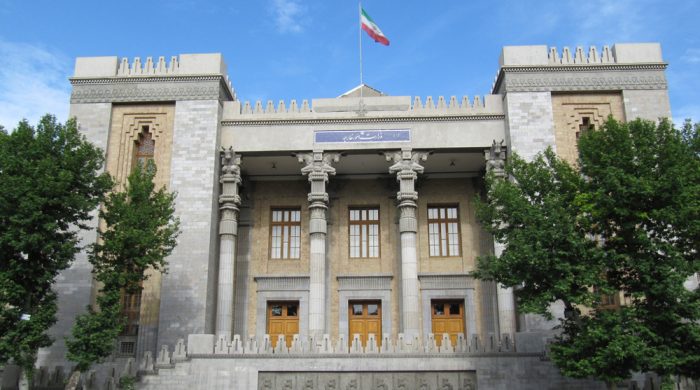
File photo of the building hosting Iran’s Foreign Ministry in the capital Tehran
Press TV – June 15, 2025
Iran’s foreign ministry has strongly condemned the Israeli military aggression on one of its buildings in the capital, Tehran, which left many people injured, including ministry staff.
Deputy Foreign Minister Saeed Khatibzadeh, in a statement on Sunday, denounced the assault as a “deliberate and ruthless” act perpetrated by the “criminal Israeli regime.”
“The casualties include a number of my colleagues, who were transferred to a hospital for treatment,” said Khatibzadeh, who also heads the ministry’s foreign policy think tank, Institute for Political and International Studies (IPIS).
Khatibzadeh described the incident as “yet another blatant war crime” and part of the Israeli regime’s “ongoing and systematic aggression” against the Islamic Republic.
His remarks come amid continued Israeli aggression on the Islamic Republic that began on Friday morning, targeting multiple locations across the country, including Tehran.
The brutal terrorist acts have resulted in the assassination of many senior military commanders, nuclear scientists, and civilians, including children and women.
In response, Iran launched Operation True Promise III, a continuation of its previous retaliatory campaigns against the Zionist entity.
The latest operation has involved large-scale missile and drone strikes by the Islamic Revolution Guards Corps (IRGC) targeting sites across the occupied Palestinian territories.
So far, Operation True Promise III has seen the IRGC carry out a series of coordinated missile and drone strikes against high-value strategic targets across the occupied territories, including deep strikes into Tel Aviv and the occupied port city of Haifa.
These precision strikes have targeted critical infrastructure, including airbases used by the regime to launch attacks against the Islamic Republic, command and intelligence centers, industrial complexes, and fighter jet production facilities.
A flood of videos circulating on social media shows Iranian ballistic missiles piercing through multiple layers of the regime’s air defense systems with remarkable effectiveness.
On Sunday, the IRGC vowed to sustain the strikes until the entity’s “complete destruction,” issuing a strongly worded statement directed at Tel Aviv’s steadfast Western allies.
Earlier on Sunday, foreign minister Abbas Araghchi said the US must accept its responsibility for Israel’s deadly aggression against the country, as evidence shows American forces helped the regime wage its terrorist assault on Iran.
“We have solid evidence indicating that American forces and bases in the region have supported the attacks by the Israeli regime’s military forces,” Araghchi told foreign envoys in Tehran on Sunday.
He emphasized that Iran’s response to Israeli aggression was based on the principle of self-defense in international relations and that every country has the legitimate right to defend itself against aggression.
Soumoud Convoy blocked in Libya en route to break Gaza blockade
Al Mayadeen | June 15, 2025
Pro-Palestinian activists, who were participating in a march aimed at breaking the Israeli blockade on Gaza, were forced to retreat to the Misrata region of western Libya after being blocked by the authorities in the country’s east, according to statements made by organizers on Sunday.
The “Soumoud” convoy, which had been stopped by the eastern authorities, decided to fall back to near Misrata, about 200 kilometres (124 miles) east of Tripoli. Misrata, which is under the control of the UN-recognized Government of National Unity based in Tripoli, stands in contrast to the eastern region of Libya, where military commander Khalifa Haftar holds authority.
The convoy, consisting of more than 1,000 people from Algeria, Morocco, Mauritania, and Tunisia, had faced a “military blockade” since Friday at the entrance to Sirte, a region under the control of Haftar.
Organizers reported that the convoy had been placed under what they described as a “systematic siege,” leaving them without access to food, water, or medicine while also facing severely disrupted communications.
The organizers also condemned the arrest of multiple convoy participants, among them at least three bloggers who had been recording the mission’s progress since it set out from Tunisia on June 9.
The Joint Action Coordination Committee for Palestine, the organizing body behind the convoy, called for the urgent release of 13 detained participants still in the custody of eastern Libyan authorities, according to a statement reported by Tunisia’s La Presse newspaper.
The group, in an accompanying video, reiterated its commitment to pushing forward with the mission toward Gaza’s Rafah border crossing with Egypt, emphasizing its goal of breaking the blockade and stopping what it described as the genocide of Palestinians resisting in Gaza.
Israeli Security Minister Israel Katz called on Egyptian authorities on June 11 to prevent the al-Soumoud convoy from reaching the Rafah border crossing, accusing the international pro-Palestine activists of being “jihadists” and warning that their presence could potentially endanger Israeli occupation forces as well as what he referred to as “regional stability.”
Katz argued that the convoy posed a threat to Israeli troops stationed near the border while also warning it could trigger unrest within Egypt and among what he described as “moderate” Arab governments in the region. He further warned that if Egyptian authorities failed to act, the Israeli occupation forces would take what they deemed “necessary measures” to stop the convoy’s advance toward Gaza.
The global march to Gaza: Indonesia and Egypt
By Dr. Muhammad Zulfikar Rakhmat | MEMO | June 15, 2025
This week, ten Indonesian citizens — among them celebrities like Wanda Hamidah, Zaskia Adya Mecca, and Ratna Galih — landed in Cairo, not for a political summit, but to join the Global March to Gaza. They came bearing no weapons, no agendas, only the unyielding conviction that humanity must speak where power has fallen silent. They came to walk.
Instead, they were watched. Monitored. Effectively detained. According to a statement posted by Abdul Somad — a widely respected Islamic preacher in Indonesia — these citizens have been placed under tight surveillance by Egyptian authorities and are unable to proceed to Rafah. Somad wrote on Instagram that their phones are monitored, their movements shadowed by police escorts, and their social media use could put them at risk of arrest.
These actions raise a chilling question — one that must be answered by both the Indonesian and Egyptian governments: why are peaceful humanitarian efforts being treated like criminal conspiracies?
The Global March to Gaza is not a political stunt. It is the latest chapter in a rising global outcry against the suffering in Palestine — a moral wave first stirred by the Madleen, a humanitarian ship that was blocked from reaching Gaza. When the ship was turned away by military force, its impact rippled across continents. From sea to desert, from ship to sandal, the world’s conscience now marches forward.
In the blazing heat of the Sinai, thousands are now walking toward Rafah — the last passage into besieged Gaza. They are not diplomats. They do not carry government mandates. They are nurses, retirees, students, and activists. They come not to protest a nation, but to protect a people.
Yet their steps are met not with open arms, but locked gates. Egypt has responded to the march with detentions, deportations, and in some cases, violence. Viral videos show activists — including Americans and Europeans — being harassed near Ismailia. An American woman was reportedly beaten and had her hijab ripped off. Irish parliamentarian Paul Murphy was detained and deported.
And Indonesia’s citizens — who have come to walk, not to wage war — are now stuck in limbo.
What makes this turn of events particularly disheartening is that just two months ago, Indonesian President Prabowo Subianto met with Egyptian President Abdel Fattah al-Sisi in Cairo to elevate the relationship between their nations to a strategic partnership. Palestine was central to their discussion. Both leaders publicly affirmed their shared commitment to support the Palestinian people and denounced Israeli aggression.
President Prabowo — leading a country whose constitution explicitly binds it to the fight against colonialism — made it clear that Indonesia sees the suffering of Palestinians as a global injustice. Al-Sisi, whose nation borders Gaza and has long served as mediator, underscored the need to halt the destruction and begin humanitarian recovery.
But if these two nations are so aligned in their support for Palestine, then why now are peaceful Indonesian citizens being surveilled, delayed, and blocked from expressing that very solidarity?
This is the question the Indonesian and Egyptian governments must answer — not just to the activists, but to their own people. Has diplomacy become so hollow that public support for Gaza is allowed only when convenient? Has humanitarianism been reduced to political theater?
Indonesia, in particular, must act. Its citizens are being obstructed for embodying values the nation claims to hold dear. It must demand their release and full freedom of movement. It must summon the Egyptian ambassador in Jakarta to account for these unjust actions. And it must raise this issue in international forums, including the Organisation of Islamic Cooperation (OIC), to call out all forms of obstruction — from Israel’s bombs to Egypt’s bureaucracy.
Rafah is more than a crossing — it is the fault line between moral paralysis and global awakening. The more it is locked, the louder the heartbeat of conscience becomes. The Global March is not simply a protest. It is a declaration that humanity will not look away.
From the Madleen at sea to the marchers on land, the message is the same: no power can suppress a movement carried by conviction. And no silence can erase the pain of Gaza.
Indonesia’s citizens are walking not just toward Gaza — but toward the soul of the nation’s foreign policy.
It is time their government walks with them.
Malaysia announces the “Fleet of a Thousand Ships” initiative to break the siege on Gaza
Palestinian Information Center – June 15, 2025
KUALA LUMPUR – Civil society organizations in Malaysia have unveiled a major international initiative—described as the largest of its kind—aimed at breaking the siege imposed on the Gaza Strip through a global maritime movement involving a thousand ships departing from multiple continents. The initiative is being hailed as an “uprising of human conscience” in support of Palestinians and a call to hold Israel accountable for its ongoing crimes.
This announcement was made during a press conference held in the capital, Kuala Lumpur, where Azmi Abdul Hamid, President of the Malaysian Consultative Council of Islamic Organizations (MAPIM), said that the initiative is a response to the escalating Israeli aggression and the genocidal crimes being committed against Gaza’s population. He emphasized that the project is gaining growing support from organizations across Europe, Asia, and Latin America.
Abdul Hamid noted that the recent seizure of the Madleen vessel by Israeli forces has helped refocus global attention on the humanitarian catastrophe in Gaza and has reignited solidarity movements around the world.
He added that the “Fleet of a Thousand Ships” would be broader and more coordinated than the 2010 “Freedom Flotilla,” which was led by the Mavi Marmara.
According to a joint statement signed by dozens of Malaysian institutions, the objectives of this maritime mission include: the immediate lifting of the siege, the delivery of humanitarian aid, the provision of international protection for Gaza’s residents, and the prosecution of Israeli leaders for war crimes.
The initiative also aims to pressure governments to take responsibility by ensuring protection for their citizens who join the mission—thereby increasing international pressure on Israel.
In a related development, Malaysian activists held a protest in front of the Malaysian Investment Development Authority, demanding an end to relations with companies supporting the Israeli occupation—most notably the American company Caterpillar, which is accused of supplying equipment used in demolitions and settlement construction. Protesters described ongoing cooperation with such companies as “complicity in genocide.”
MAPIM also announced concrete steps to expand the campaign, including the establishment of an international secretariat and a financial fund to support the logistical and technical preparations for launching the fleet. Open calls have been made to companies and individuals to contribute to the success of the initiative.
Observers anticipate that the “Fleet of a Thousand Ships” initiative will become a focal point of global attention—especially amid growing popular solidarity with Gaza and the failure of international institutions to stop Israeli aggression—underscoring the need for independent action by global civil society.
Australian writer deported by US over pro-Palestine blog posts

Al Mayadeen | June 15, 2025
The Guardian reported on Sunday that an Australian writer was detained and deported by US authorities upon arrival at Los Angeles International Airport, allegedly due to his public commentary on pro-Palestine campus protests.
Alistair Kitchen, a 33-year-old from Melbourne, had traveled to the US last Thursday intending to visit friends in New York. However, during a layover in Los Angeles, he was held by US Customs and Border Protection (CBP) for 12 hours, questioned extensively, and eventually placed on a flight back to Australia. He landed in Melbourne on Saturday.
Kitchen believes his treatment was politically motivated. “The CBP explicitly said to me, the reason you have been detained is because of your writing on the Columbia student protests,” he told The Guardian. He added that the interrogation included detailed inquiries into his opinions on the Palestinian conflict, including his “thoughts on Hamas”.
“It was quite an in-depth probing of my views on the war,” he said. “They asked me what I thought about the conflict in a very broad sense, about student protesters, what Israel should have done differently, and how I would resolve the conflict.”
Deported Dissent
Kitchen previously lived in New York for six years and was a master’s student at Columbia University. During that time, he wrote about the Gaza solidarity encampment and published articles on his blog, Kitchen Counter. One piece focused on Mahmoud Khalil, a lead negotiator of the Columbia encampment who had been detained by US authorities. In that article, Kitchen described Khalil’s arrest as one made “on utterly specious grounds by a neo-fascist state” aimed at “the deportation of dissent”.
He pointed to a Trump-era executive order issued on January 30 that promised to cancel the student visas of pro-Palestine activists and enforce “law and order” against campus protesters.
Kitchen said he had attempted to reduce the risk of being flagged by deleting some “sensitive political posts” and content from his blog and social media prior to his trip. But he believes US authorities had already connected his ESTA application to his writings using digital surveillance tools.
“Clearly, they had technology in their system which linked those posts to my Esta … a long time before I took them down,” he said. “Because they knew all about the posts, and then interrogated me about the posts once I was there.”
Border Reprisal
According to Kitchen, he was called by name shortly after deplaning and taken for secondary processing. During questioning, he said he gave officers access to his phone, something he now regrets. “I had at that time, the wrong and false hope that once they realised I was, you know, just an Australian writer and not a threat to the US, that they would let me in,” he said. “But then they took my phone away and began downloading it and searching it.”
Kitchen said he felt “terrified of retribution and reprisal from the US government” for sharing his experience publicly, but believed it important to raise awareness. He encouraged other Australians facing similar treatment to avoid giving border agents access to their devices and to accept deportation immediately instead.
He has since restored the previously removed blog posts.
During his deportation, Kitchen said his phone and passport were handed over to a Qantas flight attendant, and he was unable to access them until arriving back in Melbourne. Qantas confirmed to The Guardian that its crew received a sealed envelope from US customs containing the passenger’s belongings, which were returned upon arrival. The airline declined further comment.
Featured Video

Can the U.S. Afford to Annihilate Iran?
or go to
Aletho News Archives – Video-Images
Book Review
The Genetic Deception — now in paperback (Second Edition)
Lies are Unbekoming | October 2, 2026
The genes the field promised were never there.
The genetic story of disease is a cover story.
The twenty-first century runs on it. Paediatric clinics. Cancer centres. Forensic laboratories. Family-planning counsel. It is used to explain illness, to assign blame, to foreclose questions. It protects the industries whose products and practices are what actually caused the harm.
It isn’t true.
In 2010, Jonathan Latham and Allison Wilson looked at over seven hundred genome-wide association studies covering some eighty common diseases. The genes the field had promised were not there. The field invented a term, “missing heritability”, to explain the absence, and has quietly worked to bury the finding ever since.
The Genetic Deception is a book about what Latham and Wilson found. What the field did with it. And what the public was told instead. … continue
Blog Roll
 Aletho News
- US increasing Middle East military buildup – AP
- Flydubai scenario: Netanyahu’s plot to drag US to war with Iran, stay in power
- The Genetic Deception — now in paperback (Second Edition)
- Can the U.S. Afford to Annihilate Iran? /Seyed M. Marandi
- Elmo Sold mRNA Jabs to Your Toddler. Now They Are “Off-Label.”
- British state targets Palestine Action with yet another crooked trial
- Americans are paying the price to preserve Israel’s nuclear hegemony
- Resistance factions are necessary to ensure a permanent US Iraq withdrawal
- How Israel destabilizes the Middle East: Denying sovereignty and the right to exist
- Europe’s Establishment Is Embracing War – and Losing Voters
- If Americans Knew
- Israeli Soldiers Abduct At Least 22 Across Occupied West Bank
- Eight Palestinians Killed in Israeli Attacks on Gaza
- Israeli former leaders and security chiefs threaten legal action over ‘Jewish terrorism’
- Israel map in LA Times ad includes all land from the river to the sea
- Inside Lebanon’s 200-page dossier on Israeli war crimes
- Flydubai, genocide, settler violence, Trump abuse of power to deport – Daily Update
- Counting Antisemitic Incidents: What the ADL Audit Reveals — and Obscures
- Mamdani releases plan to combat antisemitism and hate crimes in New York City
- Iran’s Revolutionary Guards Publish Letter to the American People
- DMFI launches $1 million ad campaign supporting Virginia’s Elaine Luria
- No Tricks Zone
- Green Energy Debacle: German Expert Professor Fritz Vahrenholt Warns Of Severe Economic And Social Consequences
- Two More Paleo Reconstructions Affirm Meters-Higher Sea Levels Across Ireland, Brazil 7000-6000 Years Ago
- New Study: Earth And Venus Surface Warmth Largely Explained By Convection And Lapse Rate, Not CO2 Or Radiation
- 2025 Nature Paper Claiming Worsening Global Drought Gets RETRACTED …Heavily Flawed
- New Study: ‘Global Drought Shows No Detectable Recent Acceleration Under Climate Warming’
- Economic Masterminds: German Socialists Suggest Taxing Productivity Gains Stemming From Using AI
- The South China Sea Has Not Been Cooperating With The Climate Change Narrative
- Energy Crisis: Germany Enters Heating Season With Historically Low Gas Reserve Fill Levels
- New Study: The Antarctic Ice Sheet Gained Mass From 2020-2024 Due To Staggering Snow And Ice Accumulation
- Study: Ocean Heating Rates From Thousands Of Years Ago ‘Dwarf’ Modern Ocean Heating Rates

