Canada sells Iran’s properties, gives money away to ‘terror victims’
Press TV – September 13, 2019
Canada has gifted some $30 million worth of Iranian assets to the victims of terrorist attacks in which Iran says has not been involved, Canadian media reported.
The victims have received their share of the money earned through the sale of two Iranian-owned buildings in Ottawa and Toronto, according to a document filed in the Ontario Superior Court of Justice in August.
The valuable Ottawa property, sold for $26.5 million, was used as the Iranian Cultural Center, and the Toronto building, sold for $1.85 million, served as the Center for Iranian Studies, the Global News reported.
In addition to the $28 million earned from the sale of the two properties, the victims were also awarded a share of some $2.6 million seized from Iran’s bank accounts. Documents also list a Toyota Camry and Mazda MPV.
The recipients include several American families who have filed claims in the Ontario and Nova Scotia courts, seeking a share of Iran’s assets seized by the Canadian government.
In particular, they include the family of Marla Bennett, a US citizen killed in a 2002 bombing that rocked the Hebrew University in Jerusalem al-Quds.
The attacks are mostly blamed on Palestinian and Lebanese resistance movements Hamas and Hezbollah. The families claimed that the Iranian government supported the two organizations and was therefore responsible for their actions.
The complaints were first filed in the US but the claimants turned to Canada after finding out that the Iranian government had more properties and bank accounts there.
In July 2017, a Canadian court required the Islamic Republic to pay around $1.7 billion in damages to “American victims of terrorism.”
Iran has denied any role in the attacks which the courts have based their cases on to appropriate the country’s frozen assets.
Tehran had argued that the victims had to prove Iran’s role in each attack instead of just repeating the US government’s baseless allegations.
The seizure and sale of Iranian assets in Canada come as the country has turned into a center of fraud and a safe haven for embezzlers who manage to escape justice in the Islamic Republic of Iran, according to Iran’s prosecutor general Mohammad Jafar Montazeri.
Mahmoud Reza Khavari, a former Iranian banker, fled to Canada after a $2.6 billion financial fraud came to light in 2011. He was sentenced to 30 years in prison and the Interpol issued a warrant for him in December 2017.
Marjan Sheikholeslami, accused of embezzling public funds in Iran in two separate cases, has also fled to Canada. In 2010, amid the international sanctions on Iran, she founded various companies in Iran and Turkey to help Iran bypass the sanctions and sell its petrochemical products, but has reportedly refused to pay back the government’s money.
Australians detained in Iran were nabbed for flying drone in military area – reports
RT | September 12, 2019
An Australian couple in Iran were detained for breaking a law forbidding the flying of drones without a proper permit, according to new details that have emerged about the incident.
The couple, an Australian-British woman and her Australian boyfriend, were arrested some 10 weeks ago in Iran, British and Australian media have reported. On Wednesday, Australia’s Department of Foreign Affairs and Trade (DFAT) confirmed that it has been providing consular assistance to the families of three Australians detained in Iran, and it is believed that the duo is among those three.
While Canberra refused to disclose the identities of its citizens, and has not revealed the reason for their arrest, the mainstream media feasted on the reports, portraying the couple as innocent tourists thrown into a “notorious Tehran prison” after they camped out at a military area around Jajrood.
Fresh reports suggest that the couple was detained specifically for flying a drone near the capital, Tehran, thus violating an Iranian law banning the operation of this type of device without a government-issued license.
London-based Persian-language Manoto TV reported that the couple “were unaware” of the law, and their family blames a “misunderstanding” for their arrest.
The pair, identified in media reports as Jolie King and Mark Firkin, were prolific travel bloggers who had traveled through Asia documenting their journey on YouTube, Facebook and Instagram. Their last stop before Iran was Pakistan.
One of the goals the couple had reportedly set for the themselves was to “break the stigma around traveling to countries which get a bad rap in the media,” the Australian reported.
With mainstream media taking the bloggers’ side and using the incident to take yet another shot at Tehran, some pointed out that ignorance of the law has never been an excuse, no matter the country.
“Is there a stigma around following laws of the nation you’re traveling to? Or a stigma around doing research?” a tweeter wrote.
“A cautionary tale about breaking laws you didn’t know about,” another tweeted, noting that it’s standard practice for a country to regulate the use of drones, as they can be used for surveillance purposes and disrupt air traffic.
“Wouldn’t you get arrested in Sydney if you flew a drone without approval and inappropriately?” a commenter chimed in, while another called the spin that media put on the affair an example of “the usual West hypocrisy for propaganda.”
Trump Didn’t Start the War in Afghanistan, But He Owns It
By Thomas L. Knapp | Garrison Center | September 11, 2019
National Security Advisor John Bolton became the latest American casualty of Washington’s 18-year war in Afghanistan on September 10, fired by US president Donald Trump shortly after Trump announced that he had planned, but was canceling, a meeting with Taliban leaders at Camp David to ink a “peace deal.”
Firing Bolton is a good start. Nobody sane wants a guy who looks like Captain Kangaroo but talks like Dr. Strangelove whispering foreign policy advice in a president’s ear. The main effect of his departure from the White House is to shift perceived responsibility for America’s ongoing fiasco in Afghanistan back where it belongs: Squarely on the shoulders of Donald J. Trump.
Before Trump became a presidential candidate, his views on the war made sense. “We should leave Afghanistan immediately. No more wasted lives,” he tweeted on March 1, 2013. In November of that same year, he urged Americans to “not allow our very stupid leaders to sign a deal that keeps us in Afghanistan through 2024.”
Unfortunately his position on the war became “nuanced” (read: pandering and weaselly) as he became first a presidential candidate and then president.
As president, he increased US troop levels in Afghanistan and dragged out the war he once said he wanted to end. In fact, the notional Camp David “peace deal” would merely have reduced those troop levels back to about where they were as of his inauguration. Some “peace deal!”
Throughout Trump’s presidency, his non-interventionist supporters have continuously made excuses for his failure to end US military adventures in Afghanistan, Syria, and elsewhere.
It’s always John Bolton’s fault, or Mike Pompeo’s. It’s always this general, or that bureaucrat, or the “fake news media,” or the “deep state” undermining poor, powerless little Donny Trump, thwarting his sincere desire to do the right thing and bring the troops home.
Oddly, those same supporters would have us believe that Trump is a bold and commanding genius, scattering his opponents before him as he maneuvers 5D chess pieces around their tiddlywinks with his abnormally small hands, Making America Great Again.
It can’t be both. Nor is it necessarily either of those things. Whatever it is, this is necessarily part of it:
“The President shall be Commander in Chief of the Army and Navy of the United States, and of the Militia of the several States, when called into the actual Service of the United States …” — Article II, Section 2, US Constitution
Trump can pick up his phone any time, call the Chairman of the Joint Chiefs of Staff, and order the withdrawal of US forces from Afghanistan. If his order is disobeyed, he can relieve the generals who fail to follow it and replace them with others who’ll do their jobs.
John Bolton didn’t stop him from doing that. Mike Pompeo can’t stop him from doing that. The “fake news media” and the “deep state” don’t get to countermand presidential orders to the armed forces.
Donald Trump owns this war. If he doesn’t end it, that’s on him and no one else.
Thomas L. Knapp (Twitter: @thomaslknapp) is director and senior news analyst at the William Lloyd Garrison Center for Libertarian Advocacy Journalism (thegarrisoncenter.org).
Foreign Minister Zarif says Iran’s commitments reduction allowed under JCPOA
Press TV – September 8, 2019
Iran’s Foreign Minister Mohammad Javad Zarif says the three steps taken by the Islamic Republic to reduce its commitments under a nuclear deal it clinched with world powers in 2015 are legitimate and allowed under the agreement.
Zarif made the remarks in a meeting with the visiting acting head of the International Atomic Energy Agency (IAEA) Cornel Feruta in Tehran on Sunday.
Iran’s top diplomat said all measures taken “by the Islamic Republic of Iran to reduce its commitments in response to the European sides’ failure to fulfill theirs” conformed to Article 36 of the deal, which is officially known as the Joint Comprehensive Plan of Action (JCPOA).
The Atomic Energy Organization of Iran (AEOI) said on Saturday that the country has started up advanced centrifuges to boost its stockpile of enriched uranium, warning the signatories to the nuclear deal that the clock was ticking for them to salvage the landmark agreement in the face of pressure by the United States.
As a third step in Iran’s reduction of commitments under the deal, the AEOI said it has activated 20 IR-4 and 20 IR-6 centrifuges for research and development purposes.
The third step comes after the Europeans failed to work within a 60-day deadline to meet Iran’s demands and fulfill their commitments under the multilateral deal. Iran had already rowed back on its nuclear commitments twice in compliance with Articles 26 and 36 of the JCPOA.
Iran says its retaliatory measures will be reversible as soon as Europe finds practical ways to shield the mutual trade from the US sanctions, which were re-imposed last year when President Donald Trump withdrew from the JCPOA.
Iran has given another two months to the European signatories to take meaningful action to save the JCPOA as a France-led diplomatic process is underway between the two sides.
On the same day that Iran took the third step, the IAEA said it had inspectors on the ground in Iran who would be able to look into Tehran’s move to turn on advanced centrifuges to increase the country’s uranium stockpiles.
The Vienna-based agency added that its “inspectors are on the ground in Iran and they will report any relevant activities to IAEA headquarters.”
Elsewhere in his remarks, Zarif pointed to the close cooperation between Iran and the IAEA after the signing of the landmark nuclear accord, which led the IAEA to confirm Iran’s compliance with its JCPOA commitments in over a dozen reports.
Iran’s top diplomat also called on the IAEA to observe the principles of professionalism, confidentiality, and impartiality in fulfilling its duties regarding Iran.
The acting IAEA acting chief, for his part, said the agency has been working to build more trust and would carry out its verification activities in a professional and impartial manner.
Feruta arrived in the Iranian capital on Sunday morning to hold talks with high-level Iranian officials. The IAEA said the visit was part of its “ongoing interactions” with Tehran, including “verification and monitoring in Iran under the JCPOA.”
Earlier on Sunday, the Romanian diplomat held talks with the AEOI Head Ali Akbar Salehi.
During the meeting, Iran’s nuclear chief criticized the European signatories to the 2015 nuclear agreement for failing to honor their legal commitments to Tehran, adding that the multinational accord is “no one-way street.”
IAEA will continue impartial, professional approach: Feruta
Speaking at a joint press conference with Iran’s nuclear chief, Feruta said the UN nuclear agency would continue with its independence, impartial and professional approach and would not be affected by pressure.
He added that the IAEA is tasked with verifying the JCPOA implementation and is involved in dynamic interaction with Iran on the implementation of the Additional Protocol and its Safeguard Agreement.
He expressed the IAEA enthusiasm to continue cooperation with Iran.
IAEA underlines ‘impartiality’ in conducting safeguards activities
Later on Sunday, the IAEA issued a statement on Feruta’s Tehran visit, quoting him as saying that the agency’s “safeguards activities are conducted in an impartial, independent and objective manner.”
Acting Director General Cornel Feruta visited Iran on 8 September 2019, and met with Vice-President and President of the Atomic Energy Organization of Iran Ali Akbar Salehi, Foreign Minister Mohammad Javad Zarif and other Iranian senior officials, the statement said.
The IAEA noted that Feruta’s discussions with the Iranian officials “covered IAEA activities in Iran, with an emphasis on the ongoing interactions between the IAEA and Iran related to the implementation of the Safeguards Agreement and Additional Protocol.”
What We Know About the 30-Year-Old Ex-Coffee Fetcher Replacing Trump’s Mideast Peace Plan Architect
Sputnik – September 7, 2019
US Special Envoy for the Middle East Jason Greenblatt, one of the key figures behind the so-called Trump ‘Deal of the Century’ plan to resolve the Israeli-Palestinian conflict, announced his resignation on Thursday. Avi Berkowitz, a 30-year-old attorney and political advisor, is expected to replace him.
Greenblatt, 53, who has worked on the peace plan since late 2017 alongside Trump advisor and son-in-law Jared Kushner, said he would resign after the plan is made public, which US officials have said wouldn’t happen before the Israeli legislative elections set for later this month.
There are several things we know about Avi Berkowitz, who has served as an assistant to Kushner since January 2017, and has been a friend of his for years.
- Studying at an Orthodox seminary in Jerusalem for two years after graduating from high school, and studying at a rabbinical college in Baltimore, Maryland, Berkowitz has no reported experience in foreign policy. He graduated from Harvard Law School in 2016. He reportedly met Kushner as an undergraduate student at Queens College in the early 2010s, and joined the Trump campaign during the 2016 election.
Harvard Law School Graduation 2016!! #harvard2016 pic.twitter.com/peEAPkVAsA
— Avi Berkowitz (@AviBerkow) June 9, 2016
- In 2017, former White House spokeswoman Hope Hicks told Business Insider that Berkowitz’s duties at the time were mostly administrative, with the assistant said to have helped Kushner with “daily logistics”-related issues such as getting coffee, coordinating meetings, and assisting visitors as they were toured around the White House. According to one former White House official, these duties also included holding onto Kushner’s phone while he was in meetings.
Happy Birthday! pic.twitter.com/cHsBt3N3EG
— Avi Berkowitz (@AviBerkow) June 14, 2019
- Despite his youth and relative political inexperience, Berkowitz is said to already be one of just four people familiar with drafts of Trump’s Middle East peace plan, and tagged along with Kushner during his February 2019 trip to Bahrain, Oman, Qatar, Saudi Arabia and the UAE to discuss the plan.
- Along with Berkowitz, Brian Hook, the Trump administration’s special representative for Iran and a senior policy advisor to Secretary of State Mike Pompeo, is also expected to play “an increased role” in the Mideast peace plan negotiations.
- Berkowitz’s promotion follows his elevation last year from ‘assistant to senior advisor’ Kushner to ‘advisor to senior advisor’ Kushner. It’s unclear what additional responsibilities or benefits the promotion may have entailed. It’s also unknown whether the peace plan chief promotion will entail a formal new title.
- According to a Jewish Telegraphic Agency analysis, Berkowitz is “cut from the same religious and ideological cloth as Kushner, Jason Greenblatt and David Friedman [US Ambassador to Israel], with all four men “raised in Orthodox Jewish homes, are all from the New York area, and all have deep pre-government ties to Israel and its religious institutions.”
2.5 years pic.twitter.com/y1djDoOWYv
— Avi Berkowitz (@AviBerkow) July 19, 2019
- Greenblatt himself has described Berkowitz as someone “qualified to do what’s expected of him, and it will continue to be very much a team approach kind of place… He’s developed quite a good relationship with the relevant Middle East ambassadors and diplomats. He interacts with them a lot because of his role with Jared and when I’ve seen those interactions, they’ve been very positive.”
Trump’s Peace Plan
The Trump administration is expected to formally unveil its Israeli-Palestinian peace plan proposal after the legislative elections to Israel’s Knesset on 17 September. Details of the political portion of the plan formally remain a secret, but it is widely expected to abandon the two-state solution – which has been at the core of all previous negotiations in recent decades – in favour of financial incentives for the Palestinians. Kushner presented the financial portion of the plan at a conference in Bahrain earlier this year, with Palestinian negotiators boycotting the meeting. Kushner responded by calling the Palestinian side “hysterical and erratic.” In recent weeks, the Israeli government has also reportedly lobbied the Trump administration to recognise Israeli sovereignty over territories it controls in the West Bank. Palestinian officials have repeatedly criticised Israel over its settlement activities in the West Bank.
US in talks with Yemeni rebels to end war – official
RT | September 5, 2019
Washington is in talks with the Houthi rebels in a bid to end Yemen’s war a top US official said on Thursday. “We are narrowly focused on trying to end the war in Yemen,” Assistant Secretary of Near Eastern Affairs David Schenker said during a visit to Saudi Arabia.
“We are also having talks to the extent possible with the Houthis to try and find a mutually accepted negotiated solution to the conflict,” AFP quoted the officials as saying.
The development marks the first contact between the administration of President Donald Trump and the Houthis in over four years.
Under the administration of former president Barack Obama, US officials held brief talks with Houthi leaders in June 2015, three months after the Saudi-led intervention began, to convince them to attend UN-sponsored peace talks in Geneva to resolve the crisis.
‘Hostile news policy’: US-funded Arabic channel exposé unites Iraqi Sunnia & Shia v foreign meddling
RT | September 4, 2019
Iraq’s sectarian political scene is having a rare moment of unity, driven by an unlikely culprit. Recent reporting by a US-funded Middle Eastern news outlet has piqued claims of American meddling in Iraq’s internal affairs.
Alhurra, a US-based and -funded television channel that broadcasts to the Arab world, has landed in hot water with Iraq’s official media watchdog, as well as religious and political leaders, over a report alleging misuse of government funds among Sunni and Shia officials.
Rivals united in outrage
In a 12-minute documentary broadcast this weekend – titled “The Holy Persons of Sacred Corruption in Iraq” – Alhurra reported that Iraqi political figures were personally benefiting from the administration of religious sites and real estate deals involving state funds. The report also posited that Iraq’s highest religious authorities were involved in the corruption, including the Sunni Grand Mufti, Sheikh Mahdi al-Sumaidaie, as well as Shia leader Grand Ayatollah Ali al-Sistani.
Responding to the exposé on Monday, Iraq’s media watchdog, the Communication and Media Commission (CMC), suspended Alhurra’s operations for three months, arguing the report “caused angry reactions in Iraqi public opinion, both official and popular,” and that the outlet sought to “undermine the position” of “highly respected” institutions.
The CMC also slammed Alhurra for reporting “accusations … as credible facts without corroboration from other impartial sources,” and threatened “a tougher punishment” if the “offense is repeated.”
Alhurra stood by its work in a statement on Monday, insisting the report was “fair, balanced and professional,” and added that individuals named in the report were given a chance to respond, “which they declined.”
But religious and political figures both Sunni and Shia lashed out at Alhurra, with some arguing the outlet’s reporting reflects American hostility toward Iraq.
Head of the powerful Shia militia Asaib Ahl al-Haq, Qais al-Khazali, said the Alhurra piece is “a dangerous indication of US foreign policy,” while the largely Shia paramilitary umbrella group Hashd al-Shaabi slammed the outlet for “a hostile news policy,” according to the Lebanese Daily Star.
Parliamentary speaker Mohammed al-Halbousi, who belongs to the Sunni Al-Hal political alliance, also accused the outlet of “abusing state and religious intuitions without checking for accuracy or facts,” according to the National.
Though none of the high profile figures presented any substantial factual challenge to Alhurra’s reporting, this is not the first time the outlet has come under scrutiny.
Perception mismanagement
Founded in 2004 by the US government to combat “negative images” of the United States in the Middle East, Alhurra has more often been a disaster of mismanagement than a slick propaganda outfit. A project of the US Agency for Global Media (USAGM), Alhurra survives on over $112 million in US government funding annually.
The USAGM – which has been described as the “US propaganda arm” – oversees a number of American-backed media projects, including several outlets intended for exclusive foreign consumption, such as Radio Free Europe, Radio Free Asia and Radio y Televisión Martí, which transmits in Spanish to Cuba. Until 2013, many of those stations were forbidden from broadcasting within the United States in order to protect US citizens from government disinformation disseminated abroad.
A joint report by 60 Minutes and ProPublica in 2008 found that American taxpayers had already dropped nearly $500 million propping up Alhurra in its first four years of operation, despite the fact that the outlet’s “reporters and commentators operate with little oversight.”
Alhurra’s first president, Brian Conniff, did not speak a word of Arabic – and therefore could not understand what his own agency was broadcasting – and had no prior experience in journalism, working previously as a government auditor. Conniff was finally replaced in 2017 by former American diplomat Alberto Fernandez, who reportedly does speak the language.
Before taking the job, Fernandez slammed Alhurra for putting “radical Shi’a Islamists” on its payroll, many of them not even Iraqi, and noted the US Embassy in Baghdad complained about the outlet year after year.
The joint investigation also found that Alhurra consisted of “largely foreign staff with little knowledge of the country whose values and policies they were hired to promote,” even as the US federal government continued to pour millions into its coffers. Starting with a $67 million budget in 2004, by 2009 the outlet was taking in $112 million, which it continues to receive every year, despite ongoing mismanagement.
Whether a sophisticated media shop designed to advance US interests in the Middle East, or a poorly-functioning, over-funded wreck of a government program, Alhurra, much like the USAGM’s other foreign media projects, is stirring up trouble abroad. Perhaps it is serving its purpose after all.
Iran’s Rouhani Rules Out Any Bilateral Talks with US
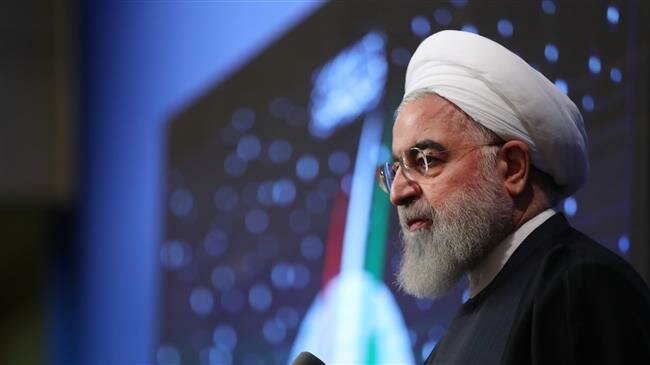
Al-Manar | September 3, 2019
Iranian President Hassan Rouhani said Tuesday that holding bilateral talks with the United States is not on the table.
“We’ve said it before time and again, and we say it again: We have no intention to hold bilateral talks with the United States. We never did and never will. It has been the case in the past year and a half, and even in previous years. There have been calls for talks, but we never responded to them,” the Iranian President Hassan Rouhani said in a Parliament session on Tuesday.
Rouhani was attending the session to defend his two candidates for the ministry of education and the ministry of tourism and cultural heritage.
Stressing that holding bilateral talks with the US is not on the table, Rouhani added “we said that the US, as part of the 5+1, held talks with us and we took part in the talks. If the US lifts all of its sanctions against Iran, whether it returns to the JCPOA or not, it does not matter to us, but if it lifts all sanctions, it is still possible for the US to be part of the 5+1; granted that it first removes all sanctions.”
“When we talk about negotiations, we only mean it under the situation where all sanctions have been lifted; that is, the situation we previously had under the JCPOA. Our stance is clear,” Rouhani stressed.
Tensions started to build up between the US and Iran after President Trump withdrew Washington from the 2015 nuclear deal, officially known as the Joint Comprehensive Plan of Action (JCPOA) in May 2018, and imposed sanctions against Tehran in a bid to restrict the country’s trade transactions with the world. The Trump administration has been making empty calls for talks, but the Islamic Republic stresses that as long as sanctions are in place and the US refuses to return to the JCPOA, negotiations will be meaningless.
“Our progress is a testament to the fact that resisting [against pressure] works. On the other hand, an active diplomacy can pave the way for us. We have never closed the doors of diplomacy and never will do so…we don’t believe that only one of these two tools should be used,” said Rouhani.
About Iran’s measures to scale down commitments to the JCPOA, Rouhani said “If the remaining signatories to the nuclear deal can live up to a part of their commitments, we may reconsider reducing our commitments. But if they fail to take any solid step, we will definitely take the third step in a few days.”
As a first step, Iran increased its enriched uranium stockpile to beyond the 300 kilograms set by the JCPOA. Next, it announced that it had begun enriching uranium to purity rates beyond the JCPOA-limit of 3.76 percent.
Rouhani went on to add, “the further we move along this path, it may make solving the issue more difficult, but since our steps are designed in a way that we can return to the starting point at any given time we desire, it will not take any time, and we will continue our talks even after taking the third step.”
“The basis of our talks with the European side is that we want them to preorder our oil and the revenues to be in our possession. This will ease the situation for us to decide against making more cuts to our commitments to the JCPOA,” Rouhani added.
“We haven’t reached a final agreement yet, but negotiations are still underway. If we fail to reach a conclusive result by Thursday, we will announce the third stage of our cuts to the JCPOA commitments,” Rouhani concluded.
Some officials have noted that Iran’s measures for the third step may include installing a new generation of centrifuges, increasing the stockpile of enriched uranium, or restoring the Arak heavy water reactor to its previous design.
It’s Necessary to Find Way to Counter US, Otherwise Nuclear Deal Won’t Be Only Loss: Zarif
Sputnik – September 3, 2019
Iranian Foreign Minister Javad Zarif said on Monday that Washington’s actions regarding the Joint Comprehensive Plan of Action are a blow to international law, and if the accord is not preserved, the nuclear deal “will not be the only loss”.
On Sunday, Tehran said it would make a third reduction of commitments agreed to under the deal and that this round would be the harshest yet. A spokesman for the Iranian government, Ali Rabiei, said on Monday that Iran would wait until Thursday for the deal’s signatories to take steps toward implementing the accord and make a decision on whether to further scrap its commitments depending on these actions.
“America’s actions are not only a blow to the JCPOA, but to the whole framework of international law. That is why, if we do not find a way to counteract the United States, the JCPOA will not be the only loss. Therefore, we share the same views with Russia on this issue”, Zarif told the Rossiya 24 broadcaster.
Earlier in the day, Zarif said that Tehran would return to full implementation of the deal, if there was progress in negotiations on the implementation by Europeans of their part of the agreement.
The JCPOA was signed in 2015 by Iran, China, France, Germany, Russia, the United Kingdom, the United States, and the European Union. It required Iran to scale back its nuclear programme and severely downgrade its uranium reserves in exchange for sanctions relief. In 2018, the United States abandoned its conciliatory policy on Iran, withdrawing from the JCPOA and hitting Iranian petroleum industries with sanctions.
America Loses Asia-Pacific as Full Spectrum Dominance Continues to Fail
By Matthew Ehret | Strategic Culture Foundation | September 2, 2019
Always working a little harder than most to stay a step below reality, US Secretary of Defense Mark Esper made especially candid remarks this week that America’s INF pullout was timed for a targeting of forces against China.
Speaking to Fox on August 21st, Esper said: “We want to make sure that we, as we need to, have the capability to deter Chinese bad behavior… China is the number one priority for this department. It’s outlined in the national defense strategy, why we think it’s a long term strategic competitor and one that is pursuing a maximization campaign, if you will, throughout the indo-Pacific theater, whether its politically, economically or militarily…”
Echoing a little Dr. Strangelove, Esper stated that there is “a coming shift” from “low intensity conflict that lasts 18 years to high intensity conflicts against competitors such as Russia and China.”
While American military exercises in the Pacific have played out on China’s doorstep at an accelerating rate since the Pivot to Asia was announced in 2011 with the most recent US-Australia Talisman Sabre bi-annual exercise and US-South Korea Ulchi Freedom war games this month, China has not remained idle.
In response to America’s vast array of military infrastructure built up on China’s border, China has responded by the unveiling of cutting edge anti-ballistic missile technologies, including hypersonic weaponry to counteract the American threat. A large part of China’s defensive response includes the Russian S400 anti-missile system which is also being adopted by India, Turkey, Syria and the United Arab Emirates as a unified system which renders the American THAAD and ABM systems impotent and obsolete. Although unconfirmed, American generals have freaked out that China is building a joint China-Cambodia naval base in Preah Sihanouk Province that gives China easy access to coastal waters on the Gulf of Thailand and ready access to the South China Sea.
America’s military impotence when faced with the new cutting edge technologies unveiled by Russia and China was outlined in a recent report released by the US Studies Center at the University of Sydney which stated that “America no longer enjoys military primacy in the indo Pacific and its capacity to uphold a favorable balance of power is increasingly uncertain.” Referring to China’s advanced anti-aircraft weapons, the report says “Chinese counter-intervention systems have undermined America’s ability to project power in the Indo-Pacific region” which the authors say, could be rendered impotent within the first 8 hours of conflict.
Rather than use this information to propose a new security doctrine premised on cooperation and dialogue as China has offered on countless occasions, the report’s authors join the fantasy world of Esper calling instead for a “collective defense” strategy akin to a Pacific NATO, whereby all of America’s Pacific allies could join in an anti-Chinese military alliance together, and relieving America of the burden of carrying WWIII on its own.
We know that this Pacific NATO has been discussed for some time and was at the heart of recent Pacific Vanguard naval drills conducted between the USA, Australia, Japan and South Korea in May 2019 which saw the participation of 3000 soldiers, two Japanese destroyers, a South Korean destroyer and two Australian frigates in their first joint war game. This outlook was also behind the August naval drill played out by Malaysia, USA, New Zealand and Australia in Guam. The USA has 54,000 troops in Japan and 28,000 in South Korea.
When China and Russia conducted their first long range joint air patrol in the Asia Pacific in July 2019, South Korea and Japan scrambled jets to intercept the Chinese and Russian aircraft, with South Korea firing hundreds of warning shots. Backed up by the USA, both Asian countries screamed loudly (and without evidence) that their air space had been violated.
In response to the belligerent comments by Esper and the Australian report, the Chinese Foreign Ministry said “China is firmly on a path of peaceful development and our national defense policy is defensive in nature”. China has gone further by providing a cooperative framework under the Belt and Road Initiative which is built around the brilliant political agenda of providing diplomatic solutions to geopolitical points of tension through economic development strategies that enrich all participants. This approach has provided China great payback through the defusing of tensions with other nations claiming territory within the South China Sea- especially under the pro-BRI orientation of Malaysia’s Dr. Mahathir Mohammed and the Philippines’ President Duterte.
Not feeling at ease being caught in the crossfire of a nuclear exchange, Japan and South Korea have also gone so far as to create a new trilateral cooperation agreement with China on August 21 premised on “next generation exchange projects in three countries… We hope to discuss future-oriented partnerships and regional affairs, including North Korea.” The agreement also enables international joint investment in all countries operating under the BRI framework. Together the three countries account for over a quarter of the world’s productivity and have everything to gain by working together.
Those American military officials promoting the obsolete doctrine of Full Spectrum dominance are dancing to the tune of a song that stopped playing some time ago. Both Russia and China have changed the rules of the game on a multitude of levels, and can respond with fatal force to any attack upon their soil with next generation weaponry beyond the scope of anything imagined by ivory tower game theorists in the west.
The ship of world history has changed course away from the rapids of war and economic collapse, as the Belt and Road Initiative has grown to proportions not imagined possible just a few years earlier and the coming months will be decisive as the west does some soul searching and decides which future it would like to have.
Moratorium on US oil sanctions to open talks with Iran
By M. K. BHADRAKUMAR | Indian Punchline | September 2, 2019
The diplomatic manoeuvrings over the situation around Iran are entering a crucial phase with an Iranian delegation led by Deputy Foreign Minister Abbas Araqchi leaving from Tehran for Paris today to pick up the threads of the 3-way discussions involving France, Iran and the United States at Biarritz a week ago on the sidelines of the G7 summit.
Araqchi is Iran’s chief negotiator with the E3 — France, UK and Germany — on the nuclear issue. Interestingly, Araqchi openly acknowledged on Saturday that the US has “shown some flexibility on the licensing of Iranian oil sales.”
The formula that was tossed around in Biarritz that the US will not oppose income being generated for Iran through oil sales is being finessed and linked to the working of the European Union’s trade mechanism for legitimate trade with Iran known as INSTEX. In essence, the formula is based on the French proposal of “freeze for freeze” — US freezing oil sanctions against Iran while Iran will freeze its steady pullback from the JCPOA commitments.
Araqchi said Iran and its European partners in the nuclear deal faced “difficult and complex” talks towards salvaging the pact. But a note of cautious optimism is apparent in Foreign Minister Javad Zarif’s remark in Tehran following a meeting of the National Security and Foreign Policy Committee at the Iranian parliament on Sunday afternoon that Iran may review the decision to further reduce JCPOA commitments if the European countries take action on INSTEX to live up to their own obligations. Tehran expects the Europeans to take a final decision by Thursday.
In the above backdrop, Iranian President Hassan Rouhani telephoned French President Emmanuel Macron on Saturday to convey Tehran’s interest in resuming the discussions under the latter’s mediation. Macron welcomed the move. Rouhani also assured Macron that Iran is supportive of a political settlement in Yemen and is willing to guarantee the security of the shipping lanes in the Persian Gulf and the Strait of Hormuz.
Perhaps, in an indirect alert to the US President Trump, Rouhani conveyed to Macron Iran’s misgivings that Israel is pulling all stops to derail the current negotiations which are at a delicate stage. Rouhani specifically referred to the Israeli attempt to provoke a flare-up involving Iran somehow, as evident in its recent air attacks on Lebanon, Syria and Iraq successively. The Hezbollah retaliated on Sunday by attacking Israel’s military vehicles, leaving a number of Israeli forces reportedly dead or injured.
In a sure sign that a broad settlement of the situation around Iran is under discussion, Zarif has travelled to Moscow with a high-level delegation aimed at coordinating the Iranian and Russian positions. Iran’s special envoys for Afghanistan, Yemen, and Syria are accompanying him. (Interestingly, Zarif referred to “serious developments” in Afghanistan, hinting at imminent US-Taliban deal this week.) Indeed, Iran is across the board addressing the western disquiet over Iran’s role in the conflicts in Yemen, Syria and Afghanistan. Tehran’s diplomatic priority will be to underscore that it can be a factor of regional security and stability.
From all appearance, Macron is steering the negotiations along three parallel tracks: a) forestall any precipitate crisis in the implementation of the 2015 nuclear deal by enabling Tehran to generate income out of oil sales that helps alleviate the hardships in the Iranian economy; b) persuade the Trump administration to concede Iran’s prerogative to resume trade relations with Europe and generate income through oil sales; and, c) defuse and de-escalate the various ‘hotspots’ in the Middle East where Iran’s role is regarded as critical — principally, Yemen, Syria and Afghanistan.
A convergence of the three tracks can be expected to lead to a new understanding between Tehran and Washington, possibly even a near-future summit involving the US and Iranian presidents. The clock is ticking and there is urgency to generate momentum for Macron’s efforts, as Trump and Rouhani are due to attend the UN General Assembly in September. A meeting is entirely conceivable as things stand.
Indeed, a deeply troubled relationship such as the Iranian-American is bedeviled with a lot of signalling and grandstanding, especially on the part of Tehran where Rouhani has to overcome significant resistance to the very idea of engaging with the US. The Supreme Leader Ali Khamenei has not said a word so far on Zarif’s visit to Biarritz or the 3-way France-Iran-US discussions under way. Tehran keeps repeating the demand on the lifting of the US sanctions as a pre-requisite for a face-to-face meeting between Rouhani and Trump.
However, it is possible to discern that Tehran is open to negotiations without preconditions and to strive for a meaningful breakthrough by optimally resorting to creative and flexible diplomacy. This flexibility factors in the assessment that Washington too is in a chastened mood.
Trump will not brook disruption by “hardliners”. Several Israeli attempts to have a phone conversation between PM Benjamin Netanyahu and Trump at Biarritz failed to materialise. Trump understands that all attempts by the US to create an international coalition against Iran have failed.
The law of diminishing returns is at work. The maximum pressure strategy against Iran is opening the window for an unprecedented expansion of Russian and Chinese influence in Tehran which may damage American regional interests in the long-term. The planned first-ever naval exercises between Iran and Russia in the Persian Gulf has rattled the US.
All in all, we may expect a moratorium on US oil sanctions in exchange for Iran’s compliance with its JCPOA obligations, which would be followed by direct negotiations for a historic thaw in the US-Iran relations.
Offer from Biarritz not good enough for Iran
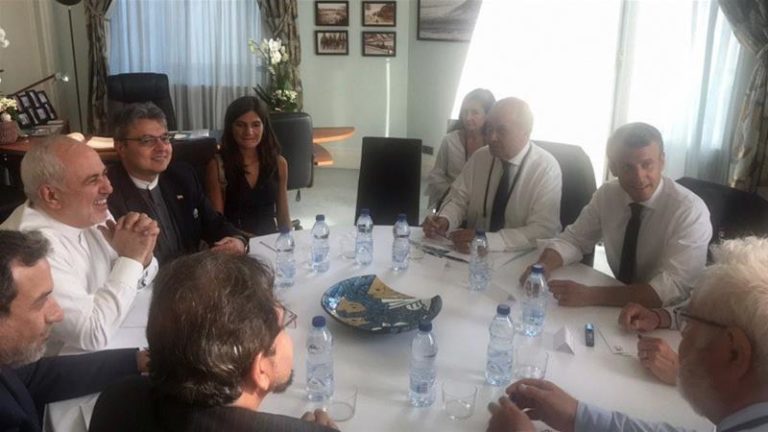
Iran’s Foreign Minister Javad Zarif (L) held talks in Biarritz on Sunday Aug. 25, 2019 with France’s President Macron (R) and Foreign Minister Jean-Yves Le Drian.
By M. K. BHADRAKUMAR | Indian Punchline | August 29, 2019
From all accounts, Tehran is struggling to cope with the startling news in the weekend from the G7 summit at Biarritz that a meeting between the presidents of the US and Iran is to be expected in the “coming weeks”.
The cautiously optimistic tone struck by the French President Emmanuel Macron and the conspicuously positive attitude adopted by President Trump along with the fact that the Iranian Foreign Minister Javad Zarif was actually present at Biarritz (with the prior knowledge and tacit concurrence of POTUS) — all these signalled that France’s back-to-back peace initiatives in the recent weeks with Washington and Tehran have come to a defining moment.
From Biarritz, Zarif took off for Tehran ostensibly to change planes for an onward journey to China as part of a previously scheduled Asian tour. Presumably, he briefed Rouhani on what transpired at Biarritz. Zarif is still on the Asian tour — China, Japan, Malaysia, etc., which are, interestingly, major buyers of Iranian oil.
If the Biarritz formula gains traction, these Asian countries have a key role to play in generating income for Iran out of oil sales, which apparently would incentivise Tehran to get into negotiations with the US.
En route to Beijing, Zarif tweeted, “Iran’s active diplomacy in pursuit of constructive engagement continues. Road ahead is difficult. But worth trying.” China’s foreign minister Wang Yi also spoke to Emmanuel Bonne, diplomatic adviser to French President Emmanuel Macron, by telephone on Monday. Bonne said France wanted to coordinate and cooperate with China to ease tensions over Iran and to maintain the 2015 nuclear deal, according to a report by official Chinese news agency Xinhua.
The initial reaction from Tehran at the level of Rouhani also suggested that he may be open to the idea of meeting Trump. Notably, Rouhani said on Monday, “I believe we should use any tool to protect our country’s national interests. If I think that meeting someone helps solve the people’s problems, I will not hesitate. The principle is our national interests.”
Two days later, however, Rouhani’s Chief of Staff and key aide Mahmoud Vaezi, who is an influential figure in the foreign policy establishment, conspicuously moderated what the president had said. Speaking to reporters in Tehran on Wednesday, Vaezi said any meeting with the US officials will solve no problem and the US must come back to the P5+1 negotiation table and respect its commitments to the Joint Comprehensive Plan of Action.
Vaezi didn’t altogether reject the idea of a Rouhani-Trump meeting, but added a template that the negotiations must also involve other guarantor states — E3, Russia and China. On the other hand, an Iranian economic delegation is proceeding to France next week. It could be that Tehran is strengthening its bargaining chip as well as insulating itself from the risk of engaging an interlocutor such as Trump who is fickle-minded, lacks consistency and has no coherent policies — and, above all, is surrounded by a team that includes notorious anti-Iran hawks, especially the National Security Advisor John Bolton.
Meanwhile, we see a significant hardening of Tehran’s stance in an interview with the state TV given by the Iranian Deputy Foreign Minister for Political Affairs Seyed Abbas Araqchi. Araqchi simply ruled out any negotiations with Washington so long as the sanctions remained in place.
In his words, “We are only talking with the European countries over our specific 11 demands (based on the JCPOA) and we will not negotiate with the US.” Vaezi’s remarks must be taken seriously, as he was one of the key negotiators of the 2015 nuclear deal and is an authoritative voice. Vaezi underlined that that no country would accept to enter negotiations while being under “maximum pressure” because doing so would mean “surrender”.
The offer held out in Biarritz appears to be simply not good enough for Tehran. Why should Tehran “surrender” after successfully countering the US’ regime change agenda and “maximum pressure” strategy and while the US has failed to reach the objectives behind its unilateral move to abandon the 2015 nuclear deal?
On Wednesday, Iran’s top military commander Chief of Staff of the Iranian Armed Forces Major General Mohammad Hossein Baqeri pointedly reminded everyone that it has been the country’s deterrence power that effectively stopped the US from going ahead with its plans to wage a war against Iran.
Quite obviously, a lot of churning has been going on within the top echelons of the Iranian establishment, which involve multiple agencies at an institutional level and even factions that would have congruent political interests or different priorities at any given time. The influential Majlis has not voiced an opinion. The bottom line is that all power centres would be waiting for the Supreme Leader Ayatollah Ali Khamenei to speak publicly.
Featured Video

The Truth About the Trump Shootings with Ken Silva
or go to
Aletho News Archives – Video-Images
From the Archives
The Geopolitics behind the War in Yemen (I)
By Mahdi Darius NAZEMROAYA | Strategic Culture Foundation | 30.03.2015
The United States and the Kingdom of Saudi Arabia became very uneasy when the Yemenese or Yemenite movement of the Houthi or Ansarallah (meaning the supporters of God in Arabic) gained control of Yemen’s capital, Sanaa/Sana, in September 2014. The US-supported Yemenite President Abd-Rabbuh Manṣour Al-Hadi was humiliatingly forced to share power with the Houthis and the coalition of northern Yemenese tribes that had helped them enter Sana. Al-Hadi declared that negotiations for a Yemeni national unity government would take place and his allies the US and Saudi Arabia tried to use a new national dialogue and mediated talks to co-opt and pacify the Houthis.
The truth has been turned on its head about the war in Yemen. The war and ousting of President Abd-Rabbuh Manṣour Al-Hadi in Yemen are not the results of «Houthi coup» in Yemen. It is the opposite. Al-Hadi was ousted, because with Saudi and US support he tried to backtrack on the power sharing agreements he had made and return Yemen to authoritarian rule. The ousting of President Al-Hadi by the Houthis and their political allies was an unexpected reaction to the takeover Al-Hadi was planning with Washington and the House of Saudi. … continue
Blog Roll
 Aletho News
- Pakistan-Iran talks secure LNG shipment to Islamabad through Hormuz
- Black Sea grain crisis puts global wheat supplies under pressure
- IRGC air defenses destroy another US MQ-1 drone over Strait of Hormuz
- Imran Khan’s entire immediate family detained in Pakistan ahead of mass protest demanding his release
- EU nation detains former presidential frontrunner
- Leaked: Britain’s Sham Conviction Of Hashim Thaci
- Seyed M. Marandi: U.S. Strike Imminent – Toward Total War in the Middle East
- Russia Voted Under Fire. Washington Is Loading the Tankers.
- 12 Things Your Oncologist Was Trained Not to Tell You
- Anthrax Attacks Paved Way for COVID-Era ‘Junk Drugs and Vaccines’
- If Americans Knew
- Huckabee aide solicited cash gifts from Israelis
- This isn’t sci-fi, AI is already killing people
- ‘The Most Brutal Thing’: Investigation Reveals Execution of Elderly Woman in Rafah
- Inside Israel’s ‘soft’ ethnic cleansing plan for Gaza through the eyes of its victims
- New online database tracks pro-Israel political donations in the United States
- Israeli president pardons soldier convicted for killing wounded Palestinian
- Singer Ed Sheeran says his ‘heart broken’ by Gaza devastation, addresses Macklemore controversy
- Israel Has Imprisoned Female Journalist Bushra Al-Tawil Without Trial Or Charge In Solitary Confinement For Past Month
- Israel poised to teach West Bank a lesson after one Israeli killed – Daily Update
- Salah Sarsour’s Legal Team Says DHS Has Not Met Its Burden to Prove He Is Deportable
- No Tricks Zone
- 2025 Nature Paper Claiming Worsening Global Drought Gets RETRACTED …Heavily Flawed
- New Study: ‘Global Drought Shows No Detectable Recent Acceleration Under Climate Warming’
- Economic Masterminds: German Socialists Suggest Taxing Productivity Gains Stemming From Using AI
- The South China Sea Has Not Been Cooperating With The Climate Change Narrative
- Energy Crisis: Germany Enters Heating Season With Historically Low Gas Reserve Fill Levels
- New Study: The Antarctic Ice Sheet Gained Mass From 2020-2024 Due To Staggering Snow And Ice Accumulation
- Study: Ocean Heating Rates From Thousands Of Years Ago ‘Dwarf’ Modern Ocean Heating Rates
- Climate Extremists Target, Attack Large-Scale Power Grid Infrastructure In Germany!
- New Study: Antarctic Ice Melt Has Contributed Less Than 1 Centimeter To Sea Level Rise In The Last 30 Years
- Fear Of Debate: Alarmist German Climate Scientist Calls On Mainstream Media To Discredit Skeptic Voices
 Aletho News