Pakistan Asks India to Provide Intel Proving Pakistan’s Involvement in Pulwama Attack
Sputnik – 11.04.2019
Pakistan has handed over a “request for more information” to the India High Commissioner in Islamabad on the Pulwama dossier, Ministry of Foreign Affairs spokesman Dr Muhammad Faisal told reporters on Thursday.
The minister added that India had so far not provided any actionable intelligence that could lead to concluding Pakistan’s involvement in the Pulwama attack that took place on 14 February this year. The attack took the lives of more than 40 Indian soldiers.
“We hope India will answer these questions soon”, Dr Faisal said during a weekly briefing, adding that the reply to previous questions had so far also not been given.
Diplomatic sources told Sputnik that Islamabad has sought a specific response with regards to an individual who is allegedly based in India. Dr Faisal told reporters that Foreign Minister Shah Mehmood Qureshi had credible intelligence that India is preparing another act of aggression against Pakistan between 16 and 20 April.
“India will receive the same response as February 27 if it challenges our resolve,” Dr Faisal told reporters on Thursday.
On the basis of the first dossier submitted by the Indian government on 27 February, Pakistan’s Foreign Office on 28 March stated that it had thoroughly investigated the entire dossier related to the Pulwama terror attack and had neither found any evidence of terror camps at the locations mentioned by India, nor of any of the persons mentioned therein that could be linked to the said attack.
“While 54 detained individuals are being investigated, no details linking them to Pulwama have been found so far. Similarly, the 22 pin locations shared by India have been examined. No such camps exist. Pakistan is willing to allow visits, on request, to these locations”, the Foreign Ministry added.
The tensions between the two nuclear-armed nations escalated in February after the Pulwama terror attack, which expanded into a full-fledge aerial clash on 27 February. An Indian MiG-21 Bison was shot down by the Pakistanis, while India has claimed that it too shot down a Pakistani F-16. Pakistan has rubbished the Indian claims.
Pakistan is blackmailing Modi and Doval
By M. K. BHADRAKUMAR | Indian Punchline | April 11, 2019
Doublespeak is commonplace in statecraft. A celebrated case is of the former US President Barack Obama who was facing re-election in 2012. Battered by criticism by his Republican contender Mitt Romney for being “soft” on Russia, Obama sought a private understanding with the Kremlin leadership that he couldn’t afford to be seen by the American public as flexible on relations with Russia until the presidential election in November that year got over.
Obama and his interlocutor then Russian President Dmitry Medvedev were unaware that their deal-making conversation on March 26, 2012 in Seoul was caught on open microphone, with the latter agreeing to Obama’s proposition that Russians would be patient until he secured his second term as president.
Quite obviously, the strong likelihood is that Pakistan Prime Minister Imran Khan’s reported optimism was not intuitively arrived at when he told the international media on Tuesday that if Prime Minister Narendra Modi won a second term in office, a Kashmir settlement was entirely conceivable.
Imran Khan would only have spoken with the full awareness of Modi’s complex political personality. In particular, he has the great advantage of being privy to the confidential exchanges between then Pakistan Prime Minister Nawaz Sharif and Modi during the latter’s celebrated surprise visit to Lahore in December 2015 as well as the ‘back channel’ conversations between the National Security Advisors of the two countries. Unlike in our dysfunctional system in the most recent years, Pakistan’s ISI keeps meticulous track of all high-level exchanges with India.
The Indian public knows hardly anything about what transpired between Modi and Nawaz in Lahore — or for that matter, during their famous “informal conversation” in Paris 25 days earlier, which probably set up the Lahore meeting.
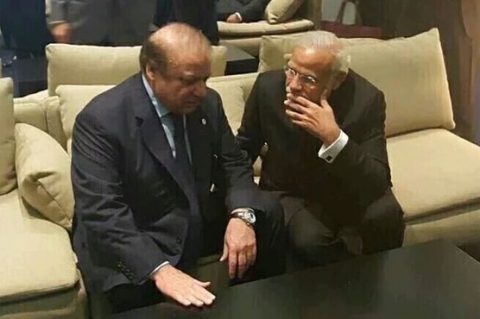
(Nawaz Sharif and Modi in “informal” conversation, Paris, Nov 30, 2015)
But make no mistake that the ISI kept track. The Pakistani side was actually expecting Modi’s surprise visit to Lahore and had made elaborate arrangements for a red carpet reception for the visiting Indian leader. Beyond doubt, every move that Modi made on Pakistani soil and every word he spoke to Nawaz was stored away as memory in the ISI archives.
Suffice to say, it is only Modi who is today in a position to clarify on what basis Imran Khan could have said with such audacity, “Perhaps if the BJP – a right-wing party – wins, some kind of settlement in Kashmir could be reached.”
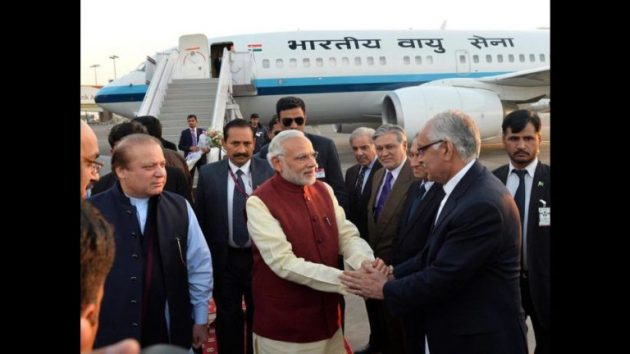
(Nawaz Sharif receiving Modi at the tarmac of Lahore airport, Dec 25, 2015)
Equally, Imran Khan’s caustic remark about the Congress is not unwarranted, when he said he didn’t expect the grand old party to deliver on a Kashmir settlement. Imran Khan cannot be unaware that although Manmohan Singh (or his NSAs) didn’t hang tough on Pakistan in the Indian media, he was tough as nail when it came to defending India’s national interests and didn’t make any concessions whatsoever to Pakistan.
In fact, Congress Party’s record has been consistently “hardline”, although it couldn’t match Modi’s rhetoric. Bangladesh war, occupation of Siachen, maritime boundary in Sir Creek — these are just three templates in India-Pakistan relations that alone should testify to the legacy of Congress rule. It must be remembered that the systematic erosion of Kashmir’s autonomy and India’s breach of promises to the Kashmir people took place in the decades since the fifties right up to the eighties only under Congress governments when BJP wasn’t even around as a gadfly.
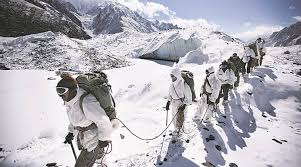
(Indian troops defending Siachen.)
So, the big question is about the signal that Imran Khan is giving when he reposes confidence in Modi to settle the Kashmir problem. Contextually, he would have three objectives — one, cautioning Modi against going too far in demonising Pakistan in his election rallies, no matter his political compulsions; two, projecting to the international audience an air of reasonableness in Pakistani policies ; and, three, forestalling any precipitate move by Modi to ratchet up tensions with Pakistan in the coming weeks between now and May 23, especially if a spectre of defeat haunts him in the election.
This last point is relevant if we factor in the decision by Islamabad only last Sunday to publicise “reliable intelligence” and “authentic information” available with it to the effect that India might make some military moves against Pakistan in the second half of April, once the elections got under way in India, out of which Modi could make political capital by whipping up jingoism.
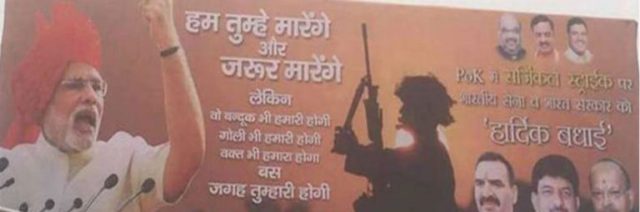
(BJP election poster with Modi and Indian soldier providing backdrop)
The intriguing part in all this is what Imran Khan really thinks of Modi as a politician. Historically, there is a perception in Pakistan that the BJP is a “Baniya party” of wheeler-dealers. But the past five years of BJP rule would have somewhat dispelled such notions. Imran Khan cannot but be aware that Modi is a creation of the RSS and unless and until he broke that umbilical cord, he cannot plough a de-ideologised furrow toward Pakistan.
Now, this is where the Modi-Nawaz exchanges and the back channel conversations between Ajit Doval and his counterpart in Islamabad, former NSA Lt. Gen. Nasser Khan Janjua, come into play. The Indian public knows nothing about the contents of these exchanges and conversations. But ISI knows, the GHQ in Rawalpindi knows and Imran Khan knows. (And, indeed, Modi and Doval know.)
Importantly, therefore, a Pakistani Prime Minister for the first time in the past 7 decades has interfered in an Indian general election and showed his preference for a particular political leader. This is unacceptable. This is blackmail.
Yet, Modi only is responsible for it. Figuring out that he has nothing positive to project before the Indian electorate, Modi made Pakistan the centre piece of his election campaign to malign and embarrass Congress and to deflect attention from burning issues such as unemployment, agrarian crisis, Rafale scam, etc. But by doing so, Modi held open a door through which Imran Khan has simply walked in.
Look at the kind of things Imran Khan says on the eve of an Indian general election — that he prefers Modi (to Rahul Gandhi) as his interlocutor; that “Muslim-ness is being attacked” in India; that Muslims in India are unhappy; that Modi is electioneering like Israel’s Netanyahu, exploiting “fear and nationalist feeling”; that J&K’s special status is under attack; that Kashmiris are waging a political struggle and there is no military solution to it; that “there is still the possibility if the polls turn against Modi in the next few weeks that India could take some further military action against Pakistan” and so on.
The most intriguing remark Imran Khan made was that Modi’s much-touted Balakot attack on February 27 was only an act of dissimulation and so the Pakistani retaliation the next day was a pro forma act — as if it were an elaborate pantomime being played out with Modi as the master choreographer. As he put it, the IAF bombed trees and the PAF retaliated by bombing stones.
These are exceptional remarks for the leader of a foreign country to make. But Modi cannot take exception, because he only invited this Pakistani slur on India’s democracy and its leadership. Clearly, Pakistan is blackmailing Modi and Doval. This seems like Modi’s “Obama moment” in Seoul 7 years ago.
Hamas Won Again
By Gilad Atzmon – April 10, 2019
Prime Minister Benjamin Netanyahu won a decisive victory yesterday. He is likely to carry on to a fifth term in office. As of this morning, the right-wing bloc has a clear advantage of 65 seats (out of 120) over the centre/left parties and seems more likely to form a coalition.
The meaning of yesterday’s election results are obvious and undeniable. The Israeli left is now marginal, verging on non-existent. The Israeli Labour party has been reduced to a miniature caricature, pretty much the size of Meretz, themselves a parody of left thinking. Needless to mention that these two parties are Zionist to the core. They deny the Palestinian right of return and believe in segregation between Jews and Arabs by means of a two-state solution.
Netanyahu is, beyond doubt, the most sophisticated player in the Israeli political theatre. In the weekend he vowed to annex the West Bank Settlements. By performing this election ploy, he managed to completely obliterate his hard-line rivals on the right such as Bennett-Shaked’s New Right and even Zehut, which promised to be a ‘rising political force.’ As for this morning neither Zehut nor Bennett, who promised his voters he would be the next Defence Minister, made it to the Knesset. Netanyahu has also managed to reduce the USA into a subservient colony. We saw President Trump working hard for his friend in Jerusalem, recognising Israeli sovereignty over the Golan Heights and castigating Iran’s Islamic Revolutionary Guard Corps as a ‘terror organisation’. But most significantly, Netanyahu is also Hamas’s favourite prime minister.
Hamas knows very well that Israeli centrist government are genocidal in their approach to Arabs and Palestinians in particular. Hamas remembers Ehud Olmert, Tzipi Livni and Ehud Barak. They clearly prefer Bibi. They know very well that Bibi has been anxious to operate in Gaza. Hamas knows very well that Israel is running out of military and political options, let alone solutions to the conflict. Hamas voted Bibi. It entered ceasefire negotiations with Israel just a few days before the election. There is good reason to believe that Hamas would prefer to deal with Netanyahu rather than with a ‘centrist’ party led by three war criminals. Hamas won again, it has pushed Israel into a state of further paralysis. Israel does not have a prospect of a future in the region. Israel may not be defeated by Quasam rockets but by its own Ghetto mentality.
Putin Open to Provocation-Free Dialogue With Ukraine’s Zelenskiy – Kremlin
Sputnik – 08.04.2019
MOSCOW – Russian President Vladimir Putin is ready to discuss any pressing issues with the Ukrainian presidential hopeful, Volodymyr Zelenskiy, if such a dialogue is free of provocations, Kremlin Spokesman Dmitry Peskov said Monday.
“In general, Putin is always open for dialogue, except for the situations when [Kiev] is trying to couple this dialogue with various provocations, sabotage and so on. In such cases, Putin’s reaction is very clear, unequivocal and decisive,” Peskov said.
Ukrainian frontrunner Zelenskiy said Sunday he was ready for talks with Putin on the Donbass conflict in the presence of Western powers.
Ukrainian presidential hopeful Zelensky has won first election round with 30.24 percent of votes, final results of the ballot count revealed, while Poroshenko has gained 15.95 percent of votes.
Iran, Iraq ‘agree on aerial defense cooperation’
Press TV – April 7, 2019
Iran’s top military commander says the country and its neighbor Iraq have agreed to cooperate in the area of air defense to fend off the challenges facing their respective air spaces.
Chairman of the Chiefs of Staff of the Iranian Armed Forces Major General Mohammad Baqeri made the announcement to reporters following a meeting in Tehran with his visiting Iraqi counterpart, Lieutenant General Othman al-Ghanimi, Tasnim News Agency reported on Sunday.
The cooperation, Baqeri said, will be aimed at confronting aerial threats.
The meeting addressed “the integrated defense of Iran and Iraq’s skies, because we might sense threats coming from the direction of [our] western borders,” he added.
“Accordingly, it was agreed that the countries’ air defense sectors work together and more coordination be made in this regard,” the Iranian commander said.
Baqeri said the two sides also agreed on potential training cooperation, the transferring of Iran’s defensive experiences to Iraq, and joint military exercises. Agreements on these, he added, will be finalized during a future visit by the Iraqi military chief.
Ghanimi was in the Iranian capital as part of a delegation accompanying Iraqi Prime Minister Adel Abdul-Mahdi. On Saturday, the delegation met with Leader of the Islamic Revolution Ayatollah Seyyed Ali Khamenei and President Hassan Rouhani.
Baqeri cited the Iraqi commander as saying that Baghdad would be exercising stricter control on the United States’ military presence on its soil.
The American forces are only there to train Iraqis and their activities are under the Iraqi Army’s oversight, Baqeri added, citing al-Ghanimi.
In his meeting with Ghanimi, Ayatollah Khamenei had stressed that the Iraqi government should make sure that US forces leave Iraq as soon as possible.
Venezuela FM takes Middle East tour, set to meet Nasrallah
Press TV – April 3, 2019
Venezuela’s foreign minister has embarked on a Middle East tour taking him through Turkey, Lebanon, and Syria, amid US measures to prop up the Latin American country’s opposition figure and self-proclaimed “interim president” Juan Guaido against President Nicolas Maduro.
Jorge Arreaza arrived in Turkey on Monday and was assured by his Turkish counterpart Mevlut Cavusoglu of Ankara’s support for the Latin American nation in the face of US pressure. “It should not be in a way that ‘I am a big country and I can determine entire rules,’” Cavusoglu said, referring to Washington’s sanctions against Venezuela and its efforts to oust Maduro, Turkish paper Hurriyet reported.
On Tuesday, the top Venezuelan diplomat traveled to Lebanon on a two-day visit. Lebanese President Michel Aoun received him at the presidential Baabda Palace in Beirut. Arreaza, who conveyed a message from Maduro to Aoun, also met with his Lebanese counterpart Gebran Bassil.
He was also slated to meet with Lebanese Prime Minister Sa’ad Hariri, Lebanese news portal Naharnet reported. According to Lebanese daily al-Joumhouria, he will also be holding a meeting with the Hezbollah resistance movement’s Secretary General Seyyed Hassan Nasrallah.
Back in January, Hezbollah conveyed its support for Maduro amid mounting US pressure for him to resign and hand over power to Washington-backed Guaido. Hezbollah-associated lawmaker Mohammad Raad was cited by Lebanese TV channel Al Manar as saying at the time that “Nasrallah stands with the Venezuelan people and with its free leadership.”
The Venezuelan foreign minister, meanwhile, expressed satisfaction with the visits to the countries in remarks to Prensa Latina. “They are two countries that respect international law and with which there are friendly and fraternal relations,” the Cuban news agency cited him as saying.
The visit to Lebanon “opens a new stage in bilateral ties with the possibility to expand economic cooperation, especially Venezuela’s advisory in the country’s energy sector,” the agency added, citing the top diplomat.
Also in January, the US took the lead in recognizing Guaido as Venezuela’s president after the head of the opposition-ruled Congress named himself the country’s interim chief executive. Washington has been pressuring other countries into following suit and has not ruled out using the military option to oust Maduro’s government.
Many countries, including Iran, Russia, China, and Cuba, however, back Maduro, spurning the subversive American efforts targeting Venezuela’s sovereignty.
Arreaza is next to travel to Syria, with which Caracas has similarly warm relations.
Kremlin Urges No Foreign Interference in Algeria
Al-Manar | April 3, 2019
The Kremlin on Wednesday said it hoped for a transition of power in Algeria without foreign “interference” after President Abdelaziz Bouteflika resigned in the face of massive street protests.
“We expect that the internal processes that are happening in this country and are exclusively the internal affair of Algeria will take place without the interference of any third countries,” Kremlin spokesman Dmitry Peskov told reporters.
He added that Russia has “mutually beneficial, friendly relations” with Algeria and that the two countries share “many joint projects in the economic sphere.”
Bouteflika, 82, had ruled the former French colony for two decades and had long been accused of clinging to power.
The veteran leader faced mounting pressure to step down following his decision to seek a fifth term, despite rarely being seen in public since suffering a stroke in 2013.
His decision to stand aside was announced on state television late Tuesday.
Defence of European empires was original NATO goal
Second in a four-part series on the 70th anniversary of the North Atlantic Treaty Organization
By Yves Engler · March 30, 2019
The first installment in this series discussed how NATO was set up partly to blunt the European Left. The other major factor driving the creation of NATO was a desire to bolster colonial authority and bring the world under a US geopolitical umbrella.
From the outset Canadian officials had an incredibly expansive definition of NATO’s supposed defensive character, which says an “attack against one ally is considered as an attack against all allies.” As part of the Parliamentary debate over NATO external minister Lester Pearson said: “There is no better way of ensuring the security of the Pacific Ocean at this particular moment than by working out, between the great democratic powers, a security arrangement the effects of which will be felt all over the world, including the Pacific area.” Two years later he said: “The defence of the Middle East is vital to the successful defence of Europe and north Atlantic area.” In 1953 Pearson went even further: “There is now only a relatively small [5000 kilometre] geographical gap between southeast Asia and the area covered by the North Atlantic treaty, which goes to the eastern boundaries of Turkey.”
In one sense the popular portrayal of NATO as a defensive arrangement was apt. After Europe’s second Great War the colonial powers were economically weak while anti-colonial movements could increasingly garner outside support. The Soviets and Mao’s China, for instance, aided the Vietnamese. Similarly, Egypt supported Algerian nationalists and Angola benefited from highly altruistic Cuban backing. The international balance of forces had swung away from the colonial powers.
To maintain their colonies European powers increasingly depended on North American diplomatic and financial assistance. NATO passed numerous resolutions supporting European colonial authority. In the fall of 1951 Pearson responded to moves in Iran and Egypt to weaken British influence by telling Parliament: “The Middle East is strategically far too important to the defence of the North Atlantic area to allow it to become a power vacuum or to pass into unfriendly hands.”
The next year Ottawa recognized the colonies of Vietnam, Cambodia and Laos as “associated states” of France, according to an internal report, “to assist a NATO colleague, sorely tried by foreign and domestic problems.” More significantly, Canada gave France hundreds of millions of dollars in military equipment through NATO’s Mutual Assistance Program. These weapons were mostly used to suppress the Vietnamese and Algerian independence movements. In 1953 Pearson told the House: “The assistance we have given to France as a member of the NATO association may have helped her recently in the discharge of some of her obligations in Indo-China.” Similarly, Canadian and US aid was used by the Dutch to maintain their dominance over Indonesia and West Papua New Guinea, by the Belgians in the Congo, Rwanda and Burundi, by the Portuguese in Angola, Mozambique and Guinea-Bissau and by the British in numerous places. Between 1950 and 1958 Ottawa donated a whopping $1,526,956,000 ($8 billion today) in ammunition, fighter jets, military training, etc. to European countries through the NATO Mutual Assistance Program.
The role NATO played in North American/European subjugation of the Global South made Asians and Africans wary of the organization. The Nigerian Labour Party’s 1964 pamphlet The NATO Conspiracy in Africa documents that organization’s military involvement on the continent from bases to naval agreements. In 1956 NATO established a Committee for Africa and in June 1959 NATO’s North Atlantic Council, the organization’s main political decision-making body, warned that the communists would take advantage of African independence to the detriment of Western political and economic interests.
The north Atlantic alliance was designed to maintain unity among the historic colonial powers — and the US — in the midst of a de-colonizing world. It was also meant to strengthen US influence around the world. In a history of the 1950-53 US-led Korean war David Bercuson writes that Canada’s external minister “agreed with [President] Truman, [Secretary of State] Dean Acheson, and other American leaders that the Korean conflict was NATO’s first true test, even if it was taking place half a world away.”
Designed to maintain internal unity among the leading capitalist powers, NATO was the military alliance of the post-WWII US-centered multilateral order, which included the International Monetary Fund (IMF), World Bank, International Trade Organization (ITO) and the United Nations. (For its first two decades the UN was little more than an arm of the State Department.)
A growing capitalist power, Canada was well placed to benefit from US-centered multilateral imperialism. The Canadian elite’s business, cultural, familial and racial ties with their US counterparts meant their position and profits were likely to expand alongside Washington’s global position.
NATO bolstered colonial authority and helped bring the world under the US geopolitical umbrella, from which the Canadian elite hoped to benefit.
New US Ambassador to Tajikistan Seems to be Up To the Task
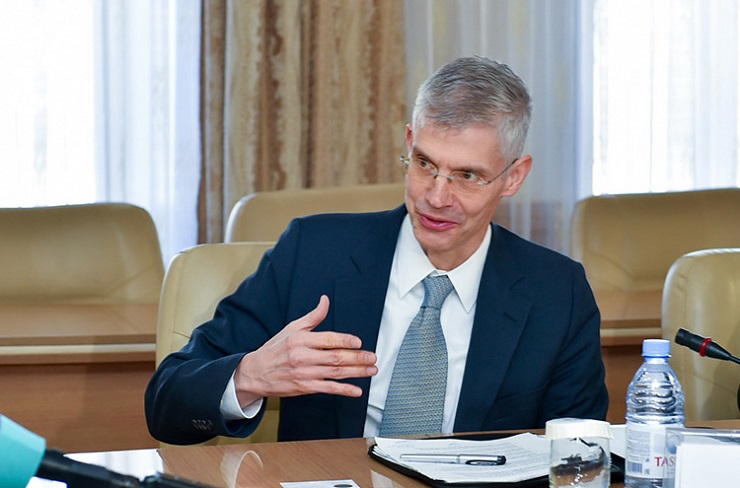
By Martin Berger – New Eastern Outlook – 29.03.2019
To this day Central Asia remains an arena of struggle for a number of major international players, namely Russia, China and the United States. In this struggle, Washington has now started losing its influence, which resulted in a series of desperate attempts to establish a sound foothold in this region, which could serve as a bulwark against both Russia and China. Against this backdrop, it’s no coincidence that the so-called private intelligence service known as Stratfor would reveal in its forecast for this year that the United States is planning to step up its efforts in Central Asia, especially in those countries that share a common border with Afghanistan, namely Tajikistan and Uzbekistan. This service won’t go into much detail about the efforts it’s referring to, but it’s hardly a secret that Washington has been busy redeploying radical Islamists from Syria, where they are getting defeated by the government forces and its allies, to Afghanistan, while making claims about its devotion to the fight against terrorism and drug trafficking.
In this situation, a relatively small regional player – Tajikistan found itself at the forefront of Washington’s attempt to push Moscow and Beijing out of the region. The US is particularly interested in influencing the foreign policy pursued by Dushanbe due to the two following reasons.
First of all, Tajikistan is not just an immediate neighbor of Afghanistan, but it shares the longest common border with this country out of all of the former Soviet republics – 800 miles in total. Secondly, Dushanbe has been enjoying close ties with Russia, which resulted in Moscow establishing its largest overseas military installation in Tajikistan – the 201st Military Base.
Due to the negligible size of its economy and its relative geographic isolation, Tajikistan can hardly be described as a promising trade partner of the United States, as Western oligarchs would have a hard time justifying investments in this country. So, the only approach that Washington can take in influencing Tajikistan into those decisions that it’s not willing to make is to complain about Dushanbe undermining democratic values, while pursuing closer military cooperation with it. For instance, as it’s been reported by a number of media sources, last year the Pentagon handed out 8 million dollars worth of military equipment to Dushanbe.
However, the situation on the ground may change rather abruptly and unexpectedly at any given moment. For instance, on the back of a long list of complaints Washington has made about Dushanbe being “not democratic enough” the West may decide to pursue a regime change in this country, which will result in the CIA and the Pentagon cutting costs on the illegal transit of opiates from Afghanistan.
That is why, in order to achieve its goals, the United States has been actively promoting the notion of establishing a regional young leadership network in Central Asia, under which young activists from Central Asian states would be able to receive education in Western universities together with the offspring of the regional elites. It goes without saying that after returning home those youngsters would promote Western neoliberal ideas, pedaling American interests like there’s no tomorrow. That is why Washington spends hundreds of millions of dollars on sponsoring various non-governmental organizations in Tajikistan.
In recent years, a large network of various organizations has been working for American money in the country, including, among others, the Soros Foundation, the Aga Khan, the Institute of War and Peace, and so on. In fact, there’s there’s well over 3,000 non-profit organizations registered in Tajikistan, with most of them being involved in the promotion of Western interests, including news agencies and law firms.
Back in the early 90s the United States and Tajikistan signed a deal on mutual attempts to facilitate the promotion of humanitarian and technical assistance. It’s hard to say how much money Washington has spent so far while promoting its narrative in Dushanbe, but it’s clear that USAID alone spent some 450 million dollars on such activities in the last three decades alone.
However, a series of “color revolutions” that Washington staged across the globe resulted in a considerable tightening of anti-NGO legislation in Tajikistan, which means that Dushanbe has been steadily increasing its ability to shape the internal situation within the country.
Now the US is testing a new strategy of coercion developed at the Pentagon for Venezuela and a number of other countries that dare to disagree publicly with Washington. It involves the use of a number of leverages, including financial sanctions and offensive online operations against the target country, along with the support of the political opposition and continuous threats of imminent military aggression.
There’s every reason to believe that the United States is going to test this new approach in Tajikistan, combining anti-government street protests with armed “revolutionary” jihad mounted by radical forces and, quite possibly, supported by a rebellion of local criminal groups. At the same time, Washington’s calculations of such developments clearly suggest that the leader of the Islamic Renaissance Party of Tajikistan, Muhiddin Kabiri would be advertised as the new leader of Tajikistan, while the prominent Badakhshan drug dealers would be tasked with fielding militants to support the runaway Tajik commander of the special forces who defected to ISIS, Gulmurod Khalimov. The Tajik portal Akhbor, in particular, has already announced that the United States initiated the transfer of elite ISIS fighters from Afghanistan that are being led by Halimov, with Saudi Arabia footing the bill for this operation.
Against this background, the arrival of the new US ambassador to Dushanbe, John Pommersheim can only be regarded as a troubling development. Pommersheim is considered to be one of the best experts on Russia in the entire State Department, as he would study Russian in Moscow after obtain scholarship from the US Department of Defense. The man who made a career at the US Information Agency (USIA) back in the 1980s is being transferred to Tajikistan from the US embassy in Kazakhstan. Moreover, Pommersheim is reverted as an expert on Central Asia and the Caucasus. His appointment in Tajikistan further demonstrates Washington’s growing interest in Central Asia. By using Tajikistan as a bridgehead, the United States can inflict extensive damage to both Russia and China, that are being described as the strategic opponents of Washington. In particular, should it succeed in destabilizing Central Asia, Washington would render the entire concept of the One Belt One Road initiative senseless, which implies China reorienting its trade routes to Europe from sea to land.
Of course, it would be naive to assume that John Pommersheim will start staging a “color revolution” in Dushanbe on the day of his arrival. As of now, the US cannot build enough momentum to force Russia or China out of Tajikistan. Instead it’s going to support all sorts of anti-Chinese and anti-Russian sentiments, taking advantage of the network of NGOs, the tactics that Pommersheim managed to master a long while ago.
We are going to follow the achievements of Pommersheim in Dushanbe rather closely, as it seems unlikely that Washington would have sent such a figure to Tajikistan for him just to enjoy the view.
German Government Refuses to Recognise Guaido’s Envoy as Ambassador

Sputnik – March 29, 2019
Although Berlin has sided with the US and recognised self-proclaimed interim president Juan Guaido, it is keeping Otto Gebauer, whom he picked to represent Venezuela in Germany, in limbo and has not granted the representative key diplomatic status. Spain, above all, has reportedly urged fellow EU member states not to recognise him.
Although Otto Gebauer, sent to Germany by self-proclaimed interim president of Venezuela Juan Guaido as his emissary, was received in Berlin, the German government does not plan to accredit him, as the newspaper Neue Osnabrücker Zeitung reports, citing the Foreign Ministry’s response to a request by the left-wing party Die Linke.
According to it, the German government first received Gebauer as “personal representative of Interim President Guaido” on 13 March 2019 to hold talks with him, but “further steps are not planned”. The outlet also reports that, above all, Spain has called on other EU member states not to grant Guaido’s representatives any diplomatic status or corresponding privileges.
Since a political crisis broke out in Venezuela in late January, when parliamentary opposition leader Guaido, backed by the US, declared himself the interim president of Venezuela after disputing President Nicolas Maduro’s re-election last May, Germany recognised him as a transitional head of state. Around 50 states, encouraged by the US, did the same. However, the constitutionally elected head of state Nicolas Maduro, supported by Russia, China, Cuba, Bolivia, Turkey and a number of other countries, continues to hold power and refuses to step down, accusing Washington of trying to orchestrate a coup in order to install Guaido as a puppet leader.
This has led to a paradoxical situation in Germany, leaving it with two Venezuelan emissaries in Berlin but not being able to hold official talks with both of them.
Die Linke praised the decision to restrain from recognising Gebauer as ambassador. Lawmaker from the German parliamentary foreign affairs committee Heike Haensel pointed out that “dispatching of new representatives for Venezuela is based on the recognition of self-appointed President Juan Guaido in violation of international law”, according to the conclusion of the Bundestag’s probe.
“This proves the absurdity of Germany’s Venezuela policy. Recognising Guaido was manoeuvered outside the bounds of international law and this rows it back again”, she said.
Apart from this diplomatic collision, Otto Gebauer has a debatable profile for a diplomat as he was involved in a 2002 coup attempt against President Hugo Chavez, who passed away several years ago. He was a member of the commando unit that held Chavez prisoner and served six years in prison for it.
The legitimacy of interim president Guiado himself is being challenged now as under Venezuelan law his maximum term is limited to a 30-day period. It expired in February while new elections have not yet been announced.
Australian Defence Strategy Still Locked in A Past Era
By James O’Neill | American Herald Tribune | March 28, 2019
According to a report in the Sydney Morning Herald (25 March 2019) the coalition government, if re-elected, would spend $2.5 billion on an air defence system. The object of the expenditure is said to “bolster Australia’s capacity to intercept enemy aircraft”. The new system will also defend against helicopters, cruise missiles and unmanned aerial systems.
The cost is divided between an initial acquisition price of $1.5 billion and a further $1 billion to operate and maintain it over two decades. The Minister for Defence, Linda Reynolds, said that the project had great export potential.
Once again, one has to wonder exactly what planet our defence politicians and their advisors actually inhabit. While the cost of this touted new system is small change compared to the tens of billions of dollars being lavished on expensive boondoggles such as the F35 joint strike fighter and the French built submarines, it is another illustration of wasted expenditure on military equipment not fit for purpose.
The stated object is to be able to defend against four intruders: helicopters; unmanned aerial systems; enemy aircraft and cruise missiles. Why one would need a $1 billion system to defend against helicopters, with their low altitude, short range, slow moving and noisy character simply boggles the mind.
Exactly what is meant by ‘unmanned aerial systems’ is not defined, but presumably refers to drones. The same point applies here as to helicopters. The more serious question relates to enemy aircraft and cruise missiles, and the source of those hostile intruders.
There is no obvious reason for Australia to be attacked by Indonesia, Papua New Guinea or any other country for whom Australia would be within the range of its bombers. The unspoken “enemy” here is presumably China, although again that raises the obvious question as to why China would wish to attack Australia. The only obvious answer to this is as a defensive reaction to an attack upon China itself.
Australia would only do that as part of yet another United States led “Coalition”, but why Australia would wish to be involved in such a foolhardy exercise against its largest trading partner should not be seriously contemplated by our defence planners, and if it is they need to spell out their rationale in clear terms.
Let us assume for arguments sake that China did attack Australia. It would not be with helicopters, unmanned aerial vehicles, cruise missiles or bombers. It would be done with one or more of its repertoire of supersonic missiles from the Dong Feng family of missiles, most probably the DF41. This missile system travels at hypersonic speed (Mach 20) and has 8 to 10 independently targetable nuclear warheads.
There is nothing in the current repertoire of United States or Australian missile defence systems that can defend against such an attack, and the heroic claims of former defence minister Christopher Pyne that it will be a “highly effective defence system” is simply nonsense.
If Australia did get into a shooting war with China, that war would likely involve China’s strategic partner Russia, whose missile systems (for example, Zircon, Burevestnik, Avangaard and Kinzhal) are decades ahead of US military technology, as even the United States itself admits (www.news.com.au 19 December 2018). For details of these Russian systems see Martyanov www.unz.com 5 March 2018; and Vineyard of the Saker www.thesaker.is 24 January 2019.
If Australia was serious about having a missile defence system then the world leader by a significant margin is the Russian S400 system, recently bought by China, Turkey, Saudi Arabia and India among others. Turkey, a NATO member, is proceeding with the purchase of the S400 despite overt threats by the Americans. The Saudis, huge purchasers of US military equipment in the past, also know where to go in order to purchase the best available system. Quite why a similar degree of realism is not allowed to intrude upon discussions of Australian defence strategy remains a puzzle. Has Australia become so “joined at the hip” with the Americans that it is willing to compromise on real military defence strategy? Instead of coherent debate we are fed the mindless pap exemplified in the SMH article referenced above.
No Terror Camps Found in Pakistan at Locations Pointed by India – Islamabad
Sputnik – March 28, 2019
New Delhi – Categorically denying the presence of any terror camps, Pakistan’s Foreign Office on Thursday stated that it has thoroughly investigated the entire dossier related to the Pulwama terror attack and has neither found any evidence of terror camps at the locations mentioned by India, nor of any of the persons mentioned therein that could be linked to the said attack.
“During the course of investigations, all aspects of the information provided by India have been thoroughly examined including the ‘confessional’ video of Adil Dar, ‘claim’ of responsibility for the attack, WhatsApp and Telegram numbers used to share videos and messages in support of Pulwama attack, list of 90 individuals suspected of belonging to a proscribed organisation and 22 pin locations of alleged training camps”, Pakistan’s Ministry of Foreign Affairs said on Thursday in a statement.
On 27 February, India had shared a dossier related to the Pulwama militant attack in which at least 40 Indian soldiers were killed on 14 February. Pakistan’s Foreign Ministry said that it had constituted an investigation team, detained a number of persons for investigations and initiated work on the technical aspects of social media content, on the basis of the Indian paper.”While 54 detained individuals are being investigated, no details linking them to Pulwama have been found so far. Similarly, the 22 pin locations shared by India have been examined. No such camps exist. Pakistan is willing to allow visits, on request, to these locations”, the Foreign Ministry added.
Pakistan also alleged that out of 91 pages and six parts shared as dossier by India, only part two and three pertain to Pulwama attack, other parts are generalised allegations.
Pakistan reiterated that additional information and documents from India would be essential to continue the process of investigations. Pakistan remains committed to taking this process to its logical conclusion, it added.
The two nuclear-armed South Asian neighbours India and Pakistan have been embroiled in an escalated border conflict after the Pulwama terror attack in the Indian state of Jammu and Kashmir that killed over 40 Indian soldiers. Pakistan-based terror outfit Jaish-e-Mohammed claimed the responsibility for the attack.
Featured Video
Seyed M. Marandi: Toward Total War in the Middle East
or go to
Aletho News Archives – Video-Images
From the Archives
The Geopolitics behind the War in Yemen (I)
By Mahdi Darius NAZEMROAYA | Strategic Culture Foundation | 30.03.2015
The United States and the Kingdom of Saudi Arabia became very uneasy when the Yemenese or Yemenite movement of the Houthi or Ansarallah (meaning the supporters of God in Arabic) gained control of Yemen’s capital, Sanaa/Sana, in September 2014. The US-supported Yemenite President Abd-Rabbuh Manṣour Al-Hadi was humiliatingly forced to share power with the Houthis and the coalition of northern Yemenese tribes that had helped them enter Sana. Al-Hadi declared that negotiations for a Yemeni national unity government would take place and his allies the US and Saudi Arabia tried to use a new national dialogue and mediated talks to co-opt and pacify the Houthis.
The truth has been turned on its head about the war in Yemen. The war and ousting of President Abd-Rabbuh Manṣour Al-Hadi in Yemen are not the results of «Houthi coup» in Yemen. It is the opposite. Al-Hadi was ousted, because with Saudi and US support he tried to backtrack on the power sharing agreements he had made and return Yemen to authoritarian rule. The ousting of President Al-Hadi by the Houthis and their political allies was an unexpected reaction to the takeover Al-Hadi was planning with Washington and the House of Saudi. … continue
Blog Roll
 Aletho News
- Pakistan-Iran talks secure LNG shipment to Islamabad through Hormuz
- Black Sea grain crisis puts global wheat supplies under pressure
- IRGC air defenses destroy another US MQ-1 drone over Strait of Hormuz
- Imran Khan’s entire immediate family detained in Pakistan ahead of mass protest demanding his release
- EU nation detains former presidential frontrunner
- Leaked: Britain’s Sham Conviction Of Hashim Thaci
- Seyed M. Marandi: U.S. Strike Imminent – Toward Total War in the Middle East
- Russia Voted Under Fire. Washington Is Loading the Tankers.
- 12 Things Your Oncologist Was Trained Not to Tell You
- Anthrax Attacks Paved Way for COVID-Era ‘Junk Drugs and Vaccines’
- If Americans Knew
- An error has occurred; the feed is probably down. Try again later.
- No Tricks Zone
- 2025 Nature Paper Claiming Worsening Global Drought Gets RETRACTED …Heavily Flawed
- New Study: ‘Global Drought Shows No Detectable Recent Acceleration Under Climate Warming’
- Economic Masterminds: German Socialists Suggest Taxing Productivity Gains Stemming From Using AI
- The South China Sea Has Not Been Cooperating With The Climate Change Narrative
- Energy Crisis: Germany Enters Heating Season With Historically Low Gas Reserve Fill Levels
- New Study: The Antarctic Ice Sheet Gained Mass From 2020-2024 Due To Staggering Snow And Ice Accumulation
- Study: Ocean Heating Rates From Thousands Of Years Ago ‘Dwarf’ Modern Ocean Heating Rates
- Climate Extremists Target, Attack Large-Scale Power Grid Infrastructure In Germany!
- New Study: Antarctic Ice Melt Has Contributed Less Than 1 Centimeter To Sea Level Rise In The Last 30 Years
- Fear Of Debate: Alarmist German Climate Scientist Calls On Mainstream Media To Discredit Skeptic Voices
 Aletho News