Canada Gets Cozy with Repressive Middle East Monarchies
By Yves Engler | Dissident Voice | April 26, 2019
While Justin Trudeau’s government embraces repressive Middle East monarchies, they want us to believe their campaign to oust Venezuela’s government is motivated by support for democracy and human rights.
On a tour of the Middle East last week Defence Minister Harjit Singh Sajjan met his United Arab Emirates counterpart Mohammed bin Ahmed Al Bowardi in Abu Dhabi. According to Emirates News Agency, Canadian and UAE officials discussed “cooperation in the military and defence sectors” at a time when the oil rich nation plays a key role in the horrendous violence in Yemen.
The Trudeau government is promoting arm sales to the UAE and other regional monarchies. With support from “15 trade commissioners and representatives from the Government of Ontario, National Defence, Global Affairs Canada, and the Canadian Commercial Corporation”, 50 Canadian arms companies flogged their wares at the Abu Dhabi-based International Defence Exhibition and Conference (IDEX) in February. To help the arms companies move their wares, Commander of the Bahrain-based Combined Task Force 150, Commodore Darren Garnier, led a Canadian military delegation to IDEX.
During his recent tour Sajjan met King Abdullah II bin Al-Hussein in Jordan. He discussed military cooperation with a monarch known for prosecuting individuals for “extending one’s tongue” (having a big mouth) against the King. At the end of March, Trudeau phoned King Abdullah II.
On April 9 the Canadian and Jordanian armed forces broke ground on a road project along the Jordanian-Syrian border. During a ceremony for the Canadian-funded initiative Commander of the Canadian Joint Operations Command, Lieutenant General Michael Rouleau, said: “this important road rehabilitation project is a tangible example of the close relationship between Jordan and Canada. It will help keep the people of Jordan safe by allowing the Jordanian armed forces to deter, monitor and interdict incursions along the northern border with Syria, which will help to enhance security in Jordan and in the region.”
On his Middle East tour Sajjan also met Kuwait’s Prime Minister and Defence Minister Sheikh Nasser Sabah Al-Ahmad Al-Sabah who is part of a family that has ruled for 250 years. According to the Kuwait News Agency, Canada’s defence minister “stressed deep relations between Kuwait and Canada and pointed out mutual willingness to bolster and consolidate bilateral ties.”
Earlier in the month finance minister Bill Morneau and Parliamentary Secretary Omar Alghabra participated in the inaugural Kuwait and Canada Investment Forum. At the time Alghabra wrote, “let’s celebrate and continue our efforts to grow the relationship between Canada and Kuwait in investments, trade and defence.”
Military ties with Kuwait are important because the Canadian forces have a small base there. In December the Canadian Navy took command of Combined Task Force 150 from their Saudi counterparts. Canada also has a small number of troops in the monarchies of Bahrain, the UAE and Qatar.
Last month Canada’s Ambassador to Qatar Stefanie McCollum boasted of growing relations between the countries, claiming “our values structures are very similar.” In an interview with Al Bawaba the Canadian diplomat also said Ottawa is seeking to deepen business ties with the natural gas rich monarchy and that the two countries are in the final stage of signing a defence cooperation agreement.
Notwithstanding the diplomatic spat last summer, the Trudeau government has mostly continued business as usual with the most powerful and repressive monarchy in the region. Recently foreign minister Chrystia Freeland looked the other way when Saudi student Mohammed Zuraibi Alzoabi fled Canada — presumably with help from the embassy — to avoid sexual assault charges in Cape Breton. While Freeland told reporters that Global Affairs was investigating the matter, Halifax Chronicle Herald journalist Aaron Beswick’s Access to Information request suggests they didn’t even bother contacting the Saudi embassy concerning the matter.
According to an access request by PhD researcher Anthony Fenton, Freeland phoned new Saudi foreign minister Ibrahim Abdulaziz Al-Assaf in January. In briefing notes for the (unannounced) discussion Freeland was encouraged to tell her counterpart (under the headline “points to register” regarding Yemen): “Appreciate the hard work and heavy lifting by the Saudis and encourage ongoing efforts in this regard.”
Despite their devastating war in Yemen and dismembering of journalist Jamal Khashoggi at the consulate in Istanbul, Saudi Arabia continues to receive large shipments of Canadian weaponry. 2018 was a record year for Canadian rifle and armoured vehicle sales to the Saudis. $17.64 million in rifles were exported to the kingdom last year and another $1.896 million worth of guns were delivered in February. In the first month of this year Canada exported $367 million worth of “tanks and other armoured fighting vehicles” to the Saudis.
As Fenton has documented in detail on his highly informative Twitter handle, armoured vehicles made by Canadian company Streit Group in the UAE have been repeatedly videoed in Yemen. Equipment from three other Canadian armoured vehicle makers – Terradyne, IAG Guardian and General Dynamics – was found with Saudi-backed forces in Yemen. The Saudi-led coalition used Canadian-made rifles as well.
On Tuesday the Saudis beheaded 37 mostly minority Shiites. Ottawa waited 48 hours — after many other countries criticized the mass execution — to release a “muted” statement. The Trudeau government has stayed mum on the Saudi’s recent effort to derail pro-democracy demonstrations in Sudan and Algeria as well as Riyadh’s funding for Libyan warlord Khalifa Haftar’s bid to seize Tripoli by force.
The close and friendly relationships between the Trudeau government and repressive Middle East monarchies demonstrates how little the Liberals care about democracy abroad and illustrates the hypocrisy of Canada’s claims that its efforts to oust Venezuela’s government is all about supporting democracy.
Yves Engler is the author of 10 books, including A Propaganda System: How Canada’s Government, Corporations, Media and Academia Sell War and Exploitation.
‘Lift sanctions & apologize if you want to talk,’ Iran’s Rouhani tells Washington
RT | April 24, 2019
The US should first drop sanctions and apologize, if it wants to sit down for negotiations, Iran’s President Hassan Rouhani said, after Washington stepped up “maximum pressure” on Tehran.
“Negotiation is only possible if all the pressures are lifted, they apologize for their illegal actions and there is mutual respect,” Rouhani said on Wednesday.
He stated that Tehran is open to talks with Washington, but the US is simply “not ready for any dialogue” and only seeks to “subdue the people of Iran.”
Iran’s Supreme Leader, Ali Khamenei, meanwhile, said that the country will thwart any attempts of the US to block its oil trade.
“The efforts to boycott the sale of Iran’s oil won’t get them anywhere. We will export our oil as much as we need and we intend,” Khamenei wrote on Twitter.
“They should know that their hostile measure won’t be left without a response.”
The warning came after US Secretary of State, Mike Pompeo, announced that Washington will stop issuing sanction waivers for the buyers of Iranian oil. It was done as part of the campaign to apply “maximum pressure” on Tehran, he said.
The two states remained in a diplomatic standoff after President Donald Trump unilaterally pulled the US out of the Joint Comprehensive Plan of Action (JCPOA) on the Iranian nuclear program last year. The US then re-imposed sanctions on Iran’s energy and banking sectors.
Iran blasted the sanctions as illegal under international law and vowed to retaliate should Washington make moves to attack its oil shipment.
Earlier this month, the US listed Iran’s Islamic Revolutionary Guard Corps (IRGC) as a “terrorist organization.” Tehran responded in kind by doing the same with the US Central Command (CENTCOM).
The Conspiracy Against Trump
The Deep State plot to undermine the president
By Philip Giraldi • Unz Review • April 23, 2019
The real “deplorable” in today’s United States is the continuation of a foreign policy based on endless aggression to maintain Washington’s military dominance in parts of the world where Americans have no conceivable interest. Many voters backed Donald J. Trump because he committed himself to changing all that, but, unfortunately, he has reneged on his promise, instead heightening tension with major powers Russia and China while also threatening Iran and Venezuela on an almost daily basis. Now Cuba is in the crosshairs because it is allegedly assisting Venezuela. One might reasonably ask if America in its seemingly enduring role as the world’s most feared bully will ever cease and desist, but the more practical question might be “When will the psychopathic trio of John Bolton, Mike Pompeo and Elliott Abrams be fired so the United States can begin to behave like a normal nation?”
Trump, to be sure, is the heart of the problem as he has consistently made bad, overly belligerent decisions when better and less abrasive options were available, something that should not necessarily always be blamed on his poor choice of advisers. But one also should not discount the likelihood that the dysfunction in Trump is in part comprehensible, stemming from his belief that he has numerous powerful enemies who have been out to destroy him since before he was nominated as the GOP’s presidential candidate. This hatred of all things Trump has been manifested in the neoconservative “Nevertrump” forces led by Bill Kristol and by the “Trump Derangement Syndrome” prominent on the political left, regularly exhibited by Rachel Maddow.
And then there is the Deep State, which also worked with the Democratic Party and President Barack Obama to destroy the Trump presidency even before it began. One can define Deep State in a number of ways, ranging from a “soft” version which accepts that there is an Establishment that has certain self-serving objectives that it works collectively to promote to something harder, an actual infrastructure that meets together and connives to remove individuals and sabotage policies that it objects to. The Deep State in either version includes senior government officials, business leaders and, perhaps most importantly, the managed media, which promotes a corrupted version of “good governance” that in turn influences the public.
Whether the Mueller report is definitive very much depends on the people they chose to interview and the questions they chose to ask, which is something that will no doubt be discussed for the next year if not longer. Beyond declaring that the Trump team did not collude with Russia, it cast little light on the possible Deep State role in attempting to vilify Trump and his associates. The investigation of that aspect of the 2016 campaign and the possible prosecutions of former senior government officials that might be a consequence of the investigation will likely be entertaining conspiracy theorists well into 2020. Since Russiagate has already been used and discarded the new inquiry might well be dubbed Trumpgate.
The media has scarcely reported how Michael Horowitz, the Inspector General of the Department of Justice (DOJ), has been looking into the activities of the principal promoters of the Russiagate fraud. Horowitz, whose report is expected in about a month, has already revealed that he intends to make criminal referrals as a result of his investigation. While the report will only cover malfeasance in the Department of Justice, which includes the FBI, the names of intelligence officers involved will no doubt also surface. It is expected that there will be charges leading to many prosecutions and one can hope for jail time for those individuals who corruptly betrayed their oath to the United States Constitution to pursue a political vendetta.
A review of what is already known about the plot against Trump is revealing and no doubt much more will be learned if and when investigators go through emails and phone records. The first phase of the illegal investigation of the Trump associates involved initiating wiretaps without any probable cause. This eventually involved six government intelligence and law enforcement agencies that formed a de facto task force headed by the CIA’s Director John Brennan. Also reportedly involved were the FBI’s James Comey, Director of National Intelligence James Clapper, Attorney General Loretta Lynch, Department of Homeland Security Director Jeh Johnson, and Admiral Michael Rogers who headed the National Security Agency.
Brennan was the key to the operation because the Foreign Intelligence Surveillance Act (FISA) court refused to approve several requests by the FBI to initiate taps on Trump associates and Trump Tower as there was no probable cause to do so but the British and other European intelligence services were legally able to intercept communications linked to American sources. Brennan was able to use his connections with those foreign intelligence agencies, primarily the British GCHQ, to make it look like the concerns about Trump were coming from friendly and allied countries and therefore had to be responded to as part of routine intelligence sharing. As a result, Paul Manafort, Carter Page, Donald Trump Jr., Jared Kushner and Gen. Michael Flynn were all wiretapped. And likely there were others. This all happened during the primaries and after Trump became the GOP nominee.
In other words, to make the wiretaps appear to be legitimate, GCHQ and others were quietly and off-the-record approached by Brennan and associates over their fears of what a Trump presidency might mean. The British responded by initiating wiretaps that were then used by Brennan to justify further investigation of Trump’s associates. It was all neatly done and constituted completely illegal spying on American citizens by the U.S. government.
The British support of the operation was coordinated by the then-director of GCHQ Robert Hannigan who has since been forced to resign. Brennan is, unfortunately still around and has not been charged with perjury and other crimes. In May 2017, after he departed government, he testified before Congress with what sounds a lot like a final unsourced, uncorroborated attempt to smear the new administration: “I encountered and am aware of information and intelligence that revealed contacts and interactions between Russian officials and U.S. persons involved in the Trump campaign that I was concerned about because of known Russian efforts to suborn such individuals. It raised questions in my mind whether or not Russia was able to gain the co-operation of those individuals.”
Brennan’s claimed “concerns” turned out to be incorrect. Meanwhile, other interested parties were involved in the so-called Steele Dossier on Trump himself. The dossier, paid for initially by Republicans trying to stop Trump, was later funded by $12 million from the Hillary campaign. It was commissioned by the law firm Perkins Coie, which was working for the Democratic National Committee (DNC). The objective was to assess any possible Trump involvement with Russia. The work itself was sub-contracted to Fusion GPS, which in turn sub-contracted the actual investigation to British spy Christopher Steele who headed a business intelligence firm called Orbis.
Steele left MI-6 in 2009 and had not visited Russia since 1993. The report, intended to dig up dirt on Trump, was largely prepared using impossible to corroborate second-hand information and would have never surfaced but for the surprise result of the 2016 election. Christopher Steele gave a copy to a retired of British Diplomat Sir Andrew Wood who in turn handed it to Trump critic Senator John McCain who then passed it on to the FBI. President Barack Obama presumably also saw it and, according to Director of National Intelligence James Clapper, “If it weren’t for President Obama, we might not have done the intelligence community assessment that we did that set off a whole sequence of events which are still unfolding today, notably, special counsel Mueller’s investigation.”
The report was leaked to the media in January 2017 to coincide with Trump’s inauguration. Hilary Clinton denied any prior knowledge despite the fact that her campaign had paid for it. Pressure from the Democrats and other constituencies devastated by the Trump victory used the Steele report to provide leverage for what became the Mueller investigation.
So, was there a broad ranging conspiracy against Donald Trump orchestrated by many of the most senior officials and politicians in Washington? Undeniably yes. What Trump has amounted to as a leader and role model is beside the point as what evolved was undeniably a bureaucratic coup directed against a legally elected president of the United States and to a certain extent it was successful as Trump was likely forced to turn his back on his better angels and subsequently hired Pompeo, Bolton and Abrams. One can only hope that investigators dig deep into what Washington insiders have been up to so Trumpgate will prove more interesting and informative than was Russiagate. And one also has to hope that enough highest-level heads will roll to make any interference by the Deep State in future elections unthinkable. One hopes.
Philip M. Giraldi, Ph.D., is Executive Director of the Council for the National Interest, a 501(c)3 tax deductible educational foundation (Federal ID Number #52-1739023) that seeks a more interests-based U.S. foreign policy in the Middle East. Website is councilforthenationalinterest.org, address is P.O. Box 2157, Purcellville VA 20134 and its email is inform@cnionline.org.
Pakistan And Iran Enter New Era of Anti-Terror Cooperation
By Adam Garrie | EurasiaFuture | 2019-04-22
Just as the PKK and its sister organisation PJAK are a mutual threat to both Turkey and Iran’s western frontier, so too are terror groups active on the Iran-Pakistan border a mutual threat to both countries that are best neutralised through joint efforts. This was proved beyond a shadow of a doubt when in February of this year a suicide bomber from Pakistan’s Balochistan frontier with Iran took the lives of 27 Iranian Islamic Revolutionary Guard Corps (IRGC) soldiers and likewise the message was made doubly clear when last week, terrorists based in the neighbouring Iranian province of Sistan and Baluchestan crossed into Pakistan disguised as soldiers and martyred 14 innocent people at point blank range after boarding a bus on the Makran Coastal Highway.
As the Makran Coastal Highway attack came days before Pakistani Prime Minister’s first visit to Iran, it may well have been a calculated provocation designed to inflame Pakistan’s relations with Iran during a season when both countries had already experienced a degradation in relations due to Iran’s hyperbolic reaction to the 13 February attack. Mohammad Ali Jafari, at the time the commander-in-chief of the IRGC made inflammatory remarks about seeking “revenge” on Pakistan for an atrocity committed by a non-state terror group proscribed as an enemy of Pakistan. Jafari’s unambiguous comments which blamed Pakistani state institutions for the attack on the IRGC cast a new narrative over the region which lead one to logically conclude that India’s investments in the Iranian port at Chabahar combined with a misunderstanding of Pakistan’s partnership with Saudi Arabia, led Iranian officials into saying things that should not have been said about a potentially strategically important neighbour.
By contrast, after the Makran Coastal Highway attack, Pakistan launched a formal diplomatic complaint to Iran and the Foreign Minister stated that the issue would be a top priority during Imran Khan’s meeting with the Iranian President Hassan Rouhani.
News has now broken that a breakthrough has in fact been reached as Pakistan and Iran have agreed to form a joint border patrol “reaction force” that will see Pakistani and Iranian soldiers police an erstwhile porous border that has led to deeply unfortunate attacks on both countries from terrorists who have no regard for either Pakistani nor Iranian national sovereignty and territorial integrity.
Even before the announcement of the joint reaction force, there were indications that Iran’s top leadership had realised the errors that were made in February in respect of blaming Pakistan for an attack that should have been a clear indicator of the fact the further cooperation was urgently needed. Yesterday, Iran’s Supreme Leader Sayyid Ali Hosseini Khamenei relieved Mohammad Ali Jafari of his duties as the IRGC commander-in-chief and replaced him with Brigadier General Hossein Salami. It is likely that the change of the guard in this respect was motivated by internal factors but the timing of the announcement has the optics of a good will gesture to Pakistan as Jafari was among the most unhinged when it came to slandering Pakistani state institutions in February. As geopolitical expert Andrew Korybko wrote last week, “the ball is in Iran’s court” and it seems that this time Tehran did in fact make the proper decision to favour win-win cooperation over totally unnecessary lose-lose antagonism and suspicion.
Overall, Iran and Pakistan have the potential to be important strategic partners in areas beyond the all-important matter of cross-border security and counter-terrorism cooperation. In the long term, Iran could form an important part of a wider CPEC+. Such a Belt and Road based trading structure could potentially see goods originating from China before travelling across CPEC to Gwadar, then being shipped to Iran where they could then either travel to north-west Eurasia via the Caucasus or otherwise into the Mediterranean via Iran’s Turkish neighbour, thus bypassing the Suez region in which Israel and other enemies of Iran hold a great deal of influence.
In terms of energy cooperation, the long anticipated pipeline from Iran into south Asia is a project that has been stalled but nevertheless holds great potential for new win-win energy exchange in the region.
Finally, as geopolitical expert Agha Hussain recently pointed out, if Iran is to bolster its pan-Islamic credentials at a time when the country is facing unique challenges from the west, Israel and parts of the Arab world, it would behove Tehran to embrace the cause of Kashmiri justice just as the country has since its inception as an Islamic Republic, embraced the cause of Palestinian justice. Not only would this help demonstrate that Iran’s Islamic Revolution is more than just a single issue geopolitical development but it would help to eliminate many of the false stereotypes that some Pakistanis have about Iran and that some Iranians have about Pakistan.
The task now for both countries is to make sure that the reaction force is well-equipped and that cooperation along the border can help to create a new era of win-win relations for both neighbours.
Trump, Erdogan seek reset of US-Turkey ties
By M. K. BHADRAKUMAR | Indian Punchline | April 21, 2019
Even as the countdown has begun before the first batch of Russian-made S-400 missiles will arrive in Turkey — expected in coming ten weeks from now — a crisis situation envelops the Turkish-American relationship. No doubt, this crisis, unless resolved in the coming days or weeks, could have profound consequences for the future of the western alliance system as a whole and the geopolitics of Eurasia and the Middle East.
What distinguishes the crisis from the run-of-the-mill spats that keep frequenting the Turkey-US relationship every now and then is that at issue here is Turkey’s vulnerability, if it proceeds with the S-400 deal, to US retribution under the 2017 law known as the Countering America’s Adversaries Through Sanctions Act, or CAATSA, which is directed against Russian arms industry but becomes applicable to third parties that enter into arms deals with Moscow.
If CAATSA sanctions click in, Turkey, which is mired in recession due to the US pressure tactic on its economy, may descend into a free fall of its currency. Incipient signs are already available. Even minor US sanctions could trigger another sharp sell-off in the Turkish lira that deepens the recession. Last year, Turkish lira shed 30 percent of its value, and the currency is down another 10 percent recently, and markets remain on edge.
Simply put, Turkey is so much integrated into the western economies and banking system that any US sanctions would inevitably have a crippling effect. And if there is one message out of Turkey’s recent local elections, it is that the state of the domestic economy could directly impact President Recep Erdogan’s political standing. The point is, despite all the brave chatter about dethroning the dollar, the hard reality is that the US is in a position to “weaponise” the dollar for the foreseeable future and all the King’s men and all the King’s horses — in Moscow and Beijing or Tehran and Caracas or wherever — have to live with that reality.
Besides, in Turkey’s case, a life outside the Western system is simply unthinkable. The Turkish elite are acutely conscious of Ataturk’s legacy that the modernisation of the country demands integration with the West. True, Turkey under President Recep Erdogan is redefining its identity but reclaiming Ottoman legacies in the Muslim Middle East does not and will not mean turning the back on Europe. Paradoxically, Turkey’s strategic autonomy is best preserved by being part of the western alliance system, considering the country’s tough neighbourhood.
No doubt, the stakes are high for Turkey. Unsurprisingly, soon after the visit to Moscow on April 8, Erdogan decided to depute a high-powered team of officials to Washington. The indications are that Erdogan came away from Moscow not quite convinced of the Kremlin’s assiduous wooing of him with an alternative non-western road map for Turkey’s future. At any rate, a team of senior Turkish ministers visited Washington last week for talks aimed at easing the crisis, which included the powerful Finance Minister Berat Albayrak, son-in-law of Erdogan.
The hugely consequential mission of Turkish ministers (which also included Defence Minister Hulusi Akar and Erdogan’s key advisor Ibrahim Kalin) culminated in an unexpected Oval Office meeting for Albayrak with President Donald Trump, with only son-in-law and top aide Jared Kushner and US Treasury Secretary Steven Mnuchin present.
Turkish officials have since exuded optimism that Trump has a “more positive attitude” to Turkey’s pleas than the US Congress where Turkey has almost no cheerleaders.
The catch, however, is that CAATSA, which was legislated in the backdrop of Trump’s alleged “Russia collusion”, has been written precisely with the idea that Trump will have no loopholes to bypass it or dilute the sanctions legislation against Russian arms industry. In fact, for granting a waiver to Turkey in the present case, Trump by law would have to show that the S-400 purchase was not a “significant transaction”, and that it would not endanger the integrity of NATO or adversely affect US military operations.
Again, Trump would also need to show in a letter to congressional committees that the S-400 missile deal would not lead to a “significant negative impact” on US-Turkish cooperation, and that Turkey is taking, or will take, steps over a specific period to reduce its Russian-made defence equipment and weapons. It is a difficult proposition, but doable — provided there is political will.
Trump’s decision to receive Albayrak — it is absolutely unprecedented for POTUS to hold talks with a visiting finance minister — signals that the great dealmaker is on the prowl and would have some formula under his sleeve. Significantly, Trump has not weighed in on Turkey in recent weeks. A senior Turkish official told Reuters that the talks in Washington were “more positive than expected” and the Americans expressed “a softer tone” than they take in public. Another Turkish official added, “There might certainly be some steps to be taken but the search for common ground will continue.”
The Acting US Defense Secretary Patrick Shanahan told reporters on Thursday: “We’re closer” to a final decision on the S-400s after a meeting with his Turkish counterpart. “It’s like: ‘OK, where are we stuck? How do we get unstuck?” he said of the talks, adding he was optimistic and hopeful of visiting Turkey for the formal transfer of F-35 stealth aircraft, which Turkey plans to buy and Washington is threatening to block if Turkey pressed ahead with the S-400 deal with Russia.
Of course, the Turkish-American relationship is littered with several other disputes too — military strategy in the Syrian conflict, Iran sanctions, Turkey’s extradition request to Washington in regard of the Muslim cleric Fetullah Gulen (whom Ankara blames for a failed 2016 military coup) and so on. But the crisis over the S-400 missile deal is the mother of all disputes, since it is directly linked to the viability of the 7-decades old Turkish-American alliance, the Russian strategies in the Black Sea and Eastern Mediterranean, US-Russia tensions and the US’ capacity to influence the Middle East politics as a whole.
What is happening is that after a brinkmanship played out through months at different levels, the crisis over the S-400 affair is reaching a nail-biting finish, with Turkey and the US having reached the edge of the precipice, peering into the abyss and not liking what they see in the darkness and groping for a way to pull back somehow. If they succeed, it will have to be on a “win-win” basis. Read a commentary in the pro-government Turkish daily Sabah entitled This picture gives us hope.
It is safer to be a cop today than 50 years ago
Homeland Security News Wire | April 11, 2019
There is no doubt that policing is a dangerous profession. But is it safer to be a cop today than it was fifty years ago? Yes, according to a study that analyzed police officer deaths (felonious and non-felonious) in the United States from 1970 to 2016.
The study represents one of the most comprehensive assessments of the “dangerousness” of policing to date and provides an important historical context on the ongoing dialogue over a perceived “war on cops” in recent years.
Researchers from Florida Atlantic University, Arizona State University, and the University of Texas at El Paso, found that despite increases in violent crimes, the hazards of policing has dramatically declined since 1970 with a 75 percent drop in police officer line-of-duty deaths. FAU notes that the study also refutes the theory of “war on cops,” following the Ferguson effect and Michael Brown’s death in August 2014, and finds no evidence to support those claims.
“On average, there were slightly more than 1.6 fewer felonious police officer deaths per month after Michael Brown’s death in August 2014 when compared with pre-August 2014,” said Lisa Dario, Ph.D., co-author and an assistant professor in the School of Criminology and Criminal Justice in FAU’s College for Design and Social Inquiry. “This result directly contradicts the hypothesized war on cops, in which an increase in felonious killings after August 2014 is predicted. Our results show the opposite. In the context of nearly 50-year monthly trends, our results show a statistically significant decline in felonious killings of police after Michael Brown’s death.”
Results of the study, published in the Journal of Criminology & Public Policy , show that felonious deaths dropped by more than 80 percent. The only anomaly is 2001 when more than 70 officers were killed during the 9/11 terrorist attack. The rate of non-felonious deaths also declined by 69 percent. Furthermore, the gap between felonious and non-felonious deaths closed over time. Officer deaths peaked in 1974 at 272; in 2016 there were 134 deaths.
Mideast States Join Iraq Summit in Blow to US-Led ‘Arab NATO’ Initiative
Sputnik – April 20, 2019
The summit marks a shift in Iraq’s foreign policy, with the country assuming the role of a mediator in the region as US President Donald Trump has revived the Obama-era concept of an anti-Iranian alliance of Gulf nations.
Iraq is hosting a one-day summit, which brings together the country’s neighbours: Syria, Turkey, Jordan, and Kuwait, as well as two long-time rivals – Saudi Arabia and Iran – in a blow to the US-led “Arab NATO” initiative, Press TV reported.
“This is a positive message to all neighbouring countries and the world that Iraq is determined to regain its health and return to its Arab, regional environment and assume its rightful place in the map of the balance of power”, Bashir Haddad, deputy parliamentary speaker said.
The development comes as US President Donald Trump breathed new life into the Obama-era initiative, “Middle East Strategic Alliance”, commonly referred to as “Arab NATO”, to forge an anti-Iran alliance of Gulf nations.
In 2017, the Trump administration suggested creating an alliance to stop what the US called Tehran’s “malign activities” in the Middle East.
The plan, first proposed by Saudi Arabia in 2017, was promoted by US Secretary of State Mike Pompeo, who even met with Qatari officials last year in a bid to deescalate tensions between Doha and Riyadh to push the idea forward.
Aside from the US and Saudi Arabia, the so-called Middle East Strategic Alliance would hypothetically include the UAE, Oman, Bahrain, Kuwait, Qatar, Jordan and Egypt to counter Iran, deepen defence relations, energy cooperation and deal with regional threats. However, Egypt reportedly dealt the first blow to the proposal last week, having withdrawn from the initiative over concerns of damaging relations with Iran.
Kim Jong-un May be The World’s Most Strategic Head of State
By Adam Garrie | EurasiaFuture | April 18, 2019
Last night it was confirmed that the DPRK tested a new tactical guided weapon. While this particular weapon does not violate the agreement by Pyongyang to refrain from testing ICMBs and nuclear warheads during the course of the peace process, it would be impossible to argue that the test is unrelated to the public disappointment that Kim Jong-un has voiced at the lack of progress on sanctions relief in the aftermath of the largely uneventful Hanoi summit between himself and Donald Trump.
Thus, the DPRK was able to show that it continues to develop its domestic defence industry while remaining committed to the letter of the no-ICMB/no-nuclear testing agreements which have thus far provided a foundation for the ongoing peace process. At the same time, the test is an indication that Kim Jong-un was not bluffing when he gave until the end of 2019 as a deadline for progress in the ongoing peace process before his country would examine alternative paths forward.
But most importantly was the timing. On the morning of the 18th (Washington D.C. time) it was known that the full contents of the Robert Mueller report would be made public (minus certain redactions). Because US Attorney General Barr’s previous summery of the report made it clear that the US President has been exonerated by Mueller, Kim would have known that Donald Trump’s spirits would likely be up as the entire world will now get to read first hand that the man many thought would destroy Trump has ended up vindicating much of what Trump has said over the last three years.
This is crucial for two reasons. First of all, in his recent speech, Kim indicated that while the last few months have seen a downturn in DPRK-US relations, his personal relationship with Donald Trump remains strong. Later, Trump agreed that he has a highly friendly relationship with Kim Jong-un and that he takes an optimistic view on the overall prospects of a successful peace process.
As such, Kim made it clear that yesterday’s new missile test was not intended to embarrass Trump personally. Because Kim and his colleagues (like the rest of the world) will have known that the public release of the Mueller report was coming within hours, Kim could have and self-evidently did use deductive reasoning to assume that short of a world war breaking out, all of US media would be totally fixated on reading and analysing the Mueller report throughout the 18th of April. On a slower news day, the DPRK’s missile test would have otherwise been headline news.
In this sense, Kim was able to make his point but do so in a matter made subtle due to the fact that the weapons test was going to necessarily be obscured by what for Americans is a bigger news story. The DPRK also used this opportunity to reiterate that far from having a problem with Trump, it is Secretary of State Mike Pompeo who Pyongyang views as the main obstacle to progress in the peace talks.
When taken as a whole, the events of the last 24 hours have revealed Kim to be not only a master of grace under pressure but more importantly, a master of combining important messages with a subtle delivery that avoids inflaming the situation.
The stagnation within the peace process since the Hanoi summit may well have made the DPRK’s new missile test inevitable but Kim Jong-un’s understanding of America’s internal political situation has helped to minimise any potentially negative fall out from Washington within the framework of a delicate and extremely important ongoing peace process.
Understanding Saudi Arabia’s Role in Post-Coup Sudan
By Adam Garrie | EurasiaFuture | April 18, 2019
In previous times, when Saudi Arabia sought to intervene in the affairs of foreign nations, it did so overtly. Whether funding foreign masjids to advance Saudi Arabia’s Wahhabi school of Sunni Islam or sponsoring militant groups with unambiguous links to Riyadh, it used to be that when Saudi Arabia wanted change in a foreign nation, there was no real attempt to hide such developments.
Under the de facto leadership of Crown Prince Muhammad bin Salman, this has partly changed. While western media has struggled to form a cohesive narrative through which to portray military strongman and US citizen Khalifa Haftar’s ongoing attempt to take Tripoli, Haftar’s own movements make it clear just how much Saudi Arabia is backing the renegade military man who once fled Libya as a traitor in the late 1980s.
Haftar was in Riyadh where he met the Saudi monarch just days before he began his assault on Tripoli. It has further been reported that Haftar has received millions of dollars from Riyadh. Thus, it is clear that in spite of Riyadh’s US partner’s support of the fledgling and endlessly corrupt Tripoli regime, Saudi Arabia along with its Egyptian and Emirati allies are firmly behind Haftar.
Recent events in Sudan have served as a reminder to the world that whilst long serving and recently ousted President Omar al-Bashir came to power in 1989 with the backing of the Muslim Brotherhood, since then, Bashir had become something of a post-ideological/poly-ideological political survivor. At various times Bashir has been friendly with and had disputes with countries as diverse as Iran, the United States, Saudi Arabia, Gaddafi’s Libya, Assad’s Syria, Egypt, Qatar and Turkey. In many ways, the only two nations with whom Bashir has had consistently good relations were China and Russia. In respect of just about every other country that seeks strategic relations with Khartoum, Bashir’s career was something of a geopolitical game of ping-pong.
Recent years however had seen Bashir’s Sudan greatly improve relations with Turkey and also Turkey’s closest Arab ally Qatar. To this end, Turkey has signed an agreement with Khartoum to construct a modern port at the location of a once prominent Ottoman Port at Suakin. Yet whilst this apparently win-win project did not immediately radiate political overtones, there were in fact many to be found. Suakin was a traditional Ottoman port of call for those on the Hajj to the Holy City of Mecca. From Suakin, pilgrims would take a short maritime journey to Jeddah before moving on to Mecca. For Saudi Arabia, this was seen as a Turkish attempt to influence what could once again become a major route for those on the Hajj. As Turkey and Saudi Arabia continue to compete for influence among the region’s millions of Sunni Muslims, Riyadh certainly took notice of the Turkey-Sudan port deal.
Although Sudan continues to provide mercenaries to the Saudi coalition in nearby Yemen, Bashir’s juggling act between Saudi Arabia on the one hand and the Turkey-Qatari partnership on the other, proved to be one that has self-evidently been a source of consternation in Riyadh.
To be sure, issues of poverty, corruption, genuine human rights concerns and a general political fatigue in the face of Bashir’s lengthy rule were in fact sources of the protests which led to the former President’s ouster. That being said, the rapidity with which Sudan’s new military rulers have moved against Bashir suggests that there is more to the situation than meets the eye.
Reports have now emerged that Bashir is under arrest whilst the country’s new self-proclaimed rulers issue frequent statements of extreme disapprobation against their former boss. This combined with the fact that Turkeys’ calls for calm and moderation are becoming increasingly vocal whilst Saudi state media is celebrating the fact that Sudan’s new regime has refused to receive Qatar’s foreign minister, makes it clear that the new forces in Khartoum are acting in a manner that leans heavily towards Riyadh and away from the Turkey-Qatar partnership that Bashir had been drawing ever closer to in his final years in power.
Although the situation in Khartoum remains fluid to the point of being chaotic, it is already becoming clear that while the origins of the coup where in many ways organic, the management of events since the ouster of Omar al-Bashir has been one that is incredibly favourable towards Saudi Arabia whilst being notably less so to Turkey and Qatar.
This likewise proves that in the age of Muhammad bin Salman, direct intervention into foreign nations via religious groups and militants has been replaced by using Riyadh’s economic influence to force rulers of poorer nations to do as Saudi Arabia wishes.
Trump & the Bolton-Pompeo Axis
By Patrick Lawrence | Consortium News | April 16, 2019
Moon Jae-in’s Oval Office meeting with President Donald Trump last Thursday marked an important step forward for both leaders. The South Korean president appears to have drawn Trump away from the all-or-nothing “big deal” he proposed when he last met Kim Jong-un — an offer we now know was intended to precipitate the North Korean leader’s rejection. Trump won, too: The encounter with Moon has effectively put the Dealmaker back on his feet after the calamitous collapse of the second Trump–Kim summit in Hanoi two months ago. A top-down agreement on the North’s denuclearization is once again within reach.
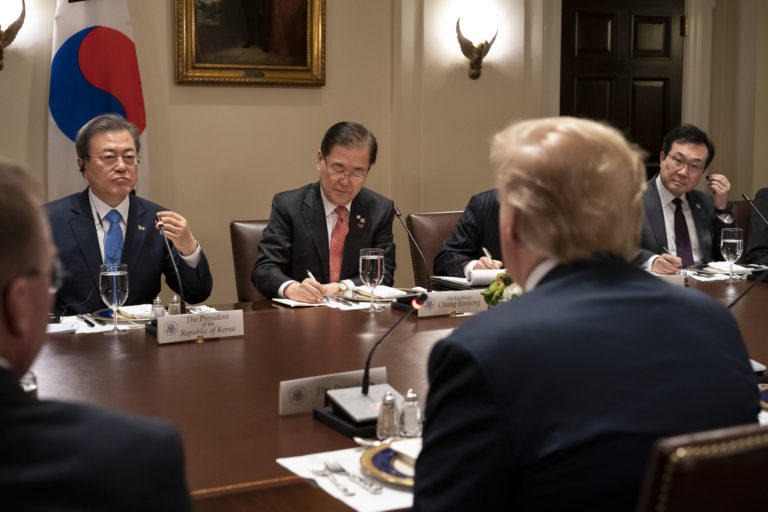
Moon facing Trump in DC, April 11, 2019. (White House/ Shealah Craighead via Flickr)
The importance of the Moon–Trump summit, while eclipsed by news of Julian Assange’s arrest in London the same day, is not be underestimated. Even before receiving Moon, Trump announced for the first time that he is willing to summit with Kim for a third time. While still stressing the North’s complete denuclearization as the U.S. objective, Trump also said he is open to the incremental diplomacy he precluded with his everything-at-once offer in Hanoi.
“There are various smaller deals that maybe could happen,” Trump said before he and Moon withdrew to the Oval Office. “Things could happen. You can work out step-by-step pieces, but at this moment we are still talking about the big deal.”
New Stance
This new stance is a big deal in itself. Moon and Kim — with Chinese and Russian support — have advocated talks based on gradualist reciprocity from the first. “Action for action,” Moon calls it. This strategy is widely accepted at the other end of the Pacific as the only plausible path to a sustainable denuclearization agreement. The U.S. has been the only nation engaged on the Korean question to argue otherwise.
In addition, Trump appeared to signal that Moon may get something he dearly wanted when he arrived in Washington: dispensation to proceed with inter–Korean economic projects — including transport links, an industrial park, and a joint-venture resort in the North — that are now blocked by a plethora of U.S. and UN–imposed sanctions. Moon views these as essential confidence-builders and the first steps toward integrating the North into a Northeast Asian economic hub that will also include South Korea, China, and the Russian Far East.
In Pyongyang, Kim responded to the events in Washington when he addressed the Supreme People’s Assembly last Friday. The speech was carefully balanced between optimism and caution, the latter reflecting Kim’s view that he was betrayed in Hanoi when Trump marshaled an offer he could not possibly embrace. “I am willing to accept if the United States proposes a third North Korea — United States summit,” Kim told North’s legislative body, “on condition that it has a right attitude and seeks a solution that we can share.”
Kim had other things to add. “We don’t like — and we are not interested in — the United States’ way of dialogue, in which it tries to unilaterally push through its demands,” he said. “We don’t welcome — and we have no intention of repeating—the kind of summit meetings like the one held in Hanoi.” The North Korean leader went on to set a year-end deadline “for the United States to make a bold decision.”
While Washington and Pyongyang had sharply conflicting versions of what transpired in Hanoi — each blaming the other for the summit’s failure — there is now little question that the U.S. side was at fault. A post–Hanoi Reuters exclusive reports that, prior to their famously canceled lunch, Trump handed Kim a sheet of paper listing, in English and Korean, extensive U.S. conditions that began with “a blunt call for the transfer of Pyongyang’s nuclear weapons and bomb fuel to the United States,” according to the piece filed by Leslie Broughton and David Brunnstrom.
The English-language version of the letter, the Reuters team reports, went on to demand “fully dismantling North Korea’s nuclear infrastructure, chemical and biological warfare program and related dual-use capabilities; and ballistic missiles, launchers, and associated facilities.”
The Libya Model
In simple terms, this was a kitchen-sink proposition — effectively a demand for unilateral disarmament — that was intended to prompt Kim to walk away. The Reuters reporters suggest that the fatal gambit was the work of John Bolton, Trump’s hyper-hawkish national security advisor. They quote North Korean officials as also implicating Secretary of State Mike Pompeo, another administration hawk, in what amounts to an act of diplomatic sabotage. The device used was Bolton’s “Libya model,” a laden reference if ever there was one. When Muammar Gaddafi gave up his chemical and nuclear weapons programs in 2003, he did so by sending Libya’s nuclear materials and equipment to the U.S. Eight years later, of course, he was assassinated in the wake of a NATO bombing campaign led by the U.S.
“The document appeared to represent Bolton’s long-held and hardline ‘Libya model’ of denuclearization that North Korea has rejected repeatedly,” Broughton and Brunnstrom report. “It probably would have been seen by Kim as insulting and provocative, analysts said.” One of those analysts was Jenny Town, a North Korea specialist at the Stimson Center in Washington. “‘This is what Bolton wanted from the beginning and it clearly wasn’t going to work,’” Reuters quotes Town as observing. “‘If the U.S. was really serious about negotiations, they would have learned already that this wasn’t an approach they could take.’”
Formidable Challenges
As this record of the Hanoi proceedings makes plain, Trump and Moon will assume formidable challenges to the extent they agree to work together toward a resolution of the Korea question on new terms. It is not clear why Trump — who went to Hanoi eager to cut his “big deal” with Kim — accepted the Bolton-inspired design and handed it on to the North Korean leader. But he has now set himself up for another in what appears to be a long line of conflicts with his foreign policy minders, Bolton and Pompeo chief among them.
The outlook in this connection is mixed at best. Trump was able to overrule new sanctions against North Korea that were announced several weeks after the Hanoi debacle. It is a matter of interpretation, but he effectively lost a battle with the Bolton–Pompeo axis when the administration designated the Iran Revolutionary Guard Corps a terrorist organization earlier this month. That move is understood widely to have pushed renewed negotiations with Tehran, for which Trump had been hoping, well beyond the point of no return.
For Moon, the challenges ahead are two. Most immediately, he must keep both Trump and Kim seated at the chess table between now and the end of the year. If no third summit is set by then, Kim has already signaled, he will consider this chapter in the long history of U.S.–North Korean negotiations closed — another story of failure. In such a case, the question facing Moon could hardly be more daunting: Can a South Korean leader determined to end nearly seven decades of enmity between the Koreas decisively wrest control of the diplomatic process from the U.S.?
That would amount to an unprecedented showdown between Seoul and Washington. Despite Moon’s admirable dedication, this is unlikely to materialize — not in the near term, in any case. Moon has formidable allies in Beijing and Moscow; Kim is plainly eager to break North Korea out of its isolation. But the U.S., perfectly satisfied to act as “spoiler” in Northeast Asia (as elsewhere), remains too powerful an obstacle despite the many signs that it is in the sunset phase of its global preeminence.
Patrick Lawrence, a correspondent abroad for many years, chiefly for the International Herald Tribune, is a columnist, essayist, author, and lecturer. His most recent book is “Time No Longer: Americans After the American Century” (Yale).
Pakistan Should Not Blindly Surrender to Modi Over Sikh Demonstrations
By Adam Garrie – EurasiaFuture – 2019-04-14
Sikh civil society groups have condemned Pakistan’s decision to ban activities of Sikhs peacefully campaigning for “Referendum 2020” in which Sikhs plan to defy New Delhi and exercise their democratic right to vote on the issue of self-determination. Next year, Sikhs intend vote “yes or no” on the question of whether Khalistan should be formed as an independent state that would separate from the Indian state of Punjab. Similar votes have happened throughout the world with a wide array of results.
In 2014, Scotland narrowly voted to remain part of the United Kingdom in such a vote whilst in 2017, in a vote that was not recognised by Spain, Catalonia voted to become an independent republic.
In Indonesia’s Western New Guinea (often referred to as West Papua internationally), there have long been calls for a new referendum after the initial vote in 1969 in which the region voted to integrate with Indonesia has been described as un-free and unfair to ordinary people in the region. Even more recently, the French overseas territory of New Caledonia voted to remain politically united with France. Perhaps the most politicised referendum in recent years was when Crimea voted to leave Ukraine and rejoin Russia. The result of this vote has been recognised by Russia, the DPRK and Syria but few other nations.
Of course, the world’s most controversial self-determination referendum is one that the UN first called for in 1948. This is the yet unrealised vote for self-determination in Kashmir.
In 2020, Sikhs in Indian Punjab are planning to hold a referendum on whether they want to form an independent nation known as Khalistan or whether they want to remain within India. India’s reaction thus far has been to browbeat, bully and threaten those who allow pro-Khalistan activities on their soil. Canada, Britain and some mainland European countries have refused to ban the Khalistan movement but India seems to have forced Pakistan’s hand in the matter.
While Pakistan has generally warm relations with the global and domestic Sikh community, it appears that Pakistan effectively succumbed to bullying from its militant BJP ruled neighbour. Of course, it is Pakistan’s domestic right to ban whatever political or activist groups it desires, including peaceful ones like the Khalistan movement. In this sense, the biggest problem is that Pakistan moved against a very small group of Sikhs who planned on hoisting banners and handing out literature at a time when India’s RAW continues to work with the Kabul regime to promote terrorism in Pakistan’s Balochistan province. Likewise, Indian occupation forces continue to inflict supreme violence against the civilians of Kashmir.
In this sense, Pakistan has leverage that it refused to exercise against India. If New Delhi is so desperate for Islamabad to prohibit insignificantly small groups of Sikhs from handing out non-violent political literature outside their places of worship, Islamabad could have said ‘we will only prohibit Khalistan activism if India gives Pakistan all of the details of the last 50 years worth of Indian meddling in Balochistan, ceases its promotion of terrorism in Balochistan via Kabul, begins a ceasefire in occupied Kashmir and renounces all forms of military violence as a means of conflict resolution with Pakistan’.
In other words, it takes two to tango. If India wants Pakistan to ban peaceful symbols of a Khalistan referendum on its soil, India had better cease fomenting violent separatism in south-western Pakistan. But in typically anti-strategic fashion, Pakistan simply capitulated to India’s bullying and got less than nothing for it. The concept of getting less than nothing for it can be proved by the fact that major pro-government Indian media outlets continue to claim (without evidence) that Pakistan is officially promoting the Khalistan movement in Indian Punjab when in fact the Khalistan movement’s presence outside of India is almost all in either Canada or the UK with other activists present in the United States and parts of continental Europe.
Forgetting any moral arguments, from a purely strategic view, Pakistan made a blunder. Islamabad could have asked India for something in return for actively prohibiting low level Khalistan activists and instead, Pakistan asked for nothing.
US Threatens Venezuela at UNSC as IMF Freezes Funds
Diplomatic battles rage on at international bodies such as the UNSC, the OAS and the IMF
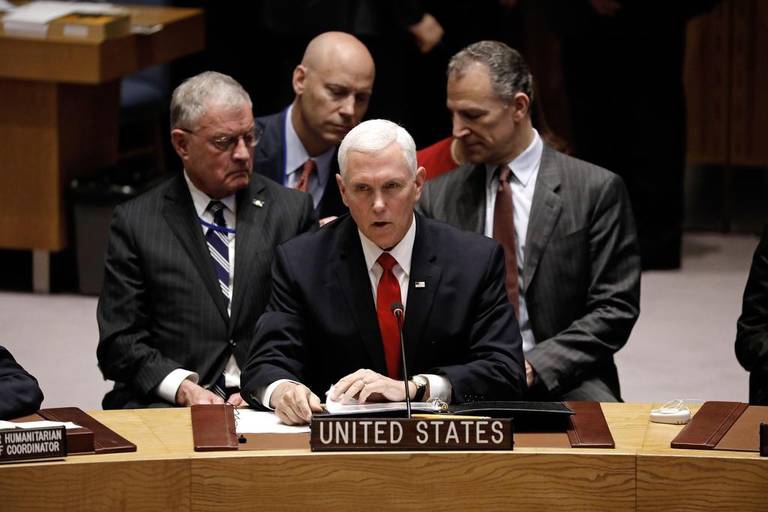
US VP Mike Pence called on the UN to recognize Guaido as Venezuela’s president. (EFE)
By Ricardo Vaz | Venezuelanalysis | April 11, 2019
Caracas – The United States pressured the United Nations to recognize self-proclaimed “Interim President” Juan Guaido during a Security Council (UNSC) meeting on Wednesday.
US Vice President Mike Pence told the UNSC that “the time has come” for the UN to recognize Guaido as Venezuela’s “legitimate president” and accept the latter’s representative to the world body. He added that the US would circulate a resolution to this effect, but offered no details on its timetable. A previous US resolution at the UNSC was vetoed by Russia and China on February 28.
Pence went on to reiterate the warning that “all options are on the table” to oust the Maduro government. “This is our neighborhood,” he told reporters afterward, calling on Russia to cease its support to the Maduro government.
Venezuela’s UN representative, Samuel Moncada, slammed what he called a “clear move to undermine” Venezuela’s rights, adding that his legitimacy depended on UN recognition and not on the declarations of the US vice president.
Russian ambassador Vassily Nebenzia accused the US of causing Venezuela “billions of dollars in losses” as a result of sanctions.
“[The US] deliberately provokes a crisis in Venezuela in order to change a legitimately elected leader for a US protege,” Nebenzia said in his speech.
Chinese representative Liu Jieyi likewise affirmed that Venezuelan affairs should be handled internally and criticized the imposition of sanctions, while his South African counterpart, Jerry Matjila, called for the UNSC to take a “constructive approach.”
Wednesday’s UNSC meeting came on the heels of a session at the Organization of American States (OAS) which approved Guaido’s appointment, Gustavo Tarre, as a representative to the body “until new elections are held.” The proposal had 18 votes in favor, 9 against, six abstentions and one absence.
Venezuelan authorities denounced the move as a violation of international law and of the OAS charter. The Foreign Ministry reiterated that Venezuela is due to leave the OAS on April 27, having started the process two years ago. Caracas denounced meddling in its internal affairs after the OAS had repeatedly tried to apply its democratic charter. However, it never managed to secure the necessary 24 votes.
Diplomatic battles surrounding Guaido’s recognition have extended to the International Monetary Fund (IMF). According to Bloomberg, the IMF cut off Caracas’ access to almost US $400 million in special drawing rights (SDR). While the IMF has shown no signs of recognizing Guaido, and lists Finance Minister Simon Zerpa as Venezuela’s representative, sources told Bloomberg that a government must be recognized by a majority of the Fund’s members to access its SDR reserves.
Venezuela remains mired in a deep economic crisis that has seen its international reserves shrink to around $9 billion. The cash crunch has been further compounded by US and allies freezing Venezuelan assets held abroad. In one such case, the Bank of England has refused to repatriate an estimated $1.2 billion worth of Venezuelan gold held in its vaults.
International tensions have also flared around the issue of humanitarian aid, with US and Venezuelan opposition ultimately failing to force an estimated $20 million worth of aid across the Venezuela-Colombia border on February 23. The operation faced strident criticism from international agencies such as the United Nations and the Red Cross, who refused to take part in the “politicization” of aid.
During Tuesday’s UNSC meeting, UN aid chief Mark Lowcock stated that Venezuela is facing a “very real humanitarian problem” and talked about the need to step up UN efforts in the Caribbean country. UN Secretary General Antonio Guterres later tweeted that the UN estimates there are 7 million people in need of aid in Venezuela, and that the UN is working to increase its assistance “in line with the principles of humanity, neutrality, impartiality and independence.”
UN agencies have increased their work in Venezuela in recent months, most recently via an agreement between Caracas and the UN’s Central Emergency Resource Fund for US $9.2 million to address the health and nutritional impacts of the country’s severe economic crisis. President Maduro has also appealed for UN assistance in countering US sanctions to bring medicines and medical equipment to Venezuela.
Likewise, the International Federation of the Red Cross (IFRC) recently announced a scaling up of its activities in Venezuela, doubling its annual country budget to $60 million as part of an agreement with the Venezuelan government.
Maduro met a Red Cross commission headed by IFRC President Peter Maurer on Tuesday to coordinate the agency’s work in Venezuela. Maurer had previously met Foreign Minister Jorge Arreaza to “strengthen cooperation agreements.”
Featured Video
Seyed M. Marandi: Toward Total War in the Middle East
or go to
Aletho News Archives – Video-Images
From the Archives
The Geopolitics behind the War in Yemen (I)
By Mahdi Darius NAZEMROAYA | Strategic Culture Foundation | 30.03.2015
The United States and the Kingdom of Saudi Arabia became very uneasy when the Yemenese or Yemenite movement of the Houthi or Ansarallah (meaning the supporters of God in Arabic) gained control of Yemen’s capital, Sanaa/Sana, in September 2014. The US-supported Yemenite President Abd-Rabbuh Manṣour Al-Hadi was humiliatingly forced to share power with the Houthis and the coalition of northern Yemenese tribes that had helped them enter Sana. Al-Hadi declared that negotiations for a Yemeni national unity government would take place and his allies the US and Saudi Arabia tried to use a new national dialogue and mediated talks to co-opt and pacify the Houthis.
The truth has been turned on its head about the war in Yemen. The war and ousting of President Abd-Rabbuh Manṣour Al-Hadi in Yemen are not the results of «Houthi coup» in Yemen. It is the opposite. Al-Hadi was ousted, because with Saudi and US support he tried to backtrack on the power sharing agreements he had made and return Yemen to authoritarian rule. The ousting of President Al-Hadi by the Houthis and their political allies was an unexpected reaction to the takeover Al-Hadi was planning with Washington and the House of Saudi. … continue
Blog Roll
 Aletho News
- Pakistan-Iran talks secure LNG shipment to Islamabad through Hormuz
- Black Sea grain crisis puts global wheat supplies under pressure
- IRGC air defenses destroy another US MQ-1 drone over Strait of Hormuz
- Imran Khan’s entire immediate family detained in Pakistan ahead of mass protest demanding his release
- EU nation detains former presidential frontrunner
- Leaked: Britain’s Sham Conviction Of Hashim Thaci
- Seyed M. Marandi: U.S. Strike Imminent – Toward Total War in the Middle East
- Russia Voted Under Fire. Washington Is Loading the Tankers.
- 12 Things Your Oncologist Was Trained Not to Tell You
- Anthrax Attacks Paved Way for COVID-Era ‘Junk Drugs and Vaccines’
- If Americans Knew
- Israeli Attacks in Gaza Kill at Least Seven Palestinians Over Three Days, including Woman and Child
- Trump’s militarization of Washington DC as he pursues Israel’s war against Iran
- Why Israel Fears This Searing New Documentary
- Huckabee aide solicited cash gifts from Israelis
- This isn’t sci-fi, AI is already killing people
- ‘The Most Brutal Thing’: Investigation Reveals Execution of Elderly Woman in Rafah
- Inside Israel’s ‘soft’ ethnic cleansing plan for Gaza through the eyes of its victims
- New online database tracks pro-Israel political donations in the United States
- Israeli president pardons soldier convicted for killing wounded Palestinian
- Singer Ed Sheeran says his ‘heart broken’ by Gaza devastation, addresses Macklemore controversy
- No Tricks Zone
- 2025 Nature Paper Claiming Worsening Global Drought Gets RETRACTED …Heavily Flawed
- New Study: ‘Global Drought Shows No Detectable Recent Acceleration Under Climate Warming’
- Economic Masterminds: German Socialists Suggest Taxing Productivity Gains Stemming From Using AI
- The South China Sea Has Not Been Cooperating With The Climate Change Narrative
- Energy Crisis: Germany Enters Heating Season With Historically Low Gas Reserve Fill Levels
- New Study: The Antarctic Ice Sheet Gained Mass From 2020-2024 Due To Staggering Snow And Ice Accumulation
- Study: Ocean Heating Rates From Thousands Of Years Ago ‘Dwarf’ Modern Ocean Heating Rates
- Climate Extremists Target, Attack Large-Scale Power Grid Infrastructure In Germany!
- New Study: Antarctic Ice Melt Has Contributed Less Than 1 Centimeter To Sea Level Rise In The Last 30 Years
- Fear Of Debate: Alarmist German Climate Scientist Calls On Mainstream Media To Discredit Skeptic Voices
 Aletho News