Venezuelan Embassy Besiegers Were ‘Elite’, Sought Gains from US Intervention
Sputnik – May 18, 2019
The angry mob of Venezuelan expatriates who laid siege to the Venezuelan Embassy in Washington, DC, earlier this month was composed of numerous figures with close ties to the inner structures of the US empire and who stood to benefit financially from a coup d’etat in Venezuela, investigative journalists told Sputnik Friday.
During the nearly three-week-long siege of the Embassy Protection Collective by opposition forces, numerous instances of harassment and violence were documented, including bigoted comments and slurs, physical struggles and the use of tools such as scuba lights, laser pointers and air horns to harass and intimidate the anti-war activists.
As journalists began to look into the footage, they also began to wonder: who are these people that form the Venezuelan opposition?
The struggle at the embassy, in Washington, DC’s historic Georgetown district, was essentially an extension of the struggle inside Venezuela. Since January 23, Juan Guaido has presumed to be Venezuela’s interim president — an office he’s recognized as occupying by the US and about 50 other nations, but which has no meaning on the ground in Caracas, where Guaido commands relatively few followers. Even internationally, three-quarters of the globe’s countries, as well as key international institutions like the United Nations and International Monetary Fund, continue to recognize Venezuelan President Nicolas Maduro, who was re-elected to a second term in May 2018.
Jeb Sprague, a lecturer at the University of Virginia and author of the forthcoming book “Globalizing the Caribbean: Political Economy Social Change and the Transnational Capitalist Class,” teamed up with journalist Alexander Rubinstein of MintPress News, who was embedded with the Embassy Protection Collective inside the embassy for nearly a month, including during the two-week period of the siege, from April 30 to May 13, to probe the internet for the identities of the people in the footage.
Their report, titled “Who’s Behind the Pro-Guaidó Crowd Besieging Venezuela’s DC Embassy?” was published on Thursday, just hours before US police stormed the facility and arrested the activists. Sprague spoke about their findings Friday with Radio Sputnik’s By Any Means Necessary.
The Embassy Protection Collective was formed on April 10 by anti-war activists in the United States who objected to Washington’s coup attempt in Venezuela and who saw the imminent delivery of the empty embassy to Guaido’s retinue as a major provocation that could lead to war. With the Maduro government’s permission and armed with international treaties recognizing the embassy’s legally inviolable status, the activists set up shop in the facility, where they soon came under attack by pro-Guaido protesters seeking to either storm the embassy or starve the collective out.
“In the beginning of their siege, their first week or two, they were really, extremely homophobic, racist — I mean, you don’t have to take my word for it, you can look on Twitter and in our article and all the links to all, you know, they are just videotaped, time after time, yelling out all this stuff,” Sprague said.
“But then what we found is they have these sort of like, PR/marketing strategists, people that came in after that initial period and they really tried to alter how people were perceiving that mob… and so you had media outlets like the New York Times, Vice Magazine… they came in. So, when they would come to the siege, there were these people who were put up by the mob for them to be interviewed.”
Sprague said one woman who became a “poster child for the pro-Guaido mob,” Dilianna C. Bustillos, “she’s actually a senior manager at Oracle, which is one of the largest companies in the world, a tech company that works with defense companies and makes like a $40 billion a year annual revenue… she’s a senior manager there. She previously volunteered with Visión Democrática, which is a pro-opposition group which is connected with a lot of the people who are working with Juan Guaido in DC.”
He noted many of the figures they identified were connected to a series of meetings at the Center for Strategic and International Studies (CSIS), a hawkish US think tank in Washington, DC, where pro-Guaido figures and shadow government officials helped plan a US invasion of Venezuela.
“They’ve started this website called ‘Ask a Venezuelan,’ and so, constantly on Twitter there’s like this mantra… they’re saying ‘ask a real Venezuelan,’ ‘ask a Venezuelan.’ And so, we started a thing called ‘Ask an Upper-Class Venezuelan;’ when we researched who they are — like the woman that founded that group, ‘Ask a Venezuelan,’ she has a $4 million a year company, and she had put out tweets supporting the guarimbas, which were these really violent protests, called for the US Marines to land in Venezuela. So one after another,” Sprague told hosts Eugene Puryear and Bob Schlehuber.
“And then we started looking at more of the people that were at the protests, and we found one guy who was a senior architect at Raytheon, the arms company. It was like, every time we looked at a person, their background in DC — two people that worked for CSIS, one that’s been working for the World Bank, another one for the Inter-American Development Bank — that guy actually got caught yelling out a lot of racist, sexist epithets.”
“One of the most interesting guys Cesar Caminero, we documented him as being there, and when I found his LinkedIn page, it said that he works for this tech company, and he does work for the [US Department of Defense], and he brags on his LinkedIn that he has this active secret clearance,” Sprague said. “And there’s this other guy who was doing tech work for US intelligence, so it was just fascinating that we could see just, one after another, people were either working with like, an international financial institution, an arms or military-oriented contractor or a hawkish think tank funded by the Gulf [monarchies] and big arms companies.”
“We figured out there’s this built-in base of these elite members, professional people in the diaspora, that basically advocate for regime change and escalation of conflict where they can really gain or benefit through US intervention,” Sprague said.
Indeed, Guaido himself is an alumnus of The George Washington University, located in Washington, DC’s Foggy Bottom neighborhood.
“Even if the embassy defenders got pushed out, I think it was still a victory in really illuminating the crimes of the Trump government and showing how violent these people are that they work with,” Sprague said.
US warns airlines risk ‘miscalculation or misidentification’ over Persian Gulf
RT | May 18, 2019
In a chilling reminder of the downing of Iran Air flight 655 by a US missile, an FAA notice said civilian aircraft flying over the Persian Gulf and the Gulf of Oman are currently at risk of “miscalculation or misidentification.”
A Notice to Airmen (NOTAM) published by the US Federal Aviation Administration (FAA) late on Thursday said the risk stems from “heightened military activities and increased political tensions” in the area. Airliners operating in the region may also “encounter inadvertent GPS interference and other communications jamming” the warning said.
The tension in the proximity of Iran comes as the US deployed additional military assets in the region, including an aircraft carrier strike group and a battery of Patriot anti-aircraft missiles. Washington said it was a response to an undefined threat posed by Iranian forces. The US also withdrew non-essential personnel from diplomatic missions in Iraq. The show of force was reportedly triggered by intelligence provided by Israel.
For some, the FAA warning may bring back the dark memory of the 1988 incident, in which an American guided missile destroyer shot down an Iranian airliner, killing 290 people on board. It happened two months after the US sunk an Iranian frigate and a gunboat in retaliation for an incident a few days earlier, in which a US warship struck an Iranian mine.
Washington said the crew of the USS Vincennes misidentified Iran Air flight 655 for a warplane trying to attack the warship and acted in self-defense. The government rejected accusations that US military service members had acted recklessly, with President George H.W. Bush infamously declaring: “I will never apologize for the United States – I don’t care what the facts are… I’m not an apologize-for-America kind of guy.”
The US did pay compensation to the families of the victims, but never accepted legal liability or apologized to Tehran.
US orders departure of non-emergency employees from Iraq
Press TV – May 15, 2019
The US State Department has ordered the departure of non-emergency government employees from Iraq, following Washington’s repeated expressions of concern about so-called threats from Iran’s allies in the Arab country.
The State Department ordered the pullout of the employees from both the US Embassy in Baghdad and its consulate in Erbil, the embassy said in a statement on Wednesday.
“Normal visa services at both posts will be temporarily suspended,” it said, recommending that those affected depart as soon as possible.
“The US government has limited ability to provide emergency services to US citizens in Iraq,” it added.
It was unclear how many staff members would leave.
US Secretary of State Mike Pompeo made an unannounced trip to Iraq on Tuesday, pressing Iraqi leaders about what he alleged were the increased dangers to Americans there from Iranian forces and their allies.
Despite this, the British general overseeing the so-called US-led coalition forces in Syria and Iraq has asserted that there has been “no increased threat from Iran” amid the US military buildup in the Persian Gulf.
British Major General Chris Ghika said at a Pentagon news briefing Tuesday that the coalition has seen “no increased threat from Iranian-backed forces” in the two countries.
The coalition has observed “no change in their posture since the recent exchange between the United States and Iran and we hope and expect that that will continue… We don’t see an increased threat from them at this stage,” Ghika told reporters.
Iraqi Prime Minister Adel Abdul-Mahdi said on Tuesday he was getting indications from talks with both the United States and Iran that “things will end well” despite the rhetoric.
The administration of US President Donald Trump has been ratcheting up economic and military pressure on Iran.
The US has deployed a carrier strike group and a bomber task force to the Middle East to confront what the Trump administration claims are “clear indications” of threats from Iran.
Zainab Walks On Her Feet, Ivanka Uses Government Money for Secret Services
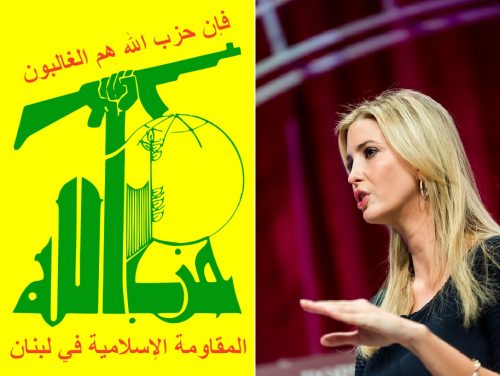
Image: Hezbollah Flag (L), Ivanka Trump (R). Credit: Public Domain/ Fortune Conferences
By Heba Mourad | American Herald Tribune | May 10, 2019
I entered the hotel apartment where a dozen ladies were sitting together. They were in Tehran for a conference on the status of women in Islam. Among the ladies sitting was a young lady in her 30s. I had seen her before in a public event in Beirut some two years ago. I went to the hotel to see a friend, and then I thought, why not see if I can socialize and get to know her up close. I had to go soon, loads of unfinished work was waiting for me at my office.
The next day, I decided to take some distance from office work and go on a short trip to accompany the ladies who were traveling to another Iranian city. And I did get lucky when I had the seat right next to her on the flight. Well, I forgot to introduce her to you; she is the daughter of the man Israel fears to death. Zainab, the daughter of Hezbollah Chief Sayed Hassan Nasrallah and I spoke all the way during that flight. We later had a long talk as well during the night after dinner.
She told me about her childhood memories, her relationship with her dad, her brother who was martyred while defending Lebanon in face of Israeli occupation, her mother who she thinks highly of, her life as a woman, a mother and a Lebanese citizen, and the list goes on.
Let all the details aside, what is so amazing about this young lady who is 33 years old and a mother of four children is that you totally forget she is the daughter of the Hezbollah chief. She is so humble and friendly. My plan was first to write about her memories with her dad in particular, especially that she does not usually talk to the media. I thought many might be curious to know more about this Nasrallah family member. I stayed with the group for one day at the hotel; we socialized and had food together. And again, I kept forgetting she is the daughter of so and so.
Rumors about this lady and her family have been circulating throughout the years. Some say she is arrogant, others say she and her family enjoy a luxurious life and spend the money of the people. Other times I hear some claiming that she lives somewhere underground and she does not go out without escorts and body guards.
She keeps a smile on her face all the time and she makes sure she is an average person in her society in terms of finances and spending.
“I go out alone, I do my own shopping and I do not have any bodyguards to escort me,” she told me. She likes keeping a simple life style and she says she is not poor, but would say she lives like any other middle-class person in her country. She joined the group of ladies all the time in the lunches and dinners, and shared a room with a couple of ladies. It felt like I had known her forever.
On that day, she was wearing her neat black gown known as the ‘Abaya’ and a pair of Sketchers. Taking pictures with the group here and there, they made jokes on how these should remain out of media’s reach to keep a low profile. She does not like being in the lime light and she likes having a normal and simple life. She told me how she enjoyed moments with her father, and how she looks up to him not only as a father but also as a leader.
She told me that the trait she likes the most about her father is how humble he is, and she tries to be always like him and teach this to her kids as well. Maybe I will not write down what I decide to keep to myself for the time being; a long and colorful discussion with the First daughter of the resistance movement.
For a second, I stopped to think: this young lady who can abuse the power of her father respects people and their feelings so much and practices what her father preaches. Her father, put on the terror list by the US is the one who taught this girl good manner. She said she always listens to his advice. “When it comes to society, I listen to his advice a lot. He knows what is best and always urges us to be respectful of the people and their feelings and that we should always set a good example.”
“I can say we are considered as middle-class. We are not poor and I thank God for providing us a decent life. However, even if we were super rich we would not have use that money to live a luxurious life. We are part of our society and we should share a similar living.”
On the other side of the planet, there exists another daughter of a famous man who has become notorious in the eyes of many, Ivanka Trump. First daughter and US presidential adviser Ivanka Trump and her husband, Jared Kushner, vacationed at a luxury resort in the Dominican Republic over a long weekend in August. The cost to US taxpayers: more than $58,000.
Also, a week-long Aspen ski vacation taken in March 2017 by Ivanka Trump, Eric Trump, and their families cost taxpayers at least $330,000 in security costs, plus thousands more in ski equipment rentals for the agents assigned to shadow the family on the slopes, according to records obtained by CBS News.
That other side of the planet is the one that keeps trying to impose “otherness”, wars, supremacy across the globe, and is inconsiderate of its own people. As Ivanka and the American ruling family enjoy luxurious hotel rooms and secret services, the Children’s Defense Fund (CDF) said in a new report that about 13 million American children are living in homes with incomes below the poverty line, depriving many of a decent education and proper nutrition, and putting them at risk of homelessness and violence.
The US Secret Service has allocated more than $90,000 for golf cart rentals in South Florida in the winter of 2018, ostensibly to protect President Donald Trump while he hits the links. Critics call the family’s frequent travel exorbitant and wasteful and insist the Trump family can afford their own security. It is okay for a president to use secret services but not to go (cheat) on golf courses, travel for the weekends or even allow his family to use that for personal and business trips.
This is while the head of the Hezbollah resistance movement lives a normal life and does not seek any luxuries, but rather dedicates all his time to protect Lebanon and the Lebanese in face of the US’s number one ally; the Israeli apartheid regime.
And the Israelis seem to fear Hezbollah more than ever. Israeli newspaper Yedioth Ahronoth quoted Yuval Steinitz, Israel’s Minister of Energy, saying that “Hezbollah missiles may target all of Israel. Zionists consider Hezbollah a very dangerous and highly experienced enemy.”
The Israeli Defense Forces, referring to the precision of the Lebanese Hezbollah missiles, writes: “Hezbollah is capable of targeting Israel’s critical facilities, and the 2006 Lebanon War seems nothing compared to a conflict with Hezbollah in future.”
Daniel “Danny” Rubinstein, an Israeli journalist, said that “Hassan Nasrallah is a great figure. Gamal Abdel Nasser fought for six days, but Hassan Nasrallah kept Israelis four weeks in their place in 2006.”
Now if you do not read history or keep up with the news, do not mistakenly think that Hezbollah is behind all the trouble in the region as Western mainstream media try to put it. Hezbollah is a Lebanese political party, as legitimate as any other in Lebanon. It was formed only when the Israeli apartheid regime decided to attack Lebanon, what people in the region used to call the ‘bride of the Middle East’.
Hezbollah has been defending the region in face of Israeli attacks and it has been standing firm in the face of terrorist groups like Daesh, al-Qaeda and al-Nusra front.
Back to where this all started; great people enjoy humility. Many say humility is weakness; however, a short but sufficient explanation would be that of Dr. Robert Hogan, founder and president of Hogan Assessments who was quoted by Forbes as explaining “Humility is the psychological opposite of narcissism.”
It is an underrated leadership quality. To be humble is not to think less of oneself, but to think of one-self-less, and this is what I think my story today should be all about.
13 attacks by Israel settlers on Palestinians over two-week period

MEMO | May 10, 2019
Israeli settlers carried out 13 attacks against Palestinians in the occupied West Bank over a two-week period 23 April-6 May, reported United Nations OCHA.
According to the monitoring body, the attacks “resulted in the injury of three Palestinians” as well as in “damage to Palestinian property across the West Bank”.
In one incident, “a group of Israeli settlers, some of whom were armed, physically assaulted and injured three Palestinian men, who were surveying land” in Kafr Ni’ma village near Ramallah.
Meanwhile, “Israeli settlers accompanied by the Israeli army, vandalized Palestinian property in Ein Harrasheh water spring and a public park in Area B of Al Mazra’a Al Qibliya village” near Ramallah on five separate occasions over the two-week reporting period in question.
OCHA added that, “according to local community sources, Israeli settlers threw stones at two houses, harassed Palestinians, and vandalized water pipes and park infrastructure.”
In ‘Urif village near Nabuls, settlers stoned the boys’ school and surrounding houses, leading to confrontations with local residents, the settlers, and “the Israeli forces accompanying them”.
Israeli settlers also vandalised 51 olive trees, punctured the tyres of 12 Palestinian vehicles, sprayed so-called “price tag” graffiti on four Palestinian houses and caused damage to a shop in Burqa (Ramallah), Isla (Qalqiliya), Huwwara (Nablus), Al-Ganoub (Hebron) and in the H2 area of Hebron.
OCHA noted that “since the beginning of 2019, the bi-weekly average of settler attacks resulting in Palestinian casualties or property damage has witnessed a 40 and 133 per cent increase, compared to the biweekly average of 2018 and 2017.”
Iran says not doing anything in breach of JCPOA
Press TV – May 7, 2019
Iran says the countermeasures it has vowed to unveil Wednesday are all within the framework of the 2015 nuclear deal, and the country is not leaving the Joint Comprehensive Plan of Action (JCPOA).
The remarks were made by Foreign Minister Mohammad Javad Zarif upon his arrival in the Russian capital Moscow, where he plans to hold talks with his Russian counterpart on the Iran nuclear deal, among others.
Speaking to reporters on Tuesday night, he said Iran’s “strategic patience” with the US’ violations of the nuclear accord during the past year is over.
“Unfortunately, the European Union and other members of the international community were not capable of standing up to the US’ pressures,” Zarif said.
Therefore, he added, Iran has decided to stop implementing some of the JCPOA commitments it used to fulfill voluntarily “for now”.
The Iranian top diplomat said the right to stop implementing commitments partially or in full in case of violation by other parties has been preserved for Iran in the JCPOA.
So Iran is not doing anything against JCPOA now; rather, it is acting totally within the framework of Articles 26 and 36 of the deal, Zarif noted.
He described the move as “an opportunity for other parties to the deal to take required measures, and not just issue statements.”
Zarif also noted that the decision has been passed by the Supreme National Security Council, and its details will be announced on Wednesday.
Iran said on Monday it seeks to unveil its countermeasures in response to the US’ 2018 withdraw from the landmark 2015 nuclear agreement signed between Tehran and six major world powers.
The plans will be announced on Wednesday, which marks the first anniversary of the US withdrawal from the nuclear deal.
US President Donald Trump withdrew Washington in May 2018 from the landmark Iran nuclear agreement, reached between Iran and the P5+1 group of countries — the US, Britain, France, Russia and China plus Germany — in July 2015. He also decided to re-impose unilateral sanctions against Tehran.
France threatens to re-impose bans
Sources at the French presidency said on Tuesday international sanctions could be re-imposed on Iran if it reneges on commitments under its nuclear deal.
A French presidential source said the European countries did not yet know precisely what steps Iran was now planning, but they could have to re-impose sanctions on Iran if those steps amount to reneging.
“We do not want Tehran to announce tomorrow actions that would violate the nuclear agreement, because in this case we Europeans would be obliged to re-impose sanctions as per the terms of the agreement,” the source said.
“We sent messages to Tehran to say that we were determined to implement the agreement, that we really wanted them to stay in this agreement even though we took into account the complexity of the situation and passed on the same messages to our American allies.”
A second French official later said that if Tehran failed to comply with the deal, the issue would be treated through a dispute mechanism under the accord itself, which could lead to the re-imposition of UN Security Council sanctions.
Letters to P4+1
Iranian President Hassan Rouhani is expected to write letters to the countries still signed up to the deal – Britain, France and Germany as well as Russia and China – on Wednesday to give them details about plans to “diminish its commitments” under the deal, ISNA quoted a source as saying.
The letters would be handed over to the ambassadors of the five countries by Deputy Foreign Minister Seyyed Abbas Araqchi. A separate letter would also be written to EU Foreign Policy Chief Federica Mogherini.
The Palestinian Authority is No Longer Crying Wolf Over its Imminent Collapse
By Jonathan Cook – The National – May 5, 2019
We have been here many times before. However, on this occasion even the principal actors understand that the Palestinian Authority is not crying wolf as it warns of imminent collapse.
The crisis is entirely of Israel and Washington’s making. Keen to pander to hawkish public opinion in the run-up to last month’s election, Israel’s Prime Minister Benjamin Netanyahu struck a severe blow against Mahmoud Abbas and his government-in-permanent-waiting.
He announced that Israel would withhold a portion of the taxes it collects on behalf of the Palestinians, and which it is obligated under the Oslo accords to pass on to the PA, based in the West Bank.
The money deducted is the sum the PA transfers as stipends to the families of political prisoners and those killed and maimed by the Israeli army.
This is an incendiary issue, as Netanyahu well knows, given that Palestinians view these families as having made the ultimate sacrifice in the struggle to liberate their people from brutal Israeli occupation.
Abbas cannot be seen to back down, and so has refused to accept any of the monthly tax transfers until the full sum is reinstated, amounting to nearly two-thirds of the PA’s revenues.
Given how precarious Palestinian finances are, after decades of resource theft and restrictions on development imposed by Israel, the PA is already on the brink of bankruptcy.
The problem for Netanyahu and Washington is that the PA was established – under the 25-year-old Oslo accords – to take the pressure and costs off Israel of policing the Palestinian population under occupation.
If the PA collapses, so do the Palestinian security forces that have been keeping order in the West Bank as Israel has continued to plunder Palestinian land and resources.
Late last month the United Nations warned that the standoff had left the PA facing “unprecedented financial, security and political challenges”.
Which means that, despite his recent electoral triumph, Netanyahu is in a serious bind.
He cannot be seen by his even more right-wing coalition partners to be climbing down and restoring stipends to people Israelis view simply as “terrorists”.
Equally, he dares not risk a Palestinian uprising in the West Bank. That would be a real possibility if the Palestinian economy implodes and there are no Palestinian security forces to suppress the resulting wave of popular anger.
A preview of the difficulties in store was given at the weekend, when more than 600 rockets were fired out of Gaza, threatening the cancellation of the Eurovision song contest in Israel later this month.
By Sunday evening, four Israelis were reported dead, while 20 Palestinians had been killed by Israeli airstrikes. The Palestinian fatalities included two pregnant women and a toddler.
There is also the danger, from Israel’s point of view, that if Abbas’s PA collapses, the void in the West Bank will be filled by his Hamas rivals, who run Gaza. Israel has been delighted to keep the Palestinian territories divided under feuding Fatah and Hamas leaderships.
A way out – or a change of tack – is urgently required.
Israel has tried twice to quietly make partial tax transfers to the PA’s bank account, in the hope the money would be accepted. The PA returned it.
Then, the European Union stepped in. Ostensibly an “honest broker”, it appears to be occupying a role the Trump administration has formally abandoned. The EU proposed last week that the PA accept the transfers on a “provisional basis”, until the crisis can be resolved.
PA officials were dismissive. “Let the people take to the streets,” one said. “We have our backs to the wall.” The PA line is that in the current climate, if it backtracks, Israel will simply intensify unilateral measures harming the Palestinian cause.
So now, more in desperation than any realistic prospect of achieving peace, attention is turning to Donald Trump’s long-promised “deal of the century”.
After endless delays, the US administration now seems to be preparing for its release next month, soon after the holy month of Ramadan finishes.
The plan’s main architects, Trump’s son-in-law Jared Kushner and his Middle East envoy Jason Greenblatt, have issued a spate of statements hinting at the contents.
Greenblatt has sought to reassure neighbouring Egypt and Jordan that they will not shoulder the burden. He discounted rumours either that Gaza’s Palestinians would be encouraged to move to the Sinai, in a land swap that would allow Israel to annex parts of the West Bank, or that Jordan would find itself recast as an alternative Palestinian homeland.
Kushner, meanwhile, has strongly suggested that the goal of a two-state solution, implied by the Oslo process, will finally be jettisoned. “New and different ways to reach peace must be tried,” he has said.
He has also stated that the plan will stress “economic benefits” for the Palestinians and “security” for Israel.
David Friedman, Trump’s ambassador to Israel and a stalwart ally of Israel’s most extreme settlers, has recently added that Israel will maintain security control of the West Bank.
According to analysts, these statements suggest the White House is preparing the ground for an offer to the Palestinians of “limited autonomy” – an outcome Arab officials confirmed to The Washington Post.
Sensing the danger, 40 former senior European officials have signed a letter opposing any plan that creates a Palestinian “entity devoid of sovereignty, territorial contiguity and economic viability”.
“Limited autonomy” would be a reformulation of Israel’s long-running ambition to thwart permanently Palestinian hopes of statehood – a policy the late Israeli academic Baruch Kimmerling once termed “politicide”.
Since the late 1970s, the Israeli right has advocated hemming Palestinians into enclaves where they are denied sovereignty.
The model of disparate cantons, effectively operating as glorified municipalities and surrounded by a sea of Israeli settlers, is little different from that of “black homelands”, or Bantustans, established in apartheid-era South Africa.
Now, it seems, the Trump administration is ready to support this racist idea as a way to promote regional peace.
The Americans hope that, with a few sweeteners, the Palestinians can be made to swallow this bitter pill. It is an idea Netanyahu has advanced for some time, with his talk of “economic peace” – or what might be better termed “economic pacification”.
But the current impasse on taxes shows that buying off the Palestinians with bribes, in return for the abandonment of core national goals, may not prove so easy.
With the PA close to collapse, it is hard to see how Trump’s deal of the century can do anything other than speed up the authority’s demise.
Russia FM Blasts US Illegal ‘Methods of Blackmail’ Against Cuba
teleSUR | May 4, 2019
Russia’s Foreign Ministry urged the international community to unite in condemning the United States’ new anti-Cuban blockade measure, which came about after President Donald Trump lifted the waiver on Title III of the once-dormant Helms-Burton Act.
“We emphasize again that the methods of blackmail and pressure used by Washington are absolutely illegal. We call on all responsible forces to defend the U.N. Charter and international law in order to jointly put an end to the anti-Cuba blockade,” the Russian ministry said in a statement.
The ministry also pointed out that Washington is threatening more sanctions on Cuba in the vein of the “Monroe Doctrine” in an “overt encroachment” on the sovereignty of the Latin American nation.
The new sanctions were made known when United States Secretary of State Mike Pompeo announced that the Title II would come into effect on May 2, permitting U.S. nationals to sue Cuban entities or foreign entities operating on the island prior to the Cuban Revolution for damages.
Moscow said the measures are excessive since Cuba has repeatedly expressed readiness to resolve existing contradictions with the United States regarding bilateral issues.
The Helms-Burton Act is a bill passed by former U.S. President Bill Clinton in 1996. However, this is the first time that any U.S. administration has authorized its implementation.
“Through the devaluation of democratic principles and rejection of international legal norms, the U.S. neglects the values it promotes, creating obstacles for all countries leading a separate policy and refusing to follow Washington’s directions,” the Foreign Ministry noted.
Canada, the European Union as well as other countries have rejected the activation of the Helms-Burton Act, explaining that it violates the norms of international law.
US ends waiver on India’s Iran oil imports. What next?
By M. K. BHADRAKUMAR | Indian Punchline | May 3, 2019
China’s stance vis-a-vis the US sanctions against Iran’s oil exports is evolving. These are early days. Quite obviously, the Chinese assessment that Iran is not going to wilt under US pressure gives a realistic picture. But it means that there is a long haul ahead and India needs to do some creative thinking. In the improved climate of Sino-Indian relations, a window of opportunity is opening for New Delhi to take a coordinated approach with Beijing.
No sooner than the Trump administration announced in a statement on April 22 its decision that it will not extend the exemption period beyond May 2 for countries buying oil from Iran — so-called “waiver” — the Chinese Communist Party tabloid Global Times came out with an editorial acknowledging that the US decision poses a “tough choice.”
China is the biggest importer of Iranian oil. The Global Times editorial blasted Washington for this “typical manifestation of unilateralism and hegemony” and weighed in on China’s policy options. The editorial offered the following advice: “We think China should clarify its interests and principles surrounding the purchase of oil from the Middle East nation and strive to minimize the loss to China’s national interests.”
That is to say, first, China should no doubt “oppose the hegemonic approach of the US but it can’t take the lead in confronting the US on issues involving Iran.” China will push back at the US by rallying world opinion against its Iran sanctions, but will not take a confrontationist approach.
Second, “Beijing needs to coordinate with other major powers to respond to US sanctions against Iran… There is a need to strengthen coordination among countries. If the issue can be dragged, then let it drag. Otherwise, the issue can be modified. If it cannot be modified, let it be dealt with on a case-by-case basis.”
Third, “The operational safety of Chinese enterprises should be given priority and they have the right to continue to cooperate with Iran or withdraw, keeping in mind the situation on the ground.” The editorial sums up: “China does not want to have a showdown with the US over Iran, nor can Beijing just let Washington do what it wants… we cannot disregard principles or interests. This is a time to test wisdom.”
However, an editorial by the government-owned China Daily on April 23 was more forthright: “Major importers of Iranian oil, China included, have the legitimate right to have normal business ties and conduct trade with Iran, including importing oil from it, should they so choose. The Chinese government is committed to safeguarding the legitimate rights and interests of its enterprises and willing to play an active and constructive role in promoting the stability of the international energy market.”
Significantly, China Daily also hinted at willingness to make coordinated moves with other affected countries such as India.
China has skirted US sanctions against Iran before. This time around too, the likelihood of that happening is being discussed by western analysts. China will find the back door, inevitably. Apart from ship-to-ship transfers of oil, China also has the option to continue to buy some Iranian crude through the banks in China that are already under US sanctions.
The US-China trade talks do not complicate Beijing’s policy calculus on Iran oil. The trade negotiations envisage US exports of oil / LNG to China worth tens of billions of dollars. (The Wall Street Journal reported in March that in a move that would be announced as part of a broader US-China trade deal, China’s state-owned China Petroleum & Chemical Corp., known as Sinopec, will agree to a long-term contract to buy about $18 billion of liquefied natural gas from Cheniere,) This eases the US pressure on China.
On the contrary, the pressure is much higher on India, which meets 80% of its oil demand through imports. Iran used to be the third largest source of supply till the US butted in. The “waiver” allowed India to import 1.25 million tonnes of oil from Iran per month (which itself meant a 30% reduction in the level of imports).
Most important, India could avail of concessional terms, which meant a saving of around a quarter of combined costs due to favourable conditions such as prices, transportation and insurance. Equally, the rupee payment mechanism worked to India’s advantage.
India has to pay Iran in rupees for oil imports and money is deposited in a special account in India, which Iran uses to purchase humanitarian supplies such as rice and medicines from India. In essence, it was barter trade that committed Iran to buy Indian products, creating export earnings for Indian business.
President Trump is notoriously tight-fisted and will never compensate India for all this financial loss. On the other hand, he hopes to take the opportunity to expand US oil exports to India, which are not based on attractive trade terms. (Besides, why should India want Trump to navigate its energy security?)
Suffice to say, with the expiry of the “waiver” on May 2, India’s oil import costs (and its US dollar payouts) will rise, and its export revenue will decrease. India’s economic growth and exchange rate’s stability will come under great pressure. The expert opinion uniformly warns that the US sanctions against Iran will push up international oil prices, thereby increasing India’s overall oil import bills. Washington claims to be generous in leaving India-Iran cooperation over Chabahar port out of the purview of the sanctions. But the US sanctions will in due course severely stymie cooperation between India and Iran over Chabahar.
The question must be frontally asked: What are the US’ intentions toward India? New Delhi has reason to be worried about Washington’s real interests, long-term strategy and the uncertainty in ties with the US. The US’ interests and strategy appear to narrow down to using India to contain China.
Mike Pompeo has rushed to claim credit for the blacklisting by the UN of Masood Azhar. Sections of the Indian media are beside themselves with joy. But the same man went into hiding a couple of weeks ago when EAM Sushma Swaraj telephoned him in Washington seeking flexibility in the US sanctions against Iran oil.
According to media reports, EAM said India should be allowed to import Iranian crude for some more time without being impacted by US secondary sanctions, as the general election is underway in the country, and that the next government with a fresh mandate will take a final call on this issue.
But Pompeo ducked, pleading helplessness — only to resurface from hiding ten days later on May 1 with the astounding claim that his boys got China to lift the block on Azhar. What to make out of such friends?
Unfortunately, the government is waffling by claiming it is ready to deal with the impact of US sanctions against Iran by getting extra supplies from other oil producing countries to compensate for loss of Iranian oil. The matrix is not about the availability of oil — as explained above — but about the huge economic costs. Simply put, India is called upon to underwrite Trump’s maverick Iran policies.
From the Indian perspective, what matters most in the coming period will be the scope to create a trading bloc with China that would allow the two countries to buy Iranian oil without going through the US banking sector.
‘A Complete Failure’: Venezuelan Coup Attempts Staged ‘More For The US Audience’
Sputnik – May 2, 2019
Juan Guaido’s third attempted coup against Venezuelan President Nicolas Maduro has failed just like the rest, but that hasn’t stopped the US corporate media from turning it into a heroic mass uprising for Americans to see. An activist told Sputnik the coverage is setting the stage for a war, but that both Americans and Venezuelans would resist it.
Guaido has claimed since January 23 to be Venezuela’s interim president, calling Maduro’s May 2018 reelection illegitimate. However, despite three attempts to divide the military ranks and raise a revolution in the country, Guaido’s opposition remains a small force that’s only proven capable of causing violence and chaos, not of grasping the hearts and minds of fellow Venezuelans.
Meanwhile, Washington officials continue to raise the specter of military force against Maduro’s government, which is still recognized by three-quarters of the globe’s countries as the legitimate government of Venezuela.
Radio Sputnik’s Loud and Clear discussed the situation with Gerry Condon, a Vietnam-era US veteran and peace resistor who is now the national president of Veterans for Peace and who recently returned from Venezuela; and Paul Dobson, a writer for VenezuelAnalysis.com, who reported from the Venezuelan city of Merida.
Dobson said the country Thursday seemed “relatively calm and stable” by comparison to earlier in the week.
“The events of Tuesday were to some extent, we can say, exaggerated by the international press,” Dobson noted. “There was definitely an attempted coup d’etat, but the extent to which Juan Guaido’s looking to grasp power was a lot weaker than he was perceived in the international corporate press.”
“Juan Guaido came out about five o’clock in the morning on Tuesday with a video message to his supporters saying he was taking a military base in Caracas with the support of ‘the main military units of the country.’ Both of these statements were later proven to be incorrect: he was outside the military base, not inside of the military base, and he had control of roughly 30 soldiers, of which about 25 were there, who later claimed they were tricked, according to their commanders. He later rejected their participation in this, and only 15 soldiers were left, essentially, on the side of Juan Guaido,” Dobson said.
“Thereafter, we saw significant civilian demonstrations across the country, principally in Caracas, but in other cities as well,” the writer told Sputnik. “We saw attempts by Juan Guaido’s supporters to both pressure through peaceful means but also violence the local military commanders to rebel against their chain of command, all of which was unsuccessful. By the end of the day, we saw Juan Guaido’s mentor and main political ally, Leopoldo Lopez, flee to both the Chilean and then later Spanish Embassy, where he is still holed up, and Juan Guaido went on record by calling his people onto the streets and to continue his struggle on Wednesday.”
Video recorded Tuesday and broadcast on Venezuelan television showed Venezuelan army soldiers taking back armored cars seized by the opposition.
“So yesterday, May Day, the government, who had already planned a traditional May Day march for the workers, made a new call for the people to come onto the streets and defend the national territory from this attempted coup d’etat — and the people responded,” Dobson said. “The march seen in Caracas has been described by many analysts as one of the largest Chavista marches in recent years.”
Dobson noted the opposition also “held an activity in eastern Caracas” that was “considerably smaller” and turned violent in the evening hours amid confrontations with the police and national guard, resulting in one death.
“Juan Guaido is free, still roaming the streets, but it can only be considered a complete failure for him, both in terms of achieving his political objectives, but also any sort of projection of power or domination here in the country. He is looking weaker now than he ever has been in the past,” Dobson said.
Condon told Sputnik that during his trip to Venezuela just before the most recent coup attempt, there was “no visible support for the opposition whatsoever” in the large, poor, working class districts. “I doubt, frankly, that Juan Guaido would even dare set foot in those barrios. He’s not welcome there. There’s a huge class divide; the opposition is largely white, middle class, of course led by wealthy ultra-right [wing] oligarchs, and they have even attacked people of color at those opposition marches, because if you have dark skin, you’re assumed to be a Chavista — a supporter of the government.”
Calling the most recent coup attempt a “Hail Mary pass, a hope and a prayer,” Condon said it seemed “staged more for the US audience. The real coup took place in the media… consistently [in] all of the mainstream media, there’s not a single voice you hear on the media against the US intervention, against the regime change effort. So it’s, in a sense, quite a big propaganda coup in the US media, aimed at the US people, perhaps preparing the way for a US military intervention.”
The activist said Veterans for Peace was calling on US soldiers to “resist participation in any military action” in Venezuela, noting that he expected “massive resistance” to such action, both on the ground by militias organized in the barrios, but also by the US soldiers themselves, who are “just fed up with having been deployed to one failed war based on lies after another.”
“I think that [US President Donald] Trump and his gang have kind of thrown down, they’ve kind of announced to the world that they are going to overthrow the Venezuelan government. I think they’re almost going to have to do something just to try to save face,” Condon said. “But I think their options, nonmilitary and military, are very limited, and I’m hopeful the resistance in Venezuela and around the world in solidarity with the Venezuelan people is going to triumph, and we’re going to turn a corner in the history of this hemisphere.”
A Desperate Empire Crashes in Venezuela
By Maximilian Forte | Zero Anthropology | May 1, 2019
The April 30, 2019, coup attempt in Venezuela has come and gone. The coup has failed. “Failed state” theory just got a lot more complicated. No longer can the “failed state” designation apply only to those states targeted for recolonization after a prolonged period of destabilization and foreign intervention. Now “failed state” theory has to apply to a degenerate imperial state at its wit’s end, and to the failure of its proxies on the ground, as well as the failure of its invented political fictions to materialize. Even worse than any “failed state,” is the failure of aspirants to power who pretend to have power—namely, the incompetent Venezuelan opposition activist, Juán Guaidó. It’s time that even the few critical media outlets left stop dignifying Guaidó, opposition activist, with the title of self-declared “interim president,” because even that is too grandiose.
This so-called “interim president” is, by the tortured logic of Elliot Abrams, the president of an interim that has not yet begun. So that means he is not the interim president even. Or, he was the interim president, but his 30-day term (as specified by the Constitution), expired months ago. Or, he is still the interim president, but only if a defunct opposition body, that calls itself the National Assembly, believes it has the authority to unilaterally overwrite the Constitution—it does not, so he is still not even a self-declared interim president. This is what the US wants the world to recognize as “interim president”: a total fiction that cannot be sustained without reference to other fictions.
This bundle of fictions has not even been wielded by people who have the good sense to know when it’s time to shut up. No, instead the authors of these inventions spin even more, as if wanting to be spotted in all their foolishness. So we had the US government almost triumphantly declaring that it was withdrawing US diplomats from Venezuela—when Venezuela’s government was the one that ordered them out. Then we had US officials rejoice that Venezuela’s representatives had been expelled from the Organization of American States—when Venezuela already declared it was withdrawing from the OAS two years ago, and this month marked the final step in the process. Then we had the US State Department pretend that it could hand the Venezuelan Embassy in Washington, DC, over to representatives of an interim president of an interim that had not even started, or that already ended. One has to really have faith in the stupidity of audiences, and be unflinching about treating everyone as idiots, to mount such an absurd production in public. It also means that they literally have no shame.
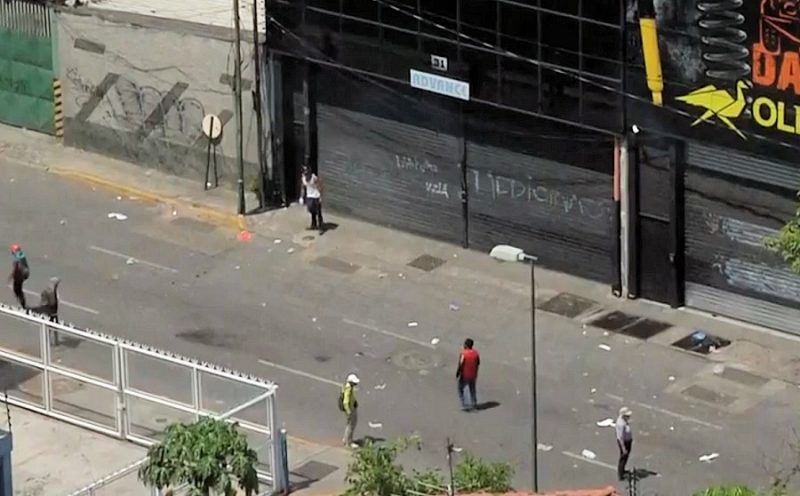
Impressive “uprising” you have there.
As a bad work of fiction, Guaidó could not mount even a lame imitation of a military-backed coup on April 30, which is just the latest in a long line of his failures this year. This character, unknown to 80% of Venezuelans a few months ago, leader of a minority party in a defunct parliament, who never campaigned for the presidency and was never elected to it—this same character posed in front of cameras and claimed military backing which he never had. So he calls on the resources of a hostile foreign power in the vain hope it make his fiction reality, clearly showing he understands nothing at all. Even worse: it shows a total lack of any care for all those who would suffer and die in war—Guaidó is ready to sacrifice them all. It’s an ill bird that fouls its own nest.
The response to Guaidó’s call? A few hundred violent protesters showed up, traded rocks with the Bolivarian National Guard, and then stood around talking to each other for hours on end. John Bolton, pushing US intervention in the name of keeping Venezuela free of external dominance (he knows no irony), even tried to nudge Venezuelans in a pitiful attempt at bribery, promising US economic relief if Guaidó took power. As far as attempted coups go, this was fortunately among the most pathetic, lame farces. There is now no resemblance between Venezuela 2019 and Libya 2011, where in the latter case opponents actually seized towns and cities and mounted protests that lasted days on end. What remains the same in the two cases is the determination of the US to implement through violent proxies a fiction of rule.
One also has to wonder how John Bolton, Mike Pompeo, and Elliot Abrams still have jobs today. Trump is not a tower of managerial business acumen after all—if one ever believed the fiction constituting his performance on The Apprentice. Bolton, who was most prominent during the April 30 coup farce, could not even keep himself from tripping over his own excremental attempt at a “narrative”. First, John Bolton called on the Venezuelan military to side with Guaidó—but then invalidated his call, turning around and asserting that, in any case, Venezuela was under (imaginary) Cuban occupation, and it was Cuban troops who were really in charge. So everything fell apart… because of Cuba, and thus Trump threatened Cuba with an embargo, which it has already been under for six decades. Cuba was the fiction used to mask another fiction—the only thing that was real here was how utterly ridiculous US empire has become.
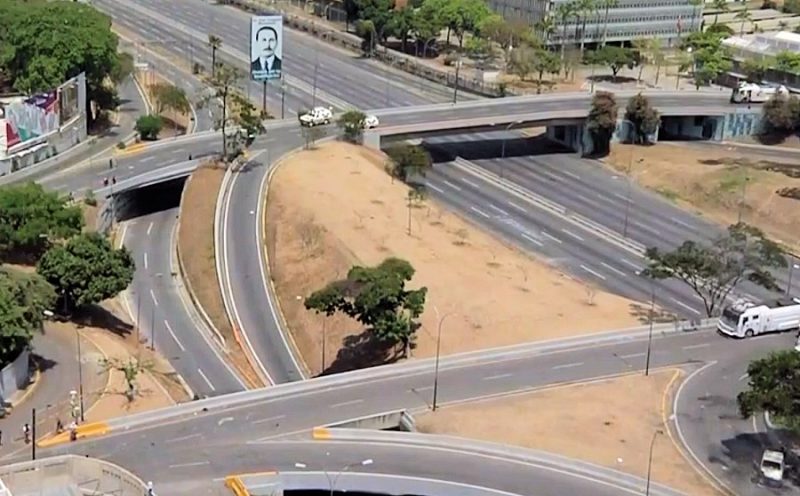
All the action, caught live on camera.
On the night of April 30, as I often do I listened to live radio from Caracas, where the assembled panellists spent a good amount of time engaged in the healthiest, most robust guffawing I have heard in ages. The subject of their laughter? Erik Prince, the war criminal who headed BlackWater and is now begging Trump for cash in return for a “plan”—a plan to send a grand total of 5,000 mercenaries to Venezuela. On RNV radio they wondered if the Americans had really become so stupid and psychotic to think that 5,000 clowns could take and hold so much as a bakery in a country which has 2,000,000 armed citizens in militias alone, not counting the hundreds of thousands in the armed forces and the paramilitary police. Apparently Prince mixed up Venezuela with Grenada—and even in Grenada it took US Marines a week to subdue armed opposition from a comparatively tiny group of diehard patriots.
Nothing is working for the US, not even what might be the most extreme sanctions ever imposed, and weeks of power outages. Certainly, none of the “humanitarian” theatre worked, whether it was the forced “aid” stunt, or the myth that Venezuelan troops set their fake aid on fire. The US was forced to imagine and fantasize about Maduro fleeing the country: witness Mike Pompeo’s bout of deranged lying about Maduro getting on a plane to Cuba, until Russia stopped him. Fictions, lies, propaganda, disinformation, fake news. To top it all off, the news came: this was not even a coup, you see. The real problem here, with such a monumental loss of face, in such a magnificent failure as April 30, is that the US will turn to even more desperate and thus more dangerous measures. However, that comes at a real cost: if the US invades, Trump has to go into an electoral contest with a new war on his back, and it’s not like such a war would come even close to a “cake walk”.
One has to wonder: will those national leaders who—without the authorization of their citizens—unilaterally “recognized” Guaidó as this so-called “interim president” thing, now take stock finally? Or will they cling to this science-fiction that there is a popular movement opposing Nicolás Maduro’s legitimate and very real government?
Clearly, very clearly as it was televised live worldwide all day on April 30 for all to see, Guaidó does not lead a popular movement. He has no authority, no legitimacy, and only a paltry amount of futile support. This so-called “uprising” was an embarrassing failure for his own image as a supposed leader. Then he takes shelter and says “tomorrow, more protests”—yes, junior, that will do the trick. Remember, sport, more always works, and besides, “there’s always tomorrow”. Keep at it, son.
This is what practice without theory looks like. This is what a “movement” without support looks like. This is what science-fiction looks like when it tries to escape the theatre and mingle with real people in the street.
Meanwhile, members of the Lima Group such as Canada, and those members of the European Union that have called for a “peaceful transition” in Venezuela, there is a lot for which they must answer. What “democracy” do they think it is where someone, not elected by the people, marshals the forces of violence in an effort to impose a government on a country? If this were to be done in their countries, would they accept it as democracy? This is the other outrageous fiction that we face: that we in North America live in democratic polities. Democracy should recognize itself in democracy—but when you instead recognize your partner in a violent clutch of putschists, then what are you?
Coup Attempt In Venezuela
Venezuelanalysis | April 30, 2019
Caracas – A military coup attempt is underway in Venezuela on Tuesday, April 30, with imprisoned right wing leader Leopoldo Lopez, and self-proclaimed “Interim President” Juan Guaido and some members of the armed forces blocking a highway in Caracas and calling on the military to rise up
According to reports, a group from Venezuela’s Sebin intelligence service freed Leopoldo Lopez from house arrest early Tuesday morning. Lopez then joined Guaido and a handful of members from different branches of the armed forces in the Altamira highway in eastern Caracas close to La Carlota airbase. Lopez and Guaido published videos on social media calling on other elements of the armed forces to join the uprising and on their supporters to take to the streets. Guaido vowed that this was the “final phase” in ousting the Maduro government.
The Venezuelan government promptly reacted, condemning the coup attempt and vowing that it would be defeated.
“We inform the Venezuelan people that right now we are facing and deactivating a small group of traitor soldiers who have positioned themselves on the Altamira overpass to attempt a coup against the state and the constitution,” Communications Minister Jorge Rodriguez tweeted.
The President of the National Constituent Assembly, Diosdado Cabello, spoke on state television, vowing that the uprising would be defeated and that those responsible would have to “assume their responsibilities.” He also called on the people and the Bolivarian militia to go out on the streets and defend Miraflores Palace.
For his part, Defense Minister Vladimir Padrino López reported that military units throughout the country reported total normalcy, and that the military remain loyal to President Maduro.
At the time of writing, Guaido’s followers are taking to the streets both in Caracas and other parts of the country, blocking roads in support of his new call for a coup. Minor confrontations with tear gas have been reported outside La Carlota air base in Caracas.
Guaido had previously called for the “largest march in Venezuela’s history” scheduled for Wednesday May 1, while a Chavista march celebrating workers’ day was also expected to take place.
Venezuela’s Defense Minister Vladimir Padrino rejected the coup attempt and said that the country’s legitimate military forces would respond to any attempt to overthrow the government of Nicolas Maduro.
“We reject this coup movement that aims to fill the country with violence. The pseudo-political leaders who have placed themselves at the forefront of this subversive movement have used troops and police with weapons of war on a public road in the city to create anxiety and terror.”
Featured Video
Seyed M. Marandi: Toward Total War in the Middle East
or go to
Aletho News Archives – Video-Images
From the Archives
The Geopolitics behind the War in Yemen (I)
By Mahdi Darius NAZEMROAYA | Strategic Culture Foundation | 30.03.2015
The United States and the Kingdom of Saudi Arabia became very uneasy when the Yemenese or Yemenite movement of the Houthi or Ansarallah (meaning the supporters of God in Arabic) gained control of Yemen’s capital, Sanaa/Sana, in September 2014. The US-supported Yemenite President Abd-Rabbuh Manṣour Al-Hadi was humiliatingly forced to share power with the Houthis and the coalition of northern Yemenese tribes that had helped them enter Sana. Al-Hadi declared that negotiations for a Yemeni national unity government would take place and his allies the US and Saudi Arabia tried to use a new national dialogue and mediated talks to co-opt and pacify the Houthis.
The truth has been turned on its head about the war in Yemen. The war and ousting of President Abd-Rabbuh Manṣour Al-Hadi in Yemen are not the results of «Houthi coup» in Yemen. It is the opposite. Al-Hadi was ousted, because with Saudi and US support he tried to backtrack on the power sharing agreements he had made and return Yemen to authoritarian rule. The ousting of President Al-Hadi by the Houthis and their political allies was an unexpected reaction to the takeover Al-Hadi was planning with Washington and the House of Saudi. … continue
Blog Roll
 Aletho News
- Pakistan-Iran talks secure LNG shipment to Islamabad through Hormuz
- Black Sea grain crisis puts global wheat supplies under pressure
- IRGC air defenses destroy another US MQ-1 drone over Strait of Hormuz
- Imran Khan’s entire immediate family detained in Pakistan ahead of mass protest demanding his release
- EU nation detains former presidential frontrunner
- Leaked: Britain’s Sham Conviction Of Hashim Thaci
- Seyed M. Marandi: U.S. Strike Imminent – Toward Total War in the Middle East
- Russia Voted Under Fire. Washington Is Loading the Tankers.
- 12 Things Your Oncologist Was Trained Not to Tell You
- Anthrax Attacks Paved Way for COVID-Era ‘Junk Drugs and Vaccines’
- If Americans Knew
- Israeli Attacks in Gaza Kill at Least Seven Palestinians Over Three Days, including Woman and Child
- Trump’s militarization of Washington DC as he pursues Israel’s war against Iran
- Why Israel Fears This Searing New Documentary
- Huckabee aide solicited cash gifts from Israelis
- This isn’t sci-fi, AI is already killing people
- ‘The Most Brutal Thing’: Investigation Reveals Execution of Elderly Woman in Rafah
- Inside Israel’s ‘soft’ ethnic cleansing plan for Gaza through the eyes of its victims
- New online database tracks pro-Israel political donations in the United States
- Israeli president pardons soldier convicted for killing wounded Palestinian
- Singer Ed Sheeran says his ‘heart broken’ by Gaza devastation, addresses Macklemore controversy
- No Tricks Zone
- 2025 Nature Paper Claiming Worsening Global Drought Gets RETRACTED …Heavily Flawed
- New Study: ‘Global Drought Shows No Detectable Recent Acceleration Under Climate Warming’
- Economic Masterminds: German Socialists Suggest Taxing Productivity Gains Stemming From Using AI
- The South China Sea Has Not Been Cooperating With The Climate Change Narrative
- Energy Crisis: Germany Enters Heating Season With Historically Low Gas Reserve Fill Levels
- New Study: The Antarctic Ice Sheet Gained Mass From 2020-2024 Due To Staggering Snow And Ice Accumulation
- Study: Ocean Heating Rates From Thousands Of Years Ago ‘Dwarf’ Modern Ocean Heating Rates
- Climate Extremists Target, Attack Large-Scale Power Grid Infrastructure In Germany!
- New Study: Antarctic Ice Melt Has Contributed Less Than 1 Centimeter To Sea Level Rise In The Last 30 Years
- Fear Of Debate: Alarmist German Climate Scientist Calls On Mainstream Media To Discredit Skeptic Voices
 Aletho News