In a somewhat unprecedented move, Pakistan’s military will voluntarily cut the defense budget for the coming fiscal year as the cash-strapped Pakistan government launches a wide-ranging austerity program.
The move comes as tensions remain high between Pakistan and its neighbor India, but the Pakistan Armed Forces chief spokesperson, Major General Asif Ghafoor, assured people that the cuts will not come at the expense of security and defense and that the military would maintain “an effective response potential to all threats.”
Prime Minister Imran Khan expressed his gratitude that the military made such a gesture despite “multiple security challenges.” For his part, Khan has also made cuts, reportedly moving into a small three-bedroom house belonging to his military secretary since taking office last year.
Pakistan was the world’s 20th biggest military spender in 2018. It invested US$11.4 billion on its military, its highest level since 2004 and four percent of the country’s GDP.
“Not a small step at all, only a strong Civil-Mily Coordination can rescue Pakistan from the deep problems of Governance and economy… shows a complete trust on the leadership of PM by an important institution,” Science and Technology Minister Fawad Chaudhry said.
The funds will be re-allocated to develop newly-merged tribal areas and develop the region of Balochistan. All military and civilian institutions will be expected to contribute to the austerity budget which will be presented on June 11.
Merida – Canadian Foreign Minister Chrystia Freeland has announced the “temporary” closure of her country’s embassy and the withdrawal of diplomatic personnel from Venezuela, claiming Ottawa had “no choice.”
In a Sunday press statement, Freeland accused the Maduro government of having “taken steps to limit the ability of foreign embassies to function” by failing to renew visas for diplomatic personnel. No evidence was provided to support the claim. She additionally claimed that that the Caribbean country is “slid[ing] deeper into dictatorship.”
The measure is to take immediate effect, with diplomatic visas reportedly due to expire at the end of June. All embassy and consular services are to be transferred to the Colombian capital of Bogota over 1,500 kilometers away.
Freeland also indicated that Ottawa will “evaluate” the status of Venezuelan diplomats in Canada “appointed by Maduro.”
Canada was the second country to recognise Juan Guaido after he swore himself in as “interim president” on January 23. It has since continued to back Guaido’s attempts to oust the Maduro government and has begun to forge diplomatic relations with the opposition leader’s representative in Canada, Orlando Viera Blanco, who has held a number of meetings with government representatives and members of parliament in Ottawa and Vancouver. The Trudeau administration has also followed US President Donald Trump in imposing several rounds of sanctions on Venezuela.
It is unknown how many Canadian citizens in Venezuela this measure will affect, but recent opposition-led estimates suggest that there are up to 50,000 Venezuelans living in Canada.
The latest diplomatic spat follows a similar confrontation in March, when the United States and Venezuela both withdrew their diplomatic teams, severed diplomatic relations and vacated the embassies. The United States had likewise recognised Guaido envoy Carlos Vecchio as Venezuela’s representative in the country.
The diplomatic scuffle comes as Guaido’s team faces a setback in its efforts to replace Maduro’s diplomatic representation in Brazil.
The far-right Bolsonaro government, which similarly recognises Guaido as the legitimate Venezuelan president, had previously invited his envoy, Maria Teresa Belandria, to present her credentials at the Presidential Palace last Tuesday, only to later inform that the invitation had been withdrawn.
“I was uninvited,” she told Reuters, downplaying the political impact of the news.
Oliver Stuenkel, a professor of foreign relations at the Getulio Vargas Foundation in São Paulo, suggests, however, that the move may suggest Brasilia is losing faith in Guaido’s efforts to oust Maduro.
“[The government] realize[s] Brazil has to deal with the reality that Maduro is not going anywhere right now,” he explained.
Brazilian diplomat Paulo Roberto de Almeida also shares this idea, claiming that the snub shows increasing friction between Brazil’s civilian and military leaders.
“Recognition of Guaido’s envoy was never agreed to by the military,” he said.
Guaido promises Maduro will go this year
Guaido, for his part, told supporters in Venezuela that he will achieve his objective to seize power by the end of the year.
Speaking at a small gathering in Barinas State, Guaido proclaimed, “We are in times of definitions, of advances, of actions (…) This didn’t start in 2019, but I’ll tell you something, it will end in 2019.”
Taking to Twitter Monday, Guaido further reiterated his pledge to do “what is needed” to oust Maduro, echoing Washington’s statements that “all options are on the table” regarding Venezuela.
Guaido has openly called for a foreign intervention into Venezuela, and is currently calling for Venezuela’s reincorporation into the Inter-American Treaty of Reciprocal Assistance (TIAR), a mutual defense pact involving sixteen countries in the hemisphere which has been cited as a possible legal justification for US military action.
It sounds absurd at first listen, but Malta and Kosovo — two of the smallest actors in Europe — are bullying Russia by preventing its military overflights to Venezuela and attacking one of its UN staff members, respectively, which appear to be part and parcel of an American-backed perception management plan to weaken Moscow’s soft power and ultimately undermine its Afro-Eurasian “balancing’ act.
The Mainstream Media is full of stories about Russia supposedly “bullying” smaller nations, while Alt-Medianever tires of talking about how the US is doing the same, but neither of them have yet to address the curious fact that two of the smallest actors in Europe have recently bullied Russia. Malta prevented Moscow from making military overflights to Venezuela, while Kosovo just attacked one of its UN staff members with impunity. Although both incidents were separately reported on in the Mainstream and Alternative Medias, they haven’t been tied together as part of the same American-backed perception management plan to weaken Moscow’s soft power. There’s a prevailing notion that Great Powers are supposedly too strong to be bullied by small states, let alone an entity that Russia doesn’t even recognize as “independent”, but that line of thinking has been debunked after what Malta and Kosovo recently did to Russia, which makes Moscow look weak in the eyes of the world.
That’s not just the author’s own interpretation either, since the popular Alt-Media outlet South Front published a piece about the Kosovo incident in which they analyzed the following (bold text is from the original):
“The goal of the action was to demonstrate to the Serbs that they would receive and can receive no real support from Russia. This provocation is intended to demonstrate to the Balkans, Europe and the entire world that the current Russian political leadership has no real will and instruments to impact the situation in the Balkans… All waiting for a Russian response. In the established situation, Russia would save its face in the event of changing the current language of statements to the language of ultimatums and real actions against both the Kosovo and Albanian leadership. If Russia sit down under this provocation, its positions on the international scene would be undermined. Russia would lose its image among the Serbs even further, and the “European integration” concept would get an additional momentum.”
South Front is correct in its assessment, even if it’s hinting at a “wishful thinking” outcome of Russia actually doing something tangible to Kosovo in response. That’s not going to happen, exactly as it also didn’t when it came to Malta’s provocation either.
Russia simply doesn’t have the political will to kinetically respond to either of them, let alone disproportionately, which isn’t necessarily a sign of weakness in and of itself for those who understand these realistic limitations but could easily be framed as such for the unaware and very impressionable international audience. The intent in doing so is to craft a “David vs. Goliath” narrative of European “underdogs” “standing up” to Russia and even to President Putin personally, which in turn is designed to disrupt Moscow’s Afro-Eurasian “balancing” act by inspiring other countries and especially Great Powers to test the limits of its responses. In tangible terms, some of Russia’s new partners and even traditional rivals alike might start playing “hard ball” with it to see how far they can go in promoting their interests at Moscow’s strategic expense, which could undermine its carefully crafted foreign policy precisely at the point when it’s experiencing two very sensitive systemic transitions at home and might therefore cause many unexpected problems for it.
Iranian Foreign Minister Mohammad Javad Zarif said that the Islamic Republic offered Gulf states dialogue after clinching the nuclear deal in 2015, revealing that Saudi Crown Prince Mohammad Bin Salman’s reply was by threatening to take the battle into Iran.
In an interview with Al-Alam TV channel, Zarif said that shortly after the nuclear deal was clinched in 2015, and as Gulf states were concerned over the rapprochement between the US and Iran, “we refused talks with Washington over the region, stressing that such dialogue should be between the region neighbors only.”
“At time we clearly announced readiness for dialogue between Gulf Cooperation Council (GCC) states, but unfortunately Mr. Mohammed Bin Salman frankly said that there is no dialogue with Tehran threatening to take the battle into Iran,” Zarif was quoted as saying in the interview.
The top Iranian diplomat said meanwhile, that the Islamic Republic’s power is a source of concern to the US, warning that any confrontation with Iran now will have negative impacts on states which are pushing towards such a step.
“We have huge defensive power and we can repel any threat.”
Zarif also stressed that the US should stop its “economic terrorism and policy of bullying.”
“The US through launching an economic war against Iranian people is waging an all-out war.”
Florida Governor Ron DeSantis and his cabinet kicked off controversy after conducting an official meeting on Israeli soil, prompting a flurry of criticism from watchdog groups and constituents alike.
DeSantis and his cabinet met Wednesday at the US Embassy in Jerusalem to proclaim support for the Jewish state and sign a bill prohibiting anti-Semitism in Florida’s public schools. DeSantis, who has promised to be the “most pro-Israel governor in America,” called the meeting “historic.”
The Florida First Amendment Foundation, joined by four media outlets, however, say the meeting violated state legislation known as the “Sunshine Law,” which requires government meetings to be open to the public.
“Holding a meeting at this distance in such a facility violates the constitutional and statutory rights of Florida citizens (and the news media) to personally observe the workings of, and for the public to offer comment to, their state’s highest officials,” the organizations wrote in a complaint filed earlier this week.
Though state officials assured the public the meeting would be “ceremonial” in nature, and would be livestreamed on Florida public television, critics argued it did not qualify as an open proceeding.
“There are legitimate concerns regarding the constitutionality of holding a Cabinet meeting that Floridians cannot attend,” First Amendment Foundation president Barbara Petersen said in a statement.
The initial complaint was dismissed by a Florida judge on Tuesday, but the governor’s office, through a spokesperson, said it intended to comply with Florida law and defend against the allegation. The spokesperson declined to comment further on “pending litigation.”
Some of the governor’s constituents chimed in on social media, many unhappy that state resources were used on the trip.
“Pretending to play secretary of state will do nothing for you in the mind of your constituents,” wrote one Floridian. “Get back home and do something for your citizens.”
Another resident said the state did not need “public funds going towards #DeSantisIllegalVacation in a state accused of apartheid,” adding “our resources need to STAY in FL.”
The DeSantis trip isn’t the only recent collision of US and Israeli politics. In late April, after a months-long legal battle, a Texas judge struck down legislation that banned Texas state employees from engaging in boycotts of Israeli products, arguing the measure sought to “manipulate debate through coercion rather than persuasion.”
The bill was one among several introduced this year to combat the growing Boycott, Divestment and Sanctions (BDS) movement in the US, an organized effort to rein in Israeli policies toward the Palestinians.
Noting Iran’s proposal for signing a non-aggression pact with regional countries, FM spokesman Mousavi said there is currently no prospect for talks with US.
“The Persian Gulf littoral states are among the most important neighboring countries for Iran; therefore, what foreign minister Zarif has put forward- i.e. the non-aggression pact- is not a new topic,” Sayyed Abbas Mousavi said in a news conference on Tuesday.
“Iran does not want to be in an insecure and stressful region,” he underlined.
Iran, in the past years, has always reiterated its readiness to sign a non-aggression pact with regional countries in a bid to build trust and confidence, and help eliminate concerns originating from other countries’ fear-inducing tactics. Most recently, Foreign Minister Zarif in a meeting with Iraqi President Barham Salih in Baghdad on Saturday repeated the suggestion to Persian Gulf states to sign a non-aggression pact. The move was praised by Russian FM Sergey Lavrov as the first step to reduce regional tensions.
Addressing Trump’s recent claims that the US is “not looking for regime change” in Iran, rather all pressures are aimed at preventing Iran from achieving nuclear weapons, Mousavi said that “Iran is not interested in empty rhetoric and pays more attention to behaviors and will decide and act upon them.”
“We do not have any talks with the US, and our basis is on respecting international pacts to which the US can return,” Mousavi said.
The US’ illegitimate withdrawal [from the nuclear deal] and some of its illusions have ruined any chance for negotiations, he said, adding that currently there is no prospect for talks with Washington. “We should wait for new developments,” he added.
Elsewhere, he noted Zarif’s recent regional tour to India, Turkmenistan, Syria, Japan, Pakistan and Iraq, saying the visits have been in line with clarifying Iran’s stance. He also voiced hope that a new round of talks would commence with Iran’s northern neighbors at the ministerial and even head of state levels.
Mousavi then criticized European’s flimsy commitment to implementing JCPOA, saying that Iran always gives diplomacy a chance, but that does not mean pinning its hope on Europe.
He added that Iran expects Europeans to act within the set 60-day deadline by Iran and if they do not do so Iran will take the next step regarding its reduction of commitments to the JCPOA.
Addressing the latest situation of EU’s trade mechanism INSTEX, Mousavi said that the first transaction between Iran and Europe has been done. Some Iranian INSTEX-experts have traveled to Europe and have conducted some negotiations. A group of European INSTEX managers will travel to Iran in future to continue talks, he added.
About other countries proposing to mediate between Iran and US amid heightened tensions, Mousavi said that “we are not at that level yet, since having other countries to mediate needs some requirements. It is vital to pay attention to the roots of Iran-US tensions, which are in the reinforcement of sanctions on Iran, US’ illegal withdrawal form JCPOA and its economic terrorism.”
He also noted that Zarif’s meetings with US senators cannot be translated as holding talks with the US since Congress members are not considered as US government officials.
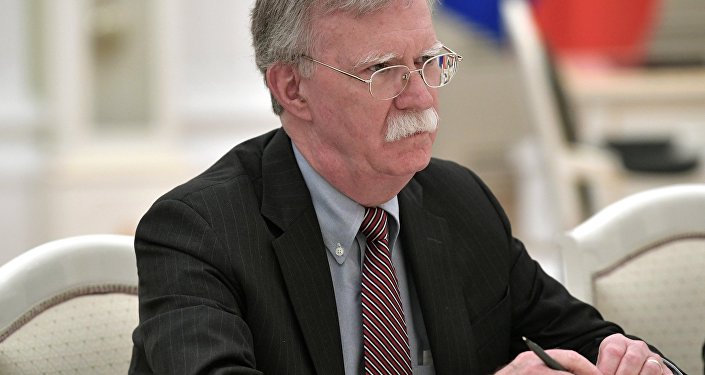
US National Security Advisor John Bolton is a “war fanatic” and “defective human product” who works to destroy peace rather than maintain it, North Korea’s Foreign Ministry has said.
The tough assessment, cited by state news agency KCNA, comes after Donald Trump’s adviser lambasted Pyongyang for recently carrying out short-range missile tests. Bolton described the drills as “no doubt” violating UN resolutions.
Hitting back, North Korea’s Foreign Ministry argued that scrapping missile tests completely would hamper the country’s national security.
“Banning launches using ballistic technology is equal to telling us to give up our right to self defence.”
The ministry official added that even in the US Bolton is well-known as a “war fanatic” and that such a “human defect must go away as soon as possible.”
Earlier in May, the North Korean military test-fired a number of rockets and missiles. Washington’s war hawks were quick to cite it as another reason to mount pressure on Pyongyang.
Trump for his part wrote on his favorite social media platform, Twitter, that the tests of “small weapons” did bother some of his people, but not him.
The tests have been viewed as a way to put pressure on Washington to roll back sanctions imposed on North Korea, while Bolton is a staunch opponent of easing the restrictions.
Calling the hawkish American’s comment “more than ignorant,” the North Korean official added that Bolton was working to “destroy peace and security.”
John Bolton has been lambasted before for his “warmongering” position not only in relation to North Korea, but also for “looking for a fight” with Iran. Former congressman Ron Paul recently told RT that such a position is “very dangerous,” lamenting Trump for appointing neocons to his team.
The US-backed Syrian Democratic Forces arrested approximately 200 male civilians, including children, during raids in Hasaka province of Syria between Friday and Sunday, according to Fars News report. According to the report, the detained civilians were forced to join the ranks of People’s Protection Units (YPG), the predominantly-Kurdish militia that comprises the core of multinational SDF.
The raids are said to be in line with the SDF policy of forced mobilization, despite protests among the local population.
The SDF also conducted raids in Raqqa province, arresting dozens of civilians.
On Thursday, SDF forces opened fire on residents of al-Hawl Refugee Camp located in southeastern Hasaka, some 15 km from the Iraqi border, according to Fars. The militants opened fire on a group of women and children who tried to escape the refugee camp due to its unbearable humanitarian conditions.
An undisclosed number of civilians died during the attack; several residents of the camp who attempted to flee were incarcerated, Fars reported citing activists in Hasaka.
The activists told reporters that the SDF imposed tight security measures around the camp, effectively taking it under siege. According to the activists, residents of the camp are in dire need of water, food and medical treatment, which can be obtained only outside the camp.
SDF treatment of civilians has sparked protests among the province’s population. On Wednesday, protesters burned down several SDF security centres across the city of Hasaka, al-Watan newspaper reported. According to the newspaper, the protests began after the SDF killed a young man who resisted forced recruitment.
The SDF reportedly dispatched reinforcements to the region, amid the rising unrest in Hasaka.
The Kurdish forces control a large part of Syria northeast of the Euphrates plus the territory around the city of Manbij. Damascus considers the US-backed SDF illegal.
Syria has been in a state of civil war since 2011, with forces backing the country’s leader, President Bashar al-Assad, fighting numerous opposition groups backed by Western states, as well as militants and terrorist organisations including Daesh — a terrorist quasi-state, outlawed in a number of countries.
The unannounced overnight visit by Iran’s Foreign Minister Javad Zarif to Pakistan on Thursday can be seen at the very minimum as forming part of a diplomatic campaign in the backdrop of the war clouds building up in the Persian Gulf. This regional tour has already taken Zarif to Russia, China, Turkmenistan, India and Japan.
For Iran, Pakistan is an important neighbour and the two countries have a history of troubled relations. (See my recent blogs Pakistan-Iran ties set for makeover – Part I and Part II.) In the prevailing regional setting, Pakistan’s importance for the Iranian geo-strategies has become crucial.
In immediate terms, King Salman has sent out invitations to two summits he’ll be hosting in Mecca on May 30 — back-to-back summits of the Gulf Cooperation Council (GCC) and the Arab League — where the leitmotif is the rising tensions with Iran. Neither GCC nor Arab League carries credibility, but Saudi Arabia is hoping that the Muslim Middle East will stand up and be counted in the vanguard of the US-led ‘Iran project’.
Enter Pakistan. Pakistan already has stated it will not take sides in the looming confrontation. Pakistan has described the crisis in the Persian Gulf region as “disturbing” and said that Washington’s decision to deploy an aircraft carrier and bombers has fuelled tensions and exacerbated “the existing precarious security situation” in the Middle East.
Just before Zarif’s arrival in Islamabad, Pakistani foreign ministry spokesman said, “We expect all sides to show restraint, as any miscalculated move can transmute into a large-scale conflict. Pakistan always supports dialogue and desires that all issues should be settled peacefully and through engagement by all sides.”
Pakistan’s stance of ‘positive neutrality’ works in favour of Tehran. Importantly, it is in stark contrast with the deafening silence of New Delhi, which has caved in to US diktat and summarily terminated all imports of Iranian oil. Suffice to say, Pakistan has moved to neutral ground at a juncture while India is bonding with the US, Israel, Saudi Arabia and the UAE — the ‘Quad’ group that pioneers the project to force a ‘regime change’ in Iran.
Delhi gave a pro forma reception to Zarif ten days ago when he came on an unannounced visit and Indian government sources went out of the way to prompt the media to see the event as entirely at Iran’s insistance. In comparison, Pakistan graciously received Zarif, who met the Pakistani Prime Minister and Foreign Minister as well as the army chief and the speaker of the national assembly.
Without doubt, the shift in India’s Middle East policies will have registered in the Iranian political establishment at the highest level. Simply put, Delhi has turned its back on Tehran and asense of betrayal is only natural in Tehran, which strained every nerve to befriend India. And the fact remains that unlike with Iran’s ties with Pakistan, there are no contradictions in Iran’s bilateral ties with India.
In view of the above, significantly, Zarif made a stopover in Chabahar Port en route to Islamabad on Thursday. No doubt, this development is heavy with symbolism, because Chabahar symbolises not only the unfulfilled Iranian expectations from partnership with India but stands out today as a relic of India’s betrayal. (See my blog India’s Betrayal of Iran Is Only the Beginning.)
(Iran’s FM Zarif at Chabahar en route to Islamabad on May 23, 2019)
In his first remarks after arrival in Islamabad, Zarif disclosed that he intended to put forward a “proposal” for connecting Pakistan’s Gwadar port to its “complementary” port Chabahar (located just 72 kms away in southeastern Iran.) To quote Zarif,
“We believe that Chabahar and Gwadar can complement each other. We can connect Chabahar and Gwadar, and then through that, connect Gwadar to our entire railroad system, from Iran to the North Corridor, through Turkmenistan and Kazakhstan, and also through Azerbaijan, Russia, and Turkey.”
Make no mistake that this is a wholesome proposal. An experienced career diplomat like Zarif is not in the business of kite-flying on such a sensitive issue that holds the potential to realign the geopolitics of the region.
Equally, it stands to reason that Tehran has consulted Beijing beforehand. Gwadar is synonymous with the China-Pakistan Economic Corridor and, of course, CPEC is the flagship of China’s Belt and Road (BRI) Initiative.
In fact, during what appeared to have been a highly successful visit to Beijing by Zarif a week ago, Iran-China cooperation within the framework of BRI figured prominently in his talks with Chinese State Councillor and Foreign Minister Wang Yi. The Xinhua report on the meeting underscored Wang’s remark that ‘China welcomes Iran to actively take part in the joint building of the Belt and Road and hopes to strengthen mutually beneficial cooperation.’
Equally, it must be factored in that the week before Zarif met Wang, he had travelled to Moscow and had talks with Russian Foreign Minister Sergey Lavrov where they discussed key issues in the international arena, as well as bilateral cooperation. The Russia-Iran consultations in Moscow stand out as a defining moment in regional security, as apparent from the remarks to the media, below, by the two foreign ministers:
(Joint press conference by Russian FM Sergey Lavrov (R) and Iran’s FM Javad Zarif at Moscow on May 8, 2019)
The big question is whether all this signifies a fundamental rethink in Iran’s foreign policy options in an emergent scenario where it must confront the geopolitical reality that a normalisation of relations with the US is to be ruled out for a very long time to come and some fundamental adjustments have become necessary.
Indeed, Iran’s Supreme Leader Ayatollah Ali Khamenei recently made an unprecedented open criticism of Iran’s foreign policy.
In sum, it is possible to estimate that the proposal that Zarif made to the Pakistani leadership signifies a reorientation of Iran’s foreign policy in the direction of greater integration with the two major Eurasian powers Russia and China.
In an ideal world, Iran would have preferred to pursue independent foreign policies, but life is real and a regional axis with Russia, China, Pakistan and Turkey becomes an imperative need today. Conceivably, this profound shift in Iran’s foreign policy calculus carries the imprimatur of Ayatollah Khamenei.
When President Volodymyr Zelensky won a landslide victory in the free and undisputed April elections, most accepted that he was given a fairly strong mandate to lead Ukraine. But it seems not everyone is so democratically-minded.
Particularly unmoved by the democratic process are a collection of Ukrainian ‘civil society’ groups, who have just issued a lengthy list of “red lines not to be crossed” by the new president, lest he risk provoking a new wave of political instability – that they would presumably instigate.
Issuing their catalog of demands on Thursday, the groups claim to be “politically neutral” but “deeply concerned” about the first actions taken by the comedian-turned-politician Zelensky, including his decision to appoint members of former President Viktor Yanukovych’s government to positions within his own government.
A scan of the undersigned reveals that many of these “civil society groups” are anything but politically neutral. In fact, quite a few of them are partly funded by the US government, various EU governments (including the UK), the European Commission itself – and, of course, the omnipresent liberal billionaire George Soros.
The list includes the notorious Euromaidan Press, Stop Fake and Ukrainian Crisis Media Center, to name just a few. In their heyday, many of these groups acted as propaganda tools of the Western-backed government of Petro Poroshenko, rather than the watchdogs they claim to be. They now confirm that a pesky election isn’t going to stand in the way of their agenda, reaffirming that their own “principles and positions” on issues remain unchanged and warning:
Should [Zelensky] cross these red lines, such actions will inevitably lead to political instability in our country…
This statement, which precedes the wide-ranging list of red lines, reads like a threat: Do what we say, or there will be trouble. Isn’t that a strange, almost dictatorial approach for groups purporting to be interested in “democracy,” “freedom,” and “dignity”? Did we all miss the part where a group of think tanks were collectively elected president of Ukraine?
Of course, these groups do indeed represent various factions of Ukrainian society and many of them no doubt have worthy aims, and they should continue their work unimpeded. But they do not represent all of Ukrainian society and they certainly do not have the authority to set the political agenda and lay down the law to the incoming government – and that, quite literally, is what they are trying to do.
It’s such a gobsmackingly odd list of demands that even Western journalists who had a broadly friendly relationship with the Poroshenko government are aghast at their audacity. The list is broken down into issues of security, foreign policy, economy, national identity (language, education and culture), media and government functioning.
On security, the groups want to forbid Zelensky from “achieving compromise” with Russia in any manner that would be “to the detriment” of the national interest, presumably as defined by themselves. Inhibiting the implementation of security and defense policies outlined in a 2016 decree signed by Poroshenko is also forbidden, they say.
In the foreign policy realm, these audacious activists warn that democratically-elected Zelensky may not initiate any actions that could lead to the “reduction or lifting” of sanctions on Russia by Western powers. He may not take any action “delaying, sabotaging, or rejecting” the course for EU and NATO membership for Ukraine. Where the economy is concerned, he may not implement any policy that goes against existing agreements with “the IMF and other foreign partners.”
It’s on the national identity front that things get really sketchy, though. The groups would like to forbid any attempt whatsoever to even “review” multiple controversial laws signed by Poroshenko, including an anti-Russia language law (which effectively alienates the 30 percent of Ukrainians who speak Russian as their native tongue) and laws on contentious “de-communization” which banned Soviet symbols in the country.
Ironically, this push for de-communization coincided with a renewed glorification of Nazism that went almost unnoticed by Western media and officials, who have supported Poroshenko’s virulently anti-Russian government as it implemented laws better suited to George Orwell’s 1984 than a modern democracy. The “NGOs” insist that Zelensky may not implement any action to support the Russian Orthodox Church in Ukraine, another ‘red line’ among their national identity demands.
Remember when Russian television channels and social networks like VKontakte were banned in Ukraine simply for the crime of being Russian? Well, Zelensky will also be in big trouble if he tries to restore them, the “civil society groups” say.
The most vague red line of all comes near the end of the list, when the new president is warned against “ignoring dialogue with civil society” – a command so vague that “almost anything” Zelensky does going forward could be interpreted as ignoring their wishes, France 24 correspondent Gulliver Cragg wrote on Twitter.
BBC correspondent Jonah Fisher tweeted that the groups themselves may have crossed a red line – the red line of “what civil society groups can legitimately demand of a freshly elected government.”
Zelensky was elected to office with 73 percent of the vote – and let’s not forget, he won that election having campaigned against many of the policies these ‘civil society’ groups are aggressively demanding be kept in place.
He has been in office only a matter of days, and these Western-backed groups are threatening to instigate political unrest should he take any action that they don’t find acceptable to their political agenda. So who, exactly, poses the real threat to democracy?
Danielle Ryan is an Irish freelance writer based in Dublin. Follow her on Twitter @DanielleRyanJ
Negotiations between the United States and North Korea over the latter’s nuclear program will not resume until the US administration backs off from what Pyongyang has characterized as a unilateral demand that it disarm.
US President Donald Trump and North Korean Supreme Leader Kim Jong-un held summits in Singapore in June 2018 and in Hanoi in February of this year, but talks broke off after the two sides were unable to bridge an impasse between their respective positions.
On Friday, North Korea’s state-run Central News Agency published comments by an unnamed Foreign Ministry official who said that the talks have broke down due to “impossible” US demands.
“The underlying cause of setback of the DPRK-US summit talks in Hanoi is the arbitrary and dishonest position taken by the United States, insisting on a method which is totally impossible to get through,” the statement read, accusing the US of having “deliberately pushed the talks to a rupture by merely claiming the unilateral disarmament.”
If it sticks to its current demands, “the United States would not be able to move us even an inch,” the Korean official stressed, barring any future more flexible approaches from US officials, “the prospect for resolving the nuclear issue will be much gloomy.”
The North Korean remarks contrast with statements by Trump, who framed the dissolution of talks between the two nations as resulting from unreasonable Korean demands for significant sanctions reduction, in exchange for only a partial nuclear disarmament on its part.
In April, the North Korean leader gave Trump a deadline until the end of the 2019 calendar year to formulate a deal which would be acceptable to both sides.
India’s much-touted and over-hyped policy of “multi-alignment” is seeming more and more like a cover for unconvincingly disguising the country’s strategic alliance the US, especially after its Ambassador to America strongly hinted that Modi will undertake an anti-Russian military pivot during his second term in office.
“There has been a tradition of dependence on defense equipment from Russia. But if you go by SIPRI figures, in the block year 2008 to 2013 we imported 76% of our defense items from Russia. In the next five-year block, from 2013 to 2018, this came down 58% and in the same period our imports from the United States increased by 569%. So that itself tells you that, when we have a choice… we are obviously diversifying our purchases.”
This is the clearest signal yet that Modi’s second term in office will be dedicated to prioritizing his country’s strategic alliance with the US, especially in the military sphere and most likely to both Russia and China’s detriment. About the first, India might go back on its deal to purchase the S-400s in order to avoid sanctions and replace them with THAADs, while for the second, its “Indo-Pacific” policy clearly aims to “contain” China.
India’s era of “multi-alignment” appears to be over, though it’s keeping this discredited slogan alive as a cover for unconvincingly disguising its strategic alliance with the US. This game-changing development will certainly complicate the regional geopolitical situation, but it also nevertheless provides the impetus for Russia to strengthen its ties with the global pivot state of Pakistan as the main component of its “Return to South Asia.”
By Mahdi Darius NAZEMROAYA | Strategic Culture Foundation | 30.03.2015
The United States and the Kingdom of Saudi Arabia became very uneasy when the Yemenese or Yemenite movement of the Houthi or Ansarallah (meaning the supporters of God in Arabic) gained control of Yemen’s capital, Sanaa/Sana, in September 2014. The US-supported Yemenite President Abd-Rabbuh Manṣour Al-Hadi was humiliatingly forced to share power with the Houthis and the coalition of northern Yemenese tribes that had helped them enter Sana. Al-Hadi declared that negotiations for a Yemeni national unity government would take place and his allies the US and Saudi Arabia tried to use a new national dialogue and mediated talks to co-opt and pacify the Houthis.
The truth has been turned on its head about the war in Yemen. The war and ousting of President Abd-Rabbuh Manṣour Al-Hadi in Yemen are not the results of «Houthi coup» in Yemen. It is the opposite. Al-Hadi was ousted, because with Saudi and US support he tried to backtrack on the power sharing agreements he had made and return Yemen to authoritarian rule. The ousting of President Al-Hadi by the Houthis and their political allies was an unexpected reaction to the takeover Al-Hadi was planning with Washington and the House of Saudi. … continue
This site is provided as a research and reference tool. Although we make every reasonable effort to ensure that the information and data provided at this site are useful, accurate, and current, we cannot guarantee that the information and data provided here will be error-free. By using this site, you assume all responsibility for and risk arising from your use of and reliance upon the contents of this site.
This site and the information available through it do not, and are not intended to constitute legal advice. Should you require legal advice, you should consult your own attorney.
Nothing within this site or linked to by this site constitutes investment advice or medical advice.
Materials accessible from or added to this site by third parties, such as comments posted, are strictly the responsibility of the third party who added such materials or made them accessible and we neither endorse nor undertake to control, monitor, edit or assume responsibility for any such third-party material.
The posting of stories, commentaries, reports, documents and links (embedded or otherwise) on this site does not in any way, shape or form, implied or otherwise, necessarily express or suggest endorsement or support of any of such posted material or parts therein.
The word “alleged” is deemed to occur before the word “fraud.” Since the rule of law still applies. To peasants, at least.
Fair Use
This site contains copyrighted material the use of which has not always been specifically authorized by the copyright owner. We are making such material available in our efforts to advance understanding of environmental, political, human rights, economic, democracy, scientific, and social justice issues, etc. We believe this constitutes a ‘fair use’ of any such copyrighted material as provided for in section 107 of the US Copyright Law. In accordance with Title 17 U.S.C. Section 107, the material on this site is distributed without profit to those who have expressed a prior interest in receiving the included information for research and educational purposes. For more info go to: http://www.law.cornell.edu/uscode/17/107.shtml. If you wish to use copyrighted material from this site for purposes of your own that go beyond ‘fair use’, you must obtain permission from the copyright owner.
DMCA Contact
This is information for anyone that wishes to challenge our “fair use” of copyrighted material.
If you are a legal copyright holder or a designated agent for such and you believe that content residing on or accessible through our website infringes a copyright and falls outside the boundaries of “Fair Use”, please send a notice of infringement by contacting atheonews@gmail.com.
We will respond and take necessary action immediately.
If notice is given of an alleged copyright violation we will act expeditiously to remove or disable access to the material(s) in question.
All 3rd party material posted on this website is copyright the respective owners / authors. Aletho News makes no claim of copyright on such material.


 Aletho News