Venezuela: New Widespread Power Outage
Venezuelan authorities denounce “double attack” against the country’s electrical infrastructure
By Ricardo Vaz | Venezuelanalysis | March 26, 2019
Caracas – Venezuela suffered another widespread power outage on Monday, with authorities claiming a “double attack” against the country’s main hydroelectric dam took place.
Both alleged attacks against the Simon Bolivar Hydroelectric Plant, known as the Guri Dam, affected as many as 16 of Venezuela’s 23 states.
The first one took place around 1:30 pm on Monday, with Venezuelan authorities denouncing a cyber attack similar to the one they claim caused a major blackout on March 7, targeting the computerized system of the electric grid. While Caracas and other central and eastern areas had power restored and stable within 72 hours, it was not until March 12 that western states Merida and Zulia finally had electricity.
However, this time electricity was restored to Caracas within three hours and to the rest of the country after several additional hours when a second alleged attack took place at 9.50 pm. Reports emerged of a fire affecting three transformers in the Guri Dam switchyard, which then took out the San Geronimo high voltage transmission line.
Communications Minister Jorge Rodriguez issued a communique accusing the opposition of “sowing instability to achieve their destabilizing goals.”
“An attack of this nature against the electric system had never been seen,” he added.
No further information has been provided as to how the fire was set and who the perpetrators might be, with Attorney General Tarek William Saab announcing that three prosecutors had been assigned to investigate.
The Venezuelan armed forces had held military drills earlier this month with special focus on protecting electricity infrastructure. The Venezuelan government has reported that workers from state electricity company CORPOELEC are working around the clock to restore the damaged transformers, but no estimate of the damage and recovery time are currently known.
By Tuesday evening, power had been restored to most of the metropolitan area around Caracas and to some other locations around the country, including parts of the western state of Merida, although with service not yet stabilized.
Venezuela’s electrical infrastructure has suffered from underinvestment, lack of maintenance, a brain drain, as well as US sanctions, which have stopped Caracas from importing spare parts and servicing equipment. Recent US sanctions, including an oil embargo, have also generated shortages of fuel which stopped secondary thermoelectric plants from being brought online to ease the burden on the Guri dam during the March 7 outage, the New York Times reported .
School and work activities were suspended on Tuesday and Wednesday, with services such as the Caracas metro not yet back in service. There has been no official information regarding the reactivation of water supply, with water pumping representing a significant portion of the country’s electricity demand.
At the time of writing there have been no reports of casualties in hospitals or of episodes of violence. The Caracas municipality and the Miranda governorship activated contingency plans for people to be able to return to the suburban metropolitan areas, but many residents were still left to walk miles to get back home.
Venezuelan authorities had revealed what they claimed was evidence of involvement of right-wing leaders, including self-proclaimed “Interim President” Juan Guaido, in a plot to hire foreign paramilitaries to execute targeted killings and acts of sabotage. Guaido’s chief of staff, Roberto Marrero, was arrested on Thursday and accused of direct links to the mercenaries. Marrero was reportedly presented before a judge on Tuesday morning.
Likewise, lawyer Juan Planchart was arrested on Sunday for his alleged participation as a financial intermediary. It remains unclear whether the alleged attacks against the Guri Dam on Monday had any connection to the supposed right-wing plot.
For his part, Guaido accused the government of making up an “imaginary electric war” during a session of the opposition-controlled National Assembly. He also pledged to offer details about “Operation Freedom” on Wednesday, claiming that it will bring an end to “the usurpation.” Concerning the arrests of Marrero and Planchart, Guaido said they were “direct attacks” against him.
Pompeo Demands Moscow “Cease Unconstructive Behavior” In Venezuela
By Tyler Durden – Zero Hedge – 03/25/2019
As we predicted a number of times before, a proxy war between Russia and the United States appears now heating up in Venezuela — this after over the weekend Russia sent a military transport plane filled with Russian troops commanded by First Deputy Commander-in-Chief of the Land Forces of Russia Gen. Vasily Tonkoshkurov, which landed in Caracas Saturday. We also reported the major development this morning that new satellite images reveal a major deployment of S-300 air defense missile systems to a key airbase south of Caracas.
Russia’s highly visible deployment of a small troop contingency along with a reported 35 tons of cargo has resulted in a direct and firm response from Washington as on Monday morning the US Secretary of State called on Russia to “cease its unconstructive behavior”.
According to Reuters Pompeo conveyed the message directly via a phone call with his Russian counterpart Foreign Minister Sergey Lavrov.
Spokesman Robert Palladino addressed the phone call in the following statement:
The secretary told Russian Foreign Minister Lavrov that the United States and regional countries will not stand idly by as Russia exacerbates tensions in Venezuela.
Palladino added that Pompeo specifically condemned Russian military support for the “illegitimate regime of Nicolas Maduro.”
Pompeo had earlier this month vowed to continue to put “unconstrained” pressure on the Maduro regime after it became apparent that all internal coup attempts by the Juan Guaido-led opposition had failed.
As we reported previously this week’s tensions follows a high-level meeting in Rome last week, during which Russia reiterated a grave warning to the US – Moscow will not tolerate American military intervention to topple the Venezuelan government with whom it is allied – thus it appears Russia is taking no chances with its South American ally.
One of those warnings delivered directly by Russia’s deputy foreign minister Sergei Ryabkov to US “special envoy” on Venezuelan affairs Elliot Abrams is understood to have been that no American military intervention in Venezuela will be tolerated by Moscow.
Perhaps paralleling the Syria situation, this could be the start of a scenario where the greater the proxy action and threats from the United States, the more Russia will slowly intervene at the behest of Maduro.
All of these developments signalling closer Russian-Venezuelan military-to-military cooperation in the face of Washington saber rattling come after three months ago the two allies held military exercises on Venezuelan soil, which the US at the time had condemned as Russia encroachment in the region.
Tens of Thousands of Germans Take to Streets to Protest EU Copyright Reform
Sputnik -23.03.2019
Tens of thousands of people in different German cities have gathered for a massive protest against copyright reforms planned by the European Union, DPA reported.
The planned changes would require, in part, that tech giants such as Facebook and YouTube take responsibility for copyright materials users upload to their platforms. Though the measure is claimed to be aimed at protecting copyright holders, many note that it can easily be used to restrict freedom of speech.
The outrage is connected with some parts of the legislation: in particular, Article 11, which allows publishers to charge platforms if they link to their stories (the “link tax”), and Article 13, putting legal responsibility on platforms for users uploading copyrighted material (the so-called ‘upload filter’).
Though the reform is believed to help authors, artists and journalists to ensure payments for their works, opponents of the legislation insist it would force websites to install filters, hinder online creativity and restrict the freedom of speech.
According to the news agency, the biggest demonstration was held in Munich, where some 40,000 to protested the legislation, marching under the motto “Save your internet”.
Moscow Rules Out Destroying 9M729 Missile Complexes, Says They Fit INF Treaty
Sputnik – 19.03.2019
MOSCOW – Russia will not destroy its 9M729 missile complexes that Washington believes to be in violation of the Intermediate-Range Nuclear Forces Treaty (INF), the Russian Foreign Ministry said Tuesday.
“We can not go for destroying our 9M729 missile that Washington groundlessly believes to violate the treaty”, the ministry said.
According to the ministry, the United States is actively developing medium-range missile systems and Russia has to be ready for Washington’s potential deployment of such systems.
The ministry also stressed that extension of another arms control document, the New START, would be in the interests of the entire international community.
“Unfortunately, Washington prefers to create an atmosphere of uncertainty, sending negative signals [about the possibility of extension]”, the ministry said.
The US has repeatedly claimed that Russia is violating the treaty by testing 9M729 (NATO reporting name SSC-8) missiles at ranges banned by the agreement. Russia has refuted the accusations, insisting that the missile’s maximum range of 480km is in line with the INF Treaty’s requirements.
On 2 February, the United States formally suspended its obligations under the INF Treaty and launched the withdrawal process, which will be completed within six months unless Moscow remedies its alleged violations of the bilateral arms control deal. The same day, Russian President Vladimir Putin denied the accusations, announcing that Moscow had also suspended its obligations under the treaty in response to the US move.
Brazilian President visits CIA before visiting Trump on first US visit
Press TV – March 19, 2019
Brazilian President Jair Bolsonaro has made an unprecedented visit to the United States Central Intelligence Agency (CIA) headquarters in Langley, Virginia, in his first US visit before a meeting with US President Donald Trump scheduled on Tuesday.
Eduardo Bolsonaro, a lawmaker and son of the Brazilian president confirmed the visit on Monday, calling the intelligence agency one of the “most respected” in the world.
“Going now with president Jair Bolsonaro and ministers of the CIA, one of the most respected intelligence agencies in the world. It’ll be an excellent opportunity to speak about international relations topics in the region with experts and the technicians of the highest level,” he said in a tweet.
Eduardo Bolsonaro claimed the meeting was to discuss “international themes in the region”.
Leading Brazilian daily O Globo reported that Bolonsaro visited the agency along with Brazilian Justice Minister Sergio Moro, noting that the visit had not been published in the president’s public agenda and that press was not allowed to accompany Bolonsaro in the event.
The CIA had no comment on the visit.
Observers believe the unusual visit further signals Bolsonaro’s shift towards Washington. The move is, however, expected to be received controversially in Brazil.
In 2013, American whistleblower Edward Snowden revealed that the American National Security Agency (NSA) had wiretapped the conversations of then-President Dilma Rousseff, leading to suspicions towards the US and its spy agencies.
Former Brazilian Foreign Minster Celso Amorim has also slammed the meeting, saying that “no Brazilian president had ever paid a visit to the CIA.”
“This is an explicitly submissive position. Nothing compares to this,” he added.
Bolsonaro originally arrived in the US on Sunday, stating that the trip marked the first “pro-America Brazilian president” recently visiting the country.
“It’s the beginning of a partnership focused on liberty and prosperity, something that all of us Brazilians have long wished for,” he said.
Bolsonaro is an ardent admirer of US President Donald Trump and the White House’s policies, particularly those with regard to opposing left-wing governments in Cuba, Nicaragua and Venezuela.
The Brazilian president, who is also known as “Tropical Trump,” has sparked controversy by following Trump on calling for the relocation of his country’s embassy to the occupied city of Jerusalem al-Quds.
Bolsonaro personally made the promise to Israeli President Benjamin Netanyahu while he attended the Brazilian president’s inauguration ceremony on January 1.
Last week, however, reports emerged that Bolsonaro may fail to carry out the move following opposition from military officers in his cabinet.
Vice President Hamilton Mourao also objected to the embassy move last month, claiming that the measure would hurt Brazilian exports to Arab countries which include an estimated $5 billion in halal food sales.
Bolsonaro has also said that he is open to considering the establishment of a US military base in Brazil as a way to “counter Russian influence” in neighboring Venezuela.
The move was rejected by Brazilian Defense Minister General Fernando Azevedo e Silva a week later.
US Wants India to Stop Oil Trade With Venezuela – Special Envoy Abrams
Sputnik – 10.03.2019
US Special Envoy for Venezuela Elliott Abrams confirmed that Washington is pressing India to stop buying Venezuelan oil.
“We say you should not be helping this regime, you should be on the side of the Venezuelan people”, Abrams told Reuters, adding that the White House had given the same message to other governments.
Previously, Bloomberg suggested that Caracas shipped 620,000 barrels a day to India in the first half of February, which is 66% more than the average daily shipments a month earlier.
In response, Indian Ministry of External Affairs spokesman Raveesh Kumar stated that New Delhi would ignore US pressure and continue its trade with Venezuela.
Addressing the political crisis in the Latin American country earlier in February, US National Security Adviser John Bolton had warned that “nations and firms that support Venezuelan President Nicolas Maduro’s theft of Venezuelan resources will not be forgotten”.
Washington introduced sanctions against Venezuelan state oil company PDVSA in January, blocking $7 billion in PDVSA assets and pressuring companies to cut ties with the firm until 11 March. The deadline, however, was later extended until 10 May.
The decision was made after opposition leader Juan Guaido declared himself the country’s interim president. The United States immediately recognised him as head of Venezuela, with many of its allies following the suit; however, Russia, China, Mexico, Turkey and a number of other countries have supported Nicolas Maduro as Venezuela’s only legitimate president.
US military truck carrying missiles crashes in Idaho

Press TV – March 10, 2019
Police in the US state of Idaho were forced to close down a highway after a semi-truck carrying missiles for the military crashed.
According to state police, the truck veered off the main road at a rest stop along I-90 in northern Idaho on Friday night as the driver attempted to use the interstate on-ramp.
The 50-year-old man at the wheel lost control of the truck and accidentally drove into a hazardous materials containment area and disabled his vehicle by driving over a snowbank at the end of the hazmat area.
No one was hurt in crash but police had to completely shut down the road for four miles as a precaution, because the truck was transporting 16 missiles, each one weighing 900kg (2,000lbs).
The driver was cited for inattentive driving.
The US military has a long history of botched transportation of dangerous weapons and military equipment.
In November 2015, an astonishing video surfaced showing an armored escort vehicle colliding into a nuclear warhead loaded into a truck near Malmstrom Air Force Base in Montana.
The escort vehicle was speeding behind the truck but the driver failed to react in time and ended up driving into it.
More recently, in February this year, a truck hauling a shipment of US Navy-owned military munitions crashed into two commercial trucks on US Highway 212 in southeastern Montana.
The US Air Force sent a six-member disposal unit to the scene, who then used 58kg of explosives to detonate 60 hazardous munitions that were damaged. The unit recovered 420 other projectiles.
In late January, two US military vehicles crashed in New Mexico, injuring all 9 personnel onboard, two of them critically.
The US military has been blamed for similar incidents abroad, notably in Germany and Japan.
US Embassy Employee Tried to Carry Mortar Shell in Luggage at Moscow Airport
Sputnik – 09.03.2019
The Russian Foreign Ministry has announced that it expects the US Department of State to explain the actions of one of its employees after a mortar shell was found in the luggage of a US embassy worker in Moscow’s Sheremetyevo International Airport.
Following the discovery of a mortar shell in the luggage belonging to a US embassy employee at the Sheremetyevo International Airport in Moscow, the Russian Foreign Ministry described this incident as an attempt to stage a provocation.
“It seems that the United States is trying to test Russia’s security capabilities not just from without, by regularly sending their warships and aircraft on provocative raids near our borders, but from within as well, even by using their embassy employees”, the ministry officials told Sputnik.
The incident occurred in the morning of 9 March when an object resembling a mortar mine was found during the screening of luggage belonging to a US embassy employee at the Sheremetyevo International Airport in Moscow.
“Bomb disposal experts who arrived at the scene confirmed that the object is indeed a mortar shell fitted with a detonator but devoid of explosive material, even though traces of explosives were present inside its casing”, the ministry explained.
The culprit himself reportedly claimed that he bought the dud shell as a souvenir for his “private collection”.
According to foreign ministry officials, the man managed to board another flight to New York and safely left Russia, without the mortar shell.
The Russian Foreign Ministry also noted that the American embassy was immediately notified of this incident by police and expressed hope that the embassy will explain the actions of their employee.
The ministry also remarked that considering the level of attention airport security gets in the United States after the 9/11 terrorist attacks, the embassy worker had to realize that “a mortar shell in the luggage is very serious”, which means that he “made this move deliberately”.
Robert Fisk Exposes Israel’s Hidden Role in the Brewing India-Pakistan Conflict
By Whitney Webb | MintPress News | March 4, 2019
Well-known British journalist Robert Fisk recently wrote a very telling and troubling article in The Independent regarding the outsized role of the state of Israel in the burgeoning tensions between India and Pakistan, two nuclear powers. The story — despite its importance, given the looming threat of nuclear war between the two countries — was largely overlooked by the international media.
The tit-for-tat attacks exchanged between India and Pakistan last week have seen long-standing tensions between the two countries escalate to dangerous proportions, though Pakistan helped to deescalate the situation somewhat by returning and “saving” an Indian pilot whose plane had been shot down in retaliation for India’s bombing of targets in a disputed area administered by Pakistan.
That bombing was retaliation for a car bomb attack launched by Jaish-e-Mohammed (JeM) militants, a group that both India and Pakistan recognize as a terrorist organization, against Indian forces. Some analysts have speculated that India’s decision to bomb this area was made by Indian President Narendra Modi, a Hindu ethno-nationalist, in order to rally his base ahead of upcoming Indian elections in May.
Yet, whatever the reason, the bombing has revealed the close ties that have formed between Modi’s India and Israel, particularly between their militaries. As Fisk notes, following the bombing, Indian media heavily promoted the fact that Israeli-made bombs — specifically, Rafael Spice-2000 “smart bombs” — had been used in the attack. Fisk writes:
Like many Israeli boasts of hitting similar targets, the Indian adventure into Pakistan might owe more to the imagination than military success. The ‘300-400 terrorists’ supposedly eliminated by the Israeli-manufactured and Israeli-supplied GPS-guided bombs may turn out to be little more than rocks and trees.”
Recently released satellite images seem to corroborate what Fisk predicted, as the bombing failed to hit its intended target and instead damaged a nearby forest.
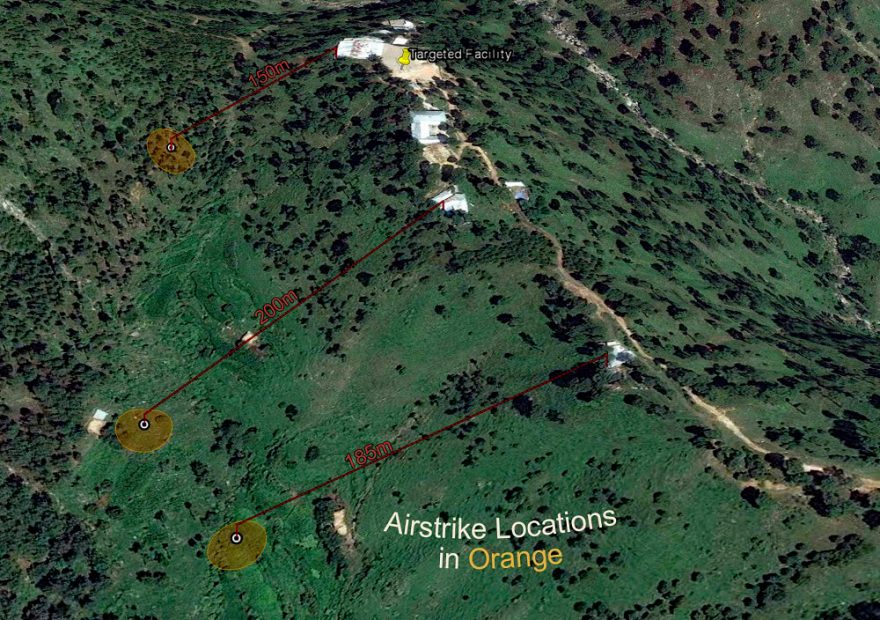
Image courtesy of Planet Labs, Google Earth and Digital Globe
Arguably the most important aspect of Fisk’s report is his detailing of the very close ties that have been forged between the Israeli and Indian militaries in recent years. For instance, according to Fisk, India was Israel’s arms industry’s largest client in 2017, spending nearly $700 million on Israeli air-defense systems, radars, ammunition and missiles. Many of those weapons had been promoted as “combat tested” after being used against Palestinians in the Gaza Strip, the world’s largest open-air prison. That same year, India represented 49 percent of Israel’s arms export market.
In addition to arms purchases, many Indian soldiers have traveled to the Negev desert to be trained by Israeli “special commando” units, and at least 16 elite Indian “Garud” commandos were recently based at two separate Israeli air bases.
Exporting oppression
Just as troubling as this military cooperation is that ethnonationalism and anti-Islam rhetoric are increasingly becoming the basis for the relationship between the two countries.
For instance, a recent Haaretz article, written by Shairee Malhotra and cited by Fisk, noted that “the India-Israel relationship is also commonly being framed in terms of a natural convergence of ideas between their ruling BJP and Likud parties.” Other reports have noted that this has translated into more “aggressive” policies from Modi targeting Kashmir and Muslims elsewhere in India and that continued Israeli goading of Modi’s anti-Islam tendencies could make life much more difficult for the estimated 180 million Muslims living in India.
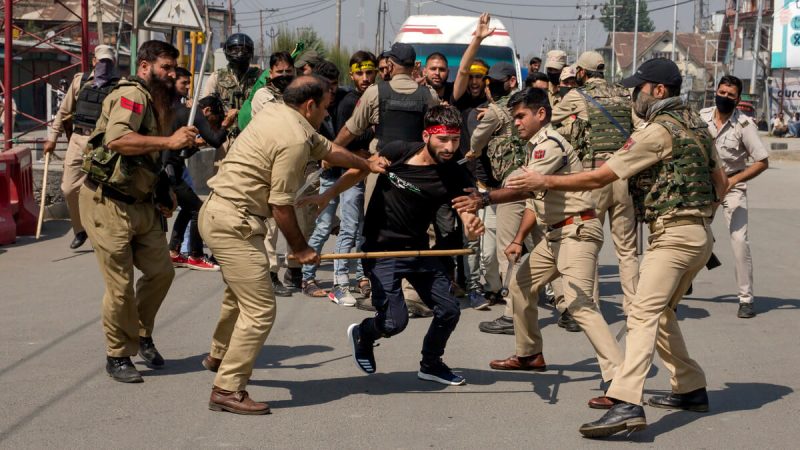
Indian police beat a Kashmiri Shiite Muslim for participating in a religious procession in Srinagar, Indian controlled Kashmir, Sept. 19, 2018. Dar Yasin | AP
While some analysts and reports have warned about this danger, Fisk notes that it will be difficult to prevent the Zionist, fascist nationalism of Benjamin Netanyahu’s Likud Party from influencing India’s ruling party, writing:
It is difficult to see how Zionist nationalism will not leach into Hindu nationalism when Israel is supplying so many weapons to India – the latest of which India, which has enjoyed diplomatic relations with Israel since 1992, has already used against Islamists inside Pakistan.”
Fisk goes on to note that “[s]igning up to the ‘war on terror’ – especially ‘Islamist terror’ – may seem natural for two states built on colonial partition.” Indeed, India’s actions in the disputed Kashmir region share many similarities to Israel’s neocolonial occupation of Palestine. For instance, the Muslim majority of Kashmir are treated as second-class citizens on their own land and their push for self-determination has been brutally suppressed by Indian forces. As of 2016, 500,000 Indian military personnel were present in the region, roughly equating to one soldier for every 25 civilians. As Al Jazeera noted at the time, there have been more than 70,000 killings, about 10,000 enforced disappearances and 7,000 mass graves found since 1947 in Indian-administered Kashmir.
There are many other parallels between Kashmir and Palestine, including the fact that the British government shares a large share of the responsibility for both. Indeed, the British-brokered partition creating the current states of India and Pakistan in 1947 is the root of the current conflict in Kashmir much as the Britain-mandated creation of the Israeli state in 1948 is the root of the current conflict in Palestine. As far as Kashmiris and Palestinians are concerned, the governments of India and Israel picked up where their colonial master of years past left off.
If a deadly conflict ultimately breaks out between India and Pakistan, it will hardly be the first time Israel has armed controversial governments. Israel sold arms to the Rwandan government during the Rwandan genocide and, more recently, to the government of Myanmar during its “ethnic cleansing” of the Rohingya Muslims. Yet, as Fisk notes, Israel’s export of Zionist nationalism and neocolonialism — and the accompanying oppression that in practice actually helps to create many of the very terrorist groups they fight against — is just as dangerous as its export of arms.
Whitney Webb is a staff writer for MintPress News and has contributed to several other independent, alternative outlets. Her work has appeared on sites such as Global Research, the Ron Paul Institute and 21st Century Wire among others. She also makes guest appearances to discuss politics on radio and television. She currently lives with her family in southern Chile.
Guaido returns to Venezuela to the welcome of foreign ‘bodyguard’ envoys
RT | March 4, 2019
Self-declared “interim president” of Venezuela, Juan Guaido, returned from his South American tour on Monday, arriving into the loving (and protective) arms of ambassadors from the foreign governments backing him.
Despite Venezuelan authorities making it clear he could face 30 years in prison for attempting to overthrow the government and violating a travel ban, Guaido chose to arrive directly to an airport in Caracas.
The risk of arrest was notably mitigated by the presence of ambassadors from Germany, France, Spain, the Netherlands and several other countries which gathered at the arrival gate to huddle around him like a high-profile human shield. While Guaido was all smiles, his Western-world entourage seemed a bit on edge.
While the media fretted that Maduro might make good on threats to arrest Guaido, the opposition leader passed through customs without incident and headed straight to a rally in central Caracas.
Meanwhile, Vice President Mike Pence warned the Venezuelan government that Washington protects its investments, stressing how important Guaido is to them, and threatening a “swift response” if anyone tries to bully him.
Shortly after moving unhindered through the airport, Guaido arrived at a demonstration he called for on Twitter the week before. Addressing crowds in the country’s capital city, he called on his supporters to take to the streets for continued demonstrations next Saturday.
While Guaido toured South America and met with his most critical support base – foreign governments – the US ramped up pressure on Maduro’s government, imposing intensified sanctions and revoking visas for state actors.
Russian oil expert detained at Kiev’s request in Greece, lawyer calls arrest ‘politicized’
RT | March 3, 2019
A Russian national has been arrested in Greece and faces extradition to Ukraine on tax-crime charges. His lawyer said he is being persecuted for supporting the former Ukrainian president who was ousted in a Western-backed coup.
Evgeny Kalinin, a Russian energy expert, was arrested by the Greek authorities at Athens International Airport on Thursday, his lawyer, Yannis Rahiotis, told Sputnik.
Kalinin is a well-known oil industry expert, Rahiotis said, noting that his client was on a routine business trip to the country at the time. Kalinin appeared in court on Friday, when he was sent to prison until Ukraine’s extradition request is delivered to Athens.
According to Rahiotis, Kalinin faces unspecified tax-crime charges, which allegedly arise from his past work as a top executive in Ukraine’s oil company.
Kalinin served as vice president of TNK-BP Commerce, a Kiev-based company that specializes in producing and selling crude oil products in Ukraine and Russia, until 2011. The company, which was founded in 2003, also operates a network of gasoline and filling stations in Ukraine.
While the essence of the charges Kalinin is facing are not yet clear, Rahiotis believes they are politically motivated. The lawyer pointed out that Kalinin’s name has been included in a database of the notorious Ukrainian website Mirotvorets (Peacekeeper). The ultra-nationalist site contains a blacklist of ‘traitors’ who it says must be dealt with. On the list, Kalinin has found himself in the company of such big foreign political names as former German chancellor Gerhard Shroeder, who was added to the ‘hit-list’ in November, prompting the German Foreign Ministry to reprimand Kiev for not taking down the website.
“This case is a political one. Kalinin is included into the Mirotvorets list. He is being persecuted because he was a supporter of former president Victor Yanukovich,” Rahiotis said.
Russian diplomats have been in contact with Kalinin, and have been providing him “with all necessary consular assistance,” the Russian Embassy in Greece said, as cited by Sputnik.
Kalinin’s arrest has already drawn condemnation from a senior Russian lawmaker.
The deputy head of the Russian Senate Defense and Security Committee, Franz Klintsevich, has said that by playing into the Kiev’s hands, Athens is undermining its centuries-old relationship with Russia, which has traditionally been an ally.
“It’s still not late to stop. Russia will do everything to free Evgeny Kalinin,” he wrote on Facebook.
Another State Duma MP, Natalia Poklonskaya, argued that Kalinin’s arrest is likely to be politicized and exploited in the ongoing Ukrainian presidential campaign. She also warned Greece against becoming a pawn in a third party’s hands by simply following formal legal guidelines.
Russia and China offer the SCO platform for India-Pak de-escalation
By M. K. BHADRAKUMAR | Indian Punchline | March 2, 2019
Saudi Arabia is pushing forward as mediator between India and Pakistan with a messianic zeal that patently enjoys US backing. The Saudi Minister of State for Foreign Affairs Adel Al-Jubeir is arriving in Delhi tomorrow. He was to have visited Islamabad on Friday but rescheduled his plan so that he can touch base with Modi first and thereafter meet the Pakistani leaders, including army chief Gen. Qamar Bajwa.
Modi and Bajwa will be Adel’s key interlocutors. How far the Saudi waltz will advance remains to be seen. How Modi handles the piquant situation will bear watch.
Certainly, the Saudi mediation makes India look rather immature and that becomes willy-nilly a reflection of Modi’s foreign policy legacy. The point is, no matter what Modi may boast about “new India”, the geopolitical reality is that India’s stature diminishes when it needs a small country like Saudi Arabia under an autocratic ruler to help out with what is arguably one of the most critical templates of its diplomacy.
Saudi Arabia has no track record as a peacemaker. On the contrary, it has a notorious reputation the world over as a promoter of terrorist groups.
Meanwhile, India does not have to be beholden to the Saudis to ease its tensions with Pakistan. The indications are that Russia and China are jointly sponsoring an initiative in this regard. China is deputing a special envoy to visit India and Pakistan to discuss the crisis situation. The Pakistani FM Shah Mehmood Qureshi disclosed this in Islamabad.
To be sure, Russia and China, which actively coordinate on the foreign policy front, are in consultation each other on the India-Pakistan tensions. We may also factor in that the foreign ministers of Russia and China had an opportunity last Wednesday to meet EAM Sushma Swaraj at the RIC ministerial.
Following that, Chinese State Councilor and Foreign Minister Wang Yi also briefed Qureshi in a phone conversation where the latter had expressed the hope that “the Chinese side will continue to play a constructive role in easing the current tension.”
Equally, at the height of the India-Pakistan crisis, on February 27, Russian Foreign Ministry also had issued a statement expressing “grave concern over the escalating situation along the Line of Control and the surge in tensions” between India and Pakistan “which are Russia’s friends.” It took a neutral stance and called on both sides “to show restraint and redouble efforts to resolve existing problems by political and diplomatic means.”
It is entirely conceivable that the Chinese special envoy’s visit is a related development signifying a coordinated effort by Beijing and Moscow and in consultation with Islamabad and New Delhi. This is of course a major shift in the tectonic plates of Eurasian politics and it has an added significance insofar as it is taking place in the New Cold War conditions.
Indeed, it does not need much ingenuity to figure out that a US-sponsored Saudi mediation between India and Pakistan must be a worrisome development for both Russia and China, from the geopolitical perspective.
At any rate, on Thursday, President Vladimir Putin telephoned Modi. According to the Kremlin readout, they discussed the “crisis in relations between India and Pakistan” and the Russian leader “expressed hope for a prompt settlement.” The careful wording hinted that Putin offered to lend a helping hand, jointly with China, to ease the tension.
Curiously, the very next day, the Russian Foreign Minster telephoned Qureshi in Islamabad — presumably to follow up on the Putin-Modi conversation — and offered help to “de-escalate” the tensions. The Russian Foreign Ministry readout, cited by state news agency TASS, says: “Moscow expressed its readiness to contribute to de-escalating tensions and that there is no alternative to settling all differences between Islamabad and New Delhi by political and diplomatic means.”
Importantly, Lavrov also outlined to Qureshi how the de-escalation process can be achieved — via the mechanism of the Regional Anti-Terrorist Structure of the Shanghai Cooperation Organization (SCO).
A Xinhua report since highlighted this aspect — that Lavrov told Qureshi about the “possibility of using the Shanghai Cooperation Organization’s Regional Anti-terrorist Structure for this purpose.”
Alongside, the Russian Foreign Ministry spokesperson Maria Zakharova outlined in an important statement on Thursday Moscow’s broad approach. Zakharova said:
“We are worried about the escalation of tension in relations between India and Pakistan and dangerous manoeuvres of both states’ armed forces along the Line of Control that are fraught with a direct military clash.”
“We are urging the sides to display maximum restraint. We continue to assume that contentious matters should be resolved by political-diplomatic methods on a bilateral basis in line with the provisions of the 1972 Simla Agreement and the 1999 Lahore Declaration.”
“We reaffirm our readiness to provide all-out support to the Indian and Pakistani efforts in countering terrorism.”
From the Indian perspective, this adds up to an extremely positive outcome of EAM’s consultations in Zhejiang with her Russian and Chinese counterparts. This must be EAM Swaraj’s finest hour in international diplomacy, as the curtain begins descending shortly on her scintillating stint as India’s foreign minister.
No doubt, the urgency of “de-escalation” of the tensions with Pakistan is self-evident. The “de-escalation” is far from over with the return of the Indian pilot. In fact, the tensions on the Line of Control can spiral out of control anytime in the present supercharged atmosphere.
Without doubt, the international community — read the US and NATO allies — is closely watching. The Afghan endgame is at a most sensitive stage and any eruption of tensions between India and Pakistan will negatively impact the peace process.
India should wholeheartedly welcome the Sino-Russian proposal, cast within an SCO framework as far more preferable to the dalliance with the Saudis and the Emiratis — or, for that matter, any UN intervention.
The fact of the matter is that both Russia and China are stakeholders in India-Pakistan normalisation and neither has any hidden agenda in this regard. Of course, Russia and China are like-minded partners for India in the fight against terrorism. On the other hand, unlike in the Cold War era, Pakistan is keen on Eurasian integration, too.
Featured Video
Seyed M. Marandi: Toward Total War in the Middle East
or go to
Aletho News Archives – Video-Images
From the Archives
The Geopolitics behind the War in Yemen (I)
By Mahdi Darius NAZEMROAYA | Strategic Culture Foundation | 30.03.2015
The United States and the Kingdom of Saudi Arabia became very uneasy when the Yemenese or Yemenite movement of the Houthi or Ansarallah (meaning the supporters of God in Arabic) gained control of Yemen’s capital, Sanaa/Sana, in September 2014. The US-supported Yemenite President Abd-Rabbuh Manṣour Al-Hadi was humiliatingly forced to share power with the Houthis and the coalition of northern Yemenese tribes that had helped them enter Sana. Al-Hadi declared that negotiations for a Yemeni national unity government would take place and his allies the US and Saudi Arabia tried to use a new national dialogue and mediated talks to co-opt and pacify the Houthis.
The truth has been turned on its head about the war in Yemen. The war and ousting of President Abd-Rabbuh Manṣour Al-Hadi in Yemen are not the results of «Houthi coup» in Yemen. It is the opposite. Al-Hadi was ousted, because with Saudi and US support he tried to backtrack on the power sharing agreements he had made and return Yemen to authoritarian rule. The ousting of President Al-Hadi by the Houthis and their political allies was an unexpected reaction to the takeover Al-Hadi was planning with Washington and the House of Saudi. … continue
Blog Roll
 Aletho News
- Pakistan-Iran talks secure LNG shipment to Islamabad through Hormuz
- Black Sea grain crisis puts global wheat supplies under pressure
- IRGC air defenses destroy another US MQ-1 drone over Strait of Hormuz
- Imran Khan’s entire immediate family detained in Pakistan ahead of mass protest demanding his release
- EU nation detains former presidential frontrunner
- Leaked: Britain’s Sham Conviction Of Hashim Thaci
- Seyed M. Marandi: U.S. Strike Imminent – Toward Total War in the Middle East
- Russia Voted Under Fire. Washington Is Loading the Tankers.
- 12 Things Your Oncologist Was Trained Not to Tell You
- Anthrax Attacks Paved Way for COVID-Era ‘Junk Drugs and Vaccines’
- If Americans Knew
- Israeli Attacks in Gaza Kill at Least Seven Palestinians Over Three Days, including Woman and Child
- Trump’s militarization of Washington DC as he pursues Israel’s war against Iran
- Why Israel Fears This Searing New Documentary
- Huckabee aide solicited cash gifts from Israelis
- This isn’t sci-fi, AI is already killing people
- ‘The Most Brutal Thing’: Investigation Reveals Execution of Elderly Woman in Rafah
- Inside Israel’s ‘soft’ ethnic cleansing plan for Gaza through the eyes of its victims
- New online database tracks pro-Israel political donations in the United States
- Israeli president pardons soldier convicted for killing wounded Palestinian
- Singer Ed Sheeran says his ‘heart broken’ by Gaza devastation, addresses Macklemore controversy
- No Tricks Zone
- 2025 Nature Paper Claiming Worsening Global Drought Gets RETRACTED …Heavily Flawed
- New Study: ‘Global Drought Shows No Detectable Recent Acceleration Under Climate Warming’
- Economic Masterminds: German Socialists Suggest Taxing Productivity Gains Stemming From Using AI
- The South China Sea Has Not Been Cooperating With The Climate Change Narrative
- Energy Crisis: Germany Enters Heating Season With Historically Low Gas Reserve Fill Levels
- New Study: The Antarctic Ice Sheet Gained Mass From 2020-2024 Due To Staggering Snow And Ice Accumulation
- Study: Ocean Heating Rates From Thousands Of Years Ago ‘Dwarf’ Modern Ocean Heating Rates
- Climate Extremists Target, Attack Large-Scale Power Grid Infrastructure In Germany!
- New Study: Antarctic Ice Melt Has Contributed Less Than 1 Centimeter To Sea Level Rise In The Last 30 Years
- Fear Of Debate: Alarmist German Climate Scientist Calls On Mainstream Media To Discredit Skeptic Voices
 Aletho News