Do not barter away India’s national security interests
By M. K. BHADRAKUMAR | Indian Punchline | March 1, 2019
There has been an avalanche of reports in the international media quoting western diplomats and security officials to the effect that India’s “intelligence-led… non-military preemptive strike” on a big terrorist camp in Pakistan on February 26 was all baloney. Apparently, these reports say, there was so such terrorist camp in existence in Balakot.
Incredibly enough, no one in the government cares to set the record straight. The Foreign Secretary had claimed earlier that the strike killed “a very large number of Jaish-e-Mohammad terrorists, trainers, senior commanders, and groups of jihadis who were being trained for Fidayeen action were eliminated.”
But surprisingly, the day after the FS spoke, Air Vice Marshal R.G.K. Kapoor said it was “premature” to provide details about casualties. He would only say that the Indian armed forces had “fairly credible evidence” of the damage inflicted on the camp by the air strikes.
It is important for the government to clarify, because what happened was a defining moment in India-Pakistan relations and in India’s fight against terrorism. The nation has a right to know. No doubt, crossing another country’s borders and attacking its territory is a major escalation. What is the rationale behind such escalation?
Prime Minister Modi says he’s given a “free hand” to the armed forces. Are we to assume that the IAF suo moto acted on February 26? That is inconceivable.
This calls for deep introspection: What is it that the government achieved through the 60-odd hours between the early hours of Tuesday and the evening of Thursday? There is no shred of evidence that Pakistani side is cowed down in fear.
On the contrary, Pakistan insists that it will retaliate against any act of Indian aggression. Prime Minister Imran Khan disclosed in the National Assembly in Islamabad yesterday that in the night of Wednesday-Thursday, the Pakistani military was in a state of readiness to fire missiles into India.
Some of our self styled experts say we’ve “sent a message” to Pakistan that we’ll hit them hard if terrorism continued. How can they be so sure? The Pakistani retaliation with an attack on India the very next day — an act of war by targeting our military installations — discredits their thesis.
The most unfortunate part is that after precipitating the crisis situation on Tuesday, the government ducked and took help from Saudi Arabia and the UAE to “de-escalate” the situation.
Make no mistake, this fateful move has grave implications. The whole world knows that these two petrodollar states are the principal sponsors of terrorist groups who destroyed Syria.
Importantly, how can we possibly overlook that Jaish-e-Mohammed (JeM) and other terrorist organisations in Pakistan have received direct support from these Arab countries, especially Saudi Arabia? There is plentiful evidence of it.
An action request cable archived by Wikileaks, documenting the illicit finance activities in Afghanistan and Pakistan, stated that “it has been an ongoing challenge to persuade Saudi officials to treat terrorist financing emanating from Saudi Arabia as a strategic priority.” The cable continues, “Still, donors in Saudi Arabia constitute the most significant source of funding to Sunni terrorist groups worldwide.” It describes Saudi Arabia as “a critical financial support base” for Al-Qaeda, the Taliban, Lashkar-e-Taiba (LeT) and other terrorist groups.”
By the estimation of the US state department, LeT and JeM are all but synonymous! As far back as in 1993, the LeT became part of the United Jihad Council, an umbrella group for militant Islamists operating in J&K, and in doing so, it formed a direct alliance with the JeM (which claimed credit for the Pulwama attack recently.)
In fact, another Wikileaks cable confirmed that Saudi Arabia and the UAE have been funnelling money not just to LeT but to JeM directly. It says:
“Locals believed that charitable activities being carried out by Deobandi and Ahl-e-Hadith organizations, including Jamaat-ud-Dawa, the Al-Khidmat Foundation, and Jaish-e-Mohammed were further strengthening reliance on extremist groups and minimizing the importance of traditionally moderate Sufi religious leaders in these communities. Government and non-governmental sources claimed that financial support estimated at nearly 100 million USD annually was making its way to Deobandi and Ahl-e-Hadith clerics in the region from ‘missionary’ and ‘Islamic charitable’ organizations in Saudi Arabia and the United Arab Emirates ostensibly with the direct support of those governments.”
Saudi Arabia has quite openly held out assurances to Pakistan that it need not go after JeM directly.
Indeed, the most dangerous part of the gambit by the Modi government to let in Saudi Arabia and the UAE into its matrix over Pakistan and Kashmir is that this policy shift is completely of sync with the wider geopolitical struggle unfolding in the region.
Quite obviously, Saudi Arabia wants to win Pakistan over in a tug-of-war game with Iran and is doling out to Islamabad generous financial help and a $10 billion investment plan to to build an oil refinery in the Gwadar port project (which actually puts a major Saudi project on Iran’s border.) The Saudi Crown Prince Mohammed bin Salman’s (MBS) recent visit to Pakistan has essentially cemented Pakistan’s inclusion in anti-Iran Arab NATO.
Against this backdrop, how could the Indian policymakers blithely overlook the far-reaching, dangerous implications of consorting with Saudi Arabia and the UAE as partners in its fight against terrorism in J&K fomented by Pakistan?
The most intriguing part is the newfound bonhomie between the Indian elite and the sheikhs. Put differently, you don’t take help from the wolf to guard the sheep, right? What explains the Faustian deal to allow them to enter the sanctum sanctorum of India’s foreign policy — Kashmir and the matrix of India-Pakistan relations?
Beware of the lure of green money. The Saudis and Emiratis are great operators in Washington, DC. Their fierce lobbying and charm offensives are legion. If they could manipulate the American political class so brilliantly, our oligarchy must be chicken feed.
US Urges ‘Calm’ While Stoking India-Pakistan Conflict
Strategic Culture Foundation | 01.03.2019
International powers this week anxiously urged India and Pakistan to avoid further escalation of military confrontation. Given the two nations have gone to war on three occasions during the past seven decades and are both nuclear armed, the international concern is palpable.
The US has lately joined calls by Russia, China and Europe appealing for restraint, and for the Indian and Pakistani leaderships to negotiate a resolution to avert a catastrophic slide towards conflict.
American President Donald Trump, while in Vietnamese capital Hanoi for a summit with North Korean leader Kim Jong-Un, claimed that the US was mediating to defuse the crisis between India and Pakistan.
“We’ve been in the middle trying to help them both out,” said Trump.
Incongruously, however, the Trump administration has in fact acted in an opposite fashion, to inflame the recent tensions between New Delhi and Islamabad.
Trump’s national security advisor John Bolton and Secretary of State Mike Pompeo have both issued statements which “support India’s right to self-defense against terrorism”. The US officials have also laid the blame on Pakistan for sponsoring acts of terrorism by militant groups in Indian-controlled Kashmir. The northern territory of Kashmir has been the cause of bitter dispute between India and Pakistan ever since they gained independence from Britain in 1947.
The massacre of over 40 Indian troops earlier this month on February 14 in the Indian-side of Kashmir has sparked outrage among the wider Indian population demanding revenge. The suicide bomb attack was claimed by Kashmiri militant group Jaish e-Mohammed (JeM). India claimed that Pakistan had a hand in the atrocity through its support for JeM, which the Pakistani authorities denied.
The mounting of air strikes by India this week deep inside Pakistani territory on a militant training camp – purportedly in retaliation for the Kashmir massacre of its troops – represented a dramatic escalation. If India had limited its strikes to Pakistani-controlled Kashmir the retaliation could perhaps have been argued as being proportionate. But the violation of Pakistani territory – some 50 kms west of the historical Line of Control – was arguably an act of war. The last time Indian warplanes struck inside Pakistan was in 1971 during the two countries’ third and last war.
Not surprisingly, Pakistani fighter jets have subsequently launched strikes on Indian-controlled Kashmir. There were also further alleged incursions by Indian warplanes, two of which were reportedly shot down by the Pakistani side. Pakistan also lost one of its jets in a shoot-down but the aircraft apparently crashed inside its territory.
Tensions have boiled over further with the capture of an Indian pilot by the Pakistanis who released video footage of him apparently injured with a bloodied face. That led to outcry in New Delhi that Islamabad was in breach of the Geneva Convention concerning treatment of prisoners of war. Pakistan’s Prime Minister Imran Khan has vowed to return the Indian pilot as a gesture towards de-escalation.
Nevertheless, the tensions and danger of an all-out war continue to mount. There have been several reports of heavy artillery cross-border exchanges between Indian and Pakistani forces. While both governments say they don’t want a war, the dynamic could explode beyond their control.
The Kashmir dispute is certainly fraught with enormous historical difficulties bestowed by baleful British imperialist legacy of partitioning land and people with such contempt for indigenous rights and traditions, as well as from cynically playing partisan politics for imperial advantage. Washington’s contemporary meddling in Indian-Pakistan affairs has echoes of past British subterfuge.
Pakistan’s relations with Kashmiri militant groups whom India denounces as “terrorist” is only part of a complex equation. Another part of the equation is India’s intensive militarization of the province and its alleged abusive occupation of territory and people who aspire to be part of Pakistan. The region is predominantly Muslim.
If a peaceful resolution is to ever succeed there must be an earnest process of demilitarizing the entire Kashmir area. That onus is primarily on India.
One thing that is certainly not constructive is the simplistic and clumsy way that the United States has intervened recently by pointedly taking the Indian side of the narrative. For senior Trump administration officials to proclaim India’s “right to self-defense” against implied Pakistani-sponsored terrorism is in effect a green light for New Delhi to launch air strikes against its neighbor.
That reckless advocacy by Washington is predictably leading to a spiral of violence which ultimately could result in an all-out war between two nuclear states.
President Trump’s self-congratulatory tone about supposed mediation between India and Pakistan is far off the mark from reality. The Trump administration’s belated words appealing for “restraint” and “calm” are belied by the earlier words from Bolton and Pompeo giving India a license to commit acts of war.
Of course, what would one expect from the American side? The Trump administration is currently in the throes of violating the sovereignty of Venezuela with threats of military invasion against that South American nation. Washington has completely lost its compass on international law and norms of conduct.
There are indeed deeper reasons for why Washington would like to see a conflict between India and Pakistan blow up. Such a confrontation would cause major geopolitical problems for China, which is historically an ally of Pakistan but which has also recently endeavored to build a rapprochement with India. Stoking a confrontation in South Asia would serve Washington’s interest in destabilizing China and Russia’s strategic plans for economic integration of Eurasia.
India and Pakistan’s political leaderships must keep cool heads and think of the bigger global picture. Only recently, India’s Narendra Modi and Pakistan’s Imran Khan were expressing an aspiration for improving ties between the two South Asian states. They must resist playing politics for internal political gains, and they must resist being manipulated by external powers which seek to gain advantage at the expense of Asian divisions. The historical thorn of Kashmir can be resolved if India and Pakistan entered into a genuine and mutual compromise.
Militants Continue to Prevent Refugees From Leaving Rukban Camp – Russian MoD
Sputnik – 26.02.2019
Militants are still preventing refugees and their families from leaving Syria’s Rukban camp, head of the Russian Defense Ministry’s Center for Syrian Reconciliation Lt. Gen. Sergei Solomatin said on Monday.
“Illegal armed groups operating in the area [spanning] 55 kilometers [34 miles] are preventing the civilians from leaving the Rukban camp”, Solomatin told a briefing.
According to earlier statements, two checkpoints were opened last Tuesday to facilitate the refugees’ withdrawal from the Rukban camp, which lies in the area controlled by the United States. Soldiers from the Russian Reconciliation Center in Syria and crews of the Syrian Arab Red Crescent are working at the checkpoints, and are prepared to provide assistance for those who want to leave the camp.
The Russian Defense Ministry’s Center for Syrian Reconciliation has called on the United States to put pressure on the leadership of opposition groups and prevent them from disrupting the evacuation of civilians from the camp.
Last week, Russian Foreign Minister Sergey Lavrov said refugees from the Rukban camp should have long been evacuated, but the United States and the militants under its control forbade them to leave. The US Department of State spokesman Robert Palladino has replied that the United States had not prevented people who live in the camp from leaving the facility and called on Russia to help facilitate deliveries of humanitarian aid.
The situation in the Rukban camp, which is situated within the US-controlled zone surrounding its military base in At-Tanf, has become increasingly dire as refugees residing there have not been regularly receiving sufficient amounts of humanitarian aid.
Meanwhile, the Russian Defense Ministry’s Center for Syrian Reconciliation also reported Monday that a number of ceasefire violations had been registered within the Idlib de-escalation zone in past 24 hours. According to Solomatin, more than 55,200 Syrians who evaded from military service were granted amnesty by Damascus. He added that as of Sunday, 224,424 Syrian refugees had returned home.
Syria has been in a state of civil war since 2011, with the government forces fighting against numerous opposition groups and militant and terrorist organizations. Russia, along with Turkey and Iran, is a guarantor of the ceasefire regime in Syria. Moscow has also been providing humanitarian aid to residents of the crisis-torn country.
Fake Humanitarianism Fails its Big Test in Venezuela
By Maximilian C. Forte | Zero Anthropology | February 24, 2019
There it is: Saturday, February 23, 2019, has now come and gone—and it’s not to say that “nothing has changed”. In fact, some important changes did occur, none of which were the ones hoped for by either the self-declared “president” of Venezuela, Juán Guaidó, nor the ones commanded by the President of the US, Donald “Can I have my Nobel Peace Prize now?!” Trump. US options have thus narrowed, as we enter a protracted and potentially more dangerous phase where possible US military intervention draws closer. So let’s quickly review some of the changes introduced by yesterday’s events.
First, the unelected, self-declared “president” of Venezuela is no longer even in Venezuela. He used the opportunity of the US AID stunt to spirit himself across the border to Colombia, with the apparent well-wishes of ushers in the Venezuelan military (he should have been suspicious, unless he really intended to flee), and Guaidó now finds himself as a tourist in Colombia. Second, the military which Guaidó presumed to order, completely ignored him and remained loyal to the established government, the only legal and legitimate one. Indeed, the third point is that in failing the credibility test, Guaidó also failed the legitimacy test: how can he be viewed as a legitimate leader, without anything to lead, and with none of the state machinery following him? That is not a leader; at best, Guaidó can be defined an aspirant to power. He is a legitimate aspirant. Some in the opposition are already speaking of an alternative deal with the Maduro government. Having failed the credibility and legitimacy tests, a frustrated Guaidó had no option other than to invite foreign military intervention—if his own military won’t listen to him, surely other nations’ militaries will? And what about Richard Branson’s much vaunted aid concert? That takes us to the fourth point: that concert was drowned out, not just by a competing concert on the Venezuelan side of the border, and not just because it failed to draw any major international acts (perhaps thanks to Roger Waters), but the events of the day itself meant that not even a word was mentioned about the concert. It was like it had never happened. The fifth development is probably the most significant: US AID via Colombia, and similar “aid” intrusions from Brazil and Puerto Rico, were a resounding failure. The frustration that had been building up for days about the lack of a viable plan, was well warranted, as was Maduro’s optimism. Not well warranted were the raised expectations.
(Note, while the headline in the The New York Times claims that aid came in via Brazil, its source on the ground instead said, “The whole thing has failed” and the trucks “remained stranded on the border”. The story is misleadingly playing on a technicality: the aid left the Brazilian side of the border, but did not pass the Venezuelan checkpoint.)
What’s Next?
This takes us back to the central question of the previous article: what is the US’ next move? Simply insulting the Venezuelan armed forces, in what some called an “irresponsible speech,” by suggesting they are guilty of dereliction of duty, then insulting them further by saying Cuba directly controls the Venezuelan military, and then insulting them yet again by assuming that they should instead take their orders directly from Washington—will not work, and that much has been proven. Threats to the safety of Venezuelan soldiers only augment the offense. The US, speaking the language of “democracy promotion,” has been openly hoping for a palace coup—no such movement is in evidence however. All we know is that Vice President Mike Pence (who is likely leading the Venezuela intervention to shield Trump from any illegalities likely to be committed) will be meeting with aspirant Guaidó at his new lodgings in Colombia. That, and more sanctions, as if Venezuela’s government expected anything else.
Clearly the obese billionaire in the Oval Office relished the prospect of one day (soon) boasting that he had toppled a “regime” by just throwing some scraps of dog food at the feet of “desperate and starving” Venezuelans. (They just have to be desperate and starving, because their place in the natural order of things is that they are citizens of a “shit hole country”.) It would have pleased him immensely, he would have smiled slyly, to know that a well fed American can dangle a MRE pack in front of “hungry” eyes, and then sit back and listen to them scamper and scuffle. Such images enforce the evolutionist paradigm of progress, development, and global dictatorship. Trump would have told his friends: “You should have seen what happened, I just sent in crap like TV dinners to that shit hole country, and those pathetic losers fell all over themselves to get it, and the regime collapsed. Poof! Beautiful. Then I took their oil”. (The last point is important, because Trump has the ethics of a looter, and his foreign policy is a projection of his business practice: theft, scams, and all sorts of other wrongdoing enough to warrant hiding many years of tax returns behind some old yarn about an audit that is apparently eternal.)
Particularly important about the day’s events was the fact that two partners in an intended coup each failed their respective tests. The US and its regional allies showed that they could not even spirit in some boxes of junk “aid” and that they held no sway over the Venezuelan military. Guaidó failed to show that he commanded any support that mattered. He didn’t even have a few miserable boxes of US aid to selectively hand out to build up a patron-client network. Having auditioned for the role of CIA tool, he only demonstrated he was not worthy of the investment. He then fled. Then the government shut down his rumoured base of operations in Caracas: the Colombian embassy. The US could not have achieved less had it picked up any random person off the streets of Caracas.
Regime Survival Got a Boost
The unintended by-product of the US’ inability to command change, is a recipe for regime survival: everything that Venezuelans suffer from now on can be appropriately and rightly blamed on US intervention; opponents of President Nicolás Maduro can be labelled traitors, CIA proxies, and puppets of Washington, with considerable justification—thanks to US intervention; Venezuela will adapt and survive US sanctions like multiple other states have done; US oil refineries, shipping companies, insurance firms and banks—the other side of Venezuelan exports of oil to the US—will now suffer irreversible loss, and the US thus also loses its chokehold on Venezuela. Rather than American hegemony, it’s multipolarity that is advancing, with Venezuela moving closer into the orbits of Russia, China, and India. (India itself is completely unafraid of US sanctions, according to Indian analysts.) The US, especially under Trump, has responded to almost everything and everyone with either sanctions or their twin, tariffs, to the extent that there is virtually not a nation left on earth that is not subject to some sort of tariff or sanction from the US. The US is sanctioning itself into irrelevance, as the rest of the world devises ways of learning to live without it.
What Did We Not See?
What was strangely absent from the day, in all the live television footage and numerous photographs of the events, were at least two things: one was that however many showed up to back Guaidó, it certainly was not the 700,000 to a million people he had promised. The other was the bizarre absence of any Venezuelan soldiers from virtually all of the photographs and live television coverage. How they could maintain a forceful presence, yet remain invisible to the media, is quite an achievement—one that denies the media any coup-worthy moments of manufactured, orchestrated outrage. Of course what was also absent—and we knew this would be—was any evidence of these supposedly starving Venezuelans. Having grown up in a society saturated with media images of the now classic “starving Ethiopian,” emaciated bodies with distended bellies, it’s noteworthy that the coup media cannot pull off such a display with Venezuela—that would be the same Venezuela with the supermarkets stuffed with goods.
Beware of Alternative “Fake News”
These postscripts are intended as memoranda to RT, CNN, and others: please check your sources for the claim that former US Assistant Secretary of State Elliot Abrams was involved in actually smuggling in weapons in the guise of humanitarian aid. However appealing that image may be, it is a dorky and corny tale that arouses suspicion. It generally does not pass the smell test—check the last two links for further insight, and also see the Wikipedia page. Abrams was, after all, a State Department official, and not a field operative. In addition, he is being blamed for the operations that were conducted by Lt. Col. Oliver North and the CIA. The “humanitarian aid” disguise was aimed at the US Congress: Congress appropriated funds for humanitarian aid, and some of the funds were misused to arm the Contras illegally. It was no secret that the US was arming the Contras either—they were backed by the US, and they were armed. Most of that aid went to US bases in El Salvador and Honduras (US allies), where there was no need to “disguise” the aid, and it went to the Contras, a military force—again no need to disguise the aid. It’s not like Abrams called Contra leaders and surprised them: “We’re sending you some bags of rice. Or are we? Wink, wink”. They certainly were not fooling Nicaragua’s government, nor did Nicaragua allow in any such “aid” only to somehow find out it was not real humanitarian aid at all—that never happened. Nicaraguan authorities did capture a US pilot, after an illegal flight resulted in a crash inside Nicaragua, revealing the contents of what the US was sending the Contras: weapons, when Congress had banned military aid to the Contras. Abrams was just one figure among many in the story, and not the most directly involved.
The “Trojan Horse” charge is thus being misinterpreted and turned into something laughable. No serious person thinks the US was trying to smuggle in weapons in US AID boxes, in front of thousands of cameras in the plain light of day. That’s why not-so-secret flights exist instead. The “Trojan Horse” idea instead seems to be a little too complicated for the media which prefers a cartoonish rendition. The serious argument is that the aid was intended to shore up Guaidó’s power, since the aid was going directly to the opposition; and, the aid expressly bypassed the legal and legitimate government authorities of Venezuela, and was thus meant to undermine their authority. Furthermore, Guaidó spoke of the “aid” effort as being one that would create a “humanitarian corridor”—echoing terminology used by the US in Syria—and which would have meant wresting territory from the hands of the Venezuelan state, thus allowing the US free passage in and out at will. In addition, the hoped-for clash (which did not materialize to the extent that was feared) could have served as a pretext for warming up international opinion in favour of a US military “rescue”. That’s the extent of the Trojan Horse in this case—it’s not about grenades inside bags of rice. Otherwise President Nicolás Maduro did not “reject” any so-called “aid” from the US, because none had been given to him. The only thing the Venezuelan government did was to block its borders from being used for illegal purposes by foreign powers—its sovereign right. It did so, and it won.
Also tenuous is the story, repeated on RT several times now, that seems to take great joy in upbraiding rivals like CNN for reporting that Venezuelan authorities had “closed” the Tienditas bridge, built in 2016 and supposedly never opened (a bridge to nowhere?). Venezuelan authorities did in fact move containers to block that bridge, and were recorded doing so by Colombian authorities on February 5, of this year. Moreover, and this is the more important point: Maduro repeatedly said any attempt to move the aid into Venezuela would be blocked. There was never even the slightest hint that Maduro would just stand aside and let it pass. It seems that some foreign journalists are divided by their partisan loyalties and create the appearance of wanting to have their cake and eat it too: the humanitarian aid is not for humanitarian purposes, and has been denounced by several of the leading international humanitarian aid agencies, but it’s not like Venezuela shut down a bridge to prevent aid from reaching suffering masses—this seems to be their odd narrative, designed to satisfy multiple competing constituencies. The events of February 23 will hopefully clarify any lingering misinterpretations, on any side.
Venezuela: An Open Letter to the UN Secretary General

Alfred de Zayas, human rights lawyer & UN independent expert on international order. His report on Venezuela has been buried by the MSM.
OPEN LETTER TO THE UNITED NATIONS SECRETARY GENERAL ANTONIO GUTERRES
AND TO THE HIGH COMMISSIONER FOR HUMAN RIGHTS MICHELLE BACHELET
from Alfred de Zayas, 23 February 2019
Dear Michelle Bachelet,
Dear Antonio Guterres
As former UN Independent Expert on the Promotion of a Democratic and Equitable International Order (2012-2018) I would like to urge you to once again make your voices heard and make concrete proposals for mediation and peace in the context of the Venezuelan crisis.
The most noble task of the United Nations is to create the conditions conducive to local, regional and international peace, to work preventively and tirelessly to avoid armed conflicts, to mediate and negotiate to reach peaceful solutions, so that all human beings can live in human dignity and in the enjoyment of the human right to peace and all other civil, cultural, economic, political and social rights. I am particularly worried by the Orwellian corruption of language, the instrumentalization and weaponization of human rights and now even of humanitarian assistance.
I look back at my UN mission to Venezuela in November/December 2017 as a modest contribution to facilitate the cooperation between the United Nations and the Venezuelan government and to open the door to the visits of other rapporteurs. See my report to the UN Human Rights Council and the relevant recommendations.
I believe that it would be timely and necessary for both of you to issue a statement reaffirming General Assembly Resolutions 2625 and 3314 and the 23 Principles of International Order that I formulated in my 2018 report to the Human Rights Council. See para 14 of [the report].
It would be appropriate to recognize the fact that the government of Venezuela has put into effect some of the recommendations contained in my report — and in the six page confidential memo that I personally gave to Foreign Minister Jorge Arreaza upon my departure.
Indeed, first the Venezuelan government released 80 detainees — including Roberto Picón and 23 others whose release I had specifically requested — that was on 23 December 2017, followed by other releases in the course of 2018. Alas, there has been practically no information about this in the mainstream media, although it is easily accessible in the internet. See also the comments of Venezuela on my report.
In particular paragraph 46(xvi):
As a result of this on 23 December 2017, 80 people arrested for acts of violence during the protests in the country were released; and on 1 June 2018, 39 more people were released.
And paragraph 46(xviii):
In this regard, the Venezuelan Government values the willingness and disposition of the Independent Expert, who was pleased to inform the competent authorities of the requests he received from some relatives of the persons deprived of their liberty. His recommendations were accepted.
Shortly after my visit Venezuelan authorities met with the UN agencies and made additional cooperation accords, thanks to the valuable efforts Peter Grohmann, the UNDP representative in Caracas.
Now the government of Venezuela has formally asked the United Nations for humanitarian assistance in connection with the current crisis. We must not let them down.
I think that the US should turn over all the humanitarian assistance and medical supplies it has flown into Colombia and have them distributed as soon as possible with the help of the United Nations and other neutral organizations, including the International Committee of the Red Cross.
Another item of information that is sorely missing from the mainstream media is the delivery last week of 933 tons of food and medicines at port La Guaira — coming from China, Cuba, India, Turkey etc.
Moreover an additional 300 tons of medicines and medical supplies provided by Russia arrived by air.
As I know from my conversations with Venezuelan ministers during my visit in 2017 and the recent conversations I have had with Venezuelan Ambassador to the UN in Geneva Jorge Valero – Venezuela has always welcomed and repeatedly asked for assistance from neutral and friendly governments so as to overcome the adverse human rights impacts of the financial blockade and the sanctions. Such help should be offered in good faith, without strings attached.
I believe that this is the moment for Michelle Bachelet to accept the invitation of the government of Venezuela, extended to her in December 2018, to visit Venezuela personally. Her presence in Venezuela should ban the growing danger of a military intervention by foreign entities. She should endorse the efforts at mediation launched by Mexico and Uruguay at the Montevideo mechanism.
There are ominous parallels with the run-up to the Iraq invasion in 2003 — an illegal war, as Kofi Annan said on repeated occasions.
It is obvious to any first year law student that the constant threats against Venezuela are contrary to article 2(4) of the UN Charter. What many do not realize is that the threats, the economic war, the financial blockade and the sanctions violate the principles contained in Article 3 of the OAS Charter
e. Every State has the right to choose, without external interference, its political, economic, and social system and to organize itself in the way best suited to it, and has the duty to abstain from intervening in the affairs of another State. Subject to the foregoing, the American States shall cooperate fully among themselves, independently of the nature of their political, economic, and social systems; f. The American States condemn war of aggression: victory does not give rights; g. An act of aggression against one American State is an act of aggression against all the other American States; h. Controversies of an international character arising between two or more American States shall be settled by peaceful procedures; I. Social justice and social security are bases of lasting peace…
Moreover, they violate numerous articles of Chapter 4 of the OAS Charter,
Article 17
Each State has the right to develop its cultural, political, and economic life freely and naturally. In this free development, the State shall respect the rights of the individual and the principles of universal morality.
Article 18
Respect for and the faithful observance of treaties constitute standards for the development of peaceful relations among States. International treaties and agreements should be public.
Article 19
No State or group of States has the right to intervene, directly or indirectly, for any reason whatever, in the internal or external affairs of any other State. The foregoing principle prohibits not only armed force but also any other form of interference or attempted threat against the personality of the State or against its political, economic, and cultural elements.
Article 20
No State may use or encourage the use of coercive measures of an economic or political character in order to force the sovereign will of another State and obtain from it advantages of any kind.
Dear Michelle Bachelet, dear Antonio Guterres: The world looks up to you in the hope that you can avert even greater suffering to the peoples of Venezuela. They need international solidarity as expressed in the report of Virginia Dandan, the then independent expert on human rights and international solidarity.
I remain respectfully yours
Professor Dr. Alfred de Zayas, Geneva School of Diplomacy
The International Criminal Complicity
On Intimidation, Cowardice & Corruption (at the International Criminal Court)
“Drill and uniforms impose an architecture on the crowd. An army’s beautiful. But that’s not all; it panders to lower instincts than the aesthetic. The spectacle of human beings reduced to automatism satisfies the lust for power. Looking at mechanized slaves, one fancies oneself a master” -Aldous Huxley
By Ronald Thomas West | February 22, 2019
The United Nations is an experiment in democracy founded on the Western principles of international law. Angela Merkel’s conflating globalism with multilateralism (these are NOT the same thing) notwithstanding, the United Nations is a global body established by multilateral treaties. This does not establish ‘globalism’ but serves as a platform for facilitating relationships between sovereign nations. The International Criminal Court is an example of this, where the ‘Rome Statute’ (the multilateral treaty establishing the court) had been ‘midwifed’ from within the UN but created a court (the ICC) that is ostensibly independent. However the UN Security Council may refer cases to the ICC, the UN has no authority over the court and no power to extend or curtail the courts jurisdiction, which is solely over those nations which had opted to enter into the treaty (Rome Statute) creating the court.
However, if the institutions of the United Nations are notoriously politicized and corrupt, and they most certainly are [1] it follows the UN’s closely aligned institutions might be expected to show similar symptoms.
We have recently seen these symptoms (read on) but it should be noted the ICC had been undermined from its inception, particularly by the USA in what appears on its face to have been a geo-strategic policy of fraudulent engagement of the Rome Statute process. In short, the USA participated in the setting up of the court but used its considerable influence to prevent the court adopting a principle of universal jurisdiction. With the court at its formation limited to jurisdiction over nations entering into the Rome Statute treaty, the USA would appear to have disingenuously joined the court (signed on) but never seriously pursued ratification (the legal necessity of a democratic nation’s parliamentary body affirming the state executive signature) and therefor never came under the court’s jurisdiction.
What had been created is a social oxymoron in actuality; a core body of nations (Europe, EU & NATO nations, particularly) determined never to self-prosecute but to use the prosecutorial vehicle provided by the Rome Statute as post-colonial geopolitical device aimed at African states in ongoing state of neocolonialism. Consequently the court has seen to the prosecutions of politicians from Congo, Kenya, Sudan and Ivory Coast but not the French role in Rwanda’s genocide or Paul Kagame, a USA darling:
“He’s [Kagame] actually gotten a free ride from the ICC despite all the evidence of his army creating, sponsoring militias in Congo since 2002. Militias sponsored by Kagame’s troops have plundered, killed civilians and recruited child soldiers in the Congo yet Kagame and his commanders have not been indicted by the ICC” [2], [3], [4]
Relevant to the French immunity (impunity), this raises a question concerning whether European states signatory to the Rome Statute, that is a “coalition of the willing” should have been liable for what amounts to a ‘crime against humanity’, or an estimated 500,000 to 1,000,000 dead civilians having resulted due to infrastructure destruction (e.g. disease via water contamination), when Iraq had been invaded despite the invading states’ leaders (notably Tony Blair) knowing that invasion’s premise was false. Are the EU & NATO states’ accountability waived by the ICC?
It hardly seems a ‘crime of aggression’ need be adopted to hold states responsible for their acts where existing statutory law should be adequate.
This brings us to a recent case filed by this reporter which points to corruption. For the purpose of defining corruption in the case at hand, identified by the court’s filing reference ICC OTP-CR-295/18 [5] it is asserted (by this reporter) any case of acquiesce in the face of intimidation is a form of corruption, where cases are shelved as opposed to pursued in good faith. A recent example of this is demonstrated in the resignation of an ICC judge citing two instances where the ICC had been subject to threats or subverted. [6]
In the first instance, Turkey arrested an ICC judge with Turk nationality under the pretext of ties to Gulen, an excuse often used by the current Salafi leadership of Turkey to rid itself of principled Sufi members of Turkey’s civil service. [7] The UN Secretary General, rather than confront Turkey with a principled stance no UN member state will unilaterally set precedent with the removal of ICC judges, allowed the precedent to stand.
The other instance causing his resignation (mentioned by Judge Flugge) is the well publicized (policy) threats against the ICC by USA National Security Advisor, John Bolton, in his speech to the Federalist Society. [8]
According to Christopher Black, a longtime barrister working the several international tribunals, including the ICC, the USA plays strongly:
“First of all through key personnel they have placed in the ICC, for example the prosecutors, some judges who are willing to do what they want…
“A judge in my case was threatened by Americans working there that if certain passages in the judgement acquitting the general I was defending were not removed he would face physical problems. This is the type of gangsterism they use to get their way in these tribunals”
Also specific to the USA, at a separate tribunal, according to Black:
“Not only was a judge in my case at the Rwanda tribunal pressured but I myself was threatened by the CIA while I was there to stop raising questions and presenting evidence they [the US side] did not like” [9]
The preceding suggests Turkey may have arrested the judge with Turkish nationality as a quid pro quo on behalf of a 3rd party to dispense with a judge perceived as a threat. In any case it’s clear the ICC is compromised.
Bearing the preceding in mind, in the case filed by this reporter, to begin it should be noted it was the ICC itself that invited my filing, when the Office of the Prosecutor had responded, on 3 July 2018, to a letter I’d emailed to a German international law attorney on, 30 June 2018, copied to the ICC.
In both the letter and the complaint a clear line of evidence had been provided pointing to Turkey had (false-flag attack, in league with al Qaida) arranged the indiscriminate murder of well over 1,000 civilians at Ghouta, Syria in August of 2013. According to a Turkish parliamentarian, Eren Erdem, citing Turkish state produced investigative files in his possession, the chemicals used to produce the Sarin gas in this attack had been sourced in Europe. Turkish MP Erdem is on record stating:
“All basic materials are purchased from Europe. Western institutions should question themselves about these relations. Western sources know very well who carried out the sarin gas attack in Syria. They know these people, they know who these people are working with, they know that these people are working for Al-Qaeda. [What] I think is Westerns are hypocrites about the situation”
In this regard it is noted the court’s Office of the Prosecutor takes on the responsibility of assembling evidence:
“At the ICC, most evidence is collected and secured by the Office of the Prosecutor (OTP)” [10]
In the present case (ICC OTP-CR-295/18) the filing party (Ronald Thomas West) had assembled ample evidence to justify initiating a preliminary investigation that should have triggered the court looking into whether there had been the associated crime of ‘aiding and abetting’ committed within ICC jurisdiction. To bolster this, the case had been made an additional, associated crime of aiding and abetting had been demonstrated where German intelligence had misinformed German politicians of the facts actually surrounding the Ghouta sarin attack, so far as to blame Assad.
This last (immediate preceding) would not necessarily constitute a prosecutable crime (depending on what the judges might be inclined to believe on a given day) but there is more. This reporter had provided the necessary evidence to the concerned politicians correcting the record; indisputable evidence Turkey’s intelligence agency was providing sarin to al-Qaida militants within a timeline consistent with the Ghouta attack. [11]
This evidence submitted to the German executive (office of the Federal Prosecutor) and oversight (parliamentary leadership of all parties represented in the federal parliament) was never acted on; the German political establishment closed ranks across the political spectrum to deny the government of Syria honest assessment of the Ghouta attack. The false-flag crime accordingly sustained as a successful political ploy in regime change endeavors by EU and NATO states where those very states have become complicit in aiding and abetting a war crime with the act of material concealment of the actual perpetrators identity (a NATO state.) [12]
The German politicians (and related institutions) had been provided with the evidence on 2 December 2015. By the time this (very same) evidence had been provided to the ICC in a formalized complaint on 4 July 2018, thirty one months had passed without action by the Germans, satisfying the requirement Germany should have had opportunity to redress the wrong.
On 6 February 2019, one week after the resignation of Judge Christoph Flugge, the ICC Office of the Prosecutor replied to this reporter with:
“The Office of the Prosecutor has examined your communication and has determined that more detailed information would be required in order to proceed with an analysis of whether the allegations could fall within the jurisdiction of the Court. The Prosecutor has determined that, in the absence of such information, there is not a basis at this time to proceed with further analysis”
Essentially what the ICC has done is, to shelve the case with a demand this reporter who’d made the filing (at their invitation) provide information beyond simple and clear evidence aiding and abetting of a war crime is ongoing by a state within the jurisdiction of the court. This general, non-specific language, in the common vernacular, are called ‘weasel words.’
Why? Clearly the ramifications of adopting the practice of prosecuting the politicians empowering false flag geopolitical engineering by intelligence agencies is frightening and no doubt opposed by politician & spy alike.
Were the ICC to proceed in this case (whether it were a successful prosecution or acquittal), not only would it likely topple Angela Merkel, but it likely brings into reach Davis Cameron and his spy chief Alex Younger, also Francois Hollande and his spy chief Bernard Bajolet… and so on.
In the case of Germany, there is a safe assumption: There will be no prosecution of these crimes due to a German constitutional loophole larger than the Brandenberg Gate … “for the good of the state.” Because at the end of the day, it is (a commonly used German expression) “just not possible” to rock the boat with Turkey or cross the USA.
Why the International Criminal Court matters (in the present moment) has little to do with justice and much to do with exposing the corruption of foundational principles across the spectrum of international institutions.
*
The ICC had been provided a nearly identical draft of this (preceding) with opportunity to comment. [13] Prior to releasing this for initial publication at the Ft Russ news website, two weeks have passed and no reply has been forthcoming. The ICC also declined to clarify the nature of “more detailed information [that] would be required” and has remained silent on my asking whether the German authorities had been contacted with request for information and if so, the nature of any reply.
Noteworthy is the ICC does not deny the “allegations” (the evidence is too strong) nor does the ICC altogether dismiss the possibility of jurisdiction (they have jurisdiction over complicit parties within the EU, only are either intimidated and afraid or too corrupted to exercise it, probably a combination) rather finds a ‘weasel words’ excuse to shelve a case that would call out the hypocrisy of the European signatories to the Rome Statute based on the criminality of the EU/NATO intelligence agencies.
The net result is, as of this moment the false-flag sarin attack at Ghouta, Syria (and murder of well over 1,000 innocents) during the month of August 2013 remains a successful sleight-of-hand attack blamed on the wrong party and the crime of aiding and abetting the perpetrators, it could be argued, extends to the International Criminal Court itself, in case where refusal to correct the public record protects the guilty parties. I would describe this as ‘international criminal complicity’ when a UN associated judicial body becomes aware of an easily rectified element of a major war crime, as simple as recognizing an evidence based false-flag, and instead chooses to sit on its hands.
The pity of it all is, if there were courage to pursue jurisdiction over those complicit parties within the Rome Statute’s signatory states, a precedent would be established perhaps leading (over time) to further precedent where anyone complicit in war crimes and crimes against humanity could be arrested when stepping on any Rome Statute nation’s soil and progress made in realizing accountability.
Ronald’s Maxim
In any democracy, ethics, self restraint, tolerance and honesty will always take a second seat to narcissism, avarice, bigotry & persecution, if only because people who play by the rules in any democracy are at a disadvantage to those who easily subvert the rules to their own advantage
References:
[1] http://www.innercitypress.com/index.html
[2] http://www.therwandan.com/the-icc-has-given-africas-most-prolific-genocidaire-a-free-ride/
[3] https://www.bbc.com/news/world-europe-41283362
[4] https://www.politico.com/magazine/story/2014/02/rwanda-paul-kagame-americas-darling-tyrant-103963
[7] https://www.dw.com/en/from-ally-to-scapegoat-fethullah-gulen-the-man-behind-the-myth/a-37055485
[9] https://www.rt.com/news/450611-us-icc-manipulation-experts/
[10] https://link.springer.com/content/pdf/10.1007%2F978-3-642-35076-4_4.pdf
[11] https://ronaldthomaswest.com/2018/04/15/what-can-be-known-vs-what-will-be-known/
[12] https://ronaldthomaswest.com/2018/10/12/a-breaking-point-in-geopolitical-torsion/
[13] copy of this post & relevant questions requesting information were sent to the ICC on 9 February 2019
Telling Only Part of the Story of Jihad
By Daniel LAZARE | Consortium News | February 21, 2019
A recent CNN report about U.S. military materiel finding its way into Al Qaeda hands in Yemen might have been a valuable addition to Americans’ knowledge of terrorism.
Entitled “Sold to an ally, lost to an enemy,” the 10-minute segment, broadcast on Feb. 4, featured rising CNN star Nima Elbagir cruising past sand-colored “Mine-Resistant Ambush Protected” armored vehicles, or MRAPs, lining a Yemeni highway.
“It’s absolutely incredible,” she says. “And this is not under the control of [Saudi-led] coalition forces. This is in the command of militias, which is expressly forbidden by the arms sales agreements with the U.S.”
“That’s just the tip of the iceberg,” she adds. “CNN was told by coalition sources that a deadlier U.S. weapons system, the TOW missile, was airdropped in 2015 by Saudi Arabia to Yemeni fighters, an air drop that was proudly proclaimed across Saudi backed media channels.” The TOWs were dropped into Al Qaeda-controlled territory, according to CNN. But when Elbagir tries to find out more, the local coalition-backed government chases her and her crew out of town.
U.S.-made TOWs in the hands of Al Qaeda? Elbagir is an effective on-screen presence. But this is an old story, which the cable network has long soft-pedaled.
In the early days of the Syrian War, Western media was reluctant to acknowledge that the forces arrayed against the Assad regime included Al Qaeda. In those days, the opposition was widely portrayed as a belated ripple effect of the Arab Spring pro-democracy uprisings elsewhere in the region.
However, in April-May 2015, right around the time that the Saudis were air-dropping TOWs into Yemen, they were also supplying the same optically-guided, high-tech missiles to pro-Al Qaeda forces in Syria’s northern Idlib province. Rebel leaders were exultant as they drove back Syrian government troops. TOWs “flipped the balance,” one said, while another declared: “I would put the advances down to one word – TOW.”
CNN reported that story very differently. From rebel-held territory, CNN’s Nick Paton Walsh described the missiles as a “possible game-changer … that may finally be wearing down the less popular side of the Shia-Sunni divide.” He conceded it wasn’t all good news: “A major downside for Washington at least, is that the often-victorious rebels, the Nusra Front, are Al Qaeda. But while the winners for now are America’s enemies, the fast-changing ground in Syria may cause to happen what the Obama administration has long sought and preached, and that’s changing the calculus of the Assad regime.”
Foreign Policy, The Washington Post, The Guardian, and The New York Times all reacted the same way, furrowing their brows at the news that Al Qaeda was gaining, but expressing measured relief that Syrian President Bashar al-Assad was at last on the ropes.
But now that Elbagir is sounding the alarm about TOWs in Yemen, CNN would do well to acknowledge that it has been distinctly more blasé in the past about TOWs in the hands of al Qaeda.
The network appears unwilling to go where Washington’s pro-war foreign-policy establishment doesn’t want it to go. Elbagir shouldn’t be shocked to learn that U.S. allies are consorting with Yemeni terrorists.
U.S. History with Holy Warriors
What CNN producers and correspondents either don’t know or fail to mention is that Washington has a long history of supporting jihad. As Ian Johnson notes in “A Mosque in Munich” (2010), the policy was mentioned by President Dwight Eisenhower, who was eager, according to White House memos, “to stress the ‘holy war’ aspect” in his talks with Muslim leaders about the Cold War Communist menace.” [See “How U.S. Allies Aid Al Qaeda in Syria,” Consortium News, Aug. 4, 2015.]
Britain had been involved with Islamists at least as far back as 1925 when it helped establish the Muslim Brotherhood in Egypt, and both the U.S. and Britain worked with Islamists in the 1953 coup in Iran, according to Robert Dreyfus in “Devil’s Game” (2006).
By the 1980s a growing Islamist revolt against a left-leaning, pro-Soviet government in Afghanistan brought U.S. support. In mid-1979, President Jimmy Carter and his national security adviser, Zbigniew Brzezinski, armed the Afghan mujahideen — not at first to drive the Soviets out, but to lure them in. Brzezinski intended to deal Moscow a Vietnam-sized blow, as he put it in a 1998 interview.
Meanwhile, a few months after the U.S. armed the mujahideen, the Saudis were deeply shaken when Islamist extremists seized the Grand Mosque in Mecca and called for the overthrow of the royal family. While Saudi Arabia has been keen to repress jihadism at home, it has been a major supporter of Sunni extremists in the region, particularly to battle the Shi‘ite regime that came to power in Tehran, also in 1979.
Since then, the U.S. has made use of jihad, either directly or indirectly, with the Gulf oil monarchies or Pakistan’s notoriously pro-Islamist Inter-Services Intelligence agency. U.S. backing for the Afghan mujahideen helped turn Osama bin Laden into a hero for some young Saudis and other Sunnis, while the training camp he established in the Afghan countryside drew jihadists from across the region.
U.S. backing for Alija Izetbegovic’s Islamist government in Bosnia-Herzegovina brought al-Qaeda to the Balkans, while U.S.-Saudi support for Islamist militants in the Second Chechen War of 1999-2000 enabled it to establish a base of operations there.
Downplaying Al Qaeda
Just six years after 9/11, according to investigative reporter Seymour Hersh, the U.S. downplayed the fight against Al Qaeda to rein in Iran – a policy, Hersh wrote, that had the effect of “bolstering … Sunni extremist groups that espouse a militant vision of Islam and are hostile to America and sympathetic to Al Qaeda.”
Under Secretary of State Hillary Clinton, policy toward Al-Qaeda turned even more curious. In March 2011, she devoted nearly two weeks to persuading Qatar, the UAE and Jordan to join the air war against Libya’s Muammar Gaddafi, only to stand by and watch as Qatar then poured hundreds of millions of dollars of aid into the hands of Islamist militias that were spreading anarchy from one end of the country to the other. The Obama administration thought of remonstrating with Qatar, but didn’t in the end.
Much the same happened in Syria where, by early 2012, Clinton was organizing a “Friends of Syria” group that soon began channeling military aid to Islamist forces waging war against Christians, Alawites, secularists and others backing Assad. By August 2012, the Defense Intelligence Agency reported that “the Salafist, the Muslim Brotherhood, and AQI [Al Qaeda in Iraq] are the major forces driving the [anti-Assad] insurgency”; that the West, Turkey, and the Gulf states supported it regardless; that the rebels’ goal was to establish “a declared or undeclared Salafist principality in eastern Syria,” and that “this is exactly what the supporting powers want in order to isolate the Syrian regime….”
Biden Speaks Out
Two years after that, Vice President Joe Biden declared at Harvard’s Kennedy School:
“Our allies in the region were our largest problem in Syria… The Saudis, the Emiratis, etc. what were they doing? They were so determined to take down Assad and essentially have a proxy Sunni-Shia war, what did they do? They poured hundreds of millions of dollars and tens of thousands of tons of military weapons into anyone who would fight against Assad, except the people who were being supplied were al Nusra and al Qaeda and the extremist elements of jihadis coming from other parts of the world.” (Quote starts at 53:25.)
The fact that Obama ordered the vice president to apologize to the Saudis, the UAE and Turkey for his comments provided back-handed confirmation that they were true. When TOWs turned up in the hands of pro-Qaeda rebels in Syria the following spring, all a senior administration official would say was: “It’s not something we would refrain from raising with our partners.”
It was obvious that Al Qaeda would be a prime beneficiary of Saudi intervention in Yemen from the start. Tying down the Houthis — “Al Qaeda’s most determined foe,” according to the Times — gave it space to blossom and grow. Where the State Department said it had up to 4,000 members as of 2015, a UN report put its membership at between 6,000 and 7,000 three years later, an increase of 50 to 75 percent or more.
In early 2017, the International Crisis Group found that Al Qaeda was “thriving in an environment of state collapse, growing sectarianism, shifting alliances, security vacuums and a burgeoning war economy.”
In Yemen, Al Qaeda “has regularly fought alongside Saudi-led coalition forces in … Aden and other parts of the south, including Taiz, indirectly obtaining weapons from them,” the ICG added. “… In northern Yemen … the [Saudi-led] coalition has engaged in tacit alliances with AQAP fighters, or at least turned a blind eye to them, as long as they have assisted in attacking the common enemy.”
In May 2016, a PBS documentary showed Al Qaeda members fighting side by side with UAE forces near Taiz. (See “The Secret Behind the Yemen War,” Consortium News, May 7, 2016.)
Last August, an Associated Press investigative team found that the Saudi-led coalition had cut secret deals with Al Qaeda fighters, “paying some to leave key cities and towns and letting others retreat with weapons, equipment, and wads of looted cash.” Saudi-backed militias “actively recruit Al Qaeda militants,” the AP team added, “… because they’re considered exceptional fighters” and also supply them with armored trucks.
If it’s not news that U.S. allies are providing pro-Al Qaeda forces with U.S.-made equipment, why is CNN pretending that it is? One reason is that it feels free to criticize the war and all that goes with it now that the growing human catastrophe in Yemen is turning into a major embarrassment for the U.S. Another is that criticizing the U.S. for failing to rein in its allies earns it points with viewers by making it seem tough and independent, even though the opposite is the case.
Then there’s Trump, with whom CNN has been at war since the moment he was elected. Trump’s Dec. 19 decision to withdraw U.S. troops from Syria thus presented the network with a double win because it allowed it to rail against the pullout as “bizarre” and a “win for Moscow” while complaining at the same time about administration policy in Yemen. Trump is at fault, it seems, when he pulls out and when he stays in.
In either instance, CNN gets to ride the high horse as it blasts away at the chief executive that corporate outlets most love to hate. Maybe Elbagir should have given her exposé a different title: “Why arming homicidal maniacs is bad news in one country but OK in another.”
Why Turkey won’t abandon the S-400 deal with Russia
By Ali Hussein Bakir | MEMO | February 20, 2019
Washington’s first deadline for Turkey to respond to its offer to buy the Patriot missile defence system passed last Friday with no progress made. Only one day after the deadline, US Vice President Mike Pence raised the issue once again with Ankara regarding Turkey’s recent deal to acquire the Russian S-400 missile defence system. In his speech at the Munich Security Conference last Saturday, Pence threatened Turkey, without mentioning it explicitly, when he said, “We’ve also made it clear that we will not stand idly by while NATO Allies purchase weapons from our adversaries. We cannot ensure the defence of the West if our allies grow dependent on the East.”
The Americans agreed recently to offer Turkey the Patriot missile deal, worth about $ 3.5 billion, but linked its agreement to do so on several conditions, including the need for Ankara to abandon the S-400 deal with Russia. The Turks initially welcomed the offer, but rejected the conditions tied to it. They also linked any possible agreement to the extent that it serves Turkey’s interests, especially regarding the timeframe offered for delivery of the system. The government in Ankara also stipulated the need for the deal to include the transfer of technology to Turkey as well as financial provisions to help pay for it.
According to Turkish President Recep Tayyip Erdoğan, the US responded positively to the possibility of delivering the system early, but it has not yet responded to the matters of joint production and financial arrangements. Since the official deadline for the response to the American offer will expire entirely at the end of March, this means that the debate on the topic will continue for another few weeks, at least. This will occur amid American threats to stop the delivery of F-35 fighter jets to Ankara and the possibility of imposing sanctions if it does not back down from the S-400 deal with Russia.
However, Turkey believes that removing it from the F-35 production programme will lead to higher costs for the Americans, and it will also hamper delivery times to many allies. More importantly, it will damage Washington’s already shrinking credibility. The Trump administration’s arrogant, exploitative behaviour only strengthens Turkey’s commitment to its deal with Russia, as it seems that pulling out is nearly impossible under the current circumstances.
There are three possible reasons why Ankara will not abandon the S-400 deal with Russia. First, the lack of trust in Washington’s sincerity, especially as the latter has not kept its promises on several occasions, most recently by threatening to cancel the delivery of the F-35s. Ankara believes that the US will be able to cancel the Patriot deal, threaten to do so or use it as a means to blackmail Turkey if and when it deems it necessary to do so. Furthermore, the lack of a financial incentive makes it very costly for Turkey to buy the Patriot system from the US, especially in the current economic climate. Unless Washington discusses this aspect of its deal, the Patriot offer will not be attractive from a purely financial point of view, neither on its own or when compared with Russia’s S-400 offer.
Finally, Washington has so far refused to transfer the technology to Turkey as part of the potential deal with Ankara. If this is not done, Turkey will not achieve its declared aims, and so it would be taking the Patriot system for purely political reasons in order to be balanced in the relationship between Russia and America. When all things are considered, therefore, it is almost certain that Ankara will stick to the S-400 deal with Russia.
This article first appeared in Arabic in Al-Arab on 19 February 2019
Pompeo, Pence & the Alienation of Europe
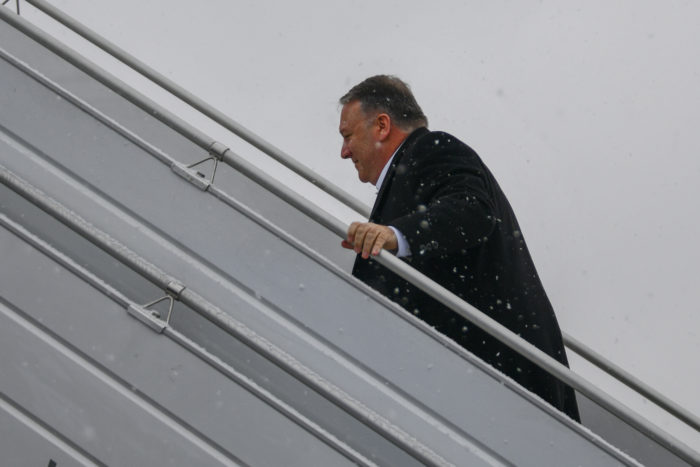
Pompeo leaving Warsaw. (State Department photo by Ron Przysucha)
By Patrick Lawrence | Consortium News | February 19, 2019
What a job Vice President Mike Pence and Secretary of State Mike Pompeo did in Europe last week. If the objective was to worsen an already critical trans–Atlantic rift and further isolate the U.S., they could not have returned to Washington with a better result.
We might have to mark down this foray as among the clumsiest and most abject foreign policy failures since President Donald Trump took office two years ago.
Pence and Pompeo both spoke last Thursday at a U.S.–sponsored gathering in Warsaw supposedly focused on “peace and security in the Middle East.” That turned out to be a euphemism for recruiting the 60–plus nations in attendance into an anti–Iran alliance.
“You can’t achieve peace and stability in the Middle East without confronting Iran,” Pompeo said flatly. The only delegates this idea pleased were Benjamin Netanyahu, the Israeli prime minister, and officials from Gulf Arab nations who share an obsession with subverting the Islamic Republic.
Pence went on to the annual security conference in Munich, where he elaborated further on a few of the Trump administration’s favored themes. Among them: The Europeans should ditch the nuclear accord with Iran, the Europeans should cut off trade with Russia, the Europeans should keep components made by Huawei and other Chinese companies out of their communications networks. The Europeans, in short, should recognize America’s global dominance and do as it does; as if it were still, say, 1954.
It is hard to imagine how an American administration can prove time and again so out of step with 21stcentury realities. How could a vice-president and a secretary of state expect to sell such messages to nations plainly opposed to them?
Pounding the Anti-Iran Theme
Pompeo, who started an “Iran Action Group” after the Trump administration withdrew last year from the 2015 nuclear accord, returned repeatedly to a single theme in his Warsaw presentations. The Iranians, he said, “are a malign influence in Lebanon, in Yemen, and Syria and Iraq. The three H’s—Houthis, Hamas, and Hezbollah—these are real threats.”
Pence ran a mile with this thought. “At the outset of this historic conference,” he said, “leaders from across the region agreed that the greatest threat to peace and security in the Middle East is the Islamic Republic of Iran.” To be noted: all the “leaders from across the region” in attendance were Sunnis, except for Netanyahu. The major European allies, still furious that Washington has withdrawn from the nuclear accord, sent low-level officials and made no speeches.
The European signatories to the Iran accord knew what was coming, surely. While Pence insisted that Britain, France and Germany withdraw from the nuclear pact—“the time has come,” he said—he also criticized the financing mechanism the three set up last month to circumvent the Trump administration’s trade sanctions against Iran. “They call this scheme a ‘special purpose vehicle,’ ” Pence said. “We call it an effort to break American sanctions against Iran’s murderous revolutionary regime.”
There were plenty of European leaders at the security conference last weekend in Munich, where Pence used the occasion to consolidate what is beginning to look like an irreparable escalation of trans–Atlantic alienation. After renewing his attack on the Iran agreement’s European signatories, he shifted criticism to the Nord Stream 2 gas pipeline. Now under construction, this will be the second undersea pipeline connecting Gazprom, the Russian energy company, to Germany and other European markets. Last month the U.S. renewed threats to sanction German companies working on the $11 billion project. “We cannot strengthen the West by becoming dependent on the East,” Pence said at the security conference Saturday.
These and other remarks in Munich were enough to get Angela Merkel out of her chair to deliver an unusually impassioned speech in defense of the nuclear accord, multilateral cooperation and Europe’s extensive economic relations with Russia. “Geo-strategically,” the German chancellor asserted, “Europe can’t have an interest in cutting off all relations with Russia.”
US Primacy V. Europe’s Future
Merkel’s speech goes to the core of what was most fundamentally at issue as Pompeo and Pence blundered through Europe last week. There are three questions to consider.
The most obvious of these is Washington’s continued insistence on U.S. primacy in the face of full-frontal resistance even from longstanding allies. “Since day one, President Trump has restored American leadership on the world stage,” Pence declared in Warsaw. And in Munich: “America is stronger than ever before and America is leading on the world stage once again.” His speeches in both cities are filled with hollow assertions such as these—each one underscoring precisely the opposite point: America is fated to continue isolating itself, a little at a time, so long as its leaders remain lost in such clouds of nostalgia.
The other two questions concern Europe and its future. Depending on how these are resolved, a more distant trans–Atlantic alliance will prove inevitable.
First, Europe must soon come to terms with its position on the western flank of the Euro–Asian landmass. Merkel was right: The European powers cannot realistically pretend that an ever-deepening interdependence with Russia is a choice. There is no choice. China’s Belt and Road Initiative, as it progresses westward, will make this clearer still.
Second, Europe must develop working accommodations with its periphery, meaning the Middle East and North Africa, for the sake of long-term stability in its neighborhood. The mass migrations from Syria, Libya and elsewhere have made this evident in the most tragic fashion possible. It is to Germany’s and France’s credit that they are now negotiating with Turkey and Russia to develop reconstruction plans for Syria that include a comprehensive political settlement.
As they do so, Washington shows no sign of lifting sanctions against Syria that have been in place for more than eight years. It may, indeed, impose new sanctions on companies participating in reconstruction projects. In effect, this could criminalize Syria’s reconstruction—making the nation another case wherein Europe and the U.S. find themselves at cross purposes.
Patrick Lawrence, a correspondent abroad for many years, chiefly for the International Herald Tribune, is a columnist, essayist, author, and lecturer. His most recent book is “Time No Longer: Americans After the American Century” (Yale). Follow him @thefloutist. His web site is http://www.patricklawrence.us.
Venezuela: The Next Move and the Final Word
By Maximilian C. Forte | Zero Anthropology | February 17, 2019
Almost a month after Donald Trump recognized Juán Guaidó as the “interim president” of Venezuela, and the imperial media started to label Nicolás Maduro as the “disputed” president of Venezuela (as if that were a universally accepted statement of fact), nothing has happened to unseat Maduro. The intended coup does not appear to be advancing. Meanwhile the US continues its sanctions, only now they are sanctioning a country they claim is led by someone who is not Maduro. If one mistook rhetoric for reality, US foreign policy would appear to have been conceived in some sort of Twilight Zone. Back in the real world, the US tacitly recognizes that Maduro is in fact the head of government and state in Venezuela, and both the threats of US military intervention and the sanctions themselves prove that point.
Far from a wave of popular condemnation of the Maduro government, Venezuela instead experiences something of a “slow coup,” mostly based on support from foreign right-wing governments. Following ZA’s sketch of the models used for this intended coup, ranging from Ukraine to Libya and Syria, others warned that we should look out for the “7 rules of regime change” that typically constitute the US’ campaigns of foreign destabilization. Libya was actually an appropriate analogy in some key regards, one of them being that the US was actively inciting chaos by trying to create a situation where more than one government claimed legitimacy. As for Ukraine, it was the Ukrainian Foreign Minister himself who drew the analogy between the Maidan protests and events in Venezuela. Also indicative of this approach is the fact that Trump hired the infamous Elliot Abrams (an ardent “Never Trumper” but an even bigger opportunist), one of the original neocons who played a role not just in the 2002 coup attempt against Hugo Chávez in Venezuela—and has now been called back for an encore—but was also tied to the covert war against Nicaragua, lying to Congress, and providing cover for the notorious death squads in El Salvador during the 1980s. In the US Congress, Democrats in charge of the House Foreign Affairs Committee put together a “team” to deal with Venezuela, including one Debbie Wasserman Schultz, who was guilty of rigging electoral processes within the DNC to the disadvantage of Bernie Sanders in 2016—worthy coup experience. (Yet, on that same committee there have been some outstanding exceptions, namely Ilhan Omar.)
Venezuela and the Problem for Trump’s White House

Nicolás Maduro, President of Venezuela
However the problem is that the “slow coup” approach seems to be increasing frustration in the ranks of both the Venezuelan opposition and the White House. How much longer can the US government tolerate its commands being ignored and “defied”? The longer this goes on, the greater the chance that Trump will lose face, at a delicate political time of upcoming US presidential elections and when he has lost so much face already. This is a person who has long boasted that his administration would always be “winning,” winning so much that his supporters would tire of all the winning. What has Trump won with Venezuela? If Trump just lets things continue, Venezuela could learn to survive sanctions the way several other states have also learned to survive them. Venezuela still has some powerful friends: China, India, and Russia chief among them. Venezuela is not under a UN-approved international sanctions regime, the kind imposed on Iraq, North Korea, and Iran. Venezuela still has room for manoeuvre, and even an IOU can carry a lot of weight if it’s based on possession of the world’s largest proven oil reserves. In addition, Venezuela’s armed forces declared their loyalty to President Maduro. The opposition made feeble, legalistic efforts to win over the military’s support (basically promising only to not “prosecute” the military for supporting the legitimate government), but this failed from the outset. Meanwhile the military held prominent exercises under the direction of Maduro’s government. The military continued to hold extensive exercises from February the 10th to the 15th, in practice for a counter-invasion. At this rate, Trump could enter the 2020 electoral campaign with Maduro still in power in Venezuela, and Trump’s opponents lampooning him as a failure: all sound and fury and nothing more than promises made of hot air.
The other option of course, the one that Trump frequently repeats is always “on the table,” is US military intervention in Venezuela. This would then be Trump’s first new war added to the list of the US’ current wars. There now appears to be a straight line of seamless continuity running from George W. Bush to Barack Obama and now Donald Trump, especially where regime change in Venezuela is concerned. Trump, who sometimes feigns awful annoyance at the “Obama legacy,” which he pretends to want to destroy, is only too keen to shore it up in Venezuela. The one “national emergency” about which no one is threatening to sue the White House, a “national emergency” decreed by Obama and still in force, is the one that classes Venezuela as an “unusual and extraordinary threat to the national security and foreign policy of the United States”. On his way out the door, Obama renewed and extended that same “national emergency”—and Trump loyally picked up the baton. Yet Venezuela has never threatened the US, and the US Congress has not authorized any military action in Venezuela. Will Trump be reticent about usurping authority by continuing to expand the executive power of the imperial presidency? If he does, another charge will then stick during the 2020 campaign: that he is authoritarian. Not just authoritarian, but one also responsible for starting a new, unpopular and costly war, an illegal war. Far from ending the US’ “foreign entanglements” and “nation building” crusades, Trump will have added to them. This would then become the final word on the Trump presidency.
Trailing a long line of failures and broken promises, Trump would be entering the 2020 presidential campaign (if his administration can survive that long), with a brand new war to place on the shoulders of Americans. Tired of all the “winning” yet?
Trump has engineered quite the situation for himself. If he does nothing more, and Maduro survives, Trump loses face. More than that, he has already lost Venezuelan oil for a whole range of US-based oil refineries and transnational shipping firms, not to mention countless billions bypassing the US financial system, and there is already talk of tapping the national oil reserve. It would be a situation where Trump ends up with less than if he had said nothing at all about the Maduro presidency—an indisputable defeat. On the other hand, if Trump chooses the military option, besides the US facing eventual defeat like it has done regularly since Vietnam, the political backlash at home would be devastating. So which is the way out for Trump?
Trump’s Next Move
There are two significant clues that suggest Trump will choose to go to war with Venezuela. One is a foreign clue, and the other is domestic. The first clue is that February 23 is likely to be the turning point. The US and its Venezuelan force multipliers are constructing a situation that could be used to provoke armed intervention by the US: an innocent humanitarian aid convoy, embraced by democracy-loving innocent civilians in Venezuela, fired upon mercilessly by the forces of the “brutal dictatorship”. Not only is the US ready to sacrifice Venezuelan lives, it is likely ready to sacrifice the lives of the US AID personnel currently in Cucuta, Colombia (poor saps, they had better get their life insurance policies in order). It has to be the kind of event that makes most Americans gasp in shock, and demand immediate justice. I don’t know if this can work, or will happen, especially because the Venezuelan government has so far excelled at playing it cool, and outsmarting the opposition.
The second clue, domestic in focus, is that Trump has recently decided to declare a war on socialism at home, with the aid of Fox News, Breitbart, and various alternative right-wing media. The only way for Trump to sell his war in Venezuela is by simultaneously linking it to a war at home. That way Trump can parade himself among diminished groups of supporters and pretend that his policy in Venezuela is what they want, and what they need: a world free of socialism.
The image of “Venezuela” is thus being instrumentalized for use against “domestic enemies,” suggestively linking the two, and the evidence for that comes directly from Trump himself. In his “State of the Union” speech of February 5, 2019, Trump stated the following about Venezuela just before turning back to the US:
“Two weeks ago, the United States officially recognized the legitimate government of Venezuela—(applause)—and its new President, Juan Guaidó. (Applause.) We stand with the Venezuelan people in their noble quest for freedom, and we condemn the brutality of the Maduro regime, whose socialist policies have turned that nation from being the wealthiest in South America into a state of abject poverty and despair. (Applause.)
Here in the United States, we are alarmed by the new calls to adopt socialism in our country….”
When one heard the speech, the flow from Venezuela to socialism in the US was both smooth and rapid—it was unmistakable that the suggestive link between the two was deliberately planned. To further applause, including from some Democrats, Trump added: “Tonight, we renew our resolve that America will never be a socialist country”. What they did not hear, and they should have if they truly listened, was Trump’s declaration of war on Venezuela.
Venezuela: The Final Word on Trump
In reviewing Trump’s foreign policy positions over the past three decades, there was one vital piece of evidence that I either overlooked or whose significance I simply did not realize (and since I have not seen the analysis that follows anywhere else, it seems everyone missed this too). While Trump may sound like he is against “endless wars,” “foreign entanglements,” “nation building” and the overthrow of foreign regimes that involves the US in affairs that do not concern it, and while he preaches respect for “sovereignty” and vows not to impose “American values” on other nations—all seemingly exceptional positions for an American president, enough to get him branded an “isolationist”—all of this is conditional on one key factor: distance/proximity.
If a potential target nation is “far away”—for example, Afghanistan and Syria—then it is wrong for the US to get involved. However, if the nation is “close” to the US—i.e., all the nations of the Western Hemisphere—then it is right for the US to intervene because in areas close to home, the US has a “special responsibility”. It’s a claim to ownership, and it’s a return to the classic neocolonial geopolitics of the Monroe Doctrine (and Trump formally cited Monroe in his 2018 address to the UN General Assembly).
The evidence for this notion of a “special responsibility” tied to proximity, comes from Trump himself. While at a golf course in August of 2017, Trump told reporters:
“We have many options for Venezuela, this is our neighbor. We’re all over the world and we have troops all over the world in places that are very, very far away. Venezuela is not very far away and the people are suffering and dying. We have many options for Venezuela including a possible military option if necessary”.
Vice President Mike Pence reiterated this explanation to Fox News, answering a question about why Trump is withdrawing troops from Syria and Afghanistan while intervening in Venezuela:
“President Trump has always had a very different view of our hemisphere… He’s long understood that the United States has a special responsibility to support and nurture democracy and freedom in this hemisphere and that’s a longstanding tradition”.
Not speaking out of turn (for a change), national security adviser John Bolton offered further confirmation: “The fact is Venezuela is in our hemisphere. I think we have a special responsibility here, and I think the president feels very strongly about it”.
Trump views Latin America as the US’ “backyard,” sovereignty thus does not apply to the Western Hemisphere’s states. But if Trump does not respect the sovereignty of Latin Americans, then why should they in turn respect the sovereign borders of the US? If sovereignty does not apply in relations between states in the Americas, then Latin Americans should dismiss US sovereignty, and freely pour across the US’ southern border. Where there is no equality and reciprocity, then invasion and counter-invasion will have to do.
If distance/proximity is one factor limiting, even reversing the scope of Trump’s putative anti-interventionism, civilization is another. On a trip to Poland in July of 2017, Trump delivered a controversial speech that many justifiably understood to be a classic defence of “White, Western, Christian civilization”:
“…. we will never forget who we are…. Americans will never forget. The nations of Europe will never forget. We are the fastest and the greatest community. There is nothing like our community of nations. The world has never known anything like our community of nations. We write symphonies. We pursue innovation. We celebrate our ancient heroes, embrace our timeless traditions and customs, and always seek to explore and discover brand-new frontiers. We reward brilliance. We strive for excellence, and cherish inspiring works of art that honor God. We treasure the rule of law and protect the right to free speech and free expression…. That is who we are. Those are the priceless ties that bind us together as nations, as allies, and as a civilization”.
Reflecting on this, I argued elsewhere that “Trump respects sovereignty only for those who are qualified to possess it : White Western Christian nations, in loose terms”. I noted that Trump evidenced the most respect for nations that are linked to the US through cultural parentage—“but where cultural affinity is lacking, Trump chooses the American materialist’s preferred substitute for culture: money, and lots of it”. Trump thus has respect for European nations plus Israel (i.e., Euro-America in the Middle East), but also China, Japan, and Saudi Arabia—that is the map of Trump’s world of sovereign states. The rest of the world is inhabited by what he freely calls “animals,” and “monsters,” shit-hole nations usually ruled by “brutal dictators”—this is the wild neocolonial frontier: it is the world beyond the pale, and beyond the pallid.
It is outside of the domain of Trump logic where we find Trump’s supposed anti-interventionist stance on Syria and Afghanistan directly collides with his actions against Venezuela and Iran, a fact noted by many others besides myself. (Except Iran does not fit within Trump’s logic as described above, which shows that it’s not much of a logic at all.) In the world of the critically rational, where people struggle to understand reality and not deny it, where contradictions need to be explained even if they cannot be reconciled, then this is how Venezuela will be the final word on Trump, especially if a war happens—read each sentence on the left, and then interject the word on the right as a corrective:
| Donald Trump’s Explicit Position (Myth) | The Final Word (Reality) |
| “We will seek friendship and goodwill with the nations of the world”… | Venezuela |
| “We do not seek to impose our way of life on anyone”… | Venezuela |
| “each nation of the world must decide for itself what kind of future it wants to build for its people”… | Venezuela |
| “America will always choose independence and cooperation over global governance, control, and domination”… | Venezuela |
| “I honor the right of every nation in this room to pursue its own customs, beliefs, and traditions. The United States will not tell you how to live or work or worship”… | Venezuela |
| “Around the world, responsible nations must defend against threats to sovereignty not just from global governance, but also from other, new forms of coercion and domination”… | Venezuela |
| “Here in the Western Hemisphere, we are committed to maintaining our independence from the encroachment of expansionist foreign powers”… | Venezuela |
| “Sovereign and independent nations are the only vehicle where freedom has ever survived, democracy has ever endured, or peace has ever prospered. And so we must protect our sovereignty and our cherished independence above all”… | Venezuela |
| “Strong, sovereign nations let diverse countries with different values, different cultures, and different dreams not just coexist, but work side by side on the basis of mutual respect”… | Venezuela |
| “…you, as the leaders of your countries will always, and should always, put your countries first”… | Venezuela |
| “The United States of America has been among…the greatest defenders of sovereignty”… | Venezuela |
| “We are going to have to stop being the policemen of the world”… | Venezuela |
| “the United States cannot continue to be the policeman of the world. We don’t want to do that”… | Venezuela |
| “it is now time to bring our troops back home. Stop the ENDLESS WARS!”… | Venezuela |
Before being elected president, Trump spoke specifically about Venezuela and Hugo Chávez in brief comments to the Miami Herald, saying: “Their leaders are not very friendly to our leaders. But, of course, our leaders don’t get along with too many people….” On Chávez he said, “He had some feelings, some very strong feelings, and he did represent a lot of people, and he represented a lot of people that had been left behind”. However, even then, Trump made comments that suggested he wanted to become involved in Venezuela’s affairs. His wish has come true, but it’s Venezuela that will have the final word.
Guaido Gives Pro-Maduro Military 7 Days to ‘Take Side of Constitution’
Sputnik – 16.02.2019
Venezuelan opposition leader Juan Guaido, who has declared himself the country’s interim president, called on the Venezuelan Armed Forces, supporting President Nicolas Maduro, to change sides, giving the military seven days to do so, in the anticipation of humanitarian aid arrivals to the crisis-hit country.
“February 23 is coming, gentlemen from the Armed Forces. It is a very important date for the Venezuelan society not only because we have an opportunity to stop this emergency, which is directly and indirectly killing people, but also to open the doors of change for Venezuela. You have this opportunity, you have eight days to take the side of the constitution,” Guaido said during a forum dedicated to national oil industry.
Guaido suggested that “usurpation” of power by Maduro and his supporters should be ended in order to leave poverty, facing the country, behind.
23 February is the day when humanitarian aid, coordinated by Guaido, is expected to reach Venezuela. Earlier in February, Guaido warned the military that blocking the aid from entering the country would be a “crime against humanity.”
The government of President Nicolas Maduro has been refusing to take in the aid saying it would justify foreign interference in the country’s internal affairs.
Christoph Harnisch, the head of the International Committee of the Red Cross (ICRC) in Columbia, has said his organization would not assist in delivering the goods to Venezuela because the ICRC does not consider the US assistance to be humanitarian aid. Earlier this month, the ICRC warned US officials against politicizing humanitarian assistance and delivering aid without the consent of local authorities.
On 23 January, Guaido, who is the speaker of the opposition-controlled National Assembly, proclaimed himself an interim president until election is held in the country, saying that an article of the Venezuelan constitution allowed him to do this. This claim was subsequently denied by supporters of Maduro.
Guaido was almost immediately recognized by the United States and its allies. Russia, China, Mexico, among other nations, voiced support for constitutionally elected Maduro, who, in turn, accused Washington of orchestrating a coup in the country.
Poland summons Israeli ambassador over Netanyahu’s Holocaust comments
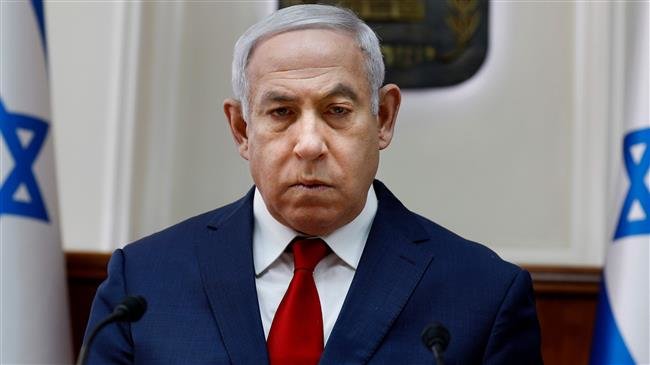
Press TV – February 15, 2019
Poland has called in Israel’s ambassador to Warsaw, threatening to scuttle an upcoming summit in Israel, after the regime’s Prime Minister Benjamin Netanyahu appeared to accuse the European country of collaborating with the Nazi Germany in carrying out the Holocaust.
The Israeli premier, who had participated in a US-sponsored Middle East conference in the Polish capital on Thursday, landed back late Friday but created a short-lived spat with the Polish government when he appeared to implicate Poles in the Holocaust.
However, a correction note issued by The Jerusalem Post alleviated the concerns of Warsaw that had been infuriated by the paper’s initial report, which quoted Netanyahu as saying on Thursday that “Poles cooperated with the Germans” in the Holocaust.
Furthermore, the Israeli regime’s foreign ministry in a statement on Friday called the whole story a mere misunderstanding originated from the Israeli paper’s misquotation.
“The prime minister’s comments concerning Poland were misquoted by The Jerusalem Post, which quickly issued a correction clarifying that an error had been made in the editing of the article,” it said.
Nonetheless, Poland’s Foreign Ministry summoned Israeli Ambassador Anna Azari to Warsaw for a dressing down over the issue.
Before being summoned, Azari made clear that Netanyahu’s comments had been misquoted.
“I was present during the prime minister’s briefing and he didn’t say that the Polish nation collaborated with the Nazis, he only said that no person was sued for speaking about those Poles who did cooperate with them,” she said in a Friday statement sent to Polish authorities.
Prior to Azari’s statement, Polish President Andrzej Duda had even suggested that the Visegrad Group summit due next week in Israel between Netanyahu and four central European counterparts could be reconsidered “in spite of the previous arrangements” if the Israeli premier had said what was originally reported.
Duda further said that he was even prepared to make his own country the location of the summit as Israel was no longer a good place for the meeting.
Later on Friday, Netanyahu’s office issued a second statement saying that he “spoke of Poles and not the Polish people or the country of Poland.” In its first statement, his office had said he had been misquoted by The Jerusalem Post.
It seemed that the correction note and clarifications finally convinced the Polish government, which said late on Friday that Netanyahu’s statements had been misquoted and misunderstood by the media, thereby ending the spat.
The sensitivities are high in Poland over the issue of its actions during the Holocaust.
Featured Video
Seyed M. Marandi: Toward Total War in the Middle East
or go to
Aletho News Archives – Video-Images
From the Archives
The Geopolitics behind the War in Yemen (I)
By Mahdi Darius NAZEMROAYA | Strategic Culture Foundation | 30.03.2015
The United States and the Kingdom of Saudi Arabia became very uneasy when the Yemenese or Yemenite movement of the Houthi or Ansarallah (meaning the supporters of God in Arabic) gained control of Yemen’s capital, Sanaa/Sana, in September 2014. The US-supported Yemenite President Abd-Rabbuh Manṣour Al-Hadi was humiliatingly forced to share power with the Houthis and the coalition of northern Yemenese tribes that had helped them enter Sana. Al-Hadi declared that negotiations for a Yemeni national unity government would take place and his allies the US and Saudi Arabia tried to use a new national dialogue and mediated talks to co-opt and pacify the Houthis.
The truth has been turned on its head about the war in Yemen. The war and ousting of President Abd-Rabbuh Manṣour Al-Hadi in Yemen are not the results of «Houthi coup» in Yemen. It is the opposite. Al-Hadi was ousted, because with Saudi and US support he tried to backtrack on the power sharing agreements he had made and return Yemen to authoritarian rule. The ousting of President Al-Hadi by the Houthis and their political allies was an unexpected reaction to the takeover Al-Hadi was planning with Washington and the House of Saudi. … continue
Blog Roll
 Aletho News
- Israeli lobby seeks to bind US fate to ‘Israel’: Araghchi
- Pakistan-Iran talks secure LNG shipment to Islamabad through Hormuz
- Black Sea grain crisis puts global wheat supplies under pressure
- IRGC air defenses destroy another US MQ-1 drone over Strait of Hormuz
- Imran Khan’s entire immediate family detained in Pakistan ahead of mass protest demanding his release
- EU nation detains former presidential frontrunner
- Leaked: Britain’s Sham Conviction Of Hashim Thaci
- Seyed M. Marandi: U.S. Strike Imminent – Toward Total War in the Middle East
- Russia Voted Under Fire. Washington Is Loading the Tankers.
- 12 Things Your Oncologist Was Trained Not to Tell You
- If Americans Knew
- Israeli Attacks in Gaza Kill at Least Seven Palestinians Over Three Days, including Woman and Child
- Trump’s militarization of Washington DC as he pursues Israel’s war against Iran
- Why Israel Fears This Searing New Documentary
- Huckabee aide solicited cash gifts from Israelis
- This isn’t sci-fi, AI is already killing people
- ‘The Most Brutal Thing’: Investigation Reveals Execution of Elderly Woman in Rafah
- Inside Israel’s ‘soft’ ethnic cleansing plan for Gaza through the eyes of its victims
- New online database tracks pro-Israel political donations in the United States
- Israeli president pardons soldier convicted for killing wounded Palestinian
- Singer Ed Sheeran says his ‘heart broken’ by Gaza devastation, addresses Macklemore controversy
- No Tricks Zone
- 2025 Nature Paper Claiming Worsening Global Drought Gets RETRACTED …Heavily Flawed
- New Study: ‘Global Drought Shows No Detectable Recent Acceleration Under Climate Warming’
- Economic Masterminds: German Socialists Suggest Taxing Productivity Gains Stemming From Using AI
- The South China Sea Has Not Been Cooperating With The Climate Change Narrative
- Energy Crisis: Germany Enters Heating Season With Historically Low Gas Reserve Fill Levels
- New Study: The Antarctic Ice Sheet Gained Mass From 2020-2024 Due To Staggering Snow And Ice Accumulation
- Study: Ocean Heating Rates From Thousands Of Years Ago ‘Dwarf’ Modern Ocean Heating Rates
- Climate Extremists Target, Attack Large-Scale Power Grid Infrastructure In Germany!
- New Study: Antarctic Ice Melt Has Contributed Less Than 1 Centimeter To Sea Level Rise In The Last 30 Years
- Fear Of Debate: Alarmist German Climate Scientist Calls On Mainstream Media To Discredit Skeptic Voices
 Aletho News