Israel unveils new synagogue in Jerusalem’s Al-Aqsa
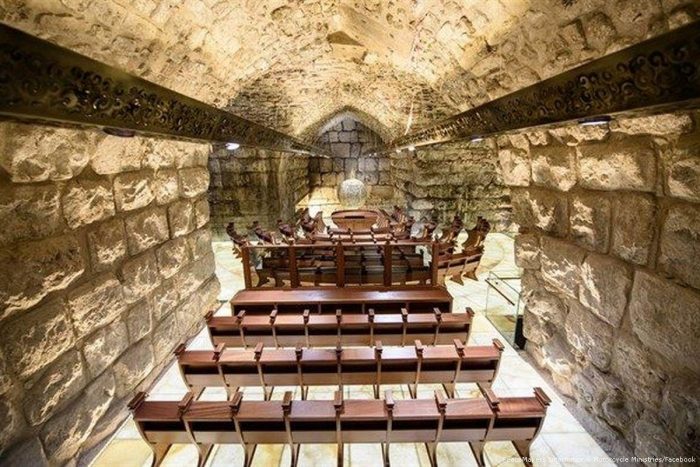
Israel unveils a new synagogue in Jerusalem’s Al-Aqsa [PeaceMakers International Motorcycle Ministries/Facebook]
MEMO | December 19, 2107
The Israeli authorities today unveiled a new Jewish synagogue under the Al-Buraq Wall – known to Jews as the Western Wall – in occupied East Jerusalem’s Al-Aqsa Mosque compound.
“Following 12 years of construction, the new synagogue was opened on Monday evening,” the Heritage Foundation of the Western Wall, an Israeli governmental body, said in a statement.
“The unique design of the prayer hall combines rare art and unique lighting, creating a wonderful contrast between ancient and modern,” the statement read.
In recent years, Islamic institutions in East Jerusalem have lodged repeated protests over excavations being carried out by the Israeli authorities under the flashpoint mosque compound.
In a statement, Sheikh Ekrema Sabri, head of Jerusalem’s Supreme Islamic Council and a former Al-Aqsa imam, stressed that the Al-Buraq Wall was a component of the Al-Aqsa’s western wall.
“The wall is part of our Islamic heritage and will remain so until Judgment Day,” Sabri said.
“The Israeli occupation has no claim on Jerusalem’s heritage,” he added. “This new synagogue… doesn’t have any historical roots.”
“All new construction by the [Israeli] occupation authorities in Jerusalem is illegitimate and lacks a historical basis,” Sabri said, adding the holy city “cannot be partitioned”.
In October 2016, UNESCO voted on a resolution which denied any Jewish connection to Al-Aqsa Mosque and Al-Buraq Wall in occupied Jerusalem.
Tension has mounted in the occupied territories since US President Donald Trump recognised Jerusalem as Israel’s capital on 6 December, drawing condemnation from across the world. Yesterday the United Nationals Security Council voted 14 to one against Trump’s decision, however due to the US power of veto a resolution could not be passed against his unilateral move.
Read also: Israel to allocate $50m to explore foundations of alleged Temple
Hernandez declared winner of Honduras presidential race, opposition calls for rallies
Press TV – December 18, 2017
In Honduras, incumbent Juan Orlando Hernandez has been declared the winner of last month’s disputed presidential election after a partial recount, with the opposition candidate rejecting the results and calling for fresh protests.
The Supreme Electoral Tribunal said Sunday after the official recount that Hernandez has won with 42.95 percent to 41.42 for challenger Salvador Nasralla.
“We have fulfilled our obligation (and) we wish for there to be peace in our country,” the tribunal’s president David Matamoros said.
Matamoros said the tribunal had resolved all the disputed issues, and that votes were recounted at select polling stations.
The count has, however, been questioned by the two main opposition parties and monitors with the Organization of American States (OAS).
As he left for the United States, Nasralla rejected Hernandez’s re-election as illegitimate and called for more protest rallies on Monday.
“The declaration by the court is a mockery because it tramples the will of the people,” Nasralla said. He added that he was “very optimistic” because “the people do not endorse fraud.”
He also said he would urge the OAS in Washington to invoke its democratic charter against Honduras.
The former Honduran president, Manuel Zelaya, who backed Nasralla, tweeted Hernandez “is not our president,” urging people to take to the streets in protest.
Meanwhile, the OAS secretary general, Luis Almagro, said “serious questions” surrounded the election results, urging Honduran officials to avoid making “irresponsible announcements.”
He also called for a fresh presidential election to guarantee peace in the country, which has been the scene of angry protests and clashes since the November 26 presidential election.
However, European Union election observers said the vote recount showed no irregularities.
The initial results had shown Nasralla with a significant lead over Hernandez with nearly 60 percent of the vote counted.
The electoral tribunal then went mysteriously silent, giving no further public updates for about 36 hours, and when they resumed, Nasralla’s lead steadily eroded and ultimately reversed in favor of Hernandez.
The protests and violence, which broke out over the manner of announcing the results, has killed at least 22 people.
Al-Houthi Hits back at US Claims on Iran Missile Supply

Head of Yemen’s Revolutionary Council, Mohammad Ali Al-Houthi
Al-Manar | December 15, 2017
Head of Yemen’s revolutionary Committee, Mohammad Ali Al-Houthi hit back at US claims that Iran had been supplying Yemeni revolutionaries with missiles.
“Had we imported Iranian missiles, then we would have boosted our air-defense system,” Al-Houthi said on his Twitter account.
“What’s ironic is that the US is the side who is supplying the Saudi-led aggression with banned weapons that have been killing the Yemeni people,” Al-Houthi said, stressing that the US has failed in Yemen.
Yemen has been since March 2015 under a brutal aggression by Saudi-led coalition, in a bid to restore power to fugitive former president Abdrabbuh Mansour Hadi.
Tens of thousands of Yemenis have been injured and martyred in Saudi-led strikes, with the vast majority of them are civilians.
However, the allied forces of the Yemeni army and popular committees established by Ansarullah revolutionaries have been heroically confronting the aggression with all means, inflicting huge losses upon Saudi-led forces.
The Saudi-led coalition – which also includes UAE, Bahrain, Egypt, Morocco, Jordan, Sudan and Kuwait – has been also imposing a blockade on the impoverished country’s ports and airports as a part of the aggression.
Turkey switches to full defiance of US, continues Putin courtship
By M.K. Bhadrakumar | Asia Times | December 14, 2017
On Monday, US National Security Advisor HR McMaster added to tensions in the Middle East when he condemned Turkey and Qatar as prime sponsors of extremist Islamist ideology.
He tore into the Turkish leadership, saying the country’s growing problems with the West are largely due to the rise of the Justice and Development Party in Ankara.
A few days ago, McMaster had described China and Russia as “revisionist powers” encroaching on US allies and undermining the international order, and castigated Iran and North Korea as outlaw regimes that “support terror and are seeking weapons of mass destruction.”
McMaster now rounds on Turkey and Qatar for mentoring a radical Islamist ideology that “is obviously a grave threat to all civilized people.” The stunning part is that Turkey is a NATO ally, while the US Central Command is headquartered in Qatar.
Arguably, Turkey no longer qualifies to be a NATO member. McMaster spoke at a rare public policy platform with his British counterpart Mark Sedwill, at an event hosted by the Policy Exchange think tank in Washington. How any of this transmutes into Anglo-American policy will bear watching. (Interestingly, on a visit to Greece last week, Erdogan publicly sought a revision of the 1923 Treaty of Lausanne, which was negotiated under the tutelage of Britain and the US and ceded, amongst other things, all Turkish claims on the Dodecanese Islands and Cyprus.
Significantly, McMaster’s outburst came within hours of a meeting in Ankara between Erdogan and Russian President Vladimir Putin, their eighth this year, during a combined day-long trip by the Russian leader which included stops in Egypt, Turkey and the Hmeimim airbase in Syria.
Ironically, if it was the perceived Soviet threat to Turkey that Harry Truman and Dean Acheson blew out of proportion to lay the ground for an enthusiastically pro-American Turkish prime minister, Adnan Menderes, to bring Turkey into the NATO fold in 1952, 55 years later the blossoming of Russo-Turkish cooperation prompts Washington to doubt Turkey’s credentials as an ally.
But then, NATO has no precedents of ousting a member state and its decisions are taken unanimously. To be sure, Erdogan will only leave the NATO tent kicking and screaming. His intent is to shake off US hegemony, which he can do better while inside the NATO tent. He is in turn taunting, provoking, snubbing, defying and – worse still –ridiculing US regional strategies.
Erdogan’s talks with Putin on Monday suggest a new stage in their coordination to undermine US interests in the Middle East. Putin announced that they agreed on a loan agreement, which will be signed “very shortly,” to pursue the “significant prospects for expanding our military and technical cooperation.”
Erdogan added that “the relevant agencies of our two countries are expected to complete what needs to be done this week” with regard to Turkey’s purchase of Russia’s S-400 missile system. It is a huge snub to Washington and some of its NATO allies that the Russian system cannot be integrated into the alliance’s defenses.
Again, Erdogan announced that Turkey and Russia are “determined to complete in the shortest possible time” the Turkish Stream (which will bring more Russian gas to Turkey and use Turkey as a hub to supply southern Europe) and the US$25 billion Akkuyu Nuclear Power Plant. The US opposes the Turkish Stream, which will frustrate its plans to export LNG to Europe.
Putin joined Erdogan to criticize the US decision regarding Jerusalem. Putin said, “It is destabilizing the region and wiping out the prospect of peace”; Erdogan said he was “pleased” by Putin’s stand. Erdogan said the OIC (Organization of Islamic Cooperation) summit in Istanbul on Wednesday would be a “turning point” on the crisis; Putin promised to send a representative.
Most stunning, though, are the emerging contours of a profound Russo-Turkish action plan in Syria. They attribute centrality to the Astana peace process, which also includes Iran but leaves the US and its regional allies in the cold. Following Putin-Erdogan talks, the next meeting at Astana has been announced.
Equally, Russia and Turkey are collaborating to organize a congress of Syrian National Dialogue in Sochi. Foreign Minister Mevlut Cavusoglu signaled on Tuesday that Turkey no longer objects to Kurdish participation. Evidently, Russia is leveraging its influence with the Kurdish groups. This badly isolates the US, which is increasingly left with rump elements of Kurdish militant groups as its remaining allies. An open-ended US military presence in Syria becomes pointless since the capacity to influence a Syrian settlement is nearing zero.
After returning to Moscow, Putin submitted to the Duma a new agreement on expanding the Russian base in the Syrian port city of Tartus. The balance of forces in the Mediterranean region is dramatically shifting even before a Syrian settlement is negotiated.
Meanwhile, Cavusoglu hinted that Turkey and Russia plan to create new facts on the ground in northern Syria. “Threats for Turkey are coming from Afrin. We may enter this region without a warning. If we carry out the operation there, we will agree on all its aspects with our allies, including Russia.”
Putin apparently heeded Erdogan’s concerns that Afrin is a crucial region for Turkish national security. This is a paradigm shift. If Turkey kicks out the Kurdish militia from Afrin in coordination with Russia, it is a slap to America’s face. A flashpoint may arise.
What emerges is that denying the US any form of land access to Syria’s Mediterranean coast and reducing the American bases in Syria as remote and isolated pockets would be a Russo-Turkish enterprise. McMaster’s rage is understandable.
Venezuela’s Electoral System Reliable, Says Monitor
By Ryan Mallett-Outtrim | Venezuelanalysis | December 8, 2017
Venezuela’s voting system remains one of the most reliable in the world, an international group of electoral experts said Thursday.
The country’s electronic voting system boasts some of the world’s best checks and balances, and is both “safe and reliable”, according to Nicanor Moscoso, the head of the Latin American Council of Electoral Experts (CEELA).
“The results have never been formally refuted. It is the most audited process in the world,” he said.
The comments were made after Moscoso concluded talks with Venezuela’s electoral authority, the CNE.
Praising the work of the CNE, Moscoso said the electoral system is heavily automated and easy for voters to use.
“Venezuelans can be sure that Sunday will deliver the real results of the democratic will,” Moscoso said, referring to upcoming municipal elections this Sunday.
More than 300 mayoral positions nationwide are up for grabs, with the ruling socialist party, the PSUV, hoping to repeat its surprise victory in October’s regional vote. The party secured 18 of the country’s 23 state governorships in the elections.
Ahead of the vote, opposition parties had expected to make major gains, and largely refused to acknowledge the unexpected results once they came in. Prominent opposition parties including Voluntad Popular, Primero Justicia and Vente Venezuela have all vowed to boycott Sunday’s vote.
The boycott is likely to backfire on the opposition, according to Phil Gunson of the International Crisis Group.
“I don’t think there are many instances in history where governments have been brought down by electoral boycotts,” he told The Guardian.
“I think the very least you can ask of an opposition is that it shows up and puts up a fight,” Gunson added.
Honduran Opposition Seeks Annulment of Election Results
teleSUR | December 2017
The main opposition parties in Honduras independently submitted requests to annul the results of the Nov. 26 presidential election, which they consider fraudulent and skewed in favor of President Juan Orlando Hernández.
Salvador Nasralla, the leader of the Alliance of Opposition Against the Dictatorship, called on the Supreme Electoral Tribunal (TSE) to initiate a total recount of all votes and documents.
Before Nasralla presented his official challenge before the TSE, he warned that 200,000 extra votes had already been counted.
“Honduras has become a global joke,” he told reporters.
The candidate stressed his optimism, claiming that justice will prevail in the end.
“I know the people will defend the result (of the recount),” said Nasralla, who indicated that once the legal bodies perform their duties after the formal challenge, he plans to travel abroad to denounce the “fraud we have found.”
Meanwhile, the Liberal Party secretary, Octavio Pineda, also delivered a formal request to the TSE to annul the results. “Principles have been violated since the current president was allowed to participate in the electoral process when the Constitution forbids it,” he said.
The TSE has up to 10 days to respond to requests for annulment.
The election, which occurred two weeks ago, has left Hondurans unsure of who will be their next president for the next four years. This uncertainty has triggered protests in the Central American country that has left at least 11 dead and 15 wounded.
OAS Finally Hints at ‘Irregularities’ in Honduran Elections Days After Vote
teleSUR | December 7, 2107
After almost two weeks since Honduran elections, the Organization of American States said it may urge for a new presidential vote if “irregularities” continue to undermine the credibility of the Nov. 26 results, which have not been officially announced.
OAS Secretary General Luis Almagro said in a written statement the regional group would prefer to audit the existing ballots, rather than initiate a new vote, adding that Honduran citizen confidence in its electoral system cannot be restored “without an exhaustive and meticulous process of verification that determines the existence or not of an electoral fraud.”
The Opposition Alliance’s Salvador Nasralla and many national and international organizations have called the vote count fraudulent, as a wide lead was erased to right-wing incumbent President Juan Orlando Hernandez of the National Party.
With the electoral process in its second week Nasralla and his team began calling for a run off election if a full ballot recount under international scrutiny couldn’t be completed.
The Opposition Alliance first demanded an internationally audited recount of the ballots from over 1,000 polling stations. This was carried out. They later demanded that the Supreme Electoral Tribunal recount the disputed ballots from over 5,000 polling stations. TSE officials and Hernandez agreed to the ballots in questions late last night after regional pressure.
Alliance evidence of electoral irregularities on the part of the TSE and its Director David Matamoros has incited profound distrust of the TSE from the opposition camp, creating a virtual stalemate in the process. Nasralla said late last night, “you can’t present your demands to a tribunal that isn’t neutral.”
He said he no longer recognizes the TSE and demands that an international mediator oversees any recount. “If we hadn’t had international participation, we would truly be in the law of the jungle,” Nasralla commented.
Nasralla and his team had earlier sent the TSE its 11 demands for electoral transparency, which included the revision of ballot boxes they say arrived at TSE offices “opened” exposing “sensitive information,” but they haven’t been completed.
Luis Zelaya, of the Liberal Party and third runner-up in the elections, has thrown his support to Nasralla and agreed that a full recount under OAS and European Union observation should take place.
Meanwhile, Matamoros was vague Wednesday night as to whether a full recount or a new election will take place.
According to current TSE figures, Hernandez is ahead with 42.98 percent while Nasralla has 41.38 percent of votes. The TSE has counted, at least once, nearly 100 percent of all ballots. By law, the TSE has until Dec. 26 to declare a winner.
Other OAS requests were that the Honduran government restore all constitutional rights to citizens and lift the nighttime national curfew, both of which were put in place Dec. 1. After the statement was released the administration lifted the curfew in nearly half of the country’s departments, but it’s still in effect in most of the nation until Dec. 11.
The curfew was put in place to limit Opposition Alliance supporters from protesting what they say was a stolen election. Despite the curfew, however, thousands of opposition supporters continue to rally day and night on the streets and highways of Honduras.
The Honduran Committee for Families of the Detained and Disappeared said that 14 people have been killed, 51 injured and 844 detained so far during the post-election protests.
Hernandez supporters are reportedly marching today in Tegucigalpa to support their candidate.
The U.S. State Department released a statement yesterday advising U.S. citizens to delay or cancel travel to Honduras “due to ongoing political protests and the potential for violence.”
North Korea Pushes US to Negotiating Table?
By Finian CUNNINGHAM | Strategic Culture Foundation | 07.12.2017
Just when the crisis in US-North Korean relations could not seem more bleak, this week sees a chance that the two sides could be moving quietly towards a diplomatic resolution. The arrival of senior United Nations diplomat Jeffrey Feltman in Pyongyang for four days of discussions with top officials was reported as a “very rare” event.
Feltman is the most senior American official in the United Nations secretariat, serving as the chief of political affairs under Secretary General Antonio Guterres. The last time such a senior UN official reportedly visited North Korea was six years ago. The delegation this week comes at the request of Pyongyang.
The US State Department said that Feltman was in North Korea on behalf of the United Nations, and that he was not conveying a message from Washington. Nevertheless, there are grounds to believe that the diplomat’s “wide-ranging” discussions with senior North Korean officials is an opening for tentative talks between Washington and Pyongyang to resolve the deepening crisis over the latter’s nuclear weapons program.
Before his UN appointment in 2012, Feltman (58) worked in the US State Department for nearly 30 years. His posts included sensitive Middle East areas: Israel, Palestine, Iraq, Lebanon and Bahrain. Officially, he may be on UN business this week in Pyongyang, but it seems plausible that this career US diplomat will, in addition, convey a significant political signal from Washington that formal talks are on.
Washington’s public position is that no talks with North Korea are on the agenda until Pyongyang halts its nuclear weapons program. However, US Secretary of State Rex Tillerson said recently there was the possibility of “talks about talks” in the future. President Donald Trump while threatening “fire and fury” on North Korea has also at other times hinted that he is willing to engage in diplomacy with North Korean leader Kim Jong-un.
For its part, North Korea has said it will never unilaterally give up its nuclear weapons program as a deterrent to what it calls US aggression.
Escalating rhetorical jibes between the two leaders over the past several months might suggest that there is minimal chance for diplomacy. Trump has disparaged Kim as “Rocket Man on a suicide mission”; while Kim has mocked the American president as “a stupid old dotard”.
Russia and China have urged all sides to engage in negotiations in order to calm roiling tensions, which have mounted over the past year from dozens of missile tests being conducted by North Korea, as well as from provocative military exercises carried out by the US and its South Korea and Japanese allies.
Last week, North Korea launched its biggest Intercontinental Ballistic Missile (ICBM) yet, a Hwasong-15, which various analysts said demonstrated the capability for a nuclear strike on any part of the US mainland, including the capital Washington DC. Pyongyang announced that the test launch proved that the country had completed its quest for acquiring nuclear weapons capable of hitting the US.
Then this week, US forces conducted their biggest-ever warplanes drill with South Korea, involving some 230 aircraft, including B1-B nuclear-capable bombers and reportedly for the first time stealth F-35 and F-22 fighter jets. The massive air-force mobilization came despite appeals from China and Russia for a suspension. There were also warnings from North Korea that the US bombing rehearsals were leading the Peninsula to the brink of nuclear war.
Trump’s top national security advisor General HR McMaster recently added to fears of a full-on conflict breaking out when he described the situation as a countdown to war. Trump has also on several occasions warned that he would “totally destroy” North Korea if the US or its allies were threatened. A threat which was again repeated last week by the US ambassador the UN Nikki Haley. Pyongyang has, in turn, said that such rhetoric amounts to a declaration of war by the US.
The re-listing on November 20 by Washington of North Korea as a “state sponsor of terrorism” is another incendiary factor in an already explosive geopolitical mix.
However, in spite of the imminent danger of all-out armed conflict, there are reasons to believe that both sides are willing to pull back.
Bellicose posturing by Trump and his aides cannot disguise the fact that Washington does not have a realistic military option in dealing with North Korea. Negotiation is the only viable option to resolve the long-running crisis, as China and Russia have both consistently urged.
Many American weapons experts, including Siegfried Hecker, the former head of Los Alamos Laboratory, reckon that North Korea has the capability of 30 to 60 nuclear weapons. An underground test in September points to the possession of a H-bomb with a 10-fold explosive power of the A-bombs dropped by the US on Hiroshima and Nagasaki.
“There is little doubt that North Korea could mount a nuclear warhead on a missile that could reach South Korea or Japan,” according to Siegfried.
That capability alone – if not also the now very real possibility of hitting the US mainland – places millions of lives at risk, if Washington were to go to war with North Korea.
Over the past decade since North Korea’s first nuclear test explosion in 2006, the country’s military defenses have progressed at an astonishing rate, despite the ratcheting up of economic and diplomatic sanctions by Washington. Most of North Korea’s weapons development has occurred under the current leader Kim Jong-un who took over six years ago after the death of his father Kim Jong-il. Four of the country’s total six nuclear tests have taken place under the watch of the 30-something-year-old incumbent.
Having now achieved the stated goal of possessing a nuclear deterrent force capable of hitting the US, Pyongyang may feel it is finally in a position to talk with Washington on a mutual basis.
South Korean diplomat, Kim Hong-gul, who met the North Korean leader six years ago at his father’s funeral, said that the recent test of the ICBM purportedly capable of striking the US, could paradoxically be a harbinger of future talks between Pyongyang and Washington.
In an interview with Bloomberg this week, the South Korea diplomat said of the ICBM test launch: “It could be a flare signaling the start of the negotiations. On completion [of nuclear forces], Kim wouldn’t need to test missiles anymore, so he could suggest a conversation with the South and the US, possibly in his New Year speech, while refraining from further tests.”
It seems significant that the day after the latest ICBM test, on November 30, Pyongyang confirmed its invitation to the UN for high-level discussions. Within days, the UN reciprocated by sending Jeffrey Feltman, the seasoned former US State Department point man, to Pyongyang this week.
It is not known if Feltman will meet with Kim Jong-un during his four-day trip, but he is scheduled to hold talks with North Korea’s most senior diplomat, foreign minister Ri Yong-ho.
Notably, too, Feltman’s visit to Pyongyang follows a high-level delegation from Beijing to North Korea, the first such trip by Chinese diplomats after a two-year hiatus.
Bloomberg also reports: “Russian lawmaker Vitaly Pashin, who recently visited Pyongyang, said Monday that North Korean officials are ready for one-on-one or multiparty talks now that they’ve become a nuclear power capable of striking the US mainland.”
The standoff between the US and North Korea is much too grim, and the stakes are much too high, for any side to crow about one-upmanship.
But maybe – just maybe – the brinkmanship shown by North Korea to persist with its nuclear program in the face of US threats has paid off by forcing Washington to come to the negotiating table in order to resolve the standoff peacefully through a political settlement.
So much for Western depiction of the North Korean leader as a “madman”. His cold-blooded logic may spare the world from a nuclear war incited by the crazies in Washington.
Honduran opposition urges total vote recount or run-off
Press TV – December 6, 2017
Honduras’ opposition presidential candidate has demanded either an entire vote recount or a run-off poll following a controversial vote-counting process that resulted in favor of incumbent President Juan Orlando Hernandez by a low margin but no declared winner.
Salvador Nasralla, who had earlier demanded a recount of at least one-third of the votes, said in a Twitter post on Tuesday that the electoral tribunal now had to review all the voting cards.
“If you don’t agree with that, let’s go to a run-off between (Hernandez) and Salvador Nasralla,” he added.
It took Honduran authorities more than a week to count the votes from the November 26 presidential election in the country of only nine million people.
Early on Monday, electoral authorities said Hernandez had won 42.98 percent of the votes, compared with Nasralla’s 41.39 percent. But the authorities stopped short of declaring a winner.
As the results began to trickle in last week, Nasralla was in the lead with a significant margin before a 24-hour hiatus in the official vote count reversed that trend. The opposition candidate soon alleged fraud and called on his supporters to take to the streets. Tens of thousands took to the streets on Sunday in a show of support for Nasralla, a former TV star.
Former Honduran president Manuel Zelaya, who was toppled in a US-backed coup in 2009 and now supports Nasralla, also declared through a Twitter message that the opposition was seeking a total recount of the vote, or legislation to allow for a run-off.
Meanwhile, police forces rebelled against the Hernandez administration on Monday, refusing to take part in a crackdown on protesters and calling on the government to address the political stalemate.
A top official at the Honduran electoral tribunal, David Matamoros, invited the opposition to compare their copies of voter tally sheets with the official body’s versions. He also said the tribunal would extend a deadline for legal challenges from Wednesday to Friday.
Meanwhile, protest rallies in favor of Nasralla that started last week continued on Tuesday afternoon as scores of people, including police officers, converged at the Tegucigalpa headquarters of Honduras’ elite police force yelling “Out, JOH,” using President Hernandez’s initials.
Hernandez, who has been commended by the US for his crackdown on violent street gangs, has also claimed victory a number of times since the election but avoided making the claim in remarks broadcast on Monday and Tuesday.
Honduras: Teenage Girl Killed as Army Enforces Curfew
teleSUR | December 2, 2017
Three people – including a teenaged girl – have so far been killed in violent clashes following the disputed Honduran elections, as the armed forces opened fire on unarmed opposition supporters while enforcing a 10-day curfew imposed by the government late Friday.
One man was killed in the port city of La Ceiba on Friday and 19-year-old Kimberly Dayana Fonseca was shot in the head early Saturday in Tegucigalpa as soldiers busted up protesters’ blockades, a spokesman for the national police said, bringing the total death toll to three.
In a brief statement to the press, the head of the Supreme Electoral Tribunal (TSE) David Matamoros announced late Saturday that the scrutiny of more than 1,000 disputed ballots would resume Sunday 9:30am local time.
He also noted that screening more than 5,000 ballots, as requested by the Opposition Alliance, would have taken 12 to 15 days. “We appreciate your presence, but there will be nothing else here today, I reiterate that we will call for tomorrow at 09h30 local time,” the magistrate said.
In response, Opposition Alliance leader Salvador Nasralla accused the TSE of deliberately excluding the towns of Lempira, La Paz and Intebuca after he requested they be reviewed when the turnout was abnormally high (75 percent) compared with the rest of the country (50 percent).
Nasralla insisted it was mathematically impossible that Hernandez could win the election with 30 percent of the votes still uncounted before the electronic system collapsed.
“We want what the Honduran people want,” he told teleSUR in a televised interview. “If the people want, we will run for another election. If they want, I won’t participate if Juan Orlando Hernandez doesn’t either.
“If (electoral authorities) refuse to recount, let’s hold the elections again, but with an international tribunal: that’s our position,” he concluded, describing the situation as “a coup d’etat.”
He also said the leadership of the armed forces had “sold themselves” in shirking their constitutional duties “against a tyrant who forcefully wants to stay in power,” and accused the government of infiltrating opposition protests in order to loot local stores and discredit the movement.
Human rights organizations have denounced the curfew, blaming “excessive force” by state troops. The U.S.-based Action Network has sent an open letter to the U.S: Congress and State Department, expressing “deep concern about reports of fraud and state violence” and calling for the immediate suspension of all U.S. police and military aid to Honduras.
The Venezuelan government firmly condemned on Saturday the “latest attempted blow against democracy from sectors of the Honduran oligarchy. The people’s will and human rights of the people of Honduras must be respected,” said Jorge Arreaza on Twitter.
In a communique, Venezuela’s Foreign Ministry also slammed the “repression and the excessive use of force by State security forces,” accusing “the same actors” responsible for the 2009 coup against the constitutional President Manuel Zelaya.
The Honduran Ministry of Justice ordered the suspension of citizens’ constitutional rights shortly before 11pm Friday. On Saturday, the Committee of the Relatives of the Disappeared in Honduras (Dodafeh) confirmed 11 people have been injured in Tegucigalpa since late Saturday and 41 arrested, six of whom are minors.
The government, controlled by current president and electoral candidate Juan Orlando Hernandez, claims the move is to counter what they call “violent protests” by supporters of presidential candidate and Opposition Alliance leader Nasralla.
The Honduran Roundtable for Human Rights (HRHR) said “excessive force” is being used by Honduran military and state security forces. Nasralla said the suspension of constitutional guarantees is part of a Supreme Electoral Tribunal (TSE) plan to “steal” his “victory,” claiming the electrobal body has committed electoral fraud since polls closed Sunday night.
The HRHR, in a formal statement, said the Armed Forces are creating a “terrorist state” against peaceful protesters, killing at least two people with rubber bullets and injuring dozens. National police forces have “arbitrarily arrested” citizens, intimidated media and thrown tear gas at marchers.
Bolivian President Evo Morales reprimanded the United States and Organization of the American States (OAS) for their alleged complicity: “Nearly a week since the Honduran elections. Why are the U.S. and OAS silently complicit regarding the elections and death of citizens in Honduras? Democracy is in danger in a neighboring country?”
Official election results on the TSE website have remained unchanged since Friday morning, with Hernandez leading by less than one percentage point over Nasralla. Over 94 percent of ballots are counted.
The decree now in effect until Dec. 11 says that people can move about freely only from 6am until 6pm. Outside of that time, they are not allowed to be on highways or in any public space, otherwise they are “putting their lives in danger.” The decree gives the military the right to patrol the streets and detain anyone “violating” the curfew.
Turkey’s Erdogan won’t capitulate
By M K Bhadrakumar | Indian Punchline | December 2, 2017
As the countdown begins for the trial in a Manhattan federal court next week of the Turkish-Iranian millionaire gold trader Reza Zarrab over violations of US sanctions against Iran, Turkey is hardening its stance. President Recep Erdogan has said that Turkey cannot be prosecuted in a fake court. (See my article in Asia Times, Gold dealer’s testimony puts Erdogan on shaky ground.)
Importantly, on Friday, the Istanbul Chief Prosecutor’s Office issued an arrest warrant for a former top CIA official Graham Fuller alleging his involvement in the failed coup attempt in Turkey in July last year. The Turkish security is apparently in possession of information that Fuller was in the country during the coup attempt on July 15 and abruptly left after the coup failed. Fuller participated in a secret meeting of the coup plotters on July 15-16, which was held in the Buyukada Island in the Sea of Marmara off Istanbul.
For the first time, Ankara is inches away from hinting that last year’s was a CIA-sponsored coup attempt, aimed at overthrowing Erdogan’s government. The government has alleged previously that the coup plotters intended to “eliminate” Erdogan.
This is an extremely serious development insofar as Turkey is, in effect, alleging that the spy agency of a major NATO ally, which swears by Article 5 of the alliance’s charter on collective security, actually conspired to overthrow its established government which enjoyed a democratic mandate.
From all indications, Turkish intelligence would have collected a lot of evidence regarding the coup before making the move to seek Fuller’s arrest. At least some of the evidence would also have been provided by friendly countries such as Russia and Iran. We will never know whether the Russian and Iranian intelligence are in possession of hard information pointing at CIA involvement in the coup attempt in Turkey, but the possibility cannot be ruled out. The Iranian Foreign Minister Mohammed Zarif was constantly interacting telephonically with his Turkish counterpart through the fateful night of the coup attempt when things were on razor’s edge.
Ankara announced on Friday that Turkish Foreign Minister Mevlut Cavusoglu will be attending the NATO Foreign Ministers’ meeting in Brussels on December 5-6. Cavusoglu is sure to bump into US Secretary of State Rex Tillerson. One can only wish to be a fly on the wall at the NATO Hqs. Indeed, if the US plan is to leverage the Zarrab case to pressure Turkey to change course in its foreign policies and revert to its cold-war era role as the West’s junior partner in the region, it may boomarang. Turkey may be preparing to go on the offensive.
Make no mistake, Turkey will follow up on the arrest warrant for Fuller. Fuller was a mentor of the controversial Islamist preacher Fetullah Gulen. According to Turkish reports, Fuller had recommended Gulen’s application for the Green Card, which in turn enabled the latter to live in exile in the US for almost two decades after he fled Turkey in 1998. Turkish intelligence keeps a close tab on Gulen’s activities Ankara has often hinted that Gulen is actively in contact with the US establishment.
If Erdogan wants to hit the Americans hard, he won’t have to look beyond next-door Syria. Erdogan’s key advisor Ibrahim Kalin has written in the pro-government Sabah newspaper today that with the defeat of ISIS, the US has no justification to support the Syrian Kurds. To quote Kalin,
- This question was discussed during a recent phone call between President Recep Tayyip Erdogan and U.S. President Donald Trump on Nov. 24. Trump’s response was affirmative, adding that the huge military support the U.S. is providing to the YPG should have ended before. His statement was contradicted only a few days later by the Pentagon.
There is an implicit warning here that Turkey is drawing a red line. Kalin disclosed in the article that Pentagon is using the pictures of Kurdish women fighters to “romanticize” the US-Kurdish alliance. Kalin wrote, “[It is] a useful instrument to sell propaganda to Western audiences, but an affront to the female body and personality. Among the many ironies of this policy, this one is stunning: America’s best ally in Syria is a Marxist-Leninist terrorist organization that fights against Turkey, a key U.S. ally, and seeks autonomy and eventual independence in Syria.”
The Turkish intelligence has got through to the chief spokesman of the US-backed Kuridsh alliance (known as the Syrian Democratic Front) Talal Silo who has “defected” to Turkey recently. In an interview with the Anadolu news agency today, Silo has spilt the beans, exposing the Pentagon’s nefarious activities in Syria that threaten Turkish national security interests. The transcript of the interview is here.
The Intercept Attacks WikiLeaks on Behalf of Democrats
By Daniel Haiphong | American Herald Tribune | November 29, 2017
The Intercept emerged during the Obama era to provide a service to whistle blowers. Journalist Glenn Greenwald, for example, helped form the Intercept in the aftermath of the corporate media backlash to Edward Snowden’s leaks about the massive surveillance machine possessed by the National Security Agency (NSA). The Intercept prided itself as a trustworthy source tailored to those interested in making state secrets a matter of public record. Then Donald Trump was elected and subtle changes to the content of the Intercept’s work became evident. By this time the Intercept was neither a safe for leaks nor a reliable source of journalism.
On November 15th, the Intercept attacked WikiLeaks, the most well-known publisher of Washington’s dirty laundry. The attack centered around WikiLeaks‘s communication with Donald Trump Jr. According to the Intercept, WikiLeaks has “given ammunition” to detractors of the group through its direct contact with Trump Jr. over Twitter. The tweets, which revolved around the release of Trump’s tax documents, are supposedly proof that WikiLeaks “advised” the Trump Administration and is thus in cahoots with it. However, sources such as MSNBC, the New York magazine, and The Atlantic do not give the Intercept’s claims much credibility.
WikiLeaks’ request for Trump Jr. to release tax information could be seen as a strategic move to pressure the Administration to respond to the broader attack on WikiLeaks. The fact remains that at the time of the accusation (October 2016), Trump’s tax history was already being scrutinized by the corporate press. WikiLeaks was also being attacked by the corporate press for releasing Podesta’s emails, many of which revealed key policy blunders of the Obama-Clinton machine. The emails revealed that the DNC had in fact rigged the Democratic primary against Bernie Sanders among a sea of evidence of Clinton’s servitude to Wall Street. The author of the Intercept article fails to mention this context at all.
Omitting the importance of the information leaked by WikiLeaks regarding the Clinton machine lays bare the partisan character of the Intercept’s attack. And this is not the first time that the Intercept has damaged its journalistic reputation with partisan politics. The Intercept was implicated in the exposure of Reality Winner’s identity in the insubstantial leak regarding Russian interference in the 2016 elections. It also published an anti-Syria hit piece comparing President Assad to fascists. Most recently, the Intercept was found to have withheld important Snowden leaks that may have changed the course of the war in Syria.
These instances of the Intercept’s alignment with US imperialism raise many questions. First, what is it that prompts the media source from publishing articles that do nothing but aid the Democratic Party wing of the empire? And furthermore, how do the Intercept’s recent journalistic blunders fit into the broader historical moment? These questions are vitally important as they point to the necessary approach to handling contradictions. This particular point in history is characterized by a crisis in every facet of US imperialism, making independent journalism that much more important to the development of a movement that can seize the time.
It turns out that the Intercept’s status as an independent media source has always been up for debate. The popular media source is a subsidiary of First Look Media. First Look Media is a venture of Pierre Omidyar, the billionaire tech capitalist and founder of eBay. Omidyar is well known for his investments in the non-profit and NGO industries around the world. He is also a staunch Democrat. In the 2016 elections, Omidyar gave hefty donations to an anti-Trump Super PAC.
It should come as no surprise then that the Intercept provides stealth defense of the Democratic Party. The Democratic Party is arguably in a weaker position than it was last November when Donald Trump defeated Hillary Clinton. Top Democrats remain committed to the dying narrative that Russia influenced the 2016 elections in favor of Trump. Former DNC interim chair Donna Brazile confirmed the facts in the 2016 WikiLeaks dump that Hillary Clinton used the DNC to secure her nomination. Polls suggest that the Democratic Party may in fact be less popular than Donald Trump. That’s because the Democratic Party has nothing to offer except anti-Russian hysterics and pro-corporate candidates.
A defense of WikiLeaks is not necessary then because the source of the attack is dubious at best and illegitimate at worst. WikiLeaks may have committed an error over Twitter by communicating with Trump Jr. If this is about political strategy, then one could make the argument that tweeting to the Trump Administration shows a level of opportunism to use the Trump Administration for its own ends. It isn’t as if Julian Assange wouldn’t have a reason to do whatever it takes to curry favor with the current Administration. Assange is a wanted man and would likely serve a life in federal prison if extradited from the Ecuadorian Embassy in London.
However politically flawed, WikiLeaks has done humanity a service by exposing the Democratic Party as but another organ of the rich. The Republican Party has long been known for its staunch support for the most egregious manifestations of white supremacy and capitalism. Donald Trump’s election was in part a rejection of the Republican Party elite. The Republican Party’s base refused to support Jeb Bush, Ted Cruz, or Marco Rubio. Trump took advantage of the chaos and won the Republican nomination, only to be confronted with a Democratic Party opposition in similar shape.
The role WikiLeaks played in the election cycle was thus a progressive one. Leaks such as Vault7 gave the masses an understanding of the Democratic Party’s true character. Clinton’s speeches to Wall Street, her “public” and “private” positions on Social Security, and her leadership in destroying Libya only added fuel to the fire sparked by the revelation that the Clinton campaign used the DNC to ensure its nomination. Any discussion about WikiLeaks cannot leave out the concrete developments that made the election so historic in the first place.
The enduring legacy of the 2016 elections is a reflection of the deep crisis that plagues US imperialism. Inequality continues to deepen, police repression continues to intensify, and a global confrontation with Russia and China remains a serious threat to the future of humanity. The Intercept’s decision to publish an attack on WikiLeaks is far more dangerous than the accusations leveled at WikiLeaks. It demonstrates a conscious neglect of progressive and radical politics in favor of the gossip that passes as news these days. The Trump-WikiLeaks connection has become just another talking point to draw readers into unsubstantiated conspiracies against the two-party elite.
This is not a time to pontificate Assange’s personal political views or those of WikiLeaks. WikiLeaks cannot drive a new movement for social transformation, only the people can. Still, it is a crime to negate the objective impact of WikiLeaks in weakening the Democratic Party. The Democratic Party is the greatest obstacle to forging a real struggle against war, austerity, and racism in our time. Criticism of WikiLeaks that leaves out this critical point amounts to tacit support for the Democrats. And the Intercept’s criticism is just one example of a longer trend that shows just what kind of influence Democratic Party donor and billionaire Pierre Omidyar has on the organization.
Featured Video
Seyed M. Marandi: Toward Total War in the Middle East
or go to
Aletho News Archives – Video-Images
From the Archives
The Geopolitics behind the War in Yemen (I)
By Mahdi Darius NAZEMROAYA | Strategic Culture Foundation | 30.03.2015
The United States and the Kingdom of Saudi Arabia became very uneasy when the Yemenese or Yemenite movement of the Houthi or Ansarallah (meaning the supporters of God in Arabic) gained control of Yemen’s capital, Sanaa/Sana, in September 2014. The US-supported Yemenite President Abd-Rabbuh Manṣour Al-Hadi was humiliatingly forced to share power with the Houthis and the coalition of northern Yemenese tribes that had helped them enter Sana. Al-Hadi declared that negotiations for a Yemeni national unity government would take place and his allies the US and Saudi Arabia tried to use a new national dialogue and mediated talks to co-opt and pacify the Houthis.
The truth has been turned on its head about the war in Yemen. The war and ousting of President Abd-Rabbuh Manṣour Al-Hadi in Yemen are not the results of «Houthi coup» in Yemen. It is the opposite. Al-Hadi was ousted, because with Saudi and US support he tried to backtrack on the power sharing agreements he had made and return Yemen to authoritarian rule. The ousting of President Al-Hadi by the Houthis and their political allies was an unexpected reaction to the takeover Al-Hadi was planning with Washington and the House of Saudi. … continue
Blog Roll
 Aletho News
- Finland’s Stubb tells European leaders to calm down
- Defeating Russia on battlefield impossible – Fico
- Finland’s Gender Clinic Reversal
- Massachusetts Wants Mental Health Visits, Why Does Government Use ‘Health’ to Enter Our Homes & Families?
- US lawmaker admits American people footing bill for Trump’s failed aggression against Iran
- Pfizer Gave $500,000 to Groups That Lobbied to End Religious Exemption in Massachusetts
- HE SAVED LIVES. NOW HE FACES PRISON.
- Israeli lobby seeks to bind US fate to ‘Israel’: Araghchi
- Pakistan-Iran talks secure LNG shipment to Islamabad through Hormuz
- Black Sea grain crisis puts global wheat supplies under pressure
- If Americans Knew
- Gaza desperately needs tents, wheelchairs, fuel… and everything else (Israel blocks it all) – Daily Update
- Israeli Attacks in Gaza Kill at Least Seven Palestinians Over Three Days, including Woman and Child
- Trump’s militarization of Washington DC as he pursues Israel’s war against Iran
- Why Israel Fears This Searing New Documentary
- Huckabee aide solicited cash gifts from Israelis
- This isn’t sci-fi, AI is already killing people
- ‘The Most Brutal Thing’: Investigation Reveals Execution of Elderly Woman in Rafah
- Inside Israel’s ‘soft’ ethnic cleansing plan for Gaza through the eyes of its victims
- New online database tracks pro-Israel political donations in the United States
- Israeli president pardons soldier convicted for killing wounded Palestinian
- No Tricks Zone
- 2025 Nature Paper Claiming Worsening Global Drought Gets RETRACTED …Heavily Flawed
- New Study: ‘Global Drought Shows No Detectable Recent Acceleration Under Climate Warming’
- Economic Masterminds: German Socialists Suggest Taxing Productivity Gains Stemming From Using AI
- The South China Sea Has Not Been Cooperating With The Climate Change Narrative
- Energy Crisis: Germany Enters Heating Season With Historically Low Gas Reserve Fill Levels
- New Study: The Antarctic Ice Sheet Gained Mass From 2020-2024 Due To Staggering Snow And Ice Accumulation
- Study: Ocean Heating Rates From Thousands Of Years Ago ‘Dwarf’ Modern Ocean Heating Rates
- Climate Extremists Target, Attack Large-Scale Power Grid Infrastructure In Germany!
- New Study: Antarctic Ice Melt Has Contributed Less Than 1 Centimeter To Sea Level Rise In The Last 30 Years
- Fear Of Debate: Alarmist German Climate Scientist Calls On Mainstream Media To Discredit Skeptic Voices
 Aletho News