Congressmen urge America’s UN Ambassador to act for sanctions on Sudan
Sudan Tribune | September 22, 2012
KHARTOUM — A bipartisan group of 38 Congressmen urged United States Ambassador to the United Nations Susan Rice to work for imposing sanctions against the Sudanese government because of its failure to allow humanitarian access to the Two Areas of South Kordofan and Blue Nile.
On 4 August the mediation announced that Sudanese government and the rebel Sudan People’s Liberation Movement North (SPLM-N) have reached an agreement to provide civilians in the rebel held areas with humanitarian assistance.
However until now the operation has not begun as the Sudanese government and tripartite committee, of UN agencies, Arab League and African Union, continue to hold meetings over its implementation.
The rebel SPLM-N called for an international operation from South Sudan or Ethiopia but the demand is rejected by Khartoum. Senior members of the SPLM-N rebels were recently in Washington and urged Congressmen to act on Sudan’s humanitarian crisis.
In their letter of 21 September, the lawmakers said they were concerned by the humanitarian crisis in the Blue Nile and South Kordofan reminding them that some 650,000 people have already been displaced or severely affected by the conflict in these border states.
After praising Resolution 2046 and the threat to impose sanctions if its dispositions are not met, the Congressmen state that “the Security Council’s principled position must be enforced in order to be credible. Accountability is key when lives hang in the balance.”
The UN Security Council is to meet next week to assess the whole process including the talks between Khartoum government and rebels.
In a statement issued on 21 September, the 15 member council said it was gravely concerned about the worsening humanitarian situation in the states.
“The members of the Council once again stressed the urgency of immediately delivering humanitarian relief supplies to the affected civilian populations, so as to avoid any further suffering or loss of life,” the statement said.
They further urged the two parties to “begin direct talks, urgently agree to and implement a cessation of hostilities, and create a conducive environment for further progress on political and security issues.”
In Khartoum the Sudanese humanitarian commissioner Suleiman Abdel-Rahman told the official SUNA that they had reports that an aircraft belonging to a foreign aid group landed in the rebel-held town of Kauda without permission from the Sudanese government.
He also said that humanitarian assistance was recently delivered to the rebel-held areas through an unspecified neighbouring state or air drop operations.
Related articles
- Sudan rebels say town entered, army camp destroyed (dailystar.com.lb)
Tel Aviv regime rejects changes to Camp David Accords

Press TV – September 23, 2012
The Tel Aviv regime says it will not accept any changes to the 1979 Egypt-Israel Peace Treaty, as the ties between the two sides continue to sour.
“There is not the slightest possibility that Israel will accept the modification of the peace treaty with Egypt,” Israeli Foreign Minister Avigdor Lieberman said on Sunday.
The 1979 peace treaty was signed following the Camp David Accords, agreed upon by then Egyptian President Anwar al-Sadat and then Israeli Prime Minister Menachem Begin on September 17, 1978, at Camp David in Washington DC.
“We will not accept any modification of the Camp David Accords,” Lieberman further said.
Lieberman’s comments come amid speculations that Egypt’s President Mohamed Morsi will seek alterations to the agreements.
Tensions have been simmering between Cairo and the Tel Aviv regime over the security of the Sinai Peninsula and the heavy deployment of Egyptian forces to the region.
Egypt boosted its military presence in the Sinai after militants killed 16 Egyptian border guards on August 5.
However, the Camp David treaty limits the number of Egyptian troops that can be present in the territory.
Lieberman also stated that Egypt should fulfill its obligations in the peninsula.
Tel Aviv has warned Cairo to pull out the military reinforcements from the region.
Related articles
Syria Opposition Figures Meet in Damascus, Reject Foreign Interference
Al-Manar | September 23, 2012
As they called for regime change in Syria, some 15 opposition parties rejected foreign interference in the ongoing crisis in the country.
During the “National Conference for Rescuing Syria” which was held on Sunday in the capital, opposition figures discussed peaceful ways to end the conflict and help unite the fragmented opposition.
Sunday’s meeting at a hotel in Damascus was held under tight security and on the initiative of the National Coordination Committee for Democratic Changes in Syria.
The ambassadors of Russia, China, Iran and some Arab states that have maintained their diplomatic presence in Syria were also attending the forum.
The conference’s main aim is to secure an “immediate ceasefire” by the conflicting parties and “transfer the armed conflict between the authorities and the opposition into a peaceful political process,” Russian Ambassador to Damascus Azamat Kulmukhametov said in his address to the forum’s participants.
“We are convinced that a dialog without preconditions is the sole way out of the current crisis whose continuation bodes no good either for Syria or for the region as a whole,” he said.
The Arab media have reported the opposition conference will discuss a change of the current Syrian regime, a transition to a civil democratic state and the dangers of the forceful scenario in the country.
The Damascus conference is being held amid disagreements inside the Syrian opposition, with some opposition activists and groups boycotting its work.
For its part, the so-called “Free Syrian Army” (FSA) has not recognized the conference, saying its participants do not “represent a true opposition and are only another face of the Syrian regime.”
Related articles
Egypt court refuses reinstatement of dissolved lower house of parliament
Ahram Online | September 22, 2012
The Supreme Administrative Court (SAC) ruled Saturday to uphold the verdict of the High Constitutional Court (HCC) deeming the People’s Assembly, formed after national polls in November 2011 unconstitutional. The assembly was dissolved on the basis of that verdict.
Although the SAC adjourned a similar case Saturday appealing the dissolution of the People Assembly, parliament’s lower house, to 15 October, only hours later it ruled in a different case in favour of the HCC verdict.
The dissolution of the People’s Assembly was a matter of great controversy in past months since HCC decision 14 June. The Muslim Brotherhood, forming the largest bloc of the former People’s Assembly, vociferously opposed the verdict together with other Islamists, with many of their lawyers working to saving the assembly through legal appeals.
Upon his inauguration, President Mohamed Morsi, who hails from the Brotherhood’s ranks, declared the People’s Assembly reinstated. However, after his decision was deemed legally flawed, parliament did not resume its functions, waiting for the Administrative Court’s final verdict on filed appeals.
Several Brotherhood members, including acting chairman of the Freedom and Justice Party (FJP) and former MP Essam El-Erian as well as secretary general of the FJP and former Parliament Speaker Mohamed Saad El-Katatni were amongst the most prominent figures confirming there was a legal possibility that the assembly would be reinstated.
Their statements were repeatedly criticised by legal experts who argued that the reinstatement of the assembly was unlikely considering that the HCC had already ruled on its unconstitutionality.
Meanwhile, the newly appointed justice minister, Ahmed Mekki, earlier criticised the HCC for issuing its verdict dissolving the elected parliament, arguing that in light of the political situation at the time it should have postponed cases related to parliament along with other politically charged cases.
The general assembly of the HCC in response condemned Mekki’s statements implying their verdict was “politically motivated.” In its statement, the HCC described his criticism as “unacceptable interference” in the court’s work, insisting that all the court’s verdicts were based on constitutional legitimacy, refuting claims they were politically biased.
The SAC in issuing its verdict Saturday also confirmed that the HCC was the body with the final say on the matter. The SAC stated that only the HCC has the authority to decide whether the People’s Assembly should be dissolved or not on the basis of the constitutionality of the elections law that governed prior polling.
Earlier on Saturday Muslim Brotherhood lawyer Abdel-Moneim Abdel-Maqsoud expressed his lack of hope that the dissolved People’s Assembly could be reinstated after the SAC adjourned the parallel case to mid-October.
The latest constitutional addendum dictates that new parliamentary elections should follow the approval of a new constitution by two months. Around 70 per cent of the constitution is reported to be in final draft form, with progress being made on the remainder. Some expect to see a full draft sometime in October.
Leading Brotherhood members also made earlier statements indicating that in the case that the People’s Assembly was not reinstated and new elections take place, the FJP — the political arm of the Brotherhood — will run for 100 per cent of available parliamentary seats.
Other similar controversial cases still awaiting the court’s final verdict include the case against the constitutionality of the Shura Council (parliament’s upper house) and a similar case against the Constituent Assembly, tasked with drafting Egypt’s new constitution, which was chosen by the dissolved People’s Assembly.
Related articles
- Former MP charges Egypt’s Morsi with ‘sacrificing’ People’s Assembly (azzasedky.typepad.com)
Settler attack in Aqraba leaves 3 injured, 1 hospitalized
September 19, 2012 | International Solidarity Movement
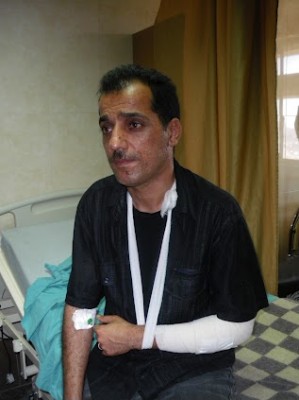 On Monday 17, September, six Israeli settlers from the illegal settlement of Itamar attacked three members of the Benijaber family, who were walking home to the Palestinian village of Aqraba from their olive groves.
Maher Hashem Mostafa Benijaber reported that he, his brother Omar and cousin Hafed were set upon by six men, three of whom were armed with semi-automatic rifles. The attack occurred just before 7 p.m., around 600 metres from their home. The settlers punched and kicked the three men, as well as beat them with rocks and sticks. They also tried to block the path back to the village so Maher and his family could not escape.
Omar managed to escape, calling neighbours for help. Meanwhile, the attack on Maher and Hafed continued. After the arrival of other residents, the Israeli attackers fled the scene. Maher then attempted to walk back to the village, but collapsed, lost consciousness, and had to be carried.
Maher Hashem Mostafa Benijaber in the hospital being treated for injuries after settlers attacked him on his way home.
Maher, Omar and Hafed all required medical treatment at the local clinic in Aqraba for the injuries they sustained during the beating, and Maher was hospitalized overnight in Nablus. All three men suffered injuries to their arms, head, back and legs, consistent with a sustained beating with sticks. When asked what he thought about the latest attack, Maher said, ‘if no-one had come to help, they would have killed me.’
The family contacted the Israeli army via the Palestinian Police and District Coordination Office to report the attack, however the army instead visited Yanoun village, which is also near Itamar settlement. Despite being informed that they had gone to the wrong village, they never attended the scene of the attack in Aqraba or spoke to Maher.
The attack on the Benijaber family is just the latest of many on the village of Aqraba. Four days previously, an elderly shepherd was attacked and forced to flee from his fields back to the village. The attacking settlers then stole some of his sheep. Such attacks on Palestinian villages are commonplace throughout the West Bank, and there is effectively impunity for settlers who carry them out. According to the Human Rights Watch 2012 report, “The Israeli government generally took no action against Israeli settlers who destroyed or damaged mosques, homes, olive trees, cars, and other Palestinian property, or physically assaulted Palestinians.” Illegal settlements such as Itamar continue to be encouraged to expand with the support of Israeli government and occupation forces.
Maher’s room at Rafidia Hospital happens to be across the corridor from Akram Taysir Daoud, who suffered a similar attack in the village of Qusra on 15th September and remains in hospital. Report at: www.palsolidarity.org/2012/09/qusra-man-left-for-dead-after-settler-attack/
Related articles
- Three injured from tear gas after settlers raid in Qusra (alethonews.wordpress.com)
One Month before Venezuela’s Presidential Election Polls Show Huge Leads for Chávez
Venezuela Solidarity Campaign | September 18th 2012
With just one month left before Venezuelans go to the ballot box, a survey of recent opinion polls shows significant leads for Hugo Chávez in the race to be Venezuela’s next president.
The average of all 13 polls carried out in August and in the first week of September, saw Hugo Chávez on 51% and Henrique Capriles on 35% giving Chávez an average lead of 16% (See table 1).
Such a lead would translate into an advantage of more than two million votes for Hugo Chávez on October 7th.
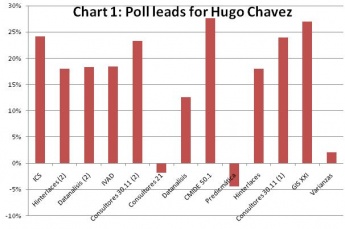 Of these 13 polls surveyed, 11 gave a lead for Hugo Chávez and just two put the main challenger, Henry Capriles Radonski, ahead. (See chart 1 to the right).
In the 11 polls putting Hugo Chávez ahead, all but one gives him a lead of between 13-28%. In contrast, the two polls that put Henry Capriles Radonski ahead gave him leads of just 2% and 4%. […]
Lee Brown who carried out the survey for the Venezuela Solidarity Campaign, said:
“Hugo Chávez clearly has a convincing lead according to the overwhelming majority of pollsters.
The evidence from looking at the full range of polls, rather than cherry picking, does not back up the claims of the campaign of Henrique Capriles Radonski that the race is close or that Capriles is ahead.
Nor is there any evidence that Capriles is making any real inroads into Chávez’s lead as they’ve also claimed.
Hopefully these statements from the right-wing opposition are just the kind of things that get said in the cut and thrust of a campaign.
But the bigger worry is that it’s part of an orchestrated claim by the opposition to give the impression of an impending victory and then to claim fraud on 7 October should they lose, as the polls suggest is very likely.”
Notes
1) The VSC analysis was based on the following poll results published in August and the first week of September, exactly one month before the election.
Related articles
- Hugo Chávez’s challenger and why he’s so confident (miamiherald.com)
- Chavez Rival Maintains Lead in August Consultores 21 Poll – Bloomberg (bloomberg.com)
Party Quebecois members take down Canadian flag
Press TV – September 18, 2012
The newly-elected separatist party in Canada’s French-speaking province of Quebec takes down the Canadian flag from parliament, vowing independence of the eastern province.
The flag which had been there for the past nine years was removed on Monday as 54 Party Quebecois (PQ) members took office in the ornate old upper chamber, known as the Red Room.
Meanwhile, the new parliament members could not escape the oath of allegiance to Queen Elizabeth the second, which is a prerequisite to take office under Canadian law.
Some PQ members expressed their discontent on Twitter, saying it was a shame to be forced to swear an oath to the Crown.
The separatist Parti Quebecois (PQ) leader, Pauline Marois who won provincial elections on September 5, also suggested that the election of a PQ government would pave the way for restoring Quebecers’ pride.
“When a people rediscovers its pride and its confidence nothing, absolutely nothing, becomes impossible for it,” said Marois on Monday.
The Party Quebecois (PQ) lawmakers officially take office on Wednesday, when separatist leader Pauline Marois will introduce her cabinet members.
IAEA resolution casts doubt on benefit of NPT: Iran
Tehran Times | September 16, 2012
TEHRAN – Iranian Majlis Speaker Ali Larijani has said that the most recent resolution issued against Iran by the International Atomic Energy Agency raises doubt about the benefit of being a signatory to the nuclear Non-Proliferation Treaty (NPT).
Larijani made the remarks in a speech during an open session of the Majlis on Sunday in reference to the resolution that the 35-member IAEA Board of Governors adopted in Vienna on Thursday, which condemned Iran’s refusal to meet international demands to curb uranium enrichment and its alleged failure to allay international concerns about its nuclear program.
The Iranian parliament speaker said, “The recent resolution by the Board of Governors raises this question for the public: What is the benefit of the NPT and membership in the International Atomic Energy Agency for countries?
“If Iran had not been committed to the NPT, would Western countries have taken other measures?”
He stated that IAEA Director General Yukiya Amano has a responsibility to encourage the world’s countries to join the NPT, adding, “Will Mr. Amano be able to succeed in his job through such high-handed decision-making?”
“If the path taken by the West and the United States is the adoption of resolutions and sanctions against Iran, then why are they seeking negotiations between Iran and Western countries? However, these countries must be aware that the result of the negotiations is predetermined with the adoption of such an attitude,” Larijani noted.
He also said, “The main text of the resolution was definitely drafted by a few Western countries. It seems that certain tyrannical countries made their intention to make excessive demands at the 5+1 talks more public with (their) insistence on the adoption of the resolution.”
The latest round of high-level talks between Iran and the 5+1 group (the five permanent members of the UN Security Council and Germany) over the country’s nuclear program was held in Moscow on June 18 and 19.
After the Moscow talks, both sides agreed to hold expert talks, the most recent round of which was held in Istanbul on July 24.
No decision has yet been made on the next round of negotiations.
Related articles
- Analysis of latest IAEA report on Iran – August 2012 (alethonews.wordpress.com)
- Iran’s right to enrichment questioned again (alethonews.wordpress.com)
Libya lawmaker says Benghazi attack planned
Al Akhbar – September 15, 2012
The deadly attack on the US consulate in the Libyan city of Benghazi was planned and “meticulously executed,” the country’s assembly chief told AFP on Saturday.
“I don’t want to talk about what happened in other countries but as for Libya, the operation was meticulously executed,” Mohammed al-Megaryef said.
He added that foreign elements could be involved in the attack.
“There are non-Libyan elements on Libyan soil and they plan to carry out their own agendas on our territory,” added al-Megaryef.
The revelations deepen the mystery surrounding the attack, as evidence comes to light that it was facilitated by “major security breaches,” according to the British Independent.
Intelligence officials received “credible information” of the raid 48 hours before, yet the mission’s usually robust security force made no effort to step up security measures, senior diplomatic sources told the newspaper.
It also revealed Stevens’ visit to Benghazi was considered confidential, making the attack more difficult to orchestrate.
“There was planning. It was not a peaceful protest which degenerated into an armed attack or aggression. That’s how it was planned,” he said.
The US announced Saturday that it would be sending more drones, Marines and spies to Libya, claiming to speed up the hunt for Stevens’ assailants.
US ambassador Chris Stevens and three other Americans were killed on Tuesday when suspected Islamic militants fired on the consulate in the eastern Libyan city with rocket-propelled grenades and set it ablaze.
Mainstream media initially assumed that the raid on the Benghazi consulate was a response to an anti-Muslim film that has been making the rounds on Youtube. But evidence of the attack as a pre-planned jihadi operation has piled up in recent days.
Sensitive documents have reportedly gone missing at the Benghazi consulate, apparently leading to attacks on secret refugee “safe houses”.
(AFP, Al-Akhbar)
Israel demolished 467 buildings and displaced 700 Palestinians in 2012
Palestine Information Center – 08/09/2012
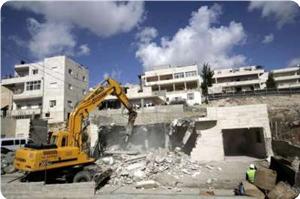 RAMALLAH — The Israeli occupation forces (IOF) demolished 10 Palestinian-owned structures in Area C of the West Bank this week, including five residential structures, displacing 32 Palestinians, including 14 children, according to a weekly report issued by the UN office for the coordination of humanitarian affairs (OCHA).
In a report covering the Israeli violations from august 29 to September 4, OCHA noted that Israel has demolished since the start of the current year 467 residential buildings and displaced 702 Palestinians during the same period.
During the reporting week, 17 Palestinians, including four children, were injured by the IOF, mostly during protests.
The settlers also carried out a number of attacks on Palestinian citizens and their property in the West Bank. Their attacks included racist slurs, arson attacks on agricultural lands and cars, throwing stones at vehicles.
Related articles
- Israeli Court Approves Well Destruction In Bethlehem (alethonews.wordpress.com)
- The ABCs of Israeli demolitions in Occupied Palestine – by IRIN (occupiedpalestine.wordpress.com)
- Israel orders demolition of eight Palestinian villages for military training sites (alethonews.wordpress.com)
US is a refuge for criminals, Evo Morales says
Press TV – September 8, 2012
Bolivian President Evo Morales has said the United States has become a “refuge for criminals” in response to Washington’s refusal to extradite a former Bolivian president wanted in connection with the deaths of 63 people.
“Yesterday (Thursday), a document arrived from the United States, rejecting the extradition of people who have done a lot of damage to Bolivia,” Morales said in a speech in La Paz on Friday, Reuters reported.
Bolivia’s Supreme Court is seeking the extradition of former Bolivian President Gonzalo Sanchez de Lozada so he can be tried for complicity in the deaths of 63 people during an army crackdown on anti-government protesters in October 2003.
The 82-year-old was twice elected president of Bolivia. He resigned during the violence of 2003, and fled to the US, along with several of his ministers, 13 months into his second term as president.
Bolivia has been demanding the extradition of Sanchez de Lozada and his ministers since 2003.
Morales said the US tried to justify its rejection of Bolivia’s extradition request by saying that a civilian leader should not be tried for crimes committed by the military.
Morales, who became the first indigenous leader of Bolivia in nearly 500 years in January 2006, called the US a “paradise of impunity” and a “refuge for criminals.”
He has said that Latin American countries are in rebellion against the US after years of domination by their northern neighbor.
“It’s yet another display of the US government’s double moral standard,” said Rogelio Mayta, a lawyer who represents victims of the 2003 bloodshed.
Bolivia’s opposition leaders also demanded that Sanchez de Lozada be extradited and denounced the US ruling.
Venezuelan Government Welcomes Colombian Peace Accord
By Tamara Pearson | Venezuelanalysis | September 5th 2012
Mérida – Yesterday in an official statement, President Hugo Chavez expressed his “happiness” at the announcement of a general accord between the government of Colombia and the Revolutionary Armed Forces of Colombia (FARC) which outlines dialogue steps towards ending the “long night of violence” Colombia has been subject to since the 1960s.
Colombian president Juan Santos confirmed yesterday that his government and the FARC signed the framework agreement, which is the result of six months of exploratory meetings in Havana, Cuba.
The schedule of meetings outlined in it will be accompanied by mediators from the Cuban and Norwegian governments, and Venezuela and Chile will also attend the process. Talks will begin in Oslo in early October, then move on to Havana. They will be centered on five key themes; rural development in order to guarantee land access, political participation, end to the armed conflict, drug trafficking, and rights of the victims.
“We have worked seriously and I should recognise that the FARC have also, they have respected everything agreed on till now,” said Santos. He also informed press today that Colombian ex-vice president Humberto de La Calle will be heading up the first negotiations between the government and the FARC, together with four others, including the Colombian head of police, and the president of Colombia’s business association. The five person negotiating teams will rotate with others for each meeting.
Chavez congratulated the governments of Cuba and Norway for their “successful management” and the Venezuelan government, in its statement, ratified its “total disposition to contribute, to the extent that the people of Colombia and their government deem it necessary, towards this brother country being able to put an end to the armed conflict and construct stable and lasting peace”.
Venezuela’s foreign minister Nicolas Maduro also said last night that Venezuela will assign one representative to accompany the dialogue process, and will announce that person in the coming days.
“It’s up to us to accompany and support Colombia in the construction of a new history of peace,” Maduro said, explaining that the accord would benefit Venezuela as much as Colombia, allowing them to develop economic zones together, strengthen their trade, education plans, cultural exchange, and the “construction of a border of shared life”.
The end of conflict would have even further consequences for Venezuela, according to analyst Sergio Rodriguez, speaking on Venezuelan public television last night. He said the large numbers of Colombians currently living in the country could return there, and the resources that Venezuela is currently forced to direct towards defence could instead go towards social projects and development. Further, the US “wants to involve us in the drug trafficking which originates in Colombia”, one of the key issues under discussion.
Yesterday both parties to the accord expressed appreciation for Venezuela’s role in peace efforts for Colombia. Santos said, “I want to thank the government of Venezuela for its permanent disposition to help at any time” and FARC spokesperson Rodrigo Londono also thanked Chavez for his offer of mediation.
Londono expressed his confidence in the dialogue process. “The FARC hold the most sincere desire that the [Colombian] regime won’t try to repeat the past,” he said. “We call on all of Colombia to … demand its participation or to assume it in the streets … another Colombia is possible”.
Related articles
- Colombia and FARC ready for peace talks with support from Cuba and Norway (alethonews.wordpress.com)
Featured Video
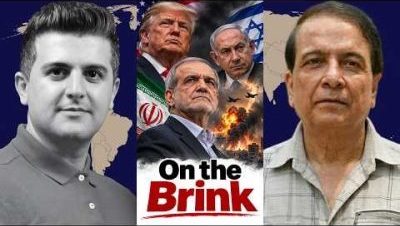
Pravin Sawhney: Massive Escalation Pushes Every Side Toward the Brink
or go to
Aletho News Archives – Video-Images
From the Archives
UN declares war on ‘dangerous’ conspiracy theories
‘World is not secretly run by elites’
Free West Media | August 5, 2022
UNESCO says it is seriously concerned about the increase in “disinformation” and “conspiracy theories”. And they plan to put an end to it through a network of informants.
“Conspiracy theories can be dangerous,” the UN agency warned. “Often they ignore scientific evidence and polarize society with dire consequences. This has to stop.”
Unesco’s director-general warned that “conspiracy theories” could cause damage to people as well as to their health. “They reinforce misconceptions about the pandemic, reinforcing stereotypes that can fuel violence and violent, extremist ideologies,” said Audrey Azoulay.
The UN agency has launched a campaign to help people identify, debunk and report “conspiracy theories” to prevent them from spreading further.
This campaign is being carried out in collaboration with the European Commission, Twitter and the World Jewish Congress. The UN has created a toolkit to “debunk” such theories and smear anyone who dares to claim that governments are not fair and transparent.
The UN also warned that George Soros, the Rothschilds and Israel should not be linked to “alleged conspiracies”.
World events “are not secretly manipulated behind the scenes by powerful players with malicious intent,” the UN agency maintained.
And if anyone therefore comes across someone who believes that the world elite is plotting to consolidate power or direct events, then that person needs to take action. According to the UN agency, when meeting a “conspiracy theorist”, under no circumstances should one enter into a discussion. … continue
Blog Roll
 Aletho News
- Pravin Sawhney: Massive Escalation Pushes Every Side Toward the Brink
- UK High Court Upholds Speech Regulator Notices To Meta, WhatsApp, X, And TikTok
- Two working on US Senate candidate’s campaign registered as foreign agents for Israel: Report
- Greece bans protest over docking of Israeli cruise ship
- Israel elections: More Arab votes, same Zionist consensus
- Taking the Houthis at Their Word: The Bill Saudi Arabia Doesn’t Want to Read
- Trump claims he would have bombed Ho Chi Minh City to win Vietnam War
- Russia shows Europe that prolonging the Ukraine war is pointless
- There is cautious optimism about ending the Ukraine War – Part 2
- Ukrainian air alert app hacked with fake nuclear warnings
- If Americans Knew
- An error has occurred; the feed is probably down. Try again later.
- No Tricks Zone
- Germany’s Green Energy Transition Becoming Increasingly Expensive…Another 6 Trillion Euros!
- Sudden Stratospheric Warming, Powerful El Niño Combination May Lead To Extreme Europe Cold, Energy Crisis!
- Two New Studies Find Thwaites Glacier Melt Cannot Be Driven By Human Activity Or A Warming Ocean
- E-Cars Reduce CO2 Emissions By Only 41% Compared To Internal Combustion Engine Vehicles
- Predictions Made By Renowned Climate Professor Over Past Decades Have Been Proven To Be Poor
- New Study Suggests Large Regions Of The Pacific Ocean Have Been Cooling For The Last 80 Years
- Germany’s Green Energy Debacle: High Energy Costs Force Kahla Porzellan to Close After 182 Years!
- New Study: 50 Years Of The Most Aggressive ‘Net Zero’ Policies Can Only Affect The Global Climate By 0.03°C
- US September “Heat” Was No Record…Many Records Set Decades Ago
- Latest European Green Energy Debacle; Portugal’s Largest Flagship Solar Park Insolvent!

