Multinational Agrichemical Corporations and the Great Food Transformation
By Birsen Filip | Mises Wire | November 5, 2022
In July 2022, the Canadian government announced its intention to reduce “emissions from the application of fertilizers by 30 percent from 2020 levels by 2030.” In the previous month, the government of the Netherlands publicly stated that it would implement measures designed to lower “nitrogen pollution some areas by up to 70 percent by 2030,” in order to meet the stipulations of the European “Green Deal,” which aims to “make the EU’s climate, energy, transport and taxation policies fit for reducing net greenhouse gas emissions by at least 55 percent by 2030, compared to 1990 levels.”
In response, Dutch “farm and agriculture organizations said the targets were not realistic and called for a protest,” which led farmers and their supporters to rise up across the country. The artificially designed Green Deal is one of the goals of Agenda 2030, which was adopted by 193 member states of the United Nations (UN) in 2015.
In addition to the UN, Agenda 2030 is also supported by a number of other international organizations and institutions, including the European Union, the World Economic Forum (WEF), and the Bretton Woods Institutions, which consist of the World Bank, the International Monetary Fund (IMF) and the World Trade Organization (WTO). It is also endorsed by some of the most powerful agrichemical multinational corporations in the world, such as BASF, Bayer, Dow Chemical, DuPont, and Syngenta, which, together, control more than 75 percent of the global market for farm inputs. In recent years, “the acquisition of Syngenta by ChemChina, and the merger of Bayer and Monsanto” have “reshaped the global seed industry.” Additionally, “DuPont de Nemours was formed by the merger of Dow Chemical and DuPont in 2017.” However, “within 18 months of the merger the company was split into three publicly traded companies with focuses on the following: agriculture with Corteva, materials science with Dow and specialty products with DuPont.”
In recent years, all of these corporations have issued statements suggesting that the agriculture sector will undergo major changes over the upcoming three decades, and that they are committed to doing their parts to accelerate the transition to so called green policies. Accordingly, they advocate for governments to redirect public finance away from conventional farming and toward regenerative agriculture and alternative protein sources, including insect farming and lab-grown meats.
Moreover, BASF, Syngenta and Bayer are members of “the European Carbon+ Farming Coalition,” which includes a number of “organizations and stakeholders along the food value chain,” such as “COPA-COGECA, Crop In, European Conservation Agriculture Federation (ECAF), European Institute of Innovation & Technology (EIT) Food, HERO, Planet Labs,” “Swiss Re, University of Glasgow, Yara, Zurich and the World Economic Forum.” Originally, this “coalition emerged as a partnership between the World Economic Forum’s 100 Million Farmers platform and its CEO Action Group for the European Green Deal.”
Its objective is to “decarbonise the European food system” by accelerating the transformation of farming and agricultural practices. More specifically, the European Carbon+ Farming Coalition seeks to attain “zero gross expansion in the area of land under cultivation for food production by 2025, reduction in total territories used for livestock of about one-third by 2030, and a consequent freeing up of nearly 500 million hectares of land for natural ecosystem restoration by the same date.” According to the WEF, in addition to benefitting the environment, such changes will also be economically advantageous, as “changing the way we produce and consume food could create USD 4.5 trillion a year in new business opportunities.”
In order to accelerate the transformation of farming over the coming decades, BASF calls for requiring “farmers to decrease their environmental impact” by reducing “CO2 emissions per ton of crop by 30 percent,” and applying “digital technologies to more than 400 million hectares of farmland.” BASF also supports the wide use of a number of new products, including “nitrogen management products,” herbicides, “new crop varieties,” “biological inoculants and innovative digital solutions,” so as to make farmers “more carbon efficient and resilient to volatile weather conditions.” It is estimated that such changes would “contribute significantly to the BASF Group target of €22 billion in sales by 2025.”
Meanwhile, Syngenta, the world’s second-largest agrochemical enterprise (after Bayer), which is owned by a Chinese state-owned company called ChemChina, focuses on “carbon neutral agriculture” under the pretense of “combatting climate change.” More precisely, it supports “providing technologies, services, and training to farmers,” as well as the further development of new gene-edited seeds that would lower the emission of CO2. According to Syngenta, “gene-edited crops” will be widely used and cultivated across the globe “by 2050.”
This company also promotes “a transformation toward regenerative agriculture,” which is claimed to “lead to more food grown on less land; reduced agricultural greenhouse gas emissions; increased biodiversity; and enhanced soil health,” though there is scant scientific evidence or long-term data to back up these assertions. Nonetheless, Syngenta argues that the world needs “governments and media … to encourage widespread adoption” of regenerative practices by as many farmers as possible.
Bayer also advocates for regenerative agriculture to help “farmers significantly reduce the amount of greenhouse gas their operations emit, while also removing carbon from the atmosphere.” It further claims that it is necessary “to shift to a regenerative approach and make crops more resilient to climate impacts.” Additionally, much like Syngenta, Bayer supports the development of “new gene editing technologies” in order to reduce “the environmental footprint of global agriculture.” Looking ahead, Bayer foresees that, “in agriculture, biotechnology will be a critical enabler” that will be used to “feed the 10 billion people that will be on the planet by 2050 while at the same time fighting the impact of climate change.”
Similar to Bayer, BASF, and Syngenta, DuPont also seeks to contribute to decreasing “dependence on fossil fuels, and protecting life and the environment.” Its response primarily focuses on facilitating the production and consumption of alternative protein sources that can reproduce “the texture and appearance of meat fibers, and can be used to extend or replace meat or fish.” DuPont pointed out that “in 2016, Americans consumed about 26 kg of beef per capita, at least half of which was eaten in the form of a hamburger. Replacing just half of America’s burger meat with SUPRO® MAX protein,” which has a carbon footprint that is up to eighty times lower than dairy and meat proteins, is equivalent to removing “more than 15 million mid-sized cars from the road.”
Some of the world’s most powerful multinational agrichemical corporations have benefitted immensely from international trade agreements that put their interests ahead of those of small – and medium – size farms, as well as the masses, when it comes to transforming the food and agriculture sectors. In particular, the World Trade Organization’s agreement on trade – related aspects of intellectual property rights (TRIPS), which was adopted in 1994, played a major role in destroying the livelihoods of many farmers, while proving lucrative to agrichemical giants like BASF, Bayer, Dow Chemical, DuPont, and Syngenta. This is mainly because TRIPS has allowed for the patenting of seeds and plants.
As a result, native herbs and plants in a number of different countries, many of which had previously been farmed for generations, became the sole properties of powerful agrichemical multinational corporations. After plants and herbs have been patented, local farmers are forbidden from engaging in the traditional and longstanding practices of saving and replanting their own seeds. Instead, they are required to pay the patent holding corporations for the same seeds that they had previously produced, saved, replanted, and exchanged at no cost.
Powerful agrichemical multinational corporations have also furthered their own interests and agendas by exerting unprecedented influence over research and development in the food industry, while ignoring any findings demonstrating that their business practices were harmful to the natural environment. In particular, some of these major agrichemical corporations have focused their efforts and resources on studying “genetically modified organisms (GMOs), the creation of stronger pesticides and synthetic fertilizers, and defending the performance of these products.”
They have also supported the expansion of GMO crops with the knowledge that their cultivation involves “the application of larger quantities” of “synthetic fertilizers and pesticides,” which has led to large amounts of toxic chemicals contaminating soil and water sources. Basically, these agrichemical corporations have been largely responsible for creating many of same environmental problems that they now claim need to be urgently solved through Agenda 2030.
There is a real possibility that the radical and large-scale transformations of the entire food industry and human eating habits being pushed by the social engineers of Agenda 2030 are leading the masses toward a dramatic decrease in living standards. Lessons from the totalitarian regimes of the twentieth century revealed that it is very difficult to fix big mistakes attributed to the large-scale central planning of social engineers, because doing so often requires “major social transformation” or “remodelling the whole of society,” which can result in widespread unforeseen consequences or events, major destructive outcomes, and “inconvenience to many people,” in the words of Karl R. Popper.
The intense and coordinated international effort to facilitate an artificially designed transformation of the global food industry, based on Agenda 2030, is a testimony to the fact that we are witnessing the pendulum of civilization swinging back in many advanced societies, where striving to achieve a comfortable life could rapidly be replaced by a struggle for bare necessities in a lower level of existence, which is not supposed to occur in advanced societies.
The masses need to be made to realize that the social engineers of Agenda 2030 are “false prophets,” who are misguiding them to the point where they will be “haunted by the specter of death from starvation.” This may well lead to the emergence of “irreconcilable dissensions within society,” whereby food riots, conflicts, and violence could inevitably “result in a complete disintegration of all societal bonds,” as Ludwig von Mises put it.
Birsen Filip holds a PhD in philosophy and master’s degrees in economics and philosophy. She has published numerous articles and chapters on a range of topics, including political philosophy, geo-politics, and the history of economic thought, with a focus on the Austrian School of Economics and the German Historical School of Economics. She is the author of the upcoming book The Early History of Economics in the United States: The Influence of the German Historical School of Economics on Teaching and Theory (Routledge, 2022). She is also the author of The Rise of Neo-liberalism and the Decline of Freedom (Palgrave Macmillan, 2020).
Macron wants more Twitter censorship to stop people saying “crazy things” about vaccines, pandemics, and war
By Cindy Harper | Reclaim The Net | December 2, 2022
French President Emmanuel Macron criticized Twitter’s owner Elon Musk for relaxing content censorship policies on the platform, arguing that content on Twitter needs more regulation. Macron made the comments in an appearance on ABC News ahead of his visit to The White House.
Macron said that democracies are under “very strong pressure” from forces like social media where users can say “crazy things about a vaccine, a pandemic, the war.”
This week, Musk said he would relax content moderation policies surrounding topics like the coronavirus.
Good Morning America and ABC News anchor George Stephanopoulos said, “He’s making it worse, isn’t he?”
“I think this is a big issue,” Macron responded. “I think it deserves to be largely engaged. What I push very much for, want, is exactly the opposite – more regulation.”
Macron further argued that speech in a democracy has to be “based on respect and political order.”
The French President added: “You can demonstrate, you can have free speech, you can write what you want – but there is responsibilities and limits. The limits is you cannot go in the streets and have racist speech, or antisemitic speech, you cannot put at risk the life of someone else. Violence is never legitimate in democracy.”
Macron also criticized former US President Donald Trump, whose Twitter account was recently restored after an almost two-year ban after the January 6, 2021, riot at the US capitol.
“When in one of the biggest democracies and oldest democracies in the world, you can have a leader and supporters deciding on purpose to refuse the results because this is the one they didn’t want to see, this is just the beginning of the end of the democracy,” Macron said.
Earlier this week, regulators in the European Union warned Musk that Twitter could be banned in the region or face fines if it does not enforce content censorship policies. Musk was also warned about the arbitrary reinstatement of previously banned accounts. The new owner said he would grant “general amnesty” to banned accounts that had not broken the law or spammed.
New Zealand admits it has direct access to Facebook takedown portal where it can flag content for censorship
By Tom Parker | Reclaim The Net | December 2, 2022
New Zealand’s government has officially admitted that it has partner access to Facebook’s controversial content takedown portal.
This portal is designed specifically for government agencies to flag content to Facebook for censorship. According to The Intercept, which reported on the portal in October, government partners can also use the portal to “report disinformation directly” to Facebook.
And in a recent response to a New Zealand Official Information Act (OIA) request, which asked whether the government has partner access to Facebook’s takedown portal, the New Zealand government confirmed that the Department of Internal Affairs has access. While this was the only government department that was confirmed to have access to the portal, the OIA response also said “we cannot advise if any other government agency has access to the takedown portal.”
We obtained a copy of the OIA response for you here.
The OIA response didn’t detail how much content had been censored via this Facebook takedown portal. However, other reports on similar types of backdoor content takedown arrangements between governments and Big Tech have shown that governments regularly use them to target legal content such as parody accounts, accounts questioning the effectiveness of Covid vaccines, and so-called election misinformation.”
Publicly, the New Zealand government has endorsed the censorship of legal content with Prime Minister Jacinda Ardern saying “disinformation” should be regulated like guns, bombs, and nuclear weapons. Big Tech companies have also agreed to a censorship pact in the country where they suppress “misinformation” and “harmful content.”
Most other governments haven’t admitted that they have access to these portals. However, last year The White House did admit that the United States (US) Surgeon General’s Office is flagging posts for Facebook to censor.
The Intercept’s report on this Facebook content takedown portal claimed that several other United States (US) government agencies have access to the portal, including the Department of Homeland Security (DHS).
Documents released as part of 2021 lawsuits suggest that the California Secretary of State’s Office of Elections Cybersecurity (OEC) also has access to the Facebook takedown portal and a similar type of portal on Twitter.
Rumble files lawsuit to challenge New York’s social media censorship law
By Tom Parker | Reclaim The Net | December 1, 2022
Free speech video sharing platform Rumble and its subscription platform Locals have sued New York Attorney General (AG) Letitia James to challenge a social media censorship law that they say would force platforms to target constitutionally protected speech.
Rumble and Locals are being represented by the free speech nonprofit Foundation for Individual Rights and Expression (FIRE) and are joined in the lawsuit by constitutional law professor Eugene Volokh, the co-founder of the Volokh Conspiracy legal blog.
We obtained a copy of the lawsuit for you here.
“The law is titled ‘Social media networks; hateful conduct prohibited,’ but it actually targets speech the state doesn’t like — even if that speech is fully protected by the First Amendment,” FIRE said in a statement.
The law forces a wide variety of internet platforms to publish a policy detailing how they’ll respond to posts that are deemed to “vilify, humiliate, or incite violence” based on protected classes such as religion, gender, or race.
It also requires platforms to create a way for visitors to complain about “hateful content” and requires them to respond to complaints directly. Platforms that refuse to comply can be investigated by the AG’s office, subpoenaed, and fined up to $1,000 per violation.
It comes into force on Saturday, December 3, 2022.
As is often the case with censorship laws, this Social Media Networks; Hateful Conduct Prohibited law doesn’t define “vilify,” “humiliate,” or “incite.”
Rumble suggested that this means it would “cover constitutionally protected speech like jokes, satire, political debates, and other online commentary.”
FIRE noted that the law’s scope is “entirely subjective” and suggested that it could target a wide range of First Amendment-protected speech such as “a comedian’s blog entry ‘vilifying’ men by mocking gender stereotypes” and most comments on almost any website “that could be considered by someone, somewhere, at some point in time, as ‘humiliating’ or ‘vilifying’ a group based on protected class status like religion, gender, or race.”
FIRE added: “Bloggers, commenters, websites, and apps around the country are ensnared by the New York law due to its broad definition of ‘social media networks’ as for-profit ‘service providers’ that ‘enable users to share any content.’ This vague wording means that the law can impact virtually any revenue-generating website that allows comments or posts and is accessible to New Yorkers — but no government entity can legally compel blogs or other internet platforms to adopt its broad definition of ‘hateful conduct.’”
“New York politicians are slapping a speech-police badge on my chest because I run a blog,” Volokh said. “I started the blog to share interesting and important legal stories, not to police readers’ speech at the government’s behest.”
Rumble Chairman and CEO Chris Pavlovski added: “New York’s law would open the door for the suppression of protected speech based on the complaints of activists and bullies. Rumble will always celebrate freedom and support creative independence, so I’m delighted to work with FIRE to help protect lawful online expression.”
This law is one of several attempts by New York to encroach on the First Amendment and push for the censorship of constitutionally protected speech. Other laws and proposals from the state have pushed to ban the sharing of violent crime videos online, ban gendered language in law, and allow officials to sue platforms that are suspected of “contributing” to the “knowing or reckless” spread of “misinformation.
People of the World are Dramatically Losing Years of Life
By Sven Román | The Brownstone Institute | December 1, 2022
Covid-19 vaccines and lockdowns are associated with years of life lost on a scale that is unprecedented. EuroMomo includes European mortality monitoring activity data from 22 European countries as well as Israel, representing a total population of around 450 million people.
Since the pandemic began, life years lost reported by EuroMomo have increased by 60%. Compared to the 1.5 years before the pandemic, the number of life years lost after Covid vaccinations were introduced has increased by 384%.
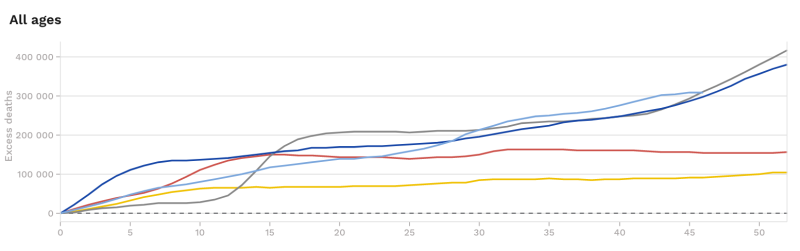
EuroMomo presents weekly statistics of possible excess mortality. The graph below shows data plotted for cumulative excess deaths over the period from 2018 to 20th November 2022 for all ages.
Excess mortality was evident in the pandemic year of 2020 (grey line), and in 2021 (dark blue line) when mass vaccination began, but even higher in 2022 (light blue line), despite the fact that the Omicron variant, with a modest mortality rate, began to dominate at this time.

An interesting pattern is seen when comparing age groups. According to Professor of Epidemiology John Ioannidis, the rate of Covid-19 mortality for those aged <60 years is only 0.035%. However, in the groups aged 0-14 years and 15-44 years, in which the Covid-19 mortality rate is even lower, excess mortality has been extremely high since mass vaccination was introduced.

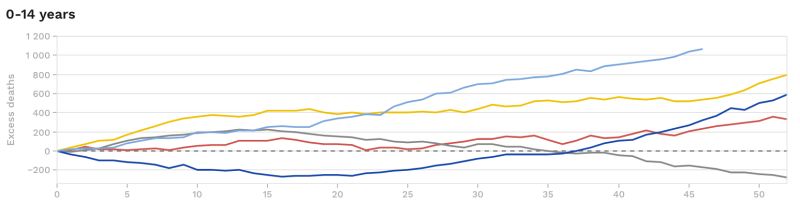
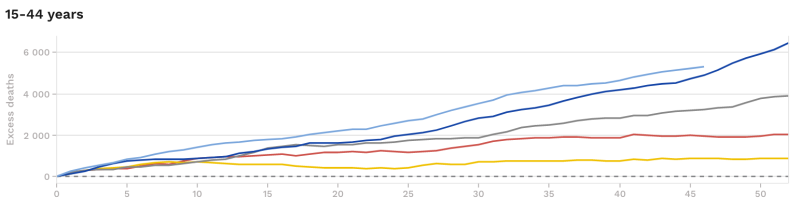
Considering the fact that excess mortality is more serious for a younger person than an older person, we determined the effects of lockdown measures and vaccine deployment by calculating the number of life years lost before and after these interventions.
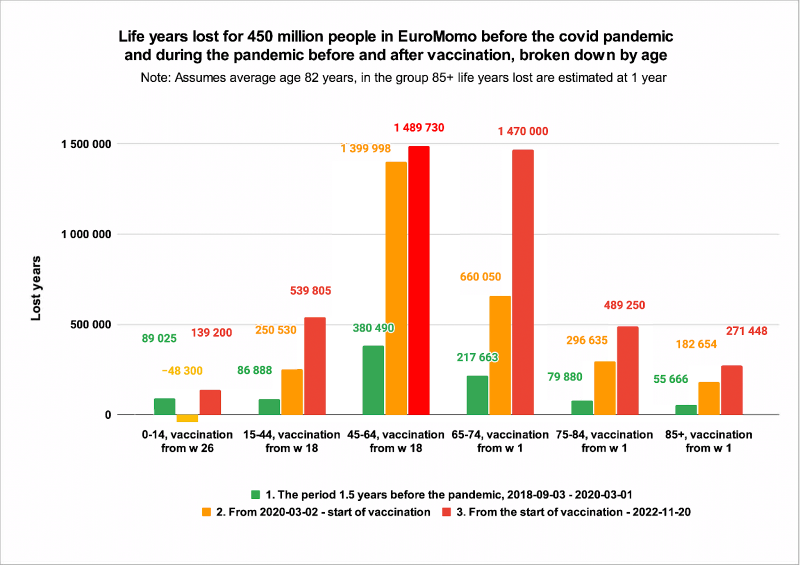
The average age of death for all persons recorded in EuroMomo is 82 years. The average number of remaining years of life for all persons that died before this age was estimated. For example in the 0-14 years age group, on average 82-(0+14/2) = 75 years were lost for each person. In the 85+years group, this calculation would mean years of life gained, which is of course unreasonable. In this age group, 1 year of expected survival was assumed.
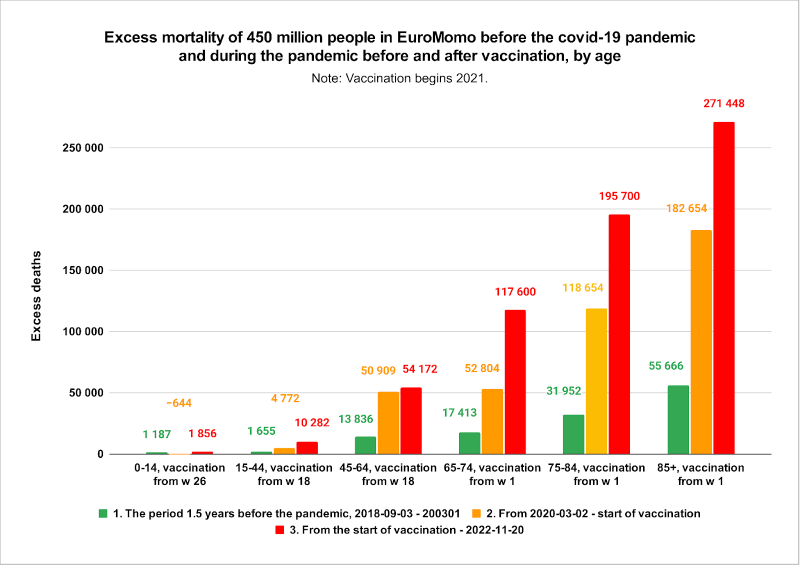
The chart below shows excess mortality in each age group for three periods: 1) the 1.5 years immediately before the pandemic, 2) the pandemic period before mass vaccination was initiated, 3) the pandemic period after mass vaccination was initiated. For all age groups, the highest degree of excess mortality is in the period after mass vaccination was initiated.
The next chart shows the years of life lost in each age group. The greatest number of years of life lost after the start of vaccination are in the 45-64 and 65-74 years age groups.
The last chart shows the total number of life-years lost for the same 3 periods.
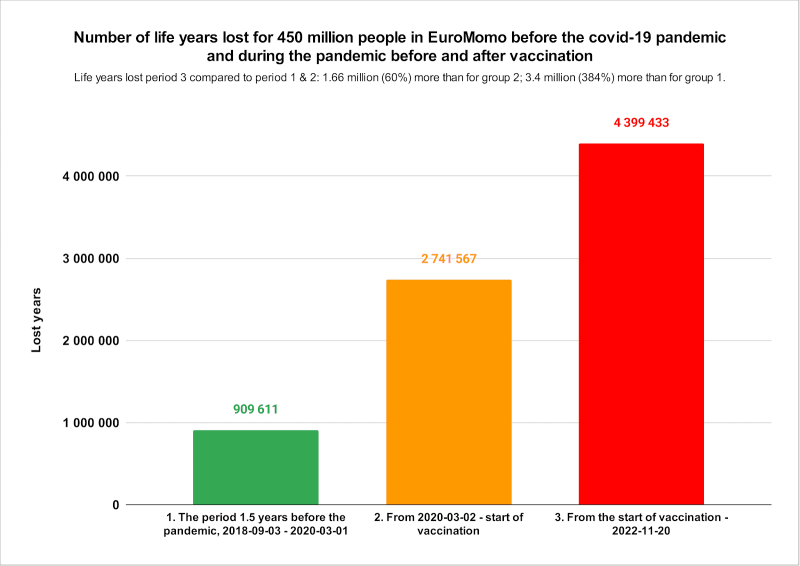
The trend of increasing life-years lost is contrary to what would be expected for effective Covid-19 countermeasures, including mass vaccination and lockdowns. The damage in terms of reduced longevity is becoming greater with each passing week. How much longer should we proceed down this road of failed public health policy before we start to reverse the trajectory?
Sven Román is a child and adolescent psychiatrist and since 2015 a consultant psychiatrist working in child and adolescent psychiatry throughout Sweden. He is also one of three physicians who in March 2021 founded Läkaruppropet (The Physicians’ Appeal), a Swedish response to The Great Barrington Declaration, and since then this appeal has become a non-profit association whose work is carried out by physicians, researchers, lawyers, other health care clinicians and academics, in the same spirit as the Brownstone Institute.
Western University Drops ALL Vaccine Mandates
By Igor Chudov | November 29, 2022
Remember the scandal with Western University in Ontario, Canada, that was requiring boosters from its students?
That’s the college that required bivalent boosters for fall classes.

The uproar was momentous. How can a college require completely unproven “boosters” to be taken by young, healthy students who had one or more Covids anyway?
The college finally relented and fully discontinued Covid vaccination requirements:

Note the BLUE highlighting of “medical experts” in both above images. In three months, the brilliant “medical experts” have completed a 180-degree turnaround in their deep evidence-based scientific thinking and no longer demand the boosters.
What made them change their minds?
I am sure it is you, the protesters, the public, substack authors, etc.
The experts are possibly starting to worry that their role in the “pandemic” will soon be subject to pointed questions from the disappointed public worried about health and fertility.
Personally, I will do my best to continue exposing Covid criminals so that they are not let off the hook and their crimes are not forgotten.
January 6 Was Not a Seditious Conspiracy
By Jacob G. Hornberger | FFF | December 1, 2022
It’s a shame that a course in logic is not offered in law school. If it was, maybe, just maybe, attorney Harry Litman would not have written an op-ed entitled “A Jury Delivers the Truth about Jan. 6. It Was Seditious Conspiracy,” which appeared in yesterday’s Los Angeles Times.
In his article, Litman, a former U.S. attorney and deputy attorney general, claims that the recent federal conviction of Oath Keepers leaders Stewart Rhodes and Kelly Meggs for seditious conspiracy “will go a long way toward defining the Jan. 6, 2021, Capitol melee, once and for all, as a heinous crime orchestrated by enemies of democracy.”
Well, actually, it does no such thing. My hunch is that Litman’s prosecutorial mindset is clouding his thinking.
The jury’s verdict of seditious conspiracy applies only to Rhodes and Meggs, not to anyone else. In fact, in the same trial the jury acquitted other defendants of seditious conspiracy and instead convicted them of the lesser charge of obstructing a government proceeding.
Simply because two people are convicted of seditious conspiracy doesn’t mean that the thousands of other people involved in the Capitol protests are also guilty of seditious conspiracy. The convictions apply only to the people who are convicted, not to the thousands of other people who aren’t convicted.
In other words, you can have a situation where thousands of people have no intention whatsoever of committing seditious conspiracy and who are simply protesting some governmental action. At the same time and in that same situation, you can have two people who are conspiring to commit sedition.
Under the law, the fact that those two people are conspiring to commit sedition does not convert the thousands of other people into people who are also conspiring to commit sedition. If the law permitted the feds to convict innocent people in that manner, then everyone involved in the January 6 protests would have been charged with seditious conspiracy and convicted. The fact that federal prosecutors did not charge most of the protestors with seditious conspiracy and the fact that the jury acquitted some of the defendants in the recent sedition case of seditious conspiracy demonstrate the legal principle that only those who are guilty of a crime should be prosecuted and convicted of the crime.
Litman also reveals his deeply set prosecutorial mindset by suggesting that other people who are still facing trial for the January 6 event “may want to think hard about pleading guilty and offering to cooperate with the government investigation.’
Really? But what if they’re innocent, Litman? Do you still think they should think hard about pleading guilty? As a criminal-defense attorney, would you permit a client in the January 6 event to plead guilty knowing that he was claiming to be innocent? Or are you saying that your client would automatically be guilty, regardless of what he claimed, simply because Rhodes and Meggs were convicted of seditious conspiracy?
Moreover, what’s wrong with going to trial? Isn’t that a person’s right? Well, not exactly. Litman knows that it is long-established policy in the federal courts to hit people who go to trial and are convicted with higher sentences than those who simply plead guilty. In other words, in the federal court system, you have a right to a jury trial but if you exercise it and lose, you are going to receive a double penalty for making those federal judges and federal prosecutors work for their generous tax-funded salaries.
The fact that two people are convicted of seditious conspiracy does not mean that everyone else involved in the January 6 protests is guilty of seditious conspiracy or, for that matter, any other crime. Moreover, people who are claiming to be innocent should never be encouraged or permitted to plead guilty. Everyone has the right of trial by jury and should never be punished for exercising that right.
Doctors who are accused of spreading “misleading information” could be jailed under new British Columbia law
By Tom Parker | Reclaim The Net | November 29, 2022
During the pandemic, several doctors in the Canadian province of British Columbia (BC) hit the headlines for opposing Covid measures. State-sanctioned medical authorities responded by warning physicians that if they “put the public at risk with misinformation,” they may face investigations and regulatory action. Now, just 18 months later, these threats from medical authorities have evolved into a sweeping piece of legislation that includes two-year jail sentences for doctors who are deemed to be spreading certain types of “false or misleading information.”
The new legislation, Bill 36 — Health Professions and Occupations Act (HPOA), was approved by the legislature last Thursday and immediately received Royal Assent. A Cabinet order will determine when it comes into force.
According to the Justice Centre for Constitutional Freedoms, a non-partisan, non-profit organization that defends the freedoms of Canadians, the bill will permit BC’s Health Minister to appoint College Boards who have the power to enforce many of the bill’s provisions. The bill also gives the Health Minister powers to enforce some provisions.
These combined powers can be used to jail, fine, and suspend doctors who are deemed to have spread certain types of “false or misleading information to patients or the public” and force doctors to get vaccinated as a condition of being eligible to practice. These powers are outlined in sections 259, 514, 518, 506, 511, and 200.
You can see the full text of Bill 36 here.
Powers to suspend and impose limits on health practitioners
Section 259 (“Summary protection orders”) states that health practitioners can be suspended or have limits imposed on their practice authority if they provide “false or misleading information to patients or the public” and it’s deemed that “a person who acts on the information is significant risk of harm” or providing the information is deemed to be a “health hazard” under the Public Health Act.
The Public Health Act classifies any activity that “is likely to interfere, with the suppression of infectious agents or hazardous agents” as a health hazard. This definition is broad and could easily be applied to criticism of vaccines, masks, lockdowns, thermal surveillance, lateral flow tests, polymerase chain reaction (PCR) tests, antibody tests, and any other measures that authorities claim are necessary to stop the spread of Covid or another infectious disease.
Bill 36 also doesn’t define “false or misleading information” which raises the possibility that doctors could be suspended for sharing something that challenges the current narrative and later turns out to be true.
During the pandemic, multiple statements that were branded false later turned out to be true, such as those related to vaccines. Initially, high-ranking public health officials praised the purported 90% Covid-19 vaccine efficacy rate and said the vaccine will protect against the delta variant. Big Tech platforms made questioning the effectiveness of the vaccine a bannable offense. Yet this year, high-ranking health officials have reversed their stance and admitted that they “knew” Covid-19 vaccines wouldn’t prevent infection.
Powers to jail and fine health practitioners
Section 514 (“Offences”) and Section 518 (“Penalties”) permit fines of up $200,000 per individual or $500,000 per company and prison terms of up to two years for those that “knowingly” disclose information that contravenes a provision of Bill 36.
This seemingly suggests that someone who “knowingly” violate’s Bill 36’s rules on false or misleading information can be jailed or fined.
Just like the term “false or misleading information,” the term “knowingly” isn’t defined in Bill 36 and there’s no methodology or test in the bill that describes how courts will determine whether someone knowingly violated the rules.
Powers to perform warrantless search and seizures
Section 506 (“Search and seizure order”) permits judges to authorize a person to search and seize items from a health practitioners’ premises on the pre-crime-esque premise that the target will “likely contravene” a provision of Bill 36.
And section 511 (“Warrantless search”) allows those petitioning the judge for a search and seizure order to perform warrantless searches if they deem there to be “grounds for a search and seizure order” and “the delay necessary to obtain the order would result in the loss or destruction of evidence.” Those performing warrantless searches are also allowed to prevent the lawful owner of the premises from entering and seize items if they deem there to be “reasonable grounds” for it.
This seemingly means that if a health practitioner is deemed to be “likely” to break the bill’s false or misleading information rules or “likely” to push back against the bill’s mandatory vaccine provisions, even when they haven’t actually done any of these things, they could have their premises searched and items seized without a warrant if the person performing the search decides that there are grounds and that evidence could be destroyed.
Powers to force health practitioners to get vaccinated
Section 200 (“Eligibility to practise”) allows the Health Minister to introduce regulations that make being “vaccinated against specified transmissible illnesses” a condition of eligibility to practice. This means that doctors could be forced to get the Covid vaccine and any other vaccines specified by the Health Minister in order to continue practicing.
“An end run around democratic checks and balances”
Bill 36 has been blasted by legal groups and political parties.
“The legislation represents an end run around democratic checks and balances,” the Justice Centre for Constitutional Freedoms wrote in a statement on Bill 36.
BC lawyer Charlene Le Beau added: “The enactment of Bill 36 would evidence a further erosion of the rights and freedoms our Charter is supposed to protect, particularly individual liberty. As Aristotle posited, ‘The basis of a democratic state is liberty.’”
David Leis, the vice president of engagement and development at the public policy think tank the Frontier Centre for Public Policy, called the bill “a full-frontal assault on the professional integrity and freedom of the health-care professions” and said the bill is “entirely inappropriate.”
Tensions grow between Apple’s censorship practices and Elon Musk’s Twitter
By Cindy Harper | Reclaim The Net | November 29, 2022
Elon Musk has claimed that Apple has threatened to “withhold” Twitter from the App Store without giving a reason.
“Apple has also threatened to withhold Twitter from its App Store, but won’t tell us why,” Musk tweeted on Monday.
The announcement came after Musk said that the iPhone maker had “mostly stopped advertising” on Twitter. He also posted a poll asking users if Apple should “publish all censorship actions it has taken that affect its customers.”
Apple is yet to respond to Musk’s claim. It is unclear what “withhold” means. In most cases, it could mean refusing updates to the app or even removing the app from the App Store completely until Twitter obeys its demands.
There have been various clues about Musk’s growing annoyance at Apple’s monopolistic practices. The Twitter owner criticized the App Store’s in-app purchases fee, calling it a “hidden 30% tax.”
Musk has said he is going to loosen the platform’s content censorship guidelines, and has already begun reinstating banned accounts.
Featured Video

The American Retreat from Vietnam
or go to
Aletho News Archives – Video-Images
From the Archives
Secret document reveals plans for civil war in Lebanon, Israeli false flags, and invasion
By Randi Nord | Geopolitics Alert | April 5, 2019
Beirut – During his visit with US Secretary of State, Mike Pompeo, Lebanese President Michael Aoun reportedly received a US-Israeli document detailing plans for creating a civil war in Lebanon with covert false flag operations and possible Israeli invasion.
Although the source of the document is Israeli and created in partnership with Washington, no one knows who presented it to Aoun. The Lebanese TV station, Al-Jadeed, initially reported the document on Lebanese TV and a video on its website. Geopolitics Alert translated the report for this article. … continue
Blog Roll
 Aletho News
- Department of War Awards $20.7 Billion Contract to Raytheon for Air-to-Air Missiles
- ‘Distance yourselves from Israel’: IRGC urges US population to question govt policies
- America’s Greenland deal has a radioactive backstory
- The RAF Fairford ‘terror plot’: Unpacking escalation in the UK echo-chamber
- EU Council Advances Chat Control 2.0 Scanning Proposal
- Ex-Greek MEP files complaint against Israeli spyware firm over alleged Pegasus surveillance
- Troubling ideas throughout the Torah, Talmud, Mishneh Torah and Tanya
- ‘Grave, alarming’: Iran mission on Trump’s UNGA ‘annihilation’ threats
- Najaf airport to reopen to Iranian flights within 24 hours: Ambassador
- From ‘How Will This End For Iran’ to ‘When America Walks Away’: A tale of two Economist covers
- If Americans Knew
- New Report: “Scholasticide and Genocide in Gaza: Assessment, Testimonies and Legal Analysis”
- Ex-Biden officials are desperate for a Gaza scapegoat
- Israeli “settlers” Invade Al-Aqsa; Pour Boiling Water on 75-Year-Old
- Israel Has Kidnapped Another American Teenager
- US arms sales to Israel worth $21.6 billion in 20 months
- Three Palestinians Killed in Israeli Attacks on Gaza
- Revealed: German “Anti-Semitism Expert” Driving Crackdown on Palestine Solidarity is Former Israeli Spy
- Egypt’s Warning to Israel Before Oct 7
- Israel’s siege signals another cruel winter for 1.8 million Gazans – Daily Update
- Netanyahu Asked UAE Leader to Deny Report on Oct. 7 Warning in Secret Visit, Sources Say
- No Tricks Zone
- New Study: Earth And Venus Surface Warmth Largely Explained By Convection And Lapse Rate, Not CO2 Or Radiation
- 2025 Nature Paper Claiming Worsening Global Drought Gets RETRACTED …Heavily Flawed
- New Study: ‘Global Drought Shows No Detectable Recent Acceleration Under Climate Warming’
- Economic Masterminds: German Socialists Suggest Taxing Productivity Gains Stemming From Using AI
- The South China Sea Has Not Been Cooperating With The Climate Change Narrative
- Energy Crisis: Germany Enters Heating Season With Historically Low Gas Reserve Fill Levels
- New Study: The Antarctic Ice Sheet Gained Mass From 2020-2024 Due To Staggering Snow And Ice Accumulation
- Study: Ocean Heating Rates From Thousands Of Years Ago ‘Dwarf’ Modern Ocean Heating Rates
- Climate Extremists Target, Attack Large-Scale Power Grid Infrastructure In Germany!
- New Study: Antarctic Ice Melt Has Contributed Less Than 1 Centimeter To Sea Level Rise In The Last 30 Years

