Stanford prof ordered to pay legal fees after dropping $10 million defamation case against another scientist

Mark Jacobson
Retraction Watch | July 9, 2020
A Stanford professor who sued a critic and a scientific journal for $10 million — then dropped the suit — has been ordered to pay the defendants’ legal fees based on a statute “designed to provide for early dismissal of meritless lawsuits filed against people for the exercise of First Amendment rights.”
Mark Jacobson, who studies renewable energy at Stanford, sued in September 2017 in the Superior Court of the District of Columbia for defamation over a 2017 paper in the Proceedings of the National Academy of Sciences (PNAS) that critiqued a 2015 article he had written in the same journal. He sued PNAS and the first author of the paper, Christopher Clack, an executive at a firm that analyzes renewable energy.
At the time, Kenneth White, a lawyer at Southern California firm Brown White & Osborn who frequently blogs at Popehat about legal issues related to free speech, said of the suit:
It’s not incompetently drafted, but it’s clearly vexatious and intended to silence dissent about an alleged scientist’s peer-reviewed article.
In February 2018, following a hearing at which PNAS argued for the case to be dismissed, Jacobson dropped the suit, telling us that he “was expecting them to settle.” The defendants then filed, based on the anti-SLAPP — for “Strategic Lawsuit Against Public Participation” — statute in Washington, DC, for Jacobson to pay their legal fees.
In April of this year, as noted then by Forbes, District of Columbia Superior Court Judge Elizabeth Carroll Wingo, who has been presiding over the case, ruled that Jacobson would have to pay those fees. In that ruling, Wingo wrote that the Court
finds that the three asserted “egregious errors” are statements reflecting scientific disagreements, which were appropriately explored and challenged in scientific publications; they simply do not attack Dr. Jacobson’s honesty or accuse him of misconduct.
Jacobson appealed that decision, but Wingo upheld it in a June 25 order.
Jacobson could be on the hook for more than $600,000, the total of what the plaintiffs have told the court were their legal costs — $535,900 for PNAS, and $75,000 for Clack.
Paul Thaler of Cohen Seglias, which has been representing Jacobson, noted in comments to Retraction Watch that the judge had not yet ruled on how much Jacobson should pay:
The Court must now determine the level of attorneys’ fees to charge, which ranges from $0 to the amounts requested by the Clack and NAS attorneys (see legal fee requests and replies for arguments in both directions). Once that is done, Prof. Jacobson will decide whether to appeal the questions of whether the publication of false facts with provable “yes/no” answers (such as the false claim that a table has maximum values when it factually has average values) are indeed questions of fact or of scientific disagreement and whether legal fees are allowed in a case of a voluntary dismissal without prejudice.
Despite dropping the suit, and the judge’s ruling, Jacobson continues to insist in comments to Retraction Watch that there were false claims in the Clack et al paper:
This case has always been about three false factual claims, including two of modeling “errors” or “bugs,” claimed by Dr. Clack and published by NAS that damaged the reputations of myself and my coauthors. What has come out is that the Clack attorney has now admitted in a Court document that Dr. Clack now makes no claim of a “bug in the source code” of our model, despite Dr. Clack’s rampant claim throughout his paper that we made “modeling errors.” Dr. Clack has also admitted in writing that our paper includes Canadian hydropower, yet neither he nor NAS has corrected this admitted error in the Clack Paper. Third, all evidence points to the fact that Table 1 of our paper contains average, not maximum values, indicating that Dr. Clack’s claim regarding modeling error on this issues is factually wrong as well. Thus, it is more clear than ever that the three false facts published by the Clack Authors were indeed false facts and not questions of scientific disagreement. I regret that it was impossible to have these errors corrected upon our first request rather than having to go through this drawn-out process to restore the reputations of myself and my coauthors.
Clack told Retraction Watch that Jacobson’s comments were not an accurate reflection of the paper he and his colleagues published. (For Clack’s responses to each of Jacobson’s claims, see this PDF; for our attempts to fact-check Jacobson’s claims by asking for evidence, see this PDF.) Clark said:
We have had to repeatedly defend against this individual who is unhappy that his responses to critique were not well received and many scientists and the public did not consider his responses adequate to explain the errors and implausible assumptions in his original PNAS paper.
Clack also said:
Jacobson sued myself and PNAS for publishing a critique of his work that he didn’t like. He chose not to sue the entire author team, but rather only myself. To get published in PNAS, we had passed peer reviewed, and editorial reviews; one reason it took so long to publish. There was a lot of information in our paper and there were many, many problems (a lot were contained in the [supplemental information]). We had 21 authors who all worked on the paper, checked the working and agreed on its content and conclusions. Jacobson had an opportunity to respond concurrently with the release of our paper. We just noted the content of his (and coauthors’) PNAS paper and showed that there were assumption issues, errors, mistakes and wrong conclusions drawn from them.
Science “should be a platform that all ideas should be critiqued and examined,” Clack told Retraction Watch :
That is why it is a slow methodical process. No one should be above being held accountable for errors or mistakes. Humans are imperfect, and so mistakes will happen, it is the job of science to correct and build from them. If there are critiques people should publish them because in the end it will only slow human progress if they do not. It should be the institutions job to protect those that publish such critiques (which most universities do).
Clack called on Stanford and other universities to pay attention to what their faculty are doing in the courts:
However, further, it should be an area that Universities (such as Stanford) should look into more. They should scrutinize whether academics are weaponizing legal avenues to hold back contrary science to their own work. Everyone has the right to pursue legal claims, but there should be a process set up as university employees that if they pursue it around academic literature or work, they have to get approval from the governing body at that university. Otherwise, there could be academics or others who use legal threats to halt publication of works that might contradict their own.
For me personally, I had no institution to defend me, and I am very honored and proud that Dentons (my lawyers) agreed to help me with my defense, because Jacobson’s filings were substantial in word count.
Indeed, on page seven of her June 25 order, Wingo called one of Jacobson’s motions — filed at nearly twice the page limit the court allowed — a “particularly egregious” violation.
New evidence shows the FBI knew General Flynn was not ‘agent of Russia’ but prosecuted him anyway
RT | July 10, 2020
President Donald Trump’s first national security adviser Michael Flynn was “not acting as an agent of Russia” by the FBI’s own determination, yet the Mueller probe was based on that claim and his legal odyssey still continues.
New evidence provided by the Justice Department to Flynn’s legal team this week, and made public on Friday as part of a court filing, shows that the FBI determined Flynn wasn’t a Russian agent, and believed he did not deliberately lie to agents during his January 2017 interview.
A handwritten document shows the officials believed there were no reasonable grounds for prosecution under the Logan Act, an arcane old law prohibiting US citizens from engaging in foreign policy.
After the Washington Post published fragments of leaked information from the FBI suggesting the opposite, however, Flynn was forced to resign in February 2017, and later that year faced perjury charges from Special Counsel Robert Mueller’s investigation into ‘Russian collusion’ by the Trump campaign.
What makes these revelations particularly egregious is the fact that the scope memo for Mueller’s probe, written by Deputy Attorney General Rod Rosenstein in May 2017 and kept classified for years, cited the Logan Act as one of the predicates for going after Flynn.
The fourteen pages of additional evidence provided by the government on July 7 demonstrate Flynn’s innocence, the “absence of any crime,” as well as “government misconduct” in investigating Flynn and “prosecutorial misconduct in the suppression of evidence favorable to the defense,” his legal team said in a statement.
Flynn initially pleaded guilty to one count of lying to the FBI, but later changed legal counsel and claimed prosecutorial misconduct. A steady drip of evidence from the DOJ ever since has revealed the plot to catch him in a perjury trap, the role of disgraced FBI agent Peter Strzok in keeping the case improperly open, and that Flynn did nothing wrong in his conversations with Russian Ambassador Sergey Kislyak – among other things.
Despite the overwhelming evidence against the prosecutors, US District Judge Emmet Sullivan has refused to approve the DOJ motion to drop the case. Instead, he appointed a retired judge who had just denounced the DOJ in the Washington Post to help him challenge it as amicus curiae.
Flynn’s lawyers took their case to the appeals court, which ruled on June 24 that Sullivan had to dismiss the charges. He refused, asking for a full-bench (en banc) review, with Flynn and the government now given ten days to respond.
The entire process is without precedent in Washington, but is hardly surprising given the political implications of the trial. Mueller’s probe was supposed to get Trump impeached and invalidate the 2016 presidential election, and though it failed the mainstream media and Democrats continue to insist on ‘Russiagate collusion.’ As the new documents show, all of it rests on the prosecution of Flynn, and falls apart entirely if he walks.
Blindness on Iraq War “Patriotism”
By Jacob G. Hornberger | FFF |July 10, 2020
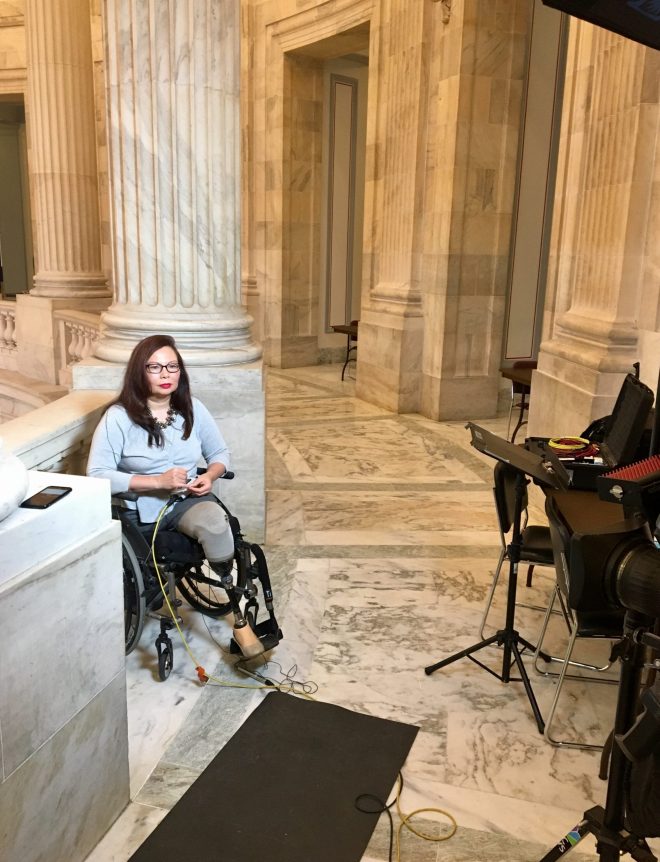
An op-ed in yesterday’s New York Times by Democrat Tammy Ducksworth demonstrates that when it comes to “patriotism,” liberals are as morally blind as conservatives.
Duckworth’s op-ed goes after conservative Fox News commentator Tucker Carlson, who recently questioned Duckworth’s patriotism by suggesting that she didn’t love her country. Naturally, Duckworth, who lost her legs while serving as a soldier in the U.S. military in Iraq, took umbrage over Carlson’s attack and responded quite vociferously in her op-ed.
Much of the controversy involves meaningless exchanges that regularly take place between Democrats and Republicans, liberals and conservatives. That’s mostly because both leftists and rights believe in the welfare-warfare state way of life.
But there is one aspect of Duckworth’s op-ed that deserves addressing because it so clearly shows that when it comes to war, the left-wing is as morally obtuse as the right wing.
Duckworth writes:
Even knowing how my tour in Iraq would turn out, even knowing that I’d lose both my legs in a battlefield just north of Baghdad in late 2004, I would do it all over again. Because if there’s anything that my ancestors’ service taught me, it’s the importance of protecting our founding values, including every American’s right to speak out.
So while I would put on my old uniform and go to war all over again to protect the right of Tucker Carlson and Donald Trump to say offensive things on TV and Twitter….
What Duckworth obviously still hasn’t come to the terms with is that her military service in Iraq had absolute nothing to do with protecting the right of freedom of speech of the American people. That’s because neither the Iraqi regime nor the Iraqi people were threatening the freedom of speech of the American people.
What Duckworth obviously still doesn’t recognize is that it was the U.S. government that was the aggressor in the Iraq War. She was part of a military force — the most powerful in history — that attacked and then occupied an impoverished Third World country that had never attacked and then occupied the United States or even threatened to do so.
Yes, I know, U.S. officials called the operation “Operation Iraqi Freedom.” But that was just propaganda. The operation had nothing to do with bringing freedom to Iraq, any more than it did with protecting the right to Americans to exercise freedom of speech. The purpose of the operation was to replace Iraqi dictator (and former U.S. partner and ally) Saddam Hussein with another U.S. stooge.”
Moreover, let’s not forget that every U.S. soldier who served in Iraq, including Duckworth, was serving in an illegal war. It was illegal given that there was no congressional declaration of war against Iraq, as the Constitution requires. It was also illegal under international law because it violated the principle against wars of aggression established by the Nuremberg War Crimes Tribunal.
Let’s also not forget about the countless Iraqis who were killed in the process. By being deprived of their lives, they were also deprived of their right of freedom of speech.
Leftists and rightists can engage in their meaningless debates on “patriotism” all they want. Just leave out the part that holds that invading and occupying a country that has never attacked the United States protects the right of Americans to exercise freedom of speech because that just isn’t true.
Lithuania’s Television Commission Bans Broadcasting of Five RT Channels
Sputnik – 08.07.2020
The Lithuanian Radio and Television Commission (LRTK) has banned the broadcasting of five RT channels in the country, following the example of neighbouring Latvia, commission chairman Mantas Martisius said on Wednesday.
“Yes, we can confirm this. The decision will come into force after being published on the LRTK website,” Martisius said.
The ban is applicable to RT, RT HD, RT Spanish, RT Documentary HD and RT Documentary, and will go into effect on Thursday, LRTK chairman explained.
Last week, Latvia banned the broadcasting of seven RT channels (namely RT, RT HD, RT Arabic, RT Spanish, RT Documentary HD, RT Documentary, RT TV), saying they are all owned by Rossiya Segodnya International Information Agency Director-General Dmitry Kiselev, who is under EU sanctions. Notably, Rossiya Segodnya and RT are two different legal entities, RT is not chaired by Kiselev, and RT Editor-in-Chief Margarita Simonyan is not under any EU sanctions.
The Russian Foreign Ministry’s spokeswoman, Maria Zakharova, has slammed Latvia’s decision to ban seven RT channels as a disgraceful and illegal move.
Estonian Foreign Minister Urmas Reinsalu said on Tuesday that the government was mulling the possibility to ban RT broadcasting in the country.
Twitter Targets Accounts of MintPress and Other Outlets Covering Unrest in Bolivia
By Alan Macleod | MintPress News | June 29, 2020
Social media giant Twitter took the step of suspending the official account of MintPress News on Saturday. Without warning, the nine-year-old account with 64,000 followers was abruptly labeled as “fake” or “spam” and restricted. This move is becoming a frequent occurrence for alternative media, especially those that openly challenge U.S. power globally.
Immediately preceding the ban, MintPress had been sharing stories about Israeli government crimes against Palestinians, the Saudi-led onslaught in Yemen (both funded and supported by Washington), and about activists challenging chemical giant Monsanto’s latest plans. However, MintPess correspondent Ollie Vargas, stationed in Bolivia and covering the coup and other events there, had another theory on the suspension. Vargas noted that his account, along with union leader Leonardo Loza and independent Bolivian outlets Kawsachun Coca and Kawsachun News were all suspended at the same time. “There was a coordinated takedown of numerous users & outlets based in Chapare, Bolivia. Thousands of fake accounts appeared after the coup. We believe they’re being mobilized to mass report those who criticize the regime,” he said. Since the November coup, Bolivia has been the sight of intense political struggle, with MintPress one of the only Western outlets, large or small, extensively covering the situation (and from a perspective that directly challenges the official US government line). Vargas added that all those accounts suspended appeared in his Twitter bio.
In December, MintPress reported how the strongly conservative Bolivian elite is treating social media as a key battleground in pushing the coup forward, with over 5,000 accounts created on the day of the insurrection tweeting using pro-coup hashtags. With the new administration still lacking both legitimacy and public support, it appears the next step is to simply silence dissenting voices online like they have been silenced inside the country. Kawsachun Coca and Kawsachun News, located in the Chapare region, still not under government control, are among the only remaining outlets critical of the Añez administration.
As Twitter has developed into a worldwide medium of communication, it has also grown an increasingly close relationship with Western state power. In September, a senior Twitter executive was unmasked as an active duty officer in a British Army brigade whose specialty was online and psychological warfare. It was almost entirely ignored by corporate media; the one and only journalist at a major publication covering the story was pushed out of his job weeks later. Earlier this month, Twitter announced it worked with a hawkish U.S.- and Australian-government sponsored think tank to purge nearly 200,000 Chinese, Russian and Iranian accounts from its platform. It has also worked hard to remove Venezuelan users critical of U.S. regime change, including large numbers of government members. Meanwhile, despite detailed academic work exposing them, Venezuelan opposition bot networks remain free to promote intervention.
Facebook has also been working hand-in-hand with the Atlantic Council, a NATO think tank, to determine what users and posts are legitimate and what is fake news, effectively giving control over what its 2.4 billion users see in their news feeds to the military organization. Reddit, another huge social media platform, recently appointed a former deputy director at the council to be its head of policy.
Earlier this year, Facebook announced that it was banning all positive appraisals of Qassem Soleimani, the Iranian general and statesman assassinated by the Trump administration. This, it explained, was because Trump had labeled the Iranian Revolutionary Guard Corps (IRGC) a terrorist organization. “We operate under U.S. sanctions laws, including those related to the U.S. government’s designation of the IRGC and its leadership,” it said in a statement. This is particularly worrying, as Soleimani was the country’s most popular public figure, with over 80 percent of Iranians holding a positive view of him, according to a University of Maryland poll. Therefore, because of the whims of the Trump administration, Facebook began suppressing a majority view shared by Iranians with other Iranians in Farsi across all its platforms, including Instagram. Thus, the line between the state, the military industrial complex, and big media platforms whose job should be to hold them to account has blurred beyond distinction. The incident also once again highlights that big tech monopolies are not public resources, but increasingly tightly controlled American enterprises working in conjunction with Washington.
More worryingly, it is the tech companies themselves who are pushing for this integration. “What Lockheed Martin was to the twentieth century,” wrote Google executives Eric Schmidt and Larry Cohen in their book, The New Digital Age, “technology and cyber-security companies [like Google] will be to the twenty-first.” The book was heartily endorsed by Atlantic Council director Henry Kissinger.
After an online outcry including journalists like Ben Norton directly appealing to administrators, the accounts were reinstated today. However, the weekend’s events are another point of reference in the trend of harassing and suppressing independent, alternative or foreign media that challenges the U.S. state power, an increasingly large part of which is linked to the big online media platforms we rely on for free exchange of ideas, opinions and discourse.
On the incident, MintPress founder Mnar Muhawesh said:
Twitter’s ban hammer and censorship army of flaggers is an attempt to re-tighten state and corporate control over the free flow of information. That’s why it’s no wonder independent media like MintPress News, Kawsachun, and watchdog journalists covering state crimes like Ollie Vargas have been targeted in what appears to be an organized effort to silence and censor dissent. Twitter’s message is very clear: our first amendment is not welcome, as long as it challenges establishment narratives.”
Alan MacLeod is a Staff Writer for MintPress News. After completing his PhD in 2017 he published two books: Bad News From Venezuela: Twenty Years of Fake News and Misreporting and Propaganda in the Information Age: Still Manufacturing Consent.
Ayotzinapa Case: Attorney General Orders Capture of 46 Public Officials
teleSUR | July 1, 2020
Mexico’s Attorney General Alejandro Gertz issued 46 arrest warrants against municipal officials for their participation in the disappearance of the 43 students from Ayotzinapa, the State of Guerrero, on September 26, 2014.
“The Attorney General’s Office imputes to 46 officials from various Guerrero municipalities the crimes of forced disappearance and organized crime,” local outlet La Jornada reported and explained that the Office of the Attorney General had neither investigated nor prosecuted certain events when this case’s proceedings were carried out between 2014 and 2018.
Gertz also ordered the capture of the former director of the Criminal Investigation Agency (AIC), Tomas Zeron, who was in charge of this case during President Enrique Peña Nieto’s administration (2012-2018).
According to local outlets, however, he reportedly fled to Canada in March, escaping accusations of torture, disappearance of people, and obstruction of justice against him.
Zeron “already has an arrest warrant and an Interpol red card, for his international location and his extradition,” Gertz said.
Federal authorities are also seeking Carlos Arrieta, Michoacan’s former Security undersecretary, and Julio Contreras, a former member of the Ministerial Police.
During the Peña Nieto administration, Mexican authorities claimed that the criminal group Guerreros Unidos murdered the 43 missing students and cremated them in a garbage dump.
This version of events was known as “the historical truth”, a phrase that the former Attorney General Jesus Murillo Karam used to describe the investigations’ conclusion.
The real goal of the ‘Stop Hate for Profit’ campaign against Facebook has nothing to do with ‘hate speech’
By Helen Buyniski | RT | June 29, 2020
A deep-pocketed astroturf campaign has created the impression that Facebook users are up in arms about racism on the platform, but the ‘Stop Hate for Profit’ campaign is a naked political power-grab by the usual suspects.
The campaign emerged earlier this month and has gathered a huge amount of support from corporations eager to check the Black Lives Matter box and burnish their image. But it’s not clear if these companies have looked into who’s behind the initiative, or what their intentions are. Stop Hate for Profit’s organizers appear less concerned with stopping “hate” than they are with muscling their way into Facebook’s boardroom and seizing the power to permanently silence political opponents.
Stop Hate for Profit’s website is operated by the Anti-Defamation League, an advocacy group notorious for its heavy-handed censorship tactics that has bragged about its involvement in YouTube content purges and regularly smears critics of Israeli policy as froth-mouthed anti-Semites. Listed co-sponsors of the campaign include activist organizations Color of Change, the National Hispanic Media Coalition, and a “media freedom” group called Free Press, which according to its mission statement seeks to “change the media to transform democracy to realize a just society.” In practice, that apparently translates to lending “free press” cover to ideologically-motivated censorship campaigns.
Because make no mistake, Stop Hate for Profit is ideologically-motivated, and its intention is censorship. All three of the aforementioned groups have at least one common financial backer: billionaire currency speculator George Soros’ Open Society Foundations. Soros has made no secret of the fact that he wants Facebook CEO Mark Zuckerberg out of the top position, penning a series of increasingly unhinged op-eds earlier this year accusing the social media tycoon of colluding with US President Donald Trump to get the latter re-elected. Soros repeatedly demanded not only that Zuckerberg be removed from power, but that Facebook be stripped of its Section 230 legal protections, treated as a publisher and not a platform – and thus rendered liable for any and all user-generated content.
It’s not too surprising, then, that this group of Soros-backed organizations just happens to have set its sights squarely on Facebook’s profitability. By taking aim at the 99 percent of Facebook’s profits obtained through advertising, the campaign has already exacted a beating on the company’s stock price, which tumbled 8.3 percent on Friday. Facebook’s value has plummeted $56 billion since the campaign started, kicking Zuckerberg off the world’s three-richest-people list and making the platform’s investors very unhappy.
The more Facebook’s poor performance can be tied to the actions of the CEO, the more likely investors are to send him packing – and Soros likely laughing all the way to the bank.
Zuckerberg has stubbornly refused to fact-check political advertising on his platform, even as Facebook subjects all non-politicians’ speech to microscopic examination by ideological crusaders loaded down with their own baggage and conflicts of interest, allowing Trump and other conservative politicians to buy their way into voters’ hearts without fear that some Soros-funded fact-checker will ruin the moment. This – not some epidemic of “hate speech” – is the problem Stop Hate for Profit is most determined to fix.
The campaign’s answer to the question of “hate speech” on Facebook is multifaceted, but all the solutions it comes up with end with groups like the ADL gaining absurd levels of power within the immensely profitable platform. They demand Facebook submit to “regular, third party independent audits of identity-based hate and misinformation” – presumably to be conducted by the ADL or its affiliates – and refund money to advertisers whose content appeared next to material that was later yanked for violating terms of service.
And they want those terms of service to cover a lot more content – everything from “climate denialism” to “militia” are to be excised from the platform if Facebook wants its advertiser dollars back.
This isn’t the first time these same forces have united to demand Facebook preemptively shut down speech they don’t like under the guise of fighting “hate.” In 2018, the Southern Poverty Law Center – the ADL’s chief rival for the donations of wealthy liberals with enormous persecution complexes – urged tech platforms to allow “individuals and organizations” (like the SPLC, presumably) to “flag hateful activities” as well as “groups and individuals engaged in hateful activities” so that they might be speedily ushered off the platform. The SPLC’s partners in this endeavor? Color of Change, Free Press, and the National Hispanic Media Coalition.
Not everyone who’s signed on to Stop Hate for Profit is necessarily in it for the censorship, of course. Some corporations no doubt think they’re actually doing something good. But ironically, some of the participants don’t appear to actually be pulling their ads from Facebook at all, as Gizmodo discovered last week. Companies eager to be seen as taking a stand against Facebook have pulled their most obvious ads, but apparently left in place advertising deals through the Facebook Audience Network, which displays ads targeted based on Facebook activity across third-party apps, or continue to advertise with Facebook subsidiary Instagram.
It’s only fitting that a campaign that is at its heart a pantomime of caring about marginalized groups should be met by a pantomime of corporate activism from its real targets – Facebook’s investors. Soros has spoken, will Zuckerberg be pried loose from the CEO’s chair?
Helen Buyniski is an American journalist and political commentator at RT. Follow her on Twitter @velocirapture23
Read more:
Zuckerberg loses $7.2 BILLION after corporate ad boycott pressing Facebook to police ‘hate speech’
RT | June 27, 2020
Plummeting Facebook shares have wiped out billions of founder and CEO Mark Zuckerberg’s personal wealth. The impetus? Corporations such as Coca-Cola and Verizon have pulled their ads, demanding that Facebook censor hate speech.
Zuckerberg lost $7.2 billion, after Facebook’s shares fell by 8.3 percent on Friday, Bloomberg reported. The dive in value happened after Unilever, one of the largest advertisers in the world, joined the list of major companies that suspended their ad campaigns on Facebook and its subsidiary Instagram. At around the same time, Coca-Cola said it was also pulling all its social-media advertising for 30 days.
More than 120 corporations, including Verizon, Dove, Lipton, Hershey’s, and Honda joined the boycott organized by activists and civil-rights groups that demanded Facebook combat what they term hate speech and disinformation on its platform.
Responding to the criticism, Zuckerberg, whose remaining net worth is now being estimated at $82.3 billion by Bloomberg, has promised to ban ads with “hateful content.” The prohibited advertising will include materials that describe a specific demographic as “a threat to the physical safety, health or survival of others.” He also vowed to fight potential voter suppression, and to take down posts by politicians and government officials if the company deems them to be an incitement to violence.
While Zuckerberg did not explicitly mention the boycott, it was clear from the announcement he was trying to appease its critics. The US media landscape has been deluged by a wave of calls for advertiser boycotts that came in the wake of the ongoing Black Lives Matter protests. The action targeted primarily conservative outlets and speakers, and ended up being so widespread that it garnered the attention of US President Donald Trump, who considered making such behavior “illegal.”
Still, while Facebook has largely avoided explicit Twitter-style hounding of ‘wrong’ political opinions so far, the social-media platform has been frequently accused of censorship. Despite its proclaimed strive for “transparency,” Facebook is very vague on its policies about ‘forbidden’ content. It has been repeatedly caught flagging and removing certain posts for no obvious reason. One of the most recent scandals involved a colored version of an iconic World War II photo depicting a Soviet flag over the Reichstag – that was sanctioned on V-Day for showing “dangerous individuals and organizations.”
Other Silicon Valley giants, such as Twitter and Google-owned YouTube, have been waging an open war on comments deemed hateful or inflammatory. Twitter has been embroiled in a public spat with Trump, labeling several of his tweets as violating the company’s policy against “abusive behavior.”
How Venezuela helped defeat Canada’s Security Council bid

By Yves Engler · June 26, 2020
Was Canada defeated in its bid for a seat on the United Nations Security Council because of Justin Trudeau’s effort to overthrow Venezuela’s government? Its intervention in the internal affairs of another sovereign country certainly didn’t help.
According to Royal Military College Professor Walter Dorn, “I spoke with an ambassador in NYC who told me that yesterday she voted for Canada. She had also cast a ballot in the 2010 election, which Canada also lost. She said that Canada’s position on the Middle East (Israel) had changed, which was a positive factor for election, but that Canada’s work in the Lima Group caused Venezuela to lobby hard against Canada. Unfortunately (from her perspective and mine), Venezuela and its allies still hold sway in the Non-Aligned Movement (NAM or G77).”
The only country’s diplomats — as far as I can tell — that publicly campaigned against Canada’s bid for a seat on the Security Council were Venezuelan. Prior to the vote Venezuela’s Vice-Minister of foreign relations for North America, Carlos Ron, tweeted out his opposition: “With its deafening silence, Canada has de facto supported terrorists and mercenaries who recently plotted against Venezuela, threatening regional peace and security. The UNSC is entrusted with upholding the United Nations Charter and maintaining International Peace and Security: Canada does not meet that criteria.”
The post was re-tweeted by Foreign Minister Jorge Arreaza, who has 1.6 million followers, and numerous Venezuelan diplomats around the world, including the Venezuelan ambassador to the UN. Joaquín Pérez Ayestarán added, “Canada recognizes an unelected, self-proclaimed President in Venezuela, in complete disregard for the will of the voters. It also tries to isolate Venezuela diplomatically & supports sanctions that affect all Venezuelans. Is the Security Council the place for more non-diplomacy?”
After Canada lost its Security Council bid Ron noted, “not surprised with UN Security Council election results today. A subservient foreign policy may win you Trump’s favor, but the peoples of the world expect an independent voice that will stand for diplomacy, respect for self-determination, and peace.” He also tweeted an Ottawa Citizen article titled “Why Black and brown countries may have rejected Canada’s security council bid.”
For his part, UN ambassador Ayestarán tweeted, “losing two consecutive elections to the Security Council of United Nations within a 10-years period is a clear message that you are not a reliable partner and that the international community has no confidence in you for entrusting questions related to international peace and security.”
Over the past couple of years the Trudeau government has openly sought to overthrow Venezuela’s government. In a bid to elicit “regime change”, Ottawa has worked to isolate Caracas, imposed illegal sanctions, took that government to the International Criminal Court, financed an often-unsavoury opposition and decided a marginal opposition politician was the legitimate president.
Canada’s interference in Venezuelan affairs violates the UN and OAS charters. It is also wildly hypocritical. In its bid to force the Maduro government to follow Canada’s (erroneous) interpretation of the Venezuelan constitution Ottawa is allied in the Lima Group with President Juan Orlando Hernandez, who openly defied the Honduran Constitution. Another of Canada’s Lima Group allies is Colombian President Ivan Duque who has a substantially worse human rights record.
Reflecting the interventionist climate in this country, some suggested Canada’s position towards Venezuela would actually help it secure a seat on the Security Council. A few weeks before the vote the National Post’s John Ivison penned a column titled “Trudeau’s trail of broken promises haunt his UN Security Council campaign” that noted “but, Canada’s vigorous participation in the Lima Group, the multilateral group formed in response to the crisis in Venezuela, has won it good notices in Latin America.” (The Lima Group was set up to bypass the Organization of American States, mostly Caribbean countries, refusal to interfere in Venezuela’s affairs.) A Canadians for Justice and Peace in the Middle East factsheet regarding “Canada’s 2020 bid for a UN Security Council seat” echoed Ivison’s view. It claimed, “Canada also presents a positive image to Latin American states, likely reinforced by its leadership of the Lima Group in 2019 and by its promise to allocate $53 million to the Venezuelan migration crisis.”
While it is likely that Lima Group countries voted for Canada, a larger group of non-interventionist minded countries outside of that coalition didn’t. Venezuelan officials’ ability to influence Non-Aligned Movement and other countries would have been overwhelmingly based on their sympathy for the principle of non-intervention in other countries’ affairs and respect for the UN charter.
The Liberals’ policy towards Venezuela has blown up in its face. Maduro is still in power. Canada’s preferred Venezuelan politician, Juan Guaidó, is weaker today than at any point since he declared himself president a year and a half ago. And now Venezuela has undermined the Liberals’ effort to sit on the Security Council.
Will Canada’s defeat at the UN spark a change in its disastrous Venezuela policy?
So it wasn’t ‘by the book’? Strzok notes reveal Obama & Biden were involved in FBI going after General Flynn
RT | June 24, 2020
New evidence shows that the decision to send the FBI after General Michael Flynn, president-elect Donald Trump’s top adviser, came from President Barack Obama and Vice President Joe Biden and wasn’t “by the book” at all.
Biden was the one to raise the Logan Act, while Obama instructed FBI Director James Comey and Deputy Attorney General Sally Yates to have “the right people” on the case during a White House meeting, according to a handwritten note from FBI Agent Peter Strzok.
The note was provided by the DOJ earlier this week to Flynn’s attorneys, who submitted it to the court as evidence on Wednesday.
While Strzok’s hard-to-read note does not mention names, it refers to people by letters – P for president, VP for vice-president, DAG for Yates, D for Director Comey, etc. – according to the court filing.
The Logan Act is an old law that bans private citizens from conducting foreign policy, but it did not apply to Flynn, since he was an incoming national security adviser to the president-elect. Even Comey admitted that his telephone conversations with Russian Ambassador Sergey Kislyak “appear legit[imate],” but was nonetheless told to pursue a case, according to Strzok’s note.
This directly contradicts the narrative about the meeting put forth by Obama’s security adviser Susan Rice, who wrote a strange memo to herself on the eve of Trump’s inauguration repeatedly saying that Obama wanted the investigation to be “by the book.”
Strzok’s note is undated, but the filing says it appears to be referring to a meeting on January 4, 2017 – the same date Strzok intervened to keep the FBI background case against Flynn open, though it had been scheduled to close due to lack of evidence of any wrongdoing. Strzok would later be one of the agents to interview Flynn, and admitted in texts to heavily editing the memorandum of that interview – which has not been made available as evidence.
Earlier in the day, the Washington, DC Circuit Court of Appeals ordered the federal judge in charge of Flynn’s case to immediately agree to the government motion to drop the charges. Last month, Judge Emmet Sullivan responded to the DOJ motion to dismiss charges – in light of evidence revealing the prosecution of Flynn was improperly predicated – by appointing a hostile ex-judge to evaluate the motion and hiring a private attorney to represent himself, at taxpayers’ expense. Flynn’s team reacted by seeking a writ of mandamus from the appeals court.
Flynn was the first casualty of the ‘Russiagate’ probe targeting Trump for alleged “collusion” with Russia in the 2016 election. The adviser was forced to resign after less than two weeks on the job, after the Washington Post accused him of lying to the FBI based on yet-unidentified leaks. He was charged by Special Counsel Robert Mueller in late 2017, and pleaded guilty to lying to the FBI under pressure, but has been fighting the charges after getting a new legal counsel in 2018.
President Trump reacted to the news by wondering if Comey and the FBI, or Mueller and his prosecutors, or Obama and Biden, will apologize to Flynn and others caught up in the probe.
Mueller’s investigation ended in May 2019 finding no evidence of any collusion anywhere, forcing Democrats to claim Trump had abused power by withholding aid from Ukraine as a pretext to impeach him.
Why the assault on a diplomat in Israel should come as no surprise
By Jonathan Cook | June 22, 2020
An Israeli diplomat filed a complaint last week with police after he was pulled to the ground in Jerusalem by four security guards, who knelt on his neck for five minutes as he cried out: “I can’t breathe.”
There are obvious echoes of the treatment of George Floyd, an African-American killed by police in Minneapolis last month. His death triggered mass protests against police brutality and reinvigorated the Black Lives Matter movement. The incident in Jerusalem, by contrast, attracted only minor attention – even in Israel.
An assault by Israeli security officials on a diplomat sounds like an aberration – a peculiar case of mistaken identity – quite unlike an established pattern of police violence against poor black communities in the US. But that impression would be wrong.
The man attacked in Jerusalem was no ordinary Israeli diplomat. He was Bedouin, from Israel’s large Palestinian minority. One fifth of the population, this minority enjoys a very inferior form of Israeli citizenship.
Ishmael Khaldi’s exceptional success in becoming a diplomat, as well as his all-too-familiar experience as a Palestinian of abuse at the hands of the security services, exemplify the paradoxes of what amounts to Israel’s hybrid version of apartheid.
Khaldi and another 1.8 million Palestinian citizens are descended from the few Palestinians who survived a wave of expulsions in 1948 as a Jewish state was declared on the ruins of their homeland.
Israel continues to view these Palestinians – its non-Jewish citizens – as a subversive element that needs to be controlled and subdued through measures reminiscent of the old South Africa. But at the same time, Israel is desperate to portray itself as a western-style democracy.
So strangely, the Palestinian minority has found itself treated both as second-class citizens and as an unwilling shop-window dummy on which Israel can hang its pretensions of fairness and equality. That has resulted in two contradictory faces.
On one side, Israel segregates Jewish and Palestinian citizens, confining the latter to a handful of tightly ghettoised communities on a tiny fraction of the country’s territory. To prevent mixing and miscegenation, it strictly separates schools for Jewish and Palestinian children. The policy has been so successful that inter-marriage is all but non-existent. In a rare survey, the Central Bureau of Statistics found 19 such marriages took place in 2011.
The economy is largely segregated too.
Most Palestinian citizens are barred from Israel’s security industries and anything related to the occupation. State utilities, from the ports to the water, telecoms and electricity industries, are largely free of Palestinian citizens.
Job opportunities are concentrated instead in low-paying service industries and casual labour. Two thirds of Palestinian children in Israel live below the poverty line, compared to one fifth of Jewish children.
This ugly face is carefully hidden from outsiders.
On the other side, Israel loudly celebrates the right of Palestinian citizens to vote – an easy concession given that Israel engineered an overwhelming Jewish majority in 1948 by forcing most Palestinians into exile. It trumpets exceptional “Arab success stories”, glossing over the deeper truths they contain.
During the Covid-19 pandemic, Israel has been excitedly promoting the fact that one fifth of its doctors are Palestinian citizens – matching their proportion of the population. But in truth, the health sector is the one major sphere of life in Israel where segregation is not the norm. The brightest Palestinian students gravitate towards medicine because at least there the obstacles to success can be surmounted.
Compare that to higher education, where Palestinian citizens fill much less than one per cent of senior academic posts. The first Muslim judge, Khaled Kaboub, was appointed to the Supreme Court only two years ago – 70 years after Israel’s founding. Gamal Hakroosh became Israel’s first Muslim deputy police commissioner as recently as 2016; his role was restricted, of course, to handling policing in Palestinian communities.
Khaldi, the diplomat assaulted in Jerusalem, fits this mould. Raised in the village of Khawaled in the Galilee, his family was denied water, electricity and building permits. His home was a tent, where he studied by gaslight. Many tens of thousands of Palestinian citizens live in similar conditions.
Undoubtedly, the talented Khaldi overcame many hurdles to win a coveted place at university. He then served in the paramilitary border police, notorious for abusing Palestinians in the occupied territories.
He was marked out early on as a reliable advocate for Israel by an unusual combination of traits: his intelligence and determination; a steely refusal to be ground down by racism and discrimination; a pliable ethical code that condoned the oppression of fellow Palestinians; and blind deference to a Jewish state whose very definition excluded him.
Israel’s Foreign Ministry put him on a fast track, soon sending him to San Francisco and London. There his job was to fight the international campaign to boycott Israel, modelled on a similar one targeting apartheid South Africa, citing his own story as proof that in Israel anyone can succeed.
But in reality, Khaldi is an exception, and one cynically exploited to disprove the rule. Maybe that point occurred to him as he was being choked inside Jerusalem’s central bus station after he questioned a guard’s behaviour.
After all, everyone in Israel understands that Palestinian citizens – even the odd professor or legislator – are racially profiled and treated as an enemy. Stories of their physical or verbal abuse are unremarkable. Khaldi’s assault stands out only because he has proved himself such a compliant servant of a system designed to marginalise the community he belongs to.
This month, however, Israeli Prime Minister Benjamin Netanyahu himself chose to tear off the prettified, diplomatic mask represented by Khaldi. He appointed a new ambassador to the UK.
Tzipi Hotovely, a Jewish supremacist and Islamophobe, supports Israel’s annexation of the entire West Bank and the takeover of Al Aqsa mosque in Jerusalem. She is part of a new wave of entirely undiplomatic envoys being sent to foreign capitals.
Hotovely cares much less about Israel’s image than about making all the “Land of Israel”, including the occupied Palestinian territories, exclusively Jewish.
Her appointment signals progress of a kind. Diplomats such as herself may finally help people abroad understand why Khaldi, her obliging fellow diplomat, is being assaulted back home.
Police Bigotry and the Drug War
By Jacob G. Hornberger | FFF | June 17, 2020
To suggest that all cops and all judges are racial bigots would obviously be ridiculous. But it would be equally ridiculous to suggest that there are no racial bigots within law enforcement or even the judiciary.
In fact, the DEA, the state police, and local law enforcement all serve as a magnet for racial bigots. There is a simple reason for that. The enforcement of drug laws attracts racial bigots. End the drug war and you get rid of that magnet.
We all know that there are racial bigots in American society. Some of them are very open about their bigotry. They make no bones about it. They don’t seem to care that people are aware of their bigotry.
Others though are more circumspect about their bigotry. They want to hide it from others. The reason? They are embarrassed about it. They care about what other people say. They know that in the times in which we live, they will quite likely be subjected to criticism, moral condemnation, social ostracism, or economic boycott. Being an openly self-proclaimed racial bigot is not a popular thing today in American society.
But if a bigot joins the DEA, the state police, or a local police department, everything changes. He knows that he still cannot openly express his bigotry but he also knows that now he can exercise his bigotry to his heart’s content and not be criticized, condemned, ostracized, or boycotted for it. On the contrary, he knows that now he will be honored, praised, awarded, and glorified for doing his part to “win the war on drugs” and “ridding” American society of drugs.
Enforcing the drug war
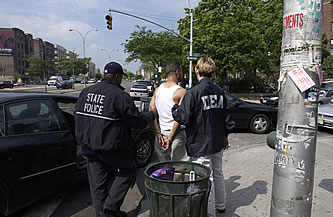 The bigoted cop can stop any black walking or driving down a street and subject him to a humiliating interrogation and pat-down search. Woe to the black who “mouths off” by objecting. He will be “roughed up” and then arrested for “resisting arrest.” If he later explains that he didn’t do anything wrong, at his trial prosecutors will ask the jury the standard question: Who are you going to believe — this upstanding police officer who keeps us all safe or this no-good defendant who has a motive to lie?
For some unlucky blacks, they will be shot or choked to death, which obviously saves the time and expense of a trial for “resisting arrest.” Or maybe, if they’re lucky, they’ll just be shot with a taser.
In the event that blacks don’t cooperate by possessing or distributing drugs, racially bigoted cops might just plant the drugs on them or frame them by falsely alleging that they were caught violating the drug laws. Just ask the people of Tulia, Texas, about that phenomenon.
And then there are the cases where blacks traveling down the highway are caught with a large amount of cash. The cops just seize it, even though there are no drugs found. If they don’t like this highway robbery, they can sue to get their money back, assuming they have additional money to hire a lawyer.
What is important in all this is that it’s the drug war that gives racially bigoted law-enforcement agents a license to exercise their bigotry legally and get thanked, praised, glorified, and honored for it.
That’s not to say, of course, that the drug war isn’t enforced against people of all colors, creeds, and national origins. We all know that it is. It is simply to say that the drug war attracts racial bigots into law enforcement (and the judiciary) so that they can exercise their bigotry to their heart’s content and be thanked, honored, praised, and glorified for it rather than criticized, condemned, ostracized, and boycotted.
By ending the drug war, you end up removing the biggest opportunity for racial bigots to exercise their bigotry through law enforcement. Police departments would no longer serve as a magnet for racial bigots. The bigots already there would start to drift away. Sure, they could still exercise their bigotry in the enforcement of murder, rape, and robbery laws, but the opportunity to do that is extremely limited.
CNN’s David Simon interview
Don’t just take my word for the importance of ending the drug war in the context of police brutality against blacks and others. Watch this 16-minute interview by CNN reporter Christiane Amanpour of David Simon, the creator of the “The Wire,” a television series about policing in America. I cannot recommend this interview too highly.
Notice how Simon continues to emphasize his point that if you want to end police brutality and corruption, you have to end the drug war. But notice something equally important, something that characterizes many members of the mainstream press: Amanpour does not seize the opportunity to follow up on Simon’s point. She doesn’t ask Simon to explain the relationship between the drug war and police brutality. She doesn’t delve into why ending the drug war is the solution to police brutality. Throughout the interview, I got the feeling that Amanpour wanted Simon to simply address police brutality in the context of the continued existence of the drug war.
To Simon’s credit, he refused to go down that road, no doubt to Amanpour’s chagrin. He was masterfully steadfast in maintaining the central point — if you want to end police brutality and corruption, you have to end the drug war.
If only all Americans were to come to this realization, we could not only bring an end this Jim Crow program but also help restore some liberty and privacy to people of all races, colors, and national origins.
Featured Video
or go to
Aletho News Archives – Video-Images
Book Review
The Maidan Killings and the False-Flag Case
By Freddie Ponton | 21st Century Wire | September 5, 2026
Before the killings that helped bring down Ukraine’s president in February 2014, American diplomats were discussing who should enter its government. In a leaked telephone call, senior State Department official Victoria Nuland told US ambassador Geoffrey Pyatt, “I think Yats is the guy,” referring to opposition leader Arseniy Yatseniuk. Washington had clear preferences and was working to advance them. Later that month, Yatseniuk became prime minister.
Ivan Katchanovski’s The Maidan Massacre in Ukraine examines the violence that preceded that transfer of power. Drawing on television footage, witness testimony, forensic examinations and Ukrainian court proceedings, he argues that elements of the opposition shot protesters and police in a false-flag operation. His case centres on evidence of protesters being shot from opposition-controlled locations, including Hotel Ukraina, overlooking the killing ground. … continue
Blog Roll
 Aletho News
- Israel expands “incitement” charge to target Palestinian education and memory
- How Israel seeks to reshape Arab classrooms
- Paris bans pro-Palestinian demonstration planned for Oct. 7 over ‘risks of public disorder’
- In August Hanning Treason Case – All Signs Point To Tel Aviv.
- France cleared dozens of military sales to Israel between May and September: Report
- France projects nuclear power as Macron pushes arsenal expansion
- The fallacy of US delusions about Iran’s economic collapse
- What changes with Lula or Flávio?
- Britain leads Western media’s demise through ‘fear porn’ narrative
- The Maidan Killings and the False-Flag Case
- If Americans Knew
- Soldier testimony sheds light on how Israel wages information war
- CIA Report Warns Israel Could Head Toward Civil War, Total Collapse
- Banker Who Exposed Howard Lutnick’s Ties to Epstein Warned of ‘Retaliation’ and ‘Personal Consequences’ in Last Post Before Suicide
- Israeli Attacks Kill Two Palestinians in Gaza
- Gaza genocide at 3: Israeli-U.S. cruelty and the smart, deep resistance to it are changing the world
- As genocide is about to enter 3rd year, little of Gaza remains– Daily Update
- “We See Our Homes Now From A Satellite, Like Strangers”
- Watch “Gaza: Doctors Under Attack”, originally censored by BBC
- NAZA: Israeli embassies in UK and US promote rival documentary to challenge Gaza genocide allegations
- David Ellison appoints Israeli to lead merged Paramount-Warner studios
- No Tricks Zone
- Latest European Green Energy Debacle; Portugal’s Largest Flagship Solar Park Insolvent!
- Green Energy Debacle: German Expert Professor Fritz Vahrenholt Warns Of Severe Economic And Social Consequences
- Two More Paleo Reconstructions Affirm Meters-Higher Sea Levels Across Ireland, Brazil 7000-6000 Years Ago
- New Study: Earth And Venus Surface Warmth Largely Explained By Convection And Lapse Rate, Not CO2 Or Radiation
- 2025 Nature Paper Claiming Worsening Global Drought Gets RETRACTED …Heavily Flawed
- New Study: ‘Global Drought Shows No Detectable Recent Acceleration Under Climate Warming’
- Economic Masterminds: German Socialists Suggest Taxing Productivity Gains Stemming From Using AI
- The South China Sea Has Not Been Cooperating With The Climate Change Narrative
- Energy Crisis: Germany Enters Heating Season With Historically Low Gas Reserve Fill Levels
- New Study: The Antarctic Ice Sheet Gained Mass From 2020-2024 Due To Staggering Snow And Ice Accumulation

