Cut Overseas Police Training Programs

Photograph Source: Lorie Shaull from St Paul, United States – CC BY-SA 2.0
By Jeremy Kuzmarov | CounterPunch | June 15, 2020
The police killing of George Floyd in Minneapolis has ignited protests across the United States and calls to demilitarize and defund the police.
A similar demand should be made to cut overseas police training programs including in Afghanistan.
The U.S. government has long adopted overseas police training as a cornerstone of nation building and counterinsurgency programs.
The idea is that American police will instill professional and democratic standards, including a respect for civil liberties among foreign counterparts and help stabilize violence prone countries.
The Floyd killing has exposed, however, that American police lack professional and humane standards and need to be retrained and reformed. They are ill suited to improve other countries’ police.
In Afghanistan, where the U.S. has spent an estimated $87 billion dollars over nineteen years training security forces, the police are notorious for corruption, sectarianism, incompetence and brutality.
In an interview quoted in the Afghanistan Papers, Thomas Johnson, a Navy official who served as a counterinsurgency adviser in Kandahar province, said that Afghans viewed the police as predatory bandits, calling them “the most hated institution” in Afghanistan.
This latter outcome resulted in part from the militarized tactics promoted by American advisers and their importation of police technologies which could be used for repressive ends.
In Honduras, where the U.S. expanded police aid following a 2009 coup d’états that ousted the mildly progressive José Manuel Zelaya, American trained units have been implicated in torture and drug related corruption, and carried out predawn raids of activists involved in protesting contested elections.
These units were trained under an initiative promoted by President Obama and extended by Trump that provided hundreds of millions of dollars for law enforcement training and assistance, mostly under the War on Drugs.
In the early 1960s, the Kennedy administration created the United States Agency for International Development’s infamous Office of Public Safety (OPS), to modernize the police forces in countries considered vulnerable to communist subversion.
Headed by CIA agent Byron Engle, who combined a deep commitment to civilian police work with an appreciation for the darker areas of political police intelligence, the OPS initially employed liberal reformers.
As political policing gained primacy, however, OPS agents became contemptuous of human rights and imported policing technologies that were used to hunt down dissidents and violently quell protests.
Charles Maechling Jr., staff director of the Special Group on Counterinsurgency under Kennedy, acknowledged that in failing to “insist on even rudimentary standards of criminal justice and civil rights, the United States provided regimes having only a façade of constitutional safeguards with up-dated law enforcement machinery readily adaptable to political intimidation and state terrorism. Record keeping in particular was immediately put to use tracking down student radicals and union organizers.”
By 1973, the OPS was abolished by Congress because of its connection to torture carried out by U.S. trained police forces in South Vietnam and Brazil.
Many OPS veterans subsequently returned to work for police forces back in the U.S., where some continued to promote tactics that encouraged police abuse, including in the suppression of urban riots.
Unfortunately, there is a long pattern of abuse in American police forces, that overseas police programs have helped to compound.
As momentum grows for a transformation of the police, activists should be demanding an end to the practice of exporting police repression and a change to the American approach towards foreign policy more broadly.
Jeremy Kuzmarov is the author of The Russians are Coming, Again: The First Cold War as Tragedy, the Second as Farce (Monthly Review Press, 2018) and Obama’s Unending Wars: Fronting for the Foreign Policy of the Permanent Warfare State (Atlanta: Clarity Press, 2019).
TSA to take mug shots of domestic air travelers
By Edward Hasbrouck | Papers, please! | June 8, 2020
The Transportation Security Administration (TSA) has officially although quietly announced that, as it has planned for years, its deployment of mug-shot machines at airport checkpoints will move from pilot projects to the new normal for domestic air travelers.
According to a Privacy Impact Assessment (PIA) released last week, the TSA plans to integrate facial recognition into the Secure Flight profiling, scoring, and control system used by the TSA and other linked agencies to decide who is, and who is not, “allowed” to pass through TSA checkpoints to exercise their right to travel by airline common carrier.
Cameras to photograph would-be travelers’ faces will be added to each of the stations at airport checkpoints where TSA employees and contractors currently scan would-be passengers’ travel documents (boarding passes and, if they present ID, ID documents).
U.S. Customs and Border Protection (CBP), in collaboration with airlines and airport operators, already collects photos of many international travelers. CBP has been moving in fits and starts toward making mug shots mandatory even for U.S. citizens traveling internationally. As of now, mug shots are still officially “voluntary” for U.S. citizen international travelers, although many U.S. citizens have reported not being allowed to opt out. But last month, as we noted in an earlier blog post, the CBP official in charge of deployment of facial recognition said CBP plans to issue a Notice of Proposed Rulemaking (NPRM) for mandatory facial recognition of international travelers before the end of this year.
We expect that, consistent with the TSA’s “biometrics vision for all commercial aviation travelers”, deployment of facial recognition at TSA checkpoints for domestic air travelers will follow the same steps as have been followed by CBP in rolling out facial recognition for international air travelers: first pilot projects, then universal deployment of “optional” mug-shot cameras at airports (on an allegedly “opt-out” basis), then increasingly adverse treatment (delay, more intrusuive and in time of pandemic dangerous groping, etc.) of those who opt out, and eventually — if most travelers “voluntarily” submit to mug shots — denial of travel to those who don’t. The PIA doesn’t say how soon any of this will happen.
The time to say “no” is now, while you still can. Don’t consent to being photographed at TSA checkpoints or airline check-in counters or kiosks. For your own safety as well the protection of your civil liberties, don’t remove your mask! TSA checkpoints, check-in counters, and all kinds of kiosks are among the places at airports where transmission of contagious diseases is most likely. We are very interested in hearing from any traveler who is ordered to remove a face mask.
The TSA claims that domestic air travelers will be allowed to “opt out” of facial imaging, but it will be up to you to spot the cameras and stay out of their field of view. Notably, the TSA’s Privacy Impact Assessment (PIA) doesn’t say what, if any, notices will be posted for travelers to see before they come into range of the mug-shot cameras.
The required notices are dictated by the Paperwork Reduction Act (PRA) and the Privacy Act, but the TSA has ignored both of these Federal laws in its facial recognition plans.
Even if a “collection of information” (including biometric information) by a Federal agency such as the TSA is voluntary, the PRA requires that it be approved in advance by the Office of Management and Budget (OMB) and assigned an OMB control number. That OMB control number and other notices specified by the PRA must be provided to all individuals from whom information is to be collected.
Pursuant to the PRA, no penalties may be imposed for failure or refusal to provide information unless these approval and notice requirements are complied with.
The PIA for facial imaging at TSA checkpoints doesn’t cite an OMB control number, and so far as we can tell, there is none. If TSA checkpoint staff ask you to take off your face mask so that they can take your mug shot, ask for the OMB control number for this information collection and a copy of the applicable Paperwork Reduction Act Notice.
The TSA says that facial images collected by the TSA “will be retained for no longer than 24 hours after the flight departure time.“ But regardless of how long this data is retained, any retention of personal identified information such as mug shots is prohibited by the Privacy Act unless the agency has previously published an applicable System Of Records Notice (SORN) in the Federal Register. Operation of a system of records without proper notice is a crime on the part of the responsible agency officials.
The new PIA for the TSA’s facial recognition scheme for air travelers claims that the data collected would be covered by the Secure Flight SORN promulgated in 2015. But facial images collected at checkpoints are not among the categories of information listed in the SORN as included in that system of records.
The bottom line is that the TSA facial recognition scheme described in the latest PIA would violate both the PRA and the Privacy Act. To the extent that it would require or induce travelers to remove their face masks, it would exacerbate the pandemic hazards of travel to the health of travelers and airline, airport, and TSA staff and contractors.
Police Killings are a Political Tactic
By Rob Urie | CounterPunch | June 15, 2020
As the spark that lit a fire, the murder of George Floyd was horrifyingly, sickeningly ordinary. According to the scant data on police killing of citizens that is available, about three people are killed by the police in the U.S. every day. And despite the protest movements Black Lives Matter and Occupy Wall Street, this number has remained about constant in recent years through Democratic and Republican administrations. This persistence stands in contrast to the political ‘branding’ of the mainstream political parties where difference is claimed, but little is evident.
The place of Mr. Floyd’s murder in the ordinary working of American governance makes it the catalyst, not the cause, of current protests. The background circumstances of economic calamity suggest that political tensions will continue to rise as unemployment and economic desperation exert a toll on social stability. The horror of Mr. Floyd’s murder should get outraged citizens into the streets regardless of broader circumstances. But with history as a guide, it is these broader factors that are creating the political moment. This highlights the urgency of acting while there is an opening.
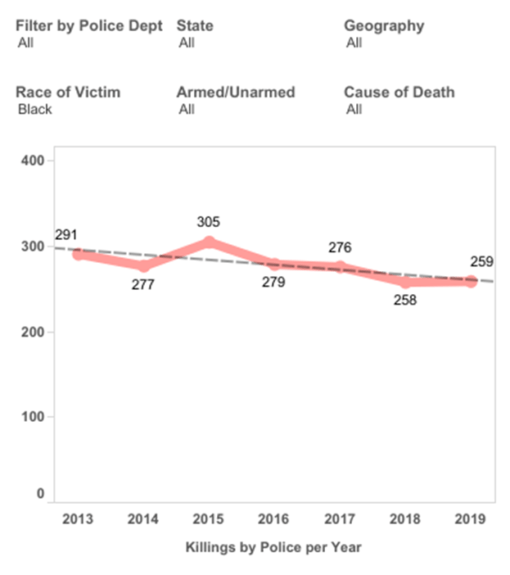
Graph: according to this credible— because it is unofficial, source, the total number of citizens killed by police per year has held steady at about 1,100 over the last decade. Ironically, given the scale and scope of the current rebellion, the number of blacks killed by the police has been falling over the last few years— meaning that the killing of whites has been rising. Illustrated here is the trend in blacks killed by the police by year. Source: mappingpoliceviolence.org.
The disproportionate targeting of blacks by the police is given needed context when the data is organized by economic class. Poor and working-class whites are arrested and incarcerated at about the same rate as poor and working-class blacks. By its nature, this data says nothing about history. But it does offer structural and political insights. To the prior, history informs the present, it doesn’t define it. To the latter, 1) the frame of race divides people who otherwise have shared class interests and 2) poor and working class ‘allies’ are struggling for their own freedom from police violence, whatever their intentions.
What this arithmetic of disparity implies is that a larger proportion of blacks than whites are poor and working class. One interpretation is that race defines economic opportunity, which is overly generous to how capitalism works. Whatever people’s sentiments, slavery, convict leasing and Jim Crow had economic explanations. Some people, call them capitalists, make themselves rich by making and keeping other people poor. Here is a dry, academic and partial explanation of how poor people are kept poor in the present.
The current focus on police violence is roughly analogous to explaining foreign entanglements like wars through the actions of foot soldiers and technicians rather than through the strategic and tactical goals of state leaders. And explanations of police power like police unions and white supremacy ignore modern history at the peril of their purveyors. The film 13th offers key insights into this history from a black liberal perspective. Richard Nixon created the carceral state to imprison the political enemies of capital.
As writer Dan Baum reported in Harper’s in 2016, Mr. Nixon created the ‘war on drugs’ to give state and local police a state-sanctioned (‘legitimate’) reason to arrest and imprison the counterculture left and blacks. Whatever Mr. Nixon’s sentiments regarding race, his goal was straightforwardly political— to use state power to arrest and imprison his political enemies. And his strategy worked. Through the war on drugs, the U.S. created the largest gulag system to imprison real and potential opponents of official state policy in human history.
This ‘political’ explanation of the carceral-police state strains the brains of Democrats who spent four decades arming, militarizing and supporting the police to combat ‘crime.’ That it is overwhelmingly poor and working people in prison who were sent there on drug charges supports Mr. Baum’s claim. As his source, Nixon aide John Ehrlichman, added, Mr. Nixon clearly understood that 1) ‘crime’ related to drugs was a political designation intended to 2) put the entire counter culture— which at the time included a large black nationalist movement, in prison.
The political question related to ‘crime’ wasn’t: what socially destructive behavior should be punished? It was: what laws can be enacted that will specifically target the political enemies of establishment interests to prevent them from mounting effective political challenges to it? To state the obvious, some of the most dangerous and socially destructive drugs (alcohol and tobacco) were kept legal to be distributed at a profit. And as ‘conspiracy theory’ as the charge still reads, decades of evidence place the CIA as the distribution center of the American narcotics trade.
What Mr. Nixon accomplished was twofold: he created the largest gulag system in world history and he gave a federal purpose to otherwise disparate and locally funded police departments. This is where Bill Clinton picked up. Through the liberal frame, Mr. Clinton’s deregulation of the banks, cutting of social spending and build out of the carceral state were unrelated acts. But even within a neoliberal frame, these are related as a carrot and stick approach to force people to adhere to the emerging neoliberal order. The requirement to work or starve was intended to recover the Dickensian conditions of early capitalism in ways that Ronald Reagan only dreamed of.
Another way to understand deregulation is as reducing the number, scale and scope of laws that constrain corporate behavior. Capital was freed by Bill Clinton as he used the class-proxy of ‘crime’ to increase violent state repression of poor and working people. By giving the police immunity for their actions, Mr. Clinton made violent crime a state-sponsored enterprise. Within the range of available options, he reduced social spending in poor neighborhoods, choosing instead to criminalize poverty. The Democrats have been the party of Wall Street ever since.
As with race in an earlier era, incarceration was made the marker that defines a super-exploitable class. The incarcerated— overwhelmingly from the poor and working class, were made to pay for their incarceration, often by working for private corporations at below-market wages; were the last hired and the first fired after being released from prison, and they were excluded from political participation through prohibitions on felon voting. These practices tie in history to convict leasing and Jim Crow— and liberal Democrats supported them.
Furthermore, what bearing would police reforms have on the political purpose of the carceral system? This purpose is determined by oligarchs and the agents of capital, not cops. Reforms will only be adopted and kept in place as long as to the broader political and economic goals of the oligarchs are met. For instance, the New Deal was jettisoned the moment it could be plausibly argued that it constrained capital. As for the Voting Rights Act, after blacks were given the right to vote, capital took over the electoral system.
Back to the film 13th for a moment. After presenting the half-baked assertion that Bill Clinton was forced by the political zeitgeist to take up Richard Nixon’s program of (re) racializing policing and the carceral system, it was clearly and accurately stated that Mr. Clinton was directly, and almost singularly, responsible for the willful destruction of millions of black and brown lives through his buildout of the carceral and police states. Mr. Clinton’s defense— that violent crime was a real problem, ignores the role that his patrons played in neighborhood destruction and the resulting social carnage that led to this outcome.
The film (13th) also provides a string of dim, thuggish, prattle from Donald Trump where he incites violence against ‘outsiders’ at his political rallies in his proto-fascist manner. This ties to his Nixonian threat to use the U.S. military to ‘dominate’ protests and protesters through violent repression. This in turn led to a rash of ‘Reichstag fire’ type analogies that treat Mr. Trump’s threats as facts while reducing the actual history of liberal Democrats building the largest gulag system in world history to a momentary lapse in judgment.
This public exploration of the liberal id was followed by well-placed editorials in the establishment press arguing that ‘Donald Trump is no Nixon— he is much worse.’ Here is Richard Nixon discussing with Nelson Rockefeller how to murder as much of the captive population of Attica prison, including prison guards, as was logistically possible just before Mr. Rockefeller did so. In addition to creating the American gulag system to imprison his political opponents, Mr. Nixon expanded the U.S. war in Vietnam to Laos and Cambodia, gratuitously slaughtering untold innocents in a war known to have been lost a full decade earlier.
That the Clintonite architect of the modern police and carceral states, Joe Biden, is the establishment Democrat’s candidate for president demonstrates their commitment to their neoliberal program. Joe Biden wrote key parts of the 1994 Crime Bill and the Patriot Act, and he dedicated his career to empowering the police while exempting them from accountability for their actions. After Bill Clinton, Joe Biden is the national political figure most responsible for the police practices that led to the murder of George Floyd.
In terms of emerging political alliances, the distance between words and actions is a political strategy. By analogy, the actions of white liberal Democrat Amy Cooper in using the NYPD for social leverage in her dispute with black birdwatcher Christian Cooper are instructional. By Ms. Cooper’s own words, she isn’t racist. Her use of race was transactional— race (and gender) are social levers, she wanted social leverage in her confrontation with Mr. Cooper, so she used them. The police were the social device at her disposal.
This is corporate logic— Ms. Cooper was a financial executive before she was publicly exposed for abusing Christian Cooper. It is also the mode of operational logic that dominates the Democrat’s political culture. The national Democrats who conceived and promoted the 1994 Crime Bill used its racial subtext for political leverage much as Ms. Cooper did. Ms. Cooper was careful to use politically correct terminology to demonstrate that while she was using race and gender to her advantage, she isn’t racist. #Resistance liberals used ‘Russia’ and ‘Putin’ in similar fashion to discredit their political opponents.
With regard to the current alliance of convenience between protesters, the establishment press and national Democrats, it was only a few weeks ago that the latter were lauding the American political police— the FBI, as the saviors of freedom and democracy in the Russiagate fraud. That the FBI was behind the scenes in the murders of Black Panther Fred Hampton, Malcolm X, and Martin Luther King, suggests that protecting freedom and democracy isn’t precisely its mandate. Through its Cointelpro program, the FBI worked with Richard Nixon— and subsequent administrations, to disrupt, thwart and otherwise destroy organized opposition to state policy.
Closer to home, the FBI was ‘deeply involved’ in the vicious police repression that was used to shut Occupy Wall Street down in an organized multi-state operation. To bring this back to Mr. Nixon’s service to capital in creating the modern carceral-police state, the FBI coordinated with the large Wall Street banks that the Obama administration was still in the process of bailing out when its assault on the peaceful protesters of OWS took place. For those who may have forgotten, Wall Street bank J.P. Morgan made a $4.6 billion contribution to the NYPD pension fund as OWS gained political strength.
Events have moved past the murder of George Floyd as establishment hacks try to extinguish the flames with ham-fisted theatrics. I had a hard time not vomiting at the sight of craven Democrats dressed in kante garb kneeling in Kaepernick fashion to show solidarity with the people they have dedicated their careers to selling out to the highest bidder. Given that ‘we’ were in a similar place in 2015, with near daily high-profile murders of unarmed youth at the hands of the police that they had empowered, and they did nothing. To save the suspense, they engage in theatrics in place of taking meaningful action, not in addition to it.
With capitalism in its deepest crisis since 2009, and possibly since the 1930s, the current political moment is fraught. As was demonstrated by the Covid-19 pandemic, the existing powers are incapable of governing. What they are capable of is massive transfers of social wealth to the already rich and political repression. If capital is perceived to be threatened, look for self-preservation to come in the form of political violence no matter which party holds the White House. One might ask what happened to Bernie Sander’s ‘coalition,’ which I supported for tactical reasons (to head off environmental calamity [?!?] ). Bernie Sanders is a Democrat. That is what happened.
ECHR Backs Activists Convicted in France Over Campaign to Boycott Israel
Sputnik – June 11, 2020
The European Court of Human Rights on Thursday backed the pro-Palestinian activists who were convicted in France for “incitement to discrimination” over their calls to boycott products imported from Israel and ruled that the conviction violated their freedom of expression.
“The Court considered that the applicants’ conviction had lacked any relevant or sufficient grounds. It was not [established] that the domestic court had applied rules in keeping with the principles set out in [of the European Convention on Human Rights, providing the right to freedom of expression] or had conducted an appropriate assessment of the facts”, the ECHR statement read.
However, the French judiciary had not violated Article 7 of the European Convention on Human Rights, which implies that a person should not be held accountable for an offence if it was not considered an offence under national law when it was committed, the ECHR also said.
The court ruled that France must pay to each campaigner “380 euros [$431] for pecuniary damage, 7,000 euros for non-pecuniary damage” and a total of 20,000 euros jointly to the applicants “for costs and expenses”.
The Israeli government has argued that the BDS campaign, sponsored by Palestinian non-governmental organisations, is driven by anti-semitism. In 2017, Israel passed a law that allows it to refuse entry to foreign supporters of the movement.
Eleven members of the Collectif Palestine 68 group, which is a French branch of the international Boycott, Divestment and Sanctions (BDS) movement, were accused over two campaigns held in 2009 and 2010 in a supermarket located in eastern France. They urged customers to not buy goods of Israeli origin and called on the store to stop selling them. The activists were accused of inciting anti-semitism and racism by a French court in 2015 and ordered to pay thousands of euros in fines.
A decade after his own ID project failed, ex-PM Blair pushes for one to prove Covid-19 ‘disease status’
RT | June 10, 2020
Ten years after Tony Blair’s contentious British ID card scheme was binned, the former PM says a digital version is urgently needed so that people can prove their Covid-19 “disease status” as the world transitions out of lockdown.
Speaking at the Virtual CogX technology conference on Tuesday, Blair argued that it’s only when citizens can easily show they’re coronavirus-free that sectors such as international travel will be able to restart.
The former UK Labour prime minister insisted that such a system would operate alongside the government’s track-and-trace program as the economy is rebooted.
“It’s a natural evolution of the way that we’re going to use technology in any event to transact daily life, and this Covid crisis gives an additional reason for doing that.”
The Tony Blair Institute for Global Change, which has been making a range of coronavirus response recommendations to leaders around the world, published a paper on Tuesday calling for a digital health ‘passport’.
Under the proposals, people would download a digital wallet app secured with either a fingerprint scan or facial recognition. This would allow them access to their personal health data, such as a test proving they’re Covid-19 free.
The suggestion comes a decade after the infamous national identity card scheme proposed and lauded by Blair’s New Labour government but ultimately scrapped by David Cameron’s coalition administration in 2010, owing primarily to civil rights concerns.
Perhaps in expectation that he would face similar criticism this time round, Blair claimed a digital form of ID could be “easily protected, so you can deal with a lot of the privacy and surveillance issues that worry people.”
This latest intervention in the civil liberties debate has provoked much anger on social media, with some suggesting this ID scheme, like the last, is likely to be a waste of money and end up in the trash.
Former UK Independence Party leader and Member of the European Parliament Gerard Batten suggested Blair was taking his orders from owners of big corporations, raging: “See how this piece of s**t earns his millions from his globalist paymasters?”
Even a self-described “Tony Blair fan” voiced his disapproval, saying such a scheme, which requires citizens to have the appropriate technology, would lead to a “two-tier world, or digital ID for the rich.”
Others joked that people really shouldn’t get so riled about Blair’s proposition, insisting – perhaps with a heavy dose of sarcasm – that this “kind-hearted soul” simply cares about everyone’s health and just wants to make sure “we’re all safe and accounted for.”
SouthFront is Censored under Cover of Pandemic
By Rick Sterling | Dissident Voice | June 8, 2020
Censorship of alternative media is becoming more widespread in the COVID19 era. This article documents the case of SouthFront.
Introducing SouthFront
Where do you find daily news, videos, analysis and maps about the conflict in Syria? Detailed reports about the conflicts in Libya, Yemen and Venezuela? News about the rise of ISIS in Mozambique? Original analysis of events in the US and Russia? SouthFront is the place.
SouthFront is unique and influential, reaching a global audience of hundreds of thousands. They have opinion articles but their reports and videos are informational and factual. Their website says,
SouthFront focuses on issues of international relations, armed conflicts and crises…. We try to dig out the truth on issues which are barely covered by the states concerned and the mainstream media.
Censorship by Facebook and YouTube
A major disinformation and censorship drive against SouthFront was recently launched. On April 30 the SouthFront Facebook account with about 100,000 subscribers was deleted without warning or notice.
On May 1, SouthFront’s main YouTube account with over 150 thousand subscribers was terminated. The English language channel had 1,900 uploaded videos with 60 million views over the past 5 years.
While the SouthFront website continues as before, the above actions remove important distribution channels which SouthFront has painstakingly built up.
The censorship has been accompanied by a parallel disinformation campaign promoted by corporate, governmental and establishment “think tank” organizations. This is in the context where the US State Department’s Global Engagement Center (GEC) has a direct liaison with Silicon Valley companies and teams focused on “countering the propaganda” from Russia, China and Iran with a current budget of $60 million per year.
In a March 2020 hearing, Senator Chris Murphy (D – Conn) lobbied for increased funding and more censorship. He said, “It’s hard to chase one lie after another. You have to actually go after the source and expose the source as illegitimate or untrustworthy, is that right?” Lea Gabrielle, head of GEC, responded “That’s correct.”
When the Senator says “it’s hard to chase one lie after another,“ he is acknowledging that it’s often hard to show that it’s a lie. Even more so when it is not a lie. It is much easier for the authorities to simply say the source is untrustworthy- or better yet to eliminate them — as they have tried to do with SouthFront.
False Accusations by Facebook
The elimination of SouthFront’s Facebook account was based on a Facebook sponsored investigation titled “April 2020 Coordinated Inauthentic Behavior Report.” The 28 page report says:
We’re constantly working to find and stop coordinated campaigns that seek to manipulate public debate across our platforms…. We view influence operations as coordinated efforts to manipulate public debate for a strategic goal where fake accounts are central to the operation…. This month we removed eight networks of accounts, Pages and Groups….. Our investigation linked this activity to … two media organizations in Crimea – News Front and SouthFront. We found this network as part of our internal investigation into suspected coordinated inauthentic behavior.
First, SouthFront is not trying to “manipulate public debate”; they are providing news and information which is difficult, if not impossible, to find elsewhere. It seems to be the censors who are trying to manipulate debate by shutting out some voices.
Second, SouthFront does not have “fake accounts”; they have a public website plus standard social media outlets like Facebook and YouTube (until cancelled). Third, SouthFront has no connection to NewsFront nor operations in Crimea.
NewsFront and SouthFront are completely different organizations. They share the name “Front” but that is irrelevant. Does Facebook confuse the New York Times with Moscow Times? After all, they both have “Times” in their title.
Facebook has shut down SouthFront on the basis of misinformation and smears.
False Accusations by DFRLab
The Digital Forensic Research Lab (DFRLab) was created by the Atlantic Council, a “non partisan organization that galvanizes US global leadership.” It is another organization which is quick to label alternative foreign policy voices as “Russian propaganda.” DFRLab claims to have “operationalized the study of disinformation by exposing falsehoods and fake news”. They reported the censorship of SouthFront with a report titled “Facebook removes Russian propaganda outlet in Ukraine” with subtitle “The social network took down assets connected to NewsFront and SouthFront, propaganda websites supportive of Russian security services.” They reported that the two “demonstrated a close relationship by liking each other’s pages.” As anyone who uses Facebook is aware, it is common to “like” a wide variety of articles and publications. The suggestion that “liking” an article proves a close relationship is silly.
The DFRLab report says NewsFront and SouthFront “disseminated pro-Kremlin propaganda in an array of languages, indicating they were attempting to reach a diverse, international audience beyond Russia.”
First, NewsFront and SouthFront are completely distinct and separate organizations. Second, is there anything unusual about a website trying to expand and reach different audiences? Don’t all publications or outlets do that? This is a tactic of the new censors: to portray normal behavior as sinister.
Another censorship tactic is to assert that it is impermissible to question the veracity of certain findings. Thus DFRLab report says NewsFront posted “outright disinformation” when it published a story that “denied the culpability of Russian-backed separatists’ involvement in the shoot-down of Malaysia Airlines MH-17”. They suggest this proves it is Russian propaganda and false. However, the facts about the downing of MH-17 are widely disputed. For example. one of the foremost American investigative journalists, the late Robert Parry, came to the same conclusion that the MH-17 investigation was manipulated and the shoot-down was probably NOT as portrayed. Parry did many articles on this important event, confirming that it is not “Russian propaganda”.
The Atlantic Council is one of the most influential US “think tanks”. It appears they have created the DFRLab as a propaganda tool to disparage and silence the sources of alternative information and analysis.
Disinformation by European Council “Task Force”
The goals and priorities of the European Union are set by the European Council. They are also increasingly active in suppressing alternative information and viewpoints.
In 2015 the European Council created an East StratCom Task Force to “address Russia’s ongoing disinformation campaigns”. Their major project is called EUvsDISINFO. They say, “Using data analysis and media monitoring services in 15 languages, EUvsDISINFO identifies, compiles, and exposes disinformation cases originating in pro-Kremlin media.”
This organization is part of the disinformation campaign against SouthFront. In April 2019 they published an analysis “SouthFront – Russia Hiding Being Russian.” The story falsely claims that SouthFront “attempts to hide the fact it is registered and managed in Russia.” The SouthFront team is international and includes Russians along with numerous other nationalities. Key spokespersons are the Bulgarian, Viktor Stoilov, and an American, Brian Kalman. They do not hide the fact that the website is registered in Russia or that PayPal donations go to an account in Russia. The website is hosted by a service in Holland. It is genuinely international.
EUvsDISINFO demonstrates the disinformation tactic of falsely claiming to have “exposed” something that is “hidden” when it is public information. There is nothing sinister about collaboration between different nationalities including Russia. EUvsDISINFO suggests there are sinister “pro-Kremlin networks.” In reality, SouthFront is a website run by a dedicated and underpaid staff and lots of volunteers. While the European Council gives millions of dollars to EUvsDISINFO, SouthFront operates on a tiny budget without government support from Russia or anywhere else.
False accusations by US Department of Defense
On April 9, the Deputy Assistant Secretary of Defense, Laura Cooper, spoke at a press briefing. She identifies SouthFront by name and accuses them of “reporting that there actually was no pandemic and that some deaths in Italy might in fact have been from the common flu.”
The first accusation is because of the SouthFront article “Pandemic of Fear.” In contrast with the accusation, the article says, “The COVID-19 outbreak is an apparent threat which cannot be ignored.” The article also discusses the much less reported but widespread pandemic of fear.
The second false accusation is regarding the high death toll in Italy. SouthFront reported the findings of a report from the Italian Ministry of Health which suggested the previous mild winter and flu season had “led to an increase in the pool of those most vulnerable (the elderly and those with chronic illnesses) that can increase the impact of the epidemic COVID-19 on mortality and explain, at least in part, the increased lethality observed in our country.” This is very different than saying the deaths were caused by the common flu. In any case, the findings came directly from Italian health authorities not SouthFront.
In the same press conference, the Deputy Assistant Secretary of Defense says she wishes to “reign in malign actors that are spreading misleading disruptive information”. The censors claim the higher ground but engage in misinformation and falsehoods as they seek to silence discussion and debate.
Conclusion
There is a coordinated effort to manipulate and restrict what the public sees and hears in both North America and Europe. Under the guise of “fact checking” and stopping “Russian propaganda,” the establishment has created private and government sponsored censors to distort and diminish questioning media. They label alternative media “Russian” or “pro Kremlin” even though many of the researchers and writers are from the West and have no connection or dependency on the Russian government.
SouthFront is an example of a media site doing important and original reporting and analysis. It is truly international with offices in several countries. The staff and volunteers include people from four continents. The censorship and vilification they are facing seems to be because they are providing information and analysis which contradicts the western mainstream narrative.
In recent developments, SouthFront is posting videos to a secondary YouTube channel called SouthFront TV. When that was also taken down on May 16, they challenged the ruling and won. The channel was restored with the acknowledgment “We have confirmed that your YouTube account is not in violation of our Terms of Service.”
SouthFront is still trying to have their main channel with 152K subscribers restored. Their Facebook account is still shut down and attempts to disparage their journalism continues. The censorship has escalated during the Covid-19 crisis.
Rick Sterling is an investigative journalist who has visited Syria several times since 2014. He lives in the SF Bay Area and can be reached at rsterling1@gmail.com.
Limit Police Power to Targeting Real Criminals
By Jacob G. Hornberger | FFF | June 8, 2020
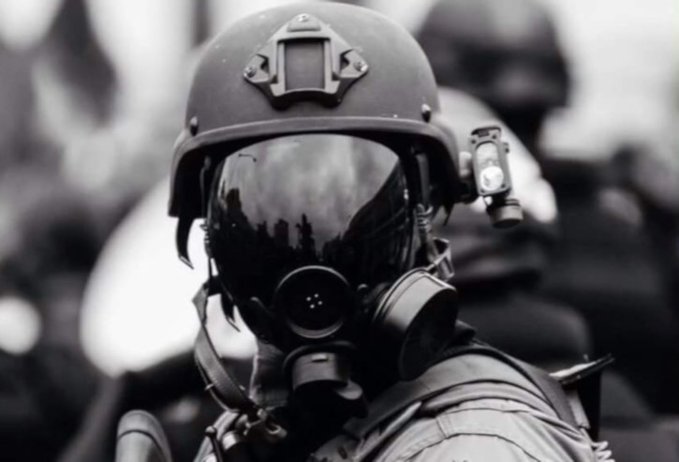
Given the history of brutality by the Minneapolis police department, especially against blacks, with the killing of George Floyd being the most recent example, the Minneapolis city council has signaled its intent to abolish its police department. The mayor of the city, Jacob Frey, opposes the idea, instead favoring police “reform,” an idea that has been tried repeatedly in the past, with dismal results.
So, which is better — abolish or reform?
Actually, there is a third alternative, one that focuses on a critically important question: What is the role of government in a free society?
Why do we need government in the first place? One reason is to protect us from people who initiate force or fraud against others. In every society, there are going to be murderers, rapists, burglars, robbers, thieves, and others who violate the rights of peaceful people. One purpose of government is to target people who commit such acts and arrest, prosecute, convict, and punish them.
That’s what the police are supposed to do — protect us from the bad guys. If someone has trespassed into your house in the middle of the night, you would like the police to respond within a few minutes after calling 911.
The big problem, however, is that the police have been charged with doing much more than targeting violent people. They have also been charged with targeting non-violent people, which consumes a lot of their time, attention, energy, and resources, which then interferes with their ability to protect us from the violent people.
The drug war is the premier example.
We can concede for argument’s sake that drugs are harmful, destructive, and dangerous. But the fact remains that when people possess, ingest, or distribute drugs, they are not violating anyone else’s rights. Smoking dope, snorting cocaine, drinking liquor, or smoking cigarettes are not the same as murdering, raping, or robbing other people.
One of the big problems with the drug war is that it attracts racial bigots to the DEA and police departments. Why is that? Because this is one area where bigots can legally exercise their bigotry to their heart’s content and even be praised, thanked, and glorified for it.
That’s not to say, of course, that everyone in the DEA and in police departments is racially bigoted. We know that that’s not true. But it is to say that there are some racial bigots in the DEA and in police departments because the drug war gives them the legal latitude to target blacks with harassment, abuse, humiliation, and even frame-ups. Moreover, when the bigoted ones use the drug war to exercise their bigotry, oftentimes the rest of the cops come to their defense out of a warped sense of police loyalty. If drugs were legal, cops would no longer be in the drug-enforcement business, which would mean that the DEA and police departments would no longer serve as magnets for racial bigots.
The fact is that government has no business targeting people who are engaged in purely peaceful (and non-fraudulent) behavior. That includes not just the possession, use, and distribution of drugs. It includes all crimes that are known as “vice,” such as prostitution and gambling.
So, before we abolish the police, which would be a day of celebration for murderers, rapists, burglars, and robbers, let’s instead limit the power of the police to target only people who commit acts of violence against others. Let’s get the police out of the business of drug enforcement and enforcement of other non-violent crimes by legalizing drugs — all of them — along with prostitution, gambling, adultery, coveting, fornication, and other peaceful or consensual acts that some people might condemn on moral or health grounds but which do not involve the initiation of force or fraud against others.
In other words, let’s keep the police but limit their power to do what government is supposed to do: protect us from those who initiate force or fraud against others, so that the rest of us can be free to pursue happiness, each in our own way.
Jacob G. Hornberger is founder and president of The Future of Freedom Foundation. He was born and raised in Laredo, Texas, and received his B.A. in economics from Virginia Military Institute and his law degree from the University of Texas. He was a trial attorney for twelve years in Texas. He also was an adjunct professor at the University of Dallas, where he taught law and economics. In 1987, Mr. Hornberger left the practice of law to become director of programs at the Foundation for Economic Education.
FBI launches open attack on ‘foreign’ alternative media outlets challenging US foreign policy
By Gareth Porter | Grayzone Project | June 5, 2020
The FBI has publicly justified its suppression of dissenting online views about US foreign policy if a media outlet can be somehow linked to one of its adversaries. The Bureau’s justification followed a series of instances in which Google and other social media platforms banned accounts following consultations with the FBI.
In a particularly notable case in 2018, the FBI encouraged Facebook, Instagram and Google to ban the American Herald Tribune (AHT), an online journal that published critical opinion articles on US policy toward Iran and the Middle East. The bureau has never offered a clear rationale, however, despite its private discussions with Facebook on the ban.
The FBI’s first step toward intervening against dissenting views on social media took place in October 2017 with the creation of a Foreign Influence Task Force (FTIF) in the bureau’s Counterintelligence Division. Next, the FBI defined any effort by states designated by the Department of Defense as major adversaries (Russia, China, Iran and North Korea) to influence American public opinion as a threat to US national security.
In February 2020, the FBI defined that threat in much more specific terms and implied that it would act against any online media outlet that was found to fall within its ambit. At a conference on election security on February 24, David K. Porter, who identified himself as Assistant Section Chief of the Foreign Influence Task Force, defined what the FBI described as “malign foreign influence activity” as “actions by a foreign power to influence US policy, distort political sentiment and public discourse.”
Porter described “information confrontation” as a force “designed to undermine public confidence in the credibility of free and independent news media.” Those who practice this dark craft, he said, seek to “push consumers to alternative news sources,” where “it’s much easier to introduce false narratives” and thus “sow doubt and confusion about the true narratives by exploiting the media landscape to introduce conflicting story lines.”
“Information confrontation”, however, is simply the literal Russian translation of the term “information warfare.” Its use by the FTIF appears to be aimed merely at justifying an FBI role in seeking to suppress what it calls “alternative news sources” under any set of circumstances it can justify.
While expressing his intention to target alternative media, Porter simultaneously denied that the FBI was concerned about censoring media. The FITF, he said “doesn’t go around chasing content. We don’t focus on what the actors say.” Instead, he insisted that “attribution is key,” suggesting that the FTIF was only interested in finding hidden foreign government actors at work.
Thus the question of “attribution” has become the FBI’s key lever for censoring alternative media that publishes critical content on US foreign policy, or which attacks mainstream and corporate media narratives. If an outlet can be somehow linked to a foreign adversary, removing it from online platforms is fair game for the feds.
The strange disappearance of American Herald Tribune
In 2018, Facebook deleted the Facebook page of the American Herald Tribune, a website that publishes commentary from an array of notable authors who are harshly critical of US foreign policy. Gmail, which is run by Google, quickly followed suit, along with the Facebook-owned Instagram.
Tribune editor Anthony Hall reported at the time that the removals occurred at the end of August 2018, but there was no announcement of the move by Facebook. Nor was it reported by the corporate news media until January 2020, when CNN elicited a confirmation from a Facebook spokesman that it had indeed done so in 2018. Furthermore, the FBI was advising Facebook on both Iranian and Russian sites that were banned during that same period of a few days. As Facebook’s chief security officer Alex Stamos noted on July 21, 2018, “We have proactively reported our technical findings to US law enforcement, because they have much more information than we do, and may in time be in a position to provide public attribution.”
On August 2, a few days following the removal of AHT and two weeks after hundreds of Russian and Iranian Pages had been removed by Facebook, FBI Director Christopher Wray told reporters at a White House briefing that FBI officials had “met with top social media and technology companies several times” during the year, “providing actionable intelligence to better enable them to address abuse of their platforms by foreign actors.” He remarked that FBI officials had “shared specific threat indicators and account information so they can better monitor their own platforms.”
Cybersecurity firm FireEye, which boasts that it has contracts to support “nearly every department in the United States government,” and which has been used by Department of Homeland Security as a primary source of “threat intelligence,” also influenced Facebook’s crackdown on the Tribune. CNN cited an unnamed official of FireEye stating that the company had “assessed” with “moderate confidence” that the AHT’s website was founded in Iran and was “part of a larger influence operation.”
The CNN author was evidently unaware that in US intelligence parlance “moderate confidence” suggests a near-total absence of genuine conviction. As the 2011 official “consumer’s guide” to US intelligence explained, the term “moderate confidence” generally indicates that either there are still differences of view in the intelligence community on the issue or that the judgment ”is credible and plausible but not sufficiently corroborated to warrant higher level of confidence.”
CNN also quoted FireEye official Lee Foster’s claim that “indicators, both technical and behavioral” showed that American Herald Tribune was part of the larger influence operation. The CNN story linked to a study published by FireEye featuring a “map” showing how Iranian-related media were allegedly linked to one another, primarily by similarities in content. But CNN apparently hadn’t bothered to read the study, which did not once mention the American Herald Tribune.
Finally, the CNN piece cited a 2018 tweet by Daily Beast contributor Josh Russell which it said provided “further evidence supporting American Herald Tribune’s alleged links to Iran.” In fact, his tweet merely documented the AHT’s sharing of an internet hosting service with another pro-Iran site “at some point in time.” Investigators familiar with the problem know that two websites using the same hosting service, especially over a period of years, is not a reliable indicator of a coherent organizational connection.
CNN did find evidence of deception over the registration of the AHT. The outlet’s editor, Anthony Hall, continues to give the false impression that a large number of journalists and others (including this writer), are contributors, despite the fact that their articles have been republished from other sources without permission.
However, AHT has one characteristic that differentiates it from the others that have been kicked off Facebook: The American and European authors who have appeared in its pages are all real and are advancing their own authentic views. Some are sympathetic to the Islamic Republic, but others are simply angry about US policies: Some are Libertarian anti-interventionists; others are supporters of the 9/11 Truth movement or other conspiracy theories.
One notable independent contributor to AHT is Philip Giraldi, an 18-year veteran of the CIA’s Clandestine Service and and an articulate critic of US wars in the Middle East and of Israeli influence on American policy and politics. From its inception in 2015, the AHT has been edited by Anthony Hall, Professor Emeritus at University of Lethbridge in Alberta, Canada.
In announcing yet another takedown of Iranian Pages in October 2018, Facebook’s Gleicher declared that “coordinated inauthentic behavior” occurs when “people or organizations create networks of accounts to mislead others about who they are what they’re doing.” That certainly doesn’t apply to those who provided the content for the American Herald Tribune.
Thus the takedown of the publication by Facebook, with FBI and FireEye encouragement represents a disturbing precedent for future actions against individuals who criticize US foreign policy and outlets that attack corporate media narratives.
Shelby Pierson, the CIA official appointed by then director of national intelligence in July 2019 to chair the inter-agency “Election Executive and Leadership Board,” appeared to hint at differences in the criteria employed by his agency and the FBI on foreign and alternative media.
In an interview with former acting CIA Director Michael Morrell in February, Pierson said, “[P]articularly on the [foreign] influence side of the house, when you’re talking about blended content with First Amendment-protected speech… against the backdrop of a political paradigm and you’re involving yourself in those activities, I think that makes it more complicated” (emphasis added).
Further emphasizing the uncertainty surrounding the FBI’s methods of online media suppression, she added that the position in question “doesn’t have the same unanimity that we have in the counterterrorism context.”
Gareth Porter is an independent investigative journalist who has covered national security policy since 2005 and was the recipient of Gellhorn Prize for Journalism in 2012. His most recent book is The CIA Insider’s Guide to the Iran Crisis co-authored with John Kiriakou, just published in February.
The Next American Revolution? Anticipated Civil Unrest
“Warning shots will not be fired”
By Larry Romanoff – Global Research – November 27, 2019
Preparing For Civil War?
US authorities have for decades become increasingly prepared for mass civil disturbances resulting from government and corporate attacks on American society. We can recall that in the early 1980s the Hidden State launched its open war on the middle class by the savage FED-induced recession and the unilateral revocation of the social contract that had existed since 1946. At that time, the US government had already anticipated widespread public unrest, fully expecting mass protests and riots, and had made preparations to deal with them in the form of internment camps. In a real sense, the government had prepared for another civil war.
Like most of the “Great Transformation”, it began during Reagan’s reign with what was called “Rex 84”, an abbreviation for Readiness Exercise 1984, a plan by the US government to detain large numbers of American citizens in case of civil unrest. This master plan involved the FBI, Department of Defense, the Emergency Measures group, the Secret Service, the CIA and altogether 34 government agencies.
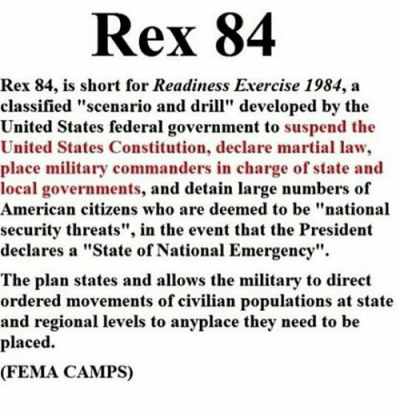
It was presented as an exercise to test military assistance in civil defense in times of national emergency, but in fact the plan was anticipating civil disturbances, major demonstrations and labor strikes that would affect continuity of government. The anticipated civil unrest from the FED-induced financial crisis that devastated the middle class was considered “subversive”, REX-84 being an authorisation for the US military to implement government-controlled movements of civilian populations at both state and regional levels, the arrest of many segments of the American population, and the imposition of martial law. (1) (2)
The Rex-84 program was created under the pretense of a possible mass exodus of illegal aliens attempting to cross into the US from Mexico, but when the program accidentally became public during the Iran-Contra Congressional hearings in 1987 it was revealed that it was in fact a secret federal government program
“to suspend the Constitution, declare martial law, assign military commanders to take over state and local governments, and detain large numbers of American citizens determined by the government to be ‘national security threats’.”
This was part of a master contingency plan for which the FBI today has a primary list of more than 100,000 Americans, and a secondary list ten times larger, who are targeted to be rounded up as subversives, including labor leaders, scholars and public figures, the incarceration designed to isolate political dissidents and to contain civil unrest.
And these are prison camps, ringed with fences, barbed wire and armed guards, not places from which escape would be likely, and they were designed to hold Americans, not Mexicans. (3)
There is no question the US government is prepared for the possibility of widespread and uncontrollable domestic disorder. This program in place and building for years was encouraged by fears of a massive public uprising in the wake of the 2008 banking fraud.
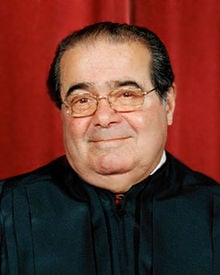 US Supreme Court Justice Antonin Scalia said some years ago that concentration camps were a likely future reality for Americans and that the Supreme Court would not do anything about the tyranny should the executive branch think it necessary. He mentioned the World War II internment of Japanese in the US and said of these camps,
“you are kidding yourself if you think the same thing will not happen again”. (4) (5)
In 2009, as the US financial crisis deepened and concern about public unrest was increasing, the US National Guard was posting job opportunities for “Internment/Resettlement Specialists” to work in “civilian internee camps” within the United States, and Halliburton [former] subsidiary KBR was seeking subcontractors to staff “emergency environment” camps located in five regions of the US. Earlier, in 2006, KBR was contracted by Homeland Security to build detention centers designed to deal with “the rapid development of unspecified “new programs” that would require large numbers of people to be interned.” (6) (7)
The US has for many years been dangerously close to a situation where, if the American people take to the streets in protest, these internments can be easily carried out. By 2004, there were more than 800 of these internment camps in the US, all empty, but all fully operational, staffed, and surrounded by full-time guards, ready to receive prisoners. I have seen photos. As well, many military bases are slated to be closed down and used as extra civilian prisons if the need arises, all intended for the internment of dissidents and others deemed “potentially harmful to the state”. Some camps can each hold 20,000 or more prisoners, a massive effort at civilian population control, and the program is still expanding. The US is very near the point today where political dissidents questioning the actions of their government will risk being rounded up and forced into these prison camps, essentially a government plan to forcibly suppress political dissent under the guise of rooting out domestic “terrorism”.
The US government defines many Americans as having become “pre-revolutionary” from their outrage at the 2008 government-approved housing collapse, with increasing concern that massive civil unrest would emerge from both the poverty-stricken lower classes and the eviscerated middle class, leading to what would become an internal civil war. This is the reason that the FBI and DHS increasingly focus their “anti-terror” apparatus on white middle-class Americans like the Occupy Wall Street protestors who were categorised as “low-level terrorists”.
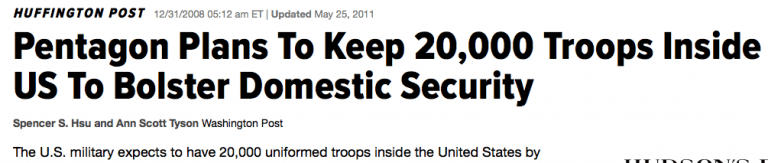
In 2008, the Washington Post reported government plans to station many tens of thousands of troops inside the country for purposes referred to as “domestic security” in the light of massive civil unrest that would follow an economic collapse or serious financial crisis, perhaps stemming from 2008.
According to the government document,
“Widespread civil violence inside the United States would force the defense establishment to reorient priorities in extremis to defend basic domestic order and human security”,
stating that the military may be needed to quell “purposeful domestic resistance”. To prepare for this quelling of resistance, the US has resorted to demonising its own citizens, a recent study funded by DHS conveniently identifying those Americans who are “suspicious of centralized federal authority” and who exhibit signs of being “reverent of individual liberty”, and re-categorising them as “extreme right-wing” terrorists. (8) (9) (10)
The program is designed to “reduce and eliminate” all domestic resistance to the US government. “Crowd control agents” will be used for this purpose, and government agencies will be involved in “gathering information on dissidents” to identify all those who have either “threatened or are creating disturbances”. The US military produced a manual on what it termed “Civil Disturbance Operations” that outlines how military assets will be used to “help local and state authorities to restore and maintain law and order” in the event of mass riots and civil unrest. Military and other law-enforcement will be tasked with “breaking up unauthorized gatherings” and restoring order by
“presenting a show of force, establishing roadblocks, breaking up crowds, employing crowd control agents, and other operations as required”.
The same government manual describes how prisoners will be processed through these internment camps, and outlines how these internees would be “re-educated” while detained in prison camps inside their own country by their own government. A leaked military document titled ‘FM 3-39.40 Internment and Resettlement Operations’, outlined a program for “re-education camps” in the US which contained plans for “political activists” to be “pacified” by various psychological officers into “sympathising” with the government and into “developing an appreciation of US policies” while detained in prison camps inside the US. The document was restricted to Department of Defense personnel but was been leaked and posted online. It outlined policies for “processing detainees into internment camps” and made clear these operations would be used for domestic civilian situations. (11) (12) The full document is available here: (13)
“Once the detainees have been processed into the internment camp, the manual explains how they will be “indoctrinated”, with a particular focus on coercing political dissidents into expressing support for U.S. policies.”
Part of the stated role of the psychological officers would be to identify political activists, political leaders, ‘malcontents’, and other agitators, and to develop and execute appropriate
“indoctrination programs to reduce or remove antagonistic attitudes”.
However, their first task would be to “pacify and acclimate detainees to accept the internment facility’s authority and regulations”.
There are also disturbing insights into the government’s intention to use brutal force to violently quell any civil political unrest. The manual includes a long list of weapons meant to be used against protesting American civilians, including anti-riot grenades. Page 20 of the manual authorises the use of “deadly force” in confronting these peaceful political “dissidents”, the murderous intent made disturbingly clear with the directive that “Warning shots will not be fired” first. Northcom itself, in a September 8, 2008 Army Times article, said the first wave of the deployment, which was put in place on October 1st at Fort Stewart and at Peterson Air Force Base in Colorado Springs, would be aimed at tackling “civil unrest and crowd control”.
In November of 2013, Forbes Magazine ran an article based on the AP newswire, detailing that DHS had been assembling a massive weapons arsenal since 2011 or 2012. (14) The AP reported that Homeland Security had been stockpiling ammunition by buying more than 1.6 billion rounds of ammunition in addition to a prior purchase of 1.5 billion rounds, for a staggering total of more than three billion rounds. This is more ammunition than the US military used collectively in all its wars in the last decade, and represents about ten shots for every man, woman and child in America. There were also confirmed purchases by various government agencies, of hundreds of millions of hollow-point rounds to be delivered to dozens of locations around the US. These bullets are so lethal they are banned for battlefield use during wars because they mushroom and fragment on impact, their only purpose being to cause the maximum possible damage to internal organs. Also purchased were large numbers of magnum rounds with the power to penetrate walls, and a frightening hundreds of millions more rounds of specialty sniper ammunition.
Even more, it was reported in early 2015 that DHS had placed orders for massive amounts of other kinds of anti-civilian weaponry termed “Less Lethal Specialty Munitions”, which were described as “an arsenal of specialized weaponry for training and deployment against crowds”. These included flash grenades, light bursts, gas and chemical grenades, riot rounds, rubber bullets, and much more. These are all heavy-duty crowd control and civilian intimidation weapons. They have no other purpose and, in the volume in which they are being purchased, it is clear the US government is expecting some very serious civil disturbances, possibly a revolution, and soon.
As recently as 2018, Forbes was reporting more of the same, that these purchases have reached an astonishing ubiquity. It isn’t only Homeland Security who is arming to the teeth. Thousands of agents at the IRS now have tactical assault rifles and heavy weaponry.
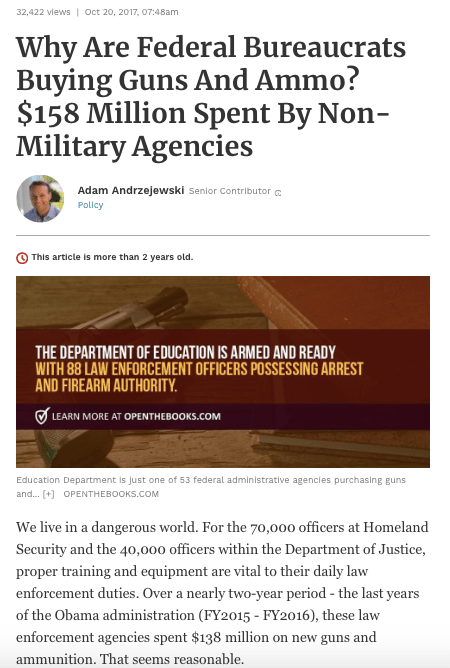
Screenshot Forbes, October 20, 2017
The Small Business Administration and the Department of Veterans Affairs have purchased thousands of Glock handguns. The Health Services agencies purchased millions of dollars worth of Glock handguns – equipped with silencers. The US Geological Survey, which is a weather bureau, purchased millions of dollars worth of Winchester Black Shadow shotguns with large bulk ammunition orders in addition to Glock handguns. Even the Department of Education purchased millions of dollars worth of Glock handguns, shotguns and body armor. I am unaware of any nation in the world where the income tax department or the departments of education and health care require huge amounts of military-grade weapons, much less body armor and gun silencers.
In June of 2016, RT reported that non-military federal agencies had more firepower than the entire US Marine Corps, this including agencies like education, health and income tax. (15) RT documented, a new report where 67 non-military federal US agencies spent $1.50 billion purchasing guns, ammunition and military-style equipment. The details came from the Militarization of America: non-military federal agencies purchases of guns, ammo, and military-style equipment, published by the non-profit good government group OpentheBooks.com. (16) (17)
In addition to the massive purchase of ammunition, DHS was showing off its acquisition of heavily armored and mine-resistant personnel carriers which have been seen on streets all across America and verified with photos and video. Forbes noted that these vehicles are equipped with gun ports and are “designed to withstand IEDs, mine blasts and 50 caliber hits to bullet-proof glass”, and asked why they would be necessary on American streets. The DHS also purchased large amounts of riot gear and bullet-proof checkpoint booths, as well as a purchase of 7000 automatic rifles, and 2700 armored vehicles, and the deployment of drones with allowance for their use on US citizens.
The DHS is becoming a massive domestic army to handle domestic conflict. In the words of Ellen Brown,
“somebody in government is expecting some serious civil unrest …”
DHS chief Janet Napolitano claimed this was to prepare for a mass influx of immigrants into the United States that would require the “shelter and processing” of large numbers of people, but this is nonsense. By whom will the US be attacked that Homeland Security would be responsible for defense, and from where would arise a mass of peaceful immigrants so large as to require more than three billion bullets to repel them?
This is the same government that recently shut down many of its operations including most of the National Parks, for lack of funds, yet had sufficient money to purchase billions of bullets for a non-existent civilian army. A spokesperson was quoted as justifying this massive purchase to “help the government get a low price for a big purchase”, and claimed DHS used “as many as 15 million rounds every year in training exercises”. Someone should ask DHS to divide 3 billion by 15 million, which tells us the ammunition purchase will supply DHS needs for the next 200 years. The authorities naturally attribute criticism and hard questions to mentally-unbalanced ‘conspiracy theorists’, but this is one more instance where actions appear irrational and the official story is so full of holes that it makes no sense.
Another DHS purchase that produced a firestorm of anger when its news went viral, was the supply of what we might call ‘unconventional’ paper targets which were used as practice shooting targets in ‘training exercises’. These targets consisted of figures of American civilians in residential settings. They included small children, a young pregnant mother, old women in robes, grandmothers and grandfathers in their kitchens and front yards, teenagers in parks, little girls and more, perhaps the most frightening part being that all these were termed “no hesitation targets”, meaning to fire without hesitation at the sight of these enemies. What could possibly justify the supply of such targets to a military force, with such an instruction? The US fedbiz.op website took down the solicitation after Infowars broke the story, and eventually apologized publicly for creating these targets of small children.
In early 2014 it was reported that the US military had built a $100 million fake city of about 300 acres in Virginia, for use in training troops for the occupation of cities, complete with a sports stadium, bank, school, and an underground subway in order to train for future combat scenarios in American urban areas. The subway carriages even carry the same logo as those in Washington DC. More disturbingly, it was reported that
“soldiers are being taught that Christians, Tea Party supporters and anti-abortion activists represent a radical terror threat, mirroring rhetoric backed by the Department of Homeland Security which frames “liberty lovers” as domestic extremists.”
The DHS is also building a 176-acre secure compound in the lowest-income area of Washington, DC, which seems almost certainly a preparation for civil war. (18) (19)
The trigger could be an economic collapse that causes angry Americans to flood the streets similar to the Occupy Wall Street and other scenes witnessed across both the US and Europe during the last FED-induced economic crisis. It is worth noting that the Occupy Wall Street protest had the right idea but the wrong target. Wall Street is just an idea, and a bit player. The ultimate cause is the FED, and that should have been their focus. But the FED, the bankers and the FBI saw this coming and infiltrated and financed the protest groups as a way to take control and deflect them from any useful action or focus.
In the middle of 2013 several US local media reported the DHS was conducting widely public but still “top secret” exercises categorised as “full scale terrorism drills” across the entire nation with the stated purpose of making citizens “feel safe”, but which resulted in thousands of terrified people not knowing how to respond to what appeared as a domestic invasion by the US military. People were capriciously apprehended and released after having their belongings searched, but nevertheless urged to celebrate their “independence” from tyranny. These drills were presented as readiness training for potential terrorist incursions, though DHS failed to mention the New York Times observation that all the domestic terror plots in the United States over the last decade were “hatched by the FBI”.
One other worrying development was the appearance of US military C-130 cargo planes apparently spraying mosquitoes over various Florida cities at an altitude of less than 50 meters. Pest control is hardly a military duty, these events immediately reminding me of the US military spraying bacterial and other pathogens over many parts of the US in various CIA-related experiments on the domestic population. These low-altitude overflights are almost certainly practice runs for potential crowd control in the future, for dispensing tear gas or other non-lethal (or lethal) material that would disperse or disorient protestors. I cannot imagine all the possibilities, but the US military most certainly is not going into the mosquito-spraying business. (19) (20)
US Major General Curry was quoted as stating,
“We have local police, backed up by each state’s National Guard, backed up by the Department of Defense. So in addition to all these forces why does Homeland Security need its own private army? Why do the SSA, NOAA and other government agencies need to create their own civilian security forces armed with hollow nose bullets?”
Some may want to dismiss this as just another conspiracy theory, but we might recall the words of Senator Daniel Inouye in 1987,
“There exists a shadowy Government with its own Air Force, its own Navy, its own fundraising mechanism, and the ability to pursue its own ideas of national interest, free from all checks and balances, and free from the law itself.”
The threats to civil liberties go much farther and are much more ominous than I’ve related so far. Another factor is the spate of secret Executive Orders that Obama signed without Congressional approval, observers claiming those orders violated existing laws and were therefore illegal but that the powers behind the White House considered themselves above all law. One of the most sinister was Executive Order 13603 which granted authorization to seize possession of every possible resource, including property and “all food storage facilities”. One author wrote that “This extremist, maniacal edict is designed to enforce our submission, rendering us totally dependent on Big Brother government or face the obvious – starvation and extermination.”
What could possibly have instigated such an order, unless the government is preparing for an all-out war against the American people? What possible excuse, during peace-time, would a “democratic” government have, for the initiation of a program to seize all the “food, water and food storage facilities” of a nation? If we add these to the internment camps and the bullets, what conclusions are possible?
Another ominous threat is that much of the NSA’s illegal intelligence-gathering activities were transferred to the Department of Homeland Security, the same people with the 800 internment camps and the 3 billion bullets. The apparent reason is that the NSA can collect information on domestic political dissidents but has no police powers to act on them, whereas DHS has legislative authority to gather, arrest and incarcerate anyone on their watch lists. DHS is apparently creating a “graded list” of these targeted so-called “security threats”, with those at the top of this list assessed according to how widely disseminated are their anti-establishment views, the followers they appear to have, and these will be the first to disappear into the internment maze. This new policy gives Homeland Security full authority to effectively terrorise the American people under a pretense of controlling domestic terrorism. When we consider these two items, Executive Order 13603 and the new powers granted to DHS, the only possible response can be fear.
If all this isn’t enough, DHS was revealed to have a secret procedure for the instant shutting down of all private communications in America, including mobile phone networks, a program accidentally revealed when government officials in San Francisco disabled all mobile phone calls during a peaceful protest against yet another man shot dead by the police. The administration insisted it had the legal authority to control these communications “during times of national crisis”, “for the purpose of ensuring public safety”, but it has also given DHS the power to actually “seize” all privately-owned communications facilities in order to prevent any civilian communications occurring. Some individuals applied to the courts for further information on these new procedures and policies, but DHS claimed it was “unable to locate or identify any records” in relation to the matter. Nothing more to be said, but it’s difficult to avoid the conclusion that the US government is quickly becoming fully prepared for war against its civilian population.
With the NSA revelations by Edward Snowdon, there is no longer any question that many US government agencies have been monitoring and gathering information on large numbers of known American political dissidents, these agencies including the NSA, FBI, CIA, DHS, various military groups and another 70 or 80 so-called “public-private fusion centers” scattered around the US. Former NSA Technical Director William Binney claimed in an interview that the NSA had a list of 500,000 to one million people in the US who were closely watched and whose every communication and bit of personal data were recorded. These are not terrorists in any sense, but potential leaders of political dissension and therefore potential suspects in the event of civil disturbances.
There also exists a database known as “Main Core”, containing names of Americans who might be considered troublesome, and which knowledgeable sources claim contains the names and communication information of more than eight million Americans who would be potential suspects of political activism, which would include “national opposition to US military invasion abroad”. It includes political dissidents, environmental and other activists, political and tax protesters, lawyers and professors, publishers and journalists, and many more who are most likely harmless, average people.
The database apparently contains all to and from email addresses, all email content, all in and out phone numbers plus duration of calls, the amounts and locations of ATM withdrawals, all credit card purchases and much more. It appears that this dissident surveillance program dates back to the early 1980s, the time of our Great Transformation, when it was revealed that Oliver North, operating from a secure White House site, had been using a database called PROMIS which was part of the REX-84 plan, to track dissidents and potential troublemakers within the United States. This database was meant to identify and immediately locate perceived “enemies of the state” if mass civil disturbances were to break out. (21) (22)
The Middle-Class Revolt
In late 2008 a leaked internal memo from Tom Fitzpatrick, Citibank’s chief technical strategist, contained ominous predictions for American civil society after the vicious financial crisis. He wrote,
“The world is not going back to normal ‘after the magnitude of what they have done’”.
Fitzpatrick claimed that the massive destruction of the middle class, the draining of all the wealth from the population, and the QE money creation by the FED would either bring about a resurgence of inflation or that the US would fall into “depression, civil disorder and possibly war”. He claimed that with the passing of each week and month there was a growing danger that could lead to political instability, a risk of domestic unrest because people were becoming increasingly disenfranchised and impoverished.
Lest we succumb to the temptation of accepting the 2008 financial crisis and the resulting loss of homes as an accident of fate, it would be wise to consider these quotes by Montagu Norman, Governor of The Bank of England prior to the crash of 1929, addressing the United States Bankers’ Association, New York, Idaho Leader, 26 August 1924.
“Capital must protect itself in every possible way, both by combination and legislation. Debts must be collected, mortgages foreclosed as rapidly as possible. When, through process of law, the common people lose their homes, they will become more docile and more easily governed through the strong arm of the government applied by a central power of wealth under leading financiers. These truths are well known among our principal men, who are now engaged in forming an imperialism to govern the world.”
And his thoughts on democracy:
“By dividing the voters through the political party system, we can get them to expend their energies in fighting for questions of no importance.” “It is thus, by discrete action, we can secure for ourselves that which has been so well planned and so successfully accomplished.”
The US government has developed an increasing fear of its own middle class, wide awake to the protests and uprisings in other nations where governments have colluded with the international bankers and large multi-nationals to gut their middle classes and effect the same transfer of wealth to the top 1% as occurred in America. People in many Western societies have become disgruntled and bitter at the increasing evidence that their vaunted democracies have been usurped by the unrestrained capitalists, creating intolerable situations where the people are sacrificed for the increasing wealth of that same top 1%.
At first, the US government exhibited a grim and rather reprehensible kind of satisfaction at watching the misery in other nations where the FED and IMF and the International Bankers had succeeded in their aims of wealth transference, but it also realised that the same boiling rage existed in America and perhaps much less controllable.
US citizens were protesting against a government that was no longer democratic in any sense, and was both unwilling and unable to repair a hopelessly corrupt and inefficient system. They finally awoke en masse and objected to ingrained corruption, shoddy public services, high taxes, homelessness, unemployment, rising inflation, the development of a police state, and more. It is public rage at the realisation of having been betrayed by a “democratic” government that converts civil unrest into political activism and revolution, and it is this that lies at the heart of the FBI’s categorisation of US political dissent as “domestic terrorism”. This terminology is important because the US, in all its hypocrisy for democracy, free speech and freedom of assembly, cannot face the world with open and apparent suppression of political dissent. Therefore, US citizens protesting against their own government cannot be exercising free speech but rather anarchy and terrorism, thereby justifying the use of deadly force to control dissension. The powers that control America have no interest in fairy-tales of freedom. They are interested in wealth and control, and the people in any country are irrelevant – including those in the US.
Americans have experienced first-hand the destruction of their quality of life; they see clearly the disappearance of future opportunity for their children, and they recognise better than most the loss of their freedom of expression which they have so valued. And they know it is precisely the retraction of that expression that is necessary for their no-longer-democratic government to maintain control. This is where their economic and social dissatisfaction mutates into political activism – revolution, in fact – and it is this realisation among the authorities that has spawned the internship camps, the billions of bullets purchased, and the “shoot to kill” orders.
Revolution – The Struggle for Class Power
Buried in the litany of troubles the US is facing today is the primary fact that the nation is engaged in a brutal class war, a struggle for class power that the bottom 99% are losing. This war was declared in the late 1970s, gained great momentum in the 1980s and 1990s, and is still accelerating toward its final desperate conclusion. There are few signs on the horizon that cause hope for a change in direction, and I fear it may be too late.
There is still power with the people themselves, and indeed without the both active cooperation and silent complicity of the people, none of the pathological descent into despair would have been possible. Probably the only force in America that can change what is happening is the combined force of labor. This isn’t so easy today, since the government killed most labor organisations and there is now little if any leadership. A total withdrawal of labor succeeded in forcing a new social contract in 1946 and may be the only power remaining today, but times have changed and tactics must change too. If all unions withdrew their services with the full cooperation of unorganised labor, change might be possible.
But realistically, there is no hope that such a mass protest could be organised even though it is the only possible way to get the attention of whatever remains of a conscientious government and force through a reversal of the tide. In any case, taking to the streets is unlikely to produce pleasant results. If the police don’t have enough bodies to beat up and arrest everyone, DHS has its internment camps, its 3 billion bullets, its years of practice with “no-hesitation” human targets, and it will use all of them.
The only safe way for Americans to go on strike today is to stay at home. On this topic, one internet commenter wrote,
“Just don’t go to work. There is no need to picket in the streets to be on strike, and the factories and offices will be just as quiet and empty, and the profits just as non-existent. The police cannot possibly conduct home-by-home visits to beat up strikers one by one, and no military, even the DHS, is efficient when trying to blow up houses scattered all over the county, one by one. Strikers are probably safe if they stay at home and lock their door.”
Another wrote,
“Another tactic is for Americans to simply quit shopping. They don’t have the money anyway, and don’t need all that useless junk. Don’t buy anything you don’t actually need, and delay even those purchases as long as possible, especially the big-ticket items like cars and furniture. If at all possible, delay every purchase for at least one year. As much as is practicable, stop driving your car. Cancel your cable TV and read a book.” Your grandmother gave you advice 100 years ago that is still valid today: “Use it up, wear it out. Make it do. Do without.”
A third commenter gave this advice:
“One thing you can do to get their attention is to stop paying your bills. VISA and MasterCard can’t cancel 800 million credit cards at the same time, and no bank can process 100 million mortgage defaults. No system can cope with massive non-payment of debt. You are their only source of money and you can ensure they don’t get any of it. That will wake them up. Tell them you’ll begin paying when the overseas corporate tax holiday is over, when high income taxes are reinstated for the rich, when the individual bankers are in prison and when the lost jobs begin returning. This isn’t foolproof, but it’s the best I can do.”
And finally, a more ambitious poster offered these comments:
“Today, the US State Department, the CIA and the FBI pride themselves on their ability to use Twitter and Facebook to cause civil unrest, chaos, violence, and even revolutions, in other countries. It may not have occurred to them that the same tools they use against everyone else can be just as easily used against them. The CIA used Gene Sharp and his Einstein Institute to prepare the Otpor civil disobedience manuals that our government used as the gunpowder to destroy Jugoslavia, and as the template for a dozen other “color revolutions” of which it was so proud. Copies are freely available on the internet.”
William Blum again:
“As I’ve said before: Inasmuch as I can’t see violent revolution succeeding in the United States (something deep inside tells me that we couldn’t quite match the government’s firepower, not to mention its viciousness), I can offer no solution to stopping the imperial beast other than this: Educate yourself and as many others as you can, raising their political and ideological consciousness, providing them with the factual ammunition and arguments needed to sway others, increasing the number of those in the opposition until it raises the political price for those in power, until it reaches a critical mass, at which point … I can’t predict the form the explosion will take or what might be the trigger … But you have to have faith. And courage.”
Rebuilding America
 This is an amended list of actions Americans must take if they want to bring their country into the community of nations as a civilised member instead of its present status as a genocidal bully, and to begin healing the nation itself. It is compiled from my own notes with the inclusion of excerpts from a speech made by Chris Hedges at Northeastern University. (23)
Discard the existing two-party political system as diseased and useless, and form one new party with a totally new slate of legislators not formerly involved in government. Their first tasks would be to:
1. Arrest all war criminals on American soil. Begin with both Bushes, Cheney and Rumsfeld, Powell and Rice, both Clintons, Kissinger, Albright, and a long list of other White House and Congressional staff, on charges of treason, war crimes and crimes against humanity.
2. Disband the Federal Reserve Banking System and repudiate all outstanding debt to the FED. The government would, according to the law and constitution, issue its own currency from this point forward.
3. Force the break-up of all the big banks and eliminate interstate banking. Nationalise the so-called investment banks like Goldman Sachs, confiscate their assets and shut them all down. Reintroduce banking sector regulations as was done after the 1930s, to ensure a catastrophe cannot recur, with violations punished by mandatory prison sentences. Outlaw program stock trading by the banks. Force the banks to revert to simple banking functions to serve the economy.
4. Disband the CIA and all its clandestine projects by cutting off all funding. Confiscate all CIA records, files, computers, data, and make the details public. Emasculate the FBI and all its executives and officers. Arrest the planners and perpetrators of all false-flag ops. Kill the NSA. Immediately cease all domestic espionage on US citizens. Cut off all funding, seize all bank accounts and confiscate all records and documents. Bomb the Arizona data storage facility to rubble. Kill the Department of Homeland Security and dismantle and close all internment camps within the continental US.
5. Disband the NED, USAID, the VOA and the 100+ other subversive NGOs that are used today to destabilise the governments and societies of other nations. Recall all CIA espionage agents from foreign embassies and consulates, who constitute about 80% of all US foreign “diplomatic” staff. Designate all Foundations and Think Tanks as enemy aliens, and shut them down.
6. Reduce the military budget by 85% and close all foreign military bases. Bring home all foreign-based military personnel and give them jobs guarding the bankers.
7. Totally eliminate the private sector from infrastructure and social services and confine it to commerce where it belongs. Roll back deregulation and privatisation, reclaiming all public infrastructure to be operated by the government for the common good. Especially kill the despicable private prison system, and free the more than one million who should never have been in prison at all. Kill the movements to debtor’s prisons and civil forfeiture before they gain any more momentum, and pass harsh legislation that holds policemen individually responsible for their crimes.
8. Begin immediate construction of a system of publicly-owned and operated hospitals and medical clinics, and guarantee that all citizens have access to free or easily-affordable health care. Eliminate all insurance companies from the health-care process. Restore funding for universal education.
9. Make all lobbying illegal, with automatic prison sentences for influence-peddling. Designate lobby groups like AIPAC as criminal organisations and hostile enemy aliens, and treat them accordingly. Kill the SuperPacs and corporate donations. Eliminate all corporate contributions to election campaigns, and limit individual contributions to $1,000 maximum. Break the corrupt Zionist control of Congress, Wall Street, the media, the World Bank and the IMF. Terminate their globalism and any reference to a New World Order. Eliminate immediately all funding and financial support for Israel.
10. Eliminate legal immunity for the elites. Make illegal the payment of corporate fines for personal crimes. Put the people in prison. Levy an 85% income tax on all corporate profits being held outside the country by US-based multinationals. Reinstate the taxes on the rich and very rich. Eliminate personal tax breaks on capital gains and institute an 85% tax on all income over $500,000 per year.
11. The media monopoly must be broken by forcing de-centralisation and pushing the ownership once again into thousands of individual companies owned by totally unrelated parties. The current control of the media must be dismantled because of the Zionists’ propaganda and the Hidden State’s political agenda. Force the disintegration of all media holding groups and wide dispersion of all media, restricting ownership to only one newspaper or TV station per market. Outlaw opinion-based journalism and make untruthful news reports punishable by public flogging.
12. Eliminate GM food, or at least legislate full disclosure on food labels. Eliminate factory farms; institute extensive monitoring and harsh penalties for food chemical violations.
13. Use the money collected from the rich, the bankers and the FED to begin repairing America’s dilapidated infrastructure before any more dams and bridges collapse.
14. Close all the torture prisons. Close Guantanamo, Diego Garcia, Abu Ghraib, and the other torture prisons and demand an accounting of all prison ships and their human cargo. Close the School of the Americas and destroy all the torture manuals.
15. Emasculate the US President, the Presidency, and the White House, and return all power to Congress because it is the concentration of power in the office of the President that has permitted the total alien control of all vital parts of the US government.
16. Eliminate all US-sponsored sanctions against other nations, especially China, Russia, Syria and Iran. End the illegal occupation of Hawaii, Puerto Rico, Afghanistan, Iraq and Libya. Get out of the Ukraine. Dismantle immediately all organised interference in the internal affairs and elections of other nations. Refund the $100 billion of Iraqi gold and cash seized, and the similar amount from Libya.
*
Note to readers: please click the share buttons above or below. Forward this article to your email lists. Crosspost on your blog site, internet forums. etc.
Larry Romanoff is a retired management consultant and businessman. He has held executive positions in international consulting firms, and owned an international import-export business. He lives in Shanghai and is currently writing a series of ten books generally related to China and the West. He can be contacted at: 2186604556@qq.com
Notes
(1) Rex 84: FEMA’s Blueprint for Martial Law in America
(2) Rex 84 – Your Internment Camp Awaits You
(3) U.S. Concentration Camps: FEMA and the REX 84
(5) https://www.washingtontimes.com/news/2014/feb/3/justice-scalia-to-lecture-at-univ-of-hawaii/
(6) Army National Guard Advertises for “Internment Specialists”
(7) Video: Become a FEMA Camp Internment/Resettlement Specialist
(8) http://www.washingtonpost.com/wp-dyn/content/article/2008/11/30/AR2008113002217_2.html?hpid=topnews
(9) Pentagon Plans To Keep 20,000 Troops Inside US To Bolster domestic security
(10) Washington Post: 20,000 More U.S. Troops To Be Deployed
(11) FM 3-39.40 INTERNMENT AND RESETTLEMENT
(12) FM 3-39.40 INTERNMENT AND RESETTLEMENT OPERATIONS
(13) https://www.infowars.com/yes-the-re-education-camp-manual-does-apply-domestically-to-u-s-citizens/
(14) Why Are Federal Bureaucrats Buying Guns And Ammo? $158 Million Spent By Non-Military Agencies
(15) 24 Jun, 2016; Non-military federal agencies have more firearm authority than entire US Marine Corps
(16) https://www.openthebooks.com/the-militarization-of-america–open-the-books-oversight-report/
(17) https://www.openthebooks.com/openthebooks_oversight_report_-_the_militarization_of_america/
(17) Asymmetric Warfare Group Built a Fake City in Virginia
(18) US army builds fake city to shoot at during training
(19) https://www.cbsnews.com/news/texas-enlists-u-s-air-force-to-spray-for-mosquitoes-after-harvey/
(20) Pentagon Misinformation Ops Target Press and Public
(23) http://calendar.northeastern.edu/event/political_economy_forum_presents_chris_hedges
Copyright © Larry Romanoff, Moon of Shanghai, 2020
Zuckerberg won’t censor Trump, but don’t mistake Facebook for a bastion of free speech
By Helen Buyniski | RT | June 2, 2020
Facebook CEO Mark Zuckerberg has taken heat over refusing to hide a post from US President Donald Trump that Twitter claimed “glorified violence.” But his reasons are more about placating power than defending free speech.
Zuckerberg’s decision to leave up a Trump post condemning the riots in Minneapolis that warned “when the looting starts, the shooting starts” upset Facebook employees, a few of whom even threatened to appeal to the company’s newly-appointed oversight board – notoriously larded with anti-Trump voices.
But the CEO’s reasoning – “people should be able to see this for themselves, because ultimately accountability for those in positions of power can only happen when their speech is scrutinized out in the open” – had little in common with the fiery rhetoric of free speech activism. In fact, it was so mind-numbingly obvious it would likely have gone unremarked-upon in any other era. How, indeed, are Americans supposed to hold their leaders accountable if they don’t know what those leaders are saying?
It’s not clear if anyone would even have expected Facebook to take action on Trump’s post, had Twitter not already done so, hiding the message behind a warning that it violated the platform’s rules about “glorifying violence.” And it’s unlikely that Twitter would have taken action on that particular message had the president not been needling the platform for weeks with envelope-pushing tweets, starting with accusing MSNBC host Joe Scarborough of murdering an intern nearly 20 years ago.
While Scarborough and co-host Mika Brzezinski demanded Trump be kicked off Twitter for the smears, it was a post about mail-in voting that finally brought down Twitter’s fact-check hammer. Still, that was enough of a rationale for Trump to unveil an executive order proposing to strip social media platforms of their cherished Section 230 immunity, which protects them from lawsuits based on user-generated content but also forbids them from selectively curating that content. Checkmate?
Silicon Valley is hurtling into a future whose ever-shrinking boundaries are dictated by censorship algorithms and all rough edges are sanded off (literally, in Twitter’s case) lest any comment wound another user’s feelings. Facebook is as guilty of this as anyone, alerting Instagram users when they’re about to post a “bullying” comment and banning “sexual” emojis. Even as social media styles itself the “new public square,” platforms find themselves in the surreal position of trying to outdo each other in silencing their users: if Facebook exiles conservative performance artist Alex Jones, declaring him a “dangerous individual,” Youtube and Twitter follow suit.
However, while Twitter CEO Jack Dorsey has attempted to apply the platform’s increasingly absurd restrictions across the board, subjecting even the president of the US to Kafkaesque limitations that seem to shift from day to day, Zuckerberg knows on which side his bread is buttered. While his competitors in Silicon Valley wore their anti-Trump politics on their sleeves, the Facebook founder met with Republican congressmen and took care to include Breitbart in the rollout of Facebook News, triggering howls of outrage from liberals.
While Dorsey exiled political advertising from his platform completely earlier this year, Zuckerberg has clung to his promise not to fact-check the speech of politicians – ensuring a steady flow of advertising dollars from both parties’ campaigns, even as Democratic politicians condemn Facebook’s hands-off approach.
This doesn’t make Zuckerberg a free speech hero, or Facebook a bastion of political enlightenment. “Regular” users will still find themselves shadow-banned or exiled entirely if they post too much “wrongthink,” as even popular pages like PragerU have discovered recently. The Facebook CEO’s equal-opportunity pandering merely makes him a competent businessman, and means he’ll almost certainly survive whatever Section 230-related crackdown is coming.
It also makes it vanishingly unlikely Zuckerberg’s platform will face anything like a takeover bid from formidable Republican “vulture capitalist” and rabidly pro-Israel Trump donor Paul Singer. The notorious hedge-funder reportedly sought to oust Dorsey from Twitter earlier this year when the CEO suggested he’d be stepping back from full-time management of the company to spend six months of the year in Africa. While Singer was apparently rebuffed with the help of loyal Twitter employees and fellow billionaire Elon Musk, he still has four directors on the company’s board and may still be circling overhead looking for signs of weakness.
Twitter has fallen a long way from the days when it referred to itself as “the free speech wing of the free speech party” and now competes with Facebook and YouTube for the title of Silicon Valley’s Ministry of Truth. The future of social media looks bleak indeed when Zuckerberg is cast as the defender of free speech. But ordinary Facebook users shouldn’t mistake his indulgence of Trump for standing on principle. His legendarily low opinion of the platform’s users – “dumb f***s” – is more pertinent now than ever.
Helen Buyniski is an American journalist and political commentator at RT. Follow her on Twitter @velocirapture23
Bigoted Cops and the Drug War
By Jacob G. Hornberger | FFF | June 3, 2020
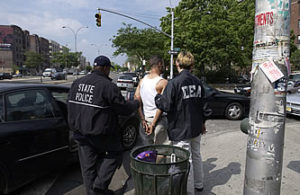 If Americans want to diminish racial bigotry in police departments across the country, the best way to start is by legalizing drugs, all of them. That would bring an end to the legal opportunity that bigoted cops have in the enforcement of drug laws against blacks.
I’m not saying that all cops are racial bigots. We all know that they’re not. But we also know that some of them are. And the drug war permits them to exercise their racial bigotry to their heart’s content — and even get praised and thanked for their service while doing so.
After all, let’s face it: there are racial bigots in society, and there will always be racial bigots in society. Anyone who thinks he is going to wipe out racial bigotry through “education” and “enlightenment” is living in la la land.
When someone engages in racial bigotry on a private level, he is subject to private and peaceful retaliatory measures, such as loss of sales if he is a business owner or the loss of a job if he is an employee. He is also subject to criticism and social ostracism. The free society makes the bigot bear an economic and social penalty for his bigotry, which might well nudge, not force, him into better behavior.
It’s totally different with drug laws. They have converted police departments into magnets for racial bigots. With the drug war, cops are empowered to stop blacks arbitrarily and subject them to abusive interrogations and intrusive, demeaning, and oftentimes violent searches and seizures of their persons, automobiles, and homes.
As long as they are “searching for drugs,” it’s all okay. No loss of sales. No loss of job. No public criticism. No social ostracism. Hey, they are helping cleanse our society of illegal drugs! They’re considered heroes! People praise them for their courage and thank them for their service.
That includes many judges, some of whom do not hesitate to mete out extraordinarily long jail sentences to blacks. A good example is a black man in North Carolina named Michael Holmes who has now served some 30 years of a 200-year jail sentence for a non-violent drug offense. There are thousands more like him.
The drug war also provides bigoted cops with the perfect opportunity to frame blacks for drug offenses by planting drugs on them or by simply lying about drug transactions. As prosecutors ask jurors, “Who are you going to believe — this upstanding (white) police officer who is simply trying to keep drugs from reaching your children or this (black) defendant who obviously has a motive to lie?” The false and fraudulent arrests, prosecutions, convictions, and harsh jail sentences meted out to dozens of innocent blacks in Tulia, Texas, several years ago is just one example of this phenomenon.
The noted academician Michelle Alexander rightly calls the drug war the new Jim Crow. It gives bigoted cops a license to do what bigoted cops did during the days of racial segregation. In fact, the drug war is without a doubt the most racially bigoted government program since segregation.
The legalization of drugs would, of course, not end racial bigotry in society. But it would end the opportunity that drug laws have given cops to legally exercise racial bigotry. Unable to exercise their bigotry legally through the enforcement of the drug war, police departments would no longer serve as a magnet for racial bigots. Those who are already cops would begin drifting back into the private sector where they would be nudged toward more appropriate behavior with such things as boycotts, criticism, and social ostracism rather than praised and thanked for their bigoted enforcement of the drug war.
Jacob G. Hornberger is founder and president of The Future of Freedom Foundation. He was born and raised in Laredo, Texas, and received his B.A. in economics from Virginia Military Institute and his law degree from the University of Texas. He was a trial attorney for twelve years in Texas. He also was an adjunct professor at the University of Dallas, where he taught law and economics.
Israelis Trained the Minnesota Cop How to Kill
By Paul Craig Roberts | Institute For Political Economy | June 2, 2020
Precisely as I reported Minnesota police received Israeli training. The knee-on-neck is an Israeli restraint hold that Israeli forces use for breaking Palestinian necks. I doubt the Minneapolis cop intended to kill Floyd. He probably thought he was just using a restraint technique. In so many of the cases of police-inflicted death and injury there is no need for restraint. People are not resisting. Maybe the cops just want to practice their training.
Another main cause of police-inflicted death and injury are the middle of the night home invasions, sanctioned by courts and local authorities. There is absolutely no reason for these invasions. They are nothing but murder weapons.
The real murderers of George Floyd were the Israelis who taught the Minnesota cops the knee-on-neck restraint technique. The irresponsible court rulings that permit unannounced home invasions have also killed a lot of people. The police have been turned into killers by their absurd and inappropriate training. The cop will pay the price for his wrongful training just as did George Floyd.
It is pure idiocy to let those responsible for these practices off the hook and to run around shouting “racism.” Knee-on-neck is a restraint technique taught to the police. It is not racism. The technique should not have been taught to American police, and people who are not resisting should not be restrained. George Floyd died because of wrongful police training, not because of racism.
Featured Video
or go to
Aletho News Archives – Video-Images
Book Review
The Maidan Killings and the False-Flag Case
By Freddie Ponton | 21st Century Wire | September 5, 2026
Before the killings that helped bring down Ukraine’s president in February 2014, American diplomats were discussing who should enter its government. In a leaked telephone call, senior State Department official Victoria Nuland told US ambassador Geoffrey Pyatt, “I think Yats is the guy,” referring to opposition leader Arseniy Yatseniuk. Washington had clear preferences and was working to advance them. Later that month, Yatseniuk became prime minister.
Ivan Katchanovski’s The Maidan Massacre in Ukraine examines the violence that preceded that transfer of power. Drawing on television footage, witness testimony, forensic examinations and Ukrainian court proceedings, he argues that elements of the opposition shot protesters and police in a false-flag operation. His case centres on evidence of protesters being shot from opposition-controlled locations, including Hotel Ukraina, overlooking the killing ground. … continue
Blog Roll
 Aletho News
- Israel expands “incitement” charge to target Palestinian education and memory
- How Israel seeks to reshape Arab classrooms
- Paris bans pro-Palestinian demonstration planned for Oct. 7 over ‘risks of public disorder’
- In August Hanning Treason Case – All Signs Point To Tel Aviv.
- France cleared dozens of military sales to Israel between May and September: Report
- France projects nuclear power as Macron pushes arsenal expansion
- The fallacy of US delusions about Iran’s economic collapse
- What changes with Lula or Flávio?
- Britain leads Western media’s demise through ‘fear porn’ narrative
- The Maidan Killings and the False-Flag Case
- If Americans Knew
- Soldier testimony sheds light on how Israel wages information war
- CIA Report Warns Israel Could Head Toward Civil War, Total Collapse
- Banker Who Exposed Howard Lutnick’s Ties to Epstein Warned of ‘Retaliation’ and ‘Personal Consequences’ in Last Post Before Suicide
- Israeli Attacks Kill Two Palestinians in Gaza
- Gaza genocide at 3: Israeli-U.S. cruelty and the smart, deep resistance to it are changing the world
- As genocide is about to enter 3rd year, little of Gaza remains– Daily Update
- “We See Our Homes Now From A Satellite, Like Strangers”
- Watch “Gaza: Doctors Under Attack”, originally censored by BBC
- NAZA: Israeli embassies in UK and US promote rival documentary to challenge Gaza genocide allegations
- David Ellison appoints Israeli to lead merged Paramount-Warner studios
- No Tricks Zone
- Latest European Green Energy Debacle; Portugal’s Largest Flagship Solar Park Insolvent!
- Green Energy Debacle: German Expert Professor Fritz Vahrenholt Warns Of Severe Economic And Social Consequences
- Two More Paleo Reconstructions Affirm Meters-Higher Sea Levels Across Ireland, Brazil 7000-6000 Years Ago
- New Study: Earth And Venus Surface Warmth Largely Explained By Convection And Lapse Rate, Not CO2 Or Radiation
- 2025 Nature Paper Claiming Worsening Global Drought Gets RETRACTED …Heavily Flawed
- New Study: ‘Global Drought Shows No Detectable Recent Acceleration Under Climate Warming’
- Economic Masterminds: German Socialists Suggest Taxing Productivity Gains Stemming From Using AI
- The South China Sea Has Not Been Cooperating With The Climate Change Narrative
- Energy Crisis: Germany Enters Heating Season With Historically Low Gas Reserve Fill Levels
- New Study: The Antarctic Ice Sheet Gained Mass From 2020-2024 Due To Staggering Snow And Ice Accumulation

