WASHINGTON – The Democrats are targeting their own population by impeaching President Donald Trump, former US Assistant Treasury Secretary Paul Craig Roberts said.
On Wednesday, Trump became the third president in US history to be impeached when the Democratic-controlled House of Representatives voted to find him guilty of abuse of power and obstruction of Congress after investigations concluding he invited foreign meddling in the American electoral process.
“The impeachment circus is a political act by the House Democrats. It is a political orchestration without any evidence or credible testimony,” Roberts said. “What is disturbing about the impeachment… is that these orchestrated actions are an attempt to overturn a democratic election. The US now engages in actions against its own population like the actions Washington recently engaged in against Venezuela, Bolivia, Honduras, and Ukraine.”
The Democratic Party, Roberts added, decided to fabricate a scandal with Ukraine after Russiagate fell apart.
“The Democrats are after power. They were frustrated by the Russiagate failure, and orchestrated a hoax that, even if it were true, would not be an impeachable event,” he said.
Roberts continued to say that the House Democrats are able to “get away with this hoax” because the American media is against Trump.
“It is disturbing also because it demonstrates that there is no integrity in the media or the security agencies,” he explained. “Without the support of the media and security agencies, the Democrats would not be able to orchestrate such obvious hoaxes.”
Roberts believes that the impeachment proceedings are not hurting Trump’s election chances, and even help him.
“As the impeachment proceedings unfolded, the public turned against the proceedings, recognizing them as a purely political action,” Roberts said. “The Democrats hoped that some of the mud would stick to Trump and reduce his reelection chances, but it seems the impeachment is helping Trump.”
The president will have to face trial in the US Senate but is unlikely to be removed from power as the higher legislative decision-making body is controlled by members of his Republican party, who have made it clear that they viewed his impeachment as a sham.
“The Senate will not convict Trump of the charges, unless enough Republican senators can be blackmailed by the FBI, CIA, and NSA, police state institutions that have spy folders on everyone, or unless the military/security complex can bribe the Republicans with large sums of money to vote against Trump,” Roberts said. “I think this is unlikely as it would be too obvious even for insouciant Americans not to notice.”
Roberts also said that Russiagate and the impeachment “have radicalized” and divided the United States.
“The population is now split in a new way. On the one hand we have the people who elected Trump, ordinary traditional Americans now demonized as “racists” and “white supremacists,” Roberts said. “On the other hand we have the Democrats, no longer the party of the working people.”
House Democrats launched their impeachment inquiry in September to probe whether Trump tried to pressure Ukraine into investigating his political rival Joe Biden, the current Democratic front-runner in the presidential primaries. Lawmakers initiated the inquiry after a whistleblower sent a complaint to the Congress claiming that Trump threatened to withdraw military aid for Ukraine if Kiev failed to investigate Biden and his son Hunter over the latter’s business dealings in the country.
Trump has denied any wrongdoing, repeatedly dismissing the impeachment inquiry as a witch hunt aimed at reversing the outcome of the 2016 presidential election.
Commenting on Wednesday’s vote, the president said that “this lawless, partisan impeachment” was “political suicide” for the Democratic Party. He also expressed confidence that he would be fully exonerated by the Senate, pledging to “continue to work tirelessly to address the needs and priorities of the American people.”
December 20, 2019
Posted by aletho |
Civil Liberties, Deception | CIA, DNC, FBI, NSA, United States |
Leave a comment
By Johanna Ross | December 20, 2019
Thursday was a busy news day, what with Trump’s impeachment and the Queen’s speech in Westminster, but another item given less coverage in UK mainstream media was arguably more significant than anything else making the headlines. Scottish First Minister Nicola Sturgeon’s speech, formally asking the UK Prime Minister to transfer the powers to hold a referendum on independence from Westminster to the Scottish parliament, may well go down in history as the beginning of the end of the United Kingdom.
Having bagged a landslide election victory, winning 48 out of the 59 seats in Scotland, Nicola Sturgeon has wasted no time in confronting Boris Johnson with what is, for him, an uncomfortable truth: that Scotland wants a second referendum on independence, and it’s not going to go away. Sturgeon’s rhetoric so far has been bold, saying that Scotland would not be ‘imprisoned’ inside the Union and that the UK government had to ‘confront reality’. On Thursday in her speech from Bute House she said her government now had an ‘unarguable mandate by any standards of democracy’ to hold another referendum on independence.
Alongside her letter to Boris Johnson requesting the powers to legally hold a second referendum under Section 30 of the 1998 Scotland Act, she published a 38 page document detailing proposed amendments to the statute, which would devolve the right to vote on leaving the UK to the Holyrood parliament. Entitled Scotland’s Right to Choose, the paper outlines her argument that there has been a “material change of circumstances” since the 2014 referendum, based on “the prospect of Scotland leaving the EU against its will and what EU exit has revealed about Scotland’s position within the UK”.
The Nationalists’ leader has a fair point. For we can debate about voters’ motivations till the cows come home, but facts are facts, and the fact remains that on 12th December the majority of Scots put their support behind a party which stands on an independence platform. Brexit hit Scotland twofold: it wasn’t simply the issue of leaving the EU itself which Scotland was against, but moreover this proud, northern nation has taken great exception to its views not being taken into account whatsoever in negotiations. In the draft Withdrawal Agreement there are umpteen mentions of Northern Ireland, but very little about how Scotland’s interests will be protected. The attitude has been something along the lines of ‘Scotland voted to remain in the UK in 2014 so it just has to put up with whatever Westminster decides’.
Indeed to say that Westminister is reluctant to grant another referendum is an understatement. Boris Johnson made it clear to Sturgeon in a telephone conversation last week that he was against it. This was reiterated by his minister Michael Gove this week when he said that there was ‘absolutely’ no prospect of the UK government ‘allowing’ another vote in the next five years. And herein lies the problem. For Westminster is always going to protect the Union, and oppose Scotland breaking away at all costs, as Spain has with Catalonia. Thinking that the EU would support Scotland when it hasn’t offered any help to Catalonia is futile.
Opponents are currently arguing that in fact, Sturgeon only won 45% of the vote last week, echoing the 2014 referendum result, and therefore, they suggest that there is no more appetite now than there was before. But one has to take into account the turnout for these two elections, and demographics. Many more people voted in the 2014 referendum than in last week’s election – 84% compared to 68%, and in particular, voters aged 16 and 17 were allowed to vote, as Scotland passed a law in 2014 allowing young people to do so in Scottish matters. Sturgeon knows that independence is popular amongst Scotland’s youth and therefore with the right campaign strategy, she must believe she can persuade young people to get out and vote for independence.
Sturgeon is careful. Independence activists have been calling on her for years now to demand a second referendum and she is regularly accused of even secretly not wanting independence herself. But clearly she has just been biding her time and her patience has paid off. She could not have chosen a better time now to call for indyref2, the momentum is behind her after the election, with the political divide between Scotland and England more stark than ever before. And Westminster’s obstinance could just play into her hands, as the more reluctant they are to grant the referendum, the more resentment towards them will build up north of the border. Johnson should be advised to grant Sturgeon’s wishes now, or risk fostering such levels of antagonism towards him and his government in Scotland, from which there would be no way back…
Johanna Ross is a journalist based in Edinburgh, Scotland.
December 20, 2019
Posted by aletho |
Civil Liberties | indyref2, Scotland, UK |
Leave a comment
German lawmakers approved a non-binding initiative on Thursday calling on the government to ban from Germany the political and militant group Hezbollah, which forms part of the Lebanese government. The move, reportedly aimed at combating anti-Semitism, has been rejected multiple times by the parliament.
The Thursday resolution was approved by the opposition Free Democrats as well as the Social Democratic Party, which is allied to the Christian Democratic Union (CDU), Chancellor Angela Merkel’s party. The move seeks to ban the political arm of Hezbollah from Germany and to add the group to the European Union’s terrorist list.
“It is unacceptable that Hezbollah is waging a terrorist fight against Israel in the Middle East, which is being financed through worldwide criminal activities, among other things,” CDU spokesperson Mathias Middelberg said in a statement, according to AP. “In view of Germany’s special responsibility toward Israel, we call on the government to ban all activities for Hezbollah in Germany.”“The separation between a political and a military arm should be abandoned, and Hezbollah as a whole should be placed on the EU terrorist list,” Middelberg said. “This could freeze Hezbollah’s funds and assets in Europe more extensively than before.”
Germany last weighed the question of banning the political wing of Hezbollah, which has just over 1,000 members, in June. That bill, sponsored by the far-right Alternative for Germany (AfD), which has repeatedly sponsored bills seeking to ban burqas and minarets, claiming “Islam is not a part of Germany,” according to Middle East Monitor, failed amid joint opposition by the same parties that sponsored the resolution passed Thursday.
Israeli Foreign Minister Israel Katz praised the move, calling it “an important step in the international struggle against terrorism, particularly against terrorist organization Hezbollah and its patron Iran,” AP noted. US Ambassador to Germany Richard Grenell also voiced his support.Hezbollah is a Lebanese political party and militant group whose primary basis of support is the country’s Shiite Muslim community, although it also enjoys the support of many Christians, Druze and even Sunni Muslims. It gained notoriety for fighting the Israel Defense Forces to a standstill in Lebanon’s south when Israel invaded in 2006. The group was formed as a self-defense force in the early 1980s, during a previous occupation by Israeli forces, against whom it waged a guerrilla campaign. It has also joined the fight in Syria against Daesh and other jihadist rebel groups.
Hezbollah has been accused of multiple acts of terrorism, such as a bus bombing in the Bulgarian city of Burgas in 2012 that killed seven people and injured 32, although no conclusive evidence tying Hezbollah to the attack has been found. It’s also been accused of being behind a slew of terrorist attacks in the early 1980s, including several deadly bombings in Beirut, but again with limited evidence behind the claims. However, 14 nations and several international organizations have declared Hezbollah to be a terrorist organization, while eight nations have declared it not to be one. Hezbollah is also accused of being a proxy of Iran.
Mustafa Ammar, a CDU candidate for the 2021 elections, told Asharq Al-Awsat late last month that secret talks had taken place during a congress held by the CDU in Leipzig about how best to limit anti-Semitism in Germany, especially in schools.“One of the measures included the total banning of Hezbollah and its activities,” Ammar told the London-based outlet. A Hamburg intelligence agency reported in July that Hezbollah had ties to about 30 mosques across Germany, where it raises funds and spreads its ideology, according to Fox News.
Hezbollah has long maintained it distinguishes between Judaism as a religion and Zionism as a political ideology, with leader Hassan Nasrallah saying in 2009: “Our problem with [the Israelis] is not that they are Jews, but that they are occupiers who are raping our land and holy places.” However, Nassrallah and other Hezbollah leaders have also been accused of anti-Semitic statements.
Last week, US President Donald Trump signed an executive order that categorized anti-Israeli speech as anti-Semitism and hate speech under Article VII of the 1964 Civil Rights Act. The move is widely interpreted as aimed at punishing anti-Israel initiatives like Boycott, Divestment and Sanctions (BDS) by declaring them to be anti-Semitic, tying the nation of Israel to the worldwide Jewish community.
December 20, 2019
Posted by aletho |
Civil Liberties, Ethnic Cleansing, Racism, Zionism, Full Spectrum Dominance, Islamophobia | Germany, Hezbollah, Zionism |
Leave a comment
The International Federation of Journalists (IFJ) expressed concern over the threats, received by employees of Sputnik Estonia, and called on Tallinn to respect freedom of media.
On Wednesday, the Rossiya Segodnya International News Agency said that employees of Sputnik Estonia had received letters from the Baltic country’s Police and Border Guard Board that warned they would face criminal prosecution unless they stopped working for the news agency by 1 January. The Estonian authorities cited the 2014 EU sanctions as a pretext for possible legal action. Sputnik and RT Editor-in-Chief Margarita Simonyan has already asked Estonian President Kersti Kaljulaid to not allow the journalists to be arrested.
“We are concerned by the current situation of Sputnik journalist in Estonia. Media professionals should be allowed to freely carry out their duties, without threats from higher authorities. We call on the Estonian government to respect press freedom, regardless of the journalists’ nationality,” IFJ General Secretary Anthony Bellanger said on late Thursday.
IFJ Vice President and Russian Union of Journalists’ Executive Secretary Timur Shafir described the threats to employees of Sputnik Estonia as a violation of the journalists’ rights and freedom of speech.
“The Estonian Police and Border Guard Board actions are a gross violation of the journalists’ rights and freedom of speech. The threat of criminal proceedings only for the fact of cooperation with the Russian media goes beyond all existing norms. What is particularly surprising is the fact that the majority of Sputnik Estonia office employees are Estonian citizens, so we can observe that the government applies repressive actions not only to the Russian media, but also to Estonians,” Shafir noted.
The situation was condemned by the Russian Foreign Ministry, which called it outrageous and called on international organizations and rights groups to react immediately.
According to Rossiya Segodnya, which Sputnik is a part of, the news agency is planning to urge the United Nations; United Nations Educational, Scientific and Cultural Organization; Organization for Security and Co-operation in Europe; Council of Europe; and European Court of Human Rights to address this unprecedented violation of the right to free speech and take measures to protect the right of journalists to work in their professional capacity.
Russian media in Estonia and its two Baltic neighbors have been frequently targeted by authorities. The Russian Foreign Ministry has accused the three nations of a coordinated crackdown on media, which is not in line with the principle of freedom of expression.
December 20, 2019
Posted by aletho |
Civil Liberties, Full Spectrum Dominance | Estonia, Human rights |
Leave a comment
You can fool all the people some of the time and some of the people all the time, but you can’t fool all the people all the time. So said Abraham Lincoln – maybe. But whoever it was forgot to mention an important corollary: fun as it may be to pull the wool over people’s eyes, you’ll writhe in agony for an equal period once the truth emerges and the fraud is exposed.
This is the significance of Department of Justice Inspector General Michael Horowitz’s devastating report on the FBI investigation of Russiagate suspect Carter Page.
For years, the FBI and its allies in the Democratic Party have had a grand time pillorying Page as the centerpiece of a gigantic Kremlin conspiracy to help Trump win the White House and bend America to its will. Thousands of headlines about this or that bombshell revelation, scores of talking heads proclaiming that “the walls are closing in” – it was all so much fun that revelers barely paused when Special Prosecutor Robert Mueller announced last March that he was unable to “establish that members of the Trump Campaign conspired or coordinated with the Russian government.”
Sure, a few Democrats perked up. But they quickly decided that even though Mueller didn’t come up with enough evidence to prove collusion, that didn’t mean that he came up with no evidence at all. So the myth continued unabated.
But payback time is now upon us. The Horowitz report is not some ordinary rebuke, but an epic assault that has left the FBI reeling. After fawning over the bureau for years, the New York Times tried to salvage a shred of self-respect by declaring that even though it “painted a bleak portrait of the FBI as a dysfunctional agency,” all was not lost because the inspector general uncovered “no evidence that the mistakes were intentional or undertaken out of political bias.”
This was incorrect. Horowitz made it clear in his Dec. 11 appearance before the Senate judiciary committee that while there was “no evidence that the initiation of the investigation was motivated by political bias,” the question gets “murkier” when it comes to subsequent FBI actions like withholding or doctoring evidence. Considering that FBI attorney Kevin Clinesmith, the man who allegedly falsified evidence against Page, is a never-Trumper who once texted “viva le resistance,” it’s hard to see how bias could not have been a factor.
The inspector general lists seventeen “significant errors” the bureau made in applying for a secret surveillance warrant. It failed to inform the court that Page had been a CIA informant for years and had been found to have been truthful throughout; that he told an undercover agent that he “literally never met” or “said one word to” Paul Manafort, his alleged co-conspirator, and that Manafort had never responded to any of his emails; that a source for ex-MI6 agent Christopher Steele’s famous “golden showers” dossier was known to be a “boaster” and an “egoist” who may “engage in some embellishment”; and that professional associates of Steele said he “[d]emonstrates lack of self-awareness [and] poor judgment” and “pursued people with political risk but no intelligence value.”
Steele, the man who turned US politics upside down, was a flake in other words while Page was more likely on the up and up. Yet the FBI assumed the opposite. Perhaps the most amazing section in Horowitz’s report concerns a Steele informant who confessed that reports of Trump’s sexual escapades in the Moscow Ritz Carlton were “just talk,” conversations he or she “had with friends over beers,” and statements made in “jest.” Yet the Steele dossier reported them as a real, and a credulous press lapped them all up. Steele’s supposed high-level Kremlin contacts, the source added, were individuals “who may have had access” – and, then again, may not have. Corroboration of Steele’s findings was meanwhile “zero.”
Yet this is the document that the FBI continued using to pursue Page and Trump and convince the public that collusion was genuine.
As devastating as all this is, US Attorney John Durham’s long-awaited report on the origins of Russiagate promises to be broader and even harder-hitting. On Dec. 9, he issued an unusual statement saying that he disagreed with Horowitz’s finding that the FBI was legally warranted in launching an investigation. This implies that maybe – just maybe – he’s come up with evidence that the intelligence agencies concocted the whole episode from the outset as skeptics have long suspected.
If so, the agony of those responsible for the Russiagate fiasco can only intensify while, for the rest of us, the fun has just begun. So lean back and enjoy the show. It going to be a doozy.
December 18, 2019
Posted by aletho |
Civil Liberties, Deception, Russophobia | FBI, United States |
Leave a comment
Well, it looks like we’ve somehow managed to survive another year of diabolical Putin-Nazi attacks on democracy. It was touch-and-go there for a while, especially coming down the home stretch, what with Jeremy Corbyn’s desperate attempt to overthrow the UK government, construct a British version of Auschwitz, and start rounding up and mass-murdering the Jews.
That was certainly pretty scary … but then, the whole year was pretty scary.
The horror began promptly in early January, when Rachel Maddow revealed that Putin was projecting words out of Trump’s mouth in real-time, i.e., literally using Trump’s head like a puppet, or one of those Mission Impossible masks. And that was just the tip of the iceberg, as, despite the best efforts of Integrity Initiative, Bellingcat, and other such establishment psyops, Internet-censoring sites like NewsGuard, and an army of mass hysteria generators, Putin’s legion of Russian “influencers” was continuing to maliciously influence Americans, who were probably also still under attack by brain-eating Russian-Cubano crickets!
While Resistance members were still wrapping their heads in anti-cricket aluminum foil, Putin (i.e., Russian Hitler) ordered Trump (i.e., Russian-asset Hitler) to launch a coup in Venezuela (i.e., Russian Hitler’s South American ally), probably to distract us from “Smirkboy Hitler” and his acne-faced gang of MAGA cap-wearing Catholic high-school Hitler Youth, who were trying to invade and Hitlerize the capital. Or maybe the coup was meant to distract us from the un-American activities of Bernie Sanders, who had also been deemed a Russian asset, or a devious “Kremlin-Trump operation,” or was working with Tulsi Gabbard to build an army of blood-drinking Hindu nationalists, genocidal Assadists, and American fascists to help the Iranians (and the Russians, of course, and presumably also Jeremy Corbyn) frontally assault the State of Israel and drive the Jews into the sea.
As if all that wasn’t horrifying enough (and ridiculous and confusing enough), by early Spring there was mounting evidence that Putin had somehow gotten to Mueller, possibly with one of those FSB pee-tapes, and was sabotaging the “Russiagate” coup the Intelligence Community, the Democratic Party, the corporate media, and the rest of the Resistance had been methodically preparing since 2016. Liberals’ anuses began puckering and unpuckering as it gradually became clear that the “Mueller Report” was not going to prove that Donald Trump had colluded with Putin and Julian Assange to steal the presidency from Hillary Clinton and transform the United States of America into a genocidal Putin-Nazi Reich.
Meanwhile, the anti-Semitism pandemic that had mysteriously erupted in 2016 (i.e., right around the time Trump won the nomination) was raging unchecked throughout the West. Jews in Great Britain were on the brink of panic because approximately 0.08 percent of Labour Party members were anti-Semitic, as opposed to the rest of the British public, who have never shown any signs of anti-Semitism (or any other kind of racism or bigotry), and are practically a nation of Shabbos goys. Clearly, Corbyn had turned the party into his personal neo-Nazi death cult and was planning to carry out a second Holocaust just as soon as he renationalized the British railways!
And it wasn’t just the United Kingdom. According to corporate media virologists, idiopathic anti-Semitism was breaking out everywhere. In France, the “Yellow Vests” were also anti-Semites. In the U.S.A., Jews were facing “a perfect storm of anti-Semitism,” some of it stemming from the neo-fascist fringe (which has been a part of the American landscape forever, but which the corporate media has elevated into an international Nazi movement), but much of it whipped up by Ilhan Omar, who had apparently entered into a “Red-Brown” pact with Richard Spencer, or Gavin McInnes, or some other formerly insignificant idiot.
Things got very confusing for a while, as Republicans united with Democrats to denounce Ilhan Omar as an anti-Semite (and possibly a full-fledged Islamic terrorist) and to condemn the existence of “hate,” or whatever. The corporate media, Facebook, and Twitter were suddenly swarming with hordes of angry anti-Semites accusing other anti-Semites of anti-Semitism. Meghan McCain couldn’t take it anymore, and she broke down on the Joy Behar Show and begged to be converted to Judaism, or Zionism, right there on the air. This unseemly display of anti-anti-Semitism was savagely skewered by Eli Valley, an “anti-Semitic” Jewish cartoonist, according to McCain and other morons.
Then it happened … perhaps the loudest popcorn fart in political history. The Mueller Report was finally delivered. And just like that, Russiagate was over. After three long years of manufactured mass hysteria, corporate media propaganda, books, T-shirts, marches, etc., Robert Mueller had come up with squat. Zip. Zero. Nichts. Nada. No collusion. No pee-tape. No secret servers. No Russian contacts. Nothing. Zilch.
Cognitive dissonance gripped the nation. There was beaucoup wailing and gnashing of teeth. Resistance members doubled their anti-depressant dosages and went into mourning. Shell-shocked liberals did their best to pretend they hadn’t been duped, again, by authoritative sources like The Washington Post, The New York Times, The Guardian, CNN, MSNBC, et al., which had disseminated completely fabricated stories about secret meetings which never took place, power grid hackings that never happened, Russian servers that never existed, imaginary Russian propaganda peddlers, and the list goes on, and on, and on … and hadn’t otherwise behaved like a bunch of mindless, shrieking neo-McCarthyites.
Except that Russiagate wasn’t over. It immediately morphed into “Obstructiongate.” As the corporate media spooks explained, Mueller’s investigation of Trump was never about collusion with Russia. No, it was always about Trump obstructing the investigation of the collusion with Russia that the investigation was not about, and that everyone knew had never happened. In other words, Mueller’s investigation was launched in order to investigate the obstruction of his investigation.
Or whatever. It didn’t really matter, because, by this time, Assange had been arrested for treason, or for jumping bail, or for smearing poo all over the walls of the Ecuadorean embassy, and The New York Times was reporting that a veritable “constellation” of social media accounts “linked to Russia and far-right groups” was disseminating extremist “disinformation,” and Putin had unleashed the Russian spywhale, and “Jews were not safe in Germany again,” because the Putin-Nazis had formed an alliance with the Iranian Nazis and the Syrian Nazis, who were backing the Palestinian Nazis that Antifa was fighting on behalf of Israel, and Jews were not safe in the UK either, because of Jeremy Corbyn, who Donald Trump (who, let’s all remember, is literally Hitler) was conspiring with a group of “unnamed Jewish leaders” to prevent from becoming prime minister, and Iran was conspiring with Hezbollah and al Qaeda to amass an arsenal of WMDs to launch at Israel and Saudi Arabia, and other peaceful Middle Eastern democracies, and Trump was finally going to go full-Hitler and declare martial law on the Fourth of July, and he was operating literal “concentration camps” where immigrants were being forced to drink out of toilets, which looked almost exactly the same as the “detention facilities” Obama had operated, except for … well, you know, the “fascism.” So who had time to worry about the corporate media colluding with an attempted Intelligence Community coup?
Then, in August, right on cue, some racist whack job murdered a bunch of people, and so now, as if the mass hysteria hadn’t already been jacked up to the max, America had “a white nationalist terrorist problem,” or was in the throes of a “white nationalist terrorism crisis.” Trump was now officially our “Nihilist-in-Chief,” and “a white supremacist who inspires terrorism” and was basically no different than Anwar al-Awlaki. It was time to take some extraordinary measures along the lines of the Patriot Act, except focused on potential white supremacist terrorists, or anyone the Editorial Board of The New York Times might deem a “threat.”
This sudden outbreak of “Trump-inspired terrorism” and the manufactured “fascism” hysteria that followed got the Resistance through end of the Summer and into the Autumn, which was always when the main event was scheduled to begin. See, these last three years have basically been a warm-up for what is about to happen … the impeachment, sure, but that’s only one part of it.
If you thought the global capitalist ruling classes and the corporate media’s methodical crushing of Jeremy Corbyn was depressing to watch … well, prepare yourself for 2020. The Year of Manufactured Mass Hysteria was not just the Intelligence Community and the corporate media getting their kicks by whipping the public up into an endless series of baseless panics over imaginary Russians and Nazis. It was the final phase of cementing the official “Putin-Nazi” narrative in people’s minds.
For the sake of anyone new to my columns, here’s how the Putin-Nazi narrative works …
The Putin-Nazi narrative has two basic parts, or messages, which are constantly repeated: (1) “Russia is attacking our democracy!; and (2) “fascism is spreading like wildfire!,” both of which parts are essentially fictions. This official Putin-Nazi narrative was introduced in the Summer of 2016, and replaced the official “War on Terrorism” narrative, which had run for fifteen years, and which was just as fictional. It has been methodically reinforced and repeated by the neoliberal establishment, the corporate media (and, more recently, the alternative media, and even by extremely intelligent anarchist anthropologists like David Graeber) for the last three years on a daily basis. At this point it has become our “reality,” just as the War on Terror became our “reality” … as the Cold War had previously been our “reality.”
When I say that this narrative has become our “reality,” I mean that it is now virtually impossible to refute it in any mainstream forum without being dismissed as a “conspiracy theorist,” or an “anti-Semite,” or a “Russian asset.” It has become axiomatic and is taken for granted that we are experiencing an explosion of anti-Semitism, and fascism, and that Russia is out to get us (so axiomatic that someone like Graeber falls into the trap of defending Corbyn by relying on, and thus reifying, the very “fascism” hysteria that was used to destroy him).
Never mind that the entire planet continues to be ruled by global capitalism, transnational corporations, and supra-governmental bodies, and that most of it is occupied by the U.S. military, NATO, and other GloboCap allies, and assorted corporate military contractors. Never mind that Russia isn’t “attacking” anyone, and that the “Nazis” haven’t taken over anything, and that no one is rounding up and murdering the Jews, or the Mexicans, or anyone else for that matter … because when have facts had anything to do with maintaining an official narrative?
The answer, in case you were wondering, is “never.” We are, all of us, living in a fiction. A fiction authored by those in power to serve the interests of those in power. That’s what an official narrative is. It makes no difference whether we believe it or not. It functions as “reality” regardless. If you doubt that … well, just ask Jeremy Corbyn. Or watch as the Labour “anti-Semitism crisis” evaporates into thin air, as the War on Terror did in 2016, once it no longer served a useful purpose.
As for 2020, I’m afraid the manufactured mass hysteria is only going to get worse. The global capitalist ruling classes are determined to snuff out this populist rebellion, and to make sure it never happens again, or at the very least not on this scale. Anyone who gets in the way is going to be branded an “anti-Semite,” or a “fascist,” or a “Russian asset.” Politicians who do not toe the line are going to have their political careers and personal reputations destroyed. (Did you notice how it took less than two days after the crushing of Jeremy Corbyn for the smearing of Sanders as an anti-Semite or “soft on anti-Semitism” to begin?)
Mainstream journalists who dare to question the official Putin-Nazi narrative, even in the most respectful way, are going to come under increasing pressure to tone it down or suffer the consequences. Putin-Nazi paranoia will metastasize. Dissident websites will be deplatformed and demonitized. The Internet will be increasingly monitored for any and all forms of non-conformity. Dissent will be increasingly stigmatized. “Reality” will be increasingly policed. It’s all going to get extremely unpleasant, and that’s assuming that civil war doesn’t break out.
And as for me, I’m just a political satirist with a barely respectable cult-sized following, so they’ll probably let me get away with continuing to cover the whole ugly show (as long as no one starts to take me seriously). I’ll try to find the humor in it, but honestly, just between you and me, what’s coming may not be all that funny.
#
December 18, 2019
Posted by aletho |
Civil Liberties, Fake News, Full Spectrum Dominance, Mainstream Media, Warmongering, Russophobia, Timeless or most popular | France, UK, United States, Zionism |
Leave a comment
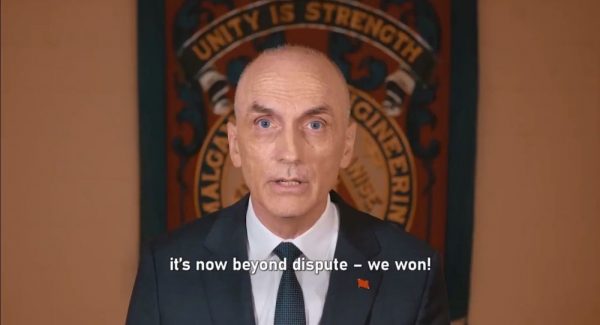
© Photo : Chris Williamson
Ex-Labour MP Chris Williamson released a video via Twitter on 17 December 2019 announcing that he won a substantial percentage of his legal fees following a “successful” lawsuit against the Labour Party.
“Despite the misleading claims by Labour Party bureaucrats that I lost by legal action in the High Court regarding my re-suspension from the party, it’s now beyond dispute. We won. I can reveal today that the Labour Party has been ordered to pay 100% of my costs up to the 5th of September for losing the case and a further 30% of my costs after the 6th of September.”
Williamson, a former MP for Derby North, was suspended in February 2019 by the Labour Party, amid accusations of antisemitism. A Labour Party panel re-instated Williamson later in June, but he was re-suspended, almost immediately and without explanation, following pressure from segments of the press and members of the Parliamentary Labour Party (PLP).
Williamson then sued the party arguing that the second suspension was unlawful.
He said the court decision confirmed “that the party acted unlawfully in re-suspending me in June [2019]. Media outlets, either wilfully or ignorantly, falsely claimed that I lost the court case. They should now correct the record”.
Williamson, who had been a party member for 44 years, said:
“all the costs being recovered will be used to establish a left legal fighting fund to assist others who have been maliciously smeared and harassed by similar allegations.”
He expressed his regret for suing the party arguing that “it’s clear that justice was impossible within the party’s unlawful disciplinary system”.
Labour should have argued for “a People’s Brexit”
Williamson spoke exclusively to Sputnik about Labour’s defeat at the general election held on 12 December.
He explained that in his view “Labour’s Brexit position was absurd”.
The former bricklayer and social worker said:
“We should have been arguing for a People’s Brexit against Bris Johnson’s Bankers’ Brexit. I’m convinced we would have won that argument”.
Williamson ultimately ran as an independent after the Party refused to re-instate him, despite his legal victory. He said that despite “campaigning for remain” he accepted the “democratic outcome of the referendum” and had been “consistently calling for [a People’s Brexit vs Johnson’s Banker Brexit] since the referendum”.
He also pointed out that this argument was roundly rejected by fellow Labour MPs.
“At the PLP meeting two days before I was suspended I was howled down for suggesting we should campaign for a People’s Brexit.”
Labour “demoralised” its membership by throwing “anti-racist socialists” to the “wolves”
Williamson also said that the party’s failure to challenge smears of antisemitism cost the party:
“Not confronting the smears and allowing anti-racist socialists to be thrown to the wolves also contributed to the defeat. It demoralised the membership and facilitated the false narrative being perpetuated by Labour’s enemies that Labour was an institutionally antisemitic, racist party.”
He ended by saying that “The truth is the whole moral panic that was created was based on a hoax”.
Williamson was first suspended after saying that he felt the Labour Party, which in his opinion had done more than any other party to combat racism, had backed down too much in the face of baseless accusations of antisemtism levied at people like Labour leader Jeremy Corbyn.
However, the actual basis cited by the party for his suspension was that Williamson was “guilty of a pattern of behaviour [that brought] the party into disrepute”. An accusation he called “Orwellian”.
In July a cross-section of notable individuals, including Israeli historian Avi Shlaim and journalist John Pilger, wrote a letter of support for Williamson in which they quoted US intellectual Noam Chomsky who said there was nothing “even remotely antisemitic” about what Williamson had said.
December 18, 2019
Posted by aletho |
Civil Liberties, Deception, Mainstream Media, Warmongering | UK, Zionism |
Leave a comment
By Johanna Ross | December 18, 2019
The Scottish independence movement has come a long way since I was a child. A few decades ago the Scottish National Party was on the fringes of politics and even when the Scottish parliament was founded, it was a Labour government at the helm. Independence was a distant dream, untouchable. It was even more intangible a prospect when my parents were young – back in the 1950s the SNP was as ostracised as the BNP currently is, with its members considered to be rather unhinged!
Gradually, over the decades, this has changed, with Alex Salmond presiding over the first ever SNP government and Nicola Sturgeon winning the largest number of seats ever for her party. Scotland’s party of independence has now been ruling the country for 12 years, and continues to dominate the political scene. On Thursday’s general election it won 47 out of 59 seats on a mandate of stopping Brexit and calling a second referendum on Scottish independence. Nicola Sturgeon has been labelled the UK’s second most powerful politician. Her party has never been as popular, and independence has never been so close. Now it seems the question is not if, but when.
Boris Johnson, having slaughtered Jeremy Corbyn in the election, is jubilant. He is currently coasting along on cloud nine, feeling vindicated after months of accusations hurled at himself and his ‘untrustworthy’ leadership. The man who just a short time ago, it was said, could face jail for deceiving the Queen and illegally proroguing parliament, took a gamble which paid off. He defiantly won the general election and now has a parliament behind him to pass his beloved Brexit bill.
And yet it’s not clear that he fully understands the implications of Thursday’s vote for the future of the Union. In fact it seems he is in denial. In a phone call with Nicola Sturgeon on Friday night Johnson reportedly emphasised that ‘he remained opposed to a second independence referendum’. But his words are not accepting the reality of the situation: that the majority of Scots have just voted decisively for the party which stands on an independence platform. And Sturgeon is not going to back down. In an interview on Sunday she said: “If he thinks – and I said this to him on Friday night on the telephone – that saying no is the end of the matter, he is going to find himself completely and utterly wrong.”
Sturgeon, usually mild mannered and reserved in her rhetoric on independence, has unequivocally turned up the volume in the debate, declaring that Scotland could not be “imprisoned” in the UK against its will. She accused the Tories of ignoring the will of the Scottish people and that they will have to ‘face up to and confront reality’ about what the election result means. In an interview with the BBC’s Andrew Marr on Sunday the Scottish First Minister expressed frustration that she was being forced to explain her position: “It really is such a subversion of democracy that you’re talking to the leader of the party that overwhelmingly won the election, and I’m under pressure to say what I’m doing because the mandate that I won is not going to be honoured by the party that got roundly defeated in Scotland”.
The independence campaign of course, narrowly lost in the 2014 referendum 45% to 55%. But so much has changed since then. At that time, the campaign for remaining in the Union was even using EU membership as an argument against independence, saying that Scotland would be jeopardising its future in the EU by leaving the United Kingdom. A few years later, the sad irony of this cannot be missed. Brexit has completely altered the political landscape in Britain, stirring up nationalism both north and south of the border. England has put Brexit before the United Kingdom, and Scotland has equally decided that its future remains with Europe, but not with England.
The Johnson government has a policy on Brexit, but its strategy on Scotland is less certain. Since the Prime Minister took office, his presence north of the border has been lacking, as has his interaction with Scottish politicians. Even his relationship with Scottish Tory leader, Ruth Davidson, was poor, as they had opposite views on Brexit. Johnson has deepened the hatred for the Conservative party in Scotland, estranging apathetic voters even further. By denying a second referendum he will only foster more bad feeling towards him and the Westminster government and boost the Nationalists’ campaign. If he doesn’t turn his attention to Scotland soon, he’ll have a Catalonia situation on his doorstep before he knows it…
Johanna Ross is a journalist based in Edinburgh, Scotland.
December 18, 2019
Posted by aletho |
Civil Liberties | Scotland, SNP, UK |
Leave a comment
Executive order implies that “Jewishness” is now a nationality
The pandering by Donald Trump and those around him to Israel and to some conservative American Jews is apparently endless. Last Wednesday the president signed an executive order that is intended to address alleged anti-Semitism on college campuses by cutting off funds to those universities that do not prevent criticism of Israel. To provide a legal basis to defund, the administration is relying on title VI of the Civil Rights Act of 1964, which prohibits any discrimination based on race, color or national origin. Since the Act does not include religion, Trump’s order is declaring ipso facto that henceforth “Jewishness” is a nationality.
The executive order does not mention Israel by name, but it does state that its assumptions are based on “the non-legally binding working definition of anti-Semitism adopted on May 26, 2016, by the International Holocaust Remembrance Alliance (IHRA), which states, ‘Antisemitism is a certain perception of Jews, which may be expressed as hatred toward Jews. Rhetorical and physical manifestations of antisemitism are directed toward Jewish or non-Jewish individuals and/or their property, toward Jewish community institutions and religious facilities’; and (ii) the ‘Contemporary Examples of Anti-Semitism’ identified by the IHRA, to the extent that any examples might be useful as evidence of discriminatory intent.”
The IHRA “contemporary examples” supplementing the basic description are important. They considerably broaden the definition of anti-Semitism, to include “Accusing Jewish citizens of being more loyal to Israel, or to the alleged priorities of Jews worldwide, than to the interests of their own nations” and “claiming that the existence of a State of Israel is a racist endeavor.” The examples also included holding Israel to a higher standard than other nations when criticizing it, and IHRA offers no possible mitigation even if the accusations are, in the case of the behavior of some Jews and of Israel, accurate.
Those who are confused because in the past expressions like “Italian” or “Irish” or “British” meant actual countries should recognize that Trump-speak never respects any connection with reality when there is political advantage just sitting out there waiting to be snatched and exploited. And that imperative is considerably multiplied when one is referring to either the state of Israel or of Jews in general, particularly as seen by the Trump White House, which clearly and repeatedly sends the message that it reveres both. Trump’s order will in effect constitute a government-promoted argument that Jews are a people or a race with a collective national origin, like Italian or Polish Americans, an assertion that clearly is untrue.
In fact, suppressing criticism of Israel on college campuses using a “weaponized” claim of anti-Semitism has long been a major foreign policy objective of the Israeli government even though nonviolent assembly and free speech are guaranteed by the U.S. Constitution. Congress has several times considered a comprehensive Anti-Semitism Awareness Act, though it has not passed due to legitimate free speech concerns. The nonviolent Boycott, Divestment and Sanctions movement (B.D.S.), which is very active on American campuses, has been particularly targeted and criticism of it is frequent in the media and from Congress while also emanating from the White House. As most accredited colleges receive federal funding, which can be considerable at a major research university, the executive order will create a major dilemma over how to respond, particularly for those schools that have Middle East study programs.
Work on the presidential executive order was initiated in the summer inside the White House by a team led by Jared Kushner, Trump’s son-in-law and senior adviser, together with his close aide special assistant to the president Avi Berkowitz. They sought to develop a formula whereby government policy would equate anti-Zionism with anti-Semitism, and Donald Trump both agreed with that assessment and followed through on it. On December 8th he promised to take action against B.D.S. and other critics in a speech delivered before the Israeli-American Council. The speech is worth reading in full by anyone who is concerned that the United States now has a government that favors one already privileged, wealthy and powerful constituency in particular and is not committed to upholding the civil liberties of all Americans.
Israel is an apartheid state. Covering up for its crimes against humanity as well as its war crimes is something of a growth industry in the United States, with Zionist billionaire oligarchs launching new foundations on a regular basis. Jewish power in the U.S. means that Israel always has been given a pass, even when it deliberately attacked and sought to sink the U.S.S. Liberty, an American Naval vessel in international waters in 1967. Thirty-four crewman died in the assault. The subsequent investigation of the attack was whitewashed by the president, secretary of state and the Navy department while the survivors were threatened with imprisonment if they revealed what had occurred. That is how a powerful and ruthless Israel acting through its traitorous domestic proxies operates and it illustrates how feeble the Establishment is in standing up to it.
This latest outrage, in which free speech and association will be denied to benefit one group on the basis of its claimed perpetual victimhood, had its genesis earlier this year when the federal government’s Education Department ordered Duke University and the University of North Carolina at Chapel Hill to reorganize the Consortium for Middle East Studies program run jointly by the two colleges in part based on their failure to include enough “positive” content relating to Judaism. The demand came with a threat to suspend federal funding of Title VI Higher Education Act international studies and foreign language grants to the two schools if the curriculum were not changed.
The Education Department was particularly irate over a conference in March called “Conflict Over Gaza: People, Politics and Possibilities.” A Republican congressman was outraged by the development and asked Secretary DeVos to investigate because the gathering was full of “radical anti-Israel bias.”
Coverage of the story revealed that “Betsy DeVos, the education secretary, has become increasingly aggressive in going after perceived anti-Israel bias in higher education.” Her deputy who has served as a focal point for the effort to root out anti-Israel sentiment is Assistant Secretary of Civil Rights Kenneth L. Marcus, who might reasonably be described as “a career pro-Israel advocate,” the founder and president of the Louis D. Brandeis Center for Human Rights Under Law, which he has used to exclusively defend the rights of Jewish groups and individuals against BDS and other manifestations of Palestinian pushback against the Israeli occupation of their country. He has not hesitated to call opponents anti-Semites and has worked with Jewish students to file civil rights complaints against college administrations, including schools in Wisconsin and California. In an op-ed that appeared, not surprisingly, in The Jerusalem Post, he observed that even when student complaints were rejected, they created major problems for the institutions involved. “If a university shows a failure to treat initial complaints seriously, it hurts them with donors, faculty, political leaders and prospective students.”
Last year Kenneth Marcus reopened an investigation into alleged anti-Jewish bias at Rutgers University that the Obama Administration had closed after finding that the charges were baseless. Marcus indicated that the re-examination was called for as his office in the Education Department would henceforth be using the IHRA-derived State Department definition of anti-Semitism that also includes “denying the Jewish people their right to self-determination,” making virtually all criticism of Israel a civil rights violation or even a hate crime.
Critics of the Trump move, many of whom are themselves Jewish, are uncomfortable with being placed by government into one category, noting inter alia that ALL students are de facto already protected by Title VI, which has been interpreted as making all forms of discrimination illegal. And they also note that the law was never intended to protect individuals whose feelings were hurt or who claim to be unwelcome or even threatened by someone saying something that they disapprove of. Since such protection is clearly the intention of the executive order, it is undeniable that the Trump’s latest ploy is little more than a mechanism to pressure colleges into effectively banning B.D.S. and other groups critical of Israel.
And the order itself raises at least one unpleasant thought: if “Jewishness” is a nation even though it is demonstrably not one, what is the alleged Jewish nationality all about? Is this just one more example of the politics of Jewish identity or is it really some form of dual loyalty, with American Jews divided between those who are loyal to the U.S. and those who are loyal to some supra-nationality or allegiance? The fact is, that Donald Trump himself has several times expressed the view that American Jews, particularly those who are politically liberal, should be more loyal to Israel.
Trump’s maneuver is unfortunately part of a well-funded and highly coordinated federal and state campaign to pass laws to criminalize critics of Israel. And the issue has also surfaced within the Democratic Party among those campaigning for the presidential nomination. Speaker Nancy Pelosi forced Representative Ilhan Omar to apologize after she criticized proposed anti-boycott legislation. More recently Bernie Sanders is being smeared as an anti-Semite even though he is Jewish because he associates with critics of Israel and has spoken out in favor of defending free speech while also supporting Palestinian rights.
There is a certain irony in all of this political theater, that the wealthiest and most powerful identifiable group in the United States should yet again be playing the victim is in itself astonishing. And making it a crime to deny Israel legitimacy while at the same time denying the same thing to Palestinians should give anyone pause.
And there is also considerable hypocrisy in that pro-Israel groups on campus have been if anything better funded and more aggressive in promoting their point of view than B.D.S. has been without any consequences. Canary Mission, for example, claims to “document people and groups that promote hatred of the U.S.A., Israel and Jews on North American college campuses” by posting their names, photos and personal information on its website. Israeli-American real estate investor and billionaire Adam Milstein is reported to be its principal funder while the site’s listings have been allegedly used by the Israeli border security officials to deny entry to pro-B.D.S. American citizens and also with potential employers to deny applicants jobs.
The Lawfare Project’s Campus Civil Rights Project meanwhile helps aggrieved Zionist students to “take legal action to ensure that schools live up to their legal obligations to protect Jewish students from anti-Semitic harassment, intimidation, and discrimination.”
So here we are again. Special privileges for the perpetual victims. And no one in the media is willing to tell it like it is, while the handful of meek voices in congress have been effectively silenced. So sad, particularly as an election year is coming up and there will undoubtedly be much more of this. When the Israelis occupy nearly all of the West Bank with Donald Trump’s approval and start “relocating” the existing population, who will be around to speak up? No one, as by that time saying nay to Israel will be a full-fledged hate crime and you can go to jail for doing so.
Philip M. Giraldi, Ph.D., is Executive Director of the Council for the National Interest, a 501(c)3 tax deductible educational foundation (Federal ID Number #52-1739023) that seeks a more interests-based U.S. foreign policy in the Middle East. Website is councilforthenationalinterest.org, address is P.O. Box 2157, Purcellville VA 20134 and its email is inform@cnionline.org.
December 16, 2019
Posted by aletho |
Civil Liberties, Ethnic Cleansing, Racism, Zionism | Human rights, Israel, Palestine, United States, Zionism |
Leave a comment
During the run up to the recent election in Great Britain, Jeremy Corbyn and the Labour Party were accused, with almost unprecedented hysteria, of anti Semitism. Mr. Corbyn is not anti Semitic, he has been a lifelong anti-racist advocate. Perhaps the histrionics in the press and pulpits were a reaction to the tepid support Corbyn has offered the Palestinians or were based on the likelihood of large tax increases under Corbyn’s socialist manifesto under which the taxpayers would fund, among other items, free universal education, free broadband and the investment of billions of pounds in hazily defined transportation and green energy funds.
Labour’s response to the unrelenting smear campaign was not to defend itself as a body that protects the rights of all races and religions (as its own manifesto claims), but instead to viciously turn on its own members, ousting anyone whose views, however historically verifiable, political or simply observational, were denounced as anti Semitic by someone. Essentially, Labour treated an accusation of anti Semitism as its own a priori truth.
In April, a Labour Party member (here called “Ted”) received a letter from Jane Shaw, secretary of Labour’s Constitutional Committee, stating that the committee “has received a charge from the National Executive Committee… that you have breached Labour Party Rules.”
The alleged breach was conduct “prejudicial or grossly detrimental to the Labour Party,” which, it claims, must be inferred from what it labels “demonstrating hostility to the Jewish people” and “published comments on line which deny or question aspects of the Holocaust.” In my opinion, the writings cited by Labour, although they touch on so-called Jewish issues, fail to substantiate Labour’s own accusations, nor have they run afoul of Britain’s strict hate speech laws. I wonder what might happen had Ted written that Africans as well as others participated in the slave trade? Would this be treated as a racist statement about Africans? I ask, because I read of no such expulsions for racism from the Labour Party.
The Party’s letter dictates its Draconian rules for contesting its accusation. The committee will hold a hearing for which Ted is given the choice of three bad options:1.Ted can appear alone; 2. Ted may bring a “silent friend” who is a “current compliant member [of the Party],” and whose name he provides in advance. Ted may consult with his friend but the friend may not speak aloud to the Committee. (what is the possible rationale for this?) or; 3. Ted may request “to be allowed be (sic) represented by either a lay or trade union representative, [who is also] a member of the Party or a [lawyer], who does not have to be a Labour Party member.
The only way Ted can use non-Labour aligned representation or support is for Ted to incur the expenses of hiring a lawyer. Of course, not every ‘accused’ member is articulate enough to represent himself before the committee nor rich enough to afford a lawyer. The Party’s letter emphatically states that its rules never allow reimbursement for expenses under any circumstances including if Ted is found innocent of all charges or even if the charges are found to have been based on fraudulent or malicious accusations.
The brief letter contains more outrageousness. It warns Ted that “It is vital to ensure fairness to you and other individuals, and to protect the rights of all concerned under the Data Protection Act 2018 that these proceedings are undertaken confidentially.” But the Data Protection Act sets standards to protect individuals, such as Ted, from organizations that collect data, such as the Labour Party. See: Ted is entitled to do as he wishes with his own file, it is the Labour Party that has a duty of confidentiality.
What is the credibility of an organization that sends an accusatory letter demanding confidentiality based on a law intended to protect individuals from organizations such as itself? Is its ‘rule’ intended to protect Labour from the consequences of its own conduct?
Labour further asserts that it retains control over data Ted receives in the process of reviewing the serious and in my opinion, unfounded charges made against him. “[such data] remains under the control of the Labour Party and … should not be .. disseminated without prior permission from a Labour Party Officer.” By what authority does Labour deny Ted the right to name his accusers? Without Ted’s knowledge or consent, the Labour Party examined his personal facebook and twitter chats to play “find the anti Semitism,” and has published their ‘findings’ to two separate Orwellian-titled “committees.” It is no surprise that the letter does not inform Ted of his reciprocal rights should a committee member publicly release information about him. There are good reasons why governments protect open trials, one of which is to discourage kangaroo courts like the one outlined in Labour’s letter.
The salient questions this letter raises are why any sane person would want to be a member of such a Party and why the Brits would choose (as they emphatically did not) to be under the leadership of a party whose standards for tolerance and justice are set by its own big brother.
December 15, 2019
Posted by aletho |
Civil Liberties, Ethnic Cleansing, Racism, Zionism, Full Spectrum Dominance | Labour Party, UK, Zionism |
Leave a comment
By Johanna Ross | December 13, 2019
Overnight the electoral map of the UK has changed significantly. Scotland is once again bathed in a sea of yellow, as England has been shrouded in blue. With the Scottish National Party obtaining 45% of the vote north of the border, and the Conservatives only 25% it is clear not only is there no mandate for Brexit in Scotland, but as leader Nicola Sturgeon has said, there is now very much a mandate for holding a second referendum on Scottish Independence.
England, on the other hand has put its support resoundingly behind Prime Minister Boris Johnson and his mantra of ‘Get Brexit Done’. With a remarkable 364 seats, as opposed to Labour’s 203 – its worst performance since 1935 – he proclaimed that a ‘political earthquake’ had occurred and that he would end all the squabbling of the last few years he would take the country out of the EU ‘no ifs and no buts’. This was a message that appealed to the majority, clearly sickened by the deadlock of Brexit. Despite the radical spending programme proposed by the Labour party, this election ended up being, as it was promoted, all about Brexit.
And this takes us to the broader context of what is in fact happening in the UK. Indeed, it’s important to see this election in the wider European political landscape. This was not just a Conservative party win, but a victory for nationalism. Not just Scottish Nationalism, but English Nationalism under the banner of Brexit, and Welsh and Irish Nationalism. For the first time ever, Northern Ireland elected more Nationalist MPs than Unionist, in what was also, like Scotland, an anti-Brexit vote, which will spur on more talk of Irish reunification. Welsh Nationalist party Plaid Cymru also held on to its four seats in Wales.
So while it may be portrayed as a landslide victory for the Conservatives, this election more than ever has shown up the cracks forming in the Union. Scottish Nationalism appears to be on an irreversible path to independence, with the question now being not if there will be a referendum on independence, but when. The strong Remain vote up north has only boosted the case for leaving the UK, as Scotland places more importance on being part of Europe, than being part of Britain. England, for its part, has clearly put more emphasis on being out of Europe, than it has on retaining the Union.
Indeed, looking at the western world in general, the popularity of nationalist and right-wing parties is undisputedly on the rise. The AfD in Germany, the National Front in France or Vox in Spain – these parties are all gaining popularity, just as Trump has in the US. And together with Johnson’s Conservatism, they all have something in common, that ‘populist’ appeal that really gets its message across. For regardless of their party leaders’ sins (Boris Johnson has been repeatedly been lambasted as a liar, racist, and misogynist), they have not been enough to deter voters, for whom clearly the nation state is what matters most.
There’s no doubt that Brexit has been a shock for the EU. Arguably Britain had always been a hesitant member, refusing to join the Euro, or join the Schengen zone (which allows borderless travel between states); it never quite developed that European mindset. But the Brexit vote took EU politicians by surprise, sending shockwaves across a Union already under pressure from Eurosceptic parties. They will no doubt breathe a sigh of relief in Brussels that the Brexit stalemate will now be broken with Boris Johnson’s parliamentary majority – finally a deal can be passed – but the reality that one of their major players finally leaving must be making them nervous.
Boris Johnson put faith in the people, and the gamble paid off. But whether he appreciates the real seismic consequences of this ‘political earthquake’ is another question. For cracks are not only emerging between Britain and Europe, but across the United Kingdom itself. It’s the price to be paid for Brexit.
Johanna Ross is a journalist based in Edinburgh, Scotland.
December 13, 2019
Posted by aletho |
Civil Liberties | European Union, Ireland, Scotland, UK, Wales |
Leave a comment