Clinton Accuses Zuckerberg of Having ‘Authoritarian’ Views on Misinformation
Sputnik – 27.01.2020
2016 presidential candidate Hillary Clinton said in an interview over the weekend that Mark Zuckerberg’s views on misinformation on his Facebook platform are “authoritarian.”
Clinton told The Atlantic magazine during the Sundance Film Festival that she believes Zuckerberg’s Facebook is “not just going to reelect Trump, but intend[s] to reelect Trump.” The magazine reported her being horrified and alarmed by what she believed was Zuckerberg’s unwillingness to battle the spread of disinformation and propaganda on Facebook.
Clinton recalled the time she saw a slowed-down video of House Speaker Nancy Pelosi that went viral on Facebook. The video made it appear Pelosi was slurring her words and was designed to make it appear she was cognitively impaired.
“Google took it off YouTube … so I contacted Facebook,” Clinton told the Atlantic. “I said, ‘Why are you guys keeping this up? This is blatantly false. Your competitors have taken it down.’ And their response was, ‘We think our users can make up their own minds.’”
The Atlantic then asked Clinton whether she saw Zuckerberg’s reasoning that Facebook users can decide for themselves what to believe as “Trumpian,” with Clinton responding, “It’s Trumpian. It’s authoritarian.”
A Facebook spokesman told Fox News on Sunday it had no comment on Clinton’s remarks, noting that Zuckerberg had spoken about the importance of protecting free expression in his speech at Georgetown University.
“People should be able to hear from those who wish to lead them, warts and all, and that what they say should be scrutinized and debated in public,” Facebook said earlier in its statement on the issue.
In her interview with the Atlantic, Clinton said that Zuckerberg can be compared to the world leaders due to the power he holds.
“I feel like you’re negotiating with a foreign power sometimes,” she said of her conversations with Facebook top executives. “He’s immensely powerful. This is a global company that has huge influence in ways that we’re only beginning to understand.”
She insisted that Zuckerberg could be persuaded to support Trump, adding that at least this is what she wants to believe and it “gives [her] a pit in [her] stomach.”
The Unbearable Hypocrisy of US Sanctions on Iran
By Daniel McAdams | Ron Paul Institute | January 26, 2020
On November 22nd of last year, the US government announced it would impose sanctions on Iran’s information minister for his alleged role in limiting domestic Internet access while protests raged in that country over increases in gas prices.
At the time, US Treasury Secretary Steven Mnuchin condemned the Iranian government for censoring information that Iranian citizens could view online, stating that, “Iran’s leaders know that a free and open internet exposes their illegitimacy, so they seek to censor internet access to quell anti-regime protests.”
The Iranians were evil, said the US government official in charge of economic sanctions, because it restricted what its citizens could read in the international press.
Our government would never do that… right?
Wrong. Yesterday, the US government knocked Iran’s state news agency, FARS, off of the Internet entirely, citing US sanctions against the country.
What that means is the Iranian news service is being censored by the United States government and that Americans will therefore no longer be able to see anything from this foreign media outlet.
Exactly what Mnuchin accused Iran of doing back in November.
Zero Hedge writes, “as Iran’s Press TV describes further“:
The news agency said that it had received an email from the server company, which explicitly said that the blockage is due to an order by the Treasury’s Office of Foreign Assets Control (OFAC) and its inclusion in the list of Specially Designated Nationals (SDN).
The agency attached to its post a screenshot of its website with the message “www.farsnews.com’s server IP address could not be found.”
This latest US censorship of Iranian media is nothing new. Iran’s Press TV has been removed from YouTube and other US social media with “US sanctions on Iran” being given as the reason.
Americans are not allowed to see the Iranian perspective on the Middle East because the Beltway bombardiers and their bosses in the military-industrial complex depend on successfully demonizing all Persians so that Americans will accept their annihilation in another neocon war. If Americans are allowed to see the Iranian perspective they might not be so supportive of the slaughter the neocons are cooking up.
The bottom line is this: the US Administration cites Iran’s restricting of outside media as evidence of the evil nature of the Iranian government, all the while scrambling to restrict American citizens’ access to Iranian media outlets.
Pot. Kettle. Black. Hypocrisy.
Copyright © 2020 by RonPaul Institute.
Bolivia: MAS Presidential Candidate Becomes Target of Lawfare
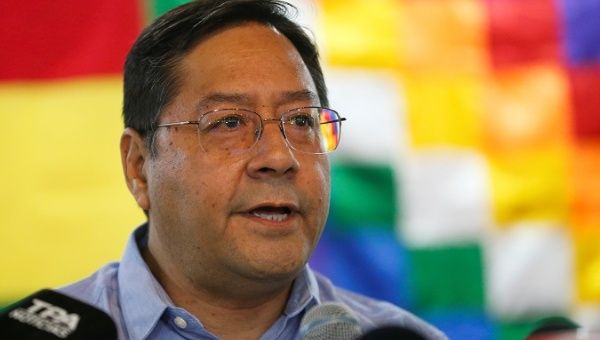
Luis Arce at a news conference after being announced as the Movement to Socialism’s presidential candidate, in Buenos Aires, Argentina Jan. 20, 2020. | Photo: Reuters
teleSUR | January 22, 2020
Bolivia’s Office of the Prosecutor expanded an investigation against Evo Morales’ former officials, among whom is Luis Arce, the Movement Towards Socialism (MAS) presidential candidate.
The announcement was made by prosecutor Heidi Gil one day after the MAS unveiled that Arce would be its presidential candidate in the upcoming elections in May.
The judicial process is related to the alleged diversion of public resources from the Indigenous Development Fund (Fondioc), a case in which former Presidency’s Minister Juan Ramon Quintana has also been mentioned.
“If the Prosecutor finds enough evidence during the extension of the investigation, they will be called to testify,” Gil said referring to Arce and Quintana.
The extension of the judicial investigation was requested by the current Fondioc director, Rafael Quispe, a well-known opponent of the Morales administration who was appointed to that position by the government of Jeanine Añez.
Since the coup d’etat consummated on November 10 in Bolivia, numerous MAS militants have been subject to judicial persecution.
In this regard, the MAS leader Evo Morales said that the current U.S.-backed de facto regime does not seek justice but “revenge and impunity.”
Former Minister of Economy Luis Arce is one of the intellectuals who designed the economic model that allowed Bolivia to keep high growth rates for more than a decade.
Jewish Congress launches campaign against ‘antisemitism’ (aka support for Palestinian rights)

Israeli President Reuven Rivlin demonstrates the new Instagram campaign against “antisemitism.” EJC and Israel consider opposition to Israeli human rights violations “antisemitic.”
Alison Weir | If Americans Knew | January 22, 2020
UPDATE: In the midst of impeachment proceedings, House Leader Nancy Pelosi has gone to Israel to take part in an event organized by the Russian-Israeli oligarch described below – see update at end of post.
The European Jewish Congress (EJC) has announced the launch of a worldwide, star studded social media campaign against what it calls “antisemitism,” but which is often advocacy for Palestinian human rights and opposition to Israeli apartheid. EJC is the regional affiliate of the World Jewish Congress, one of whose main missions is to advocate for Israel.
The EJC considers anti-Zionism to be a form of anti-Semitism and employs a newly created definition of antisemitism in which certain types of statements about Israel are supposedly “antisemitic.” As a result, EJC’s opposition to “antisemitism” often consists of censoring information that exposes Israeli violations of Palestinian human rights.
Its new campaign, called “Stop This Story,” particularly focuses on Instagram, although it will also use YouTube and other platforms. According to the EJC, the campaign will be the “first global initiative of its kind that will leverage Instagram’s AR (Augmented Reality) effects to drive a global movement.” It claims to have recruited “some of the world’s leading AR effects’ creators.”
The campaign says it has enrolled a number of “international stars” and “international influencers, each of them with millions followers.” Among these are supermodel Bar Refaeli, actress Vanessa Kirby (from ‘The Crown’), former NBA player Omri Casspi, and “many other international figures, actors, entertainers, and sportsmen and women.”
The man behind the campaign

Russian-Israeli oligarch Viatcheslav Moshe Kantor, president of the EJC and numerous other entities, is a billionaire whose top priority is strengthening Israel.
The individual behind the new campaign is EJC President Moshe Kantor, also known as Viatcheslav Kantor, He explains the reasoning underlying the campaign: “The best way to spread any message today is through social media because social networks and those who use them have the power to make the necessary changes in our societies.”
Kantor is a Russian-Israeli billionaire dedicated to Israel. He has stated that the creation of the State of Israel is the “biggest achievement” of Diaspora Jewry, and believes that all Jews must work to “strengthen our beloved state.”
In 2008 Kantor enunciated his core belief: “The reality of today requires that European Jews care not only about the preservation and security of Israel, but also the way it is treated by the rest of the world. This must be the leading priority of the European Diaspora.”
Kantor heads up and sometimes even originated, a network of pro-Israel international entities.
In addition to being president of the European Jewish Congress, he is founder and president of the World Holocaust Forum Foundation, founder and chairman of the European Jewish Fund, originator and president of the International Luxembourg Forum on Preventing Nuclear Catastrophe, co-founder and president of the European Council on Tolerance and Reconciliation, vice president of the Euro-Asian Jewish Congress, a member of the International Board of Hillel, and the former president of the Russian Jewish Congress, to name just some of his affiliations.
His ability to accomplish all this stems from his enormous wealth. In addition to being an “international philanthropist,” as he identifies himself, Kantor is an international businessman with $4 billion at his disposal. He has been accused of unscrupulous business dealings and financial fraud.
Like other Russian oligarchs, Kantor made his fortune in the first years of Russia’s “new capitalism”– sometimes called “gangster capitalism” – when, under the guise of “privatization,” Russia’s economy was massively looted, causing ruin to many Russian citizens who saw their life savings vanish, sometimes in a matter of weeks. Kantor’s father, a former Red Army soldier, reportedly served prison time for “speculation and embezzlement of state property in a large scale, taking bribes and forgery.” Kantor was among the many individuals in the Russian Jewish community who flourished; many – perhaps most – of the Russian oligarchs have ties to Israel.
Kantor is known for a variety of international activities. Along with notorious oligarch Boris Berezovsky, Kantor is said to have been a “sponsor of the ‘Orange Revolution’ in Ukraine in 2005, which led to the cancellation of the initial results of the presidential election.” Berezovsky later bragged that he had funded the revolution. In 2006 Kantor received an award from Ukraine’s new president for “distinguished services” to the country.
Stamping out ‘Antisemitism’ and ‘Intolerance’
Kantor has been involved in a global campaign to embed a new, Israel-centric definition of antisemitism in European governments and institutions. The EJC says that the definition of anti-Semitism must be “clarified” because “the new form of anti-Semitism” supposedly “emanates from pro-Palestinians.” Kantor says that BDS, the international boycott of Israel over its violent human rights abuses, is “antisemitic.” (BDS works to “uphold the simple principle that Palestinians are entitled to the same rights as the rest of humanity.”)
Kantor advocates that governments punish antisemites as harshly as they punish terrorists. He has been working to convince European governments to adopt a bizarre 13-page program of “concrete and enforceable obligations that ensure tolerance and stamp out intolerance.”
The Orwellian program, entitled “National Statute for the Promotion of Tolerance” (revised version here), would restrict freedom of expression, impose re-education programs, enact surveillance structures, and institute criminal penalties for “antisemitism” and other “intolerance.” Expressing views specified as impermissible would be “regarded as criminal offenses punishable as aggravated crimes.”
The document proposes a deeply authoritarian structure controlling multiple aspects of society to coerce “tolerance,” and anyone who doesn’t get with the program would be taken care of, e.g. “Juveniles convicted of committing crimes listed in paragraph (a) will be required to undergo a rehabilitation programme conducive to a culture of tolerance.” Big Brother in the form of a “National Tolerance Monitoring Commission” would ensure that no one says or does anything that the Commission determines is “intolerant.”
The program is being promoted by Kantor’s “European Center for Tolerance and Reconciliation” (ECTR), and may be on the way to becoming a reality. Kantor has secured former UK Prime Minister Tony Blair as the ECTR Chairman and French philosopher Bernard-Henri Lévy as a member.
According to its website ECTR has formed a joint task force with the European Council to work on implementing the program throughout Europe. The European Council, composed of the heads of state or government of the 28 EU member states, defines the EU’s overall political direction and priorities.
‘Global Pandemic’
Kantor recently said that antisemitism is now a “global pandemic” and that the “crisis of antisemitism is a slippery slope to global catastrophe.” He warns that Jews could “disappear completely as a people from Europe,” and raises the alarm about what he describes as “mass killing at synagogues.”
Media reports on the new EJC campaign similarly emphasize recent tragic attacks on Jews, and reference the assaults in the cities of Monsey, Jersey City, Halle, Poway, and Pittsburgh.
These terrifying attacks killed a combined total of 14 Jews.
News reports on the alleged perpetrators of the assaults, who were of diverse races, indicate a variety of motivations. One attacker said he had been inspired by a 2019 assault on two New Zealand mosques that had killed 51 Muslims.
Previous fatal shootings have also occurred at other religious sites. The largest number of fatalities in the US may have been at a Christian church, where 26 worshipers were killed in 2017.
While Kantor and the EJC claim the existence of massive antisemitism, Jewish Americans are reportedly the wealthiest group in the US, and this also appears to be the case for Jews worldwide.
Meanwhile, Israeli forces have killed almost 10,000 Palestinian men, women, and children since 2000 and injured tens of thousands; Palestinian resistance forces have killed approximately 1,200 Israelis (details here).
Such disproportion is not new.
Twenty-five years ago, an Israeli author wrote: “In the last 40 years the number of non-Jews killed by Jews is by far greater than the number of the Jews killed by non-Jews.”
Many Jews around the world, including in Israel itself, have long strenuously opposed Israeli violence. According to Kantor and his cohort, these individuals are also “antisemitic.”

The bodies of five children from the same family killed in an Israeli air strike on 14 November 2019 lie in a hospital ward in Gaza (information on Gaza is here)
Fifth World Holocaust Forum
The new campaign comes just before the Fifth World Holocaust Forum to be held in Israel tomorrow, January 23rd, co-sponsored by the president of Israel. The forums are another one of Kantor’s many projects.
Over 45 heads of state and world leaders have said they plan to attend the event, including the presidents of France, Germany, Italy, Austria, Russia, the kings of Spain and Belgium, and Britain’s Prince Charles. Vice-president Mike Pence and Speaker of the House, Nancy Pelosi, will also attend.
The event is being held at Yad Vashem, Israel’s holocaust complex, a vast, sprawling institution with dozens of Israeli flags and tree-studded walkways leading to exhibits, archives, monuments, sculptures, and memorials.
The event website proclaims that the Holocaust is “the most horrific tragedy in human history” and states that “a new wave of antisemitism unseen since World War II poses an existential threat to European Jewry.”
According to the Jerusalem Post, among the forum’s features will be speeches by select heads of state, a Holocaust survivor, video clips, and “musical interludes performed by an orchestra and an international choir.” The event will be live streamed and conclude with the Israeli national anthem.
Yad Vashem is in Jerusalem where there is evidence all around – for any with eyes to see – of another genocidal program, one that has been going on since the one commemorated by Yad Vashem ended. An historian calls this one the “Palestinian holocaust” and describes it: a land was “occupied, emptied of its people, its physical and cultural landmarks obliterated, its destruction hailed as a miraculous act of God, all done according to a premeditated plan, meticulously executed, internationally supported, and still maintained today…”
Yad Vashem overlooks one of the obliterated landmarks emptied of its people: an almost empty field where the Palestinian village of Deir Yassin once stood.
On April 9, 1948 Zionist forces systematically exterminated 110 men, women, and children as part of a plan to rid Palestine of its Muslim and Christian population in order to make way for the Jewish state. This was one of 16 such Zionist massacres that took place before the official start of Israel’s founding war of ethnic cleansing, and over a month before a single Arab Army joined the conflict. In contrast to Yad Vashem’s monuments and memorials, Deir Yassin has no marker.
More recent evidence of the ongoing oppression can be found in the Issawiya neighborhood of Jerusalem, where heavily armed Israeli police have raided over 500 Palestinian homes and arrested more than 700 residents since May, apprehending children as young as five. Israeli forces shot dead a 21-year-old at close range and have injured over 300 people of all ages. Soldiers beat and humiliate residents at will. One resident says the area “has turned into a ghetto.” (Another such ghetto is Gaza, where Israeli forces yesterday killed three young men who had reportedly temporarily escaped from their prison.)
Not far from Issawiyah is Israel’s mammoth apartheid wall, confiscating additional Palestinian land and helping to imprison over two million people. In 2002 Israeli media reported that Israeli generals were studying how the German army fought in the Warsaw ghetto for use in Israel’s next campaign against Palestinians.
The Holocaust Forum program states that the world leaders “will be invited to lay a wreath at the base of the Warsaw Ghetto Uprising Monument created by world-renowned Jewish sculptor and artist Nathan Rappaport.”
Perhaps some of the world leaders could also visit the unmarked site of Deir Yassin, and lay a wreath on one of its crumbling graves. And then go to Israel’s wall and echo a famous demand from a previous head of state: “Tear down this wall.”
And maybe a future social media campaign could focus on ending all genocides, injustice, and oppression.
UPDATE:

Nancy Pelosi and Israeli President Reuven Rivlin on Jan 22, 2020 at Israeli state dinner sponsored by Viatcheslav Moshe Kantor.
(Pelosi’s Congressional offices are not telling constituents where she is.)
The UK Guardian reports that many of the heads of state have now arrived and that Israeli President Rivlin is hosting a state dinner today. Officials said organizers of the dinner “had tuned the grand piano, brought in 800 candles and hired 200 servers and ushers to serve Israeli cuisine. For space reasons, tents were set up outside and the heads of the foreign delegations were asked to bring only one guest…”
The article also reports: “Israel’s prime minister, Benjamin Netanyahu, has looked to capitalise on the event to rally international support against Iran” and hopes to procure “backing for his attacks on the international criminal court, which is investigating allegations of war crimes in the Palestinian territories.”
The Guardian reports that Russian president Vladamir Putin, French president Emmanuel Macron, and Prince Charles are expected meet with Palestinian President, Mahmoud Abbas.
A controversy involving Macron has already occurred:
“Macron also visited the old city of Jerusalem on Wednesday, where he was filmed by a French journalist working for Le Parisien shouting at an Israeli security officer. He appeared to be yelling at the man, who may have been assigned to his security detail, to leave the church of St Anne’s. The church has been owned by the French government since it was gifted by the Ottomans to Napoleon III in 1856, and is still considered French territory.
“Everybody knows the rules,” he said firmly in English. “Outside, please,” he shouted. “Please respect the rules. They [have been in place] for centuries. They will not change with me.”
“Macron’s altercation mirrored that of another French president, Jacques Chirac, who in 1996 refused to enter the same church until Israeli security left.”
Alison Weir is executive director of If Americans Knew, president of the Council for the National Interest, and author of Against Our Better Judgment: The Hidden History of How the U.S. Was Used to Create Israel.
Bolivia: As Elections Near, US-Backed Interim Gov’t Mobilizes Military, Arrests Opposition Leaders
By Alan Macleod | MintPress News | January 20, 2020
Wednesday, January 22 marks the day that Jeanine Añez is set to stand down as “interim” President of Bolivia, beginning the process for fresh elections set for May 3. Añez came to power in November, following a U.S.-backed coup that deposed the Movement to Socialism’s (MAS) Evo Morales. However, she is certainly not acting as if she intends to relinquish her power, let alone move towards new elections. Instead, she has sent the military, replete with tanks and other armored fighting vehicles, into the capital cities of all nine departments of the country.
MintPress News’ Ollie Vargas was on the scene in the center of the capital La Paz, where he filmed hundreds of armed soldiers performing drills outside the Cathedral of St. Francis and dozens of military vehicles circling the city, sirens on and guns drawn.
“The purpose of that is to intimidate people ahead of possible protests against the coup on the 22nd of January… This was a show of force saying you are not going to be able to march where you want. The military is preparing for war-style operations if marchers do arrive in the city. It is about intimidating the people,” he said in an interview with TeleSUR English; “The point was to be a show of force, rather than itself be an act of repression. It was there to show what repression could come.”
The military played a leading role in the November coup, demanding Morales resign and handpicking Añez as his successor. The police, too, were crucial, rebelling against Morales and later repressing protests from the country’s indigenous majority, even conducting massacres in the towns of Sacaba and Senkata. “It seems like the police are following the instructions of the far-right in Bolivia,” said United Nations Special Rapporteur Alfred de Zayas. Last week, Añez rubber stamped a pay rise for the country’s police, bringing their salaries up to that of the military’s.
For an interim government, the Añez administration has certainly made some sweeping policy changes, both at home and abroad. Internally, it has begun a mass privatization program aimed at conducting a fire sale of the country’s considerable natural resources. Since November it has been at war with the press, launching a crackdown on all media hostile to it, closing down multiple TV stations, with critical journalists disappearing or being found dead in suspicious circumstances. It has also set up new SWAT-like secret police battalions aimed at suppressing what is calls subversive voices, both domestic and foreign.
Añez has completely reoriented the country’s foreign policy, pulling out of multiple international and intercontinental organizations, expelling thousands of foreign nationals, recognizing Israel and inviting the Israeli Defense Forces to train the Bolivian security services and closing its own anti-imperialist military school.
It has also moved far closer to the United States than previously, recognizing U.S.-backed figure Juan Guaidó as the legitimate head of state of Venezuela. Earlier this month, a team from the U.S.-funded group USAID arrived in the country to advise the government on how to best conduct the upcoming election. Given the U.S.’ history in overthrowing heads of state across Latin America, the news has not been greeted with pleasure by all. Thus, while many inside the country have voiced their concern over the suspension of democracy, no one is accusing the new government of being lazy or unambitious.
MAS candidates forced to organize abroad
Under very difficult circumstances, the MAS party yesterday announced that its candidates for the May elections will be a ticket of Luis Arce Catacora for president and David Choquehuanca for vice-president. MAS leaders met in neighboring Argentina due to the repression in their own country. The location meant that a number of key figures accused of crimes by the new administration, including up-and-coming star Andrónico Rodríguez, could not attend. Arce, 58, Western-educated and middle-class, was Minister of Finance under Morales in an era when Bolivia generated high and sustained economic growth. Many see him as far from radical. His running mate is David Choquehuanca, an indigenous activist from a peasant background. He was Morales’ longtime Foreign Minister and was also secretary of ALBA, an intercontinental organization Añez has recently pulled the country out of. He is commonly seen as the driving force behind Bolivia’s anti-imperialist foreign policy, currently being dismantled by the coup government. Some will be disappointed that Andrónico Rodríguez, a charismatic indigenous 30-year-old union organizer groomed by Morales for a leadership position, was not chosen.
Whether those candidates will, until May, be able to remain in their positions – or even out of prison – is an open question. Many MAS officials, including President Morales and Vice-President Alvaro Garcia Linera, have been forced to flee the country or face arrest. Another MAS leader, Walter Ferrufino was arrested this weekend as he was traveling to Argentina for the meeting.
In the October election, Morales and the MAS gained 47 percent of the vote in the first round, enough to secure an overall victory. In contrast, Añez’s party, the Democrat Social Movement, received four percent. While all sides continue to behave as if a vote will take place in May, the absurdity of holding an election under the circumstances of a military takeover, where by far the most popular party is being repressed, means that there is a very real possibility the proceedings end up lacking credibility.
Alan MacLeod is a Staff Writer for MintPress News. After completing his PhD in 2017 he published two books: Bad News From Venezuela: Twenty Years of Fake News and Misreporting and Propaganda in the Information Age: Still Manufacturing Consent.
One More Social Leader Killed In Colombia, 21 So Far in 2020

Social leaders in Colombia are under threat since the peace agreement of 2016. | Photo: EFE
teleSUR | January 19, 2020
The Cordobexia Social Foundation denounced Saturday the assassination of social leader Luis Dario Rodriguez, the second activist killed in the northwestern department of Cordoba this week and the 21st so far in Colombia this year.
According to the statement released by the foundation, the social leader was murdered on Friday afternoon as he was returning home from a fishing trip in the municipality of Tierralta.
“He was shot by men on a motorcycle,” denounced the Cordobexia Social Foundation, as well as calling on the national government to protect and guarantee the exercise of human rights in Colombia.
Rodriguez was a member of the Association of Displaced and Vulnerable Families of Tierralta and of the human rights network of southern Cordoba. Also a father of three children and dedicated himself to fishing and agriculture.
His activism consisted of speeding up land claim processes after the flooding of the Alto Sinúu lands by the URRA 1 hydroelectric plant.
Less than a week ago, social leaders, Jorge Luis Betancourt and Tulio Sandoval were also murdered in their respective municipalities.
Betancourt also from Cordoba was killed in the municipality of Montelibanom and was a farmer’s rights activist.
While, Sandoval, who was participating in the crop substitution program, was killed by armed individuals who broke into his house, dragged him out and shot him repeatedly in front of his family.
In this context, Attorney General Fernando Carrillo recently called for an end to what he described as “the systematic murder of social leaders.”
Since the peace agreement signing, the Office of the United Nations High Commissioner for Peace in Colombia has counted more than 300 murders of human rights leaders.
How Expansive is FBI Spying?
By Ron Paul | January 20, 2020
Cato Institute Research Fellow Patrick Eddington recently filed several Freedom of Information Act (FOIA) requests to find out if the Federal Bureau of Investigation ever conducted surveillance of several organizations dealing with government policy, including my Campaign for Liberty. Based on the FBI’s response, Campaign for Liberty and other organizations, including the Cato institute and the Reason Foundation, may have been subjected to FBI surveillance or other data collection.
I say “may have been” because the FBI gave Mr. Eddington a “Glomar response” to his FOIA requests pertaining to these organizations. A Glomar response is where an agency says it can “neither confirm nor deny” involvement in a particular activity. Glomar was a salvage ship the Central Intelligence Agency used to recover a sunken Soviet submarine in the 1970s. In response to a FOIA request by Rolling Stone magazine, the CIA claimed that just confirming or denying the Glomar’s involvement in the salvage operation would somehow damage national security. A federal court agreed with the agency, giving federal bureaucrats, and even local police departments, a new way to avoid giving direct answers.
The Glomar response means these organizations may have been, and may still be, subjected to federal surveillance. As Mr. Eddington told Reason magazine, “We know for a fact that Glomar invocations have been used to conceal actual, ongoing activities, and we also know that they’re not passing out Glomars like candy.”
Protecting the right of individuals to join together in groups to influence government policy is at the very heart of the First Amendment. Therefore, the FBI subjecting such groups to surveillance can violate the constitutional rights of everyone involved with the groups.
The FBI has a long history of targeting Americans whose political beliefs and activities threaten the FBI’s power or the power of influential politicians. The then-named Bureau of Investigation participated in the crackdown on people suspected of being communists in the post-World War I “Red Scare.” The anti-communist crackdown was headed by a young agent named J. Edgar Hoover who went on to become FBI director, a position he held until his death. Hoover kept and expanded his power by using the FBI to collect blackmail material on people including politicians.
In the 1930s and 1940s, the FBI spied on supporters of the America First movement, including several Congress members. Two of the most famous examples of FBI targeting individuals based on their political activities are the harassment of Martin Luther King Jr. and the COINTELPRO program. COINTELPRO was an organized effort to spy on and actively disrupt “subversive” organizations, including antiwar groups
COINTELPRO officially ended in the 1970s. However, the FBI still targets individuals and organizations it considers “subversive,” including antiwar groups and citizen militias.
Congress must hold hearings to determine if the FBI is currently using unconstitutional methods to “monitor” any organizations based on their beliefs. Congress must then take whatever steps necessary to ensure that no Americans are ever again targeted for surveillance because of their political beliefs and activities.
Soros-linked political pressure group Avaaz joins forces with MSM to purge climate skeptics from YouTube

Extinction Rebellion Climate Change Action In London © Getty Images / Mike Kemp
By Sophia Narwitz | RT | January 17, 2020
Independent mainstream media outlets are engaging in a politically-motivated campaign to force YouTube to demonetize and hide any video that denies [catastrophic, man-made] climate change.
Published on Avaaz’s website, the left-leaning non-profit group released a report on January 16 that claims YouTube is profiting by broadcasting misinformation to millions of people by giving climate denial videos too much prominence. The report is an undisguised intimidation campaign, as not only does it list major advertizers who are running ads on videos that question the legitimacy of the threat climate change poses for humanity, but it explicitly calls for them to put pressure on the platform as a means of putting an end to the so-called disinformation.
Despite the findings being published just yesterday, many mainstream sites had lengthy articles posted not long after that, which featured quotes from those who worked on the report. Timings which suggest select websites were given early access, making it clear what agenda is being pushed, more so as they all tout the same talking points. Vice, Time, Gizmodo, The Verge, and countless other news entities want YouTube to punish creators who don’t toe the “correct” ideological line. The objective is to demonetize, and thus censor, such individuals as they’ll be less inclined to work on content that they won’t be able to profit from.
Nell Greenburg, a campaign director at Avaaz, claims the report isn’t about removing content, but that contradicts the report’s own messaging. There is a clear attempt to have content hidden as the report calls into question the promotion of such videos in the “up next” box on the site. It’s semantics at this point, but hiding videos would hurt creators and dissuade them from even trying to share their thoughts. It is an indirect way of removing ‘wrongthink.’
YouTube has already called into question the methodology of the report, but, given the media and powerful activist groups are targeting advertisers such as Nintendo, Red Bull, Uber, and Warner Bros, it’s a safe assumption the platform giant will give into their demands if their bottom line ever becomes affected. We are less than one year removed from Vox Media’s war on Google and its subsequent “adpocalypse,” after all.
Samsung has already contacted the company to “resolve the current issue and prevent future repetition,” so a second adpocalypse is probably likely. Though, this time, the scale could change as residing in the crosshairs isn’t just independent creators, but Fox News and other right-leaning media, given that they, too, have content on YouTube that questions the validity of a [catastrophic, man-made] changing climate.
That the MSM agrees with this says a whole lot, since many websites are in no position to push a platform into limiting content they deem as false, especially when considering the one-sided nature of their many blunders. If 2019 was any indication, they’re not exactly on top of stuff. From the reaction to the Covington school kids, to the countless Trump and Russia stories that went nowhere and fizzled, the most blatant purveyors of literal fake news are the mainstream media.
As for George Soros’ connection with Avaaz, while it claims to be predominantly member-funded now, its seed money was reportedly allocated by the billionaire’s opaque network of groups, and various prominent figures from his Open Society Foundation, such as former Democratic congressman Tom Periello, have been among its leadership. Leaked documents from 2010 detail that promoting climate change campaigns was always designated as a primary function of Avaaz.
This situation ultimately raises questions into why anyone, or anything, should have the power to dictate what others can create. Regardless of one’s personal views on the matter, there’s no denying that bold claims have been made about the climate that later were disproved. Little is, as yet, set in stone, and content that lands on any one side of the debate should be free to exist. If a creator is making videos people are watching, their hard work shouldn’t be thrown in the bin simply because an activist group with ties to one of the world’s richest people and his proxies says so. It is not the role of billionaires and their pet projects to play babysitter.
Sophia Narwitz is a writer and journalist from the US. Outside of her work on RT, she is a primary writer for Colin Moriarty’s Side Quest content, and she manages her own YouTube channel.
Keeping with its Crackdown on Alternative Voices, Google Deletes Press TV from YouTube
By Alan Macleod | MintPress News | January 15, 2020
Without warning, tech giant Google “permanently removed” Iranian government-owned media channel Press TV UK’s YouTube channel Monday night amid increasing American hostility to Iran.
“This attack on the freedom of speech of Press TV’s journalists seems to be part of an anti-Iran purge as the West sets its sights on regime change in Iran,” Press TV said. Its content, in its own words, focuses on “anti-imperialism, anti-racism, and covers aspects of the news which the mainstream corporate media in the United Kingdom have refused to air.”
The London-based outlet had over 28,000 subscribers on its YouTube account at the time of its deletion.
British-Sudanese journalist Ahmed Kaballo accused Google of acting like the “judge jury and executioner” for his employer’s channel, expressing his great disappointment that his journalistic output is now gone and his worry at “what this really represents” for alternative media that “show a different perspective and holds a critical lens” on war and empire.
MintPress News reached out to Kaballo for comment. “The actions of Google in the last 24 hours has made me lose hope in the idea of free press and free speech,” he said. “Journalism is about pushing the boundaries and being fearless in our reporting but in this climate where they can do this to us in this fashion, it’s clear that our perspective. which is overtly anti-imperialist, is, in the eyes of Google, simply not allowed.”
After online pushback, by Wednesday morning UK time, Google had reversed its decision. However, just as Press TV was celebrating its reinstatement, it was again taken off the air. YouTube sent a message to Press TV UK claiming that they had received a complaint about the channel and decided that it violates their terms of service. Kaballo described the political hokey pokey his organization was under as “psychological warfare.”
Press TV says the move is “part of an anti-Iran purge as the West sets its sights on regime change in Iran.” It comes in the context of the Trump administration’s assassination of Lt. General Qassem Soleimani January 3, while he was in Iraq attending peace talks. In response, Iran launched dozens of ballistic missiles at U.S.-occupied military bases in Iraq, although it was careful to warn the U.S. of the attack beforehand. As a result, there were no deaths. The Iraqi parliament also immediately voted to expel all American troops from the country. However, the U.S. refused to leave.
While the threat of a hot war with the Iran appears to have subsided, an intense, online propaganda war rages between the two countries. During his funeral, the hashtag #IraniansDetestSoleimani trended across American Twitter. But analysis showed that it was not Iranians, but organized Trump supporters who were boosting the message, supporting, as 47 percent of Americans did, their president’s decision to kill him.
Last Friday, Facebook announced that it felt compelled to delete all positive posts about the deceased general from its platform and its subsidiary Instagram. “We operate under U.S. sanctions laws, including those related to the U.S. government’s designation of the Iranian Revolutionary Guard Corps (IRGC) and its leadership,” it said, explaining that Trump’s new sanctions made supporting Iran online on any American website essentially illegal. Instagram had already closed Soleimani’s account in April last year, following Trump’s designation of the IRGC as a terrorist group. Just after Facebook’s decision, Twitter suspended Ayatollah Khamenei’s account for “unusual activity.” Instagram is extremely popular in Iran, with around one in three people owning an account, almost as popular as Soleimani, who over 80 percent view positively or very positively. Thus, the U.S. government has, through pressuring monopolistic Silicon Valley giants, effectively banned a majority opinion being shared by Iranians to Iranians, in Iran.
This is not the first occasion that the U.S. government has used the American monopoly over the means of communication online to shut down alternative voices from other countries. Facebook has previously de-platformed Venezuela-based outlets TeleSUR English and Venezuelanalysis, both of which offered differing opinions and analysis of the U.S. government’s actions in Venezuela and Latin America. Meanwhile, the Trump administration has forced RT journalists to register as “foreign agents,” under a rule originally set up to deal with Nazis during World War Two.
Press TV, too, has had a history of poor treatment at the hands of the U.S. state. In January last year, the FBI illegally detained Press TV anchor Marzieh Hashemi for ten days. She was never charged and was deprived of Halal food and a hijab during her detention. While the network is still reachable directly on its website, the fact that the U.S. government can unilaterally decide what the world sees, hears or reads, zapping British based Iranian networks from universal social media giants the entire world uses raises questions about freedom of information in the digital age.
Governing Russia
Irrussianality | January 15, 2020
Putin has spoken. The Russian constitution needs some tweaking, he told legislators in his annual address to the Federal Assembly yesterday. Restrictions on how often someone can be president will remain, thus clearing up the question of whether Putin will stay on as president after 2024 – he won’t. But, under the changes Putin proposes, the Prime Minister will henceforth be appointed by parliament not the president, an amendment which should shift power towards the legislature. All this would have to be approved in a national referendum, but still it got the pundits buzzing.
In reality, though, this wasn’t the main focus of Putin’s speech, and while it’s what got the headlines it wasn’t what struck me most about what the Russian president had to say. What hit me was how he was to a large degree repeating stuff he’d said before and how this indicated the extreme limits of his power. Most notably, Putin started off with a long exposition of Russia’s demographic problems and the need to find ways to support families with young children so as to encourage parents to have more kids. This had been the main thing he’d talked about last year, at which point he had unveiled a series of financial measures to try and resolve the demographic problem. What were the results? Well, if this year’s speech is anything to go by, last year’s measures had no effect at all. In fact, the birth rate actually fell! Perhaps the most revealing section of Putin’s speech to me was the following segment, in which he said:
The most sensitive and crucial issue is the opportunity to enrol one’s child in a day nursery. Earlier, we allocated funds from the federal budget to help the regions create 255,000 new places in day nurseries by the end of 2021. However, in 2018 to 2019, instead of 90,000, 78,000 new places were created, out of which only 37,500 places can actually be provided to kids. Other places are unavailable simply because an educational licence is still not obtained. This means that these nurseries are not ready to enrol children.
Why do I find this so interesting? Because it shows very clearly that there’s a world of difference between making policy statements and even transposing those statements into specific policies with assigned budgets, and actually putting those policies into effect, let alone achieving the objectives for which the policies were created. Supposedly, Putin is all-powerful; the state is highly centralized; the leader just has to wave his wand, and the system obeys. What the statement above shows is that this isn’t the case. Putin can issue whatever instructions he likes, but that doesn’t mean that it’s done.
This isn’t an isolated case. In the past, I’ve noted how other issues keep cropping up year after year in Putin’s speeches, indicating that all his decrees on the issue in question have resulted in naught. For instance, in a 2016 blogpost, ‘The Limits of Power’, I talked about Putin’s complaints that his orders on economic deregulation had not been carried out. Just a couple of weeks ago, I came across another reference somewhere (unfortunately I can’t remember where) to a speech Putin recently gave calling for a ‘bonfire of regulations’. The fact that he felt a need to demand this yet again is quite striking.
A similar story can be seen in the case of the key economic policy of the past couple of years, namely billions of dollars which have been assigned to infrastructure spending. It promises a lot, but as numerous reports have demonstrated, only a fraction of the assigned money has been spent, in part because bureaucrats are afraid of the scrutiny they’ll come under once they start dispensing a lot of cash.
And then there’s this story from Intellinews a few days ago:
Russia is suffering from a crisis of confidence that is visible in the extremely high dividend payments (owners take cash rather than invest) and extremely low corporate borrowing, which is the other side of the same coin. The government understands it needs to do something about boosting investors’ confidence in the economy, but while the draft version of a new investor protection law was very radical, the version that was submitted to the Duma was so twisted by state-owned enterprise lobbying that everyone hates it and it is very unlikely to be passed.
In this case, what we see is one part of the Russia state lobbying another part of the state in order to undermine what a third part of the state (the government) wants to do. In circumstances like this, it’s remarkable that anything gets done at all.
In short, governing Russia is a tough business. The ship of state doesn’t always go where the pilot wants it to. This is, of course, hardly a uniquely Russian problem, but the Russian response to it has not always been successful. Historically speaking, when faced with the sort of difficulties mentioned here, Russian rulers have tended to try to bureaucratize and centralize, thereby reinforcing autocracy. Another response has been to find reliable people to whom large powers are then delegated as sort of autocratic plenipotentiaries. At the start of yesterday’s speech, Putin suggested that perhaps Russia needed to move in the other direction. As he put it:
Our society is clearly calling for change. People want development, and they strive to move forward in their careers and knowledge, in achieving prosperity, and they are ready to assume responsibility for specific work. Quite often, they have better knowledge of what, how and when should be changed where they live and work, that is, in cities, districts, villages and all across the nation.
If the proposed constitutional changes help prod Russia in that direction, they may well prove to be worthwhile. But don’t hold your breath.
UPDATE: Within seconds of posting this, news arrived that the Russian government had resigned, with Prime Minister Medvedev citing the proposed constitutional changes as the reason. I will ponder my response over the next 24 hours.
Putin Updates Russian Constitution as Western Media Tries to Catch Up
By Johanna Ross | January 17, 2020
Russian President Vladimir Putin gave his annual inauguration speech on Wednesday, announcing a welfare package for women and children which would put the average western democracy to shame. But it wasn’t the social reform which caused shockwaves across global media. Instead it was the changes to the constitution aimed at giving more power to parliament and less to the President, as Putin sets the scene for Russia’s democratic future once he leaves his post (as it is widely believed he will) in 2024. Putin’s speech yesterday was followed by the resignation of Prime Minister Medvedev and his government, a procedure which, although took many by surprise, was a natural follow-on from the announcements.
Western media however was aghast. ‘What is Putin up to?’ read the headlines as Russia watchers frantically tried to work out what was going on. There must be something more to this, the narrative was spun. ‘The details are murky’ professed The Economist, as it bought time to figure out what it all meant. The Twittersphere was completely unprepared and perplexed by the government’s resignation. Many commentators couldn’t work out whether it was a good or bad thing. The general line was ‘we’re not quite sure what’s happening; more details to follow.’
This then evolved quickly into the line that the constitutional reforms were all part of Putin’s strategy to stay in power indefinitely. ‘Vladimir Putin proposed sweeping reforms that could extend his decades-long grip on power beyond the end of his presidency.” boasted CNN. This particular article even went as far as to misrepresent what the Russian President had actually said, by taking it completely out of context. Although Putin said regarding the resignation of the government: “I want to express satisfaction with the results that have been achieved. Of course not everything worked out, but nothing ever works out in full”, the CNN piece quoted him as saying ‘not everything worked out’ which by itself gives a completely different meaning, implying Putin was dissatisfied with the government’s work.
The Economist followed suit, taking up its usual antagonistic stance towards Russia with the headline “How Vladimir Putin is preparing to rule forever.” Furthermore on Twitter it alleged ‘Vladimir Putin’s regime has killed too many people to make it plausible that he would voluntarily give up power’, to which journalist Mary Dejevsky rightfully responded: ‘why would a president who, according to your interpretation, is intent on staying in power, be preparing a transition?’
Wednesday’s events in Russia really proved problematic for the western commentariat. For what in essence was clearly an attempt by Putin to further democratise Russia: reducing the number of terms a President can run to two, and ensuring the parliament appoints the Prime Minister as opposed to the President doing so; was perversely portrayed as a sign of authoritarianism, in a desperate attempt to fit the narrative. Absent from most analysis was the fact that Putin wants to put his proposals to a public vote: if that’s not democracy then I don’t know what is.
What has also been largely ignored by the western media was the implications of certain constitutional reforms on the future government and President. For arguably most significant of all was Putin’s proposal that any future President ought to have lived in Russia continuously for a period of 25 years and that civil servants should be barred from holding foreign citizenship.
So what should be regarded as a positive attempt to consolidate democracy in Russia, is being unfortunately, and rather predictably, interpreted as the opposite. But even if Vladimir Putin does continue a central role in Russia’s future, with record approval ratings I don’t see many people having a problem with that. This is the man who restored Russia as a world power to be reckoned with after the collapse of the USSR and the ensuing deep economic crisis during the 1990s. Russians won’t forget that.
Johanna Ross is a journalist based in Edinburgh, Scotland.
Featured Video

Spain train disaster raises questions over Israeli-linked security contractors
or go to
Aletho News Archives – Video-Images
From the Archives
Are There 50,000 ‘Israeli-born’ Individuals Living in the UK?
By Professor David Miller | August 18, 2026
Recent disclosures by the Zionist regime show that some 2,069 British nationals were serving in the IDF as of March 2025, according to Freedom of Information (FoI) requests submitted to the occupation forces (1,686 dual British-Israeli, plus 383 multinational). We cannot tell from the figures how many of these were already settler colonists and intend to stay in the colony, and how many will return or have returned to the UK. Presumably, those returning to the UK will number far fewer than 2,000, since many are known to have become permanently residents of the colony.
Additionally, the IDF figures only provide a snapshot, and do not tell us how many have served in the Jewish supremacist military either before or after March 2025. One way into the question of how many genocidaires are living in Britain is to ask how many current British residents were born in the Zionist colony. There is data on that, as we shall see. … continue
Blog Roll
 Aletho News
- Zelensky spent over 740 days outside Ukraine while West serves as his real home
- Indian captain of Russian ‘shadow fleet’ tanker faces 10-year jail term in UK
- Europe, US face higher heating bills amid Iran war fallout
- The Leak That Arrived Right on Cue
- No, New York Times, California’s Climate Has Always Been a Land of Flood, Drought, and Fire
- Are There 50,000 ‘Israeli-born’ Individuals Living in the UK?
- German CDU MPs Seek Climate “Misinformation” List
- The ‘Gaza Treatment’: How Media Headlines Obscure Who is Bombing Yemen
- Ro Khanna urges Democrats to strip Israel ‘integration’ provision from defense bill
- Why Iran designated British MI6, Royal Navy, and RAF as hostile, terrorist organizations
- If Americans Knew
- An error has occurred; the feed is probably down. Try again later.
- No Tricks Zone
- German Authorities Start Initiative To Evaluate Public Register For Climate “Disinformation” Spreaders!
- Zonal Asymmetry of Temperature Change in the Antarctic Circumpolar Current
- New Study: The Net Fossil Fuel Contribution To Rising Atmospheric CO2 Has Been Zero For 500 Years
- Germany’s Green Energy Transition Becoming Increasingly Expensive…Another 6 Trillion Euros!
- Sudden Stratospheric Warming, Powerful El Niño Combination May Lead To Extreme Europe Cold, Energy Crisis!
- Two New Studies Find Thwaites Glacier Melt Cannot Be Driven By Human Activity Or A Warming Ocean
- E-Cars Reduce CO2 Emissions By Only 41% Compared To Internal Combustion Engine Vehicles
- Predictions Made By Renowned Climate Professor Over Past Decades Have Been Proven To Be Poor
- New Study Suggests Large Regions Of The Pacific Ocean Have Been Cooling For The Last 80 Years
- Germany’s Green Energy Debacle: High Energy Costs Force Kahla Porzellan to Close After 182 Years!

