Is This What The ‘Snoopers Charter’ Will Be Used For Eventually?
By Graham Vanbergen | TruePublica | December 1, 2016
One should wonder where the universal surveillance system dubbed the ‘snoopers charter’ installed by Britain’s government is heading for eventually. Recently described by Edward Snowden in tweets as the “most intrusive and least accountable surveillance regime in the West” and its “a comprehensive record of your private activities, the activity log of your life,” – it should really make you ask that question.
We now have a good idea of what surveillance the British government is going to be conducting over its citizens from now on. But think for a minute. The last twelve months of online activity will be captured – what does this say about you? What does it look like? Does it reveal your political interests, subscriptions, social networks and how they relate to you, religious or medical concerns, even your most private sexual interests. And fantasies; fantasies that many people have that are never enacted, such as doing something evil or illegal – but searching the internet out of nothing more than inquisitiveness. How confusing would that be to the state or to one of the many tens of thousands of individuals in government departments not professionally trained to interpret all this data. Generally speaking what this surveillance system does is to map out who you really are like no other.
Before we consider where this system is potentially going, it should be understood what the government is capable of when it comes to creating an act and then abusing it. Let’s take the the Regulation of Investigatory Powers Act 2000 (RIPA).
RIPA was primarily defined as a legal framework to combat serious crime and terrorism: “In the interests of national security (including terrorism), for the purpose of preventing or detecting crime or of preventing disorder, in the interests of the economic well-being of the United Kingdom, in the interests of public safety, for the purpose of protecting public health.” Four iterations later in 2003, 2006, 2010 and 2015 and the Act has widened out dramatically.
Soon after Theresa May at the Home Office got her knees under the table, the use of RIPA caused headlines such as: “Official complaint over police use of Ripa against journalists” (The Guardian ) and “BBC uses anti-terror spy powers to track down licence fee dodgers” (Daily Mail ).
Then we found that local councils were using this act designed to catch serious criminals and terrorists to hunt down non-payment of council tax. Indeed, 11 councils every day were conducting thousands of covert surveillance operations across the country for this purpose alone.
These same anti-terror laws were also used to target dog fouling and even underage sunbed users and parking fines.
In terms of actual terrorism, regardless of your political or judicial persuasion, you could argue why the killer of politician Jo Cox was not tried in Yorkshire for the crime of murder but tried in London for an act of terrorism. Interestingly, the judge in this case said: “It is evident from your internet searches that your inspiration is not love of country or your fellow citizens, it is an admiration for Nazis and similar anti-democratic white supremacist creeds. Our parents’ generation made huge sacrifices to defeat those ideas and values in the second world war. What you did … betrays those sacrifices.”
If ever there was a case for highlighting mission creep by the government, the Regulation of Investigatory Powers Act defines it perfectly, the Terrorism Act 2000 seems to work in harmony, when it suits the government.
Back to the, where are the new surveillance laws going question. If the government now has total access to your entire life and you apply mission creep as in the proven example above, consider what China is currently testing right now.
From the Wall Street Journal :
“Hangzhou’s local government is piloting a “social credit” system the Communist Party has said it wants to roll out nationwide by 2020, a digital reboot of the methods of social control the regime uses to avert threats to its legitimacy. More than three dozen local governments across China are beginning to compile digital records of social and financial behavior to rate creditworthiness. A person can incur black marks for infractions such as fare cheating, jaywalking and violating family-planning rules. The effort echoes the dang’an, a system of dossiers the Communist party keeps on urban workers’ behaviour.
In time, Beijing expects to draw on bigger, combined data pools, including a person’s internet activity, according to interviews with some architects of the system and a review of government documents. Algorithms would use a range of data to calculate a citizen’s rating, which would then be used to determine all manner of activities, such as who gets loans, or faster treatment at government offices or access to luxury hotels.”
What China intends to do is collect data from multiple sources, incorporate government department data, social media and online activities, and combine them with academic achievement, volunteer work, financial expenditure, loans and tax data, online shopping habits and the like. The WSJ headline “China’s New Tool for Social Control: A Credit Rating for Everything” explained further:
“A credit-scoring service by Alibaba affiliate Ant Financial Services—one of eight companies approved to pilot commercial experiments with social-credit scoring—assigns ratings based on information such as when customers shop online, what they buy and what phone they use. If users opt in, the score can also consider education levels and legal records. Perks in the past for getting high marks have included express security screening at the Beijing airport, part of an Ant agreement with the airport.
“Especially for young people, your online behavior goes towards building up your online credit profile,” said Joe Tsai, Alibaba’s executive vice chairman, “and we want people to be aware of that so they know to behave themselves better.”
Planning documentation in a ZeroHedge article on the same subject described the credit system to “allow the trustworthy to roam everywhere under heaven while making it hard for the discredited to take a single step.” It even provides an over-arching infographic.

According to the WSJ/Zerohedge articles a “blacklisting system” has already been created. The purposes of this is to counterbalance the good behaviour credits.
The system is designed to automatically provide “green lanes” for faster access to government services for “well-behaved” citizens while levying travel bans and other punishments on those who get out of line. China’s judiciary has already created a blacklisting system that would tie into the national social-credit operation. Zhuang Daohe, a Hangzhou legal scholar, cites the example of a client, part-owner of a travel company, who now can’t buy tickets for planes or high-speed trains because a Hangzhou court put him on a blacklist after he lost a dispute with a landlord.
The blueprint to this system is really quite simple. Credits are given for perceived good behaviours and taken away by bad perceived behaviours. Well behaved citizens will get access to “Green Lanes” that gives faster and better government services and penalties for those with low scores include delays or higher barriers to obtaining loans for instance or being given access to leisure services.
Additional scrutiny will be implemented for those who are classified in more sensitive employment such as journalists, lawyers or teachers, but one can can see how wide this list might become. It’s all about control.
Think this is all too far-fetched for a democracy like Britain or America? Well, it is already happening – slowly. The government knows the theory of the panopticon. Its been using it for centuries. The panopticon is a type of institutional building designed by the English philosopher and social theorist Jeremy Bentham in the late 18th century. The concept of the design is to allow all (pan-) inmates of an institution to be observed (-opticon) by a single watchman without the inmates being able to tell whether or not they are being watched. Although it is physically impossible for the single watchman to observe all cells at once, the fact that the inmates cannot know when they are being watched means that all inmates must act as though they are watched at all times, effectively controlling their own behaviour constantly. Bentham’s design is being adapted as a government playbook for future civil rights and liberties.

Investigatory Powers Bill will provide any Secretary of State with the ability to force communication service providers (CSPs) to remove or disable end-to-end encryption
Here’s how: Pew Research conducted over two and half years from 2014 (after the Snowden revelations) demonstrates how self censorship is already working in a big way. “Some 86% of internet users have taken steps online to remove or mask their digital footprints, but many say they would like to do more or are unaware of tools they could use. And 55% of internet users have taken steps to avoid observation by specific people, organizations or the government – 61% say they would like to do more to protect their privacy.” In addition 31% had taken at least one step to hide or shield their information from the government.
A study by the University of Oxford demonstrated some interesting results regarding recent changes in our internet activities. The study provides evidence of the “chilling effects” of Wikipedia users associated with online government surveillance, again after the Snowden revelations of 2013.
“Using an interdisciplinary research design, the study tests the hypothesis, based on chilling effects theory, that traffic to privacy-sensitive Wikipedia articles reduced after the mass surveillance revelations. The Article finds not only a statistically significant immediate decline in traffic for these Wikipedia articles after June 2013, but also a change in the overall secular trend in the view count traffic, suggesting not only immediate but also long-term chilling effects resulting from the NSA/GCHQ PRISM online surveillance revelations. These, and other results from the case study, offer compelling evidence for chilling effects associated with online surveillance.”
This study is among the first to demonstrate — using either Wikipedia data or web traffic data more generally — how government surveillance and similar actions may impact online activities, including access to information and knowledge online says it author Jon Penney.
Here is proof that the more people know they are being surveilled, the more they censor themselves. The government are becoming so intrusive that many now believe for self protection they are to be classed alongside hackers.
So as Bentham’s panopticon is redesigned for the digital age to instill anxiety in order that those in power continue their reign, everyone else is being forced to bow their heads for fear of being caught looking up. In the meantime, China’s new method of population control will, no doubt, be carefully monitored by our own government and who knows, may modify, adapt or even adopt it to control behaviour of its citizens (who just voted against the establishment by way of Brexit).
Our government had no intention of declaring its universal citizen surveillance systems (found to be illegal in courts both at home and abroad); and in an attempt to legally cover itself has railroaded through the Snoopers Charter in record time, willingly supported by an opposition in exchange for nothing more than a self centered exclusion clause for its own benefit. The government, after a few more years of unchallenged and weak opposition will continue to act as though it has some divine existential right to move Britain towards an authoritarian state where the thin veil of democracy is more rhetoric than reality and corporations seize complete control such as CETA’s rampant profiteering ambitions.
Why Are Media Outlets Still Citing Discredited ‘Fake News’ Blacklist?
By Adam Johnson | FAIR | December 1, 2016

Russians spread “fake news,” say anonymous “experts” (WaPo, 11/24/16).
The Washington Post (11/24/16) last week published a front-page blockbuster that quickly went viral: Russia-promoted “fake news” had infiltrated the newsfeeds of 213 million Americans during the election, muddying the waters in a disinformation scheme to benefit Donald Trump. Craig Timberg’s story was based on a “report” from an anonymous group (or simply a person, it’s unclear) calling itself PropOrNot that blacklisted over 200 websites as agents or assets of the Russian state.
The obvious implication was that an elaborate Russian psyop had fooled the public into voting for Trump based on a torrent of misleading and false information posing as news. Everyone from Bloomberg’s Sahil Kupar to CNN’s to Robert Reich to Anne Navarro to MSNBC’s Joy Ann Reid tweeted out the story in breathless tones. Center for American Progress and Clinton advocate Neera Tanden even did her best Ron Paul YouTube commenter impression, exclaiming, “Wake up people.”
But the story didn’t stand up to the most basic scrutiny. Follow-up reporting cast major doubt on the Washington Post’s core claims and underlying logic, the two primary complaints being 1) the “research group” responsible for the meat of the story, PropOrNot, is an anonymous group of partisans (if more than one person is involved) who tweet like high schoolers, and 2) the list of supposed Russian media assets, because its criteria for Russian “fake news” encompasses “useful idiots,” includes entirely well-within-the-mainstream progressive and libertarian websites such as Truth-Out, Consortium News, TruthDig and Antiwar.com (several of whom are now considering lawsuits against PropOrNot for libel).
PropOrNot says their criteria for “Russian propaganda” is “behavioral” and “motivation-agnostic,” so even those who publish views that simply coincide with the Russian government’s, regardless of intent or actual links to Russia, are per se Kremlin assets—an absurd metric that casts a net so wide as to render the concept meaningless.
Glenn Greenwald and Ben Norton of The Intercept (11/26/16) called PropOrNot “amateur peddlers of primitive, shallow propagandistic clichés” who were “engaging in extremely dubious McCarthyite tactics about a wide range of critics and dissenters.” Fortune magazine’s Matthew Ingram (11/25/16) insisted the report had the “beginnings of a conspiracy theory, rather than a scientific analysis,” while AlterNet’s Max Blumenthal (11/26/16) lamented that “insiders have latched onto a McCarthyite campaign that calls for government investigations of a wide array of alternative media outlets.”
As Matt Taibbi wrote in Rolling Stone (11/28/16):
The vast majority of reporters would have needed to see something a lot more concrete than a half-assed theoretical paper from such a dicey source before denouncing 200 news organizations as traitors.
Almost everyone outside of the Washington Post who critically examined the list concluded it was at best shoddy and ill-considered, and at worst a deliberate attempt to encourage a chilling effect on Russia-related reporting. That a group of Cold Warrior hacks would publish such a blacklist is not a surprise; that one of the most established names in American news would uncritically parrot it was. Its reporting, writing-up and referencing is a prime example of how fake real news on real fake news spreads without question.
USA Today (11/25/16), Gizmodo (11/25/16), PBS (11/25/16), The Daily Beast (11/25/16), Slate (11/25/16), AP (11/25/16) The Verge (11/25/16) and NPR (11/25/16) all uncritically wrote up the Post’s most incendiary claims with little or minimal pushback. Gizmodo was so giddy its original headline had to be changed from “Research Confirms That Russia Played a Major Role in Spreading Fake News” to “Research Suggests That Russia Played a Major Role in Spreading Fake News,” presumably after some polite commenters pointed out that the research “confirmed” nothing of the sort.
“Um ‘stories planted or promoted by the Russian disinformation campaign were viewed 213 million times,’” New York Times deputy Washington editor Jonathan Weisman (11/24/16) tweeted out to the tune of 2,800 retweets. But the report didn’t show this at all. There was no methodology provided, nor was there any consideration by Weisman that that “213 million” figure of Russian “fake news” included, for example, the third-most popular news site in the United States, the Drudge Report.
Drudge not only has no funding or backing from Putin, but predates his administration by several years. But because Drudge occasionally publishes stories that make the US look bad in relation to Russia, and because PropOrNot’s “useful idiots” criterion is “motivation-agnostic,” its entire footprint has become a “Russian disinformation campaign.” Did Weisman know this? Did he care?
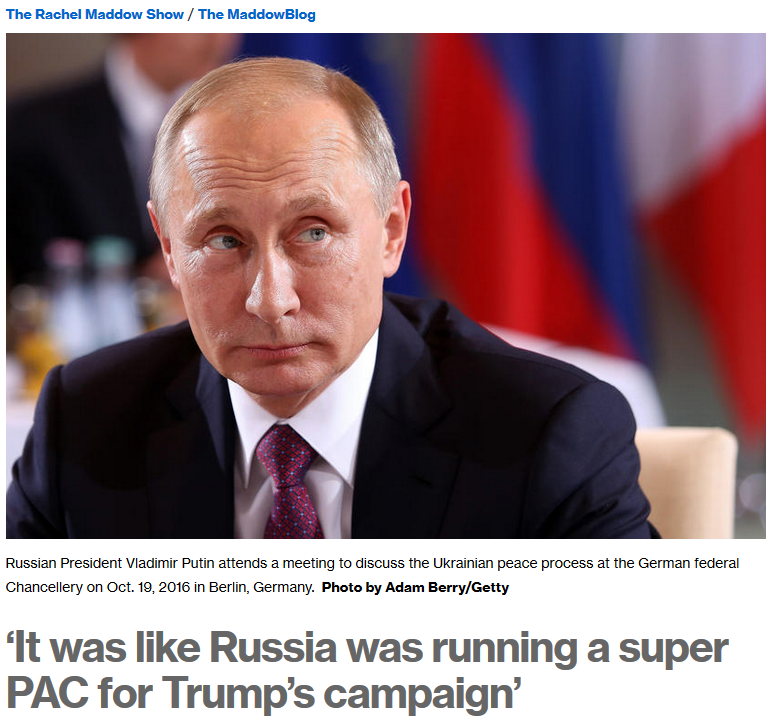
(MaddowBlog, 11/28/16)
As reports debunking or discrediting The List came out, the story continued to spread. Joy Ann Reid (Daily Beast, 11/27/16) alluded to the PropOrNot story to bolster her claim that there was an “alarming consensus of experts” that Russia interfered in the US election by “pumping of fake news and propaganda into the country’s digital bloodstream,” despite no such consensus existing. On Monday, Business Insider (11/28/16) insisted that PropOrNot’s “methods uncover some connections that merit consideration,” while citing only two examples and ignoring all of the major objections advanced by Greenwald, Taibbi et al. Rachel Maddow’s popular blog (MSNBC, 11/28/16) added another breathless write-up hours later, repeating the catchy talking point that “it was like Russia was running a super PAC for Trump’s campaign.”
Despite respected media critics taking the report to task, the Post’s spurious claims are being cemented as conventional wisdom, all the while the writer of the story and his editor refuse to answer direct criticism or reveal who this anonymous person or persons is. What are their motives? Who are their funders? Why is “useful idiot” being propped up by a major news outlet as a useful distinction? Why weren’t those on the blacklist asked to comment? Despite numerous inquiries by The Intercept, Rolling Stone and The Nation (11/28/16), all these questions remain unanswered.
One would think reports on “fake news” would themselves be held to the highest possible editorial standards, if not out of some instinctual desire to avoid high doses of irony and cognitive dissonance, at least to shield against charges of blatant hypocrisy. But increasingly, as the moral panic surrounding “fake news” reaches fever pitch, the standards of skepticism and sourcing employed by some of our most trusted news sources have inversely sunk to tabloid levels.
Adam Johnson is a contributing analyst for FAIR.org. You can follow him on Twitter at @AdamJohnsonNYC.
The group Roots Action has a petition up calling for a retraction of the blacklist story: “Tell the Washington Post: Smearing Is Not Reporting.”
Clinton scheming to seize White House through backdoor
By Robert Bridge | RT | December 2, 2016
Next month, Donald J. Trump, with hand on Bible, will be sworn in as the 45th President of the United States. Or will he? The recent talk about recounting votes and ‘faithless electors’ suggests this highly contentious power struggle is far from over.
In fact, it may be just beginning.
Anybody who believes Hillary Rodham Clinton has been sent to the political graveyard by a Manhattan real estate developer has forgotten the cruel surprises of recent history (Remember the Greek referendum? Brexit anyone?). Democratic due process has devolved into something like ‘The Hunger Games’ for the rich – a sensational televised spectacle to entertain the elite every four years, while keeping the people believing they can effect real change.
Although it may seem implausible to some, Donald J. Trump may be denied the presidency due to a democratic system that has been corrupted to the bone by excessive wealth, power and collusion at the highest levels.
Countdown to disaster?
As the world media continues to eulogize Cuban leader Fidel Castro, the neocon-liberal establishment is quietly positioning their chess pieces for a power grab of epic proportions. As far as I can tell, there are three stages of this silent coup presently being carried out on behalf of Hillary Clinton.
The first step in the process was to perpetuate the news that although Donald Trump won the Electoral College (306-232), he failed to win the popular vote – reportedly by 2.5 million votes, at last count.
Clinton’s alleged victory in the popular vote count, which continued for three weeks after Nov.9 (keep in mind that most of the vote monitors had already went home as these votes were being quietly tallied), could present serious complications for Trump and his chances of entering the White House, as will become clear a bit later.
Meanwhile, the blatantly anti-Trump media is conducting “thought experiments” to show how Clinton would have, could have, should have won the Electoral College if only the Electoral map had been spliced and diced here and there across the nation. The implicit media message behind all of this tomfoolery, of course, is that Wall Street-approved Clinton deserves her coronation, because, well, that is what the elite want, democratic procedure be damned.
This ongoing campaign on behalf of Clinton is much more than just sour grapes; in fact, it is a war of attrition designed to exert undue pressure on the Electoral College, the rickety institution that got Trump elected in the first place. And although it has never robbed an election from a candidate who has gained the majority of Electoral College votes, there is a possibility – and a very high one in this particular battle – of so-called “faithless electors” tipping this contest in Clinton’s favor.
This represents the second stage of Clinton’s attempt at reversing the results of the presidential election in her favor.
Will the Electoral College go rogue?
The Electoral College is scheduled to meet on December 19 to perform what, under normal circumstances, would be a mere formality of voting for either Clinton or Trump, according to the will of their constituents.
Needless to say, we are not dealing with “normal circumstances.”
The 2016 presidential campaign represents an epic power struggle that will determine the trajectory of US domestic and foreign policy like no other contest in recent history. No surprise, then, that neo-liberal lobbying groups have been exerting immense pressure on these electors to ignore the will of the people and “vote their conscience.”
You’d be very wrong to think this couldn’t work. If 37 Republican electors vote against Trump, it will block him from winning the presidency. The Democrat’s team of lawyers and political consultants are now working around the clock to make this happen.
Micheal Baca, a Denver Democrat and a member of the state’s Electoral College delegation, is one of the individuals working to persuade Republican electors to discard the will of the people and vote for anybody but Trump.
Baca makes no secret about his intentions to override the Constitution and go rogue.
“This is not about Hillary,” he said. “This is about trying to stop Donald Trump.”
Let’s take a moment and perform our own “thought experiment” and consider the repercussions if Hillary Clinton is inaugurated as President instead of Trump. If the country is not completely overwhelmed by coast-to-coast riots and protests, and there is somehow a peaceful transition of power, then Clinton can expect to face four years of the most hostile, uncooperative (Republican) Congress in American history (although given the number of neocons who openly support Clinton and her hawkish tendencies, there could be points of agreement).
In a best-case scenario, it would be a four-year-long government shutdown, aside from performing the necessary task of maintaining ‘law and order’ at home while continuing on a war footing abroad. America would get its first real taste of what martial law feels like.
The American Conservative painted the following picture as to what would happen if Trump’s Electoral College victory were rescinded: “Constitutional government would have broken down, and we would be facing something like a Latin American presidential dictatorship. For several years, Washington’s political debate would be reduced to something like a Hobbesian war of all against all.”
Is that something we really need? Apparently it is for some folks, and not least of all Green Party presidential candidate, Jill Stein.
And this brings us to the final stage of a possible Clinton coup.
Civil War, anyone?
It is generally assumed that it was Jill Stein, the Green Party presidential candidate who masterminded the call for a recount of votes in Wisconsin, Michigan, and Pennsylvania. That’s not quite right.
New York magazine reported that on November 17 Hillary Clinton was “urged by a group of prominent computer scientists and election lawyers to call for a recount in three swing states won by Donald Trump… The group is so far not speaking on the record about their findings and is focused on lobbying the Clinton team in private.”
Just one day after the above article appeared (Nov. 22), Jill Stein, who came in dead last with about 3 million votes less than Gary ‘What is Aleppo?’ Johnson, announced she would be collecting money to recount votes in the swing states. By the way, one of the odd things about Stein’s choice of swing states is that these are the same places where Trump emerged victorious. Coincidence or conspiracy theory, that alone should have set off some alarms.
In any case, the reason Stein and not Clinton is calling for the recount is evident: Throughout the campaign, the media hounded Trump with a single annoying question never asked of the future loser: Would he accept the results of the election in the event he lost? When Trump said he would take a “wait and see” approach, Clinton assumed a holier than thou position.
“Now make no mistake,” Clinton solemnly told supporters, “by doing that, he is threatening our democracy. The peaceful transition of power is one of the things that sets us apart. It’s how we hold our country together no matter who’s in charge.”
So now that the tables are turned, Stein is in the kitchen doing the dirty work. And the media suddenly can’t get enough of this woman who haunted the 2016 election like a phantom sighting.
Here’s how News Busters tallied her sudden stardom: “When Jill Stein was the Green Party’s candidate for US president, the networks only gave her 36 seconds of coverage. However, as soon as she launched a campaign to contest the presidential election and demand a recount of ballots in several key states, the evening news shows on ABC, CBS and NBC managed to find 7 minutes and 26 seconds of coverage for her in just four days. That’s more than 12 times as much coverage as in the entire campaign.”
But it gets better. Stein has managed to accumulate a massive war chest to carry out the recount – $7 million at last count (or about seven times what she received during her entire presidential campaign). At one point, her recount drive was pulling in almost $5,000 every minute. Somehow that doesn’t sound like the average Joe Voter digging deep in his Levi’s. Even more mysteriously, when Stein first started passing the hat around, she said $2.5 million would be plenty, thank you very much. Yet every time she hit the target, a higher threshold was introduced. Just can’t keep up with inflation these days!
Is Stein’s campaign simply about collecting some easy money while giving the Green Party some much-needed attention? Or is Stein just trying to shed some much-needed light on the dry rot that is gnawing away at the foundation of US democracy? All that, however necessary, seems very unlikely. After all, the recount plan was initially floated to Hillary Clinton, not Jill Stein. Thus, we must assume this is all part of a major power push for Hillary Clinton to grab the White House from Donald Trump.
As Paul Joseph Watson elegantly put it: “Her entire campaign was backed by an establishment that wouldn’t hesitate to exploit a recount to carry out the vote fraud they thought they didn’t need on Election Day.”
Exactly.
And here is where we can fit the last piece into the puzzle to understand what is really going on here. If the recount effort alone won’t make much of a difference to either Clinton or Stein’s chances of overturning the massive edge that Trump now enjoys, then why are they bothering themselves? Hold onto your seats, folks, this gets interesting.
The answer boils down to simple arithmetic, as well as some monkey play in the system.
Presently, Michigan has already agreed to a recount, which will be carried out this weekend and require hand-counting of ballots in the regions. This process will take many days. Federal law requires the recount to be finished by Dec. 13 – just six days before the Electoral College is expected to cast its votes.
Wisconsin has already agreed to a recount, while Pennsylvania is dragging its feet. In other words, this process will probably take us right up to Dec. 19 – the date the Electoral College is supposed to cast their votes (Why the Electoral College vote isn’t valid without these voters, who could go rogue, is a question for another day).
Keep in mind that the total number of Electoral College Votes in Wisconsin, Michigan, and Pennsylvania equals 46. Now take Trump’s 306 Electoral votes and subtract that amount. This leaves you with 260, which is below the 270 required for a candidate to be automatically considered the winner of a presidential election. Do you see where this is going?
Now if this recount should start to point toward a Clinton victory in these three swing states, this will present Trump with a very serious quandary. Should he kick up a fuss and protest the recount on the grounds that he won the Electoral College, this could provoke some sort of “constitutional crisis” that prevents the recount from being completed by the Dec. 13 deadline.
Now, if the matter remains unsettled by Dec. 19 this could – technically speaking – give the Electoral College’s “faithless electors” yet more reason for not aligning themselves with their constituents. Or, on the other hand, the Wisconsin, Michigan and Pennsylvania votes could be considered forfeited because they failed to resolve the issue by the Dec. 19 deadline.
So if it did come down to this, who do you think will be selected – possibly by the very Supreme Court that Trump hopes to disband once in office – to be the 45th president of the United States?
Yes, Hillary Rodham Clinton, the candidate we have been told got 2.5 million more popular votes than Donald Trump (I would suggest Trump start a serious process to challenge those votes right now).
For those who still doubt this possibility, please consider the two latest failed grassroots movements of our times – Brexit and the Greek referendum – two examples of ‘democracy in action’ that the political elite has de facto canceled or put on hold indefinitely.
Such dramatic setbacks, which are becoming the rule rather than the exception, lend credence to Mark Twain’s famous observation that “If voting made any difference they wouldn’t let us do it.”
In other words, the elite will always get what they want, regardless how the votes goes.
Clinton seizing the White House through the backdoor would not be the strangest thing to happen in old Washington. Just ask George W. Bush how he got elected president in 2000 by the Supreme Court, not We the People.
Robert Bridge is an American writer and journalist based in Moscow, Russia. His articles have been featured in many publications, including Russia in Global Affairs, The Moscow Times, Lew Rockwell and Global Research. Bridge is the author of the book on corporate power, “Midnight in the American Empire”, which was released in 2013. email: robertvbridge@yahoo.com
Trump Calls For Punishing Those Who Burn The American Flag
By Jonathon Turley | November 29, 2016
Donald Trump has set off a new controversy with a signature early morning tweet. Trump lashed out at those who burn American flags and said that they should be punished for their actions. The problem is that this question was already answered by the Supreme Court, which found that such acts (while despicable) are constitutionally protected under the First Amendment to the United States Constitution.
Early this morning, Trump went on Twitter to say: “Nobody should be allowed to burn the American flag – if they do, there must be consequences – perhaps loss of citizenship or year in jail!”
I have long been critical of those who burn our flag, which I view as a symbol of our constitutional freedoms and the sacrifice of generations to preserve this Republic. However, there are many things that people say or do that I find disturbing or insulting. That does not alter the fact that they are protected expressions of free speech.
President-Elect Trump does not appear to see it that way. Yet, both the Constitution and the Supreme Court stand in the way of punitive measures for flag burners. Having said that, Trump’s view has been shared by various justices in history including such liberal icons as Chief Justice Earl Warren in his dissenting opinion in Street v. New York, 394 U.S. 576 (1969). Likewise, Hillary Clinton supported such a law in 2005.
Nevertheless, in the United States, the destruction of the flag is a protected form of free speech. In Texas v. Johnson, 491 U.S. 397 (1989), the Supreme Court voted 5-4 that flag burning was protected speech under the First Amendment to the United States Constitution. It is considered one of the core cases defining free speech in the United States. Brennan was joined by Marshall, Blackmun, Scalia, and Kennedy (Kennedy wrote a concurrence). I agree with the decision as did conservatives like Scalia, who Trump has expressed great admiration for. Justice Anthony Kennedy wrote a powerful concurrence where he famously stated:
Justice Kennedy wrote a concurrence with Brennan’s opinion.[3] Kennedy wrote:For we are presented with a clear and simple statute to be judged against a pure command of the Constitution. The outcome can be laid at no door but ours. The hard fact is that sometimes we must make decisions we do not like. We make them because they are right, right in the sense that the law and the Constitution, as we see them, compel the result. And so great is our commitment to the process that, except in the rare case, we do not pause to express distaste for the result, perhaps for fear of undermining a valued principle that dictates the decision. This is one of those rare cases.
Though symbols often are what we ourselves make of them, the flag is constant in expressing beliefs Americans share, beliefs in law and peace and that freedom which sustains the human spirit. The case here today forces recognition of the costs to which those beliefs commit us. It is poignant but fundamental that the flag protects those who hold it in contempt.
Congress has shown the same opposition to the decision as Trump. It passed the 1989 Flag Protection Act to make it a federal crime to desecrate the flag. That law was struck down in United States v. Eichman, 496 U.S. 310 (1990). The Court ruled that “the Government may not prohibit the expression of an idea simply because society finds the idea itself offensive or disagreeable.”
Various congressional members have also sought to pass a constitutional amendment on flag desecration but the proposed amendment has failed in the Senate. It has been ten years since the last serious effort has been made for an amendment on the issue. Trump aides might argue that he was not questioning the legitimacy of the decision but supporting a constitutional amendment.
I understand Trump’s anger and I indeed share it when I see the flag burned. However, you do not protect the flag by diminishing the very thing is represented: our constitutional freedoms.
Of course, while Trump cannot change the meaning of the Constitution, he can change the make up of the Court (or support a Flag-Desecration Amendment). Ironically, by replacing Scalia with someone who does not hold as strong a belief in First Amendment rights, he could shift the vote toward a reversal of the 1989 precedent. I hope that that is not the case. It could place this country on a slippery slope of criminalized speech. I prefer to live in a country where tweets and protests are both given ample protection.
The Corporate Media’s Gulag of the Mind
By Charles Hugh Smith | of two minds | November 28, 2016
Your crime, as it were, need not be substantiated with evidence; the mere fact you publicly revealed your anti-Establishment thought convicted you.
One of the most remarkable ironies of The Washington Post’s recent evidence-free fabrication of purported “Russian propaganda” websites (including this site) is how closely it mimics the worst excesses of the USSR’s Stalinist era.
Those unfamiliar with the Stalinist era’s excesses will benefit from reading Solzhenitsyn’s three-volume masterpiece The Gulag Archipelago: 1918-1956, The Gulag Archipelago 2 and Gulag Archipelago 3.
One episode is especially relevant to the totalitarian tactics of The Washington Post’s evidence-free accusation. Solzhenitsyn tells the story of one poor fellow who made the mistake of recounting a dream he’d had the previous night to his co-workers.
In his dream, Stalin had come to some harm. In Solzhenitsyn’s account, the fellow was remorseful about the dream.
Alas, mere remorse couldn’t possibly save him. He was promptly arrested for “anti-Soviet thoughts” and given a tenner in the Gulag–a tenner being a ten-year sentence in a Siberian labor camp.
The Washington Post’s accusation is based on a “behavioral analysis”–in other words, publicly sharing “anti-Soviet thoughts”–in our era, the equivalent is sharing anti-Establishment thoughts.
Your crime, as it were, need not be substantiated with evidence; the mere fact you publicly revealed your anti-Establishment thought convicted you.
This is the Corporate Media’s Gulag of the Mind. We’ll tell you what’s “true” and what is correct to think and believe. Any deviation from the party line is a threat and must be discredited, marginalized or suppressed.
Where is the Post’s hard evidence of Russian ties or Russian influence? There isn’t any–but like Stalin’s henchmen, the Post has no need for evidence: merely going public with an anti-Establishment thought “proves” one’s guilt in the kangaroo court of America’s corporate media (a.k.a. mainstream media or MSM).
While The Washington Post is owned by billionaire Amazon founder Jeff Bezos, the vast majority of what we read, watch and hear is controlled by a handful of corporations loaded with cash and connections to the ruling elite.

This concentration of media control creates the illusion of choice— the same elite-propaganda spin is everywhere you look; our “choice” of “approved” (i.e. corporate) media is roughly the same as that offered the Soviet citizenry in the old USSR.
This is why the billionaire/corporate media is so desperate to discredit the non-corporate media: if an alternative to the corporate media’s elite-propaganda catches on, the corporate media will lose its audience, its advert revenues and a substantial measure of its influence.
The cornered elite-propaganda beast is lashing out, undermining its waning credibility with every attack on an independent free press. As I noted in a recent conversation with Max Keiser, democracy requires the citizenry to sort out who benefits from whatever narrative is being pushed.
That’s what terrifies the elite-propaganda mainstream media: the status quo narrative they’ve spewed for years doesn’t benefit the bottom 95% — rather, it actively impoverishes and disempowers the bottom 95%–and the citizenry is slowly awakening to this reality.
So for goodness sakes, if you have an anti-elitist dream, keep it to yourself or you’ll end up on the ruling elite’s “enemies list.”
The final irony in all this: the real enemy of democracy and freedom of the press is The Washington Post and the rest of the billionaire/corporate media. The only way to escape the Corporate Media’s Gulag of the Mind is to stop watching their TV channels, turn off their radio stations and stop reading their print/digital propaganda–except of course if you have a taste for dark humor.
Check out both of my new books, Inequality and the Collapse of Privilege ($3.95 Kindle, $8.95 print) and Why Our Status Quo Failed and Is Beyond Reform ($3.95 Kindle, $8.95 print). For more, please visit the OTM essentials website.
‘Beacon for despots everywhere’: Britain’s ‘extreme’ surveillance bill becomes law
RT | November 29, 2016
Britain’s intelligence services have officially been given the most wide-ranging and privacy-invading mass surveillance powers in the world, according to critics, after the Investigatory Powers Act became law on Tuesday.
The legislation, dubbed the ‘snooper’s charter,’ authorizes the government to hack into devices, networks and services in bulk, and allows for large databases of personal information on UK citizens to be maintained.
It requires internet, phone and communication app companies to store customers’ records for 12 months and allow authorities to access them on demand.
That data could be anything from internet search history, calls made or messages sent, and will be available to a wide range of agencies, including the Department for Work and Pensions as well as the Food Standards Agency.
Security agencies will also be able to force companies to decrypt data, effectively placing limits on the use of end-to-end encryption.
Home Secretary Amber Rudd has hailed the legislation as “world-leading,” saying it provides “unprecedented transparency and substantial privacy protection.”
The Home Office says the “landmark” law “sets out and governs the powers available to the police, security and intelligence agencies to gather and access electronic communications.”
In a statement, the department said the law “brings together and updates existing powers while radically overhauling how they are authorized and overseen.”
Not all the powers available in the act will be rolled out immediately. Some require testing so will not be ready for some time, the Home Office says.
The legislation has been divisive since it was first published, and was opposed by tens of thousands of people in a recent petition.
Civil liberties group Liberty told the Independent the law served as a “beacon for despots everywhere.”
“It’s a sad day for our democracy as this bill, with its eye-wateringly intrusive powers and flimsy safeguards, becomes law,” said Bella Sankey, the group’s policy director.
“The government has a duty to protect us, but these measures won’t do the job. Instead they open every detail of every citizen’s online life up to state eyes, drowning the authorities in data and putting innocent people’s personal information at massive risk.
“This new law is world-leading – but only as a beacon for despots everywhere. The campaign for a surveillance law fit for the digital age continues, and must now move to the courts.”
Privacy campaigners say the law will provide an international standard to authoritarian regimes around the world to justify their own intrusive surveillance powers, and could be a breach of human rights.
EU resolution on ‘Russian propaganda’ is attack on media freedom & stinks of hypocrisy

By Danielle Ryan | RT | November 24, 2016
There’s news. There’s fake news. And then there’s “pseudo” news, which according to the European Parliament, encompasses any Russian media which doesn’t adhere to a Western narrative and neglects to present an entirely pro-EU perspective on world events.
In a completely bonkers move this week, the EU Parliament approved a resolution to counter “Russian propaganda” and the “intrusion of Russian media” into the EU. The resolution was adopted with 304 MEPs voting in favor, 179 MEPs voting against it and 208 abstaining. The most bizarre part, however, is that the resolution lumped Russian media in with Islamist propaganda of the kind spread by terror groups like the so-called Islamic State. Thus Russian media is put on the same level with videos of ISIS beheadings and incitements to mass murder.
According to the resolution, Russian media exists to “undermine the very notion of objective information or ethical journalism,” and one of its methods is to cast all other information “as biased or as an instrument of political power.”
The real hypocrisy here is that this last part almost exactly describes how Brussels regards any media critical of its own actions. The resolution criticizes channels like RT for casting other news sources as biased or as instruments of political power while smearing anyone who associates with the Russian media as Kremlin puppets, bought and paid for by Vladimir Putin — and yet the irony appears completely lost on them.
Act as I say, not as I do
The totally barmy resolution also “notes with regret” that Moscow uses meetings with EU counterparts only for propaganda purposes, rather than for establishing a “real dialog” with Brussels. Another statement ripe with irony, given Brussels just a couple of weeks ago hosted an EU-Russia summit, the aim of which was to foster “mutual understanding” between Russia and the EU — without inviting any representatives of the Russian government. Instead, they asked obscure and practically unknown opposition figures with zero power or influence inside Russia. As noted by RT columnist Bryan MacDonald, this would be like Brussels hosting a summit to discuss the future of the United States and inviting the Green Party’s Jill Stein while ignoring the two parties that actually hold power. Under Brussels’ own definition, one could easily argue that the EU is trying to “undermine political cohesion” in Russia just as it accuses Moscow of doing in Europe.
Unfortunately, this ludicrous report is not a one-off. It appears to be part of an all-out attack on the Russian media coming from every angle. One of the most surprising developments comes from the organization Reporters Without Borders (RSF), which apparently prides itself on protecting journalists and press freedom worldwide. RSF has declared that it will no longer give interviews to any reporters from the Rossiya Segodnya group, which includes RT and the Sputnik news agency.
Similarly, a couple of weeks ago US State Department spokesman John Kirby refused to acknowledge an RT reporter as being on an equal footing with other journalists in the briefing room. Kirby point blank refused to treat Gayane Chichakyan as being “on the same level” because she represented a “state-owned” outlet — despite AP reporter Matt Lee stepping in to defend her.
Now, while RT may be state-funded, one very much doubts that Kirby would chastise a reporter from, say, the virulently anti-Russia BBC, whose Trust members are all appointed by the Queen on the advice of UK government ministers. He probably also doesn’t worry too much about US government-funded media like the CIA-founded RFE/RL, which operates for the exclusive purpose of undermining the Russian government and spreading pro-US information. Around the same time as Kirby’s comment, RT’s video agency Ruptly was banned from attending a Pentagon media event because the agency is a “Russian propaganda platform.”
Now, if RT was spreading false information, all these concerned think tankers, government agencies, and politicians might have a point. But you would be hard-pressed to turn on RT any day of the week and hear one of its anchors spreading blatant lies. You might hear a different editorial slant than you would on CNN, but in a world dominated by Western corporate media, alternative viewpoints are necessary and refreshing.
McCarthyism goes global
Meanwhile, the British Parliament is set to hear another report denouncing public figures for their alleged links to Russia and the Russian media. Neo-McCarthyism has indeed gone global. The British report, cautiously and tastefully named ‘Putin’s Useful Idiots’ was written by Andrew Foxhall of the notorious neocon think tank the Henry Jackson Society. The report challenges the credibility of politicians or public figures who appear sympathetic to Russia and proposes a crackdown on such individuals.
The British report even suggests news laws which could force politicians to declare all of their media appearances, presumably so those who appear on the likes of RT can be smeared as Kremlin agents and Putin’s puppets.
This is incredible and truly worrying. What is going on here should not be confused with anything to do with protecting democracy and the credibility of journalism. In fact, what the EU is doing is engaging in an all-out attack on journalism, much the same way they would accuse unfriendly governments of cracking down on the spread of information that did not suit the prevailing narrative. But dangerously, they are doing it under the guise of concern for democratic principles and values.
These people are suggesting it is nothing short of treasonous to hold an opinion that goes against the acceptable government-sanctioned consensus. In any other part of the world, this is the kind of mentality and action that Brussels and London criticize as a severe violation of media freedom and nothing short of state repression.
If the European project is solid as a rock, surely Brussels has nothing to worry about. But if a couple of Russian media outlets present such a grave threat to its existence, there must be some serious cracks in the foundations. Ultimately, it speaks to the fragility of the union that the EU so quickly throws its “values” out the window when the going gets tough.
Danielle Ryan is an Irish freelance writer, journalist and media analyst. She has lived and traveled extensively in the US, Germany, Russia and Hungary. Her byline has appeared at RT, The Nation, Rethinking Russia, The BRICS Post, New Eastern Outlook, Global Independent Analytics and many others. She also works on copywriting and editing projects. Follow her on Twitter or Facebook or at her website http://www.danielleryan.net.
Academic among 7 Palestinians from West Bank kidnapped by Israeli forces
Palestine Information Center – November 24, 2106
 WEST BANK – The Israeli occupation army (IOF) kidnapped seven Palestinians, including an academic, from West Bank provinces at dawn Thursday.
A PIC news correspondent said the IOF rolled into the An-Najah Campus dormitory in al-Maajin neighborhood, in western Nablus, and wreaked havoc on the apartment of lecturer Issam Rashed al-Ashqar, 57, before they kidnapped him and seized his car.
Al-Ashqar, an ex-prisoner, is a lecturer at the Physics Department at An-Najah University. He had previously been sentenced to several prison-terms, mostly in administrative detention, without charge or trial. He has also been diagnosed with health disorders.
The Israeli occupation army further kidnapped the two Palestinian citizens Amjad Abu Sbeih and Yazen al-Basiti from their own family homes in Jerusalem’s Old City.
The IOF stormed Jenin’s western towns of Anin and Zabouba and cracked down on Palestinian drivers in the eastern outskirts of the city.
A PIC reporter quoted eyewitnesses as stating that the IOF kidnapped the citizen Abdul Nasser Mohamed Yassin, 42, from Anin village after they ravaged his home and subjected the family to intensive questioning.
A military checkpoint was pitched by the IOF near the main entrance to Zabouba town.
The campaign culminated in the abduction of other Palestinians from Nablus, al-Khalil, and Bethlehem’s town of Beit Fajjar.
Major Media Crash: They Need A Scapegoat
By Jon Rappoport | Activist Post | November 20, 2016
They kept telling the American people Hillary Clinton was going to win the election; and in every way they could think of, they told the American people this was a good idea.
 Then, on election night, they, the media, crashed.
The results came in.
The media went into deep shock.
As protests and riots then spread across America, the media neglected to mention a) they’d been bashing Trump because he said he might not accept the outcome of the vote, and b) here were large numbers of people on the Democrat side who weren’t accepting the outcome of the vote.
A new campaign had to be launched.
Suddenly, on cue, it was: Hillary Clinton lost because “fake news” about her had been spread around during the campaign.
Fake news sites. That was the reason.
These “fake sites” had to be punished. Somehow. They had to be defamed. Blocked. Censored.
Here is an excerpt from a list of “fake news” sites suggested by one professor. The list is circulating widely on the Web: Project Veritas; Infowars; Breitbart; Coast To Coast AM; Natural News; Zero Hedge; The Daily Sheeple; Activist Post; 21st Century Wire.
Free speech? Bill of Rights? Never heard of it.
Obama put in his two cents: “Because in an age where there’s so much active misinformation and it’s packaged very well and it looks the same when you see it on a Facebook page or you turn on your television… If everything seems to be the same and no distinctions are made, then we won’t know what to protect.”
Excuse me. “We won’t know what to protect?” Meaning what to favor, what to promote, what to lie about? Meaning only some speech is free?
Obama is way, way behind the curve. Thousands of websites and blogs have been exposing major media as fake for years. I started nomorefakenews.com in 2001.
If Google, Facebook, and Twitter keep expanding their censorship of “disfavored messages,” they’re going to pay a price. More and more users will go elsewhere.
The facade of the major media is getting thinner. You can see a glow of rage and resentment behind it. They’re desperately looking for revenge on the millions and millions of people who are deserting them and laughing at them.
They presumed too much. They presumed they had us in the palm of their hand. We were their property. We were transfixed by their authority.
All that is going away. Bye, bye.
The big shift is accelerating. Independent media are in the ascendance. Understand that. Recognize it.
The impossible is happening.
Fake news sites? Please. The major media are the biggest fakes the world has ever seen. Their anchors and star reporters are bloviating cranks. They’re dinner-theater actors.
Over the years, I’ve talked to some of them. I’ve warned them of their coming troubles. They were miles away from believing me. Now, they’re starting to sweat blood.
Major media news for America is still basically manufactured in New York and Washington—plus occasional outbursts from Hollywood creatures who bemoan the decline of inclusive liberalism, as they expand their gun-toting security staffs and dig deeper bunkers. The New York-Washington axis exists in a self-serving bubble, which has now taken serious punctures. The delusional attacks against “fake sites” underlines how out of touch these elites are with the rest of the country.
Independent media outlets are winning. They won’t be stopped.
When the people who now head the tech giants were growing up, they were heralding the Internet as a new era of free information-exchange. But now that they find themselves working with the government in the Surveillance State, they’re fronting for censorship. In fact, they’re showing they were never for freedom. That was a pose all along. They were, from the beginning, agents of repression. They can try to stop independent media now, but they will fail.
Fake web sites? What about fake companies? What about Google, Facebook, Twitter? Behind their happy-happy messages, they were built to propagandize, profile, and control.
Understand this: major media have a rock-bottom article of faith. It is: “We own the news.”
They can’t give it up. They’ll never give it up. It fuels everything they do. It’s the substance and core of their attitude.
As their ship goes down below the waves, they’ll be chanting it. “We own the news.”
But they don’t. In truth, they never did. For a time, they managed to sell that delusion to the people.
That time is drawing to a close.
The elite political class and their media minions fear more than independent news countering their own news. For obvious reasons, every civilization down through history has had its own monopolistic media, its central “broadcasting system.” Its controlled outlet. But now, The One has become Many.
That is the threat.
The rapid proliferation of The Many is an unpredictable X-factor.
The population is waking up to decentralized media. Instead of the hypnotic attachment to one basic information source — the habit of a lifetime — the public is learning to handle multiple sources. Therefore, the hypnotic spell is being broken and dissolved.
This is the basic problem for the elites.
How can they reinstate the trance?
By trying to censor the Internet? By creating a sudden war or other disaster, briefly “unifying” the country? These are not permanent solutions, particularly since more and more people understand such maneuvers and their true aims.
Awake is awake. Putting the genie back in the bottle—particularly when major media denizens aren’t very bright, as evidenced by their latest “fake news” scam—is on the order of trying to perform a piece of stage magic after the audience has already learned how it’s done.
Of course, the media clowns will try. And in the process, they’ll further expose themselves and actually assist in the awakening.
Boom.
Image Credit: TruthandArtTV
Israeli Bid to Silence Mosque Prayer Calls Revived
Al-Manar | November 23, 2016
A controversial Israeli bill to silence the Muslim call to prayer is to go forward after it was amended so as not to affect the Jewish Shabbat siren, the speaker’s office said Wednesday.
Health Minister Yaakov Litzman, an ultra-Orthodox Jew, had blocked the draft law in its original form for fear it would also force the toning down of the sirens that announce the start of the Jewish day of rest at sundown each Friday.
But he lifted his objections after it was amended to apply only between 11 pm and 7 am.
The bill will “probably” now be put to a preliminary vote in parliament “next week,” a spokesman for speaker Yuli Edelstein told AFP.
It will then require three further parliamentary votes before it becomes law but it has already sparked outrage around the Arab and wider Muslim world.
Even Israeli government watchdogs have slammed the proposed legislation, describing it as a threat to religious freedom and an unnecessary provocation.
Arab Israeli lawmaker Ahmed Tibi has vowed to appeal to the High Court of Justice if the Shabbat siren is excluded from the scope of the bill on the grounds that it discriminates between Jews and Muslims.
The law would apply to mosques in annexed Arab east al-Quds (Jerusalem) as well as the occupied territories. But supersensitive Al-Aqsa mosque compound — Islam’s third holiest site — will be exempted.
“No changes will be made on” al-Aqsa Mosque an Israeli official told AFP.
Featured Video

The Search for Truth: Charlie Kirk’s Assassination One Year Later
or go to
Aletho News Archives – Video-Images
From the Archives
The 9/11 “Double-Cross” Conspiracy Theory
BY LAURENT GUYÉNOT • UNZ REVIEW • SEPTEMBER 6, 2022
Is it true that “9/11 was an inside job”? Yes, insofar as Israel is “inside” the U.S. But for the 9/11 truthers who have identified Israel as the main perpetrators, “9/11 was an inside job” is at best a half-truth, and at worst an integral part of the Zionist operation, like a secondary flag sewn as a lining under the false flag of Islamism. Victor Thorn (1963-2017) wrote in his book 9/11 made in Israel: The Plot Against America (2011): “In essence, the ‘9-11 truth movement’ was created prior to Sept. 11, 2001 as a means of suppressing news relating to Israeli complicity. . . . The slogan ‘9-11 was an inside job’ was quite possibly the greatest example of Israeli propaganda ever devised.” In milder terms, it is “controlled opposition”.
A genuine truth movement would have pointed to Israel as the prime suspect from the start. From day one, it was obvious who would benefit. … continue
Blog Roll
 Aletho News
- Europe’s mounting social chaos… chickens coming home to roost for proxy war against Russia
- US-Russia Diesel Deal Becomes Massive Defeat for Ukraine
- Hormuz and the Looming Economic Catastrophe
- Dhubab offensive, media blitz and the rapid unraveling of Saudi-backed coalition’s new gambit
- Putin Conveys to Trump Iran’s Vision on Possible Conflict Resolution – Kremlin
- The Search for Truth: Charlie Kirk’s Assassination One Year Later
- ‘Harsh reality’: Iran says France seeks monopoly on power and intimidation, not peace for all
- When Will This White House Madness End?
- Huckabee aide goes to ‘unusual lengths’ to portray ‘Israel’ positively
- Trump Announces Diesel Supply Deal With Putin Following Phone Call
- If Americans Knew
- Israeli forces kill another child in Gaza – Daily Update
- Gaza ceasefire exists in name only, say more than 100 organizations
- Nearly 2 Million in Gaza Need Urgent Shelter Assistance as Winter Looms: IOM Chief Warns
- Suppressing Palestinian resistance: US charity under fire for AI monitoring of Gaza classrooms
- Thousands Are Held in Israeli Torture Camps. This Is What Happens Inside
- Israel puts Gaza’s sick, injured, newborn in peril – Daily Update
- Report claimed Mark Levin used by Israeli government to influence Trump
- Over 2,000 Gazans have died awaiting medical evacuation amid Israel’s continued siege
- How a U.S. Diplomat Suppressed and Altered Reports Critical of Israel
- 5 Palestinians Die from Israeli Strikes in Gaza as Relentless Attacks Continue
- No Tricks Zone
- New Study: 50 Years Of The Most Aggressive ‘Net Zero’ Policies Can Only Affect The Global Climate By 0.03°C
- US September “Heat” Was No Record…Many Records Set Decades Ago
- Latest European Green Energy Debacle; Portugal’s Largest Flagship Solar Park Insolvent!
- Green Energy Debacle: German Expert Professor Fritz Vahrenholt Warns Of Severe Economic And Social Consequences
- Two More Paleo Reconstructions Affirm Meters-Higher Sea Levels Across Ireland, Brazil 7000-6000 Years Ago
- New Study: Earth And Venus Surface Warmth Largely Explained By Convection And Lapse Rate, Not CO2 Or Radiation
- 2025 Nature Paper Claiming Worsening Global Drought Gets RETRACTED …Heavily Flawed
- New Study: ‘Global Drought Shows No Detectable Recent Acceleration Under Climate Warming’
- Economic Masterminds: German Socialists Suggest Taxing Productivity Gains Stemming From Using AI
- The South China Sea Has Not Been Cooperating With The Climate Change Narrative

