At it Again: Law Enforcement Officials’ Anti-Encryption New York Times Op-Ed
By Jamie Williams | EFF | August 12, 2015
Yesterday, Manhattan District Attorney Cyrus Vance, Jr. and law enforcement officials from Paris, London, and Madrid published an anti-encryption op-ed in the New York Times—an op-ed that amounts to nothing more than a blatant attempt to use fear mongering to further their anti-privacy, anti-security, and anti-constitutional agenda. They want a backdoor. We want security, privacy, and respect for the Fourth Amendment’s guarantee that we be “secure” in our papers. After all, the Founding Fathers were big users of encryption.
The government’s use of horror stories to convince us that we should unlock our doors and give it free reign to pry inside our lives is nothing new. FBI Director James Comey is notorious for his examples of how cell-phone encryption will lead law enforcement to a “very dark place.” Yesterday’s op-ed adopts Comey’s signature tactic, focusing on the fatal shooting of a man in Illinois in June of this year and suggesting—without any evidence—that but for encryption built into both of the victim’s two phones (both found at the crime scene), police would have been able to track down the shooter. Never mind that of the two devices mentioned in the article, one of them (the Samsung Galaxy S6) isn’t actually encrypted by default.
The op-ed goes on to cite numerous other “examples,” again divorced from any actual facts, of cases in which encryption supposedly “block[ed] justice”—including 74 occasions over a nine-month period in which the Manhattan district attorney’s office encountered locked iPhones. Vance has touted this statistic before. But a spokesperson for his office told Wired last month that the office handles approximately 100,000 cases in the course of a year, meaning that officials encountered encryption in less than 0.1% of cases. And Vance has never been able to explain how even one of these 74 encrypted iPhones stood in the way of a successful prosecution.
The op-ed faults Apple and Google for attempting to offer their customers strong, user-friendly encryption. An iPhone with iOS8 automatically encrypts text messages, photos, contacts, call history, and other sensitive data though the use of a passcode. But contrary to the suggestion of the op-ed’s authors, Google has already backed off its promise to offer its users encryption by default, and Google would have been able to unlock the specific model of Samsung phone at issue.
But what’s more important than the op-ed’s shortage of facts is how out of touch it is with not only the fundamental importance of encryption and how encryption works, but also the U.S. Constitution.
The op-ed calls for an “appropriate balance between the marginal benefits of full-disk encryption and the need for local law enforcement to solve and prosecute crimes.” This single sentence demonstrates the numerous ways in which the authors are untethered from reality.
First, the benefits of encryption are in no way “marginal”—unless you view ensuring the privacy and security of innocent individuals across the globe as trivial goals. The authors here reveal their failure to appreciate the need for encryption to protect against not only security breaches, but also criminals (the folks they are supposed to be protecting us from) and of course pervasive and unconstitutional government surveillance.
Second, when the authors say they want an “appropriate balance,” what they are really asking for is a backdoor—or golden key—to allow government officials to decrypt any encrypted messages. As The Intercept explained in an article outlining the many things wrong with the op-ed, Vance and his counterparts in Paris, London, and Madrid are “demand[ing]—in the name of the ‘safety of our communities’—a magical, mathematically impossible scenario in which communications are safeguarded from everyone except law enforcement.”
We’ve said it before and we’ll say it again: It is technologically impossible to give the government an encryption backdoor without weakening everyone’s security. Computer scientists and cybersecurity experts agree, and have been telling the government as much for nearly two decades. And earlier this year, one Congressman with a technical background called encryption backdoors “technologically stupid.” Everyone who understands how encryption works agrees.
Third, law enforcement isn’t currently and won’t in the future “go dark” as a result of encryption. The government voiced the same concerns over encryption stifling criminal investigations during the Crypto Wars of the 1990s—i.e., Crypto Wars, Part I—which saw efforts by the government to prevent the development and distribution of strong consumer encryption technologies. (Protecting your ability to use strong encryption was one of EFF’s very first victories.) Such concerns have proven to be unfounded in the past. Just a few weeks ago, former NSA director Mike McConnell, former Homeland Security director Michael Chertoff, and former deputy defense secretary William Lynn—in a Washington Post op-ed in support of ubiquitous encryption—remarked that despite losing Part I of the Crypto Wars,
[T]he sky did not fall, and we did not go dark and deaf. Law enforcement and intelligence officials simply had to face a new future. As witnesses to that new future, we can attest that our security agencies were able to protect national security interests to an even greater extent in the ’90s and into the new century.
The same is true today. And as the former national security officials recognize, “the greater public good is a secure communications infrastructure protected by ubiquitous encryption at the device, server and enterprise level without building in means for government monitoring.”
At its core, yesterday’s op-ed demonstrates a fundamentally different vision for the future than the one we have here at EFF. Our vision is for a world where the privacy of communications are protected and where we can use the best tools possible to protect it. The vision of Vance, Comey, and others in the anti-encryption camp is for a world where no one is secure and where everyone is vulnerable. Their vision is not consistent with reality. And we hope the public is not swayed by their fear tactics.
Steven Salaita, Palestine and Free Speech

By Margaret Kimberley | Black Agenda Report | August 12, 2015
Steven Salaita is a renowned academic in the field of Native American Studies. That is why the University of Illinois at Urbana-Champaign (UIUC) hired him in 2013 as a tenured associate professor in the American Indian Studies Program. Salaita resigned from his previous position and had every reason to believe that he was on his way to Illinois. However he was terminated on August 1, 2014.
In the summer of 2014 Israel was in the midst of a murderous campaign in Gaza which killed more than 2,000 people, including 500 children. Steven Salaita is a Palestinian-American and like millions of people he vented anger and outrage as the horrific war crime continued. His posts on twitter garnered the attention of the administration and donors at the University of Illinois and he was fired before he even began working.
From the beginning Salaita waged a courageous fight to prove that he was in fact already an employee and to see that the university paid a price for mocking academic freedom, ruining his career and upending his personal life. He has succeeded in some of those efforts. The university experienced nearly universal condemnation and was censured by the American Association of University Professors for violating the principles of academic freedom. In addition, prominent persons such as Cornel West are boycotting the University of Illinois and have cancelled appearances in support of Salaita’s struggle.
UIUC has been on the losing end of the court battle, with one judge ordering the university to release emails related to the case and another ruling that Salaita’s lawsuit can proceed. That decision renders as patently false the university’s claim that he was not yet an employee. Salaita is enjoying legal victories and has secured a temporary position at the American University in Beirut, but his difficult experience points out that in America speech isn’t so free if powerful interests are taken to task.
Criticism of Israel is the third rail in American life. Politicians dutifully toe the line and either praise Israel without question or say nothing and hope to be unnoticed. Even local elected officials who have no role in foreign policy secure campaign funds and protection from political challengers if they support Zionism. They may face defeat should they do otherwise.
The Salaita case shows the insidious nature of the censorship that is imposed from without which inevitably creates self-censorship for millions of people. Even as Israel wages a very public campaign against congressional approval of the P5+1 nuclear energy agreement with Iran, the president still gives words of support to a country which boldly and blatantly interferes with his policy agenda.
Not only did president Obama praise Israel even after he was publicly humiliated by Prime Minister Benjamin Netanyahu, but he claimed an equivalence between that country’s apartheid system and the black American struggle for freedom. Among the many shameful things he has said in his political life that is among the worst.
Taking on Israel in a public forum is a daunting task. The rules may be unwritten but they are real and Salaita’s experience is not lost on others. There is no other issue that engenders so much fear, silence and acquiescence. So great was the fear of retribution that the university’s trustees and administration made a decision which they should have known would come back to haunt them. Such incompetence only happens in an institution operating in a state of corrosive group think, outside pressure and systemic rot.
The university has spent more than $843,000 in public money to defend its losing cause. The soon to be former chancellor and other staff tried to hide their dirty work by using personal email addresses and not just in regards to the Salaita case. This inherently unethical behavior was meant to thwart any search for public information but shoes have begun to drop as more wrong doing comes to light. Chancellor Phyllis Wise, who orchestrated the firing, recently resigned but she will still have a $300,000 faculty salary and receive a $400,000 golden parachute.
When Salaita chose to fight for his right to work and to speak freely he revealed a lot more about the rotten state of academia and its connections with wealthy donors. Even public institutions are beholden to big money and live in fear of losing favor and funding. In an era of triumphant neo-liberalism everything is a commodity, including higher education.
Salaita could have condemned any country other than Israel using the same language and would not have lost his job. Such is the power of Zionism and its defenders. They have what amounts to a gangster protection racket, enforced not with guns but with money and positions for those who go along. Those who don’t are made to suffer.
The right to speak freely does not extend to everyone in this country, but then again it never did. Because of people like Steven Salaita some of that injustice is out in the open for all to see. American politicians, the corporate media, and big universities may still genuflect in Israel’s direction but that obedience shouldn’t extend to every citizen. Salaita is fighting not just for himself, but for true democracy for everyone.
Margaret Kimberley’s Freedom Rider column appears weekly in BAR, and is widely reprinted elsewhere. She can be reached via Margaret.Kimberley(at)BlackAgendaReport.com.
NY prison inmates suffered beatings, retaliation after historic escape – report
RT | August 12, 2015
After two inmates escaped from Clinton Correctional Facility, those who stayed endured a “campaign of retribution” by correctional officers, with dozens reporting secret beatings and other abuses, according to a New York Times report.
Richard Matt and David Sweat, convicted killers who shared a cell in the maximum security prison in New York, broke free on June 6. Their escape triggered a massive manhunt, which resulted in Matt killed and Sweat injured and captured three weeks later.
Prison worker Joyce Mitchell was arrested and pled guilty to providing the tools that allowed Matt and Sweat to cut through their cell wall and get away. Another faces criminal charges over contraband while nine officers have been suspended and the leadership of the prison has been removed in the wake of the escape.
But in the days after Matt and Sweat left the facility it was their fellow inmates who suffered at the hands of correctional officers, the New York Times reported. Dozens reported being handcuffed and beaten by officers demanding information about the escape.
One prisoner, Patrick Alexander, was handcuffed and taken to a broom closet, where three corrections officers he didn’t know interrogated him, he told NYT.
“The officer jumps up and grabs me by my throat, lifts me out of the chair, slams my head into the pipe along the wall,” he said. “Then he starts punching me in the face. The other two get up and start hitting me also in the ribs and stomach.”
When he repeatedly denied having any information, the officer conducting the interrogation threatened to waterboard him, he said.
Victor Aponte worked in the prison tailor shop, where Matt also had a job. He described undergoing a similar interrogation, saying one guard tied a plastic bag around his neck and used it as a hanging noose.
“I don’t know how long he hung me up like that because I passed out,” he wrote in a letter.
Several inmates were denied medical care after the interrogations and were later bullied out of reporting how they sustained their injuries, the report said.
Clinton inmates were also subjected to harsh reprisals by the authorities. Dozens were transferred from the privileged “honor block” of the Clinton Correctional, where Matt and Sweat lived, to solitary confinement or other prisons. Others were stripped of privileges that they had earned by years of good behavior. Unlike prison staff, no inmate was found linked to the escape, the newspaper commented.
Over 60 inmates have filed complaints with Prisoners’ Legal Services of New York, an organization that assists prisoners, the newspaper said. A letter making similar allegations was sent last month to state corrections officials by an inmate council at the facility.
The state corrections department launched an investigation into the allegations, pledging that “any findings of misconduct or abuse against inmates will be punished to the full extent of the law.”
Repression in Jordan to Protect Israel
The Trial and Sentencing of Amer Jubran
By Noah Cohen | Dissident Voice | August 11, 2015
On July 29, 2015, the trial of Palestinian activist Amer Jubran in Jordan reached its predictable conclusion: 10 years with hard labor for phony “terrorism” offenses, based at least in part on laws manufactured after his arrest.
Last year I wrote an article about the circumstances of Amer’s arrest and detention. At that time he was being held without charges, after being seized from his home in the middle of the night and held incommunicado at an undisclosed location for over 2 months.
In August of 2014, he was finally given a list of charges against him. These included the charge of threatening to “harm relations with a foreign government,” part of a new set of “anti-terrorism” laws enacted in Jordan in June of 2014 (a month after Amer’s arrest in May). The law is a codification of Jordan’s existing practice of arresting dissidents who call attention to the regime’s traitorous collaboration with the main political enemies of its own people: Israel and the United States. A pertinent example would be Mwaffaq Mahadin, tried in 2010 for “endangering relations with a foreign state” for speaking on Al-Jazeera about Jordan’s security cooperation with the US. Under the new legislation, this “crime” became a “terrorism” offense, punishable before the State Security Court.
In a statement about his trial and sentencing recorded from prison (recording here, transcript here), Amer recounts a moment in his interrogation by the GID (General Intelligence Directorate, Jordan’s infamous secret police) which leaves no doubt about the real decision-makers behind his arrest and imprisonment:
During the interrogation period, I was told by the GID that any decision made about me is involving (quote) ‘our American and Israeli friends’ (end-quote). All started when I refused to be a sell-out and work against the Lebanese resistance. I was told then that I will be sent behind the sun for such a refusal. And frankly it is very easy for me to disappear behind the sun rather than to be well outside, but a sell-out and traitor.
The involvement of the US in Amer’s detention and trial comes as no surprise. As I recounted in my earlier article, the US had already detained Amer while he was living in the United States for his political activism on behalf of Palestine and against the US invasions of Afghanistan and Iraq. While living here as a green-card holder, he committed the inexcusable crime of refusing to be intimidated by the wave of anti-Arab and anti-Muslim repression that immediately followed September 11.
In 2002, he stood on a stage in Washington DC, before an anti-war gathering of more than 75,000 people, and spoke against US support for Israel and against the invasion of Iraq.
Amer has clarified in conversation that his refusal “to be a sell-out and work against the Lebanese resistance” was a refusal to act as an infiltrator and informant for the GID. He was thus charged with supporting Hezbollah.
In a similar trial that reached its conclusion a day earlier, another 12 people were sentenced for periods of up to 15 years for supporting Hamas. As one commentator asked in the Jordan Times: “[I]n whose interest is it to try those who support the Palestinian Hamas movement?”
“Anti-terrorism” laws that criminalize support for armed movements of national liberation in Palestine and national self-defense in Lebanon have nothing to do with protecting Jordan or its people. Neither Hamas nor Hezbollah has ever threatened the security of Jordan. Such laws are designed purely to protect the interests of Israel and the US in their ongoing violations of the national sovereignty of Arab lands.
Likewise, Jordan’s General Intelligence Directorate and its State Security Court function as arms of foreign powers. They are not protecting the security of Jordanians, but rather the security of Jordan’s most violent and militarily aggressive neighbor (Israel), and US soldiers who use Jordan as a base for attacking other Arab countries. Most recently, the US has been using Jordan as a base for training military forces involved in the destabilization of Syria–a conflict that threatens to engulf the entire region in violence.
To do their work effectively, these agencies must necessarily suppress the human and political rights of Jordanians. Journalists, activists, professors, religious leaders and all of Jordan’s ordinary citizens live under the constant threat of Jordan’s secret police and its judicial security apparatus. Trials before the State Security Court lack even the outward semblance of judicial independence, with judges recruited from the military and the GID itself.
In the campaign to free Amer Jubran, we are calling for letters on Amer’s behalf to be directed to the UN High Commissioner for Human Rights, Prince Zeid Ra’ad Zeid Al Hussein, a Jordanian. We have no illusions about the UN or its High-Commissioner for Human Rights. The value of such a campaign is to show that people around the world are watching, and to strip away the sham of “human rights” and “democracy” in Jordan.
Jordan is the most valuable regional asset for both Israel and the US. Its GID is one of the most powerful intelligence agencies in the world, active throughout the region, and does much of the dirty work of suppressing the rights of people in the Arab world. It’s time to expose its crimes, and disrupt the political arrangement behind them.
Noah Cohen is active with the Amer Jubran Defense Campaign and can be reached through the campaign at defense (at ) amerjubrandefense.org
264 Egypt activists died in jail due to ‘medical negligence’ since 2013
Press TV – August 11, 2015
As many as 264 detainees in Egyptian prison facilities have died in jail since the 2013 military ouster of former President Mohamed Morsi due to what is widely described as “medical negligence” on the part of prison authorities, a report said.
Seventy-two of the detainees have died this year while in government custody due to denied access to medications or treatment facilities, the UK-based Arab Organization for Human Rights said in a statement, the Middle East Monitor reported on Monday.
The development came as other human rights groups pointed to the death of jailed political activists Essam Derbala, who was the chairman of Egypt’s prominent Jamaa al-Islamiya Shura Council in Qena, as well as Mohammad Mehdi Hajjaj.
According to the Arab African Center for Freedom and Human Rights, Hajjaj died in the Raml police station in Egypt’s second largest city of Alexandria after local authorities denied the delivery of his medication and refused to transport him to a local hospital when his condition deteriorated.
The report further noted that the list of Egyptian opposition figures who died in prison due to medical negligence includes senior Muslim Brotherhood leader Farid Ismail who died in May, Sheikh Nabil Maghribi the oldest political prisoner in Egypt who died in June, and Sheikh Morgan Salem Jouhari, a former member of the Shura Council.
In August alone, the report added, four political prisoners have so far died in government custody, including Sheikh Izzat Salamoni, Ahmed Ghozlan, Sheikh Morgan Salem Jouhari, and Mahmoud Hanafi of the Muslim Brotherhood.
Morsi himself has reportedly asked to be transferred to a private medical center, claiming that an attempt has been made to poison him inside the prison.
In a brutal government crackdown on pro-Morsi protest rallies following his ouster, at least 1,400 people have been killed and thousands arrested and jailed by security forces. Many of the detainees have been sentenced to death or long prison terms in mass trials.
20 New Forced Disappearances Reported in Mexican State
teleSUR | August 11, 2015
According to the Regional Security and Justice Coordinator and Popular Citizens Police (CRSJ-PCP), a municipal government in the violent Mexican state of Guerrero and local political party the Antorcha (Torch) Campesina, an offshoot of the ruling Institutional Revolutionary Party (PRI), forcibly disappeared 20 people, including women and children.
“The enforced disappearances took place on Sunday and we hold municipal and state authorities responsible for the outcome of this incident,” reported the local nongovernmental organization.
According to CRSJ-PCP, the forced disappearances took place in San Antonio Coyahuacan in the Olinala municipality, about 100 miles southeast of Iguala, where the 43 Ayotzinapa students were attacked Sept. 16, 2014 and allegedly handed over to a drug gang.
San Antonio is also located 150 miles north of Acapulco, the third most dangerous city in the world. Fifteen people were killed in the city over the weekend, including activist Miguel Angel Jimenez, who led a search team looking for the 43 missing Ayotzinapa students and 257 other victims of forced disappearances.
“We fear for the lives of our comrades. The municipal government of Olinala says it has nothing to do with these disappearances, but its police brandish their AK-47s along with the Antorchista (members of the PRI Antorcha Campesina), who are the same anyway,” the organization said.
“These acts are repulsive and represent a stupid provocation, and if this is sanctioned by the state government then we are talking about political dementia,” the statement added.
The community group also accused the government of using Antorcha Campesina to carry out aggressions against the people, including forced disappearances.
Citlali Perez, leader of the CRSJ-PCP, called on the government to immediately release the 20 people forcibly disappeared.
The group said the local, state and federal government reject the existence of the local community police PCP. However, many argue they have increased security to a region that was deep in despair as a result of official negligence.
According to the CRSJ, the conflict in the region is also about land, as Antorcha Campesina wants to illegally take over the land commissioner’s office.
Ukraine Bans Dozens of Russian Books
Sputnik – 11.08.2015
Goskomteleradio, the State Committee of Television and Radio of Ukraine, has issued a ban on 38 books by Russian authors, prohibiting their import onto Ukrainian territory, the press service of the agency has declared.
Goskomteleradio deputy head Bogdan Chervak did his best to explain the decision, stating that it was “dictated by the need to prevent the Russian Federation from using methods of information warfare and disinformation against the citizens of Ukraine to spread the ideologies of hate, fascism, xenophobia and separatism.”
The list of banned books includes several works by Donetsk-born science fiction writer Fedor Berzin, as well as Tom Clancy-style works of fiction predicting the Ukrainian civil war by Ukrainian-born author Gleb Bobrov and by Georgi Savitskiy.
The ban also targets books in the areas of political science and social science by conservative Russian publicist Alexander Dugin, radical political dissident Eduard Limonov, Russian academic and presidential advisor Sergei Glazyev, and renowned Russian economist Valentin Katasonov. Most of the banned books are related in one way or another to Ukraine; many of them were published over the past two years in the midst of the Ukrainian crisis.
Goskomteleradio warned that the list of banned Russian books is likely to be expanded, saying that it would cite Article 28 of Ukraine’s Publishing Act, which prohibits the distribution of published works which can be used to threaten Ukraine’s independence, change the constitutional order by force, or violate the sovereignty and territorial integrity of the state.
The agency launched its initiative early last month, referring to the country’s State Fiscal Service with a request to include Russian books in the list of goods prohibited from import onto Ukrainian territory from Russia.
Authorities did not clarify what would happen to those who violated the ban on the import of the banned literature, but noted that the books themselves would be confiscated and destroyed.
Russian authors and social scientists have begun reacting to the ban. Russian pop historian Nikolai Starikov, whose book “Ukraine: Chaos and Revolution: The Weapon of the Dollar” made the list of banned books, argued that Kiev’s move is an attempt to hide some basic truths. Starikov emphasized that his book had “neither hate, nor a call to separatism, nor fascist ideas –[in other words] none of the things listed by Ukrainian authorities,” adding that by banning his work, Ukrainian authorities were trying to hide a simple truth, that “Ukraine has witnessed an unconstitutional seizure of power… [and] come under the external control of the US.”
Popular Russian radio journalist Sergei Dorenko, one of whose books also made the list, noted that “in the age of the internet, it’s simply funny for the Ukrainians to try and ban something.” Dorenko referred to the fact that since the appearance of the internet in countries like Ukraine and Russia, books have often been made available on the internet, for free, even before being published and released in bookstores. With the appearance of e-readers and tablets, the trend has become so pervasive that many authors, especially academics, have deliberately released their works online, for free, in order to get a wider readership. In such a situation, it’s questionable how much effect, if any, a ban on physical copies of books will actually have.
The latest ban on Russian media is part of a growing trend. Over the past year, Ukraine has created and diligently expanded its list of banned Russian media, prohibiting nearly 400 Russian films and television series, issuing a blacklist for Russian artists said to be ‘threatening Ukraine’s national security’, and banning the broadcast of over a dozen Russian television channels on Ukrainian territory for their alleged contravention of Ukrainian legislation. With the prevalence of internet and satellite television technology, experts doubt the practical effectiveness of Kiev’s initiatives.
Journalists arrested in Ferguson face charges a year later

Huffington Post’s Ryan Reilly (L) and Washington Post’s Wesley Lowery (R) © Twitter
RT | August 11, 2015
Two reporters have been summoned to face criminal charges related to their arrests last August in Ferguson, Missouri. Their media outlets, the Washington Post and the Huffington Post, have slammed the decision as “abuse” and “contemptible overreach.”
Ferguson police arrested Wesley Lowery of the Washington Post and Ryan Reilly of the Huffington Post on August 14, 2014, at a McDonald’s on Florissant Avenue, where the reporters had set up shop to cover the ongoing protests over the shooting of black teenager Michael Brown.
When the police ordered them to clear out, Reilly tried to take a photo. Officers then demanded his ID, which he lawfully declined to provide. He was then detained, along with Lowery, “for not packing up fast enough.”
Both reporters were charged by the St. Louis county with “trespassing and interfering with a police officer,” almost a year after their arrest. They could face a fine of $1,000 and up to a year in a county jail, according to the St. Louis county’s municipal code.
Martin Baron, executive editor of the Washington Post, blasted the decision to prosecute the journalists in a statement Monday.
“Charging a reporter with trespassing and interfering with a police officer when he was just doing his job is outrageous,” Baron said. “You’d have thought law enforcement authorities would have come to their senses about this incident. Wes Lowery should never have been arrested in the first place. That was an abuse of police authority.”
“This latest action represents contemptible overreaching by prosecutors who seem to have no regard for the role of journalists seeking to cover a major story and following normal practice,” Baron said.
“At least we know St. Louis County knows how to file charges,” Washington bureau chief Ryan Grim and senior politics editor Sam Stein of the Huffington Post wrote, denouncing the decision. If a reporter can be “charged like this with the whole country watching, just imagine what happens when nobody is,” they said.
According to the San Francisco-based Freedom of the Press Foundation, 24 journalists were arrested in Ferguson between August and November 2014, including RT’s Denise Reese. Several have sued the St. Louis County for unlawful arrest. Last week, the county settled with Gerald “Trey” Yingst and Turkish photographer Bilgin Sasmaz, paying out several thousand dollars and pledging to expunge arrest records and not file criminal charges.
More lawsuits are pending. One American and three German reporters sued the St. Louis police in March over their August 2014 arrests. One of them, Ansgar Graw of Die Welt, said he had covered many disputed areas and conflict zones, from Gaza and Georgia to Iran and Cuba. “But to be arrested and yelled at and be rudely treated by police? For that I had to travel to Ferguson and St. Louis in the United States of America.”
READ MORE: State of emergency declared in St. Louis county; activists arrested at federal courthouse
Don’t Be Fooled by the Political Game: The Illusion of Freedom in America
By John W. Whitehead | Rutherford Institute | August 10, 2015
“The shaping of the will of Congress and the choosing of the American president has become a privilege reserved to the country’s equestrian classes, a.k.a. the 20% of the population that holds 93% of the wealth, the happy few who run the corporations and the banks, own and operate the news and entertainment media, compose the laws and govern the universities, control the philanthropic foundations, the policy institutes, the casinos, and the sports arenas.”—Journalist Lewis Lapham
Being a citizen in the American corporate state is much like playing against a stacked deck: you’re always going to lose.
The game is rigged, and “we the people” keep getting dealt the same losing hand. Even so, most stay in the game, against all odds, trusting that their luck will change.
The problem, of course, is that luck will not save us. As I make clear in my book, Battlefield America: The War on the American People, the people dealing the cards—the politicians, the corporations, the judges, the prosecutors, the police, the bureaucrats, the military, the media, etc.—have only one prevailing concern, and that is to maintain their power and control over the citizenry, while milking us of our money and possessions.
It really doesn’t matter what you call them—Republicans, Democrats, the 1%, the elite, the controllers, the masterminds, the shadow government, the police state, the surveillance state, the military industrial complex—so long as you understand that while they are dealing the cards, the deck will always be stacked in their favor.
Incredibly, no matter how many times we see this played out, Americans continue to naively buy into the idea that politics matter, as if there really were a difference between the Republicans and Democrats (there’s not).
As if Barack Obama proved to be any different from George W. Bush (he has not). As if Hillary Clinton’s values are any different from Donald Trump’s (with both of them, money talks). As if when we elect a president, we’re getting someone who truly represents “we the people” rather than the corporate state (in fact, in the oligarchy that is the American police state, an elite group of wealthy donors is calling the shots).
Politics is a game, a joke, a hustle, a con, a distraction, a spectacle, a sport, and for many devout Americans, a religion.
In other words, it’s a sophisticated ruse aimed at keeping us divided and fighting over two parties whose priorities are exactly the same. It’s no secret that both parties support endless war, engage in out-of-control spending, ignore the citizenry’s basic rights, have no respect for the rule of law, are bought and paid for by Big Business, care most about their own power, and have a long record of expanding government and shrinking liberty.
Most of all, both parties enjoy an intimate, incestuous history with each other and with the moneyed elite that rule this country. Don’t be fooled by the smear campaigns and name-calling. They’re just useful tactics of the psychology of hate that has been proven to engage voters and increase voter turnout while keeping us at each other’s throats.
Despite the jabs the candidates volley at each other for the benefit of the cameras, they’re a relatively chummy bunch away from the spotlight, presenting each other with awards (remember when Jeb Bush presented Hillary Clinton with a Liberty Medal for her service to the country), attending each other’s weddings (Bill and Hillary had front-row seats for Trump’s 2005 wedding), and embracing with genuine affection.
Trump’s various donations to the Clintons (he donated to Hillary’s Senate campaigns, as well as the Clinton Foundation) are not unusual. Remember, FOX News mogul Rupert Murdoch actually hosted a fundraiser for Hillary’s Senate reelection campaign back in 2006 and contributed to her presidential campaign two years later. In fact, FOX News has reportedly been one of Hillary’s biggest donors for the better part of two decades.
Are you starting to get the picture? It doesn’t matter who wins the White House, because they all work for the same boss: Corporate America. In fact, many corporations actually hedge their bets on who will win the White House by splitting their donations between Democratic and Republican candidates.
We’re in trouble, folks, and picking a new president won’t save us.
We are living in a fantasy world carefully crafted to resemble a representative democracy. It used to be that the cogs, wheels and gear shifts in our government machinery worked to keep our republic running smoothly. However, without our fully realizing it, the mechanism has changed. Its purpose is no longer to keep our republic running smoothly. To the contrary, this particular contraption’s purpose is to keep the corporate police state in power. Its various parts are already a corrupt part of the whole.
Just consider how insidious, incestuous and beholden to the corporate elite the various “parts” of the mechanism have become.
Congress. Perhaps the most notorious offenders and most obvious culprits in the creation of the corporate-state, Congress has proven itself to be both inept and avaricious, oblivious champions of an authoritarian system that is systematically dismantling their constituents’ fundamental rights. Long before they’re elected, Congressmen are trained to dance to the tune of their wealthy benefactors, so much so that they spend two-thirds of their time in office raising money. As Reuters reports, “For many lawmakers, the daily routine in Washington involves fundraising as much as legislating. The culture of nonstop political campaigning shapes the rhythms of daily life in Congress, as well as the landscape around the Capitol. It also means that lawmakers often spend more time listening to the concerns of the wealthy than anyone else.”
The President. With the 2016 presidential election shaping up to be the most expensive one in our nation’s history, with estimates as high as $10 billion, “the way is open for an orgy of spending by well-heeled interest groups and super rich individuals on both political sides.” Yet even after the votes have been counted and favors tallied, the work of buying and selling access to the White House is far from over. President Obama spends significant amounts of time hosting and attending fundraisers, having held more than 400 fundraising events over the course of his two terms in office. Such access comes with a steep price tag. It used to be that $100,000 got you an overnight stay at the White House. Now it will cost you $500,000 for four meetings a year with President Obama. Yet as Harvard professor Lawrence Lessig asks, “[H]ow does a man, as a person, run the nation when he’s attending 228 fundraisers? And the answer is not very well. It’s pretty terrible for your ability to do your job. It’s pretty terrible for your ability to be responsive to the American people, because—let me tell you—the American people are not attending 228 fundraisers. Those people are different.”
The Supreme Court. The U.S. Supreme Court—once the last refuge of justice, the one governmental body really capable of rolling back the slowly emerging tyranny enveloping America—has instead become the champion of the American police state, absolving government and corporate officials of their crimes while relentlessly punishing the average American for exercising his or her rights. Like the rest of the government, the Court has routinely prioritized profit, security, and convenience over the basic rights of the citizenry. Indeed, law professor Erwin Chemerinsky makes a compelling case that the Supreme Court, whose “justices have overwhelmingly come from positions of privilege,” almost unerringly throughout its history, sides with the wealthy, the privileged, and the powerful. For example, contrast the Court’s affirmation of the “free speech” rights of corporations and wealthy donors in McCutcheon v. FEC, which does away with established limits on the number of candidates an entity can support with campaign contributions, and Citizens United v. FEC with its tendency to deny those same rights to average Americans when government interests abound, and you’ll find a noticeable disparity.
The Media. Of course, this triumvirate of total control would be completely ineffective without a propaganda machine provided by the world’s largest corporations. Besides shoving drivel down our throats at every possible moment, the so-called news agencies which are supposed to act as bulwarks against government propaganda have instead become the mouthpieces of the state. The pundits which pollute our airwaves are at best court jesters and at worst propagandists for the false reality created by the American government.
The American People. “We the people” now belong to a permanent underclass in America. It doesn’t matter what you call us—chattel, slaves, worker bees, drones, it’s all the same—what matters is that we are expected to march in lockstep with and submit to the will of the state in all matters, public and private. Through our complicity in matters large and small, we have allowed an out-of-control corporate-state apparatus to take over every element of American society.
Our failure to remain informed about what is taking place in our government, to know and exercise our rights, to vocally protest, to demand accountability on the part of our government representatives, and at a minimum to care about the plight of our fellow Americans has been our downfall.
Now we find ourselves once again caught up in the spectacle of another presidential election, and once again the majority of Americans are acting as if this election will make a difference and bring about change—as if the new boss will be different from the old boss.
When in doubt, just remember what comedian and astute commentator George Carlin had to say about the matter:
The politicians are put there to give you the idea that you have freedom of choice. You don’t. You have no choice. You have owners. They own you. They own everything. They own all the important land. They own and control the corporations. They’ve long since bought and paid for the Senate, the Congress, the state houses, the city halls. They got the judges in their back pockets and they own all the big media companies, so they control just about all of the news and information you get to hear. They got you by the balls. They spend billions of dollars every year lobbying. Lobbying to get what they want. Well, we know what they want. They want more for themselves and less for everybody else, but I’ll tell you what they don’t want. They don’t want a population of citizens capable of critical thinking. They don’t want well-informed, well-educated people capable of critical thinking. They’re not interested in that. That doesn’t help them. That’s against their interests.
They want obedient workers. Obedient workers, people who are just smart enough to run the machines and do the paperwork…. It’s a big club and you ain’t in it. You and I are not in the big club. …The table is tilted, folks. The game is rigged and nobody seems to notice…. Nobody seems to care. That’s what the owners count on…. It’s called the American Dream, ’cause you have to be asleep to believe it.
5 Examples of Highly Decorated Criminal Cops that Annihilate the “Bad Apple” Theory
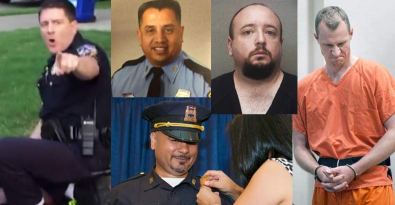
By Jay Syrmopoulos | The Free Thought Project | August 9, 2015
It’s become apparent that there is a systemic problem in policing, yet many Americans continue to be willfully ignorant of the dark reality transpiring outside of their front doors. Often people will claim “it’s just a few bad apples,” but the truth is that problem is much more deeply ingrained.
Imagine for a moment being bestowed one of the highest honors of your profession, and what that recognition would represent. In policing that honor would be called the “Officer of the Year,” and would represent the elite of the police force within which these officers work.
It would make sense to expect that the officers awarded this prestigious honor to be those who uphold and exemplify the highest ideals and values of law enforcement.
In a telling sign of the current state of policing in America, we have seen five former “Officer of the Year” recipients reveal their true nature in 2015 and show exactly how corrupt the soul of American law enforcement system has become.
This is what an “Officer of the Year” looks like in 2015:
Eric Casebolt: “Officer of the Year” in 2008 in McKinney, TX. Casebolt resigned in disgrace this year after assaulting children at a pool party while a grand jury investigation was pending.
Noe Juarez: “Officer of the Year” in 2009 in Houston, TX. Juarez was indicted on charges of trafficking drugs and weapons for Los Zetas, one of the most ruthless and violent Mexican cartels.
Edwin Guzman: “Officer of the Year” in 2012 in Boston, MA. Guzman was arrested and charged with sexual assault charges against a minor.
Jonathan Bleiweiss: “Officer of the Year” in 2013 in Broward County, FL. Bleiweiss plead guilty to confining and raping 20 male immigrants.
Jerad Gale: “Officer of the Year” in 2014 in Champaign, IL. Gale was arrested and charged for choking and raping two women.
Americans should be very troubled that men like theses are being honored as the best of the best in policing. People must come to the realization that these weren’t simply a few bad apples that had simply people fooled into believing they were good cops.
The sinister reality is these men are exactly what law enforcement looks for, modern day cowboys with too much machismo and a bully complex. Theses borderline sociopathic tendencies, which are rampant within the profession, are a canary in the coal mine and a stark warning about the systemic brutality that has taken firm root in U.S. policing today.
When men such as these are honored as the best of “America’s Finest” it’s apparent the system is broken!
School ‘banishes’ 7yo student for saying he doesn’t believe in God – lawsuit
RT | August 5, 2015
A seven-year-old Indiana student was “banished” from sitting with his classmates at lunch after stating that he did not believe in God, according to a lawsuit which claims the school violated the child’s First Amendment rights.
The suit – filed by the American Civil Liberties Union (ACLU) of Indiana and obtained by the Washington Post – claims the punishment occurred after the student, named only as AB, told a classmate on the playground that he didn’t go to church and didn’t believe in God.
That child then started to cry, stating that AB had hurt her feelings by saying that he didn’t believe in God.
The girl’s visible distress prompted a playground supervisor to report the incident to AB’s teacher, identified in the suit as Michelle Myer.
In response, Myer told AB that she was “very concerned” about what he had done, and said she was going to contact his mother.
Myer forced the child to sit by himself at lunch for three days, and told him that he shouldn’t talk to the other students because he had offended them.
The lawsuit states that this was distressing to AB, as it implied that he had done something wrong by expressing his personal opinion.
However, according to the suit, the hurt did not end there.
The matter was then sent to “another adult” employed at Forest Park Elementary School. Upon hearing the story, the adult reportedly told AB’s classmate that she should be “happy she has faith” and that she “should not listen to AB’s bad ideas.” She then patted the girl’s hand.
Despite Myer’s claim that she would contact AB’s parent, that phone call never took place. Instead, AB’s mother found out about the incident from her son, who came home from school upset and stating that he was hated by teachers and students at the school.
This prompted his mother to call the assistant principal of the school, demanding that her child not be punished for expressing his religious views. The teacher was also included in the call, during which she confirmed her involvement in the matter.
After the phone call, AB was apparently told by Myer and other teachers that he could believe what he wants to believe.
Following his three days of punishment, AB was allowed to sit with his fellow classmates at lunch. However, the lawsuit stresses that lasting damage has been inflicted on the student.
That damage includes the fact that some students refuse to talk to the child, and that AB is now “anxious and fearful” about school.
In response to the incident, the school district released a statement: “It is clear that it is not the province of a public school to advance or inhibit religious beliefs or practices. Under the First and Fourteenth Amendments to the Constitution, this remains the inviolate province of the individual and the church of his/her choice. The rights of any minority, no matter how small, must be protected.”
Citing the violation of First Amendment rights, the suit is seeking damages and attorneys’ fees. The child’s mother has been allowed to proceed with the lawsuit anonymously, in order to protect her child’s identity.
Mandatory Reporting of User Content Chills Speech and Violates Privacy Rights
By Kelsey Harclerode and Erica Fisher | EFF | August 5, 2015
EFF joined a broad coalition of 31 organizations in sending a letter to Senate leadership opposing an unconstitutionally vague law that would require Internet companies to report to the government when they obtain “actual knowledge” of any “facts and circumstances” related to “terrorist activity.” Section 603 of the Intelligence Authorization Act for Fiscal Year 2016 (S. 1705), which does not define “terrorist activity,” raises significant First and Fourth Amendment concerns, including the chilling of protected speech and the warrantless search and seizure of private electronic content.
First Amendment Concerns
The most obvious flaws in Section 603 are its vagueness and overbreadth: it will chill wholly legal speech and conduct. The key reason is that there is no clear agreement in U.S. society about what counts as “terrorism” (and triggers mandatory reporting). The single, tiny island of clarity in the term “terrorist activity” is one non-exclusive reference to 18 U.S.C. § 842(p), which makes it unlawful for a person to distribute information relating to explosives if the person has knowledge that the recipient intends to use the information to commit a violent crime. Otherwise, Section 603 is a Rohrschach blot.
Because Section 603 leaves both companies and users uncertain as to what exactly triggers the mandatory reporting requirement, this vague obligation to report will encourage service providers to broadly implement the law and will, in turn, encourage users to self-censor to avoid being reported to the federal government as possible “terrorists.” Without further clarification, the law will likely put innocent political activists, journalists, engaged citizens, professors and students participating in wholly lawful debate and research under a cloud of suspicion. For many, the risk of being put on a mysterious government watch list will more often than not outweigh the benefit of speaking.
With limited context for, say, a tweet or private direct message, service providers will err on the side of over-reporting and submit First Amendment-protected speech through content-flagging or automated monitoring systems. Section 603 includes a “protection of privacy” subsection, which clarifies that nothing in the provision “may be construed to require [a] service provider…to monitor any user…or the content of any communication.” Yet this “protection” does little to counteract the pressure on intermediaries to monitor their users’ behavior and content. While intermediaries often rely on content-flagging systems that enable users to report apparent unlawful or abusive activity of other users, this mechanism is prone to fraudulent notices. An automated monitoring system based on keywords would allow intermediaries to avoid having to themselves make decisions about their users’ content. But because it’s not obvious what constitutes “terrorist activity,” a user could be reported any time she uses a buzzword related to terrorist groups, the Middle East, U.S. foreign policy, or a particular political ideology.
Fourth Amendment Concerns
Section 603 not only chills lawful speech, it also tries to evade constitutional barriers that protect against unreasonable searches and seizures of private communications by the government.
EFF has consistently argued that a warrant based on probable cause is required for compelled government access to content stored by “cloud” service providers. In United States v. Warshak, the Sixth Circuit held that the government cannot access email content without a warrant because users have a Fourth Amendment-protected reasonable expectation of privacy in the email content that they store with these intermediaries.
While Section 603 does not permit the government to demand the production of content, it does require Internet companies to report content—including private content—reflecting “terrorist activity.” There is no question that this kind of mandatory reporting statute is subject to Fourth Amendment scrutiny, not unlike the ordinance found unconstitutional in Los Angeles v. Patel.
The applicability of the Fourth Amendment is particularly important given the amount of private content the government will acquire under this provision. As noted above, this mandatory provision will encourage companies to over-report both public and private content to the government. This will enable the government to evade normal due process requirements—including meeting legal standards such as probable cause and submitting to judicial review—while collecting much private content protected by the Fourth Amendment.
Future Action
Section 603’s constitutional implications have not gone unnoticed in Congress. On July 27, the Senate was set to pass the bill by unanimous consent until Sen. Wyden objected to this expedited procedure. The Senate will now have to engage in the normal process of debate and amendment, or remove this provision from the bill to prompt Sen. Wyden to withdraw his objection and enable the bill to pass by unanimous consent. The government should not be permitted to evade constitutional limits by turning private companies into watchdogs with no leashes. We urge Senate leadership to withdraw Section 603 from the intelligence authorization bill.
Featured Video

Seyed M. Marandi: US-Iran War Inevitable: Kuwait and Bahrain May Fall
or go to
Aletho News Archives – Video-Images
From the Archives
Oil and the Israel Lobby
Reknowned economist M. Shahid Alam offers this excellent critique of Noam Chomsky’s defective analysis of the relative influence of Oil versus the Israel lobby over US foreign policy: … continue
Blog Roll
 Aletho News
- ICC ignored ‘very well-documented’ NATO crimes – ex-Libyan minister
- SNSC secretary dismisses US response to Iran’s conditions as ‘inadequate’
- Sanaa says Taiz roads open, secure for residents, warns Saudi forces
- Iraqi resistance group urges Saudi leadership to admit defeat, lift Yemen siege
- Trump’s Retreat: How Al-Aqsa Flood Took Down the US Empire
- Israel’s Military Actions in Lebanon Grossly Violate International Law — Lavrov
- Seyed M. Marandi: US-Iran War Inevitable: Kuwait and Bahrain May Fall
- Leaders Condemn Ansarallah Attack on Saudi Arabia While Ignoring Illegal War Against Yemen
- Leaked: Britain’s Covert Iraqi Psyops Network
- Yemeni Armed Forces Warn Airlines Against Using Saudi Airports, Exempt Mecca and Medina
- If Americans Knew
- How Israel Conquered the Latin American Right
- Agents search Rep. Omar’s Washington home in criminal probe as she vows she won’t ‘be silenced’
- “The Rule Was: ‘Shoot Everyone You See'”
- Israel goes ballistic over Nobel Laureate Navi Pillay
- U.S. May Join Yet Another Middle Eastern War — TCN
- Yellow Line moves again as Israel closes in on trapped Gazans – Daily Update
- Israeli Attacks Kill Seven Palestinians in Gaza Including Six-year-old Girl
- Gaza: Ceasefire Anniversary Marks Year of Failed Promises
- The American Conservative: Mike Huckabee Should Resign
- A C-Section in Shackles: A Palestinian Woman’s Harrowing Birth in Israeli Detention
- No Tricks Zone
- Germany’s Green Energy Debacle: High Energy Costs Force Kahla Porzellan to Close After 182 Years!
- New Study: 50 Years Of The Most Aggressive ‘Net Zero’ Policies Can Only Affect The Global Climate By 0.03°C
- US September “Heat” Was No Record…Many Records Set Decades Ago
- Latest European Green Energy Debacle; Portugal’s Largest Flagship Solar Park Insolvent!
- Green Energy Debacle: German Expert Professor Fritz Vahrenholt Warns Of Severe Economic And Social Consequences
- Two More Paleo Reconstructions Affirm Meters-Higher Sea Levels Across Ireland, Brazil 7000-6000 Years Ago
- New Study: Earth And Venus Surface Warmth Largely Explained By Convection And Lapse Rate, Not CO2 Or Radiation
- 2025 Nature Paper Claiming Worsening Global Drought Gets RETRACTED …Heavily Flawed
- New Study: ‘Global Drought Shows No Detectable Recent Acceleration Under Climate Warming’
- Economic Masterminds: German Socialists Suggest Taxing Productivity Gains Stemming From Using AI

