Ukrainian Democracy: A Barrier to Washington’s Goals
What Do Ukrainians Really Want?
By Nick Alexandrov | CounterPunch | February 28, 2014
When Ukraine is the topic, the major U.S. media outlets agree: “Europe and the United States have made a priority of fostering democracy in the former Soviet republics,” David M. Herszenhorn wrote in the New York Times. The Washington Post asserted that Ukraine is “a country that has been struggling to become a genuine democracy” with help from Western powers, who keep it “from becoming an autocratic Kremlin colony, like neighboring Belarus.” “Ukraine is the crossroads between a free and an authoritarian Europe,” the Wall Street Journal concurred, while Yale professor Timothy Snyder urged, in a CNN piece, Europe and America to back the Ukrainian protesters—“a chance to support democracy,” he emphasized. Marvelous. But in the real world, Ukrainian democracy is not merely something Washington has failed to support, but is actually incompatible with U.S. governmental aims.
U.S. officials are quite open about their opposition to Ukrainian self-determination and well-aware how unpopular Washington’s preferred policies are. Nearly a decade ago, for example, the U.S. House of Representatives’ Subcommittee on Europe met for a hearing on “Ukraine’s Future and U.S. Interests.” Rep. Doug Bereuter (R-NE) opened the session, noting that “a recent survey conducted by a center for economic and political research suggests that up to 40 percent of Ukrainians believe that relations with Russia should be a priority.” Meanwhile, “28 percent gave preference to the EU,” and “2 percent said that relations with the U.S. should be a foreign policy priority. Another survey suggested that almost two-thirds of the population would consider supporting a political union with Russia,” Bereuter concluded. “So,” he went on, “I think that United States policy must remain focused” on incorporating Ukraine “into European and Euro-Atlantic structures.” Rep. Robert Wexler (D-FL) spoke next, reiterating that U.S. policy should “further Ukraine’s integration in Euro-Atlantic institutions;” Steven Pifer, the former Ambassador to Ukraine, drove the point home, outlining “the United States Government’s vision for Ukraine”: “increasingly close ties to Europe and Euro-Atlantic institutions.” This vision persisted over the following decade. The Atlantic Council’s Damon Wilson, speaking before the U.S. Senate’s Subcommittee on European Affairs—the topic was “Ukraine at a Crossroads”—in February 2012, explained that “Ukraine’s genuine European integration” remained a major objective.
And recent commentary and news coverage depicts European integration as something most Ukrainians desire. In early February, Secretary of State Kerry, at the Munich Security Conference, remarked that Ukrainians should be permitted “to associate with partners who will help them realize their aspirations”—Europe and the U.S. obviously being the partners, integration to be deepened via what the Times’ Herszenhorn referred to as “sweeping political and trade agreements” that Ukrainian President Viktor Yanukovych “refused to sign” last November, resulting in “a broken promise between a leader and his citizens,” and then the uprisings. Now Al Jazeera reports that the acting president, Oleksander Turchinov, has “made clear that Kiev’s European integration would be a priority,” thereby giving Ukrainians what we’re told they want.
But British and U.S. governmental studies reveal the Ukrainian public is ambivalent about European integration. Britain’s Foreign and Commonwealth Office, for example, funded a “scoping study” through the British Embassy in Kyiv a year ago, titled “A blueprint for enhancing understanding of and support for the EU-Ukraine Association Agreement [AA] including DCFTA [Deep and Comprehensive Free Trade Area] in Ukraine.” The AA was one of the key “sweeping political and trade agreements” Yanukovych refused to sign. British officials, in their report, stressed that “support for the AA is not overwhelming amongst the population at large,” observing that “opinion polls show that about 30% of respondents are in favour of European integration, 30% for the Customs Union [Moscow-led integration], and about 30% are undecided.” This bleak situation called for a propaganda offensive, or “a national public awareness ‘Campaign of Arguments,’” as the British dubbed it, which was to “be aimed at the general public as its primary target audience.” British advisers urged PR teams “to formulate advertising slogans, global and targeted messages,” and to play up “the European civilizational model” and other benefits the AA allegedly would bring. This “civilizational model” today entails “massive attacks on public services, wages, pensions, trade unions, and social rights” under imposed “draconian austerity policies,” Asbjørn Wahl wrote in January’s Monthly Review—a reality the British indoctrination scheme’s outline studiously avoided, it’s hardly worth mentioning.
The propaganda barrage may have been successful to some extent. But as the year progressed, the U.S. government had a hard time finding evidence of overwhelming Ukrainian support for European integration. The International Republican Institute (IRI), for example, polled Ukrainians last September: “If Ukraine was able to enter only one international economic union, with whom should it be?” Forty-two percent of respondents chose the EU, while 37% preferred the Russian Customs Union. IRI then asked, “How would you evaluate your attitude towards the following entities?” Fifty percent of respondents felt “warm” towards Russia; 41% felt “warm” towards Europe—and just 26% were fond of the U.S. IRI figures resembled those USAID published in a December 2013 report. Its authors found it “interesting to note that Ukrainians are split on whether the country should join the European Union or the Customs Union. Thirty-seven percent would like Ukraine to take steps to join the European Union, 33% prefer the Customs Union and 15% say Ukraine should join neither of these blocs.” Furthermore, “34% say that Ukraine should have closer economic relations with Russia, 35% say it should have closer economic relations with Europe and 17% say it should have good relations with both.” A Kyiv International Institute of Sociology poll reinforced these findings: “Ukraine is split practically 50/50 over the accession to the European Union or the Customs Union,” Interfax-Ukraine summarized the study’s conclusions.
Reviewing this data forces us to ask: Who is Washington’s chief enemy in Ukraine? Is it Russia, bent on killing Ukraine’s budding democracy? Is it the tyrant Yanukovych? The U.S. policy record points to a different conclusion, one a Johns Hopkins Center for Transatlantic Relations study—included in the official transcription of the Senate’s 2012 “Ukraine at a Crossroads” hearing—discusses in the context of Ukraine’s potential NATO membership. “The main obstacle” to Ukraine’s joining the organization “is not Russian opposition,” its authors emphasized, “but low public support for membership in Ukraine itself.” Again: on this and other issues, the Ukrainian people are “the main obstacle” to U.S. foreign policy aims. We should bear this fact in mind as the crisis deepens in Eastern Europe.
Nick Alexandrov lives in Washington, DC.

Israeli forces kill Palestinian man during Birzeit arrest raid
Ma’an – 27/02/2014
 RAMALLAH – Israeli forces killed a Palestinian man on Thursday after opening fire on a property in Birzeit, locals said.
Muatazz Washaha, 24, was found dead inside the house following a stand-off between Israeli military forces which lasted several hours.
Witnesses said that the victim was hit in the head by a rifle-fired Energa shell.
Israeli forces were reportedly trying to arrest Muatazz for being an activist with the Popular Front for the Liberation of Palestine.
During the dawn raid, Israeli forces stormed the house and detained his brother, Ramiz, and two other men. Earlier reports suggested Israeli forces were targeting another brother, Thaer.
Palestinian firefighters rushed to the scene after the house caught on fire as a result of Israeli artillery shelling.
Palestinian Authority Minister of Detainees, Issa Qaraqe, said Israeli troops raided Birzeit at around 3 a.m.
An Israeli army spokeswoman said that Israeli forces raided Birzeit to arrest a man suspected of “terror activity.”
“After the suspect was called to turn himself in, he barricaded himself inside his house, effectively resisting arrest. Under the premise that he had weapons in his possession, the forces used different means to complete the arrest, including live fire.”
An AK47 assault rifle was found in the house, but no shots were fired at any point towards Israeli forces.
Second Bahrain detainee dies in custody: ministry
Al-Akhbar | February 26, 2014
A 23-year-old Bahraini man who was detained in December and accused of smuggling weapons died from an illness in custody on Wednesday, the Interior Ministry said, the second death of a person held on security-related charges this year.
Jaffar Mohammed Jaffar was arrested in a raid that the government said broke up a plot to bring in detonators and explosives by boat and use them to launch attacks in the island kingdom.
Bahrain, home to the U.S. Fifth Fleet, has been rattled by bouts of unrest since February 2011 when Bahrainis took to the streets, demanding democratic reforms from the ruling family.
Jaffar was suffering from sickle cell anaemia and was admitted to hospital on Feb 19, the ministry said in a statement. He died from the condition on Wednesday, it added.
Rights campaigners did not challenge the government’s account that Jaffar had died as a result of an illness, but the main opposition group, al-Wefaq, said in a statement that medical treatment had been withheld and described Jaffar as “a martyr”.
Activist Mohammed al-Maskati also told Reuters he had spoken to Jaffar and four others by phone after their arrest and “they told me that they have all been tortured”.
Bahrain’s Interior Ministry, which regularly denies mistreating detainees, told Reuters on Wednesday Jaffar had not been tortured and said he had received full medical care.
Jaffar’s death came a month after authorities reported Fadhel Abbas, 20, had died in custody from gunshot wounds suffered during his arrest in a raid on another smuggling operation on Jan. 8.
Police said officers had shot them as he tried to run them over. Protesters clashed with members of the force after his funeral.
Demonstrations and clashes between protesters and the security forces have continued regularly, while negotiations between the government and opposition have stalled.
The authorities say they have rolled out some reforms and are willing to discuss further demands, but the opposition says there can be no progress until the government is chosen by elected representatives.
Earlier this month a policeman was killed by an explosion at a protest to mark the third anniversary of Bahrain’s uprising.
(AFP, Al-Akhbar)
Honduras: Candidate’s Brother Killed in Electoral Dispute
Weekly News Update on the Americas | February 23, 2014
Indigenous Honduran campesino Justiniano Vásquez was found dead on Feb. 21 in San Francisco de Opalaca municipality in the western department of Intibucá, where the victim’s brother Entimo Vásquez is challenging the results of a Nov. 24 mayoral election. Justiniano Vásquez’s body had deep wounds, and there were signs that his hands had been bound. Community members charged that the killing was carried out by Juan Rodríguez, a supporter of former mayor Socorro Sánchez, who the electoral authorities said defeated Entimo Vásquez in the November vote. Rodríguez had reportedly threatened Entimo Vásaquez in the past. San Francisco de Opalaca residents captured Rodríguez and turned him over to the police. The Civic Council of Grassroots and Indigenous Organizations of Honduras (COPINH), which reported Vásquez’s death, demanded punishment for the perpetrators and called on the authorities “to carry out their work objectively [and] effectively.”
Entimo Vásquez ran for mayor as a candidate of the new center-left Freedom and Refoundation Party (LIBRE) in the November presidential, legislative and local elections; Socorro Sánchez was the candidate of the rightwing National Party (PN). Vásquez formally challenged the results, but the Supreme Court of Justice (CSJ) backed Sánchez. Community residents, who are mostly members of the Lenca indigenous group, charged that the vote was fraudulent and also accused Sánchez of irregularities during his previous term as mayor. Vásquez’s supporters have occupied the town hall since late January, preventing Sánchez from taking office. (La Tribuna (Tegucigalpa) 2/13/14; COPINH 2/21/14; La Prensa (Nicaragua) 2/22/14 from AFP)
In related news, on Feb. 10 a court in the western department of Santa Bárbara issued a definitive dismissal of weapons possession charges against COPINH general coordinator Berta Cáceres. A group of soldiers arrested Cáceres and another COPINH official on May 24 last year, claiming they had found an illegal firearm in the activists’ car [see Update #1178]. Cáceres was in Santa Bárbara at the time to support protests by indigenous Lenca communities against the construction of the Agua Zarca dam on and near their territory. In an interview with the Uruguay-based Radio Mundo Real on Feb. 13 Cáceres said national and international solidarity had been fundamental for winning dismissal of the charges. (Radio Mundo Real 2/13/14)
Related article
Why We Oppose the Oakland Spy Center
By OAKLAND PRIVACY WORKING GROUP | CounterPunch | February 25, 2014
On March 4, 2014, the Oakland City Council will decide to award a contract that, if approved, will impact your civil rights. The Domain Awareness Center (“DAC”) is a full-time mass surveillance project encompassing the city and Port of Oakland and initially funded by the Department of Homeland Security (“DHS”). The Oakland Privacy Working Group opposes this project because city staff and the Oakland Police Department (“OPD”) have proven they can’t be trusted to oversee something this critical; furthermore it won’t solve crime, there is great potential for abuse of civil liberties, and the city cannot afford it. The city has no data retention and privacy policy or oversight committee for the DAC, which is absurd when one considers the potential harm and past wrongdoing by the city.
The DAC will share live video and data with regional government, law enforcement, and as stated by Port Facilities Security Officer Mike O’Brien at the February 18, 2014 City Council meeting, “there is an expectation by the Feds that we will share information with them.” Future proposed DAC phases include adding cameras at Oakland Unified School District buildings and throughout Oakland Housing Authority properties, automatic license plate readers, facial recognition software, and social media monitoring. Strangely, Oakland Police Department (“OPD”) has suggested including planning, business, and property tax databases, which are unrelated to crime fighting.
We are being sold the line that the DAC will help solve Oakland’s crime problem, yet there is no data that proves mass surveillance does so. And city staff has shown no interest in solving crimes with the DAC. As stated by the East Bay Express in the Dec. 18, 2013 article “The Real Purpose of Oakland’s Surveillance Center, “While the emails reveal a great deal about the DAC, they are also notable for what they do not talk about … city staffers do not discuss any studies pertaining to the use of surveillance cameras in combating crime, nor do they discuss how the Domain Awareness System could help OPD with its longstanding problems with solving violent crimes. In more than 3,000 pages of emails, the terms ‘murder,’ ‘homicide,’ ‘assault,’ ‘robbery,’ and ‘theft’ are never mentioned.”
OPD can’t manage its resources and has a poor relationship with the community. In a February 6, 2014 report by the city auditor, “OPD spent at least $1.87 million on technology that was never used or underused.” According to OPD’s report to the Public Safety Committee at its September 2013 meeting, the city has over 650 homicide investigations with unexamined evidence, some cases going back seven years. Alameda County has over 1,900 rape kits that have never been looked at. In the same September 2013 meeting, OPD stated that it needed $1.2 million to increase staff at its crime lab, an amount that will now be usurped by the DAC’s estimated annual operating costs to the city of $1.6 million.
For 10+ years running, OPD has failed to comply with the Negotiated Settlement Agreement from the infamous Riders trial. Yet, the City Council is poised to hand over to OPD the most advanced surveillance and tracking tools in history. In her February 13, 2014 letter to the City Council, ACLU Nor-Cal staff attorney Linda Lye noted that “black people were twice as likely (68%) to be surveilled for ‘no obvious reasons’ than whites” by video surveillance systems.
City staff disregards Oakland’s contracting policies and cannot be trusted to oversee something more critical like our private data. The work on Phase 1 was completed by SAIC, a contractor found to be in noncompliance with the City’s Nuclear Free Zone Ordinance (“NFZO”). SAIC defrauded the city of New York on a payroll system contract, agreeing in 2012 to pay $500 million to avoid prosecution. As revealed by internal city emails, Oakland city staff knew these facts prior to execution of the Phase 1 contract and concealed these facts from the City Council as SAIC received payment. Unsurprisingly, SAIC overcharged the city on Phase 1. In 2013 SAIC was exposed and prevented from pursuing the Phase 2 contract. Noncompliance with the NFZO is also a problem for the staff-selected Phase 2 contractor.
Most importantly, ours is a civil rights movement. The Bill of Rights codified our civil liberties. The California Constitution has an express right to privacy. Long-held legal doctrines such as freedom of speech, the press, and assembly and the requirement of due process and probable cause, form the basis of our civil society. Many lives have been lost defending these rights. The result of mass surveillance is a chilling effect upon legal activities, such as meeting in a public plaza or attending a mosque for worship in this post-9/11 world.
Oakland has in the past rejected mass surveillance, in 1997 and 1999. Council member Henry Chang reflected on his decision to come to the United States, saying, “We came because we don’t want to be watched by Big Brother all the time.” Council member Ignacio De La Fuente cast his no vote by citing a lack of evidence that cameras are effective in reducing crime and concluding that the program was not “worth the risk of violating people’s privacy rights.”
The DAC won’t reduce crime. It is a financial boondoggle. Staff and OPD have proven they cannot be trusted to oversee it. Most importantly, the DAC will infringe upon our civil liberties.
Oakland Privacy Working Group can be reached through their website: oaklandprivacy.wordpress.com
Related articles


Chicago Police “Heat List” Renews Old Fears About Government Flagging and Tagging
By Jay Stanley | ACLU | February 25, 2014
The Verge had a story last week (expanding on an August report from the Chicago Tribune that I’d missed) that the Chicago police have created a list of the “400 most dangerous people in Chicago.” The Trib reported on one fellow, who had no criminal arrests, expressing surprise over having received a visit from the police and being told he was on this list. A 17-year-old girl was also shocked when told she was on the list.
The database, according to the Verge, is based on historic crime information, disturbance calls, and suspicious person reports. The CPD’s list is heavily based on social network analysis (which is interesting considering the debates now swirling around the uses of metadata and the analysis such data enables). A sociologist whose work inspired the list, Andrew Papachristos, told the author of a Chicago Magazine piece (which goes into some interesting depth on some of the theory behind the list): “It’s not just about your friends and who you’re hanging out with, it’s actually the structure of these networks that matter.”
The list was funded through a Justice Department grant known as “Two Degrees of Association.” (At least that’s one less hop than the NSA uses.)
I’m still consistently surprised how often things we worry about in the abstract actually show up in the real world. For years, privacy advocates have been warning about how databases might be mined by the authorities for information used to label, sort, and prejudge people. True, there are all too many precedents for this sort of thing, including the CAPPS II program proposed early in the Bush Administration, the nation’s terrorist watch lists, various police gang lists, and the Automated Targeting System. The TSA’s Pre-Check whitelist is also a cousin of this kind of program. All are based on using various information sources and grinding them through one or another logic engines to spit out a judgment about individuals and their supposed dangerousness or safeness as a human being. But still, this program amazes me in how starkly it replicates the kinds of things we have been warning about in many different contexts.
Just two weeks ago, for example, I was asked by several news outlets what we think about police officers using Google Glass. I told them that Glass is basically a body camera, and that the issues were the same as those outlined in our white paper on police use of that technology. The principal difference between Glass and the body cameras being marketed to police is that Glass can also display information. I said this shouldn’t be a problem—unless (I added almost apologetically because of the slightly fanciful nature of this point) the police started using them with face recognition to display some kind of rating or warning for individuals who have been somehow determined to be untrustworthy.
“Of course, that’s not a problem today,” I said, “it’s more of a futuristic concern.”
Ha! Barely a week later, that scenario doesn’t seem so futuristic any more to me, especially at a time when some want to use face recognition to warn them when someone on a blacklist tries to enter a store or school. (True, Google doesn’t currently permit FaceRec apps on Glass, but it’s unclear how long that will last.)
Some further points and questions about Chicago’s heat list:
- The principal problem with flagging suspicious individuals in this way may be the risk of guilt by association. Although we don’t know how valid, accurate, and fair the algorithm is, it’s important to note that even if its measures were valid statistically—that one particular individual really does have an increased risk of crime because of certain things about his or her life—it may still constitute guilt-by-association for a person who actually remains innocent. It is simply not fair for people to be subject to punishments and disadvantages because of the groups they belong to or what other people in similar circumstances tend to do. I keep going back to the example of the man whose credit rating was lowered because the other customers of a store where he shopped had poor repayment histories.
- Why should the police restrict their hotlist to 400? Why not 4,000 or 40,000? In fact, why not give every citizen a rating, between 1 and 100 say, of how “risky” they might be? Then the police could program their Google Glass to display that score hovering above the head of every person who comes into their field of vision. This is a path it’s all too easy to see the police sliding down, and one we should not take even the first steps towards.
- Remember too the point that (as I made here) there are a vast number of laws on the books, many complicated and obscure, and anyone who is scrutinized closely enough by the authorities is far more likely to actually be found to have run afoul of some law than a person who isn’t. In that respect inclusion on the list could become a self-fulfilling prophesy.
- Will the Chicago police carry out any kind of analysis to measure how effective this technique is? Will they look at the success of their predictions, search for any discriminatory effects, or attempt to find out whether these rankings become a self-fulfilling prophesy? The police often have little inclination to do any such things—to adopt rigorous criteria for measuring whether their new toys and gizmos are providing a good return on investment. Purely from an oversight point of view, every aspect of this program would ideally be made public so the world could scrutinize it—certainly the algorithm. Privacy concerns, however, suggest that the names of individuals who are (quite possibly totally unfairly) flagged by these algorithms not be made public, nor any personal data that is being fed into the algorithms.
- A Chicago police commander is quoted as saying, “If you end up on that list, there’s a reason you’re there.” This framing begs the question at the heart of this approach: is it valid and accurate? Such circular logic is genuinely frightening when it comes from a police officer talking about matters of guilt and innocence.
- It’s true that there could be a fine line between laudable efforts to identify and help “at-risk youth,” and efforts to tag some people with labels that are used to discriminate and stigmatize. Research on the “epidemiology of violence” could be valuable if used as part of a public health approach to crime. But if it’s part of a criminal justice “pre-crime” approach, then that’s where the problems arise.
Overall, the key question is this: will being flagged by these systems lead to good things in a person’s life, like increased support, opportunities, and chances to escape crime—or bad things, such as surveillance and prejudicial encounters with the police? Unfortunately, there are all too many reasons to worry that this program will veer towards the worst nightmares of those who have been closely watching the growth of the data-based society.
Related article

Two Palestinian Human Rights Defenders Kidnapped In Nablus
By Saed Bannoura | IMEMC | February 25, 2014
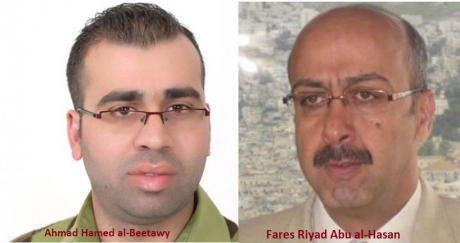 The Solidarity Foundation for Human Rights (SFHR) has reported that Israeli soldiers kidnapped, on Tuesday at dawn, its lawyer and its researcher, after the army violently invaded their homes in the northern West Bank city of Nablus.
The foundation said dozens of soldiers invaded the home of SFHR lawyer Abu al-Hasan, in the Rojeeb Housing Projects area, east of Nablus, and kidnapped him after violently searching his home causing property damage.
Soldiers detonated the door of Abu al-Hasan’s home, invading the place and terrifying the family.
They also interrogated Abu al-Hasan’s father for more than an hour, and confiscated documents and files. Abu al-Hasan was moved to the Petah Tikva interrogation facility.
It added that the soldiers also broke into several nearby homes, violently searched them and ransacked their property and belongings, and used their rooftops as monitoring towers during the invasion.
Meanwhile, soldiers also detonated the front door of the home of SFHR researcher Ahmad al-Beetawy, and invaded the property in the Dahia area, south of Nablus, searched it for more than an hour and kidnapped him.
His brother said the soldiers also invaded the home of their mother, in the same neighborhood, and violently searched it. Al-Beetway defends the rights of Palestinian political prisoners, illegally held by Israel.
The foundation said that the soldiers also invaded its office in al-Isra’ building, in the center of Nablus city, and confiscated computers and files after violently searching the property.
Related articles


Violence and Vulnerability in Buenaventura, the Dark Side of Development
By Margaret Boehme | Red Hot Burning Peace | February 24, 2014
From the tenth-floor balcony of our hotel in Buenaventura, we sit with community leader Miguel Duarte and watch as the sunset over the Pacific Ocean streaks the sky with peach and mauve before fading to a shroud of lavender-gray and darkness. Below us, teenage girls chase a soccer ball. A few hundred yards away, a patch of the island is covered with tree tops like the heads of broccoli. “Take a photo of that island,” says Duarte, pointing at the tree line. “There are thousands of dead bodies buried on it.”
“We need a commission from the Attorney General’s office to count the bodies,” he continues. “The island is controlled by paramilitaries.”
The violence in Buenaventura is staggering, yet reliable statistics are hard to attain: official documentation is lacking and it’s left to community leaders, like 18-year-old Jesús, to try to compile the data independently. At our meeting, he pulls out his notebook and begins reading off his handwritten list of victims from a recent massacre. He gets to the end of his list, glances up, and says, “Children were cut up and heads were found in barrios Santa Monica and Campo Alegro. Last night Alberto’s cousin was killed in a confrontation. That one made the newspaper.”
According to a report issued in January 2014, the city sees two-to-three murders and three-to-six forced disappearances daily. In November 2013 alone, fighting between different armed groups displaced 2,500 families in Buenaventura.
“We’re convinced of one thing,” says Duarte. “This pressure is so that people leave.”
On the heels of shoot-outs in waterfront neighborhoods, city officials arrive and ask residents if they’re ready to sign documents in which they agree to vacate the zone. On February 5 and 6, local security forces staged an elaborately orchestrated tsunami drill for neighborhoods near the port, with armed men blocking off streets and redirecting traffic into the night. According to Colombian Process of Black Communities (PCN), the exercise was yet another effort to brainwash Buenaventura’s Bajamar residents into believing that it’s not safe to live in the area and that they should be ready to evacuate at a moment’s notice.
Many point out that Buenaventura is dangerous for people who live in neighborhoods slated for commercial development but that, paradoxically, these same areas are safe for tourists. Below our hotel, a seafood fusion-sushi bar does slow business just yards from a neighborhood where armed groups recently did battle.
It’s Friday night in this commerce town, and clubs cater to weekend carousers with pockets full of pesos. Against a backdrop of giraffe-like cranes, half-built high-rises sprouting rebar, and a balmy breeze dispersing salsa beats, Duarte explains that 15 or 20 years ago, people began to talk about megaprojects in the region: port expansion, a cargo terminal, a tourist boardwalk, and an international airport in nearby Cali. Those conversations coincided with the beginning of the market liberalization process, as the port changed from public to private ownership.
Over the past 15 years, as the armed conflict arrived to nearby rural areas, many residents fled their farming communities at the outskirts of Buenaventura and settled in ocean-front neighborhoods near the city center, joining communities of Afro-Colombians who had arrived generations ago. In 2005, the FARC and Colombian military battled in Buenaventura. In 2006, paramilitaries entered the urban zone to protect businesses and terrorize the local population.
The first interurban displacement in Buenaventura—in which people fled from one neighborhood to another within the city—was in 2009. Today, ground zero for violent displacement coincides perfectly with zones marked for port expansion, a coal warehouse, a massive container storage area, and a tourist promenade. The violence, PCN states, is “part of the war strategy to control territory and clean out the zone to bring in projects.”
Residents in vulnerable neighborhoods are not opposed to the city’s economic growth, per se. But many feel that projects should benefit all people in the area, not bring prosperity to few while forcing misery on most.
That’s what Remedios’ husband, Eduardo believed. Their home in Caucana, about 45 minutes from the port, is along the road being widened to facilitate port expansion and accompanying projects in order to make Buenaventura competitive for Free Trade Agreement projects.
The old road is narrow, windy, and unpaved, meaning that it currently takes a truck seven or eight hours to make the trip from Buenaventura to Bugalagrande, a town along the Pan-American Highway. The new road will reduce the journey to about an hour.
Eduardo opposed the road expansion through their community because small children play there, and the project was contaminating their air and bad for people’s health. Remedios said, “He’d been looking to strengthen the community. He didn’t want to leave people in misery.” He’d been advocating for the community’s right to Free Prior and Informed Consent for new projects on their land guaranteed under Law 70, or the “Law of Black Communities.”
One morning Eduardo got a call that warned him he’d be killed if he ran in upcoming community council elections. For months he lived under the dark cloud of death threats, and on February 23, 2013, he was murdered. A year later, despite the efforts of his wife and other community members to seek justice, the government has made no progress in the investigation of his death.
“It has left me desperate, my kids too. They’re struggling at school. They don’t remember their vowels, just sleep, play, fight, scream….My children want to know why their father was murdered. They’re small, thinking bad thoughts, seeking vengeance. I’m asking for help because I don’t want my kids to become bad people.”
While we are in Buenaventura, a death threat is circulated, naming as military targets indigenous groups, campesinos, Marcha Patriotica members, protestors who block roads, and “guerilla-defending” NGOs—the name often used by paramilitaries to refer to NGOs that work on human rights issues.
Back on the tenth-floor balcony, a man whose community is surrounded by illegal armed groups looks out over the port, past the island of dead bodies, to the green lights blinking at the edge of the bay. He says, “If we don’t act quickly in Buenaventura, there will be more deaths.”
Margaret Boehme is a member of the Witness for Peace Colombia team based in Bogotá.
Related article

Cop Harasses Photographer, Steals His Cellphone Battery And Attempts To Get YouTube To Pull The Incriminating Video
By Tim Cushing | Techdirt | February 24, 2014
Recording a police officer in public isn’t a crime. Well, it isn’t anything a cop can cite or arrest you for doing. Instead, a bunch of vague infractions are listed in hopes that something will stick and deter future citizen recordings.
Shawn Randall Thomas, a New York photographer, was approached by NYPD officer Efrain Rojas when he noticed Thomas filming another officer’s interaction with a turnstile jumper in a subway station. “Approached” is putting it mildly. Rojas confronted Thomas and got physical when the photographer refused to stop filming.
A New York City cop beat up and arrested a man for video recording him inside a subway station from 30 feet away Saturday night, walking up to him and getting in his face all while claiming the man was invading his personal space…
Thomas also obtained footage from another man who had recorded Rojas with his knees on Thomas’ back as he lay face down on the sidewalk just outside the sub station, seconds after Rojas had bashed his face into the pavement, busting his lip.
The injury was so bad that they had to transport him to the hospital twice during his 24-hour incarceration where doctors described him as a victim of assault.
As if the impromptu “use of force” wasn’t enough, Thomas was also charged with the following:
[Thomas] is still facing charges of resisting arrest, trespassing, disorderly conduct and obstructing government…
Here’s the video:
Note that Rojas had to come over to where Thomas was filming (nearly 30 feet away) in order to be “obstructed.” Note also that Thomas was filming in a public location, where it’s almost impossible to “trespass.” And note that the de rigueur “resisting arrest” is included only because Thomas didn’t apply his own handcuffs, hoof it to the nearest cruiser and slide into the back seat.
Here’s the description of “resisting arrest” from the arrest report itself:
Deponent further states that, at the above time and place, defendant did resist a lawful arrest by crossing defendants’ arm across defendant’s chest while deponent attempted to place defendant in handcuffs.
But it gets worse. Officer Rojas apparently grabbed Thomas’ cellphone and either deleted the footage or removed the battery in order to prevent Thomas from filming any further. (PINAC’s account of this event mentions “deletion” and Thomas using Recuva to recover the deleted footage, but the description of events only says Rojas took Thomas’ phone and pocketed the battery.) Thomas then took out his backup phone (a Blackberry) and tried to continue filming, at which point Rojas “knocked the phone out of [Thomas’] hand” and slammed him to the ground.
Either way, Rojas made an effort to prevent any further filming. The incident report filed by Rojas makes no mention of the fact that he seized a cellphone and either deleted footage or seized the phone’s battery. He also undermines the charge of trespassing by noting the area where Thomas was filming was public, which is contrary to Rojas’ filmed assertion that Thomas was “violating” his “personal space.”
Apparently, Rojas wasn’t done with feeling “violated” by Thomas’ filming. According to PINAC’s Facebook page, Officer Rojas filed a privacy complaint asking YouTube to remove the video. YouTube, fortunately, turned his request down, which means that Rojas will now have to deal with a recording that contradicts (or severely weakens) many of the claims he made in his sworn statements (the arrest report).
As PINAC and Thomas point out, the obstruction charge is especially baseless, given Thomas’ distance from the officers (approx. 30 feet compared to the report’s “close proximity”) and the fact that the entire situation appears to be completely under control by the time Officer Rojas arrives. Rojas seems to be the only cop there who viewed Thomas and his camera as somehow interfering with police business. Rojas then abandons his “partner” — who is presumably dealing with an actual criminal — solely to harass someone with a camera. If nothing else, Rojas has problems with prioritizing, giving the non-criminal (and protected) act of filming precedence over an actual law enforcement work.
Officer Rojas had multiple paths to take when he noticed a citizen filming him performing his public duties in a public place. Unfortunately, he decided to take the well-worn path and violate the rights of the photographer. And like many others, this decision has done nothing more than heap more negative publicity on the police department and the officer involved. The correct response — ignore it and do your job — still remains largely untested.
Related article

84-Year-Old Pacifist Nun Sentenced to 3 Years in Prison after Exposing Lack of Security at Nuclear Weapons Site
By Noel Brinkerhoff | AllGov | February 23, 2014
Three anti-nuclear protesters, including an elderly Roman Catholic nun, will spend multiple years in prison for breaching security at a key weapons facility previously known as the “Fort Knox of uranium.”
Sister Megan Rice, 84, and two other members of the group Transform Now Plowshares embarrassed the U.S. Department of Energy and its security contractor at the Y-12 Nuclear Complex in Tennessee two years ago.
The three activists managed to enter the top-security grounds and travel all the way to a key building that houses 400 metric tons of highly enriched uranium used in nuclear warheads.
Rice along with Michael Walli, then 64, and Greg Boertje-Obed, then 57, had enough time to paint slogans like “The fruit of justice is peace” and splash bottles of human blood on the bunker wall before private security guards arrived on the scene.
They were convicted last year on two felony counts: damaging government property and obstructing the national defense, a sabotage charge. But they were not sentenced until February 18, 2014.
Rice received a prison term of two years and eleven months, while Walli and Boertje-Obed each got five years and two months because of earlier protest-related arrests.
“Please have no leniency with me,” Rice told the judge prior to her sentencing. “To remain in prison for the rest of my life would be the greatest honor for me.”
U.S. District Judge Amul Thapar asked prosecutors before handing down the sentences what harm the activists caused at Y-12.
Assistant U.S. Attorney Jeff Theodore responded that the defendants “had destroyed the ‘mystique’ of the ‘Fort Knox of uranium.’”
The August 2012 break-in at the complex prompted multiple federal reviews of security procedures, including congressional hearings, a report by the Energy Department’s inspector general (IG), and an independent commission review.
In the wake of the embarrassing episode, the Energy Department set about to test security readiness at nuclear weapons sites across the country. At Y-12, the IG discovered, the security knowledge exam itself was compromised when personnel disseminated it, along with the answers, ahead of time.
To Learn More:
Y-12 Protestors “Destroyed the Mystique” of Nuclear Security (by Lydia Dennett, Project On Government Oversight)
Nun, 84, Sentenced to Nearly 3 Years in Prison for Breaking into Nuclear Weapons Plant (Associated Press)
How the Obama Administration Charged 3 Pacifists with Violent Acts of Sabotage (by Noel Brinkerhoff, AllGov)
The 82-Year-Old Nun Who Breached U.S. High-Security Nuclear Complex (by Matt Bewig, AllGov)
Obama’s Next Assassination Target
Get email updates: http://stormcloudsgathering.com/scg_u…
Donate: http://StormCloudsGathering.com/donate
Speak out: http://commongroundmovement.com/no-mo…
Sources and transcript: http://stormcloudsgathering.com/the-r…
Follow us on Facebook: http://facebook.com/StormCloudsGathering
Follow us on Twitter: http://twitter.com/collapseupdates
What Happens When You Marry The NSA’s Surveillance Database With Amazon’s Personalized Marketing?
By Glyn Moody | Techdirt | February 21, 2014
By now, most people who shop online are aware of the way in which companies try to tailor their offers based on your previous purchasing and browsing history. Being followed by strangely relevant ads everywhere is bad enough, but what if the government started using the same approach in its communications with you? That’s one of the key ideas explored in an interesting new article by Zeynep Tufekci, strikingly presented on Medium, with the title “Is the Internet good or bad? Yes.”
Tufekci suggests that neither of the two main metaphors regularly wheeled out for today’s global surveillance — George Orwell’s “1984” and Jeremy Bentham’s Panopticon — is right:
To understand the actual — and truly disturbing — power of surveillance, it’s better to turn to a thinker who knows about real prisons: the Italian writer, politician, and philosopher Antonio Gramsci, who was jailed by Mussolini and did most of his work while locked up. Gramsci understood that the most powerful means of control available to a modern capitalist state is not coercion or imprisonment, but the ability to shape the world of ideas.
The question then becomes: how can people’s ideas be shaped so as to control them? Simply bombarding the population with messages only works for a while, until people become jaded and resistant to them. That’s where Edward Snowden’s revelations about “big data surveillance” come in, Tufekci suggests:
Individually tailored, subtle messages are less likely to produce a cynical reaction. Especially so if the data collection that makes these messages possible is unseen. That’s why it’s not only the NSA that goes to great lengths to keep its surveillance hidden. Most Internet firms also try to monitor us surreptitiously.
She’s worried about this approach being used to influence people’s political behavior, and points to a recent study in Nature that explored precisely this area:
By altering a message designed to encourage people to vote so that it came with affirmation from a person’s social network, rather than being impersonal, the researchers had shown that they could persuade more people to participate in an election. Combine such nudges with psychological profiles, drawn from our online data, and a political campaign could achieve a level of manipulation that exceeds that possible via blunt television adverts.
Indeed, Tufekci thinks the process has already begun:
During a break [in a conference called “Data-Crunched Democracy”], I cornered the chief scientist on Obama’s data analytics team, who in a previous job ran data analytics for supermarkets. I asked him if what he does now — marketing politicians the way grocery stores market products on their shelves — ever worried him. It’s not about Obama or Romney, I said. This technology won’t always be used by your team. In the long run, the advantage will go to the highest bidder, the richer campaign.
He shrugged, and retreated to the most common cliché used to deflect the impact of technology: “It’s just a tool,” he said. “You can use it for good; you can use it for bad.”
That’s hardly very comforting, and neither is Tufekci’s concluding thought:
Internet technology lets us peel away layers of divisions and distractions and interact with one another, human to human. At the same time, the powerful are looking at those very interactions, and using them to figure out how to make us more compliant. That’s why surveillance, in the service of seduction, may turn out to be more powerful and scary than the nightmares of Nineteen Eighty-Four.
Follow Glyn Moody @glynmoody on Twitter or identi.ca, and +glynmoody on Google+
Featured Video

Seyed M. Marandi: US-Iran War Inevitable: Kuwait and Bahrain May Fall
or go to
Aletho News Archives – Video-Images
From the Archives
Oil and the Israel Lobby
Reknowned economist M. Shahid Alam offers this excellent critique of Noam Chomsky’s defective analysis of the relative influence of Oil versus the Israel lobby over US foreign policy: … continue
Blog Roll
 Aletho News
- ICC ignored ‘very well-documented’ NATO crimes – ex-Libyan minister
- SNSC secretary dismisses US response to Iran’s conditions as ‘inadequate’
- Sanaa says Taiz roads open, secure for residents, warns Saudi forces
- Iraqi resistance group urges Saudi leadership to admit defeat, lift Yemen siege
- Trump’s Retreat: How Al-Aqsa Flood Took Down the US Empire
- Israel’s Military Actions in Lebanon Grossly Violate International Law — Lavrov
- Seyed M. Marandi: US-Iran War Inevitable: Kuwait and Bahrain May Fall
- Leaders Condemn Ansarallah Attack on Saudi Arabia While Ignoring Illegal War Against Yemen
- Leaked: Britain’s Covert Iraqi Psyops Network
- Yemeni Armed Forces Warn Airlines Against Using Saudi Airports, Exempt Mecca and Medina
- If Americans Knew
- After Oct 7, IDF policy allowed civilian casualties for even the lowest-ranking targets
- Israel’s Destruction of Southern Lebanon Intensified After the Cease-Fire
- The Last-Minute Decision That Gave Israel Its Name
- The American Conservative: How Trump Made the World Go Nuclear
- Meet the US generals and admirals advancing Israeli policy
- Opinion: Why news organizations should boycott Israel
- The Israeli witch hunt of Sami Abu Shehadeh exposes the lie of the ‘Jewish and democratic’ state
- No state has a ‘right’ to exist – least of all Israel
- Testimonies about Gaza’s civilian death toll expose Israel’s atrocities – Daily Update
- How Israel Conquered the Latin American Right
- No Tricks Zone
- New Study Suggests Large Regions Of The Pacific Ocean Have Been Cooling For The Last 80 Years
- Germany’s Green Energy Debacle: High Energy Costs Force Kahla Porzellan to Close After 182 Years!
- New Study: 50 Years Of The Most Aggressive ‘Net Zero’ Policies Can Only Affect The Global Climate By 0.03°C
- US September “Heat” Was No Record…Many Records Set Decades Ago
- Latest European Green Energy Debacle; Portugal’s Largest Flagship Solar Park Insolvent!
- Green Energy Debacle: German Expert Professor Fritz Vahrenholt Warns Of Severe Economic And Social Consequences
- Two More Paleo Reconstructions Affirm Meters-Higher Sea Levels Across Ireland, Brazil 7000-6000 Years Ago
- New Study: Earth And Venus Surface Warmth Largely Explained By Convection And Lapse Rate, Not CO2 Or Radiation
- 2025 Nature Paper Claiming Worsening Global Drought Gets RETRACTED …Heavily Flawed
- New Study: ‘Global Drought Shows No Detectable Recent Acceleration Under Climate Warming’

