Saudi Aramco picks Israel-linked banker
Press TV – February 8, 2017
Saudi Arabian Oil Co. (Aramco) has chosen the New York-based boutique investment bank Moelis & Co to advise on its initial public offering, reports say.
The sale of the world’s biggest oil company is the latest of several moves by the Saudi government to generate revenues in the face of a gaping budget deficit.
Aramco had invited banks in January to pitch for an advisory position on what is expected to be the world’s biggest initial public offering.
JPMorgan, which has been Aramco’s commercial banker for years, and Michael Klein, a former star Citigroup banker, had been advising Saudi authorities on the IPO.
However, the kingdom’s decision to pick a small banker has surprised many observers. International business outlets such as Bloomberg and the Financial Times said the choice represents a coup for Moelis founded no earlier than 2007.
The IPO, which is predicted to raise about $100 billion, is set to yield millions of dollars in fees and push Moelis up in global investment bank rankings.
Last year, Moelis hired Shlomo Yanai, a retired Israeli military officer, to join the firm as a senior adviser. Yanai had earlier been offered the directorship of the Israeli spy agency Mossad by Prime Minister Benjamin Netanyahu but he turned it down.
The oil giant’s initial public offering, holding $2 trillion in assets, is expected to take place in 2018 with an initial sale of a five-percent share.
According to Bloomberg, Aramco expects Moelis to help it select underwriters for the sale, make decisions on potential listing venues and ensure the IPO goes smoothly.
Saudi Arabia is currently dealing with a budget deficit of nearly $100 billion caused by a sharp slump in oil prices as well as Riyadh’s rising military expenditure. The kingdom emerged as the world’s third largest military spender in 2015 when it began its military campaign against Yemen.
The Saudis have also been forced to introduce a series of austerity measures that include canceling of some bonuses offered to state employees and increasing of entry visa fees for residents and foreigners.
The ruling Saudi family will transfer the revenue from the sale of Aramco to the country’s public investment fund (PIF), which will then be tapped to purchase strategic financial and industrial assets abroad.
Climate scientists versus climate data
By John Bates | Climate Etc. | February 4, 2017
A look behind the curtain at NOAA’s climate data center.
I read with great irony recently that scientists are “frantically copying U.S. Climate data, fearing it might vanish under Trump” (e.g., Washington Post 13 December 2016). As a climate scientist formerly responsible for NOAA’s climate archive, the most critical issue in archival of climate data is actually scientists who are unwilling to formally archive and document their data. I spent the last decade cajoling climate scientists to archive their data and fully document the datasets. I established a climate data records program that was awarded a U.S. Department of Commerce Gold Medal in 2014 for visionary work in the acquisition, production, and preservation of climate data records (CDRs), which accurately describe the Earth’s changing environment.
The most serious example of a climate scientist not archiving or documenting a critical climate dataset was the study of Tom Karl et al. 2015 (hereafter referred to as the Karl study or K15), purporting to show no ‘hiatus’ in global warming in the 2000s (Federal scientists say there never was any global warming “pause”). The study drew criticism from other climate scientists, who disagreed with K15’s conclusion about the ‘hiatus.’ (Making sense of the early-2000s warming slowdown). The paper also drew the attention of the Chairman of the House Science Committee, Representative Lamar Smith, who questioned the timing of the report, which was issued just prior to the Obama Administration’s Clean Power Plan submission to the Paris Climate Conference in 2015.
In the following sections, I provide the details of how Mr. Karl failed to disclose critical information to NOAA, Science Magazine, and Chairman Smith regarding the datasets used in K15. I have extensive documentation that provides independent verification of the story below. I also provide my suggestions for how we might keep such a flagrant manipulation of scientific integrity guidelines and scientific publication standards from happening in the future. Finally, I provide some links to examples of what well documented CDRs look like that readers might contrast and compare with what Mr. Karl has provided.
Background
In 2013, prior to the Karl study, the National Climatic Data Center [NCDC, now the NOAA National Centers for Environmental Information (NCEI)] had just adopted much improved processes for formal review of Climate Data Records, a process I formulated [link]. The land temperature dataset used in the Karl study had never been processed through the station adjustment software before, which led me to believe something was amiss. When I pressed the co-authors, they said they had decided not to archive the dataset, but did not defend the decision. One of the co-authors said there were ‘some decisions [he was] not happy with’. The data used in the K15 paper were only made available through a web site, not in digital form, and lacking proper versioning and any notice that they were research and not operational data. I was dumbstruck that Tom Karl, the NCEI Director in charge of NOAA’s climate data archive, would not follow the policy of his own Agency nor the guidelines in Science magazine for dataset archival and documentation.
I questioned another co-author about why they choose to use a 90% confidence threshold for evaluating the statistical significance of surface temperature trends, instead of the standard for significance of 95% — he also expressed reluctance and did not defend the decision. A NOAA NCEI supervisor remarked how it was eye-opening to watch Karl work the co-authors, mostly subtly but sometimes not, pushing choices to emphasize warming. Gradually, in the months after K15 came out, the evidence kept mounting that Tom Karl constantly had his ‘thumb on the scale’—in the documentation, scientific choices, and release of datasets—in an effort to discredit the notion of a global warming hiatus and rush to time the publication of the paper to influence national and international deliberations on climate policy.
Defining an Operational Climate Data Record
For nearly two decades, I’ve advocated that if climate datasets are to be used in important policy decisions, they must be fully documented, subject to software engineering management and improvement processes, and be discoverable and accessible to the public with rigorous information preservation standards. I was able to implement such policies, with the help of many colleagues, through the NOAA Climate Data Record policies (CDR) [link].
Once the CDR program was funded, beginning in 2007, I was able to put together a team and pursue my goals of operational processing of important climate data records emphasizing the processes required to transition research datasets into operations (known as R2O). Figure 1 summarizes the steps required to accomplish this transition in the key elements of software code, documentation, and data.
 Figure 1. Research to operations transition process methodology from Bates et al. 2016.
Unfortunately, the NCDC/NCEI surface temperature processing group was split on whether to adopt this process, with scientist Dr. Thomas C. Peterson (a co-author on K15, now retired from NOAA) vigorously opposing it. Tom Karl never required the surface temperature group to use the rigor of the CDR methodology, although a document was prepared identifying what parts of the surface temperature processing had to be improved to qualify as an operational CDR.
Tom Karl liked the maturity matrix so much, he modified the matrix categories so that he could claim a number of NCEI products were “Examples of “Gold” standard NCEI Products (Data Set Maturity Matrix Model Level 6).” See his NCEI overview presentation all NCEI employees [ncei-overview-2015nov-2 ] were told to use, even though there had never been any maturity assessment of any of the products.
NCDC/NCEI surface temperature processing and archival
In the fall of 2012, the monthly temperature products issued by NCDC were incorrect for 3 months in a row [link]. As a result, the press releases and datasets had to be withdrawn and reissued. Dr. Mary Kicza, then the NESDIS Associate Administrator (the parent organization of NCDC/NCEI in NOAA), noted that these repeated errors reflected poorly on NOAA and required NCDC/NCEI to improve its software management processes so that such mistakes would be minimized in the future. Over the next several years, NCDC/NCEI had an incident report conducted to trace these errors and recommend corrective actions.
Following those and other recommendations, NCDN/NCEI began to implement new software management and process management procedures, adopting some of the elements of the CDR R2O process. In 2014 a NCDC/NCEI Science Council was formed to review new science activities and to review and approve new science products for operational release. A draft operational readiness review (ORR) was prepared and used for approval of all operational product releases, which was finalized and formally adopted in January 2015. Along with this process, a contractor who had worked at the CMMI Institute (CMMI, Capability Maturity Model Integration, is a software engineering process level improvement training and appraisal program) was hired to improve software processes, with a focus on improvement and code rejuvenation of the surface temperature processing code, in particular the GHCN-M dataset.
The first NCDC/NCEI surface temperature software to be put through this rejuvenation was the pairwise homogeneity adjustment portion of processing for the GHCN-Mv4 beta release of October 2015. The incident report had found that there were unidentified coding errors in the GHCN-M processing that caused unpredictable results and different results every time code was run.
The generic flow of data used in processing of the NCDC/NCEI global temperature product suite is shown schematically in Figure 2. There are three steps to the processing, and two of the three steps are done separately for the ocean versus land data. Step 1 is the compilation of observations either from ocean sources or land stations. Step 2 involves applying various adjustments to the data, including bias adjustments, and provides as output the adjusted and unadjusted data on a standard grid. Step 3 involves application of a spatial analysis technique (empirical orthogonal teleconnections, EOTs) to merge and smooth the ocean and land surface temperature fields and provide these merged fields as anomaly fields for ocean, land and global temperatures. This is the product used in K15. Rigorous ORR for each of these steps in the global temperature processing began at NCDC in early 2014. Figure 2. Generic data flow for NCDC/NCEI surface temperature products.
In K15, the authors describe that the land surface air temperature dataset included the GHCN-M station data and also the new ISTI (Integrated Surface Temperature Initiative) data that was run through the then operational GHCN-M bias correction and gridding program (i.e., Step 2 of land air temperature processing in Figure 2). They further indicated that this processing and subsequent corrections were ‘essentially the same as those used in GHCN-Monthly version 3’. This may have been the case; however, doing so failed to follow the process that had been initiated to ensure the quality and integrity of datasets at NCDC/NCEI.
The GHCN-M V4 beta was put through an ORR in October 2015; the presentation made it clear that any GHCN-M version using the ISTI dataset should, and would, be called version 4. This is confirmed by parsing the file name actually used on the FTP site for the K15 dataset [link]; NOTE: placing a non-machine readable copy of a dataset on an FTP site does not constitute archiving a dataset). One file is named ‘box.12.adj.4.a.1.20150119’, where ‘adj’ indicates adjusted (passed through step 2 of the land processing) and ‘4.a.1’ means version 4 alpha run 1; the entire name indicating GHCN-M version 4a run 1. That is, the folks who did the processing for K15 and saved the file actually used the correct naming and versioning, but K15 did not disclose this. Clearly labeling the dataset would have indicated this was a highly experimental early GHCN-M version 4 run rather than a routine, operational update. As such, according to NOAA scientific integrity guidelines, it would have required a disclaimer not to use the dataset for routine monitoring.
In August 2014, in response to the continuing software problems with GHCNMv3.2.2 (version of August 2013), the NCDC Science Council was briefed about a proposal to subject the GHCNMv3 software, and particularly the pairwise homogeneity analysis portion, to a rigorous software rejuvenation effort to bring it up to CMMI level 2 standards and resolve the lingering software errors. All software has errors and it is not surprising there were some, but the magnitude of the problem was significant and a rigorous process of software improvement like the one proposed was needed. However, this effort was just beginning when the K15 paper was submitted, and so K15 must have used date with some experimental processing that combined aspects of V3 and V4 with known flaws. The GHCNMv3.X used in K15 did not go through any ORR process, and so what precisely was done is not documented. The ORR package for GHCNMv4 beta (in October 2015) uses the rejuvenated software and also includes two additional quality checks versus version 3.
Which version of the GHCN-M software K15 used is further confounded by the fact that GHCNMv3.3.0, the upgrade from version 3.2.2, only went through an ORR in April 2015 (i.e., after the K15 paper was submitted and revised). The GHCN-Mv3.3.0 ORR presentation demonstrated that the GHCN-M version changes between V3.2.2 and V3.3.0 had impacts on rankings of warmest years and trends. The data flow that was operational in June 2015 is shown in figure 3.
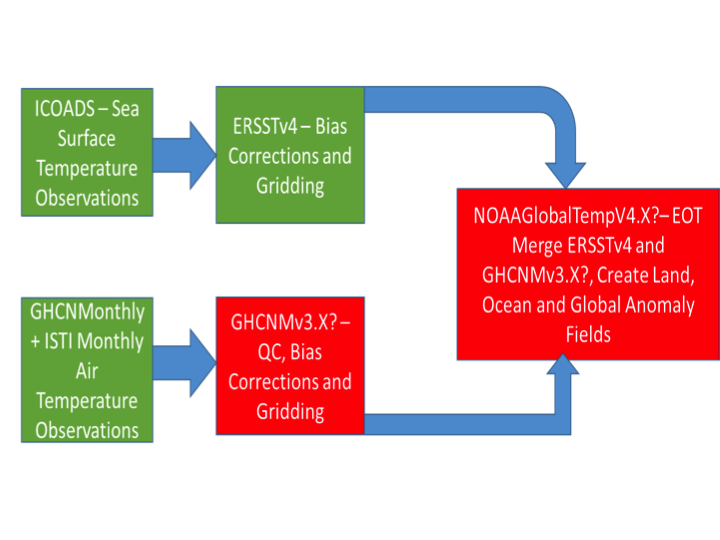 Figure 3. Data flow for surface temperature products described in K15 Science paper. Green indicates operational datasets having passed ORR and archived at time of publication. Red indicates experimental datasets never subject to ORR and never archived.
It is clear that the actual nearly-operational release of GHCN-Mv4 beta is significantly different from the version GHCNM3.X used in K15. Since the version GHCNM3.X never went through any ORR, the resulting dataset was also never archived, and it is virtually impossible to replicate the result in K15.
At the time of the publication of the K15, the final step in processing the NOAAGlobalTempV4 had been approved through an ORR, but not in the K15 configuration. It is significant that the current operational version of NOAAGlobalTempV4 uses GHCN-M V3.3.0 and does not include the ISTI dataset used in the Science paper. The K15 global merged dataset is also not archived nor is it available in machine-readable form. This is why the two boxes in figure 3 are colored red.
The lack of archival of the GHCN-M V3.X and the global merged product is also in violation of Science policy on making data available [link]. This policy states: “Climate data. Data should be archived in the NOAA climate repository or other public databases”. Did Karl et al. disclose to Science Magazine that they would not be following the NOAA archive policy, would not archive the data, and would only provide access to a non-machine readable version only on an FTP server?
For ocean temperatures, the ERSST version 4 is used in the K15 paper and represents a major update from the previous version. The bias correction procedure was changed and this resulted in different SST anomalies and different trends during the last 15+ years relative to ERSST version 3. ERSSTV4 beta, a pre-operational release, was briefed to the NCDC Science Council and approved on 30 September 2014.
The ORR for ERSSTV4, the operational release, took place in the NCDC Science Council on 15 January 2015. The ORR focused on process and questions about some of the controversial scientific choices made in the production of that dataset will be discussed in a separate post. The review went well and there was only one point of discussion on process. One slide in the presentation indicated that operational release was to be delayed to coincide with Karl et al. 2015 Science paper release. Several Science Council members objected to this, noting the K15 paper did not contain any further methodological information—all of that had already been published and thus there was no rationale to delay the dataset release. After discussion, the Science Council voted to approve the ERSSTv4 ORR and recommend immediate release.
The Science Council reported this recommendation to the NCDC Executive Council, the highest NCDC management board. In the NCDC Executive Council meeting, Tom Karl did not approve the release of ERSSTv4, noting that he wanted its release to coincide with the release of the next version of GHCNM (GHCNMv3.3.0) and NOAAGlobalTemp. Those products each went through an ORR at NCDC Science Council on 9 April 2015, and were used in operations in May. The ERSSTv4 dataset, however, was still not released. NCEI used these new analyses, including ERSSTv4, in its operational global analysis even though it was not being operationally archived. The operational version of ERSSTv4 was only released to the public following publication of the K15 paper. The withholding of the operational version of this important update came in the middle of a major ENSO event, thereby depriving the public of an important source of updated information, apparently for the sole purpose of Mr. Karl using the data in his paper before making the data available to the public.
So, in every aspect of the preparation and release of the datasets leading into K15, we find Tom Karl’s thumb on the scale pushing for, and often insisting on, decisions that maximize warming and minimize documentation. I finally decided to document what I had found using the climate data record maturity matrix approach. I did this and sent my concerns to the NCEI Science Council in early February 2016 and asked to be added to the agenda of an upcoming meeting. I was asked to turn my concerns into a more general presentation on requirements for publishing and archiving. Some on the Science Council, particularly the younger scientists, indicated they had not known of the Science requirement to archive data and were not aware of the open data movement. They promised to begin an archive request for the K15 datasets that were not archived; however I have not been able to confirm they have been archived. I later learned that the computer used to process the software had suffered a complete failure, leading to a tongue-in-cheek joke by some who had worked on it that the failure was deliberate to ensure the result could never be replicated.
Where do we go from here?
I have wrestled for a long time about what to do about this incident. I finally decided that there needs to be systemic change both in the operation of government data centers and in scientific publishing, and I have decided to become an advocate for such change. First, Congress should re-introduce and pass the OPEN Government Data Act. The Act states that federal datasets must be archived and made available in machine readable form, neither of which was done by K15. The Act was introduced in the last Congress and the Senate passed it unanimously in the lame duck session, but the House did not. This bodes well for re-introduction and passage in the new Congress.
However, the Act will be toothless without an enforcement mechanism. For that, there should be mandatory, independent certification of federal data centers. As I noted, the scientists working in the trenches would actually welcome this, as the problem has been one of upper management taking advantage of their position to thwart the existing executive orders and a lack of process adopted within Agencies at the upper levels. Only an independent, outside body can provide the needed oversight to ensure Agencies comply with the OPEN Government Data Act.
Similarly, scientific publishers have formed the Coalition on Publishing Data in the Earth and Space Sciences (COPDESS) with a signed statement of commitment to ensure open and documented datasets are part of the publication process. Unfortunately, they, too, lack any standard checklist that peer reviewers and editors can use to ensure the statement of commitment is actually enforced. In this case, and for assessing archives, I would advocate a metric such as the data maturity model that I and colleagues have developed. This model has now been adopted and adapted by several different groups, applied to hundreds of datasets across the geophysical sciences, and has been found useful for ensuring information preservation, discovery, and accessibility.
Finally, there needs to be a renewed effort by scientists and scientific societies to provide training and conduct more meetings on ethics. Ethics needs to be a regular topic at major scientific meetings, in graduate classrooms, and in continuing professional education. Respectful discussion of different points of view should be encouraged. Fortunately, there is initial progress to report here, as scientific societies are now coming to grips with the need for discussion of and guidelines for scientific ethics.
There is much to do in each of these areas. Although I have retired from the federal government, I have not retired from being a scientist. I now have the luxury of spending more time on these things that I am most passionate about. I also appreciate the opportunity to contribute to Climate Etc. and work with my colleague and friend Judy on these important issues.
Postlude
A couple of examples of how the public can find and use CDR operational products, and what is lacking in a non-operational and non-archived product
- NOAA CDR of total solar irradiance – this is the highest level quality. Start at web site – https://data.nodc.noaa.gov/cgi-bin/iso?id=gov.noaa.ncdc:C00828
Here you will see a fully documented CDR. At the top, we have the general description and how to cite the data. Then below, you have a set of tabs with extensive information. Click each tab to see how it’s done. Note, for example, that in ‘documentation’ you have choices to get the general documentation, processing documents including source code, data flow diagram, and the algorithm theoretical basis document ATBD which includes all the info about how the product is generated, and then associated resources. This also includes a permanent digital object identifier (doi) to point uniquely to this dataset.
- NOAA CDR of mean layer temperature – RSS – one generation behind in documentation but still quite good – https://www.ncdc.noaa.gov/cdr/fundamental/mean-layer-temperature-rss
Here on the left you will find the documents again that are required to pass the CDR operations and archival. Even though it’s a slight cut below TSI in example 1, a user has all they need to use and understand this.
- The Karl hiatus paper can be found on NCEI here – https://www.ncdc.noaa.gov/news/recent-global-surface-warming-hiatus
If you follow the quick link ‘Download the Data via FTP’ you go here – ftp://ftp.ncdc.noaa.gov/pub/data/scpub201506/
The contents of this FTP site were entered into the NCEI archive following my complaint to the NCEI Science Council. However, the artifacts for full archival of an operational CDR are not included, so this is not compliant with archival standards.
Biosketch:
John Bates received his Ph.D. in Meteorology from the University of Wisconsin-Madison in 1986. Post Ph.D., he spent his entire career at NOAA, until his retirement in 2016. He spent the last 14 years of his career at NOAA’s National Climatic Data Center (now NCEI) as a Principal Scientist, where he served as a Supervisory Meteorologist until 2012.
Dr. Bates’ technical expertise lies in atmospheric sciences, and his interests include satellite observations of the global water and energy cycle, air-sea interactions, and climate variability. His most highly cited papers are in observational studies of long term variability and trends in atmospheric water vapor and clouds.
NOAA Administrator’s Award 2004 for “outstanding administration and leadership in developing a new division to meet the challenges to NOAA in the area of climate applications related to remotely sensed data”. He was awarded a U.S. Department of Commerce Gold Medal in 2014 for visionary work in the acquisition, production, and preservation of climate data records (CDRs). He has held elected positions at the American Geophysical Union (AGU), including Member of the AGU Council and Member of the AGU Board. He has played a leadership role in data management for the AGU.
He is currently President of John Bates Consulting Inc., which puts his recent experience and leadership in data management to use in helping clients improve data management to improve their preservation, discovery, and exploitation of their and others data. He has developed and applied techniques for assessing both organizational and individual data management and applications. These techniques help identify how data can be managed more cost effectively and discovered and applied by more users.
David Rose in the Mail on Sunday
David Rose of the UK Mail on Sunday is working on a comprehensive expose of this issue [link].
Here are the comments that I provided to David Rose, some of which were included in his article:
Here is what I think the broader implications are. Following ClimateGate, I made a public plea for greater transparency in climate data sets, including documentation. In the U.S., John Bates has led the charge in developing these data standards and implementing them. So it is very disturbing to see the institution that is the main U.S. custodian of climate data treat this issue so cavalierly, violating its own policy. The other concern that I raised following ClimateGate was overconfidence and inadequate assessments of uncertainty. Large adjustments to the raw data, and substantial changes in successive data set versions, imply substantial uncertainties. The magnitude of these uncertainties influences how we interpret observed temperature trends, ‘warmest year’ claims, and how we interpret differences between observations and climate model simulations. I also raised concerns about bias; here we apparently see Tom Karl’s thumb on the scale in terms of the methodologies and procedures used in this publication.
Apart from the above issues, how much difference do these issues make to our overall understanding of global temperature change? All of the global surface temperature data sets employ NOAA’s GHCN land surface temperatures. The NASA GISS data set also employs the ERSST datasets for ocean surface temperatures. There are global surface temperature datasets, such as Berkeley Earth and HadCRUT that are relatively independent of the NOAA data sets, that agree qualitatively with the new NOAA data set. However, there remain large, unexplained regional discrepancies between the NOAA land surface temperatures and the raw data. Further, there are some very large uncertainties in ocean sea surface temperatures, even in recent decades. Efforts by the global numerical weather prediction centers to produce global reanalyses such as the European Copernicus effort is probably the best way forward for the most recent decades.
Regarding uncertainty, ‘warmest year’, etc. there is a good article in the WSJ : Change would be healthy at U.S. climate agencies (hockeyshtick has reproduced the full article).
I also found this recent essay in phys.org to be very germane: Certainty in complex scientific research an unachievable goal. Researchers do a good job of estimating the size of errors in measurements but underestimate chance of large errors.
Backstory
I have known John Bates for about 25 years, and he served on the Ph.D. committees of two of my graduate students. There is no one, anywhere, that is a greater champion for data integrity and transparency.
When I started Climate Etc., John was one of the few climate scientists that contacted me, sharing concerns about various ethical issues in our field.
Shortly after publication of K15, John and I began discussing our concerns about the paper. I encouraged him to come forward publicly with his concerns. Instead, he opted to try to work within the NOAA system to address the issues –to little effect. Upon his retirement from NOAA in November 2016, he decided to go public with his concerns.
He submitted an earlier, shorter version of this essay to the Washington Post, in response to the 13 December article (climate scientists frantically copying data). The WaPo rejected his op-ed, so he decided to publish at Climate Etc.
In the meantime, David Rose contacted me about a month ago, saying he would be in Atlanta covering a story about a person unjustly imprisoned [link]. He had an extra day in Atlanta, and wanted to get together. I told him I wasn’t in Atlanta, but put him in contact with John Bates. David Rose and his editor were excited about what John had to say.
I have to wonder how this would have played out if we had issued a press release in the U.S., or if this story was given to pretty much any U.S. journalist working for the mainstream media. Under the Obama administration, I suspect that it would have been very difficult for this story to get any traction. Under the Trump administration, I have every confidence that this will be investigated (but still not sure how the MSM will react).
Well, it will be interesting to see how this story evolves, and most importantly, what policies can be put in place to prevent something like this from happening again.
I will have another post on this topic in a few days.
Being retired sure is liberating . . .
New Book Details US Attempts to Topple Correa

Cover of Ecaudor in the Sights: The Wikileaks Revelations and the Conspiracy Against the Government of Rafael Correa | Photo: El Telegrafo
teleSUR | February 2017
In his new book, “Ecuador In the Sights: The WikiLeaks Revelations and the Conspiracy Against the Government of Rafael Correa,” released this week in Quito, Norwegian journalist Eirik Vold details attempts by the U.S. government to topple Ecuadorean President Rafael Correa and derail his Citizens’ Revolution.
“Correa was not about to let Washington maintain its dominance through financial institutions like the World Bank and the International Monetary Fund,” Vold told the Andes press agency in explaining the motivation behind years of U.S. efforts to undermine the Ecuadorean president.
The book is largely based on the “Cablegate” documents released by WikiLeaks in 2010, including thousands of secret documents sent from the U.S. Embassy in Quito and the U.S. consulate in Guayaquil.
“There is direct U.S. interference in Ecuador,” Vold told El Telegrafo, adding that “documents show a close relationship between several figures of Ecuadorean political life, the financial sector, and the United States Embassy.”
In the book, Vold outlines how the U.S. looked to thwart Correa from the very beginning, trying to directly prevent his election out of fear of losing the U.S. military base in Manta, the base of CIA operations in the region, as well as control over the U.S. oil company Occidental Petroleum Corp.
After his 2006 election, Correa nationalized the oil company and closed the U.S. base in Manta.
Vold says his book documents multiple attempts by the U.S. to sabotage UNASUR — the regional cooperation body founded in 2007 by progressive governments in Latin America — as well as extensive contacts between the U.S. Embassy and members of the national police force before an attempted 2010 coup, known as 30S.
In 2015, 22 police officers were found guilty of insubordination for their role in the failed coup.
Vold also claims the secret cables identify multiple NGO, media, finance, and political contacts which the U.S. embassy used to attempt to destabilize Correa’s government.
One of those Vold names is current vice presidential candidate Andres Paez. Paez, formerly the president of the left-wing Left Democracy Party, is now running on the right-wing CREO ticket along with former banker Guillermo Lasso.
“The U.S. says in a document he is one of our most trusted contacts. In other documents, it is pointed out that he was considered an ally for imposing free trade agreements, and it is evident that he had meetings at the United States Embassy.”
The Norwegian journalist, who has written extensively about U.S. involvement in Latin America, including a book about Hugo Chavez’s Bolivarian Revolution, said that Ecuador is of particular importance due to its efforts to protect WikiLeaks founder Julian Assange from U.S. persecution, ensuring its role as a “protector of the right to information for the whole planet.”
“We’re talking about a region with the world’s greatest concentration of natural resources, and obviously a region which has been known as the U.S.’s ‘backyard’,” he told Andes. “So U.S. activities are very intense in the region, but they have been maintained, for the last decade, with a more discrete, more covert strategy.”
“The revelations are many, the purpose is one,” he said at a book launch in Quito on Thursday. “That the Ecuadorean public regardless of their political inclination has access to truthful information about the activities of U.S. officials. And local informants in the country who had previously been concealed from them.”
Booming Black Market in Bundeswehr Rifles Funds Iraqi Refugees’ Flight to Europe
Sputnik – 04.02.2017
Last month German media revealed that German weapons supplied to Kurdish Peshmerga in northern Iraq are being sold on the black market, where they may end up in the hands of terrorist groups.
NDR and WDR reporters in the cities of Erbil and Sulaymaniyah in Iraqi Kurdistan discovered German weapons being sold on the black market there, engraved with the initials “Bw,” meaning Bundeswehr.
Weapons on sale included Heckler and Koch G3 rifles on sale for $1450 and $1800, and Walther P1 pistols with an asking price of $1200.
One arms dealer told a reporter that he could procure the Heckler & Koch G36 assault rifle for $5000.
These weapons sales have also financed the flight of refugees from Iraq to Germany, an Iraqi Kurdish refugee living in Germany told the news program.
Former Peshmerga Mustafa S said that he is one of hundreds of fighters who have sold their weapons to finance their escape from Iraq.
“Mustafa S said that he knows around 100 Peshmerga who have sold their weapons in recent months in order to flee. The situation has become unbearable for many. The low oil price, lack of payment from the Iraqi central government and the battle against Daesh, which guzzles about five million dollars daily, have brought the Kurdish regional government to the brink of bankruptcy. (Mustafa) himself had not been paid for five months and did not know how he was going to pay rent, food, and medicine for his disabled daughter. Now, he lives with his wife and their six children in a home for asylum seekers in East Germany,” Tagesschau reported.
Deputy Chairman of the Die Linke opposition party in the German Bundestag Tobias Pfluger called on the government to stop supplying arms to the Peshmerga. He told Sputnik that the deliveries are counter to the German constitution.
“The interesting thing is that the training missions that are connected with these weapons deliveries break several domestic federal laws. German and EU legislation, the War Weapons Control Act and the Foreign Trade and Payments Act, prohibit direct deliveries to war zones,” Pfluger explained.
The German Defense Ministry has delivered an estimated 2,400 tons of arms and munitions to Kurdish Peshmerga fighters since it began to supply the militia in summer 2014. A government spokesman told NDR and WDR that the government of Iraqi Kurdistan is responsible for the weapons’ misuse.
The German Defense Ministry is committed to the “proper verification of supplied weapons,” and their use in accordance with international law.
However, since the Ministry is unable to trace individual arms, “the sale of individual weapons cannot be excluded with absolute certainty.”
Pfluger said that assurances from local forces that the arms will remain in their possession are “worthless.”
“It is completely perverse that they have to sign a so-called confirmation of retention. That is nothing other than a completely worthless piece of paper because we know that the weapons show up on the markets in Iraq and Syria. In this respect, we say that this commitment must be ended, it is an intensification of the war and is in no way something that creates peace there.”
Peace activist and spokesman for Aktion Aufschrei — Stop the arms trade! Jurgen Grasslin told Sputnik Deutschland that German guns have ended up far removed from their intended destination.
“The federal government usually has no idea where their weapons are actually delivered to, when they are exported. My research, based on (studies of) numerous countries and trips to crisis regions and war zones over the past 30 years, shows clearly that weapons roam. Weapons do not stay in the place where they are delivered.”
Grasslin, author of a book entitled “The Black Book of Arms Trading: How Germany Profits from War” (Schwarzbuch Waffenhandel: Wie Deutschland am Krieg verdient), alleges that German arms deliveries constitute “complicity in murder.”
“If Daesh is firing German weapons, and of course weapons from other countries, that is more than a scandal, it is a breach of the law. It is complicity in murder. You are delivering to a war zone. You know that these weapons don’t stay in the hands of the recipients, and that they land in the hands of the worst terrorist groups, for example Daesh. The people who authorize these arms exports must be named, that is namely members of the Bundessicherheitsrat (Federal Security Council) or Federal Government. The first to be named should be Chancellor Angela Merkel and her deputy Sigmar Gabriel, who lead the Bundessicherheitsrat and are thus responsible for these armed forces.”
Nancy Pelosi says she’s for single payer, refuses to co-sponsor single payer legislation
An Open Letter to Nancy Pelosi from Ralph Nader
Representative Nancy Pelosi
House Minority Leader
United States House of Representatives
233 Cannon House Office Building
Washington, DC 20515
January 17, 2017
Dear Representative Pelosi:
I see you were quoted in The Hill newspaper recently (“Pelosi Rips GOP for Cut and Run Strategy on Obamacare,” by Mike Lillis, January 12, 2017) saying that you are for single payer health insurance. You had this preference before Presidents Clinton and Obama, who ideally agree with you, dismissed single payer as “impractical” given the entrenched and powerful healthcare industry.
A couple of years ago, I wrote an article titled “21 Ways Canada’s Single Payer System Beats Obamacare”.
Within a week or so, your colleague, Congressman John Conyers (D-Michigan), will re-introduce HR 676, the single payer bill in the House.
Will you actively support this much more efficient and comprehensive legislation, with its many advantages proven in other countries, and persuade other House Democrats to also co-sponsor?
Last year, only 63 Democrats co-sponsored.
Obamacare, without a public option, has been a complex patchwork in so many ways — including forcing individuals to purchase inadequate insurance from private health insurance companies — insurance that carries with it high premiums, deductibles, co-pays and forces narrow networks.
For many, Obamacare is quasi-catastrophic insurance with limited choice of doctor and hospital.
If the Republicans repeal Obamacare, Democrats need to be ready and offer to replace it with something that can attract left/right support — single payer, Medicare for All — everyone in, nobody out, free choice of doctor and hospital, no medical bankruptcies, no coercive co-pays or deductibles, with all their accompanying fears and anxieties, and no more deaths due to lack of health insurance.
A December 2015 national Kaiser public opinion poll found that 58 percent of adults in the U. S. supported single payer (Medicare for All), including 81 percent of Democrats, 60 percent of Independents, and 30 percent of Republicans. Imagine the poll numbers when Full Medicare for All starts to be explained, in its clear simplicity, and promoted by a major political party.
Let’s work together to present the American people something both more efficient and responsive that they want and need — Medicare for All and freedom to choose their doctor, clinic and hospital.
Sincerely,
Ralph Nader
PO Box 19312
Washington, DC 20036
Russia Calls the West’s Bluff over Real Elections, At Long Last
By Seth Ferris – New Eastern Outlook – 01.02.2017
The world continues to turn upside down. Think the Western democracies are still the authorities on the one thing they are supposed to know about? Think again.
For generations the OSCE, the Organisation for Security and Cooperation in Europe, has been monitoring elections in various countries to ensure they meet Western democratic standards. After each one it publishes a report, which sometimes bears little relation to what people on the ground have seen, and each one of these mysteriously reflects the current political position of the Western powers – if they like a country and its government, they have conducted free and fair elections, if not, the elections are declared wholly or partially invalid.
This practice has often raised criticism, but still the OSCE is being called in to monitor elections all over the globe. Why? Because it is the institution representing countries with a long democratic tradition, and those these have since chosen as their friends. That’s it. It does not have to do anything to justify the vast sums given to it to be the authority on elections, simply be there.
Theoretically the OSCE is the product of a partnership between East and West. But in effect the OSCE is run by Western democracies and those countries it now believes have adopted Western standards since the Cold War. These nations, we are told, understand democracy and can therefore recognise it when they see it.
On 19 January the Head of Russia’s Central Elections Commission, Ella Pamfilova, recommended to the OSCE’s Michael Link that it should adopt a common set of standards for election monitoring. This would enable it to compare one country’s performance with another’s and see whether countries are improving or regressing compared to previous elections. “I consider it very important that the standards of elections monitoring in all OSCE member countries be unified,” she reportedly said.
This statement opened mouths all over the world. So let’s get this straight – the OSCE has been monitoring all these elections without any set standards of what democracy is, what is free and fair, what are the acceptable and unacceptable variables, what are the irreducible minimums or what the rights and responsibilities of governments, election commissions and political parties are? It has continued being regarded as the authority on these questions in spite of this? And now the Russians – the RUSSIANS – have to call for a common set of standards to give the monitors some idea what they are supposed to be doing?
You think, therefore we are
This isn’t about elections. It is about how long you can get away with a con. Since the end of World War Two The West’s policy has been based on lies – it is supposed to believe in certain values, such as democracy and human rights, but goes round depriving the rest of the world of the same values it says are paramount.
Everyone has seen this happen, but the West is still supposed to know more about these values than anyone else. So if other countries want democracy and human rights they automatically turn to the West. If they end up with governments which claim to respect democracy and human rights but do exactly the opposite, and Western monitors telling them that rigged elections are substantially free and fair, is that their own fault or that of the Westerners they asked to prevent these things happening? But still they feel they have nowhere else to turn, because Western democracies must somehow know best, and they won’t be better off any other way.
Russia’s request makes one simple point. If you believe in democracy, you will have developed a sophisticated definition of what it is and why it is so important after such long experience of it. If you have such a definition, every observer who monitors elections will know it and be able to assess the elections against it. Of course there will be some local variations in practice between democratic countries, and some of these might raise the concern of some countries. But there will be a common set of standards already in place against which these too can be judged, and thus everyone sent as a monitor will be able to cite these to acquire credentials as a democrat, even if they’ve played little or no part in actual elections.
This is indeed perfectly logical. If it hasn’t happened, this cannot be because the conditions don’t exist. It is because no one wants to be bound by any definition of what democracy is. The West wants to use the term how it wants, when it wants, and make everything up to fit whatever broader political goals it has. The West pronouncing on whether elections are free and fair is about as credible as Australia saying it is in the northern hemisphere because the cover of the North-South report said so and that was written by Western European politicians.
Power to some other people
Does this process actually achieve anything? It enables selected people to enjoy all-expenses-paid junkets to different countries, where they go around with badges on which technically say “Election Observer” but in reality say “You can’t say anything about me, I’m the expert”. How many of these junkets they get depend on how well they fit the evidence to the pre-existing script about that election. Many observers arrive before polling day and stay afterwards: maybe this is to do with monitoring the pre- and post-election situations, or maybe it is to give them time in various places of ill repute as a payoff for going along with the official script.
Lots of historic examples of election monitoring fraud are available. When India decided it wanted to annex the independent Kingdom of Sikkim in 1975 it persuaded its parliament to abolish the monarchy and then hold a referendum on joining India. Obviously, as Sikkim was already an Indian protectorate, it monitored that referendum to ensure it was free and fair. Very few others were able to find out anything about the referendum until the results came in, which showed 97% support for joining India, despite the fact the alleged number of people could not have physically voted on the day due to the terrain, most of the voters had been imported from India and the observers were also armed troops in many cases.
Similarly, when Viktor Yanukovych was up against Yulia Tymoshenko in the 2010 presidential runoff in Ukraine Mikheil Sakkashvili’s Georgia sent hundreds of observers, as a neighbouring, friendly country. The trouble was, most of these were actually martial artists, or simply thugs, with no experience of organising elections. Saakashvili openly supported Tymoshenko in these elections and had already been happy to use force on his own citizens in Georgia. It would have interesting to quiz these observers about what a “free and fair” election is supposed to mean.
Indeed, the May 2008 Georgian Parliamentary Election had already provided a classic example of vote rigging and fraud which was obvious to anyone from a democratic country. The international observers looked on and saw nothing, and the OSCE rubber stamped the results, with the existence of various spying platforms in Georgia at stake.
What OSCE monitors do has nothing to do with the welfare of the people whose country they are pronouncing upon. It is about exerting control. If the outcome of an election is what the West desires, it is free and fair, and no one can complain because they have no other set of standards to refer to. They can’t call on some other organisation to review the OSCE’s judgment because, although such organisations exist and can act independently, their credibility can be easily exploded.
If someone disagrees with the conclusions of the mighty OSCE, however farcical those conclusions may be, they must have some political motive or be unaware of the full facts. This sort of common thinking, however baseless, is what has enabled the West to get away with this for so long. How it responds to Russia’s request for it to adopt standards it can be held to, which it should have done itself long ago, remains to be seen.
Velvet fist in an iron glove
This sort of control is familiar to anyone who has worked with aid agencies, which, like democratic systems, are designed to help people. Whether these are international or internal to a specific country, the principle is the same: we know everything; you know nothing, so you have to accept whatever we say so we can prevent you ever achieving what you want to achieve.
Eastern Europe is full of aid agencies from Western countries, regardless of the political orientation of that country. Each one brings money to conduct programmes which are supposed to bring greater democracy, rule of law, industrial or agricultural efficiency, human rights etcetera. The process is supposedly simple: benchmarks are set, and if prospective beneficiaries achieve these benchmarks they get the funding to take part in the programme, which involves meeting further benchmarks as they go along.
This results in situations such as the National Democratic Institute in Georgia insisting that the principles of democracy and fairness are “very clear” because it says so, without explaining what these principles actually are, why it therefore produces wildly inaccurate opinion polls at each election for pay and why it never says a word about a president who was democratically elected with 87% of the vote being overthrown in a coup and the state being built ever since on supporting that coup. It results in situations where people who’ve never set foot in a country before try to tell local farmers, with all their accumulated experience, that they have to do things differently, rather than better, to enter shiny Western markets whilst also supporting the rigging of those markets against them to suit other clients elsewhere, who pay better or are more politically reliable.
But the worst aspect is that the pump soon runs dry. The further people get involved in these programmes the more paperwork they have to do. That in itself is onerous, but it comes with strings attached. To keep receiving support they have to become increasingly politically acceptable to the donor, as the aid is not designed to improve the situation on the ground but to serve the broader political objectives of the donor governments. Georgia provides another disgusting example of this: during Saakashvili’s time even staff of the International Red Cross, most of who didn’t support him, had to be seen canvassing for him and his party, flags waving, trumpeting Western progress, when that same government wouldn’t let them rescue people stranded in South Ossetia during the 2008 war.
Internal aid organisations are no different. They also tell prospective clients, which are usually local welfare organisations with their own remit, that they have to adopt all kinds of quality standards to be eligible for any funding, because everyone else has trustworthy quality standards and they don’t. These standards are usually drawn up by people who have never worked in a similar organisation, and the standards themselves are often irrelevant to the organisations which are told to get them.
But the more money they get as a result, the more games they have to play to retain those funds and keep providing services, even though what they do has increasingly less to do with the welfare of their clients. Who is creating the problems their clients face? The same government whose various arms are telling them they have to adopt these systems to function. It is therefore rather obvious which such systems are invented, by whom, and what they are ultimately designed to achieve.
It’s not going to go away
It would be a positive thing if a country like Russia, which has always been told it has to learn from the West because it is deficient, was able to make Western countries adopt better standards. People in Eastern Europe know perfectly well what democracy actually means, which is why they cry out for it and object when they don’t get it. At every election in every Western country there are some offences committed, and no one has ever been able to demonstrate that people, who were originally from “young democracies” or no democracy at all, commit more of these than anyone else.
However it is likely that “Missionary Syndrome” will still hold sway. Whatever fine words the OSCE might come out with about listening to experts; it all depends on where those experts come from. In the 1980s there was a craze for Protestant countries which had formerly been British or German colonies to send missionaries to “the Old Country” to try and get local people going to church again. The common response was, “we sent our missionaries to you, what do you have to teach us?” Even those who agreed with every point being made wouldn’t accept it coming from the mouth of an ex-colonial, because natives of the former imperial power must automatically know more.
Nevertheless, this latest move is yet another example of Russia taking on the mantle the US used to have – Russia is increasingly the power of legality and international agreements, the US increasingly the rogue operator. Everything Russia does which the West objects to was done by the West long before, in defiance of its professed principles, and that is exactly why Russia is doing it. The way to change the game is for all sides to behave legally and properly, but it is Russia, not the US, which is seeking to bring that about.
All this is very alarming to the millions of people brought up with the opposite assumption, which at one time really was justified. Realising this is what is happening is like suddenly discovering you’re the opposite of what you thought you were.
Now that Donald Trump, allegedly a Russian stooge, has taken power in the US there is much cry over the threat Russia poses. That “threat” exists because Western hypocrisy and criminality put it there – and only by doing what it was always supposed to do, with or without Russian prompting, is that “threat” ever going to go away.
Seth Ferris, investigative journalist and political scientist, expert on Middle Eastern affairs.
Soros-funded NGOs aiming to bring down Hungarian govt – foreign minister
RT | January 30, 2017
The activities of organizations funded by US billionaire investor George Soros in Hungary are “anti-democratic,” as they want to undermine the government in Budapest, the foreign minister of Hungary told RT.
Soros “would like this government to fail, he would like to kind of fire this government because he doesn’t like our approach, doesn’t like our policies,” Foreign Minister Peter Szijjarto told RT’s Sophie Shevardnadze.
“We find it very anti-democratic if someone from abroad would like to influence Hungarian voters on whom to vote for,” he asserted.
Several days before the interview, the Hungarian parliament began to discuss a bill allowing authorities to audit NGO executives and request detailed reports on their foreign donations.
Earlier in January, chairman of the ruling Fidesz party Szilard Nemeth said that “these organizations must be pushed back with all available tools, and I think they must be swept out, and now I believe the international conditions are right for this with the election of the new president [Donald Trump].”
Last September, Nemeth, who is also the deputy chairman of Hungary’s National Security Committee, submitted a list of 22 NGOs “connected to the Soros network for the purpose of having these organizations screened.”
Foreign Minister Szijjarto said it is obviously the right of his country to be protected from foreign influence. “This is what we have heard a lot from the US for the last months – that external influence is so dangerous… So, it’s a good reason – if this is the American position, it can be our position as well.”
Hungary, which lies at the very heart of Europe, last year became a main passageway for hundreds of thousands of migrants and refugees eager to reach northern European countries. The government, led by right-wing President Viktor Orban, responded by erecting fences along Hungary’s borders and introducing strict border controls. Budapest has consistently refused EU-backed mandatory resettlement quotas, calling them a blow to member states’ sovereignty.
Szijjarto cited intelligence reports alleging that “there were organizations which helped illegal migrants find ways to Hungary, to find where they could violate our border, to find out how to apply for asylum status, and these reports have said that George Soros was in the background of these organizations.”
Countries to Hungary’s east and south are concerned about Soros’ operations, too. In Macedonia, an organization called Stop Operation Soros (SOS) has been launched. Its founder, Nikola Srbov, accused Soros of hijacking civil society, calling upon followers to “fight against one-mindedness in the civil sector, which is devised and led by Soros,” according to Vecer newspaper.
Russian prosecutors branded the Open Society Foundation (OSF), a major Soros asset, and Open Society Institute’s Assistance Foundation threats to the country’s constitutional order and national security in 2015, and banned them from providing grants to Russian partners.
Groups run by Soros have also been accused of meddling in Ukrainian affairs and supporting the 2013 Euromaidan protests that led to the ouster of democratically-elected President Viktor Yanukovich.
Featured Video

Death Spikes & Rising Cancer In Our Youth Explained
or go to
Aletho News Archives – Video-Images
From the Archives
Politicians lie
By Mazin Qumsiyeh | Popular Resistance | August 18, 2013
There is no way to say this truth nicely: Politicians lie. That includes Japanese, American, Egyptian, Israeli, and Palestinian politicians! Is there something more common sense than that? Yet, so many citizens around the world believe their own politicians or wistfully acknowledge lies but think it is part of the job needed to run things. They believe even when politicians contradict themselves blatantly. This phenomenon is rather remarkable. It is a dissonance and disconnect from reality that many seem oblivious to. It is very dangerous because it can lead to accepting rationales for going to war. These can be deadly wars that lead to millions of lives lost as happened in what was called World War 1 and WW2. Even when incredible and declassified evidence abound, politicians continue to lie and old mythologies refuse to die. Here are just a few of the countless lies told to us over the past few decades… continue
Blog Roll
 Aletho News
- Iraqi resistance group vows to stage airport sit-ins over Iran aerial blockade
- Turkish parliament to review Saudi-Pakistan defense pact next month
- DEATH SPIKES & RISING CANCER IN OUR YOUTH EXPLAINED
- Iran offers Trump deal before US election
- Merz regime wants ‘secret police’ – opposition
- Israeli settlers terrorize West Bank Palestinians with state-provided drones: Report
- They see them, then kill them: Israeli quadcopters track, deliberately target civilians in Gaza
- Debunked: Trump’s egregious UNGA claims on war against Iran crumble under scrutiny
- Europe was part of the infrastructure of US aggression against Iran: Deputy FM
- New evidence on the Bucha Massacre
- If Americans Knew
- Trump betrayed voters with his campaign lies and prioritized a foreign country once he took office
- Netanyahu calls Israel’s war in Gaza ‘opposite of genocide’ in UN speech to near-empty hall
- Settler Kidnappings: Torture, Sexual Abuse and Terrorisation of Palestinian Abductees as Israel Deepens Annexation of West Bank
- Gaza winter nears as 162,000 tents become unusable, raising fears of humanitarian crisis
- Netanyahu says, “It’s the opposite of genocide”; UN says Gaza economy is world’s ‘most severe crisis on record’ – Daily Update
- Israel’s US-Backed Assault on Gaza Has Created the ‘World’s Most Severe Economic Crisis on Record’: UN
- ‘Protecting U.S. Citizens’… From Israel
- ‘This is where I live now, the back of a truck’: a day in the life of a grandmother in Gaza
- In UN Speech, Iran’s President Displays Pictures of Children Killed by US, Brings Attention to Israel’s Nuclear Arsenal
- Israel displaces hundreds of Palestinians amid wave of demolitions in West Bank
- No Tricks Zone
- New Study: Earth And Venus Surface Warmth Largely Explained By Convection And Lapse Rate, Not CO2 Or Radiation
- 2025 Nature Paper Claiming Worsening Global Drought Gets RETRACTED …Heavily Flawed
- New Study: ‘Global Drought Shows No Detectable Recent Acceleration Under Climate Warming’
- Economic Masterminds: German Socialists Suggest Taxing Productivity Gains Stemming From Using AI
- The South China Sea Has Not Been Cooperating With The Climate Change Narrative
- Energy Crisis: Germany Enters Heating Season With Historically Low Gas Reserve Fill Levels
- New Study: The Antarctic Ice Sheet Gained Mass From 2020-2024 Due To Staggering Snow And Ice Accumulation
- Study: Ocean Heating Rates From Thousands Of Years Ago ‘Dwarf’ Modern Ocean Heating Rates
- Climate Extremists Target, Attack Large-Scale Power Grid Infrastructure In Germany!
- New Study: Antarctic Ice Melt Has Contributed Less Than 1 Centimeter To Sea Level Rise In The Last 30 Years

