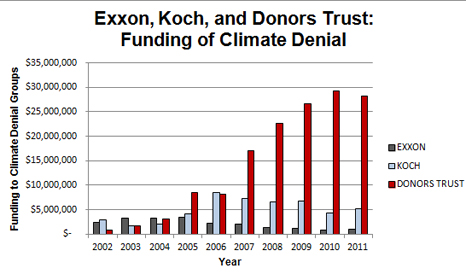
It will be difficult to bring the number down to anything approaching the amount of funding skeptics are said to get:
By Matt Agorist | The Free Thought Project | December 10, 2016
Insys Therapeutics, the company who makes insane profits from a drug behind one of the worst overdose epidemics in the nation’s history, fentanyl, is in hot water — again.
According to Reuters, six former Insys Therapeutics Inc executives and managers were arrested on Thursday on charges that they engaged in a nationwide scheme to bribe doctors to prescribe a drug containing the opioid fentanyl, U.S. prosecutors said.
Along with the executives, Michael Baich, the former CEO, was also charged in an indictment filed in federal court in Boston this week.
They have all been brought up on charges of racketeering for their scheme.
“Patient safety is paramount, and prescriptions for these highly addictive drugs, especially fentanyl, which is among the most potent and addictive opioids, should be prescribed without the influence of corporate money,” Carmen M. Ortiz, the United States attorney in Massachusetts, said in a statement. “I hope that today’s charges send a clear message that we will continue to attack the opioid epidemic from all angles, whether it is corporate greed or street-level dealing.”
What makes this information so damning and hypocritical is that in September, the Free Thought Project helped to expose Insys Therapeutics for paying hundreds of thousands of dollars to keep marijuana, a plant that has never killed anyone, illegal.
That’s right, in a glaring display of hypocrisy, the maker of the drug Subsys, a sublingual fentanyl spray, claims that marijuana is dangerous because it could hurt children. At least that was their public reasoning for shoving $500,000 towards a campaign opposing marijuana legalization in the US.
These people not only advocated that pot is dangerous, but they were bribing doctors to prescribe a drug responsible for one of the most deadly epidemics in the history of the United States — for entirely unnecessary reasons.
About 129 people died each day nationwide in 2014 from a drug overdose and more than half of those were opioid, heroin, or fentanyl related, according to the DEA.
Insys has every reason in the world to despise legal weed as multiple studies now show that it is a great alternative for pain relief versus the highly addictive and deadly opioids.
According to a study that looked at 17 states with medical cannabis laws in place, researchers “found that the use of prescription drugs for which marijuana could serve as a clinical alternative fell significantly, once a medical marijuana law was implemented.”
Prescriptions fell dramatically for opioid painkillers, with 1,826 fewer doses being prescribed per year by the typical physician in a medical cannabis state. Amazingly, the trend also applied to prescriptions for depression, seizure, nausea and anxiety.
Insys has other reasons to fear this beneficial plant as well — because they are making a synthetic version of it.
According to a September report by the Intercept, Insys is currently developing a product called the Dronabinol Oral Solution, a drug that uses a synthetic version of tetrahydrocannabinol (THC) to alleviate chemotherapy-caused nausea and vomiting. In an early filing related to the dronabinol drug, assessing market concerns and competition, Insys filed a disclosure statement with the Securities and Exchange Commission stating plainly that legal marijuana is a direct threat to their product line:
Legalization of marijuana or non-synthetic cannabinoids in the United States could significantly limit the commercial success of any dronabinol product candidate. … If marijuana or non-synthetic cannabinoids were legalized in the United States, the market for dronabinol product sales would likely be significantly reduced and our ability to generate revenue and our business prospects would be materially adversely affected.
It is apparent that the people at Insys are willing to go to extreme and unscrupulous lengths to maintain their market share — up to and including buying off doctors and politicians, as well as pushing a highly dangerous drug on people who may not need it.
According to the indictment of the executives, as reported by the NY Times, the six former employees, including the former chief executive, Michael L. Babich, and regional sales directors, offered bribes and kickbacks to pain doctors in various states in exchange for getting them to prescribe more of the company’s product, Subsys, a spray form of fentanyl. Subsys is supposed to be used only by cancer patients who are already on round-the-clock pain drugs.
The irony about the government’s choice to indict these Insys executives is that they are a small time company who has very little market share. If we compare Insys Therapeutics to the makers of OxyContin, for example, we can see a glaring difference as to how the two companies are treated by the government.
While Insys sits in court awaiting a much-deserved criminal indictment, the makers of OxyContin, the Sackler family, is rubbing elbows with the elite.
As the DEA cracks down on fentanyl, the FDA announced last year that they approved the use of OxyContin, a similarly deadly drug, for use in children.
So, while the news of Insys getting busted for pushing their deadly drug on people who don’t need it is certainly worthy, the elite who make billions a year from peddling their deadly addictive drugs through pill mills across the US while fighting to keep cannabis illegal, remain quietly protected by the establishment and their immoral war on drugs.
RT | December 7, 2016
The International Institute of Strategic Studies, an influential UK diplomacy and security think tank run by prominent military, political, and business figures, has received over $38mn in secret donations from Bahrain.
Bahrain, a former British colony and oil-rich Arab country which accommodates the US Navy’s Fifth Fleet, had secretly donated more than $38 million (£30 million) to the International Institute of Strategic Studies (IISS), a reputed UK think tank which positions itself as a leading global military and security research consultancy, according to human rights group Bahrain Watch.
The donations, which the IISS received over the course of five years, were said to form around a quarter of the think tank’s budget, or over $7.6 million (£6 million) per year, Bahrain Watch said citing confidential documents it obtained in cooperation with the Guardian.
Money from the Bahrain government was received in large part under a secret memorandum of understanding (MoU) between IISS head John Chipman and Bahraini Foreign Minister Sheikh Khalid Bin Ahmed Al Khalifa, who had previously served as ambassador to the UK.
The IISS and Bahrain agreed to “take all necessary steps to keep confidential all classified information which is disclosed or obtained in relation to this MoU, and neither shall divulge such information to any third party.”
The leak comes amid UK Prime Minister Theresa May’s two-day trip to Bahrain to discuss post-Brexit trade with Gulf leaders. UK Foreign Secretary Boris Johnson is also expected to arrive in the Bahraini capital Manama on Friday to address a Middle East-related conference organized by the IISS.
The event itself, called the Manama Dialogue, was financed by Bahrain’s ruling family, which is paying for all the delegates to stay at the Ritz-Carlton Hotel, the report said. Since 2011, the ruling family has donated $19 million (£14.9 million) to fund the conference, which is attended by influential figures from the Gulf and western nations, among others, the leaked papers show.
In a statement to the Guardian, the IISS said its agreement with the Bahraini rulers “expressly gives the IISS full freedom to develop the agenda and invite participants in line with priorities it judges to be important to encourage strong debate on regional issues and facilitate important diplomatic contacts.”
“The IISS for a number of years has received funding from a wide range of governments for conferences and major international summits,” it added.
“The Bahraini government is willing to spend so much on the IISS and the Manama Dialogues because they allow the government to portray itself as modern, liberal and business-friendly, in contradiction to the evidence of torture, abuse and political disenfranchisement,” Bahrain Watch said in turn.
In April, a report for the Foreign Affairs Select Committee blasted Bahrain’s poor human rights record, not least during the violent suppression of the Arab Spring protests, with direct support from another controversial UK ally – Saudi Arabia.
Earlier, Amnesty International accused London of “whitewashing” Bahrain’s record in the United Nations, having never condemned the country’s human rights abuses. The Bahraini royal family has enjoyed a close relationship with the British monarchy for several decades.
In mid-November, a new Royal Navy base in Bahrain was inaugurated by Prince Charles, with construction mostly funded by the Bahrainis. The US Naval Forces Central Command (NAVCENT) is also headquartered in the country, guiding the operations of the Fifth Fleet.
The IISS advisory board features high-ranking Western military brass, politicians, and business leaders, including George Robertson, former secretary-general of NATO, Field Marshal Charles Guthrie, former chief of the UK General Staff, Marillyn Hewson, CEO of Lockheed Martin, Amos Yadin, former chief of Israeli military intelligence, as well as Carl Bildt, Sweden’s ex-foreign minister.
Founded in 1958, the IISS describes itself as a primary source of information on international strategic issues for “politicians and diplomats, foreign affairs analysts, international business, economists, the military, defense commentators, journalists and academics.”
Apart from the Manama Dialogue, the institute hosts the Shangri-La Dialogue, an annual meeting of Asia-Pacific region defense ministers in Singapore.
It also publishes ‘The Military Balance,’ a comprehensive annual assessment of each country’s military capabilities. A 2015 Global Think Tank Index compiled by the University of Pennsylvania ranked IISS as the fourth-best non-US research institution.
RT | December 6, 2016
Petro Poroshenko holds sway in Ukraine by channeling western financial aid into war and bribery, while making big money with a close circle of loyal oligarchs, fugitive Ukrainian MP Aleksandr Onishchenko told RT in an exclusive interview.
Aleksandr Onishchenko, a former MP in Ukraine’s parliament, a billionaire oligarch and professional Olympic showjumper, fled the country this summer a week before being stripped of parliamentary immunity due to an investigation into an alleged gas fraud scheme.
He said that the case against him is a setup and the Ukrainian government tried to frame him to cover up a large-scale bribery scheme linked directly to President Poroshenko.
Onishchenko, who said he was a key figure in the complex scheme for two years, vowed to show western sponsors of the Ukrainian government where their money is actually going. He told RT that most IMF aid money is being used by President Poroshenko and his accomplices to fuel the ongoing civil conflict in the east of Ukraine.
“Most of the money they use for the war. I think that Poroshenko is very interested to keep the war,” Onishchenko said. An overgrown military not only allows Poroshenko to reap profits from “war-time” contracts but also suppress political opponents, the fugitive Ukrainian MP alleged.
“All the contracts for this war, even the smaller [ones], like weapons, or some stuff for the army, they [are going through] the companies which are close to [Poroshenko]. They are just [laundering] money … for them the war is like business.”
Ukraine’s president and his accomplices have a stake in all the major businesses in the country now and it’s impossible for someone outside the inner circle to make money in Ukraine, according to Onishchenko, who claims Poroshenko and his team are scared that someone could potentially fund the opposition in the wake of upcoming elections
“Poroshenko is in control now [of] all the state’s companies. It’s the biggest business they’re doing. It’s a chemical factory in Odessa, a lot of state energy companies,” said Onishchenko. Only people close to the president have been put in charge of these companies, he said.
Read more
Ukrainian President Petro Poroshenko © Valentyn Ogirenko Fugitive Ukrainian MP says he handed proof of Poroshenko ‘buying votes’ to US Justice Dept
“They use this money for political [advantage] for voting, for supporting … they use this money to make Poroshenko stronger,” Onishchenko added.
A scandal surrounding impressive income declarations, recently filed by Ukrainian politicians, brought to attention the scale of Ukrainian corruption, Onishchenko told RT.
He hopes the recent revelations about the scale of corruption in the Ukrainian government will result in the end of financial aid to the country.
“All Europe was shocked after the declaration of the people from the parliament of Ukraine. If you saw, all the people’s deputies, they declared so much cash. It was crazy, like millions and millions. How did they make that cash?” Onishchenko said.
“Poroshenko corrupts them … pays them money for… voting. That’s why they have so much money now. They’re buying … big houses, they are buying yachts and a lot of stuff. They must explain where the money is from. That’s why they put the money in these declarations. After these declarations from the government of Ukraine and this corruption scandal, even what I said to the press, I don’t see that western Europe will support [them] anymore, I mean, financially, Ukraine. Because they see they just use money for corruption and they’ll never accept this.”
By James Petras | December 5, 2016
With a few notable exceptions, political leaders are chosen by political leaders, and not by electorates or community-based organizations or popular assemblies. Popular media figures and the so-called ‘pundits’, including academics and self-declared experts and ‘think-tank’ analysts reinforce and propagate these choices.
A collection of terms and pseudo concepts are essential in validating what is really an oligarchical process. These concepts are tagged onto whoever is chosen by the elite for electoral candidates or for the seizure of political power. With this framework in mind, we have to critically analyze the symbols and signs used by popular opinion-makers as they promote political elites. We will conclude by posing an alternative to the ‘propaganda of choice’, which has so far resulted in broken pre-election promises and political debacles.
Language and Pseudo-Concepts: Subterfuges for Manipulated Choices
The usual suspects in the business of mass-manipulation describe their political leaders in the same folksy or pseudo-serious terms that they attribute to themselves: Experts/ intuitive improvisers/ trial and error ‘muddlers’. The ‘experts’ often mean wrong-headed policymakers and advisers whose decisions usually reflect the demands of their current paymasters. Their stated or unstated assumptions are rarely questioned and almost never placed in the context of the contemporary power structures. The experts determine the future trajectory for their political choices. In this way, the views expressed by ‘experts’ are primarily ideological and not some disembodied scholarly entity floating in an indeterminate space and time.
Pundits often promote ‘experience’ in describing the ‘experienced’ leader, adviser or cabinet member. They denigrate the opposition candidate adversary as ‘lacking experience’. The obvious questions to this platitude should be: ‘What kind of experience? What were the political results of this experience? Who did this experience serve?
We know that Secretaries of Defense William Gates and Donald Rumsfeld and their leading assistants, Paul Wolfowitz and Douglas Feith were appointed to their high positions and praised for their ‘experience’. This ‘experience’ drove the country into repeated disastrous military engagements, political debacles and unending wars. It would be better to reject officials who are highly ‘experienced’ in creating disasters and appoint those officials experienced in conciliation and reconciliation. Unfortunately the ‘experts’ never discuss these matters in any historical context.
Many political choices are adorned with ‘titles’, such as ‘successful entrepreneur’ and/or ‘prize winning journalist’. This ignores the fact that those ‘bestowing titles’ come from a narrow band of inbred organizations with financial, military or ideological interests looking for near-future rewards from their now titled, prize winning political choice.
Highly certified candidates, we are told, are those eminently qualified to lead, whether they are university academics with prestigious degrees, or doctors, lawyers, or investors who work for leading groups. The most highly vetted officials coming from Harvard University have implemented economic policies leading to the worst crises in the shortest time in world history.
Lawrence Summers, PhD and Harvard University President-turned Treasury Secretary participated in the pillage of Russia in the 1990s and then brought his talent for sowing international chaos home by joining Federal Reserve Chairman Alan Greenspan. These two ‘experts’ promoted enormous financial swindles, which led to the worst economic crash in the US in seven decades.
Money laundering by the big banks flourished under Princeton Summa Cum Laude and US Treasury ‘Under-Secretary for Terrorism and Financial Intelligence’, Stuart Levey. Levey concentrated on implementing brutal economic sanctions against Iran shutting US businesses out of multi-billion-dollar oil deals with Tehran, promoting a huge annual $4 billion-dollar giveaway to Israel and a granting a uniquely privileged trade status for the Jewish state – which cost the US taxpayers additional billions.
Receiving ‘prestigious awards’ does not predict a successful policymaker in contemporary US politics. The underlying ideological commitments and political allegiances determine the appointment of these ‘prize-winning’ leaders. From an objective perspective, any obscure college economics graduate, eager to increase high tech US exports and sign profitable trade agreements with Iran, would have been far more successful political choice as Secretary of Treasury.
Frequently ‘identity’ colors the choice of appointees, especially favoring an ‘oppressed’ minority, even if their field of competence and their political allegiances run counter to the real interests and political needs of the vast majority of American citizens. Some ‘ethnic’ groups wear their identity on their shirt sleeves as a point of entry into lucrative or influential appointments: “Hello, I’m a Jewish graduate of Yale Law school, which makes me the best choice for an appointment to the Supreme Court … where there are already three Jews out of the ten Justices… and only an anti-Semite would consider a fourth to be an ‘over-representation’ of our tiny national minority… whereas the total absence of any WASPs (white Anglo-Protestants) on ‘The Court’ only confirms their historical degeneracy…” Who could object to that?
‘Identity’ appointees are not reluctant to employ scare tactics, including citing old historical grievances and claiming special suffering unique to their heritage, to justify their appointment to privileged, lucrative positions. Their identity also seems to insulate them from any fall-out from their policy catastrophes such as disastrous wars and economic crises, as well as providing impunity for their personal involvement in financial mega-swindles.
Race and claims of victimization often serves as a justification for being a political ‘chosen one’. We are told repeatedly that some appointee, even with a tangential link to skin color, must have suffered past indignities and is therefore uniquely qualified to represent the aspirations of an entire group, promising to eliminate all inequality, right injustices and promote peace and prosperity. Racial identity never prevented three of the worst Caribbean tyrants from robbing and torturing their people: The two Haitian dictators, ‘Papa Doc’ and ‘Baby Doc’ Duvalier murdered tens of thousands Haitians, especially among mixed race educated elites. Cuban dictator Fulgencio Batista had to slaughter hundreds of Afro-Caribbean sugar workers in Santiago de Cuba before he could enter the exclusive ‘whites only’ Havana Golf and Country Club.
In the United States, it was a ‘man of color’, General Colin Powell, Secretary of State under President George W. Bush, who bombed and invaded black African Somalia and implemented the policy of invading and destroying Iraq and Afghanistan. The carefully groomed ‘First Black President-To-Be’ Barack Obama, was the protégé of a Chicago-based millionaire lobby led by the fanatical ‘Israel-First’ mob, to bring ‘identity’ to its highest level. This charade culminated in the ‘First Black President’ and promoter of seven devastating wars against the poorest people of the world receiving the Nobel Peace Prize from the he Chairman of the Norwegian Nobel Committee in the presence of the King of Norway and a committee composed of five members appointed by the Storting (Norwegian Parliament). Such is the power of identity. It was of little comfort to the hundreds of thousands of Libyans and South Sahara Africans murdered, pillaged, raped and forced to flee in rotting boats to Europe, that the NATO bombs destroying their country had been sent by the ‘Historic Black US President and Nobel Peace Prize Winner’. When the wounded, captive President of Libya, Muammar Gadaffi, the greatest proponent of Pan-African integration, was brutalized and slaughtered, was he aware that his tormentors were armed and supported by ‘America’s First Black President’? A video of Gadaffi’s gruesome end became a source of gleeful entertainment for the ‘Feminist’ US Secretary of State, Hillary Clinton, who would go on to cite her ‘victory’ over the Libyan President in her bid to become ‘The First Female President of the US”.
The question is not about one’s race or identity, but whose interests are served by the Afro-American leader in question. US President Barack Obama served Wall Street and the Pentagon, whereas Malcolm X and Martin Luther King had a long and arduous history of leading peoples’ movements. MLK joined the striking Afro-American garbage workers in Memphis and the autoworkers in Detroit. Malcolm X organized and spoke for the Harlem community – while inspiring millions.
Gender labels covered the fact that a politically chosen woman ruled on behalf of a family-led tyranny, as in the case of Indira Gandhi in India. The financial lords of the City of London financiers, and the mining and factory bosses in Great Britain chose the very female Prime Minister Margaret Thatcher, who launched multiple wars abroad and smashed trade unions at home. Madame Secretary of State, Hillary Clinton, who promoted seven wars resulting in the deaths, injuries, displacement and rape of 5 million African and Middle Eastern women and destruction of their families, had the unconditional support of the top 20 Wall Street banks when she ran to become the ‘First Woman President of the United States’.
In other words, political appointments chosen for their ‘gender identity’ bring no special qualities or experience that would recommend them as progressive. When political and business elites choose a female for a high political office, they do so because it serves their interests to put a progressive political gloss on their reactionary policies. The ‘gender emphasis’ is most effective on liberals and the advocates of ‘identity over class politics’. In reality it is a vacuous symbol rather than real power and highlights elite upward mobility.
Often media moguls, publicists and corporate leaders laud the ‘social background’ of a candidate. They use such criteria to groom and co-opt upwardly mobile workers, trade union officials and community militants. ‘Chosen leaders’ from minority or oppressed backgrounds are put in charge of discipline, work-place speed-ups and lay-offs. They sometimes adopt ‘workers’ language, splicing rough anti-establishment curses with their abuses as they fire workers and cut wages. One’s past social background is a far less useful criterion than current social commitments. As Karl Marx long ago noted, the ruling class is not a closed caste: It is always open to co-opting bright and influential new members among upwardly mobile labor leaders and activists.
Labor leaders receive ‘special favors’, including invitations to political inaugurations and corporate meetings with all the travel and luxury accommodations paid. Elites frequently transform past militant leaders into corporate policemen, ready to identify, exclude and expel any genuine emerging local and shop floor militants. Public and private labor relations experts frequently describe a labor militant’s ascent to the elite as an ‘up by his own bootstraps operation’ – putting a virtuous gloss on the ‘self-made worker’ ready to serve the interests of the corporate elite! The primary feature that characterizes these ‘boot-strappers’ is how their sense of ‘solidarity’ turns upward and forward toward the bosses, and not backward and downward toward the working masses, as they transform into ‘boot-lickers’.
Many examples of these ‘upward and forward’-looking political choices are found among entertainment celebrities, sports heroes, media figures and pop musicians. Rap singers become ghetto millionaires. And ‘working-class hero’ rock musicians, the well-wrinkled as well as the young, charge hundreds of dollars a seat for their rasping and grasping performances while refusing to play on behalf of striking workers.
The popular music, promoted by the elite, contain country and working class lyrics, sung with phony regional twangs to entertain mass audiences even as the successful performers flaunt their Presidential awards, luxury mansions and limos. The political and corporate elite frequently choose phony working class or ethnic identity celebrities to endorse their products, as the gullible public is encouraged to purchase useless commodities, electronic gadgets and gimmicks, and to support reactionary politicians and politics. There are a few celebrities who protest or maintain real mass solidarity but they are blacklisted, ostracized or past their peak earning power. Most celebrities prefer to shake their backsides, mouth raunchy language, snort or smoke dope and slum a bit with their bodyguards, but the political elite have chosen them to distract and depoliticize the young and discontented. They are paid well for their services.
Conclusion
The concepts, symbols and signs of the ruling class determine who will be the political ‘choices’ for leaders and officials. Political elites co-opt upwardly mobile ‘identities’, among minorities and workers, carefully assessing which of their qualities will contribute to the desired elite outcomes. This is how working class and community-based electorates are seduced into voting against their real class, national, community, gender and racial economic interests.
Renegades, demagogues, soothsayers and other charlatans of many races, ethnicities, genders and proclivities run for office and win on that basis.
The elite pay a relatively small fee for procuring the services of prestigious, certified, titled and diversified candidates to elect or appoint as leaders.
Elite power only partially depends on the mass media, money and power. It also needs the services of the concept and language masters, identity promoters and propagandists of the embellished deed.
Stripping away the phony veneer of the ‘chosen’ politicians requires a forceful critique of the signs and symbols that cloak the real identity of the makers and breakers of these leaders. And it requires that they be exposed for their proven failures and disasters, especially their role in leading America into an unending series of political, military and economic debacles.
RT | November 30, 2016
Washington is offering a grant of up to $800,000 to Ukrainian public organizations that will monitor regional authorities and secure ties with local media. Experts say it’s a way to keep President Petro Poroshenko in power amid declining popularity.
“[The] goal is to enhance the accountability and responsiveness of the Ukrainian government at the local level through civil society advocacy, monitoring, and civic activism,” reads a US State Department funding announcement, published this week on the grants.gov website.
It explains further that the State Department is looking for “civil society organizations,” either non-profit or for-profit (with some conditions) that will provide proposals “to perform a watchdog function and advocate for democratic governance” in Ukraine.
The description states the program is aimed at increasing civic activism in Ukraine at a local level and building and training a network of civic activists throughout the country. These in turn are to keep watch on the activities of local governments and encourage partnerships between civil society and media “to communicate important information about local reforms to the public.”
The organizations applying for the grant must present a program for their activities, along with a financial plan, by January 17, 2017. They are also required to have ties with “thematic or in-country partners, entities and relevant stakeholders, including private sector partners and NGOs” and provide proof of these links or their potential development.
The description states that applicants are also requested to have “demonstrable experience in administering successful, and preferably similar, projects.”
It adds that: “Projects should have the potential to have an immediate impact leading to long-term sustainable reforms, and should have potential for sustainability beyond DRL (Bureau of Democracy, Human Rights and Labor of the State Department) resources.”
Among other things, the bureau says it welcomes projects that “advance the rights and uphold the dignity of the most vulnerable or at-risk populations,” with one of the criteria for the selection of candidates being their cooperation with minority groups.
The State Department reserves a significant role for itself in the implementation of the program that receives the grant. It will, for instance, demand quarterly reports on the program’s spending and progress.
‘Chance to keep Poroshenko at helm’ – experts on funding grant
Experts believe that this and other such funding opportunities Washington has offered Ukraine are a means of preventing the fall of the country’s president and Washington favorite, Petro Poroshenko. The Ukrainian leader’s public approval ratings have plunged recently.
According to Liga.Net, in November Poroshenko’s rating drew 14.3 percent of popular support – having plummeted to a low of 10.7 percent in summer. He is still behind former Prime Minister Yulia Tymoshenko in the ratings.
Speaking to RT Russian, political analyst Nikolay Shlyamin said: “The activists who will work in the country under this program and for the money from this grant will penetrate [Ukraine’s] state agencies to monitor the spending of officials and then publish reports on the expenditures from the state budget.
“In addition, they will attract the media who will cover the process of fighting against corruption in the country. In this case, there is a chance that the Americans will be able to keep their favorite at the helm for the upcoming presidential elections,” Shlyamin believes.
He notes that the Ukrainian people have become disillusioned with Poroshenko’s leadership, with his promises to introduce visa-free travel with the EU and eradicate corruption proving a failure.
“Under Poroshenko, Ukraine has so far been unable to secure European Union and NATO membership. In domestic policy [there have been] also continuous failures,” Shlyamin told RT Russian.
He believes the current grant is one of the final efforts by US President Barack Obama’s administration to maintain US-Ukraine relations as they have been since the coup in 2014.
“Obama will soon leave office. Therefore, he needs to have time to allocate the necessary financial resources to continue the current policy and prevent future president Donald Trump from building a new line of cooperation with Ukraine,” he says.
Some, like film director Oliver Stone, have called the Maidan revolution of 2014 a US-staged coup, while former US Congressman Ron Paul called on foreign actors – like Washington, NATO or Moscow – to stay out of the country.
In 2015, Sputnik news agency reported that the National Endowment for Democracy (NED) – a bureau much like the DRL, which is offering the current grant – played a significant role in the preparation of the Kiev coup. From 2011 to 2014 it was said to have given some $14 million to Ukrainian NGOs which facilitated media coverage of mass demonstrations and organized youth movements.
After much speculation on the US role in the upheaval of 2014, President Obama last year openly admitted to having a hand in the events, or in his words “broker[ing] a deal to transition power in Ukraine.”
Shlyamin’s colleague Sergey Sudakov said that, given its political significance, a major grant like the one currently being advertised for Ukraine is likely to end up in the hands of someone trusted by Washington, such as billionaire investor George Soros.
“The government must be sure of the loyalty of those who are entrusted with such projects. After all, their goal [is] espionage and site preparation for the implementation of pro-American policy,” he said.
Experts say that under Obama, Washington has been striving to gain full control over Ukraine – a strategically important region due to its location close to Russia. Shlyamin noted that in this “struggle for Kiev,” Washington has been pursuing “soft force,” introducing US democratic values through methods such as education and cultural training.
Indeed, the US government has been known to allocate large sums to work with Ukrainian media, businesses and civil society activists. Last year, Victoria Nuland, the State Department’s top diplomat for Europe, acknowledged that since 1991 America has poured $5 billion of taxpayers’ money into what she said was assisting Ukrainians in building “democratic skills and institutions.”
Grants were distributed through the DRL, the United States Agency for International Development (USAID), and the National Endowment for Democracy (NED), with the money going to sponsor various NGOs, political parties and media outlets.
However, Ukraine is not the only country whose internal affairs Washington is keen on being closely involved in. Just two months ago it emerged that USAID had assigned $3 million to Russian non-governmental entities, according to data posted on government website usaspending.gov.
The organization, which was banned in Russia in 2012 as “undesirable,” announced the funding opportunity just as Russia was preparing to hold parliamentary elections. The investment was listed under the heading ‘For activity in Russia,’ set to be completed by 2017.
Read more:
Coups for export: US has history of supporting anti-govt upheavals
By Brian Kahn and Bobby Magill | Climate Central | November 23, 2016
The world is waiting to hear what President-elect Donald Trump has in mind for governing the U.S. Among the biggest questions is what will happen to the budget for climate and energy-related activities. […]
Here’s where a number of federal agencies stand with climate and energy funding, what they spend it on, and what could be under fire after Jan. 20 when Trump takes office. The budget numbers below are based on the 2017 fiscal year budget requests for each agency or department.
Energy Department
2017 climate-related budget: $8.5 billion
What it’s spent on: Energy efficiency and renewable and nuclear energy research and development as well as science and computing. […]
Interior Department
2017 climate-related budget: $1.1 billion
What it’s spent on: Supporting scientific research and managing landscapes for climate resilience as well as expanding public access to climate-related information. The Interior Department, through the U.S. Geological Survey, funds climate science centers […]
State Department
2017 climate-related budget: $984 million
What it’s spent on: Almost anything the U.S. does about climate change on the international stage comes via the State Department. That includes committing money to the Green Climate Fund […]
NASA
2017 climate-related budget: $1.9 billion
What it’s spent on: NASA funds a variety of climate research on earth and in space. […]
Environmental Protection Agency
2017 climate-related budget: $1.1 billion
What it’s spent on: Climate and air quality research and development as well as enforcing climate rules and regulations such as the Clean Power Plan […]
National Oceanic and Atmospheric Administration
2017 climate-related research and development: $190 million
What it’s spent on: NOAA’s climate science budget funds both in-house researchers and a number of programs at universities. … Full article
It will be difficult to bring the number down to anything approaching the amount of funding skeptics are said to get:
RT | November 18, 2016
Washington invested $585 million in promoting democracy across the globe in the past year, the US Department of State’s financial report for fiscal year 2016 revealed.
According to the paper, the State Department’s total assets equaled $93.8 billion in the last fiscal year, which concluded on September 30, increasing by $3.2 billion compared to 2015.
Of this amount, $585 million was spent by the State Department under the article ‘Democracy, human rights and governance’ – $70 million down on the 2015 figure.
The report didn’t specify the projects funded by the agency abroad, but Secretary of State John Kerry wrote in the preface that “we have supported important democratic gains in Sri Lanka, Nigeria, and Burma.”
Kerry also stressed that “in an era of diffuse and networked power, we (the US) are focusing on strengthening partnerships with civil society, citizen movements, faith leaders, entrepreneurs, innovators, and others to promote democracy and good governance and address gender-based violence.”
In later pages, the authors of the report explained that the State Department promotes democratic values because “stable democracies are less likely to pose a threat to their neighbors or to the US.”
Washington achieves its goals through leveraging trade agreements, pursuing meaningful sanctions, fostering people-to-people ties and encouraging responsible business conduct, which respects human and labor rights, the paper said.
According to the report, the State Department always back those who strive for justice and accountability in “post-conflict states.”
“Activists and organizations in authoritarian countries rely on our support as they work toward peaceful democratic reforms, democratic institutions, respect for minority rights, and dignity for all,” it stressed.
Prior to the Russian parliamentary election in September, the US Agency for International Development (USAID), which works closely with the State Department, allocated $3 million to non-governmental organizations in Russia.
The investment was listed under the heading “For activity in Russia”, according to government website US Spending.
Since June, Russia has banned over a dozen NGOs from operating in the country as “undesirable” foreign groups.
The Soros Foundation, the US National Endowment for Democracy and Senator John McCain’s International Republican Institute were among the outlawed organizations.
“Today Russia faces its strongest attack in the past 25 years, targeting its national interests, values and institutes,” the Russian Senate said in its ruling.
“[The attack’s] main goal is to influence the internal political situation in the country, undermine the patriotic unity of our people, undermine the integration processes within the CIS space and force our country into geopolitical isolation,” the ruling added.
Russian President Vladimir Putin also criticized Washington for its attempts to democratize foreign states via military or other means.
“I’ve always been of the opinion that you can’t change things from the outside, regarding political regimes, power change,” Putin said in September.
“I’m sure – and the events of the past decade add to this certainty – in particular the attempts of democratization in Iraq, Libya, we see what they led to: the destruction of the state system and the rise of terrorism,” the president said.
‘Bad day for democracy’
RT | November 16, 2016
Germany’s highest court has rejected the opposition parties’ bid to make the government reveal to a parliamentary commission investigating the activities of the US NSA spy agency in Germany, the spy targets they had jointly worked on.
The head of the Left Party in the NSA parliamentary commission, Martina Renner, said the ruling was a “bad day for democracy,” which signaled that the “secret services can continue doing what they want, undisturbed by parliamentary control,” Zeit reported.
The ruling is a response to a complaint filed by two opposition parties, The Greens and the Left Party, in September 2015 following reports that the Bundesnachrichtendienst (BND) intelligence agency had collaborated with the NSA, helping it eavesdrop on European firms and prominent politicians.
The Constitutional Court’s October ruling, that was made public only this Tuesday, said the US was against sharing the sensitive spy target list, and doing so without US permission would hamper German intelligence agencies’ ability to cooperate with counterparts in the future, Reuters reported.
Anna Biselli of the digital research organization Netzpolitik called the Constitutional Court’s ruling “a blow for any clarification on the activities of the BND and the NSA and for the entire parliamentary monitoring of secret services.”
“The government has been successful with its universal argument that the state’s welfare is in danger if the list is revealed. Unfortunately, this argument is widely used to avoid giving out information. This makes the parliament’s job of monitoring the BND effectively very difficult, although that is exactly one of its responsibilities,” she told Deutsche Welle.
Biselli said that one of the commission’s key tasks was to look into the selectors list, which included search parameters from the NSA that the German spy agency to track millions of surveillance targets worldwide.
“The commission wanted to look into the list of selectors because it wanted to know which targets the BND illegally spied on for the NSA,” Biselli said. In the course of its investigation, it was found that the BND monitored sensitive targets, including European governments, institutions and corporations.
“There were several million, probably 13 to 14 million selectors [used to spy on targets], controlled together with the NSA over the course of 10 years,” Greens politician Konstantin von Notz, who is on the parliamentary committee investigating NSA activities, said in an interview with Deutschlandfunk on Wednesday.
“There are probably hundreds of thousands, perhaps even millions, of European and German victims. There will be companies, journalists, probably politicians monitored for years, and this is unpleasant at the very least, and it will all remain under the seal of secrecy,” he added.
The NSA spied on German chancellors and their offices for over a decade, a WikiLeaks report revealed last year. Leaked NSA intercepts indicated that the US tapped the phones of the political offices of the last three German chancellors – Angela Merkel, Gerhard Schröder (in office 1998–2002) and Helmut Kohl (chancellor from 1982 to 1998) – and targeted at least 125 phone numbers of top German officials.
Another scandalous revelation made in April last year suggested that the German BND foreign intelligence agency helped the NSA spy on European firms and officials.
Read more:
BND helped NSA spy on EU politicians & companies ‘against German interests’

or go to
Aletho News Archives – Video-Images
By Mazin Qumsiyeh | Popular Resistance | August 18, 2013
There is no way to say this truth nicely: Politicians lie. That includes Japanese, American, Egyptian, Israeli, and Palestinian politicians! Is there something more common sense than that? Yet, so many citizens around the world believe their own politicians or wistfully acknowledge lies but think it is part of the job needed to run things. They believe even when politicians contradict themselves blatantly. This phenomenon is rather remarkable. It is a dissonance and disconnect from reality that many seem oblivious to. It is very dangerous because it can lead to accepting rationales for going to war. These can be deadly wars that lead to millions of lives lost as happened in what was called World War 1 and WW2. Even when incredible and declassified evidence abound, politicians continue to lie and old mythologies refuse to die. Here are just a few of the countless lies told to us over the past few decades… continue
 Aletho News If Americans Knew No Tricks Zone
