Fraud probe against Netanyahu to go public: Israeli official
Press TV – July 10, 2016
An Israeli official says the details of an investigation into allegations of large-scale money laundering by Prime Minister Benjamin Netanyahu will be made public soon.
The official, whose name was not mentioned in reports, said on Saturday that police believe that they have adequate evidence to make the probe public this week or early next week.
Some of the inquiry materials had originated in other, unrelated investigations, but they have now been linked to the money laundering case involving the Israeli prime minister.
The police and the attorney general’s office think it is untenable to keep the investigation secret anymore due to its sensitivity, he said, adding that a decision was made to make an official announcement about the case.
Police have so far prevented leaks to the media concerning the probe, but there were reports of people being summoned for questioning by the police’s anti-fraud unit.
Recently, Israeli media said the investigation against Netanyahu focuses on foreign funds he received after resuming office in 2009. The premier has dismissed the allegations.
Netanyahu is also implicated in a separate fraud case involving French tycoon Arnaud Mimran, who is said to have previously made unrelated donations to the Israeli premier.
Earlier this week, a French court convicted Mimran of fraud and sentenced him to eight years in prison and one million euros in fines in a 2008-2009 fraud case.
On Friday, Channel 10 reported that the latest police investigation into Netanyahu’s affairs involves suspicions of money laundering on a wide-scale.
The suspicion pertains to the alleged transfer of “large sums” to either Netanyahu or one of his family members and is not linked to campaign or political funding, it said.
The television said the investigation may require questioning abroad, but no investigators have yet been sent out of Israel.
Russia Pushes Back on NATO Expansion
By Natylie Baldwin | Consortium News | July 9, 2016
Can Russian President Vladimir Putin turn the tables on NATO and the European Union in the Balkan states that are not yet members of the Atlanticist project? According to Filip Kovacevic, a political science professor who specializes in Russia and Eastern Europe, Putin has a plan. Some details were provided in an exclusive report in May on the nascent project by Russia to counter NATO expansion into the remaining Balkan countries that have not yet been swept into the Western alliance.
The plan has its origins in the grassroots movement that arose in the aftermath of the first Cold War, which called for non-alignment and cooperation with both East and West. Kovacevic describes the movement as follows:
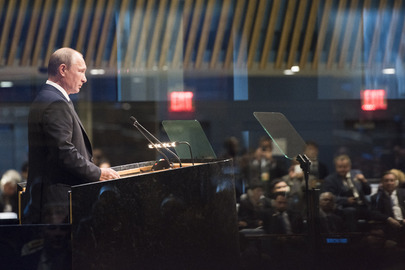
Putin addresses the UN, 09-28-15. (UN Photo)
Their members were generally young people who were enthusiastic, honest and genuinely committed to the public good, but were plagued by the lack of funding and faced with frequent media blackout and open discrimination. Nonetheless, their programs articulated the most promising and humane geopolitical vision for the Balkans. They conceptualized the Balkans as a territorial bridge between the West and the East rather than as the place of persistent confrontation, or the ‘line of fire’ as formulated by the U.S. Secretary of State John Kerry in 2015. They wanted the Balkans to become a force for peace and human dignity in the world. Their vision still remains the best option for the Balkans people.
This desire for non-alignment is understandable as a continuation of the policy of Tito’s Yugoslavia during the Cold War – the nation that several of the modern day Balkan states were a constituent part of. However, according to Kovacevic, these groups were easily overwhelmed, in terms of both financial and propaganda resources, in the 1990s by pro-NATO forces in the West.
In addition to providing resources to build up pro-NATO sentiment in the media and NGO sectors of these countries, financial resources and pressure was used to sway a large number of politicians to favor NATO membership, often in opposition to the general population’s views. Some of the unsavory forms of incentive or pressure include what amounts to blackmail and bribery, Kovacevic told me in an email interview:
This is a long-term process. In the U.S. intelligence community it is called ‘seeding.’ The intelligence scholar Roy Godson defines it as ‘identifying potential agents of influence’ at an early stage and then acting to advance their careers. This is typically done covertly, but there have been the historical examples of overt support. …
In the Balkans, the key role in the process of ‘seeding’ was accomplished by various institutes, conferences, retreats, grants, etc. For instance, I was told by a confidential source who participated in the same U.S.-NATO program, the long-time foreign minister and one-time prime minister of Montenegro, Igor Luksic, was a product of such a process. Luksic was chosen as a very young man to attend various conferences and retreats in Brussels and Washington and, after that, his political career really took off. All the while, he promoted the NATO agenda in Montenegro, even though this went against the will of the majority of the population.
Another example is Ranko Krivokapic who was the speaker of the Montenegrin Parliament for over a decade. He traveled on official business to the U.S. a few times every year and boasted to others that he had a lot of friends in the State Department and other institutions of the U.S. government. There are examples like these in Serbia, Macedonia, Croatia, etc. All over the Balkans.
There is also the fact the European Union has dovetailed its security arrangements to such an extent with NATO that new members are now virtually brought into the NATO structures by default. For example, Mahdi D. Nazemroaya, author of The Globalization of NATO, reports that the E.U.’s Security Strategy was absorbed into NATO during its annual summit in 2006. The emphasis of the summit was on securing energy resources with the goal of ‘co-managing the resources of the EU’s periphery from North Africa to the Caucuses.’ Also implied was the goal of redefining the E.U.’s security borders in synch with both Franco-German and Anglo-American economic and geopolitical interests.
Moreover, British Russia scholar Richard Sakwa, has pointed out that the security integration of the E.U. with NATO was further intensified with the ratification of the Treaty of Lisbon in 2007:
As for the comprehensive character, this is something that has been gaining in intensity in recent years as the foreign and security dimension of the E.U. has effectively merged with the Atlantic security community. The E.U.’s Common Foreign and Security Policy (CFSP) since the Treaty of Lisbon (the “Reform Treaty”) of 13 December 2007, which came into effect in 2009, is now in substance part of an Atlantic system. Acceding countries are now required to align their defense and security policy with that of NATO, resulting in the effective ‘militarization’ of the E.U.
At this point, the forces seeking a non-aligned bridge role for the Balkan states are still very much around, but have suffered marginalization due to lack of resources to take on the powerful and now entrenched pro-NATO political forces. However, with increasing discontent with the weak economic prospects in certain Balkan states, combined with increasing instability in the E.U., it is believed that there is an opening for growth of the movement.
Economic Conditions in the Balkans
The Balkan states comprise Romania, Bulgaria, Albania, Macedonia, Serbia, Kosovo, Montenegro, Bosnia-Herzegovina and Greece.
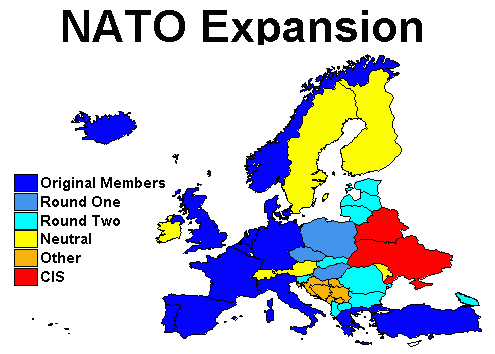
A map showing stages of NATO’s expansion. Dark blue showing original members; lighter blue the “round one” members; aqua the “round two” members; yellow represents neutral states; and brown and red otherwise aligned (including Ukraine, although that has changed since the 2014 U.S.-backed coup).
In 2007, Romania and Bulgaria became E.U. members (three years after joining NATO). Romania’s GDP has barely kept up with its 2008 rate and has a general unemployment rate of 6.4 percent, which sounds reasonable until you look at the youth unemployment rate of 21 percent, which doesn’t bode well.
Bulgaria, on the other hand, is not part of the Eurozone and has not adopted the euro as its currency. Its economic prospects since joining the E.U. have not been impressive either. In the midst of the financial crisis of 2009, its GDP contracted by 5.5 percent, with a current unemployment rate of 7 percent and youth unemployment at 17 percent. Bulgaria is also recognized as one of the union’s most corrupt countries.
Macedonia, Montenegro, Serbia, Kosovo, Bosnia-Herzegovina and Albania are all in the process of E.U. integration, with a supposed approval rate of 80-90 percent among the respective populations of these countries (except for Serbia), despite the virtual rape of Greece and the lackluster performance of Romania and Bulgaria.
It should be noted that all three Balkan nations that are actual E.U. members have higher emigration than immigration rates, another indication that accession to the E.U. doesn’t necessarily translate into a prosperous future for the average person, particularly the young.
There is also the instability highlighted by the British people’s vote to leave the E.U., spurred by disgust with austerity measures imposed by unaccountable bureaucrats in Brussels along with an influx of immigrants – one-third from these poorer E.U. nations – which adversely affect lower-wage natives.
Even if the E.U. had a better track record of effectiveness in terms of improving economic conditions for the masses, it would have a very tall order with some of the prospective Balkan states. Macedonia, for example, has an unemployment rate between 24 and 25 percent as of January 2016, although it has improved from the 2005 high of 37 percent. Despite this improvement, Macedonia still has one of the lowest GDPs in Europe and 72 percent of its citizens claimed they manage their household income only with “difficulty” or “great difficulty” in 2012.
Bosnia-Herzegovina is still feeling the effects of the war of 1992 to 1995 that included major physical destruction of infrastructure and the bottoming out of its GDP. It currently suffers an unemployment rate of 42-43 percent.
Kosovo, a state that owes its existence to a NATO intervention, has 33 percent unemployment, a high crime rate and increasing political violence due to ethnic tensions and a growing ultra-nationalist movement. The Council of Europe compared the government of Kosovo to a mafia state in a 2010 report which revealed trafficking in human organs as well as drugs and weapons throughout Eastern Europe, even implicating the then-prime minister in the operation.
Russia’s Opening
Kovacevic states that the Atlanticist project of E.U. austerity economics and the enabling of Washington’s destabilizing wars via NATO is starting to chip away at its popularity among Balkan populations. He also says Putin is prepared to take advantage of this opening and, since the outbreak of the Ukraine crisis, has turned his attention “to the Balkans with political force and funding not seen since the days of tsar Nicholas II.”
This attention has manifested in the Lovcen Declaration, which was signed on May 6, by members of Russia’s largest political party, United Russia, and the opposition Democratic People’s Party in Montenegro in the village of Njegusi. Kovacevic explains:
One of the most powerful political figures in Montenegro, the metropolitan Amfilohije, the chief bishop of the Serbian Orthodox Church in Montenegro, was present at the signing and gave his blessing. Though in the past Amfilohije has been known to support the authoritarian and pro-NATO prime minister Milo Djukanovic around the election time, he has always publicly opposed NATO membership and has given fiery speeches on its ‘evil nature’ to the point of accusing NATO for continuing Hitler’s anti-Slavic project.
Even more importantly, Amfilohije’s involvement with the Lovcen Declaration reveals one of the fundamental components of Putin’s overall geopolitical plan – the nurturing and intensification of the religious Christian Orthodox connection between the Russians and the Orthodox peoples of the Balkans. This includes not [only] the Serbs, Montenegrins and Macedonians, but also the Greeks and Bulgarians whose states are in NATO and whose religious ‘awakening’ can easily subvert NATO from the inside.
Criticism and minimization of the project have set the tone in Western media, to the extent that it has been covered at all, particularly in relation to utilizing an opposition party for significant influence. But Kovacevic argues that such a dismissive attitude is disingenuous:
[T]he very same method has been used by the U.S. and NATO intelligence services to control the governments of East-Central European states since the collapse of communism. Countless small parties with just a handful of parliamentary deputies were formed with the money coming from the various ‘black budgets’ with the task of entering the governing coalition and then steering the entire government in the direction charted by their foreign founders and mentors.
These parties have had minimal public legitimacy, but have made a great political impact with their ‘blackmail’ potential. As they also don’t cost very much, the CIA, the MI6, and the BND regularly create them for every new election cycle.
Now the Russians (primarily, the SVR and the GRU) are using the same rulebook for their own geopolitical interests. In addition, however, Putin’s grand design for the Balkans embodied in the ANS is also likely to prove durable not only because it builds on the traditional cultural and religious ties linking Russia and the Balkans, but also because it rides on the wave of the enormous present popular dissatisfaction with the neoliberal Atlanticist political and economic status quo.
The fact that this declaration was signed in Montenegro is most relevant due to the fact that the country has been officially invited to join NATO, whose subsequent membership is treated in the West as a fait accompli. However, accession requires consensus approval by all current NATO members – one member could veto the move before completion of the process as happened with Macedonia when Greece vetoed their membership aspirations in 2008 when an invitation was to be offered at the Bucharest Summit – as well as approval by the population of Montenegro.
Joining any alliance treaty is arguably something that affects national sovereignty, which requires a referendum as Kovacevic, who is Montenegrin, explains:
The corrupt government of Milo Djukanovic is trying to avoid a national referendum because it knows that it does not have a majority support for NATO. If given a choice, the people of Montenegro would reject the protocol. The Constitution requires a referendum for all matters that affect national sovereignty, but Djukanovic is arguing falsely that NATO membership leaves Montenegrin sovereignty intact.
Kovacevic predicts that a show-down over NATO membership could create instability in the country: “[I]f he [Djukanovic] tries to push this decision through the Parliament (which he no doubt will), wide-scale strikes and demonstrations may take place all over the country. Whoever is pushing Montenegro in NATO is dangerously destabilizing the country in mid-to-long term.
If that happens, Washington may find for the first time in recent memory that forcing instability on a smaller country may ultimately accrue benefits to another great power, helping to facilitate a shift in geopolitics that it didn’t bargain on. As Nazemroaya comments in his book:
The [NATO] alliance is increasingly being viewed as a geopolitical extension of America, an arm of the Pentagon, and a synonym for an evolving American Empire. … Ultimately, NATO is slated to become an institutionalized military force. … Nevertheless, for every action there is a reaction and NATO’s actions have given rise to opposing trends. The Atlantic Alliance is increasingly coming into contact with the zone of Eurasia that is in the process of emerging with its own ideas and alliance. What this will lead to next is the question of the century.
Natylie Baldwin is co-author of Ukraine: Zbig’s Grand Chessboard & How the West Was Checkmated, available from Tayen Lane Publishing. In October of 2015, she traveled to 6 cities in the Russian Federation and has written several articles based on her conversations and interviews with a cross-section of Russians.
French fraudster linked to Netanyahu jailed over vast tax scheme
Press TV – July 7, 2016
A French court has sentenced to eight years in jail a tycoon, who previously made unrelated donations to Israeli Prime Minister Benjamin Netanyahu, over a massive fraud scheme.
Arnaud Mimran was convicted of fraud on Thursday and sentenced to eight years in prison and one million-euro fine for the 2008-2009 fraud, which French authorities say resulted in a major tax shortfall.
Mimran has been on trial as a key suspect in a 283 million-euro scam in the trade and taxation of carbon emissions permits.
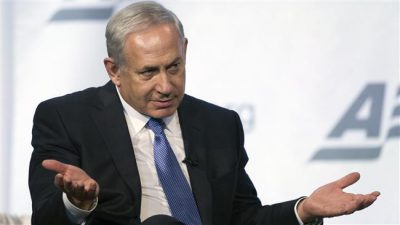 Ten other defendants were also given prison terms ranging from one to eight years and six were also fined 1 million euros. All the defendants were convicted of aggravated fraud and money-laundering.
Half of the defendants were tried in absentia and one person was acquitted.
The tax scam case has been described as “the heist of a century” by French authorities.
During his trial, the French magnate also testified that on another occasion he had gave 1 million euros to Netanyahu’s election campaign.
Netanyahu’s office has denied any campaign payments and said the contribution was made in 2001 to a fund used while he held no office.
Mimran was convicted of tax offenses in France in the late 1990s as well.
Meanwhile, Israel’s police are reportedly probing whether the prime minister had received illegal contributions from foreign businessmen during his current tenure.
Netanyahu and his wife, Sara, have become embroiled in a series of controversies about how their wealthy lifestyle is funded.
Washington’s ‘New Managers’ in Latin America: Oligarchs, Bankers and Swindlers
By James Petras :: 07.07.2016
Amid raging corruption, social pathologies and outright political thuggery, a new gang of vassal regimes has taken-over Latin America. The new rulers are strictly recruited as the protégé’s of US financial and banking institutions. Hence the financial press refers to them as the “new managers” – of Wall Street.
The US financial media has once again provided a political cover for the vilest crimes committed by the ‘new managers’ as they launch their offensive against labor and in favor of the foreign and domestic financiers.
To understand the dynamics of the empire’s new vassal managers we will proceed by identifying (1) the illicit power grab (2) the neo-liberal policies they have pursued (3) the impact of their program on the class structure (4) their economic performance and future socio-political perspectives.
Vassals as Managers of Empire
Latin America’s current vassalage elite is of longer and shorter duration.
The regimes of longer duration with a historical legacy of submission, corruption and criminality include Mexico and Colombia where oligarchs, government officials and death squads cohabit in close association with the US military, business and banking elites.
Over the past decades 100,000 citizens were murdered in Mexico and over 4 million peasants were dispossessed in Colombia. In both regimes over ten million acres of farmland and mining terrain were transferred to US and EU multinationals.
Hundreds of billions of illicit narco earnings were laundered by the Colombian and Mexican oligarchy to their US accounts via private banks.
The current political managers, Peña in Mexico and Santos in Colombia are rapidly de-nationalizing strategic oil and energy sectors, while savaging dynamic social movements – hundreds of students and teachers in Mexico and thousands of peasants and human rights activists in Colombia have been murdered.
The new wave of imperial vassals has seized power throughout most of Latin America with the direct and indirect intervention of the US. In 2009, Honduras President Manuel Zelaya was ousted by a military coup backed by Secretary of State Hillary Clinton. Zelaya’s program of agrarian reform, regional integration (with Venezuela) and constitutional elections was abolished. Zelaya was replaced by a US vassal, Roberto Micheletti who proceeded to murder several hundred landless rural workers and indigenous activists.
Washington moved to organize a constitutional cover by promoting a highly malleable landowner, Porfirio Lobo Sosa to the presidency.
The State Department next ousted Paraguyan President Francisco Lugo who governed between 2008-2012. Lugo promoted a moderate agrarian reform and a centrist regional integration agenda.
With the backing of Secretary of State Clinton, the Paraguayan oligarchy in Congress seized power , fabricated an impeachment decree and ousted President Lugo. He was briefly replaced by Vice President Federico Franco (2012-2013).
In 2013, Washington backed , the capital, Asuncion’s, notorious crime boss for President, one Horacio Castes – convicted for currency fraud in 1989, drug running in 1990, and most recently (2010) money laundering.
The Honduras and Paraguayan coups established (in miniature) the precedent for a new wave of ‘big country’ political vassals. The State Department moved toward the acceleration of banking takeovers in Brazil, Argentina and Peru.
In rapid succession, between December 2015 and April 2016 vassal managers seized power in Argentina and Brazil. In Argentina millionaire Mauricio Macri ruled by decree, bypassing constitutional legality. Macri fired scores of thousands of public service workers, closed social agencies and appointed judges and prosecutors without Congressional vote. He arbitrarily arrested social movement leaders – violating democratic procedures.
Macri’s Economic and Finance Ministers gained millions of dollars by ‘buying into’ multinational oil companies just prior to handing over private options on public enterprises.
The all-encompassing swindles and fraud carried out by the ‘new managers’ were covered up by the US media, who praised Macri’s professional team.
Moreover, Macri’s economic performance was a disaster. Exorbitant user fees on utilities and transport for consumers and business enterprises, increased three to ten-fold, forcing bankruptcy rates to soar and households to suffer light and gas closures.
Wall Street vulture funds received a seven billion dollar payment from Macri’s managers, for defaulted loans purchased for pennies over a dollar, twenty-fold greater then the original lenders.
Data based on standard economic indicators highlights the worst economic performance in a decade and a half.
Price inflation exceeds 40%; public debt increased by twenty percent in six months. Living standards and employment sharply declined. Growth and investment data was negative. Mismanagement, official corruption and arbitrary governance, did not induce confidence among local small and medium size businesses.
The respectable media, led by the New York Times, the Financial Times, the Wall Street Journal and the Washington Post falsified every aspect of Macri’s regime. Failed economic policies implemented by bankers turned cabinet ministers were dubbed long-term successes; crude ideologically driven policies promoting foreign investor profiteering were re-invented as business incentives.
Political thugs dismantled and replaced civil service agencies were labelled ‘a new management team’ by the vulgar propaganda scribes of the financial press.
In Brazil, a phony political power grab by Congressional opportunists ousted elected President Dilma Rousseff. She was replaced by a Washington approved serial swindler and notorious bribe taker, Michel Temer.
The new economic managers were predictably controlled by Wall Street, World Bank and IMF bankers. They rushed measures to slash wages, pensions and other social expenditures, to lower business taxes and privatize the most lucrative public enterprises in transport, infrastructure, landholdings, oil and scores of other activities.
Even as the prostitute press lauded Brazil’s new managers’, prosecutors and judges arrested three newly appointed cabinet ministers for fraud and money laundering. ‘President’ Temer is next in line for prosecution for his role in the mega Petrobras oil contracts scandal for bribes and payola.
The economic agenda by the new managers are not designed to attract new productive investments. Most inflows are short-term speculative ventures. Markets, especially, in commodities, show no upward growth, much to the chagrin of the free market technocrats. Industry and commerce are depressed as a result of the decline in consumer credit, employment and public spending induced by ‘the managers’ austerity policies.
Even as the US and Europe embrace free market austerity, it evokes a continent wide revolt. Nevertheless Latin America’s wave of vassal regimes, remain deeply embedded in decimating the welfare state and pillaging public treasuries led by a narrow elite of bankers and serial swindlers.
Conclusion
As Washington and the prostitute press hail their ‘new managers’ in Latin America, the celebration is abruptly giving way to mass rage over corruption and demands for a shift to the political left.
In Brazil, “President” Temer rushes to implement big business measures, as his time in office is limited to weeks not months. His time out of jail is nearing a deadline. His cabinet of ‘technocrats’ prepare their luggage to follow.
Maurico Macri may survive a wave of strikes and protests and finish the year in office. But the plunging economy and pillage of the treasury is leading business to bankruptcy, the middle class to empty bank accounts and the dispossessed to spontaneous mass upheavals.
Washington’s new managers in Latin America cannot cope with an unruly citizenry and a failing free market economy.
Coups have been tried and work for grabbing power but do not establish effective rulership. Political shifts to the right are gyrating out of Washington’s orbit and find no new counter-balance in the break-up of the European Union.
Vassal capitalist takeovers in Latin America generated publicist anesthesia and Wall Street euphoria; only to be rudely shocked to reality by economic pathologies.
Washington and Wall Street and their Latin America managers sought a false reality of unrestrained profits and pillaged wealth. The reality principle now forces them to recognize that their failures are inducing rage today and uprisings tomorrow.
FBI Investigation Produces No Indictment, But Proves Hillary Clinton’s a Serial Liar
By Dave Lindorff | This Can’t Be happening! | July 6, 2016
Hillary Clinton may or may not be a crook. That remains to be proven, though the sheer magnitude of the wealth that she and husband Bill have amassed since leaving the White House, and while she was serving as Secretary of State — nearly a quarter of a billion dollars earned by two people with no known skills capable of producing that kind of income — should raise questions. What can be stated now as fact though, is that Hillary is a serial liar.
If this wasn’t clear already from her long history of distortion and prevarication — like her false claim that she had to “duck to avoid sniper fire” during a state visit to Bosnia — it is clear now from FBI Director James Comey’s 11-page public report on his agency’s year-long investigation into her use of a private server for all her private and official emails during her term as Secretary of State.
That report has exposed her serial lying to both Congress and the public about that illegal use of private email service to handle her public business.
As the Associated Press reports, Clinton lied in March 2015 when she declared in one of her rare news conferences, “I did not email any classified material to anyone on my email. There is no classified material.”
But as Comey reports, she did. Quite often in fact. The FBI in its exhaustive investigation found at least 113 email chains –some of which had to be uncovered after they had been erased by Clinton’s private lawyers — contained material that was classified at the time of sending, including some that were classified Top Secret and that referred to a “highly classified special-access program.”
She lied again at that same press conference when she asserted, “I responded right away and provided all my emails that could possibly be work related” to the State Department.
Not true, according to the FBI, and also, of course, to the Inspector General of the State Department, with whose own investigation of her actions, Clinton simply refused to cooperate.
Clinton lied when she said earlier this month, in an NBC interview, “I never received nor sent any material that was market classified.” Comey says that in fact her system did handle emails that bore specific markings indicating they were classified.
Clinton lied when she tried, as she explained more than once, including in that same March 15 news conference addressing the issue, to claim that she had used her own Blackberry phone rather than a State Department secure phone, simply because she “thought it would be easier to carry just one device for my work and for personal emails instead of two.” In fact, Comey said his agents determined that Clinton had “used numerous mobile devices to view and send email,” all using her personal account. So much for wanting to use “just one device”! Comey said she also had used different non-government servers, all of them vulnerable to hacking.
Clinton lied again when she claimed that her private server was on “property guarded by the Secret Service and there were no security breaches.” She lied again when she added, “The use of that server, which started with my husband, certainly proved to be effective and secure.” Her campaign website adds the equally false assertion that “There is no evidence there was ever a breach.”
In fact, all Comey will say is that the FBI did not uncover a breach, but he adds that because of the sophisticated abilities of “hostile” forces (i.e foreign countries’ intelligence services) that would be engaging in any such hacking, “We assess it is possible that hostile actors gained access to Secretary Clinton’s personal email account.” They would just not leave any “footprints,” he explains.
We also know Clinton was lying when she said, “I opted for convenience to use my personal email account, which was allowed by the State Department.” The falsity of that particular lie was exposed by the State Department Inspector General, who in his own report on her private server scandal, found that she had never “sought or received approval” to operate a private server for her State Department communications, and added that as Secretary of State, she “had an obligation to discuss using her personal email account to conduct official business with State Department offices.”
Some of these violations that Clinton has objectively lied about may not be crimes. Others clearly are. At a minimum, Clinton deliberately sought to violate the requirements of the Freedom of Information Act, which make all but classified documents public records that are supposed to be made available on request to journalists and the public on request (and even many secret documents upon appeal). By conducting her official business on a private server, Clinton was assuring that no FOIA requests could touch her.
The question of Clinton’s “trustworthiness” is a huge issue among the public, with all but her die-hard supporters — a minority within the Democratic Party.
Maybe some people don’t care in these cynical times when it’s simply assumed that “all politicians lie,” but one hopes that those lies will relate to personal foibles and sins, not official business. A nation that celebrates great leaders like George Washington, who at least according to the national mythology once said, “I cannot tell a lie,” and Abraham “Honest Abe” Lincoln, for their integrity and forthrightness, surely can demand at least a semblance of truthfulness in its top leader.
Clearly Hillary Clinton has failed that test of leadership, and in a big way.
I’m concerned that the FBI and the State Department’s own Office of Inspector General, as well as Republicans in Congress, have missed the real import of Clinton’s lying. It is not that she violated rules and standards that may have led to national security secrets being hacked, serious though that may be. For one thing, powerful intelligence agencies like those of the Russians and Chinese, just like the US’s own National Security Agency, have the capability to hack even the government’s most secure servers.
What should really be getting asked, by government investigators, political critics and by any real journalists left out there, is why Clinton, as Secretary of State, was so insistent — even to the point of violating laws and State Department policies — on avoiding the reach of the Freedom of Information Act (FOIA). The answer to that has to take us back to the reality of the Clinton’s phenomenal success at vacuuming up vast sums of money from wealthy individuals, corporations, and even foreign potentates, both for their personal accounts as when either Clinton speaks at gatherings of bankers, pharmaceutical executives or military industry leaders, and for their Clinton Foundation, reportedly the recipient of over $2 billion in corporate and foreign government largesse.
Their success at raking in such piles of cash reeks of influence peddling, probably much of it conducted by phone and by email — and it’s the kind of thing that, if it were done by a Secretary of State on a government electronic device, would be vulnerable to a FOIA request.
On a private server, it’s the type of communications activity that Hillary Clinton’s private attorneys would have “wiped” from her hard drive to escape scrutiny when they erased thousands of emails they determined, with no official backstopping, to have been “private.”
Comey was wrong to recommend no prosecution of Clinton for her email practices, since some of her own State Department employees, as well as employees of the CIA and other agencies have been charged with and convicted of felonies for the same and even lesser infractions. But Clinton, as a Secretary of State and as the likely Democratic Party candidate for president, clearly lives on a higher plane that operates under a different set of rules. Only the “little people” get called to account for such crimes in the United States.
If the severely compromised US “Justice” Department cannot step up and issue an indictment based upon the findings of the FBI about Clinton’s email violations, it is up to the people of the United States to decide whether we want such a greedy woman — a confirmed serial liar ready to say anything necessary to obtain power — to be our next president.
Hillary Clinton’s Emails and the Crisis of Legitimacy
A Black Agenda Radio commentary by Glen Ford | July 6, 2016
 Hillary Clinton has escaped indictment – as almost universally expected – for commingling her email communications as secretary of state with her personal business, including the global money laundering, bribery and extortion racket called the Clinton Foundation. The Clintons are capable of infinite corruption. That’s why they’re in politics: to protect the criminal enterprises of the truly rich people they serve, and to become rich, themselves. That is the nature of the system – and the system works; it provides impunity to the powerful.
FBI Director James Comey essentially admitted as much when he acknowledged that there was “evidence of potential violations of the statutes regarding the handling of classified information.” A reasonable person in Clinton’s position “should have known” that what she was doing was violating the law. But, he said, the FBI’s “judgment is that no reasonable prosecutor would bring such a case.” The public knows perfectly well that what Comey really means is that there’s no way he was going to keep the rulers of the United States from getting the president they want.
So, Hillary gets off, as did the warlord General David Petraeus and other insiders who were not fully prosecuted for clearly breaking the law. Yet, President Obama has shattered all historical records in treating whistleblowers as spies. Obama pushed for and got the power to detain people indefinitely without trial or charge, but is so tolerant of systemic criminality among Wall Street bankers that his own attorney general had to briefly admit that the Lords of Capital are “too big to jail.” So, on the one hand, the fundamental right to due process under the law has ceased to exist – yet, for the rich impunity has become all but absolute.
The rulers are caught in a crisis of legitimacy. Obscenely concentrated wealth has turned U.S. society into a Constitution-free zone for the wealthy, who behave as if they are a separate species. They have exhausted the tolerance even of white Americans, descendants of Europeans who came here hoping to become rich, but now despair of keeping their heads above water and are growing to despise the 1%.
Black folks are waking up – angry! – after two generations of relative quietude, pushing back against a police state that is coddled by Congress, upheld by the Supreme Court, and unchallenged by the executive branch. The system is leaking legitimacy like a sieve.
Donald Trump is seen as illegitimate by probably a majority of Americans, but so is Hillary Clinton. In some ways, Clinton is even more revolting. Most people that hate Trump can point to one or more of his specific policies or statements. However, people are just plain repulsed by Hillary Clinton. If pressed on why they find her so distasteful, folks say she is dishonest, not to be trusted – but usually offer no particulars. What they really feel, is that she is corrupt to the bone; that she personifies the Lie that the top of society tells to the bottom.
The crisis of legitimacy becomes acute when enough people say, “Who are you to hold power over me?”
Glen Ford can be contacted at Glen.Ford@BlackAgendaReport.com.
Bakari Sellers: Hitman for Israel, Hillary and Wall Street

By Glen Ford | Black Agenda Report | July 6, 2016
Bakari Sellers, the 31 year-old former South Carolina state lawmaker who became a paid CNN shill for Hillary Clinton in 2015, following the Charleston massacre, is also a longtime operative for AIPAC, the deep-pocketted, cutthroat lobby for Israel. In a letter to Democratic Party officials, last month, Sellers claimed to have gathered the signatures of 60 “lifelong” Black Democrats urging rejection of any changes to the party’s slavishly pro-Israel 2012 platform positions, denouncing as “anti-Semitic” the global movement against Israeli oppression of Arabs in Palestine and the nearly 50-year-long occupation of the West Bank. “Since the last platform was approved, anti-Semitism has been on the rise and it has taken a new form – the boycott, divestment and sanctions movement known as BDS,” said the letter, much of which consisted of quotes from Hillary Clinton, including, “In Israel’s story, we see our own.” Clinton’s vision is clear, in one respect: the U.S. was once the largest of the world’s apartheid states; today, Israel is the last one standing.
Clinton’s minions on the platform committee brushed aside Bernie Sanders delegates’ planks on Israel, as well as the TPP pro-corporate trade deal, single payer healthcare, a carbon tax, and linking a $15 an hour minimum wage to inflation.
The names on Sellers’ list have not yet been made public, but there is no shortage of Black apologists for Israel. In 2014, the entire Congressional Black Caucus joined in a unanimous U.S. House resolution affirming the Zionist state’s right to “defend itself” – even as Israeli bombs were slaughtering over 2,100 men, women and children in Gaza.
Despite his relative youth, Bakari Sellers is a veteran operative for AIPAC, the American Israel Political Action Committee, Israel’s strong-arm lobby. According to the web site Electronic Intifada, Sellers was recruited back in 2004, when AIPAC had just begun a massive campaign at historically Black colleges and among even younger students of color, nationwide. Sellers was a real catch for AIPAC; not only had he just been elected student body president, he is also the son of Cleveland Sellers, a former leader of SNCC, the Student Non Violent Coordinating Committee, who was wounded in the 1968 Orangeburg Massacre when state police killed three Black college students protesting segregation. The elder Sellers is now president of Voorhees College. SNCC’s stand in solidarity with Palestinians in 1967, the year of Israel’s Six Day War and its seizure of Arab East Jerusalem and the West Bank, is widely believed to mark the beginning of the deepening between Black political activists and Zionism.
Bakari Sellers’ service to AIPAC is a repudiation and perversion of SNCC’s internationalist and humanitarian values. He has eagerly deployed himself as one of Zionism’s Black up-and-coming political stars. In return, AIPAC has helped bankroll his political career. “The way I’m able to communicate, the exposure, the people that I’ve met – a lot of people I’ve met at the AIPAC policy conference became a huge part of my fundraising base,” Sellers told an AIPAC leadership seminar for college students, in 2008.
Sellers has found that AIPAC money and Wall Street funding go hand in hand – and he’s in it up to his elbows. “Looking forward to giving the address tonight @Aipac Annual Wall Street Dinner in Manhattan,” he tweeted, mentally scooping up cash with both hands.
A prime duty of white people’s – or Zionist’s – Black surrogates, is to act as torpedoes against troublesome Black activists. Sellers’ assignment is to be a counterpoint to anti-corporate, anti-imperialist critics of Israeli policy, like Dr. Cornel West, one of Bernie Sanders’ delegates on the platform committee. When CNN trotted Sellers out to defend Clinton’s 1990s record of spreading racist hysteria against Black male “super-predators,” West admonished him to remember “the legacy of your blessed father… look at his example. He was not just fighting against racism – he was fighting against a class system as well,” said West. “You can’t do that as a Wall Street Democrat.”
Sellers looked beaten, but he could not be shamed, because he and the rest of his Black Misleadership Class are utterly shameless in their relentless pursuit of favor from the rich and powerful. As Dr. West told Sellers, the Black political elite “confuses the gravy train with the freedom train.”
Back in the early 2000s, when the BAR team was working at The Black Commentator, we toyed with the idea of creating a Trojan Horse Watch to keep track of the growing number of Black politicians that were succumbing to the siren song of the Wall Street wing of the Democratic Party, the Democratic Leadership Council. The flood of corporate money into grassroots Black electoral politics – a new phenomenon – had not yet turned into a tsunami. One guy stood out above the rest: Cory Booker, the 31 year-old, one-term Newark, New Jersey, city councilman who was mounting his first challenge to Mayor Sharpe James. Booker made his national debut at a power luncheon of the Manhattan Institute, a star think tank in the right-wing, corporate constellation. He would sometimes arrive at campaign stops in a caravan of Hasidic Jews, although there was no significant Hasidic community in Newark. On deeper examination, it became clear that Booker was not your ordinary Black politician, grubbing for money as best he could, from whoever was giving it. Booker was a true zealot for Zionism, and a hard core corporate ideologue. The decades of leadership by a Black political class that chose the “gravy train” over the “freedom train” had produced a new breed of Black political striver that is totally at home with corporatism, imperialism and Zionism, and is eager to be deployed by his masters as a political weapon.
Bakari Sellers is part of this crop: fruit of the poisoned tree.
Glen Ford can be contacted at Glen.Ford@BlackAgendaReport.com.
Trumping Hillary: The Same Old Pol-Mil Game
Will the 2016 Election Change America’s Militarized Foreign Policy?
By Chuck Spinney | The Blaster | June 27, 2016
Pro-Israel Neocons have said they will jump off the Republican ship and vote for Hillary Clinton, because she will continue business as usual with regard to our militarized foreign policy. Apologists for Donald Trump argue that he will pursue a more restrained and less warlike foreign policy, including a more balanced policy toward Israel.
But recent report by Stuart Winer in the Times of Israel suggests Trump’s bombastic ‘art of the deal,’ at least when applied to pol-mil policy, will turn out to be yet another politician’s distinction without a difference — to wit:
A senior adviser to Donald Trump said Wednesday that Prime Minister Benjamin Netanyahu should wait for the presumptive Republican presidential nominee to win the White House before signing a military aid deal with Washington, because Trump would offer a better deal than the Obama administration.
In an interview with Channel 2 television David Friedman said that a Trump administration would maintain Israel’s military advantage over its neighbors. He said Trump would not reduce defense aid to Israel but “in all likelihood will increase it significantly.”
“The aid package will certainly not go down in all likelihood it will go up in a material amount because Israel must maintain a technological and military superiority within the region,” Freidman said. “I can’t give advice how Israel should bargain and develop its own strategy.”
Friedman’s suggestion that Trump would increase aid to Israel apparently ran contrary to the GOP candidate’s call to make Israel pay back foreign aid. In March, Trump said he believed Israel should pay for defense aid it receives from the US.
Could it be that the choice for President in 2016 will have no effect on America’s militarized foreign policy, and if so, would this be something new and different?
As with most political questions in Versailles on the Potomac, the pathway to answering this question is less one of Ivory-tower policy analysis than a gritty one of following the money — in this case the money flowing through the triangular relations of the Military – Industrial – Congressional Complex. It is a question that goes to the heart of President Eisenhower’s prophetic warning, “In the councils of government, we must guard against the acquisition of unwarranted influence, whether sought or unsought, by the military-industrial complex.”
More on this question later.
‘FBI uses situations with terrorism to gain access to Americans’ private lives’ – John McAfee
RT | June 23, 2016
The FBI uses situations like terrorism as a pretext to enter the private lives of Americans. It shows the US government has lost sight of the meaning of privacy, John McAfee, of McAfee Antivirus, former Libertarian candidate for president, told RT America.
The US Senate rejected Wednesday a bill that would empower the FBI to get warrantless access to people’s metadata, including internet browsing histories. It had been proposed after the shooting at a gay club in Orlando. However, another vote on the bill – is expected to come soon. Senate Republican leader Mitch McConnell switched his vote to ‘no’ at the end of the voting in a move that will allow him to bring the legislation up for consideration again.
RT: How dangerous might this amendment be to privacy, if the FBI could so easily and legally gather metadata information? What are the potential repercussions?
John McAfee: The concept is horrific. Using metadata alone – you can find out a lot about a person. But to look at the browsing history – for heaven’s sake that is got to be among the most private of all things. There are people who might visit unsavory sites – that is their business, not my business. What has happened in the American government is our government has lost sight of the meaning of privacy.
Privacy is not just if you have nothing to hide, you have nothing to fear – that is nonsense. Privacy is exercised by every individual in this country hundreds of times per day. With every relationship that you have, you choose a different level of privacy. Buying something at the store from a clerk you do not know, you might talk about at most the weather or the price of clothes. When you talk to a casual acquaintance – she might divulge more. To a good friend – you might divulge a lot. To your spouse – you might divulge everything. But even then you might choose to withhold certain things…
RT: Isn’t it up to a citizen how much to disclose?
JM: Yes, absolutely… If everyone knew everything about everyone else, we would have chaos. When the government begins to remove those barriers that we purposely put in place to keep society functioning smoothly then we’re taking away a foundation of the same society. Please see this – this is insane.
RT: Proponents of expanding the Patriot Act argue that allowing extending the powers for the FBI and other intelligence agencies could have prevented the Orlando attack. Are they right, or are they just exploiting the fears of American?
JM: They are totally wrong. Look at the powers that they already have that have done nothing. The FBI is supposed to be one of the most technologically advanced parts of our country. Yet, during the iPhone incident with Apple they couldn’t even get into a phone which I know 10,000 hackers could easily get into this.
The FBI specifically is using situations like terrorism to try to gain an entry into the private lives of the American public – first by going to Apple saying “give us a master key!” Had they succeeded? They then had gone to Google, which owns 92 percent of the market and said: “You give us a master key!” Now they are asking Congress to in the name of protecting society to let us invade the rights of society. You can’t do that. There is no way to protect us by invading us.
RT: Donald Trump earlier said that Americans don’t know what was in Clinton’s deleted e-mails, while US “enemies probably know every single one of them.” Given your role as a technologist, how true is all of that? Do you think somebody accessed her e-mails and can they permanently be deleted?
JM: Ok, I’d like to first say that I very seldom agree with Trump. However, in this case he is absolutely correct. We have records, public statements her server has been hacked. They shut it down a couple of times because a hack was in process. Now, what does that mean – a hacking process – if you noticed it, your data is gone. They had taken the security controls off her server, because many people were not getting her e-mails. Her server was hacked – we know this. I am well-connected with the dark web; I have to be, because I am in the security business. And if you don’t know what the bad people are doing, then you can’t build a good product…
The government is completely clueless when it comes to security. Or if they are not clueless then they are deliberately deceiving the American public. I don’t want to believe that.
Read more:
Senate narrowly blocks amendment allowing warrantless access to online data
FBI using Israeli firm to crack San Bernardino iPhone without Apple
Featured Video

Death Spikes & Rising Cancer In Our Youth Explained
or go to
Aletho News Archives – Video-Images
From the Archives
Politicians lie
By Mazin Qumsiyeh | Popular Resistance | August 18, 2013
There is no way to say this truth nicely: Politicians lie. That includes Japanese, American, Egyptian, Israeli, and Palestinian politicians! Is there something more common sense than that? Yet, so many citizens around the world believe their own politicians or wistfully acknowledge lies but think it is part of the job needed to run things. They believe even when politicians contradict themselves blatantly. This phenomenon is rather remarkable. It is a dissonance and disconnect from reality that many seem oblivious to. It is very dangerous because it can lead to accepting rationales for going to war. These can be deadly wars that lead to millions of lives lost as happened in what was called World War 1 and WW2. Even when incredible and declassified evidence abound, politicians continue to lie and old mythologies refuse to die. Here are just a few of the countless lies told to us over the past few decades… continue
Blog Roll
 Aletho News
- RSF military group defects, joins Sudanese army: State media
- Ireland goalkeeper refuses to play ‘Israel’ as squad weighs boycott
- China pushes back against US on Cuba, Iran
- Ukrainian Soldiers, Potential Mercenaries: Have Gun, Will Travel!
- Burnham’s UN debut… A masterclass in British disinformation
- Iran flights continue despite US aviation sanctions
- Global Tipping Points Lead the World Into a State of Entropy
- The day-after at the White House: USA and Xi Jinping
- The Geopolitical Balance in the Red Sea: The UAE Being Displaced by New Players
- Iraqi resistance group vows to stage airport sit-ins over Iran aerial blockade
- If Americans Knew
- Deconstructing Netanyahu’s pants-on-fire UN rant – Daily Update
- Trump betrayed voters with his campaign lies and prioritized a foreign country once he took office
- Netanyahu calls Israel’s war in Gaza ‘opposite of genocide’ in UN speech to near-empty hall
- Settler Kidnappings: Torture, Sexual Abuse and Terrorisation of Palestinian Abductees as Israel Deepens Annexation of West Bank
- Gaza winter nears as 162,000 tents become unusable, raising fears of humanitarian crisis
- Netanyahu says, “It’s the opposite of genocide”; UN says Gaza economy is world’s ‘most severe crisis on record’ – Daily Update
- Israel’s US-Backed Assault on Gaza Has Created the ‘World’s Most Severe Economic Crisis on Record’: UN
- ‘Protecting U.S. Citizens’… From Israel
- ‘This is where I live now, the back of a truck’: a day in the life of a grandmother in Gaza
- In UN Speech, Iran’s President Displays Pictures of Children Killed by US, Brings Attention to Israel’s Nuclear Arsenal
- No Tricks Zone
- New Study: Earth And Venus Surface Warmth Largely Explained By Convection And Lapse Rate, Not CO2 Or Radiation
- 2025 Nature Paper Claiming Worsening Global Drought Gets RETRACTED …Heavily Flawed
- New Study: ‘Global Drought Shows No Detectable Recent Acceleration Under Climate Warming’
- Economic Masterminds: German Socialists Suggest Taxing Productivity Gains Stemming From Using AI
- The South China Sea Has Not Been Cooperating With The Climate Change Narrative
- Energy Crisis: Germany Enters Heating Season With Historically Low Gas Reserve Fill Levels
- New Study: The Antarctic Ice Sheet Gained Mass From 2020-2024 Due To Staggering Snow And Ice Accumulation
- Study: Ocean Heating Rates From Thousands Of Years Ago ‘Dwarf’ Modern Ocean Heating Rates
- Climate Extremists Target, Attack Large-Scale Power Grid Infrastructure In Germany!
- New Study: Antarctic Ice Melt Has Contributed Less Than 1 Centimeter To Sea Level Rise In The Last 30 Years

