A number of US senators have questioned the Obama administration’s foreign aid to Honduras, pointing to growing reports of human rights atrocities in the Central American country that has long been regarded as a US-client state.
In a Tuesday letter to US Secretary of State John Kerry, 21 US senators cited “numerous recent killings and threats targeting [labor] union leaders, opposition figures, farmers, students, journalist and others,” emphasizing that officials of the US-backed government have been implicated in such criminal acts, which often go unpunished, The Los Angeles Times reports Wednesday.
“As the November 2013 [Honduran presidential] elections draw near, we are particularly troubled by reports of corruption and extrajudicial killings,” the senators wrote in the letter.
The development comes nearly four years after a US-sponsored military coup in Honduras, ousted its popular and democratically-elected President Manuel Zelaya, despite objections by many South American heads of state.
This is while many military and civilian officials involved in the brutal military coup still remain in power in the impoverished country, whose wealth and resources are almost entirely controlled by American corporations that operate under the protection of the country’s heavy-handed military and police forces, broadly trained by US instructors.
Honduras, according to the report, has one of the highest homicide rates in the Western Hemisphere due to a profound presence of drug traffickers, vicious gangs and brutal political killings in the country.
The growing violence has especially climbed since the US-backed military coup in the country, the report adds.
The ousted president’s wife, Xiomara Castro, was recently picked as an opposition candidate for president in the upcoming election, and “several people from her Free Party have been killed or attacked,” the report adds.
The senators further asked Kerry to submit to Congress a detailed analysis of whether the Honduran regime was doing something to “protect freedom of expression and association, the rule of law and due process” and to investigate death-squad-style killings involving government security forces.
According to the report, the United States suspended a portion of its aid to Honduras after the country’s top police commander was linked to numerous killings.
“All but about $10 million was resumed, but the Honduran government is supposed to meet a set of criteria that includes ensuring free speech, due process and the prosecution of authorities who commit human rights crimes,” it adds.
In their letter to the Secretary of State, however, the senators expressed doubts that such conditions were being met, urging Kerry to “ensure that no US assistance is provided to police or military personnel or units credibly implicated in human rights violations.”
June 19, 2013
Posted by aletho |
Civil Liberties, Corruption, Progressive Hypocrite, Subjugation - Torture | Free Party, Latin America, United States, Xiomara de Zelaya |
Leave a comment
Since the start of the protests and ensuing unrest in Turkey, a peculiar tradition has emerged in Istanbul. As the soon as the clock strikes 9 pm, a chorus of percussion – banging pots and pans – emanates from open windows in “pro-opposition” buildings. The cacophony lasts for about half an hour, sometimes more, depending on the day’s events. Its purpose: to show solidarity with the protesters in Taksim Square.
Istanbul – Aznur returned from the dentist disappointed and worried. She had an appointment, but the clinic was closed. She was not sure if this had something to do with the general strike called by Turkey’s trade unions.
The young woman, in her twenties, stood bemused, her face still swollen from yesterday’s tear gas. She then mumbled, “Maybe he is still detained. He was protesting with us last night.”
Though Aznur’s English is broken, this is nonetheless a “great achievement” in Turkey, where few people go on to master any foreign languages. In truth, the language barrier has made on-location coverage difficult for those who want to understand events beyond the news agencies.
Five Turkish trade unions declared the strike following the brutal police crackdown on protesters, which has claimed the lives of four activists and injured thousands since the protests began. Yesterday alone, 600 protesters were detained throughout Turkey, according to a source in the Turkish Bar Association who declined to be named.
The trade unions’ move also signals their rejection of the policies of Turkish Prime Minister Recep Tayyip Erdogan. Such policies have started to infringe alarmingly on individual freedoms, as many young men and women have told us.
Serttaş, a 30-year-old physical therapist, said, “Does Erdogan think Turkey is Gaza? The municipality of Ankara prohibited men and women from holding hands in public places and public transportation! Who does he think he is? All that is left for him to do is come with me to the bathroom! And why would he ban the sale of alcohol after 10 pm? I don’t understand.”
“We are here defending our way of life,” he added.
Yesterday was a momentous day. The repression of unarmed, peaceful protesters was unparalleled for a country not at war. Perhaps the explanation for Erdogan’s ham-fisted approach lies in his fear of catching the “Arab Spring” bug.
In its crackdown on the protesters, the government used a new type of tear gas, which could be a misnomer since the gas is blinding, as we were told by medical sources who said that 17 people have lost their sight because of the gas. The government has also shut down all communications, Internet access, and public transport like the subway and taxis. On top of it all, he has cut off power from Taksim Square to deter protesters from coming to the site.
These measures paralyzed the touristic capital. Thousands of tourists were stranded. We were able to spot some lost in the streets, unable to find their way back to their hotels.
We saw a Japanese tourist standing in front of a clerk at the bus station in Findikli Station on the Bosphorus. “I have a question,” she tried to tell the clerk. He looked at her said, “Yok yok” – Turkish for “there isn’t,” as in there isn’t anything operating. The tourist asked again, “Bus? Tram?”
“Bus yok, metro yok,” the clerk replied, making hand gestures to mimic someone walking. The girl, not quite sure what to do, followed his advice.
I, too, was stranded after witnessing the dispersal of a protest near Taksim using tear gas, water cannons, and batons. I ran away from the terrible smell in the direction of the waterfront along with some protesters. There, I encountered staggering traffic along the Bosphorus.
I learned afterwards that the legendary traffic was caused by Erdogan’s supporters, who came in from the Turkish provinces to meet his call to rally in the neighborhood of Zeytinburnu, where Erdogan delivered his speech.
“Most people left before Erdogan finished half of his speech,” a man in his fifties told us from where was he standing, in front of his café. I glanced at the Turkish television inside that was broadcasting Erdogan’s speech, and I saw the flag of the Syrian opposition.
During my long wait at the waterfront, I saw many large buses packed with women wearing the headscarf, and crammed taxis. Traffic was at a standstill. We asked one taxi after another, “Osmanbey?” to which the unanimous answer was “Kapali, kapali,” meaning “it’s closed.” The police reinforcements had closed it down.
Nearly an hour later, when Erdogan’s speech was over, traffic suddenly started rolling. In a matter of minutes, the street was completely empty, as though someone had blocked it at a faraway spot. I heard chants in the distance, and soon thereafter, a few-hundred-strong protest arrived in the area. Clearly, they came to protest against what Erdogan said during his speech.
Most of the protesters are young and middle class. There even are claims that most of the protesters are taking to the streets for the first time. Almost everyone was wearing a gas mask or goggles.
They looked at the choppers flying overhead and waved their fists at them in a challenging gesture. Passing boats in the Bosphorus sounded their horns, and people banged pots on balconies or applauded.
Şenol, a 40-year-old man who took part in the protests, said, “I do not blame the poor for backing Erdogan. They do not know their rights. They think that the handouts of the Justice and Development Party are something good. They don’t understand that his economic policies impoverish them.”
He continued, “Erdogan fools them with religious slogans while he sells public property, and expands the circle of cronies of businessmen and the nouveau riche. One day, they will understand. We too voted for him thinking he would rid us of the military, but he is worse than them.”
The time is nearly 8 pm. The sky is overcast. I tried to contact friends, but the phone lines are broken. Smartphones weren’t so smart either, because the Internet had been shut down.
Istanbul was nearly choking because of the fires and toxic gases that poisoned the air. Scores of hotel reservations and trips have been cancelled, much to the chagrin of workers who depend on tourism to make a living.
The clashes in Taksim and neighboring quarters continued throughout Saturday and Sunday. Street battles near the Osmanbey metro station led to a major confrontation on Sunday shortly after 4 pm.
It rained heavily, flash-flooding Istanbul’s streets. The rain washed away the toxic air, and forced some police officers to retreat. The protesters also took advantage of the rain to flee to their homes and wait for the next round of protests tomorrow.
June 18, 2013
Posted by aletho |
Corruption, Economics, Solidarity and Activism | Erdogan, Istanbul, Recep Tayyip Erdoğan, Taksim Square, Turkiye |
Leave a comment
Canada has vowed to provide Jordan with an additional USD 100 million in aid amid ongoing crisis in the Arab country’s neighboring Syria.
Canada Foreign Minister John Baird said in a statement on Monday that Ottawa offered another USD 98.4 million to the Jordan’s government to help the kingdom cope with the influx of Syrian refugees.
The aid followed Baird’s visit to Jordan on Sunday and his meeting with Jordanian Foreign Minister Nasser Judeh over the Syria unrest.
Ottawa’s move came after Pentagon said on Saturday that the US will keep its F-16 jets and patriot missile batteries in Jordan after the joint military exercises with the kingdom this month.
This is while reports say that US government was preparing to impose a no-fly zone over Syria.
On June 14, Obama ordered his administration to provide the militants with weapons, a day after the US claimed that the Syrian government has used chemical weapons against the militants and thus crossed Washington’s “red line.” Damascus has rejected the allegation as “lies.”
The delivery of the weapons, which include assault rifles, shoulder-fired rocket-propelled grenades and antitank missiles, would be carried out through the CIA, reports say.
Last week, a US defense official also stated that Washington would keep a unit of US Marines on amphibious ships off the Red Sea coast after consultations with Jordan.
The US-based Wall Street Journal had earlier reported that the no-fly zone could be implemented from Jordan.
June 18, 2013
Posted by aletho |
Corruption, Militarism | Canada, John Baird, Jordan, Nasser Judeh, Press TV, Syria, United States |
Leave a comment
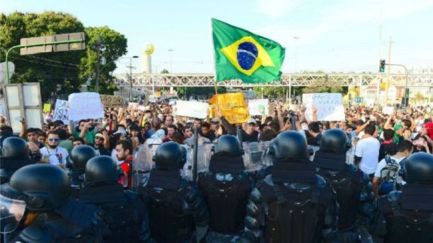
Brazilian police block protesters from entering Maracana soccer stadium in Rio on June 16, 2013
Brazilian police have fired tear gas and rubber bullets to disperse a crowd of about 3,000 people protesting outside Rio de Janeiro’s Maracana stadium before a Confederation Cup soccer game.
The rally took place on Sunday in protest against the vast sums of public money spent on the organization of the tournament.
The protesters also opposed the huge cost of preparations to host next year’s World Cup, which is expected to reach USD 15 billion (about 11 billion euros).
“I don’t care about the World Cup – I want health and education!” shouted the protesters.
Initially, police stood in line as a barricade outside of the stadium.
However, as the crowd of protesters tried to pass the blockade riot police charged towards the group.
On June 15, police clashed with protesters in a similar demonstration during the opening of the Confederations Cup in the capital, Brasilia.
The clashes ended with 39 people injured after police fired tear gas and rubber bullets to disperse the crowd.
June 17, 2013
Posted by aletho |
Corruption, Economics, Solidarity and Activism | Brazil, Confederation Cup, FIFA Confederations Cup, World Cup |
Leave a comment
Here we go: “NSA admits listening to U.S. phone calls without warrants”:
“A requirement of the 2008 law is that the NSA “may not intentionally target any person known at the time of acquisition to be located in the United States.” A possible interpretation of that language, some legal experts said, is that the agency may vacuum up everything it can domestically — on the theory that indiscriminate data acquisition was not intended to “target” a specific American citizen.”
Gathering everything is OK. Also:
“Director of National Intelligence Michael McConnell indicated during a House Intelligence hearing in 2007 that the NSA’s surveillance process involves “billions” of bulk communications being intercepted, analyzed, and incorporated into a database.
They can be accessed by an analyst who’s part of the NSA’s “workforce of thousands of people” who are “trained” annually in minimization procedures, he said. (McConnell, who had previously worked as the director of the NSA, is now vice chairman at Booz Allen Hamilton, Snowden’s former employer.)”
As far as the NSA is concerned, gathering everything without warrants is legally permitted, and once they have it, NSA analysts who are ‘trained’ to NSA standards are legally allowed to listen to whatever they want. Gathering everything is actually better than getting a FISA warrant for a particular target.
PRISM is going to take over the entire discussion, and, lo and behold, it is not that bad. Get a few more keys for the ‘lockbox’, and all will be deemed to be well.
The three big questions concerning Total Information Awareness are:
- economic – can we pay to store all this information?;
- technical – can we develop search engines that will allow us to handle all this information without becoming paralyzed by the sheer volume of it (remember that Simon’s big straw man was the ridiculousness of having FBI agents listen to all the conversations!!!), the traditional problem with totalitarian states?; and
- legal – in a country with constitutional protections for basic liberties, how is any of this allowed?
The NSA believes it has an answer to the first two of these problems, and just needs to fool Americans into believing that the presence of those scary Moooooooslims under their beds justifies a bit of bending of the constitution to finesse the legal problem. Some tinkering will be done to PRISM, and everybody will go back to sleep.
The final step will be to continue to expand the exploitation of the information as a method of social control using blackmail or something like blackmail – even the awareness that there is information out there that could be used for blackmail will start to influence behavior, particularly repressing any kind of political protest (not that there is much of that anyway) – and to use the insider information to siphon up whatever wealth is not yet in the hands of the 1% (it is a fun fact that Booz Allen is owned by the Carlyle Group).
June 16, 2013
Posted by aletho |
Civil Liberties, Corruption, Full Spectrum Dominance | Booz Allen Hamilton, Carlyle Group, Director of National Intelligence, Foreign Intelligence Surveillance Act, John Michael McConnell, National Security Agency, NSA, United States |
Leave a comment
What should you do if you uncover wrongdoing and the people responsible are the same ones who are supposed to investigate it? The way our politicians and elite media figures talk, you would think there’s something honorable about tipping them off (or shutting your mouth). In the political arena, the bold person of conscience – the rebel, the maverick, the damn-the-costs truth-teller – is the bad guy, not the action hero; the company man is played by Bruce Willis.
When Edward Snowden gave up a lucrative career in an island paradise to blow the whistle about the US government’s staggeringly broad spying operations – revealing what thousands of others with access to the same information wouldn’t – he was going up against a system that values loyalty to those who sign your paychecks over loyalty to principle or the public. A columnist for The New York Times, which is very much a part of that system, denounced him in terms one would think would be reserved for our leaders, declaring that Snowden had “betrayed the Constitution” and “the privacy of us all” by leaking evidence of the Obama administration doing just that.
Snowden need not be the world’s greatest human being for us to recognize the courage it took to do what he did. When compliance with a system makes one an accomplice to wrongdoing, there’s no virtue in being compliant. There’s no virtue in abiding by the “honor codes of all those who enabled [one] to rise,” as the Times columnist put it, when that code doesn’t respect the rights of everyone else. We recognize that when we go to the movies. Maybe we should stop condemning it in real life?
Instead of getting caught up in media attempts to pathologize a whistle-blower, we should also probably look more closely at what the whistle was blown on, because what Snowden revealed should be concerning, even if you don’t have relatives in Yemen.
This Matters
According to leaked classified documents, the US National Security Agency (NSA) is collecting data on nearly every call made by nearly every American, from the time it was placed, who was called and from where it originated. The NSA also has relationships with nearly every major Internet company, from Facebook to Google, granting the agency streamlined access to your user history. Everything you email or post to your wall could end up on an NSA server somewhere. That’s a lot of data, which is why the agency is building a 1.5 million square feet server farm in Utah to hold it, at a cost of $1.2 billion.
The Obama administration claims the information it belatedly admits it collects is only later accessed with a court order. But then, those court orders are classified, granted by judges in a secret court in front of which only the government can appear. Meanwhile, the White House has refused to release its legal rationale for the spying program, which senators from the president’s own party suggest is both illegal and unnecessary. It has, however, publicly credited the program with breaking up terrorist plots, though those claims – like its earlier denials that the spying program existed – have proven false.
But while it’s intrusive, sure, if you have nothing to hide, you have nothing to fear, right? Well, no. Even if you don’t have grandparents in Yemen, you should be concerned about any agency – that is, a collection of fallible human beings – that claims the right and has the power to know pretty much everything you’ve ever done on your iPhone. Go ahead and assume the best motives on the part of those in power, just don’t forget that even the most honorable people have ex-lovers too. Even saints can be seduced by power.
Most spooks aren’t saints, either. They’re like us: fallen. And what would you do if you were invisible? For some NSA employees, listening to your phone calls is the equivalent of sneaking into the locker room, several of them telling ABC News that the agency routinely eavesdrops on the phone calls of Americans abroad as they call friends and family back home.
“Hey, check this out,” the agents would tell each other, according to one whistle-blower. “There’s good phone sex or there’s some pillow talk, pull up this call, it’s really funny, go check it out.” Not exactly the model of professionalism one would hope for in someone who has god-like eavesdropping powers.
“These were just really everyday, average, ordinary Americans who happened to be in the Middle East, in our area of intercept and happened to be making these phone calls on satellite phones,” said another military whistleblower. Journalists and aid workers had their communications intercepted on a regular basis.
That was a decade ago.
It’s Gotten Worse
These days, the NSA is now known to be intercepting a much broader range of communication. Revelations to The Guardian show it claims the ability to tap into not just email communication, but live Skype calls. Basically everything you do on the Internet could potentially be viewed by a US government agent. There’s no need for black helicopters when you voluntarily divulge your life secrets with the help of a black box made by Sony. Or a white one by Apple.
You should be especially concerned if you have opinions about things going on in our world. When a group of Pennsylvanians began working to stop a natural gas fracking project in their community, they found themselves listed on a state Department of Homeland Security bulletin. “We want to continue providing this support to the Marcellus Shale Formation natural gas stakeholders while not feeding those groups fomenting dissent against those same companies,” the Secretary of Homeland Security, a Democrat, stated in an email.
If you oppose corporate America’s destruction of your community, you could end up being lumped in with actual terrorist threats. And once the word “terrorism” is invoked, all bets are off, potentially leading to a government agent, working on behalf of their corporate stakeholders, going through every ill-considered email you ever sent.
Sometimes, simply stating one’s political beliefs is enough to grab the state’s attention. In Seattle, the NSA’s partners in surveillance at the FBI tracked a group of young anarchists to a May Day demonstration, not because they were wanted for any crimes, but because they called themselves anarchists.
“Although many anarchists are law-abiding,” an FBI agent explained, “there is a history in the Pacific Northwest of some anarchists participating in property destruction and other criminal activity in support of their political philosophy.” And so we track them. And with the surveillance capabilities we have today, it’s not hard to make even the most innocent acts seem sinister, particularly when one has unpopular political beliefs or presents a challenge to corporate or state power.
It Could Be You
Combined with expansive terrorism laws, that could be a nightmare for those who fall in the arbitrary crosshairs of a government prosecutor looking to make a name for themselves. In 2010, the Supreme Court ruled that humanitarian groups can be convicted of “material support” for terrorism even if that support consists solely of helping seek conflict resolution. As former president Jimmy Carter said at the time, “the vague language of the law leaves us wondering if we will be prosecuted for our work to promote peace and freedom.”
Others don’t have to wonder. Since 2010, antiwar activists across the country have been subpoened and forced to testify before grand juries into a “material support” for terrorism investigation that has succeeded in scaring those who do humanitarian work in Palestine and Colombia, but as of yet yielded no convictions. Perhaps our broad spying and terrorism laws are working, just not in the way our leaders tell us. And, as these activists can attest: you don’t need to be convicted of anything to be constantly spied on.
As another NSA whistle-blower, William Binney, recently told journalist Amy Goodman, “if you’re doing something that irritates or is against what the government wants to be expressed to the American public, then you can become a target.” It’s as easy as that. And whenever you call a friend, keep in mind that you’re calling every friend your friend has ever called. Are you absolutely sure you have nothing to hide?
In Washington, most politicians seem annoyed that you now know this. They wish you didn’t. As Senator Al Franken explained, “Anything that the American people know, the bad guys know so there’s a line here, right?”
That’s how those in Washington often view those they claim to represent in our representative democracy: lumped in with the bad guys. Indeed, aiding us in our knowledge of what the government is doing in our name, as Bradley Manning and now Edward Snowden have done, is often likened with aiding the enemy.
“I don’t look at this as being a whistle-blower,” Senator Dianne Feinstein said of the NSA leaks. “I think it’s an act of treason.”
Feinstein voted for a war in Iraq that she and her husband personally profited from, so she knows a thing or two dozen about treachery. But she’s off base here. The American public is not the enemy, nor should informing them about the things being done to them with their own money be construed as the act of a traitor. Edward Snowden may not be the world’s greatest human being; who reading this has met him? What we do know is that his act did a lot of good by exposing a lot of wrong and took a lot more courage than it takes to criticize him on Capitol Hill. Since they don’t see that very often there, no wonder they mistake it as treason.
June 14, 2013
Posted by aletho |
Civil Liberties, Corruption, Full Spectrum Dominance, Progressive Hypocrite | iPhone, National Security Agency, New York Times, NSA, Snowden, United States |
Leave a comment
Thousands of US tech, finance, and manufacturing firms have secret agreements with national security agencies to trade sensitive information in return for classified intelligence, Bloomberg’s sources revealed.
The firms involved are referred to as ‘trusted partners’ by US intelligence organizations such as the National Security Agency (NSA), Central Intelligence Agency (CIA), the Federal Bureau of Investigation (FBI) and branches of US military.
In fact, thousands of US companies voluntarily provide US agencies with data (i.e. equipment specifications), Bloomberg’s four sources, who either worked for the government or in companies that have these agreements, said. And the information received can be used to gain access to computers of America’s rivals.
Cooperation between companies and intelligence agencies is legal, reported Bloomberg. And the fact that the companies provide information voluntarily means there is no need for US agencies to get court orders and no oversight is required under the Foreign Intelligence Surveillance Act, one out of four sources said.
Also, some of the companies’ executives are guaranteed immunity from civil actions related to transfer of information.
For example, Microsoft passes on information about bugs in its software before it publicly releases a fix to the problem, two sources confirmed. This kind of information can protect US government computers, as well as help to infiltrate those used by foreign governments by exploiting vulnerabilities in the Microsoft’s system.
Microsoft is reportedly not told how the US government uses the information passed on down to it, according to one official. Spokesman for Microsoft Frank Shaw confirmed such releases and stated that they give the government a chance to get “an early start: on risk assessment and mitigation.”
McAfee, America’s global computer security software company, is another ‘trusted partner’ and is known for its cooperation with the NSA, CIA, and FBI. It can share valuable data including malicious internet traffic, one of the sources said.
The company’s worldwide chief technology officer, Michael Fey, rebuffed the claim that the company does not share any personal information with the government.
“McAfee’s function is to provide security technology, education, and threat intelligence to governments … [including] emerging new threats, cyber-attack patterns and hacker group activity,” he stated.
Due to the sensitivity of information being traded, these kinds of agreements are usually made strictly between companies’ chief executive officers and heads of the US agencies. At times the chief executives could clear a few trusted people to work directly with the agencies.
Sharing info: Out of ‘patriotism’ or for ‘classified’ info?
In return for their cooperation, companies are showered with attention and gratitude.
“If I were the director and had a relationship with a company who was doing things that were not just directed by law, but were also valuable to the defense of the Republic, I would go out of my way to thank them and give them a sense as to why this is necessary and useful”, Michael Hayden, former director of the NSA and the CIA said.
One of the sources said that public would be surprised how much help the government is seeking in terms of collecting information. Reportedly, it is currently implementing a new expensive program called Einstein 3. The program was developed by the NSA to protect the government from hackers by analyzing billions of emails being sent to the government computers.
Five of America’s major internet companies, including AT&T and Verizon, have agreed to install the program on their servers and have received immunity guarantees, which specify that they would not be held liable under US wiretap laws, one of the sources revealed.
In the past companies like AT&T, Verizon and BellSouth were already reportedly involved for eavesdropping on behalf of the NSA. In 2006 sources revealed that the companies collected call records of tens of millions of Americans and shared them with NSA.
US companies are willing to participate in these kinds of agreements because they either believe they are helping to protect the nation and/or helping to advance their own interests by receiving classified information in return, sources said.
Google’s co-founder Sergey Brin, for example, was given sensitive government information a year into its data sharing agreement with NSA. The info provided linked the 2010 attack on Google to a specific unit within the Chinese military – the People’s Liberation Army – one of the sources confirmed. Brin was even given a classified clearance to attend a secret briefing on the subject.
Google was reportedly one of the participants in the secret NSA PRISM program that was revealed by ex-CIA staffer and whistleblower Edward Snowden. The program uses data mining surveillance to access emails, videos, chats, photos and search queries from nine worldwide tech giants.
Snowden also disclosed a secret NSA program called Blarney, which gathers metadata on computers and devices that send emails or browse the Internet through principal data routes, known as a backbone.
The whistleblower was last seen Monday, checking out of his hotel in Hong Kong, where he stayed for three weeks after leaving the US.
Snowden is hoping that staying in Hong Kong would help him avoid any extradition attempts on behalf of the US. In terms of the US-Hong Kong Extradition Treaty, both Hong Kong and Beijing have the power to stymie Snowden’s extradition. China for its part has no extradition treaty with the United States.
China has thus far refrained from making statements on the Snowden case. But a popular Chinese Communist Party-backed newspaper has printed an article demonstrating the benefits of not sending Snowden back to US, arguing that his knowledge of US surveillance programs are key to China’s national interest.
The article comes after Snowden resurfaced and gave an exclusive interview to the South China Morning Post, revealing top-secret US government records that show dates and IP addresses of computers in Hong Kong and on the mainland that were hacked by the NSA over a four-year period.
In the meantime, the FBI has launched an investigation into Snowden leaking US top secret surveillance tactics and has promised to hold the whistleblower accountable.
June 14, 2013
Posted by aletho |
Civil Liberties, Corruption, Deception, Full Spectrum Dominance, Timeless or most popular | Central Intelligence Agency, CIA, Crime, Hacking, Human rights, Information Technology, National Security Agency, NSA, Security, United States, USA |
Leave a comment
On Wednesday’s episode of “Morning Edition” on NPR, a segment was devoted to exploring the extreme violence that has engulfed Honduras in recent years. Indeed, if measured by per capita murder rate, Honduras is now the most dangerous in the country in the world. There are many reasons why Honduran civil society has broken down like this, but let’s suspend that discussion for the moment in order to focus on one particular aspect of this story on NPR that was quite revealing.
At one point in the segment, Carrie Kahn, the NPR correspondent reporting from Honduras, said the following:
Last year, the U.S. Congress held up funding to Honduras over concerns of alleged human rights abuses and corruption, particularly in the Honduran police force. Part of the funds are still on hold.
This is an astonishing statement for someone who purports to be a journalist. Unless Ms. Kahn has psychic powers, she cannot know why the U.S. Congress held up funding to Honduras. She can only know why Congress said it was holding up funding to Honduras. There is often a profound difference between why politicians say they are implementing policy X and why they are actually doing it. As you might have heard, politicians are occasionally dishonest and insincere, and their decisions are informed by a number of factors that have nothing to do with their personal beliefs. For a journalist, someone who is supposed to adversarially cover politicians and express skepticism at everything they say, this kind of blind faith is inexcusable.
The problem, though, is that Ms. Kahn’s statement is actually quite a bit worse than that. Even if she had said, “the U.S. Congress held up funding to Honduras over what it claimed were concerns of alleged human rights abuses and corruption,” instead of just mindlessly repeating what the government claimed, that would still be wildly insufficient for any journalist who takes her profession even the slightest bit seriously. Why? Because the United States government provably does not base its decisions on allocating foreign aid on “concerns about human rights and corruption.” For decades, the U.S. has provided aid to some of the most repressive and corrupt governments on Earth. Going down the list would be trivial, but, for the sake of comparison, let’s stay relatively close by and just look at Colombia. The U.S. government ships hundreds of millions of dollars to the Colombian government every year; in FY 2012, $443 million was provided, making Colombia the leading recipient of U.S. aid in the hemisphere.
In a strange twist, though, Colombia is also widely considered to be the most repressive violator of human rights in the hemisphere, and corruption there is rampant. This is quite a conundrum. Ms. Kahn tells us that the U.S. withheld aid from Honduras “over concerns of alleged human rights abuses and corruption.” But the U.S. evidently has no such “concerns” in Colombia and continues to send hundreds of millions of dollars in annual aid. One is almost tempted to conclude that the U.S. government makes these decisions based not on noble and selfless “concerns” about human rights and corruption, but, rather, on what it perceives to be U.S. interests.
Ms. Kahn must know that the government claim she dutifully parroted is transparently fraudulent and, in fact, downright comical. She cannot be a working journalist and not know this. Presumably, she follows the news, she is knowledgeable regarding basic facts about U.S. aid, and she knows that the U.S. has always cheerfully sent aid to brutal regimes around the world. She’s not a wide-eyed poly-sci 101 student who is shocked to find out that U.S. government decisions are not invariably and solely based on considerations of Good and Evil. Ms. Kahn is a highly educated reporter, and she obviously does know these things, but the culture of obedience and submissiveness in American journalism is so profound that she probably doesn’t even consciously realize that she’s serving state power instead of doing journalism. The U.S. government told her that aid is being withheld to Honduras because of concerns about human rights and corruption, therefore aid is being withheld to Honduras because of concerns about human rights and corruption. That’s that. Then she goes on NPR, unquestioningly repeats government claims, and she’s done her job. We would call this “propaganda” if it happened in the Soviet Union, but it’s called “journalism” when it happens here.
June 13, 2013
Posted by aletho |
Corruption, Mainstream Media, Warmongering | Colombia, Honduras, Human rights, Latin America, Morning Edition, NPR, United States |
Leave a comment
A lot of people in the US media are asking why America’s most famous whistleblower, 29-year old Edward Snowden, hied himself off to the city state of Hong Kong, a wholly owned subsidiary of the People’s Republic of China, to seek at least temporary refuge.
Hong Kong has an extradition treaty with the US, they say. And as for China, which controls the international affairs of its Hong Kong Special Administrative Region, while granting it local autonomy to govern its domestic affairs, its leaders “may not want to irritate the US” at a time when the Chinese economy is stumbling.
These people don’t have much understanding of either Hong Kong or of China.
As someone who has spent almost seven years in China and Hong Kong, let me offer my thoughts about why Snowden, obviously a very savvy guy despite his lack of a college education, went where he did.
First of all, forget about Hong Kong’s extradition treaty. When it comes to deciding whether someone will be extradited, particularly for a political crime, as opposed to a simple murder or bank heist, the decision will be made in Beijing, not in a Hong Kong courtroom. Second, Hong Kong has a long history of providing a haven to dissidents — even to dissidents wanted by the Chinese government. Consider, for example, the Chinese labor movement activist Han Dongfang, who was the subject of a massive dragnet after the Tiananmen protests, but who successfully fled to Hong Kong before the handover of the place from Britain to China, and is continuing to monitor Chinese labor strife and protest from his home on Hong Kong’s Lamma Island. Hong Kong also has a public that is very supportive of democratic values — certainly more so than the majority of American citizens. Hong Kong people may not be paying too much attention to Snowden’s situation right now, but if the US were to actively seek to extradite him, I am confident that the place would erupt in support for him, including the local media.
As for China, while the issue that has Snowden on the run — exposing an Orwellian spying program targeting the American people and run by the super-secret National Security Agency — is certainly not one that the Chinese like to discuss in terms of their own locked-down society, you can bet that the folks in the Propaganda Bureau in Beijing, and in the inner circle of the government, are rubbing their hands with glee both at the incredible embarrassment their harboring of Snowden causes the hypocritical US, and at the trove of intelligence information he has, which they may be able ultimately to lure him into disclosing if they treat him well.
Then too, there is the matter of the Confucian concept of gift-giving and mutual obligations. It was, I am sure, no accident that Snowden chose the weekend that President Obama was hosting a summit in California with China’s new president Xi Jinping to disclose his identity as the NSA whistleblower who exposed the national spying program to the Guardian and the Washington Post. In doing that, he gave President Xi an incredible gift — the chance to hold the upper hand in his negotiations with a hugely embarrassed and compromised Obama over issues like Chinese computer hacking of US corporate and government secrets, and theft of intellectual property. For of course it is clear that the NSA is at least as active in hacking Chinese computers and spying on Chinese communications.
Such a gift as that is not easily ignored or forgotten in Chinese culture. President Xi owes Snowden a lot, and I believe he will honor that debt by seeing that Snowden is protected from any threat that might be posed to him by a vindictive or frightened US government.
But Snowden isn’t relying solely on Chinese cultural values to protect himself.
He was also careful to send a powerful message of warning to the US officials in the videoed public interview he gave outing himself. As he told interviewer Glenn Greenwald, “I had access to the full rosters of everyone working at the NSA, the entire intelligence community, and undercover assets all over the world. The locations of every station, we have what their missions are and so forth. If I had just wanted to harm the US? You could shut down the surveillance system in an afternoon.”
That one line at the end had to make the folks in Langley and at NSA headquarters sit up straight or to head to the bar for a stiff one! And indeed he could. And I will guarantee you, Snowden being as smart as he is, that he has already taken that information and dispersed it to a number of trusted people, perhaps including Greenwald, with instructions that they should put it all out on the Web if anything happens to him, such as his being kidnapped or disappeared or terminated. It’s a wonderful insurance policy and one that would not have escaped him. Nor would he have bothered to discover that he had all that information available to him if he hadn’t thought that he might need it.
It would be a relatively easy matter for the high-tech spooks at the NSA to retrace Snowden’s electronic trail to see if he really did download all that super-secret information and really could blow up the entire US spy machine. If they find out that he really has that information, he’s basically untouchable.
The real question is not what they are going to do to Snowden. It’s what we Americans are going to do now that we know how truly insane and totalitarian our government has become.
Will we go back to watching our sports teams and our reality TV programming, and forget about the fact that we no longer have any privacy in our lives, that our elected leaders and our judges are operating on the assumption that if they get out of line the fascist machine at the NSA that works in service of the corporate elite will blackmail or destroy them with its access to all their communications. Or will we rise up and demand an end to this high-tech tyranny in the name of a fraudulent “War” on Terror?
Snowden exiled himself and gave up a great job in Hawaii in the hope that we would rise up when we learned that our democracy has been hijacked.
Let’s hope he’s right.
June 11, 2013
Posted by aletho |
Civil Liberties, Corruption, Full Spectrum Dominance, Timeless or most popular | China, Hong Kong, National Security Agency, NSA, Snowden, United States |
Leave a comment
The US State Department may have hushed up allegations of misconduct by its employees worldwide that range from soliciting prostitutes to getting narcotics from a drug ring, a report says.
The CBS News uncovered on Monday a memo that showed the department’s security force, the Diplomatic Security Service (DSS), tried to cover up sex and drugs charges against agents and diplomats working for the State Department.
The DSS is responsible for protecting nearly 70,000 employees at the State Department and 275 US embassies around the world.
The memo by the State Department inspector general made direct reference to eight specific cases in which inquiries into alleged criminal activities by diplomatic security agents or contractors were “influenced, manipulated, or simply called off” by more senior officials.
The cases included an unnamed US ambassador who repeatedly solicited prostitutes, a security official “engaged in sexual assaults” on foreign nationals hired as embassy guards in Beirut, and the members of former Secretary of State Hillary Clinton’s security team who “engaged prostitutes while on official trips in foreign countries.”
The ambassador involved in the case was called to Washington D. C. to have a meeting with Undersecretary of State for Management Patrick Kennedy about the issue but was permitted to go back to his regular duties, the report said.
The document also revealed details of an alleged “underground drug ring” close to the US embassy in the Iraqi capital Baghdad, which provided the DSS staffers with drugs.
State Department spokeswoman Jen Psaki on Monday did not deny any of the allegations in the CBS report, but refused to go into details.
“We take allegations of misconduct seriously and we investigate thoroughly. All cases mentioned in the CBS report were thoroughly investigated or are under investigation,” she said.
June 11, 2013
Posted by aletho |
Corruption | Diplomatic Security Service, DSS, State Department, United States Department of State |
Leave a comment
British Prime Minister David Cameron is facing criticism for breaking his promise to lead a transparent government, after he refused to reveal what had been discussed at the secretive Bilderberg meeting.
Cameron’s presence at the shadowy meeting is provoking controversy as the Prime Minister’s spokesman claimed that he is still committed to lead a transparent government, even though he refused to discuss what was said in the secretive conference.
A member of the Alliance for Lobbying Transparency, Tamasin Cave, said that Cameron’s decision to attend the Bilderberg conference “drives a coach and horses” through his pledge of openness”.
This comes as on the Sky News channel, opposition Labour MP Michael Meacher demanded transparency over the Bilderberg meeting, which took place in a luxury hotel in Watford, Hertfordshire.
“If there is any conference which required transparency, it is the Bilderberg conference because this is really where the top brass of western finance capitalism meet”, Meacher said, adding that there will be no statement in the House of Commons about it.
“This is totally in contradiction to the government’s commitment to have greater transparency,” he added.
The Bilderberg Group, which is made up of senior politicians, business leaders and academics from around the world, commonly attracts conspiracy theories as its annual gatherings always take place in secrecy.
June 9, 2013
Posted by aletho |
Corruption, Deception | Bilderberg Group, Cameron, David Cameron |
Leave a comment
During the world’s most secretive gathering the Bilderberg Group is set to discuss topics including cyber warfare, US foreign policy, “developments in the Middle East” and “Africa’s challenges” despite the glaring absence of regional representatives.
The Bilderberg Group, long criticized for a lack of transparency, has revealed details of its upcoming meeting. This year 138 politicians, bank bosses, billionaires, chief executives and European royalty have confirmed their attendance to the invitation-only event, set to take place in Watford, England. The list notably includes only 14 women.
The group is comprised largely of individuals from financial and business backgrounds – there will be nearly three dozen CEOs and more than two dozen Chairmen of banks and petroleum giants. Twenty-three financial institutions will be represented at the five-star Grove Hotel near Watford, Hertfordshire, including Goldman Sachs.
As the list was released, critics could not help but point fingers at problems some of the attendees are currently facing in their respective fields.
Special attention has been placed on Amazon’s founder and CEO Jeff Bezos and Google’s Eric Schmidt, as the two are currently facing unprecedented political pressure over their tax avoidance strategies. Google, for its part, has faced scrutiny amid reports that it paid just £10 million in corporation tax in Britain between 2006 and 2011, despite revenues of £11.9 billion.
Chancellor George Osborne and his Labour shadow Ed Balls, who have been making headlines with their spending and tax offers for the UK, will also rub shoulders with other participants of the Bilderberg Conference.
One of the guests is group chairman of HSBC Holdings plc, which faced a stringent investigation in 2012 for allegedly assisting in the laundering of money from Mexico, Iran and Syria for terrorist networks and drugs cartels.
Among guests there are also the 75th and 70th US Treasury Secretaries, Tim Geithner and Robert Rubin, respectively.
There will be other leading figures such as Christine Lagarde, head of the IMF, former US secretary of state and Nobel Peace Prize winner, Henry Kissinger, and David Petraeus, the former director of the CIA.
The list of prestigious names also includes the former Prime Ministers of France and Italy, François Fillon and Mario Monti.
There will also be scholars from some of the world’s most prestigious universities – one from Harvard University, two from Stanford, and one from both Oxford and Princeton.
Starting June 6 for three days, the delegates will be discussing of the record a list of topics of universal importance, determining how the world should proceed.
“The conference has always been a forum for informal, off-the-record discussions about megatrends and the major issues facing the world,” a Bilderberg spokesman said in a press release.
Originally founded in 1954 to foster dialogue between Europe and North America, this year’s topics include an expansive range of issues.
With Europe still trying to find solutions for financial problems and growing unemployment, the elite guests are set to discuss “jobs, entitlement and debt”, “politics of the European Union” and the broadly defined “current affairs”.
Among the 12 “key topics” for this year’s conference are “developments in the Middle East” and “Africa’s challenges.” The inclusion of “Africa’s challenges” is an interesting choice, as the guest list is notably absent of any major (or minor) political or academic figures from that vast continent.
Despite Bilderberg’s traditional exclusion of other areas of the world, six Turkish attendees are slated to be the only Middle Eastern voices at the conference. The inclusion of a large contingent from that country comes at an auspicious time, as political demonstrations continue throughout Turkey in opposition to the ruling AKP party.
The overlapping agendas of political and private sector leaders, as well as current and former political leaders is enough to make even the most conservative of observers start to wonder what may bear fruit as a result of the top-level, off-the-record conference.
As with gatherings of the G-8 and other international organizations such as the World Trade Organization, which tend to draw large, disruptive groups of demonstrators, Bilderberg has prepared a robust security apparatus to keep things running smoothly.
According to various reports by British media, UK taxpayers will have to bear the brunt of the ‘exceptional costs’ to police the meeting, which takes place in that country for the first time since 1998.
June 5, 2013
Posted by aletho |
Corruption, Supremacism, Social Darwinism, Timeless or most popular | Africa, Bilderberg Group, Middle East |
Leave a comment