Dr. Mark Trozzi’s Licence Stripped for “Misinformation” & Criticizing CPSO Policy
Dr. Trozzi to appeal after College of Physicians and Surgeons of Ontario revokes his licence
PRESS RELEASE | January 25, 2024
The Ontario Physicians and Surgeons Discipline Tribunal issued a penalty decision today revoking Dr. Mark’s Trozzi‘s medical licence after ruling in October that he had committed acts of professional misconduct by spreading misinformation about Covid-19 science and making statements critical of Covid-19 public health policies and recommendations. Through his counsel, Michael Alexander, Dr. Trozzi announced today that he will exercise his statutory right to appeal the decision to the Ontario Divisional Court.
In reaching its decision, the Tribunal rejected Supreme Court cases, dating from 1939, which hold that Canadians enjoy an absolute constitutional right to express minority opinions on any subject. This allowed the Tribunal to rule that the College has a right to regulate the expression of its members in the name of the public interest.
The Tribunal’s ruling also rested on the prior discipline hearing decision, where the Tribunal found that Dr. Trozzi had caused harm by spreading misinformation, even though expert witnesses for the College failed to tender evidence that Dr. Trozzi’s statements had caused harm to a patient or a member of the public.
In support of its ruling, the Tribunal also rejected a 41-page report Dr. Trozzi submitted in 2021 in which he defended himself against the College’s initial allegations, citing 29 references from mainstream sources such as Lancet, the New England Journal of Medicine, Public Health Ontario and Statistics Canada. This was done without mentioning that the College’s main expert witness, Dr. Andrew Gardam, had admitted on cross-examination during the discipline hearing that he had never attempted to refute the Trozzi report.
When the pandemic was on the horizon in 2020, Dr. Trozzi, a university professor and 25-year ER veteran, played a leading role in preparing his own ER facility to deal with Covid patients. However, while the press was reporting in late 2020 that ER rooms were overwhelmed, Dr. Trozzi’s ER room was virtually empty. Wondering how this could be, Dr. Trozzi called colleagues around Canada and the U.S. to inquire about their experiences and learned that their ER rooms were empty too.
As a result, Dr. Trozzi began to study Covid-19 science rigorously and soon discovered the government’s narrative regarding the virus was deeply flawed. He then quit his job and devoted himself full-time to exploring the truth about all things Covid on a dedicated site. When a scientist friendly to the government’s narrative alerted the College of Physicians to the site and Dr. Trozzi’s heretical views, the College launched an investigation that resulted in his prosecution for professional misconduct.
 Dr. Trozzi’s registration history: no disciplinary issues in 20+ years of medicine since his start Jun. 22, 1990. Issues only began when he, like any other doctors during Covid, spoke out against the unscientific Covid and “vaccine” mandates and, ironically, by continuing to follow the CPSO’s own guidelines prior to Covid, including giving patients informed consent for any medical treatments.
Alexander commented: “Since Dr. Trozzi’s right to appeal to the Divisional Court is based on a statute, the Court will be required to employ the highest standard of review on all legal issues, and that standard is correctness. In other words, the Court will have to determine whether the Tribunal got the right answer on every key legal issue; and where it does not, the Court will be required to correct the Tribunal’s reasoning. The College has never had to face a fundamental challenge to its authority on this basis.”
He added: “On correctness review, it will be very hard for the College to justify its initial decision to investigate Dr. Trozzi. Under the legislation, the College must have reasonable and probable grounds, which is the criminal standard, for believing that a member has committed an offence before it can launch an investigation. However, in its orders, the College did not describe any evidence to support the probable belief that Dr. Trozzi had done something wrong, and even failed to cite a specific offence. The appeal should succeed on this point alone.”
Finally: “The Court of Appeal’s recent decision to refuse to hear Jordan Peterson’s case does not mean, as some have speculated, that freedom of expression is dead in Ontario. The Peterson case turned on the issue of whether the College of Psychologists could regulate the form of Dr. Peterson’s expression, not its content. In Trozzi, the Divisional Court must decide whether to recognize the right of every citizen to express an alternative opinion, even if it offends censorious bureaucrats.”
To support Dr. Trozzi, DONATE HERE.
Pentagon contradicts White House about US troop presence in Yemen
The Cradle | January 28, 2024
US defense officials claim they have no boots on the ground in Yemen, despite a recent acknowledgement that US forces are indeed present in the war-torn Gulf state, a 27 January report from The Intercept shows.
On 17 January, a journalist asked US Defense Department press secretary Brig. Gen. Pat Ryder if he could give assurances that the US had no troops on the ground in Yemen. Ryder responded, “I’m not aware of any U.S. forces on the ground.”
However, the White House reported to Congress on 7 December that “A small number of United States military personnel are deployed to Yemen to conduct operations against al-Qa’ida in the Arabian Peninsula and ISIS.”
Erik Sperling, the executive director of Just Foreign Policy, who worked on Yemen as a Capitol Hill staffer, told The Intercept it is possible Brig. Gen. Ryder “is trying to skirt the question to avoid greater scrutiny.”
Pentagon officials also deny that the US is at war with Yemen despite bombing it.
“We don’t think that we are at war,” Pentagon deputy press secretary Sabrina Singh said on 18 January. “We don’t want to see a regional war.”
One journalist in the press briefing responded, saying, “We’ve bombed them five times now … if this isn’t war, what is war?”
This month, the US began a new bombing campaign against Yemen, which is now primarily governed by the Ansarallah resistance movement. With US and UK backing, Saudi Arabia and the UAE fought a war against Ansarallah between 2015 and 2022.
This month’s US bombing campaign came after Ansarallah-led Yemeni forces began attacking Israeli-linked shipping vessels in the Red Sea. Ansarallah wishes to stop the Israeli military campaign on Gaza, which has killed over 26,000 Palestinians and is widely viewed as constituting genocide.
But as the US bombing campaign in Yemen began, “defense officials suddenly became more reticent about the American military presence in Yemen,” The Intercept noted.
Though US officials claim their forces are in Yemen to fight Al-Qaeda-linked groups, a BBC investigation released on 22 January revealed that the UAE, a close US ally, has hired Al-Qaeda militants to fight for the Southern Transitional Council (STC), the Emirati-backed government in sparsely populated eastern Yemen.
A whistleblower cited in the investigation provided the BBC with “a document with 11 names of former Al-Qaeda members now working in the STC,” among them former high-ranking operatives of the extremist group.
Nasser al-Shiba, a former high-ranking Al-Qaeda member, is now the commander of the of the STC’s armed units, several sources told the BBC.
Top Democrat-linked PR firm tapped by pro-Israel groups to control Gaza war narrative
By Kit Klarenberg | MintPress News | December 29, 2023
On December 6, it was announced with much fanfare that the 10/7 Project, a new “centralized communications operation to promote continued US bipartisan support for Israel; push for accurate, complete coverage of the Israel-Hamas war,” and achieve a “stronger” media “focus” on the victims of October 7’s Al-Aqsa Flood would be launched, by a quintet of the largest Israeli lobby groups on U.S. soil.
Who and what is funding the 10/7 Project isn’t at all clear. Publicity material spoke vaguely of an unnamed “coterie of philanthropists” and the organization’s interest in sourcing “more philanthropic support” moving forward. Future formal financial disclosures may make for fascinating reading, but its founders offer some clues.
The five comprise the American Jewish Committee (AJC), the Jewish Federations of North America (JFNA), the Anti-Defamation League (ADL), the American Israel Public Affairs Committee (AIPAC), and the Conference of Presidents of Major American Jewish Organizations. This is quite the rogue’s gallery of Zionist entities, several of which have deplorable track records of actively whitewashing, if not outright facilitating, Israeli apartheid propaganda activities that have become turbocharged since October 7.
As such, the 10/7 Project’s professed mission of countering “disinformation” about October 7 and “Israel’s response” to the events can only be considered highly disquieting, especially given its target audience is “key media and government influencers.” In reality, of course, the organization is just the latest salvo in the Zionist state’s long-running information war against Palestinians and the Western world. This pitched battle has recently become ever more treacherous, specifically due to Tel Aviv’s genocidal “response” to Operation Al-Aqsa Flood.
One could be forgiven for thinking the 10/7 Project had already floundered in its objectives. After an initial ripple of mainstream interest, primarily from Israeli outlets and Zionist news platforms, the organization has seemingly vanished without a trace from the media landscape – or at least, its name has. As we shall see, though, it’s evident that in the manner of an iceberg, the 10/7 Project’s public footprint represents but the visible tip of something far larger and considerably more destructive.
‘STRANGLEHOLD ON CONGRESS’
While the 10/7 Project may not be directly making headlines daily, its parent organizations certainly are. The ADL has since October 7 published a steady stream of reports, lapped up by the media largely without question, testifying to an explosion of “anti-Semitic incidents” across the Western world in the wake of Operation Al-Aqsa Flood.
Shocking stuff, one might think. Yet, as an investigation by MintPress News Senior Staff Writer Alan MacLeod revealed, the ADL is producing such staggering figures by categorizing anti-Israel and pro-Palestine rallies and corresponding chants at both as individual “anti-Semitic incidents.” Despite the exposure of its embarrassing, Enron-style accounting, the League continues to pump out the same bogus “research” at regular intervals. On December 12, it claimed “anti-Semitism” in the US was now up 337% in the wake of October 7, “an all-time record.”
It is far from the first time ADL definitions of anti-Semitism have failed to pass muster. For example, in December 2022, The Grayzone’s Alex Rubinstein revealed that the League did not categorize Ukraine’s openly Neo-Nazi paramilitary Azov Battalion to be the “far right group it once was.” This, despite the fact that Azov’s mission to “lead the white races of the world in a final crusade… against Semite-led Untermenschen,” as articulated by founder Andriy Biletsky, remains unchanged.
Meanwhile, the infamous AIPAC – accurately described by U.S. political scientist John Mearsheimer as “a de facto agent for a foreign government, [with] a stranglehold on Congress” – has made clear its significantly intensified mission to rid Washington DC of any elected official possessed of even vaguely anti-war, pro-Palestinian views, by declaring war on lawmakers such as Rashida Tlaib and Ilhan Omar.
When AIPAC moves against, or in favor, of particular politicians, they mean business – and depressingly, the organization usually wins. Annually, the organization publishes a report on its “policy and political achievements” that year. Its 2022 installment boasts, among other things, of bagging $3.3 billion “for security assistance to Israel, with no added conditions” and having gifted $17.5 million – the most of any U.S. PAC – to “pro-Israel candidates,” 98% of whom won their elections, in the process defeating 13 anti-Israel challengers.
CONFLICTS OF INTEREST
The official website of the 10/7 Project is spartan in the extreme. Visitors are offered a “contact us” form, a link to subscribe to its regular newsletter, and a “what we do” section listing purported activities. This includes informing the public “with credible, real-time information about events in Israel and Gaza,” highlighting “excellent reporting,” calling out “biased coverage,” holding “biased media accountable,” and offering “expert spokespeople for press and broadcast outlets.”
Unmentioned anywhere is that the 10/7 Project is represented by a trio of notorious PR and political consultancies – CKR Solutions, OnMessage Public Strategies, and SKDK. Together, they move in the shadows to advance the organization’s interests and messaging publicly and on Capitol Hill. SKDK’s contribution will inevitably be the most insidious and impactful.
Since its founding in 2004, the company has careened from damaging scandal to damaging scandal yet consistently secures major, big-ticket clients. The reason for this is clear. SKDK was founded by and employs a retinue of high-ranking, well-connected Democratic operatives. Among them is Anita Dunn, Barack Obama’s White House Communications Director, credited as the “mastermind” of Joe Biden’s 2020 election win and widely regarded as a key member of the President’s “inner circle.”

Joe Biden speaks with SKDK’s Anita Dunn ahead of his State of the Union address in February 2023. Adam Schultz | White House
Ever since Obama’s 2008 election win, SKDK has been plausibly accused of selling privileged access to the White House to clients despite failing to register as a lobbying firm. This means major corporations have a direct means of encouraging – and bribing – the Oval Office to offer tax breaks, shred regulations, dump legislation, smash unions, and generally harm the U.S. public interest with total impunity and in absolute secrecy.
SKDK’s expansive Rolodex also helps politicians get out of serious trouble. In 2018-2019, Illinois House Speaker Michael Madigan paid the company $200,000 for “crisis communications” assistance after one of his campaign workers sued him for harming her professionally when she complained of sexual harassment by one of his top aides. Meanwhile, in August 2021, it was revealed a senior SKDK staffer personally intervened to suppress negative media coverage of sexual harassment allegations against New York Governor Andrew Cuomo.
Even more perversely, it’s since been revealed that at the same time, SKDK was advising Madigan on how to navigate his public controversy, the company was also helping his former campaign worker bring a lawsuit against the aide who’d sexually harassed her. A more perfect demonstration of the DC blob’s incestuous nature and SKDK’s total lack of ethical and professional scruples one would be hard-pressed to find. And both are highly competitive categories.
SKDK played a pivotal role in Biden’s 2020 presidential bid, decisively reversing his fortunes after abysmal performances in various caucuses. While the mainstream media primarily praised the miraculous work of the company and Dunn – his de facto campaign director – there has also been fierce controversy surrounding its electioneering activities. For example, SKDK fired off daily “Misinformation Briefings” to major tech and social media firms, including Google, Meta and Twitter, requesting that specific content be suppressed or removed.
In most cases, the recipients complied, meaning SKDK exerted extraordinary influence over what voters did and did not know and could and could not see during the controversial 2020 Presidential election. Which surely at least partially accounts for Biden’s victory. To make matters even worse, the company was simultaneously. reaping a $35 million windfall from the government of California by running the state’s supposedly bipartisan “get-out-the-vote” campaign. The contract, originally to be financed by local taxpayers, was mysteriously awarded to SKDK on a “no-bid” basis.
‘DICTATE TERMS’
Clearly, the 10/7 Project was intended to be a very public affair. In an early promotional interview, executive director Josh Isay – perhaps unsurprisingly, until August 2022 SKDK’s longtime CEO – boasted about the “widespread enthusiasm” with which the organization’s “efforts to set the record straight and combat misinformation spouted by Hamas terrorists and their anti-Israel allies” had so far been received:
We look forward to continuing to do the critically important work of providing policymakers and the American public with reliable information about Israel and Hamas, and uplifting the stories of the innocent victims of the October 7th massacre.”
Yet, there is no obvious sign of those ambitions bearing fruit to date. A partial explanation for this failure may lie in the 10/7 Project’s wish to transform the “innocent victims” of Operation Al-Aqsa Flood into human interest stories and atrocity propaganda while elevating the organization’s eponymous date to the position of 9/11 in the American public’s mind.
In the weeks since the 10/7 Project’s inception, it has become ever-increasingly clear the Zionist narrative of what unfolded when Hamas breached Gaza’s armored concentration camp walls – unquestioningly regurgitated over and again for weeks after that by the Western media – is completely and grotesquely fraudulent.
For example, on December 15, it was reported based on social security data that Tel Aviv’s claim that 1,200 civilians died in the initial assault was greatly exaggerated. In reality, just 695 lost their lives. The previous figure was itself a revision from an initial civilian casualty “estimate” of 1,400.
Every civilian death in a warzone is an extremely grave crime. It is surely for this reason that Tel Aviv on December 12 desperately argued “it would not be morally sound” to investigate “friendly fire” incidents in “kibbutzim and southern Israeli communities” during Operation Al Aqsa Flood – civilians killed by Israeli Occupation Forces. Nonetheless, the numbers involved are avowedly “immense.”
Among the “stories of the innocent victims of the October 7th massacre” selected by the 10/7 Project for public “uplifting” in service of whitewashing and justifying the Gaza genocide will have been a great many individuals slaughtered in cold blood by indiscriminate, excessively violent IDF actions. This is all but inevitable. Urgently casting those victims into obscurity while ensuring the entire issue of Zionist “friendly fire” is not examined is now of paramount importance.
More significantly, though, the exposure – and occasional admission – of Tel Aviv’s brazen lies has fundamentally shifted mainstream narratives and sympathies away from Israel and towards the Palestinians. Audiences of every extraction globally can witness the monstrous reality of the genocide in Gaza and learn of Zionist abuse of the Palestinians even before the colonial entity’s founding in 1948 with their own eyes and ears.
Israeli deceit has been so relentless and so readily exposed that even typically subservient Western news networks and their featured pundits are treating official claims with enormous skepticism. Similarly, Zionist violence is so constantly unremitting and wantonly sadistic that graphic reports of carpet bombs maiming and slaughtering every generation of Palestinians are now commonplace.
Meanwhile, developments such as the revelation that IDF soldiers killed three shirtless Israelis waving a white flag, speaking Hebrew and seeking their assistance have traveled widely, in turn highlighting prior examples of identical “peacetime” atrocities inflicted upon Palestinians. By contrast, there has to date been no “misinformation spouted by Hamas terrorists and their anti-Israel allies” to combat at all.
A LOSING BATTLE
As a result, the 10/7 Project and its founders are placed in the invidious position of having to publicly defend the indefensible – namely, a modern-day genocide unfolding on television screens and front page headlines the world over. In such circumstances, overt and unashamed advocacy work is best conducted behind the scenes. Yet, it is precisely in this context that the 10/7 Project may be most dangerous and potent due to its open-door Oval Office access.
Tireless solidarity efforts by European activists, protesters, citizen journalists, and civil society organizations have produced significant results. Paris went from mulling legislation criminalizing anti-Zionism in November to now leading global pressure for a ceasefire. Multiple governments and opposition leaders are likewise changing their tune. Senior British officials openly warn Netanyahu to drastically rein in his unquenchable bloodlust if he wishes to retain any international support.
Stateside, however, while the crusading work of grassroots pro-Palestine voices and groups has been redoubtable, the Biden administration’s commitment to facilitating, encouraging, and exacerbating the Gaza genocide, however it can, remains undimmed. While the President has demanded Netanyahu’s slaughter be wrapped up by the new year, there is no indication material, financial, and diplomatic support upon which the new Nakba depends is being curtailed. On December 18, during an official visit to Tel Aviv, Defense Secretary Lloyd Austin issued a bloodcurdling oath:
This is Israel’s operation, and I’m not here to dictate timelines or terms. Our support [for] Israel’s right to defend itself is ironclad, as you’ve heard me say a number of times, and that’s not going to change.”
One way greater pressure could be brought to bear against the Biden administration might be for citizens to demand their elected representatives in Washington to disclose what dealings they may have had with the 10/7 Project or its representatives since its launch.
To ascertain whether and how White House policy and public pronouncements are being directly informed, if not explicitly dictated, by the wishes and wills of a shadowy and unaccountable lobbying coalition with indeterminate but no doubt intimate political and financial connections to the perpetrators of a 21st century Holocaust.
Kit Klarenberg is an investigative journalist and MintPress News contributor exploring the role of intelligence services in shaping politics and perceptions. His work has previously appeared in The Cradle, Declassified UK, and Grayzone. Follow him on Twitter @KitKlarenberg.
Arizona GOP Chair Resigns After Kari Lake Threatens “More Damaging” Recording
By Tyler Durden | Zero Hedge | January 24, 2024
One day after the Daily Mail published a leaked recording of Arizona GOP Chairman Jeff DeWit trying to bribe Trump ally Kari Lake to stay out of politics for two years, DeWit resigned.
“This morning, I was determined to fight for my position,” he said in a statement reported by Just the News. “However, a few hours ago, I received an ultimatum from Lake’s team: resign today or face the release of a new, more damaging recording. I am truly unsure of its contents, but considering our numerous past open conversations as friends, I have decided not to take the risk. I am resigning as Lake requested, in the hope that she will honor her commitment to cease her attacks, allowing me to return to the business sector—a field I find much more logical and prefer over politics.”
Arizona Senate candidate Kari Lake called on the state’s GOP chair Jeff DeWit to resign after a recording emerged of him trying to bribe Lake to stay out of politics for two years.
In the recording, first reported by the Daily Mail, DeWit, 51, can be heard asking lake to name her price not to run.
“There are very powerful people who want to keep you out,” he can be heard telling her in a conversation recorded last March.
He then, after asking her not to mention the conversation to anyone, makes his first offer:
“So the ask I got today from back east was: “Is there any companies out there or something that could just put her on the payroll to keep her out?”
Lake is taken aback.
“This is about defeating Trump and I think that’s a bad, bad thing for our country,” she replied.
DeWit later framed it in a different way.
“Just say, is there a number at which –
“I can be bought?” Lake interjected. “That’s what it’s about?”
“You can take a pause for a couple of years. You can go right back to what you’re doing,” DeWit replied.
Lake repeatedly shuts him down, and says she wouldn’t pull out for a billion dollars.
“This is not about money, it’s about our country,” she says (one her own recording, we’re guessing).
Listen (via Collin Rugg).
Following the report, Lake called on DeWit to resign.
“He’s gotta resign. We can’t have somebody who is corrupt and compromised running the Republican Party,” she told an NBC reporter during Trump’s New Hampshire primary victory party.
Abolish the FBI
By Jacob G. Hornberger | FFF | January 23, 2024
Among the worst mistakes America has ever made is to bring into existence the Federal Bureau of Investigation — the FBI.
A national police force is an essential part of any tyrannical regime. Just look at any tyrannical foreign regime, either right wing and left wing, over the past 100 years. I will guarantee you that you will find a national police force. It serves as a useful adjunct to a big military-intelligence establishment to keep people in line.
Of course, we are all familiar with such things as COINTELPRO and the FBI’s murder of innocent people at Waco and Ruby Ridge. We are also familiar with the FBI’s fierce opposition to Martin Luther King and the civll-rights movement as well as the virtual certainty that the FBI orchestrated King’s murder. We are also familiar with former FBI Director J. Edgar Hoover’s longtime penchant for keeping secret files on people’s personal lives with the aim of blackmailing them into supporting whatever the FBI wants. We are also familiar with the FBI’s ardent support of the Vietnam War, the Cold War, and the anti-communist crusade. We are also familiar with the FBI’s active role in America’s political system.
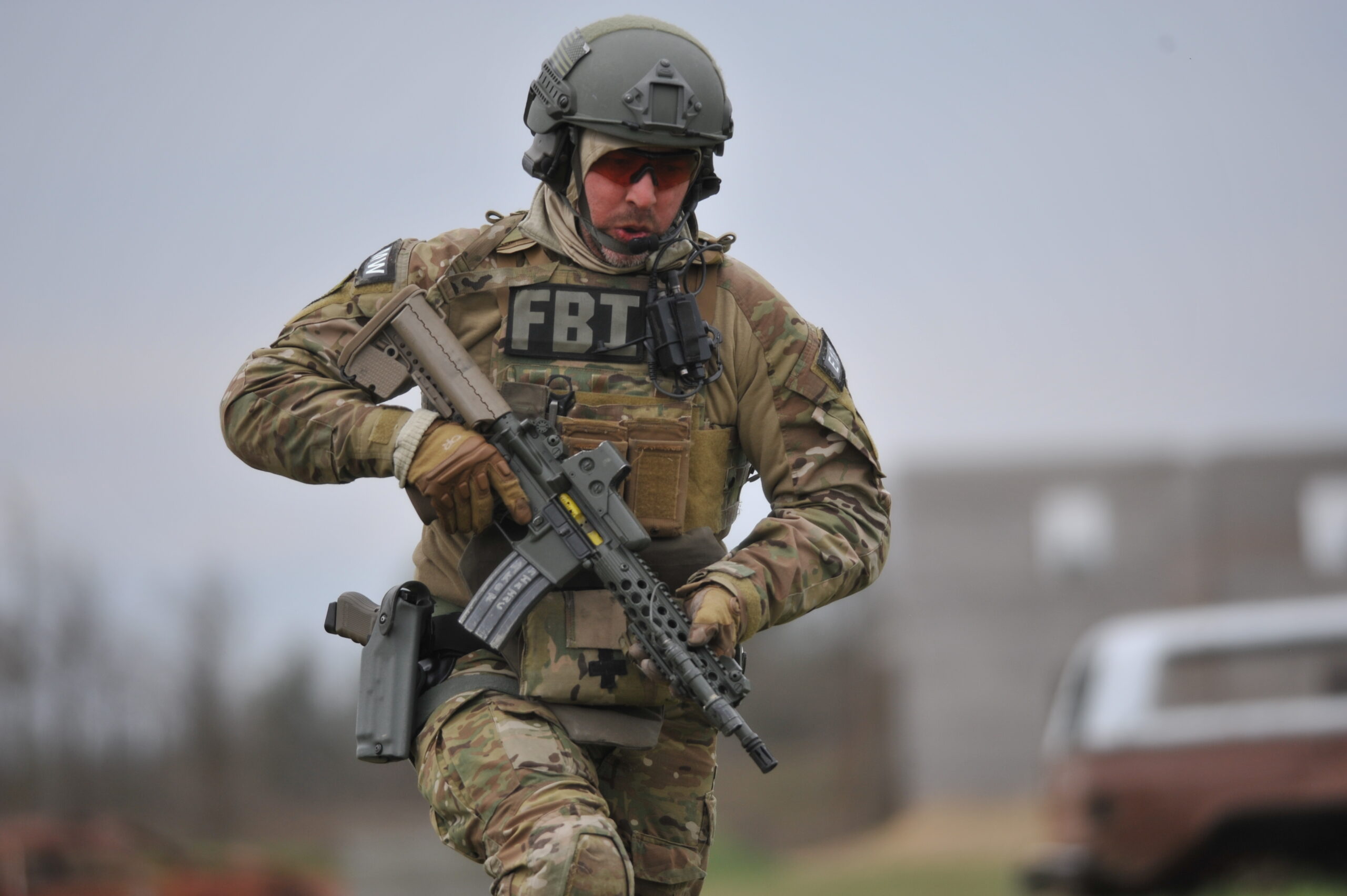 Less familiar is the FBI’s ubiquitous practice of inducing people to commit crimes in order to justify its continued existence and its continued receipt of taxpayer-funded largess. That practice involves entrapping people into committing crimes and then proudly patting itself on the back for “keeping America safe” by supposedly busting dangerous criminals.
An example of this sordid practice is detailed in a January 19, 2024, article in the New York Times that involved four men whose lives were partially destroyed by the FBI as part of its attempt to make itself look good by creating and encouraging a crime supposedly committed by those four men.
The four men — James Cromitie, Laguerre Payen, David Williams and Onta Williams — were from Newburgh, New York, and became known as the “Newburgh Four.” Given the FBI’s history of viewing Martin Luther King and the civil-rights movement as communist agents, it’s not surprising that the FBI targeted four Black men for its entrapment scheme. The fact that they were poor also figured into the FBI’s plot, given that the FBI used the lure of big amounts of taxpayer money to induce the men to commit a crime.
The scheme was part of the FBI’s post-9/11 plot to invent criminal conspiracies to commit terrorist attacks. That’s what the FBI did with the Newburgh Four. The FBI used the services of an informant named Shahed Hussain. The FBI had Hussain infiltrate various mosques and identify poor people who could be induced to engage in acts of terrorism. That would enable the FBI to exclaim, “We’ve busted terrorists! We’re keeping you safe! Give us more taxpayer money!”
Hussain promised the Newburgh Four $250,000 if they would agree to participate in a terrorist plot. After several months of refusing the offer, the four black men, at least one of whom was unemployed and broke, agreed to participate in bomb plots at various synagogues.
The men were busted and given 25-year jail sentences. They had served 14 years in jail until a heroic federal judge recently ordered their release. As reported in the New York Times article, the judge, Colleen McMahon, called the case “notorious.” She pointed out that “nothing about the crimes of conviction” had been of the “defendants’ own making.” She pointed out that the FBI’s agent in the crime, Shahed Hussain, was a “small time grifter and petty drug dealer.”
Judge McMahon correctly pointed out that the “real lead conspirator was the United States.” She added, “The F.B.I. invented the conspiracy; identified the targets; manufactured the ordnance.” The New York Times pointed out that McMahon added that the FBI “federalized” the charges — ensuring long prison terms — by driving several of the men into Connecticut to view the “bombs.”
After 14 years in jail on FBI-manufactured crimes, the Newburgh Four are free. But the best way to ensure that the FBI doesn’t destroy other people’s lives is to abolish it. Its dismantling would go a long way toward restoring freedom and justice in America. Anyway, criminal justice belongs at the state and local level, not the federal level.
Four of Britain’s top institutions have made erroneous estimates of the cost of Net Zero
By Paul Homewood | Not A Lot Of People Know That | January 24, 2024
Four national institutions have failed to model the 2050 energy system correctly, and all of them in ways that lead to understatement of the costs of Net Zero.
Over the weekend, the Sunday Telegraph reported that the Climate Change Committee has got its energy system modelling wrong. The revelation was made by Sir Christopher Llewellyn Smith, the lead author of the recent Royal Society report on electricity storage, in remarks made at a seminar at Oxford.
According to Sir Christopher, the Climate Change Committee’s estimates of the costs of Net Zero are fundamentally flawed because they have only modelled isolated years. As he pointed out in the seminar, low-wind years can happen back to back, which means that the Climate Change Committee need twice as much storage capacity as they thought. As a result, they have underestimated the costs.
However, the Sunday Telegraph didn’t mention that it’s not just the Climate Change Committee that has made this mistake. In the same seminar, Sir Christopher pointed out that the National Infrastructure Commission has done the same thing, despite being warned of the problem of clusters of low-wind years. So they too will have underestimated the costs.
The National Infrastructure Assessment… is also based on one year…they were told by the Met Office ‘you can get extreme events’…it’s not enough to look at one. They looked at one, so they got the answer wrong. The Met Office are really angry, because they told them ‘don’t do it’, but they did it.
I can also reveal that National Grid ESO, in its Future Energy Scenarios, has done the same thing. I wrote to the NGESO team to ask how they did things, and was told that their models are prepared using weather conditions in 2013, which they describe as an “average year”. They are starting to run tests against low-wind conditions (so-called ‘dunkelflautes’), but back-to-back wind droughts don’t seem to be on their radar yet:
The generation provided from renewables, as well as the demand profile, is typically based on an average weather year (2013).
For FES23, we also conducted an initial piece of analysis looking at abnormal weather conditions (resulting in abnormal supply and demand patterns), the results of which can be found in our FES23 publication under the title Dunkelflaute Period. We took a period of extreme weather, in this case between Jan-Feb 1985, and applied it to our Consumer Transformation scenario in 2050, to look at how the system would respond to a sustained period low renewable output…
We are planning on looking at abnormal supply and exceptional demand in more detail going forward as well as the effects of more extreme weather.
That means that they too will have underestimated the cost of Net Zero.
The Royal Society is to be congratulated for clarifying the problem. However, it turns out that their own modelling is fundamentally flawed too. That’s because, while they model 37 years of different wind speeds, they assume that electricity demand is always the same. Sir Christopher has admitted that this is not correct, in a podcast broadcast last year. As he put it then:
And now I confess something that is a bit of a weakness in our report. We’ve got this model of one year of demand… based in the weather in 2018…We simply repeat that 37 times.
This is clearly wrong, because in 2050 it is imagined that we will all heat our homes with electric heat pumps. Electricity demand will therefore be much higher in cold years than in mild ones, and if we have back to back cold years, we are going to need much more storage.
So, four well funded national institutions have failed to model the 2050 correctly, and all of them in ways that low-balls the cost of Net Zero. That’s a remarkable coincidence, and one that should probably raise alarm bells about the extent of the rot in the British establishment.
Revelation That U.K. Climate Target is Based on One Windy Year’s Data Threatens to Unravel Net Zero Credibility
BY CHRIS MORRISON | THE DAILY SCEPTIC | JANUARY 24, 2024
In October the Daily Sceptic reported on a paper written for the Royal Society led by Sir Chris Llewellyn Smith of Oxford University that concluded batteries were not the answer to the huge storage requirements of intermittent ‘green’ electricity power. Despite the prestigious academic fire power on parade, the paper died a death in the popular prints, presumably because of its unwelcome message about the much-touted battery solution. But recent revelations suggest the report could act as a loose thread that helps unravel the collectivist Net Zero agenda in the U.K. The Royal Society analysed decades of local wind speeds and found the electricity system needed the equivalent of at least a third of green energy to be stored as backup. Such a cost would be astronomical. Now it appears that the Government’s Climate Change Committee (CCC) fudged the issue by using just one year of high wind data in persuading Members of Parliament in 2019 to donkey-nod through Theresa May’s insane legislative rush to Net Zero by 2050.
Sir Chris’s report showed that wind could fall away for days at a time during periods of intense cold dominated by high atmospheric pressure. It also found wind speeds varied between years, all of which is in fact known and has been studied widely by other scientists. The Telegraph has reported on remarks made by Sir Chris after the paper was published in which he noted that the CCC has “conceded privately” that reliance on one year’s data was a “mistake”. It appears that the information given to MPs committing to 2050 Net Zero assumed there would be just seven days when wind turbines would produce less than 10% of their potential electricity output. According to Net Zero Watch that compares with 30 such days in 2020, 33 in 2019 and 56 in 2018.
In reporting that the CCC has conceded the “mistake”, the Telegraph noted that Sir Chris said the committee was still saying it doesn’t differ much from Sir Chris’s calculations. “Well that’s not quite true,” observed the Oxford Emeritus Professor. Asked by the newspaper if it disputed the account of Sir Chris, a CCC spokesman said it had “nothing further to add”.
Of course the ‘Noble Lie’ that Net Zero must be foisted on an unwilling population whatever the economic and societal cost will need to be preserved. Nothing to see here, move along please, is likely to guide most mainstream media in covering these latest revelations. The investigative science and Net Zero writer Paul Homewood is less inclined to ignore the serious matter. “It is now clear that Parliament authorised Net Zero without any proper assessment, whether financial or energy, and the whole Net Zero legislation must now be suspended until a full independent assessment is carried out.” He goes further and states that current and past members of the CCC must be held to account, and “excluded from any further influence over the country’s energy policy, or indeed on any issue of public policy”.
In general, nobody wants to talk about the lack of wind and solar backup, so there is a widespread pretence that the problem will somehow be solved in the future. But having dismissed any role for batteries, the Royal Society suggested hydrogen as a solution, an idea, alas, only slightly less dumb than batteries. Highly explosive, low kinetic energy compared with hydrocarbons, expensive to produce, difficult to store and move around – the disadvantages are all too obvious. Francis Menton of the Manhattan Contrarian saw the report as an “enormous improvement” on every other effort on the subject of large scale energy storage systems. But in the end, the authors still have a “quasi-religious commitment” to a fossil-free future, and this means that the report, despite containing much valuable information, “is actually useless for any public policy purpose”.
What is becoming clear is the level of statistical deception that is practised across climate science and the promotion of Net Zero. Surface temperature measurements are frequently adjusted upwards on a retrospective basis despite ignoring growing urban heat corruptions, activists use computer models to run up garbage-in, garbage-out scares on an almost daily basis, and bad weather is deliberately confused with long-term climate to suggest the latter is changing due to human caused carbon dioxide. All lapped up without a critical word between them by members of the mainstream media increasingly funded by elite billionaires.
The donkey-nodding politicians and the poodle media often hide behind the notion that they are just following the ‘science’. There is no such thing as the ‘science’, settled or otherwise, just the ongoing scientific process. The distinguished scientist and Nobel laureate Richard Feynman captured the integrity of the process when he wrote: “If you’re doing an experiment, you should report everything that you think might make it invalid – not only what you think is right about it. … Details that could throw doubt on your interpretation must be given, if you know them.”
Renewable energy is not a low-cost substitute for fossil fuels, notes a forward in Rupert Darwall’s recently published report on Net Zero and Britain’s “disastrous” energy policies. High and rising energy costs have locked Britain into economic decline, a suggestion given weight by last week’s savage destruction of the steel economy of Port Talbot. Renewables are not cheap, nor can they provide the reliability that modern societies expect and on which they depend. His report is said to convincingly demonstrate “how Britain was conned into Net Zero by deceptive and illusory promises of cheap wind power”.
The CCC is a dedicated green activist group that sits at the heart of U.K. Government. It is a pernicious, untrustworthy force in British politics giving cover to policies that will lead to de-industrialisation and massive changes in future lifestyle including restriction on diet, transport and personal freedoms.
Here’s hoping the wind scandal blows the damn thing away.
Chris Morrison is the Daily Sceptic’s Environment Editor.
Israeli army, police repeat false claims of Hamas atrocities

Remains of destruction on Kibbutz Be’eri seen on October 11, 2023. (Photo credit: Lazar Berman / Times of Israel)
The Cradle | January 23, 2024
Recent claims made by a senior Israeli army officer and police spokesperson regarding alleged atrocities committed by Hamas during Operation Al-Aqsa Flood are false, Haaretz newspaper reported on 21 January.
On 20 January, Lt. Col. Guy Basson, deputy commander of the Israeli army’s Kfir Brigade, claimed in an interview with Channel 14 that fighters from Hamas’ military wing, the Qassam Brigades, murdered eight infants and a survivor of the Auschwitz concentration camp on 7 October.
Speaking to Channel 14, Basson claimed: “We get to Kibbutz Be’eri, and I’m confronted with two main scenarios. One was from the children’s nursery… where [the eight infants] were simply slaughtered and murdered.” When the interviewer asked him in response,” Did you see the children inside…?” Basson responded: “A house. Eight babies, eight dead babies.”
Basson later added: “Another image that stuck with me is Genia, of blessed memory, an elderly woman from Kibbutz Be’eri. I see the number engraved on her arm, and you say to yourself, she went through the Holocaust in Auschwitz and ended up dying on Kibbutz Be’eri.”
However, Haaretz reported that the incidents described in the interview never took place.
Haaretz reported there is no survivor of Germany’s World War II concentration camps named Genia in Be’eri.
The liberal Israeli daily noted that “Regarding the claim that eight babies were murdered in a kibbutz nursery, to this day there is no known case in any of the surrounding communities where children from several families were murdered together.”
In Kibbutz Be’eri, one baby, Mila Cohen, 10 months old, was killed on 7 October, along with her father, Ohad, when Qassam fighters shot through the door of the safe room in their home, hitting both Ohad and Mila on the other side, in an apparent bid to take them captive to Gaza.
A Kibbutz Be’eri spokesperson rejected Lt. Col. Basson’s claims, stating, “Nearly one hundred people were murdered on Kibbutz Be’eri, and the community suffered hundreds of heartbreaking incidents on that Black Saturday and over the past months, especially regarding the hostages. However, incidents such as eight murdered babies and a murdered Holocaust survivor named Genia – did not happen.”
An Israeli army spokesperson said, “The events in question will be investigated and examined. There was no intention to describe a reality that didn’t happen, and we apologize if anyone was offended. We will set the record straight and clarify to all commanders involved in the media effort.”
Channel 14 declined to respond to an inquiry by Haaretz, and the interview still appears on the channel’s social media accounts.
Haaretz notes that in another recent incident, the Israel Police spokesman for foreign media, Sgt. Dean Elsdunne, made an incorrect claim that “pregnant women were sliced open” by Qassam fighters on 7 October. The police spokesman was echoing a previous incorrect claim made by a member of the Zaka rescue organization that collected bodies for burial according to Jewish custom.
A police source said that “after the matter was checked, the incident was clarified to the police officer.”
Following the 7 October Hamas attack, Israeli army soldiers and spokespersons made numerous false claims to portray Hamas as carrying out a massacre against Israeli civilians rather than a military operation to liberate Gaza from decades of Israeli siege, blockade, and bombardment.
The army has sought to hide its own role in killing many Israeli civilians when they responded to the Hamas attack with overwhelming firepower, including from Apache attack helicopters, Merkava tanks, and armed Zik drones. In some cases, Israeli civilians were killed by the army deliberately to prevent them being taken captive to Gaza by Hamas, per the controversial Israeli military doctrine known as the Hannibal Directive.
Met Office Lie About “More Intense Storms”
By Paul Homewood | Not A Lot Of People Know That | January 22, 2024
Having set up the big lie about storms, by naming every passing low pressure system and only reporting wind speeds at high altitude and clifftop sites, the Met Office have now doubled down with the lie that storms in the UK are more intense, and it is due to climate change:

https://www.bbc.co.uk/news/live/uk-68036507/page/2
Yet the Met Office’s own State of the Climate Report last year was absolutely clear that storms are now less intense than in the 1980s and 90s:


https://rmets.onlinelibrary.wiley.com/doi/epdf/10.1002/joc.8167
Claire Nasir then compounds her error by talking about rainfall.
Despite the heatwave in June, rainfall for the summer as a whole was above average, as was spring. So where she got this idea of a rainfall deficit is a mystery.
Meanwhile, although autumn was wetter than average, it was a long way from being unusually so. To call it a shift between extremes is the sort of palpable nonsense we are so used now to hearing from the Met Office.


It is time that the Met Office’s climate change work was defunded, and the organisation returned to its proud tradition as a Meteorological Office.
Macron Does a Putin, Ends Up Shooting Own Foot
By Finian Cunningham | Strategic Culture Foundation | January 20, 2024
French President Emmanuel Macron sought this week to revamp his tattered authority over a nation that seems to have grown weary of this self-important charlatan.
In a special media conference lasting two and half hours broadcast to the nation, it seemed Macron was taking a leaf out of Russian President Vladimir Putin’s book. Putin gives an annual marathon press conference taking questions from journalists and the public on all and sundry national and international issues.
It didn’t go so well for Macron who ended up appearing as if he was pleading to be given respect.
There is no doubting Putin’s command of issues. Over four hours, he can hold the audience’s interest with cogent rational arguments, making his points with comprehensive facts and figures. Putin’s approval rating among the Russian public is riding high consistently in what can be deduced as genuine respect for his leadership.
It beggars belief that any Western leader could comparably acquit themselves, speaking freely for several hours on diverse topics. Biden, Sunak, Scholz, and Trudeau are joke figures who wilt under any scrutiny.
Macron tried to do a Putin this week with his nationally televised presser and the French people weren’t impressed. Polls showed, cited by NPR Radio, that a big majority (64 percent) of French disapproved of their president’s performance and the content of his views. He was criticized for peddling reactionary ideas.
Macron talked a lot about the need for national unity and restoring France’s international reputation. He called for a “civic rearmament” which was a strange way to promote national renewal. It smacked of fascism. Like much of his pitch, Macron sounded insecure, authoritarian, and chauvinistic. His views were more assertions than reasoned arguments. He was obviously concerned about the popularity of opposition leader Marie Le Pen, and he traduced her as leading a “party of lies”.
Not a good move by Macron especially when many French citizens can see that Monsieur Le President is himself a flagrant liar.
During his appeal to the nation, Macron spun the outrageous calumny that France must support the Ukrainian regime with billions of more euros because, as he lied with a bare face, if Russia wins the war in that country (a war instigated by NATO), then Putin would continue an expansionist invasion of Europe.
Talk about absurd scaremongering. Macron must take his compatriots for complete fools to peddle such hogwash on primetime TV.
Macron said his countrymen and women need to agree to supply more Scalp cruise missiles to the (Nazi-adulating) Kiev regime in order to maintain attacks on Russian territory, such as the strikes on Belgorod at New Year which killed dozens of civilians. These French-supplied missiles have also been used to target the Russian territory of Crimea.
Just as Macron was exalting supposed French values, it turned out that an entire company of French mercenaries was killed in the Ukrainian city of Kharkov by a devastating Russian missile strike. At least 60 French special forces were blown apart. Paris is denying that French forces were killed.
Russia summoned the French ambassador in Moscow the next day to deliver an official rebuke to Paris on the involvement of its troops in the war. This is not a new discovery by any means. American, British, Canadian, Polish, and other NATO mercenaries have been long-tracked by Russia as unofficial participants in the two-year conflict. The French have taken a particularly significant role in sending foreign legionnaires to Ukraine to fight Russia.
Macron has involved his country in a reckless covert war with Russia – all in total deception of the French people.
This gives the lie to the real nature of the war in Ukraine. It is a U.S.-led NATO proxy war against Russia, which Russia is winning despite the array of foreign weaponry, funding, and troops.
Macron, the pathetic puppet who seems to have delusions of grandeur as if he is a reincarnation of Napoleon or De Gaulle, is immersing his country into a futile but recklessly dangerous war with nuclear-powered Russia.
If Macron spent the billions he has funneled into propping up a corrupt Neo-Nazi regime in Kiev on funding French public services and paying French workers a decent salary then maybe the French public would not have so much contempt for the former Rothschild investment banker sitting in the Elysée Palace.
Macron was elected president in May 2017 with the promise to “restore French greatness”. He was re-elected again narrowly in 2022. But his lies, empty promises, and delusions are finally catching up with him.
Like other Western so-called leaders, the French president has trashed his country’s economy to fuel a U.S.-led covert war against Russia in Ukraine. The warmongering is being done behind the Western public’s back with outrageous mendacity and deceit.
Macron and other Western charlatan leaders lament the loss of their political authority as if that is some kind of mystery or the fault of Russian propaganda and misinformation. The reasons for the growing public contempt of Western politicians are obvious to everyone but the liars in office.
The long awaited debate of Covid science: Experts rebut the expert opinions of BC’s College of Physicians and Surgeons
The College is trying to punish Dr. Charles Hoffe for numerous 100% scientifically accurate statements on multiple aspects of Covid science.
Pierre Kory’s Medical Musings | January 18, 2024
Canadian community doctor Dr. Charles Hoffe was one of the first to notice something was “wrong” with the vaccines in April 2021 after he witnessed terrible injuries (strokes etc.) and even a death in the patients he was vaccinating. He then wrote an open letter to the College of Physicians and Surgeons of British Columbia with his observations and concerns, suggesting that perhaps the jabs should be put on pause until their safety could be more assured. One paragraph from the letter said:
“In our small community of Lytton, BC, we have one person dead, and three people who look as though they will be permanently disabled, following their first dose of the Moderna vaccine. The age of those affected ranges from 38 to 82 years of age,” he wrote.
Hoffe was then banned from working in the local emergency ward and other provincial hospitals. He later submitted more than a dozen claims of vaccine injuries on behalf of his patients, but all were denied validity.
*For more background, click tweet below by Dr. Mark Trozzi, another persecuted Canadian doctor for a summary of what is happening to Hoffe (and includes a powerful speech by Dr. Hoffe).
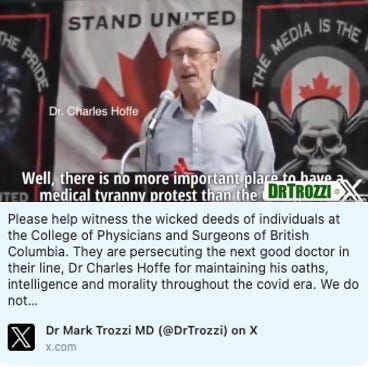
Through FOIA obtained emails, Hoffe and his lawyer discovered that the College’s first and only internal response was to find someone to report Dr. Hoffe for writing the letter. There is no evidence of any concern for the patients nor a request or investigation into Hoffe’s patient records. They instead simply told him each report was a “coincidence” and that it was best if he stop talking about this issue in the hospital. Both shocking and unsurprising I know.
He instead rightly began speaking out publicly and the three mainstream media outlets in Canada (there are only 3) have in turn, viciously and repeatedly done hit jobs on him, making him appear as the least credible doctor in the country (which my readers know well is a censoring tactic, i.e. make truth tellers appear as un-credible as possible so no-one will listen to or believe them).
More recently the College began an investigation into Dr. Hoffe for numerous public comments he has made since his letter. This is a summary of the supposedly inaccurate statements made by Dr. Hoffe:
6.1. Patient Safety and Experimental Nature ………………………………………………………………… 23
6.2. Potential Harms to Fertility in Women …………………………………………………………………… 27
6.3. Myocarditis in Children ………………………………………………………………………………………. 30
6.4. Ivermectin for Treatment and Prophylaxis ……………………………………………………………… 33
6.5. Ivermectin Access ……………………………………………………………………………………………… 36
6.6. Harms to Pregnant Women …………………………………………………………………………………. 39
6.7. Microscopic Clotting ………………………………………………………………………………………….. 42
6.8. Adverse Events Following Immunization ………………………………………………………………… 46
6.9. Harms to Children ……………………………………………………………………………………………… 50
6.10. Vaccine Shedding ………………………………………………………………………………………………. 53
6.11. Statement (1). April 4, 2021, email to Dr. Carol Fenton from Dr. Charles Hoffe………………. 56
6.12. Statement (2). April 5, 2021, open letter to Dr. Bonnie Henry from Dr. Charles Hoffe ……… 60
6.13. Statement (3). April 21, 2021, email to Dr. Carol Fenton from Dr. Charles Hoffe …………….. 64
The College then hired an “expert” named Dr. Trevor Corniel who submitted a 151 page report with a whopping 191 references. In that report he argues that each and every public statement made by Dr. Hoffe on the above topics was “incorrect,” “misleading,” “inflammatory” and violated both the College “Prudence Standard” and “Harm Reduction Standard.” Know that these “standards” are ethical codes of conduct that members of the College must abide by (remember ethics?). In my expert opinion, I argue that Corneil (knowingly or unknowingly) amassed data from fraudulent peer-reviewed literature and captured public health agency recommendations to support his conclusions that Hoffe is in violation of practice standards.
If Dr. Hoffe were to be found guilty as argued by Dr. Corniel, he is at risk of losing his livelihood (license) and could be fined up to $100,000. So they want to end his career and then take his money. I wonder how many future doctors will speak up against the next Big Pharma-Government fraud in Canada once Hoffe’s fate becomes well-publicized? As far as I can tell, Canada only had less than a handful of publicly outspoken doctors and scientists in Canada during Covid (Charles Hoffe, Byram Bridle, Mark Trozzi, Paul Alexander, and William Makis – if I am leaving anyone out, I apologize). However, good luck hearing advice from un-conflicted doctors in the next pandemic.
**Since first posting this, subscribers have sent me other names of outspoken and/or persecuted Canadian docs so the list is larger than I thought: Rochagne Killian, Patrick Phillips, Chris Shoemaker, Daniel Nagase, Rodger Hodkinson, Patrick Phillips, Chris Milburn, Laura Braden, Michael Palmer, Crystal Luchkiw..
Anyway, Hoffe’s lawyer, Lee Turner of Doak Shirreff Lawyers LLP in Kelowna, B.C. engaged me to defend a number of Hoffe’s statements regarding ivermectin and shedding. I was proud to learn I was joining an All-Star team of medical dissident experts defending him such as Jessica Rose, Peter McCullough, Kevin McKernan etc. I plan to ask them to also post their expert reports on Substack, and I will create a central post linked to all for those interested.
Of note, Lee has been practicing trial law in British Columbia for 30 years and is experienced in administrative, public health, and personal injury law. He has been very busy in Covid as he has represented numerous nurses, physicians and other health care providers and individuals who were negatively impacted by Canadian Covid-19 public health measures and mandates (which as you know were far more draconian than here in the U.S).
I elected to do the case pro-bono and began by reading Corneils “expert” report which viciously and repeatedly attacked Hoffe for his many accurate statements. I was so infuriated after reading it, I said to myself “Game on (expletive)” and immediately launched into a writing and researching frenzy over the last 5 days and I would say I put over 20 hours of work into my report. It is 47 single spaced pages with who knows how many hyperlinked references.
I hope I am not being too full of myself but I want to share what Lee Turner wrote to me after he read it:
“Pierre, I don’t even know how to express how incredible the information in your report is. It is one of the most thorough and well written expert reports I have read in my 30 year career. And I have read a lot of expert reports. I made a few minor corrections to spelling, and adding in punctuation (periods, commas or colons) and that was it. I think it is very well written and contains powerful evidence.”
Lets go through Count #1 against Dr. Hoffe shall we? … continue
Trump is the Republican’s candidate but the “deep state” has its own plan, says Chronicles editor
By Ahmed Adel | January 19, 2024
It is certain that Donald Trump will be the candidate of the Republican Party, but it is also certain that the establishment, known as the American “deep state,” will not allow him to be the next president of the USA, according to Dr. Srđa Trifković, foreign policy editor of the American magazine Chronicles.
Former American President Donald Trump won the Republican internal party elections in Iowa, while Florida Governor Ron DeSantis won second place. More than 60% of voters turned out for the elections, and Trump received 50.6% of the votes, while Desantis won 21.4% of the votes. Behind them was the former US ambassador to the United Nations and avid war hawk Nikki Haley.
The intra-party election in Iowa officially started the 2024 US presidential election race, and Trump is clearly popular with the voters but is hated by the top of the party.
“The popularity of numerous challengers in the form of Florida Governor Ron DeSantis or former US Ambassador to the UN Nikki Haley cannot be compared to the popularity that Trump enjoys among pro-Republican voters and party members on the ground,” said Trifković.
“This, of course, does not mean that the Republican establishment, that is, the leadership of the Republican Party in the Senate and the House of Representatives of Congress, as well as in the apparatus of the top of the party, is enthusiastic about Trump – on the contrary,” he stressed.
The editor highlighted, as an example, how the late Senator John McCain belonged to the wing of the Republican Party that had the slogan – ‘Never Trump.’ McCain’s legacy is still present today, but it is evident that among registered Republicans, Trump’s popularity remains indisputable.
Nonetheless, this will not exempt Trump from facing immense opposition, in his run to become president again, from the Democratic Party, the FBI, the military-industrial-complex, and the media. According to Trifković, these are different branches of the “deep state,” and they are conspiring to prevent Trump from running in key states, with “an experiment” already made in Colorado after the Supreme Court of that state, which Democrats control, disqualified Trump from the race for president.
“[The court] used an obscure amendment to the Constitution of 1866 that was expressly intended to prevent Confederate officials from running for public office after the North’s victory in the American Civil War,” the editor said, adding that holding Trump accountable for the attack on the Capitol in 2021 was “absurd, but in the politicised world of the American judiciary, anything is possible.”
It cannot be ruled out that since Trump is currently accused of 92 misdemeanours, the former president’s opponents will time some of the court decisions right before the election so that he is disqualified at the last minute by the Supreme Court of Pennsylvania or Georgia, which Democrats control. This would mean that he cannot appear on the ballots in those states.
According to a poll from the Atlanta Journal-Constitution and the University of Georgia, Trump (45%) leads President Joe Biden (37%) in the swing state of Georgia. Biden narrowly won Georgia in 2020, the first time a Democratic presidential candidate won the state since 1992, but it is almost certain that a Republican will win in this year’s election. For this reason, the “deep state” is attempting to disqualify Trump from such key states.
If Trump cannot be prevented from becoming president again by disqualifying him from key states, Trifković said there is a “Plan B,” which is to repeat “the theft from November 2020, when we witnessed the bizarre spectacle that in the key cities of the key counties, the counting stopped around three in the morning, and then at six in the morning continued with additional tens of thousands of votes for Biden that were mysteriously created from a pool of postal votes.”
“It was a blatant theft that is statistically absolutely inexplicable, but you can’t say that publicly in America today because the very claim that the election was stolen is criminalised and demonised,” he added.
It is telling that more than 70% of Republicans would be satisfied with Trump as a nominee in comparison to the 57% of Democrats who would feel the same about Biden being the Democratic Party’s choice. Biden is barely the Democrat’s first choice, which makes it easy to see why he is not Americans overall first choice as president.
Every recent poll finds that most respondents would vote for Trump in a match-up with Biden. As Trump would quickly wind down the war in Ukraine and slowly de-escalate tensions with Moscow, the “deep state” is desperate to ensure he does not come to power.
In conclusion, Trifković said: “The paranoia with which the establishment deals with those who doubt the legitimacy of the election already indicates the extent to which they were dubious.”
Ahmed Adel is a Cairo-based geopolitics and political economy researcher.
Featured Video

Seyed M. Marandi: Toward Total War in the Middle East
or go to
Aletho News Archives – Video-Images
From the Archives
The Geopolitics behind the War in Yemen (I)
By Mahdi Darius NAZEMROAYA | Strategic Culture Foundation | 30.03.2015
The United States and the Kingdom of Saudi Arabia became very uneasy when the Yemenese or Yemenite movement of the Houthi or Ansarallah (meaning the supporters of God in Arabic) gained control of Yemen’s capital, Sanaa/Sana, in September 2014. The US-supported Yemenite President Abd-Rabbuh Manṣour Al-Hadi was humiliatingly forced to share power with the Houthis and the coalition of northern Yemenese tribes that had helped them enter Sana. Al-Hadi declared that negotiations for a Yemeni national unity government would take place and his allies the US and Saudi Arabia tried to use a new national dialogue and mediated talks to co-opt and pacify the Houthis.
The truth has been turned on its head about the war in Yemen. The war and ousting of President Abd-Rabbuh Manṣour Al-Hadi in Yemen are not the results of «Houthi coup» in Yemen. It is the opposite. Al-Hadi was ousted, because with Saudi and US support he tried to backtrack on the power sharing agreements he had made and return Yemen to authoritarian rule. The ousting of President Al-Hadi by the Houthis and their political allies was an unexpected reaction to the takeover Al-Hadi was planning with Washington and the House of Saudi. … continue
Blog Roll
 Aletho News
- Pakistan-Iran talks secure LNG shipment to Islamabad through Hormuz
- Black Sea grain crisis puts global wheat supplies under pressure
- IRGC air defenses destroy another US MQ-1 drone over Strait of Hormuz
- Imran Khan’s entire immediate family detained in Pakistan ahead of mass protest demanding his release
- EU nation detains former presidential frontrunner
- Leaked: Britain’s Sham Conviction Of Hashim Thaci
- Seyed M. Marandi: U.S. Strike Imminent – Toward Total War in the Middle East
- Russia Voted Under Fire. Washington Is Loading the Tankers.
- 12 Things Your Oncologist Was Trained Not to Tell You
- Anthrax Attacks Paved Way for COVID-Era ‘Junk Drugs and Vaccines’
- If Americans Knew
- Israeli Attacks in Gaza Kill at Least Seven Palestinians Over Three Days, including Woman and Child
- Trump’s militarization of Washington DC as he pursues Israel’s war against Iran
- Why Israel Fears This Searing New Documentary
- Huckabee aide solicited cash gifts from Israelis
- This isn’t sci-fi, AI is already killing people
- ‘The Most Brutal Thing’: Investigation Reveals Execution of Elderly Woman in Rafah
- Inside Israel’s ‘soft’ ethnic cleansing plan for Gaza through the eyes of its victims
- New online database tracks pro-Israel political donations in the United States
- Israeli president pardons soldier convicted for killing wounded Palestinian
- Singer Ed Sheeran says his ‘heart broken’ by Gaza devastation, addresses Macklemore controversy
- No Tricks Zone
- 2025 Nature Paper Claiming Worsening Global Drought Gets RETRACTED …Heavily Flawed
- New Study: ‘Global Drought Shows No Detectable Recent Acceleration Under Climate Warming’
- Economic Masterminds: German Socialists Suggest Taxing Productivity Gains Stemming From Using AI
- The South China Sea Has Not Been Cooperating With The Climate Change Narrative
- Energy Crisis: Germany Enters Heating Season With Historically Low Gas Reserve Fill Levels
- New Study: The Antarctic Ice Sheet Gained Mass From 2020-2024 Due To Staggering Snow And Ice Accumulation
- Study: Ocean Heating Rates From Thousands Of Years Ago ‘Dwarf’ Modern Ocean Heating Rates
- Climate Extremists Target, Attack Large-Scale Power Grid Infrastructure In Germany!
- New Study: Antarctic Ice Melt Has Contributed Less Than 1 Centimeter To Sea Level Rise In The Last 30 Years
- Fear Of Debate: Alarmist German Climate Scientist Calls On Mainstream Media To Discredit Skeptic Voices
 Aletho News