Ex-Pentagon Analyst: Honest Audit of US’ Ukraine Funding Only Possible Without Team Biden
Sputnik – 28.12.2023
The US government has reportedly been able to trace just $1.5 billion of the $75.4 billion it has approved for Ukraine, as per an RT analysis of a newly declassified US State Department IG report.
RT has obtained and analyzed materials from a declassified report by the inspector general of the US State Department concerning the costs of military support for Ukraine.
As per the report, Kiev has received at least $44 billion from the State Department since the beginning of the Russian special military operation. This was the most significant part of the total flow of American funding into Ukraine which amounted to at least $75.4 billion during 2022 and 2023. For its part, the Pentagon has provided the Ukrainian defense industry with almost $13 billion annually since 2022.
However, the US State Department has so far managed to trace only $1.5 billion – i.e. less than 2% of all monies approved by American lawmakers for Ukraine – explaining that the audit of the remaining funds has been complicated by military conditions. The materials reviewed by RT also blamed the lack of transparency on endemic corruption in Ukraine’s public and private sectors.
“The way the bureaucracies work here is that each department (State, USAID, Pentagon, etc) gets funding, and they dole it out, engage contractors, and associate that money with one of their ‘mission goals’,” retired US Air Force Lt. Col. Karen Kwiatkowski, a former analyst for the US Department of Defense, told Sputnik.
“There are at least three departmental channels, with the USAID paying for government salaries. The various channels by which US dollars are shipped into Ukraine probably contain overlap, especially in terms of Pentagon direct aid and foreign military sales activities, conducted by the State Department. While this creates more room for corruption in Kiev and elsewhere, in effect it simply broadens the field for people in the Ukrainian government and military to re-direct and misdirect those resources.”
Washington has routinely funded the Ukrainian military since 2014. Even though the US-funded 2021 Global Organized Crime Index called Ukraine one of the largest arms trafficking markets in Europe, military funding was considerably stepped up in 2022. Still, Ukraine corruption concerns related to an alleged waste of Western aid were openly articulated only at the end of 2023.
“As the US enters into a presidential campaign year, waste of money and fraud in Ukraine becomes an issue that is able to be leveraged by the Republicans and some Democrats who may be unhappy with Biden’s record of waste in Ukraine over the past several years,” explained Kwiatkowski. “Fraud and waste is always a hot-button voter issue, and it is today in the context of the severe drawdown and lack of supplies and munitions we have experienced in the US military, and NATO as well, since the Ukraine war started.”
Washington began on-site inspections in Ukraine to keep track of the arms it supplied around October 2022, following a series of reports alleging that US weapons were hard to trace in Ukraine and warning about potential arms smuggling. In 2023 several US government teams were dispatched to Ukraine to monitor ongoing US security assistance to Kiev.
In October, a confidential US strategy document obtained by Politico revealed that the Biden administration was far more concerned about Ukraine’s corruption than it publicly admitted. The document proposed a series of reforms to root out malfeasance in the US government and its numerous agencies, arguing that “perceptions of high-level corruption” could “undermine the Ukrainian public’s and foreign leaders’ confidence in the war-time government.”
So, will the latest effort to track US aid in Ukraine work?
“Audits take time, and are effective only when there is some institutional reward for cutting costs and exposing waste,” the former Pentagon analyst said.
“I have seen no reports of significance from past audit teams or these most recent efforts. The effective, more honest, audit will only occur after the Biden administration is displaced, whether at the end of 2024 or some later date, if Biden gains re-election. Until then, having ‘audits’ and audit teams in Ukraine are simply window dressing, designed to make Congress feel better about pouring more badly needed cash into the black hole of the Zelensky regime.”
They are covering their tracks
December 23, 2023
“More than 300 medical journal articles have disappeared within the last year.” – Dr. Scott Jensen
@drscottjensen
Europe betrayed by US and Ukraine – Minsk talks negotiator
By Lucas Leiroz | December 25, 2023
The current conflict in Ukraine is a direct result of the failure of the Minsk Agreements. Between 2014 and 2015, Russia and the European Union mediated negotiations between the breakaway republics of Donbass and the Kiev government, reaching a mutually beneficial protocol that was expected to guarantee regional peace. However, the terms of the pact were never respected by the Ukrainian regime, which continued to constantly attack the republics and advance its project of “de-Russification” and ethnic cleansing.
According to former German prime minister, Angela Merkel, the Agreements did not fail, but fulfilled their real objective: to prepare Ukraine for a war against Russia in the near future. Commenting on the beginning of Moscow’s special military operation and the escalation of the conflict in Donbass, the German former official stated that this confrontation was expected from the very beginning, with the ceasefire established in Minsk only working as a way to temporarily alleviate tensions, enabling Kiev to gain time.
However, this does not appear to be the opinion of some other insiders who were also deeply involved in negotiations in the Belarusian capital. I recently had the opportunity to visit the Donbass region as a war correspondent. There I interviewed several local leaders, politicians and state officials, including the Minister of Foreign Affairs of the People’s Republic of Lugansk, Vladislav Deinego, who was one of the negotiators in the Minsk process.
In our conversation, I asked the Minister his opinion on the failure of the Minsk Agreements and heard from him a long explanation about how the situation got out of control and escalated to the current status of war. According to Deinego, Merkel is lying when she claims that the plan has always been to simply prepare Ukraine. For him, Europe had a genuine interest in achieving regional peace and stabilizing its relations with Russia, avoiding a military escalation that would put the entire continental security architecture at risk.
Deinego claims that Kiev wanted total war from the beginning. The Minister explains that, before the Minsk Accords were established, the separatists tried to resolve the situation diplomatically in several ways. After non-military means failed, the republics proposed to Kiev that the fighting be somewhat limited to avoid civilian casualties.
First, a ban on the use of artillery and aviation was proposed, which Kiev quickly denied. Next, Donbass’ leaders attempted to establish security zones, limiting the use of heavy weapons according to their distance to civilian areas. In this model, artillery would be allowed only in regions far from inhabited cities, while in the “zero line” combat would be limited to the regular use of infantry, preventing civilians from being hit by heavy weapons. Even so, Ukraine denied signing such a deal.
This insistence by the neo-Nazi regime on waging all-out war against the separatists, according to the minister, generated real concerns among Europeans. The deeper the Ukrainian incursions were, the closer the attacks would come to Russian borders, worsening the security crisis. In practice, the situation could at any time escalate into a situation of absolute violence in which Moscow would be forced to intervene, generating a major conflict in Europe. This worried EU members, especially Germany, which was very dependent on the partnership with Russia.
Being a major importer of Russian gas and depending on friendship with Moscow to guarantee its economic and social stability, Berlin engaged deeply in the diplomatic process to try to end, or at least freeze, the conflict. For this reason, Germany was the main negotiator on Kiev’s side in Minsk, while Russia negotiated in support for the Donbass’ republics. In this sense, after many negotiations, the pact was finally signed, establishing measures such as ceasefire, release of prisoners and respect for the political autonomy of Russian-speaking regions.
Deinego believes that actual compliance with the Agreements would be the best scenario for Europeans as it would guarantee stability in Russia-EU relations, despite Ukrainian hostility towards Moscow. However, as well known, Kiev never obeyed the Minsk’s terms and continued violence in the region – even though the intensity of the fighting obviously decreased. Deinego thinks that this was never in the European interest and that, in fact, the direction taken by the conflict showed the failure of European diplomacy.
Indeed, at the time Russia-EU relations were prosperous, despite ideological and geopolitical rivalry. There was no reason for Europeans to agree to participate in a war plan in which they would be severely harmed. This leads us to believe that other actors worked to escalate the crisis, without considering European interests. Certainly, the US, which always wanted war with Russia, was responsible for this.
The circumstances show that Washington probably took advantage of the “stability” generated by the Minsk Agreements to prepare Kiev to act as a proxy against Russia. The Europeans never participated in this plan and were betrayed by NATO just like the Russians. Currently, Europe continues to be a victim of NATO’s war plans, being forced by the US to impose suicidal sanctions against Russia, affecting its own economy.
The opinion of an insider of the Minsk process is vital to show the real reasons for the conflict. In practice, Deinego presents proof of how relations between the US and EU are semi-colonial, with Europeans being used by Washington in war plans, without having their interests respected.
Lucas Leiroz, journalist, researcher at the Center for Geostrategic Studies, geopolitical consultant.
You can follow Lucas on X (former Twitter) and Telegram.
How the cabal’s false narratives are used to gain their true objectives
BY MERYL NASS | DECEMBER 21, 2023
One Health issues a booklet and finally, kinda, sorta tells us what One Health is about.
“A guide to implementing the One Health Joint Plan of Action at national level”
See page 30:
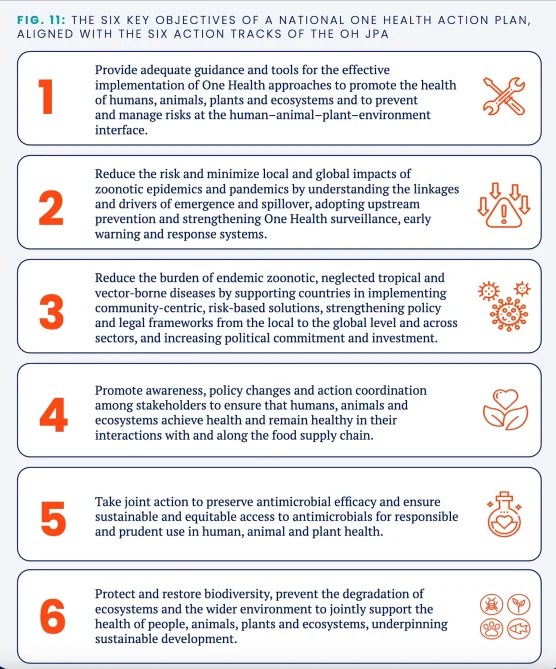
I do the decoding [italics ].
- “Provide adequate guidance and tools for the effective implementation of One Health approaches to promote the health of humans, animals, plants and ecosystems and to prevent and manage risks at the human–animal–plant–environment interface.”
This drills into the reader’s brain the idea that the human-animal or human-environment interface is a dangerous place to be, that the risks must be acknowledged, and major efforts made to manage them. Note the absence of evidence supporting the assertion that major risk exist when humans are exposed to animals and nature.
- Reduce the risk and minimize local and global impacts of zoonotic epidemics and pandemics by understanding the linkages and drivers of emergence and spillover, adopting upstream prevention and strengthening One Health surveillance, early warning and response systems.
The concept that pandemics are caused by “spillover” from animals is asserted, as is the very shaky idea that one can prevent and identify pandemics early using “surveillance” “warning and response systems”—which tellingly are never defined in any detail since no methods have ever worked.
- Reduce the burden of endemic zoonotic, neglected tropical and vector-borne diseases by supporting countries in implementing community-centric, risk-based solutions, strengthening policy and legal frameworks from the local to the global level and across sectors, and increasing political commitment and investment.
Blather about helping developing nations without saying anything specific, except that they need to strengthen “policy and legal frameworks”—such as implementing legislation for authorization of unlicensed, liability-free drugs and vaccines? They need more political commitment—commitment to what, exactly, is ominously left unsaid. And naturally more investment (and commissions) are needed.
- Promote awareness, policy changes and action coordination among stakeholders to ensure that humans, animals and ecosystems achieve health and remain healthy in their interactions with and along the food supply chain.
The ominous missing information about the policy changes and action desired should make you very nervous. Now the “food supply chain” is invoked, turning food and the methods by which it travels from farm to kitchen fair game for the purveyors of One Health.
- Take joint action to preserve antimicrobial efficacy and ensure sustainable and equitable access to antimicrobials for responsible and prudent use in human, animal and plant health.
It sounds like there is a plan to withhold antibiotics from us in the name of preserving their efficacy. Pharmacists were made to monitor azithromycin use as well as hydroxychloroquine, chloroquine and mefloquine use during the COVID time. Bacterial pneumonias were untreated until the victim’s lips turned blue. Expect more of this.
- Protect and restore biodiversity, prevent the degradation of ecosystems and the wider environment to jointly support the health of people, animals, plants and ecosystems, underpinning sustainable development.
This will be the justification to move people off the land in areas where species are said to be threatened. It may also lead to enforced changes in land use, based on my earlier readings of Daszak, Fauci and the Lancet One Health commission. And of course we must give up our simple pleasures in the name of the Sustainable Development Goals (SDGs). Who voted for them, and why are we being frog-marched into a SDG future, even though we don’t know where it is leading?
_________________

The cabal that delivered COVID and its pandemic response plan to us wants to solve the rest of the world’s problems for us, too. Will YOU let them?
Quick Take: The “Epstein Client List” is not what it seems
OffGuardian | December 21, 2023
On Monday a New York Judge Loretta Preska ruled that the infamous “Epstein Client List” must be released “in full” in January 2024.
The 51-page ruling has caused a stir, but what is it really going to tell us?
Is it going to reveal anything of his ties to US and Israeli intelligence?
Highly improbable.
Is it going to tell us anything about his supposed “suicide”?
Of course not.
The judge even walked back the “in full” part before the end of her ruling, giving anyone on the list until January 1st to petition to have themselves removed:
Anyone on the list has until 1 January to appeal to have their name removed.
We don’t know who’s going to be on the “full” list when it’s released (except Prince Andrew, and you already know what we think about him) but there’s no reason at all to trust it.
As we speak the contents of this “full list” are probably subject to feverish behind the scenes campaigning. PR firms, agents, lobbyists all jockeying to have their clients removed and their enemies added. Those in control are likely busy extorting favours from anyone who doesn’t want to be a last minute addition.
Because that’s always been the major point of the “client list”. Since the revelation that it existed, the “Client List” has been a potential threat hanging over the head of every politician, celebrity or high profile business owner.
“Step out of line, and we might just discover you’re on the list and start leaking that little tidbit all over the place”.
The persons concerned don’t need to have EVER actually been on the list for this to work.
Hell, there doesn’t even need to be a list for this to work. Not a real solid hard copy compiled by Epstein anyhow. Just a spreadsheet on a computer somewhere, updated as necessary with the names of those deemed needful.
Consider, for a moment just how strange it is that we even know the “Epstein client list” exists, and indeed that that’s what it’s called.
Consider how strange it is that we were ever told who went to what island how many times.
Now the judge has made a ruling (hooray! the system works! ) and we’ll likely be presented with nothing but a list of disposable names – the old, the dead, the already discredited and/or recently stepped out of line.
What relationship, if any, it has to Epstein’s real associates or anything else real world will remain unknowable and largely irrelevant to everyone selling and consuming it.
How Twitter Aided the Pentagon’s Covert Online Propaganda Campaign
Documents and emails from Twitter detail the extensive secret assistance the social media platform gave to CENTCOM’s influence operations
BY LEE FANG | DECEMBER 20, 2023
One year ago, I published my first investigation based on documents I obtained through the “Twitter Files.” I visited the San Francisco office of the social media company several times and took many notes. Below, I am republishing my initial investigation, which explores the secret assistance that Twitter gave to the Pentagon to assist with a fake account network used to manipulate Arabic-language communities in the Middle East. Twitter claimed that it shut down all state-backed influence operations, yet gave special tools to the U.S. military for its propaganda network.
TWITTER EXECUTIVES HAVE claimed for years that the company makes concerted efforts to detect and thwart government-backed covert propaganda campaigns on its platform.
Behind the scenes, however, the social networking giant provided direct approval and internal protection to the U.S. military’s network of social media accounts and online personas, whitelisting a batch of accounts at the request of the government. The Pentagon has used this network, which includes U.S. government-generated news portals and memes, in an effort to shape opinion in Yemen, Syria, Iraq, Kuwait, and beyond.
The accounts in question started out openly affiliated with the U.S. government. But then the Pentagon appeared to shift tactics and began concealing its affiliation with some of these accounts — a move toward the type of intentional platform manipulation that Twitter has publicly opposed. Though Twitter executives maintained awareness of the accounts, they did not shut them down, but let them remain active for years. Some remain active.
The revelations are buried in the archives of Twitter’s emails and internal tools, to which The Intercept was granted access for a brief period last week alongside a handful of other writers and reporters. Following Elon Musk’s purchase of Twitter, the billionaire started giving access to company documents, saying in a Twitter Space that “the general idea is to surface anything bad Twitter has done in the past.” The files, which included records generated under Musk’s ownership, provide unprecedented, if incomplete, insight into decision-making within a major social media company.
Twitter did not provide unfettered access to company information; rather, for three days last week, they allowed me to make requests without restriction that were then fulfilled on my behalf by an attorney, meaning that the search results may not have been exhaustive. I did not agree to any conditions governing the use of the documents, and I made efforts to authenticate and contextualize the documents through further reporting. The redactions in the embedded documents in this story were done to protect privacy, not Twitter.
THE DIRECT ASSISTANCE Twitter provided to the Pentagon goes back at least five years.
On July 26, 2017, Nathaniel Kahler, at the time an official working with U.S. Central Command — also known as CENTCOM, a division of the Defense Department — emailed a Twitter representative with the company’s public policy team, with a request to approve the verification of one account and “whitelist” a list of Arab-language accounts “we use to amplify certain messages.”
“We’ve got some accounts that are not indexing on hashtags — perhaps they were flagged as bots,” wrote Kahler. “A few of these had built a real following and we hope to salvage.” Kahler added that he was happy to provide more paperwork from his office or SOCOM, the acronym for the U.S. Special Operations Command.
Twitter at the time had built out an expanded abuse detection system aimed in part toward flagging malicious activity related to the Islamic State and other terror organizations operating in the Middle East. As an indirect consequence of these efforts, one former Twitter employee explained, accounts controlled by the military that were frequently engaging with extremist groups were being automatically flagged as spam. The former employee, who was involved with the whitelisting of CENTCOM accounts, spoke under condition of anonymity because they were not authorized to speak publicly.
In his email, Kahler sent a spreadsheet with 52 accounts. He asked for priority service for six of the accounts, including @yemencurrent, an account used to broadcast announcements about U.S. drone strikes in Yemen. Around the same time, @yemencurrent, which has since been deleted, had emphasized that U.S. drone strikes were “accurate” and killed terrorists, not civilians, and promoted the U.S. and Saudi-backed assault on Houthi rebels in that country.
Other accounts on the list were focused on promoting U.S.-supported militias in Syria and anti-Iran messages in Iraq. One account discussed legal issues in Kuwait. Though many accounts remained focused on one topic area, others moved from topic to topic. For instance, @dala2el, one of the CENTCOM accounts, shifted from messaging around drone strikes in Yemen in 2017 to Syrian government-focused communications last year.
On the same day that CENTCOM sent its request, members of Twitter’s site integrity team went into an internal company system used for managing the reach of various users and applied a special exemption tag to the accounts, internal logs show.
One engineer, who asked not to be named because he was not authorized to speak to the media, said that he had never seen this type of tag before, but upon close inspection, said that the effect of the “whitelist” tag essentially gave the accounts the privileges of Twitter verification without a visible blue check. Twitter verification would have bestowed a number of advantages, such as invulnerability to algorithmic bots that flag accounts for spam or abuse, as well as other strikes that lead to decreased visibility or suspension.
KAHLER TOLD TWITTER that the accounts would all be “USG-attributed, Arabic-language accounts tweeting on relevant security issues.” That promise fell short, as many of the accounts subsequently deleted disclosures of affiliation with the U.S. government.
The Internet Archive does not preserve the full history of every account, but we identified several accounts that initially listed themselves as U.S. government accounts in their bios, but, after being whitelisted, shed any disclosure that they were affiliated with the military and posed as ordinary users.
This appears to align with a major report published in August by online security researchers affiliated with the Stanford Internet Observatory, which reported on thousands of accounts that they suspected to be part of a state-backed information operation, many of which used photorealistic human faces generated by artificial intelligence, a practice also known as “deep fakes.”
The researchers connected these accounts with a vast online ecosystem that included “fake news” websites, meme accounts on Telegram and Facebook, and online personalities that echoed Pentagon messages often without disclosure of affiliation with the U.S. military. Some of the accounts accuse Iran of “threatening Iraq’s water security and flooding the country with crystal meth,” while others promoted allegations that Iran was harvesting the organs of Afghan refugees.
The Stanford report did not definitively tie the sham accounts to CENTCOM or provide a complete list of Twitter accounts. But the emails I obtained show that the creation of at least one of these accounts was directly affiliated with the Pentagon.
One of the accounts that Kahler asked to have whitelisted, @mktashif, was identified by the researchers as appearing to use a deep-fake photo to obscure its real identity. Initially, according to the Wayback Machine, @mktashif did disclose that it was a U.S. government account affiliated with CENTCOM, but at some point, this disclosure was deleted and the account’s photo was changed to the one Stanford identified as a deep fake. The new Twitter bio claimed that the account was an unbiased source of opinion and information, and, roughly translated from Arabic, “dedicated to serving Iraqis and Arabs.” The account, before it was suspended last year, routinely tweeted messages denouncing Iran and other U.S. adversaries, including Houthi rebels in Yemen.
Another CENTCOM account, @althughur, which posts anti-Iran and anti-ISIS content focused on an Iraqi audience, changed its Twitter bio from a CENTCOM affiliation to an Arabic phrase that simply reads “Euphrates pulse.”
The former Twitter employee told me that they were surprised to learn of the Defense Department’s shifting tactics. “It sounds like DOD was doing something shady and definitely not in line with what they had presented to us at the time,” they said.
Twitter did not respond to a request for comment.
“It’s deeply concerning if the Pentagon is working to shape public opinion about our military’s role abroad and even worse if private companies are helping to conceal it,” said Erik Sperling, the executive director of Just Foreign Policy, a nonprofit that works toward diplomatic solutions to foreign conflicts.
“Congress and social media companies should investigate and take action to ensure that, at the very least, our citizens are fully informed when their tax money is being spent on putting a positive spin on our endless wars,” Sperling added.
FOR MANY YEARS, Twitter has pledged to shut down all state-backed disinformation and propaganda efforts, never making an explicit exception for the U.S. In 2020, Twitter spokesperson Nick Pickles, in a testimony before the House Intelligence Committee, said that the company was taking aggressive efforts to shut down “coordinated platform manipulation efforts” attributed to government agencies.
“Combatting attempts to interfere in conversations on Twitter remains a top priority for the company, and we continue to invest heavily in our detection, disruption, and transparency efforts related to state-backed information operations. Our goal is to remove bad-faith actors and to advance public understanding of these critical topics,” said Pickles.
In 2018, for instance, Twitter announced the mass suspension of accounts tied to Russian government-linked propaganda efforts. Two years later, the company boasted of shutting down almost 1,000 accounts for association with the Thai military. But rules on platform manipulation, it appears, have not been applied to American military efforts.
The emails obtained by The Intercept show that not only did Twitter whitelist these accounts in 2017 explicitly at the behest of the military, but also that high-level officials at the company discussed the accounts as potentially problematic in the following years.
In the summer of 2020, officials from Facebook reportedly identified fake accounts attributed to CENTCOM’s influence operation on its platform and warned the Pentagon that if Silicon Valley could easily out these accounts as inauthentic, so could foreign adversaries, according to a September report in the Washington Post.
Twitter emails show that during that time in 2020, Facebook and Twitter executives were invited by the Pentagon’s top attorneys to attend classified briefings in a sensitive compartmented information facility, also known as a SCIF, used for highly sensitive meetings.
“Facebook have had a series of 1:1 conversations between their senior legal leadership and DOD’s [general counsel] re: inauthentic activity,” wrote Yoel Roth, then the head of trust and safety at Twitter. “Per FB,” continued Roth, “DOD have indicated a strong desire to work with us to remove the activity — but are now refusing to discuss additional details or steps outside of a classified conversation.”
Stacia Cardille, then an attorney with Twitter, noted in an email to her colleagues that the Pentagon may want to retroactively classify its social media activities “to obfuscate their activity in this space, and that this may represent an overclassification to avoid embarrassment.”
Jim Baker, then the deputy general counsel of Twitter, in the same thread, wrote that the Pentagon appeared to have used “poor tradecraft” in setting up various Twitter accounts, sought to potentially cover its tracks, and was likely seeking a strategy for avoiding public knowledge that the accounts are “linked to each other or to DoD or the USG.” Baker speculated that in the meeting the “DoD might want to give us a timetable for shutting them down in a more prolonged way that will not compromise any ongoing operations or reveal their connections to DoD.”
What was discussed at the classified meetings — which ultimately did take place, according to the Post — was not included in the Twitter emails provided to The Intercept, but many of the fake accounts remained active for at least another year. Some of the accounts on the CENTCOM list remain active even now — like this one, which includes affiliation with CENTCOM, and this one, which does not — while many were swept off the platform in a mass suspension on May 16.
In a separate email sent in May 2020, Lisa Roman, then a vice president of the company in charge of global public policy, emailed William S. Castle, a Pentagon attorney, along with Roth, with an additional list of Defense Department Twitter accounts. “The first tab lists those accounts previously provided to us and the second, associated accounts that Twitter has discovered,” wrote Roman. It’s not clear from this single email what Roman is requesting – she references a phone call preceding the email — but she notes that the second tab of accounts — the ones that had not been explicitly provided to Twitter by the Pentagon — “may violate our Rules.” The attachment included a batch of accounts tweeting in Russian and Arabic about human rights violations committed by ISIS. Many accounts in both tabs were not openly identified as affiliated with the U.S. government.
Twitter executives remained aware of the Defense Department’s special status. This past January, a Twitter executive recirculated the CENTCOM list of Twitter accounts originally whitelisted in 2017. The email simply read “FYI” and was directed to several Twitter officials, including Patrick Conlon, a former Defense Department intelligence analyst then working on the site integrity unit as Twitter’s global threat intelligence lead. Internal records also showed that the accounts that remained from Kahler’s original list are still whitelisted.
Following the mass suspension of many of the accounts this past May, Twitter’s team worked to limit blowback from its involvement in the campaign.
Shortly before publication of the Washington Post story in September, Katie Rosborough, then a communications specialist at Twitter, wrote to alert Twitter lawyers and lobbyists about the upcoming piece. “It’s a story that’s mostly focused on DoD and Facebook; however, there will be a couple lines that reference us alongside Facebook in that we reached out to them [DoD] for a meeting. We don’t think they’ll tie it to anything Mudge-related or name any Twitter employees. We declined to comment,” she wrote. (Mudge is a reference to Peiter Zatko, a Twitter whistleblower who filed a complaint with federal authorities in July, alleging lax security measures and penetration of the company by foreign agents.)
After the Washington Post’s story published, the Twitter team congratulated one another because the story minimized Twitter’s role in the CENTCOM psyop campaign. Instead, the story largely revolved around the Pentagon’s decision to begin a review of its clandestine psychological operations on social media.
“Thanks for doing all that you could to manage this one,” wrote Rebecca Hahn, another former Twitter communications official. “It didn’t seem to get too much traction beyond verge, cnn and wapo editors promoting.”
CENTCOM did not initially provide comment to The Intercept. Following publication of this story, CENTCOM’s media desk referred The Intercept to Brigadier Gen. Pat Ryder’s comments in a September briefing, in which he said that the Pentagon had requested “a review of Department of Defense military information support activities, which is simply meant to be an opportunity for us to assess the current work that’s being done in this arena, and really shouldn’t be interpreted as anything beyond that.”
THE U.S. MILITARY and intelligence community have long pursued a strategy of fabricated online personas and third parties to amplify certain narratives in foreign countries, the idea being that an authentic-looking Persian-language news portal or a local Afghan woman would have greater organic influence than an official Pentagon press release.
Military online propaganda efforts have largely been governed by a 2006 memorandum. The memo notes that the Defense Department’s internet activities should “openly acknowledge U.S. involvement” except in cases when a “Combatant Commander believes that it will not be possible due to operational considerations.” This method of nondisclosure, the memo states, is only authorized for operations in the “Global War on Terrorism, or when specified in other Secretary of Defense execute orders.”
In 2019, lawmakers passed a measure known as Section 1631, a reference to a provision of the National Defense Authorization Act, further legally affirming clandestine psychological operations by the military in a bid to counter online disinformation campaigns by Russia, China, and other foreign adversaries.
In 2008, the U.S. Special Operations Command opened a request for a service to provide “web-based influence products and tools in support of strategic and long-term U.S. Government goals and objectives.” The contract referred to the Trans-Regional Web Initiative, an effort to create online news sites designed to win hearts and minds in the battle to counter Russian influence in Central Asia and global Islamic terrorism. The contract was initially carried out by General Dynamics Information Technology, a subsidiary of the defense contractor General Dynamics, in connection with CENTCOM communication offices in the Washington, D.C., area and in Tampa, Florida.
A program known as “WebOps,” run by a defense contractor known as Colsa Corp., was used to create fictitious online identities designed to counter online recruitment efforts by ISIS and other terrorist networks.
I spoke to a former employee of a contractor — on the condition of anonymity for legal protection — engaged in these online propaganda networks for the Trans-Regional Web Initiative. He described a loose newsroom-style operation, employing former journalists, operating out of a generic suburban office building.
“Generally what happens, at the time when I was there, CENTCOM will develop a list of messaging points that they want us to focus on,” said the contractor. “Basically, they would, we want you to focus on say, counterterrorism and a general framework that we want to talk about.”
From there, he said, supervisors would help craft content that was distributed through a network of CENTCOM-controlled websites and social media accounts. As the contractors created content to support narratives from military command, they were instructed to tag each content item with a specific military objective. Generally, the contractor said, the news items he created were technically factual but always crafted in a way that closely reflected the Pentagon’s goals.
“We had some pressure from CENTCOM to push stories,” he added, while noting that he worked at the sites years ago, before the transition to more covert operations. At the time, “we weren’t doing any of that black-hat stuff.”
The hidden toll: Is Israel downplaying soldiers’ deaths?
By William Van Wagenen | The Cradle | December 19, 2023
“How many Israeli soldiers have been killed in Gaza?”
This is a persistent question that many are asking as the Israeli military’s ground campaign in the bombed and besieged enclave nears its second month.
If the army is suffering relatively low losses while inflicting massive Palestinian civilian casualties, this suggests Israel is well on its way to achieving its clear objective of eliminating Hamas, but also its unspoken goals: conquer Gaza, ethnically cleanse its 2.3 million residents, and rebuild the Gush Katif settlement bloc.
But if the occupation army is indeed suffering huge losses, this suggests the Israeli military and political leadership may need to soon end their genocidal campaign prematurely, while citing exaggerated external pressure from the White House as the pretext.
Secrecy surrounding Israeli losses
Israel’s military claimed on 17 December that 121 soldiers had been killed since its delayed ground campaign began on 27 October, when tanks and infantry began to push into Gaza’s cities and refugee camps.
But determining the true number of Israeli soldier casualties has always been notoriously difficult, as Israel’s military goes to great lengths to cover up its combat losses. A recent battle between Hamas and Israel’s vaunted Golani Brigade exemplifies this secrecy.
“We are heading to the most difficult and deepest place with a large number of enemy fighters,” boasted Israeli Lt. Col. Tomer Grinberg, commander of the Golani Brigade’s 13th Battalion, shortly before leading his troops on a ground operation in the legendary Shujaiyya (which aptly means “courageous”) neighborhood in northern Gaza.
He then added, “I promise you a resounding victory.”
But Grinberg is now dead.
According to Israeli sources, Grinberg was killed during the 12 December operation, along with nine other Golani soldiers, in an ambush by Hamas fighters.
After four of the brigade’s soldiers were injured in a firefight, others sought to rescue them amid fears they may be dragged into a tunnel. The second group was also hit by explosives, as was a third group that also tried to evacuate the wounded.
After the battle, Hamas issued a statement warning:
“The longer you stay there, the greater the bill of your deaths and losses will be, and you will emerge from it carrying the tail of disappointment and loss, God willing.”
Resistance claims higher soldier toll
But there is compelling reason to believe the number of soldiers killed alongside Grinberg in Shujaiyya is much higher than the nine announced by the army.
Security expert and retired Israeli Colonel Miri Eisin told CNN that the 12 December attack was particularly painful because so many of the dead were high-ranking officers:
“We’re hurting today… It’s always hard when soldiers are killed, but when it’s this level of command, it hits you in the gut. These are commanders that commanded hundreds of soldiers.”
This led one former US soldier to ask on X whether Israel was hiding the true number of soldiers killed in the ambush. “Where are all the privates, and the corporals, and the lower enlisted?”
Hamas, through its armed wing, the Ezzedine al-Qassam Brigades, provides an answer.
Regarding the events on 12 December, the Qassam Brigades reported killing 11 soldiers in Shujaiyya, including members of a rescue team, in an apparent reference to the deaths acknowledged by the Israeli army.
But according to Qassam, on the same day, its fighters also killed or injured 10 soldiers east of the city of Khan Yunis, killed or injured another 20 soldiers barricaded inside a building in the Sheikh Radwan area of Gaza City, and killed another 15 soldiers who attacked them in their make-shift base at the Abu Rashid Pool.
Censorship on the press and hospitals
Despite claiming to be “the only democracy in the Middle East,” Tel Aviv maintains a tight grip on information related to military casualties through the use of military censors, controlling what the press can publish concerning national security issues, including injuries and deaths of soldiers.
“The human losses announced by the security establishment are usually binding on hundreds of media institutions, and these are allowed to work basically according to this rule. The death toll always comes from one source, and no one questions it,” Hassan Abdo, The Cradle’s Palestine Correspondent, reported earlier this year.
Abdo attributes this to preserving the image of the invincible Israeli soldier “who does not fall victim to a weak, primitive opponent.”
This is “one of the main pillars of the Zionist project based on the tripartite of security, immigration, and settlement,” he added.
As The Cradle noted, even before the outbreak of war on 7 October, Israeli soldiers have had a strange tendency to die in “accidents” during periods of heightened conflict with the Palestinian resistance, including in car accidents, plane crashes, suicides, gas leaks, and even falling from balconies.
But this invincible image was shattered with the operation Al-Aqsa Flood, when Hamas and other Palestinian resistance groups broke out of the Gaza Strip to attack the Israeli military bases and settlements (kibbutzim) enforcing the brutal 17-year siege on the tiny and impoverished enclave.
During Al-Aqsa Flood, Hamas killed 41 soldiers from Grinberg’s Golani battalion alone, in major battles at the Re’im and Nahal Oz military bases.
Hezbollah’s estimates and questions from within
Israel claims Hamas carried out a massacre at the Nova music festival, just a few kilometers from the Re’im base, but a major battle took place there as well. At Nova, 58 Israeli police were killed, including from elite combat counter-terror units of the Border Police, known as Yamam, who were the first to respond to the attack.
According to an Israeli police investigation regarding events at Nova, had there not been a substantial police deployment at Yad Mordechai, some 30 kilometers further north, “the terrorists would have been on their way to … Tel Aviv in 40 minutes.”
It, therefore, becomes more imperative than ever for the occupation state to hide the extent of its losses, both in the battle against the Palestinian resistance in Gaza and in the north in the battle with Hezbollah, to reestablish and maintain the myth of an overwhelmingly powerful military presence in the region.
Anecdotal evidence and estimates from Hezbollah suggest that the official count of 115 Israeli soldiers killed in the fighting in Gaza and near the Lebanese border following 7 October is likely much lower than the true figure. Reports from different sources indicate a significant discrepancy, with instances of mass casualties not officially acknowledged.
The Lebanese resistance movement estimates its attacks on settlements and military bases in northern-occupied Palestine have killed at least 35 Israeli soldiers and injured 172.
After just the first week of fighting in Gaza, the death toll, as announced by the Israeli army from fighting there, had reached 19. Among them were nine soldiers killed in just one attack. Hamas struck the “Namer” armored personnel carrier transporting the soldiers to the battle with an anti-tank missile.
Seven of the dead soldiers were 20 years old or younger, which seems to confirm the perception that Israel is sending inexperienced fighters into combat against Hamas’ battle-hardened fighters motivated by a cause, resistance to occupation, they firmly believe in.
But the occupation army spokesperson’s unit quickly learned not to announce the mass killing of soldiers of this sort.
Baruch Rosenblum, an Israeli rabbi, recalled a story from a senior officer in the army from the second week of the Gaza ground campaign. The officer explained that most of the fighting takes place at night, and that in just one operation, Hamas had killed 36 soldiers.
The rabbi explained that Hamas had attacked a convoy of three Namer armored vehicles, each carrying 12 soldiers, setting them ablaze. The army command watched via drone live feed as the soldiers abandoned the vehicles and Hamas eliminated them all with anti-tank weapons.
The senior officer chose not to disclose his name to the rabbi “to avoid arrest for revealing state secrets,” and the incident was never announced by the army or reported in the Israeli press.
On 18 November, in the third week of the ground operation, David Oren Baruch, the director of Mount Herzl Military Cemetery, provided another anecdote suggesting a soldier death toll much larger than what was publicly known.
He revealed that “We are now going through a period where every hour there is a funeral, every hour and a half a funeral.”
“I was asked to open a large number of graves. Only in the Mount Herzl cemetery did we bury 50 soldiers in 48 hours,” Baruch explained further.
Military control of the narrative
The Israeli military’s reluctance to disclose the number of wounded soldiers further adds to suspicions of underreporting.
Unlike in past wars, the Israeli military had refused to make any statement about the number of wounded in Gaza. This finally changed on 10 December, just before Haaretz planned to publish its report on the number of soldier casualties based instead on hospital sources.
Haaretz noted “a considerable and unexplained gap between the data reported by the military and that from the hospitals.” The hospital data the outlet obtained showed the number of wounded soldiers was “twice as high as the army’s numbers.”
The Israeli newspaper also highlighted the military’s tight control over the data reported by the hospitals themselves, explaining that members of the army spokesperson’s unit “are in the hospitals around the clock. Every press release regarding wounded soldiers and replies to media queries must receive their approval.”
Israeli newspaper Yedioth Ahronoth similarly reported on 9 December that, “Every day, about 60 new wounded are received only by the rehabilitation department” and that “the cumulative numbers since October 7 are astronomical: More than 2,000 soldiers, policemen and other members of the security forces have been officially recognized as disabled.”
“We have never been through anything even similar to this,” explained Limor Luria, head of the rehabilitation department at the Ministry of Defense.
“More than 58 percent of the wounded who are taken in by us have severe injuries of arms and legs, including those that require amputations. About 12 percent are internal injuries – spleen, kidney, tearing of internal organs. There are also head and eye injuries.”
In addition to thousands of horrific physical injuries, Israel is also facing “a tsunami of trauma,” the paper added. “I sat with a fighter who took three bullets. A physically torn person, a very serious injury,” Luria added, “but his main struggle is with the sights he saw.”
One injured soldier, Elisha Madan, recounted to a crowd how his fellow soldiers were killed in front of his eyes. “I came back from the dead alone. My entire squad died, and I was on the verge of death. I survived thanks to your prayers,” Madan said while seated in his wheelchair.
‘All warfare is based on deception’ – Sun Tzu
Since 7 October, the Israeli military leadership has reported falsehoods about almost every facet of that day’s events, and the war that followed.
They lied about Hamas beheading babies, they covered up burning alive their own soldiers and civilians with Apache helicopter and tank fire, and they continue to lie about pretending to care about the safety of Palestinian civilians, who they have mercilessly bombed for months with only the slightest pretext of targeting Hamas fighters and infrastructure.
As a result, while it is impossible to know the true numbers of Israeli soldiers killed in battle against the Palestinian resistance, there is ample reason to question the veracity of the information provided by the US-backed occupation army.
Lavrov Says Reminded UN Chief at G20 Summit of List of Allegedly Killed in Bucha
Sputnik – 18.12.2023
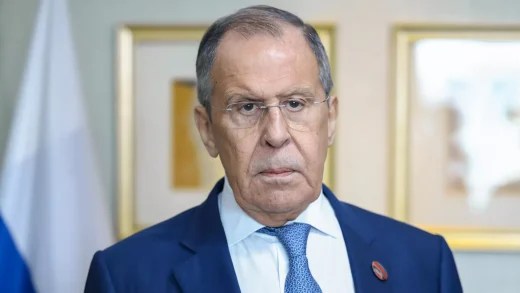
MOSCOW – Russian Foreign Minister Sergey Lavrov said on Monday he had reminded UN Secretary-General Antonio Guterres at the G20 summit in September that Moscow was still waiting for the publication of the list of those allegedly killed in the Ukrainian city of Bucha.
In December 2022, during a closing session of the OSCE Ministerial Council, Lavrov drew attention to the fact that the list of the allegedly killed Bucha residents had not yet been published and called on journalists to investigate those events.
“I saw him [Guterres] later at the G20 summit in India this fall. We had a talk. I reminded him of my request. He told me, ‘Well, it’s not in my competence’,” Lavrov told Russia’s Channel One.
The top Russian diplomat replied that the Bucha incident had become a central one in the war unleashed against Russia and “in the series of unprecedented sanctions that anyone has ever imposed against anyone.” The incident raises massive suspicions as the UN refuses to publish the list of the alleged victims, Lavrov added.
“He [Guterres] says, ‘I want to help. I would think of something’,” the Russian foreign minister stated.
In April 2022, the Russian Defense Ministry said that photo and video materials published by Kiev, which testify to crimes allegedly committed by the Russian military in Bucha in the Kiev Region, were another “Ukrainian provocation.” The ministry stressed that during the time the city was under Russian control, no local residents had been subjected to violent actions.
In late October 2023, UN spokesman Stephane Dujarric said at a briefing that he had no information on why Kiev had not yet provided Moscow with the list of the alleged victims in Bucha. After Dujarric was asked why the UN would not send a special mission to Bucha to collect data and obtain the list of the alleged victims, the spokesman said there were a number of missions that had already gone there.
Featured Video

Weaponized Journalism: 2021 Sayer Ji Interview with NPR
or go to
Aletho News Archives – Video-Images
From the Archives
How Rothschild Banking Clan Uses Its Vast Wealth to Influence World Events and Control Governments
By Ilya Tsukanov – Sputnik – 15.09.2024
How powerful is the Rothschild banking family? How did they amass their fortune? Just how rich are they? Do they secretly control the world? Sputnik explores. … continue
Blog Roll
 Aletho News
- London tourism expo promotes Israeli agency linked to theft of Palestinian land
- Dockworkers launch global strike against Israeli and US military shipments
- Europe facing gas price shock – Gazprom chief
- Ukraine continues recruiting people with disabilities
- Weaponized Journalism: 2021 Sayer Ji Interview with NPR
- Beyond Netanyahu: what Israel’s election means for Palestinians
- Lithuania plans universal conscription
- Lies, Damn Lies, and Ukraine News
- Financial Times rejects Nordic demands to correct Putin call story – media
- The Case for Less Unity in Europe
- If Americans Knew
- An error has occurred; the feed is probably down. Try again later.
- No Tricks Zone
- Germany’s Green Energy Transition Becoming Increasingly Expensive…Another 6 Trillion Euros!
- Sudden Stratospheric Warming, Powerful El Niño Combination May Lead To Extreme Europe Cold, Energy Crisis!
- Two New Studies Find Thwaites Glacier Melt Cannot Be Driven By Human Activity Or A Warming Ocean
- E-Cars Reduce CO2 Emissions By Only 41% Compared To Internal Combustion Engine Vehicles
- Predictions Made By Renowned Climate Professor Over Past Decades Have Been Proven To Be Poor
- New Study Suggests Large Regions Of The Pacific Ocean Have Been Cooling For The Last 80 Years
- Germany’s Green Energy Debacle: High Energy Costs Force Kahla Porzellan to Close After 182 Years!
- New Study: 50 Years Of The Most Aggressive ‘Net Zero’ Policies Can Only Affect The Global Climate By 0.03°C
- US September “Heat” Was No Record…Many Records Set Decades Ago
- Latest European Green Energy Debacle; Portugal’s Largest Flagship Solar Park Insolvent!

