Biden Admin Lying to Americans ‘About Everything to Do With Ukraine’ – RFK Jr
Sputnik – 08.07.2023
Robert F Kennedy Jr, the present 2024 presidential hopeful and nephew to assassinated former US President John F Kennedy, previously said at a town hall event that the Ukraine crisis had been turned by Washington into “a proxy war between Russia and the United States”.
The federal government under the Joe Biden administration has been blatantly lying to the Americans “about everything to do with Ukraine”, said Robert F Kennedy Jr, in an interview for Judge Andrew Napolitano on his Judging Freedom podcast.
“This was a sell job that they gave us on Ukraine,” insisted the 2024 Democratic candidate for US President.
“The Russians tried to avoid a war… wanted to sign the Minsk Accords – a reasonable document – to keep NATO out of Ukraine, with Ukraine remaining neutral… That [US] remove the Aegis missile systems from Romania, Poland, and that the murder… the wholesale killing of ethnic Russians in the Donbass by the Ukrainian government that America put in power stop. Those are all things that we should have agreed to,” stated the nephew of assassinated former US President John F Kennedy.
He added that Ukraine’s President Volodymyr Zelensky won in 2019 by promising to sign the Minsk accords. The complex series of measures negotiated by Russia, France, Germany and Ukraine in 2014-2015 in a bid to put an end to the armed conflict between the Kiev authorities and the breakaway region of Donbas. Moscow repeatedly stated that Kiev was not fulfilling the deal, for example not granting self-government to the Russian-speaking region of Donbass. In February, Ukrainian President Volodymyr Zelensky admitted he never intended to implement the Minsk agreements, with former German Chancellor Angela Merkel and Former French President Franсois Hollande, who participated in the Normandy format, admitting the same.
“It is existential for the Russians… they have a legitimate national security interest,” Robert F Kennedy Jr pointed out, referring to Moscow’s ongoing special military operation in Ukraine.
“[The US] wanted the war, for the reasons that Biden has said… The real reason for the war in Ukraine is regime change in Russia,” Kennedy emphasized in the interview on the Judging Freedom podcast.
Kennedy previously slammed decades of policy conducted by the US and NATO toward Ukraine and Russia for fueling the current conflagration.
“We have neglected many, many opportunities to settle this war peacefully,” Kennedy said in June during a live town hall event with NewsNation. He added that Washington had turned the ongoing conflagration in Ukraine into a proxy war waged by the United States against Russia.
“We were told this was a humanitarian exercise… But when President Biden was asked why we are over there, he said for regime change of [Russian President] Vladimir Putin,” the 2024 White House hopeful underscored.
Weighing in on remarks by US Defense Secretary Lloyd Austin, who said last year that Washington wanted “to see Russia weakened,” Kennedy scathingly remarked:
“That is the opposite of a humanitarian mission, that is a mission about a war of attrition.”
‘What Are They Hiding?’: RFK Jr. Unhappy Biden Delayed Release of JFK Documents
By Ian DeMartino – Sputnik – 07.07.2023
Despite a 1979 House review that concluded two or more shooters and co-conspirators were likely involved in the assassination, only Lee Harvey Oswald was accused of killing former US President John F. Kennedy. Oswald maintained his innocence until he was gunned down by Mafia-connected nightclub owner Jack Ruby before his trial.
Robert F. Kennedy Jr., the current 2024 presidential hopeful and nephew to assassinated former US President John F. Kennedy, is not happy that current President Joe Biden decided to delay the release of government documents related to the 1963 assassination.
On June 30, the Biden Administration quietly released a memo before the holiday weekend, announcing that some government documents related to the assassination would not be released as planned, a decision that angered Kennedy Jr. The White House has stated that to date, some 99% of the records have been released; however, multiple records include redactions.
“It’s not about conspiracy – it is about transparency,” the environmental and anti-vaccination figure said on Twitter on Sunday. “In a midnight Friday night announcement the White House has delivered the bad news that President Biden will be maintaining secrecy indefinitely on some JFK assassination related records.”
The 1992 John F. Kennedy Assassination Records Collection Act mandated the release of all government documents related to the killing by October 2017. However, the bill included a clause that allowed the release of documents to be delayed if it was “made necessary by an identifiable harm to the military defense, intelligence operations, law enforcement, or conduct of foreign relations.”
Biden said in his memo that the “postponement of public disclosure of that information is necessary to protect against identifiable harms to the military defense, intelligence operations, law enforcement, and the conduct of foreign relations that are of such gravity that they outweigh the public interest in disclosure.”
That explanation, which was the same justification used by former President Donald Trump when he delayed the release of the records, was not enough to satisfy Kennedy Jr., who called the postponement “unlawful.”
“The assassination was 60 years ago. What national security secrets could possibly be at risk? What are they hiding?” he questioned.
Kennedy Jr. has become more vocal about the alleged involvement of the CIA in his uncle’s assassination. He recently said ex-CIA Director Allen Dulles helped cover up the CIA’s role in the former president’s death. Dulles was fired by President Kennedy, and was a member of the Warren Commission, which was established to investigate the fatal shooting.
He also recently stated that the first instinct of his father was that the CIA was behind the murder.
Bizarre New Attack on Robert F. Kennedy, Jr: He Promotes the ‘Ugly Message that Being Autistic is Bad’
By Adam Dick | Ron Paul Institute | July 7, 2023
It seems clear that most parents of autistic children in America love the children and see great value in the children’s activities and thoughts. It also seems clear that most of these parents also would prefer that their children could live free from the effects of autism and that a way is found to prevent autism from developing in other children.
That is commonsensical.
But, when people in the media are looking for any and every basis to tar Robert F. Kennedy, Jr. and his presidential campaign, his dedication to the ordinarily perceived of as admirable goal of seeking to reduce the prevalence of autism is twisted by opponents into a vicious perspective.
MSNBC columnist Eric Garcia wrote in Sunday editorial focused on Kennedy that “the crux of his baseless claim that vaccines cause autism is the ugly message that being autistic is bad.”
Notice the language Garcia uses. He does not write that Kennedy says people with autism are bad people. Yet, it is just that misreading that would make the “ugly message” designation make any sense. What we have here is nonsense that many readers will fix in their minds into a condemnation of Kennedy for something the author did not state and offered no evidence to support.
Working to prevent autism is an activity rooted in the promotion of human happiness and health. If it is condemnable as an “ugly message,” it would seem that individuals working to prevent cancer, heart attacks, Alzheimer’s, and other serious medical problems should be similarly condemned.
Kennedy is a candidate for president, so it is right that he be criticized. But, media people, can you at least keep the criticism rational and not rooted in deception?
Copyright © 2023 by RonPaul Institute
How the Taliban crushed the CIA’s heroin bonanza in Afghanistan
The Taliban has not once, but twice eradicated Afghanistan’s poppy cultivation, the world’s largest source of heroin.
By William Van Wagenen | The Cradle | July 7, 2023
In the aftermath of the chaotic US and UK withdrawal from Afghanistan in August 2021, Pakistani journalist Hamid Mir warned in the Washington Post of the dangers of “ignoring one important consequence of the Taliban takeover: the coming boom in Afghanistan’s narcotics trade.”
Mir then boldly predicted that, “in the next few years, a flood of drugs from Afghanistan may become a bigger threat than terrorism.”
This projection of an international drug trade boom seemed plausible, considering the longstanding accusations that the Taliban funded their two-decade insurgency against the occupying forces by controlling opium production. In fact, it was believed that 95 percent of heroin used in Britain originated from Afghan opium.
It comes as a surprise then, that a June 2023 report published by Alcis, a British-based geographic information services firm, revealed that the Taliban government had all but eliminated opium cultivation in the country, wiping out the base ingredient needed to produce heroin. This outcome mirrored a similar move by the Taliban in 2000 when they were in power the first time.
Ironically, instead of praising Kabul’s new leaders for quashing the source of illicit drugs, the international community responded to this development with criticism. Even the US Institute for Peace (USIP), which is funded by the US government, argued that “The Taliban’s successful opium ban is bad for Afghans and the world.”
Such western displeasure towards the Taliban’s efforts to dismantle the global heroin trade may seem perplexing at first glance.
However, a closer examination of events in Afghanistan reveals a different perspective. Under the guise of the “War on Terror,” the 2001 US and UK invasion was driven in part by the desire to restore the heroin trade, which the Taliban had abruptly terminated just a year earlier.
The western powers sought to reestablish the lucrative flow of billions of dollars that the heroin trade provided to their financial systems. In fact, “For 20 years, America essentially ran a narco-state in Afghanistan.”
‘Dollar for Dollar’
To understand the origins of the Afghan heroin trade, a review of US involvement in the central Asian nation is necessary, beginning in 1979 when the CIA embarked on a covert program to undermine the pro-Soviet Afghan government in Kabul.
The US covertly supported an umbrella of Muslim guerrilla fighters known as mujahideen, with the hope that provoking an insurgency would entice the Soviet Army to intervene. This calculated move would force the Soviets into occupying Afghanistan and engaging in a protracted and costly counter-insurgency campaign, thereby weakening the Soviet Union over time.
To accomplish this, the CIA turned to its close allies, Saudi Arabia and Pakistan, for help. Saudi Prince Bandar bin Sultan facilitated a meeting between CIA Director William Casey and Saudi King Fahd, in which the Saudis committed to matching “America dollar for dollar supporting the mujahedeen.”
The US and Saudi Arabia, with help from Pakistani’s Inter-Services Intelligence (ISI), set up training camps for the mujahideen in Pakistan, and supplied them with advisors, weapons, and cash to fight the Soviets.
Gulbaddin Hekmatyar, the founder of the Hizb-i-Islami militia, was among the most prominent mujahideen leaders, receiving some $600 million in aid from the CIA and its allies.
Journalist Steve Coll writes in his Pulitzer Prize-winning book Ghost Wars that Hekymatyar recruited from the most radical, anti-western, transnational Islamist networks to fight with him, including Osama bin Laden and other Arab volunteers. CIA officers “embraced Hekmatyar as their most dependable and effective ally,” and “the most efficient at killing Soviets.”
Caravans of opium
Aid to Hekymatyar and other mujahideen leaders was not limited to cash and weapons. According to renowned historian Alfred McCoy:
“1979 and 1980, just as the CIA effort was beginning to ramp up, a network of heroin laboratories opened along the Afghan-Pakistan frontier. That region soon became the world’s largest heroin producer.”
The process involved smuggling raw opium gum to Pakistan, where it was processed into heroin in laboratories run by the ISI. The finished product was then discreetly transported via Pakistani airports, ports, or overland routes.
By 1984, Afghan heroin supplied a staggering 60 percent of the US market and 80 percent of the European market, while devastatingly creating 1.3 million heroin addicts in Pakistan, a country previously untouched by the highly-addictive drug.
McCoy states further that, “caravans carrying CIA arms into that region for the resistance often returned to Pakistan loaded down with opium.” Reports from 2001 cited by the New York Times confirmed that this occurred “with the assent of Pakistani or American intelligence officers who supported the resistance.”
In May 1990, the Washington Post reported that the US government had for several years received, but declined to investigate, reports of heroin trafficking by its allies, including “firsthand accounts of heroin smuggling by commanders under Gulbuddin Hekmatyar.”
Rise of the Taliban
When the Soviets did finally withdraw in 1989, the country fell into civil war as the major CIA-backed factions began fighting among themselves for control of the country. Mujahideen leaders became warlords and committed terrible atrocities against the local population while fighting amongst themselves.
It was during this anarchy that religious students from the madrassas (seminary schools), the Taliban, emerged with the help of Pakistani intelligence to take control of the country in 1996, subsequently inheriting the opium trade, which continued unhindered for several years.
In July 2000, however, Taliban leader Mullah Omar ordered a ban on all opium cultivation. Remarkably, the Taliban successfully slashed the opium harvest by 94 percent, reducing yearly production to only 185 metric tons.
Five months later, in December 2000, the US and Russia used the UN Security Council to impose harsh new sanctions on Afghanistan, citing the Taliban’s refusal to hand over Al-Qaeda leader Osama bin Laden following the bombing of the USS Cole in Yemen, in which 17 US sailors were killed. Bin Laden had taken refuge in the Islamic Emirate in 1996 after he was expelled from Sudan.
The New York Times reported that US officials sought to impose the new sanctions, despite warnings from the UN that “a million Afghans could face starvation in coming months because of a drought and continued civil war.”
Following the attacks on 11 September, 2001, Bush administration officials demanded the Taliban hand over Bin Laden once again. Mullah Omar insisted the US first provide evidence of Bin Laden’s guilt, but President Bush refused this request and ordered the US air force to begin bombing Afghanistan on 7 October.
In the wake of the bombing, Mullah Omar dropped the demand for evidence, and offered to hand over Bin Laden to US ally Pakistan for trial. Bush administration officials once again refused.
Journalist and author Scott Horton highlights in his book Fool’s Errand a peculiar aspect of the US campaign: the lack of a clear focus on capturing or eliminating Bin Laden. In fact, President Bush had already stated on 25 September that success or failure should not be defined solely by capturing Bin Laden.
Horton notes further that US planners made no initial effort to hunt down Bin Laden and the foreign Arab fighters supporting him. Instead, head of US Central Command, General Tommy Franks prioritized partnering with Afghan warlord Rashid Dostum to take control of the north of the country, and establish a “land link” to Uzbekistan.
Turning to the warlords
To also capture the capital, Kabul, and other key cities in the south, Alfred McCoy notes the CIA:
“Turned to a group of rising Pashtun warlords along the Pakistan border who had been active as drug smugglers in the south-eastern part of the country. As a result, when the Taliban collapsed, the groundwork had already been laid for the resumption of opium cultivation and the drug trade on a major scale.”
Though US forces were too late to prevent Bin Laden’s escape to Pakistan, the US bombing campaign came just in time for the beginning of poppy planting season. Poppies are planted in the autumn so that the juice from the plant, from which opium is extracted, can be harvested in spring.
McCoy clarified further that, “the Agency (CIA) and its local allies created ideal conditions for reversing the Taliban’s opium ban and reviving the drug traffic. Only weeks after the collapse of the Taliban, officials were reporting an outburst of poppy planting in the heroin-heartlands of Helmand and Nangarhar.”
In December, one of these rising Pashtun warlords, Hamid Karzai, was appointed Chairman of the Afghan Interim Administration and later president.
By the spring of 2002, large amounts of Afghan heroin were once again being transported to Britain via daily flights from Pakistani airports. The Guardian observed the case of a 13-year-old girl who was stopped after she stepped off a Pakistan International Airlines flight from Islamabad to London carrying 13kgs of heroin with a street value of £910,000.
Industrial scale
Thanks to the “land link” established by General Franks, heroin also immediately began flowing north from Mazar-e-Sharif, under CIA ally Rashid Dostum’s control, to Uzbekistan and then to to Russia and Europe.
The flow of heroin was witnessed by Craig Murray, the British Ambassador to Uzbekistan, who explained that Dostum, an ethnic Uzbek, facilitated the smuggling of heroin from Afghanistan to Uzbekistan, where it was then shipped up the railway line, in bales of cotton, to Moscow and then Riga. As Murray noted:
“Opium is converted into heroin on an industrial scale, not in kitchens but in factories. Millions of gallons of the chemicals needed for this process are shipped into Afghanistan by tanker… The four largest players in the heroin business are all senior members of the Afghan government – the government that our soldiers are fighting and dying to protect.”
‘A hands off approach’
In addition to Dostum, Afghan President Hamid Karzai’s younger brother, Ahmed Wali Karzai, quickly secured a prominent role in the Afghan heroin trade.
Credible reports emerged that Wali Karzai was deeply involved in the heroin trade, however, according to the New York Times, the incidents were never investigated, “even though allegations that he has benefited from narcotics trafficking have circulated widely in Afghanistan.”
Senior officials at the US Drug Enforcement Agency (DEA) and the office of the Director of National Intelligence (DNI) complained that the Bush “White House favored a hands-off approach toward Ahmed Wali Karzai because of the political delicacy of the matter.”
The Times later reported that according to a top former Afghan Interior Ministry official, a major source of Wali Karzai’s influence was his control over key bridges crossing the Helmand River on the route between the opium-growing regions of Helmand Province and Kandahar. This allowed Karzai to charge huge fees to drug traffickers to allow their drug-laden trucks to cross the bridges.
Like Dostum and Hekmaytar, Wali Karzai built his heroin empire while on the CIA payroll. The agency began paying Karzai in 2001 to recruit an Afghan paramilitary force that operated at the agency’s direction in and around Kandahar and to rent a large compound for use as the base of the Kandahar Strike Force. The CIA also appreciated Karzai’s help in communicating and sometimes meeting with Afghans loyal to the Taliban.
Karzai also served as the head of Kandahar’s elected provincial council. According to a senior US military officer in Kabul quoted by the Times, “Hundreds of millions of dollars in drug money are flowing through the southern region, and nothing happens in southern Afghanistan without the regional leadership knowing about it.”
The blame game
In late 2004, as reports of Karzai’s involvement in the heroin trade were emerging, Alfred McCoy writes that “the White House was suddenly confronted with troubling CIA intelligence suggesting that the escalating drug trade was fueling a revival of the Taliban.”
A proposal from Secretary of State Colin Powell to fight the heroin trade was resisted by US ambassador to Afghanistan, Zalmay Khalilzad, and then-Afghan finance minister Ashraf Ghani. As a compromise, the Bush administration used private contractors for poppy eradication, an effort that New York Times journalist Carlotta Gall later described as “something of a joke.”
Additionally, reports of a 2005 cable sent by the US embassy in Kabul to Powell’s successor, Secretary of State Condoleezza Rice, viewed Britain as being “substantially responsible” for the failure to eradicate poppy cultivation. British personnel chose where the eradication teams worked, but those areas were often not the main growing areas, and “the British had been unwilling to revise targets.”
The cable also faulted President Karzai, who “has been unwilling to assert strong leadership.” The State Department nevertheless defended him, saying, “President Karzai is a strong partner, and we have confidence in him,” despite reports of his brother’s key role in the heroin trade.
But the problem went beyond Wali Karzai. A UN report for the World Bank published in February 2006 concluded the Afghan heroin trade was operating with the assistance of many top Afghan government officials and under the protection of the Afghan Ministry of Interior.
As evidence of CIA and Afghan government involvement in the heroin trade grew, the focus of the western media shifted towards blaming the Taliban for using drug profits to fund their insurgency against foreign forces.
However, historian Peter Dale Scott challenged this narrative, citing UN estimates that the Taliban’s share of the Afghan opium economy was a fraction compared to that of supporters of the Karzai government. Scott emphasized that the largest share of the drug trade was controlled by those aligned with the Afghan government.
The surge
In early 2010, the Obama administration announced a “surge” of 33,000 US troops to help pacify the country, with a particular focus on key districts known for poppy cultivation. One such district was Marja in Helmand province, which McCoy referred to as “the world’s heroin capital.”
Despite the surge’s mission, US commanders seemed unaware of Marja’s significance as a hub for heroin production, fueled by the surrounding opium fields that accounted for 40 percent of the world’s illicit opium supply.
In September 2010, eight months after the start of the surge, “unsubstantiated” reports emerged that British soldiers were involved in trafficking heroin out of Afghanistan using military aircraft at airports in Camp Bastion and Kandahar.
Camp Bastion, jointly operated by the UK and the US, was located near Lashkar Gah, another major center of poppy cultivation. In 2012, it was alleged that poppy cultivation was taking place just outside the base’s perimeter, with British soldiers providing protection to farmers against Afghan security forces.
By late 2014, British and US forces withdrew from Camp Bastion, handing it over to Afghan forces, who renamed it Camp Shorabak. However, according to a UN report, “the opium-growing area around Britain’s main base in Afghanistan nearly quadrupled between 2011 and 2013.”
Despite the withdrawal, opium exports from Camp Shorabak apparently continued, and a small number of British military personnel returned in 2015 in what was described by the Ministry of Defense as an advisory role.
In 2016, Obaidullah Barakzai, a member of the National Assembly of Afghanistan, claimed, “It’s impossible for a few local drug smugglers to transfer opium in thousands of kilos. This is the work of the Americans and British. They transport it by air from Camp Shorabak.”
After US forces chaotically withdrew from Afghanistan in August 2021, the Taliban once again succeeded in eliminating poppy cultivation, showing it was far from a “dedicated drug cartel” after all.
Follow the money
In November 2021, an opium merchant claimed that “All the profits go to the foreign countries. Afghans are just supplying the labor.”
Peter Dale Scott noted that according to the UN, some $352 billion in drug profits had been absorbed into the western financial system, including through the US’ largest banks in 2009. As a result, Scott said the “United States involvement in the international drug traffic links the CIA, major financial interests, and criminal interests in this country and abroad.”
In 2012, the Daily Mail reported that HSBC, Britain’s biggest bank, faced up to £640million in penalties for allowing “rogue states and drugs cartels to launder billions of pounds through its branches,” and for becoming “a conduit for criminal enterprises.”
The billions in profits flowing from the Afghan heroin trade into western banks have now been eliminated by the Taliban not once, but twice in the past two decades.
Taliban leader Mullah Omar’s pronouncement in July 2000 that poppy cultivation was “un-Islamic” was, therefore, a more likely cause of the US sanctions imposed in December of the same year, and of the US invasion of Afghanistan a year later, than was any US desire to apprehend Bin Laden and dismantle Al-Qaeda.
In March 2002, just six months after the bombing and invasion of Afghanistan, a journalist asked President Bush, “Where’s Osama bin Laden?” Bush replied, ‘I don’t know. I don’t really think about him very much. I’m not that concerned.”
The Afghan drug trade serves as a stark reminder of the intricate connections between geopolitics, illicit economies, and global finance, and the need for greater transparency and accountability in addressing these complex issues.
The historical evidence also challenges the simplistic narrative that the Taliban largely controlled the Afghan drug trade, highlighting the dominant role played by the US-backed Afghan government and its allies in the CIA.
“Fake News” from NBC on US-Russian talks about an ‘off ramp’ to the Ukraine war in April 2023 that never took place
By Gilbert Doctorow – July 6, 2023
News portals in Ukraine and elsewhere in Europe were quick to pick up a feature item today on NBCNews.com entitled “Former U.S. officials have held secret Ukraine talks with prominent Russians.” The subtitle goes on: “The aim of the discussions is to lay the groundwork for potential negotiations to end the war, people briefed on the talks tell NBC News.”
The very notion that such talks could have taken place elicited disparaging comments from the usual suspects who would not miss a chance to be in the public eye: former U.S. ambassador to Russia, Michael McFaul, and Matt Dimmick, a former Russia and Eastern Europe director at the National Security Council. Said comments form part of the NBC report.
This news item also surfaced on Russian state television in the early evening edition of Sixty Minutes under the heading “Fake News.” Their panel discussion opened with an announcement from the RF Ministry of Foreign Affairs, responding to what is said in the second paragraph in the NBC article, which reads:
“In a high-level example of the back-channel diplomacy taking place behind the scenes, Russian Foreign Minister Sergey Lavrov met with members of the group for several hours in April in New York, four former officials and two current officials told NBC News.”
Per Lavrov, no such meeting ever took place and there are no back channels.
And then the Sixty Minutes panel was off to the races, as we say.
They listed the former U.S. officials who were said to have taken part in the meeting – Charles Kupchan, Richard Haass, and Thomas Graham, all members of the Foreign Relations Council and, as they stressed with truculent humor, all are decidedly very former. Their heyday was decades ago and today none of them holds a rank that would justify Lavrov’s spending any time with them, let alone discussing the basic principles for some negotiated settlement of the Russia-Ukraine war. They are just a bunch of old academics who get together to reminisce about the arms control negotiations of the distant past and similar issues long ago laid to rest.
After breaking its fake news story, NBC spent the greater part of its article talking about how back channel communications, dubbed Track Two talks, function and what utility they have in general.
To be sure, backchannels have served a constructive purpose in U.S. – Russian relations in the not too distant past, though I doubt that journalist Josh Lederman has a clue about this. Thomas Graham’s former mentor and associate, Henry Kissinger, had been an important initiator of such an outreach back in the summer-early autumn of 2008 when he, too was a former, not active political actor. But then Kissinger was and is Kissinger, not some flunky. That was in the time just after the Russia-Georgia war, when relations between the two countries were very tense, almost as seriously as today. And, most importantly, at the time Kissinger’s was not the only backchannel operating. In parallel there was another channel headed by a couple of members of the U.S. Senate. The end result was a paper on steps to improve bilateral relations that became known as the ‘re-set’ in the early days of the first Obama administration. Whether that initiative was creative enough to go beyond atmospherics and set the groundwork for a real change in the relationship is a different matter. The answer to that, of course, is ‘no.’
The likes of Kupchan, Haass and Graham cannot be compared to the operators of the 2008 backchannel and it was no wonder that the Sixty Minutes panel thumbed its noses at them. I, for one, have in the past taken the measure of two of these three as thinkers and found that Haass and Kupchan are muddle headed and their writings are mired in contradictions. Supposedly what they write and publish in the house organ Foreign Affairs magazine is peer vetted, but it helps not a whit. When everyone is aligned and no one disagrees, when there are no debates, only back slappers, then the quality of thinking sinks.
See my critique of Kupchan’s article ‘Nato’s final frontier: Why Russia should join the Atlantic Alliance” in Stepping out of Line (2012) pp. 199 -208 and my piece “Richard Haass: the Absent Voice at Valdai-Sochi” in Does Russia Have a Future (2015) pp 259-262
©Gilbert Doctorow, 2023
Walensky Warns Public to Beware of ‘Misinformation’ and ‘Politicized Science’
By Brenda Baletti, Ph.D. | The Defender | July 5, 2023
As she ended her tenure last week as director of the Centers for Disease Control and Prevention (CDC), Dr. Rochelle Walensky warned the American public to be on guard against “misinformation” and the “politicization of science.”
Walensky told The Wall Street Journal she hopes Americans will make health decisions based on “their own risk assessment and their own personal risks, but not through politics,” emphasizing that public health recommendations also shouldn’t be politicized.
“Ironically, this comes after two-and-a-half years of Walensky misinforming the public and politicising the science,” investigative journalist Maryanne Demasi, Ph.D., wrote on her Substack.
Demasi and many others took to Twitter to remind people of Walensky’s false statements and politicized decision-making.
Walensky last week published a farewell op-ed in The New York Times, in which she wrote that public health is critically important in the U.S., and yet she “fear[s] the despair from the pandemic is fading too quickly from our memories.”
She complained that “the agency [CDC] has been sidelined, chastened by early missteps with Covid and battered by persistent scrutiny.”
She also told the WSJ that public health shouldn’t fall along partisan lines.
Yet stark political partisanship defined her time at the CDC. The WSJ reported that a recent KFF poll showed political affiliation was the strongest demographic predictor of COVID-19 vaccination. And about one-quarter of Americans don’t trust the CDC’s health recommendations, according to a 2022 survey published in the journal Health Affairs.
Walensky acknowledged “missteps in communicating” by the CDC, which, she said, “could have done a better job” making it clear to the public that the agency’s message could change during the pandemic.
But, she told the WSJ, the CDC has a plan to regain public trust in the future — by working directly with media organizations to discuss how to best shape public opinion prior to releasing scientific information to the public.
She said the CDC plans to use a method called “prebunking,” where they will communicate directly with media organizations before they release information to let the media know which details about public health might be “misconstrued.”
According to The Associated Press (AP) “prebunking” by public health agencies allows the agencies to define something as “misinformation” before readers have an opportunity to encounter it elsewhere as possibly true.
Then search engines such as Google prioritize “credible websites” like the U.S. Food and Drug Administration’s (FDA) or the CDC’s in its searches.
FDA Commissioner Robert Califf, the Virality Project and Google are among those who have promoted prebunking as a way to combat misinformation.
Journalist Kim Iversen proposed a different approach Walensky might take to restoring public trust in the CDC.
She said:
“Well, the way to do it is to apologize, to own up to your lies, to own up to the mistakes that you made and to discuss why you did that, why the agency followed such political partisanship when they should have been following science, why they ignored the science that was right in front of them.”
CDC broadcast a long list of ‘misinformation’ during Walensky’s tenure
Throughout her tenure at the CDC, which began when Biden took office in January 2021, Walensky made a series of public statements that have proven to be false.
Evidence has since emerged that Walensky knew many of these statements were false when she made them.
In March 2021, Walensky famously told Rachel Maddow, that “vaccinated people do not carry the virus, don’t get sick.”
The CDC was forced to walk back her statements a few days later. But that message was the basis for vaccine mandates imposed later that year by the Biden administration, businesses, universities and public venues throughout the country.
In a mid-June congressional hearing, Walensky defended her March statements, claiming they were true at the time.
But the Washington Examiner reported on June 20 that emails obtained through a Freedom of Information Act request showed Walensky and Dr. Francis Collins were aware of and discussed “breakthrough cases” of COVID-19 in January 2021 — just before the vaccines became widely available — and yet continued to tell the public the vaccines would prevent transmission.
In that same congressional testimony, Walensky also defended the mask mandates, saying that the summary of Cochrane’s review — which found wearing masks in the community “probably makes little to no difference” in preventing viral transmission — had been “retracted.”
But it was neither retracted nor had the authors of the review changed the language in the summary, Demasi reported.
In June 2021, Walensky told “Good Morning America” that the risk of myocarditis was extremely rare, and there was overwhelming data the vaccines were safe for children — even after hundreds of cases of myocarditis had been reported and the CDC had been aware of a safety signal since February.
Under Walensky, the CDC also gave false information on vaccine safety monitoring, added the COVID-19 vaccines to the childhood vaccine schedule despite known harms, withheld data on boosters from the agency’s own advisers and told pregnant women the vaccine was safe — just days after Pfizer reportedly finalized a report demonstrating it wasn’t.
In a March study by Krohnert and others, researchers compiled instances of errors in data presented by the CDC during the COVID-19 pandemic in publications, press releases, interviews and Twitter. The authors reported 25 instances where the agency under Walensky promoted demonstrably false numbers.
In most (80%) cases, the CDC exaggerated the severity of the pandemic. For example, Walensky gave a briefing on June 23, 2022, during which she claimed COVID-19 was a “top 5 cause of death” in children, which was untrue.
Most recently, the House Select Subcommittee on the Coronavirus Pandemic gave Walensky until July 12 to turn over phone records involving American Federation of Teachers (AFT) President Randi Weingarten. The House is investigating potential political interference on the part of AFT with the CDC’s school reopening recommendations during the COVID-19 pandemic, The Defender reported.
Walensky warns of ‘future threats’
Walensky warned at the end of her Times op-ed:
“I want to remind America: The question is not if there will be another public health threat, but when. The C.D.C. needs public and congressional support if it is going to be prepared to protect you from future threats.”
To take on these “future threats” the Biden administration nominated Dr. Mandy Cohen, an internal medicine physician and former state health secretary of North Carolina, to replace Walensky.
But critics warn Cohen is “a public health COVID authoritarian” who is “fully entrenched in the ‘bio-pharmaceutical complex.’”
Dr. Peter McCullough told The Defender that during the COVID-19 pandemic, Cohen failed to recognize therapeutics and natural immunity, and supported lockdowns, vaccine mandates and masking.
Cohen comes to the CDC from the private sector, where she is executive vice president of Aledade and CEO of Aledade Care Solutions, whose executive leadership and board of directors includes people with connections to the World Economic Forum and the Bill & Melinda Gates Foundation.
Walensky congratulated Cohen on her nomination, describing her as “a respected public health leader who helped North Carolina successfully navigate” COVID-19, and whose “unique experience and accomplished tenure in North Carolina … make her perfectly suited to lead CDC as it moves forward by building on the lessons learned from COVID-19 to create an organization poised to meet public health challenges of the future.”
Brenda Baletti Ph.D. is a reporter for The Defender. She wrote and taught about capitalism and politics for 10 years in the writing program at Duke University. She holds a Ph.D. in human geography from the University of North Carolina at Chapel Hill and a master’s from the University of Texas at Austin.
This article was originally published by The Defender — Children’s Health Defense’s News & Views Website under Creative Commons license CC BY-NC-ND 4.0. Please consider subscribing to The Defender or donating to Children’s Health Defense.
Dr. Paul Offit Lets Us Know ‘the Experts’ Have Officially Lost Their Minds
By Madhava Setty, M.D. | The Defender | July 5, 2023
I don’t have a big presence on Twitter. I don’t find the platform suitable for exploring and critiquing interesting ideas. You can say only so much in 280 characters. It’s great for inciting someone or dropping a witty comeback or link without much context.
At least that’s what I thought. Then I stumbled upon a tweet from Dr. Paul Offit. He’s taught me that you can convey a lot in a few short sentences.
Who is Dr. Paul Offit?
Offit is a big name in vaccines. Beyond what is listed below, he also sat on the Advisory Committee on Immunization Practices for the Centers for Disease Control and Prevention (CDC) and is presently a member of the Vaccines and Related Biological Products Advisory Committee for the U.S. Food and Drug Administration (FDA).
He’s had a say in the approval and/or authorization of many biologics, including the COVID-19 mRNA products.
Briefly, Offit is:
- Director of the Vaccine Education Center and professor of pediatrics in the Division of Infectious Diseases at Children’s Hospital of Philadelphia.
- Maurice R. Hilleman Professor of Vaccinology at the Perelman School of Medicine at the University of Pennsylvania.
- An internationally recognized expert in the fields of virology and immunology.
- A founding advisory board member of the Autism Science Foundation and the Foundation for Vaccine Research.
- A member of the Institute of Medicine and co-editor of the foremost vaccine text, “Vaccines.”
- The author or co-author of more than 150 papers in medical and scientific journals in the areas of rotavirus-specific immune responses and vaccine safety.
- The co-inventor of the rotavirus vaccine, RotaTeq®, recommended for universal use in infants by the CDC.
- A recipient of the Charles Mérieux Award from the National Foundation for Infectious Diseases.
His list of accomplishments goes on.
I don’t pretend to know more about vaccines than he does. I’m just an anesthesiologist and engineer. He must be a very smart person. Which is why this tweet is so baffling:
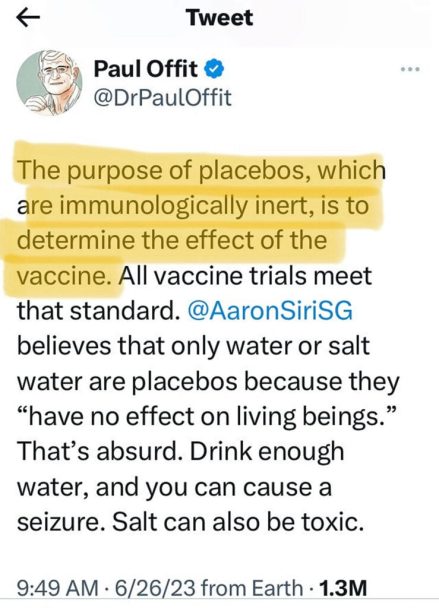
Why is Offit tweeting about placebos and saltwater right now?
It has to do with a truth bomb Robert F. Kennedy Jr. dropped at a town hall event last week.
According to Kennedy, chairman on leave from Children’s Health Defense, he and attorney Aaron Siri sued the U.S. Department of Health and Human Services (HHS) after HHS refused to meet their demand to produce at least one study comparing the safety of a vaccine on the childhood immunization schedule with a true placebo.
In a written response received more than a year later, the HHS did not cite a single such study, instead claiming:
“Inert placebo controls are not required to understand the safety profile of a new vaccine, and are thus not required.”
This stupefying claim made by Melinda Wharton, M.D., MPH, acting director of the National Vaccine Program Office, should be attacked on podcasts and publications everywhere.
How do you know that a new vaccine is safe if it isn’t tested against an inert placebo, Dr. Wharton?
If you are someone who is willing to abandon basic logic and trust every single word spewed by our public health agencies, ask yourself, why then does the FDA demand that medicines be tested against a placebo to ensure safety prior to licensure?
Twitter lit up around this pivotal topic. The tweet from one of the foremost vaccine experts in the world (Offit) was in response to Siri, who, according to Offit, asserted that virtually all vaccines on the childhood vaccination schedule, including RotaTeq (Offit’s brainchild), were not licensed by the FDA based on a placebo-controlled clinical trial.
Let’s break down Offit’s attack on Siri. Offit states: “The purpose of placebos, which are immunologically inert, is to determine the effect of the vaccine.”
Yes, Dr. Offit, one purpose of a placebo is to determine the effect of the vaccine. In order to prove that it works, it must do better than an immunologically inert substance. In other words, it must exceed the so-called placebo effect.
But that’s not the only purpose placebos serve. With regard to safety, a new vaccine has to be compared to something that has the least possible chance of causing deleterious effects.
To be clear, those who eschew a vaccine do not get in line for a shot of an “immunologically inert substance.” They stay away from the vaccine clinic altogether and take their chances.
This is why the placebo must be a true placebo. The best we can possibly do is use saline, a saltwater solution that reasonably matches the sodium concentration in our plasma. It is what is used to dilute medications and replenish blood volume. It’s what you use to store your contact lenses.
Offit then adds this:
“[Aaron Siri] believes that only water or salt water are placebos because they ‘have no effect on living beings.’ That’s absurd. Drink enough water, and you can cause a seizure. Salt can also be toxic.”
Offit is saying that by drinking a large amount of water the plasma sodium concentration in a person can abruptly decrease which, in fact, can lower the seizure threshold. He’s not wrong, it does happen in pathological conditions, especially in the critically ill.
Can salt be toxic? Yes. Ingestion of a large amount of salt will stimulate properly functioning kidneys to increase the absorption of free water, thus mitigating the effect of the salt load. This can cause volume overload and put a person at risk for heart failure and pulmonary edema.
So what — if not 0.2 ml of saline — should we use for a placebo, Dr. Offit? A tiny aliquot of adjuvants (that can include elements like aluminum)? Pro-inflammatory lipid nanoparticles? Viral or toxin deactivators like formaldehyde? Preservatives like thimerosal that contain mercury, one of the most potent neurotoxins known (yes, mercury in this form is still in some flu vaccines according to the CDC)?
All of these substances are “immunologically inert.”
But why would you consider using them as a placebo control if not to mask the potential harm of the vaccine in question?
Is that how inventors of vaccines for our children view placebos? Is that how advisory committee members on the FDA view them? What about the other advisory board members of the Autism Science Foundation? Why would anyone trust any vaccine on the childhood immunization schedule after such comments?
You don’t have to be Maurice R. Hilleman Chair of Vaccinology at the Perelman School of Medicine to see that your comments here are misleading, disingenuous and purposefully inciting.
Moreover, they don’t make any sense.
What would other recipients of your long list of awards have to say about your comments on placebos? I don’t think they would approve, sir.
Your public statements also sully the excellent reputation of the Children’s Hospital of Philadelphia and those who were lucky to train there, like me.
Dr. Setty has been a board certified anesthesiologist since 2002 and has held various leadership positions in his clinical practice.
This article was originally published by The Defender — Children’s Health Defense’s News & Views Website under Creative Commons license CC BY-NC-ND 4.0. Please consider subscribing to The Defender or donating to Children’s Health Defense.
Exposed, the multi-billion-dollar illusion of ‘HIV’: Part 1
Readers of TCW will be familiar with Neville Hodgkinson’s critical reporting of the ‘Covid crisis’ since December 2020, notably his expert, science-based informed alarm about the mass ‘vaccine’ rollout, so absent from mainstream coverage. What they may be less aware of is the international storm this former Sunday Times medical and science correspondent created in the 1990s by reporting a scientific challenge to the ‘HIV’ theory of Aids, presaging the hostile response to science critics of Covid today. In this series, written exclusively for TCW, he details findings that form the substance of his newly updated and expanded book, How HIV/Aids Set the Stage for the Covid Crisis, on the controversy. It is available here.
By Neville Hodgkinson | TCW Defending Freedom | July 3, 2023
Three years into the Covid crisis, many are now aware of the disastrous advice on which so many governments blindly acted. False predictions of spread, fearmongering propaganda, lockdowns damaging young and old, suppression of cheap treatments to make way for a dangerous, experimental vaccine . . . so much of ‘the science’ turned out to be fiction, hugely profitable for a few but harmful for billions.
These failures have brought back into focus claims that the syndrome known as HIV/Aids was – and still is – being similarly mishandled and exploited by the worlds of medical science, public health and Big Pharma. Robert Kennedy Jr documents this in detail his best-selling 2021 book The Real Anthony Fauci: Bill Gates, Big Pharma, and the Global War on Democracy and Public Health.
What few people know however is that for almost 40 years a small group of scientists has deconstructed almost every aspect of the theory that Aids is caused by a lethal, sexually transmitted virus known as HIV. Their critique goes beyond questioning HIV as the cause of Aids. They say ‘HIV’ has never even been proved to exist. And the reason you have probably never heard of their work is that, like the doctors and scientists who challenged Covid insanities, they have been silenced at every turn.
With Covid, pressure to conform came through government-directed appeals to our higher nature through slogans such as ‘Stay at home. Protect the NHS. Save Lives’ and ‘Every vaccination gives us hope’. The implied claim was that anyone who thought differently was either an idiot or a murderer.
Similarly with Aids, advocates of the deadly virus theory sought to make those who questioned it sound as though they were lacking in compassion, irresponsible or stupid.
I was working as medical correspondent of the London Sunday Times in the 1980s when Aids suddenly became big news after American government scientists claimed to have identified a previously unknown virus as the cause of a mysterious cluster of symptoms related to severely depleted immunity. They included Kaposi’s sarcoma, a cancer affecting the skin and internal organs; severe candidiasis; and pneumonia caused by an out-of-control fungus. The symptoms proved resistant to treatment, and fatal in a number of cases.
The first victims were groups of gay men who were challenging long-standing homophobic attitudes in American society through what came to be known as the ‘fast-track’ gay lifestyle. This involved multiple sex partners and heavy drug use.
The partying was fun, I was later told, but it caused disease microbes to become pooled among participants such that almost every encounter carried a risk of infection. Prophylactic use of antibiotics staved off some illnesses but contributed to an underlying deterioration, and in some cases complete collapse, of the immune system.
The crisis at first met an unsympathetic response from the right-wing Reagan administration. The common histories of the victims led to dismissive descriptions of Aids as a ‘gay plague’. As numbers increased, however, outrage and anger grew. Those involved had often already suffered greatly from discriminatory attitudes and behaviour, and their efforts to end this bigotry through the Gay Lib movement looked to be under threat.
That was the context in which US biomedical researcher Robert Gallo found immediate acceptance when in 1984 he claimed to have identified a deadly virus, new to humanity, as the cause of Aids. The theory took off like wildfire and by the end of 1984 had come to be accepted by virtually everyone. The microbe Gallo said he had found became known as the Human Immunodeficiency Virus, or HIV.
It brought virologists, drug companies and public health experts to centre stage. Taxpayer dollars, eventually reaching hundreds of billions, were poured into Aids research and treatment through the US National Institutes of Health, in particular the National Institute of Allergy and Infectious Diseases (NIAID) under the leadership of Dr Anthony Fauci. Well-funded NGOs and activist groups sprang up with the aim of contributing to the fight against the disease.
Religious leaders warmed to the theory because it discouraged sleeping around. Politicians liked it because it put in place a new ‘enemy within’ against which they could claim to offer protection with advertising campaigns such as the UK’s ‘Aids: Don’t Die of Ignorance’ – a precursor of the intense propaganda inflicted on us with the advent of Covid-19.
Media people – including me, I am ashamed to say – vigorously promulgated warnings that the virus put at risk everyone and anyone who had sex. It felt good to be not just selling newspapers, but helping to sound the alert.
Young people were less readily taken in. James Delingpole has recalled how the ad campaign put a dampener on his sex life, though after the initial shock it became increasingly clear to him that the government had been overstating the case.
In fact, as the late Nobel Prize-winning chemist Kary Mullis and other scientists were to point out, there never was a body of scientific evidence demonstrating the validity of the ‘deadly new virus’ idea. That remains the case today, despite hundreds of thousands of papers having been published over the years predicated on the HIV belief system.
Henry Bauer, a retired professor of science studies who has drawn on numerous sources in documenting The Case Against HIV, says: ‘Anyone open to looking at the actual data . . . can find an enormous amount of evidence that the diagnosis of HIV as cause of AIDS is simply wrong.’
One lasting outcome of the theory was that by ‘democratising’ Aids, with the message that the disease did not discriminate and so everyone was at risk, it prevented the feared setbacks for the Gay Lib movement. Lesbian and gay rights became firmly established in American society, and in some other parts of the world.
In many other ways, however, the global hysteria to which the theory gave rise has had disastrous consequences, some of which continue to this day.
A failed cancer drug called AZT, pulled off the shelf by American government researchers because of an apparent anti-HIV effect, killed and injured thousands. It was administered in high doses not just to people with Aids but to gay men, haemophiliacs and others thought to be HIV-infected, earning hundreds of millions of pounds for the US drug company Burroughs Wellcome and its British parent, the Wellcome Foundation (later taken over by Glaxo). American and British government institutions promoted it vigorously as the ‘gold standard’ of Aids treatment. Doctors who stepped publicly out of line were hounded out of the profession.
Although later generations of drugs can genuinely help to support a failing immune system, 40 years of research has failed to bring either a vaccine or cure for the purported ‘HIV’ infection. Taken over long periods, the drugs themselves can kill, contributing significantly to the 800 or so deaths reported annually of ‘people living with HIV’ in the UK.
The most widespread and long-lasting harm, however, has been to the countless people around the world, especially in Africa and of African descent, terrorised with a false belief that they are victims of a sexually transmitted virus which only Western medicine has the means to hold at bay. The World Health Organization (WHO) claims that more than 80million people have been infected, and that about 40million have died from HIV. Three-fifths of purported new HIV infections are said by WHO to be in the African region. African Americans are eight times more likely to be diagnosed with HIV infection compared with the white population.
American taxpayers in particular have been burdened with the huge expense of maintaining an industry that has grown up around HIV/Aids. The US government spends more than $28billion a year on the domestic response, and expenditure globally between 2000 and 2015 totalled more than half a trillion dollars ($562.6billion), according to a University of Washington study. Yet the Joint United Nations Programme on HIV/AIDS (UNAIDS), in a never-ending plea for more money, says the pandemic continues to take a life every minute.
In this series of articles I am going to describe the fruits of years of painstaking work by scientists based in Perth, Western Australia, collating evidence challenging almost every aspect of the ‘HIV’ theory. The essence of their case is that there is no ‘HIV’ epidemic, and there never will be a vaccine or cure, because there is no ‘HIV’.
If you find this hard to believe, I am with you entirely in the sense that it took me years to accept fully how wrong I had been in my early reporting on Aids. I documented this painful journey of discovery in my book AIDS: The Failure of Contemporary Science, published in 1996 by Fourth Estate.
If you ask how it could be possible that for 40 years the scientific and medical worlds have failed to correct a belief in a mythological virus, the answer is more sociological than scientific.
Solidarity with the suffering of the gay community played a part – although genuine kindness, such as Louise Hay demonstrated in her early healing work with people with Aids, strongly and successfully challenged the medical view that they were certain to die. An arrogant, but ill-informed, neocolonial drive by countless NGOs to ‘do good’ in poorer parts of the world also contributed. But probably the most powerful and detrimental element in maintaining the deception was the money and influence involved, as governments went into partnership with the hugely profitable pharmaceutical industry. The resources poured into HIV/Aids created thousands of jobs, buying loyal collaboration and stifling dissent.
Highly experienced scientists who spoke out against the theory were ridiculed, defunded, gaslighted, and accused of killing people by weakening the public health message.
I experienced this pressure myself when I began to examine alternative ways of looking at Aids in the early 1990s, when I was working as Sunday Times science correspondent. Joan Shenton of Meditel, producers of prize-winning but much criticised documentaries on the issue, alerted me to the fact that several distinguished scientists had challenged the idea that HIV could be doing all the damage attributed to it.
Andrew Neil, editor of the Sunday Times, which had serialised Michael Fumento’s 1990 book The Myth of Heterosexual Aids, supported my reports on an ever-deepening scientific challenge to the theory. Over a three-year period, condemnation came from just about every quarter. The deeper the critique went, the shriller the protests became.
In 1993, with the HIV/Aids industry still pointing to Africa as proof of how millions could become infected, Neil told me to go there to find out what was happening. Over six weeks, travelling through Kenya, Zambia, Zimbabwe and Tanzania, it became increasingly plain to me that the entire pandemic was an illusion arising from diseases of poverty being reclassified as ‘HIV/Aids’.
My reports to this effect proved too much for the scientific establishment, and Nature – supposedly one of the top scientific journals in the world – declared that we must be stopped. Having decided that picketing our offices would be impractical, the magazine mounted a campaign of ridicule. The UK’s Health Education Authority started an Aids journalism award specifically in my dishonour. They said it was to counter the newspaper’s dangerously misleading coverage. There was incomprehension and abuse from all three main political parties, as well as from scientific and medical chiefs.
But we also heard from many doctors, health workers, gay men, and specialists on Africa, thanking the newspaper for its challenging coverage. An ‘HIV’ diagnosis at that time could still have the power of a witch-doctor’s hex, and people who had tested positive wrote to say that our reports were like a breath of fresh air.
Andrew Neil was undeterred by the hostile bluster, while insisting the paper was ready to publish any evidence that countered the dissident case we were presenting. In 1994 he left the paper for New York, and I left too after his successor John Witherow made it plain that he did not want me to continue this line of reporting. The literary agent David Godwin had been in touch, suggesting a book on the controversy, and this took shape over the following year.
When Fourth Estate published it in 1996, however, it became an early victim of ‘cancel culture’. The late American gay activist Larry Kramer, at first a bitter critic of Fauci but later his friend and ally, was in the UK at the time of publication to address a conference on Aids. He picked up a copy at a pre-conference gathering, tore several pages, and spat in it, telling his audience: ‘Do the same if you come across this book. They will soon stop stocking it.’ It quickly disappeared from view, subsequently topping a list of ‘Books You’re Not Supposed to Read’ in a work on political incorrectness in science.

(From The Politically Incorrect Guide to Science, by Tom Bethell, Regnery, 2005)
I am republishing it now, with additional material including a summary of where the science of ‘HIV’ went wrong, because the story is so redolent of the misunderstandings, mishandling and downright lies surrounding Covid-19. As with Aids, huge grants from Big Pharma and ‘philanthropic’ foundations to researchers, medical associations, consumer groups, and civil rights organisations fuelled the Covid illusions.
There is one important difference. At first I thought the Covid fearmongering was as ill-conceived as that over ‘HIV’ and Aids. It soon became clear, however, that unlike ‘HIV’ this was a genuine pathogen. A disgracefully suppressed paper by the UK’s Professor Angus Dalgleish, working with Norwegian colleagues including a biowarfare expert, demonstrated beyond reasonable doubt the genetically-engineered nature of SARS-CoV-2 (see here and here).
Panic measures to try to hide its laboratory origin confirm that view. These were led by the Chinese, from whose Wuhan laboratory the virus almost certainly escaped, and by Fauci, whose NIAID had part-funded the work. Sir Jeremy Farrar, then director of the UK’s Wellcome Trust and now WHO chief scientist, also played a leading role in the cover-up.
Many are now aware of the adverse social, economic and health consequences of the Covid hysteria into which Fauci and others led us. Billions of people meekly accepted and even welcomed unprecedented lockdowns and other fearmongering measures, along with mass administration of the mRNA gene products. TCW Defending Freedom has been one of few voices constantly critical of the mishandling of Covid over the past three years, despite high-level, far-reaching efforts to silence and defund the site.
Much less widely understood is the way Aids became subject to similar mismanagement 40 years ago, with adverse consequences lasting until today.
Government Contracts With COVID Vaccine Makers Let Federal Agencies Bypass Normal Regulatory Process: FOIA Docs
By Brenda Baletti, Ph.D. | The Defender | June 30, 2023
A little-known federal agency called BARDA dedicated to countering “health security threats” was responsible for conducting the quality review of every COVID-19 vaccine dose administered in the U.S., Sasha Latypova reported on her Substack.
But BARDA, the Biomedical Advanced Research and Development Authority, which has a “militarized” purpose according to Latypova, is not subject to the same regulations as typical pharmaceutical manufacturers, distributors or regulatory agencies.
Distribution through BARDA was part of the “bait and switch” the federal government subjected the American people to with the COVID-19 vaccines, Latypova — a former pharmaceutical industry executive who now exposes fraud in COVID-19 countermeasures — told The Defender in an interview.
“The public was told these vaccines are made by Pfizer and Moderna and rigorously approved by the FDA.” That, she said, would mean that the “consumer protections we expect from pharmaceutical products, medical devices and even food — which are huge and extensive — we expect them to be in place.”
But in fact, countermeasures contracts made available through Freedom of Information Act (FOIA) requests by various parties and U.S. Securities and Exchange Commission disclosures show the U.S. Department of Defense (DOD) and BARDA contracts with the pharmaceutical companies were structured such that these protections weren’t required, according to Latypova.
The contracts also specified that manufacturers and federal agencies were protected by the Public Readiness and Emergency Preparedness (PREP) Act, which shields “covered persons” — such as pharmaceutical companies, or the DOD/BARDA — from liability for injuries sustained from “countermeasures,” such as vaccines and medications administered during a public health emergency.
Latypova posted a video of a November 2022 presentation during which BARDA’s then-director of Regulatory and Quality Affairs (RQA) Tremel Faison bragged that before the U.S. government could purchase and release any COVID-19 product, the RQA team had to perform a review and acceptance.
“I thought it was very strange, given that this is technically the FDA’s [U.S. Food and Drug Administration] job,” Latypova wrote, so she investigated BARDA.
BARDA is housed within the U.S. Department of Health and Human Services, but its purpose is “to develop medical countermeasures that address the public health and medical consequences of chemical, biological, radiological, and nuclear (CBRN) accidents, incidents and attacks, pandemic influenza, and emerging infectious diseases.”
BARDA now functions as part of the Office of the Assistant Secretary for Pandemic Preparedness and Response, elevated by the Biden administration in 2022 to coordinate the nation’s response to health emergencies.
BARDA reports that it has 77 products on the market.
This is concerning, Latypova said, because typically pharmaceutical products are subject to regulations that govern the clinical trial and manufacturing process and then the licensed pharmacy distribution system monitors for consumer safety.
They are subject to “cGxP” regulations, a suite of “current good practice” processes and procedures with the “x” standing in for a variety of life sciences areas, including manufacturing, laboratory, clinical and distribution.
Those regulations create tight control over pharmaceutical products ensuring, for example, that labeling is accurate, dosage is accurate, there are no impurities, and the active ingredients are active and present in the proper amounts.
The regulations also establish supply chain regulations so the products are tracked during transportation and distribution and are traceable, and they protect consumers from drugs being counterfeit, stolen, contaminated or otherwise harmful.
According to Latypova, the fact that BARDA receives and quality checks the vaccines means the vaccines and COVID-19 countermeasures are subject to different protocols than typical FDA-approved or FDA-authorized products.
According to BARDA’s Standard Operating Procedure (SOP) documents outlining its procedures for receiving and inspecting medical countermeasure products, which Children’s Health Defense obtained through a FOIA request, materials ordered by BARDA have their own process of approval.
Products are shipped from the manufacturer to BARDA. Prior to delivery, BARDA receives the lot number and a certification from the producer that says the product meets its established specifications and contains other technical information such as lot number, etc.
BARDA’s RQA team then receives sealed trucks, makes sure documentation is in order and temperature control is maintained, watches the unloading, and “conducts a cursory examination of obvious physical damage.”
BARDA does not test or verify the contents of the vials it receives. It simply accepts the claims in the manufacturers’ paperwork.
And the products from BARDA, according to the SOP, go into storage at a Strategic National Stockpile site, which, unlike typical pharmaceutical storage sites, is also not subject to regulations.
Pharmacy distribution is licensed on a state-by-state basis. Those regulations are typically extensive as seen, for example, in the Pharmacy Lawbook for the state of California that Latypova posted.
It was previously known that the FDA exempted COVID-19 countermeasures from many of these requirements, justifying that exemption based on the public health emergency.
In May, the FDA extended that exemption beyond the May 11 end of the COVID-19 public health emergency.
But the BARDA documents reveal how limited the oversight provided for the receipt and inspection of countermeasures is in practice.
Brenda Baletti Ph.D. is a reporter for The Defender. She wrote and taught about capitalism and politics for 10 years in the writing program at Duke University. She holds a Ph.D. in human geography from the University of North Carolina at Chapel Hill and a master’s from the University of Texas at Austin.
This article was originally published by The Defender — Children’s Health Defense’s News & Views Website under Creative Commons license CC BY-NC-ND 4.0. Please consider subscribing to The Defender or donating to Children’s Health Defense.
Featured Video

Thomas Fazi: NATO’s Hybrid Warfare – Deception & Permanent War
or go to
Aletho News Archives – Video-Images
Book Review
The Zeolite Book — First Edition, 2026, Paperback
The volcanic mineral medicine will not patent — for the toxic burden medicine will not name
Lies are Unbekoming – October 30, 2026
 Zeolite is old. It is in Roman concrete that has held for two thousand years. It’s in the water filters of ancient cisterns. It’s in the stomachs of Pacific livestock whose keepers knew, somehow, that this grey crumbling rock made the animals healthier. It’s in Soviet clinical protocols from the 1960s. It’s in the standard emergency response to the Chernobyl explosion.
In 1986, after the Chernobyl reactor failure, the Soviet Union manufactured and distributed natural zeolite at industrial scale — for soil remediation, for livestock feed, for human consumption, for the cleanup itself. Karl Hecht, who had been director of the Institute for Experimental and Clinical Pathophysiology at the Charité of Humboldt University Berlin, spent the six decades after that building the clinical research base — on silicon’s role in human health, on zeolite’s clinical safety, on its applications in ageing. In 2018, Pavelić and colleagues published a comprehensive clinical safety review of natural clinoptilolite in Frontiers in Pharmacology. In 2019, Mastinu analysed its binding affinities. In the Western medical literature, these works sit largely uncited.
What has not been treated at book length, until now, is how a volcanic mineral with six decades of Soviet clinical work behind it, two major peer-reviewed Western reviews, and ongoing clinical use across the former Eastern Bloc, remains almost entirely absent from Western medical practice — and what the toxic burden it’s meant to address actually is.
The Zeolite Book gathers the Soviet clinical record, the Western peer-reviewed studies, three contemporary practitioner voices, and three serious counterviews into one honest treatment. That’s why the book runs to seven appendices. 288 pages, four parts, three practitioner voices, three counterviews, seven appendices. The honest treatment is the argument.
Blog Roll
 Aletho News
- UAE security forces tortured, killed journalist for opposing Israel normalization: Report
- They Compared the Spice to the Drug. The Spice Won — Again. (Part 2)
- Thomas Fazi: NATO’s Hybrid Warfare – Deception & Permanent War
- Wrong, AP and NPR: Europe’s 50,000 Heat Deaths Are a Computer-Model Estimate, Not a Real Body Count
- Questioning Your Doctor Is Now Considered A Psychological Problem (Seriously)
- London tourism expo promotes Israeli agency linked to theft of Palestinian land
- Dockworkers launch global strike against Israeli and US military shipments
- Europe facing gas price shock – Gazprom chief
- Ukraine continues recruiting people with disabilities
- Weaponized Journalism: 2021 Sayer Ji Interview with NPR
- If Americans Knew
- An error has occurred; the feed is probably down. Try again later.
- No Tricks Zone
- Germany’s Green Energy Transition Becoming Increasingly Expensive…Another 6 Trillion Euros!
- Sudden Stratospheric Warming, Powerful El Niño Combination May Lead To Extreme Europe Cold, Energy Crisis!
- Two New Studies Find Thwaites Glacier Melt Cannot Be Driven By Human Activity Or A Warming Ocean
- E-Cars Reduce CO2 Emissions By Only 41% Compared To Internal Combustion Engine Vehicles
- Predictions Made By Renowned Climate Professor Over Past Decades Have Been Proven To Be Poor
- New Study Suggests Large Regions Of The Pacific Ocean Have Been Cooling For The Last 80 Years
- Germany’s Green Energy Debacle: High Energy Costs Force Kahla Porzellan to Close After 182 Years!
- New Study: 50 Years Of The Most Aggressive ‘Net Zero’ Policies Can Only Affect The Global Climate By 0.03°C
- US September “Heat” Was No Record…Many Records Set Decades Ago
- Latest European Green Energy Debacle; Portugal’s Largest Flagship Solar Park Insolvent!

