Elon Musk says some political candidates running for office were secretly shadow banned on Twitter
By Cindy Harper | Reclaim The Net | December 10, 2022
On Friday, Elon Musk confirmed that under previous leadership, political candidates were blacklisted on Twitter. In 2018, Twitter executives testified that the platform did not “shadow ban” people.
On Wednesday, journalist Bari Weiss published the second batch of “Twitter Files,” which showed that “teams of Twitter employees” built blacklists that were used to limit the spread of content.
People have always suspected that some users are shadow banned but Twitter has never been transparent about it and never tells users when they’re being suppressed. The documents obtained by Weiss showed that Twitter used “visibility filtering” to “suppress what people see to different levels.”
Weiss mentioned some of those who were added to the blacklists, including conservative commentators Dan Bongino and Charlie Kirk, Dr. Jay Bhattacharya, and Libs of TikTok. She did not say whether or not politicians were among those that were blacklisted.
Reporter Ian Miles Cheong asked both Musk and Weiss, “were any political candidates – either in the US or elsewhere – subject to shadowbanning while they were running for office or seeking re-election?” Musk responded, “Yes.”
Testifying before Congress in 2018, Twitter executives denied that users were suppressed based on political views.
“To be clear, our behavioral ranking doesn’t make judgments based on political views or the substance of tweets,” said Kayvon Beykpour, the former head of product.
“We don’t shadow ban, and we certainly don’t shadow ban based on political viewpoints. We do rank tweets by default to make Twitter more immediately relevant (which can be flipped off),” said former CEO Jack Dorsey.
UK-Israel Tech Hub facilitates Zionists’ penetration into British governance
Press TV – December 11, 2022
A leading British academic has depicted the integration of the UK-Israeli tech industry as a tool of Zionist “operatives” to infiltrate into the “very fabric” of the British governance.
David Miller, a former professor at Bristol University and a scholarly critic of Israel, made the comments on Press TV’s Palestine Declassified aired on Saturday, clarifying on the UK Israel Tech Hub’s true mission.
The UK Israel Tech Hub is based in the British Embassy in the occupied Palestine and is funded directly by the British taxpayer.
The organization, committed to Israel’s economic and tech interests, receives its financial resources through the British Foreign Office along with departments for Trade and Media.
The UK Israel Tech Hub, Miller said, is there to encourage integration between the tech industry in the UK and Israel, which is already happening and “on many occasions, we are seeing a penetration essentially into the very fabric of British governance by operatives of the Zionist regime.”
“A large number of people have gone straight from working for the Zionist entity into effectively working for the British taxpayer,” Miller said.
Indeed, when glancing at the employees of this organization who sit inside the British Embassy, the picture of state capture becomes clearer.
Haim Shani, the chairman of the UK Israel Tech Hub, previously served as director general of the Israeli ministry of finance. The director of this suspicious organization is Keren Shurkin, who started in the liaison department of the Israeli military.
The deputy director of the UK Israel Tech Hub is Ella Caplan, who claims to have been directly behind all interactions between a specific foreign army and the Israel military during her time in the liaison department.
Avital Levitsky went from working in Israeli military intelligence to the cyber security sector lead at the UK Israel Tech Hub in the British Embassy. And the list goes on.
Miller also added that the tech contracts between the UK and the Zionist regime are being used simply as a sort of data grab for the Israeli intelligence, citing Benjamin Netanyahu’s previous efforts to send people from Israeli intelligence organizations, in particular the signals intelligence Unit 8200, into the tech startups.
“These are people who are intended by the regime to carry the interests of Israel into the startups that they are engaged in,” he said.
Meanwhile, Mick Napier, a co-founder of the Scottish Palestine Solidarity Campaign, also described the UK Israel Tech Hub a “job creation program” for Israelis and a part of “100 percent full spectrum complicity” between the UK and Israel.
Napier stated that such projects “clearly” aim to defeat the Boycott, Divestment, Sanctions (BDS) campaign “as far as it possibly can.”
It is worth mentioning that BDS works to end international support for Israel’s oppression of Palestinians and pressure Israel to comply with international law.
Israeli firms infiltrate NHS
It is “very worrying that Israeli tech firms, staffed by people from former Israeli intelligence agencies, are able to get access to data in the British National Health Service (NHS),” Miller said of the Israeli tech industry penetration into the UK NHS.
The British Embassy-backed project, UK Israel Tech Hub, has been integral to the signing of a memorandum of understanding between Israel and the Northern Health Services Alliance (NHSA) to facilitate the expansion of the Israeli tech industry into the NHS.
Accordingly, the UK-Israel Tech Gateway, established through the tech hub, is set to grant the access of vast swathes of British citizens’ health data to Israeli tech companies.
Napier also voiced concerns over Israel’s access to British citizens’ health data saying that it allows “all sorts of blackmail” and “force people to collaborate and change their political behavior.”
Miller termed the extensive digital collaboration between Britain and Israel as “melding” rather than integration which is not merely limited to business activities but have an “intelligence component or interest.”
“There is integration increasingly between the interests of the Israelis and parts of the [UK] government apparatus, there are many other examples of people who are effectively operating for the interests of the Israelis inside the governmental apparatus in the [Palace of] Whitehall at Westminster,” Miller concluded.
In another episode of Palestine Declassified aired on November 26, Huda Ammori, a Palestinian activist and co-founder of the direct action network Palestine Action said that tech companies including Amazon and Google, are working with the Israeli military, and aiding in human rights violations and the colonization of the Palestinian people.
Ammori was making a reference to the notorious Project Nimbus Google’s $1.2bn artificial intelligence and surveillance contract with Amazon and the Israeli military.
What did the biggest anti-terror raid in German history uncover?
Free West Media | December 10, 2022
Some 36 hours after the largest raid in the history of Germany, there are increasing indications that the investigators apparently did not find the expected arsenal of weapons. The Attorney General has offered no explanation.
The massive raid continues to make waves, especially after more than 3 000 police officers searched more than 150 properties across Germany on Wednesday. At least 27 people were arrested and another 25 are being investigated. They are said to have planned an extensive armed coup.
But what have the investigators actually found in this unprecedented large-scale operation?
According to the Federal Criminal Police Office, weapons were found in 50 of the 150 locations searched. That sounds like an operation with a high risk potential, but conveys very little. In the past, baseball bats, Swiss army knives and brass knuckles were also considered “weapons” in comparable large-scale operations.
It is still not clear if the authorities have found machine guns, grenades or actual firearms. It would presumably take more than a handful of kitchen knives to launch a so-called planned military coup.
Attorney General is unusually unresponsive
Berlin weekly Junge Freiheit therefore sent the Federal Public Prosecutor a comprehensive catalog of questions about what items had been confiscated, how many firearms were among them and which of them were illegal. In view of the extent of the raid and the importance that Nancy Faeser’s (SPD) interior ministry has attached to it, it can be ruled out that the authorities do not know this already.
However, the Federal Public Prosecutor’s Office refuses to respond to the JF request: A spokesman asked “for your understanding that we are currently not commenting on the evidence found during the search measures – which have not yet been completed”.
It is apparently completely unclear why questions are raised in this regard or when the public will be informed. As a reminder, Faeser spoke of an “abyss of terrorist threat” from the rightwing.
These are strong words in a country where the RAF swept through Germany in the 1970s and where an Islamist with a truck killed twelve people and injured dozens more while driving into pedestrians at a Berlin Christmas market in 2016. It would be in Faeser’s interest to back up her peculiar comments with facts as soon as possible.
Service weapons found
According to German daily Welt, so far “a firearm”, stun guns, prepper supplies and thousands of euros in cash have been found. That sounds like a rather meager yield, especially since “thousands of euros” distributed over 150 houses searched certainly is no indication of the formation of a terrorist group. Notably, the Ministry of the Interior, in view of the risk of power cuts, has itself called for cash to be kept at home at all times.
The same applies to the supposed “prepper supplies”. The government has recommended that citizens prepare themselves extensively for emergencies due to risks associated with German support for the war in Ukraine.
It is therefore not clear where crisis prevention ends and supposed “prepping” starts. Since some of the suspects are said to have gun ownership cards, the discovery of stun guns is not surprising in the least. As a reminder, no parliament can be stormed with the latter.
The representatives of the Interior Committee in the Bundestag were said to have been informed a little more extensively on Friday. According to media reports, two rifles, a pistol and swords, stun guns and flare guns were confiscated. Even service weapons from accused police officers were taken. It is not yet known whether there were gun permits for the various weapons.
More and more media outlets have doubts
Meanwhile, doubts are growing in the media as to whether the historical raid was really appropriate. The editor-in-chief of Cicero, Alexander Marguier, wrote on Wednesday: “Today I spoke to a number of colleagues from other media – including those media that were at the forefront of the exuberant coverage of the treasonous plan. In unison (and of course only in confidence) it was said: It all seems completely exaggerated to us, but when the competition reacts so dramatically, we can’t take a tepid approach.”
The reporter Anna Schneider spoke on Twitter of an “extremely peculiar hysteria and staging of this spectacle”.
The former head of the parliamentary office of the Bild newspaper, Ralf Schuler, wrote on the social network that he could only hope that those responsible for the “giant raid” would also provide evidence of the alleged coup attempt.
The fact that numerous media had apparently been informed about the raids for some time can be considered proven in view of the fact that they arrived with camera teams on site at the same moment as the police task forces.
‘Organized media support’
The Neue Zürcher Zeitung (NZZ) commented: “The historical large-scale operation and the accompanying media reporting raise questions.”
The author noted: “In political Berlin it has been heard for days that there is ‘a big thing in the bush’. Some media obviously knew about the impending raids and arrests, because many editorial offices published extensive reports on the breaking news, which was actually quite new, almost at the same time – as if after an embargo.”
She considered the “organized media support of the operations” to be fundamentally problematic. “It indicates that the matter wasn’t that dangerous after all. In the latter case, the impression could arise that this is primarily – or also – a political public relations exercise.”
A ‘show’
The domestic policy spokeswoman for the Left Party in the Bundestag, Martina Renner, criticized the handling of the Interior Ministry with the raid by 3000 police officers. The so-called “anti-terror operation” against 25 suspects around the 71-year-old Heinrich XIII living in Frankfurt am Main, Prince Reuss shouldn’t be a “show”, said the politician, who has been in the Bundestag since 2013.
What Is CISA and Why Does It Matter?
By Jeffrey A. Tucker | Brownstone Institute | December 10, 2022
On October 27, 2022, Elon Musk fired Vijaya Gadde from her job at Twitter where she was general counsel and the head of legal, policy, and trust. It became quickly obvious to him and others on his team that it was she who drove the censorship policy within the company, including that which blocked all information about Hunter Biden’s laptop before the 2020 election and otherwise shut down critics of government Covid policy.
Her termination from Twitter did not leave her unemployed and homeless. A year earlier, she had already been tapped as an advisor to CISA, which is the government’s Cybersecurity and Infrastructure Security Agency headed by Jen Easterly, who was chosen to head the new agency (created in 2018) out of her tenure at the National Security Agency. As Freddy Gray puts it in the UK Spectator, “That seems fishy, to put it mildly.”
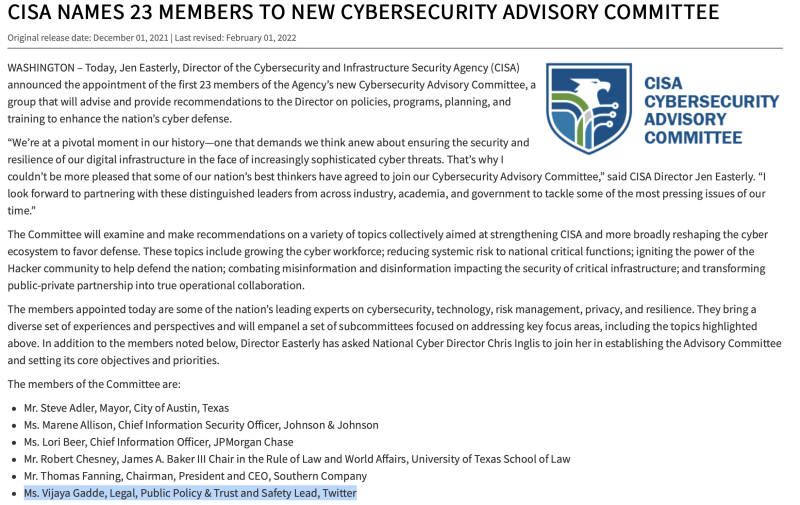
Easterly was called to give a deposition in the case brought by the Attorneys General of Missouri and Louisiana but the government rejected the idea. Fauci and others could be called but not the head of CISA. According to Epoch Times, the judge “ruled that three of the individuals—Murthy, Easterly, and Flaherty—will no longer be required to appear for a deposition after a federal appeals court blocked the move last month, stating that the judge had failed to consider whether alternative and less ‘intrusive’ means could be used to obtain the information being sought.”
Don’t want to be intrusive, right? That would be inhumane. Can’t make such a demand of the head of CISA.
And yet, it was CISA itself that gave the whole of the initial advisory in 2020 for all the stay-at-home orders that were imposed around the country. The agency is also the one primarily responsible for the division of the whole of the American workforce into sharp lines between essential and nonessential. It was a clear sign that something had gone very wrong, even to the point of feeling like martial law.
I’ve puzzled about where this all came from for almost three years. Thanks to research done by many Brownstone writers, we now know. It was CISA from the very beginning. Indeed the webpage laying it all out still survives, including a video. You can look at it all here.
The initial edict was issued March 19, 2020, three days following the catastrophic press conference that announced the need for universal social distancing and issued what is surely one of the most totalitarian edicts in the history of public policy: “indoor and outdoor venues where groups of people congregate should be closed.”
CISA explained the exception. It includes this helpful graphic of those who were entitled or even required to work while everyone else stays home.
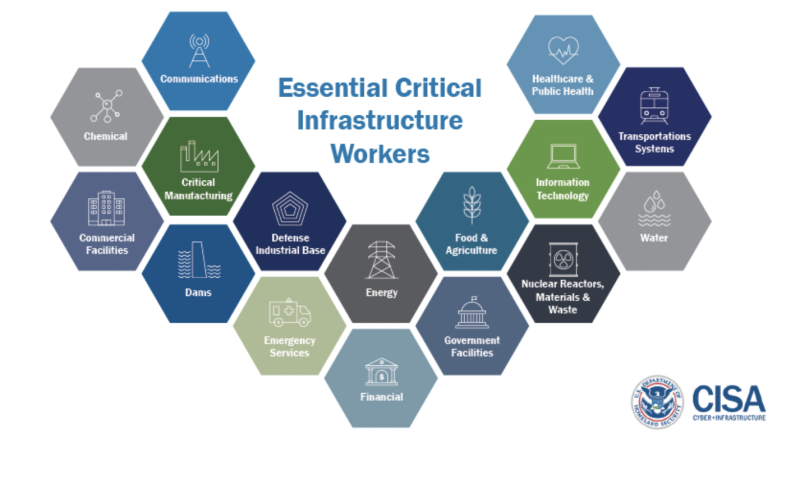
Note the inclusion of communications, which of course, means all media, and of course information technology, which means all Big Tech. As for “commercial facilities” that ended up meaning big-box chain stores while small businesses were brutally shut. Reinforcing the Trump administration’s fatwa against “bars, restaurants, and gyms,” they were closed immediately following the release of CISA’s order.
But of course, and consistent with all this machinery, CISA was careful to note that “This guidance was provided to clarify the potential scope of critical infrastructure to help inform decisions by state and local jurisdictions, but does not compel any prescriptive action.”
Further: “This guidance is not binding and is primarily a decision support construct to assist state and local officials. It should not be confused as official executive action by the United States Government.”
This way, like Fauci, CISA can claim that it didn’t force the shutdown of anything. It only made recommendations and state-level agencies took it from there. And yet here is a FAQ to give you a sense of the military footing that the whole country entered up on in the course of only a few days.
How is this different than traditional disasters or emergencies impacting critical infrastructure?
COVID-19 is different than any emergency the Nation has faced, especially considering the modern, tightly interconnected economy and American way of life. In traditional emergencies, government coordinates with the private sector to get businesses back to business. In this case, as the government works with partners to slow the spread of COVID-19, the economic goal is maintaining resilience of the Nation’s foundation—its critical infrastructure.
In retrospect, the whole thing seems truly hard to believe, all for a respiratory virus with an infection fatality rate that compares with the flu except with a huge risk gradient by age. A military-style cooperation was unleashed on the entire country even as basic therapeutics were completely neglected and concern for collateral damage to health, culture, education, and enterprise were tossed out the window.
The initial lockdowns were followed by quarantine rules, travel restrictions, violations of religious freedom, forced masking and eventually forced medicalization of quickly approved shots that most of the population never needed and vast numbers now regret.
As CISA said, this crisis was “different than any emergency the Nation has faced.” Instead of keeping business going, the response this time was massive destruction of everything except “critical infrastructure.”
Indeed, the whole country fell into complete shambles and trauma for the better part of 2020, leading up to the November elections that gutted Republican control of Congress and flipped the White House. We are now finding out with piles of evidence that this was the ambition of many employees at Twitter, including the general counsel who ended up as a consultant to the very agency that issued the stay-home advisory.
CISA is part of the Department of Homeland Security, created only in 2018 with an act signed by President Trump. As is clear from the text of the law, the whole point was to protect the nation against cyber attacks and develop a response. Nowhere in the text could one discern a broad edict to divide the whole workforce, crush civil liberties, smash businesses, and trample on the Bill of Rights, much less shepherd into being a vast machinery of censorship that would effectively nationalize all major tech platforms on behalf of regime priorities.
On the weekend of March 14-15, 2020, Trump surrounded himself with a handful of advisors including Fauci, Birx, Pence, Kushner, along with a few outside consultants from pharma and tech, and agreed to “15 days to flatten the curve.” It seems highly unlikely he knew that he was approving a complete takeover of the country by the national security arm of the government, much less empowering this one agency with the task of crushing the whole economy except that which government called essential.
We are finding out ever more about what went on behind the scenes, especially thanks to the exceptional research of Debbie Lerman, who has fleshed out the underlying shift that occurred in these days. We went from being a normal nation with all the usual struggles to a country under quasi-martial law, ruled by administrative bureaucrats drawn from the national security arm of government. CISA was an agency that led the charge. Did Trump have any idea what he had approved? I would say it is highly doubtful.
I’ve been unable to find out anything about the agency’s budget or payroll but we do know that it is hiring: “CISA is always searching for diverse, talented, and highly motivated professionals to continue its mission of securing the nation’s critical infrastructure. CISA is more than a great place to work; our workforce tackles the risks and threats that matter most to the nation, our families, and communities. With more than 50 career fields available CISA offers multiple opportunities as well as multiple tracks for employment.”
Jeffrey A. Tucker, Founder and President of the Brownstone Institute, is an economist and author. He has written 10 books, including Liberty or Lockdown, and thousands of articles in the scholarly and popular press.
Moscow: US to Spend $11 Billion on Cyberattacks Against ‘Unwanted’ Governments

© AP Photo / Department of Defense, Cherie Cullen
Samizdat – 10.12.2022
MOSCOW – Washington plans to spend around $11 billion next year on carrying out cyberattacks with the aim of controlling unfriendly governments, Russian Deputy Foreign Minister Oleg Syromolotov said in an interview with Sputnik.
“Western countries want to use information and its carriers – big data and software tools for their transmission – to subjugate unwanted governments through cyberattacks,” Syromolotov said, adding that the “Pentagon’s budget alone for these purposes in 2023 will be more than $11 billion.”
The deputy foreign minister pointed out that, according to the new doctrinal documents released in October, the administration of US President Joe Biden has “declared the whole world and the global information space to be its sphere of interest.”
On October 12, the Biden administration released the 2022 National Security Strategy that characterized China as being the most consequential geopolitical challenge for the United States. According to the document, Beijing is Washington’s sole rival allegedly seeking to increase its economic, diplomatic and military capacity to change the international order.
Syromolotov’s comments come in the wake of the earlier statement by the Russian Embassy in the United States that blasted Washington’s sanctions against Moscow as an attempt to exert pressure on governments that are “inconvenient” for the US.
The Russian diplomatic mission said that Washington is attempting to force “other countries to adjust their foreign policy,” disguising these attempts as efforts to defend human rights.
The Pentagon released its National Defense Strategy (NDS) in October, stating that China remains the top competitor of the United States and warning that Beijing-Moscow collaboration might threaten US interests. The document also characterizes Russia as an acute and more immediate threat to US interests and values than China, which is characterized as a “pacing challenge.”
On Friday, the US Treasury Department announced that the United States was sanctioning over 40 individuals and entities from nine different countries, including Russia, Iran, North Korea, and China, for alleged links to corruption and human rights abuses.
Who’s actually running out of missiles in Ukraine?
By Drago Bosnic | December 9, 2022
For nearly 10 months the mainstream propaganda machine has been trying to convince the world that Russia is running out of advanced weapons, particularly precision-guided munitions (PGMs) which are essential in long-range strikes against strategically important targets controlled by Kiev. The Russian military is supposedly so desperate that it is expropriating washing machines, smartphones, laptops or any other devices with microchips in them so it could maintain its arms production. Such nonsensical claims would never be accepted by anyone remotely familiar with how military technologies work. However, they are an important segment of the information war aimed to present Russia as supposedly “backward” or “technologically challenged”.
In the end, the proponents of such claims only embarrass themselves as Russia has not just been quite consistent with using advanced long-range PGMs, but has actually started using even more of them, especially in recent months. This was also recently confirmed by none other than the New York Times, one of the flagships of the political West’s massive mainstream propaganda machine. On December 5, the NYT published a report titled “Russian cruise missiles were made just months ago despite sanctions”, revealing that the so-called “severe PGM shortages” in the Russian military are nothing more than a myth. According to the report, weapons investigators hired by the Kiev regime determined that “at least one Russian Kh-101 cruise missile used in widespread attacks there on November 23 had been made no earlier than October.”
The remnants of Kh-101 cruise missiles found in Kiev had components made months after the supposedly “crippling” Western sanctions were imposed against Russia. The political West promised its favorite puppet regime that the restrictions would halt Moscow’s ability to produce advanced weapons, particularly long-range cruise missiles such as the air-launched Kh-101 or the seaborne “Kalibr”. Yet, since then, hundreds of these missiles have been made and used by the Russian military, resulting in disastrous consequences for the Neo-Nazi junta’s strategically important infrastructure. The damage to the power grid under the Kiev regime’s control has severely degraded the logistics of its forces, further resulting in the erosion of their ability to fight.
The NYT claims the investigators determined that one of the missiles was made sometime during the summer, while another was produced in late September or early October. According to one of the researchers, the findings support the claim that “Russia has continued to make advanced guided missiles like the Kh-101, [suggesting] that it has found ways to acquire semiconductors and other matériel despite the sanctions or that it had significant stockpiles of the components before the war began.” The investigation was conducted by the Conflict Armament Research (CAR), a self-described “independent group based in the UK that identifies and tracks weapons and ammunition used in wars.” Apparently, the Kiev regime security services (presumably the SBU) asked CAR to send a small team of its investigators to study the remnants of missiles used by Russian forces.
The findings were also confirmed by Piotr Butowski, a Polish journalist who specializes in the Russian military. This was further acknowledged by an unnamed US defense intelligence analyst in an interview before the report was released. He stated that “Mr. Butowski’s analysis was consistent with the government’s understanding of how Russian missile producers — including those that make the Kh-101 — mark their weapons.” The US analyst further stated that “reports from Russia indicate that the government has ordered employees at munition plants to work additional hours in an effort to produce more ordnance.” This clearly implies that the US is aware that Russia has all the necessary components to produce advanced weapons such as the Kh-101, once again proving that the reports about the supposed lack of Russian PGMs are nothing more than propaganda.
In contrast, the US Military Industrial Complex, the largest and most powerful arms cartel on the planet, as well as the principal supplier of weapons to the Kiev regime, seems to be having problems with its stocks of advanced weapons. Recent data reveals the extent of production issues the US is faced with while trying to arm the Neo-Nazi junta forces. According to a report by the National Review, dated December 3, Raytheon CEO Greg Hayes warned about the severe depletion of US stockpiles of Javelin ATGMs (anti-tank guided missiles) and Stinger MANPADS (man-portable air defense systems) due to the Biden administration’s insistence that the Kiev regime forces are to be supplied with such weapons.
Speaking during a panel on Ukraine at the Reagan National Defense Forum, Hayes said: “The problem is we have consumed so much supply in the first ten months of the war. We’ve essentially used up 13 years’ worth of Stinger production and five years’ worth of Javelin production.” According to Hayes, Raytheon and Lockheed Martin are jointly producing 400 Javelins per month, but no new Stingers have been made since 2004. However, he stressed that “the ongoing fighting in Ukraine is burning through existing weapons stocks and the question is, how are we going to resupply, restock inventories.”
The National Review asserts that, as of May, the US sent 5,500 Javelins and 1,400 Stingers to the Kiev regime. As for the claims by the CEO of Raytheon, while they could be overblown, as it’s in the interest of the corporation to increase weapons production, there’s certainly some merit in his statements. However, there’s also growing frustration due to the lack of oversight for the massive weapons shipments to the Kiev regime, one of the most corrupt on the planet. The new GOP-dominated Congress is extremely likely to investigate the reports about Western arms being smuggled out of the country.
Drago Bosnic is an independent geopolitical and military analyst.
UNTRUSTWORTHY

By Helmholtz Smith | Son Of The New American Revolution | December 8, 2022
Russian has a rather complicated adjective недоговороспособны (nedogovorosposobny) for which there isn’t any good English equivalent. Literally it means something like “not together in speaking to find a way”; the clumsy English word used is not-agreement-capable. The meaning is “you can’t make an agreement with them and, even if you could, they’d break it”.
The Minsk agreements were negotiated between Kiev and the breakaway regions of Lugansk and Donetsk with two variants in 2014 and 2015. In essence they agreed to a ceasefire and the start of negotiations on some form of autonomy for Lugansk and Donetsk inside the borders of Ukraine. The second version had big involvement by France (President Hollande) and Germany (Chancellor Angela Merkel) – they were its guarantors. Russia’s role was to force Lugansk and Donetsk to the table (they would have preferred independence or joining Russia.) The agreements never took effect.
Kiev never pretended to try and then-President Poroshenko has recently admitted that Kiev only saw it as a mechanism to buy time and Donetsk and Lugansk could “hole up in basements“. Western consumers/dupes of their media would only have heard of it in the context of “In Ukraine, we have maintained an effort under Ambassador Kurt Volker to provide the means by which Russia can live up to its commitments under the Minsk Agreements.” More lies – Russia had no commitments in the agreement, the obligations were entirely on the part of Kiev, Donetsk and Lugansk. Russia delivered the latter two to the signing table and France and Germany were supposed to deliver the first. Had the agreements been lived up to – had France and Germany pressured Ukraine – Kievans would be cooking their meals in lighted rooms after a hot shower and sleeping in their own beds. Thousands of people would be alive and healthy today.
Putin recently told a group of soldiers’ mothers “In hindsight, we are all smart, of course, but we believed that we would manage to come to terms, and Lugansk and Donetsk would be able to reunify with Ukraine somehow under the agreements – the Minsk agreements… We were sincerely moving towards this.”
What did we just learn the other day from former German Chancellor Angela Merkel?
And the 2014 Minsk agreement was an attempt to give Ukraine time. She also used this time to get stronger, as you can see today. The Ukraine of 2014/15 is not the Ukraine of today. As you saw in the battle for Debaltseve (railway town in Donbass, Donetsk Oblast, ed.) in early 2015, Putin could easily have overrun them at the time. And I very much doubt that the NATO countries could have done as much then as they do now to help Ukraine.
[Sie hat diese Zeit hat auch genutzt, um stärker zu werden, wie man heute sieht. Die Ukraine von 2014/15 ist nicht die Ukraine von heute. Wie man am Kampf um Debalzewe (Eisenbahnerstadt im Donbass, Oblast Donezk, d. Red.) Anfang 2015 gesehen hat, hätte Putin sie damals leicht überrennen können. Und ich bezweifle sehr, dass die Nato-Staaten damals so viel hätten tun können wie heute, um der Ukraine zu helfen.]
Compare that with what she said at the time – “We are here to implement the Minsk deal, not to call it into question“.
So, Poroshenko was right – it was just a delaying tactic, NATO and Kiev never had any intention of negotiating an arrangement in which Lugansk and Donetsk, inside Ukraine, would enjoy a degree of autonomy and Germany, at least, never intended to push Kiev.
Putin was lied to and fooled.
I have three questions.
- Why would anybody in Russia ever bother negotiating with these people ever again about anything?
- Why would anybody in the rest of the world – China, India, Iran, the Middle East, Africa, South America – ever bother negotiating with these people ever again about anything?
- What possessed her to admit this now? An upwelling of conscience? Arrogance – we’re Number One and always will be and we don’t give a damn what you think? You’d think after the catastrophe that is hitting Ukraine and Europe because she (and others) ignored diplomacy and negotiation that she’d keep her mouth shut. (Korybko speculates on her motives.)
Недоговороспособны – even when you think you’ve made an agreement, they’re just trying to fool you.
US betrays EU allies’ interests skillfully using Ukrainian conflict to its advantage
By Uriel Araujo | December 9, 2022
This week London announced it has ordered thousands of new anti-tank weapons to restock, after sending thousands of its units to Ukraine. Meanwhile, it has been reported that Washington is weighing Kiev’s requests to provide the country with cluster munition warheads. Both the UK and NATO have been almost running out of weapons for Ukraine. Recently, US President Joe Biden has been struggling to maintain his international coalition to support Kiev, but hardly succeeded due to domestic problems (both in the EU and in the United States). The conflict in Ukraine aggravates Europe’s energy crisis and this is one of the very reasons Washington has fueled this conflict.
University of Chicago political science professor John Mearsheimer has written extensively on how NATO’s enlargement policies over the years plus its strategy to move Ukraine out of Russia’s orbit by integrating it into the political West are the very root of the conflict which started in 2014 – and 8 years on, this is still the case.
For almost 8 years, the Donbass conflict was Europe’s forgotten war, even though in April 2021 Kiev escalated the violence there once more, with Washington’s full support. Since 2014, NATO has been aggressively provoking and encircling Russia (even in the Arctic), and its member states have been sending massive arms shipments to Ukraine.
Meanwhile, the Washington-led West, including media conglomerates, has white-washed Ukraine’s far-right problem and the blatantly neo-Nazi nature of its Azov Regiment, as well Kiev’s mass killings, its human rights infringements, genocidal policies, and chauvinistic nationalism aimed against ethnic Russians.
For example, on February 18, before the beginning of the current Russo-Ukrainian military conflict (February 24), Kiev started a nasty bombing campaign on Donbass, targetting civilian infrastructure and even a kindergarden in Lugansk. Ironically, the week before that, Moscow had withdrawn its troops from the area near the border, which should have de-escalated tensions – much to no avail.
Up to February 18, in a series of provocations, Ukraine’s military personnel often broke the cease-fire in Donbass and shelled the region so as to instigate the local militias into responding, thus providing a pretext for further Ukrainian aggression while NATO kept sending weapons and mercenaries to Kiev and further fueling tensions. All of that, one can argue, had been escalating to the point of potentially becoming casus belli for Russia. And here we are today. Whether one is critical of Moscow’s decision to launch its military campaign or not, all the above is part of the larger context that one should always keep in mind.
Why then has the US played such a destabilizing role and has supported all that? I’ve written on how the geopolitics of Washington’s strategies is intertwined with geoeconomics and energy interests. The United State’s persistent campaign against Nord Stream and against any Russian-European gas cooperation is part of that. Geoenergetic interests are one of the main issues and driving forces of the 21st century and Washington has been waging a largely unilateral economic war through sanctions and legislative measures.
Its goal has always been to have Europeans buying American LNG, which is more expensive, in fact, even though Russia is quite literally at the “doorstep” of the continent. The truth is that Europe’s energy crisis from the very beginning has served American interests well. In addition, the US-led “Green Agenda” which hampers African energy security quite ironically also hurts European’s own.
One could very well argue then that Washington’s economic war is being waged not only against Moscow, but in fact also against its own European allies. If this sounds far-fetched, one should consider the fact that Biden’s recent aggressive $369 billion subsidies package (which hurts Europe) has been described by French President Emmanuel Macron as an issue that could “divide the West”. EU diplomats have been quoted as saying that the American initiative “changes everything” to the point of making some of them ask “is Washington DC still our ally or not?”. EU industry chief Thierry Breton even stated Biden’s package poses an “existential challenge” to the European economy and industry.
The UK economy is also collapsing over the energy issue, while recession and even depression haunt Europe. Philip Pilkington, an Irish economist famous for his contributions on the empirical estimate of general equilibrium and other fields, has been writing on how post-Nord Stream Europe faces possible deindustrialization. If the high energy costs, related to the ongoing conflict in Ukraine, make European industry uncompetitive, Washington’s subsidy package is a nail in the coffin. In this scenario, Europe’s industry might be “wiped out by American rivals”, as Politico journalists Jakob Hanke and Barbara Moens put it. As the US stands ready to absorb European industrial potential, EU countries will face increasing unemployment, inflation and a decrease in living standards. That scenario of course promises social unrest.
In April, defeated French presidential candidate Marine Le Pen promised to pull France out of NATO. As temperatures decrease with the coming winter amid rising energy prices, one should expect European populism and the far-right to gain more and more political influence, as they have been successfully capitalizing on growing popular discontent with NATO and with the EU bloc itself. It is quite unfortunate that, in Europe, opposition to NATO and to suicidal policies has been largely marginalized to the point of almost becoming a monopoly of so-called extremist discourse.
It remains to be seen how European political elites will respond to the new developments, as the reality of an American economic war against their continent becomes increasingly impossible to deny.
How the ‘Twitter Files’ have exposed a senior FBI official’s role in manipulating the outcome of the 2020 US election
By Felix Livshitz | RT | December 9, 2022
Internal Twitter documents and communications published by the journalist Matt Taibbi have provided devastating detail on a sweeping censorship operation conducted by the social network. They expose the central role played by a senior FBI agent in potentially influencing the outcome of the 2020 US election.
Immediate reaction to the Twitter Files was mixed, but overwhelmingly the mainstream American media has rushed to pour cold water on Taibbi’s bombshell disclosures, with, for example, The Washington Post branding them a “dud” and CNN claiming they “largely corroborated what was already known.”
Such responses are quite extraordinary given that the Twitter Files offers incontrovertible evidence of one of the largest, most influential global social networks taking extraordinary measures – usually reserved to prevent the dissemination of child pornography – to block information on its platform.
In particular, Twitter banned, both publicly and privately, the sharing of a New York Post article, based on the contents of a laptop owned by Hunter Biden, pointing to possible corruption on the part of his father, then-presidential candidate Joe Biden. The report reinforced existing concerns about Hunter’s role with Burisma, for which he received up to $50,000 per month from the Ukrainian energy giant over a five-year period for attending a handful of corporate events.
The material exposed by Taibbi shows that a decision was made by individuals at the highest levels of Twitter – with direct connections to Biden’s Presidential campaign – due to apparent fears the laptop contents had been hacked and/or had been released as part of a Russian information operation. This was despite there being zero evidence or even a vague suggestion that either was the case, and significant internal concerns.
The Twitter Files show how, among the top brass involved in the suppression of this hugely significant story was the social network’s legal vice president Jim Baker, a former FBI general counsel. He was coincidentally also fundamental to the Bureau’s multiple attempts to fraudulently concoct a link between Trump’s campaign and Russia, one way or another.
It’s clear that many staffers didn’t believe there were grounds to ban the New York Post story on the basis of Twitter’s policies on sharing hacked materials. One communications department official wrote that they were “struggling to understand the policy basis for marking this as unsafe,” while their superior fretted, “can we truthfully claim that this is part of the policy?”
However, their legitimate worries were overruled. Twitter later reversed this ban but by that point the false specter of Russian meddling had been so successfully cemented – including via a joint letter signed by over 50 senior US spies – that the story was largely discredited in the eyes of many Americans and, thus, ignored. It is only now, with Biden safely in the White House, that other outlets have begun to verify the laptop’s contents as not only real, but damaging.
Baker was central to overruling subordinates about the basis for banning the story. In an email published by Taibbi, he announced it was “reasonable for us to assume that they may have been” hacked.
It is not explained why it was “reasonable” to make this assumption, especially as Baker himself acknowledged there were instead indications that “the computer was either abandoned and/or the owner consented to allow the repair shop to access it for at least some purposes.” Which is, of course, a total contradiction in terms. So the ban went ahead, despite internal concern about the decision.
“Hacking was the excuse but, within a few hours, pretty much everyone realized that wasn’t going to hold,” an anonymous Twitter source told Taibbi. “But no one had the guts to reverse it.”
One of the reasons Baker’s intervention may have cut through initial misgivings, and no staffers then had the “guts to reverse it,” could’ve been his status as resident Russian “disinformation” expert at Twitter. He left the FBI in June 2018 on undisclosed grounds, although it was later confirmed he was the subject of a criminal Justice Department investigation due to alleged leaking to the media of scurrilous innuendo about Trump’s non-existent relationship with the Kremlin at the time.
Questions were also asked about whether, as General Counsel, Baker played any role in greenlighting or overseeing various failed FBI counterintelligence investigations into Trump’s election team. Known as Crossfire Hurricane, these related probes were built on extremely shaky foundations, and led to no evidence supporting suspicions of Trump-Russia ties being unearthed, but still remained open under internal pressure, in contravention of established investigative protocols.
A subsequent internal review found 17 separate “significant inaccuracies and omissions” in the FBI’s court submissions for warrants that it applied for to spy on campaign staffer Carter Page.
More recently, Baker testified at the trial of Michael Sussmann, a well-connected Washington DC lawyer tied to the Democratic party. He was charged by Attorney General John Durham with lying to the FBI when he presented to the Bureau falsified evidence of contact between Trump Tower and Moscow via Russia’s Alfa Bank, in the summer of 2016.
Sussmann claimed he was not representing a client in doing so, when in reality he was acting on behalf of the Democrats, and billed them for the service. Baker would’ve known anyway that this cover story was a lie, as he and Sussmann were longtime friends, but he recorded the delivery as the uninterested, selfless act of a concerned citizen. Quite why he wasn’t charged for procedural misconduct is not known.
It’s also not known why such dealings didn’t torpedo his professional credibility upon leaving the Bureau. Departing an organization like the FBI under such a dark cloud would normally mean the end of someone’s career. Instead, Baker was snapped up by Twitter to be the right hand man of Vijaya Gadde, the company’s head of legal.
Throughout her time at the social network, she was derided as its censor-in-chief, and leaked documents reveal she regularly consulted with the Department of Homeland Security on how best to restrict inconvenient facts online. It’s understandable why Baker would be such an attractive hire for Gadde.
He was by that point clearly an expert in perpetuating false claims of “disinformation” and “Russian meddling” for political purposes, to tremendous effect. The Russiagate hoax almost took down President Trump, and meant his term in office was spent ramping up tensions with Moscow rather than improving relations as he’d repeatedly promised on the campaign trail.
It could have been calculated within Twitter HQ that Baker would be willing to play a similarly destructive role the next time round, and prevent Trump from getting re-elected in the first place. Helping suppress the damaging material facts contained in the New York Post may have done just that.
Featured Video

Ivermectin and iodine
or go to
Aletho News Archives – Video-Images
From the Archives
UN declares war on ‘dangerous’ conspiracy theories
‘World is not secretly run by elites’
Free West Media | August 5, 2022
UNESCO says it is seriously concerned about the increase in “disinformation” and “conspiracy theories”. And they plan to put an end to it through a network of informants.
“Conspiracy theories can be dangerous,” the UN agency warned. “Often they ignore scientific evidence and polarize society with dire consequences. This has to stop.”
Unesco’s director-general warned that “conspiracy theories” could cause damage to people as well as to their health. “They reinforce misconceptions about the pandemic, reinforcing stereotypes that can fuel violence and violent, extremist ideologies,” said Audrey Azoulay.
The UN agency has launched a campaign to help people identify, debunk and report “conspiracy theories” to prevent them from spreading further.
This campaign is being carried out in collaboration with the European Commission, Twitter and the World Jewish Congress. The UN has created a toolkit to “debunk” such theories and smear anyone who dares to claim that governments are not fair and transparent.
The UN also warned that George Soros, the Rothschilds and Israel should not be linked to “alleged conspiracies”.
World events “are not secretly manipulated behind the scenes by powerful players with malicious intent,” the UN agency maintained.
And if anyone therefore comes across someone who believes that the world elite is plotting to consolidate power or direct events, then that person needs to take action. According to the UN agency, when meeting a “conspiracy theorist”, under no circumstances should one enter into a discussion. … continue
Blog Roll
 Aletho News
- There is cautious optimism about ending the Ukraine War – Part 2
- Ukrainian air alert app hacked with fake nuclear warnings
- Ivermectin and iodine
- Congratulations climate skeptics — you are a ‘Hybrid weapon of war’ and a growing public health threat
- ‘The Arab Vote’: How Israeli Racism Has Ruined Their Elections
- Israel forces Palestinians in Gaza to choose between assassination alone or death with their families: Report
- US Approves Sale of 500 Patriot Missiles to Ukraine, Deliveries May Take Years
- German Imperialism: An Urgent Explainer
- Backed by AAP, West Virginia Proposal Would Allow Dental Hygienists to Give HPV Vaccine to 9-Year-Olds
- Poland Is the Symptom and Europe Is the Patient
- If Americans Knew
- An error has occurred; the feed is probably down. Try again later.
- No Tricks Zone
- Germany’s Green Energy Transition Becoming Increasingly Expensive…Another 6 Trillion Euros!
- Sudden Stratospheric Warming, Powerful El Niño Combination May Lead To Extreme Europe Cold, Energy Crisis!
- Two New Studies Find Thwaites Glacier Melt Cannot Be Driven By Human Activity Or A Warming Ocean
- E-Cars Reduce CO2 Emissions By Only 41% Compared To Internal Combustion Engine Vehicles
- Predictions Made By Renowned Climate Professor Over Past Decades Have Been Proven To Be Poor
- New Study Suggests Large Regions Of The Pacific Ocean Have Been Cooling For The Last 80 Years
- Germany’s Green Energy Debacle: High Energy Costs Force Kahla Porzellan to Close After 182 Years!
- New Study: 50 Years Of The Most Aggressive ‘Net Zero’ Policies Can Only Affect The Global Climate By 0.03°C
- US September “Heat” Was No Record…Many Records Set Decades Ago
- Latest European Green Energy Debacle; Portugal’s Largest Flagship Solar Park Insolvent!

