Ukraine Independence Day: Is Ukraine Killing her Own People?
By Peter Koenig | Dissident Voice | August 26, 2022
On 24 August Ukraine celebrated her Independence Day. It also marked the dubious anniversary of 6 months of war; a war that could have been drastically shortened, tens of thousands of lives saved and peace installed hadn’t it been for the relentless western / NATO provocations, and billions worth of western weapons deliveries to Ukraine. The west pretends these killer weapons are destined to create Peace, and would you believe the media are able to make most of the western world population believe in this nonsense.
It is literally George Orwell’s 1984: “Peace is War and War is Peace;” Orwell’s classical Doublespeak, a language that deliberately obscures, disguises, distorts, or reverses the truth.
On that very day, the NYT brazenly reports, without any evidence whatsoever, that on “Ukraine’s Independence Day, a Russian attack killed at least 22 people and wounded 50, at a train station in eastern Ukraine, near Dnipro.”
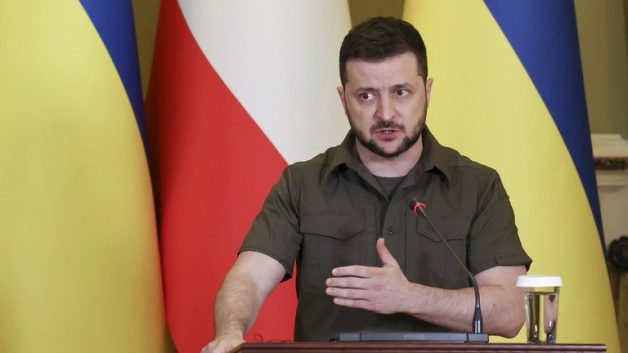
The NYT continues, “But despite the missile strike, one of the deadliest on Ukraine’s railways in recent months, Ukraine stood defiant as the country celebrated its separation from the Soviet Union.” In a slickly produced address earlier in the day, President Volodymyr Zelensky declared Ukraine “reborn” six months after Russia invaded.
Such are the flagrant lies dished out to not only the American people. The European media are equally corrupted. At times even more so.
It gradually emerges that public support for western interference – western support of Ukraine – is fading by the day.
According to a Reuters / Ipsos poll, released on 23 August, still 53% of US adults agree that Washington should support Kiev, “until Russian forces are withdrawn from territory claimed by Ukraine.”. Those with doubts to continue pumping weapons into Ukraine, amount to 37%, and 18% oppose such “aid” altogether. Some 28% are undecided.
Forty percent of Americans now agree with the statement that “the problems of Ukraine are none of our business, and we should not interfere,” comparing with 31% when the same question was asked in April 2022.
The awakening might indicate that fewer and ever fewer people believe the mainstream propaganda – and especially the Zelenskyy statements. The truth of who is killing whom, and the truth about the corrupt and shamefully criminal Ukraine President, is slowly but surely seeping through the veil of deception.
In the case of the attack on the railway station, there is no doubt that the assault was launched by Ukraine’s forces on her own people, killing 22 of them and injuring at least 50. The figures are not verified. They are the ones reported by the “distinguished” NYT (25 August 2022).
Similarly, The Guardian reports (29 July 2022) that according to the Russian Defense Ministry, 40 prisoners were killed and 75 wounded in the attack on the prison in the frontline town of Olenivka. The prison was struck by Ukrainian forces with US-made Himars rockets. Yet, Ukraine was blaming Russia with the attack on its own people and with US-made weapons.
It would be hard to make believe more ludicrous statements. Yet, by telling half-truth or full-lies relentlessly and repeatedly the western media (still) gets away with murder among most of its listeners. But – the Times Are a-Changing.
Russia from the beginning has followed – and keeps following – a strict policy of avoiding civilian casualties as best as possible.
These attacks on Ukraine’s own people are certainly not carried out by Russian forces, but rather by Ukrainian military, and/or their associated Nazi Azov Battalions.
They also killed without scruples tens of thousands of pro-Russian Ukrainians in the Donbass and north-eastern Ukraine areas, since the US/western instigated 2014 Maidan Coup.
No doubt, the attacks were sanctioned by Zelenskyy. He follows clear instructions from NATO and the – unelected European Council. That the EC under Ursula von der Leyen is an unelected and tyrannical executing branch of the Deep State or the Dark elitist Cult, is no longer a secret. Madame von der Leyen is a member of the WEF’s (World Economic Forum) Managing Council.
Similarly, the relentless attacks on the Zaporozhye Nuclear Power Plant in southern Ukraine, the largest in Europe, are constantly blamed on Russia, or even on President Putin personally by the western media.
Again, the contrary is true. In order to prevent another Chernobyl-type nuclear disaster (26 April 1986), or worse, Russian troops have been occupying the Zaporozhye Plant, since March 2022. They were worried, and rightly so, about a nuclear annihilation of much of western Europe and Russia. Finally, on 19 August, Russia has shut down the plant, to limit the worst of a potential disaster.
Moscow has warned that the continuing attacks could ultimately render the power plant inoperable and might even result in a major disaster, similar to Chernobyl. Kiev and some Western officials, however, have accused Russia of shelling the plant, despite the fact that it is controlled by Russia’s own troops.
As unquestioned western support is waning, western media ever so often report the Zelenskyy Government’s accusations of Russia, but finish with the paraphrased observation that “it is difficult to verify the facts” – an own skin-saving-statement.
The next Biden Administration promised shipment of war material is of the order of an estimated US$ 3 billion. Is it part of the roughly US$ 50 billion already approved US war support to Ukraine – or is it apart?
Nobody keeps track. In any case – even western media report that about 70% of the war material sent to Ukraine ends up on the black market. Only about 30% reaches the front-line – and Ukrainian soldiers who are totally unprepared to handle the sophisticated western weaponry.
It is high time that the truth comes out – and the majority of the people see beyond the propaganda, see the most flagrant war crimes committed by Zelenskyy’s Ukraine – and stop supporting this war.
The sooner the west stops sending weaponry and tanks and most sophisticated war materiel to Ukraine, the sooner Peace may return.
If only PEACE were part of the Great Reset’s Agenda – and part of the UN Agenda 2030 – and part of Klaus Schwab’s “4th Industrial Revolution” – meaning the digitization, robotization, and absolute control of everything and every surviving human being. But PEACE, as we are still thinking humans conceive of it, is not part of the Reset Agenda.
But we are many and they are few. We may replace the Reset with the Peace agenda.
Peter Koenig is a geopolitical analyst and a former Senior Economist at the World Bank and the World Health Organization (WHO), where he has worked for over 30 years on water and environment around the world. He lectures at universities in the US, Europe and South America.
Ex-US Intel Chief: FBI Meddling With Biden Laptop Story’s Circulation is ‘Election Interference’
Samizdat – 27.08.2022
Facebook CEO Mark Zuckerberg recently revealed that his social media platform slashed the spread of the Hunter Biden laptop story due to the FBI agents showing up at the company and warning that it was a “Russian propaganda” – something that was later declared untrue despite Democrats peddling a different narrative.
Former Director of National Intelligence John Ratcliffe has slammed the actions of the FBI directed at hushing the Hunter Biden laptop story on Facebook* as “election interference”. In his interview with Fox’s host Tucker Carlson, Ratcliffe said that in its internal discussions, the FBI, its chief Christopher Wray and the DoJ said they did not believe the claims that the story was a “Russian propaganda piece.”
Back at the time, major Democrats, including Chairman of the House Intelligence Committee Adam Schiff, tried to drown the story in “Russia propaganda” allegations after it popped up just weeks ahead of presidential election in 2020. This narrative was picked up by the mainstream media outlets, many of which changed their tune almost two years later, admitting the story was legit.
John Ratcliffe says that to his knowledge the FBI did not believe the story was planted by Russia back in 2020 when it first broke.
And yet, according to Facebook CEO Mark Zuckerberg, the bureau asked the social media platform to hush it up under the pretext of “Russian propaganda.”
“To hear that, contrary to what [FBI Director Christopher Wray] was saying, and the official position of the FBI that agents were acting in contradiction to that in dealings with Facebook or telling – if whistleblowers are to be believed – FBI agents to suppress information about Hunter Biden’s laptop and to amplify damaging information about then-President Donald Trump – that is entirely inconsistent with what we all knew,” Ratcliffe said.
Ratcliffe, who held the post of the Intelligence Director in the days the story unfolded, said he even made an official statement at the time dismissing the allegations regarding Russia’s involvement. Those statements were drowned in Democrats’ cries of Moscow allegedly trying to meddle in the US elections.
The ex-intelligence chief says he was shocked to hear that the FBI actually used the “Russian propaganda” claim to put the Hunter laptop story under wraps, at least on Facebook. Ratcliffe stressed that “a lot of folks” misled the American voters that year with regards to the laptop story, and suggested that what the FBI did might be considered interference in domestic politics.
“Yeah, it is election interference. And the troubling part about this, is the FBI is the primary domestic authority for enforcing election security; making sure that people don’t interfere with the American voters and American elections. And if they’re engaged in election interference, then we’ve got a real problem,” Ratcliffe said.
According to the latest poll, conducted by New Jersey-based Technometrica Institute of Policy and Politics, an overwhelming majority of Americans believe that if the laptop story was not silenced in media and social media, the election outcome might have been different in 2020.
Some 79% thought the “truthful” coverage of the story would have tipped the scales in the 2020 election and a similar percentage say they believe the information on the laptop was authentic. Additionally, 81% of those interviewed believe US Attorney General Merrick Garland should appoint a special counsel, to investigate the trove of the documents found on the laptop and partially published since the story first broke in 2020.
Facebook Hushes Hunter Laptop Story at FBI’s Request
Zuckerberg confessed in “The Joe Rogan Experience” podcast that the FBI agents visited the company after the laptop story broke and said it should be on “high alert” for a “dump [of] Russian propaganda.” The CEO said the company had no reason to doubt the concerns of “a very professional law enforcement” and hence took the warning seriously.
He, however, defended the social media platform, noting that it did not silence the story completely, like Twitter did, and instead slashed its circulation.
The files discovered on the laptop of Hunter Biden shed light on the murky business dealings of the US president’s son in Ukraine and China. One of the emails suggested that he organized an off-the-books meeting between his father and an employee at the Ukrainian company he was working for – Burisma – while Joe Biden was vice president. That contradicted the latter’s claims of never being involved in his son’s business affairs.
A set of stories about Hunter’s dealings in China also allege he held a stake in a joint venture with a Chinese energy company for his father. The stake was only referred to as bein held for “the Big Guy”, but several media alleged it was the US president, while one of Hunter Biden’s associate, Tony Bobulinski, publicly confirmed it was him.
Joe Biden himself never commented or confirmed on his son potentially holding the stake for him in the company tied to the Chinese government, with which Biden negotiated back in his days of vice presidency.
Western Psychological Warfare Apparatus Creates False Beliefs
Tortilla con Sal | August 2022
An increasingly large number of people now agree that information of all kinds in the countries of North America, Europe and their Pacific allies is deployed overwhelmingly to serve the interests of Western corporate oligarchs and the politicians who front for them. Outlets including news media and NGOs, academic and scientific journals as well as international institutions have practically all been fully integrated now into the long standing, global psychological warfare offensive of the West’s ruling classes. At home, they work relentlessly to control the perceptions and behavior of their countries’ populations. Overseas, they seek constantly to mobilize international opinion against countries like Russia and China, governments from Syria to Venezuela, political movements like Hezbollah, and even individuals, like Julian Assange, who resist them.
The main purpose of this vast psychological warfare apparatus is to create false beliefs which over time harden into false memories. The process consolidates ruling class control domestically while also facilitating their present and future crimes of aggression around the world. Populations in the West are deliberately misinformed and misled by means of plausible misrepresentation, blatant distortion, systematic omission and downright lies. Categories of information such as journalism, academic and scientific research, investigation by NGOs or briefings from international institutions have all been deformed, distorted and devalued by their abuse so as to further the domestic and global interests of the Western oligarchies.
Since long before 20th Century public relations and psychology, the fundamental way to manipulate mass consciousness, from the Holy Inquisition to the enthronement of Science, has been to encourage submission to authority. The Milgram experiment is a notorious example, although, in one respect, itself a cause for optimism. Other more insidious means sow ruling class messaging among otherwise trusted contrary sources. Concentrated corporate control of information and communications resources has made possible mutual constant universal reinforcement between all varieties of mass media and information outlets. Like magicians, governments and corporations understand very well that suppressing resistance depends on disappearing contrary information by every means possible, including censorship, mass distraction and sensory overload.
An apparently hardly noticed corollary of this systematic perversion of good faith reporting, research and investigation has been a collapse of rationality. In Western public life, it is now effectively forbidden to compare and contrast rival versions of events which contradict the general received wisdom propagated by Western government and corporate approved information outlets. So political and intellectual argument in North America and Europe has become ever more narcissistic, self-serving and ultimately irrational. This applies also to supposedly progressive or even radical outlets which in their coverage of international affairs still depart from essentially neocolonial assumptions of Western superiority.
Over the last fifteen years or so a growing number of independent writers and reporters have sought to challenge the false information spread by well coordinated and concentrated corporate and government controlled networks of mutually reinforcing information outlets. This development has notably sharpened the relation between information and class. More clearly than ever the production and distribution of information has become a vast theater of propaganda operations controlled by a multinational intellectual managerial class with shared imperatives. They promote and enforce a class monopoly of access to information outlets for producers of information and similarly a corresponding monopoly of distribution outlets, both mainstream and ostensibly alternative, for its consumption.
All production and distribution of information involves some variety of reporting which, like any other human activity, can be good or bad. Reporting in general has always been an arena of competing interests and rationalities. But, even so, fundamental components of competent reporting have generally been held to include, among other things, recording first hand accounts of events, clearly sourcing those accounts, presenting trustworthy data and documentary evidence, offering provenance of those sources, acknowledging loyalties and bias while considering competing rival versions, making the reporting accessible and frankly submitting all this material to free and open scrutiny.
It is certainly debatable when contemporary reporting began its categorical collapse into the current gross, unrelenting pyschological warfare offensive by North American and European oligarchies against their own peoples and the majority world. However, the rapidly increasing numbers of independent reporting outlets signal the reality of that collapse and also help reveal its class nature, its class nuances and its irrationality. The currently developing fierce efforts by the West’s ruling oligarchs to repress and censor independent reporting confirm the wholesale abandonment of rationality by Western societies and their leaders. A principal criterion for appraising rationality in an individual or a society is precisely their ability and self-confidence in making a case against rival arguments.
Attempts at outright censorship, or the many other kinds of arbitrary intellectual and cultural repression deployed, represent a failure to be able to reason effectively, to promote consensus or to accommodate legitimate dissent. This collapse of reason and its accompanying deformation of self-confidence into dismissal and exclusion are self-evident in the routine reporting practice and editorial policies of the managers controlling academic and scientific production and the propaganda theater most people still like to call journalism, among the board members and staff of influential non governmental organizations, among the personnel of international institutions and also among the managerial class controlling artistic and cultural production.
Given the intense concentration of political and economic power among the Western oligarchs who have successfully conspired to control all these sectors, the resulting general unanimity of presuppositions among their respective subaltern intellectual and cultural managerial classes is as much to be expected as their complete lack of accountability. Anyone openly challenging or contradicting received wisdom is marginalized and ostracised in what is a truly authentic class warfare waged by North American and European oligarchs against their own peoples and the majority world.
In response, as a class phenomenon, the proliferation of independent reporting outlets reflects not just underlying genuine popular outrage at being permanently misled. It is also a correspondingly authentic, resilient grassroots challenge to the status quo. Conventional liberal or social democrat opinion gauges the authenticity of independent reporting by the criteria of financial and/or editorial independence. But a low budget is no guarantee of integrity and a genuinely independent information outlet may or may not be ideologically aligned with a foreign political movement or government. Under contemporary conditions a more authentic criteria of reporting independence is the degree of legitimate defence of governments and peoples who are victims of the crimes of Western ruling elites.
Truly independent reporting takes this position while at the same time using conventional reporting norms to cover issues and events Western mainstream and alternative media obfuscate or conceal. Doing so necessarily endows genuinely independent reporting outlets, regardless of their political allegiances, with class characteristics by the very nature of their readiness to expose contradictions in accounts of events and issues produced by corporate capitalist information outlets. Paradoxically or not, class solidarity with the victims of imperialist crimes becomes the principal criteria of reporting independence both in terms of what is reported and too how it is reported. For the moment, that means being in solidarity with the world’s peoples defending their basic rights against Western ruling class aggression.
This text was produced by Stephen Sefton with research by Lauren Smith and comments from others.
US Drones Flying in Afghan Airspace, Taliban Says as Group Yet to Confirm Death of al-Zawahiri
Samizdat – 25.08.2022
Afghanistan on Thursday accused the US of flying drones over its territory without official permission.
Taliban spokesman Zabiullah Mujahid said his government raised the issue with the US as it considers operating drones without its consent to be an act of aggression.
The spokesman also mentioned that the alleged killing of Ayman al-Zawahiri, leader of the al-Qaeda network, is still a claim, and “the investigation has not yet been finalized.”
On August 1, US President Joe Biden announced that Zawahiri was killed in a “precision” strike in Kabul, where the terrorist mastermind had, as Washington claimed, moved to “reunite with members of his immediate family.”
Under the Doha peace deal which was struck between the US and the Taliban in 2020, the group reportedly agreed not to allow al-Qaeda or any other extremist group to operate in areas under their control.
According to media reports, al-Zawahiri had been in charge of the terror group al-Qaeda since 2011.
Mossad Likely Behind Salman Rushdie Stabbing: Denver Professor
Al-Manar | August 23, 2022
The last week’s stabbing of novelist Salman Rushdie, the author of a sacrilegious anti-Islam book may have been orchestrated by the Mossad, suggested Nader Hashemi, Director of the Center for Middle East Studies at the University of Denver.
In a Saturday interview with Negar Mortazavi, host of the Iran Podcast, Hashemi questioned the timing of the attack, highlighting what he believed to be two possible explanations.
Hashemi said that one possibility is that Iran wanted to take vengeance on the United States for the 2020 assassination of IRGC general Qassem Suleimani in a drone strike at Baghdad Airport.
Another possibility, Hashemi said, adding that he believes this is more likely, is that Rushdie’s attacker, Hadi Matar, had been convinced to commit the attack by a Mossad agent masquerading as an IRGC operative or supporter.
“That so-called person online claiming to be affiliated with the Islamic Republic of Iran could’ve been a Mossad operative.”
“The other possibility, which I actually think is much more likely, is that this young man Hadi Matar was in communication with someone online who claimed to be an Islamic Revolutionary Guard Corps member or supporter and lured him into attacking Salman Rushdie and that so-called person online claiming to be affiliated with the Islamic Republic of Iran could’ve been a Mossad operative.”
Hashemi went on to suggest that the Zionist entity’s motive for carrying out a false flag operation would be to galvanize opposition to the ongoing efforts of world powers to revive the 2015 nuclear agreement.
“Israel has taken a very strong position against reviving the Iran nuclear agreement,” he said. “We were in very sensitive negotiations, like an agreement was imminent, and then the attack on Salman Rushdie takes place. I think that’s one possible interpretation and scenario that could explain the timing of this at this moment during these sensitive political discussions related to Iran’s nuclear program.”
The Completely Fraudulent “Levelized Cost Of Electricity”
By Francis Menton | Manhattan Contrarian | August 18, 2022
My last post on Tuesday reported on the Soho Forum climate change debate that had taken place the previous day. Debater Andrew Dessler, arguing in favor of rapid reductions in human greenhouse gas emissions by the method of vastly increasing electricity production from wind and solar generators, had heavily relied on the assertion that wind and solar are now the cheapest ways to generate electricity. An important slide in his presentation showed comparative costs of generation from various sources, with wind and solar clearly shown as least expensive. At the bottom of the slide, the acronym “LCOE” was legible.
LCOE stands for Levelized Cost of Electricity. I first encountered this term a couple of years ago, and thought that I should get on top of it to understand its significance. It took me about a half hour to figure out that this metric was completely inapplicable and invalid for purposes of comparing the costs of using dispatchable versus non-dispatchable generators as the predominant sources to power an electrical grid that works. The reasons are not complicated, but do take some minutes of thought if the matter has not previously been explained to you. In Tuesday’s post, I asked as to Dessler’s reliance on this LCOE metric:
[I]s he aware of this [inapplicability of LCOE] and therefore intentionally trying to deceive the audience? Or, alternatively, is he innumerate, and does not understand how this works quantitatively?
Some commenters on the post were quite harsh in their judgments of Dessler. They argued for the inference of intentional deception, on the basis that no one claiming expertise in this field could really be so obtuse as to think LCOE was a valid metric for the purpose for which Dessler was using it.
So today I thought to look at how others go about comparing the costs of generation of electricity from wind and solar versus dispatchable sources like fossil fuels or nuclear. I can’t say that I was surprised to learn that LCOE is everywhere as the metric of choice for the comparison. Moreover, it is almost impossible to find any discussion of why LCOE is completely misleading when comparing the cost of a grid powered predominantly by dispatchable sources to the cost of a grid powered predominantly by intermittent wind and solar sources backed up by storage.
Consider, for example, the International Renewable Energy Agency, going by the acronym IRENA. IRENA is a UN offshoot, launched in 2009 and based in Abu Dhabi, that currently has 168 member countries including all the big ones. IRENA’s mission is to advocate for and promote “renewables” as the way to go for the world’s energy system. Surely, with all the big countries (and most of the small ones) backing its efforts, IRENA’s utterances can be relied upon as definitive.
IRENA puts out annual reports on the costs of renewable power generation. The latest one, titled “Renewable Power Generation Costs in 2021,” just came out in July. Here is the press release, dated July 13, 2022. Excerpt from the press release:
New IRENA report shows almost two-thirds of renewable power added in 2021 had lower costs than the cheapest coal-fired options in G20 countries. . . . IRENA’s new report confirms the critical role that cost-competitive renewables play in addressing today’s energy and climate emergencies by accelerating the transition in line with the 1.5°C warming limit and the Paris Agreement goals. . . . “Renewables are by far the cheapest form of power today,” Francesco La Camera, Director-General of IRENA said. “2022 is a stark example of just how economically viable new renewable power generation has become.”
Amid the excited claims that renewables are “by far the cheapest” sources of power, the term LCOE does not appear anywhere in the press release. To find that that is the metric being used to make these “by far the cheapest” claims, you need to go to the main Report. Excerpt:
The global weighted average levelised cost of electricity (LCOE) of new utility-scale solar PV projects commissioned in 2021 fell by 13% year-on-year, from USD 0.055/kWh to USD 0.048/kWh. . . . The global weighted average LCOE of new onshore wind projects added in 2021 fell by 15%, year-on-year, from USD 0.039/kilowatt hour (kWh) in 2020 to USD 0.033/kWh.
Here is the featured chart, showing that costs of power from solar PV cells have now fallen well below the costs of power from natural gas:
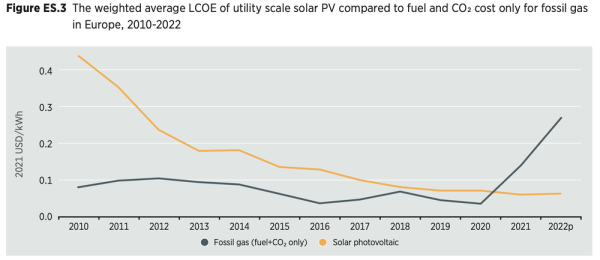
You can see right there that here in 2022 power from natural gas is at least three times as expensive as power from solar PV cells. But the title of the chart gives away that the metric for comparison is LCOE.
Look around for others making cost comparisons of ways to produce electricity, and you will find more and more of same. From Bloomberg, June 30, 2022, “Renewable Power Costs Rise, Just Not as Much as Fossil Fuels”:
The costs for renewable plants plunged for a decade as production of solar and wind equipment surged and technologies improved, but the supply-chain chaos triggered by the pandemic ended those steady declines last year, according to BNEF’s biannual survey of the levelized cost of energy. . . . New onshore wind now costs about $46 per megawatt-hour, while large-scale solar plants cost $45 per megawatt-hour. In comparison, new coal-fired plants cost $74 per MWh, while gas plants are $81 per MWh.
From the Guardian, June 23, 2021 (citing last year’s report from IRENA — also based on LCOE):
Almost two-thirds of wind and solar projects built globally last year will be able to generate cheaper electricity than even the world’s cheapest new coal plants, according to a report from the International Renewable Energy Agency (Irena). . . . Francesco La Camera, Irena’s director general, said . . . “ “Today renewables are the cheapest source of power.”
So it’s not just Dessler. Some big international agency of “experts” adopts LCOE for making these cost comparisons, and everybody just nods along without ever putting in the 30 or so minutes of critical thinking that would be needed to figure out that this is completely wrong.
To reiterate points previously made, the LCOE metric assumes that wind and solar generators are essentially the same kind of thing as dispatchable fossil fuel-powered generation plants. Just build about the same amount of nameplate capacity, and everything will work out just fine. But in fact a predominantly wind/solar system requires vastly more infrastructure to make a fully-functioning reliable grid: some combination of a 4x or 5x overbuild of generators, vastly more transmission lines, and 20 or 30 days of battery storage. These elements could easily multiply the cost of electricity to the consumer by a factor of 5 or 10 or more. Nobody knows, because there is no functioning demonstration project from which reasonably precise costs can be extrapolated. And frankly, there never will be such a demonstration project, because the costs are so enormous that it can never be done. Meanwhile, everyone just nods along as if LCOE comparisons are meaningful.
Dr. Robert Malone sues The Washington Post who accused him of spreading “misinformation” online
By Christina Maas | Reclaim The Net | August 22, 2022
Dr. Robert Malone, an expert in mRNA technology and a vocal Covid vaccines critic who has been consistently censored by Big Tech, is suing the Washington Post for defamation. The lawsuit alleges that the news outlet made defamatory statements against him in an article published on January 24.
The article claimed that Dr. Malone spread “misinformation” in a speech where he said the vaccines “are not working” against the Omicron variant. As evidence the statement was false, the Post cited a paper by the CDC that found that booster shots were protecting people against severe disease.
The Post omitted the part where Dr. Malone said that vaccines, “do not prevent Omicron infection, viral replication, or spread to others.”
Speaking to The Epoch Times, Dr. Malone said: “I said nothing about disease and death at that point in time.” He went on to accuse the Post of selective misquoting and using the CDC study to counter a claim he never made.
The Epoch Times obtained an interview between the article’s writer, Timothy Bella and Dr. Malone, before the article was written. Bella told Dr. Malone, “I have respect for you and your body of work,” and that he was hoping to shadow the doctor during his stay in DC where he gave a speech at a protest against Covid mandates.
Malone initially sent a notice to the Post threatening legal action if the article was not removed or the defamatory statements retracted. When the outlet refused, he filed a lawsuit at a federal court in Virginia.
According to the lawsuit, the article made 10 defamatory statements against Dr. Malone, including that he has been “discredited,” his claims are “not only wrong, but also dangerous,” and that he “repeated falsehoods that have garnered him legions of followers.”
We obtained a copy of the complaint for you here.
“The qualities WaPo disparaged—Dr. Malone’s honesty, veracity, integrity, competence, judgment, morals, and ethics as a licensed medical doctor and scientist—are peculiarly valuable to Dr. Malone and are absolutely necessary in the practice and profession of any medical doctor and scientist. WaPo ascribes to Dr. Malone conduct, characteristics, and conditions, including fraud, disinformation, misinformation, deception, and dishonesty, that would adversely affect his fitness to be a medical professional and to conduct the business of a medical doctor,” the suit states.
“Dr. Malone’s statements concerning COVID-19 and the purported ‘vaccines’ were 100% factually accurate. He has never committed fraud on [sic] engaged in any medical disinformation or misinformation. Further, the so-called ‘vaccines’ do not work, as is abundantly clear from both the scientific and anecdotal evidence to date,” it also says.
Dr. Malone is also currently involved in a lawsuit against Twitter over its censorship.
Tel Aviv hiding evidence of ethnic cleansing of Palestinians from public: Israeli media
The Cradle | August 22, 2022
According to a report by Hebrew newspaper Haaretz released on 22 August, Tel Aviv has been working through its defense ministry to hide historical documents related to the founding of the state of Israel, from the Israeli public.
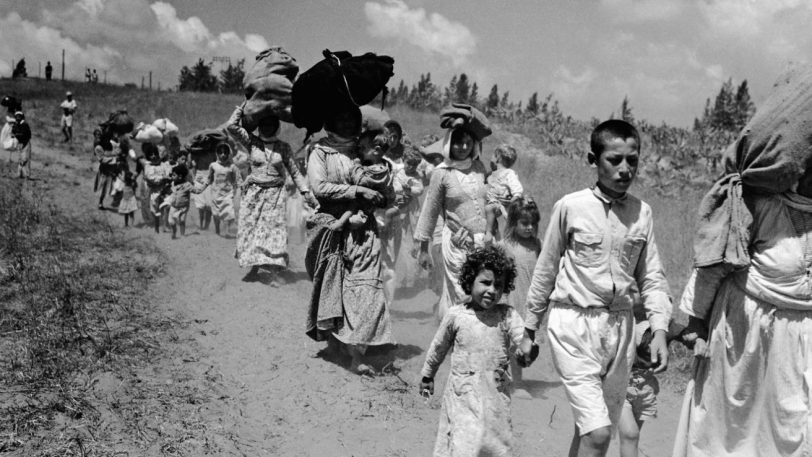
The founding of Israel in 1948, known throughout the Arab world as the “Nakba,” or catastrophe, involved the ethnic cleansing and mass expulsion of Palestinians from their land by ultra-nationalist Jewish gangs.
These gangs were later integrated into the Israeli military.
The documents contain details on Israel’s killing of civilians, as well as the erasure of entire Palestinian villages. Israel is undergoing “a systematic process to conceal evidence of the Nakba,” Haaretz reveals.
The report states that efforts to hide these documents have been carried out by the Directorate of Security of the Defense Establishment, a secret department in the Israeli Defense Ministry known as the Malmab, “whose work and budget are secret.”
Members of the Malmab reportedly “worked without any legal authority, even in some cases [hiding] documents that the military censor had previously allowed to be published,” Haaretz revealed.
The report also details that government officials, including members of the Israeli Knesset, who by law are allowed access to such archives, were barred from viewing the documents in question.
A settlement was reached in which the Israeli Treasury would send requests in order for archived documents to be examined for disclosure. The Malmab apparatus would then search through them thoroughly to determine if they can be published alongside Israel’s accessible archives, despite already being accessible by Israeli law.
Haaretz reported that the Malmab were also working to hide documents relating to Tel Aviv’s nuclear program.
“If the state admitted … that the documents were hidden without authority, why did it not insist on their immediate disclosure?” the report asks.
The report concludes by saying that Israel has to “get rid of the twisted habit it has adopted of concealing its past from the public … the public has the right to know the history of the country in which it lives, and also to discover its less pleasant aspects.”
Despite the events of the Nakba being common historical knowledge, Israel’s attempt to hide these documents represents its policy of trying to control the perception of the Israeli public.
Israel is known to have attempted hiding the atrocities of its past.
On 8 July, Hebrew media revealed the existence of a mass grave under the parking lot of a tourist attraction in Israel, where the bodies of dozens of Egyptian soldiers burned alive by Israeli forces were buried during the 1967 Arab–Israeli War, also known as the Six-Day War.
For over five decades, Tel Aviv kept the secret of the mass grave, never attempting to return the bodies to their homeland.
Additionally, Israel has been secretly building a nuclear arsenal for several decades – owning around 40 to 800 nuclear warheads which it denies having – while criticizing Tehran over its nuclear program.
MEET THE EX-CIA AGENTS DECIDING FACEBOOK’S CONTENT POLICY
By Alan Macleod | MintPress News | July 12, 2022
It is an uncomfortable job for anyone trying to draw the line between “harmful content and protecting freedom of speech. It’s a balance”, Aaron says. In this official Facebook video, Aaron identifies himself as the manager of “the team that writes the rules for Facebook”, determining “what is acceptable and what is not.” Thus, he and his team effectively decide what content the platform’s 2.9 billion active users see and what they don’t see.
Aaron is being interviewed in a bright warehouse-turned-studio. He is wearing a purple sweater and blue jeans. He comes across as a very likable, smiley person. It is not an easy job, of course, but someone has to make those calls. “Transparency is incredibly important in the work that I do,” he says.
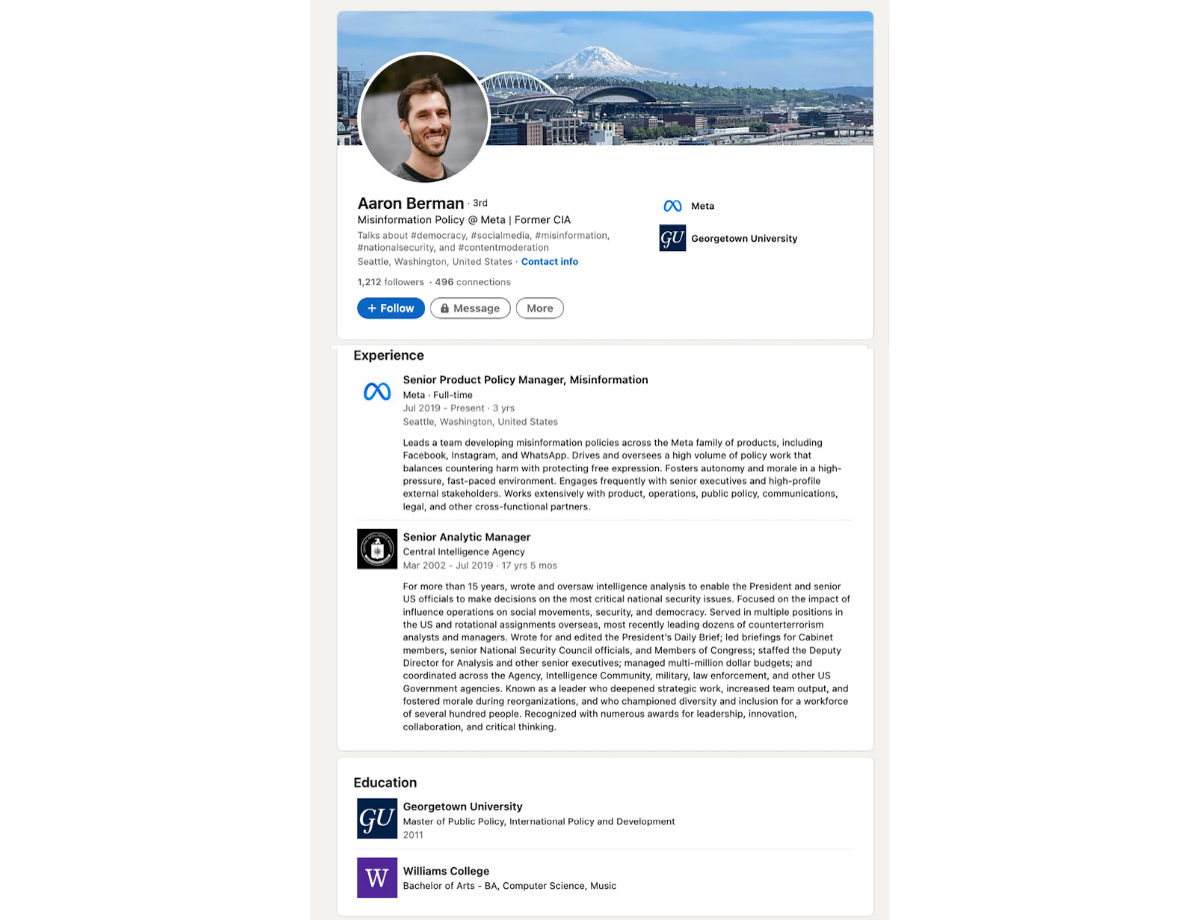
Aaron is CIA. Or at least he was until July 2019, when he left his job as a senior analytic manager at the agency to become senior product policy manager for misinformation at Meta, the company that owns Facebook, Instagram and WhatsApp. In his 15-year career, Aaron Berman rose to become a highly influential part of the CIA. For years, he prepared and edited the president of the United States’ daily brief, “wr[iting] and overs[eeing] intelligence analysis to enable the President and senior U.S. officials to make decisions on the most critical national security issues,” especially on “the impact of influence operations on social movements, security, and democracy,” his LinkedIn profile reads. None of this is mentioned in the Facebook video.
Berman’s case is far from unique, however. Studying Meta’s reports, as well as employment websites and databases, MintPress has found that Facebook has recruited dozens of individuals from the Central Intelligence Agency (CIA), as well as many more from other agencies like the FBI and Department of Defense (DoD). These hires are primarily in highly politically sensitive sectors such as trust, security and content moderation, to the point where some might feel it becomes difficult to see where the U.S. national security state ends and Facebook begins.
In previous investigations, this author has detailed how TikTok is flooded with NATO officials, how former FBI agents abound at Twitter, and how Reddit is led by a former war planner for the NATO think tank, the Atlantic Council. But the sheer scale of infiltration of Facebook blows these away. Facebook, in short, is utterly swarming with spooks.
TRUST ME, BRO
In a political sense, trust, safety and misinformation are the most sensitive parts of Meta’s operation. It is here where decisions about what content is allowed, what will be promoted and who or what will be suppressed are made. These decisions affect what news and information billions of people across the world see every day. Therefore, those in charge of the algorithms hold far more power and influence over the public sphere than even editors at the largest news outlets.
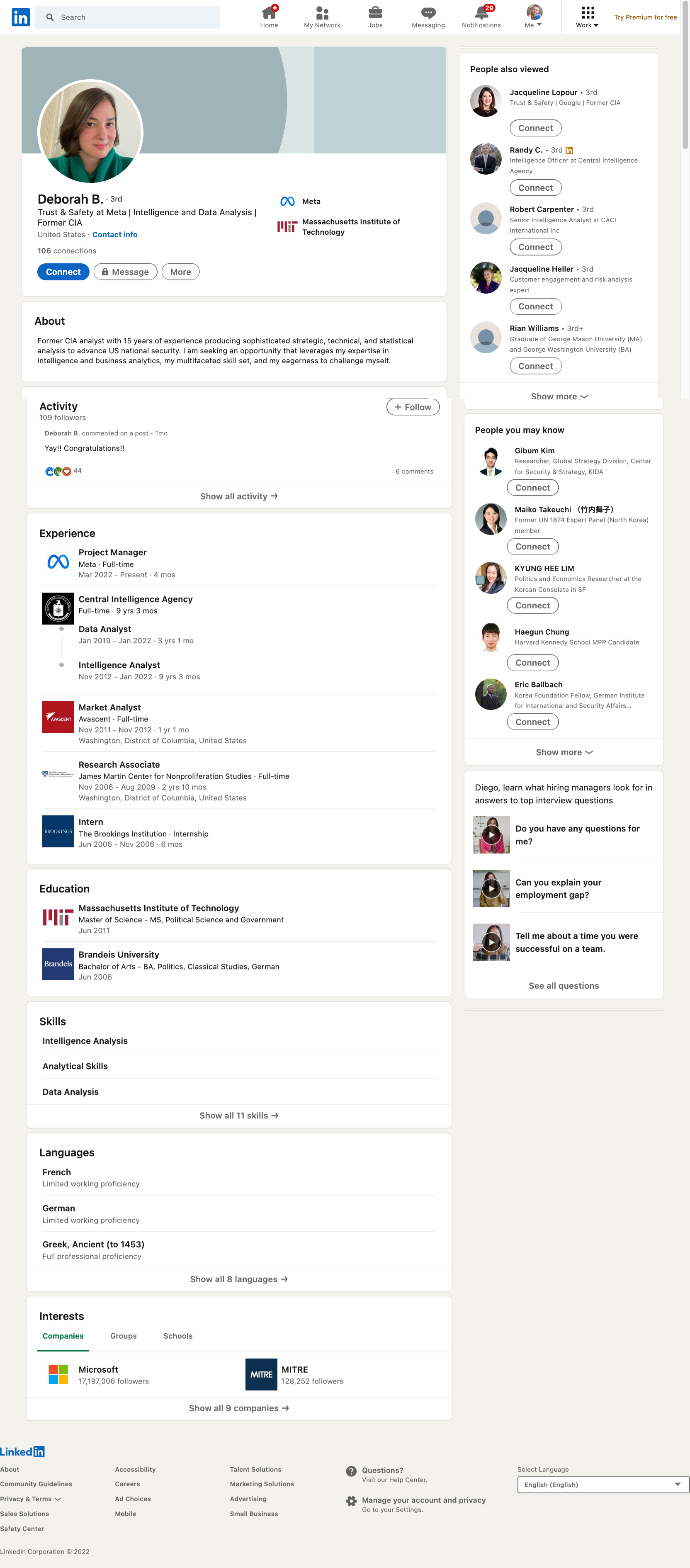
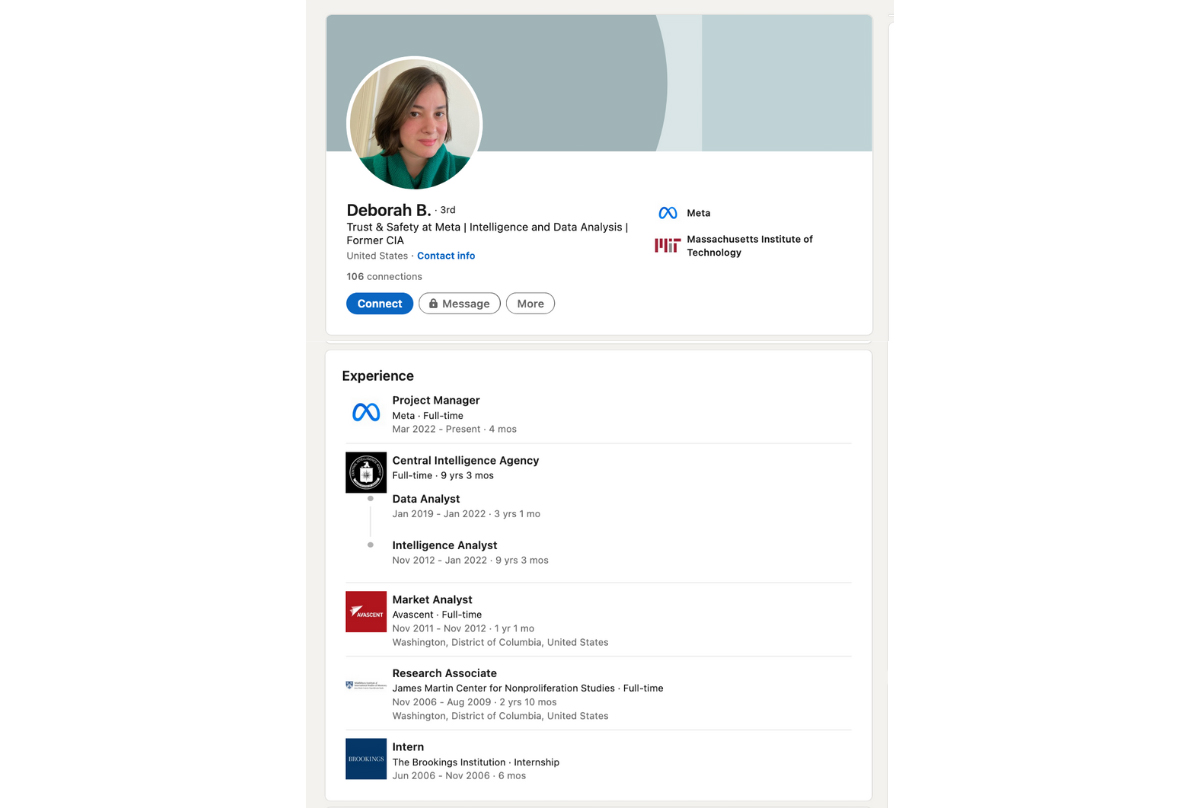
There are a number of other ex-CIA agents working in these fields. Deborah Berman, for example, spent 10 years as a data and intelligence analyst at the CIA before recently being brought on as a trust and safety project manager for Meta. Little is known about what she did at the agency, but her pre-agency publications indicate she was a specialist on Syria.
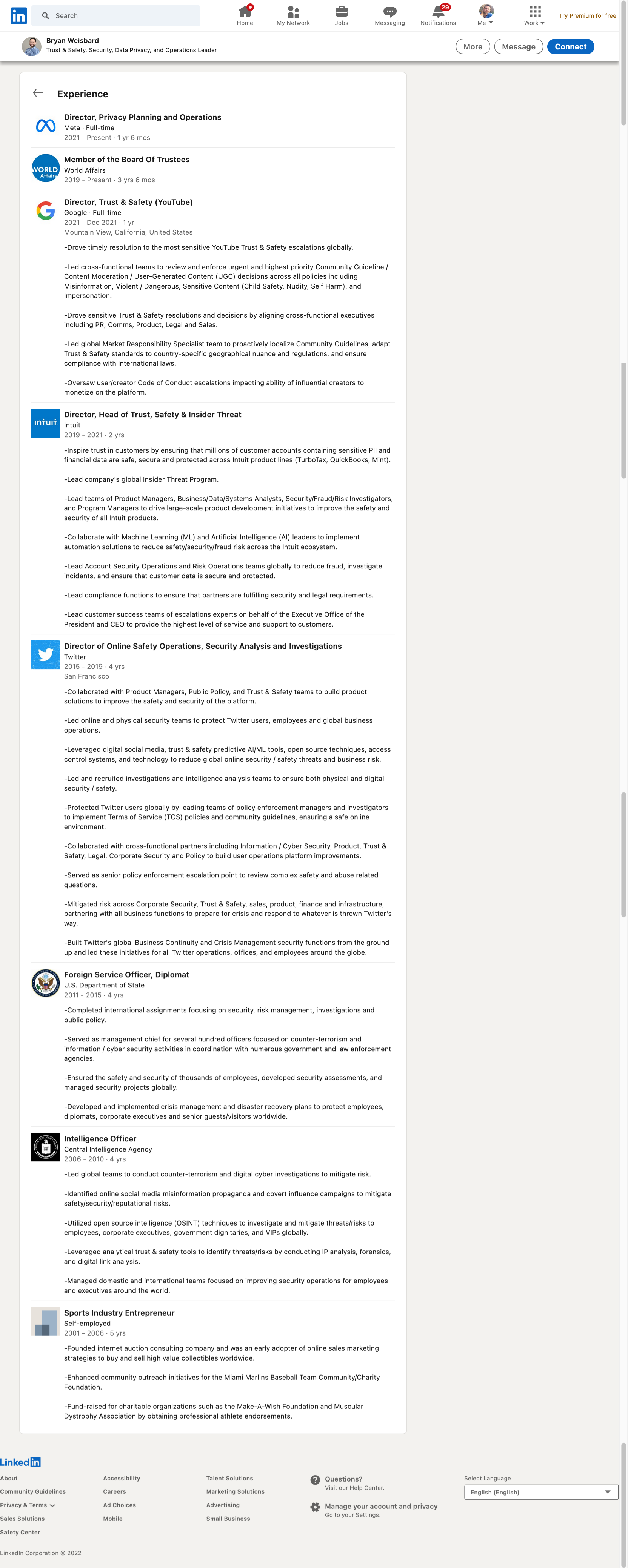
Between 2006 and 2010, Bryan Weisbard was a CIA intelligence officer, his job entailing, in his own words, leading “global teams to conduct counter-terrorism and digital cyber investigations,” and “Identif[ying] online social media misinformation propaganda and covert influence campaigns”. Directly after that, he became a diplomat (underlining how close the line is between those two professions), and is currently a director of trust and safety, security and data privacy for Meta.
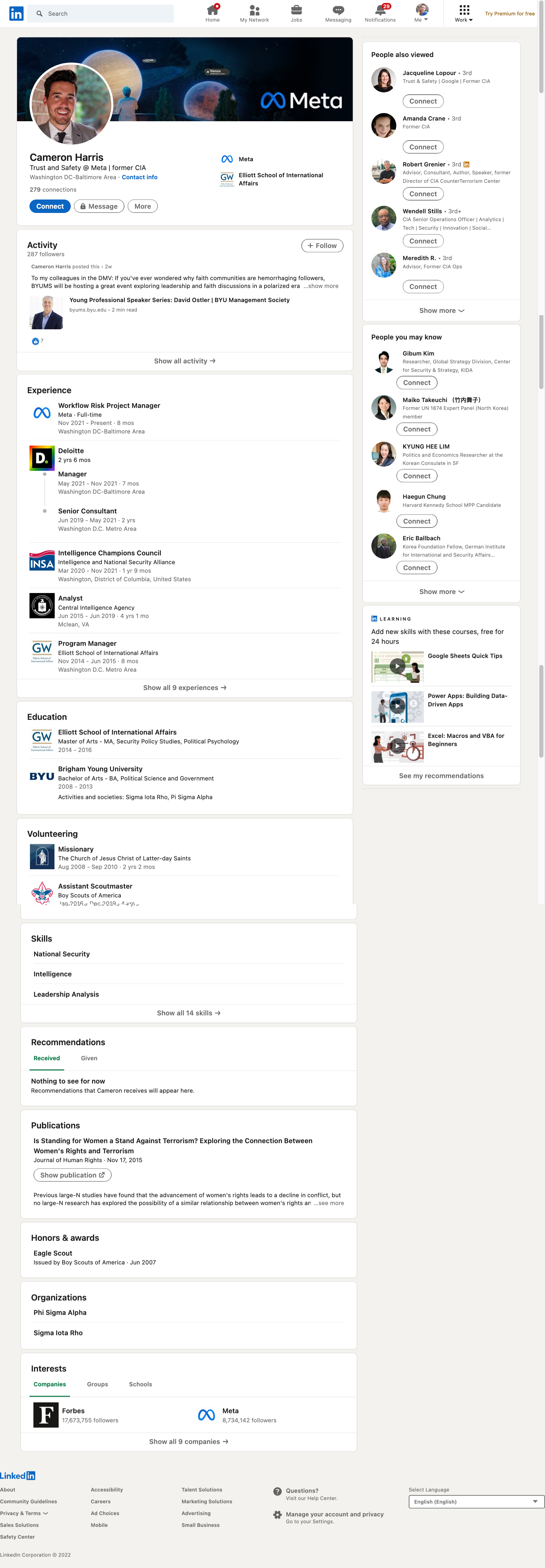
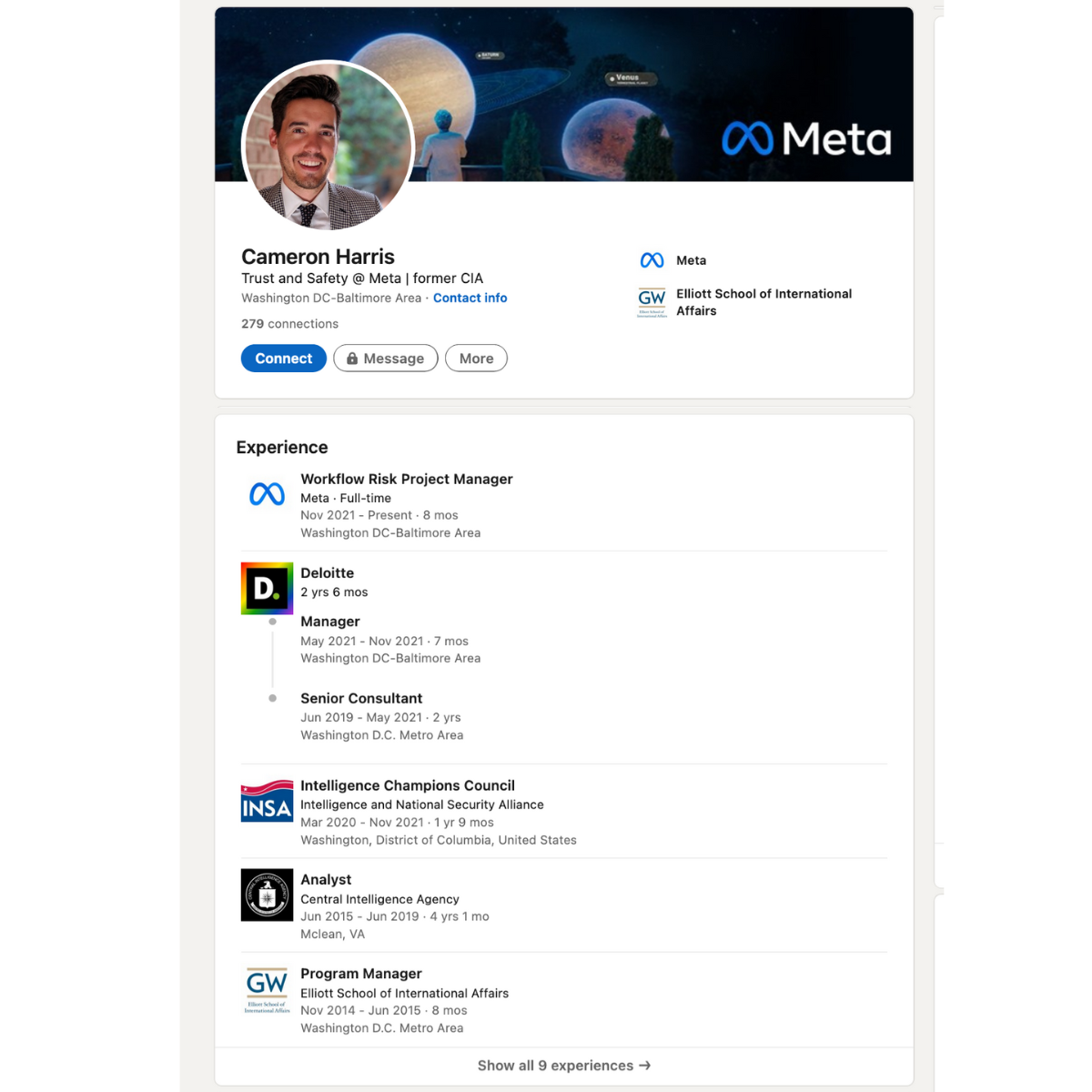
Meanwhile, the LinkedIn profile of Cameron Harris – a CIA analyst until 2019 – notes that he is now a Meta trust and safety project manager.
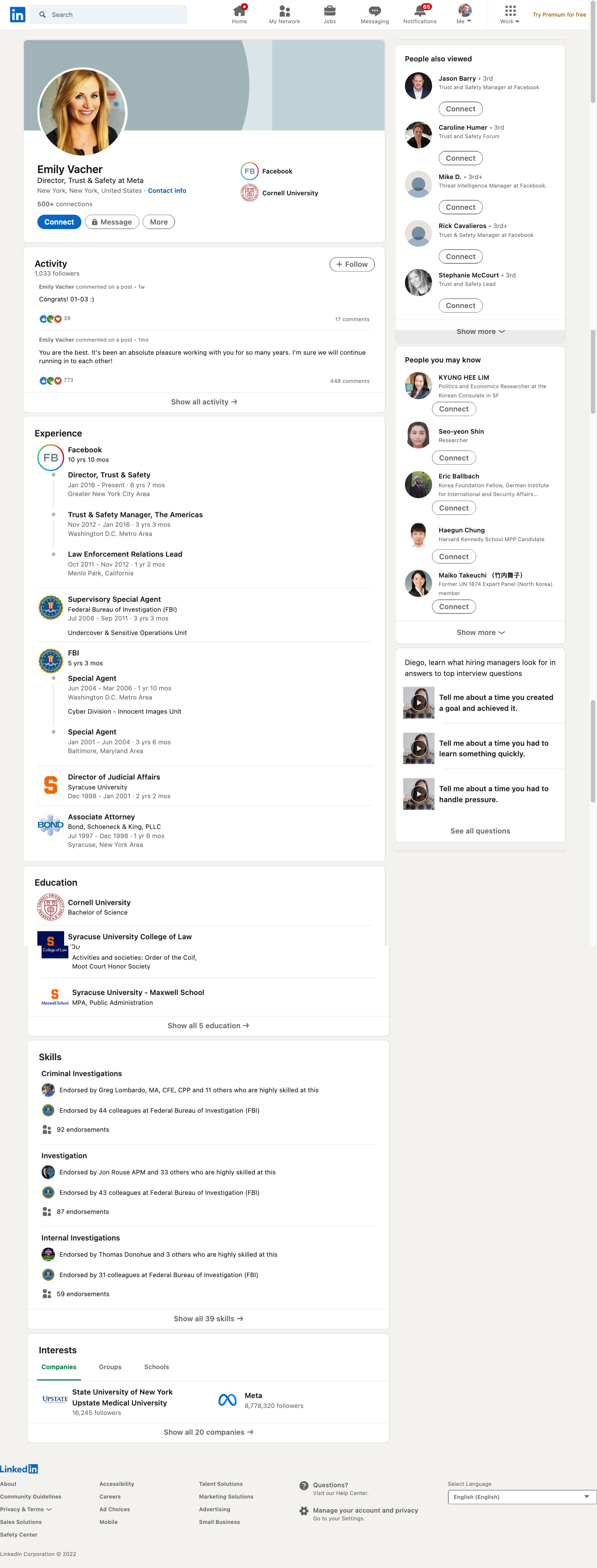
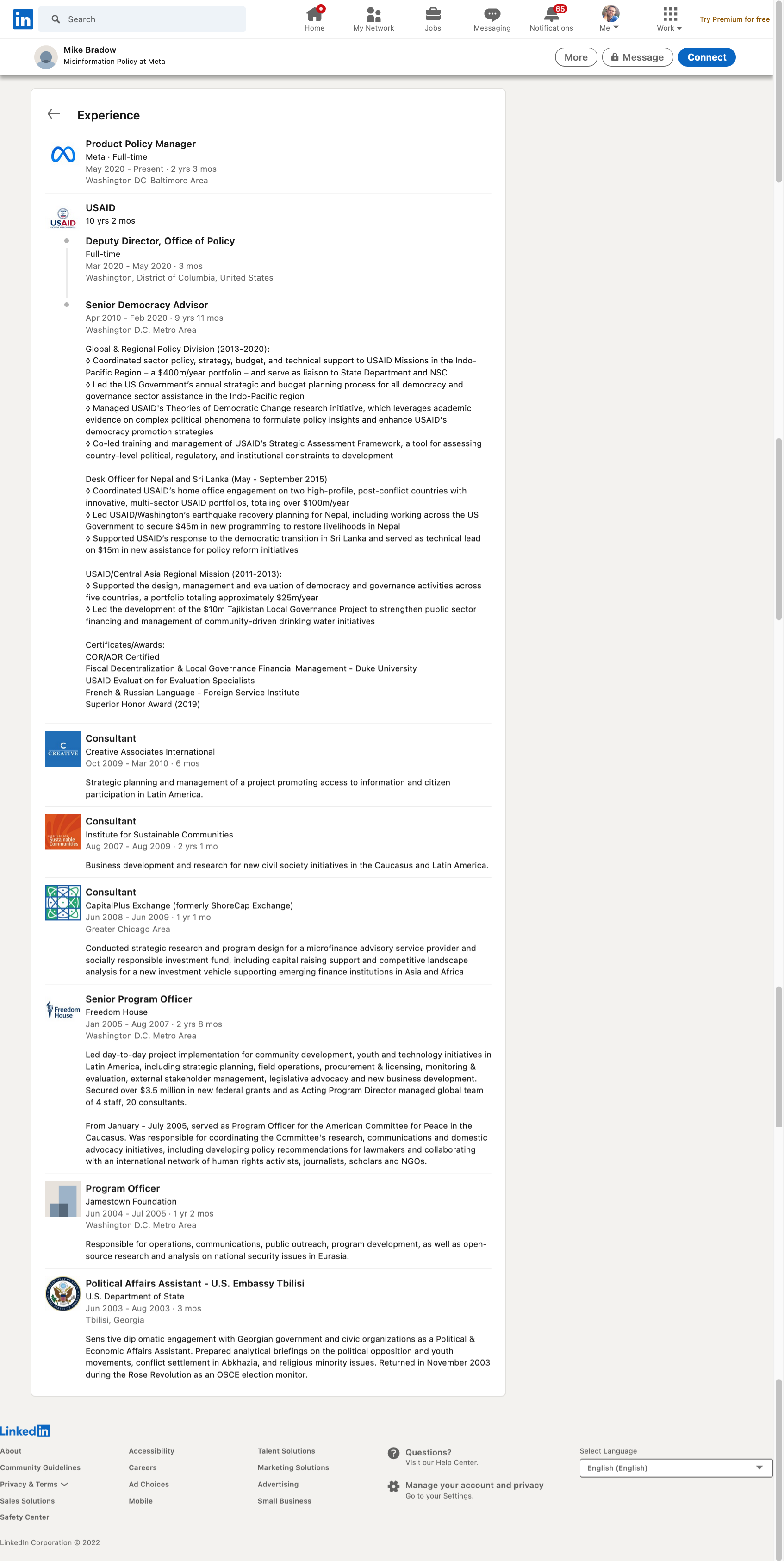
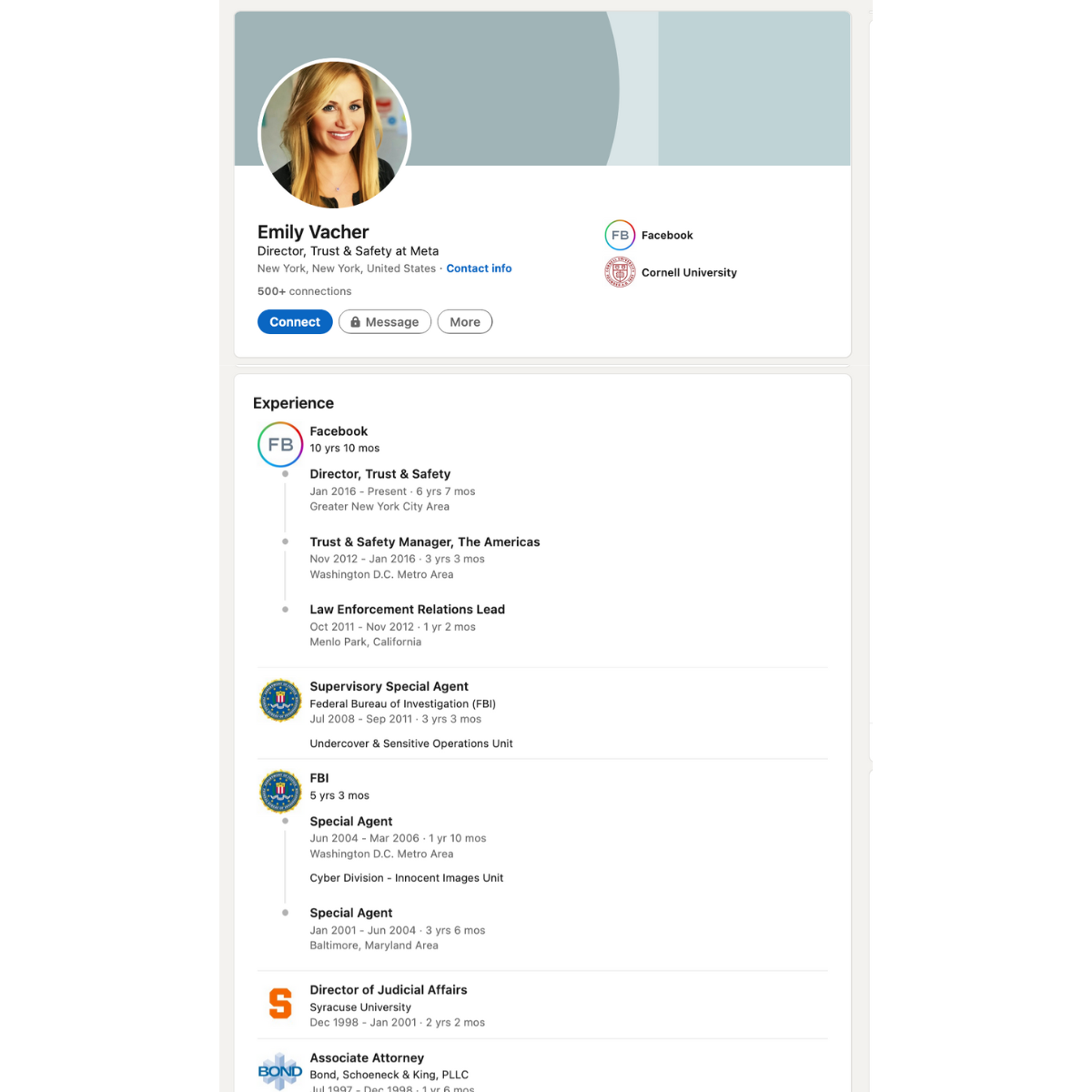
Individuals from other state institutions abound as well. Emily Vacher was an FBI employee between 2001 and 2011, rising to the rank of supervisory special agent. From there she was headhunted by Facebook/Meta, and is now a director of trust and safety. Between 2010 and 2020, Mike Bradow worked for USAID, eventually becoming deputy director of policy for the organization. USAID is a U.S. government-funded influence organization which has bankrolled or stage managed multiple regime change operations abroad, including in Venezuela in 2002, Cuba in 2021, and ongoing attempts in Nicaragua. Since 2020, Meta has employed Bradow as a misinformation policy manager.
Others have similar pasts. Neil Potts, a former intelligence officer with the U.S. Marine Corps, is vice president of trust and safety at Facebook. In 2020, Sherif Kamal left his job as a program manager at the Pentagon to take up the post of Meta trust and safety program manager.
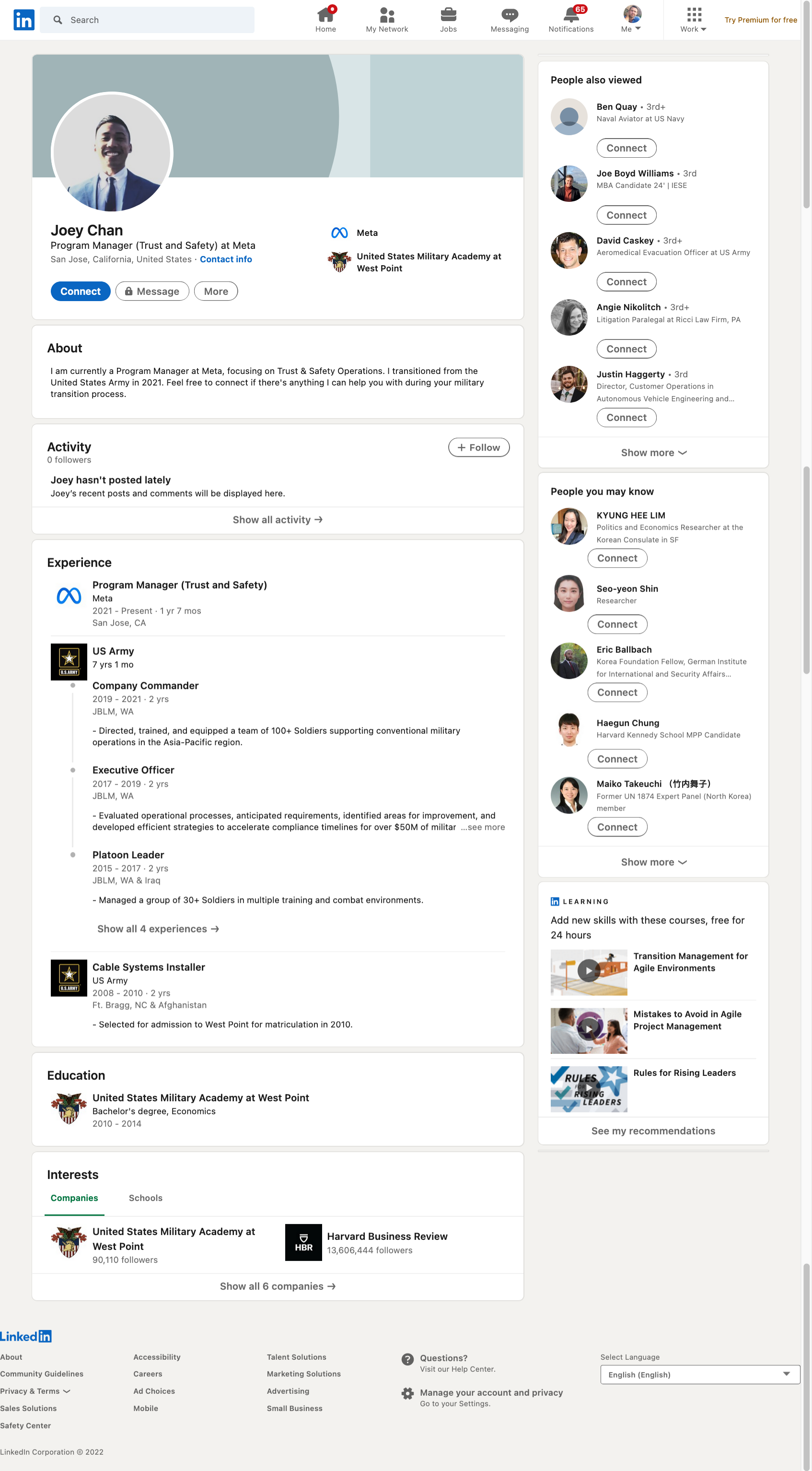
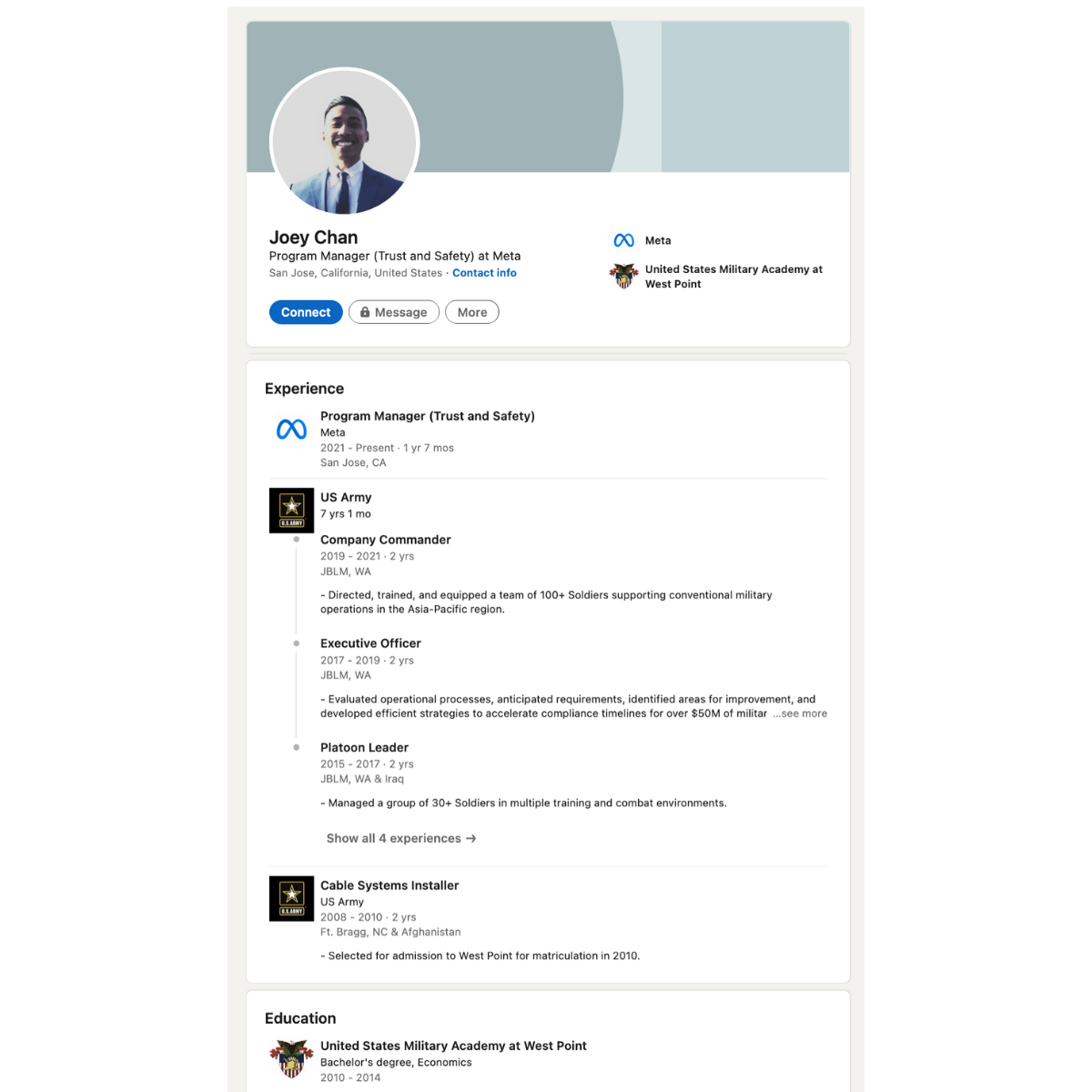
Joey Chan currently holds the same trust and safety post as Kamal. Until last year, Chan was a U.S. Army officer commanding a company of over 100 troops in the Asia Pacific region.
None of this is to say that any of those named are not conscientious, that they are bad people or bad at their job. Vacher, for example, helped design Facebook’s amber alert program, notifying people to missing children in their area. But hiring so many ex-U.S. state officials to run Facebook’s most politically sensitive operations raises troubling questions about the company’s impartiality and its proximity to government power. Meta is so full of national security state agents that at some point, it almost becomes more difficult to find individuals in trust and safety who were not formerly agents of the state.
Despite its efforts to brand itself as a progressive, “woke” organization, the Central Intelligence Agency remains deeply controversial. It has been charged with overthrowing or attempting to overthrow numerous foreign governments (some of them democratically elected), helping prominent Nazis escape punishment after World War Two, funnelling large quantities of drugs and weapons around the world, penetrating domestic media outlets, routinely spreading false information and operating a global network of “black sites” where prisoners are repeatedly tortured. Therefore, critics argue that putting operatives from this organization in control of our news feeds is deeply inappropriate.
One of these critics is Elizabeth Murray, who, in 2010, retired from a 27-year career at the CIA and other U.S. intelligence organizations. “This is insidious,” Murray told MintPress, adding,
I see it as part of the gradual and sinister migration of ambitious young professionals originally trained (with CIA’s virtually unlimited, U.S.-taxpayer funded pot of resources) to surveil and target ‘the bad guys’ during the so-called Global War on Terror of the post-9-11 era.”
MintPress also contacted Facebook/Meta for comment but has not received a response.
ARM’S LENGTH CONTROL
Some may ask what the big fuss is. There is a limited pool of individuals with the necessary skills and experience in these new tech and cybersecurity fields, and many of them come from government institutions. Casinos, after all, regularly hire card sharks to protect themselves. But there is little evidence that this is a poacher-turned-gamekeeper scenario; Facebook is certainly not hiring whistleblowers. The problem is not that these individuals are incompetant. The problem is that having so many former CIA employees running the world’s most important information and news platform is only one small step removed from the agency itself deciding what you see and what we do not see online – and all with essentially no public oversight.
In this sense, this arrangement constitutes the best of both worlds for Washington. They can exert significant influence over global news and information flows but maintain some veneer of plausible deniability. The U.S. government does not need to directly tell Facebook what policies to enact. This is because the people in decision-making positions are inordinately those who rose through the ranks of the national security state beforehand, meaning their outlooks match those of Washington’s. And if Facebook does not play ball, quiet threats about regulation or breaking up the company’s enormous monopoly can also achieve the desired outcomes.
Again, this article is not claiming that any of the named individuals are nefarious actors, or even that they are anything but model employees. This is a structural problem. Put another way, if Facebook were hiring dozens of managers from Russian intelligence agencies like the FSB or GRU, everybody would recognize the inherent dangers. It should be little different when it hires individuals from the CIA, an organization responsible for some of the worst crimes of the modern era.
FROM STATE INTELLIGENCE TO PRIVATE INTELLIGENCE
Facebook has also hired a plethora of ex-national security state officers to run its intelligence and online security operations. Until 2013, Scott Stern was a targeting officer at the CIA, rising to become chief of targeting. In this role, he helped select the targets for U.S. drone strikes across South and West Asia. Today, however, as a senior manager of risk intelligence for Meta, “misinformation” and “malicious actors” are his targets. Hopefully he is more accurate at Facebook than at the CIA, where the government’s own internal assessments show that at least 90% of Afghans killed in drone strikes were innocent civilians.
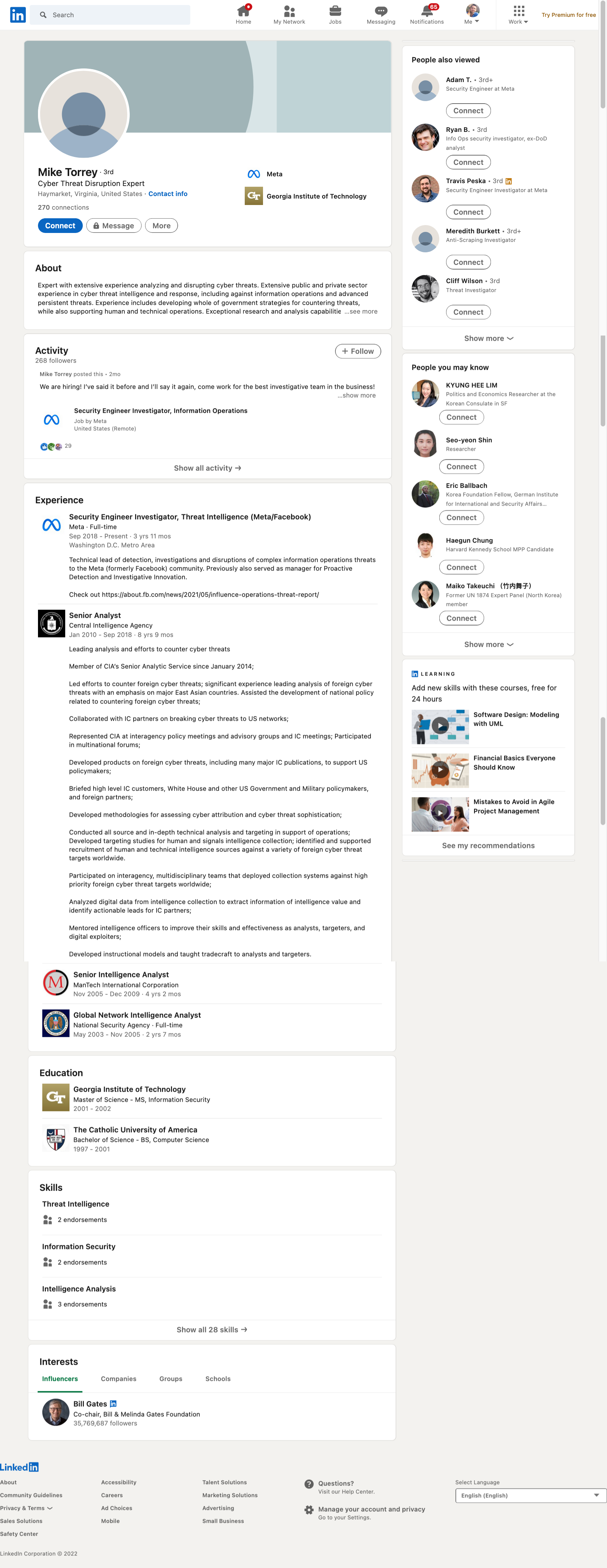
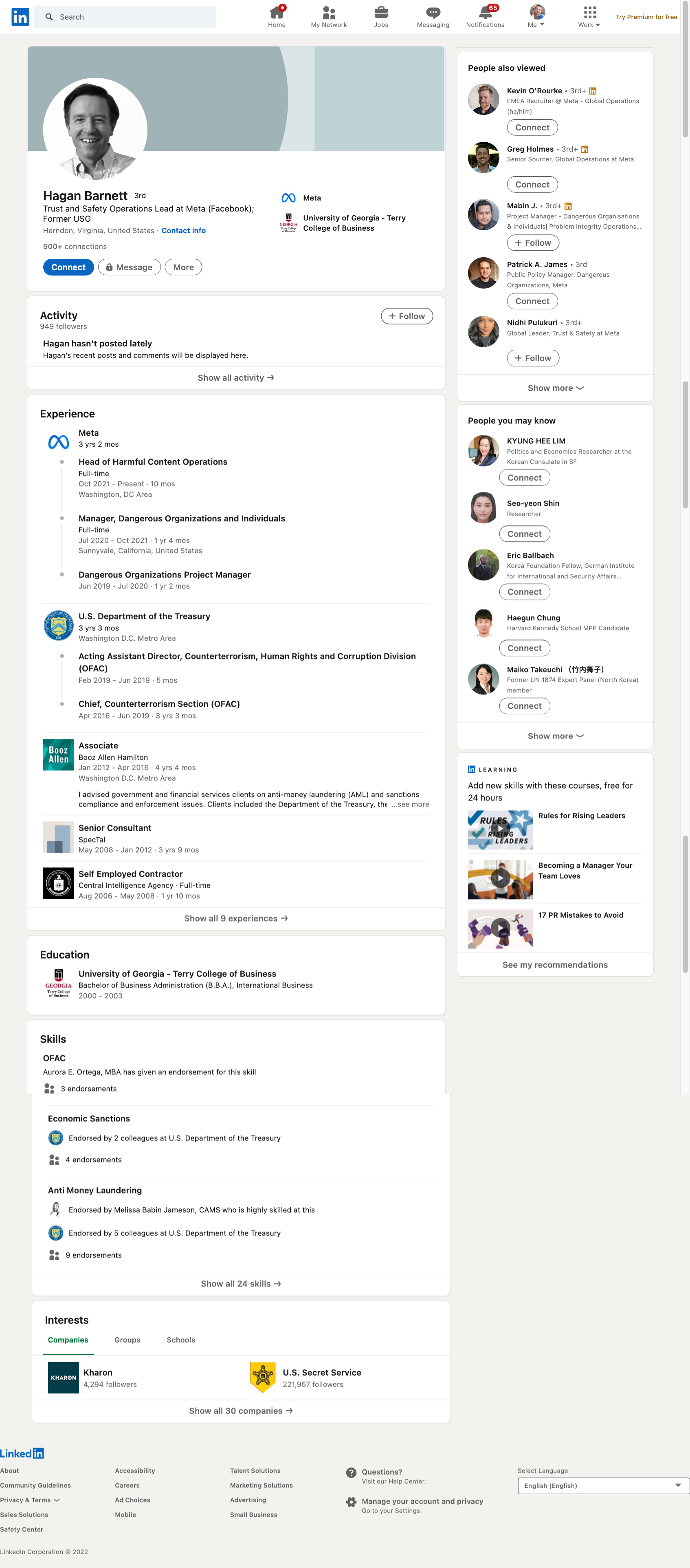
Other former CIA men at Facebook include Mike Torrey, who left his job as a senior analyst at the agency to become Meta’s technical lead of detection, investigations and disruptions of complex information operations threats, and former CIA contractor Hagan Barnett, who is now head of harmful content operations at the Silicon Valley giant.
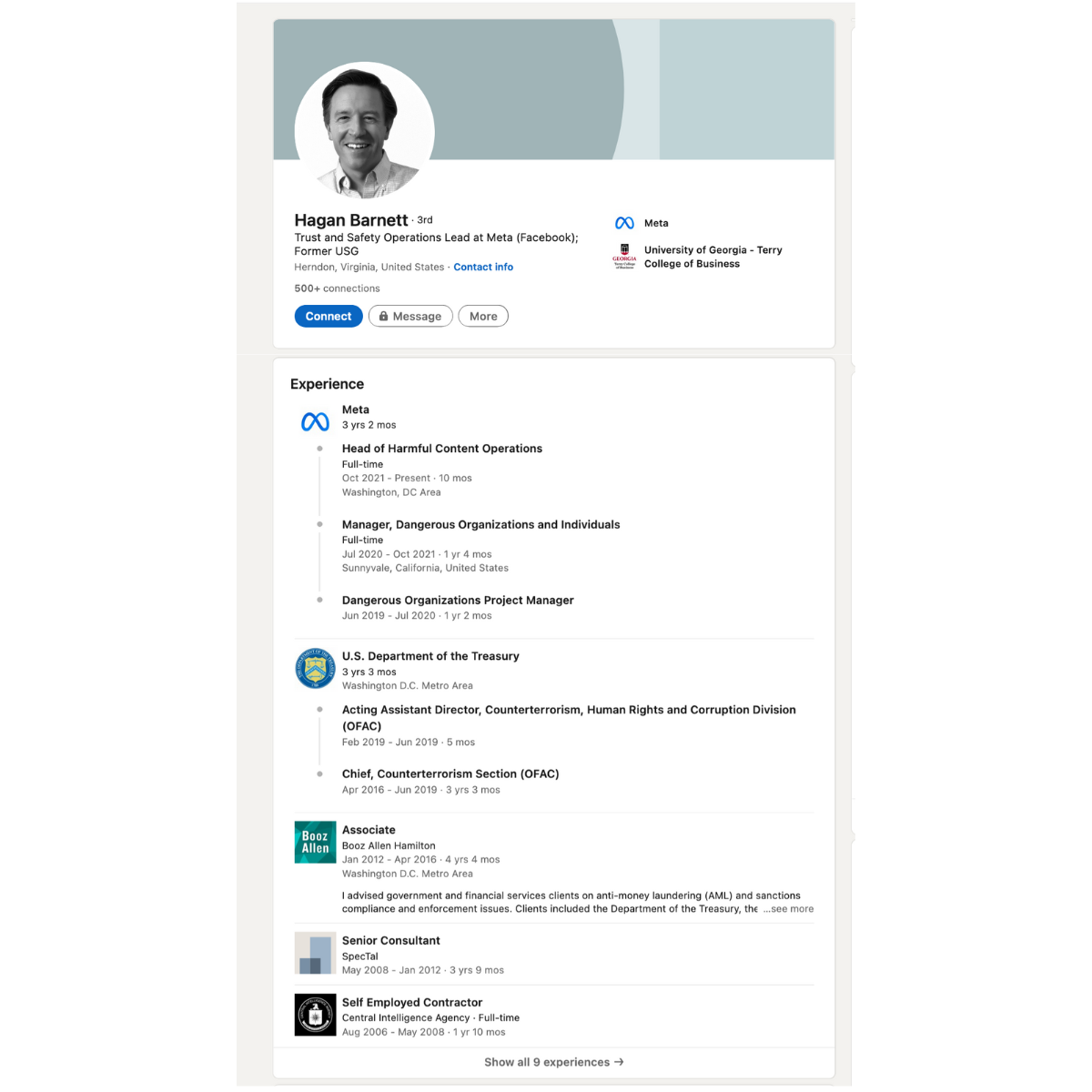 Meta’s intelligence and online security team includes individuals from virtually every government agency imaginable. In 2015, Department of Defense intelligence officer Suzanna Morrow left her post to become director of global security intelligence for Meta. The FBI is represented by threat investigations manager Ellen Nixon and head of cyber espionage investigations Mike Dvilyanski. Facebook’s influence operations policy manager Olga Belogolova had stints at the State Department and the Office of the Secretary of Defense.
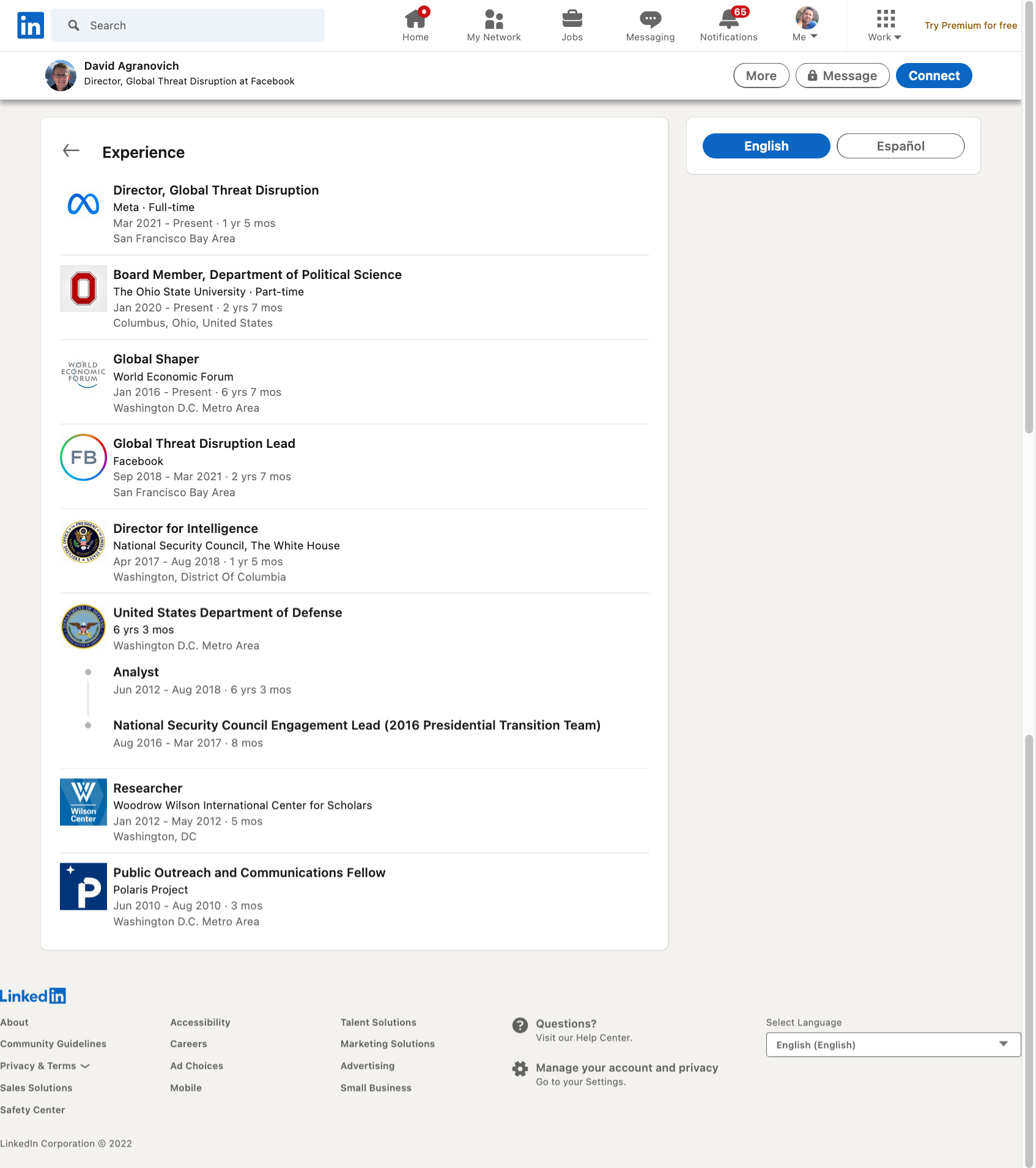
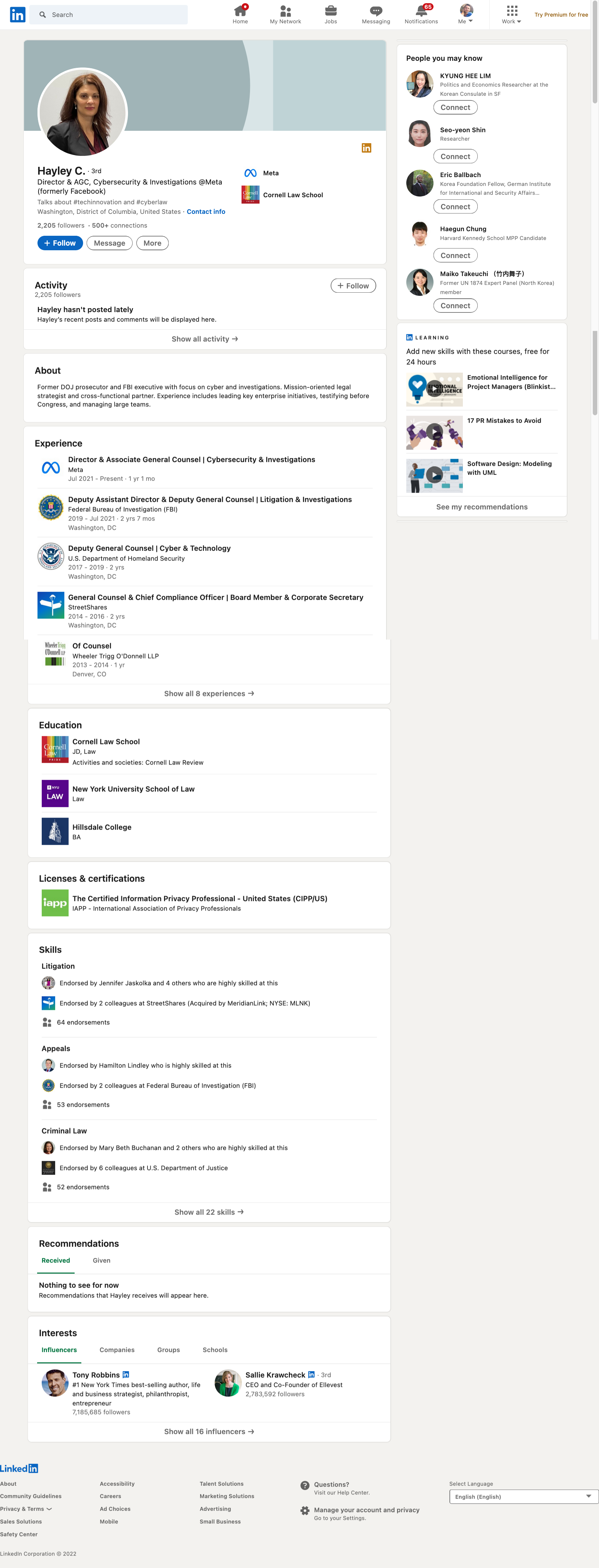
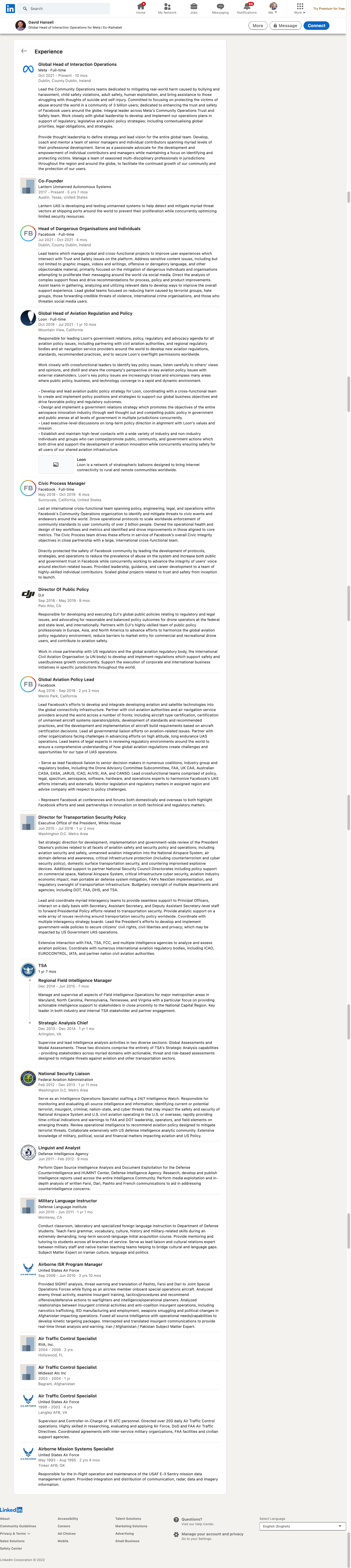
Before Meta, David Agranovich and Nathaniel Gleicher both worked for the National Security Council. Agranovich is director of global threat disruption at Facebook while Gleicher is head of security policy. Hayley Chang, director and associate general counsel for cybersecurity and investigations, worked formerly for both the FBI and Department of Homeland Security. And Meta’s global head of interaction operations, David Hansell, was once an Air Force and Defense Intelligence Agency man.

One of Meta’s most outwardly-facing employees is its global threat intelligence lead for influence operations, Ben Nimmo, a character MintPress has covered before. Between 2011 and 2014, he served as NATO’s press officer, moving the next year to the Institute for Statecraft, a U.K. government-funded propaganda operation aimed at spreading misleading information about enemies of the British state. He was also a senior fellow at the Atlantic Council, NATO’s semi-official think tank.
Perhaps then, it is not surprising that Facebook never seems to find U.S. government influence operations online – they are part of one!
CYBER WAR, CYBER WARRIORS
While Meta has not unmasked any nefarious U.S. government action, it regularly uncovers what it claims are foreign disinformation campaigns. According to a recent Facebook report, the top five locations of coordinated inauthentic behavior between 2017 and 2020 on its platform are Russia, Iran, Myanmar, the United States and Ukraine. However, it was at pains to note that American operations were driven by fringe far-right elements, white supremacists and conspiracy theorists, and not the government.
This is despite the fact that it is now well-established that the Pentagon fields a clandestine army of at least 60,000 people whose job is to influence public opinion, the majority of them doing so from their keyboards. A Newsweek exposé from last year called it “The largest undercover force the world has ever known,” adding,
The explosion of Pentagon cyber warfare, moreover, has led to thousands of spies who carry out their day-to-day work in various made-up personas, the very type of nefarious operations the United States decries when Russian and Chinese spies do the same.”
Newsweek warned that this army was likely breaking both U.S. and international law by doing so, explaining that,
These are the cutting-edge cyber fighters and intelligence collectors who assume false personas online, employing ‘nonattribution’ and ‘misattribution’ techniques to hide the who and the where of their online presence while they search for high-value targets and collect what is called ‘publicly accessible information’—or even engage in campaigns to influence and manipulate social media.”
As far back as 2011, The Guardian was reporting on this enormous cyber force, whose job it was to “secretly manipulate social media sites by using fake online personas to influence internet conversations and spread pro-American propaganda.” Yet the ex-military and ex-CIA officials Facebook employs do not seem to have found any trace of their former colleagues’ at work on the platform.
DIGITALLY SWINGING ELECTIONS
Since its beginnings in 2004, Facebook has grown to become a massive global empire and by far the most important news distributor the planet has ever known. The company boasts almost 3 billion active users, meaning that nearly 2 in 5 people worldwide use the platform. A recent 12-country study suggested that around 30% of the entire world gets its news via their Facebook feeds. This gives whoever is in charge of curating those feeds and controlling those algorithms inestimable power. It also represents a serious national security threat for all other countries, especially those that might wish to take a path independent from the United States. That those people are in large part former spooks makes this threat all the more perilous.
This is far from a hypothetical quandary. In November, less than a week before the country’s election, Facebook took the decision to delete hundreds of pages and accounts belonging to individuals and groups that supported the Nicaraguan Sandinista party – a longtime U.S. target for regime change. These included many of the nation’s most influential journalists and media outlets. Considering that around half of the country uses the platform for news and entertainment, the decision could barely have been more intrusive, and was likely designed to try to swing the election towards the pro-U.S. candidate.
Facebook claims that those accounts were bots engaged in “inauthentic behavior.” When those individuals migrated on to Twitter, recording videos identifying who they were to show they were not bots, Twitter immediately deleted those accounts too, in what was dubbed a coordinated attempt at suppression.
The individual behind this attempt was the aforementioned Ben Nimmo, who co-authored an unconvincing report, full of questionable assumptions and allegations. This included an insinuation that accounts following a pattern of activity whereby their Facebook usage levels peaked in the morning and afternoon and dwindled to almost nothing after midnight Nicaragua time suggested they were bots.
Facebook was also used by right-wing Cubans to attempt a U.S.-backed color revolution against the ruling Communist government last year.
Giving any individual or group that much control over the airwaves of communication raises huge questions about national security and sovereignty – doubly so when those individuals are so intimately connected to the U.S. national security state.
When asked what the public’s reaction would be to the news of such an intimate connection between Facebook her former employer, Murray stated that she was unsure whether many would be bothered:
I would like to think that the American public would strenuously object. However the CIA and other agencies have worked over many decades to cultivate a positive – indeed almost glamorous – image in the eyes of the vast majority of the public, mostly through TV series, Hollywood films, and favorable media coverage – so sadly my guess is that the vast majority of the public probably believes that these are the folks who should be in charge.”
However, she said, the news would likely land a very different way in countries that have been the target of Washington’s ire. “As you’re no doubt aware, the CIA has an atrocious public reputation in most parts of the world,” she added.
SPOOKS IN EVERY DEPARTMENT
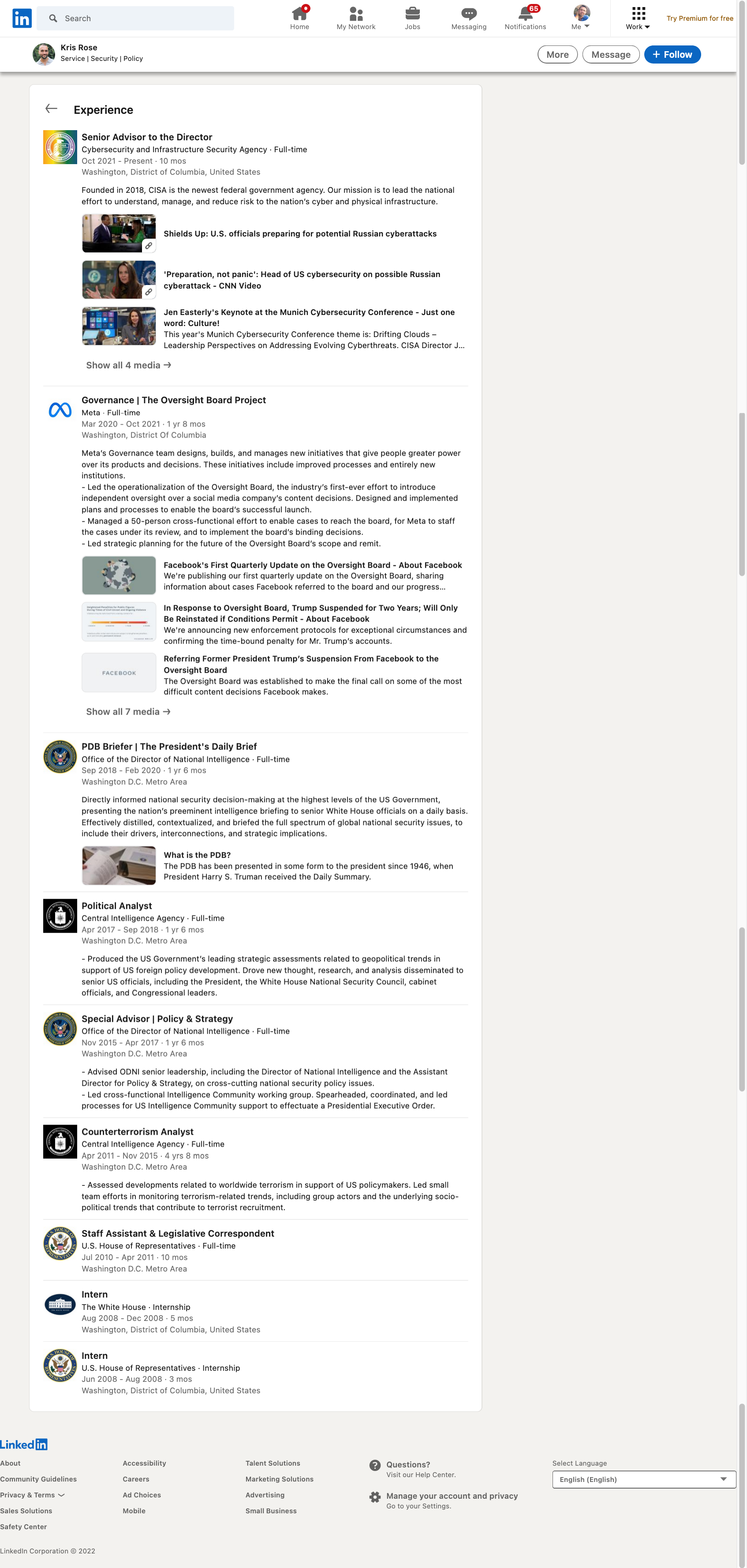
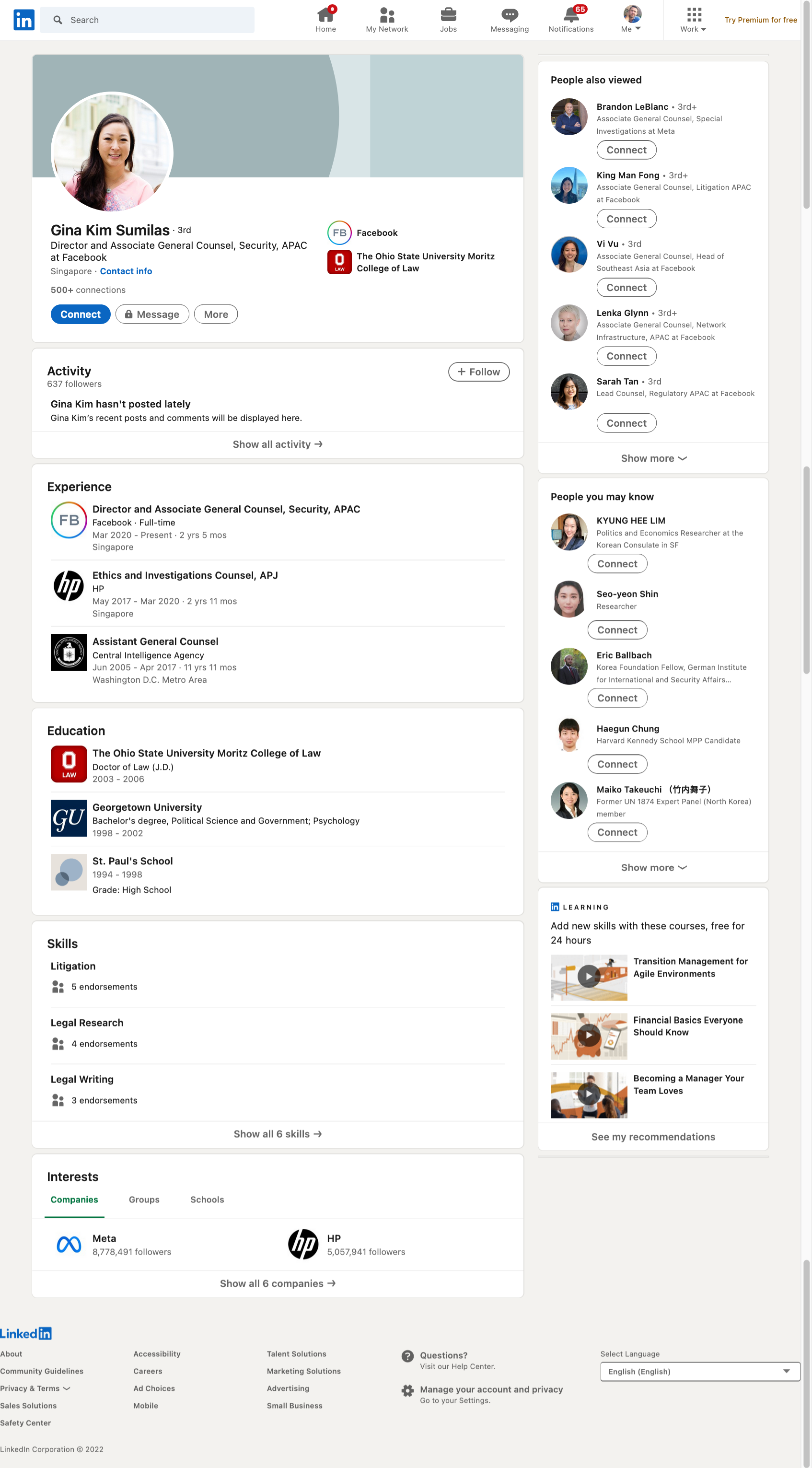
MintPress has found former representatives of the U.S. national security state in virtually every politically sensitive department at Facebook. This includes even higher levels. Between 2020 and 2021, Kris Rose was a member of Meta’s governance oversight board – the group responsible for the overall direction of the platform. He left his job at the Director of National Intelligence as the president’s daily brief writer to take up the role. Before that, he had spent six years at the CIA as a political and counterterrorism analyst. Meanwhile, Gina Kim Sumilas, Facebook’s director and associate general counsel for the Asia Pacific region, spent nearly twelve years in the CIA before moving into the tech private sector.
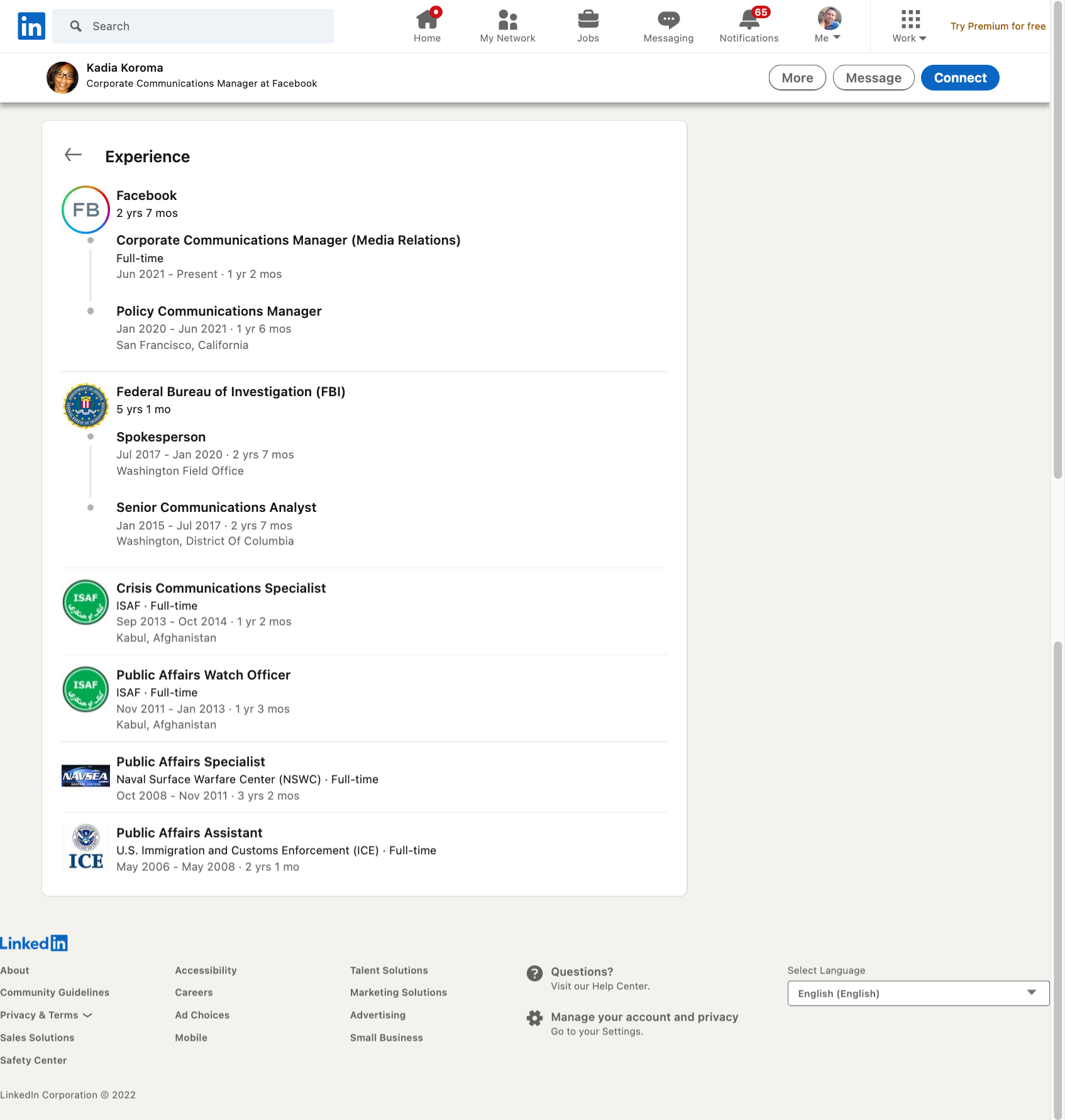
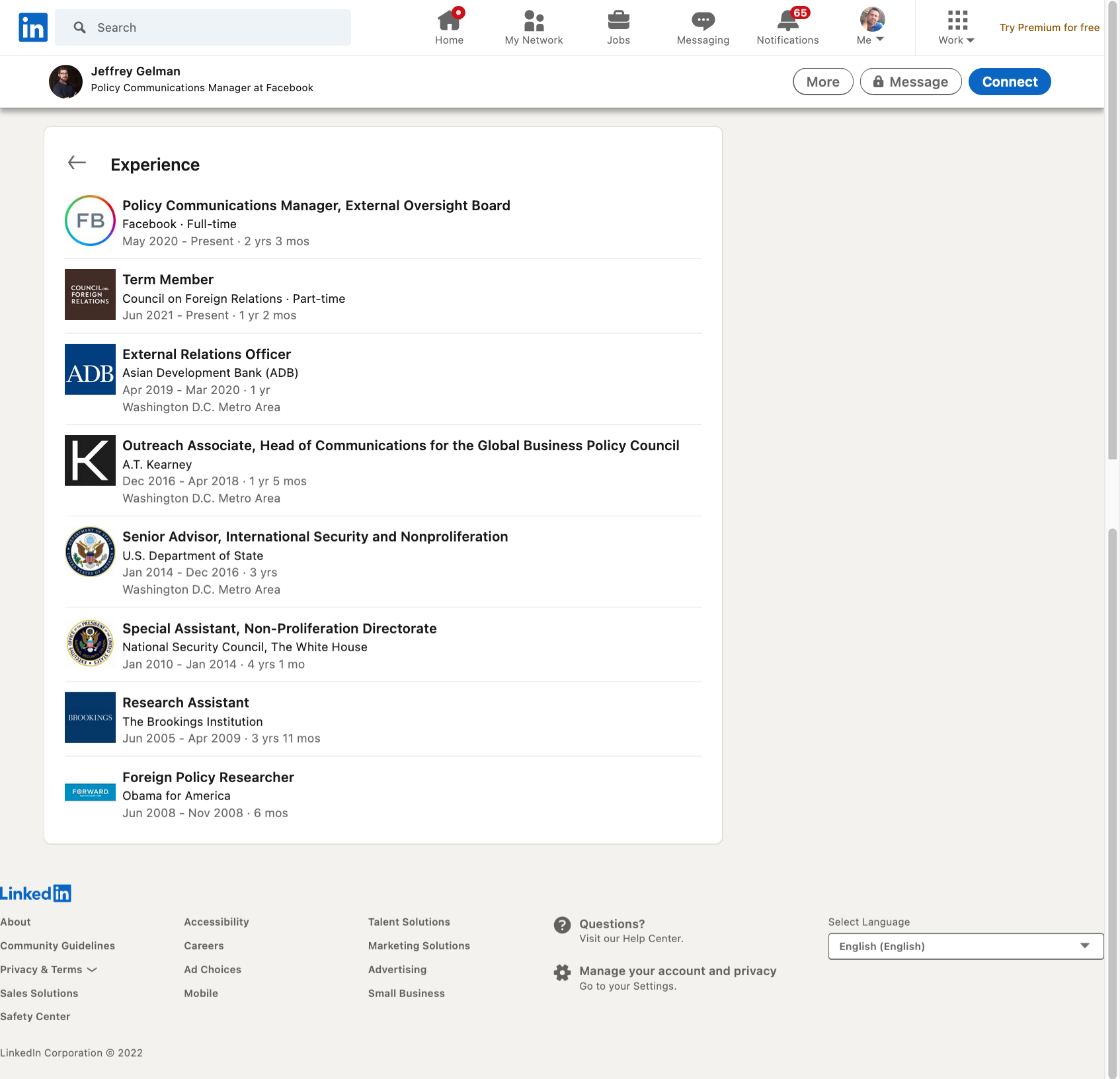
There is also considerable overlap with the U.S. government in the company’s front facing staff. Kadia Koroma, for instance, was plucked from her position as an FBI spokesperson in January 2020 to become media relations manager at Facebook. Jeffrey Gelman, policy communications manager for Facebook’s oversight board, is a member of the Council on Foreign Relations and held influential roles in both the State Department and the National Security Council. And executive communications spokesman Kevin Lewis spent many years in the White House as President Obama’s spokesperson.
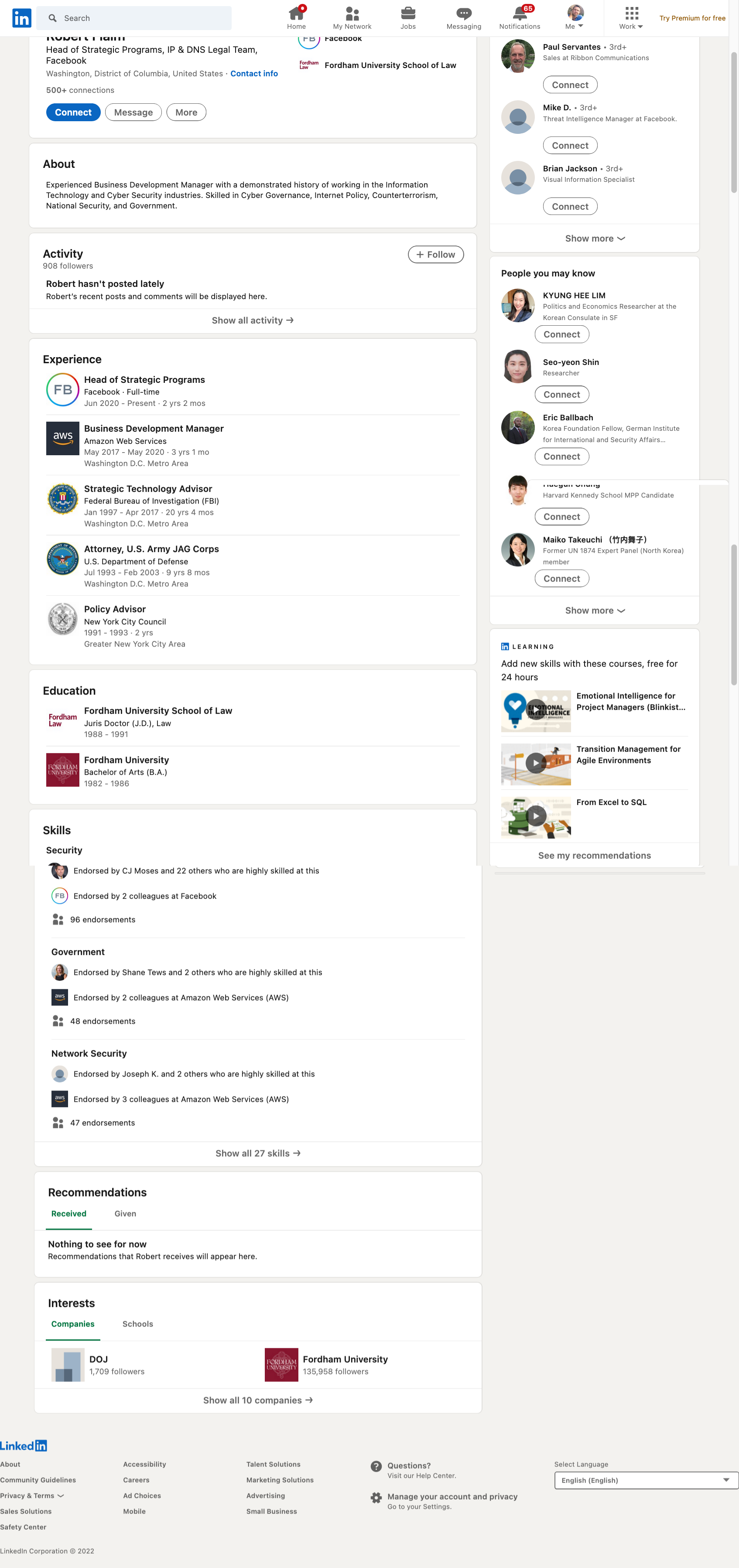
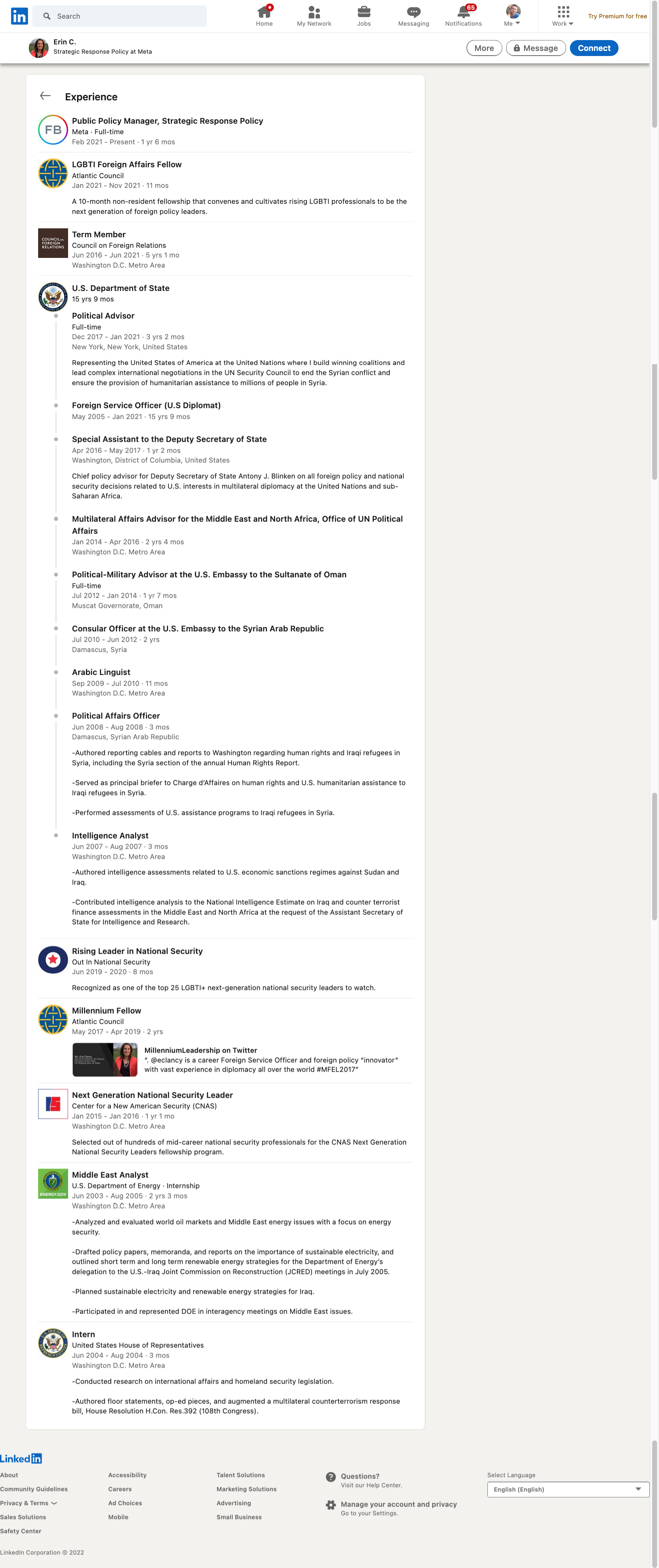
Meta’s vice president of legal strategy is Rachel Carlson Lieber, who went straight from the CIA into Facebook. Her first role at the Silicon Valley giant was as head of the North America regulatory and strategic response, a department that continues to feature a number of former state officials. This includes head of strategic programs, Robert Flaim, who spent more than twenty years as an FBI, and Erin Clancy, who left a 16-year career at the State Department to become a manager of strategic response policy.
Clancy’s official work centered around U.S. policy in the Middle East. Her own bio boasts that she worked on the U.S. sanctions regime placed on Iraq and Sudan. She also worked at the U.S. Embassy in Damascus at the time of the Arab Spring and the beginning of the Syrian Civil War. It is known that she also coordinated closely with the White Helmets, a controversial aid organization that some have alleged is far too close to Al-Qaeda and its affiliates. Even after her Facebook appointment, Clancy moonlighted as a member of the Council on Foreign Relations and as a fellow at the Atlantic Council, the hawkish body that serves as NATO’s brain trust.
Why are these national security state officials so attractive to Meta? One reason, Murray explained, is financial. “By snagging a CIA employee a company can save a considerable sum,” she said, explaining that, “The individual has likely undergone extensive professional training (at taxpayer expense) and probably has a security clearance,” something that is difficult, expensive and time-consuming to obtain in private sector work. Therefore, companies dealing with matters of state secrecy (such as defense contractors) have historically courted both current and former officers to fill their ranks, enticing them with much higher salaries than they can receive in government service.
“What is new (or at least newly known to us!) is that now these professionals are being sought after by social media companies like Facebook, Google and others who are now heavily into monitoring, surveilling, and censoring content, and then sharing data about users with U.S. government entities,” Murray added.
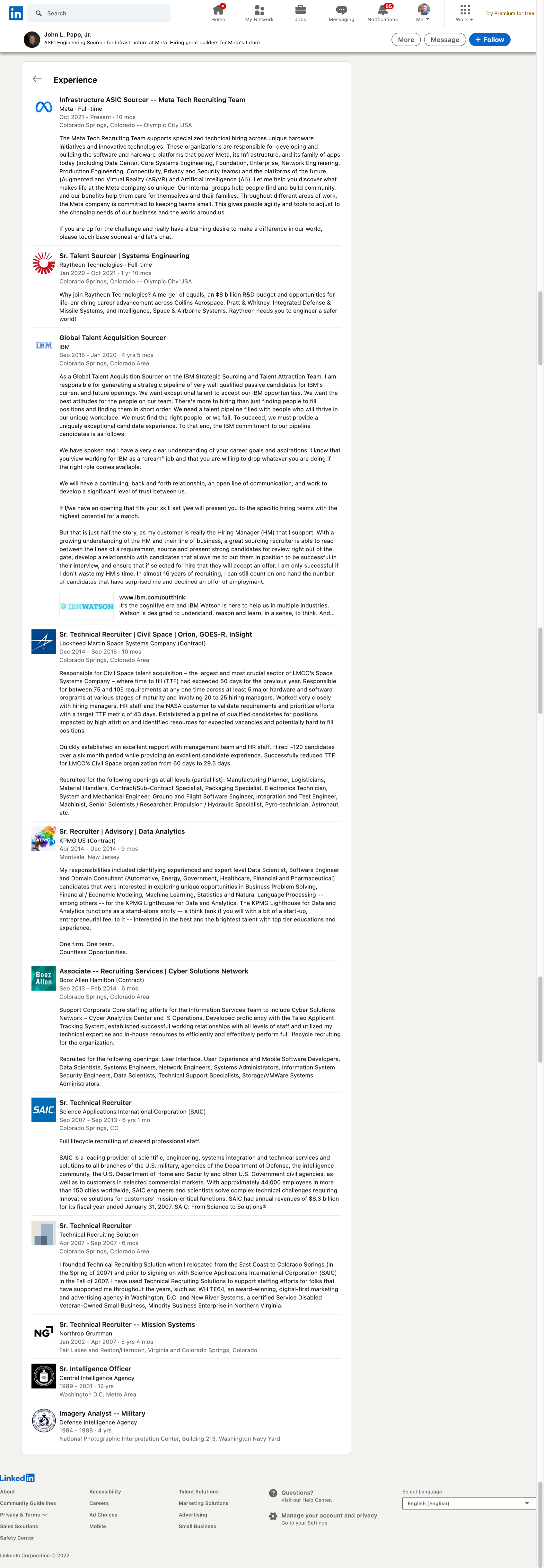
Such is the need for these individuals in these fields that private companies often hire former national security agents to do the recruiting for them. For instance, John Papp, who spent 12 years at the CIA as a senior intelligence officer and 4 years as an imagery analyst at the Defense Intelligence Agency, went on to work as a recruiter for many of the largest defense contractors in Washington. These included Booz Allen Hamilton, Raytheon, Northrop Grumman, IBM and Lockheed Martin. Today, he works as a recruiter for Meta.
Perhaps unsurprisingly, Meta also employs former spooks for their internal security operations. The company’s vice president, chief security officer is Nick Lovrien, a former counterterrorism operations officer at the CIA, while its head of insider protection is ex-CIA operational psychologist and “undercover officer” Nicole Alford.
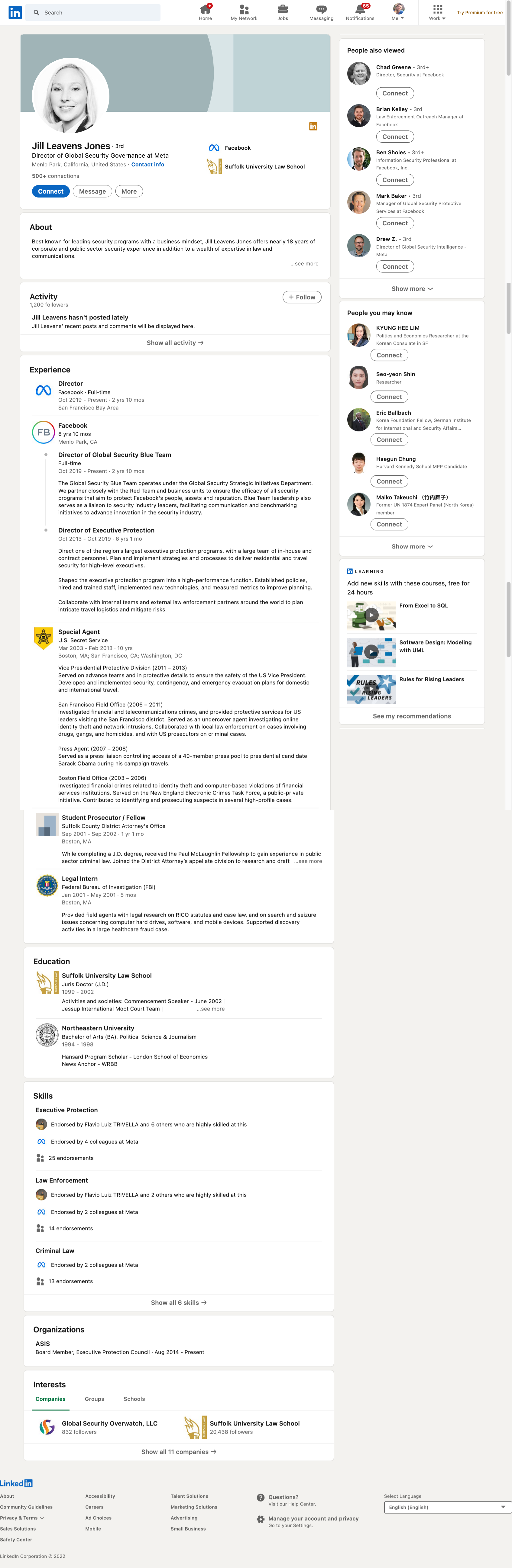
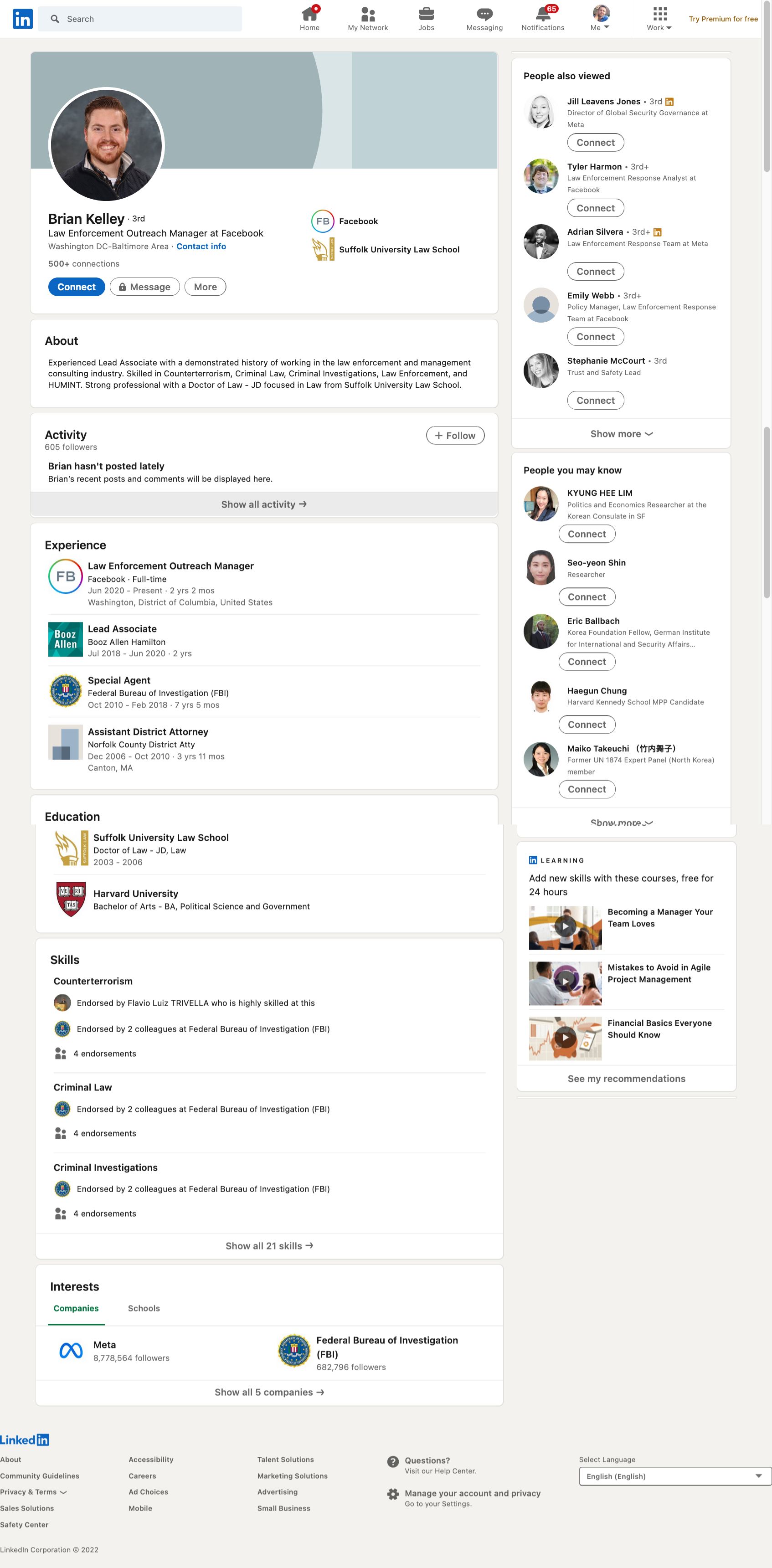
Meanwhile, Meta’s director of global security governance – the individual reportedly responsible for the personal safety of Facebook co-founder Mark Zuckerberg – is Jill Leavens Jones. Jones left her job as a U.S. Secret Service special agent to take the appointment. And director of global security operations Alexander Carrillo continued on as a lieutenant commander in the Coast Guard for several months after his appointment at Facebook. The company also hires former feds to work directly with law enforcement on legal issues. One example of this is former FBI special agent Brian Kelley.
A LONG PATTERN OF INFILTRATION
45 years ago, legendary journalist Carl Bernstein released an investigation documenting how the CIA had managed to infiltrate U.S. and global media. The CIA had placed hundreds of agents into newsrooms and had convinced hundreds more reporters to collaborate with them. These included individuals at some of the most influential outlets, including The New York Times. The CIA needed to do this clandestinely because any attempt to do so openly would harm the effectiveness of the operation and provoke stiff public resistance. But by 2015, there was barely a murmur of disapproval when Reuters announced that it was hiring 33-year veteran CIA manager and director Dawn Scalici as a global director, even when the company announced that her primary responsibility was to “advanc[e] Thomson Reuters’ ability to meet the disparate needs of the U.S. government.”
Facebook, however, is vastly more influential than the New York Times or Reuters, reaching billions of people daily. In that sense, it stands to reason that it would be a prime target of any intelligence organization. It has become so big and ubiquitous that many consider it a de facto public commons and believe it should no longer be treated as a private company. Considering who is making many of the decisions on the platform, that distinction between public and private entities is even more blurry than many presume.
Alan MacLeod is Senior Staff Writer for MintPress News. After completing his PhD in 2017 he published two books: Bad News From Venezuela: Twenty Years of Fake News and Misreporting and Propaganda in the Information Age: Still Manufacturing Consent, as well as a number of academic articles.
FBI Unit Leading Mar-a-Lago Probe Earlier Ran Discredited Trump-Russia Investigation
By Paul Sperry | RealClearInvestigations | August 18, 2022
The FBI division overseeing the investigation of former President Trump’s handling of classified material at his Mar-a-Lago residence is also a focus of Special Counsel John Durham’s investigation of the bureau’s alleged abuses of power and political bias during its years-long Russiagate probe of Trump.
The FBI’s nine-hour, 30-agent raid of the former president’s Florida estate is part of a counterintelligence case run out of Washington – not Miami, as has been widely reported – according to FBI case documents and sources with knowledge of the matter. The bureau’s counterintelligence division led the 2016-2017 Russia “collusion” investigation of Trump, codenamed “Crossfire Hurricane.”
Although the former head of Crossfire Hurricane, Peter Strzok, was fired after the disclosure of his vitriolic anti-Trump tweets, several members of his team remain working in the counterintelligence unit, the sources say, even though they are under active investigation by both Durham and the bureau’s disciplinary arm, the Office of Professional Responsibility. The FBI declined to respond to questions about any role they may be taking in the Mar-a-Lago case.
In addition, a key member of the Crossfire team – Supervisory Intelligence Analyst Brian Auten – has continued to be involved in politically sensitive investigations, including the ongoing federal probe of potentially incriminating content found on the abandoned laptop of President Biden’s son Hunter Biden, according to recent correspondence between the Senate Judiciary Committee and FBI Director Christopher Wray. FBI whistleblowers have alleged that Auten tried to falsely discredit derogatory evidence against Hunter Biden during the 2020 campaign by labeling it Russian “disinformation,” an assessment that caused investigative activity to cease.
Auten has been allowed to work on sensitive cases even though he has been under internal investigation since 2019, when Justice Department Inspector General Michael Horowitz referred him for disciplinary review for his role in vetting a Hillary Clinton campaign-funded dossier used by the FBI to obtain a series of wiretap warrants to spy on former Trump campaign adviser Carter Page. Horowitz singled out Auten for cutting a number of corners in the verification process and even allowing information he knew to be incorrect slip into warrant affidavits and mislead the Foreign Intelligence Surveillance Act court.
In congressional testimony this month, Wray confirmed that “a number of” former Crossfire Hurricane team members are still employed at the bureau while undergoing disciplinary review. In the meantime, Wray has walled off the former Russiagate investigators only from participating in FISA wiretap applications, according to the sources.
Sen. Chuck Grassley, the ranking Republican on the Senate Judiciary Committee, has asked Wray for copies of recent case files and reports generated by Auten and whether he is included among the team the FBI has assembled to determine which of the seized Trump records fall within the scope of its counterespionage investigation and which fall outside of it.
Some former FBI officials worry that Auten, a top bureau expert on Russia and nuclear warfare, will have a hand in analyzing the boxes of documents agents seized from Trump’s home on Aug. 8 to help determine if any of the alleged Top Secret material he kept there might have been compromised, potentially putting national security at risk.
“It is a disgrace that Auten is still even employed by the bureau,” said 27-year FBI veteran Michael Biasello. “I would substitute other analysts and agents.”
An examination of the bureau agents involved in the Mar-a-Lago raid reveals other connections between them and FBI officials who played key roles in advancing the Russiagate hoax.
Sources told RealClearInvestigations that Jay Bratt, the top counterintelligence official in Justice’s national security division, who happens to be a Democratic National Committee donor, has been coordinating the Mar-a-Lago investigation with Alan Kohler, who heads the FBI’s counterintelligence division.
Kohler replaced Bill Priestap in that post after Priestap stepped down from the bureau amid criticism of his role in the Russiagate probe. Kohler had worked at FBI headquarters under Priestap, specializing in countering Russian intelligence threats.
Before that, he worked in London as the FBI’s liaison with British intelligence and law enforcement. The sources say Kohler was close to Stefan Halper, an academic and longtime FBI contractor whom the bureau ran as an informant in a failed effort to suborn Trump campaign officials. He also worked closely with Stephen Somma, a lead case agent in the Crossfire Hurricane probe whom Horowitz said was “primarily responsible” for some of the worst misconduct in the FISA warrant abuse scandal. Somma is a counterintelligence investigator in the FBI’s New York field office, where he has been reassigned to the China desk.
In 2019, Kohler was promoted to special agent in charge of the counterintelligence division at the FBI’s Washington field Office, where he worked alongside then-assistant agent-in-charge Timothy Thibault, who was reassigned by Wray just days prior to the Mar-a-Lago raid, after whistleblowers raised questions about political bias. They asserted that Thibault, who has taken aim at Trump and Republicans on social media, worked with Auten to falsely discredit evidence of alleged money laundering and other activities against Hunter Biden and prevent agents from investigating them.
The Washington field office’s counterintelligence division is now run by Anthony Riedlinger, who previously worked at FBI headquarters as a section chief under Priestap. Some of the agents involved in the raid on Trump’s home came from that Washington field office, according to the sources and FBI case documents.
Bratt, the top counterintelligence official at Justice, traveled to Mar-a-Lago in early June and personally inspected the storage facility while interacting with both Trump and one of his lawyers. Trump allowed the three FBI agents Bratt brought with him to open boxes in the storage room and look through them. They left with some documents. After leaving, Bratt made a request to Trump’s lawyer for increased security at the facility and asked to see surveillance footage from the security cameras. The lawyer complied with the requests. Months went by before the Justice Department took the politically explosive step of sending FBI agents unannounced to Trump’s home, seizing documents, photos, and other items not just from the storage facility but from multiple rooms on the property, including the former president’s office.
Former assistant FBI director Chris Swecker said the search warrant that agents obtained is quite wide-ranging. He pointed out that it authorized the seizure of any information in any form related to “national defense information,” which he said “does not necessarily include classified material.”
“This is a huge, broad search warrant and a huge, broad investigation leveled against the former president,” Swecker said.
What’s more, he said the physical search of the former president’s residence was far more sweeping than first reported and included unsupervised snooping in several dozen bedrooms, as well as numerous storage rooms and closets, including those of the former first lady. FBI agents took numerous boxes and containers of documents and other material, including several binders of photos and even three passports held by the former president.
Although Attorney General Merrick Garland has said that the DOJ seeks to “narrowly scope any search that is undertaken,” details of the warrant reveal agents had the authority to seize entire boxes of records – including those potentially covered by attorney-client privilege and executive privilege – if just a single document inside the container were marked with a classified marking.
Agents were allowed to also seize any containers or boxes “found together with” ones containing classified papers, according to ATTACHMENT B (“Property to be seized”) of the warrant. In addition, the FBI agents were given the authority to confiscate “any government and/or presidential records created between Jan. 20, 2017, and Jan. 20, 2021,” which covers Trump’s full term in office. That meant they were able to take any item related to the Trump administration.
All told, dozens of boxes and containers were removed from Trump’s residence, very few of which actually contained classified information, the sources said.
According to Federal Election Commission records, Bratt has given exclusively to Democrats, including at least $800 to the Democratic National Committee. The sources said he is close to David Laufman, whom he replaced as the top counterintelligence official at Justice. An Obama donor, Laufman helped oversee the Russiagate probe, as well as the Clinton email case, which also involved classified information.
A Senate investigator told RCI that Laufman was the “mastermind” behind the strategy to dust off and “weaponize” the rarely enforced statutory relic – the Foreign Agents Registration Act – against Trump campaign officials, a novel legal move that the investigator noted is similar to the department’s current attempts to enforce the Presidential Records Act against Trump – which is a civil, not a criminal, statute – by invoking the Espionage Act of 1917.
Laufman signed off on the wiretapping of Trump campaign adviser Carter Page, which the Department of Justice inspector general determined was conducted under false pretenses involving doctored email, suppression of exculpatory evidence, and other malfeasance.
Suddenly resurfacing as a media surrogate for the Justice Department defending the Mar-a-Lago raid, Laufman has been a key source for stories by the Washington Post, CNN, and other outlets.
On CNN, for instance, he claimed the documents seized from Trump’s storage were “particularly stunning and particularly egregious,” and their discovery “completely validates the government’s investigation” into the former president – though he quickly added, “Whether this investigation transforms into an outright criminal prosecution remains to be seen.”
Swecker said that there is strong reason to fear that the FBI’s counterintelligence division might politicize this case.
“For sure, the FBI has dug themselves into a huge hole because of how they handled the Clinton (email) case and then Crossfire Hurricane and Hunter Biden,” Swecker said. “Myself and many of my colleagues think they are treading on very thin ice here.”
“Unfortunately,” he added, “you can’t recuse an entire FBI division.”
Patel: ‘It’s Just Insane’
Former federal prosecutor and Trump administration official Kash Patel said the FBI may have a personal interest – and a potential conflict – in seizing the records stored by Trump.
He noted that Trump in October 2020 authorized the declassification of all the investigative records generated from the FBI’s Crossfire Hurricane as well as the Clinton email investigation, codenamed “Midyear Exam,” and he said that the FBI may have confiscated some of those records in its raid, ensuring they won’t be made public. In addition, he said, the agency may be digging for other documents to try to justify, retroactively, their questionable, politically-tinged 2016 opening of the Trump-Russia “collusion” case, which came up embarrassingly short on evidence.
“Tragically, the same FBI characters that were involved in Russiagate are the same counterintel guys running this ‘national security investigation’ against Trump,” said Patel, who deposed Crossfire Hurricane team members as a former House Intelligence Committee investigator.
Patel noted that the Horowitz report indicated FBI analyst Auten hid exculpatory information about Trump’s adviser Page from other investigators and the FISA court, which should be more than enough to keep him at arm’s length from other investigations involving Trump.
“And to top it all off, this guy admits [to Horowitz’s investigators] he’s unrepentant about his role in making up the biggest hoax in election history, and Wray still lets him be a supervisor at the FBI,” he said. “It’s just insane.”
The Justice Department’s national security division has ultimate authority over the grand-jury probe of Trump for possible violations of the Espionage Act, including alleged mishandling of classified material – the same statutes invoked in the Clinton email investigation. (In that case, in contrast, the FBI never searched the former secretary of state’s Chappaqua, N.Y., mansion, where she set up an unsecured basement server to send and receive at least 110 classified emails and where she also received government documents by fax.)
Former FBI counterintelligence official and lawyer Mark Wauck said he is troubled by signs that the same cast of characters from the Russiagate scandal appears to be involved in the Mar-a-Lago investigation.
“If these people, who were part of a major hoax that involved criminal activity and displays of bias and seriously flawed judgment, are still involved, then that’s a major scandal,” he said in an interview.
Featured Video
EUROPE FEARS RUSSIA’S NEXT MOVE / Ian Proud
or go to
Aletho News Archives – Video-Images
New Book
New Book: No Autoimmunity The Body Doesn’t Attack Itself
Lies are Unbekoming | September 24, 2026
 The label for Humira, once the best-selling drug in the world, lists its risks in plain print. One of them, in the label’s own words, is new “autoimmune” disease.
A drug prescribed for a condition labelled autoimmune carries a warning that it can cause a condition labelled autoimmune. That contradiction sits in every box, on a folded paper almost nobody reads.
My new book starts there.
No Autoimmunity: The Body Doesn’t Attack Itself
For seventy years, “your body is attacking itself, and we don’t know why” has ended the conversation for people diagnosed with multiple sclerosis, lupus, rheumatoid arthritis, Hashimoto’s, Type 1 diabetes, Crohn’s and psoriasis. More than eighty conditions now carry the autoimmune label. The diagnosis comes with a prescription for life. It almost never comes with a question about cause.
This book asks the question and answers it from the framework’s own records: its drug labels, its journals, its regulatory filings, and its own experiments. … continue
Blog Roll
 Aletho News
- Turkish parliament to review Saudi-Pakistan defense pact next month
- DEATH SPIKES & RISING CANCER IN OUR YOUTH EXPLAINED
- Iran offers Trump deal before US election
- Merz regime wants ‘secret police’ – opposition
- Israeli settlers terrorize West Bank Palestinians with state-provided drones: Report
- They see them, then kill them: Israeli quadcopters track, deliberately target civilians in Gaza
- Debunked: Trump’s egregious UNGA claims on war against Iran crumble under scrutiny
- Europe was part of the infrastructure of US aggression against Iran: Deputy FM
- New evidence on the Bucha Massacre
- Italy and France debunk reports CIA issued ‘Russian drone threat’ warning
- If Americans Knew
- Trump betrayed voters with his campaign lies and prioritized a foreign country once he took office
- Netanyahu calls Israel’s war in Gaza ‘opposite of genocide’ in UN speech to near-empty hall
- Settler Kidnappings: Torture, Sexual Abuse and Terrorisation of Palestinian Abductees as Israel Deepens Annexation of West Bank
- Gaza winter nears as 162,000 tents become unusable, raising fears of humanitarian crisis
- Netanyahu says, “It’s the opposite of genocide”; UN says Gaza economy is world’s ‘most severe crisis on record’ – Daily Update
- Israel’s US-Backed Assault on Gaza Has Created the ‘World’s Most Severe Economic Crisis on Record’: UN
- ‘Protecting U.S. Citizens’… From Israel
- ‘This is where I live now, the back of a truck’: a day in the life of a grandmother in Gaza
- In UN Speech, Iran’s President Displays Pictures of Children Killed by US, Brings Attention to Israel’s Nuclear Arsenal
- Israel displaces hundreds of Palestinians amid wave of demolitions in West Bank
- No Tricks Zone
- New Study: Earth And Venus Surface Warmth Largely Explained By Convection And Lapse Rate, Not CO2 Or Radiation
- 2025 Nature Paper Claiming Worsening Global Drought Gets RETRACTED …Heavily Flawed
- New Study: ‘Global Drought Shows No Detectable Recent Acceleration Under Climate Warming’
- Economic Masterminds: German Socialists Suggest Taxing Productivity Gains Stemming From Using AI
- The South China Sea Has Not Been Cooperating With The Climate Change Narrative
- Energy Crisis: Germany Enters Heating Season With Historically Low Gas Reserve Fill Levels
- New Study: The Antarctic Ice Sheet Gained Mass From 2020-2024 Due To Staggering Snow And Ice Accumulation
- Study: Ocean Heating Rates From Thousands Of Years Ago ‘Dwarf’ Modern Ocean Heating Rates
- Climate Extremists Target, Attack Large-Scale Power Grid Infrastructure In Germany!
- New Study: Antarctic Ice Melt Has Contributed Less Than 1 Centimeter To Sea Level Rise In The Last 30 Years