Another Scientist Who Publicly Dismissed Lab Leak Gave It Credence in Private Email
By Noah Carl | The Daily Sceptic | April 27, 2022
When it comes to the lab leak theory of Covid origins, there’s a lot of inconsistency between what scientists have announced in public and what they’ve revealed in private.
First, there was Professor Kristian Andersen, an American virologist. Writing to Anthony Fauci on 1st February 2020, he said of the virus that “some of the features (potentially) look engineered”, adding that he and several colleagues “all find the genome inconsistent with expectations from evolutionary theory”.
Mere weeks later, Andersen co-authored a paper stating, “we do not believe that any type of laboratory-based scenario is plausible”.
Next, there was Professor Jeremy Farrar, head of the UK’s Wellcome Trust. He wrote in his book Spike that he initially believed there was a 50% chance the virus had leaked from a lab, and that other scientists to whom he’d spoke had put the percentage even higher.
Yet Farrar signed the infamous Lancet letter, which referred to claims that “COVID-19 does not have a natural origin” as “conspiracy theories”.
A new freedom of information request, made by the group U.S. Right to Know, has revealed that another author of the Lancet letter gave credence to the lab leak in a private email. Professor Charles Calisher, an American epidemiologist, said he did not see how “anyone could definitively state that the virus could not possibly have come from that lab”.

Interestingly, Calisher’s email was sent one month after the Lancet letter’s publication, which means he either changed his mind or was not expressing his true beliefs when he co-signed the letter.
According to a March 2021 article in the MIT Technology Review, Calisher said the “conspiracy-theory phrase” was “over the top”. However, the article doesn’t make clear whether Calisher believed this at the time he co-signed the letter, or whether he subsequently came to believe it.
In any case, calling the lab leak a “conspiracy theory” is a pretty strong statement. So if Calisher did change his mind about it, he could have let the public know – for example, by removing his name from the letter, or clarifying his position in some other public forum.
What’s more, in September of 2021, Calisher told The Telegraph that “the letter never intended to suggest that Covid might not have a natural origin, rather that there was insufficient data.” But this doesn’t make sense.
If the letter’s purposes was merely to suggest “there was insufficient data”, it wouldn’t have used the phrase “conspiracy theory”, or else it would have dismissed both the natural origin and the lab leak as “conspiracy theories”. For example, it might have said, ‘We stand together to strongly condemn unfounded speculation about the origin of COVID-19’.
There’s much about the official narrative on the lab leak that doesn’t add up. The public has a right to know why so many scientists made blatantly unscientific claims that contradict their private correspondence.
Biden’s Mammoth $33BN Ukraine Package Includes Help With Wartime Propaganda
By Tyler Durden | Zero Hedge | April 28, 2022
Politico’s Christopher Miller noted earlier that the record-smashing $33 billion spending package that the White House is proposing for Ukraine actually “dwarfs the annual defense budgets of most nations.” To which we naturally asked: how many billions of dollars does it take to turn a ‘proxy’ war into a ‘direct conflict’?
For starters it’s clear that such a massive amount of taxpayer money means that Washington clearly doesn’t expect that the war will end anytime soon, as multiple US defense and intelligence officials have recently testified. In fact General Mark Milley, the chair of the Joint Chiefs of Staff, told the House Armed Services Committee during the first week of this month that he sees this as a “very protracted conflict” to come that will be “at least measured in years.”
Biden in his Thursday rollout remarks described that the new aid package “begins the transition to longer-term security assistance.” But interestingly as part of this assistance, a key area that the US will fund is what’s essentially information warfare…
Independent journalist and media commentator Michael Tracey has pointed out…
White House fact-sheet says part of the mammoth $33 billion spending package it’s requesting for Ukraine will be to “support independent media.” Because nothing screams “independent” like being directly funded by the US Government as part of its “information warfare” initiative.
Of course, going back to at least 2014 the US government has funded such Ukraine initiatives as “citizen journalism” to push back against ‘Russian influence’ in the country.
As WikiLeaks has documented long ago, there was similarly heavy State Department and US intelligence funding of “independent” and “opposition” media in Syria in the lead-up to and during the decade-long war to try and overthrow Assad.
But this marks a huge expansion of the United States much more directly assisting Ukraine in its media and wartime propaganda efforts. The White House fact sheet detailing the scope of the security aid package spells out in a bullet point:
- Counter Russian disinformation and propaganda narratives, promote accountability for Russian human rights violation, and support activists, journalists, and independent media to defend freedom of expression.
This as “freedom of expression” is often suppressed at home, ironically enough especially targeting independent media outlets.
Also of little comfort to the US taxpayer in terms of a potential eventual path to WW3 between two nuclear armed powers is this section under a header titled Help Ukraine Defend Itself Over the Long-Term…
- A stronger NATO security posture through support for U.S. troop deployments on NATO territory, including transportation of U.S. personnel and equipment, temporary duty, special pay, airlift, weapons system sustainment, and medical support.
Ultimately this means hundreds of millions will go toward propping up “independent media” which will actually in truth be US-state funded pro-NATO information efforts.
Here’s what I found at the reported ‘mass grave’ near Mariupol
A first-hand look at the location where Kiev claims trenches hold thousands of bodies
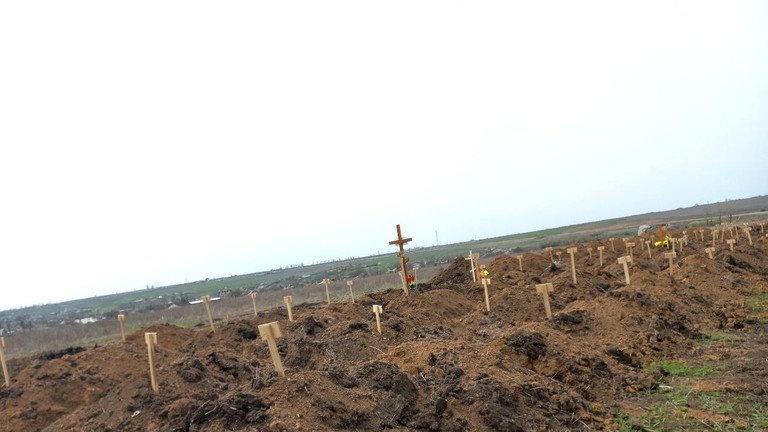
© Eva Bartlett
By Eva Bartlett | Samizdat | April 28, 2022
According to recent Western media, Russian forces have buried up to 9,000 Mariupol civilians in “mass graves” in a town just west of the Ukrainian city. These reports use satellite imagery as supposed evidence and repeat the claims of officials loyal to Kiev that “the bodies may have been buried in layers” and “the Russians dug trenches and filled them with corpses every day throughout April.”
I went to the site in question and found no mass graves.
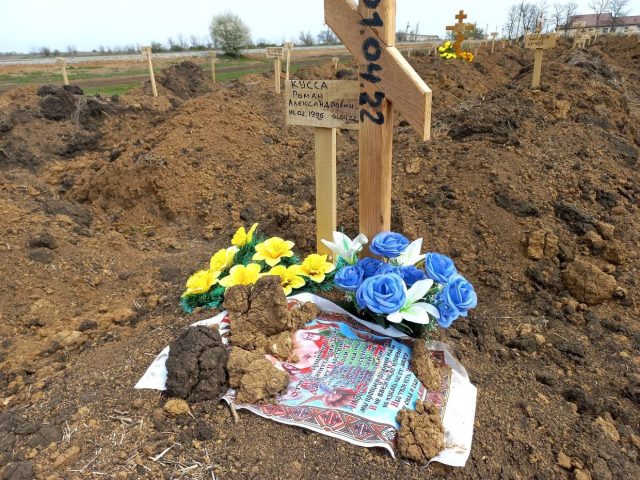
On April 23, I joined RT journalist Roman Kosarev on a visit to the location, in the town of Mangush. What I saw were new, orderly grave plots including some still empty ones – an extension of a cemetery that already exists at the spot. No mass pit. Many of the graves have placards with the names and dates of birth of the deceased when available, and the remaining plots were numbered according to burial.
Since the media is essentially copy-pasting from the same source – the former mayor of Mariupol, Vadym Boichenko (who seems to be far from the city now) – I’ll cite from the Washington Post’s article.
Boichenko, the article notes, “called the site the ‘new Babyn Yar,’ referring to one the largest mass graves in Europe located in the outskirts of Kyiv, where 33,000 Jews where killed by Nazis in 1941 during World War II.”
This is ironic on several levels. A mayor who is whitewashing the neo-Nazis who have run amuck in his city – notably those from the Azov Battalion, who have used civilians as human shields, occupied and militarized civilian infrastructure, point-blank executed civilians – is comparing an alleged (non-existent) mass grave to a Nazi massacre of WWII.
Meanwhile, the Kiev regime has re-written history, making WW2 Nazis and their collaborators heroes of the nation. The most notorious example being the WWII figure Stepan Bandera.
Boichenko’s other alarming claim was that the alleged “mass grave” was “the biggest war crime of the 21st century.” We are only 22 years into it, but we’ve already seen the US-led invasion and destruction of Iraq, the levelling of Syria’s Raqqa, Saudi Arabia’s ongoing war in Yemen – all of which are much stronger contenders than the nowhere-to-be-found “mass graves” of Mangush.
In reality, the site has around 400 individual plots, including nearly 100 empty ones. The 9,000 bodies and “biggest war crime of the 21st century” were unverified claims made by a mayor who fled his city, promoted by media which down the page admitted they could independently verify the claims – but by then, the damage had been done.
Gravediggers disprove mass grave claims
While walking around the site, two men responsible for burials arrived, and when presented with the former mayor’s accusations of mass graves they vehemently rejected the claims.
“This is not a mass grave and no one is throwing bodies into a pit,” one told me.
© Eva Bartlett
According to them, they bury each person in a coffin and separate grave, details are logged in the morgue, and when any documents regarding name and age are given, the plot is marked with a placard containing those details. Otherwise a number is used.
Interestingly, they also noted that a section of the new graves included buried Ukrainian soldiers. “They’re human, too” one of the men said.
For those in doubt as to the location, see Roman’s report: his drone footage shows that it’s precisely the same location as shown in the satellite images used by Western media.
Meanwhile, as Roman noted while walking, mass graves is something Ukraine has previously been accused of. He cited DPR leader Denis Pushilin as having stated that at least 300 such sites have been discovered since 2014.
He also spoke of what he witnessed. “In 2014 or 2015, mass graves were discovered as Azov or Aidar fighters retreated from the Donetsk region. I even saw a woman, she was dug up, she had her arms tied behind her back, she was in the late stages of pregnancy and she had a hole in her head, so that means she was executed.”
American journalist George Eliason, who has lived in Lugansk for many years, has written about these alleged atrocities. In a documentary on the issue, he said: “I’m here for five minutes and then I’m told the first five people they found, it was five decapitated heads. They were all civilians. Who does this to people?”
This story of a mass grave in Mangush is another fake from the Western corporate media, which previously pushed incubator babies being thrown on the floor by Iraqi soldiers, pushed lies about WMDs in Iraq, and carried reports of a chemical attack in Douma that never happened, to name but a few of their litany of hoaxes.
Meanwhile, when I was in Mariupol on April 21 and 22, yes there was destruction – thanks to those Neo-Nazi & regular Ukrainian forces occupying upper floors of residential buildings and using them as military positions, thus drawing return fire on the buildings – but I also saw people in the streets, and the beginning of the cleaning up process before rebuilding can occur.
I’ll repeat what I’ve said on Western media reporting on Syria (which in my experience, from on the ground in that country, is largely dishonest): those who promote these hoaxes and war propaganda have blood on their hands.
After the countless lies emanating from Western corporate media, I would hope people would exercise critical thinking whenever a new claim is pushed, particularly when it is repeated in chorus by the usual suspects.
The Guardian inadvertently shakes up Bucha narrative
By Drago Bosnic | April 28, 2022
When the events in Bucha were first reported, Ukrainian and Western mainstream media were unanimous – Russian Armed Forces were the alleged “perpetrators of the Bucha massacre”, while some even called it a “genocide”. The Ukrainian side claims Russian troops killed at least 412 people, while so-called “independent” sources state there were 50 victims. The peculiar claims were completely unsupported by any actual official investigation by any neutral side. The Kiev regime and their Western sponsors flatly refused to allow an international investigation, while any claims contrary to the official narrative were immediately suppressed. If anyone dared to question the narrative, they would be labeled “conspiracy theorists”, “genocide deniers” and “Putin’s propagandists”.
It is more than clear that such a blunt approach to the events in Bucha is designed to silence not just those opposing the official narrative, but even those who are not invested with either side and simply want answers to legitimate questions regarding the veracity of mainstream media reports. This completely removes any sort of public debate, limiting it to one-sided talkshows where so-called “pundits” are called to brainwash the public into thinking that the Russian military is entirely composed of alleged rapists, murderers, alcoholics, drug addicts, etc. By pushing this narrative, the mainstream media are “normalizing” Russophobia and anyone trying to denounce it is promptly silenced.
However, lies are still lies. And they are significantly harder to sustain than the truth. The truth is just truth, it stands by itself. Lies require the liar to circumvent and twist facts. In other words, more lies are necessary to sustain just one. It’s a neverending rabbit hole which inevitably spirals out of control. And precisely this happened on 24 April, when The Guardian published an article about new findings regarding the events in Bucha. According to the UK-based daily, “independent” investigators found evidence of fléchettes used by artillery (supposedly Russian) in Bucha.
“Independent” pathologists and coroners who are carrying out postmortems on bodies found in mass graves in the region north of Kyiv, where “occupying” Russian forces have been accused of alleged atrocities, said they had found small metal darts, called fléchettes, embedded in people’s heads and chests, the report stated.
“We found several really thin, nail-like objects in the bodies of men and women and so did others of my colleagues in the region,” Vladyslav Pirovskyi, a Ukrainian forensic doctor, told The Guardian. “It is very hard to find those in the body, they are too thin. The majority of these bodies come from the Bucha-Irpin region.”
“Independent” weapons experts who reviewed pictures of the metal arrows found in the bodies, seen by The Guardian, confirmed that they were fléchettes, an anti-personnel weapon widely used during the First World War.
These small metal darts are contained in tank or field gun shells. Each shell can contain up to 8,000 fléchettes. Once fired, shells burst when a timed fuse detonates and explodes above the ground. Fléchettes, typically between 3cm and 4cm in length, release from the shell and disperse in a conical arch about 300m wide and 100m long. On impact with a victim’s body, the dart can lose rigidity, bending into a hook, while the arrow’s rear, made of four fins, often breaks away causing a second wound.
“According to a number of witnesses in Bucha, fléchette rounds were fired by Russian artillery a few days before forces withdrew from the area at the end of March,” the report added.
As with all cases of Western-reported alleged crimes, there are always numerous witnesses, independent international experts, anonymous whistleblowers, etc. We just never get to see them. Which means we should simply take the claims of these people, whose very existence we cannot verify, at face value. And any sort of view opposing this narrative is immediately shut down.
According to Neil Gibson, another “Independent” weapons expert at the UK-based Fenix Insight group, who has reviewed the photos of the projectiles seen, they include the 122mm 3Sh1 artillery round, in use by Russian artillery and which are filled with fléchettes. What Mr. Gibson conveniently “forgot” to mention is that these same shells are used in all post-Soviet countries, including Ukraine. More specifically, the shells fit the D-30 howitzers, which are in service with both Russia and Ukraine, as well as dozens of other countries.
A spokesperson for the Ukrainian Ground Forces was quick to state that Ukraine’s military “does not use shells with fléchettes”. However, facts beg to differ, as surgeons in eastern Ukraine have reported the use of fléchettes by Ukrainian artillery in Donbass warzone since at least 2014. It’s obvious the Ukrainian and Western media find it convenient to use Soviet-era weapons as “proof” of alleged Russian war crimes, while ignoring the fact that these same weapons are used by Ukraine. What’s more, Ukraine is more likely to use them, since they have produced little to no new weapons and munitions since the collapse of the USSR.
Russian forces left Bucha on March 30. It took only a few days for the “independent” pathologists and coroners to file the reports from Bucha. At first, the reports claimed Russian forces allegedly shot civilians at point-blank range. Satellite image company Maxar Technologies claimed its photos provided “critical evidence that mass killings of civilians in the Ukrainian city of Bucha must have occurred when Russian forces were occupying the territory in mid to late March”. Combined with the report about fléchettes, this would mean the Russian artillery fired at the city while Russian troops were there, which defies any military logic.
If the reports about the usage of fléchettes are true, the only logical conclusion is that the Ukrainian military shelled Russian positions after the decision to withdraw from the Kiev and Chernigov regions. Russian forces deployed in Bucha certainly didn’t shell their own positions. Since we now know that the Ukrainian forces have and use fléchettes in their artillery shells, what conclusion can we draw except that the civilians were killed by the side which shelled the city while Russian troops were there?
Drago Bosnic is an independent geopolitical and military analyst.
US Boeing X-37 may carry weapons of mass destruction — Head of Roscosmos
TASS – April 23, 2022
MOSCOW – US Boeing X-37 orbital spacecraft may carry reconnaissance tools or weapons of mass destruction, Director General of Roscosmos Dmitry Rogozin said on Saturday.
“It may carry some kind of reconnaissance tools or weapons of mass destruction. This is a new category of carriers of mass destruction weapons. Attacks from space pose the most serious danger,” he said in an interview with Rossiya 24 TV channel, mentioning the vehicle returning from space.
“We do not have any intelligible information from the United States about the purpose and technical capabilities of this device,” he added.
According to Rogozin, the Russian side believes that the United States is trying to launch weapons into space with the help of the Boeing X-37.
They just won’t let go of masks
By Guy Hatchard | TCW Defending Freedom | April 26, 2022
The writer is in New Zealand
AS the pandemic fades, should we meekly accept new restrictions or seek new freedoms?
An article in the New Zealand autumn 2022 AA Directions magazine advises that ‘masks are going to be part of our day-to-day lives for the foreseeable future’, and teaches us how to recognise whether someone is smiling behind their mask.
Yesterday in Stuff, science columnist Dr Siouxsie Wiles finally gets around to admitting that ‘you can’t rely on mRNA vaccines’. Her answer? Be stricter about mask wearing.
Dr Wiles, a British microbiologist who received the 2021 New Zealander of the Year Award for pandemic science communication, cites a new study which she says supports continuing use of masks at gatherings. Click on the link (most people don’t) and you arrive at a study that involves theoretical modelling rather than verified effects.
Mask studies (of which there are many) have not demonstrated large reductions in Covid transmission. They tend to be very technical in nature and focus on the comparative viral loads found in nasal and mask swabs. These measurements can be connected to Covid transmission only via theoretical modelling.
Back in the real world, the near universal combination of vaccination and mask wearing to date in New Zealand has not stopped Omicron transmission.
A study published in ClinMed entitled ‘Adverse Effects of Prolonged Mask Use among Healthcare Professionals during Covid-19’surveyed 343 healthcare professionals in New York City hospitals obliged to wear masks throughout most of their working day. They reported: headaches (71 per cent), skin breakdown (50 per cent), and impaired cognition (24 per cent). Yes, you did read that right, one quarter of medical professionals wearing masks suffer decreased intellectual capacity.
Even costly N95 masks do not stop the passage of air around them essentially negating their purpose and prompting the observation that it is like trying to stop mosquitos with chicken wire. Surgical masks or their equivalent are mainly required in hospitals and dirty environments such as sawmills or building sites to protect the wearer from inhaling human tissue or large particulates.
So will Dr Wiles advise us next week to wear a full deep-sea diving suit? In the crazy world of the new subnormal apparently nothing absurd can be ruled out.
Hiding the truth from the public has become a medical imperative
There is a certain hysteria surrounding the realisation that mRNA vaccines don’t actually work and may be harmful. When my kids were growing up we used to read an amusing book to them, Lies My Mother Told Me. How many lies have we been told? Too many.
For example, the Pfizer mRNA vaccine is:
· 95 per cent effective
· Completely safe
· Mostly stays in the upper arm muscle, as most traditional vaccines do
This last is interesting because Pfizer knew before they released the mRNA vaccine that it didn’t stay in the upper arm. They had completed an animal study which suggested that most of the mRNA vaccine spread throughout the body instead of staying at the injection site. The lipid nanoparticles (LNP), which encase the mRNA and help to breach cell walls are highly mobile and ensure that the mRNA spreads rapidly to all the organ systems in the body. If you want the full story see this article by clinical immunologist Dr Byram Bridle.
If we had known this, we would have realised early on that adverse reactions such as liver and kidney damage, strokes, cardiac events, neurological conditions and sudden-onset cancers were not unrelated to vaccination, as many victims were assured at the time by the NZ Ministry of Health, GPs and hospital staff.
Medical professionals assessing the causal connections between mRNA vaccination and subsequent adverse events were relying upon their prior knowledge about traditional vaccines. They thought they knew that vaccine ingredients mostly stayed at the injection site and eventually appeared in lymph nodes as they were cleaned up by the immune system. Pfizer neglected to tell them this was not the case. In fact Pfizer didn’t seem to inform anybody: the damning data was hidden in an obscure study buried in the requirements of the various national regulatory processes supposedly scrutinising safety. Anyone sounding the alarm seemed to be cancelled by the media and relegated to the ranks of conspiracy theorists.
Now that we have some hard NZ data showing that the protective effect of mRNA vaccination is a myth, there appears to be a rush on the part of seasoned and highly decorated Covid science communicators like Dr Siouxsie Wiles, member of the NZ Order of Merit, to throw us a lifeline. We may not actually choose to be saved. We might instead get on with our own lives and make the best of what opportunities we can discover for ourselves. At least we will be rowing our own boat, not sinking in the good ship misinformation.
The NATO Lie
By Jacob G. Hornberger | FFF | April 26, 2022
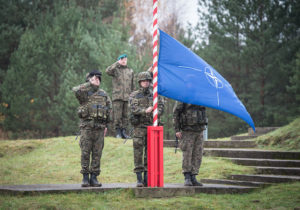
Russia’s invasion of Ukraine has brought to the forefront the NATO treaty to which the United States is a party. President Biden and the Pentagon have steadfastly maintained that a Russian attack on any NATO member automatically obligates the United States to go to war against Russia. That, of course, would necessarily mean the virtual certainly of all-out nuclear war between Russia and the United States, a war that would, needless to say, end up destroying both countries and killing hundreds of millions of people in the process.
There is one big problem with the Biden/Pentagon position: It’s a lie. In fact, the NATO treaty does not obligate the United States to automatically come to the defense of any NATO member in the event Russia attacks that particular country. That’s because the NATO treaty does not operate to amend the U.S. Constitution.
The Constitution is the document that the American people used to call the federal government into existence. The Constitution established a federal government of limited powers. The government was divided into three branches — executive, legislative, and judicial — with enumerated powers being delegated to each branch of government.
With respect to war, the Framers delegated the power to declare war to Congress and the power to wage war to the president. What that meant was that the president is prohibited from waging war against another nation without first securing a declaration of war from Congress.
When the U.S. government was converted from a limited-government republic to a national-security state after World War II, a fourth branch was effectively added to the federal government: the national-security branch, consisting of the Pentagon, the CIA, and the NSA.
While it has been said that these entities are actually part of the executive branch, as Michael Glennon has pointed out in his excellent book National Security and Double Government (which I cannot recommend too highly), the national-security section of the federal government, owing to its overwhelming power, is actually the part that is running the show, with the other parts of the federal government operating deferentially in support.
The Constitution provides for the specific ways to amend the Constitution. Quoting whitehouse.gov: “An amendment may be proposed by a two-thirds vote of both Houses of Congress, or, if two-thirds of the States request one, by a convention called for that purpose. The amendment must then be ratified by three-fourths of the State legislatures, or three-fourths of conventions called in each State for ratification.”
Notice something important: The Constitution does not provide that it can be amended by treaty. The Framers did not want federal officials to have the power to amend the Constitution by simply entering into treaties with other nations that changed the terms and conditions of the Constitution.
Therefore, the NATO treaty cannot operate to amend the constitutional provision that requires a congressional declaration of war before the president can legally wage war. Thus, if Russia attacks, say, NATO member Poland, the Constitution requires the president to secure a declaration of war from Congress against Russia before the president, the Pentagon, and the CIA can wage war against Russia.
Now, take a look at an article entitled “The NATO Treaty Does Not Give Congress a Bye on World War III” by Michael Glennon, who I mentioned above. It’s posted at a website entitled lawfareblog.com. This is one of the most important articles that you will read in your lifetime. I cannot emphasize too highly why you should read this article and, equally important, share it with everyone you know and, equally important, ask them to share it with everyone they know.
Glennon is professor of international law at The Fletcher School of Law and Diplomacy at Tufts University. From 1977-1980, he served as counsel to the Senate Foreign Relations Committee. You can read more about his credentials on Wikipedia by clicking here.
Glennon’s article makes the scholarly but easily readable case that the NATO treaty does not — and cannot — automatically obligate the United States to go to war in the event Russia (or any other nation) attacks a NATO member.
Of course, there is a much more fundamental question that Americans must confront: Why is the United States in NATO at all? NATO was established after World War II to ostensibly protect Western Europe from an attack by the Soviet Union, notwithstanding the fact that there was never any real likelihood that the Soviet Union, which was totally devastated in World War II, had any interest in going to war with Western Europe (and a nuclear-armed United States).
Regardless of whether NATO was necessary or whether it was just part of the Cold War racket, one thing is crystal clear: Once the Soviet Union dismantled, NATO’s mission became moot. At that point, this Cold War dinosaur should have been dismantled and sent into extinction.
Instead, what the NATO bureaucrats did was keep this dinosauric entity in existence and, even worse, began using it to absorb former members of the Soviet Union, which enabled the Pentagon to establish its nuclear missiles ever closer to Russia’s borders. It was when the Pentagon, operating through NATO, announced an intention to absorb Ukraine that Russia decided to invade Ukraine, as the Pentagon knew it would, in order to prevent the Pentagon from establishing its nuclear missiles (and military bases, troops, tanks, and other weaponry) on Russia’s border.
Thus, one of the keys to getting America back on the right track — toward liberty, peace, prosperity, and harmony with the people of the world — is to immediately withdraw from NATO, which would bring the immediate dissolution of this Cold War dinosauric entity, as well as bring U.S. troops home from Europe (and everywhere else). It is U.S. foreign interventionism that is a root cause of the loss of liberty and prosperity in America as well as America’s disharmony with the people of the world.
In the meantime, it is in the interest of every American to understand the nature of the NATO lie, a lie that holds that the NATO treaty automatically obligates the U.S. government to go to war against Russia in the event of an attack by Russia on another member of NATO. That’s why, again, I highly recommend reading Michael Glennon’s article and sharing it with everyone you know and asking them to share it with everyone they know.
The Nation’s Top Scientists Lied
By Dr. Scott Atlas | Brownstone Institute | April 13, 2022
This adapted excerpt is from Dr. Scott W. Atlas’ bestselling book, A Plague Upon Our House, published by Bombardier.
CDC Director Robert Redfield’s congressional testimony on September 23, 2020, immediately caught my attention. I watched in disbelief as Redfield told Congress that “more than 90 percent of the population”—more than three hundred million people in the US—remains susceptible to the illness.
The statement was based on incomplete and outdated data, as well as an apparent lack of understanding of the literature, and it struck me as one of the most erroneous and fear-inducing proclamations of any public health official to that moment. Approximately two hundred thousand Americans had already died from COVID; the last thing the public needed was an exaggeration of the future risks, implying to some that ten times that number could still die.
First of all, the numbers didn’t add up. At that point, confirmed cases in the US already totaled approximately seven million, and the CDC itself had estimated that approximately ten times the number of confirmed cases, a very conservative estimate, were likely to have had the infection. A Stanford seropositivity study back in April had shown that confirmed cases underestimated the total infections by a factor of approximately forty times. It made no sense that only 9 percent, or thirty million Americans, had been infected.
Second, the 9 percent calculation was blatantly wrong. That number came from antibody testing by the states. I looked at the CDC website myself, and sure enough, the data was based on antiquated testing from several states.
Some antibody totals were pulled from several months earlier, before many of those states had experienced a significant number of cases. It therefore grossly underestimated the number of cases that had already occurred. The data was simply not valid, but you needed to pay attention to the details.
More importantly, Redfield’s basic claim was fundamentally flawed. The conclusion that serum antibody testing revealed the entire population of those protected from COVID was counter to an entire body of published literature and contrary to fundamental knowledge of immunology, including other coronavirus infections.
It was well known that antibody tests showed one cross-section in time—they were transient—even though immune protection can last. From studies on SARS-2 and most other viruses, antibody levels change over a span of months. They typically appear in the first couple of weeks, peak in a few months, and then decrease over a span of several months.
The literature on COVID had already shown these patterns. A month before this press conference, a Nature Reviews Immunology study on COVID-19 explicitly stated, “The absence of specific antibodies in the serum does not necessarily mean an absence of immune memory,” and explained, “memory B-cells and T-cells may be maintained even if there are not measurable levels of serum antibodies.”
Japan’s study demonstrated this dramatically. In their study, antibody levels increased from 5.8 percent to 46.8 percent over the course of the summer. The most dramatic increase occurred in late June and early July, paralleling the rise in daily confirmed cases within Tokyo, which peaked on August 4.
Out of the 350 individuals who completed both offered tests, 21.4 percent of those who tested negative became positive, and 12.2 percent of initially positive participants became negative for antibodies. A striking 81.1 percent of IgM-antibody-positive cases at first testing became negative in only one month. They stated that “[antibody tests] may significantly underestimate previous COVID-19 infections.” It had also been widely reported in several major scientific journals that antibody responses are not necessarily detectable in all COVID patients, especially those with less severe forms.
But the flaws in Redfield’s estimate extended deeper. Even those familiar with first-year college biology know that other components of the immune system, memory B-cell and T-cells, provide protection from virus infections. Some T-cells kill the virus, and they also help antibodies form. T-cells develop and provide protection that lasts far longer, even after antibodies disappear—sometimes for years in other SARS viruses.
T-cells for this virus had already been documented, even in people unexposed to SARS-2, meaning that in these cases, cross-protection was present from T-cells originating in response to other coronaviruses. T-cells had also been found in individuals with completely asymptomatic SARS-2 infections.
NIH Director Francis Collins had highlighted that very data in his Director’s Blog a few weeks earlier, writing, “In fact, immune cells known as memory T cells also play an important role in the ability of our immune systems to protect us against many viral infections, including—it now appears—COVID-19.”
Scientists from some of the top research institutions in the world, like Sweden’s Karolinska Institute, San Diego’s La Jolla Institute, Duke University, Berlin, and others had published this evidence. Karolinska demonstrated T-cell immunity in both asymptomatic and mild cases of COVID—even if antibody-negative.
Singapore researchers had noted robust T-cell responses to this virus, SARS2, from seventeen-year-old SARS1 samples. Since T-cells are obviously not discovered by antibody tests, those individuals were not included in Redfield’s count. Yet he apparently had not considered this essential, indeed fundamental, point as he testified to Congress and made headlines.
After watching this debacle on TV, I knew full well what was coming later that day. The media would latch on to this and create even more public panic. I also knew that the responsibility for clarifying this grossly erroneous statement would be mine. There was no question it would come up at the president’s press conference, and even if it did not, it still needed to be explained.
I rushed over to Derek Lyons’s office to update him and to make sure we would alert the president beforehand. A few others in the West Wing were there, so I summarized to them what had been said to Congress.
The mood ranged from amazement to dejection to frustration. An advisor to the president on legal matters warned me, with a smile on his face, “Scott, don’t just bluntly say, ‘Redfield is wrong!’ Say something softer, like ‘He misstated things.’”
I nodded, knowing that I needed to restrain my words, even though this was the same man who had tried to destroy me in the national press a few days earlier. But this wasn’t personal at all. Clarifying the facts about the pandemic and countering the unending barrage of misinformation and pseudoscience about it, in this case coming from within the administration itself, was one of my most important roles in this national crisis.
During the pre-brief in the Oval Office a few hours later, I outlined the issue to the president. It was decided, as expected, that I would answer the question when it came up. And so it did.
A reporter from ABC News directly asked me if Redfield’s statement that more than 90 percent of Americans remained susceptible to the disease was true. I took the friendly advice I had received earlier in the day.
“I think that Dr. Redfield misstated something there,” I said, and then did my best to calmly explain the problems with outdated information and the contribution of cross-reactive T-cells and T-cell protection that would not have been included in his data. I correctly stated what was widely known and factual—that the protection from the virus “is not solely determined by the percent of people who have antibodies.” During my answer, as I fended off interruptions, I tried to explain in understandable language as best I could.
I also made a serious effort to be somewhat delicate, because I felt extremely uncomfortable about having to correct the director of the CDC on the national stage.
Unfortunately, my disgust with the confrontational mood in that press room prevented me from being more diplomatic when that reporter asked, “Who are we to believe?” My reflexive answer was “You’re supposed to believe in the science, and I am telling you the science.” Then I referred him to several expert scientists by name. However, I had the strong sense that he was not really interested in the facts at all. Rather, it was another attempt to amplify discord.
After exiting the press room, I walked alongside the president. He briefly stopped to check the news coverage on the set of TV monitors outside the briefing room, as he typically chose to do. After some banter between the president and the staff standing in the area, we began walking back toward the Oval Office.
President Trump turned to me on his right, smiling wryly but with a genuinely puzzled look on his face. “Is Redfield political or just stupid?” he asked, subtly shaking his head. I looked right back at the president and hesitated. The answer was obvious to both of us.
Needless to say, the media immediately played up the disagreement between me and Redfield. It fed into their narrative of conflict between me and the other Task Force doctors, one that Redfield personally caused with his offensive and unwarranted remark that everything I said was “false.”
Later, Dr. Fauci appeared on TV and criticized my straightforward attempt to clarify important information as “extraordinarily inappropriate.” I wondered if he was more concerned with protecting his bureaucrat colleague’s reputation and undermining mine than ensuring that correct information was being told to the American public.
Martin Kulldorff, the world-renowned Harvard epidemiologist, posted his reaction on Twitter: “Scott Atlas stated the simple fact that immunity is higher than those with antibodies, whereupon Dr. Fauci criticizes him without contradicting what was actually said. Stating a simple scientific fact is not ‘extraordinarily inappropriate.’ What is going on?”
Scott W. Atlas, M.D., is the Robert Wesson Senior Fellow in health care policy at the Hoover Institution of Stanford University and a fellow at Hillsdale College’s Academy for Science and Freedom.
Christian Drosten, Karl Lauterbach try to block Health Ministry committee set to evaluate lockdowns and other containment measures

Health minister Karl Lauterbach caught maskless on a train
eugyppius | April 25, 2022
In March 2021, the German Bundestag ordered the Ministry of Health to set up an expert committee to evaluate the effectiveness of containment measures in Germany, from lockdowns to masks. They required this committee to complete their evaluation by 30 June 2022, and to publish a report before the end of September.
The committee finally convened on 22 April via video conference, delayed apparently because communicating with Karl Lauterbach’s ministry has been a huge problem. In the hours after that meeting, the committee chair notified its members that he had finally heard from Lauterbach. The health minister had raised the idea of extending the evaluation deadline to 31 December, and suggested that the committee mandate might end up being redefined.
As Welt explains, Christian Drosten had previously voiced staunch opposition to the project of investigating the efficacy of containment measures:
… [A]n internal virtual meeting in March, Charité virologist Christian Drosten argued against individually evaluating the containment measures. In a nine-minute speech, he said there was too little data, it was too early for such a study, and one could end up “in hot water,” according to WELT information. In view of this intervention from Drosten, who has been one of the most important advisers to political decision-makers since the start of the pandemic, the committee turned to the Ministry of Health for further instructions.
Nothing came of that meeting; the committee had a mandate from the Bundestag, the legal force of which does not rest upon Drosten’s feelings.
When Welt asked the health ministry to comment on the latest delays, a Lauterbach spokesman said the experts don’t have sufficient data, and that the ministry is in discussions with the Bundestag about how to handle this. He even denied that there would be any delay in the committee’s work, which is plainly a lie, because Welt has documents and off-the-record statements from committee members to the opposite effect. One such member even complained to their reporter that “It shows great disrespect to try to withdraw our mandate to evaluate containment measures after so many hours of work.”
We are asked to believe that containment measures have been super successful in the past, and that they remain an important tool for future waves. Lauterbach himself has promised the return of containment in the Fall, because he did not get his vaccine mandate. At the same time, nobody must be permitted to evaluate the efficacy of these allegedly crucial measures. We can’t be allowed to know which ones work and which ones don’t. That would be dangerous somehow, even for an expert committee. In fact it would be so dangerous, that Christian Drosten, the public face of mass containment in Germany, felt compelled to deliver a secret lecture warning against any such evaluative process.
What’s really galling about all this, isn’t that they’re lying, but that they’re terrible at it.
“A Magnet for Conspiracy Theories”: Wikipedia Kills Entry for Hunter Biden’s Investment Company
By Jonathan Turley | April 24, 2022
Wikipedia editors are under fire this week for removing the entry for Rosemont Seneca Partners, the investment company connected to Hunter Biden and his alleged multimillion dollar influence peddling schemes. The site bizarrely claimed that the company was “not notable.” The timing itself is notable given the new disclosure that Hunter Biden’s business partner, Eric Schwerin, made at least 19 visits to the White House and other official locations between 2009 and 2015. That included a meeting with then-Vice President Joe Biden despite Biden’s repeated claim that he knew nothing about his son’s business dealings. Schwerin was the president of Rosemont Seneca.
Wikipedia has been accused of raw bias in removing the entry at a time when interest in the company is at its peak, including the possibility of an indictment of Hunter Biden over his financial dealings. Rosemont Seneca is one of the most searched terms for those trying to understand the background on the Biden business operations.
Yet, an editor known only as “Alex” wrote that the company was simply “not notable” — an absurd claim reminiscent of the recent claim by Atlantic Magazine’s writer Anne Applebaum that she did not cover the scandal because it simply was “not interesting.”
Alex wrote: “This organization is only mentioned in connection with its famous founders, Hunter Biden and Christopher Heinz.” That itself is an odd statement. It is mentioned as one of the key conduits of alleged influence peddling money. Alex added that “keeping it around” ran the risk of the page becoming “a magnet for conspiracy theories about Hunter Biden.”
Any Wikipedia page could be a magnet for conspiracy theories, including the page on Hunter Biden himself. The fact is that this is a real company with real dealings that are the subject of a real criminal investigation. Indeed, various Republican members have already pledged to conduct investigations into this and other companies if they secure either house of Congress after the midterm elections.
So Wikipedia killed it just as a United States Attorney is drilling down on financial dealings of Hunter Biden, including money received from foreign sources through Rosemont Seneca.
The bias in the reference to the “conspiracy theories” is glaring. While some clearly misstate the facts of the Hunter Biden dealings (on both sides of the controversy), the central role of the company in these dealings is no conspiracy theory. I have long criticized Hunter Biden and his uncle for engaging in raw influence peddling — a practice long associated with the Biden family.
I have also been highly critical of how media and social media companies killed the Hunter Biden story. Much like Wikipedia’s explanation this week, they claimed the Hunter Biden laptop story was merely conspiracy theories and Russian disinformation before the election. We are now approaching the midterm elections and suddenly Wikipedia is killing the page on this key company.
Republican senators claim that Hunter Biden was a partner in Rosemont Seneca with Chris Heinz, the stepson of future Secretary of State John Kerry, and their friend, Devon Archer. Archer was recently sent to prison for fraud in a matter that did not involve Hunter Biden.
In 2013, Rosemont Seneca entered into a business partnership with a Chinese investment fund called Bohai Capital. There are references in these transactions to Bohai Harvest RST. “RST” stood for “Rosemont Seneca Thornton,” a consortium of Rosemont Seneca and the Thornton Group, a Massachusetts-based firm.
Hunter Biden’s counsel insists that he did not have an equity interest in RST. However, Rosemont Seneca and RST feature greatly in the controversial transactions with foreign figures. Moreover, the Wall Street Journal reports that:
“Prosecutors have focused in particular, those people said, on the payments from Burisma, which first flowed to a company called Rosemont Seneca Bohai LLC before going on to Mr. Biden. Between 2014 and 2019, Hunter Biden held a Burisma board seat for which he was paid around $50,000 a month.”
The company has been tied to a series of payments to Hunter Biden from car purchases to cash transfers that are under investigation. Wikipedia does not (and should not) take sides in such allegations. Rather, it can serve as a conduit for those searching the company as part of a major and ongoing controversy.
Yet, “Alex” does not consider any of that “notable” and dismisses references to the company in a federal investigation as mere “conspiracy theories.”
Wikipedia was founded on lofty and even revolutionary goals of empowering the world with free access to sources of knowledge. The key minds behind Wikipedia saw the danger of bias creeping into this work and emphasized the need for strict neutrality.
Larry Sanger declared “Wikipedia has an important policy: roughly stated, you should write articles without bias, representing all views fairly.”
Likewise, Jimmy Wales insisted “A general-purpose encyclopedia is a collection of synthesized knowledge presented from a neutral point of view. To whatever extent possible, encyclopedic writing should steer clear of taking any particular stance other than the stance of the neutral point of view.”
I have long been a fan of Wikipedia and its noble purpose. For that reason, I am saddened by this move which seems to reject the essential pledge of the company. Wikipedia’s editors have been increasingly accused of bias in such decisions. However, this move is particularly raw and inexplicable. Wikipedia will lose the trust of many if it goes down the path of companies like Twitter in allowing staff to use its platform for their own political agendas.
Wikipedia should immediately reverse and disassociate itself from the decision of “Alex” on the Rosemont Seneca page.
Featured Video

Broke Princes: Saudi Arabia’s Powder Keg
or go to
Aletho News Archives – Video-Images
From the Archives
Registered Israeli foreign agent driving contrived campus antisemitism crisis
By Wyatt Reed | The Grayzone | December 17, 2023
Lawsuits accusing top US universities of harboring antisemitism all originate from one source: a corporate law firm that fielded the pro-settler ex-US ambassador to Israel, and which was registered as a foreign agent of an Israeli principal as recently as 2021.
The firm now represents professional Israel lobby activists posing as victimized “Jewish students” and seeking to crush the free speech rights of Palestine solidarity activists. … continue
Blog Roll
 Aletho News
- US Elections Offer Choice Between ‘Bad and Worse’ as Both Parties Serve War Lobby – ex-UN Expert
- Ghalibaf warns US government not to betray voters who rejected war
- Broke Princes: Saudi Arabia’s Powder Keg
- Albania’s Crisis: Rama, Israeli Investments and the Demand for Accountability
- Hezbollah Categorically Denies Syrian Accusations: We Aim at Confronting Israeli Enemy, Not Undermining Syria’s Stability
- Trump claims funding to Israel ending in 2026 as merger of Israeli–US armies looms
- Iran Weathering The Storm, But Saudi Arabia Is Sinking
- Sunk Ships Don’t Sail Home: Why Peace Won’t Save the Oil Market and War Will Wreck It
- No Cossacks at the gates, fix Italy instead – opposition leader to Meloni
- The Pits: Zelensky’s torture chamber network in the public eye
- If Americans Knew
- An error has occurred; the feed is probably down. Try again later.
- No Tricks Zone
- New Study: The Net Fossil Fuel Contribution To Rising Atmospheric CO2 Has Been Zero For 500 Years
- Germany’s Green Energy Transition Becoming Increasingly Expensive…Another 6 Trillion Euros!
- Sudden Stratospheric Warming, Powerful El Niño Combination May Lead To Extreme Europe Cold, Energy Crisis!
- Two New Studies Find Thwaites Glacier Melt Cannot Be Driven By Human Activity Or A Warming Ocean
- E-Cars Reduce CO2 Emissions By Only 41% Compared To Internal Combustion Engine Vehicles
- Predictions Made By Renowned Climate Professor Over Past Decades Have Been Proven To Be Poor
- New Study Suggests Large Regions Of The Pacific Ocean Have Been Cooling For The Last 80 Years
- Germany’s Green Energy Debacle: High Energy Costs Force Kahla Porzellan to Close After 182 Years!
- New Study: 50 Years Of The Most Aggressive ‘Net Zero’ Policies Can Only Affect The Global Climate By 0.03°C
- US September “Heat” Was No Record…Many Records Set Decades Ago

