UK undercover cops foiled ISM activists using deceit & abuse… were there shady deals with Mossad?
By Kit Klarenberg | RT | November 13, 2020
Evidence presented to an ongoing inquiry into UK police operations that infiltrated ‘extremist’ activist groups fuels questions over whether the intelligence they garnered was passed on to Israel.
Founded in 2001, the International Solidarity Movement (ISM) is a pro-Palestinian political campaign group, dedicated to the use of nonviolent protest.
ISM has chapters around the world, which regularly train and dispatch volunteers to Palestine, to assist locals with activities such as protests, chaperoning and olive-picking. Despite the movement’s peaceful nature, two volunteers – Rachel Corrie and Tom Hurndall – died after coming into contact with occupation forces, both in 2003. Corrie was crushed by a bulldozer, Hurndall shot in the head by an Israeli military sniper.
In December 2018, the Undercover Policing Inquiry (UCPI), which investigates numerous controversies surrounding the British state’s use of clandestine operatives, revealed ISM’s London branch was infiltrated by Special Branch spy ‘Rob Harrison’ (a pseudonym).
He penetrated the group 2004-2006, and was concurrently involved in a number of left-wing and anarchist movements in the UK capital, his activities even taking him overseas, and resulting in his arrest by uniformed officers under his cover name.
The DJ detective
Harrison’s undercover identity was extensive and colourful, a key strand of his ‘legend’ being his moonlighting as a professional DJ, under the moniker ‘Boogie Knight’. He also posted on the popular left-wing online forum urban75 as ‘Boogie Boy’, typically on the subject of music, but occasionally about politics.
On the forum, he was involved in a regular music sharing scheme whereby members would create CD compilations and send them to other users. Through this scheme he would have learned posters’ identities and addresses.
In any event, as a consequence of this background, he frequently performed DJ sets at ISM London fundraising events, and also parties convened by activists and their friends.
His generally affable, sociable nature, and readiness to buy others drinks down the pub, also meant he was frequently invited into private homes for gatherings and social events large and small. Many were disarmed by his ready admissions of being politically under-educated relative to those around him, and this avowed lack of assurance led them to open up in confidence to Harrison.
Three of the London ISM activists he spied on – Asa Winstanley, Atif Chodhury, and the pseudonymous ‘MCD’ – are all core participants in the ongoing UCPI. Two years after Harrison’s unmasking, Asa still finds the subject difficult to talk about.
“It’s the worst feeling in the world,” he recalls. “A person you trusted, you spent time with, a friend, was actually the complete opposite of everything you thought they were. He joined ISM London before I did and some people now say they were wary of him, but to my mind he was the absolute last guy you’d suspect of being an infiltrator. He was quiet but friendly, helpful and enthusiastic, always willing to go the extra mile.”
Still, despite Asa’s contemporary confidence, reviewing old emails sent by the undercover cop to members of the group, he now sees clearly that Harrison was trying to sabotage the group, subtly stirring up internal trouble. His email address also remained on ISM London’s internal mailing lists until 2013, meaning police could have retained covert access to the group’s private discussions years after his deployment ended.
Asa also says Harrison was largely a silent, passive presence at meetings, although he was highly proactive when it came to mailing the group’s merchandise, offering to drive activists to the airport when they left for Palestine, and other hands-on assistance.
Such activities would have provided him with extensive intelligence on ISM London activists and supporters, their names, addresses and more – information particularly valued by the authorities, as, due to security concerns, ISM members rarely revealed their surnames, or when they were planning to leave.
Passing on secrets to Mossad?
There are indications that the information Harrison collected on ISM may have been passed by British security services to the Israeli government. By 2008, Tel Aviv had managed to obtain such good intelligence on Palestinian solidarity activists that many who attempted to visit Palestine from the UK were quickly deported after arrival or blocked from entering altogether. As ISM London’s primary raison d’etre was to get people into the occupied territories, its value and impact was significantly curtailed.
In 2005, four ISM London activists visited Palestine – one was let in, the others weren’t. Subsequently, the volunteer who gained entry was told by an Israeli human rights lawyer, Gaby Lasky, that the authorities had “international security” records on at least one of the three denied entry.
Whatever the truth of the matter, after the UCPI released Harrison’s cover name, researchers set about tracking down members of the groups he infiltrated. While several echoed Asa’s characterisation, others recalled him behaving in a predatory, creepy manner around female activists, being excessively flirtatious and suggestive to an extent that made them feel extremely uncomfortable.
Such behaviour, which extended to accusations that he groped someone at a party, exacerbated distrust of Harrison in certain circles. Still, the only documented instance of widespread suspicion that he was an undercover officer occurred while he was infiltrating State of Emergency Collective, a direct action group which sought to push anti-war protests beyond mere demonstrations.
Harrison, among other things, helped transport its members to numerous actions by car, including the paint-bombing of election offices. One group scheduled to take part in the attack was eventually unable to attend, and he was said to have gotten very angry at their failure to take part, causing friction between members.
General misgivings about this and other disruptive tendencies on the part of Harrison led to numerous people abandoning the group, and in August 2007, he was asked to leave. Its membership eviscerated, State of Emergency Collective disbanded not long after – it’s an open question whether the movement would have endured were it not for his presence.
Deception & abuse
Like many other undercover officers, Harrison deceived a woman into a long-term romantic relationship during his deployment – somewhat uniquely though, she wasn’t an activist.
His courtship with ‘Maya’ (a pseudonym), nonetheless furthered his covert objectives, as she was the friend and neighbour of Atif Chodhury. This gave him legitimate reason to frequently be in the same area as Atif, and to become close friends with him in the process. Atif divulged much intimate personal information to the police spy. It’s the first example to emerge from the UCPI so far of an operative deceiving a non-activist into a relationship in order to surveil a target.
In a statement to the UCPI on November 9, Phillippa Kaufmann QC laid out in shocking detail the exploitation, manipulation and abuse Maya was subjected to by Harrison, not merely over the course of their relationship, but for many years afterwards.
The pair met through the sprawling social scene surrounding ISM London, with Harrison frequently visiting a housing cooperative where she lived with other activists. Their relationship began in May 2006, following an encounter at a fundraising event at which he was DJing.
Maya was initially reluctant for their connection to progress further, but Harrison subjected her to intense pressure, responding angrily to her not wanting to rush into things.
Harrison’s harassment was only just beginning, however. Kaufmann stated that throughout the relationship, he subjected Maya to significant emotional abuse and coercion, engaging in highly controlling behaviour, some of which was clearly calculated to cause Maya to suffer feelings of guilt and low self-esteem.
He regularly accused her of infidelity or promiscuity, bombarding her with texts accusing her of sleeping with other men, and becoming aggressively furious whenever she spent time with other men. Such was Harrison’s bullying, Maya began self-harming, which he was well-aware of, and isolating herself from male friends. Today, she believes his controlling conduct was a means of coercing her into proving her commitment to him.
Harrison would never take her on dates, and rarely see her anywhere other than her flat. Moreover, despite his obsessive, paranoid nature, he would frequently disappear for long periods, not responding to messages or answering his phone, occasionally blocking her number.
Self-harm & suicidal thoughts
He ended the relationship abruptly around Easter 2007, claiming his mother was dying of cancer, and disappeared without trace. Devastated by Harrison’s abrupt departure, Kaufmann said Maya began using hard drugs as a way of coping with the loss, and to suppress memories of his abuse. Eventually, she had to travel abroad and stay with family to recover from the shock of the break up, and to kick her drug habit.
Upon returning to the UK, the trauma Harrison inflicted continued to impact her psychologically and emotionally. A Master’s degree that she began in 2006 would take five years to complete – throughout, he continued to intermittently send Maya emails and text messages, and leaving comments on her blog, only ceasing contact in 2011.
Out of the blue, he got in touch with her again in August 2014, asking to meet, which they did. They communicated online regularly thereafter and met several times over the next few months, Harrison frequently speaking about the future, expressing a desire to resume their relationship and one day marry, even discussing what names to give their children.
As a result of his reappearance, Maya broke up with her partner of five years, whom she was living with at the time, and in February 2015, she and Harrison slept together for the first time since their separation almost eight years earlier.
“They had unprotected sex and Maya had to take emergency contraception the following day. The same day Rob disappeared and with the exception of one email he sent to her in 2016, he has never contacted Maya since,” Kaufmann revealed.
Maya learned Harrison was an undercover officer only in March 2019, when a friend informed her. She has struggled to come to terms with how such an important part of her life was based on lies and exploitation, and how such an important person in her life didn’t actually exist. Her mental health deteriorated sharply; she experienced suicidal feelings, and began self-harming again.
In common with all other undercover officers being probed by the UCPI, Harrison initially applied for blanket anonymity, meaning not even his victims could learn his real name. Inquiry chair John Mitting was initially “minded to” accept it, however, upon Maya gaining core participant status in June 2019, the former High Court judge reversed his decision.
Harrison, via his solicitors, acquiesced to her being provided his real name, but only on the understanding that she and her lawyers weren’t permitted to release it publicly. The request was robustly denied, with Mitting stating Maya was “entitled to make such use as she thinks right of personal information which she is entitled to know.”
It was a rare example of the chair appearing to favour the needs of undercover officers’ victims over the officers themselves. Overwhelmingly, real names haven’t been released, despite legitimate and clear grounds for doing so, and in some cases not even cover names have been disclosed.
Kit Klarenberg is an investigative journalist exploring the role of intelligence services in shaping politics and perceptions. Follow Kit on Twitter @KitKlarenberg
Trump’s anti-ISIS envoy admits he MISLED president about US troop numbers in Syria to keep them there
RT | November 13, 2020
When President Donald Trump ordered all but a few hundred US troops withdrawn from Syria, his own diplomats hid the true number of American forces from the president, envoy Jim Jeffrey has revealed in a new interview.
“We were always playing shell games to not make clear to our leadership how many troops we had there,” Jeffrey, envoy to the global coalition against Islamic State (IS, formerly ISIS) told Defense One on Thursday. Jeffrey added that the actual number of troops in northeastern Syria is “a lot more” than the 200-400 that Trump agreed to leave behind last year.
Trump’s withdrawal appeared to make good on his campaign-trail promise to extricate the US from its “forever wars” in the Middle East. Trump, who referred to Syria in 2018 as “sand and death,” angered a host of Pentagon chiefs and diplomats when he announced the near-total pullout from the country last October. Defense Secretary Jim Mattis resigned in protest when Trump first announced withdrawal plans in 2018, and Jeffrey said on Thursday that the decision was “the most controversial thing in my fifty years in government.”
Jeffrey’s predecessor, Brett McGurk, also handed in his notice when Trump revealed the pullout. Taking over from McGurk, Jeffrey and his team routinely misled the president to ensure that “there was never a Syria withdrawal.”
Even before he signed up to work for the Trump administration, Jeffrey’s opposition to the president was well known. Shortly after Trump was named as the Republican candidate in 2016, Jeffrey signed a letter declaring that the businessman and TV host “would be the most reckless president in American history.” The letter’s other signatories included a host of Bush administration security officials, who helped shape the policies that destabilized the Middle East and gave rise to Islamic State.
Despite his open and secret opposition to Trump’s policies, Jeffrey told Defense One that the president’s “modest” approach to the Middle East has yielded better results than George Bush’s military interventionism or Barack Obama’s apologetic overtures to Muslim leaders while arming extremist militias in Syria.
Trump, by contrast, has managed to put together a political alliance between Israel and a number of Gulf states, while maintaining relations with Iraq and focusing pressure on Iran. Conflict in the region is frozen in a “stalemate,” Jeffrey noted.
“Nobody really wants to see President Trump go, among all our allies,” he said. “The truth is President Trump and his policies are quite popular among all of our popular states in the region. Name me one that’s not happy.”
Trump’s withdrawal plans throughout the region have earned him the scorn of policy hawks in Washington. When the New York Times published an anonymously sourced report in June accusing Russia of paying Taliban fighters to kill American troops in Afghanistan, the Democrat-controlled House Armed Services Committee voted to deny Trump the funding for a withdrawal from the war-torn country. Before the Times’ report was published, Trump signed a deal with the Taliban to end the 19-year conflict, and White House plans for a withdrawal by fall were leaked. The report was later debunked by the Pentagon itself.
Trump has since moved to withdraw from Afghanistan again, tweeting last month that “we should have the small remaining number of our BRAVE Men and Women serving in Afghanistan home by Christmas!”
A number of rapid-fire personnel changes at the Pentagon seem to confirm that Trump intends to withdraw further from the Middle East. Retired Army Col. Douglas Macgregor – a long-time proponent of ending the war in Afghanistan – was appointed on Wednesday to serve under new Acting Defense Secretary Christopher Miller. CNN reported that departing Defense Secretary Mark Esper had been pushing back against Trump’s withdrawal plans, calling them “premature.”
However, the results of this month’s election are still unclear, and Trump’s tenure in the White House may be coming to an end. Should Joe Biden eventually be declared president, Jeffrey advised the Democrat to stick to the Trump doctrine in the Middle East. “I think the stalemate we’ve put together is a step forward and I would advocate it,” Jeffrey said.
Almaz-Antey Refutes Dutch Prosecutors’ Claims About Lack of Response on MH17 Case Requests
Sputnik – 12.11.2020
Russian aerospace defence concern Almaz-Antey refuted on Thursday, in a statement to Sputnik, the Dutch prosecutor’s office’s claims that the company had not sent a response to the request for the appointment of experts in the case of the Malaysian Boeing MH17, which crashed in Ukraine in 2014.
“Almaz-Antey denies the statement of the Dutch prosecutor’s office that the concern did not send a response as part of the investigation into the July 2014 crash of MH17. On September 4, an e-mail was sent to the investigating judge in the Netherlands in response to a request for legal assistance with information about the appointment of our investigation experts, and on September 21, a confirmation was received from the investigating judge about the receipt of our letter and the establishment of contacts,” the company said.
Almaz-Antey stressed that both of these letters were at its disposal.
Earlier in Thursday’s hearings on the Malaysian plane crash, Dutch prosecutor Manon Ridderbeks said the investigating judge had not yet appointed Almaz-Antey experts to further investigate the MH17 case, as the Russian side had not responded to his request.
The Canadian Military Declares War on Canadians – #PropagandaWatch
Corbett • 11/13/2020
Podcast: Play in new window | Download | Embed
Dan Dicks of PressForTruth.ca joins us to delve deeper into the insane story of the Canadian military fake wolves psyop. We go beyond the ludicrous story of the government using fake wolves to scare the public to discover that the Canadian military is now openly announcing that they are targeting the Canadian public themselves with their newly-weaponized public affairs department. The Canadian military has declared war on Canada. Will Canadians even notice?
Watch on Archive / BitChute / LBRY / Minds / YouTube or Download the mp4
SHOW NOTES
PressForTruth.ca
THIS Is How You CONDITION The Masses For The MILITARIZATION OF COVID-19(84)!!!
‘Something extremely bogus is going on’: Musk says he’s positive & negative for Covid-19 after taking 4 tests in 1 day
RT | November 13, 2020
Futurist entrepreneur Elon Musk has expressed doubts about the accuracy of coronavirus tests, after claiming to have been both diagnosed and cleared of the disease on the same day.
The SpaceX and Tesla founder wrote on Twitter that he had been administered four tests for the virus over a 24-hour period, leading to contradictory results.
“Two tests came back negative, two came back positive. Same machine, same test, same nurse. Rapid antigen test from BD,” Musk said.
The tweet sparked a heated debate on social media, with some accusing the billionaire businessman of being “irresponsible” by suggesting that Covid-19 tests are unreliable.
However, Musk paid no attention to the criticism and expressed further skepticism about the testing process in follow-messages.
One Twitter user speculated that Musk’s apparent false-positive illustrates why countries are seeing “spikes” of the disease, to which the Tesla CEO responded: “If it’s happening to me, it’s happening to others.”
The billionaire also agreed with a comment that noted that “revenues from tests are likely not bogus & very consistent.”
Musk said he was taking polymerase chain reaction (PCR) tests from separate labs and that the results would be ready in about a day. He explained that he had symptoms of a “typical cold” but was otherwise not exhibiting any health problems purportedly linked to Covid-19.
The 49-year-old has been an outspoken critic of government response to the spread of the virus. Previously, he denounced lockdown policies adopted in countries around the world, arguing that only at-risk people should quarantine “until the storm passes.”
He also said that neither he nor his family will likely take future coronavirus vaccines once they become available, saying that the response to the pandemic has “diminished [his] faith in humanity.”
Biden state media appointee advocated using propaganda against Americans and ‘rethinking’ First Amendment
By Ben Norton · The Grayzone · November 11, 2020
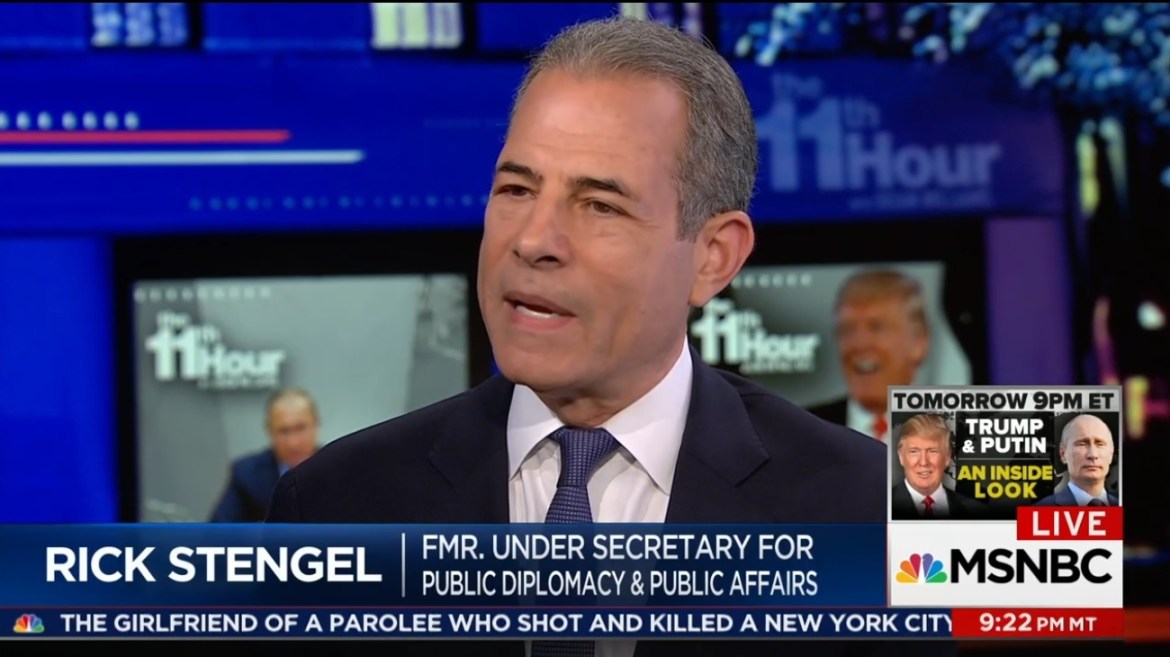
Richard Stengel, the top state media appointee for US President-elect Joe Biden’s transition team, has enthusiastically defended the use of propaganda against Americans.
“My old job at the State Department was what people used to joke as the chief propagandist,” Stengel said in 2018. “I’m not against propaganda. Every country does it, and they have to do it to their own population. And I don’t necessarily think it’s that awful.”
Richard “Rick” Stengel was the longest serving under-secretary of state for public diplomacy and public affairs in US history.
At the State Department under President Barack Obama, Stengel boasted that he “started the only entity in government, non-classified entity, that combated Russian disinformation.” That institution was known as the Global Engagement Center, and it amounted to a massive vehicle for advancing US government propaganda around the world.
A committed crusader in what he openly describes as a global “information war,” Stengel has proudly proclaimed his dedication to the careful management of the public’s access to information.
Stengel outlined his worldview in a book he published this June, entitled “Information Wars: How We Lost the Global Battle Against Disinformation and What We Can Do About It.”
Stengel has proposed “rethinking” the First Amendment that guarantees the freedom of speech and press. In 2018, he stated, “Having once been almost a First Amendment absolutist, I have really moved my position on it, because I just think for practical reasons in society, we have to kind of rethink some of those things.”
The Biden transition team’s selection of a censorial infowarrior for its top state media position comes as a concerted suppression campaign takes hold on social media. The wave of online censorship has been overseen by US intelligence agencies, the State Department, and Silicon Valley corporations that maintain multibillion-dollar contracts with the US government.
As the state-backed censorship dragnet expands, independent media outlets increasingly find themselves in the crosshairs. In the past year, social media platforms have purged hundreds of accounts of foreign news publications, journalists, activists, and government officials from countries targeted by the United States for regime change.
Stengel’s appointment appears to be the clearest signal of a coming escalation by the Biden administration of the censorship and suppression of online media that is seen to threaten US imperatives abroad.
From Obama admin’s “chief propagandist” to Russiagate-peddling MSNBC pundit
Before being appointed as the US State Department’s “chief propagandist” in 2013, Richard Stengel was a managing editor of TIME Magazine.
In the Obama administration, Stengel not only created the Global Engagement Center propaganda vehicle; he also boasted that he “led the creation of English for All, a government-wide effort to promote the teaching of English around the world.”
After leaving the State Department in 2016, Stengel became a strategic advisor to Snap Inc., the company that runs the social media apps Snapchat and Bitmoji.
Stengel also found time for a fellowship at the Atlantic Council, a think tank closely linked to NATO and the Biden camp which has received funding from the US government, Britain, the European Union, and NATO itself, along with a host of Western weapons manufacturers, fossil fuel corporations, Gulf monarchies, and Big Tech juggernauts.
Stengel worked closely with the Atlantic Council’s Digital Forensic Research Lab, a dubious organization that has fueled efforts to censor independent media outlets in the name of fighting “disinformation.”
But Stengel is perhaps most well known as a regular political analyst on MSNBC in the Donald Trump era. On the network, he fueled Russiagate conspiracy theories, portraying the Republican president as a useful idiot of Russia and claiming Trump had a “one-sided bromance” with Vladimir Putin.
Stengel left MSNBC this November to join Biden’s presidential transition. The campaign announced that he was tapped to lead the Biden-Harris agency review team for the United States Agency for Global Media (USAGM).
Agency review teams are an integral part of the transition process, responsible for evaluating the operations of federal agencies.
Our teams are composed of diverse experts with deep policy expertise, ready to ensure we’re prepared to lead on Day One.https://t.co/2gY1E0Ey5k
— Biden-Harris Presidential Transition (@Transition46) November 10, 2020
USAGM is a state media propaganda organization that has its origins in a Cold War vehicle created by the CIA to spread disinformation against the Soviet Union and communist China. (The agency was previously called the Broadcasting Board of Governors, or BBG, until it rebranded in 2018.)
USAGM states on its website that its most important mission is to “Be consistent with the broad foreign policy objectives of the United States.”
An agency shakeup this year produced revelations that USAGM provided clandestine assistance to separatist activists during the protests that consumed Hong Kong in 2019. The program earmarked secure communications assistance for protesters and $2 million in “rapid response” payouts for anti-China activists.
Richard Stengel’s “obsessive” crusade against Russian “disinformation”
When Richard Stengel referred to himself as the State Department’s “chief propagandist,” advocated the use of propaganda against the American people, and proposed to “rethink” the First Amendment, he was participating in a May 3, 2018 panel discussion at the Council on Foreign Relations (CFR).
During the CFR event, titled “Political Disruptions: Combating Disinformation and Fake News,” Stengel hyped up the threat of supposed “Russian disinformation,” a vague term that is increasingly used as an empty signifier for any narrative that offends the sensibilities of Washington’s foreign policy establishment.
Stengel stated that he was “obsessed with” fighting “disinformation,” and made it clear he has a particular obsession with Moscow, accusing “the Russians” of engaging in “full spectrum” disinformation.
Joining him on stage was political scientist Kelly M. Greenhill, who mourned that alternative media platforms publish “things that seem like they could be true… that’s the sphere where it’s particularly difficult to debunk them… it’s this gray region, this gray zone, where it’s not traditional disinformation, but a combination of misinformation and play on rumors, conspiracy theories, sort of gray propaganda, that’s where I think the nub or the crux of the problem lies.”
Stengel approved, adding, “By the way those terms, the gray zone, are all from Russian active measures, that they’ve been doing for a million years.”
The panelists made no effort to hide their disdain for independent and foreign media outlets. Stengel stated clearly that a “news cartel” of mainstream corporate media outlets had long dominated US society, but he bemoaned that those “cartels don’t have hegemony like they used to.”
Stengel made it clear that his mission is to counter the alternative perspectives given a voice by foreign media platforms that challenge the US-dominated media landscape.
“The bad actors use journalistic objectivity against us. And the Russians in particular are smart about this,” Stengel grumbled.
He singled out Russia’s state-funded media network, RT, lamenting that “Vladimir Putin, when they launched Russia Today, said it was an antidote to the American English hegemony over the world media system. That’s how people saw it.”
Ben Decker, a research fellow at the Misinformation Project at the Harvard Kennedy School of Government, lamented that “RT is invading every weekly finance media space.”
But Decker was cheered by the proliferation of US oligarchs committed to retaking control of the narrative. “In America and across the world,” he stated, “the donor community is very eager to address this problem, and very eager to work with communities of researchers, academics, journalists, etc. to target this problem.”
“I think that there is an appetite to solve this from the top down,” he continued, urging the many academics in the audience “to apply for grant money” in order to fight this Russian “disinformation.”
The CFR panel culminated with an African audience member rising from the crowd and confronting Stengel: “Because what is happening in America is what the United States flipped on the Global South and in the Third World, which we lived with, for many, many years, in terms of a master narrative that was and still is propaganda,” the man declared.
Rather than respond, Stengel rudely ignored the question and made his way hurriedly for the exit: “You know what, I hate last questions. Don’t you? I never, I usually just want to end something before the last question.”
The video of the revealing confrontation caused such a furor that CFR’s YouTube account disabled comments and made the video unlisted. It cannot be found in a search on Google or YouTube; it can only be found with the direct link.
The video of the full discussion is embedded below:
Biden, the Media and CIA Labeled the Hunter Biden Emails “Russian Disinformation.” There is Still No Evidence.
By Glenn Greenwald | November 12, 2020
Congressman Adam Schiff, the Chairman of the House Intelligence Committee and, not coincidentally, the single most shameless pathological liar in the U.S. Congress by a good margin, appeared on CNN with Wolf Blitzer on October 16 to discuss The New York Post story about Hunter Biden’s emails. The CNN host asked him a rhetorical question embedded with baseless assumptions: “does it surprise you at all that this information Rudy Giuliani is peddling very well could be connected to some sort of Russian government disinformation campaign?”
Schiff stated definitively that it is: “we know that this whole smear on Joe Biden comes from the Kremlin,” adding: “clearly, the origins of this whole smear are from the Kremlin, and the President is only too happy to have Kremlin help in amplifying it.” Referencing Trump’s promotion of The New York Post reporting while at his White House desk, Schiff said: “there it is in the Oval Office: another wonderful propaganda coup for Vladimir Putin, seeing the President of the United States holding up a newspaper promoting Kremlin propaganda.”
Schiff, as he usually does when he moves his mouth, was lying: exploiting CNN’s notorious willingness to allow Democratic officials to spread disinformation over its airwaves without the slightest challenge. Schiff claimed certainty about something for which there was and still is no evidence: that the Russians played a role in the procurement and publication of the contents of Hunter Biden’s laptop.
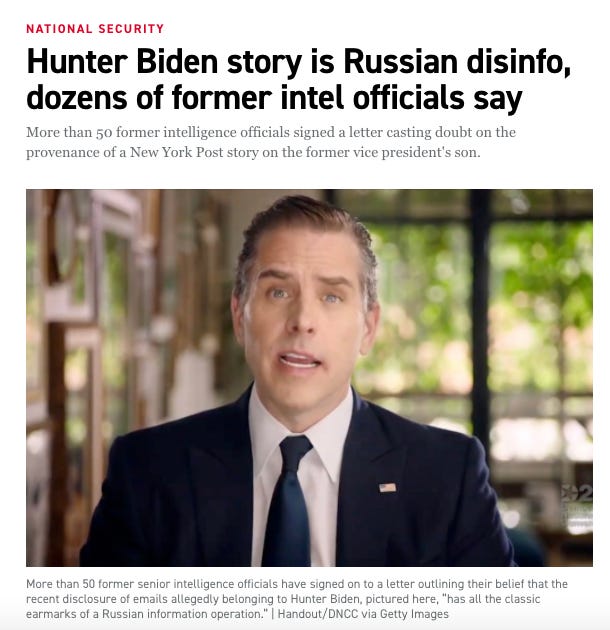
As he also usually does when he publicly lies, Schiff was merely echoing the propaganda of current and former operatives of the CIA and other arms of the intelligence community who abuse their power to interfere in U.S. domestic politics: the very factions over which the Intelligence Committee which Schiff runs is supposed to exercise oversight supervision, not serve as their parrot. During the same week as Schiff’s CNN appearance, as Politico reported, “more than 50 former senior intelligence officials signed on to a letter outlining their belief that the recent disclosure of emails allegedly belonging to Joe Biden’s son ‘has all the classic earmarks of a Russian information operation.’”
In that letter from intelligence operatives about The New York Post story — signed by Obama’s former CIA chief John Brennan now of MSNBC (repeatedly caught lying), Obama’s former Director of National Intelligence James Clapper now of CNN (who got caught lying to the Senate about NSA domestic spying), Bush’s former NSA and CIA chief Micheal Hayden now of CNN (who served during 9/11 and the Iraq War), and dozens of other similar professional disinformation agents — the intelligence operatives announced “our view that the Russians are involved in the Hunter Biden email issue,” adding “that our experience makes us deeply suspicious that the Russian government played a significant role in this case.”
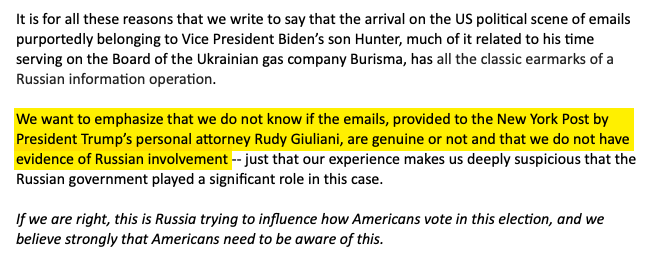
With these ex-CIA officials and their servant Adam Schiff disseminating this narrative into U.S. public, both the Biden campaign and their captive media outlets began asserting this rank speculation as truth. They did so despite the fact that even the intelligence officials were cautious enough to acknowledge: “We want to emphasize that … we do not have evidence of Russian involvement” — a rather crucial fact that numerous outlets omitted when laundering this CIA propaganda and which the Biden campaign and Adam Schiff completely ignored when treating the claims as proven truth.
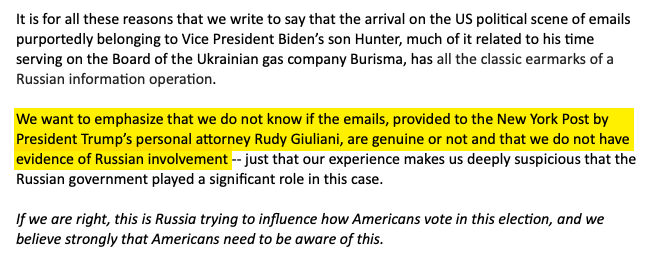 Letter from 50 former intelligence officials about The New York Post reporting on Hunter Biden’s laptop, Oct. 19, 2020
The Biden campaign immediately embraced this evidence-free claim about Russia from Schiff and the intelligence community to justify its refusal to answer questions about the revelations from this reporting. “I think we need to be very, very clear that what he’s doing here is amplifying Russian misinformation,” said Biden Deputy Campaign Manager Kate Bedingfield when asked about the possibility that Trump would cite the Hunter emails at the last presidential debate. Biden’s senior advisor Symone Sanders similarly warned on MSNBC: “if the president decides to amplify these latest smears against the vice president and his only living son, that is Russian disinformation.”
Far worse were the numerous media outlets that spread this evidence-free claim of Kremlin involvement in lieu of reporting on the contents of the emails. Just watch how CBS Evening News with Norah O’Donnell purported to “report” on this story — an emphasis on the Russian origins of the materials, featuring a former “FBI operative” who admitted he had no evidence for the speculation CBS nonetheless aired, all with no mention of the serious questions raised by the revelations themselves:
As I noted when I announced my resignation from The Intercept, a major reason I harbored so much cynicism and scorn for their claim that my story on the Hunter Biden emails had failed to meet their high-minded, rigorous editorial and fact-checking scrutiny was because that same publication was just was one of the many anti-Trump news outlets which, in the name of manipulating the outcome of the election on behalf of the Democratic Party, had mindlessly laundered the CIA/Schiff narrative without the slightest adversarial skepticism or, worse, without a whiff of evidence.
Just one week before they refused to publish my own article, they published this remarkable disinformation, featuring an utterly reckless paragraph that was nothing more than stenographic servitude to the intelligence community and Adam Schiff. Just marvel at what was approved by the fastidious editorial and fact-checking machinery of that “adversarial” publication concerning claims by ex-CIA operatives:
Their latest falsehood once again involves Biden, Ukraine, and a laptop mysteriously discovered in a computer repair shop and passed to the New York Post, thanks to Trump crony Rudy Giuliani. The New York Post story was so rancid that at least one reporter refused to put his byline on it. The U.S. intelligence community had previously warned the White House that Giuliani has been the target of a Russian intelligence operation to disseminate disinformation about Biden, and the FBI has been investigating whether the strange story about the Biden laptop is part of a Russian disinformation campaign. This week, a group of former intelligence officials issued a letter saying that the Giuliani laptop story has the classic trademarks of Russian disinformation.
Numerous other media outlets disseminated the same CIA propaganda — including The Economist (“Marc Polymeropoulos, the CIA’s former acting chief of operations for the Europe and Eurasia Mission Centre…notes that ‘the use of actual material is a hallmark of Russian disinformation campaigns’”), and (needless to say) MSNBC’s Joy Reid (“Hunter Biden story an ‘obvious Russian plot’ McFaul believes”).
Now that this disinformation campaign has done its job — allowing Biden to get past the election without having to answer any real questions about those emails and his family’s work in Ukraine and China — the truth has emerged that there is [not], and never was, any evidence for the disinformation that these materials came from the Kremlin. Some media outlets, though not all, have at least had the integrity to admit this, now that it no longer matters.
“Director of National Intelligence John Ratcliffe said Monday that recently published emails purporting to document the business dealings of Hunter Biden are not connected to a Russian disinformation effort,” USA Today acknowledged. “Hunter Biden’s laptop is not part of some Russian disinformation campaign,” Ratcliffe added.
On October 20, the FBI sent a letter to Sen. Ron Johnson — in response to his request for any information showing Kremlin involvement in the New York Post story — in which they, too, made clear they were not aware of any such evidence:
The FBI is the primary investigative agency responsible for the integrity and security of the 2020 election, and as such, we are focused on an array of threats, including the threat of malign foreign influence operations. Regarding the subject of your letter, we have nothing to add at this time to the October 19th public statement by the Director of National Intelligence about the available actionable intelligence. If actionable intelligence is developed, the FBI in consultation with the Intelligence Community will evaluate the need to provide defensive briefings to you and the Committee pursuant to the established notification framework.
Numerous outlets which had originally noted suspicions of Kremlin involvement and and FBI investigation to determine possible Russian responsibility ultimately updated their stories or published new articles noting the FBI’s admission (though The Intercept never did: its story about Kremlin involvement stands).
In The Washington Post, Thomas Rid wrote this Hall of Fame sentence: ““We must treat the Hunter Biden leaks as if they were a foreign intelligence operation — even if they probably aren’t.” As The New York Times columnist Ross Douthat summarized: “At this point we can posit with some certainty that The Post’s story was not some sort of sweeping Russian disinformation plot but a more normal example of late-dropping opposition research, filtered through a partisan lens and a tabloid sensibility, weaving genuine facts into contestable conclusions.”
The pronouncements of DNI Ratcliffe and the FBI should no more be treated as gospel than the accusations of Kremlin involvement by Adam Schiff, John Brennan and their CIA friends. But that is exactly what the bulk of the U.S. media did with the obvious goal of shielding Joe Biden from questions about the revelations in the emails of his son: they deceived Americans into believing that the whole story was a Kremlin “disinformation” plot and therefore should be ignored.
Whatever else is true about this whole sordid affair, no evidence has emerged — none — that the Russians have played any role in any of this. It is of course possible that one day such evidence may be found of involvement by the Russians — or the Chinese, or the Iranians, or the Venezuelans, or the Saudis, or any other state or non-state actor your imagination might conjure. One cannot prove the negative that this did not happen.
But journalism, in its minimally healthy form, requires evidence before spreading inflammatory accusations about a nuclear-armed power and, even more so, speculation designed to discredit evidence of possible misconduct by the front-running candidate for the U.S. presidency. But here we have yet another case where purported news outlets — knowing that there is no price to pay professionally or reputationally for publishing evidence-free intelligence agency propaganda as long as it benefits the Party and advances the ideology which they all embrace — casually spread disinformation without the slightest evidentiary basis.
Yet again we find that the most prolific propagators of Fake News and disinformation are not the enemies of the mainstream U.S. media. It is the mainstream U.S. media itself that deceives, propagandizes and spreads disinformation on behalf of the coalition of the intelligence community and the Democratic Party far more than any other faction or entity.
Where is the evidence that Russia was involved in this New York Post story? And how can media outlets who endorsed and spread this and now refuse any self-critique expect anything but distrust and scorn from the public when they do this?
Elections and Legitimacy
By James Bovard | American Institute for Economic Research | November 11, 2020
This year’s presidential election is the fourth since 2000 to be marred by either widespread allegations of voter fraud or of foreign interference. Politicians and pundits have long counted on elections to wave a magic wand of legitimacy over the reign of whoever is designated the winner. But Americans are increasingly wondering if the endlessly-trumped “consent of the governed” has become simply another sham to keep them paying and obeying.
Twenty years ago, America was in the throes of a fiercely disputed recount battle in Florida. Democratic presidential nominee Vice President Al Gore won the national popular vote but the Electoral College verdict was unclear. Florida’s 25 electoral votes would give either Gore or Republican candidate George W. Bush the 270 votes needed to win the presidency. Six million votes were cast in Florida, and Bush initially had a winning margin of 537 votes. But the count was a complete mess.
Some Florida counties had antiquated voting equipment while others had harebrained ballot designs that confounded voters, resulting in “dangling chads,” “butterfly” ballots, and other unclear preferences. After the Florida Supreme Court ordered a manual recount of disputed votes in all counties, the Bush campaign legal team quickly filed briefs with the Supreme Court seeking to stop the process.
In a controversial decision, the Supreme Court, in a 5-to-4 ruling, stopped the recount because it could result in “a cloud upon what [George W. Bush] claims to be the legitimacy of his election,” Justice Antonin Scalia wrote. Justice John Paul Stevens dissented: “The Florida court’s ruling reflects the basic principle, inherent in our Constitution and our democracy, that every legal vote should be counted.” No such luck. Two days later, the same Supreme Court majority blocked any subsequent recounting because it was “not well calculated to sustain the confidence that all citizens must have in the outcome of elections.” Sustaining confidence” was more important than counting votes. Justice Stevens again dissented: “We have never before called into question the substantive standard by which a State determines that a vote has been legally cast.”
The 2000 election results seemed almost as shaky as the story of the Lady of the Lake giving the Excalibur sword to Arthur, thereby signifying his right to rule England. At a minimum, the outcome of the 2000 presidential election was decided by lawyers and political appointees (justices), not by voters. Former President Jimmy Carter observed in 2001, “As we have seen in Florida and some other states… the expected error rate in some jurisdictions is as high as 3 percent of the [vote] total.”
Four years later, George W. Bush narrowly won reelection after a campaign that was boosted by numerous false terror attack warnings that helped frighten voters into giving him another four years. Ohio was the key state determining the outcome that time, and its results appeared tainted by numerous decisions by Republican election officials who favored Bush. Democrats also charged that the electronic voting machines used in much of Ohio had been manipulated to produce misleading vote totals.
In January 2005, Democratic members of the House of Representatives launched a brief challenge to the legitimacy of the 2004 presidential election. Rep. Maxine Waters (D-Cal.) complained that many states used more sophisticated technology for lottery tickets than for elections: “Incredibly even in those few jurisdictions that have moved to electronic voting… we do not require a verifiable paper trail to protect against vote tampering.”
Republican Congressmen went ballistic. Rep. Rob Portman (R-Ohio) accused the Democrats of seeking to “obstruct the will of the American people.” Rep. J.D. Hayworth (R-Ariz.) bewailed that the protest “serves to plant the insidious seeds of doubt in the electoral process.” Rep. Roy Blunt (R-Mo.), the House Majority Whip, sought to put the entire government above questioning: “It is the greatest democracy in the history of the world and it is run by people who step forward and make a system work in ways that nobody would believe until they see it produce the result of what people want to have happen on Election Day.” Blunt’s “nobody would believe” phrase was more prescient than he intended.
For tens of millions of Americans and for convention halls full of editorial writers, the 2016 presidential election results were forever tainted by allegations that the Trump campaign colluded with the Russians to score an upset victory. Those allegations spurred a Special Counsel investigation that haunted most of Trump’s presidency and helped Democrats capture control of the House of Representatives in 2018. In 2019, Special Counsel Robert Mueller finally admitted that no case of collusion existed. But we have since learned that there was pervasive collusion between Obama administration officials and federal agencies to target Trump’s 2016 campaign. And, as George Washington University professor Jonathan Turley observed, the media ignored “one of the biggest stories in decades. The Obama administration targeted the campaign of the opposing party based on false evidence.”
Instead, the media cheered secretive federal agencies that had interfered in American politics. Washington Post columnist Eugene Robinson captured the Beltway’s verdict: “God bless the Deep State!” The media’s veneration will make it easier for the FBI, CIA, and National Security Agency to meddle with if not fix future elections.
This year’s presidential election may be the most fraud-ridden event since 1876, when four states had disputed results and Congress gave the presidency to Republican Rutherford Hayes despite ample evidence of conniving. Earlier this year, some states mailed ballots to all the names on the voting lists, providing thousands of dead people the chance to vote from the grave. More than 92 million people voted by mail.
President Trump warned that the shift to mail-in voting could result in “the most corrupt vote in our nation’s history.” A 2012 New York Times analysis concluded that “fraud in voting by mail is… vastly more prevalent than the in-person voting fraud that has attracted far more attention.” But that blunt admission vanished into the Memory Hole as the media endlessly derided any apprehension of electoral foul play.
Shortly before Election Day, Democratic candidate Joe Biden boasted, “We have put together I think the most extensive and inclusive voter fraud organization in the history of American politics.” A Reuters “Fact Check” analysis revealed that Biden’s comment was a “slip of the tongue” and that he likely meant “voter protection.” Since Election Day, the same media outlets that insisted that there was no corruption in the Biden family now assure Americans there was no significant voter fraud.
The 2020 election controversies are being fought out by lawyers and judges. The media is hoping that hailing Joe Biden as the rightful ruler will speedily restore legitimacy to the political system. But 70 million Trump voters are unlikely to be swayed by the same media that endlessly belittled both the president and his supporters.
Perhaps the real problem with the current American political system is that elections are practically the last remaining source of apparent legitimacy. Presidents take an oath to “preserve, protect and defend the Constitution of the United States.” But this has long been a nonbinding throwaway gesture – if not a laugh line for Washington insiders. Elections failed to prevent every recent American commander-in-chief from expanding and exploiting the dictatorial potential of the presidency.
Should we expect anything different from Biden? When he was chairman of the Senate Judiciary Committee, he co-authored numerous oppressive drug laws and forfeiture laws that helped obliterate much of the Bill of Rights. His political philosophy never went beyond his famous utterance: “Lock the S.O.B.s up!” He supported expanding federal power whenever there were votes or campaign contributions to be pocketed.
Biden has said he would dictate a national mask mandate and could impose a national lockdown if Covid infection rates rise. The same media outlets that served as Biden’s Basement Barricade during the campaign – helping him avoid challenges that might have raised questions about his positions and mental capacity – will cheer any restrictive Covid policy Biden imposes. In lieu of constitutionality, we’ll hear that it is the “will of the people” or some such pablum.
Nor will there likely be any way to constrain Biden if he follows the advice of his bellicose foreign policy advisors. Counterpunch editor Jeffrey St. Clair asked: “Which country will Biden bomb first in order to ‘restore America’s place in the world?’” The Biden campaign promised to “increase pressure” on Syrian president Bashar Assad – presumably by providing more arms and money to the terrorist groups that Obama began aiding almost a decade ago. Biden will sanctify his foreign bombing campaigns with the same lame legal tautology that the Obama administration used to justify killing Libyans in 2011. The Justice Department announced that Obama “had the constitutional authority” to attack Libya “because he could reasonably determine that such use of force was in the national interest.”
The more power presidents capture, the more facts they can suppress. The federal government is creating trillions of pages of new secrets every year, effectively making it impossible for average citizens to learn the truth about foreign policy until long after U.S. bombs have dropped. Biden is unlikely to end the pervasive secrecy that makes a mockery of self-government.
In his victory speech last Saturday, Biden pledged to “restore the soul of America.” But Americans were not voting for a faith healer; they were selecting a chief executive for a federal government. Only 20 percent of Americans nowadays trust the government to “do the right thing” most of the time, according to a Pew Research Center survey. The election results will likely further erode federal legitimacy at a time when Uncle Sam has no trust to spare. How many more election debacles and brazen abuses of power does Washington believe the American people will tolerate?
James Bovard is the author of ten books, including Public Policy Hooligan, Attention Deficit Democracy, The Bush Betrayal, and Lost Rights: The Destruction of American Liberty. He has written for the New York Times, Wall Street Journal, Playboy, Washington Post, New Republic, Reader’s Digest, and many other publications. He is a member of the USA Today Board of Contributors, a frequent contributor to The Hill, and a contributing editor for American Conservative.
U.S. Color Revolution: The Not So Phantom Menace
By Tom Luongo | Gold Goats n’ Guns | November 9, 2020
“There is no civility, there is only politics…
The Bureaucrats are in charge now…”
— Senator Palpatine
The Black Revolution in the U.S. is proceeding according to script. We are into the 3rd act of it.
Act I was the Coronapocalypse setting the stage for vastly expanded government powers and the systemic undermining of the sitting President.
Act II was the summer of violence and fake polling data which created the illusion of a society at war with that same President for not addressing the needs of the people.
Underneath the headlines the forces arrayed against Trump were building the infrastructure to ensure that however the people voted on November 3rd, the outcome was pre-determined in their favor against him.
Act III is the election itself and the aftermath. The coup has begun. The pressure campaign to force the incumbent Trump, hated by the establishment, to concede has ratcheted up to eleven.
This is all very normal for color revolutions, just ask Alexander Lukashenko in Belarus or Viktor Yanukovich formerly of the Ukraine. We can’t ask Slobodon Milosovic. He dead.
But one thing happened they didn’t count on, Trump actually winning the election by margins in swing states that couldn’t be overcome without overt and blatant fraud.
That’s created the opportunity for a complete reversal of the current results and a successful countering of the color revolution strategy, which rests on a media-made frenzy supported by foreign government leaders to oust the sitting president from power quickly without proper adherence to the process.
And that feeds the plot points for the next eight weeks until Congress convenes to certify (or not) the Electoral College.
President Trump refuses to concede the election, and rightly so. There are multiple paths to not only victory for him but also exposing the deep corruption of the election process and the people who control it.
Lukashenko survived the color revolution in Belarus because the attempt there was ham-fisted. It lacked the ingredients necessary to pull it off — identitarian division within the people and ‘corporate’ sponsorship.
The conditions weren’t ripe for that kind of result. All he had to do was offer reforms once the energy died down and make peace with Russia and he would survive.
Ousting him from power may not have been the primary goal, but achieving the secondary goal of severing EU and US ties to it and forcing Russia to devote resources to Belarus is almost as important.
So, if Trump wants to lead the nation he has to show it by fighting tooth and claw, just like Lukashenko did. And that means organizing support for him across the country. This is why he is incredibly smart to organize rallies. According to Axios :
President Trump plans to brandish obituaries of people who supposedly voted but are dead — plus hold campaign-style rallies — in an effort to prolong his fight against apparent insurmountable election results, four Trump advisers told me during a conference call this afternoon.
“Insurmountable election results??” Really? A few thousand votes separates Trump from outright sweeping all the battleground states whose vote totals are very sketchy and this is ‘insurmountable?’
This is what I mean by the pressure campaign having gone plaid. There is no responsible journalism left within the major media outlets.
Only those who were forced out on principle or corruption have the ability to speak their mind now.
Never in a million years would I look to Megyn Kelly for the voice of rationality. But it looks like being excommunicated from the inner circle does wonders for one’s ability to tell the truth.
The division today was cynically stoked and nurtured for this current operation to effect this exact result. The bigger point Megyn doesn’t articulate is that this division is exactly the kind of ‘secondary goal’ desired if Trump prevails in the courts or through the Electoral College.
Regardless of the outcome that division cuts deep enough to ensure an America permanently weakened, ripe for a complete remaking into a hellish place. There is a full-court press on right now across the world to attack sovereignty of important states whose populations are dissident to The Davos Crowd’s Great Reset — notably the U.K., the U.S., Poland and Russia.
Trump’s fight is their fight. His supporters and sovereigntists of all stripes are to be ritualistically humiliated by every headline, every utterance, every Tweet and every newscast between now and when the State Legislatures meet to select slates of Electors in December.
The media will never concede they were wrong, will never report on anything fairly. They are in on the grift. Looking for them to admit anything is a waste of energy and time. Simply turn them off and become #Ungovernable.
This is a psychological war now, designed to rob you of your reason and sap your willingness to fight by creating an overwhelming picture of Trump as the bad guy, Quixotically clinging to power we’re being told he’s already lost.
But Megyn Kelly is right in telling people that there will be no reconciliation without acceptance. And since, at its core, leftism is a religion without the ability to forgive, since it is vehemently anti-Christian, there will be no acceptance back into the fold, including for her.
It will be marginalization, retribution and continued vitriol of all Trump supporters and anyone not down with being reset into the grand vision of the New Soviet Green Man.
They haven’t even secured the presidency yet and BLM/Antifa are already turning on white Biden supporters who are urging peace.
Nothing shields you from the mob once the mob gets going. I hope this person’s conscience is clean that he did his part to stop Orange Man Bad because once this is over, that’s all he’ll have left.
Klaus Schwab told you this. You’ll Own Nothing and be Happy.
Or else.
The choice was struggle sessions or Trump rallies. I told you months ago you would be faced with the Hobson’s Choice of accepting their dystopic future or having your house burned down.
Millions chose poorly last week and they will have massive buyer’s remorse as the plans are rolled out and they are sacrificed.
Don’t believe me? Ask Ukrainians if they are better off six years after their color revolution or not? That one was successful.
Act III of a color revolution is the most dangerous. It is the one where chaos can reign for months and the balance tipped by the slimmest of margins. But in the end it always comes down to the willingness of the people to decide their future.
Because taking down the U.S. is such a monumental undertaking they had to create a problem global in scale, COVID-19.
The U.S. has everything against it in this situation. The oligarchy and its quislings are firmly in command of the narrative. There are real, deep divisions to keep people fighting each other while the oligarchs proceed with their plans.
Trump is trying to marshal a counter-revolution on the ground and in the courts. The evidence will be presented. Apparatchiks will ignore their orders. Protests will miraculously spring up in all the right places.
The media will misrepresent everything.
It will be up to us to decide which way the State Legislatures decide whose electors go to Washington D.C. next month by putting real pressure on them to act on their conscience and the evidence. That’s the law.
But the menace of it is real and it won’t go away regardless of the outcome of the election. It no longer lurks in the shadows. It slouches towards Washington waiting to be reborn.
Featured Video

New positive ivermectin evidence
or go to
Aletho News Archives – Video-Images
From the Archives
Secret document reveals plans for civil war in Lebanon, Israeli false flags, and invasion
By Randi Nord | Geopolitics Alert | April 5, 2019
Beirut – During his visit with US Secretary of State, Mike Pompeo, Lebanese President Michael Aoun reportedly received a US-Israeli document detailing plans for creating a civil war in Lebanon with covert false flag operations and possible Israeli invasion.
Although the source of the document is Israeli and created in partnership with Washington, no one knows who presented it to Aoun. The Lebanese TV station, Al-Jadeed, initially reported the document on Lebanese TV and a video on its website. Geopolitics Alert translated the report for this article. … continue
Blog Roll
 Aletho News
- EU Council Advances Chat Control 2.0 Scanning Proposal
- Ex-Greek MEP files complaint against Israeli spyware firm over alleged Pegasus surveillance
- Troubling ideas throughout the Torah, Talmud, Mishneh Torah and Tanya
- ‘Grave, alarming’: Iran mission on Trump’s UNGA ‘annihilation’ threats
- Najaf airport to reopen to Iranian flights within 24 hours: Ambassador
- From ‘How Will This End For Iran’ to ‘When America Walks Away’: A tale of two Economist covers
- Tehran blasts ‘baseless’ speculation linking Iran to alleged bomb plot at UK air base
- The Rise And… Rise Of ‘Color Revolutions’
- The Coming GOP Bloodbath?
- Arctic Scare Stories Melt Away
- If Americans Knew
- Netanyahu Asked UAE Leader to Deny Report on Oct. 7 Warning in Secret Visit, Sources Say
- CNN Chief Int’l Correspondent Clarissa Ward on Journalists in Gaza
- Democratic Party Consultants Surround Troy Jackson with Pro-Israel Donors
- Christian Leader Responds To Netanyahu’s Claims Regarding Palestinian Christians
- In Gaza, ‘Whoever Survives the Bombing Won’t Survive the Rubble’
- Israel kills more Palestinians, amid push to resettle Gaza – Daily Update
- Israel forces Gazans to live in constant peril – Daily Update
- Deconstructing Netanyahu’s pants-on-fire UN rant – Daily Update
- Trump betrayed voters with his campaign lies and prioritized a foreign country once he took office
- Netanyahu calls Israel’s war in Gaza ‘opposite of genocide’ in UN speech to near-empty hall
- No Tricks Zone
- New Study: Earth And Venus Surface Warmth Largely Explained By Convection And Lapse Rate, Not CO2 Or Radiation
- 2025 Nature Paper Claiming Worsening Global Drought Gets RETRACTED …Heavily Flawed
- New Study: ‘Global Drought Shows No Detectable Recent Acceleration Under Climate Warming’
- Economic Masterminds: German Socialists Suggest Taxing Productivity Gains Stemming From Using AI
- The South China Sea Has Not Been Cooperating With The Climate Change Narrative
- Energy Crisis: Germany Enters Heating Season With Historically Low Gas Reserve Fill Levels
- New Study: The Antarctic Ice Sheet Gained Mass From 2020-2024 Due To Staggering Snow And Ice Accumulation
- Study: Ocean Heating Rates From Thousands Of Years Ago ‘Dwarf’ Modern Ocean Heating Rates
- Climate Extremists Target, Attack Large-Scale Power Grid Infrastructure In Germany!
- New Study: Antarctic Ice Melt Has Contributed Less Than 1 Centimeter To Sea Level Rise In The Last 30 Years

