Not with a bang, but a whimper: Final ‘Russiagate’ report provides ‘BREATHTAKING’ evidence of… nothing
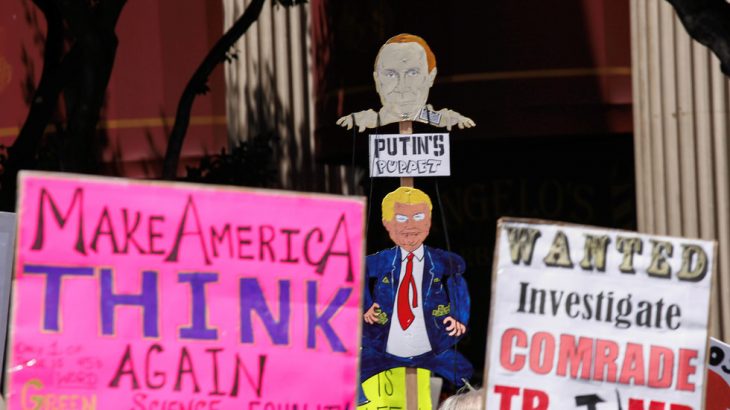
FILE PHOTO: People take part in a “March for Truth” protest against Donald Trump in Los Angeles, California, June 3, 2017 © Reuters / John Fredricks
RT | August 18, 2020
A new Senate report resurrects the corpse of ‘Russiagate’ and promises new evidence of collusion between the Trump campaign and Moscow. However, it reached its so-called conclusions by relying on some literal fake news.
The Senate Intelligence Committee released its fifth and final report on Russia’s supposed interference in the 2016 election, and President Donald Trump’s supposed ‘collusion’ with the Kremlin, on Tuesday. The report retreads much of the same ground as Special Counsel Robert Mueller’s ‘Russiagate’ investigation, and arrives at broadly similar conclusions.
However, the scope of the report has led its authors to arrive at vastly different conclusions. Senator Marco Rubio (R-Florida), who currently chairs the committee, said on Tuesday that the report “found absolutely no evidence that then-candidate Donald Trump or his campaign colluded with the Russian government to meddle in the 2016 election.”
Rubio only took over leadership of the committee from Sen. Richard Burr (R-North Carolina) in May. Before stepping down under a cloud of suspicion over alleged pandemic insider trading, Burr basically allowed Senator Mark Warner (D-Virginia) to largely run the committee’s probe from 2017 onwards.
Warner saw things differently than Rubio, saying on Tuesday that the final volume revealed “a breathtaking level of contacts between Trump officials and Russian government operatives.”
Warner was likely seeing what he wanted to see. The latest edition of the report focused on the “counterintelligence threats” posed by Russia in 2016, yet, like earlier editions, it relied on rumor, hearsay, and what appear to be politically motivated reports, in documenting these supposed “threats.”
For example, former Trump campaign manager Paul Manafort is described as having worked with a Russian intelligence official “on narratives that sought to undermine evidence that Russia interfered in the 2016 US election,” yet the report neglected to describe this official – an Ukrainian citizen named Konstantin Kilimnik – as a US State Department informant, which he was.
The report also describes a phone conversation between former campaign associate Roger Stone and someone who “almost certainly” was President Trump. Based on Stone’s prior interest in WikiLeaks’ forthcoming release of Democratic Party emails, the report concludes that “it appears quite likely” Stone and Trump spoke about WikiLeaks.
The word “likely” appears nearly 140 times throughout the 1,000-page report, while “almost certainly” appears 21 times. In nearly every case, these words are used to make assumptions in place of actual evidence.
The Russian military intelligence outfit – referred to most often as GRU – is described as conspiring with WikiLeaks to release the Democratic emails, a claim that is not, and has never been, substantiated. Kilimnik is described as “linked” to this so-called hacking operation based only “on a body of fragmentary information.” Such shoddy sourcing goes on throughout the report, and readers looking for evidence of Russia’s election-hacking capability are directed to the committee’s earlier reports.
However, anyone flicking through these reports is greeted by some even more scandalous citations. In a report released in December 2018, the committee notes it relied on the work of New Knowledge, a firm staffed by techies linked to the Democrats and the US military. New Knowledge co-founder Jonathon Morgan is also a developer of the anti-Russia Hamilton 68 Dashboard, which is partly funded by NATO and USAID.
This firm was later revealed to have run its own election interference operation, generating thousands of fake social media profiles to swing Alabama’s 2017 special Senate election against Republican candidate Roy Moore. Ironically, this scheme saw one of New Knowledge’s founders booted off Facebook for “coordinated inauthentic behavior,” a charge Russiagaters usually level at so-called troll accounts.
Yet this firm’s guesswork was treated as evidence, as was the 2017 ‘Intelligence Community Assessment’, itself the work of a small number of Obama administration intelligence chiefs who were later implicated in a plot to derail Trump’s presidency.
Coming less than 90 days before the presidential election, the latest report is unlikely to move the needle on Trump’s popularity, nor spur a fresh impeachment drive against the president.
However, its conclusion – that Russia’s election-meddling efforts are “ongoing” – will likely give lawmakers on both sides of the aisle a fresh shot at blaming Russia for whatever may go awry when Americans go to the polls in November.
Lukashenko: Videos of Russian troops in Belarus are ‘fake’ – Minsk more worried about NATO movement in Poland & Lithuania
By Jonny Tickle | RT | August 19, 2020
Belarusian President Alexander Lukashenko has completely denied that there are any foreign troops in the country, rejecting online “fakes” that claim to show columns of Russian troops heading towards the border.
Instead he says Belarusian officials should carefully monitor NATO troops at the country’s western borders. “The defense ministry should pay special attention to movements of NATO forces in Poland and Lithuania,” state news agency BelTA quoted him as saying. “We should track all directions of their movements, and their intentions.”
Lukashenko is currently facing mass unrest following the results of a national election on August 9, deemed by many to be falsified. Some internet commenters have claimed that the Belarusian president has called for Russian military assistance, but this has been denied.
“As for foreign troops, today there is not a single one from another state in Belarus,” he said, according to BelTA.
“Another problem is fakes. People are blatantly lying on the internet, saying that there are foreign troops in Belarus, and equipment from Russia,” the President complained. Lukashenko noted that videos are published online showing military vehicles driving down a road, but nobody knows when or where these were filmed.
In particular, Lukashenko mentioned a viral image showing a convoy of Belarusian military vehicles said to be moving towards the city of Orsha, which had been widely speculated to be Russian.
On Tuesday, Lukashenko announced that the Belarusian army had been deployed in the west of the country and put on full alert. Along this frontier, Belarus shares borders with Lithuania, Poland, and Ukraine.
Since 1994, Russia and Belarus have been part of a group called the Collective Security Treaty Organization (CSTO), a collection of six former Soviet countries who have pledged to protect each other in case of war.
The CIA Versus the Kennedys
By Jacob G. Hornberger | FFF | August 18, 2020
Former Congressman Ron Paul and his colleague Dan McAdams recently conducted a fascinating interview with Robert F. Kennedy Jr., which focused in part on the assassination of President John F. Kennedy, who was Kennedy Jr.’s uncle. The interview took place on their program the Ron Paul Liberty Report.
Owing to the many federal records that have been released over the years relating to the Kennedy assassination, especially through the efforts of the Assassination Records Review Board in the 1990s, many Americans are now aware of the war that was being waged between President Kennedy and the CIA throughout his presidency. The details of this war are set forth in FFF’s book JFK’s War with the National Security Establishment: Why Kennedy Was Assassinated by Douglas Horne.
In the interview, Robert Kennedy Jr. revealed a fascinating aspect of this war with which I was unfamiliar. He stated that the deep animosity that the CIA had for the Kennedy family actually stretched back to something the family patriarch, Joseph P. Kennedy, did in the 1950s that incurred the wrath of Allen Dulles, the head of the CIA.
Kennedy Jr. stated that his father had served on a commission that was charged with examining and analyzing CIA covert activities, or “dirty tricks” as Kennedy Jr. put them. As part of that commission, Kennedy Jr stated, Joseph P. Kennedy (Kennedy’s Jr.’s grandfather) had determined that the CIA had done bad things with its regime-change operations that were destroying democracies, such as in Iran and Guatemala.
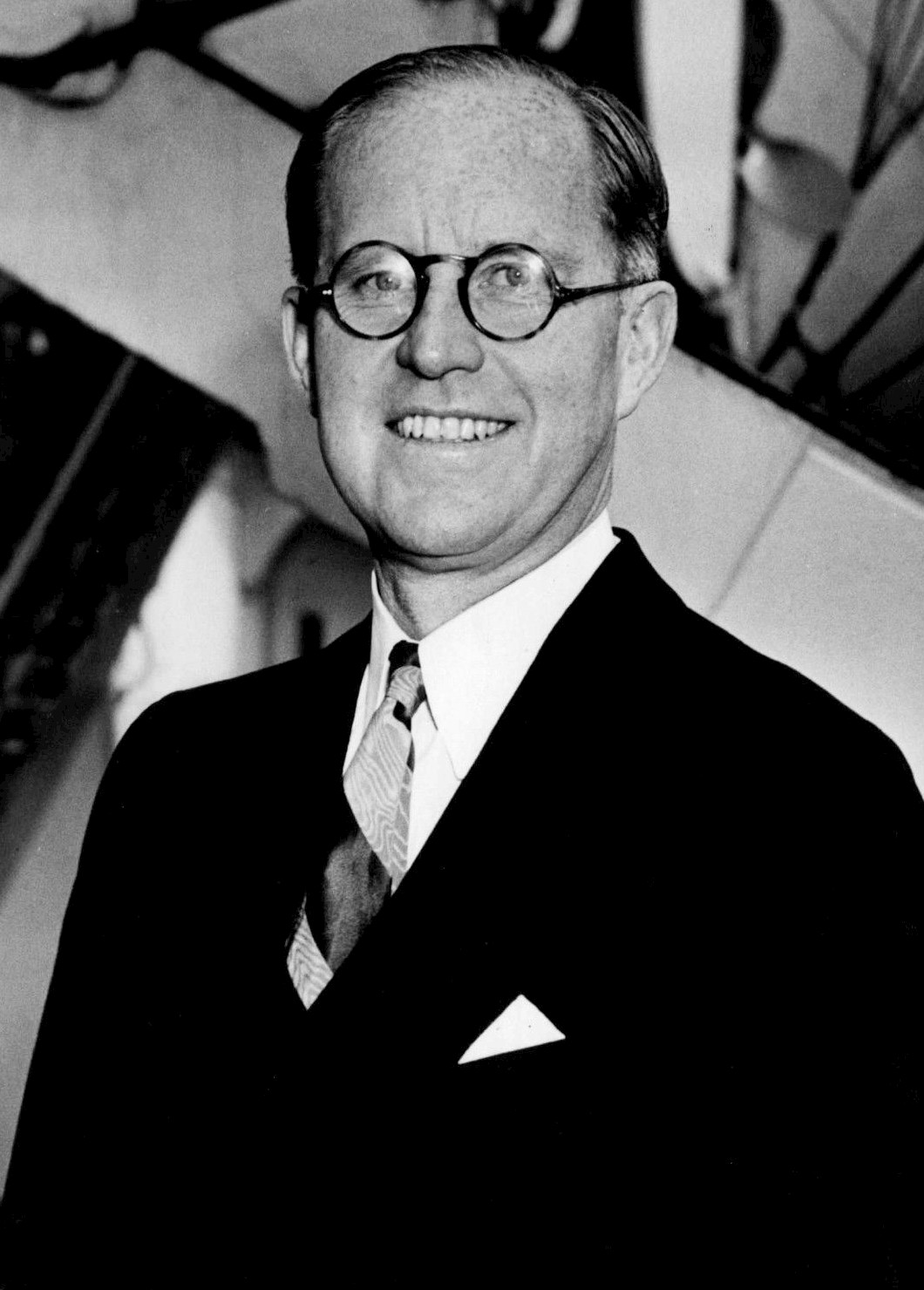 Consequently, Joseph Kennedy recommended that the CIA’s power to engage in covert activities be terminated and that the CIA be strictly limited to collecting intelligence and empowered to do nothing else.
According to Kennedy Jr., “Allen Dulles never forgave him — never forgave my family — for that.”
I wasn’t aware of that fact. I assumed that the war between President Kennedy and the CIA had begun with the CIA’s invasion at the Bay of Pigs in Cuba. The additional information added by Kennedy Jr. places things in a much more fascinating and revealing context.
Upon doing a bit of research on the Internet, I found that the commission that Kennedy Jr. must have been referring to was the President’s Board of Consultants on Foreign Intelligence Activities, which President Eisenhower had established in 1956 through Executive Order 10656. Eisenhower appointed Joseph Kennedy to serve on that commission.
That year was three years after the CIA’s 1953 regime change operation in Iran which destroyed that country’s democratic system. It was two years after the CIA’s regime-change operation in Guatemala that destroyed that country’s democratic system.
Keep in mind that the ostensible reason that the CIA engaged in these regime-change operations was to protect “national security,” which over time has become the most important term in the American political lexicon. Although no one has ever come up with an objective definition for the term, the CIA’s power to address threats to “national security,” including through coups and assassinations, became omnipotent.
Yet, here was Joseph P. Kennedy declaring that the CIA’s power to exercise such powers should be terminated and recommending that the CIA’s power be strictly limited to intelligence gathering.
It is not difficult to imagine how livid CIA Director Dulles and his cohorts must have been at Kennedy. No bureaucrat likes to have his power limited. More important, for Dulles and his cohorts, it would have been clear that if Kennedy got his way, “national security” would be gravely threatened given the Cold War that the United States was engaged in with the Soviet Union, China, Cuba, North Korea, and other communist nations.
Now consider what happened with the Bay of Pigs. The CIA’s plan for a regime-change invasion of Cuba, was conceived under President Eisenhower. Believing that Vice President Nixon would be elected president in 1960, the CIA was quite surprised that Kennedy was elected instead. To ensure that the invasion would go forth anyway, the CIA assured Kennedy that the invasion would succeed without U.S. air support. It was a lie. The CIA assumed that once the invasion was going to go down in defeat at the hands of the communists, Kennedy would have to provide the air support in order to “save face.”
But Kennedy refused to be played by the CIA. When the CIA’s army of Cuban exiles was going down in defeat, the CIA requested the air support, convinced that their plan to manipulate the new president would work. It didn’t. Kennedy refused to provide the air support and the CIA’s invasion went down in defeat.
Now consider what happened after the Bay of Pigs: Knowing that the CIA had played him and double-crossed him, John Kennedy fired Allen Dulles as CIA director, along with his chief deputy, Charles Cabell. He then put his younger brother Bobby Kennedy in charge of monitoring the CIA, which infuriated the CIA.
Now jump ahead to the Cuban Missile Crisis, which Kennedy resolved by promising that the United States would not invade Cuba for a regime-change operation. That necessarily would leave a permanent communist regime in Cuba, something that the CIA steadfastly maintained was a grave threat to “national security”— a much bigger threat, in fact, than the threats supposedly posed by the regimes in Iran in 1953 and Guatemala in 1954.
And then Kennedy did the unforgivable, at least insofar as the CIA was concerned. In his famous Peace Speech at American University in June 1963, he declared an end to the entire Cold War and announced that the United States was going to establish friendly and peaceful relations with the communist world.
Kennedy had thrown the gauntlet down in front of the CIA. It was either going to be his way or the CIA’s way. There was no room for compromise, and both sides knew it.
In the minds of former CIA Director Allen Dulles and the people still at the CIA, what Kennedy was doing was anathema and, even worse, the gravest threat to “national security” the United States had ever faced, a much bigger threat than even that posed by the democratic regimes in Iran and Guatemala. At that point, the CIA’s animosity toward President Kennedy far exceeded the animosity it had borne toward his father, Joseph P. Kennedy, several years before.
Jacob G. Hornberger is founder and president of The Future of Freedom Foundation. He was born and raised in Laredo, Texas, and received his B.A. in economics from Virginia Military Institute and his law degree from the University of Texas. He was a trial attorney for twelve years in Texas. He also was an adjunct professor at the University of Dallas, where he taught law and economics. In 1987, Mr. Hornberger left the practice of law to become director of programs at the Foundation for Economic Education.
Don’t Forget Trump’s Deal with the CIA on the JFK Records
By Jacob G. Hornberger | FFF | August 17, 2020
In April 2018, President Trump issued an order to the National Archives to continue keeping thousands of CIA records relating to the John Kennedy assassination secret from the American people. The new deadline, which could be extended again by either Trump or a President Biden, was set for October 2021.
Since the order was issued early in the Trump regime, no doubt he felt confident that there would be no adverse political consequences flowing from his order. But now that Trump is engaged in a heated race with Joe Biden, he ought to be called upon to explain and justify his order for continued secrecy in an assassination that took place almost six decades ago.
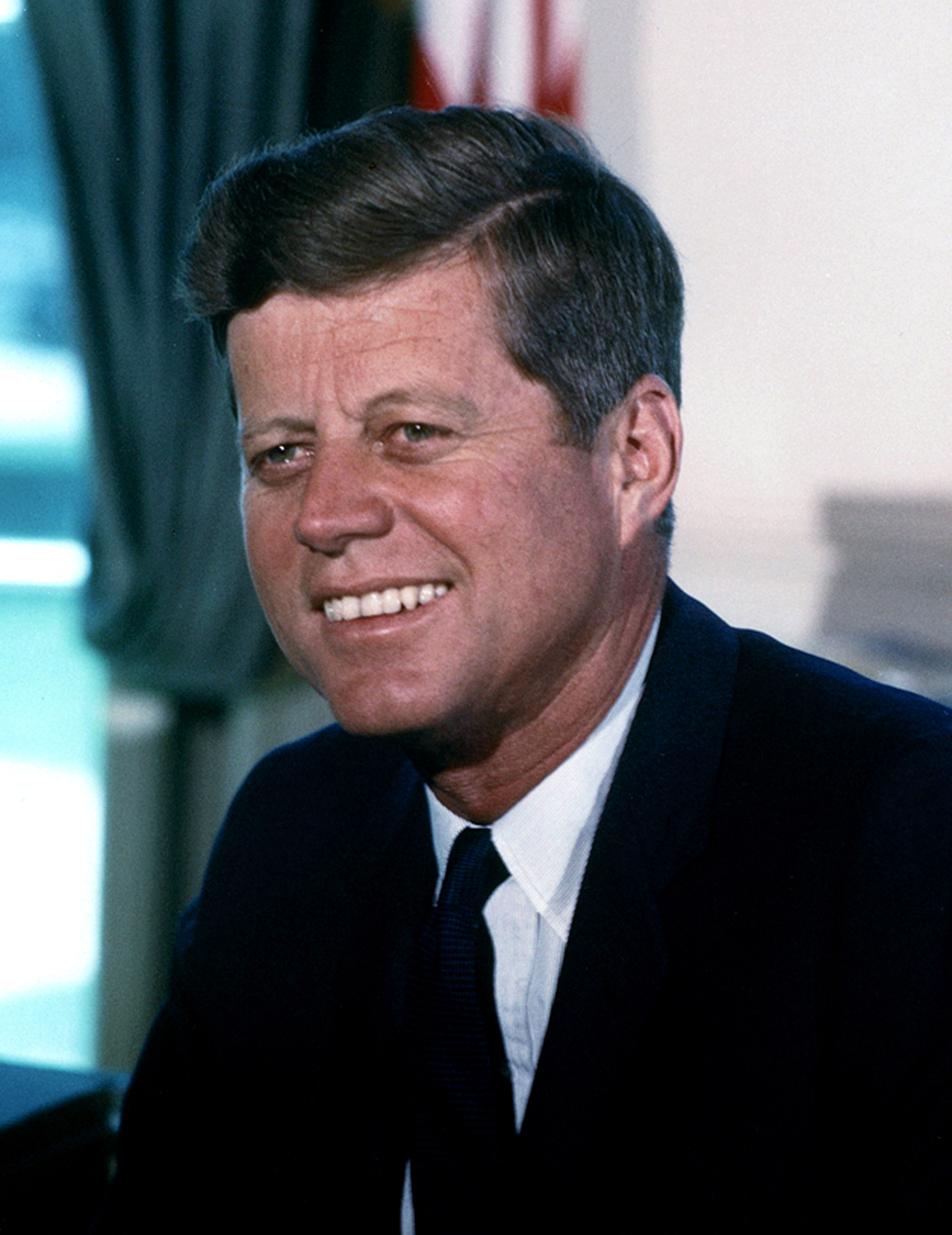 Given the official narrative of the Kennedy assassination, the massive secrecy in which the Pentagon and the CIA engaged after the assassination has never made any sense.
The official narrative says that a lone nut former U.S. Marine communist killed Kennedy with no apparent motive. The most that proponents of the lone-nut theory have ever come up with on a possible motive is that a little man wanted to become a big man by killing a big man. The big problem with that theory is that the accused assassin, Lee Harvey Oswald, denied that he did it and even contended that he was being framed for the crime. If a little man wanted to become a big man by killing a big man, wouldn’t he be acknowledging that he did it and even boasting about it?
IN 1991, Oliver Stone come out with his movie JFK, which posited that Kennedy had been assassinated as part of a U.S. domestic regime-change operation intended to protect “national security” from a president who had declared an end to the Cold War and an intention to establish peaceful and friendly relations with the Soviet Union and the rest of the communist world. (See FFF’s book JFK’s War with the National Security Establishment: Why Kennedy Was Assassinated by Douglas Horne, who served on the staff of the ARRB.)
At the end of JFK, Stone inserted a blurb pointing out the continued secrecy of federal agencies with respect to records relating to the Kennedy assassination some 30 years after the assassination in what had been presented as nothing more than a lone-nut murder of a president.
While the mainstream media was poo-pooing Stone’s movie, the American people were outraged over the continued secrecy. Public pressure caused Congress to enact the JFK Records Collection Act in 1992, which mandated the release of all assassination-related records of federal agencies, including the Pentagon and the CIA.
To enforce the law, Congress called into existence the Assassination Records Review Board. In its four years of operation, the ARRB secured the release of tens of thousands of records relating to the assassination, some of which pointed to the fraudulent nature of the autopsy that the U.S. military conducted on the president’s body. (See my books The Kennedy Autopsy and The Kennedy Autopsy 2.)
There were two strange parts of the JFK Records Act:
1. The law expressly prohibited the ARRB from investigating any aspect of the JFK assassination. Doesn’t that seem to be a rather strange provision? If a matter that had intentionally been kept secret for 30 years needed to be investigated, wouldn’t you think that Congress would want it investigated? The no-investigation provision was strictly enforced on the ARRB staff by the ARRB board of trustees.
2.The law permitted federal agencies to keep their records secret for another 25 years, a provision that the CIA took advantage of. Given that this was supposedly just a lone-nut murder, why was secrecy necessary in the first place? What “national security” concern would there have been? And wouldn’t a lapse of 30 years be sufficient for any such “national security” concern? Why another 25 years, especially since continued secrecy would only serve to buttress Stone’s thesis in JFK?
Back in the 1990s, 25 years must have seemed like a long time away, long enough that the CIA and the Pentagon could rest easy. Anyway, by the time those 25 years expired, there was a good chance that no one would care anyway, especially within the mainstream press.
But when that deadline rolled around in 2018, there were people who still cared. They were demanding that Trump release the records.
That’s not what Trump did. Instead, he granted the CIA’s request for at least another 3 1/2 years of secrecy.
Back in 2018, Trump didn’t have to justify his decision, but now that he’s running for reelection, he should be made to account for what he did by being asked the following questions:
1. How could the release of the CIA’s long-secret JFK-assassination-related records possibly pose a threat to “national security”?
2. Why not order an immediate release of those long-secret records now rather than wait until October of next year?
3. If the CIA has nothing to hide, why is it still hiding it almost 60 years after the Kennedy assassination?
The big problem, of course, is the deep loyalty that the mainstream press, Democrats, Republicans, and even some conservative-oriented libertarians have toward the CIA, not to mention the deep fear of being labeled a “conspiracy theorist.” That is why it is unlikely that Trump will be required to justify his deference to the CIA and its desire for continued secrecy in the Kennedy assassination.
Jacob G. Hornberger is founder and president of The Future of Freedom Foundation. He was born and raised in Laredo, Texas, and received his B.A. in economics from Virginia Military Institute and his law degree from the University of Texas. He was a trial attorney for twelve years in Texas. He also was an adjunct professor at the University of Dallas, where he taught law and economics. In 1987, Mr. Hornberger left the practice of law to become director of programs at the Foundation for Economic Education.
US intelligence saying IRAN is paying bounties to kill Americans in Afghanistan is pure parody
By Scott Ritter | RT | August 18, 2020
It was Russia in June, now it’s Tehran. Don’t US analysts understand that Taliban fighters really don’t need any more motivation to target American troops? This is simply politicized (un)intelligence that isn’t fooling anyone.
According to CNN, the Iranian government has paid “bounties” to the Haqqani network, a terrorist group with close links to the Taliban, for six attacks on US and coalition forces in Afghanistan in 2019, including one on December 11 which targeted Bagram Air Base, north of Kabul, which wounded four US personnel.
This explosive allegation was contained in a Pentagon briefing document which was reviewed by CNN. While the bounties mentioned were attributed to an unnamed “foreign government,” CNN claims that sources “familiar with” the intelligence named the country as Iran. These bounties, and the attacks on US personnel they underwrote, played a role in the deliberations that led to the assassination of Major General Qassem Soleimani, the head of the Iranian Quds Force, by US forces in early January 2020, the network reported.
The CNN report comes on the heels of similar allegations regarding “bounties” paid by Russian military intelligence to the Taliban, likewise for the purpose of underwriting attacks on US and coalition personnel in Afghanistan. The Russian bounty story has since turned out to have been based upon uncorroborated raw intelligence deemed by senior US officials as being too poorly sourced to be actionable by the president or his senior advisers. The intelligence was leaked to the press regardless, in what appeared to be an effort to undermine President Trump’s ongoing efforts to forge a peace agreement with the Taliban and to embarrass him in the leadup to the 2020 presidential election.
At first blush, it appears that the CNN reporting is cut from the same cloth as was the Russian “bounty” story. First and foremost (as the CNN reports notes), the Haqqani network did not, and does not, need financial incentives from outside agencies to motivate it to carry out attacks against US and/or coalition targets. As such, even if payments were in fact sent from Iran to the Haqqani network, the likelihood that they were linked to the December 11 attack, or any other, is virtually nil.
The linkage attributed to the December 11 attack on Bagram Air Base and the decision by the US to assassinate Qassem Soleimani is likewise tenuous. In the days, weeks and months following the Soleimani assassination, the Trump administration was called to task by Congress and the media about its justification for the Soleimani strike. While a great deal of weight was given to a rocket attack on K-2 Air Base in Iraq on December 27 that killed a US civilian contractor, there was no mention at any time about any Iranian “bounty” scheme ongoing inside Afghanistan, despite the fact that a direct correlation between such a “bounty” and the need to kill Soleimani would have been a stronger argument in favor of the attack on the Iranian general.
US intelligence has claimed that Iran has been providing “modest” amounts of armaments to the Taliban on an ongoing basis since 2007, something both the Taliban and Iran deny. According to statements made by US intelligence spokespersons in November 2019, this assistance was beefed up in 2015 to assist the Taliban in confronting Islamic State (IS, formerly ISIS) inside Afghanistan. No mention was made of any “bounty” scheme, although Secretary of State Mike Pompeo did link the Iranian assistance to an attack on US forces in May 2019.
While there is evidence to suggest that Iran and the Taliban enjoyed some sort of a relationship dating back to 2007, this relationship seemed focused on supporting Taliban forces based out of western Afghanistan, along the border with Iran; there was no evidence that this relationship included the payment of “bounties” for targeting US personnel.
Moreover, there was no suggestion that at the time of the December 27, 2019 attack on Bagram Air Base, Iran was providing support to the Haqqani network, a Sunni terrorist organization with close links to Pakistani intelligence and which operates out of the Pakistani city of Quetta. Indeed, the first indication of an Iranian connection to the Haqqani network came in the aftermath of the signing of the US-Taliban peace agreement in February 2020, when fringe elements of the Taliban, including allies within the Haqqani network, broke away in order to continue the struggle against the US in Afghanistan.
Even this reporting is sketchy – the alleged Iranian-Taliban-Haqqani cooperation was in the “early stages of forming,” not indicative of the kind of maturity that would have had to exist to sustain any viable bounty scheme. Moreover, any cooperation that was still in its infancy in February 2020, could not have been the basis of an arrangement regarding an attack that took place in December 2019. Finally, an Iranian-Haqqani bounty scheme would fly in the face of the public commitment by the Haqqani network in support of the US-Taliban peace agreement. In short, the CNN report fails on matters of fact and logic.
The timing of the CNN report provides the greatest insight as to why such a poorly sourced and thinly argued claim would be made against Iran at this time, coming as it does on the heels of the US losing a major vote in the UN Security Council concerning the lifting of an arms embargo against Iran.
This embarrassing defeat, in which the US was only able to garner a single additional vote in support of its resolution, has set the stage for an even greater confrontation at the UN over so-called “snap-back” sanctions the US seeks to impose on Iran.
The Iran-Haqqani bounty allegation was leaked by persons in the US intelligence community who have no qualms about injecting manufactured and/or misleading intelligence into the American news cycle at a critically sensitive time, with less than 90 days remaining until the 2020 US presidential election. Instead of seeking to embarrass President Trump, this leak is designed to bolster the Trump administration’s argument that Iran is a threat worthy of sustaining a major confrontation at the Security Council which could threaten the legitimacy and viability of that organization.
In the end, the motives behind an intelligence leak are irrelevant. The US intelligence community, through its repeated use of well-timed leaks to influence policy by deceiving the American public about the truth, has shown itself to be a highly politicized institution that operates at the whim of nameless partisan operatives, and not in the best interests of the United States.
That it can still ask for and receive a budget in excess of $80 billion per year is a harsh indictment of just how decrepit the US system of government has become, where a blind eye continues to be turned when it comes to the blatant abuse of intelligence for purposes other than what it was intended for.
Scott Ritter is a former US Marine Corps intelligence officer and author of ‘SCORPION KING: America’s Suicidal Embrace of Nuclear Weapons from FDR to Trump.’ He served in the Soviet Union as an inspector implementing the INF Treaty, in General Schwarzkopf’s staff during the Gulf War, and from 1991-1998 as a UN weapons inspector. Follow him on Twitter @RealScottRitter
Managing the Narrative
Corporations and government use internet to control information

By Philip Giraldi • Unz Review • August 18, 2020
Some Americans continue to believe that when they go to the internet they will get a free flow of useful information that will guide them in making decisions or coming to conclusions about the state of the world. That conceit might have been true to an extent twenty years ago, but the growth and consolidation of corporate information management firms has instead limited access to material that it does not approve of, thereby successfully shaping the political and economic environment to conform with their own interests. Facebook, Google and other news and social networking sites now all have advisory panels that are authorized to ban content and limit access by members. This de facto censorship is particularly evident when using the internet information “search” sites themselves, a “service” that is dominated by Google. Ron Unz has observed how when the CEO of Google Sundar Pichai faced congressional scrutiny on July 29th together with other high-tech executives, the questioning was hardly rigorous and no one even asked how the sites are regulated to promote certain information that is approved of while suppressing views or sources that are considered to be undesirable.
The “information” sites generally get a free pass from government scrutiny because they are useful to those who run the country from Washington and Wall Street. That the internet is a national security issue was clearly demonstrated when the Barack Obama Administration sought to develop a switch that could be used to “kill it” in the event of a national crisis. No politician or corporate chief executive wants to get on the bad side of Big Tech and find his or her name largely eliminated from online searches, or, alternatively, coming up all too frequently with negative connotations.
Google, for example, ranks the information that it displays so it can favor certain points of view and dismiss others. Generally speaking, progressive sites are favored and conservative sites are relegated to the bottom of the search with the expectation that they will not be visited. In late July, investigative journalists noted that Google was apparently testing its technical ability to blacklist conservative media on its search engine which processes more than 3.5 billion online searches every day, comprising 94 percent of internet searching. Sites targeted and made to effectively disappear from results included NewsBusters, the Washington Free Beacon, The Blaze, Townhall, The Daily Wire, PragerU, LifeNews, Project Veritas, Judicial Watch, The Resurgent, Breitbart, Drudge, Unz, the Media Research Center and CNSNews. All the sites affected are considered to be politically conservative and no progressive or liberal sites were included.
One has to suspect that the tech companies like Google are working hand-in-hand with some regulators within the Trump administration to “purge” the internet, primarily by removing foreign competition both in hardware and software from countries like China. This will give the ostensibly U.S. companies monopoly status and will also allow the government to have sufficient leverage to control the message. If this process continues, the internet itself will become nationally or regionally controlled and will inevitably cease to be a vehicle for free exchange of views. Recent steps taken by the U.S. to block Huawei 5G technology and also force the sale of sites like TikTok have been explained as “national security” issues, but they are more likely designed to control aspects of the internet.
Washington is also again beating the familiar drum that Russia is interfering in American politics, with an eye on the upcoming election. Last week saw the released of a 77 page report produced by the State Department’s Global Engagement Center (GEC) on Russian internet based news and opinion sources that allegedly are guilty of spreading disinformation and propaganda on behalf of the Kremlin. It is entitled “Understanding Russia’s Disinformation and Propaganda Ecosystem” and has a lead paragraph asserting that “Russia’s disinformation and propaganda ecosystem is the collection of official, proxy, and unattributed communication channels and platforms that Russia uses to create and amplify false narratives.”
Perhaps not surprisingly, The New York Times is hot on the trail of Russian malfeasance, describing the report and its conclusions in a lengthy article “State Dept. Traces Russian Disinformation Links” that appeared on August 5th.
The government report identifies a number of online sites that it claims are actively involved in the “disinformation” effort. The Times article focuses on one site in particular, describing how “The report states that the Strategic Culture Foundation [website] is directed by Russia’s foreign intelligence service, the S.V.R., and stands as ‘a prime example of longstanding Russian tactics to conceal direct state involvement in disinformation and propaganda outlets.’ The organization publishes a wide variety of fringe voices and conspiracy theories in English, while trying to obscure its Russian government sponsorship.” It also quotes Lea Gabrielle, the GEC Director, who explained that “The Kremlin bears direct responsibility for cultivating these tactics and platforms as part of its approach of using information and disinformation as a weapon.”
As Russia has been falsely accused of supporting the election of Donald Trump in 2016 and the existence of alternative news sites funded wholly or in part by a foreign government is not ipso facto an act of war, it is interesting to note the “evidence” that The Times provides based on its own investigation to suggest that Moscow is about to disrupt the upcoming election. It is: “Absent from the report is any mention of how one of the writers for the Strategic Culture Foundation weighed in this spring on a Democratic primary race in New York. The writer, Michael Averko, published articles on the foundation’s website and in a local publication in Westchester County, N.Y., attacking Evelyn N. Farkas, a former Obama administration official who was running for Congress. In recent weeks, the F.B.I. questioned Mr. Averko about the Strategic Culture Foundation and its ties to Russia. While those attacks did not have a decisive effect on the election, they showed Moscow’s continuing efforts to influence votes in the United States…”
Excuse me, but someone writing for an alternative website with relatively low readership criticizing a candidate for congress does not equate to the Kremlin’s interfering in an American election. Also, the claim that the Strategic Culture Foundation is a disinformation mechanism is overwrought. Yes, the site is located in Moscow and it may have some government support but it features numerous American and European contributors in addition to Russians. I have been writing for the site for nearly three years and I know many of the other Americans who also do so. We are generally speaking antiwar and often critical of U.S. foreign policy but the contributors include conservatives like myself, libertarians and progressives and we write on all kinds of subjects.
And here is the interesting part: not one of us has ever been told what to write. Not one of us has ever even had a suggestion coming from Moscow on a good topic for an article. Not one of us has ever had an article or headline changed or altered by an editor. Putting on my ex-intelligence officer hat for a moment, that is no way to run an influencing or disinformation operation intended to subvert an election. Sure, Russia has a point of view on the upcoming election and its managed media outlets will reflect that bias but the sweeping allegations are nonsense, particularly in an election that will include billions of dollars in real disinformation coming from the Democratic and Republican parties.
Putting together what you no longer can find when you search the internet with government attempts to suppress alternative news sites one has to conclude that we Americans are in the middle of an information war. Who controls the narrative controls the people, or so it seems. It is a dangerous development, particularly at a time when no one knows whom to trust and what to believe. How it will play out between now and the November election is anyone’s guess.
Philip M. Giraldi, Ph.D., is Executive Director of the Council for the National Interest, a 501(c)3 tax deductible educational foundation (Federal ID Number #52-1739023) that seeks a more interests-based U.S. foreign policy in the Middle East. Website is https://councilforthenationalinterest.org, address is P.O. Box 2157, Purcellville VA 20134 and its email is inform@cnionline.org.
Senate chairman subpoenas FBI Director, ex-State official as Russia-Ukraine probe intensifies
John Solomon Reports | August 17, 2020
A powerful Senate committee chairman has subpoenaed FBI Director Chris Wray and a former State Department official in an intensifying investigation into possible U.S. corruption in Russia and Ukraine and declared there is evidence Joe Biden’s family engaged in a “glaring conflict of interest.”
Senate Homeland Security and Government Affairs Committee Chairman Ron Johnson announced the actions Monday, strongly accusing Democrats of levying false allegations against him and other GOP investigators to distract from the evidence his committee has gathered about Joe and Hunter Biden’s dealings in Ukraine.
“We didn’t target Joe and Hunter Biden for investigation; their previous actions had put them in the middle of it,” Johnson wrote in a letter released Monday that provided a detailed timeline of Joe Biden’s Ukraine policy actions and his son’s hiring with the Ukraine natural gas company Burisma Holdings.
“Many in the media, in an ongoing attempt to provide cover for former Vice President Biden, continue to repeat the mantra that there is ‘no evidence of wrongdoing or illegal activity’ related to Hunter Biden’s position on Burisma’s board,” the senator wrote. “I could not disagree more.”
Johnson noted evidence gathered by his committee showed Joe Biden met with his son’s business partner, Devon Archer, in April 2014 and within a month the vice president then visited Ukraine and both his son Hunter and the business partner were put on the Burisma board as the firm faced multiple corruption investigations.
“Isn’t it obvious what message Hunter’s position on Burisma’s board sent to Ukrainian officials?” Johnson asked. “The answer: If you want U.S. support, don’t touch Burisma. It also raised a host of questions, including: 1) How could former Vice President Biden look any Ukrainian official (or any other world leader) in the face and demand action to fight corruption? 2) Did this glaring conflict of interest affect the work and efforts of other U.S. officials who worked on anti-corruption measures?”
You can read Johnson’s letter here:
File 2020-08-09 RHJ letter re Investigation history purpose goals 1805.pdf
Sources familiar with Johnson’s investigation say the committee has secured testimony from at least one State Department official who worked in Ukraine saying the Bidens’ conduct created the appearance of a conflict of interest and undercut U.S. efforts to fight corruption in Kiev.
Johnson also divulged that late last week he issued a formal subpoena to Wray demanding he immediately surrender records from the Russia collusion probe that the committee has been seeking for months.
The subpoena gives Wray until 5 p.m. on Aug. 20 to comply and demands all records from the probe known as Crossfire Hurricane, including those provided for a damning report by the Justice Department inspector general.
You can view the subpoena here:
Johnson also announced his committee has prepared a subpoena for Jonathan Winer, a former Obama State Department official who had extensive contact with British intelligence operative Christopher Steele, the author of a flawed dossier that helped propel the FBI probe into now disproven Trump-Russia collusion.
“Mr Winer‘s counsel has not responded since Thursday as to whether he would accept service of the subpoena,” Johnson said. “If he does not respond by tomorrow, we will be forced to effect service through the U.S. Marshals. More subpoenas can be expected to be issued in the coming days and weeks.”
Johnson and Senate Finance Committee Chairman Chuck Grassley have been pursuing a two-track investigation for more than two years, examining both failures and corruption in the FBI’s Russia probe as well as the issue of the Bidens’ conflicts in Ukraine.
As the 2020 election draws nearer and the committee’s evidence mounts in the Biden portion of the probe, Democrats have repeatedly attacked Johnson and Grassley accusing them of accepting evidence with Ukrainian officials tied to Russia.
In his letter, Johnson adamantly denies he has talked with or received documents from the Russian-tied Ukrainians, accusing Democrats like Sen. Richard Blumenthal of Connecticut of knowingly fomenting disinformation.
“The only problem with their overblown handwringing is that they all knew full well that we have been briefed repeatedly, and we had already told them that we had NOT received the alleged Russian disinformation,” Johnson wrote. “The very transparent goal of their own disinformation campaign and feigned concern is to attack our character in order to marginalize the eventual findings of our investigation.”
Johnson’s letter identifies 14 questions he believes Joe Biden should answer and said the dealings documented by his committee — all from U.S. government documents — follow a larger pattern of family members appearing to cash in on the vice president’s policymaking.
“The appearance of family profiteering off of Vice President Biden’s official responsibilities is not unique to the circumstances involving Ukraine and Burisma,” the senator wrote. “Public reporting has also shown Hunter Biden following his father into China and coincidentally landing lucrative business deals and investments there.
“Additionally, the former vice president’s brothers and sister-in-law, Frank, James and Sara Biden, also are reported to have benefited financially from his work as well. We have not had the resources to devote investigatory time to these other allegations, but I point them out to underscore that Ukraine and Burisma seem more of a pattern of conduct than an aberration.”
Johnson’s announcement follows one day after Senate Judiciary Committee Chairman Lindsey Graham released a document Sunday he says shows the FBI misled senators on the Intelligence Committee during the Russia probe by falsely suggesting Steele’s dossier was backed up by one of his key sources.
“Somebody needs to go to jail for this,” Sen. Lindsey Graham (R-S.C.) the panel’s chairman, told the Fox News program Sunday Futures with Maria Bartiromo. “This is a second lie. This is a second crime. They lied to the FISA court. They got rebuked, the FBI did, in 2019 by the FISA court, putting in doubt all FISA applications.”
The document in question contains the draft talking points the FBI used to brief the Senate Intelligence Committee in February 2018, including an assessment that the primary sub-source of the information contained in the Steele dossier had backed up the former MI-6 agent’s reporting.
The primary sub-source “did not cite any significant concerns with the way his reporting was characterized in the dossier to the extent he could identify it,” the FBI memo claimed. “… At minimum, our discussions with [the Primary Sub-source] confirm that the dossier was not fabricated by Steele.”
In fact, by the time the FBI provided senators the briefing, agents had already interviewed Steele’s primary sub-source, who disavowed much of what was attributed to him in the dossier as in “jest” or containing uncorroborated allegations.
You can read the FBI memo Graham released here:
The Abyss of Disinformation Gazes Into Its Creators
By Patrick Armstrong | Startegic Culture Foundation | August 17, 2020
He who fights with monsters should look to it that he himself does not become a monster. And if you gaze long into an abyss, the abyss also gazes into you. – Friedrich Nietzsche
The other day the U.S. State Department published “Pillars of Russia’s Disinformation and Propaganda Ecosystem“. The report should have a disclaimer like this:
Everything you read in the NYT or hear Rachel Maddow say about Russia is true: Putin is a murderer, a thief and a thug, he shot down MH17, poisoned the Skripals, elected Trump, invaded Georgia and stole Crimea. If you question any part of this, you are controlled and directed by Russian Disinformation HQ.
Freedom of speech does not entitle you to doubt The Truth.
The methodology of all of these things – this is one of several – is uncomplicated. Paul Robinson has commented on the dependence of so much comment about Russia, and this report in particular, on the myth of central control.
- Anything anywhere on Russian social media, whether sensible or crazy, was personally put there by Putin to sow discord and weaken us. All social media or websites based in Russia are 100% controlled by Putin.
- The Truth about Russia is found in the West’s official statements and in the “trusted source media”. Anyone who questions it benefits Putin, who wants to bring us down, and is therefore acting as a servant of Russian Disinformation HQ.
The argument really is that simple and can be found in its baldest (and stupidest) version on the EU vs DiSiNFO site, The NATO Centre of Excellence is pretty bad while The Integrity Initiative seems to have been embarrassed into silence. Note the “disinfo”, “excellence” and “integrity” bits – that’s called gaslighting. Who funds these selfless truth seekers? The EU, NATO and the British government. But they’re good and truthful, unlike those tricky Russians.
In this particular effusion they look at seven websites, six of which are registered in Russia and one in Canada. The report declares that they are in an ecosystem directed from Russian Disinformation HQ. In reality they are sites which publish writers who – to take one example – think that it is a bit unusual that a deadly nerve agent smeared on a door handle requires the roof of the house to be replaced. But doubt, these days, is the outward sign of an inward Putinism.
Door handle!
Yeah, OK, but why the roof?
Putinbot!
One of the websites mentioned in the report is the one you’re reading now – Strategic Culture Foundation.
Could these be the officials who told the NYT about the bounties? Or gave it the photos it had to walk back a few days later? Or said their sources had “mysteriously gone quiet?” Or told it all 17? Or said it was probably microwave weapons? Or gave us years of scoops about how Mueller was just about to lock him up? Or told the NYT that Russia’s “economy suffers from flat growth and shrinking incomes“? Probably, but you’re not supposed to ask these questions.
The report has a good deal of speculation about who backs Strategic Culture Foundation (p 15). Personally I don’t much care who runs it (and I very much doubt that the Kremlin understands the point of running an opinion website). I’ve been in the USSR/Russia business for some time and what I think hasn’t changed much since 1986 or so. I’ve written for a number of sites which have faded away and I will not permit having what I write changed; the one time it happened twelve years ago, I immediately switched my operations elsewhere. Strategic Culture Foundation has never changed anything I’ve submitted and only twice suggested a topic – this one and Putin’s weaponised crickets. (And the warning is still up at the U.S. State Department site!) The other writers on the site whom I know haven’t changed their views either. Strategic Culture Foundation hasn’t created something that didn’t exist before, it’s collected something that already existed. What do we writers have in common? Well, Dear Reader, look around you. Certainly we question The Truth. Or maybe SCF is a place where people “baffled by the hysterical Russophobia of the MSM and the Democratic Party since the 2016 election” can find something else? Or maybe it’s part of Madison’s “general intercourse of sentiments”?
There was a theory in the Cold War that the two sides would eventually converge. I often think that they met and then kept on going and passed each other. In those days the Soviets did their best to block what they considered to be – dare I suggest it? – disinformation. And so RFE/RL, BBC, Radio Canada and so on were jammed. We, on our side, didn’t care who listened to Radio Moscow or read Soviet publications. Today it’s the other way round. Which fact prompts the easy deduction that the side that’s confident that it has a better connection to reality and truth doesn’t waste effort trying to block the other. In a fascinating essay, the Saker describes Russian propaganda for its home audience: “give as much air time to the most rabid anti-Kremlin critiques as possible, especially on Russian TV talkshows”. They even took the trouble to dub Morgan Freeman’s absurd “we are at war” video. That’s brilliant – we won’t tell you they hate you, we’ll let them tell you they hate you.
The report talks as if this “ecosystem” were big and influential. But it’s a tiny mouse next to a whale. Total followers on Twitter of all seven sites are 156 thousand (p65). That’s nothing: the NYT has 47.1 million Twitter followers, BBC Breaking News 44.8, WaPo 16.1. Why even Rachel Maddow has ten million followers eager to hear her explain how Russia is going to turn off your furnace next winter. So the rational observer has a choice to make after reading this report: either the report ludicrously over-exaggerates the influence of this “ecosystem” or 156,000 website followers are astonishingly influential and I, with my Strategic Culture Foundation pieces, personally control several Electoral College votes.
The real message of “Pillars of Russia’s Disinformation and Propaganda Ecosystem“, to someone who isn’t invested in spinning – ahem – theories about a Kremlin disinformation conspiracy, is that the “pillars” are feeble and the “ecosystem” small: Maddow alone has three times the followers of these seven plus the RT (3 million) the “all 17” report spent nearly half its space irrelevantly ranting about. Or maybe it’s saying that American voters are so easily influenced that “the Lilliputian Russians, spending a pittance compared to the Goliaths of the Clinton and Trump campaigns, was the deciding factor in 2016“.
Ironically this thing appeared at the same time as two that suggest Washington’s view of Moscow needs some work: It’s Time to Rethink Our Russia Policy and The Problem With Putinology: We need a new kind of writing about Russia. Good to see titles like that but they aren’t really rethinking anything: they still agree that Putin’s guilty of everything that Maddow says he is. Real re-thinking might get a toehold, for example, were people to contemplate why it is imbecilic to say that Moscow holds military exercises close to NATO’s borders. But you’ll only see that sort of thing on Strategic Culture Foundation and the others.
But now the abyss gazes back
Clinton loses an election, blames Russia, the intelligence agencies pile on, the media shrieks away. Americans are told patriotic Americans don’t doubt. And now we arrive at the next stage of insanity. William Evanina, director of the National Counterintelligence and Security Center, informs us that “Russia is backing Donald Trump, China is supporting Joe Biden and Iran is seeking to sow chaos in the U.S. presidential election…”. I guess that means that Russia and China will cancel each other out and that he’s telling us that Iran will choose the next POTUS. Who would have thought that the fate of the “greatest nation in earth” (as Presidents Trump, Obama, Bush Jr, Clinton, Bush Sr and Reagan like to call it) would be hidden under a turban somewhere in Iran?
So, American, know this: your “trusted sources” are telling you not to bother to vote in November – it’s not your decision.
COVID-19: Who’s Scheming?
By Dr. Pascal Sacré | Global Research | August 16, 2020
In order for us to be on the same wavelength, I have to define that word. Conspiracy Theorist: An advocate of Conspiracy theory.
It’s like saying, racist: defender of a theory of racism. We don’t get very far with that. A synonym is conspiracy theorist.
What is a conspiracy theory or conspiracy theorist? One thing’s for sure, these words are pejorative, bad. Nobody likes this label: “conspiracy theorist”, “conspiracy theory”.
Since September 11, 2001, this ancient word [1] has been used to disqualify anyone who makes statements which go against the official narrative.
Let’s analyze this sentence because every word is important.
By official, many mean governmental.
That’s not quite right.
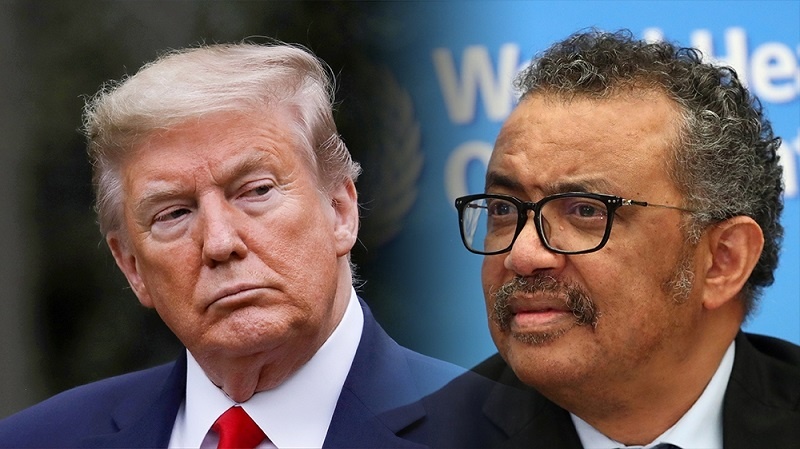 If you say that Donald Trump, who is the “official” president and elected head of the U.S. government, is full of BS, who has used the support of the Russians to get elected [2] or that he wants to cancel the next U.S. elections [3], i.e. which constitute conspiracy theories against Trump, Western journalists in chorus will applaud. They won’t call you a conspiracy theorist even if, according to the definition, that’s what you have being doing.
In the case of COVID-19 in 2020, if you say that all the doctors (and there are not two, ten or a hundred, but thousands around the world) who say that hydroxychloroquine is a cure to COVID-19 and that these crazy doctors have escaped from a lunatic asylum [4], once again the journalists will congratulate you. In any case, even without proof of what you say, no one will call you a conspiracy theorist.
Yet, it is a conspiracy theory and it is directed against qualified doctors.
By doing so, you are accusing doctors [5], some of whom work at the University or in recognized hospitals for decades, such as Professor Harvey Risch [6] of epidemiology at the Yale School of Public Health, Professor Didier Raoult, Director of the Institut Hospitalo-Universitaire Méditerranée Infection in Marseille, and Dr Christian Perronne [7], a professor of French university hospital practitioners, specialized in the field of tropical pathologies and emerging infectious diseases and former president of the specialized commission “Communicable Diseases” of the High Council of Public Health, in addition to many less known but equally reliable and serious doctors, family doctors, field doctors, general practitioners or specialists [8 to 13].
You are a real “conspiracy theorist” if you think that all these highly qualified doctors are lying or want to manipulate you, Yet, no one will treat you like that.
The truth is that you will be labeled a “conspiracy theorist” if and only if you say things against the official narrative or official consensus, which is sustained and acknowledged by:
- international institutions (World Trade Organization, World Health Organization, International Monetary Fund, World Economic Forum, United Nations, European Commission, European Medicines Agency…).
- By national relays who report to these international institutions in all important fields, health, medical, educational, media, economic… [14].
All this forms a coherent, transnational, supranational system (a consensus), driven by common goals and using a precise and studied language.
It must be understood that this system is independent of politicians and survives electoral changes. It perpetuates itself, whatever happens, not through a president, a particular person, but through these institutions that go through all the scandals [15 to 18] and all the attacks without taking a scratch.
Who runs this system?
I won’t answer here first because this is another task which deserves a full report and second, because many researchers have already successfully identified this topic [19 to 22].
Therefore, being a president, head of government, a medical graduate and representing a valid and serious authority is not enough to protect you from being challenged on the grounds that the challenger is a conspirator.
No.
To benefit from this protection, you must belong to the system, speak its language and pursue its goals.
Thus, Anthony Fauci, with his criticizable and contradictory remarks [23], will never be called a conspirator.
Professor Harvey Risch will.
Thus, newspapers that claim that Remdesivir (produced by Big Pharma) is effective in treating COVID-19, contrary to hydroxychloroquine, will never be called conspiracy theorists.
Those who say otherwise, with studies and doctors to back them up, yes.
The problem is that Trump said he was in favour of hydroxychloroquine as well, and he is discredited each time he says it.
It is said that Remdesivir proved its effectiveness against Covid-19, in a Belgian newspaper of August 11, 2020 [24].
Words are important.
The word “proven“, in this case, is false.
But who will notice it, if you are neither a doctor nor aware of the studies in question?
In the meantime, a lie is taken for granted, it becomes a truth.
A single treatment with Remdesivir will bring Gilead Science Inc. $2,500 per patient [25].
In contrast, Hydroxychloroquine, nothing or almost nothing. It is a very inexpensive drug.
The terms “conspiracy” or “conspiracy theory” have nothing to do with truth or credibility, they have to do with conformity to dominant ideas, dictated by the system that relentlessly pursues its goals.
Another important word is “theory“. Conspiracy theories.
This implies ramblings without foundation, without evidence.
Yet many claims labeled “conspiracy theories” are not theoretical.
It is rare to have formal proof at the time of the claim. It may be the result of research, reflections or presumptions.
In forensic medicine or criminal science, you will not always have irrefutable evidence but a set of solid presumptions (motive, indirect and coherent facts) that is sufficient to convict an accused person, according to the law.
Consider the “conspiracy theory” that the pharmaceutical industry is pushing to discredit hydroxychloroquine in favour of its expensive products, antivirals such as Remdesivir or vaccines.
It would be nice to have irrefutable proof of this, but I can’t see an industry leader writing such an admission and then leaving it lying around to fall into the hands of an honest journalist. That would be really suicidal, don’t you think? And in any case, we would discredit that executive, or that journalist, until their words become worthless.
However, as we would do in any police investigation, is there a strong circumstantial body of evidence?
1) Does this industry have a motive?
Yes.
This industry has a famous motive for doing this: money.
It’s not thousands or hundreds of thousands of euros that would push a lot of people to commit murder, but billions of euros [26-27].
2) Does this industry have the means to do this?
Yes.
We know it thanks to the testimony of people from inside, like John Virapen, former CEO of Eli Lilly & Company in Sweden [28], or former editors of major medical journals like Marcia Angell [29] (New England Journal of Medicine) or Richard Horton [30] (Lancet).
3) Has the industry ever done it?
Yes.
There are proven cases that illustrate the corruption of doctors by the pharmaceutical industry, such as the case of anaesthetist Scott Reuben who falsified data concerning the efficacy of the antidepressant Effexor (venlafaxine), produced by Wyeth (merged with Pfizer) in neuropathic and postoperative pain [31].
This is just one example [32]. More recently, you have the Lancet-Gate: “Scientific Corona Lies” and Big Pharma Corruption
Even when the evidence is there, have you ever seen a journalist who accused someone of being a “conspiracy theorist” make his mea culpa, apologize for his misunderstanding and restore the reputation of the “theorist” in question? And above all, restore the truth?
For just one example, I will take the story of the Kuwaiti babies torn from their incubator and thrown to the ground by Iraqi soldiers to justify the American intervention in Iraq in 1990. President George H. Bush senior used it on several occasions in several inflammatory speeches.
It was a lie [33]. We know that.
Yet anyone who would have known or understood this, and said so at the time, would have been called a “conspiracy theorist” in collusion with Saddam Hussein.
For the record, and to show you that these techniques did not stop in 1991 or after the proof of this lie, the dishonest PR firm behind this Kuwaiti babies myth is the same firm that in 2020 helped the World Health Organization (WHO) to make the World Health Organization (WHO) believe in the COVID-19 pandemic and to enforce its diktats: the firm Hill & Knowlton [34].
So, what does this mean, conspiracy, and who is really a conspirator?
We can see that it means nothing.
It’s a pejorative, bad label, which will not be given to you if you lie, or if you criticize a person or a government that justly disturbs the system.
It will be given to you if what you say, even if it is true, plausible, proven, goes against the authorized discourse of the system.
Check it out for yourself.
Criticize the doctors who defend the use of hydroxychloroquine in VIDOC-19, and you won’t be charged with conspiracy.
You will be listened to, approved.
 Criticize Anthony Fauci or the national security councils regarding Covid-19, then yes, you will be accused of conspiracy, indeed of all evils.
Very often it has nothing to do with theories.
The facts that are put forward are sometimes proven, very often supported by many solid and plausible arguments.
Words are very important. Do not underestimate their importance. They direct our thoughts.
I know this as a doctor, but I also know it as a passionate advocate of therapeutic communication.
Like the very first doctors of the Antiquity, I know that words can heal.
They can also make people docile or sick.
The words “conspiracy theorist”, “conspiracy theorist”, “conspiracy theorist” only serve to cut short any debate.
Only to have the person the dominant system wants to discredit rejected, so that person is no longer listened to.
That is what is dangerous, not “conspiracy theories”.
What is really dangerous is to not even want to debate and to exclude ideas, people and opinions on the pretext that they are disturbing.
That is what sows the seeds of a totalitarian society; not conspiracy theories.
It is by refusing any debate, any discussion and by brandishing this kind of disqualifying expression that threatens humanity.
Dr Pascal Sacré
Translation from French by Maya for Global Research
Notes :
[1] Théorie du complot, Wikipédia
[2] Ingérence : comment la Russie a biaisé la campagne de 2016 au profit de Trump
[3] Comment Trump pourrait saboter l’élection pour la remporter
[4] Hydroxychloroquine: Goliath contre David, acte I : les détracteurs
[5] Covid-19 – Hydroxychloroquine, David contre Goliath, acte II : les supporteurs
[6] L’hydroxychloroquine agit chez les patients à haut risque, et dire le contraire est dangereux, Harvey Risch M.D., Ph.D., professeur d’épidémiologie à la Yale School of Public Health.
[7] Christian Perronne : “À Garches, nous avons de bons résultats avec l’hydroxychloroquine”, April 15, 2020, Fervent defender of the treatment with hydroxychloroquine and azithromycin, for Pr Christian Perronne the question of its effectiveness no longer arises. Head of the Infectious Diseases Department at the Raymond-Poincaré Hospital in Garches, he has seen it every day since the beginning of the epidemic: Professor Raoult’s treatment cures and considerably reduces the need for intensive care.
[8] Riposte à la covid-19 : la saine colère du Dr BELLATON, Source : page Facebook de Silviane Le Menn, 20 avril 2020.
[9] Coronavirus : le bilan très positif d’un praticien lorrain qui prescrit l’hydroxychloroquine, the Lorrain Republican, Philippe Marque, April 6, 2020. The results are more than positive: “I have used this protocol on a dozen hospitalized patients, who therefore have a Covid-19 that is already relatively worrying, and I have had neither death nor any evolution towards a serious stage requiring resuscitation.”
[10] Un médecin mosellan constate l’efficacité d’un protocole à base d’azithromycine, the Lorrain Republican, Thierry Fedrigo, April 11, 2020. Two Moselle doctors and one of their Belgian colleagues seem to have developed a drug combination effective against coronavirus. Relying on azithromycin without resorting to the hydroxychloroquine advocated by the infectiologist Didier Raoult, they have noted a clear drop in hospitalizations of their treated patients.
[11] Un médecin néerlandais soigne les patients atteints de coronavirus, mais le gouvernement néerlandais n’est pas content, Amari Roos, 10 avril 2020
[12] Des médecins algériens attestent de l’«efficacité quasi totale» de l’hydroxychloroquine contre le Covid-19,April 27, 2020. The heads of infectious disease departments of a hospital in Blida and another in Algiers say that the hydroxychloroquine protocol followed in the treatment of patients with coronavirus gives a “near-total” positive result.
[13] Après l’Algérie, le Maroc encense l’efficacité de l’hydroxychloroquine contre le Covid-19, May 1, 2020. The therapeutic protocol based on hydroxychloroquine and azithromycin used against Covid-19 “has given positive results” in Morocco, the Health Minister said, adding that “side effects are minimal”.
[14] Ordres nationaux tels que l’Ordre des Médecins, l’Ordre des Pharmaciens, Hautes Autorités de Santé, Sciensano en Belgique…
[15] Agence européenne du médicament : des experts sous influence ?, 12 décembre 2017.
[16] Covid-19: les conseillers du pouvoir face aux conflits d’intérêts, paru le 31mars 2020, écrit par Rozenn Le Saint et Annton Rouget.
[17] Coronavirus : des liens troubles entre labos et conseils scientifiques, Valeurs actuelles, 3 avril 2020.
[18] L’Assemblée parlementaire du Conseil de l’Europe va enquêter sur l’OMS et le scandale « pandémique », Mondialisation.ca, F. William Engdahl, 6 janvier 2010
[19] Anthony C Sutton: British economist, historian and writer. Sutton was a Stanford scholar at the Hoover Foundation from 1968 to 1973. He taught economics at UCLA. He studied in London, Göttingen and UCLA and received a PhD in science from the University of Southampton, England. In 1972, at the Hoover Institution in Stanford, he was awarded a Ph.D : Wall Street et l’ascension de Hitler , Wall Street et la révolution bolchévique
[20] Carroll Quigley: American historian and professor of history at Georgetown University from 1941 to 1976. Quigley was born in Boston, where he later studied and earned two degrees and a doctorate in history from nearby and highly regarded Harvard University. At Georgetown University: Tragedy and Hope: A History of the World in Our Time
[21] Pierre Hillard : essayiste français, docteur en science politique : La marche irrésistible du nouvel ordre mondial , Chroniques du mondialisme
[22] Michael Parenti, American historian, political scientist and cultural critic. He has taught in American and foreign universities. A must read: L’Horreur impériale
[23] Lancet-Gate: « Mensonges scientifiques sur le coronavirus » et corruption des grandes sociétés pharmaceutiques., Mondialisation.ca, Prof. Michel Chossudovsky, 15 July 2020. Dr Anthony Fauci, Donald Trump’s adviser, described as “America’s top infectious disease expert”, played a key role in smearing the HCQ cure that had been approved years earlier by the CDC, as well as in legitimizing Gilead’s Remdesivir.
[24] Le remdesivir, médicament qui a prouvé son efficacité face au Covid-19, 11 août 2020.
[25] Le traitement au remdesivir coûtera 2.340 dollars, selon Gilead, 29 juin 2020
[26] COVID-19 : au plus près de la vérité. Vaccins., Mondialisation.ca, Dr Pascal Sacré, 2 août 2020
[27] COVID-19: au plus près de la vérité – Hydroxychloroquine (HCQ), Mondialisation.ca, Dr Pascal Sacré, 29 juillet 2020
[28] Médicaments effets secondaires : la mort, les laboratoires nous trompent. John Virapen, le cherche midi éditions, 2014
[29] The truth about drug companies, how they cheat us, how to thwart them, Marcia Angell, MD, former editor of the New England Journal of Medicine, French translation, les éditions le mieux-être, 2005.
[30] COVID-19 : le côté obscur de la science révélé, Mondialisation.ca, Dr Pascal Sacré, 26 mai 2020
[31] Top Pain Scientist Fabricated Data in Studies, Hospital Says, 11 Mars 2009
[32] Du Nujol au Tamiflu : la guerre menée par l’industrie pharmaceutique contre nos santés, Mondialisation.ca, Dr Pascal Sacré, 16 juin 2010
[33] l’affaire des Couveuses de la Mort et le début de la Guerre du Golfe
[34] COVID 19 – Contrat de l’OMS avec la société de relations publiques Hill & Knowlton
Mail-in Voting Leaves Window for ‘Significant Fraud’ & ‘Logistical Challenges’, Observers Say
By Aleksandra Serebriakova – Sputnik – 16.08.2020
Election officials in nearly all US states were warned by the US Postal Service officials back in July about possible delays resulting from voting via mail-in ballots , according to documents published last week. More American states are now moving to either introduce universal vote-by-mail or ease restrictions associated with absentee voting.
US President Donald Trump reiterated his harsh remarks on Saturday towards the universal mail-in-voting system that has been introduced in nine American states now, with California, Vermont, New Jersey and Nevada, recently joining the ranks.
For the president, who indicated his support for “absentee balloting”, which requires a request for a ballot in advance, the universal mail-in ballot system, where ballots are sent to all registered voters automatically, looked “catastrophic”.
“It’s going to make our country a laughing stock all over the world”, the president said on Saturday.His comments come following the news that the US Postal Service (USPS) previously warned election officials in 46 American states, including those in such heated battlegrounds as Pennsylvania, Florida and Michigan, that there were risks that not all of the ballots would be delivered to the office on time for Election Day. But several other American states are also now mulling the possibility of resorting to this system in the midst of the coronavirus pandemic.
“Yes, mail-in-voting does pose new logistical challenges for election offices that previously dealt with few mail ballots”, says Anthony Fowler, a political scientist from the University of Chicago.
Fowler recognizes the clear advantages the postal voting presents to those willing to safely cast their vote during the health crisis, but still believes that there are some instances of fraudulent behavior that are associated with it:
“Mail voting raises the possibility that the person who filled out the ballot is not who they say they are or that the person who filled out the ballot was coerced in some way”, he explains.
An analysis of the risks associated with postal voting should be carried out without the “distraction” associated with the endless Trump-versus-Democrats debate, says Brian Gaines, an elections expert with the University of Illinois.
“Ballots filled out away from the security and privacy of a booth at an official polling station are inherently less secure”, he believes. “They are more subject to coercion, and they are more prone to be ‘lost’ without being properly processed”.
“The more steps there are in the voting process, the more occasions for error”, the election expert notes, comparing procedures surrounding mail-in voting to those when a person simply goes to a polling station.
However, Gaines says that’s not the only issue.
“Beyond errors and coercion, there are more opportunities for fraud when ballots are away from polling stations and effort is required to get them back to the vote counters”, he explains. “Most states do not allow so-called ‘third parties’ to collect absentee ballots (‘bundle’ or ‘harvest’ them), but some do”.
It is the campaign, church or some other organizations collecting ballots for delivery that can potentially intervene in the election process, Gaines explains, as they can “selectively discard ballots on the basis of guesses about how people might be voting, or can tamper with the ballots”.
“None of this means that vote-by-mail is a source of ‘massive’ fraud or error, but I think that, partisan politics apart, it is plainly more vulnerable to fraud and mistakes than in-person voting”, the expert adds.
“In most elections, fraud and error are negligible or marginal, but in a very close election, they can be decisive. This time, with many more states pushing voters to vote by mail, there may be a bit more confusion and maybe a bit more small-scale fraud”, Gaines concludes.
With the USPS delivery systems being overloaded with “millions of ballots” in the course of the November election, logistics indeed becomes “an enormous issue”, says Mitchell Feierstein, CEO of the Glacier Environmental Fund Limited.
“It is highly probable that there be significant fraud with the mail-in ballots”, the hedge-fund manager argues.
Following the news from the US postal authorities that they cannot guarantee that all the mail-in ballots would arrive on time, protesters gathered outside the house of USPS Postmaster General Louis Dejoy, demanding his resignation. But according to Feierstein, “no matter what happens, the result of the 2020 election will not be accepted by one side”.
CIA Behind Guccifer & Russiagate – a Plausible Scenario
Strategic Culture Foundation | August 14, 2020
William Binney is the former technical director of the U.S. National Security Agency who worked at the agency for 30 years. He is a respected independent critic of how American intelligence services abuse their powers to illegally spy on private communications of U.S. citizens and around the globe. Given his expert inside knowledge, it is worth paying attention to what Binney says.
In a media interview this week, he dismissed the so-called Russiagate scandal as a “fabrication” orchestrated by the American Central Intelligence Agency. Many other observers have come to the same conclusion about allegations that Russia interfered in the 2016 U.S. elections with the objective of helping Donald Trump get elected.
But what is particularly valuable about Binney’s judgment is that he cites technical analysis disproving the Russiagate narrative. That narrative remains dominant among U.S. intelligence officials, politicians and pundits, especially those affiliated with the Democrat party, as well as large sections of Western media. The premise of the narrative is the allegation that a Russian state-backed cyber operation hacked into the database and emails of the Democrat party back in 2016. The information perceived as damaging to presidential candidate Hillary Clinton was subsequently disseminated to the Wikileaks whistleblower site and other U.S. media outlets.
A mysterious cyber persona known as “Guccifer 2.0” claimed to be the alleged hacker. U.S. intelligence and news media have attributed Guccifer as a front for Russian cyber operations.
Notably, however, the Russian government has always categorically denied any involvement in alleged hacking or other interference in the 2016 U.S. election, or elections thereafter.
William Binney and other independent former U.S. intelligence experts say they can prove the Russiagate narrative is bogus. The proof relies on their forensic analysis of the data released by Guccifer. The analysis of timestamps demonstrates that the download of voluminous data could not have been physically possible based on known standard internet speeds. These independent experts conclude that the data from the Democrat party could not have been hacked, as Guccifer and Russiagaters claim. It could only have been obtained by a leak from inside the party, perhaps by a disgruntled staffer who downloaded the information on to a disc. That is the only feasible way such a huge amount of data could have been released. That means the “Russian hacker” claims are baseless.
Wikileaks, whose founder Julian Assange is currently imprisoned in Britain pending an extradition trial to the U.S. to face espionage charges, has consistently maintained that their source of files was not a hacker, nor did they collude with Russian intelligence. As a matter of principle, Wikileaks does not disclose the identity of its sources, but the organization has indicated it was an insider leak which provided the information on senior Democrat party corruption.
William Binney says forensic analysis of the files released by Guccifer shows that the mystery hacker deliberately inserted digital “fingerprints” in order to give the impression that the files came from Russian sources. It is known from information later disclosed by former NSA whistleblower Edward Snowden that the CIA has a secretive program – Vault 7 – which is dedicated to false incrimination of cyber attacks to other actors. It seems that the purpose of Guccifer was to create the perception of a connection between Wikileaks and Russian intelligence in order to beef up the Russiagate narrative.
“So that suggested [to] us all the evidence was pointing back to CIA as the originator [of] Guccifer 2.0. And that Guccifer 2.0 was inside CIA… I’m pointing to that group as the group that was probably the originator of Guccifer 2.0 and also this fabrication of the entire story of Russiagate,” concludes Binney in his interview with Sputnik news outlet.
This is not the first time that the Russiagate yarn has been debunked. But it is crucially important to make Binney’s expert views more widely appreciated especially as the U.S. presidential election looms on November 3. As that date approaches, U.S. intelligence and media seem to be intensifying claims about Russian interference and cyber operations. Such wild and unsubstantiated “reports” always refer to the alleged 2016 “hack” of the Democrat party by “Guccifer 2.0” as if it were indisputable evidence of Russian interference and the “original sin” of supposed Kremlin malign activity. The unsubstantiated 2016 “hack” is continually cited as the “precedent” and “provenance” of more recent “reports” that purport to claim Russian interference.
Given the torrent of Russiagate derivatives expected in this U.S. election cycle, which is damaging U.S.-Russia bilateral relations and recklessly winding up geopolitical tensions, it is thus of paramount importance to listen to the conclusions of honorable experts like William Binney. The American public are being played by their own intelligence agencies and corporate media with covert agendas that are deeply anti-democratic.
Featured Video

Dan Dicks with James Corbett on Solutions Watch
or go to
Aletho News Archives – Video-Images
From the Archives
$1.5bn up in smoke: US THAAD missile stockpile dries up defending Israel against Iran
By Ivan Kesic | Press TV | July 2, 2025
According to American media, defense news outlets, and independent analysts, the 12-day Israeli military aggression against Iran significantly depleted the US stockpile of THAAD (Terminal High Altitude Area Defense) interceptor missiles.
Citing official sources, American magazine Newsweek reported on Friday that the US transferred a substantial portion of its advanced missile defense capabilities to support the Israeli regime, an effort with questionable results and a critical impact on US strategic reserves.
THAAD, developed by Lockheed Martin arms manufacturing company, is a key component of Israel’s multi-layered air defense architecture. It is designed to intercept medium-range ballistic missiles, including those launched from Iran and Yemen.
The US-made system is capable of targeting short-, medium-, and intermediate-range ballistic missiles during their terminal phase, whether inside or outside Earth’s atmosphere.
THAAD uses a “hit-to-kill” method, relying on kinetic energy rather than explosive warheads to destroy incoming threats, intercepting at altitudes of up to 150 km and ranges between 150-200 km.
Operated exclusively by American personnel, the US military maintains eight THAAD batteries with an estimated 350–400 interceptors in total. The eighth battery was activated during the June 20 Israeli aggression against Iran and is capable of intercepting hypersonic missiles. … continue
Blog Roll
 Aletho News
- Zionist Bought Senate Blocks Information About American Citizens Killed By Israel
- While Gaza dominates the UN, these are the people keeping it alive
- New Report: “Scholasticide and Genocide in Gaza: Assessment, Testimonies and Legal Analysis”
- ‘THAAD Delusion’: Iran war exposes US missile shield limits – The Atlantic
- Moscow issues warning to NATO over Russian exclave
- Yes, the Iran war has destroyed Trump’s presidency
- The fallacy of US delusions about Iran’s economic collapse
- Hezbollah denies Syria cell link, warns of Israeli plan to sow discord
- The legacy of US sanctions, war, and occupation in Iraq
- Iraqi resistance group rejects disarmament, vows to maintain support for Lebanon
- If Americans Knew
- Mamdani releases plan to combat antisemitism and hate crimes in New York City
- Iran’s Revolutionary Guards Publish Letter to the American People
- DMFI launches $1 million ad campaign supporting Virginia’s Elaine Luria
- US Senate blocks resolution seeking report on Americans killed by Israel
- Israeli Attacks Kill Ten Palestinians in Gaza
- Massacre at Minab: The School That Became a Grave
- Israeli media: The IDF Shows It Doesn’t Turn a Blind Eye; It Actively Emboldens Settler Havoc
- As settlers ravage West Bank, Israeli forces kill 10 in Gaza – Daily Update
- New Report: “Scholasticide and Genocide in Gaza: Assessment, Testimonies and Legal Analysis”
- Ex-Biden officials are desperate for a Gaza scapegoat
- No Tricks Zone
- Green Energy Debacle: German Expert Professor Fritz Vahrenholt Warns Of Severe Economic And Social Consequences
- Two More Paleo Reconstructions Affirm Meters-Higher Sea Levels Across Ireland, Brazil 7000-6000 Years Ago
- New Study: Earth And Venus Surface Warmth Largely Explained By Convection And Lapse Rate, Not CO2 Or Radiation
- 2025 Nature Paper Claiming Worsening Global Drought Gets RETRACTED …Heavily Flawed
- New Study: ‘Global Drought Shows No Detectable Recent Acceleration Under Climate Warming’
- Economic Masterminds: German Socialists Suggest Taxing Productivity Gains Stemming From Using AI
- The South China Sea Has Not Been Cooperating With The Climate Change Narrative
- Energy Crisis: Germany Enters Heating Season With Historically Low Gas Reserve Fill Levels
- New Study: The Antarctic Ice Sheet Gained Mass From 2020-2024 Due To Staggering Snow And Ice Accumulation
- Study: Ocean Heating Rates From Thousands Of Years Ago ‘Dwarf’ Modern Ocean Heating Rates

