Six big lies you have been told about ‘Russiagate’
By Nebojsa Malic | RT | May 12, 2020
Russian ‘meddling’ in the 2016 US presidential election has become an article of faith, not just among Democrats but many Republicans as well, thanks to the endless repetition of vague talking points, none of which hold water.
It all began with the Democratic National Committee (DNC) claiming in June 2016 that Russia hacked their computers, after documents were published revealing the party’s rigging of the primaries. This was followed by Hillary Clinton accusing her rival for the presidency Donald Trump that he was “colluding” with Russia by asking Moscow for her emails – the ones she deleted from a private server she used to conduct State Department business, that is.
With a little help of the mainstream media, which overwhelmingly endorsed Clinton and predicted her victory, her efforts to cover up her email scandal turned into Russia “hacking our democracy,” eventually spawning the ‘Russiagate’ investigation led by Special Counsel Robert Mueller and a series of failed attempts to derail Trump’s election and oust him from the White House.
Lie #1: Russia hacked the DNC
The infamous US intelligence community assessment (ICA) of January 2017, and the Senate Intelligence Committee report based on it – as well as ‘analysis’ by actual election meddlers, among others – all claimed that the Russian government and President Vladimir Putin personally were behind the “hack” and publication of DNC documents. These have always been assertions, and no evidence was ever provided.
Last week’s declassification of 50+ interviews in the probe conducted by the House Intelligence Committee revealed that the cybersecurity firm CrowdStrike, brought in by the DNC lawyers to fix the “hack,” did not have evidence either.
CrowdStrike’s president, ex-FBI official Shawn Henry, testified that they “saw activity that we believed was consistent with activity we’d seen previously and had associated with the Russian Government.” [emphasis added]
In the same testimony, Henry also testified that CrowdStrike never had any evidence the data was actually “exfiltrated,” i.e. stolen from the DNC servers.
CrowdStrike’s feelings about the hack remain the only “evidence” so far, since the FBI never asked them or the DNC for the actual server, as Henry also confirmed. Meanwhile, former NSA official and whistleblower William Binney argued back in November 2017 that actual evidence showed a leak from the inside, not a hack.
Lie #2: Russia hacked Podesta’s emails and published them in collusion with WikiLeaks
There is likewise zero proof that the Russian government had anything to do with the private email account of John Podesta, Clinton’s campaign chair, which a staffer admitted had been compromised when someone fell for a phishing scam.
Instead, the key argument that WikiLeaks was somehow ‘colluding’ with Russia over the publication of the emails rests on a conspiracy theory promoted by the Clinton campaign staff, after RT reported on a fresh batch of emails before WikiLeaks got around to tweeting about them – but after they were published on the website and available to anyone willing to do actual journalism.
In fact, the existence of RT has been a major “argument” of Russiagaters; a third of the ICA intended to show ‘Russian meddling’ consisted of a four-year-old appendix about RT that was in no way relevant to the 2016 situation but lamented its coverage of fracking and ‘Occupy Wall Street’ protests, for example.
Lie #3: The Steele ‘pee tape’ dossier was irrelevant
As it later emerged, Clinton’s claims about ‘Russian collusion’ were based on a dodgy dossier her campaign commissioned through the DNC and a firm called Fusion GPS from a British spy named Christopher Steele. It said that the Kremlin was blackmailing Trump with a tape of depraved sex acts in a Moscow hotel, with prostitutes supposedly paid to urinate on a bed President Barack Obama had slept on.
It was clearly ridiculous and entirely evidence-free. Democrats claimed it played no role in Russia investigations. Yet the FBI paid Steele for information from the dossier, and used it to justify a FISA warrant for the surveillance of Trump campaign aide Carter Page – and with him the campaign itself – starting right before the election, and renewed three times.
By January 2020, the DOJ had formally disavowed the dossier and all four FISA warrants, along with any information obtained from them, saying “there was insufficient predication to establish probable cause.”
Lie #4: General Michael Flynn treasonously colluded with Russia and lied about it to the FBI
Trump’s first national security adviser was hounded out of the White House after less than two weeks on the job, after media leaks insinuated he had improperly discussed sanctions with Russian ambassador Sergey Kislyak, violating the Logan Act, and then lied to the FBI about it.
After FBI Director James Comey was fired by Trump in May 2017, he told the media the president had urged him to drop the investigation of Flynn, which was quickly construed as “obstruction” and used as one of the pretexts to appoint Robert Mueller as special counsel into ‘Russiagate.’
When actual evidence was finally coaxed out of prosecutors, however, it showed that the FBI sought to frame Flynn in a perjury trap, and that the people involved were Comey himself, his deputy Andrew McCabe, disgraced lovers Peter Strzok and Lisa Page, and others. All charges against Flynn were dropped.
Flynn didn’t even lie to Strzok and the other agent interviewing him – and the memo of that conversation had been first heavily edited, then destroyed. Basically, everything about the Flynn case has been as false as ABC’s December 2017 bombshell report about his “collusion” with Russia that got Brian Ross fired.
Lie #5: Mueller found collusion, or at least Russian meddling
When Mueller’s final report came out, in the spring of 2019, it found zero evidence of “collusion” but insisted there had been Russian “meddling” in the election. The only trouble was that he had no proof of meddling, basing it entirely on the above-mentioned intelligence “assessments” and his own indictments.
A Russian company named in one of the indictments actually contested it in US court and won. First, a federal judge slapped down Mueller’s prosecutors for violating rules by presenting allegations as “established” and “confirmed” facts and ruling that no link was actually established behind a catering company accused of “sowing discord” on social media – a far cry from hacking the DNC! – and the Russian government.
The DOJ quietly dropped that particular case in March, just as coronavirus shutdowns were starting across the US, using “recent events” and a change in classification of some of its evidence as a face-saving excuse.
Lie #6: Paul Manafort was Trump’s conduit to Russia
Paul Manafort, who ran Trump’s campaign between March and August 2016, was convicted of multiple counts of conspiracy against the US and sentenced to a lengthy prison term. However, despite repeated attempts by the media to present him as some kind of liaison between Trump and Russia, the entirety of things that got him in trouble with the law had to do with tax evasion on money he made lobbying for and in… Ukraine.
During the two trials against Manafort, it emerged that he and his business partner Rick Gates had worked with Podesta’s brother Tony to fleece Ukrainian oligarchs for years, and stash the profits in tax havens.
The Ukrainian officials who leaked the so-called “black ledger” implicating Manafort to the US media were even convicted of election meddling by a court in Kiev, and the whole thing may have been solicited by a Ukrainian-American DNC contractor… The US media have been curiously uninterested in that particular “collusion,” needless to say.
Peel back all these layers of misinformation, like an onion, and what’s left is an empty talking point, endlessly repeated by Democrats like Adam Schiff (D-California), that “Russia hacked our democracy.”
The charge is vague enough that it can mean anything, and deliberately so. No evidence is ever offered, because there isn’t any – as the years of investigations and boxes full of documents have clearly shown.
Crowdstrike admits ‘no evidence’ Russia stole emails from DNC server
Pushback with Aaron Maté | May 11, 2020
Crowdstrike, the firm that accused Russia of stealing DNC emails in 2016, has made a bombshell admission. In newly released Congressional testimony, Crowdstrike president Shawn Henry said that “we did not have concrete evidence” that alleged Russian hackers actually took the emails from DNC servers. “There’s circumstantial evidence, but no evidence that they were actually exfiltrated,” Henry said.
Aaron Maté breaks down Henry’s testimony and why it adds new doubt about the core allegation at the heart of Russiagate.
UK propaganda campaign in Syria was bloated, inefficient & possibly illegal: internal review
By Danielle Ryan | RT | May 12, 2020
British state-funded propagandists created “a constellation of media outlets” in Syria and produced so much content that people “no longer knew who or what to believe,” an internal review into the failed operation has revealed.
Details of the UK government’s Syria propaganda campaign, aimed at supporting the so-called ‘moderate armed opposition’, were published by Middle East Eye (MEE) in February. The work, which began in 2012, involved establishing a network of anti-government citizen journalists to shape public perceptions of the war, the outlet’s investigation found.
Now MEE has revealed the contents of a “scathing” internal government review, which found that the programs – collectively dubbed ‘Operation Volute’ – were sloppily and inefficiently run and may even have broken UK laws. The review also concluded that some projects “were designed to impress the US government,” the outlet said.
‘Fundamental shortcomings’
This image of Britain as a prolific propaganda-pusher is in stark contrast to the mainstream media view of Western powers acting as the ultimate truth-tellers in a world of ‘bad guys’ and fake news, which Britons are accustomed to hearing about.
The MEE report bursts that bubble, revealing that communications companies contracted by the British government used “news agencies, social media, poster campaigns and even children’s comics” to covertly bolster the Syrian opposition and to undermine the Assad government, as well as the Islamic State (IS). Efforts were stepped up “dramatically” in 2013 after the UK parliament inconveniently voted against military intervention in the country.
However, the review, carried out in 2016, found that London’s grand plans weren’t exactly as effective as envisioned and said the initiatives suffered from “fundamental shortcomings” – including the fact that “no conflict analysis” and “no target audience analysis” was done. Unsurprisingly, the review referred to the work euphemistically as “strategic communications” rather than propaganda.
The contractors were pumping out so much content that they created “a constellation of media outlets,” where Syrian audiences and activists “got lost and were distracted.” The result was that “people no longer knew who or what to believe,” MEE said.
Law-breaking and ‘reputational damage’
Ironically, while all this was happening, the British mainstream media was busy obsessing over and publishing stories on Russian propaganda, while completely ignoring and failing to investigate its own government’s massive influence operation and potential law-breaking.
The assessment revealed that concerns had been voiced within the UK government about whether there was even a need for the programs, and about the “major risk” that the activities of the contractors were “in contravention of UK law” – though there is no more detail given on how that may be the case, MEE reported.
The review also pointed to a “duplication” of efforts and warned of possible “reputational damage” to the British government if its funding of the programs was revealed.
Deaths and ‘work that caused harm’
Some of the projects were overseen by a Ministry of Defence (MoD) unit called Military Strategic Effects. Offices were also set up in Istanbul and Amman, where Syrians were recruited for the work. Many of the stringers (part-time local reporters) who were employed inside Syria were not even aware that they were working on projects funded by the British government. The budget for the projects in 2015-16 came to £9.6 million – and more was earmarked for future work.
The British government was seemingly unmoved by the fact that some of these people also lost their lives in the course of the work, noting coldly that one of their contractors “suffered losses of core staff that damaged the organisation quite fundamentally.”
“The department declined to say whether the effects hoped for were weighed against the risk to life; how many people died; and whether the UK was supporting their dependents,” MEE said.
The government also noted that some of the stringers working with the “moderate” rebels were “undertaking work which could cause (and has caused) harm,” but did not give more details.
‘Value for money’
Unsurprisingly, the programs were most heavily pushed by the Ministry of Defence. In fact, “the only” government ministers who were “fully committed” to the propaganda programs in 2013 were those at the MoD. They felt they were getting “extraordinary value for money given current policy restraints.” Those “policy restraints” referring, of course, to parliament’s vote not to intervene militarily. Some other ministers were asking “whether taxpayers’ money should be spent” on the projects while there remained “substantial doubts” about them.
While the review is highly critical of inefficiencies, nowhere in the government review is the decision to pour millions into propaganda campaigns and influence operations in a foreign war ever actually questioned.
Danielle Ryan is a freelance journalist based in Dublin. Her work has appeared at Salon, The Nation, RT and others. (Twitter: @DanielleRyanj)
Spygate: Why Did Hillary Clinton & Barack Obama Seem So Determined to Impede and Topple Trump?
By Ekaterina Blinova | Sputnik | May 12, 2020
US Attorney John Durham who is currently conducting an investigation into the origins of the Trump-Russia probe should take a look at a role played by Hillary Clinton and the Clinton Foundation in sparking and fanning the Russiagate scandal, says Wall Street analyst Charles Ortel.
The newly released House Intelligence Committee’s transcripts shed some more light on Joseph Mifsud, the mysterious Maltese professor who apparently told then Trump campaign aide George Papadopoulos in March 2016 that Moscow had “damning” Hillary Clinton emails. According to one of the transcripts, Mifsud was heard bragging he was a member of the Clinton Foundation.
Joseph Mifsud sparked the Russian investigation and set up George Pop SO the same person “mifsud” is in the Clinton foundation org 🤔 #WWG1WGA #QAnons #TheMoreYouKnow #ClintonFoundation #TheGreatAwakening pic.twitter.com/GgoaLRqK2c
— mtag ⭐️⭐️⭐️ (@Mgreaze) May 9, 2020
Additionally, in a November 2017 interview with Italian newspaper La Repubblica the Maltese professor also admitted that he was in the organisation: “I am a member of the European Council on Foreign relations and you know which is the only foundation I am member of? The Clinton Foundation”. At the same time, Mifsud flatly denied that he had told Papadopoulos about the Clinton emails.
Mifsud & Downer Both Tied to Clinton Foundation
The exposure has prompted a lively debate among social media users, who recollected that following the controversial conversation with Mifsud, Papadopoulos had a drink with the Australian high commissioner to the UK Alexander Downer, also known for his ties with the Clinton Foundation.
Mifsud & Downer, a Clinton Foundation member & a major contributor. Of course, Alexander Downer is a close friend of Clintons & donated $25M of Australian tax dollars to the Clinton Foundation.
Coincidence or collaboration to overthrow a duly elected POTUS?
— Mark Layman (@MarkLayman12) May 9, 2020
Following this historic meeting Downer approached the FBI to inform the bureau – in a breach of diplomatic protocols – that Papadopoulos somehow knew that the Russians “had dirt” on Hillary Clinton. This information became the trigger for launching the Crossfire Hurricane op against the Trump campaign on 31 July 2016.
“Mifsud was a small donor according to notoriously unreliable and materially false disclosures on the Clinton Foundation website”, says Charles Ortel, a Wall Street analyst who has been looking into the Clinton Foundation’s alleged fraud for several years. “I suspect he may have been involved with the ‘Clinton Global Initiative’, a forum where Clinton supporters (for the most part) interacted with connected globalists, in theory to promote smart giving, but in practice to advance substantial for-profit activities”.
Ortel expresses hope that US Attorney John Durham and his team appointed by AG William Barr to investigate the origins of Crossfire Hurricane operation “will examine Mifsud and every person and project claimed in particular by CGI, which seems to have been a forum where money traded for influence while hiding in plain sight”.
Former Australian diplomat and politician Downer seems to be a bigger fish, according to the analyst.
“As Australia’s foreign minister, Downer channeled millions of his taxpayers’ money towards international projects in the name of ‘Clinton HIV/AIDS Initiative’ (and similar sounding variants) as well as ‘Clinton Climate Initiative’ starting in 2006”, Ortel elaborates. “None of these entities lawfully existed. And there has never been a proper accounting for these grants. Moreover, Downer and Australia signed multiple agreements with Bill Clinton and Ira Magaziner who held themselves out to be lawfully appointed representatives of the Clinton Foundation when they never were”.
According to the Wall Street analyst “Downer had and has much to lose from a Trump victory, so it is not surprising that he has apparently played such an important role attempting to frame Donald J. Trump and others who threaten to expose and punish crony globalists”.
“From the day Hillary announced her second presidential run, she and her backers did all they could to rig the primaries and then the general election”, he says. “Downer’s known and suspected actions, like Mifsud’s are not surprising. They likely gained and thought they would gain more from another Clinton presidency”.
Clinton Knew That Her Campaign Funded Dirt Digging on Trump
Hillary Clinton had either direct or indirect ties with many participants of the Trump-Russia saga, including Mifsud and Downer who initially sparked the so-called Russiagate scandal and Fusion GPS, the firm behind the infamous anti-Trump “dirty” dossier which played a crucial role in “justifying” FBI surveillance operations against Trump aides.
Citing newly released testimonies, American investigative journalist John Solomon reported on 11 May, that Clinton campaign chairman John Podesta and Hillary Clinton had been aware that her campaign had funded opposition research and sought for dirt on Trump’s ties to Russia during the 2016 election.
“I think she was – she knew that we had an opposition research staff in-house”, Podesta said in a testimony. “We, the campaign, directly purchased some opposition research… I think that I only learned subsequently that the payments were made through Perkins Coie, 50 percent from the campaign, 50 percent from the DNC”.
Ortel is not surprised that Hillary Clinton appears to be deeply involved in how the Trump-Russia investigation started. According to him, the roots of the “Clinton corruption run deep”, starting in Arkansas where Bill Clinton served as a governor and attorney general.
“Once the Clinton’s moved to the White House, the scale of their corrupt and suspicious activities expanded to the national and international stages”, the Wall Street analyst presumes. “From 1997 onwards, a key instrument in swapping cash for influence has been the network of Clinton ‘charities’ that has never been properly regulated anywhere”.
 He suggests that if one wants to understand why Hillary Clinton and Barack Obama seemed so “determined to impede or topple President Trump”, “Durham and his team must go back into history comparing sums that donors claim they sent towards the Clinton Foundation, with the Foundation’s public filings, submitted many places, under penalties of perjury”.
“Unlike the botched attempts to set perjury traps against Flynn and others, the Clinton Foundation public record, evident in plain sight includes multiple confessions of making false statements under oath”, the analyst highlights. May the long overdue indictments, prosecutions, convictions, fines and incarcerations soon begin”.
This Is Why You Can’t Trust The Fact Checkers
By Derrick Broze | The Last American Vagabond | May 11, 2020
For the last eight years I have worked as a writer, researcher, and investigative reporter for many well-known American independent media outlets. I have spent my time investigating digital surveillance technology, attacks on indigenous communities, and the overall growth of the government and corporate power. As someone working in this field, writing about topics which are often seen as controversial or “outside the mainstream” – censorship and personal attacks are part of the job description.
However, the attacks on independent media have rapidly increased in the last four years, with many formerly active journalistic outlets ceasing to exist due to lack of traffic and thus, lack of funds. We have seen outlets outright branded “fake news” or accused of collusion with the Russian government. Some channels and websites have been unable to apply for advertising or use certain digital products based on these labels. Some channels and reporters have been deleted off social media and other digital platforms altogether. And, if the social media managers don’t delete you, they might just use the algorithm to hide your posts, limiting your ability to interact with the public.
Attack of the “Fact” Checkers
Perhaps the most insidious method is the recent use of “fact checkers” to limit the reach of an outlet, or simply brand them with the fake news scarlet letter to discourage readers from engaging. This has been increasing in the last 2 years and I personally know of several remaining indy media outlets who have had to decide whether or not to run certain articles or video reports out of fear they might be censored or banned. Of course, with the algorithmic games being played by social media platforms, most outlets are reaching a tiny fraction of what they once were.
Case in point, The Mind Unleashed. I have been part of the TMU team on and off for the last year or so. In that time we have been struggling to reach a small fraction of our 9 million Facebook followers. Part of the reason we are struggling to reach people is because we have the dubious recognition of being labeled fake news by Facebook and affiliated fact checkers.
In a recent article published in Newsweek Espanol, in partnership with Newsguard, The Mind Unleashed is described as a “site that promises to ‘promote and inspire unconventional thinking,’ but is actually dedicated to publishing falsehoods.” The quote was in reference to a story TMU had written about the origins of COVID-19 and the potential for the virus to have been created as a bio weapon.
Newsguard is one of a number of “fact checker” services which has proliferated since the election of Donald Trump to U.S. President. Newsguard is a browser plug-in for Chrome and Microsoft Edge that gives trustworthiness ratings to most of the internet’s top-trafficked sites. It uses a color coded system to warn readers of an article or website’s trustworthiness. In a previous investigation, TLAV writer Whitney Webb exposed the neoconservative roots of the Newsguard team. Webb wrote:
“Newsguard’s advisory board makes it clear that Newsguard was created to serve the interests of American oligarchy. Chief among Newsguard’s advisors are Tom Ridge, the first Secretary of Homeland Security under George W. Bush and Ret. General Michael Hayden, a former CIA director, a former NSA director and principal at the Chertoff Group, a security consultancy seeking to “advise corporate clients and governments, including foreign governments” on security matters that was co-founded by former Homeland Security Secretary Michael Chertoff, who also currently serves as the board chairman of major weapons manufacturer BAE systems.”
Newsguard started as a partnership between Steven Brill and Louis Gordon Crovitz, with Crovitz appearing to be the connection to the world of finance, media, and geopolitics. Crovitz held a number of positions at Dow Jones and at the Wall Street Journal, is a board member of Business Insider, a member of the Council on Foreign Relations, and claims to have been an “editor or contributor to books published by the American Enterprise Institute and Heritage Foundation.” As Webb noted, “the American Enterprise Institute (AEI) is one of the most influential neoconservative think tanks in the country and its ‘scholars,’ directors and fellows have included neoconservative figures like Paul Wolfowitz, Richard Perle, John Bolton and Frederick Kagan.”
Most recently, Newsguard has created a list of “Websites Publishing False Coronavirus Information” and a list “Super Spreaders” of false information. These lists include many well-known and credible independent media outlets. This is not to say that every website listed is credible and should be supported. The point is that these types of lists only serve to “blackball” certain outlets and schools of thoughts which counter the mainstream version of events.
Newsguard is not the only fact checker service operating in the current “post-truth era”. Social media companies like Facebook have partnered with several organizations with the stated aim of fact checking and debunking disinformation. Of course, these organizations tend to reinforce the narratives being woven by the mouthpieces in the corporate media and the puppet masters working the politicians. For a moment Facebook partnered with reviled “fact checker” Snopes, but, after Snopes was discredited, Facebook has now partnered with companies like Lead Stories.
Lead Stories also “fact checked” The Mind Unleashed a couple times, always using arbitrary standards and semantics to make a story appear to be false or misleading. In one story, Lead Stories relies on data from the aforementioned Newsguard. So who is Lead Stories? The About page states that since January 2019 they have been a part of Facebook fact checker program. They describe the partnership as follows:
“Under the terms of this partnership we get access to listings of content that has been flagged as potentially false by Facebook’s systems or its users and we can decide independently if we want to fact check it or not. In addition to this we can enter our fact checks into a tool provided by Facebook and Facebook then uses our data to help slow down the spread of false information on its platform. Facebook pays us to perform this service for them but they have no say or influence over what we fact check or what our conclusions are, nor do they want to.”
Lead Stories is run by Perry Sanders Jr., an attorney known for representing the family of rapper Notorious B.I.G. after his murder, and Editor-in-Chief Alan Duke, who helped create Lead Stories after 26 years with CNN. Despite Duke’s bio stating that he “did ground-breaking investigative reporting on the Jeffrey Epstein sex trafficking scandal“, CNN is most known as a “super spreader” of propaganda and fake news. It is CNN, ABC, CBS, the Washington Post and others who actually helped cover up Epstein’s crimes. The entire Lead Stories team is filled with former and current CNN employees, as well as other MSM outlets.
Two other organizations that have partnered with Facebook and fact checked TMU are Science Feedback and Africa Check, both which claim to identify and expose the spread of disinformation. Science Feedback describes itself as “a worldwide network of scientists sorting fact from fiction in science based media coverage. Our goal is to help readers know which news to trust”. Africa Check says they are a non-profit attempting to “raise the quality of information available to society across the continent.”
As with Lead Stories and Newsguard, Africa Check uses semantics to label a story false or misleading. Science Feedback uses a similar strategy, casting The Mind Unleashed (and other alternative media sites) in a web of “disinformation” related to a report about the potential for a “mini ice age”.
Interestingly, Africa Check’s list of partners includes The Bill and Melinda Gates Foundation, yet another example of how the Gates’ spread their influence and agenda around the world – this time as part of an effort to control the dialogue around hot topics. Gates also funded the Event 201 pandemic simulation exercise which discussed the potential for censoring the internet or even arresting individuals who spread information that has been deemed false. Africa Check is also partnered with the George Soros-funded Open Society Foundations.
How to Limit Discussion and Control the Narrative
The strategy for the social media companies and fact checkers is simple: label someone fake news, lower their reach with algorithmic manipulation, force them to comply to arbitrary commands if they want the fake news label removed, control the narrative and shape the conversation.
Over the last two years I have seen good, hard working reporters and members of the independent/alternative media struggle to maintain integrity and report truthfully about controversial topics while also walking on egg shells in an attempt not to upset the fact checkers. For example, in late February, one writer had an article fact checked for discussing the various reports about COVID-19 being engineered in a lab. The Facebook fact checker stated:
“As explained in our fact-check, the claim that was reported in your article, namely that the coronavirus was created in a lab, is unsupported by evidence and is in fact contradicted by multiple scientific studies indicating that the virus originated naturally in wildlife.”
The writer of this particular order actually went to great lengths to make it clear that some sources disagreed with the claim, but according to Facebook’s fact checker, “it does not acknowledge that the claim is false to begin with, giving readers the misleading impression that there is legitimate scientific doubt over the issue when this is not the case.”
In other words, there is no reason to tell the public that some professionals and researchers have a different theory about the origins of the virus. No matter what was offered to the fact checker there was no compromise. Not only did they want the title to be changed and for an editor’s note to be attached acknowledging the apparently “false” claim, but they said they would not remove the fake news label if we took the article down. The options were essentially to keep the article up and comply, or keep it up, change nothing, and be labeled fake news.
In emails from Newsguard, TMU was admonished for “its history of promoting conspiracy theories related to the Sept. 11 attacks and the Douma, Syria chemical weapons attacks, as well as its promotion of marijuana as a cancer cure in stories”. It’s clear to see that anyone who does not buy the official narratives about the major geopolitical events of our day, or support the Big Pharma kool-aid – will be punished.
Unfortunately, the censors are winning because many in the alternative media are choosing to self-censor in the hopes that things will get better in the long run or that doing so will allow them to stay on the platform longer, and continue to reach more people. As we are now seeing, this is a losing strategy.
Two Years After the FB-Atlantic Council Partnership & the Independent Media Purge
What we are witnessing today, in May 2020, is the continuation of the fight against “fake news” which began immediately following the election of Donald Trump. In November 2016, Merrimack College associate professor Melissa Zimdars posted a public Google document titled, “False, Misleading, Clickbait-y, and/or Satirical ‘News’ Sources” which went viral after being reported on by most corporate mainstream outlets.
Within a matter of weeks, a new list appeared online from an organization calling itself PropOrNot, an allegedly independent group of researchers trying to find the truth about the dissemination of Russian propaganda and fake news. This list also contained names of prominent independent media outlets like Anti Media, The Corbett Report, Mint Press News, and many others.
It was this combination of the Zimdars list and the PropOrNot list which had the immediate effect of placing a target on the vast majority of independent journalists and outlets who have also been accused of directly or indirectly conspiring with the Russians. Websites and social media pages for these outlets began to suffer a drastic reduction in reach and interaction with their audiences. Many websites have lost access to Google advertising money due to these false associations. The problem is that the majority of the mainstream media unquestionably reported on and repeated the claims made by these two lists without any attempt at investigative work.
In January 2018, PropOrNot would be exposed for their connections to The Atlantic Council, a think tank with connections to the western Military-Industrial Complex. Coincidentally, in May 2018, Facebook announced a partnership with the Atlantic Council, which officially claims to provide a forum for international political, business, and intellectual leaders. The social media giant said the partnership was aimed at preventing Facebook from “being abused during elections.”
The press release promoted Facebook’s efforts to fight fake news by using artificial intelligence, as well as working with outside experts and governments.
“Today, we’re excited to launch a new partnership with the Atlantic Council, which has a stellar reputation looking at innovative solutions to hard problems. Experts from their Digital Forensic Research Lab will work closely with our security, policy and product teams to get Facebook real-time insights and updates on emerging threats and disinformation campaigns from around the world. This will help increase the number of “eyes and ears” we have working to spot potential abuse on our service — enabling us to more effectively identify gaps in our systems, preempt obstacles, and ensure that Facebook plays a positive role during elections all around the world.”
The Atlantic Council of the United States was established in 1961 to bolster support for international relations. Although not officially connected to the North Atlantic Treaty Organization, the Atlantic Council has spent decades promoting causes and issues which are beneficial to NATO member states. In addition, The Atlantic Council is a member of the Atlantic Treaty Organization, an umbrella organization which “acts as a network facilitator in the Euro-Atlantic and beyond.” The ATO works similarly to the Atlantic Council, bringing together political leaders, academics, military officials, journalists and diplomats to promote values that are favorable to the NATO member states.
Officially, ATO is independent of NATO, but the line between the two is razor thin.
Essentially, the Atlantic Council is a think tank which can offer companies or nation states access to military officials, politicians, journalists, diplomats, etc., to help them develop a plan to implement their strategy or vision. These strategies often involve getting NATO governments or industry insiders to make decisions they might not have made without a visit from the Atlantic Council team. This allows individuals or nations to push forth their ideas under the cover of hiring what appears to be a public relations agency but is actually selling access to high-profile individuals with power to affect public policy. Indeed, everyone from George H.W. Bush to Bill Clinton to the family of international agent of disorder Zbigniew Brzezinski have spoken at or attended council events.
In 2016, The New York Times wrote “The Atlantic Council, which has seen its annual revenue grow to $21 million from $2 million in the last decade, offers access to United States and foreign government officials in exchange for contributions. Individual donors, like FedEx, have also helped fund specific reports that align with their agendas.” The Times wrote that giving financial support is rewarded with “an ‘unprecedented level of information and access,’ including the chance to have a corporate executive, if the company donates at least $50,000 a year, speak at an Atlantic Council event ‘with top U.S. and foreign leaders’ present.”
According to their website, “The Atlantic Council’s Digital Forensic Research Lab (DFRLab) has operationalized the study of disinformation by exposing falsehoods and fake news, documenting human rights abuses, and building digital resilience worldwide.” The DFRLab tracks global disinfo campaigns, fake news stories, and “subversive attempts against democracy while teaching the public skills to identify and expose attempts to pollute the information space.”
The Atlantic Council’s list of financial supporters reads like a who’s-who of think tanks and Non-Governmental Organizations. The Atlantic Council receives funding from the Brookings Institution, Carnegie Endowment, Cato Institute, Council on Foreign Relations, and the Rand Corporation, to name a few. In addition, various members of the Military-Industrial Complex are benefactors of the Atlantic Council, including Huntington Ingalls, the United States’ sole maker of aircraft carriers; Airbus, the plane manufacturer; Lockheed Martin, the shipbuilder and aviation company; and Raytheon, which makes missile systems. All of the companies have contracts with the U.S. Department of Defense and offer financial support to the Atlantic Council. The Council also receives support from Chevron and the Thomson Reuters Foundation. Finally, the Atlantic Council receives direct financial support from the U.S. Departments of the Air Force, Army, Navy and Energy and from the U.S. Mission to NATO.
By October 2018 – only five months after the Atlantic Council partnership with Facebook – the social media giant announced they were unpublishing, or purging, over 500 pages and 200 accounts who are accused of spreading political spam. Several of these pages and writers were also removed from Twitter on the same day.
“Today, we’re removing 559 Pages and 251 accounts that have consistently broken our rules against spam and coordinated inauthentic behavior,” Facebook stated in a blog post. Facebook states that the people behind this alleged spam “create networks of Pages using fake accounts or multiple accounts with the same names” and “post the same clickbait posts in dozens of Facebook Groups”.
Nearly 3 years later, we are still seeing the repercussions of the purge of independent media voices. In the wake of COVID-19 and calls for stemming the flow of “misinformation”, we will likely see more censorship and digital purging. Those who are attempting to stay informed and aware need to recognize that getting your news from Google, Facebook, YouTube, etc., will keep you trapped in a bubble of sanitized, state-approved information.
Step Outside the Matrix and Question Everything.
Question Everything, Come To Your Own Conclusions.
The ‘See-No-Evil’ Phase of Russiagate
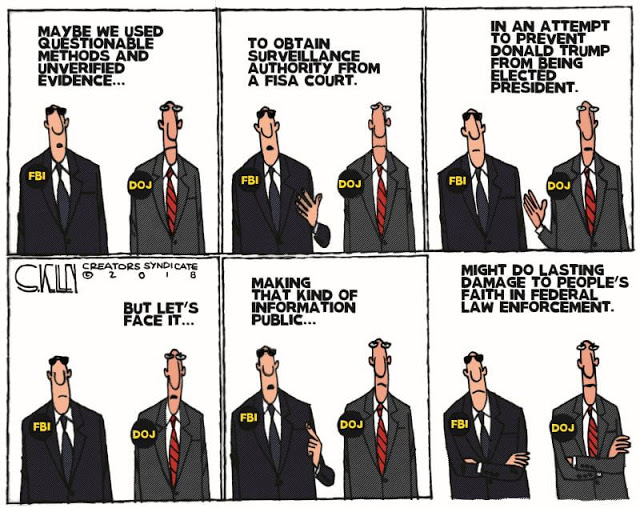
By Patrick Lawrence | Consortium News | May 11, 2020
The long, destructive conspiracy theory known as Russiagate, the mother of them all, at last evaporates into thin air. No shred of it remains as of back-to-back disclosures over the past couple of weeks. Where does this leave us? What is to come of this momentous turn of events?
Among those not inclined toward hysteria or copious quaffs of Democratic Party Kool–Aid, it has long been a question how those who concocted and sustained the tales of Russian “meddling,” “collusion,” and mail hackery would manage their embarrassment — not to mention their potential legal liabilities — once their edifice-built-on-sand collapsed, as it was destined from the first to do.
The early signs are as some predicted: They will slither quietly off the stage without comment, they will deny their incessant, ever-vehement accusations, they will profess to weariness, they will insist there are more important things to think about now.
Here is a tweet from one Bob F published Saturday. Our Bob touches nearly all of the above-noted bases. His mentions of Matt Taibbi, Aaron Maté, and Jimmy Dore reference two journalists and a talk-show host who identified the fraud from the first and had the scruples not to surrender to the liberal totalitarianism we have suffered these past three years:
ok ok ok ok @aaronjmate and @jimmy_dore got one thing right in their lives. Can we move on from this shiny object that is Russiagate? Trump and the Republicans are looting this country. We could be very close to armed revolt. But let’s talk more about Russia Russia Russia.
— Bob F (@BobF_666) May 9, 2020
Yes, Bob, lets. This is a brilliant specimen of the flaccid cowardice we’re now to witness many times over. Reassuringly enough, a modest twitter storm followed. Here is a reply from Kathy Woods, a consistently insightful commentator in Twitterland:
Move on? Hell no! I can’t stand Trump, but the Dems used the levers of the security state to perpetrate a fraud. They buried progressive momentum and brought us to the brink w/ Russia. It’s essential we completely expose this.
— Kathy Woods (@woods_kathy) May 10, 2020
For good measure, here is another response to Big Bob, this one addressing his implicit assertion of Democratic Party virtue in the Age of Trump:
A) liberals never stopped russiagating so obviously it needs to continue to be debunked.
B) if you think the Democrats are not equally to blame for the looting, I got a bridge to sell you.
— David Warschauer???? (@rogersmithbigo) May 9, 2020
There is anger abroad as Russiagate finally unwinds, plainly. This is an excellent thing. And Ms. Woods is right: It is important to make the sun shine on what became, before the end, a scandal of historic proportions. There is a chance of achieving the “complete exposure” Woods asks for, but it remains a question, as of now, whether this will come to pass.
Two weeks ago the Justice Department made public documents showing that when, in January 2017, prosecutors wanted to close the collusion case against Michael Flynn, who briefly served as President Donald Trump’s national security advisor, because they found “no derogatory information” against him, Peter Strzok, the philandering F.B.I. agent later found to be shaping an “insurance policy” against a Trump victory in the 2016 election, cajoled them into keeping it open — absence of evidence be damned.
Two Other Developments
The Strzok revelations turned out to be prelude to the two other developments further demolishing the Russiagate narrative. Last Thursday Justice finally dropped its case against Flynn altogether. We now know he was the victim of a perjury trap when questioned about his contacts with Sergey Kislyak, Moscow’s ambassador to Washington in 2016. “Get him to lie so we can prosecute him,” was the FBI’s directive.
Yet worse, Flynn’s guilty plea was in response to prosecutors’ threats to indict his son if he pled otherwise. Tell me the difference, please, between this kind of stuff and the treatment of the accused in the postwar show trials in Eastern Europe.
On the same day the Justice Department dropped the charges against Flynn, the House Intelligence Committee released documents showing that the FBI had no evidence that Russia pilfered the Democratic National Committee’s email archives by hacking into its servers in mid–2016. The FBI had none because CrowdStrike, the patently corrupt cyber-security firm on which it (inexplicably) relied, never gave it any: It had none, either — contrary to its many claims otherwise.
The taker of cake here is that the documents also show that the House Intelligence Committee, chaired by the inimitable (thank goodness) Adam Schiff, knew there were no grounds to allege Russian involvement in what wasn’t a hack by anyone, but a leak, probably by someone with direct access to the DNC’s servers.
My Consortium News colleague Ray McGovern has just detailed the collapse of the “Russians-hacked-it” ruse.
No evidence anywhere along the line of collusion, none of Russians stealing mail. There is a simpler way to put this: No Russiagate.
In truth, there has been evidence aplenty of the Russiagate fraud for some time, due in part to the researches of Veteran Intelligence Professionals for Sanity, VIPS, of which McGovern is a principal. The problem has been to secure official acknowledgement of three years’ worth of wrongdoing. We now have it, even if it arrives with no admission whatsoever of responsibility.
Enter Perception Management
Now come the lies, the dissembling, and the media’s “perception management.” Tucker Carlson, the Fox News presenter, offered a funny-but-not-funny catalog of the liars who now stand exposed, none more thoroughly than the egregious Schiff, who ought to resign over this, and Evelyn Farkas, another Obama-era holdover with absolutely no regard for the truth. Loretta Lynch, Obama’s A–G, will also have things to answer for, assuming answers for her misconduct are required of her.
Among the press and broadcasters, it has been a spinfest this past week — led, naturally, by The New York Times, given no one in the media dares venture a syllable for which the Times has not signaled prior approval. The paper’s report on the dismissal of the Flynn case marked the judgment down as “the latest example of Attorney General William P. Barr’s efforts to chisel away at the results of the Russia investigation.” I lost count of the mentions of Flynn’s “lying” and “guilty plea” after nine. No reference to the perjury trap set for Flynn, or the threat to indict his son.
The Times ran two further pieces hatcheting Flynn and Barr in Saturday’s editions, here and here, and a straight-out character assassination of Flynn on Sunday, casting him as some kind of pathological split personality. The Gray Lady doth protest too much, in my view.
The press vastly over-invested in the Russiagate narrative from the first, and now appears set to throw yet more money after all the bad. This is not a good sign. It suggests that our troubled republic simply cannot accept its errors, leaving us unable to learn from them. This is why America in its post-democratic phase cannot self-correct. It is why we have no assurance that another Russiagate, in whatever form, will not be visited upon us.
“Attorney General William P. Barr’s efforts to chisel away at the results of the Russia investigation”? Absolutely. We have to hope he gets somewhere. Committed Russiagaters now take to charging that Barr is corrupting an otherwise snow-white Justice Department. Say what? Given all we now know, this starts to tip into the zone of black humor.
Barr and his investigators are fully armed as of last week. They have all they need to get to the bottom of this dark ocean. They have it in their power to bring to justice the three architects of the Russiagate scam when it was in motion — ex–C.I.A. Director John Brennan, ex–Director of National Intelligence James Clapper, ex–F.B.I. Director James Comey — for what amounted to an attempt to depose a president in a bloodless coup. These are the Democratic Party’s answer to former President Richard Nixon’s infamous “plumbers,” if you ask me.
Whether Barr and his investigators get the task done is to a great extent a matter of politics and bureaucratic warfare that will at best be partially visible to us in coming months. It is a question of how far he will be permitted to go.
Succeed or fail, the record is at least and at last straight.
Patrick Lawrence, a correspondent abroad for many years, chiefly for the International Herald Tribune, is a columnist, essayist, author and lecturer. His most recent book is “Time No Longer: Americans After the American Century” (Yale).
German media watchdog rejects Browder’s complaint against Spiegel over Magnitsky report, says his own narrative lacks proof
RT | May 11, 2020
Bill Browder’s complaint against Der Spiegel for questioning the story he used to push for anti-Russian sanctions has backfired, with Germany’s Press Council concluding his own position is far from being an “indisputable fact.”
“We cannot agree with your analysis, in which you criticize the allegations made by the author,” the German Press Council – a monitoring organization formed by major German publishers and journalistic associations – said in its response to Browder’s team, as it rejected the complaint against one of Germany’s major news media outlets.
The papers detailing the council’s decision were published on Twitter by Der Spiegel reporter Benjamin Bidder, who authored an investigative bombshell picking apart Browder’s story about his auditor Sergey Magnitsky’s death back in November 2019.
The report provoked the British investor’s fury, and he swiftly filed a complaint after the news outlet dared to question the narrative that the vulture capitalist turned human rights campaigner had perpetuated for years as he relentlessly called for sanctions against Russia.
The US-born investor has always claimed that Magnitsky was a courageous whistleblower, who exposed corruption in Russia and was mercilessly killed by authorities out of revenge. The German weekly, however, concluded that this narrative was riddled with lies and said Western nations have fallen for a “convenient” story made up by a “fraudster.”
Browder lashed out at Der Spiegel, accusing it of “misrepresenting the facts” and even letting itself to be instrumentalized by Moscow. He told another German newspaper, Die Welt, that Der Spiegel outright “ignored” his evidence and asked him questions “put together by people close to the Russian government.”
The paper did not let itself be bullied, and published another lengthy piece containing further evidence supporting its conclusions. Now, the Press Council has said that Der Spiegel was fairly accurate in its assessments.
“The factual basis [of the report] at the time of the publication was sufficiently clear,” it said. The media watchdog further noted that it is the position of Browder’s team that “cannot be, to say the least, seen as a proven and undeniable fact.”
It also noted that Magnitsky cannot be seen as a “lawyer,” since he had no legal education. That was exactly what Der Spiegel said, and what Browder vehemently contested.
Magnitsky died in pre-trial detention in Moscow back in 2009, when he was investigated in relation to Browder’s own case. The investor was eventually found guilty of massive tax evasion and embezzlement in Russia and was twice sentenced in absentia to nine years in prison.
The 56-year-old, meanwhile, proclaimed himself Russian President Vladimir Putin’s “enemy number one” and used the death of his associate to lobby for the passing of the infamous Magnitsky Act in the US back in 2012. That legislation allowed the American authorities to impose sanctions against Russian officials over alleged human rights violations. Later, Browder also pushed for similar acts in Canada and the UK.
Former Obama Official Criticized After Classified Testimony Contradicts Her Public Statements

By Jonathan Turley | May 11, 2020
The long-delayed release of testimony from the House Intelligence Committee has proved embarrassing for a variety of former Obama officials who have been extensively quoted on the allegedly strong evidence of collusion by the Trump campaign and the Russians. Figures like James Clapper, who is a CNN expert, long indicated that the evidence from the Obama Administration was strong and alarming. However, in testimony, Clapper denied seeing any such evidence. One of the most embarrassing is the testimony of Evelyn Farkas, a former Obama Administration official who was widely quoted in her plea to Congress to gather the evidence that she knew was found in by the Obama Administration. In her testimony under oath Farkas repeatedly stated that she knew of no such evidence of collusion.
Farkas, who served as the deputy assistant secretary of Defense for Russia/Ukraine/Eurasia, was widely quoted when she said on MSNBC in 2017 that she feared that evidence she knew about would be destroyed by the Trump Administration. She stated:
“was urging my former colleagues, and, frankly speaking, the people on the Hill… Get as much information as you can, get as much intelligence as you can, before President Obama leaves the administration, because I had a fear that somehow that information would disappear with the senior people that left. So it would be hidden away in the bureaucracy . . . the Trump folks, if they found out how we knew what we knew about their, the staff, the Trump staff’s dealing with Russians, that they would try to compromise those sources and methods, meaning we would no longer have access to that intelligence. So I became very worried, because not enough was coming out into the open, and I knew that there was more.”
MSNBC never seriously questioned the statements despite the fact that Farkas left the Obama Administration in 2015 before any such investigation could have occurred. As we have seen before, the factual and legal basis for such statements are largely immaterial in the age of echo journalism. The statement fit the narrative even if it lacked any plausible basis.
Not surprisingly, the House Intelligence Committee was eager to have Farkas share all that she stated she “knew about [“the Trump folks”], their staff, the Trump’s staff’s dealing with Russian” and wanted to get “into the open.” After all, she told MSNBC that “I knew that there was more.”
She was finally put under oath in the closed classified sessions and there was nothing but classified crickets. Farkas was repeatedly asked to share that information that electrified the MSNBC hosts and audience. She repeatedly denied any such knowledge, telling then Rep. Trey Gowdy (R, S.C.), “I didn’t know anything.”
Gowdy noted that Farkas left the Obama administration in 2015 and asked “Then how did you know?” She repeated again “I didn’t know anything.”
Gowdy then asked “Well, then why would you say, we knew?”
Gowdy later asked, getting to the point “You also didn’t know whether or not anybody in the Trump campaign had colluded with Russia, did you?”
“I didn’t,” Farkas responded.
MSNBC has said nothing about its prior headline story being untrue. Indeed, the media has barely acknowledged that the new documents reinforce that there was never any evidence of collusion and ultimately the allegations were rejected by the Special Counsel, Congress, and inspectors general.
For her part, Farkas has moved on. She is running for Congress. She is still citing her role in raising “the alarm” about Russian collusion:
“After I left the Obama administration, I campaigned to help elect Secretary Clinton as our next President. When Russians interfered in that election, I was among the first to sound the alarm and urge Congress to take action. And I haven’t let up since then.”
She was indeed one of the first but it proved to be a false alarm based on nonexistent knowledge. Does that matter anymore?
Twin Pillars of Russiagate Crumble
For two and a half years the House Intelligence Committee knew CrowdStrike didn’t have the goods on Russia. Now the public knows too.
By Ray McGovern – Consortium News – May 9, 2020
House Intelligence Committee documents released Thursday reveal that the committee was told two and half years ago that the FBI had no concrete evidence that Russia hacked Democratic National Committee computers to filch the DNC emails published by WikiLeaks in July 2016.
The until-now-buried, closed-door testimony came on Dec. 5, 2017 from Shawn Henry, a protege of former FBI Director Robert Mueller (from 2001 to 2012), for whom Henry served as head of the Bureau’s cyber crime investigations unit.
Henry retired in 2012 and took a senior position at CrowdStrike, the cyber security firm hired by the DNC and the Clinton campaign to investigate the cyber intrusions that occurred before the 2016 presidential election.
The following excerpts from Henry’s testimony speak for themselves. The dialogue is not a paragon of clarity; but if read carefully, even cyber neophytes can understand:
Ranking Member Mr. [Adam] Schiff: Do you know the date on which the Russians exfiltrated the data from the DNC? … when would that have been?
Mr. Henry: Counsel just reminded me that, as it relates to the DNC, we have indicators that data was exfiltrated from the DNC, but we have no indicators that it was exfiltrated (sic). … There are times when we can see data exfiltrated, and we can say conclusively. But in this case, it appears it was set up to be exfiltrated, but we just don’t have the evidence that says it actually left.
Mr. [Chris] Stewart of Utah: Okay. What about the emails that everyone is so, you know, knowledgeable of? Were there also indicators that they were prepared but not evidence that they actually were exfiltrated?
Mr. Henry: There’s not evidence that they were actually exfiltrated. There’s circumstantial evidence … but no evidence that they were actually exfiltrated. …
Mr. Stewart: But you have a much lower degree of confidence that this data actually left than you do, for example, that the Russians were the ones who breached the security?
Mr. Henry: There is circumstantial evidence that that data was exfiltrated off the network.
Mr. Stewart: And circumstantial is less sure than the other evidence you’ve indicated. …
Mr. Henry: “We didn’t have a sensor in place that saw data leave. We said that the data left based on the circumstantial evidence. That was the conclusion that we made.
In answer to a follow-up query on this line of questioning, Henry delivered this classic: “Sir, I was just trying to be factually accurate, that we didn’t see the data leave, but we believe it left, based on what we saw.”
Inadvertently highlighting the tenuous underpinning for CrowdStrike’s “belief” that Russia hacked the DNC emails, Henry added: “There are other nation-states that collect this type of intelligence for sure, but the — what we would call the tactics and techniques were consistent with what we’d seen associated with the Russian state.”
Not Transparent
Try as one may, some of the testimony remains opaque. Part of the problem is ambiguity in the word “exfiltration.”
The word can denote (1) transferring data from a computer via the Internet (hacking) or (2) copying data physically to an external storage device with intent to leak it.
As the Veteran Intelligence Professionals for Sanity has been reporting for more than three years, metadata and other hard forensic evidence indicate that the DNC emails were not hacked — by Russia or anyone else.
Rather, they were copied onto an external storage device (probably a thumb drive) by someone with access to DNC computers. Besides, any hack over the Internet would almost certainly have been discovered by the dragnet coverage of the National Security Agency and its cooperating foreign intelligence services.
Henry testifies that “it appears it [the theft of DNC emails] was set up to be exfiltrated, but we just don’t have the evidence that says it actually left.”
This, in VIPS view, suggests that someone with access to DNC computers “set up” selected emails for transfer to an external storage device — a thumb drive, for example. The Internet is not needed for such a transfer. Use of the Internet would have been detected, enabling Henry to pinpoint any “exfiltration” over that network.
Bill Binney, a former NSA technical director and a VIPS member, filed a sworn affidavit in the Roger Stone case. Binney said: “WikiLeaks did not receive stolen data from the Russian government. Intrinsic metadata in the publicly available files on WikiLeaks demonstrates that the files acquired by WikiLeaks were delivered in a medium such as a thumb drive.”
The So-Called Intelligence Community Assessment
There is not much good to be said about the embarrassingly evidence-impoverished Intelligence Community Assessment (ICA) of Jan. 6, 2017 accusing Russia of hacking the DNC.
But the ICA did include two passages that are highly relevant and demonstrably true:
(1) In introductory remarks on “cyber incident attribution”, the authors of the ICA made a highly germane point: “The nature of cyberspace makes attribution of cyber operations difficult but not impossible. Every kind of cyber operation — malicious or not — leaves a trail.”
(2) “When analysts use words such as ‘we assess’ or ‘we judge,’ [these] are not intended to imply that we have proof that shows something to be a fact. … Assessments are based on collected information, which is often incomplete or fragmentary … High confidence in a judgment does not imply that the assessment is a fact or a certainty; such judgments might be wrong.” [And one might add that they commonly ARE wrong when analysts succumb to political pressure, as was the case with the ICA.]
The intelligence-friendly corporate media, nonetheless, immediately awarded the status of Holy Writ to the misnomered “Intelligence Community Assessment” (it was a rump effort prepared by “handpicked analysts” from only CIA, FBI, and NSA), and chose to overlook the banal, full-disclosure-type caveats embedded in the assessment itself.
Then National Intelligence Director James Clapper and the directors of the CIA, FBI, and NSA briefed President Obama on the ICA on Jan. 5, 2017, the day before they gave it personally to President-elect Donald Trump.
On Jan. 18, 2017, at his final press conference, Obama saw fit to use lawyerly language on the key issue of how the DNC emails got to WikiLeaks, in an apparent effort to cover his own derriere.
Obama: “The conclusions of the intelligence community with respect to the Russian hacking were not conclusive as to whether WikiLeaks was witting or not in being the conduit through which we heard about the DNC e-mails that were leaked.”
So we ended up with “inconclusive conclusions” on that admittedly crucial point. What Obama was saying is that U.S. intelligence did not know—or professed not to know—exactly how the alleged Russian transfer to WikiLeaks was supposedly made, whether through a third party, or cutout, and he muddied the waters by first saying it was a hack, and then a leak.
From the very outset, in the absence of any hard evidence, from NSA or from its foreign partners, of an Internet hack of the DNC emails, the claim that “the Russians gave the DNC emails to WikiLeaks” rested on thin gruel.
In November 2018 at a public forum, I asked Clapper to explain why President Obama still had serious doubts in late Jan. 2017, less than two weeks after Clapper and the other intelligence chiefs had thoroughly briefed the outgoing president about their “high-confidence” findings.
Clapper replied: “I cannot explain what he [Obama] said or why. But I can tell you we’re, we’re pretty sure we know, or knew at the time, how WikiLeaks got those emails.” Pretty sure?

Comey briefs Obama, June 2016 (Flickr)
Preferring CrowdStrike; ’Splaining to Congress
CrowdStrike already had a tarnished reputation for credibility when the DNC and Clinton campaign chose it to do work the FBI should have been doing to investigate how the DNC emails got to WikiLeaks. It had asserted that Russians hacked into a Ukrainian artillery app, resulting in heavy losses of howitzers in Ukraine’s struggle with separatists supported by Russia. A Voice of America report explained why CrowdStrike was forced to retract that claim.
Why did FBI Director James Comey not simply insist on access to the DNC computers? Surely he could have gotten the appropriate authorization. In early January 2017, reacting to media reports that the FBI never asked for access, Comey told the Senate Intelligence Committee there were “multiple requests at different levels” for access to the DNC servers.
“Ultimately what was agreed to is the private company would share with us what they saw,” he said. Comey described CrowdStrike as a “highly respected” cybersecurity company.
Asked by committee Chairman Richard Burr (R-NC) whether direct access to the servers and devices would have helped the FBI in their investigation, Comey said it would have. “Our forensics folks would always prefer to get access to the original device or server that’s involved, so it’s the best evidence,” he said.
Five months later, after Comey had been fired, Burr gave him a Mulligan in the form of a few kid-gloves, clearly well-rehearsed, questions:
BURR: And the FBI, in this case, unlike other cases that you might investigate — did you ever have access to the actual hardware that was hacked? Or did you have to rely on a third party to provide you the data that they had collected?
COMEY: In the case of the DNC, … we did not have access to the devices themselves. We got relevant forensic information from a private party, a high-class entity, that had done the work. But we didn’t get direct access.
BURR: But no content?
COMEY: Correct.
BURR: Isn’t content an important part of the forensics from a counterintelligence standpoint?
COMEY: It is, although what was briefed to me by my folks — the people who were my folks at the time is that they had gotten the information from the private party that they needed to understand the intrusion by the spring of 2016.
In June last year it was revealed that CrowdStrike never produced an un-redacted or final forensic report for the government because the FBI never required it to, according to the Justice Department.
By any normal standard, former FBI Director Comey would now be in serious legal trouble, as should Clapper, former CIA Director John Brennan, et al. Additional evidence of FBI misconduct under Comey seems to surface every week — whether the abuses of FISA, misconduct in the case against Gen. Michael Flynn, or misleading everyone about Russian hacking of the DNC. If I were attorney general, I would declare Comey a flight risk and take his passport. And I would do the same with Clapper and Brennan.
Schiff: Every Confidence
But No Evidence
Both pillars of Russiagate–collusion and a Russian hack–have now fairly crumbled.
Thursday’s disclosure of testimony before the House Intelligence Committee shows Chairman Adam Schiff lied not only about Trump-Putin “collusion,” [which the Mueller report failed to prove and whose allegations were based on DNC and Clinton-financed opposition research] but also about the even more basic issue of “Russian hacking” of the DNC.
[See: “The Democratic Money Behind Russia-gate” republished today.]
Five days after Trump took office, I had an opportunity to confront Schiff personally about evidence that Russia “hacked” the DNC emails. He had repeatedly given that canard the patina of flat fact during an address at the old Hillary Clinton/John Podesta “think tank,” The Center for American Progress Action Fund.
Fortunately, the cameras were still on when I approached Schiff during the Q&A: “You have every confidence but no evidence, is that right?” I asked him. His answer was a harbinger of things to come. This video clip may be worth the few minutes needed to watch it.
Schiff and his partners in crime will be in for much tougher treatment if Trump allows Attorney General Barr and U.S. Attorney John Durham to bring their investigation into the origins of Russia-gate to a timely conclusion. Barr’s dismissal on Thursday of charges against Flynn, after released FBI documents revealed that a perjury trap was set for him to keep Russiagate going, may be a sign of things to come.
Given the timid way Trump has typically bowed to intelligence and law enforcement officials, including those who supposedly report to him, however, one might rather expect that, after a lot of bluster, he will let the too-big-to-imprison ones off the hook. The issues are now drawn; the evidence is copious; will the Deep State, nevertheless, be able to prevail this time?
Ray McGovern works with Tell the Word, a publishing ministry of the ecumenical Church of the Saviour in inner-city Washington. A former CIA analyst, his retirement he co-founded Veteran Intelligence Professionals for Sanity.
Harvard Howler: Study claims PM2.5 increases risk of death from COVID19
By Steve Milloy | Junk Science | April 7, 2020
Never waste a crisis. A new study from Harvard claims that 1 microgram per cubic meter increase in PM2.5 is associated with a 15% increase in deaths from COVID19. This is totally absurd.
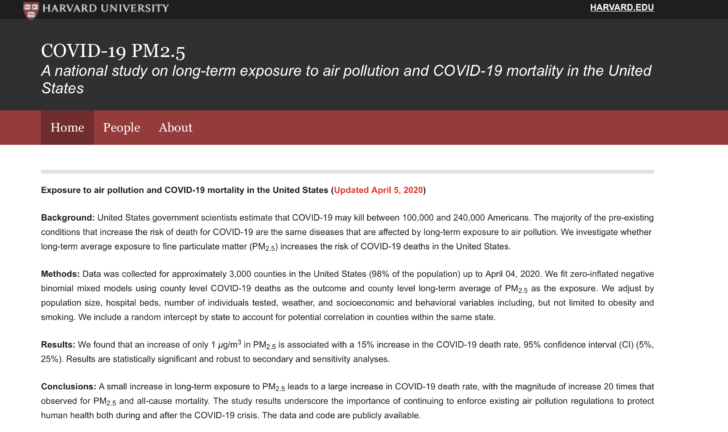
Here are the links you’ll need:
Here’s why this is a totally bogus claim.
- There is no biological plausibility to the notion that PM2.5 causes death.
- A change in exposure to PM2.5 of 1 microgram per cubic meter is not significant, discernible or detectable.
- If this claim were true, the death toll in Wuhan, China would be astronomical since, for example, the PM2.5 level in Wuhan is 158 micrograms/m3 — about 10 times higher than average US air.
But now that the Harvard fraudsters have made this data available, perhaps they’d be wailing to share their Harvard Six City study data?
A Cautionary Tale About the WHO

By Larry Romanoff | Moon of Shanghai | May 10, 2020
There appears to be no shortage of claims from multiple informed and independent sources that the WHO has two primary functions, the first as a tool for world population reduction on behalf of its masters, and the second as a powerful marketing agent for big pharma, specifically the vaccine manufacturers. Many critics have pointed out that the ‘vaccination experts’ at the WHO are “dominated by the vaccine makers standing to gain from the enormously lucrative vaccine and antiviral contracts awarded by governments.” And indeed, the advisory and other committees involved with the WHO’s vaccine programs seem heavily populated with those who profit directly from those same programs.
Equally, the claims and concerns about population control and reduction are far from conspiracy theories today, with far too much evidence, some of it frightening, that this is indeed a major agenda of the WHO today. We have already seen too much hard evidence of this body’s involvement in both areas to justify dismissing the concerns as implausible fears. Moreover, there is a disturbing list of individuals closely associated with the WHO, who have had either population reduction or mass vaccinations as a pet project; individuals like David Rothschild, David Rockefeller, George Soros, Donald Rumsfeld, Bill Gates, and many more, the list including national organisations like the CDC, FEMA, the US Department of Homeland Security, the Rockefeller and Carnegie Institutes, the CFR, and others.
It is not difficult, on the basis of all the evidence, to conclude the WHO is an international criminal enterprise under the control of a core group, one with European corporate dynasties at its center which, as one writer noted, “provides the strategic leadership and funds the development, manufacturing and release of synthetic, man-made viruses solely to justify immensely profitable mass vaccinations”. We have seen so many instances of an unusual and apparently laboratory-made virus appearing without warning, the onset followed immediately by urgent worried pronouncements from the WHO of yet another mandatory mass vaccination.
We have the rampant production of deadly viruses in secretive labs around the world, and the repeated “accidental” release of those into various populations (think ZIKA) – seemingly inevitably without explanation, apology or even a semblance of actual investigation, much less censure or criminal or civil charges. We also have the blanket legal immunity for all pharma companies in their creation and dissemination of deadly pathogens by vaccination. When we add into this mix the WHO’s history of criminality as with their now-famous tetanus/hCG international sterility program, the curious timing of the onset of AIDS, and the many occurrences of the WHO’s vaccination programs perfectly coinciding with a sudden outbreak of yet another unusual disease in the same areas and populations, one would have to be a hard-core ideologue to not become damned suspicious.
WHO Vaccinations and Population Control
During the early 1990s, the WHO had been overseeing massive tetanus vaccination campaigns in Nicaragua, Mexico, the Philippines, Tanzania and Nigeria. All tell a similar story, one that almost beggars belief but with the facts too clear to refute. Tetanus is a disease whose onset we often associate with stepping on a rusty nail or some such event. It should be clear that men would be at least as likely, if not more likely, to encounter this circumstance than would women, and perhaps careless children more than adults, but the WHO vaccination program was directed only to females from 15 to 45 years of age – in other words, child-bearing ages. In Nicaragua, the targets were females from 12 to 49 years of age.
Also, a single tetanus shot is universally accepted as sufficient to provide protective duration of ten years or more, but the WHO inexplicably insisted on vaccinating these women five times within several months. Shortly after the initiation of these programs, concerns began to emerge about spontaneous abortions and other complications arising exclusively within the vaccinated populations. On suspicion, a group in Mexico had the vaccination serum analysed and discovered it contained the Human chorionic gonadotrophin (hCG) hormone. This hormone is critical to the female body during pregnancy. It causes the release of other hormones that prepare the uterine lining for the implantation of the fertilised egg. Without it, a woman’s body is unable to sustain a pregnancy and the fetus will be aborted. This hormone was injected into the subjects along with the tetanus serum, causing a female body to then recognise both as foreign agents and to develop antibodies to destroy either if they were to ever appear in the body in the future.
Upon becoming pregnant, a woman’s body would fail to recognize hCG as a friend and would produce anti-hCG antibodies, the prior vaccination now inducing her body’s immune system to attack the hormone that is needed to bring an unborn child to term, preventing subsequent pregnancies by killing the hCG which is necessary to sustain them. This means each woman who received the WHO inoculation was vaccinated not only against tetanus but also against pregnancy. (1) (2)
The WHO at first denied the facts and disparaged the results of the initial tests, but following this revelation each nation conducted extensive tests and in all cases the hCG hormone was identified as existing in the tetanus vaccination serum. The WHO eventually went silent and discontinued their program but by this time many millions of women had been vaccinated – and rendered sterile. One important fact is that the three different brands of tetanus vaccine being used in this project were developed, produced, and distributed in secrecy and that none had ever been tested or licensed for sale or distribution anywhere in the world. The companies that produced them were Connaught Laboratories and Intervex from Canada, and Australia’s CSL Laboratories. Connaught is the same firm that, along with the Canadian Red Cross, knowingly distributed AIDS-contaminated blood products for several years during the 1980s, a criminal organisation that should have been executed along with its owners. (3)
Further damning evidence that the Western media censored, was the fact that the WHO had been actively involved for more than 20 years prior in the development of an anti-fertility vaccine utilizing hCG tied to tetanus toxoid as a carrier – precisely the same combination as in these vaccines. According to the WHO’s own reports, they had spent nearly $400 million on this kind of “reproductive health” research. More than 20 research articles have been written on this subject, many of these by the WHO itself, that document in detail the WHO’s attempts to create an anti-fertility vaccine utilizing tetanus toxoid. And they aren’t alone; the UNFPA, the UNDP, the World Bank and of course – whenever we encounter secret efforts at population control – the ubiquitous Rockefeller Foundation, are all allied in this cause, as was the US National Institute of Health. The Government of Norway was also a partner in this travesty, contributing more than $40 million to develop this Tetanus-abortion vaccine.
The Bill & Melinda Gates Foundation has been heavily funding the distribution of tetanus vaccine in Africa by UNICEF, which is the agency that provided Kenya with the vaccine laced with hCG. Gates said: “The world today has 6.8 billion people. That’s heading up to about nine billion. Now if we do a really great job on new vaccines, health care, reproductive health services, we could lower that by perhaps ten or fifteen percent.” (4) The Rockefeller Foundation also heavily funded this vaccine research and distribution. (5) All this amounts to genocide on a planetary scale.
I examined in detail the WHO website and discovered there were dozens of articles, many written by WHO researchers, documenting in detail the WHO’s attempts to create an anti-fertility vaccine utilizing tetanus toxoid as a carrier. (6) Some leading articles included:
- “Clinical profile and Toxicology Studies on Four Women Immunized with Pr-B-hCG-TT,” Contraception, February, 1976, pp. 253-268.
- “Observations on the antigenicity and clinical effects of a candidate antipregnancy vaccine: B-subunit of human chorionic gonadotropin linked to tetanus toxoid,” Fertility and Sterility, October 1980, pp. 328-335.
- “Phase 1 Clinical Trials of a World Health Organisation Birth Control Vaccine,” The Lancet, 11 June 1988, pp. 1295-1298. “Vaccines for Fertility Regulation,” Chapter 11, pp. 177-198, Research in Human Reproduction, Biennial Report (1986-1987), WHO Special Programme of Research, Development and Research Training in Human Reproduction (WHO, Geneva 1988).
- “Anti-hCG Vaccines are in Clinical Trials,” Scandinavian Journal of Immunology, Vol. 36, 1992, pp. 123-126.
As early as 1978, the WHO was actively exploring ways to eradicate much of the population of the Third World. A paper published by the WHO (7) was titled, “Evaluating … placental antigen vaccines for fertility regulation”; The paper acknowledged “substantial progress” in its worldwide eugenics program of culling non-whites, but yet identified “an urgent need for a greater variety of methods” of preventing fertility, and gushed over the fact that “immunisation as a prophylactic measure is now so widely accepted”, that the employment of sterilisation vaccines would be widely appealing (to those dispensing the vaccines) and would offer “great ease of delivery”.
If that isn’t clear, the WHO is saying that vaccinations for other purposes – protection against diseases – are so common and widely-accepted, inoculation is probably the easiest way to sterilise the populations of undeveloped countries. The paper then notes the accumulation of evidence that “there exist proteins specific to the reproductive system” which “could be blocked” by vaccinations and provide a new method of “fertility regulation”. Among the stated advantages of a sterilisation vaccine is that it could prevent or disrupt implantation of the fertilised egg onto the uterus wall, and thereby guarantee that every (non-white) conception would result in a miscarriage or spontaneous abortion, i.e., an anti-hCG vaccine. The paper continues:
“Testing … will reveal whether a single injection is sufficient to achieve the desired level of immunization, or whether several boosting injections will be required. The main desired effect is to achieve a degree of immunization sufficient to: (a) neutralize the hormonal activity of hCG in vivo; and (b) prevent or disrupt implantation at a very early stage of pregnancy. It is not yet established whether immunization with the β hCG peptide conjugate will cause an irreversible biological neutralization of hCG … This will probably vary from individual to individual. In the first case, the indication for immunization will be restricted to sterilization, whereas in the second eventuality … immunization may be considered as a long-lasting but reversible anti-fertility measure.”
On August 17-18, 1992, the WHO produced a report titled “Fertility Regulating Vaccines”, resulting from a large meeting in Geneva of scientists and ‘womens’ health advocates’ “to review the current status of the development of fertility regulating vaccines.” The meeting was from a joint Special Program of research in reproduction of the UNDP, UNFPA, the WHO and the World Bank. The report stated, “… applied research on FRV’s (fertility-regulating vaccines) has been going on for more than twenty years …”, and discussed not only the anti-hCG vaccines already receiving clinical trials, but the development of other vaccines such as an anti-GnRH vaccine that would extend the temporary infertility due to breast-feeding.
This vaccine was also being field-tested at the time, with the possible intention of employing both antigens in the same vaccine on the assumption that a single vaccine might not sterilise all victims. They also recognised the dangers of administering such a vaccine to women who were already pregnant, and expressed awareness the antibodies would almost certainly be present in the milk and might therefore render the infants permanently sterile as well – with the massive understatement that this “might not be acceptable to all potential users …” From the outset, WHO planners realised that during mass vaccinations, many pregnant women would also be inoculated with the anti-hCG serum, which would inevitably result not only in sterilisation, miscarriages and spontaneous abortions but also incurable autoimmune disorders and birth defects.
The same paper went on to state, “In addition to women being immunized inadvertently during an established pregnancy, fetuses could be exposed to potential teratological effects of immunization …”. In other words, WHO staff would freely inoculate pregnant women, those embryos or fetuses not spontaneously aborting would experience pathological growth from which would result various undefined birth defects. The WHO is not researching ‘reproductive health’, but reproductive impossibility, and their tetanus-hCG vaccine is not in any sense ‘regulating’ the fertility of women but rendering their fertility biologically impossible, which is not quite the same thing. Their own paper stated the vaccination likely “will cause an irreversible biological neutralization of hCG”, which means the permanent sterilisation of innocent women who agreed to receive tetanus shots.
Try to understand what this means: the WHO was for decades receiving hundreds of millions of dollars in funding for research and testing, to produce an antifertility vaccine that would make a woman’s immune system attack and destroy her own babies in the womb, a vaccine they would surreptitiously combine with a tetanus vaccination without informing the victims. To say their deceit was successful would be an understatement. The WHO inoculated more than 130 million women in 52 countries with this vaccine, permanently sterilising some very large percentage of them without their knowledge or consent. It was only when an enormous number of women in all countries experienced vaginal bleeding and miscarriages immediately after the vaccinations, that the hormone additive was discovered as the cause. Suspicions were aroused when the WHO selected only females of child-bearing age and further specified the unheard-of practice of five multiple injections over a three month period, but the health officials in these undeveloped countries still had faith in the white man’s medicine.
Upon the discovery of the hormone in the vaccine, Nigerian physicians reported WHO doctors telling them the hCG hormone “would have no effect on human reproduction”, statements they knew to be false. When this information reached the public, the WHO assumed an offensive and repugnant stand, mocking and ridiculing the nations that had performed the tests and revealed the contamination, condemning them as incompetent, having “unsuitable” testing laboratories, and using improper samples or procedures. WHO officials claimed these nations had “Not the right kind of lab to do the test. The labs know only how to test urine samples . . .” This is the standard response by Western agencies, governments, and corporations, when caught with adulterated products. When Coca-Cola’s drinks in China were found to contain frightening levels of pesticides and chlorine, the immediate accusation was that China’s biological laboratories were all incompetent. When Nestle’s noodles in India were found to contain dangerously toxic amounts of lead, India’s laboratories were all incompetent. The next step is to carefully produce a few samples known to be uncontaminated, provide them to an “independent” laboratory that inevitably pronounces them clean, then move the story off the front page.
When the discovery was made, many nations enacted immediate legal restraining orders against WHO and UNICEF vaccine programs. WHO and UNICEF officials said the “grave allegations” were “not backed up by evidence”, which was nonsense. UNICEF, USAID and the WHO refused to address the evidence like vaginal bleeding, miscarriages and spontaneous abortions. They also refused to discuss the reasons for a series of five closely-spaced vaccinations when one had always been sufficient, ignoring the content of their own published papers stating that multiple injections of a tetanus-hCG vaccine would be necessary for effective sterilisation.
When faced with documented results, WHO officials admitted the hormone did indeed exist “in small amounts” in “some” of the vaccine material, but that this was an inconsequential result of “accidental contamination”. Nobody at the WHO attempted to explain the source of the hCG hormone in sufficient volume to contaminate 130 million doses of a vaccine, nor how that “contamination” could “accidentally” have inserted itself into all those vaccines. The Lancet reported that the US National Institute of Health supplied much of the hCG hormone for WHO experiments and testing. The Western media were of course too busy at the time telling us how evil Iran was, to notice the small issue of 130 million women having been deliberately vaccinated against pregnancy, without their knowledge. As I’ve often mentioned elsewhere, the Western media are excessively fond of demonising Hitler, but Hitler didn’t sterilise 130 million women without their knowledge or consent, so where is the moral outrage against the WHO? The outrage is buried in the fact that none of those 130 million sterilised women were white.
The WHO went silent for a while, but in 2015, Vatican Radio charged that the UN organisations WHO and UNICEF were again executing vast international programs of depopulating the earth by using vaccines to surreptitiously sterilise women in Third World countries, this time in Kenya. It stated that “Catholic Bishops in Kenya have been opposed to the nationwide Tetanus Vaccination Campaign targeting 2.3 million Kenyan women and girls of reproductive age between 15-49 years, terming the campaign a secret government plan to sterilize women and control population growth”. (8) In May of 2018, it was reported that fertility-regulating vaccines were being used in India. (9)
And Polio, Too
In 2009, there was a spreading outbreak of Polio in Nigeria, a direct result of yet another WHO vaccination program, this time directly linked to the vaccine which was made from a live polio virus which always carries a risk of causing polio instead of protecting against it – as the Americans learned to their chagrin many years ago. Today in the West, polio vaccines are made from a killed virus that cannot cause polio. This latest WHO-sponsored outbreak actually began several years prior, which the WHO blamed on the live virus in their vaccines that had somehow “mutated”. So once again, the WHO is causing polio in the undeveloped world, amid evidence that for every case of identified polio there are hundreds of other children who don’t develop the disease but remain carriers and pass it on to others. It has long been recognised that the live oral vaccine used by the WHO can easily cause the very epidemics it pretends to be eliminating, and of course there is no published evidence that the polio virus had in fact “mutated”. The same occurred in Kenya, this time using the hCG hormone tied to polio vaccinations, with the same tragic results. (10)
In late 2013, Syria experienced a sudden outbreak of polio, the first in that country in about 20 years, and in an area that had been under the control of US-backed revolutionary mercenaries. The Syrian government claimed to have evidence that these foreigners brought the disease into the country from Pakistan, from Western (US) agencies. The WHO was active in Pakistan in yet another of its “humanitarian vaccination programs” that strangely coincided in geographic area with a severe outbreak of polio, and Syrian authorities were adamant that the West transmitted it to their nation when 1.7 million doses of polio vaccine were purchased by UNICEF, in spite of the fact that no cases of polio had been seen since 1999. After the mass vaccination program started, cases of polio began to reappear in Syria.
UNICEF began a similar mass vaccination program with 500,000 doses of live oral polio vaccine in the Philippines in spite of the fact there were no reported cases of polio in the Philippines since 1993. This would fit the pattern from other instances of sudden disease emergencies. I have not managed yet to reconstruct the WHO’s vaccination and other programs in all locations, but sudden outbreaks of viruses are always suspicious since they cannot be created from nothing and must be introduced into a population, and with surprising regularity appear on the heels of some WHO vaccination program. The sudden and inexplicable appearance of the Bubonic plague in Peru and Madagascar are two such events and, increasingly often, the pathogens do not appear to be natural in origin. In particular, the SARS-related camel virus in the Middle East had some obvious signs of human engineering as did the SARS coronavirus itself. There are many other such cases which are far too often linked with the presence of some program of the WHO.
The WHO is also becoming active in China with alarming potential for disaster. As one example, in late 2013, a number of newborn Chinese babies died immediately after being inoculated by the WHO against hepatitis B. The WHO China representative, Dr. Bernhard Schwartlander, called China’s program “very successful”, but I find myself with gnawing suspicions about his definition of ‘success’. The infant deaths may indeed have been an unfortunate accident, but I was not encouraged by Schwartlander’s comment that it is “difficult to establish a causal link between the vaccines and the babies’ deaths”. Knowing the past history of the WHO and their infectious inoculations, the ‘difficulty of establishing a causal link between the WHO vaccinations and civilian deaths’, may have been the part that was ‘successful’.
Pfizer Case Study – The Perfectly-Timed Epidemic
It is by now well-known that many new drugs are accompanied by serious side-effects such as irreversible liver damage, and are often fatal to children. In 1996 Pfizer developed a new antibiotic called Trovan to treat a variety of infections – meningitis being one example. Many of these new antibiotics are very powerful and with side effects that normally make them too dangerous to use for children, often causing permanent liver damage, joint disease and many other debilitating complications. Inexplicably, Pfizer decided to perform test trials on infants. However, Pfizer had the standard problem that FDA certification in the US required clinical trials on humans, and these are almost impossible to conduct in developed countries because no parents are willing to allow their children to take part in such risky clinical trials, to say nothing of the lawsuits resulting from trials gone bad. Therefore these pharma companies tend almost universally to take their trials to poor countries in Africa, Asia and South America where the laws are unprepared and the people don’t understand the risks of untested and unapproved drugs. The American (and European) pharma companies therefore transformed the developing world into an enormous test laboratory that carries no financial liability.
As luck would have it, at precisely the moment when Pfizer was ready to commence clinical trials of this new drug, Nigeria was suddenly and inexplicably hit with one of the worst meningitis epidemics in history. And of course, Pfizer was there to help the Nigerian government deal with the outbreak. But Pfizer didn’t exactly deal with the outbreak; what it did was to conduct a reprehensible clinical trial for its new medication, on a group of victims unlikely to complain. Rather than “helping” as it claimed, Pfizer gathered a trial group and a control group, giving one group Pfizer’s new medication and a competitor’s product to the other. It quickly became obvious that the Americans were not on a humanitarian mission but were saving the expense of live trials. After experimenting on about 200 victims, they gathered their test information and left – right in the middle of the meningitis epidemic, without having saved any lives. The Nigerian government tallied the deaths at about 11,000.
That would have been the end, except that a controversy erupted soon after about the relationship between Pfizer’s need for test trials and the meningitis outbreak. As it happened, the WHO was in Nigeria immediately prior to that time on another of its “life-saving” vaccination programs, this time for polio, and the timing and location of the meningitis outbreak apparently matched perfectly the WHO’s polio vaccination program. And of course it perfectly matched Pfizer’s need for large numbers of test subjects. There were lawsuits and payments, accusations and denials, but to this day Nigeria refuses WHO entry into the country and will not participate in any further “humanitarian” aid from the UN or the WHO. We cannot definitively say that the WHO deliberately created the meningitis epidemic for the benefit of Pfizer’s tests, but it’s the only theory that fits all the known facts and it’s the kind of thing the WHO appears to do on a regular basis. We should note Pfizer’s intention to market Trovan in the US and Europe after its trials on these African children, but the FDA refused to approve Trovan for American children due to the severe dangers.
Pfizer’s behavior after these “field trials” ended was, if anything, even more reprehensible. The lawsuits were based on claims that Pfizer did not have proper consent from parents to use an experimental drug on their children, the use of which not only left many children dead but others with brain damage, paralysis or slurred speech. Pfizer eventually reached a settlement with the Nigerian state government to pay $75m in damages and to create a fund of $35m to compensate the victims. This, after what the Guardian described as “a 15-year legal battle against Pfizer over a fiercely controversial drug trial”. Pfizer not only resisted to the end, forcing the poor families through 15 years of hell before finally relenting, but resorted to extortion and blackmail of Nigerian government officials in attempts to avoid making any payments to the families of the tiny victims of its illegal drug trial. The UK Guardian reported that leaked US government diplomatic cables revealed that “Pfizer hired investigators to look for evidence of corruption against the Nigerian attorney general in an effort to persuade him to drop the legal action”, with the apparent full knowledge and possibly assistance of the US State Department.
The Guardian stated the diplomatic cables recorded meetings between Pfizer’s country manager, Enrico Liggeri, and US officials at the Abuja embassy on 9 April 2009, stating, “According to Liggeri, Pfizer had hired investigators to uncover corruption links to federal attorney general Michael Aondoakaa to expose him and put pressure on him to drop the federal cases. He said Pfizer’s investigators were passing this information to local media.” The Guardian also reported there was no suggestion or evidence Nigeria’s attorney general was swayed by this pressure. Pfizer of course claimed the entire notion was “preposterous”, but we can assume the cables – which were classified as “Confidential” – didn’t lie.
It seems Pfizer was dissembling in all its statements, not only with claims of government approval and parental knowledge, but their claim a Nigerian doctor was in charge and directed the experiments. The government’s study found the local doctor was the director “in name only” and most often was not even informed of the procedures of the study and was typically “kept in the dark”. As well Pfizer used the fake letter from a non-existent department to obtain FDA approval for these clinical trials. Pfizer finally admitted the forged letter was “incorrect”, but I’m not sure that is the most appropriate adjective to use. Pfizer also made the infuriatingly dishonest claim that its antibiotic “Trovan demonstrated the highest survival rate of any treatment at the hospital. Trovan unquestionably saved lives.” Well, maybe, but the data on which Pfizer based this claim were the fact that in one location five patients died after using Pfizer’s drug while six patients died after using another medication, with no data as to infection severity or anything else. At best, an empty and fundamentally dishonest claim.
To deflect the issue of Pfizer’s Trovan being lethal to children, the company claimed that the international body Doctors Without Borders (Médecins sans Frontières) were administering Pfizer’s drug in their own large treatment program, a claim MSF vehemently denied, saying, “We have never worked with this family of antibiotic. We don’t use it for meningitis. That is the reason why we were shocked to see this trial in the hospital.” It was Pfizer’s Liggeri who claimed the lawsuits against Pfizer “were wholly political in nature”, and Liggeri as well who concocted the accusation that MSF had administered Pfizer’s Trovan to children.
In 2006 the Washington Post reported on a lengthy Nigerian government study that concluded Pfizer violated international law by testing its unapproved drug on children with brain infections. The Post apparently obtained a copy of the confidential report which had been hidden away for five years, and which stated Pfizer had never received authorisation from the government for its clinical trial, the apparent authorisation letter having been forged on the letterhead of a non-existent department and backdated to a date prior to the study. According to the Post’s article, the government claimed Pfizer’s ‘humanitarian effort’ was “an illegal trial of an unregistered drug, and a clear case of exploitation of the ignorant.” (11)
The American response was not one of shame for participating in this fraud, nor did the State Department condemn Pfizer for either conducting the drug trials or attempting the extortion and blackmail. Instead, the US ambassador condemned the leak of US embassy cables, as if publicly revealing the crime constituted a worse action than the crime itself. The State Department rushed the high moral ground to condemn “endangering innocent people” and “sabotaging peaceful relations between nations”, ignoring the facts that Pfizer’s trials did far more to ‘endanger innocent people’ and ‘sabotage relations’ than could be done by the revelation of a crime. But in the eyes of the US government, Americans do not commit crimes, and in any case the victims weren’t white. The cables further claimed Pfizer settled only because legal and ‘investigative’ fees had been costing the company more than $15 million per year, which leads one to wonder what occurs in the minds of these people who will spend $15 million a year for 15 years, to avoid paying half that sum to compensate lives they destroyed.
And there is still more. We have seen so many documented examples of the US courts assuming jurisdiction where they have none, agreeing to try cases without any US involvement that occurred wholly outside the US, in flagrant violations of international law, and indicative only of imperial arrogance. But when Nigeria attempted to file claims against Pfizer in the US, the American courts refused to hear the cases, oddly claiming they had no jurisdiction. And this isn’t the first time the US government, the State Department and the US courts have circled the wagons to protect a US multinational by closing the courts.
In 2004 and 2007, the Nigerian media carried reports which were heavily suppressed in US and Western media that the country was refusing to permit UN health authorities to carry out further administration of polio vaccines, blaming the WHO for having initiated the meningitis epidemic in 1996 that resulted in Pfizer’s highly questionable drug trial in that country. Nigerian leaders were also concerned that polio and other foreign vaccines were deliberately contaminated with sterilising and other agents, as occurred in the Philippines and other nations at around the same time. In much of Africa, there appears to be little remaining of the trust that once existed in international agencies and US and European pharma companies. Today, they are viewed primarily as imperial predators with a distinctly anti-human agenda, or at least an agenda that is anti non-white. The portions of Nigeria and other African nations that do still permit vaccinations now insist these be prepared in a trusted non-Western country with no involvement of the WHO or other Western agencies.
Many nations today insist the WHO is a tool to reduce Muslim populations, a claim that is increasingly difficult to dismiss as simple paranoia, and in fact Nigeria also discovered sterilants in WHO vaccines in that country that were clearly capable of lowering fertility in women. The Western media steadfastly ignore the body of evidence supporting these claims and suspicions, and focus instead on a moralistic concern that “the world might be slipping in its efforts to wipe out polio”, categorising the valid concerns of so many nations as ignorant and uninformed suspicion. The Western media of course are all reading from the same page as the perpetrators of this outrage.
We also have the ever-present corporate apologists, weaving their tapestries of misinformation attempting to irreversibly confuse an issue with irrelevancies and so as to place doubts in the minds of the public. One perennial favorite is a claim that “these attacks on pharmaceutical companies could encourage countries to enact legislation that would lower drug profits, which in turn could hamper the development of new medications”. This foolish statement from Roger Bate, a “fellow” at the International Policy Network, which is a lobby group for big pharma, funded by the usual Foundations and corporations, and dutifully reported by London’s Daily Telegraph in its campaign to confuse the uninformed public. The statement is actually rather clever, suggesting that our condemnation of the atrocities and illegalities of big pharma are somehow unjustified violent “attacks” on undeserving corporations. In the case of Pfizer and its Nigerian Trovan trials, The Telegraph gives us an added incentive to sympathise with big pharma by telling us – without evidence or documentation – that “the Nigerian government’s motives (in condemning Pfizer) have also been questioned”, the issue being morphed from reprehensible drug trials resulting in death of children into one of an untrustworthy government with questionable political motives. Thus will the Western media spin and weave until truth in all its forms disappears from the landscape forever.
Larry Romanoff is a retired management consultant and businessman. He has held senior executive positions in international consulting firms, and owned an international import-export business. He has been a visiting professor at Shanghai’s Fudan University, presenting case studies in international affairs to senior EMBA classes. Mr. Romanoff lives in Shanghai and is currently writing a series of ten books generally related to China and the West. He can be contacted at: 2186604556@qq.com. He is a frequent contributor to Global Research.
Notes:
(1) Tetanus vaccine laced with anti-fertility drug; https://www.ncbi.nlm.nih.gov/pubmed/12346214
(2) HCG found in WHO tetanus vaccine in Kenya; https://nexusnewsfeed.com/article/human-rights/hcg-found-in-who-tetanus-vaccine-in-kenya/
(3) Vaccines and Population Control: A Hidden Agenda; https://www.thelibertybeacon.com/are-new-vaccines-laced-with-birth-control-drugs/
(4) Bill Gates and the anti-fertility agent in African tetanus vaccine;
(5) Rockefeller-Funded Anti-Fertility Vaccine Coordinated by WHO; https://www.globalresearch.ca/rockefeller-funded-anti-fertility-vaccine-coordinated-by-who
(6) One need only search the WHO website for hCG to find the reports.
(7) Clin. exp. Immunol. (1978) 33, (360-375); February 8, 1978
(8) Vatican: UNICEF and WHO are sterilizing girls through vaccines
(9) Fertility-Regulating Vaccines are Being Tested in India; https://vactruth.com/2018/05/30/fertility-regulating-vaccines-india/
(10) Polio Vaccines Laced with Sterilizing Hormone Discovered in Kenya – WHO is Controlling Population?
(11) Panel Faults Pfizer in ’96 Clinical Trial In Nigeria; www.washingtonpost.com/wp-dyn/content/article/2006/05/06/AR2006050601338.html
(12) Drugs companies fund patient groups which attack NHS; https://www.telegraph.co.uk/news/health/3112841/Drugs-companies-fund-patient-groups-which-attack-NHS-decisions.html
Copyright © Larry Romanoff, Global Research, 2020
Israel Mulls Response to Alleged Iranian Cyber Attack That Breaks ‘All the Codes of War’ – Report
Sputnik – May 9, 2020
Tel Aviv has accused Tehran of targeting Israel in cyber attacks “on a daily basis”, despite Iran denying the accusations and insisting that the country “does not engage in cyber warfare”.
The Israeli “high-level security cabinet” has reportedly condemned an “Iranian cyber attack” on Tel Aviv’s civil water infrastructure, according to the Times of Israel. The participants of the meeting were reportedly forced to sign confidentiality forms.
The alleged attack in question that reportedly took place in late April was described by one of Israeli officials as a “significant escalation” by Iran that “crossed a red line” as it targeted civil facilities. Officials note that the attack did little damage, despite minor problems reported in local councils.
“This is an attack that goes against all the codes of war. Even from the Iranians we didn’t expect something like this”, the official said, quoted by the report.
According to the report, Tel Aviv is currently mulling responses.
The alleged attack took place in late April and was first reported by Fox News, after the Water Authority and the Israel National Cyber Directorate announced an “attempted cyber breach on water command and control systems”. Reports allege that Iran used American servers for the cyber breach – something that was never acknowledged by the US.
 Tehran has denied responsibility for the attack.
“The Iranian government does not engage in cyberwarfare,” said Alireza Miryousefi, a spokesman for Iran’s Mission to the United Nations in New York.
Israeli PM Benjamin Netanyahu often accuses Iran of cyber attacks, claiming that hacks are made on a “daily basis” and that Tel Aviv “monitors and prevents it every day”, which Iran has repeatedly denied.
In January, the Israeli Energy Minister claimed that the country had neutralized “a very serious” cyber attack targeting one of the nation’s main power stations.
Featured Video
No Vote, No Representation, No State: Democracy, Israeli Style
or go to
Aletho News Archives – Video-Images
From the Archives
Sanctions, War and the Policy of Dual Containment
By SASAN FAYAZMANESH | March 17, 2008
It is now nearly three decades since the Unites States adopted the policy of dual containment of Iran and Iraq. While much has been written about the containment of Iraq, there has been very little in-depth analysis of this policy when it comes to Iran. In a book that is going to be released on March 31, 2008, entitled The United States and Iran: Sanctions, Wars and the Policy of Dual Containment (Routledge), I attempt to address this shortcoming by investigating when and why the US policy of containment of Iran came about, how it evolved, and where it stands today.[1] To the extent that Israel has been involved in US policy making, the study will also include the role that Israel has played in the containment of Iran. Also, since the fate of Iran has been inextricably linked to that of Iraq, occasionally the investigation will overlap with the containment of Iraq.
The policy of dual containment of Iran and Iraq originated during the Carter Administration, but it was not until the Clinton Administration that the expression “dual containment” became popular. … continue
Blog Roll
 Aletho News
- No Vote, No Representation, No State: Democracy, Israeli Style
- Zionist Bought Senate Blocks Information About American Citizens Killed By Israel
- While Gaza dominates the UN, these are the people keeping it alive
- New Report: “Scholasticide and Genocide in Gaza: Assessment, Testimonies and Legal Analysis”
- ‘THAAD Delusion’: Iran war exposes US missile shield limits – The Atlantic
- Moscow issues warning to NATO over Russian exclave
- Yes, the Iran war has destroyed Trump’s presidency
- The fallacy of US delusions about Iran’s economic collapse
- Hezbollah denies Syria cell link, warns of Israeli plan to sow discord
- The legacy of US sanctions, war, and occupation in Iraq
- If Americans Knew
- Mamdani releases plan to combat antisemitism and hate crimes in New York City
- Iran’s Revolutionary Guards Publish Letter to the American People
- DMFI launches $1 million ad campaign supporting Virginia’s Elaine Luria
- US Senate blocks resolution seeking report on Americans killed by Israel
- Israeli Attacks Kill Ten Palestinians in Gaza
- Massacre at Minab: The School That Became a Grave
- Israeli media: The IDF Shows It Doesn’t Turn a Blind Eye; It Actively Emboldens Settler Havoc
- As settlers ravage West Bank, Israeli forces kill 10 in Gaza – Daily Update
- New Report: “Scholasticide and Genocide in Gaza: Assessment, Testimonies and Legal Analysis”
- Ex-Biden officials are desperate for a Gaza scapegoat
- No Tricks Zone
- Green Energy Debacle: German Expert Professor Fritz Vahrenholt Warns Of Severe Economic And Social Consequences
- Two More Paleo Reconstructions Affirm Meters-Higher Sea Levels Across Ireland, Brazil 7000-6000 Years Ago
- New Study: Earth And Venus Surface Warmth Largely Explained By Convection And Lapse Rate, Not CO2 Or Radiation
- 2025 Nature Paper Claiming Worsening Global Drought Gets RETRACTED …Heavily Flawed
- New Study: ‘Global Drought Shows No Detectable Recent Acceleration Under Climate Warming’
- Economic Masterminds: German Socialists Suggest Taxing Productivity Gains Stemming From Using AI
- The South China Sea Has Not Been Cooperating With The Climate Change Narrative
- Energy Crisis: Germany Enters Heating Season With Historically Low Gas Reserve Fill Levels
- New Study: The Antarctic Ice Sheet Gained Mass From 2020-2024 Due To Staggering Snow And Ice Accumulation
- Study: Ocean Heating Rates From Thousands Of Years Ago ‘Dwarf’ Modern Ocean Heating Rates

