Lockerbie’s only convict may be exonerated posthumously
By Dr Mustafa Fetouri | MEMO | March 26, 2020
The only man to be convicted of the infamous Lockerbie bombing, Abdelbaset Al-Megrahi, died in 2012 and protested his innocence until his final breath. His fellow Libyan and co-defendant, Lamin Khalifa Fhimah, was acquitted and is still living in Libya. The bombing of Pan Am Flight 103 in December 1988 killed all 259 passengers and crew on board as well as 11 people on the ground in the small Scottish town of Lockerbie.
Al-Megrahi was not alone in believing that he and his country were innocent of the crime. His family members are determined to clear his name if not prove his complete innocence. His son Ali is leading the family mission and told the BBC that his father was “innocent and had cared more about the victims than himself.”
The family has just won a huge victory with the Scottish Criminal Case Review Commission (SCCRC) decision on 11 March that an appeal can be made to the High Court of Justiciary, Scotland’s highest criminal court. The SCCRC had to decide if there are grounds for a posthumous appeal on the basis of a possible miscarriage of justice, among other possibilities. The commission found sufficient grounds to question the 2001 trial that convicted Al-Megrahi. Six grounds for review were considered before it was concluded that a miscarriage of justice may have occurred by reason of “unreasonable verdict” and “non-disclosure”.
This specifically raised serious doubts about the process by which Al-Megrahi was identified and linked to clothes found in the suitcase said to have contained the bomb. According to the SCCRC, “No reasonable trial court could have accepted that Mr. Megrahi was identified as the purchaser.”
The only witness to link Al-Megrahi to the clothes was a Maltese shop keeper named Toni Gauci, who died in 2016. He was a co-owner of a clothes shop in Malta and he testified that he sold the clothes to Al-Megrahi, who denied vehemently that he had ever been to the shop let alone bought anything from the witness. During the trial, this testimony was central to Al-Megrahi’s conviction, although the crown prosecutor, Lord Advocate Peter Frasier, later completely dismissed Gauci as “an apple short of a picnic” and “not quite the full shilling”. Why he accepted his testimony at the special court at Camp Zeist in the Netherlands in the first place is still a mystery. Could it have been a conspiracy against Muammar Gaddafi and Libya, as the late Libyan leader always claimed? He is not alone in thinking so.
Law Professor Robert Black, who came up with the idea of holding Al-Megrahi’s trial in a Scottish court sitting in the Netherlands — the first such occasion in history – now talks of a wider conspiracy to frame Libya. “I think the Scottish prosecution was from the start excessively influenced by the US Department of Justice, FBI and CIA,” Black told me this week when I asked about this possibility. In the late eighties, the US hated Gaddafi for his unrelenting opposition to America’s policies in the Arab world and beyond. He was accused of so many terrorist acts around the world that adding Lockerbie to the list would have been neither difficult to do nor easy to dispute; western media and politicians already projected Gaddafi as a monster capable of any and every evil.

Abdelbaset Al-Megrahi was convicted of the Lockerbie bombing, 23 April 2017 [Twitter]
It later emerged that Toni Gauci received $2 million in return for his testimony against Al-Megrahi before he disappeared from Malta altogether. Many experts think that he was coached on his story to be as convincing as possible. Under Scottish law, it is illegal to reward or coach witnesses in any legal proceedings.
According to Professor Black, the High Court of Judiciary could return its verdict before the 32nd anniversaries of the atrocity on 21 December this year. Meticulous as ever, the now retired professor thinks the court is likely to quash the original verdict and thus exonerate the late Abdelbaset Al-Megrahi posthumously. If that happens, he believes that Al-Megrahi’s family would be “entitled to claim compensation for wrongful imprisonment.” The convicted man spent eight years in prison after his conviction on 31 January 2001 before being released in 2009 on compassionate grounds as he was terminally ill with prostate cancer. However, warned Black, any such claim is likely to be resisted strongly.
At this stage we might feel entitled to ask what should happen to Libya if the verdict goes the way that Al-Megrahi’s family hope. The North African country had to endure crippling economic sanctions imposed by a series of UN Security Council resolutions starting with Resolution 731 passed on 21 March 1992. If Al-Megrahi is vindicated, might Libya also be vindicated and possibly claim compensation for the damage caused by the sanctions? Can it ask for the reimbursement of $2.7 billion paid to victims’ families? Even though the country accepted responsibility for the actions of its “officials” — Al-Megrahi and Fhimah, who was station manager for Libyan Arab Airlines in Malta at the time of the bombing — the money was paid as part of the requirements of the UN Resolutions.
Whatever the Scottish High Court of Justiciary decides later this year, many think that Al-Megrahi and Libya are already exonerated by the fact that the SCCRC has raised serious doubts about the trial and its verdict. Given the obvious US links to the case, it is interesting to note that current US Attorney General William Barr was the acting Attorney General who indicted the two Libyans in 1991. What will he have to say when the Court in Scotland returns its verdict?
COVID-19: Two Major ‘Waves’ of Global Infection, Towards Global Contamination?

By Larry Romanoff | Global Research | March 26, 2020
The US State Department and media are heavily promoting as theology that COVID-19 is “a Chinese virus and China spread it around the world”, demanding apologies and more. One American law firm in Florida filed a class action lawsuit against the Chinese government, seeking compensation for ‘damages’. (1) I have reviewed and analysed the details available of all first and subsequent confirmed infections in all countries, including infection source, virus strain, and timeline, which data provide ample evidence that this American theology is not supported by the facts. There appears to have been two major ‘waves’ of global infection, the first around the end of January, the second a month later. (2) (3) (4)
It is true that – in the very early stages, the first wave – 22 countries had their first confirmed infections in travelers from China but, soon after this, in the second wave, 34 countries obtained their first confirmed infection in travelers from Italy, and another 16 from Iran. However, so-called “first infection” in these countries, from Chinese citizens or other travelers, proved in all but perhaps two cases to be irrelevant because these first external infections proved to have no links to the subsequent local outbreaks, and because the virus strain in many of those explosive local eruptions did not exist in China but only in the US.
What this means is that while Italy discovered its first two infections in Chinese tourists, these two were unrelated to the subsequent virus outbreak because the strain infecting Italy is different from that in China and in those two Chinese tourists. Italy, like almost all other countries, did not obtain its infection from China and indeed could not have done. The only country with Italy’s variety of the virus is the US, and thus the infection must have originated in America, not in China. Similarly, the locations near China – South Korea, Japan, Vietnam, even Taiwan Province, share an entirely different common strain. China had only a tiny pocket of that strain, and very far from Wuhan. These were not infected by China, either. I have dealt with this in an earlier article. (5)
Much was made in the American media of the “first American virus infection” being a Chinese traveler from Wuhan, but that was also irrelevant because the massive underlying epidemic waiting to break free (as it soon did) was unrelated to that Chinese citizen, the thousands of infections in Washington, California and New York clearly stemming from unidentified (and unsought) local sources.
Given the high volume of Chinese passenger traffic around the world, it isn’t surprising that some infections would have been discovered in Chinese nationals in other countries and, since the first outbreak occurred in China, it was natural to test travelers from China. Because of that focus, few countries thought to check travelers from the United States. Australia did check, the country’s Prime Minister recently stating that 80% or more of all infections in his country occurred in the US, then traveled home. (6) Similarly, Iceland confirmed that some of their coronavirus infections have been traced to Denver. (7) (8) I have a strong suspicion that if all countries review the travel history of their early infections, they will discover more US traffic in the mix, perhaps predominantly so.
If you can get people focused on asking the wrong question, you don’t care about the answers. The wrong question is whether the original virus came from a bat or a pangolin or a banana, but that’s irrelevant. It wasn’t a bat or a banana that infected the people in Wuhan, but a live person – or a person carrying a live virus in a pail. The right questions to ask relate to the identity of that person and the source of the contents of that pail, and those answers seem to lead us to the USA. Certainly, they are not to be found in China.
Let’s take a quick look at those two waves of infections that circled the globe.
The First Wave simultaneously infected 25 nations or provinces within a few days centered around January 25. The infected areas: Macau, Hong Kong, Taiwan, Singapore, Vietnam, South Korea, Sri Lanka, the Philippines, Cambodia, Nepal, Malaysia, Australia, Thailand, Canada, the US, Germany, Italy, the UK, France, Bavaria, Spain, Belgium, Russia, Finland, and the UAE.
One month later. The Second Wave simultaneously infected 85 nations within a few days centered around February 25. The infected countries: Austria, the Netherlands, Switzerland, Portugal, Luxembourg, Monaco, San Marino, the Vatican, Liechtenstein, Malta, New Zealand, Pakistan, Afghanistan, Indonesia, Bangladesh, the Maldives, Bhutan, Andorra, Bulgaria, Belarus, Lithuania, Poland, Hungary, the Ukraine, the Czech Republic, Slovenia, Latvia, Croatia, Estonia, North Macedonia, Georgia, Romania, Bosnia & Herzegovina, Slovakia, Serbia, Moldova, Albania, Egypt, Iraq, Oman, Bahrain, Kuwait, Lebanon, Qatar, Saudi Arabia, Jordan, Palestine, Iceland, Ecuador, Armenia, Norway, Denmark, Costa Rica, Peru, Colombia, Mexico, the Dominican Republic, Paraguay, Chile, Brazil, Argentina, Nigeria, Togo, Cameroon, Senegal, Algeria, South Africa, Morocco, and Tunisia. Kosovo, Namibia, Uruguay, the Sudan, Ethiopia, Lesotho, Bolivia, Panama, the Democratic Republic of Congo, Mongolia, Burkina Faso, Brunei and Cyprus were simultaneous around one week later.
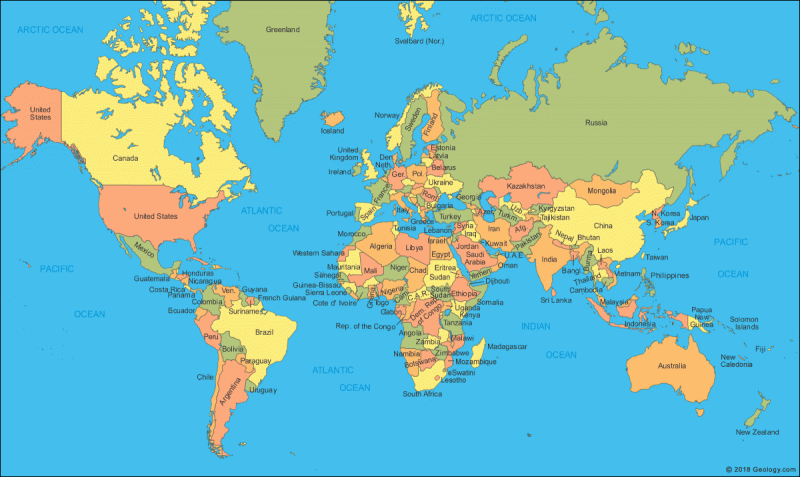
Source: Geology.com
I make no claim to being a virologist, but this is beginning to look damned peculiar. A natural virus hasn’t the ability to simultaneously infect 85 different countries on all continents of the world, with outbreaks in multiple locations in each country – and to do it without the vehicle of a seafood market full of bats and bananas.
More peculiar is that these countries were by no means all infected with the same variety of the virus, which means the simultaneous infections in these 85 countries were not from the same source. Even more peculiar is that most countries, at least the major ones, reported simultaneous outbreaks in multiple locations, and to date while some nations have been able to identify one or more of their ‘patients zero’, I am aware of no country that was able to definitively identify all their several ‘patients zero’. Considering the above information in light of the known basic facts of virus transmission, intuition suggests at least the possibility of there having been many people carrying a pail of live viruses.
It is interesting to note that high fatality rates are entirely within Italy, Iran, and China. For approximate figures, China’s fatality rate is between 3% and 4%, that of Iran at about 7% and Italy the highest at around 9%. Even more interesting is that if these countries did pass their strain of the virus to other nations, those strains abandoned their lethality when they left home. Of the 34 countries supposedly infected by Italy, for example, all exhibit very low mortality, the same being true of Chinese or Iranian infections. The natural conclusion is that these viruses prefer their ‘home populations’ and pose at best a minor threat to others.
*
Larry Romanoff is a retired management consultant and businessman. He has held senior executive positions in international consulting firms, and owned an international import-export business. He has been a visiting professor at Shanghai’s Fudan University, presenting case studies in international affairs to senior EMBA classes. Mr. Romanoff lives in Shanghai and is currently writing a series of ten books generally related to China and the West. He is a Research Associate of the Centre for Research on Globalization (CRG). He can be contacted at: 2186604556@qq.com
Notes
(2) https://www.clinicaltrialsarena.com/features/coronavirus-outbreak-the-countries-affected/
(3) https://www.clinicaltrialsarena.com/features/coronavirus-countries-with-suspected-cases/
(4) https://www.clinicaltrialsarena.com/features/
(5) https://www.globalresearch.ca/covid-usa-targeting-italy-and-south-korea/5707042
(7) https://www.denverpost.com/2020/03/13/iceland-coronavirus-traced-denver/
(8) https://icelandmonitor.mbl.is/news/news/2020/03/13/three_covid_19_cases_in_iceland_traced_to_denver/
Copyright © Larry Romanoff, Global Research, 2020
China censures US for ‘clumsy trick’ to smear others with rumors amid COVID-19 pandemic
Press TV – March 23, 2020
China censures the United States for playing a ‘clumsy trick’ on other countries by smearing them with rumors aimed at accusing those countries with having a hand in the global spread of the deadly coronavirus.
China’s Foreign Ministry spokesman Geng Shuang said on Monday that Washington “on the one hand required federal organizations to speak with one voice to smear China; and on the other hand criticized China, Russia and Iran for spreading false information.”
“I just want to ask, who on earth is spreading false information, misleading the public and calling white black? Such trick of smearing others with rumors and with the play of a thief crying ‘stop the thief’ are just too clumsy.”
China, he added, has always been “open, transparent and responsible.”
“In the past two months and more, the Chinese people have united as one to fight the epidemic and earned precious time for the rest of the world to take necessary precautionary measures. We have made great contribution. WHO has recently pointed out that countries like Singapore and South Korea made good use of the precious time earned by China and took measures. Their moves have curbed the epidemic spread. What has the US done during this period?”
The Chinese official also stated that since January 3 the government in Beijing had been providing “regular briefings” to the World Health Organization (WHO) and other countries, including the United States.
On January 23, he added, “China announced to shut down roads exiting Wuhan City. The US government on February 2 announced to ban entry of all foreigners who had been to China in 14 days before. By then the US just announced a dozen of confirmed COVID-19 cases.”
“Now 50 days have passed, the confirmed cases in the US have surged from less than 20 to more than 30,000. What kind of strong measures has the US taken in the 50 days? It had totally squandered the time China earned for the world.”
The Chinese official further noted that Washington is seeking to “defame” others and “find a scapegoat” instead of admitting its own mistake, “which is totally immoral and irresponsible, and will do nothing good to the US epidemic control work and to the international cooperation in fighting the epidemic.”
“All it should do is concentrating on its own business and play a constructive role in working with all countries to fight the epidemic and protecting global public health security,” the Chinese official said of the US government.
The COVID-19 disease, caused by the new coronavirus, emerged in Wuhan, the capital of China’s Hubei province, in December. It has been reportedly contained in China, but is spreading rapidly around the globe.
UN to set up global coronavirus fund: Norway
Meanwhile, Norway said on Monday that the United Nations will set up a fund to prevent the spread of coronavirus and support the treatment of patients worldwide.
The purpose of the fund, proposed by the Norwegian government, is to assist developing countries with weak health systems in coping with the pandemic as well as to tackle the long-term consequences.
The initiative is similar to a 2014 United Nations Ebola Response Fund.
“We want to make sure that the efforts are as unified as possible and as early as possible so that we can answer up to the demands that countries will have, especially the poorest countries,” Norwegian Foreign Minister Ine Eriksen Soereide told Reuters.
In Africa, Angola, Eritrea and Uganda have confirmed their first cases, while Mauritius recorded its first death as the virus spreads across the continent despite efforts by governments to hold it back.
Elsewhere in the Gaza Strip, the first two cases were confirmed on Sunday.
Coronavirus aid to Italy not a ploy to get EU sanctions lifted: Russia
The Kremlin said Monday that medical assistance Russia is providing to Italy is not part of an attempt to get Rome help lift EU sanctions on Moscow.
The Russian army on Sunday began flying medical help to Italy after receiving an order from President Vladimir Putin, a goodwill gesture that Moscow labeled “From Russia with Love.”
Italy is the European country hardest hit by the viral crisis.
When asked if Russia expected Italy to return the favor by trying to get EU sanctions imposed on Russia over Ukraine lifted, Kremlin spokesman Dmitry Peskov described the notion as absurd.
“We’re not talking about any conditions or calculations or hopes here,” Peskov said.
“Italy is really in need of much more wide scale help and what Russia does is manageable.”
Russia to use mobile phones to track people at risk
Prime Minister Mikhail Mishustin has given the authorities five days to develop a system to track people who have come into contact with anyone with coronavirus by using mobile phone geolocation data.
Under the new system, people would be sent information if they came into contact with someone who was infected and the same information would be passed on to special regional headquarters set up to fight the respiratory disease pandemic.
The Kremlin said the measure was legal and part of a raft of measures Russia is taking to try to halt the spread.
Postponement of Olympics should be considered: Japan
The head of the Japan Olympic Committee (JOC) said he had to consider postponing the Games among his options amid increasing calls from committees around the world to delay the Olympics due to the coronavirus outbreak.
“From the athletes’ point of view of safety and security, we have to come to a stage where we cannot help but consider things including postponement,” JOC President Yasuhiro Yamashita told reporters on Monday.
However, he said too long a delay would be a burden to athletes given the possibility of having to qualify again, for example.
Spain death toll tops 2,000 after 462 deaths in 24 hours
The coronavirus death toll in Spain has surged to 2,182 after 462 people died within 24 hours, the health ministry says.
The death rate showed a 27-percent increase on the figures released a day earlier, with the number of confirmed cases of COVID-19 rising to 33,089 in Spain, one of the worst-hit countries in the world after China and Italy.
Despite an unprecedented national lockdown which was put in place on March 14, the number of deaths and infections have spiraled in Spain, with the figures growing as the country steps up its capacity for testing.
And the lockdown, which was initially put in place for two weeks, will be extended until April 11 to try to curb the spread, Prime Minister Pedro Sanchez said — in a measure which will be put to parliament on Tuesday.
The rise in infections in this country of 46 million people has brought Spain’s healthcare system to the brink of collapse, particularly in Madrid, the worst-hit area, which has registered 10,575 cases, and where 1,263 people have died — accounting for 58 percent of the national death toll.
Some 3,910 healthcare workers have tested positive for the virus, or around 12 percent of those infected, the health ministry’s emergencies coordinator Fernando Simon said.
Officials have repeatedly warned that the number of deaths and infections would continue to rise this week and that the worst was yet to come.
Greece bans flights from UK, Turkey as coronavirus cases rise
Greece has suspended flights from Britain and Turkey to curb the spread of coronavirus, as a lockdown took effect in the country.
The ban came into effect at 0400 GMT — 6:00 a.m. in Athens — on March 23 and ends at 1300 GMT on April 15.
It was a temporary and preemptive measure, a ministerial decree said, as part of further efforts to combat the coronavirus pandemic.
Greece saw its largest single-day jump in confirmed coronavirus cases on Sunday, a rise of 94 infections which brought the total to 624, with fatalities increasing to 15.
The prime minister announced a curfew with few exceptions restricting the movement of people, the latest in a series of measures to fight the virus. Greece has already sealed its borders to non-EU citizens, and those from Italy and Spain.
Police officers were deployed on the streets of Athens on Monday to enforce the lockdown, which allows people out only with special permits. The lockdown order came into effect at 0400 GMT.
Two more doctors die from coronavirus in France
Two more doctors have died after contracting the coronavirus in France, officials said on Monday, a day after the country reported the first death of a doctor treating COVID-19 patients.
One of the doctors, a 66-year-old gynaecologist in Mulhouse near the border with Switzerland and Germany, was infected by a patient during a consultation, according to his clinic.
The other was a 60-year-old general practitioner at a hospital in Saint-Avold near Metz, further north along the German frontier, according to the town’s mayor.
Both died on Sunday when officials announced the death of a 67-year-old doctor who was among the first to treat coronavirus cases in the northern Oise department, which has been badly hit by the outbreak.
Health experts warn that many French hospitals are already overflowing with coronavirus cases even as the government races to set up military field hospitals to help cope with a shortage of beds.
Mulhouse has imposed its own nighttime curfew in addition to nationwide home-confinement rules seeking to curtail the virus, which has spread rapidly in France’s eastern regions.
France is also experiencing a shortfall of ventilators to care for seriously ill patients and face masks and other protective equipment for health workers.
France’s National Health Service reported Sunday that 674 people had died in the country so far — an increase of 112 in 24 hours.
Russiagate: The Sequel
Impervious to facts, the false historical narrative is back for more
By Jason Hirthler | American Herald Tribune | March 23 ,2020
Famous muckraker journalist and author of The Jungle, Upton Sinclair, once declared that, “It is difficult to get a man to understand something when his salary depends on his not understanding it.” He was talking about mainstream journalism. Few mainstream outlets better exemplify his maxim than The New York Times. It should then come as no surprise that the Times, the bible of the bourgeoisie, is at it again. The editorial board recently published a new article bringing the coronavirus and this year’s election under the sweeping banner of Russiagate, a tattered and discredited narrative that is being anxiously rehabilitated by the Washington establishment. But of course. The estimable “editorial board” tells us “conditions are ripe,” sending a shiver down the spine of every Biden liberal on either coast. But ripe for what? I think we all know the answer to that question by heart: “to sow discord”. Indeed that infamous epithet is sewn into the headline of the story, as though it had never left.
The first paragraph begins with the assumption that Russian disinformation in our election has been conclusively demonstrated, such that the question need not even be broached. To be clear: Russian disinformation at the express direction of the Kremlin. This whopping assumption taken as a foregone conclusion, we jump ahead to the next question: How will the Russians interfere this time around? Having established an unproven history as fact, the board then moves on to reupholster the sagging narrative from 2016. This time it won’t be the “bumbling” G.R.U., but rather the “more competent, stealthier” S.V.R. Now, with the SVR presumably involved (thought unconfirmed), we may expect “pernicious operational innovation and escalation” with the Russians descending to new lows to weaponize the coronavirus.
Look what’s already been accomplished. A false historical narrative has been posited as the context in which the latest news is shared. Then they introduced a tantalizing new security agency to the plot. Finally, they elevate the idea that “active measures” campaigns, resurrecting an old Soviet term, were not intended to elect Donald Trump, this having been effectively challenged, but rather to, one shudders to think, “weaken the United States.” This sweeping new storyline has been adumbrated in paragraph without providing a single piece of verifiable evidence.
And so, what to expect during this year’s “quadrennial extravaganza”, as Noam Chomsky drily described our electoral farce? Not having any solid evidence of any SVR plans, better to consult Soviet history for clues. The article then accuses the Soviets of a “racial engineering” campaign of anti-semitism in West Germany in 1959, in New York and the U.S. in 1960, and Africa shortly thereafter. Again, no evidence is provided. This is particularly strange that the German Democratic Republic (GDR) in East Germany would have launched an anti-semitic campaign in the West, given that it alone conducted a thoroughgoing purge of Nazis from its society, while the Federal Republic of Germany (FRG) in the West happily integrated the surviving Nazi braintrust into its power structures, and sent not a few off to the States to lend their dastardly talents to our ‘democracy promotion’ agendas.
It is then said, with resigned recognition, that one of the central problems with combatting devious active measures of this kind was that “the K.G.B. largely stuck to the facts.” Which continues to be an insidious feature of modern Russian ‘active measures’, like the channel RT, for example, which regularly hosts angry populist Americans who rattle off chains of facts one can’t find in the mainstream press. It often seems the establishment media is more irritated at the inconvenience of alternative narratives than their veracity. Another ‘throwback’ story is tossed into the pot, perhaps to conjure dormant nostalgia for the Cold War: cigar boxes packed with explosives are sent to a ritzy dinner party to kill a diplomat. Surely the cigars in question were Cohibas, perhaps autographed by Fidel himself?
Just as one is beginning to get excited about all these ‘active measures’, the authors draw us hastily back to sobering reality. We are now given an elementary lesson in amateur psychology: active measures are intended, it seems, to elicit “emotional” reactions and “corrode” the target. Evidently, the best way to do this is to drive a wedge between deeply democratic, multicultural societies in any of the major western utopias. Hence the racial engineering. It is also important to blame the U.S. for afflicting brown people abroad: such as spreading dengue fever in Cuba and malaria in Pakistan. The authors fail to unravel these charges since each is absurd on its face. Or such is the editorial board’s consensus, if not the reader’s. One imagines the board members chucking at the charges: As if the United States of America would ever attempt such a thing! But then again, since World War Two, the U.S. has tried to overthrow some 50 foreign governments, assassinate some 50 foreign leaders, either invade directly or by proxy or simply bomb 30+ countries, not to mention interfering in some 30 foreign elections, all this with the aim of destabilizing and disbanding populist movements around the world. Nobody embodies counterrevolutionary imperialism better than Washington and its vassals. But these facts are, as Sinclair would remind us, what the board and its authors are paid to forget.
But back to the true evildoers, Russia. According to anonymous sources with no evidence to share, the Russians will harness the coronavirus to divide Americans from each other. The authors reference a discord-sowing campaign being run out of Ghana by a group called ELBA, uncovered by Facebook and CNN. A modest single-story yellow house with stone-fronting is shown in the linked CNN article, the worldwide headquarters of the ghastly ELBA “Russian trolls” who, stunningly, were not even aware they were Russian trolls. Most were Ghanaians. But such is the surreptitious and artful Kremlin craft. Ghanaian security forces raided the small house and then darkly implied our worst fears when they attributed ELBA’s funding to a “European country.” CNN traced the Ghanaian man who ran the company back to Russia, where he worked as a translator. That manager, Seth Wiredu, was confused that Ghanaian security had raided his business. “I fight for black people,” he said. Indeed, the posts on Facebook were focused on repression of African-Americans, quite sensibly. Facebook quickly took down 71 associated accounts. Of course, our white authors at the Times, say the Russians have influenced African-Americans since 2016. CNN attempted to tie Wiredu to the Internet Research Agency (IRA) of 2016 fame, though he flatly denied the association.
And so, regarding the Russians supposed gameplan for 2020, we are left with little substantiated intelligence and much speculative fodder. The story itself is based merely on what “officials said.” Unnamed officials. Anonymous officials. Government agents. “They gave few details,” of course, but this, as you know, is all done in the name of national security. One can just imagine the Times deep throat hemming and hawing and biting his lip in some oil-stained underground parking deck, finally whispering, “I really can’t show you the evidence. It would compromise national security.” And then a conspiratorial and patriotic nod from the Times stenographer. “I understand completely,” he replies. “The safety of the American people is paramount.”
Manufacturing Consent, Consensus, and Fear
One of the filters that Noam Chomsky and Edward Hermann laid out in their classic Manufacturing Consent is to do with sources. Namely, “the reliance of the media on information provided by government, business, and ‘experts’ funded and approved by these primary sources and agents of power.” Voices of the establishment, in other words. This is precisely how the MSM has managed the deliberate expansion of Russiagate. Times journalists reflexively accept the pronouncements of their government sources. It has gotten to the point where sources must no longer provide evidence for their claims. They must merely claim that providing evidence would compromise national security. Any serious journalist would insist on evidence. But journalists do not do this because they recognize that if they did, the source would likely quit being their source and begin to break stories with competitor news outlets. The muckraker again: their salary depends on blind faith. There is no reasonable excuse for this journalistic stenography. Parroting government sources is exactly that.
Anonymous Sources Lack Credibility
Aside from the self-evident willingness of the press to print unsubstantiated and inflammatory claims, there are three other reasons to view such stories with skepticism. First, how many times must we be told that the military-intelligence community is not trustworthy? An infinite number, it seems. From the Church Commission to the National Endowment for Democracy (NED) and the invention of ‘perception management’ to a former CIA director’s naked admission that the organization lied, cheated, and stole as a business model. The government has lied to us about Iraq, the greatest war crime of this century. Before then it lied to us about Cuba, Nicaragua, Vietnam, among many other nations. Since then it has spread disinformation about Libya, Syria, Venezuela, Iran, North Korea, and Russia. Evidence was manufactured to support a foregone conclusion. The CIA has bought and paid for journalists at least since the Church Commission.
Second, aside from the perfidious track record of government sources, the mainstream media itself has been shown to be untrustworthy. The notion of journalistic impartiality is more mythic than substantiated. Not least because of its history of conspiracy and connivance with the government. The press hasn’t helped its cause by installing a surfeit of military and intelligence retirees as lead analysts.
Third, and critically for this particular topic, we now know that much of the supposed evidence for Russiagate has been debunked:
- The idea the GRU was definitively behind the supposed hacking of the DNC is errant on two counts: the evidence suggests it was a leak, not a hack; and the CIA is known to have technology that allows it to fake any source it chooses.
- The Mueller Report was an unmitigated disaster for conspiracy-pushing Democrats.
- We know that the infamous dossier author Christopher Steele was a DNC contractor, like CrowdStrike, which refused to turn over its servers to the FBI for investigation after claiming it was hacked, and that the Clinton campaign paid for part of Steele’s investigative work. The Russians were central to Clinton’s explanation of why she lost.
- We know that there has been no definitive proof that the Kremlin was behind any of the social media posts that were said to corrupt the election.
- Supposed spy Maria Butina was essentially entrapped, jailed, had her reputation destroyed, and was then banished back to Russia.
- That Donald Trump’s entire presidency has been largely hostile to Russia, an odd stance for a supposed puppet of the Kremlin.
- The Times itself launched and promoted the dissimulating sham known as the Intelligence Community Assessment of Russian interference. The newspaper repeatedly claimed the ICA was signed off on by all 17 intelligence agencies, a claim it later quietly retracted when it was shown that only four handpicked agencies had actually supported the assessment. Likely handpicked by John Brennan to legitimate suspicions invented by… John Brennan.
- The supposed Russian backing of Roy Moore’s Alabama Congressional campaign was a false flag run by a company that wrote the Senate report on Russian interference.
- We do know the Internet Research Agency was a for-profit clickbait agency that spent a comparative pittance ($100,000) compared to the hundreds of millions spent by the 2016 candidates. Neither have the IRA’s posts aligned with either candidate nor the election itself, with most posts occurring after the election.
- We know the MSM’s hysterical claims in reporting the supposed reach of 126 million people via social media posts have collapsed on examination. They actually represented four ten thousandths of the total number of posts on Facebook during the time period, a “miniscule” amount according to Facebook. They mostly occurred after the election, were not predominantly political in nature, and were based on the theoretical possibility that 29 million people may have gotten at least one post in their feed and shared the posts at the average sharing rate. All this setting aside that only 10 percent of Facebook posts in a feed are ever seen at all.
- A host of other ill-conceived stories, from Paul Manafort’s supposed clandestine meetings with Julian Assange, to Putin’s hacking of electricity grids, to sonic microwave attacks of U.S. diplomats, have all been exposed and treated with the contempt they deserved.
- The indictments against the 13 members of IRA are in the process of being dropped. The reason? You guessed it: national security.
Why Anti-Russian Disinformation?
Given the breadth of Russiagate’s failure, we now know that the MSM is happy to disseminate largely counterfactual content. Why? Cui bono? After it was launched in 2016, Russiagate quickly became a perfect storm in which the interests of three powerful Washington entities converged. The Clinton campaign used the story to rationalize its embarrassing defeat to a casino mogul. The Democratic Party used the tale to attempt to excuse its discredited centrist politics to re-energize its disillusioned base in the faux resistance of a supposed traitor in the White House. And, most importantly, the intelligence community leveraged the claims to constrain Trump’s foreign policy, steering him away from befriending Russia or thoroughly dismantling costly wars abroad. All three were happy to then harness the alternative media that was undermining their chosen narratives. The Democrats and the military intelligence community likely see benefits in extending this threadbare fiction through the 2020 electoral season, not to mention the pandemic. After all, Bernie Sanders populist campaign has given the establishment a real fright, as Trump’s campaign did four years ago. Much of this has to do with deteriorating conditions among the working class. But also it has to do with access to alternative sources of information. It is the internet that has destabilized the establishment’s control of the national discourse over the last 20 years. It reached a crescendo in 2016.
Since then, Russiagate has been leveraged to suppress alternative voices on the internet and insurgent contrarians in the mainstream. The censorship of left voices across the social media spectrum has been well noted, from Google algorithm changes to Facebook account deletion to demonetization on YouTube. Likewise, progressive voices in the mainstream, like Tulsi Gabbard, were smeared by MSM for their anti-war positions and marginalized in the national discourse. Gabbard correctly clarified in a Washington Post article that it was the intelligence community that was interfering in our elections by continually leaking Russiaphobic claims without evidence. This is precisely what the Times editorial board have long peddled. They are showing little sign of quitting their perfidy.
This is standard issue rollback by federal forces. The history of anti-communism, expertly unpacked by Alex Carey among many others, demonstrates that anti-communism has been used to suppress socialist thought in America. Chomsky and Herman said anti-communism was the fifth filter by which elites managed the flow of information to the public. They called it a “national religion.” Historically, nothing has encouraged self-censorship better than the fear of being called a communist. In the post-Soviet era, that nimble and dexterous label has now been simply repurposed into the charge that one is a ‘Putin stooge,’ or a ‘Russian bot’ if you challenge Washington claims about Moscow. Easily done since Russia was the home of the Bolshevik Revolution. But it isn’t actually communism or Russia that is the underlying target of establishment repression: it is independence. Independent media, independent nations, independent politicians.
Max Blumenthal, a stalwart of the anti-imperialist left, perhaps said it best when he summarized Russiagate as follows, “those responsible for this fake neocon intrigue got a new Cold War, record defense budgets, and a McCarthyite political atmosphere to denigrate opponents of permanent war. A waste of energy and a setback for peace.” Well put. We should thus remember, in a time of remarkable insecurity about our healthcare system and its ability to combat the pandemic, there has long been a media virus that has infected the nation’s understanding of foreign policy, ironically by sanitizing news of critical context, fact, and motive. Buyer beware.
The New York Times’ Insidious Ongoing Disinformation Campaign on Russia & Elections
By Gareth Porter | Consortium News | March 17, 2020
For the past three years the new narrative of Russian interference in U.S. elections has bound corporate news media more tightly than ever to the interests of the national security state. And no outlet has pushed that narrative more aggressively – and with more violence to the relevant facts — than The New York Times.
Times reporters have produced a series of stories that loudly proclaim the Russian election meddling narrative but offer no real facts in the body of the story supporting its most sensational claims.
The Times service to the narrative was introduced by its February 2017 story headlined, “Trump Campaign Aides Had Repeated Contacts with Russian Intelligence.” We now know from Justice Department Inspector General Michael Horowitz’s report on the FBI investigation of the Trump campaign that the only campaign aide who had contacts with Russian intelligence officials was Carter Page, and those had taken place years before in the context of Page’s reporting them to the CIA. The Horowitz report revealed that FBI officials had hidden that fact from the FISA Court to justify its request for surveillance of Page.
But the Times coverage of the Horowitz report in December 2019 failed to acknowledge that the calumny about Page’s Russian intelligence contacts, which it had published without question in 2017, had been an FBI deception.
Two more Times Russiagate stories in 2018 and 2019 featured spectacular claims that proved on closer examination to be grotesque distortions of fact. In September 2018 a 10,000-word story by Scott Shane and Mark Mazzetti sought to convince readers that the Russian Internet Research Agency (IRA) had successfully swayed U.S. opinion during the 2016 election with 80,000 Facebook posts that they said had reached 126 million Americans.
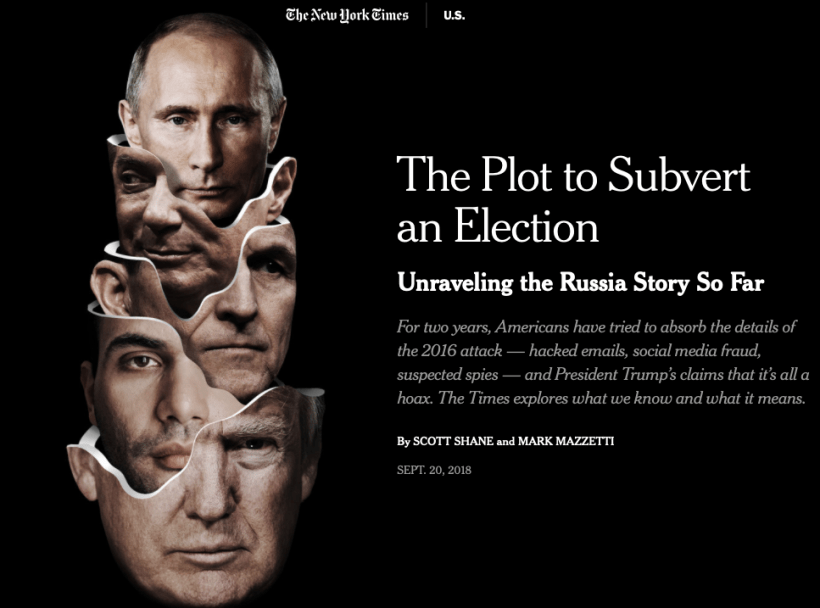
But that turned to be an outrageously deceptive claim, because Shane and Mazzetti failed to mention the fact that those 80,000 IRA posts (from early 2015 through 2017), had been engulfed in a vast ocean of more than 33 trillion Facebook posts in people’s news feeds – 413 million times more than the IRA posts.
In December 2019, senior national security correspondent David Sanger wrote a story headlined, “Russia Targeted Election Systems in All 50 States, Report Finds,” and Sanger’s lede said the Senate Intelligence Committee had “concluded” that all 50 states had been targeted. But the Committee report actually reaches no such conclusion. It quoted President Barack Obama’s cyber-security adviser Michael Daniel as recalling that he had “personally” reached that conclusion, but shows the only basis for his conclusion was remarkably lame: the “randomness of the attempts” and his conviction that Russian intelligence was “thorough.”
The Committee reported that some intelligence “developed” in 2018 had “bolstered” the subjective judgment by Daniel. But all but one of the eight paragraphs in the report describing that intelligence were redacted, and the one unredacted paragraph suggests that the redacted paragraphs provided no conclusive evidence that Russian intelligence had scanned any state election websites, much less those of all 50 states. The paragraph said, “However, IP addresses associated with the August 16, 2016 FLASH provided some indicators the activity might be attributable to the Russian government…. [emphasis added].”
The Committee report also contained summary statements from six states that the Department of Homeland Security has continued to include among the 21 states it insists were hacked by the Russians in 2016, denying any cyber threat to their systems. Another 13 states reported only that there was “scanning and probing” by inconclusive IP addresses the FBI and DHS had sent them. Sanger did not report any of those troublesome details.
In January 2020 the Times began its coverage of the theme of Russian interference in the 2020 election with a story headlined, “Chaos is the Point: Russian Hackers and Trolls Grow Stealthier in 2020.” The story, written by Sanger, Matthew Rosenberg and Nicole Perlroth, sought to heighten the existing U.S. climate of paranoia about a Russian attack in regard to the 2020 elections. Once again, however, nothing in the story supports the sinister tone of the headline.
It reported Department of Homeland Security officials’ anxiety about the ransom-ware attacks on 100 American towns, cities and federal offices during 2019, which are clearly criminal operations aimed at large-scale payoffs by cities. The story informed readers that DHS was investigating “whether Russian intelligence was involved in any of the attacks,” on the apparent theory that the criminals were being used by the Russians.
Since those ransom-ware attacks had been going on for years, the obvious question would have been why DHS would have waited until 2020 to reveal that it was investigating Russian involvement. Thus, the only fact underlying the story was the DHS desire to find evidence to support its accusations of Russian election hacking.
Still at it in 2020
The Times continued its advocacy journalism in a Feb. 26 report that U.S. intelligence officials had “warned” in a briefing for the House Intelligence Committee on Feb. 13 that “Russia was interfering in the 2020 campaign to get President Trump elected,” citing five people “familiar with the matter.”
The Times’ team of four writers proceeded to declare, “The Russians have been preparing – and experimenting – for the 2020 election… aware that they needed a new playbook of as-yet undetectable methods, United States officials said.” But instead of reporting actual evidence of any Russian action or decision for action, the Times writers again cited what their sources suspected could be done.
“Some officials,” they wrote, “believe that foreign powers, possibly including Russia, could use ransom-ware attacks…to damage or interfere with voting systems or registration databases.” The Times’ sources thus had no actual intelligence on the question and were merely speculating on what any foreign government might do to disrupt the election.
Three days after that report, moreover, the Times backed away from its previous lede after intelligence sources disputed its claim that Russia was intervening to reelect Trump, suggesting that the briefing officer, Shelby Pierson, had overstated the assessment. Sanger sought to limit the damage with a story labeling the problem one of “dueling narratives” in the intelligence community.
Then Sanger admitted, “It is probably too early for the Russians to begin any significant moves to bolster a specific candidate,” which obviously invalidated the Times’ previous speculation on the subject. But after The Washington Post published a story that the FBI had informed Senator Bernie Sanders that Russia had sought to help his campaign, Sanger quickly returned to the same narrative of Russian interference to advance its favorite candidates.
On the Times’ podcast “The Daily,” Sanger opined that the Russians were now supporting both Trump and Sanders – because Sanders, “like Donald Trump,” has “got a real aversion to interventions around the world.”
The most recent entry in the Times’ campaign to create anxiety about Russian interference in the election focused on race relations. On March 10, the Times headlined its story, “Russia Trying to Stoke U.S. Racial Tension before Elections, Officials Say.” In their lede Julian Barnes and Adam Goldman announced, “The Russian government has stepped up efforts to influence racial tensions in the United States as part of its bid to influence November’s presidential election, including trying to incite violence by white supremacist groups and stoke anger among Afro-Americans, according to seven American officials briefed on recent intelligence.”
But true to the modus operandi used routinely to push the Russian election threat narrative, the writers did not offer a single fact supporting such a story line. They even admitted that the officials who were making the claims provided “few details” about white supremacists and “did not detail how” blacks were being encouraged to use violence.
It turns out, in fact, that U.S. officials have found nothing indicating Russian support for violent white supremacists in America. The only fact that they could cite — based on a single source — was that the FBI is “scrutinizing any ties” between Russian intelligence and Rinaldo Nazzaro, the American founder of a “neo-Nazi group,” who lives with his Russian wife in St. Petersburg, Russia, but owns property in the United States. So, the Times’ single source had nothing but a suspicion for which the FBI was trying to find evidence.
The final touch in the piece was the accusation that RT had “fanned divisions” on race by running a story about a video of New York policemen attacking and detaining a young black man that Barnes and Goldman write “sparked outrage” and had also “posted tweets aimed at stirring white animosity.” But the RT article on the video merely reported accurately that the video depicted unprovoked police brutality and that it had already gone viral. The Times itself had published a much more detailed Associated Press story on the same incident that went into a discussion of the history of police brutality in New York City. By the Times’ own criterion, the AP was doing far more to stoke racial animosity than RT.
The opinion pieces that RT published attacking The New York Times for its coverage of a video at the University of Wisconsin that offended non-whites and for a Times opinion piece critical of the Apu character on “The Simpsons” echoed views on race and culture that most Americans find offensive. The idea that they were part of a Russian plot to generate racial animosity, however, is a very long stretch.
The descent of The New York Times into this unprecedented level of propagandizing for the narrative of Russia’s threat to U.S. democracy is dramatic evidence of a broader problem of abuses by corporate media of their socio-political power. Greater awareness of the dishonesty at the heart of the Times‘ coverage of that issue is a key to leveraging media reform and political change.
Gareth Porter is an independent investigative journalist and historian and winner of the 2012 Gellhorn Prize for Journalism. His latest book, with John Kiriakou, is “The CIA Insider’s Guide to the Iran Crisis: From CIA Coup to the Brink of War.”
Pompeo and Netanyahu paved a path to war with Iran, and they’re pushing Trump again
By Gareth Porter | The Grayzone | March 20, 2020
Though it narrowly averted war with Iran this January, the Trump administration is still pushing for all-out military conflict. The architects of the drive to war, Mike Pompeo and Benjamin Netanyahu, have relied on a series of cynical provocations to force Trump’s hand.
The US may escape the most recent conflict with Iran without war, however, a dangerous escalation is just over the horizon. And as before, the key factors driving the belligerence are not outraged Iraqi militia leaders or their allies in Iran, but Trump’s secretary of state, Mike Pompeo, and Israeli Prime Minister Benjamin Netanyahu, who has long sought to draw the US into a military confrontation with Iran.
Throughout the fall of 2019, Netanyahu ordered a series of Israeli strikes against Iranian allies in Iraq and against Lebanese Hezbollah units. He and Pompeo hoped the attacks would provoke a reaction from their targets that could provide a tripwire to outright war with Iran. As could have been expected, corporate US media missed the story, perhaps because it failed to reinforce the universally accepted narrative of a hyper-aggressive Iran emboldened by Trump’s failure to “deter” it following Iran’s shoot-down of a U.S. drone in June, and an alleged Iranian attack on Saudi oil facility in September.
Pompeo and John Bolton set the stage for the tripwire strategy in May 2019 with a statement by national security adviser John Bolton citing “troubling and escalatory indications and warnings,” implying an Iranian threat without providing concrete details. That vague language echoed a previous vow by Bolton that “any attack” by Iran or “proxy” forces “on United States interests or on those of our allies will be met with unrelenting force.”
Then came a campaign of leaks to major news outlet suggesting that Iran was planning attacks on U.S. military personnel. The day after Bolton’s statement, the Wall Street Journal reported that unnamed U.S. officials cited “U.S. intelligence” showing that Iran “drew up plans to target U.S. forces in Iraq and possibly Syria, to orchestrate attacks in the Bab el-Mandeb strait near Yemen through proxies and in the Persian Gulf with its own armed drones…”
The immediate aim of this campaign was to gain Trump’s approval for contingency plans for a possible war with Iran that included the option of sending as many as 120,000 U.S. troops into region. Trump balked at such war-planning, however, complaining privately that Bolton and Pompeo were pushing him into a war with Iran. Following Iran’s shoot-down of the U.S. drone over the Strait of Hormuz on June 20, Pompeo and Bolton suggested the option of killing Maj. Gen. Qassem Soleimani in retaliation. But Trump refused to sign off on the assassination of Iran’s top general unless Iran killed an American first, according to current and former officials.
From that point on, the provocation strategy was focused on trying to trigger an Iranian reaction that would involve a U.S. casualty. That’s when Israeli Prime Minister Benjamin Netanyahu interjected himself and his military as a central player in the drama. From July 19 through August 20, the Israeli army carried out five strikes against Iraqi militias allied with Iran, blowing up four weapons depots and killing as many Shiite militiamen and Iranian offcers, according to press accounts.
The Israeli bombing escalated on August 25, when two strikes on the brigade headquarters of a pro-Iranian militia and on a militia convoy killed the brigade commander and six other militiamen, and a drone strike on Hezbollah’s headquarters in south Beirut blew the windows out of one of Hezbollah’s media offices.
Netanyahu and Pompeo sabotage Trump and Macron’s attempt at diplomacy
Behind those strikes was Netanyahu’s sense of alarm over Trump toying with the idea of seeking negotiations with Iran. Netanyahu had likely learned about Trump’s moves toward detente from Pompeo, who had long been his primary contact in the administration. On August 26, French President Emanuel Macron revealed that he was working to broker a Trump-Rouhani meeting. Netanyahu grumbled about the prospect of U.S.-Iranian talks “several times” with his security cabinet the day before launching the strikes.
Two retired senior Israeli generals, Gen. Amos Yadlin and Gen. Assaf Oron, criticized those strikes for increasing the likelihood of harsh retaliation by Iran or one of its regional partners. The generals complained that Netanyahu’s attacks were “designed to prod [Iran] into a hasty response” and thus end Trump’s flirtation with talking to Iran. That much was obviously true, but Pompeo and Netanyahu also knew that provoking an attack by Iran or one of its allies might cause one or more of the American casualties they sought. And once American blood was spilled, Trump would have no means to resist authorizing a major escalation.
Kataib Hezbollah and other pro-Iran Iraqi militias blamed the United States for the wave of lethal Israeli attacks on their fighters. These militias responded in September by launching a series of rocket attacks on Iraqi government bases where U.S. troops were present. They also struck targets in the vicinity of the U.S. Embassy.
The problem for Netanyahu and Pompeo, however, was that none of those strikes killed an American. What’s more, U.S. intelligence officials knew from NSA monitoring of communications between the IRGC and the militias that Iran had explicitly forbidden direct attacks on US personnel.
Netanyahu was growing impatient. For several days in late October and early November, he met with his national security cabinet to discuss a new Israeli attack to precipitate a possible war with Iran, according to reports by former Israeli Ambassador Michael Oren. Oren hinted at how a war with Iran might start. ‘[P]erhaps Israel miscalculates,” he suggested, “hitting a particularly sensitive target,” which, in his view, could spark “a big war between Israel and Iran.”
But on December 27, before Netanyahu could put such a strategy into action, the situation changed dramatically. A barrage of rockets slammed into an Iraqi base near Kirkuk where U.S. military personnel were stationed, killing a U.S military contractor. Suddenly, Pompeo had the opening he needed. At a meeting the following day, Pompeo led Trump to believe that Iranian “proxies” had attacked the base, and pressed him to “reestablish deterrence” with Iran by carrying out a military response.
In fact, U.S. and Iraqi officials on the spot had reached no such conclusion, and the investigation led by the head of intelligence for the Iraqi federal police at the base was just beginning that same day. But Pompeo and his allies, Defense Secretary Mark Esper and Chairman of Joint Chiefs Gen. Mark A Milley, were not interested in waiting for its conclusion.
A deception brings the US and Iran to the brink of war
The results of a subsequent Iraqi investigation revealed that the rocket barrage had been launched from a Sunni area of Kirkuk with a strong Islamic State presence, and that IS fighters had carried out three attacks not far from the base on Iraqi forces stationed there in the previous ten days. US signals intercepts found no evidence that Iraqi militias had shifted from their policy of avoiding American casualties at all cost.
Kept in the dark by Pompeo about these crucial facts, Trump agreed to launch five airstrikes against Kataib Hezbollah and another pro-Iran militia at five locations in Iraq and Syria that killed 25 militiamen and wounded 51. He may have also agreed in principle to the killing of Soleimani when the opportunity presented itself.
Iran responded to the attacks on its Iraqi militia allies by approving a violent protest at the U.S. Embassy in Baghdad January 31. The demonstrators did not penetrate the embassy building itself and were abruptly halted the same day. But Pompeo managed to persuade Trump to authorize the assassination of Qassem Soleimani, Iran’s second most powerful figure, presumably by hammering on the theme of “reestablishing deterrence” with Iran.
Soleimani was not only the second most powerful man in Iran and the main figure in its foreign policy; he was idolized by millions of the most strongly nationalist citizens of the country. Killing him in a drone strike was an open invitation to the military confrontation Netanyahu and Pompeo so desperately sought.
During the crucial week from December 28 through January 4, while Pompeo was pressing Trump to retaliate against Iran not just once but twice, it was clear that he was coordinating closely with Netanyahu. During that single week, he spoke by phone with Netanyahu on three separate occasions.
What Pompeo and Netanyahu could not have anticipated was that Iran’s missile attack on the U.S. sector of Iraq’s sprawling al-Asad airbase in retaliation would be so precise that it scored direct hits on six U.S. targets without killing a single American. (The US service members were saved in part because the rockets were fired after the Iraqi government had passed on a warning from Iran to prepare for it). Because no American was killed in the strike, Trump again decided against further retaliation.
Towards another provocation
Although Pompeo and Netanyahu failed to ignite a military conflict with Iran, there is good reason to believe that they will try again before both are forced to leave their positions or power.
In an article for the Atlantic last November, former Israeli Ambassador Michael Oren, channeled Netanyahu when he declared it would be “better for conflict [with Iran] to occur during the current [Trump] administration, which can be counted on to provide Israel with the three sources of American assistance it traditionally receives in wartime,” than to “wait until later.”
Oren was not the only Israeli official to suggest that Israeli is likely to go even further in strikes against Iranian and Iranian allies targets in 2020. After listening to Israeli army Chief of Staff Aviv Kochavi speak in late December, Haaretz military correspondent Amos Harel reported that the Israeli army chief conveyed the clear impression that a “more serious confrontation with Iran in the coming year as an almost unquestionable necessity.” His interviews with Israeli military and political figures further indicated that Israel would “intensity its efforts to hit Iran in the northern area.”
Shockingly, Pompeo has exploited the Coronavirus pandemic to impose even harsher sanctions on Iran while intimidating foreign businesses to prevent urgently needed medical supplies from entering the country. The approaching presidential election gives both Pompeo and Netanyahu a powerful reason to plot another strike, or a series of strikes aimed at drawing the US into a potential Israeli confrontation with Iran.
Activists and members of Congress concerned about keeping the US out of war with Iran must be acutely aware of the danger and ready to respond decisively when the provocation occurs.
US urged to explain military lab shutdown
By Leng Shumei – Global Times – 2020/3/15
Netizens and experts are calling for the US government to release information on the suspension of an infectious disease research lab under the US Army, as a petition on the White House website listed coincident events between the closure and the outbreak of COVID-19, urging the US government to clarify whether the lab was related to the deadly virus.
While the origin of the novel coronavirus is still unknown and conspiracy theories have caused widespread panic, experts said that timely information disclosure to the public would benefit global unity and cooperation against the pandemic, which had infected more than 150,000 people and killed 5,400 around the world as of Saturday.
The Fort Detrick laboratory that handles high-level disease-causing material, such as Ebola, in Fredrick, Maryland was shut after the US Centers for Disease Control and Prevention issued a cease and desist order to the organization in July, 2019 according to local media.
The suspension was due to multiple causes, including failure to follow local procedures and a lack of periodic recertification training for workers in the biocontainment laboratories. The wastewater decontamination system of the lab also failed to meet standards set by the Federal Select Agent Program, media reported.
The lab, which was closed more than half a year ago, recently caught public attention as a petition submitted to the White House website on March 10 listed some coincidences in time between the closure and the COVID-19 outbreak.
For example, “a large-scale ‘influenza’ killed more than 10,000 people” in the US in August 2019 following the closure; and the COVID-19 epidemic broke out globally in February 2020 after the US organized Event 201 – A Global Pandemic Exercise – in October 2019.
The petition also noted that many English-language news reports about the closure of Fort Detrick were deleted amid the worsening COVID-19 pandemic, raising suspicions over the lab’s relationship with the novel coronavirus.
Petitioners urged the US government to publish the real reason for the lab’s closure and to clarify whether the lab was related to the novel coronavirus and whether there was a virus leak.
The petition had received just more than 400 signatures as of Sunday.
Chinese netizens urged the US government to respond to the public’s appeals as soon as possible.
“It’s not a small issue, the truth should be published,” an internet user commented.
“The world deserves to know the truth,” said another.
Ni Feng, a deputy director of the Institute of American Studies of the Chinese Academy of Social Sciences, called on the US government to increase transparency in the COVID-19 pandemic related issues in response to wide-spread doubts.
The origin of the virus should be decided according to scientific research, but the urgent issue at the current stage is to cooperate in the global battle against the pandemic, Ni noted.
Wang Yiwei, a professor with the School of International Relations at Renmin University of China, agreed with Ni, noting that the US had behaved badly to China when the latter was struggling with the epidemic – accusing China of low transparency and blaming a Chinese lab for leaking the virus.
Now China has won the conviction of the world with practical efforts and improvements. The US should cooperate sincerely with China and the world against the virus, according to Wang.
The indictment of Concord was meant to prove Russia interfered in the US presidential election. But it was just a political sham
By Scott Ritter | RT | March 17, 2020
Now that the Department of Justice has rightly dismissed the case, it just shows that the allegations were aimed at shaping public opinion – and that it’s all about the politicization of the US Justice System
It was the indictment that shook America. Or at least, it was supposed to. For months, prosecutors working for Robert Mueller – the special prosecutor charged with investigating allegations of collusion between the campaign of then-candidate Donald Trump and various Russian actors to tip the scales of the 2016 US presidential election in Trump’s favor – had been slaving away behind a wall of secrecy. Set up in May 2017, the Mueller team had little to show for its efforts save for a handful of guilty pleas by Trump associates for lying to federal agents. No evidence had been provided to an increasingly skeptical public to sustain the notion that the Russians had actively interfered in the election.
That changed in February 2018, when the Mueller team unveiled an indictment of thirteen Russian citizens and three Russian companies, including Concord Management, spelling out in detail an assortment of acts that, on the surface, looked damning. “From in or around 2014 to the present,” the indictment read, “defendants knowingly and intentionally conspired with each other (and with persons known and unknown to the Grand Jury) to defraud the United States by impairing, obstructing and defeating the lawful functions of the Government through fraud and deceit for the purpose of interfering with the US political and electoral processes, including the presidential election of 2016.”
From that point on, “thirteen individuals and three companies” became the mantra of the pro-“Russia did it” brigade, repeated over and over again on TV news, Twitter, Facebook and other platforms where they and their ilk gathered to promote the theory that President Trump had colluded with the Russians to secure his electoral victory in 2016. Whenever anyone questioned the validity of the investigation, like clockwork the supporters of Mueller and his work would religiously cite the existence of this indictment, as if, in and of itself, it proved Mueller’s case.
It was a pure numbers game, inflated further when Mueller and his team indicted twelve serving Russian Military Intelligence officers for allegedly hacking the Democratic National Committee server, among other alleged crimes, in the spring of 2016. What had Mueller accomplished with these indictments? The reality was that they were little more than a publicity stunt, a public relations game that allowed Mueller supporters to respond that “he indicted 25 Russians and three Russian companies” any time the accomplishments of the investigation were brought into question.
While these statistics sounded impressive, creating as they did the impression of irrepressible, righteous momentum, they represented little more than grand theater designed to create an impression of guilt that wasn’t backed up by fact. The Mueller indictment targeting Concord Management grew out of a grand jury investigation where the government had total control of the evidence presented. There’s an old saying about the US grand jury system, that “a prosecutor can indict a ham sandwich” – the implication being you can make anyone look guilty for anything at any time. The ham sandwich isn’t given the chance to present its case.
Normally, an indictment would compel a defendant, presented with overwhelming evidence of his or her guilt, to seek a plea arrangement. Or, seeing that the evidence was insufficient, they would take the case to trial where, through discovery, the prosecutor would be compelled to hand over any and all evidence so that the defense could mount a counterargument. In this light, a prosecutor would normally craft the grand jury case in a way that maximized its impact at trial. But the Concord Management case, like the case against the Russian intelligence officers, was never meant to go to trial. No one expected the Russians to mount a defense, because to do so would require their presence in the court, on American soil, where they would be subject to arrest and confinement.
Concord Management, however, took everyone by surprise, hiring a US-based legal team to defend it against the plethora of fantastic allegations that underpinned the indictment. In doing so, Concord Management put the Mueller team in a position where they would have to disclose how they obtained all the extraordinary details about the alleged Russian activities, including internal emails, travel itineraries, and specific details about the thirteen Russian men and women.
Confronted with the reality that Concord was ultimately prepared to take the case to trial, the Department of Justice pulled the plug on the indictment, hiding behind the claim that sensitive law enforcement techniques would be revealed if it was required to present its case. Oh, really?
This revelation only underscores how ill-prepared the Mueller team was to take the Concord case to trial – normally, questions about what evidence can and cannot be presented at trial are worked out before the indictment is published. But when an indictment is more about manipulating public perception by putting forth unsustained allegations, rather than proving actual fact-based guilt, issues about evidentiary classification don’t matter. But in this case, however, they do matter – and the US government, its bluff called, was compelled to dismiss the charges.
Under normal circumstances, the announcement that the indictment used to underpin the credibility of an investigation into whether the now-President of the United States colluded with Russia to win an election had been dismissed would not only be headline news, but would also generate public outrage and demands that those who brought the indictment forward be investigated for politicizing the American justice system.
But there is nothing normal about the present circumstance. The combined impact of the Mueller investigation (which stalled far short of its goal of indicting the president) and the related impeachment trial process (which likewise failed) left the American public sharply divided on the issue of Trump-Russian collusion, facts be damned. The dismissal of the Concord indictment should be further evidence that the allegations of Russian interference in the 2016 presidential election have been vastly overblown. The other indictments are similarly unsustainable at trial.
It’s just disappointing that the coronavirus news cycle will probably drown out this story, leaving the ramifications of the abuse of the US legal system by politically motivated prosecutors unexplored, and the American public worse off for it.
Scott Ritter is a former US Marine Corps intelligence officer. He served in the Soviet Union as an inspector implementing the INF Treaty, in General Schwarzkopf’s staff during the Gulf War, and from 1991-1998 as a UN weapons inspector. Follow him on Twitter @RealScottRitter
WHY IS CROWDSTRIKE CONFUSED ON ELEVEN KEY DETAILS ABOUT THE DNC HACK?
By Larry C Johnson | Sic Semper Tyrannis | March 17, 2020
Here is the bottom-line—despite being hired in late April (or early May) of 2016 to stop an unauthorized intrusion into the DNC, CrowdStrike, the cyber firm hired by the DNC’s law firm to solve the problem, failed abysmally. More than 30,000 emails were taken from the DNC server between 22 and 25 May 2016 and given to Wikileaks. Crowdstrike blamed Russia for the intrusion but claimed that only two files were taken. And CrowdStrike inexplicably waited until 10 June 2016 to reboot the DNC network.
CrowdStrike, a cyber-security company hired by a Perkins Coie lawyer retained by the DNC, provided the narrative to the American public of the alledged hack of the DNC, But the Crowdstrike explanation is inconsistent, contradictory and implausible. Despite glaring oddities in the CrowdStrike account of that event, CrowdStrike subsequently traded on its fame in the investigation of the so-called Russian hack of the DNC and became a publicly traded company. Was CrowdStrike’s fame for “discovering” the alleged Russian hack of the DNC a critical factor in its subsequent launch as a publicly traded company?
The Crowdstrike account of the hack is very flawed. There are 11 contradictions, inconsistencies or oddities in the public narrative about CrowdStrike’s role in uncovering and allegedly mitigating a Russian intrusion (note–the underlying facts for these conclusions are found in Ellen Nakashima’s Washington Post story, Vicki Ward’s Esquire story, the Mueller Report and the blog of Crowdstrike founder Dmitri Alperovitch):
- Two different dates—30 April or 6 May—are reported by Nakashima and Ward respectively as the date CrowdStrike was hired to investigate an intrusion into the DNC computer network.
- There are on the record contradictions about who hired Crowdstrike. Nakashima reports that the DNC called Michael Sussman of the law firm, Perkins Coie, who in turn contacted Crowdtrike’s CEO Shawn Henry. Crowdstrike founder Dmitri Alperovitch tells Nakashima a different story, stating our “Incident Response group, was called by the Democratic National Committee (DNC).
- CrowdStrike claims it discovered within 24 hours the “Russians” were responsible for the “intrusion” into the DNC network.
- CrowdStrike’s installation of Falcon (its proprietary software to stop breaches) on the DNC on the 1st of May or the 6th of May would have alerted to intruders that they had been detected.
- CrowdStrike officials told the Washington Post’s Ellen Nakashima that they were, “not sure how the hackers got in” and didn’t “have hard evidence.”
- In a blog posting by CrowdStrike’s founder, Dmitri Alperovitch, on the same day that Nakashima’s article was published in the Washington Post, wrote that the intrusion into the DNC was done by two separate Russian intelligence organizations using malware identified as Fancy Bear (APT28) and Cozy Bear (APT29).
- But, Alperovitch admits his team found no evidence the two Russian organizations were coordinating their “attack” or even knew of each other’s presence on the DNC network.
- There is great confusion over what the “hackers” obtained. DNC sources claim the hackers gained access to the entire database of opposition research on GOP presidential candidate Donald Trump. DNC sources and CrowdStrike claimed the intruders, “read all email and chat traffic.” Yet, DNC officials insisted, “that no financial, donor or personal information appears to have been accessed or taken.” However, CrowdStrike states, “The hackers stole two files.”
- Crowdstrike’s Alperovitch, in his blog posting, does not specify whether it was Cozy Bear or Fancy Bear that took the files.
- Wikileaks published DNC emails in July 2016 that show the last message taken from the DNC was dated 25 May 2016. This was much more than “two files.”
- CrowdStrike, in complete disregard to basic security practice when confronted with an intrusion, waited five weeks to disconnect the DNC computers from the network and sanitize them.
Let us start with the very contradictory public accounts attributed to Crowdstrke’s founder, Dmitri Alperovitch. The 14 June 2016 story by Ellen Nakashima of the Washington Post and the October 2016 piece by Vicki Ward in Esquire magazine offer two different dates for the start of the investigation:
When did the DNC learn of the “intrusion”?
Ellen Nakashima claims it was the end of April:
DNC leaders were tipped to the hack in late April. Chief executive Amy Dacey got a call from her operations chief saying that their information technology team had noticed some unusual network activity. . . . That evening, she spoke with Michael Sussmann, a DNC lawyer who is a partner with Perkins Coie in Washington. Soon after, Sussmann, a former federal prosecutor who handled computer crime cases, called Henry, whom he has known for many years. Within 24 hours, CrowdStrike had installed software on the DNC’s computers so that it could analyze data that could indicate who had gained access, when and how.
Ward’s timeline, citing Alperovitch, reports the alert came later, on 6 May 2016:
At six o’clock on the morning of May 6, Dmitri Alperovitch woke up in a Los Angeles hotel to an alarming email. . . . late the previous night, his company had been asked by the Democratic National Committee to investigate a possible breach of its network. A CrowdStrike security expert had sent the DNC a proprietary software package, called Falcon, that monitors the networks of its clients in real time. Falcon “lit up,” the email said, within ten seconds of being installed at the DNC: Russia was in the network.
This is a significant and troubling discrepancy because it marks the point in time when CrowdStrike installed its Falcon software on the DNC server. It is one thing to confuse the 30th of April with the 1st of May. But Alperovitch gave two different reporters two different dates.
What did the “hackers” take from the DNC?
Ellen Nakashima’s reporting is contradictory and wrong. Initially, she is told that the hackers got access to the entire Donald Trump database and that all emails and chats could be read. But then she is assured that only two files were taken. This was based on Crowdstrike’s CEO’s assurance, which was proven subsequently to be spectacularly wrong when Wikileaks published 35,813 DNC emails. How did Crowdstrike miss that critical detail? Here is Nakashima’s reporting:
Russian government hackers penetrated the computer network of the Democratic National Committee and gained access to the entire database of opposition research on GOP presidential candidate Donald Trump, according to committee officials and security experts who responded to the breach.
The intruders so thoroughly compromised the DNC’s system that they also were able to read all email and chat traffic, said DNC officials and the security experts. . . .
The DNC said that no financial, donor or personal information appears to have been accessed or taken, suggesting that the breach was traditional espionage, not the work of criminal hackers.
One group, which CrowdStrike had dubbed Cozy Bear, had gained access last summer (2015) and was monitoring the DNC’s email and chat communications, Alperovitch said.
The other, which the firm had named Fancy Bear, broke into the network in late April and targeted the opposition research files. It was this breach that set off the alarm. The hackers stole two files, Henry said. And they had access to the computers of the entire research staff — an average of about several dozen on any given day. . . .
CrowdStrike is continuing the forensic investigation, said Sussmann, the DNC lawyer. “But at this time, it appears that no financial information or sensitive employee, donor or voter information was accessed by the Russian attackers,” he said.
The DNC emails that are posted on the Wikileaks website and the metadata shows that these emails were removed from the DNC server starting the late on the 22nd of May and continuing thru the 23rd of May. The last tranche occurred late in the morning (Washington, DC time) of the 25th of May 2016. Crowdstrike’s CEO, Shawn Henry, insisted on the 14th of June 2016 that “ONLY TWO FILES” had been taken. This is demonstrably not true. Besides the failure of Crowdstrike to detect the removal of more than 35,000 emails, there is another important and unanswered question—why did Crowdstrike wait until the 10th of June 2016 to start disconnecting the DNC server when they allegedly knew on the 6th of May that the Russians had entered the DNC network?
Crowdstrike accused Russia of the DNC breach but lacked concrete proof.
Ellen Nakashima’s report reveals that Crowdstrike relied exclusively on circumstantial evidence for its claim that the Russian Government hacked the DNC server. According to Nakashima:
CrowdStrike is not sure how the hackers got in. The firm suspects they may have targeted DNC employees with “spearphishing” emails. These are communications that appear legitimate — often made to look like they came from a colleague or someone trusted — but that contain links or attachments that when clicked on deploy malicious software that enables a hacker to gain access to a computer. “But we don’t have hard evidence,” Alperovitch said.
There is a word in English for the phrases, “Not sure” and “No hard evidence”–that word is, “assumption.” Assuming that the Russians did it is not the same as proving, based on evidence, that the Russians were culpable. But that is exactly what CrowdStrike did.
The so-called “proof” of the Russian intrusions is the presence of Fancy Bear and Cozy Bear?
At first glance, Dmitri Alperovitch’s blog posting describing the Fancy Bear and Cozy Bear “intrusions” appears quite substantive. But cyber security professionals quickly identified a variety of shortcomings with the Alperovitch account. For example, this malware is not unique nor proprietary to Russia. Other countries and hackers have access to APT28 and have used it.
Skip Folden offers one of the best comprehensive analyses of the problems with the Alperovitch explanation:
No basis whatsoever:
APT28, aka Fancy Bear, Sofacy, Strontium, Pawn Storm, Sednit, etc., and APT29, aka Cozy Bear, Cozy Duke, Monkeys, CozyCar,The Dukes, etc., are used as ‘proof’ of Russia ‘hacking’ by Russian Intelligence agencies GRU and FSB respectively.
There is no basis whatsoever to attribute the use of known intrusion elements to Russia, not even if they were once reverse routed to Russia, which claim has never been made by NSA or any other of our IC.
On June 15, 2016 Dmitri Alperovitch himself, in an Atlantic Council article, gave only “medium-level of confidence that Fancy Bear is GRU” and “low-level of confidence that Cozy Bear is FSB.” These assessments, from the main source himself, that either APT is Russian intelligence, averages 37%-38% [(50 + 25) / 2].
Exclusivity:
None of the technical indicators, e.g., intrusion tools (such as X-Agent, X-Tunnel), facilities, tactics, techniques, or procedures, etc., of the 28 and 29 APTs can be uniquely attributed to Russia, even if one or more had ever been trace routed to Russia. Once an element of a set of intrusion tools is used in the public domain it can be reverse-engineered and used by other groups which precludes the assumption of exclusivity in future use. The proof that any of these tools have never been reverse engineered and used by others is left to the student – or prosecutor.
Using targets:
Also, targets have been used as basis for attributing intrusions to Russia, and that is pure nonsense. Both many state and non-state players have deep interests in the same targets and have the technical expertise to launch intrusions. In Grizzly Steppe, page 2, second paragraph, beginning with, “Both groups have historically targeted …,” is there anything in that paragraph which can be claimed as unique to Russia or which excludes all other major state players in the world or any of the non-state organizations? No.
Key Logger Consideration:
On the subject of naming specific GRU officers initiating specific actions on GRU Russian facilities on certain dates / times, other than via implanted ID chips under the finger tips of these named GRU officers, the logical assumption would be by installed key logger capabilities, physical or malware, on one or more GRU Russian computers.
The GRU is a highly advanced Russian intelligence unit. It would be very surprising were the GRU open to any method used to install key logger capabilities. It would be even more surprising, if not beyond comprehension that the GRU did not scan all systems upon start-up and in real time, including key logger protection and anomalies of performance degradation and data transmissions.
Foreign intelligence source:
Other option would be via a foreign intelligence unit source with local GRU access. Any such would be quite anti-Russian and be another nail in the coffin of any chain of evidence / custody validity at Russian site.
Stated simply, Dmitri Alperovitch’s conclusion that “the Russians did it” are not supported by the forensic evidence. Instead, he relies on the assumption that the presence of APT28 and APT29 prove Moscow’s covert hand. What is even more striking is that the FBI accepted this explanation without demanding forensic evidence.
Former FBI Director James Comey and former NSA Director Mike Rogers testified under oath before Congress that neither agency ever received access to the DNC server. All information the FBI used in its investigation was supplied by CrowdStrike. The Hill reported:
The FBI requested direct access to the Democratic National Committee’s (DNC) hacked computer servers but was denied, Director James Comey told lawmakers on Tuesday.
The bureau made “multiple requests at different levels,” according to Comey, but ultimately struck an agreement with the DNC that a “highly respected private company” would get access and share what it found with investigators.
The foregoing facts raise major questions about the validity of the Crowdstrike methodology and conclusions with respect to what happened on the DNC network. This is not a conspiracy theory. It is a set of facts that, as of today, have no satisfactory explanation. The American public deserve answers.
Kremlin slams ‘unfounded’ EU report on Russian pandemic disinformation
RT | March 18, 2020
An EU report which accuses Russia of waging a disinformation campaign around Covid-19 isn’t backed by a single fact and has nothing to do with common sense. That’s according to Vladimir Putin’s spokesman.
Earlier, the Financial Times claimed that it obtained findings by the European External Action Service (EEAS), which insist that the “Russian pro-Kremlin media” is running a “significant disinformation campaign” to stoke “confusion, panic and fear” in the EU and the US to “aggravate the coronavirus pandemic crisis.”
“I can’t comment on this from the point of view of common sense,” Dmitry Peskov said when asked by journalists about the controversial paper. “One might expect that this Russophobic obsession would decline in the current situation, but as we see it’s not happening.”
The EEAS’ report didn’t even include a single example or a reference to a specific media outlet, so all the accusations are “unfounded,” Peskov concluded.
‘Russian troll firm’ says it has a $50bn grudge to settle with US after indictment dropped by DoJ
RT | March 17, 2020
A Russian firm that the DoJ failed to prosecute for “sowing discord” during the 2016 election aims to take its pound of flesh – or at least a hefty compensation for its tarnished reputation.
The February 2018 indictment of Concord Management & Consulting LLC, one of several issued by the team of Special Counsel Robert Mueller, was praised by the Russiagate crowds as a crucial step in uncovering the holy grail of Trump-Russia collusion. The case was dropped just weeks before going to trial, with prosecutors claiming that the firm’s defense strategy – demanding evidence that the company had waged ‘information warfare’ against America – posed a threat to US national security.
Concord had been “eager and aggressive in using the judicial system to gather information about how the United States detects and prevents foreign election interference,” the motion to dismiss said.
Protecting “sources and methods” is the cookie cutter explanation that the US intelligence community uses to justify evidence-free accusations. But it may not work this time; Concord CEO Yevgeny Prigozhin – dubbed ‘Putin’s chef’ by the Western media, says he didn’t consider the case closed with the charges dropped.
The DoJ’s decision proves that statements like “Prigozhin interfered in the US presidential election” were “lies and fiction,” he said in a statement. Concord will seek $50 billion in damages from the US government for “illegal persecution and sanctions,” he warned.
“I have found only two things positive in the biased US justice systems. One is attorney Eric Dubelier, who had the guts to fight against the American government and has secured a victory. The other is Special Counsel Robert Mueller, who had the courage to resign after realizing the kind of lawlessness he had been dragged into,” Prigozhin added.
Mueller resigned in May 2019 after his much-hyped probe ended with an anticlimactic report and criminal charges against 34 individuals and three entities, including Concord. The team that decided to call off the indictment against the company included two prosecutors who were part of Mueller’s investigation.
Featured Video
No Vote, No Representation, No State: Democracy, Israeli Style
or go to
Aletho News Archives – Video-Images
From the Archives
Sanctions, War and the Policy of Dual Containment
By SASAN FAYAZMANESH | March 17, 2008
It is now nearly three decades since the Unites States adopted the policy of dual containment of Iran and Iraq. While much has been written about the containment of Iraq, there has been very little in-depth analysis of this policy when it comes to Iran. In a book that is going to be released on March 31, 2008, entitled The United States and Iran: Sanctions, Wars and the Policy of Dual Containment (Routledge), I attempt to address this shortcoming by investigating when and why the US policy of containment of Iran came about, how it evolved, and where it stands today.[1] To the extent that Israel has been involved in US policy making, the study will also include the role that Israel has played in the containment of Iran. Also, since the fate of Iran has been inextricably linked to that of Iraq, occasionally the investigation will overlap with the containment of Iraq.
The policy of dual containment of Iran and Iraq originated during the Carter Administration, but it was not until the Clinton Administration that the expression “dual containment” became popular. … continue
Blog Roll
 Aletho News
- No Vote, No Representation, No State: Democracy, Israeli Style
- Zionist Bought Senate Blocks Information About American Citizens Killed By Israel
- While Gaza dominates the UN, these are the people keeping it alive
- New Report: “Scholasticide and Genocide in Gaza: Assessment, Testimonies and Legal Analysis”
- ‘THAAD Delusion’: Iran war exposes US missile shield limits – The Atlantic
- Moscow issues warning to NATO over Russian exclave
- Yes, the Iran war has destroyed Trump’s presidency
- The fallacy of US delusions about Iran’s economic collapse
- Hezbollah denies Syria cell link, warns of Israeli plan to sow discord
- The legacy of US sanctions, war, and occupation in Iraq
- If Americans Knew
- Mamdani releases plan to combat antisemitism and hate crimes in New York City
- Iran’s Revolutionary Guards Publish Letter to the American People
- DMFI launches $1 million ad campaign supporting Virginia’s Elaine Luria
- US Senate blocks resolution seeking report on Americans killed by Israel
- Israeli Attacks Kill Ten Palestinians in Gaza
- Massacre at Minab: The School That Became a Grave
- Israeli media: The IDF Shows It Doesn’t Turn a Blind Eye; It Actively Emboldens Settler Havoc
- As settlers ravage West Bank, Israeli forces kill 10 in Gaza – Daily Update
- New Report: “Scholasticide and Genocide in Gaza: Assessment, Testimonies and Legal Analysis”
- Ex-Biden officials are desperate for a Gaza scapegoat
- No Tricks Zone
- Green Energy Debacle: German Expert Professor Fritz Vahrenholt Warns Of Severe Economic And Social Consequences
- Two More Paleo Reconstructions Affirm Meters-Higher Sea Levels Across Ireland, Brazil 7000-6000 Years Ago
- New Study: Earth And Venus Surface Warmth Largely Explained By Convection And Lapse Rate, Not CO2 Or Radiation
- 2025 Nature Paper Claiming Worsening Global Drought Gets RETRACTED …Heavily Flawed
- New Study: ‘Global Drought Shows No Detectable Recent Acceleration Under Climate Warming’
- Economic Masterminds: German Socialists Suggest Taxing Productivity Gains Stemming From Using AI
- The South China Sea Has Not Been Cooperating With The Climate Change Narrative
- Energy Crisis: Germany Enters Heating Season With Historically Low Gas Reserve Fill Levels
- New Study: The Antarctic Ice Sheet Gained Mass From 2020-2024 Due To Staggering Snow And Ice Accumulation
- Study: Ocean Heating Rates From Thousands Of Years Ago ‘Dwarf’ Modern Ocean Heating Rates

