John Solomon responds to Lt. Col. Vindman about Ukraine columns … with the facts
John Solomon Reports | November 22, 2019
I honor and applaud Army Lt. Col. Alexander Vindman’s service to his country. He’s a hero. I also respect his decision to testify at the impeachment proceedings. I suspect neither his service nor his testimony was easy.
But I also know the liberties that Lt. Col. Vindman fought on the battlefield to preserve permit for a free and honest debate in America, one that can’t be muted by the color of uniform or the crushing power of the state.
So I want to exercise my right to debate Lt. Col. Vindman about the testimony he gave about me. You see, under oath to Congress, he asserted all the factual elements in my columns at The Hill about Ukraine were false, except maybe my grammar
Here are his exact words:
“I think all the key elements were false,” Vindman testified.
Rep. Lee Zeldin, R-N.Y, pressed him about what he meant. “Just so I understand what you mean when you say key elements, are you referring to everything John Solomon stated or just some of it?”
“All the elements that I just laid out for you. The criticisms of corruption were false…. Were there more items in there, frankly, congressman? I don’t recall. I haven’t looked at the article in quite some time, but you know, his grammar might have been right.”
Such testimony has been injurious to my reputation, one earned during 30 years of impactful reporting for news organizations that included The Associated Press, The Washington Post, The Washington Times and The Daily Beast/Newsweek.
And so Lt. Col. Vindman, here are the 28 primary factual elements in my Ukraine columns, complete with attribution and links to sourcing. Please tell me which, if any, was factually wrong.
Fact 1: Hunter Biden was hired in May 2014 by Burisma Holdings, a Ukrainian natural gas company, at a time when his father Joe Biden was Vice President and overseeing US-Ukraine Policy. Here is the announcement. Hunter Biden’s hiring came just a few short weeks after Joe Biden urged Ukraine to expand natural gas production and use Americans to help. You can read his comments to the Ukrainian prime minister here. Hunter Biden’s firm then began receiving monthly payments totaling $166,666. You can see those payments here.
Fact 2: Burisma was under investigation by British authorities for corruption and soon came under investigation by Ukrainian authorities led by Prosecutor General Viktor Shokin.
Fact 3: Vice President Joe Biden and his office were alerted by a December 2015 New York Times article that Shokin’s office was investigating Burisma and that Hunter Biden’s role at the company was undercutting his father’s anticorruption efforts in Ukraine.
Fact 4: The Biden-Burisma issue created the appearance of a conflict of interest, especially for State Department officials. I especially refer you to State official George Kent’s testimony here. He testified he viewed Burisma as corrupt and the Bidens as creating the perception of a conflict of interest. His concerns both caused him to contact the vice president’s office and to block a project that State’s USAID agency was planning with Burisma in 2016. In addition, Ambassador Yovanovitch testified she, too, saw the Bidens-Burisma connection as creating the appearance of a conflict of interest. You can read her testimony here.
Fact 5: The Obama White House invited Shokin’s prosecutorial team to Washington for meetings in January 2016 to discuss their anticorruption investigations. You can read about that here. Also, here is the official agenda for that meeting in Ukraine and English. I call your attention to the NSC organizer of the meeting.
Fact 6: The Ukraine investigation of Hunter Biden’s employer, Burisma Holdings, escalated in February 2016 when Shokin’s office raided the home of company owner Mykola Zlochevsky and seized his property. Here is the announcement of that court-approved raid.
Fact 7: Shokin was making plans in February 2016 to interview Hunter Biden as part of his investigation. You can read his interview with me here, his sworn deposition to a court here and his interview with ABC News here.
Fact 8: Burisma’s American representatives lobbied the State Department in late February 2016 to help end the corruption allegations against the company, and specifically invoked Hunter Biden’s name as a reason to intervene. You can read State officials’ account of that effort here
Fact 9: Joe Biden boasted in a 2018 videotape that he forced Ukraine’s president to fire Shokin in March 2016 by threatening to withhold $1 billion in U.S. aid. You can view his videotape here.
Fact 10: Shokin stated in interviews with me and ABC News that he was told he was fired because Joe Biden was unhappy the Burisma investigation wasn’t shut down. He made that claim anew in this sworn deposition prepared for a court in Europe. You can read that here.
Fact 11: The day Shokin’s firing was announced in March 2016, Burisma’s legal representatives sought an immediate meeting with his temporary replacement to address the ongoing investigation. You can read the text of their emails here.
Fact 12: Burisma’s legal representatives secured that meeting April 6, 2016 and told Ukrainian prosecutors that “false information” had been spread to justify Shokin’s firing, according to a Ukrainian government memo about the meeting. The representatives also offered to arrange for the remaining Ukrainian prosecutors to meet with U.S State and Justice officials. You can read the Ukrainian prosecutors’ summary memo of the meeting here and here and the Burisma lawyers’ invite to Washington here.
Fact 13: Burisma officials eventually settled the Ukraine investigations in late 2016 and early 2017, paying a multimillion dollar fine for tax issues. You can read their lawyer’s February 2017 announcement of the end of the investigations here.
Fact 14: In March 2019, Ukraine authorities reopened an investigation against Burisma and Zlochevsky based on new evidence of money laundering. You can read NABU’s February 2019 recommendation to re-open the case here, the March 2019 notice of suspicion by Ukraine prosecutors here and a May 2019 interview here with a Ukrainian senior law enforcement official stating the investigation was ongoing. And here is an announcement this week that the Zlochevsky/Burisma probe has been expanded to include allegations of theft of Ukrainian state funds.
Fact 15: The Ukraine embassy in Washington issued a statement in April 2019 admitting that a Democratic National Committee contractor named Alexandra Chalupa solicited Ukrainian officials in spring 2016 for dirt on Trump campaign manager Paul Manafort in hopes of staging a congressional hearing close to the 2016 election that would damage Trump’s election chances. You can read the embassy’s statement here and here. Your colleague, Dr. Fiona Hill, confirmed this episode, testifying “Ukraine bet on the wrong horse. They bet on Hillary Clinton winning.” You can read her testimony here.
Fact 16: Chalupa sent an email to top DNC officials in May 2016 acknowledging she was working on the Manafort issue. You can read the email here.
Fact 17: Ukraine’s ambassador to Washington, Valeriy Chaly, wrote an OpEd in The Hill in August 2016 slamming GOP nominee Donald Trump for his policies on Russia despite a Geneva Convention requirement that ambassadors not become embroiled in the internal affairs or elections of their host countries. You can read Ambassador Chaly’s OpEd here and the Geneva Convention rules of conduct for foreign diplomats here. And your colleagues Ambassador Yovanovitch and Dr. Hill both confirmed this, with Dr. Hill testifying this week that Chaly’s OpEd was “probably not the most advisable thing to do.”
Fact 18: A Ukrainian district court ruled in December 2018 that the summer 2016 release of information by Ukrainian Parliamentary member Sergey Leschenko and NABU director Artem Sytnyk about an ongoing investigation of Manafort amounted to an improper interference by Ukraine’s government in the 2016 U.S. election. You can read the court ruling here. Leschenko and Sytnyk deny the allegations, and have won an appeal to suspend that ruling on a jurisdictional technicality.
Fact 19: George Soros’ Open Society Foundation issued a memo in February 2016 on its strategy for Ukraine, identifying the nonprofit Anti-Corruption Action Centre as the lead for its efforts. You can read the memo here.
Fact 20: The State Department and Soros’ foundation jointly funded the Anti-Corruption Action Centre. You can read about that funding here from the Centre’s own funding records and George Kent’s testimony about it here.
Fact 21: In April 2016, US embassy charge d’affaires George Kent sent a letter to the Ukrainian prosecutor general’s office demanding that Ukrainian prosecutors stand down a series of investigations into how Ukrainian nonprofits spent U.S. aid dollars, including the Anti-Corruption Actions Centre. You can read that letter here. Kent testified he signed the letter here.
Fact 22: Then-Ukraine Prosecutor General Yuriy Lutsenko said in a televised interview with me that Ambassador Marie Yovanovitch during a 2016 meeting provided the lists of names of Ukrainian nationals and groups she did want to see prosecuted. You can see I accurately quoted him by watching the video here.
Fact 23: Ambassador Yovanovitch and her embassy denied Lutsenko’s claim, calling it a “fabrication.” I reported their reaction here.
Fact 24: Despite the differing accounts of what happened at the Lutsenko-Yovanovitch meeting, a senior U.S. official in an interview arranged by the State Department stated to me in spring 2019 that US officials did pressure Lutsenko’s office on several occasions not to “prosecute, investigate or harass” certain Ukrainian activists, including Parliamentary member Leschenko, journalist Vitali Shabunin, the Anti-Corruption Action Centre and NABU director Sytnyk. You can read that official’s comments here. In addition, George Kent confirmed this same information in his deposition here.
Fact 25: In May 2018, then-House Rules Committee chairman Pete Sessions sent an official congressional letter to Secretary of State Mike Pompeo asking that Yovanovitch be recalled as ambassador to Ukraine. Sessions and State confirmed the official letter, which you can read here.
Fact 26: In fall 2018, Ukrainian prosecutors, using a third party, hired an American lawyer (a former U.S. attorney) to proffer information to the U.S. government about certain activities at the U.S. embassy, involving Burisma and involving the 2016 election, that they believed might have violated U.S. law. You can read their account here. You can also confirm it independently by talking to the U.S. attorney’s office in Manhattan or the American lawyer representing the Ukrainian prosecutors’ interests.
Fact 27: In May 2016, one of George Soros’ top aides secured a meeting with the top Eurasia policy official in the State Department to discuss Russian bond issues. You can read the State memos on that meeting here.
Fact 28: In June 2016, Soros himself secured a telephonic meeting with Assistant Secretary of State Victoria Nuland to discuss Ukraine policy. You can read the State memos on that meeting here.
Lt. Col. Vindman, if you have information that contradicts any of these 28 factual elements in my columns I ask that you make it publicly available. Your testimony did not.
If you don’t have evidence these 28 facts are wrong, I ask that you correct your testimony because any effort to call factually accurate reporting false only misleads America and chills the free debate our Constitutional framers so cherished to protect.
The Umbrella Man, the Sins of the Father, and the Kennedy Curse
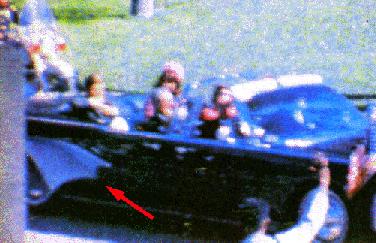
By Laurent Guyénot • Unz Review • November 22, 2019
I first heard of the so-called “Umbrella Man” from a commenter to my unz.com article “Did Israel Kill the Kennedys?” (thanks again). It is one of the most puzzling pieces in the JFK assassination file. An intriguing introduction to it is this short interview of Josiah Thompson filmed by Errol Morris for the New York Times, on the 48th anniversary of his death:
Or view on Vimeo.
This film is interesting because, besides presenting the facts accurately, it illustrates the kind of “cognitive dissonance” they can produce, leading reasonable people to believe an implausible but harmless and comforting explanation, rather than a more logical but deeply disturbing one. In that case, it seems that normally programmed brains will reject vigorously, as unspeakable and therefore unthinkable on the conscious level, the notion that John Kennedy’s assassination can possibly have anything to do with his father’s appeasement policy in 1938, despite the fact that that notion has been deeply ingrained in our subconscious mind through the twin Jewish mythemes of “The Sins of the Father” and “The Kennedy Curse”, as illustrated by those two books:
The “sins of the father” is a not-so-subtle reference to Exodus 20:5:
“I, Yahweh, am a jealous God, punishing the children for the sin of the parents to the third and fourth generation of those who hate me.”
Chief among Joe Kennedy’s sins was, of course, that “he was a documented anti-Semite and an appeaser of Adolf Hitler” (publisher’s presentation of Kessler’s book).
The “Kennedy Curse” is a quasi kabalistic attempt to explain how the Kennedys were “on a fatal collision course with reality” because they “made the fatal mistake of thinking of themselves as divine.” By implication, their assassinations are to be blamed on their “self-defeating behavior” (publisher’s presentation of Klein’s book).
Taken together, those twin hasbara refrains evoke a notion of divine punishment. JFK and RFK were punished for the sins of their Jew-hating, Nazi-loving father. Mind you, it was Yahweh who took vengeance, not Israel!
The Umbrella Man fits so perfectly in this mythic narrative! The problem is that myths are not supposed to incarnate themselves so patently in physical reality. The implications are here too disturbing: for no reasonable man can believe that Yahweh supernaturally inspired Louie Steven Witt his “bad joke” (as he called it when interviewed by the special House Select Committee on Assassinations in 1978). Then who inspired it?
Such a question is off-limit for Josiah Thompson’s mind. So he simply decided not to see anything “sinister” in the weird fact that he relates. He not only takes Witt’s explanation at face value (“this is just wacky enough, it has to be true!” in other words, credo quia absurdum), but assumes that the strange behavior of the Umbrella Man and JFK’s assassination are unrelated, and happened precisely at the same time and at the same spot by pure quantum physics coincidence.
By setting his mind on that explanation, Thompson obviously feels relieved not to have to get into “conspiracy theories”, because “everybody else got into the conspiracy theories,” and he is above the crowd. I find it hard to explain that this is the same Josiah Thompson who published in 1967 a book titled Six Seconds in Dallas: a micro-study of the Kennedy assassination proving that three gunmen murdered the President, for which he studied the Zapruder film and interviewed eyewitnesses in order to come up with a plausible line of fire, and the conclusion of a conspiracy and government cover-up. What happened to Josiah in between?
Russ Baker has posted on his website WhoWhatWhy a couple of articles in reaction to Thompson’s NYT interview: here and here. Contrary to Thompson, he finds Witt’s explanation literally unbelievable, and opts for the theory of the “signal man”: the Umbrella Man was “signaling the shooters, perhaps that JFK had been hit, perhaps that he still seemed to be alive, perhaps to keep shooting.” That theory, adopted by film director Oliver Stone for his 1991 movie JFK, is of course far more credible than the theory of the fléchette-shooting umbrella that Thompson chose to mention to his own satisfaction. But I must say I find it not entirely convincing. I cannot conceive that professional snipers would need such a conspicuous accomplice, standing almost in their line of fire (in the case of those shooting from the Grassy Knoll).
I also find no reason to doubt, as Baker does, that Witt was the real Umbrella Man. Witt was identified by neighbors and local newsmen before he came forward to the HSCA, and the photos of him on Dealey Plaza seem to match.
Baker borrows from John Simkin of Spartacus Educational the opinion that the umbrella was never the symbol of Chamberlain anyway, and so that Witt’s explanation makes no sense. Baker is wrong on that point, apparently. The umbrella was so much the iconic trademark of Prime Minister Neville Chamberlain that cartoonist David Low of the London Evening Standard, not only systematically drew him with his umbrella, but even drew him as an umbrella!

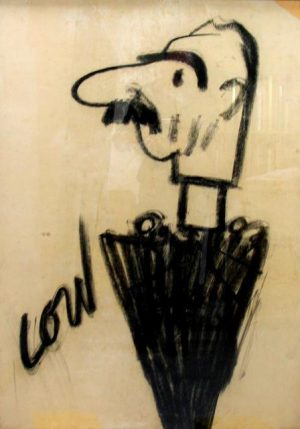
Chamberlain, who became a reviled symbol of appeasement (his biography bears the significant title, More Than Munich: The Forgotten Legacy of Neville Chamberlain) was the archetypal Umbrella Man.
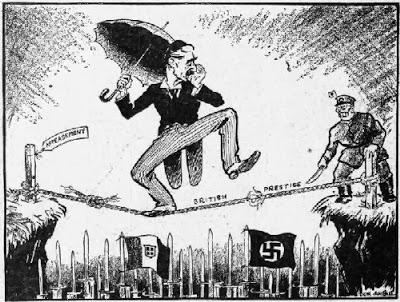
According to Edward Miller,
“Umbrella protests first began in England after Chamberlain arrived home from the [Munich] conference carrying his trademark accessory. Wherever Chamberlain traveled, the opposition party in Britain protested his appeasement at Munich by displaying umbrellas.”[1]
Louie Steven Witt declares in his testimony to the HSCA that he had heard that “some members of the Kennedy family” had once been offended in an airport by people brandishing umbrellas. I haven’t found any confirmation that Joseph Kennedy or any other Kennedy had been heckled by open umbrellas as a “silent protest” against their objectionable lack of love for the Jews, but I find it plausible that “the umbrella was a sore spot to the Kennedys,” as Witt put it in his HSCA testimony. So John Kennedy being heckled with Chamberlain’s umbrella at the same time as being assassinated under Ben-Gurion’s order does strike me as both plausible and significant, as a sort of cryptic signature by the Zionist-Irgun mafia.
In my view, summarized here, John Kennedy was assassinated by Israel for three major reasons:
Dimona: President Kennedy, who had made nuclear disarmament his grand mission on the international level, and was on the way to achieve it with Khrushchev (as shown by James Douglass in JFK and the Unspeakable), was determined to stop Israel developing its own nuclear bomb. According to Colonel Muammar Gaddafi’s interpretation, it was to plunge into the Israeli deep state and supervise Kennedy’s assassination that Ben-Gurion resigned in July 1963 before receiving Kennedy’s ultimatum letter demanding inspections of Dimona.
American Zionist Council: John Kennedy and his Attorney General Bobby Kennedy had infuriated Zionist leaders by supporting an investigation led by Senator William Fulbright (whom Kennedy had been prevented to name as Secretary of State) aimed at registering the American Zionist Council as a “foreign agent” subject to the obligations defined by the Foreign Agents Registration Act of 1938, which would have rendered its lobbying division, the AIPAC, near powerless. On October 11, 1963, the AZC received a formal demand from RFK’s office to register within 72 hours (details here).
Nasser: Kennedy unequivocally supported Arab nationalism in 1957 as a senator,[2] reversed Eisenhower’s foreign polity in a pro-Nasser way (as documented by Philip Muehlenbeck, Betting on the Africans: John F. Kennedy’s Courting of African Nationalist Leaders, Oxford UP, 2012), and committed the U.S. to support U.N. Resolution 194 for the right of return of Palestinian refugees. That was a major threat to Zionist interests, who had bet on making Nasser an enemy of the United States.
To these reasons for assassinating Kennedy, we must add the opposite reasons for putting Johnson instead in the Oval Office, for Johnson buried both the Dimona and the AZC proceedings, and cut U.S. support for Nasser’s in order to boost support to Israel. In 1967, he would commit high treason against his own country by allowing and covering-up Israel’s failed false-flag attack on the USS Liberty. No wonder Israel loved Johnson as much as they hated Kennedy.
In the Zionists’ view, JFK’s anti-Israel policies (discreet or secret) were part of a more general “Kennedy problem” that went back to his father’s attempt to prevent WWII by supporting Chamberlain’s appeasement with Hitler rather than Churchill’s appeasement with Stalin. According to German documents declassified in 1949, the German Ambassador in London, Herbert von Dirksen, after meeting U.S. ambassador Joseph P. Kennedy in 1938, wrote that he “understood our Jewish policy completely,” and was “Germany’s best friend” in London.[3] When Roosevelt entered the war, Joseph Kennedy resigned, and later complained privately that, “the Jews have won the war.”[4] According to biographer David Nasaw, Joseph was not an anti-Semite in the racial sense, but rather someone who believed in a Jewish conspiracy to push the United States into an unnecessary war with Germany (Nasaw insists he was mistaken, because “Jewish influence on American foreign influence was negligible, its influence on the State Department nonexistent”).[5]
Zionists had reasons to fear that Joseph Kennedy did “inject some poisonous drops of anti-Semitism in the minds of his children, including his son John’s” (as printed in September 1960 by the Herut, Menachem Begin’s political party).[6] In 1940, John had published a book titled Why England Slept, adapted from his Harvard thesis which was, as the title alluded, a response to Churchill’s 1938 book While England Slept, and a veiled support for his father’s pro-appeasement views. In his Pulitzer prize-winning book Profiles in Courage (1956), Kennedy had declared his admiration for Senator Robert Taft, who by calling the Nuremberg trials a shameful parody of justice had sacrificed his political career, including his chances for the presidency, rather than build it on hypocrisy. Although Zionists probably didn’t know it until recently, in 1945, JFK had written the following in his diary, as quoted here by Abigail Abrams:
“You can easily understand how that within a few years Hitler will emerge from the hatred that surrounds him now as one of the most significant figures who ever lived. He had boundless ambition for his country which rendered him a menace to the peace of the world, but he had a mystery about him in the way he lived and in the manner of his death that will live and grow after him. He had in him the stuff of which legends are made.”[7]

Joseph Jr., Joseph Sr., and John Kennedy in 1938
The Kennedys were a family of strong traditions and strong convictions. They had to be destroyed, politically as had Charles Lindbergh (1902-1974), and if necessary physically, before they extirpate America from Zionists’ clutches.
Dallas was an Israeli coup, ordered from Tel Aviv with Johnson’s support, and supervised by the local B’nai B’rith under the cover of the Dallas Citizens Council, who was sponsoring Kennedy’s visit, and of whom Abraham Zapruder himself was a member (watch his satisfaction when interviewed two hours after JFK’s assassination in the History Channel documentary JFK – 3 Shots That Changed America , at 43:34).
When trying to make sense of Dallas’ Umbrella Man, we are faced with a dilemma: should we believe Witt’s explanation of his strange behavior (as does Josiah Thompson), or should we consider him an accomplice to the assassination (as does Russ Baker)? Only in the framework of the Israeli theory pioneered by Michael Collins Piper is it possible to surmount the dilemma.
Let’s recap what we know for certain. Fact number 1: on the sunny day of November 22, 1963, one man was standing on the President’s motorcade route with an open umbrella, at the precise moment and place when JFK was shot. To assume that the Umbrella Man’s strange behavior and JFK’s assassination are unrelated is unreasonable. The coincidence is just too improbable.
Fact number 2: In 1978, Louie Steven Witt claimed in front of the HSCA that he was the Umbrella Man and explained that he wanted to heckle JFK about his father’s policy of appeasement of Hitler in 1938.
Although Thompson and Baker disagree about everything else, they agree that there can be no connection between John Kennedy’s assassination and Joseph Kennedy’s appeasement policy. That is where they are both wrong.
Was Louie Steven Witt a Zionist agent, a sayan? Not necessarily. Operations like the JFK assassination are planned on a strict need-to-know basis: no one knows more than he needs to know. Witt declared to the HSCA that he belonged to no organization whatsoever. He summarized his motivation for his “bad joke” in these words:
“In a coffee break conversation someone had mentioned that the umbrella was a sore spot with the Kennedy family. Being a conservative-type fellow, I sort of placed him in the liberal camp and I was just going to kind of do a little heckling.”
What would be interesting to know is: who inspired Witt during his coffee break? Did the coffee break take place in the office of Witt’s Jewish boss, director of the Rio Grande National Life insurance Co. in Dallas? Did Witt have insurmountable debts, like Jacob Rubenstein, aka Jack Ruby? Russ Baker mentions that the company wrote a lot of insurance for the military and was located in the same building that housed the local office of the highly negligent Secret Service.
Mr Witt, would you kindly come forward again and answer a few questions?
Notes
[1] Edward H. Miller, “Umbrella Man”, November 22, 2013, on The Historical Society, on
[2] “Remarks of Senator John F. Kennedy, ‘The New Dimensions of American Foreign Policy’,” University of Pennsylvania, Philadelphia, Pennsylvania, November 1, 1957”; Arthur Schlesinger, A Thousand Days: John Kennedy in the White House (1965), Mariner Books, 2002, p. 554.
[3] Edward Renehan Jr., “Joseph Kennedy and the Jews”, History News Network; Kellen Perry, – “The Dark Side Of Joe Kennedy Sr.” allthatsinteresting.com, April 17, 2017.
[4] Quoted in Herbert Druks, John F. Kennedy and Israel, Praeger Security International, 2005, p. 10
[5] David Nasaw, The Patriarch: The Remarkable Life and Turbulent Times of Joseph P. Kennedy, Penguin, 2015, p. 509.
[6] Alan Hart, Zionism: The Real Enemy of the Jews, vol. 2: David Becomes Goliath, Clarity Press, 2013, p. 252.
[7] Abigail Abrams, “Auction of Rare Diary Highlights What John F. Kennedy Really Thought About Hitler,” Time, March 23, 2017, on
Laurent Guyénot is the author of JFK-9/11: 50 years of Deep State , Progressive Press, 2014, and From Yahweh to Zion: Jealous God, Chosen People, Promised Land … Clash of Civilizations, 2018. (or $30 shipping included from Sifting and Winnowing, POB 221, Lone Rock, WI 53556).
Unspeakable Memories: The Day John Kennedy Died
By Edward Curtin | November 22, 2019
There is a vast literature on the assassination of President John F. Kennedy, who died on a November 22nd Friday like this in 1963. I have contributed my small share to such writing in an effort to tell the truth, honor him, and emphasize its profound importance in understanding the history of the last fifty-six years, but more importantly, what is happening in the U.S.A. today. In other words, to understand it in its most gut-wrenching reality: that the American national security state will obliterate any president that dares to buck its imperial war-making machine. It is a lesson not lost on all presidents since Kennedy.
Unless one is a government disinformation agent or is unaware of the enormous documentary evidence, one knows that it was the CIA that carried out JFK’s murder. Confirmation of this fact keeps arriving in easily accessible forms for anyone interested in the truth. A case in point is James DiEugenio’s recent posting at his website, Kennedys and King, of James Wilcott’s affidavit and interrogation by the House Select Committee on Assassinations, declassified by the Assassinations Record Review Board in 1998. In that document, Wilcott, who worked in the finance department for the CIA and was not questioned by the Warren Commission, discusses how he unwittingly paid Lee Harvey Oswald, the government’s alleged assassin, through a cryptonym and how it was widely known and celebrated at his CIA station in Tokyo that the CIA killed Kennedy and Oswald worked for the Agency, although he did not shoot JFK. I highly recommend reading the document.
I do not here want to go into any further analysis or debate about the case. I think the evidence is overwhelming that the President was murdered by the national security state. Why he was murdered, and the implications for today, are what concern me. And how and why we remember and forget public events whose consequences become unbearable to contemplate, and the fatal repercussions of that refusal. In what I consider the best book ever written on the subject, JFK and the Unspeakable: Why He Died and Why It Matters (2009), James W. Douglass explains this in detail, including the James Wilcott story.
Realizing what I am about to say might be presumptuous and of no interest to anyone but myself, I will nevertheless try to describe my emotional reactions to learning of John Kennedy’s murder so long ago and how that reverberated down through my life. I hope my experiences might help explain why so many people today can’t face the consequences of the tragic history that began that day and have continued to the present, among which are not just the other assassinations of the 1960s but the lies about the attacks of September 11, 2001 and the subsequent endless and murderous “war on terror” with its mind-numbing propaganda and the recent anti-Russia phobia and the blatant celebration of the so-called “deep-state’s” open efforts to overthrow another president, albeit a very different one.
On November 22, 1963 I was a college sophomore. I was going down three steps into the college dining hall for lunch. (Many of my most significant memories and decisions have taken place on steps, either going up or going down; memory is odd in that way, wouldn’t you say?) I remember freezing on the second step as a voice announced through a PA system that the president had been shot in Dallas, Texas. When I finally recovered and went down into the building, another announcement came through saying the president had died. The air seemed to be sucked out of the building as I and the other students with a few professors sat in stunned silence. Soon little groups on this Catholic campus joined together to pray for John Kennedy. I felt as if I were floating in unreality.
Later that day when I left the campus and drove home, I thought back to three years previously and the night of the presidential election. Everyone at my house (parents, grandparents, and the five sisters still at home) had gone to bed, but I stayed up past 1 A.M., watching the television coverage of the vote count. My parents, despite their Irish-Catholicism, were Nixon supporters, but I was for JFK. I couldn’t comprehend why anyone would vote for Nixon, who seemed to me to personify evil. When I finally went up the stairs to bed, I was convinced Kennedy would win and felt very happy.
It wouldn’t be for another tumultuous decade before I would hear Kris Kristofferson sing
Never knowin’ if believin’ is a blessin’ or a curse
Or if the going up is worth to coming down….
From the rockin’ of the cradle to the rollin’ of the hearse
The goin’ up was worth the coming down
and I would ask myself the same question.
In the meantime, the next few years would bring the Bay of Pigs, the Cuban Missile crisis, and the Nuclear Test Ban Treaty, among other significant events, and for a high school student interested in politics and world events it was a heady and frightening few years. It was a country of newspapers back then, and I would read perhaps 3-4 each day and sensed a growing animosity toward Kennedy, especially as expressed in the more conservative NYC papers. I can remember very little talk of politics in my home and felt alone with my thoughts. As far as I can remember, this was also true at the Jesuit high school that I attended. And of course nothing prepared me for the president’s murder and the feeling of despair it engendered in me, a feeling so painful that I couldn’t really acknowledge it. At nineteen, I felt traumatized but couldn’t admit it or tell anyone. After all, I was a scholar and an athlete. Tough.
Then on Sunday morning my family had the TV on and we watched as Jack Ruby shot Lee Harvey Oswald, the guy the government said had killed the president. The unreality was compounded manyfold, and when later it was reported that Oswald had died, I felt I was living in an episode of The Twilight Zone, a popular television show at the time, whose narrator would say we are now entering the weird world between shadow and substance.
The next day a friend and I went to the Fordham University campus to visit a Jesuit priest who was a mentor to us. He had the television on for JFK’s funeral and we sat and watched it for a while with him. After a few hours, it became too painful and the two of us went outside to a football field where we threw a football back and forth. Perhaps subconsciously we were thinking of Kennedy’s love of football; I don’t know. But I remember a feeling of desolation that surrounded us on that empty cold field with not another soul around. It seemed sacrilegious to be playing games at such a time, yet deep trauma contributes to strange behavior.
Then I went on with my college life, studying and playing basketball, until the day after Malcolm X was assassinated on February 21, 1965. Those New York newspapers that didn’t like Kennedy, hated Malcolm even more and were constantly ripping into him. I vividly remember talking to my college basketball teammate the next day. His sense of devastation as a young African American struck me forcefully. As we walked to basketball practice and talked, his sense of isolation and gloom was palpable. Visceral. Unforgettable. It became mine, even though I didn’t at the time grasp its full significance.
In 1968 when Dr. Martin Luther King was assassinated, I was driving to visit a girlfriend and remember hearing the news on the car radio and feeling deeply shocked. I felt immediately oppressed by the first warm spring evening in the New York area. It was as if the beautiful weather, usually so uplifting after winter and so joyously stimulating to a young man’s sexuality, was conspiring with the news of King’s death to bring me down into a deep depression.
Soon the country would awaken on June 5 to the surreal news that Senator Robert Kennedy was shot in Los Angeles the night before. Like so many Americans, when he died not long after, I felt his death was the last straw. But it was far from it. For all the while Lyndon Johnson had lied his way to election in 1964 and escalated the Vietnam war to savage proportions. Death and destruction permeated the air we were breathing. The year 1968 ended with the suspicious death in Thailand of a hero of mine, the anti-war Trappist Monk Thomas Merton. Subsequent research has shown that that too was an assassination. And while all of this was going on and my political consciousness was becoming radicalized, I became a conscientious objector from the Marines. I was 24 years old.
By the late 1970s, having been fired from teaching positions for radical scholarship and anti-war activities, and mentally exhausted by the unspeakable events of the 1960s, I retreated into the country where I found solace in nature and a low-key life of contemplation, writing literary and philosophical essays, a novel, book reviews, and becoming a part-time newspaper columnist. By the 1990s, I gradually returned to teaching and a more active political engagement, primarily through teaching and writing.
Then in 1991 Oliver Stone jolted me back in time with his film JFK. I found powerful emotional memories welling up within me, and growing anger at what had happened to the U.S. in the previous decades. Soon JFK Jr., who was investigating his father’s assassination and was about to enter politics and take up his father’s mantle, was killed in a blatantly rigged “accident.” A month before I had been standing in line behind his wife in the bakery in my little town while he waited outside in a car. Now the third Kennedy was dead. I called my old friend the Jesuit priest from Fordham, but he was speechless. The bodies kept piling up or disappearing.
When the attacks of September 11, 2001 happened, I realized from day one that something was not right; that the official explanation was full of holes. My sociological imagination took fire. All that I had thought and felt, even my literary writing, came together. The larger picture emerged clearly. My teaching took on added urgency, including courses on September 11th and the various assassinations.
Then in 2009 I read and reviewed James Douglass’s masterpiece, JFK and the Unspeakable, and my traumatic memories of 1963 and after came flooding back in full force. I realized that those youthful experiences had been so difficult for me to assimilate and that I therefore had to intellectualize them, for the emotional toll of re-experiencing them and what they meant was profound. The book really opened me to this, but so too did the awareness of how sensitive I was to John Kennedy’s death, how emotional I felt when reading about it or hearing him speak or listening to a song such as “The Day John Kennedy Died” by Lou Reed. It was as though a damn had burst inside me and my heart had become an open house without doors or windows.
I tell you all this to try to convey the ways in which we “forget” the past in order to shield ourselves from powerful and disturbing memories that might force us to disrupt our lives. To change. Certain events, such as the more recent attacks of September 11, have become too disturbing for many to explore, to study, to contemplate, just as I found a way to marginalize my feelings about my own government’s murder of President Kennedy, a man who had given me hope as a youngster, and whose murder had nearly extinguished that hope.
Many people will pretend that they are exposing themselves to such traumatic memories and are investigating the events and sources of their disquietude. It is so often a pretense since they feel most comfortable in the land of make-believe. What is needed is not a dilettantish and superficial nod in the direction of having examined such matters, but a serious in-depth study of the facts and an examination of why doing so might make one uncomfortable. A look outward and a look inward. Just as people distort and repress exclusively personal memories to “save” themselves from harsh truths that would force them to examine their current personal lives, so too do they do the same with political and social ones. When I asked two close relatives of mine, both of whom came close to death on September 11, 2001 at The World Trade Towers, what they have thought about that day, they separately told me that they haven’t really given it much thought. This startled me, especially since it involved mass death and a close encounter with personal death in a controversial public event, two experiences that would seem to elicit deep thought. And these two individuals are smart and caring souls.
What and why we remember and forget is profoundly important. Thoreau, in writing about life without principle, said, “It is so hard to forget what is worse than useless to remember.” This is so true. We are consumed with trivia, mostly by choice.
Perhaps a reason we remember so much trivia is to make sure we forget profound experiences that might shake us to our cores. The cold-blooded public execution of President John Kennedy did that to me on that melancholy Friday when I was 19, and by trying to forget it and not to speak of it, I hoped it would somehow go away, or at least fade to insignificance. But the past has a way of never dying, often to return when we least expect or want it.
So today, on this anniversary Friday, another November 22, I have chosen to try to speak of what it felt like once upon a time on the chance that it might encourage others to do the same with our shared hidden history. Only by speaking out is hope possible. Only by making the hidden manifest.
T. S. Eliot wrote in “Journey of the Magi” words that echo ironically in my mind on this anniversary of the day John Kennedy died:
All this was a long time ago, I remember
And I would do it again, but set down
This set down
This: were we led all that way for
Birth or Death? There was a Birth certainly,
We had evidence and no doubt. I had seen birth and
Death,
But had thought they were different; this Birth was
Hard and bitter agony for us, like Death, our death.
We returned to our places, these Kingdoms,
But no longer at ease here, in the old dispensation,
With an alien people clutching their gods.
I should be glad of another death.
Remembering in all its emotional detail the day John Kennedy died has been a long and cold journey for me. It has allowed me to see and feel the terror of that day, the horror, but also the heroism of the man, the in-your-face warrior for peace whose death should birth in us the courage to carry on his legacy.
Killing a man who says “no” to the endless cycle of war is a risky business, says a priest in the novel Bread and Wine by Ignazio Silone. For “even a corpse can go on whispering ‘No! No! No! with a persistence and obstinacy that only certain corpses are capable of. And how can you silence a corpse.”
John Kennedy was such a man.
Eliot was right: Sometimes death and birth are hard to tell apart.
President Kennedy’s courage in facing a death he knew was coming from forces within his own government who opposed his efforts for peace, nuclear disarmament, and an end to the Cold War – “I know there is a God-and I see a storm coming. I believe that I am ready,” he had written on a slip of paper, and his favorite poem contained the refrain, “I have a rendezvous with death” – should encourage all of us to not turn our faces away from his witness for peace.
We must stop being at ease in a dispensation where we worship the gods of war and clutch the nuclear weapons that our crazed leaders say they will use on a “first-strike” basis. If they ever do, Eliot’s question – “were we led all that way for Birth or Death?” – will be answered.
But no one will hear it.
The Kennedy Autopsy 2
By Jacob G. Hornberger | FFF | November 22, 2019
Fifty-six years ago today, President John F. Kennedy was shot dead on the streets of Dallas, Texas. The official story is that a lone nut named Lee Harvey Oswald, without any motive, committed the assassination. During the past several decades, however, the overwhelming amount of circumstantial evidence, much of which was intentionally kept secret, points to a national-security regime-change operation to oust Kennedy from office and elevate Vice President Lyndon Johnson to the presidency.
 A key to understanding the assassination lies in a critically important event that occurred after the assassination. That event was the official autopsy that was conducted on the president’s body. By understanding the autopsy, one can gain a better understanding of the assassination itself.
That was the purpose of my best-selling book several years ago, The Kennedy Autopsy, which was a synopsis of a watershed five-volume assassination book entitled Inside the Assassination Records Review Board by Douglas P. Horne, who was a staff member of the ARRB in the 1990s.
The ARRB was the agency that Congress called into existence to enforce the President John F. Kennedy Records Collection Act of 1992, the law that required the CIA, the Pentagon, the Secret Service, and other federal agencies to disclose assassination-related records that such agencies had insisted on keeping secret since the day of the assassination. The law was enacted in response to the public outcry produced by Oliver Stone’s movie JFK, which posited that the assassination was a national-security regime-change operation carried out by the U.S. national-security establishment. At the end of the movie was a blurb pointing out the national-security establishment’s continued secrecy with respect to its assassination-related records.
The Future of Freedom Foundation recently published my new book The Kennedy Autopsy 2: Lyndon Johnson’s Role in the Assassination, which builds on the mountain of circumstantial evidence surrounding the president’s autopsy supporting the thesis developed by Oliver Stone in his movie and by Douglas Horne in his five-volume book. Specifically, my new book documents the circumstantial evidence pointing to the role that Lyndon Johnson played in the assassination.
Now, before anyone cries “Conspiracy theory!” which is the term that the CIA promoted early on to its assets in the mainstream press to dissuade people from questioning the official version of the assassination, consider the following:
The purpose of an autopsy is to determine the cause of death, which includes a determination of where the bullets were fired from. Since this was a state murder case, Texas law required that an autopsy be conducted on President Kennedy’s body. That duty fell to the Dallas County Medical Examiner, Dr. Earl Rose, who was one of the most competent pathologists in the country.
As soon as Kennedy was declared dead, however, a Secret Service team had the president’s body placed in an expensive, ornate casket and began taking it out of Parkland Hospital. Rose refused to permit them to do that, standing in their way, and declaring that he was required by state law to conduct an autopsy on the president’s body. In loud, screaming voices, the Secret Service team made it clear to Rose that they were operating under orders to take the body back to Washington without permitting Rose to conduct his autopsy. When Rose continued standing his ground, the Secret Service agents pulled back their suit jackets and brandished their guns. Screaming, yelling, and issuing a stream of profanities, they forced their way out of Parkland Hospital with Kennedy’s body, in direct violation of Texas law.
Waiting at Love Field was Lyndon Johnson, who was having seats removed from the back of Air Force One to make room for the casket. That meant that he knew that the casket was coming, which is virtually conclusive proof that he was the one who issued that order to that Secret Service team before he departed from Parkland Hospital.
Johnson himself was actually the very first conspiracy theorist in the Kennedy assassination. When he was at Parkland Hospital waiting to see if Kennedy would die and then later on the way to Dallas’s Love Field, Johnson raised the notion that the assassination might be the first step in a nuclear attack by the Soviet Union on the United States.
Yet, Johnson’s own actions establish that he knew that his conspiracy theory was bogus. When he arrived at Love Field, he had his personnel transfer everyone’s luggage from his plane — Air Force Two — to Air Force One, so that he could ride on the presidential plane rather than the vice-presidential plane. Yet, both planes were identical. He also took the time to find a federal judge to swear him in, despite the fact that the U.S. attorney general, Robert Kennedy, had advised him that no such swearing in was necessary. Johnson also took the time to wait for the casket to appear and be loaded onto Air Force One.
Does that sound like a man who was concerned that Soviet missiles might possibly be raining in on the United States, including one being aimed at Dallas, Texas? Wouldn’t a president who was genuinely concerned about such a possibility have gotten up into the air immediately in order to conduct America’s defenses to such an attack? Despite his words, Johnson’s actions indicate that he was certain that the Soviets played no role in the assassination. There could only be one reason for such certainty, even while promoting what he knew was a bogus conspiracy theory.
When Air Force One landed in Maryland, Johnson ensured that the president’s body be turned over to the military rather than to civilian authorities. Why? America isn’t a military nation. It’s a civilian nation. The United States wasn’t at war, and Kennedy hadn’t been killed on the field of battle. Why the military instead of a Maryland or Washington, D.C., medical examiner?
The reason is that a fraudulent autopsy was needed to disguise the fact that shots had been fired from the front of Kennedy. The accused killer, Lee Harvey Oswald, was in Kennedy’s rear and, therefore, could not have fired from the front.
Now, before anyone cries “Conspiracy theory!” consider the following:
After the House Select Committee Hearings on the Assassination, which reopened the investigation into the assassination, several enlisted men came forward and told a remarkable story. They said that they had secretly carried the president’s body into the Bethesda morgue in a cheap, military-style shipping casket similar to the ones being used to bring back bodies of U.S. soldiers being killed in Vietnam. They said that they carried the body into the morgue about 6:35 p.m., which was approximately 1 1/2 hours before the body was officially carried into the morgue at 8 pm in the expensive, ornate casket into which the body had been placed in Dallas. They said that military officials had sworn them to secrecy, forced them to sign written secrecy oaths, and threatened them with court martial and criminal prosecution if they ever told anyone what they had seen and done.
In the 1990s, the ARRB uncovered a written document prepared by a Marine sergeant named Roger Boyajean, which had been prepared soon after the autopsy. The document confirmed that the president’s body had in fact been secretly carried into the morgue at 6:35 p.m. Boyayean himself confirmed to the ARRB the authenticity of the document and the event itself.
Now, before anyone cries “Conspiracy theory!” consider the following:
One of the three autopsy physicians, Col. William Finck, later testified that on the evening of the assassination he received a telephone call from Commander James J. Humes, who was one of the other autopsy physicians. The purpose of the call was to request Finck to assist with the autopsy. The call was made at 8 p.m., which was the same time that the president’s body was officially being carried into the morgue in the expensive, ornate Dallas casket.
Finck testified that Humes told him in that call that they already had x-rays of the president’s body. The question naturally arises: How could they already have x-rays at 8 p.m. if the president’s body was first being carried into the morgue at 8 p.m.? Finck inadvertently confirmed the remarkable story that those enlisted men would disclose several years later.
Now, before anyone cries “Conspiracy theory!” consider the following:
The ARRB summoned a woman named Saundra Spencer to testify. On the weekend of the assassination, she was a U.S Navy petty officer working in the U.S. Navy’s photography lab in Washington, D.C. She had a top-secret security clearance. She worked closely with the White House on official photographs, including top-secret ones. No one has ever questioned the veracity, competence, and professionalism of Saundra Spencer. It would be virtually impossible to find a more credible witness.
Under oath, Spencer told the ARRB a remarkable story. On the weekend of the assassination, she was asked to develop photographs of the autopsy carried out by military officials on President Kennedy’s body. She was told that her role was a highly classified operation. For some 30 years, she had kept the secret.
The ARRB showed Spencer the military’s official autopsy photographs. She carefully examined them. She testified directly and unequivocally that the photographs were not the ones she developed on the weekend of the assassination. The ones she developed, she said, showed a massive exit-sized wound in the back of President Kennedy’s head, which implied a shot having been fired from the front.
Now, before anyone cries “Conspiracy theory!” consider the following:
After Kennedy was brought into Trauma Room One in Parkland Hospital, the treating physicians immediately began emergency treatment procedures. However, one of the treating physicians summoned the others to view the back of the president’s head. They saw a huge exit-sized hole in the lower back of President Kennedy head. At that point, they knew that there was no way that they could save his life. The statements of the treating physicians immediately after the assassination confirm what Saundra Spencer would tell the ARRB some 30 years later. See “RIP: Dr. Robert McClelland, the Most Important JFK Witness” by Jefferson Morley.
For much more on the events surrounding the autopsy as well as the events leading up to Lyndon Johnson’s dramatic announcement that he was dropping out of the 1968 presidential race, read my new book The Kennedy Autopsy 2: Lyndon Johnson’s Role in the Assassination.
Colombia’s US Ambassador Advocates ‘Covert Actions’ Against Venezuela in Leaked Audio
By Lucas Koerner | Venezuelanalysis | November 21, 2019
Senior Colombian diplomats discussed strategies for regime change in Venezuela in a leaked audio published by Colombian news site Publimetro on Wednesday.
Speaking in a Washington DC cafe, Colombian Foreign Minister Claudia Blum and Ambassador to the US Francisco Santos repeatedly stressed the failure of US-led efforts to oust Venezuelan President Nicolas Maduro.
“The solution is not a military coup, because the military is not going to remove [Maduro]. Nor is the United States going to remove him at the point of an “I don’t know what,” observed Blum, alluding to the possibility of US military intervention in Venezuela.
Santos stressed the need for clandestine operations to “support the opposition.”
“The only thing that I see is with covert actions within [Venezuela] to make noise and support the opposition which is very isolated,” he told Blum.
The ambassador additionally reported that the “CIA [Central Intelligence Agency] is not getting involved [in Venezuela],” a fact that Blum appeared to lament.
Santos went on to complain about the apparent disarray within the Trump administration. He noted that the State Department and the White House were divided over the Inter-American Reciprocal Assistance Treaty (TIAR), which the former “wanted” but the latter did not. The TIAR was activated in September at the behest of the Venezuelan opposition, which hailed the move as a first step towards foreign military intervention in Venezuela.
For her part, Blum concurred with her ambassador’s assessment, lamenting that with US elections fast approaching, “no one knows what Trump is going to do.”
Santos responded by speculating that if Trump fears losing the presidential race, “he will go into Venezuela,” a possibility downplayed by the foreign minister.
Both officials, however, agreed on the urgent need to remove Maduro from power.
“If this guy doesn’t go, Colombia has no future,” warned Santos, going on to describe efforts to enlist US congressional support on Venezuela.
“Let them understand that this shithole is going to destabilize the whole continent,” he emphasized.
Since opposition leader Juan Guaido’s self-proclamation as Venezuelan “interim president” in January, the hard-right Colombian government of Ivan Duque has spearheaded efforts to oust Maduro.
In February, Colombia strongly supported a US-led attempt to force “humanitarian aid” across the Venezuelan border, which Blum dismissed as a “fiasco.”
More recently, tensions have been on the rise along the 2,219 kilometer Venezuelan-Colombian border since Bogota resumed hostilities with guerrilla factions in August.
The leaked audio is the latest in a series of Venezuela-related scandals that have dogged the Duque government in recent months.
In September, photos and witness testimony surfaced revealing that Guaido had crossed the Colombian border in February with the assistance of Colombian paramilitary groups in coordination with the Colombian authorities. The Duque administration had earlier been accused of turning a blind eye to accusations that Guaido’s envoys to the country had embezzled money destined to support deserters from the Venezuelan armed forces.
Weeks later, Duque came under fire after presenting false evidence of ELN activity in Venezuela during his speech at the UN General Assembly in New York.
The latest scandal provoked condemnation from Caracas, with Foreign Minister Jorge Arreaza slamming Colombian interference in Venezuelan affairs.
“Colombia has been affirming for years that Chavismo destabilizes the region… Meanwhile in a leaked conversation the new foreign minister and ambassador in the US confess how and with whom they conspire to destabilize Venezuela,” he tweeted.
The OAS lied to the public about the Bolivian election and coup
Facts show nothing suspicious about the re-election of Evo Morales
By Mark Weisbrot | MarketWatch | November 19, 2019
What is the difference between an outright lie — stating something as a fact while knowing that it is false — and a deliberate material representation that accomplishes the same end? Here is an example that really pushes the boundary between the two, to the point where the distinction practically vanishes.
And the consequences are quite serious; this misrepresentation (or lie) has already played a major role in a military coup in Bolivia last week. This military coup overthrew the government of President Evo Morales before his current term was finished — a term to which nobody disputes that he was democratically elected in 2014.
More violent repression and even a civil war could follow.
OAS mission
The Organization of American States (OAS) sent an Electoral Observation Mission to Bolivia, entrusted with monitoring the Oct. 20 national election there. The day after the election, before all the votes were even counted, the mission put out a press release announcing its “deep concern and surprise at the drastic and hard-to-explain change in the trend of the preliminary results…”
Here is what the OAS was referring to: there is an unofficial “quick count” of the voting results that involves contractors who upload results at intervals, as the tally sheets are available. At 7:40 p.m. on election day, they had reported about 84% of the votes and then stopped reporting for 23 hours (more on that below).
When they resumed reporting results at 95% of votes counted, Morales’s lead had increased from 7.9% before the interruption to just over 10%.
This margin was important because in order to win without a second-round runoff, a candidate needs either an absolute majority, or at least 40% and a 10-point margin over the second-place finisher. This margin — which grew to 10.6% when all the votes were counted in the official count — re-elected Morales without a second round.
Morales’s lead grew steadily
Now, if you had any experience with elections or maybe even arithmetic, what is the first thing you would want to know about the votes that came in after the interruption? You might ask, were people in those areas any different from people in the average precinct in the first 84%?
And was the change in Morales’s margin sudden, or was it a gradual trend that continued as more vote tally sheets were reported?
You might even want to ask these questions before expressing “deep concern and surprise” about what happened, especially in a politically very polarized situation that was already turning violent. … continue
Rethinking National Security: CIA and FBI Are Corrupt, but What About Congress?
By Philip Giraldi | Strategic Culture Foundation | November 21, 2019
The developing story about how the US intelligence and national security agencies may have conspired to influence and possibly even reverse the results of the 2016 presidential election is compelling, even if one is disinclined to believe that such a plot would be possible to execute. Not surprisingly perhaps there has been considerable introspection among former and current officials who have worked in those and related government positions, many of whom would agree that there is an urgent need for considerable restructuring and reining in of the 17 government agencies that have some intelligence or law enforcement function. Most would also agree that much of the real damage that has been done has been the result of the unending global war on terror launched by George W. Bush and Dick Cheney, which has showered the agencies with resources and money while also politicizing their leadership and freeing them from restraints on their behavior.
If the tens of billions of dollars lavished on the intelligence community together with a “gloves off” approach towards oversight that allowed them to run wild had produced good results, it might be possible to argue that it was all worth it. But the fact is that intelligence gathering has always been a bad investment even if it is demonstrably worse at the present. One might argue that the CIA’s notorious Soviet Estimate prolonged the Cold War and that the failure to connect dots and pay attention to what junior officers were observing allowed 9/11 to happen. And then there was the empowerment of al-Qaeda during the Soviet-Afghan war followed by failure to penetrate the group once it began to carry out operations.
More recently there have been Guantanamo, torture in black prisons, renditions of terror suspects to be tortured elsewhere, killing of US citizens by drone, turning Libya into a failed state and terrorist haven, arming militants in Syria, and, of course, the Iraqi alleged WMDs, the biggest foreign policy disaster in American history. And the bad stuff happened in bipartisan fashion, under Democrats and Republicans, with both neocons and liberal interventionists all playing leading roles. The only one punished for the war crimes was former CIA officer and whistleblower John Kiriakou, who exposed some of what was going on.
Colonel Pat Lang, a colleague and friend who directed the Defense Intelligence Agency HUMINT (human intelligence) program after years spent on the ground in special ops and foreign liaison, thinks that strong medicine is needed and has initiated a discussion based on the premise that the FBI and CIA are dysfunctional relics that should be dismantled, as he puts it “burned to the ground,” so that the federal government can start over again and come up with something better.
Lang cites numerous examples of “incompetence and malfeasance in the leadership of the 17 agencies of the Intelligence Community and the Federal Bureau of Investigation,” to include the examples cited above plus the failure to predict the collapse of the Soviet Union. On the domestic front, he cites his personal observation of efforts by the Department of Justice and the FBI to corruptly “frame” people tried in federal courts on national security issues as well as the intelligence/law enforcement community conspiracy to “get Trump.”
Colonel Lang asks “Tell me, pilgrims, why should we put up with such nonsense? Why should we pay the leaders of these agencies for the privilege of having them abuse us? We are free men and women. Let us send these swine to their just deserts in a world where they have to work hard for whatever money they earn.” He then recommends stripping CIA of its responsibility for being the lead agency in spying as well as in covert action, which is a legacy of the Cold War and the area in which it has demonstrated a particular incompetence. As for the FBI, it was created by J. Edgar Hoover to maintain dossiers on politicians and it is time that it be replaced by a body that operates in a fashion “more reflective of our collective nation[al] values.”
Others in the intelligence community understandably have different views. Many believe that the FBI and CIA have grown too large and have been asked to do too many things unrelated to national security, so there should be a major reduction-in-force (RIF) followed by the compulsory retirement of senior officers who have become too cozy with and obligated to politicians. The new-CIA should collect information, period, what it was founded to do in 1947, and not meddle in foreign elections or engage in regime change. The FBI should provide only police services that are national in nature and that are not covered by the state and local jurisdictions. And it should operate in as transparent a fashion as possible, not as a national secret police force.
But the fundamental problem may not be with the police and intelligence services themselves. There are a lot of idiots running around loose in Washington. Witness for example the impeachment hearings ludicrous fact free opening statement by House Intelligence Committee chairman Adam Schiff (with my emphasis) “In 2014, Russia invaded a United States ally, Ukraine, to reverse that nation’s embrace of the West, and to fulfill Vladimir Putin’s desire to rebuild a Russian empire.”
And the press is no better, note the following excerpt from The New York Times lead editorial on the hearings, including remarks of the two State Department officers who testified, on the following day: “They came across not as angry Democrats or Deep State conspirators, but as men who have devoted their lives to serving their country, and for whom defending Ukraine against Russian aggression is more important to the national interest than any partisan jockeying…
“At another point, Mr. Taylor said he had been critical of the Obama administration’s reluctance to supply Ukraine with anti-tank missiles and other lethal defensive weapons in its fight with Russia, and that he was pleased when the Trump administration agreed to do so…
“What clearly concerned both witnesses wasn’t simply the abuse of power by the president, but the harm it inflicted on Ukraine, a critical ally under constant assault by Russian forces. ‘Even as we sit here today, the Russians are attacking Ukrainian soldiers in their own country and have been for the last four years…’ Mr. Taylor said.”
Schiff and the Times should get their facts straight. And so should the two American foreign service officers who were clearly seeing the situation only from the Ukrainian perspective, a malady prevalent among US diplomats often described as “going native.” They were pushing a particular agenda, i.e. possible war with Russia on behalf of Ukraine, in furtherance of a US national interest that they fail to define. One of them, George Kent, eulogized the Ukrainian militiamen fighting the Russians as the modern day equivalent of the Massachusetts Minutemen in 1776, not exactly a neutral assessment, and also euphemized Washington-provided lethal offensive weapons as “security assistance.”
Another former intelligence community friend Ray McGovern has constructed a time line of developments in Ukraine which demolishes the establishment view on display in Congress relating to the alleged Russian threat. First of all, Ukraine was no American ally in 2014 and is no “critical ally” today. Also, the Russian reaction to western supported rioting in Kiev, a vital interest, only came about after the United States spent $5 billion destabilizing and then replacing the pro-Kremlin government. Since that time Moscow has resumed control of the Crimea, which is historically part of Russia, and is active in the Donbas region which has a largely Russian population.
It should really be quite simple. The national security state should actually be engaged in national security. Its size and budget should be commensurate with what it actually does, nothing more. It should not be roaming the world looking for trouble and should instead only respond to actual threats. And it should operate with oversight. If Congress is afraid to do it, set up a separate body that is non-partisan and actually has the teeth to do the job. If the United States of America comes out of the process as something like a normal nation the entire world will be a much happier place.
Devin Nunes Exposes The Democrats’ 10 Most “Outlandish” Trump Conspiracy Theories
By Tyler Durden – Zero Hedge – 11/20/2019
“In their mania to attack the president, no conspiracy theory is too outlandish for the Democrats.”
Those were the ‘fighting’ words of a clearly frustrated Rep. Devin Nunes as he addressed the American public ahead of today’s latest round of farcical impeachment circus shenanigans.
With Democrats yawningly repeating endless hearsay and opinion as ‘fact’, Nunes – in a few brief minutes – exposed the whole house of cards by laying out succinctly the ‘facts’ of what Democrats have tried to pull in the last three years:
“Time and again, they floated the possibility of some far-fetched malfeasance by Trump, declared the dire need to investigate it, and then suddenly dropped the issue and moved on to their next asinine theory”
Nunes’ “Top 10” list of “asinine” Democrat attacks on Trump are as follows…
Trump is a long-time Russian agent, as described in the Steele dossier.
The Russians gave Trump advance access to emails stolen from the DNC and the Hillary Clinton campaign.
The Trump campaign based some of its activities on these stolen documents.
Trump received nefarious materials from the Russians through a Trump Campaign aide.
Trump laundered Russian money through real estate deals.
Trump was blackmailed by Russia through his financial exposure with Deutsche Bank.
Trump had a diabolical plan to build a Trump Tower in Moscow.
Trump changed the Republican National Committee platform to hurt Ukraine and benefit Russia.
The Russians laundered money through the NRA for the Trump campaign.
Trump’s son in law lied about his Russian contacts while obtaining his security clearance
“It’s a long list of false charges, all false, and I can go on and on and on,” Nunes concluded.
But, as Schiff would have you believe, this time is different – “we gotcha”.
What Republicans Must Ask the Whistleblower
By Peter Van Buren | We Meant Well | November 19, 2019
The whistleblower needs to be front and center in the impeachment proceedings on TV. Here’s why.
As the latest public spectacle unironically displaces daytime soap operas, the picture is starting to become clearer. The people testifying aren’t there to save America. They are a group of neo-somethings inside the administration who disagreed with Trump’s Ukraine policy and decided to derail it.
The plan was unlikely intended to lead to impeachment when things began to move back in May, after then-Ambassador to the Ukraine Marie Yovanovitch was fired. Contrary to the president’s policy the taxpayers paid her to represent, she had her own, and promoted confrontation with Russia over Ukraine and sought more military aid. Bill Taylor was then installed as a figurehead in the embassy and Ukraine policy was taken away from hardliners at the State Department and NSC and handed over to America’s favorite knucklehead, Rudy Giuliani, and the inexperienced, Trump-appointee, Gordon Sondland.
The bureaucracy called a Code Red. They were needed on that wall to stand against Russia. It seemed easy enough. Ukraine was off most of the public’s radar, so some Op-Eds, Trump’s men nudged aside, and the mini-coup over Ukraine policy would have worked. John Bolton, who could have stepped in and told everyone to return to their seats or no snack time, was agog at the amateur efforts by Giuliani, and certainly no fan of a less robust Ukraine policy anyway.
Things got out of the group’s hands when Democrats, desperate for something to impeach on after Russiagate imploded, seized on the objections over Ukraine policy as slightly more than the nothing they otherwise had (the alternative was resurrecting the Stormy Daniels-Michael Avenatti-Michael Cohen sleaze fest.) An objection over policy and who would run it was transformed into a vague smatter of quid pro quo based on that July 25 phone call, using a whistleblower’s undergrad-level prank “complaint” as the trigger.
And that’s why the whistleblower is very relevant. He knows nothing first-hand himself (neither does anyone else, see below, but someone had to go first) admitting in his complaint all his information is second hand. He is not anonymous; Google “who is the whistleblower” and you too can know everything official Washington and the media already know about him, back to his college days. So no one needs to fret about his safety, and no one needs to ask him any questions about the July 25 call.
Here is the question the whistleblower must be asked: how did this jump from policy disagreements among like-minded people (you, Vindman, Taylor, et al) to claims of an impeachable offense? Who engineered that jump? Was it Adam Schiff’s staffers who first met with the whistleblower? Schiff lied about that contact. Or was it a partisan D.C. lawyer who has been trolling Twitter since Trump’s election looking for someone to hand him raw material he’d lawyer into a smoking gun (an organization he is connected with had mobile billboards advertising for whistleblowers circling the White House, the Capitol, the Pentagon, the CIA and the National Security Agency to try to attract clients)?
Did the whistleblower make himself into a pawn, or was he made into a pawn? The answer is very important because at this point how the whistleblower came to be at the ground zero of electoral politics tells us if this is a legitimate impeachment or a political assassination. The voters will have to judge that in about a year independent of the partisan votes (the weakness of the actual impeachment case is explained here) taken in the House and Senate.
The popular impression is men like the whistleblower, Bill Taylor, and Alex Vindman are non-partisan, and there is some truth to that. They came up through a system which strongly emphasized service to the president, whomever that is. But it would be wrong to equally claim they are policy agnostic; in fact, likely quite the opposite. They see themselves as experts, and in Vindman’s case, a native son, who know better. That’s why they were hired, to advise, and under Obama their advice (for better or worse, they wanted to bring us to war with Russia) was generally followed.
They knew they knew better than the Orange Clown who somehow ended up in the Oval Office and ignored them. They knew he was wrong, and talked and texted about it among themselves. That’s OK, normal even. But it appears they came to see Trump not just as wrong but as dangerous. Add in some taint of self-interest on Trump’s part, and he became evil. They convinced themselves it was a matter of conscience, and wrapped their opposition in the flagged courage of a (created?) whistleblower. Certainly if one hadn’t existed it would have been necessary to invent him.
With their testimony focused mostly on their disagreements with Trump’s Ukraine policy, and their own intellectual superiority, it seems such proclamations of conscience have more to do with what outcomes and policy the witnesses support and less to do with understanding that without an orderly system of government with a functioning chain of command all is chaos. The Trump-deranged public is overlooking the dark significance of serving officials undermining the elected president because of policy disagreements. They hate Trump so much they are tolerating insubordination, even cheering it. Now that’ll bite America back soon enough. You don’t join government to do whatever partisan thing you think is right; you serve under a system and a chain of command. There is no Article 8 in the Constitution saying “but if you really disagree with the president it’s OK to just do what you want.”
I served 24 years in such a system, joining the State Department under Ronald Reagan and leaving during the Obama era. That splay of political ideologies had plenty of things in it my colleagues and I disagreed with or even believed dangerous. Same for people in the military, who were told who to kill on America’s behalf, a more significant moral issue than a boorish phone call. But we also knew the only way for America to function credibly was for [us] to follow the boss, the system created by the Constitution, and remembering we weren’t the one elected, and that we ultimately worked for those who did the electing. So let’s hear from the whistleblower and all the witnesses about that, not their second hand knowledge of Trump’s motivations, but their first hand knowledge of their own motivations.
Americans in government and military are mostly decent people. Unlike some who hold power in banana republics, they are unlikely to be convinced to undermine the president for personal gain. But give them a crusade, tell them they are heroes Mueller failed to be, and they will convince themselves anything is justified. Those impure motivations are what transformed the witnesses now driving impeachment from being dissenters to insubordinate, into convincing themselves they needed to make a stand. Vindman gives it away, saying he twice “registered internal objections about how Mr. Trump and his inner circle were treating Ukraine,” out of what he called a “sense of duty.” Duty to what?
The not very anonymous whistleblower is only 33-years-old, but of the mold. Ivy League, CIA, language guy, a Ukraine specialist who found himself and his knowledge embraced by Obama and Biden — the right guy in the right place — until he was set aside by Trump with new policy. Taylor fancies himself the last honest man, shepherding U.S.-Ukrainian policy through rough waters, having been ambassador to Ukraine 2006-2009. Yovanovitch was a partisan, representing her own vision, not that of the elected leadership, because she was sure she knew better after her years at State. Best and the brightest. They were professional, seasoned dammit, look at their resumes! The uniform!
If they came to being whistleblowers and then players in politics honestly, then were simply side-slipped into becoming pawns, they should be quietly retired, this generation’s Colin Powell. But if they are agent provocateurs, they need to be fired. That’s why we need to talk to the whistleblower, to understand that difference.
That’s for them, now for us. If this all was just a hearing on bad policy planning and what happens when knuckleheads like Rudy Giuliani get involved, it would make interesting history. If this was a long-overdue review of U.S. relations with Ukraine, it would be welcome. But as an attempt to impeach the president, it is a sordid, empty, brazen, political tactic hardly worthy of the term coup. It sets a terrible example of what we will tolerate from the bureaucracy if we hate the incumbent president enough. It opens the door to political opportunism, and informs real would-be insubordinates how to proceed more effectively. It signals chaos to our allies and opens opportunity to our enemies.
There’s a fine line between necessary dissent and wicked insubordination, between conscience and disobedience, but there is a line and it appears to have been crossed here. The attack is no longer on policy, on which Taylor and Vindman may lay some claim, it is on the president and only the voters should have that say.
The Kimberley Process: Israel’s multi-billion dollar blood diamond laundry
By Sean Clinton | MEMO | November 19, 2019
Last week there was a callous, brutal attack on a sleeping family in their home in Gaza which killed a husband and wife, blowing their shredded bodies across a street; the ensuing bombardment killed 34 people including a family of eight. That this was all done by a leading member of the global diamond industry illustrates starkly the magnitude of the “conflict free” fraud perpetrated by that industry.
Few people are aware that diamonds are Israel’s number one manufacturing export, a “cornerstone” of its economy. According to Israeli Prime Minister Benjamin Netanyahu, that economy “generates 88 per cent of the vast security budget that funds the Israel Defence Forces, [and security agencies] Mossad and Shin Bet.”
The Jerusalem Post indicates that, “Israel turns over about $28 billion in diamonds a year. The value of exported diamonds is so significant (about a fifth of total industrial exports) that the government reports its figures sans diamonds to ensure the gems do not skew the values.”
All this week, members of the Kimberley Process (KP) diamond regulatory body are meeting in New Delhi to conclude a three year period of review and reform aimed primarily at expanding the definition of a “conflict diamond” in order to outlaw diamonds linked to human rights violations by government forces. That effort is certain to fail. Not a single motion has been tabled to outlaw blood diamonds that enter the supply chain downstream of the mining sector.
Despite the bloodshed, violence and unregulated nuclear weapons funded by its revenue, the jewellery industry claims brazenly that diamonds processed in Israel are responsibly sourced and conflict free. Given the unwavering political, financial and economic support given to Israel by the USA, EU, India, Canada and Australia, and their influence in the KP, none of these countries are ever going to allow the body to ban Israeli blood diamonds; to do so would sound the death knell for Israel’s number one manufacturing industry.
The jewellery industry also wants to keep the lid firmly shut on this Pandora’s Box. Israel is a key player in the diamond supply chain. Unless forced by consumer pressure, corporations and companies won’t cut ties with the Israeli diamond industry without direction from international bodies such as the KP or the UN; that will never happen given the impunity that Israel enjoys and exploits.
This was made clear by Anglo American chairman Stuart Chambers at the company’s AGM in London in April. When I asked why De Beers and Forevermark continue to trade with companies in Israel that generate revenue used to fund war crimes and crimes against humanity he said, “Certainly as a company we would, as you would expect, always respect the political community in their sitting in judgement of national states or countries where they are deemed to have done something which the international community does not accept, they would then be subject to international measure including potential embargoes to trade. Where that happens of course we as an international company would need to take that into account and comply with that. But we as a company cannot sit in political judgement on something which is very difficult to get to the bottom of until such time as the international community has decided that.”
Anglo American thus tries to absolve itself by framing the issue as a political problem rather than an issue of human rights and corporate fraud.
De Beers and Forevermark sell diamonds crafted in Israel and claim that they are 100 per cent conflict free even though the industry there is a significant source of revenue (€1bn/yr) for a regime guilty of human rights violations. Indeed, De Beers sightholders companies ABT Diamonds Ltd and the Steinmetz Group company, Diacore, directly fund the Israeli military. Since this was raised at the Anglo American AGM in April the page confirming this on De Beers’ website has been removed from public view, but an archive of it can be found here. ABT and its owner have “made significant contributions to the Israeli military”.

The Steinmetz Foundation “adopted” a unit of the notorious Givati Brigade. This Israeli army unit was responsible for the Samouni family massacre in Gaza, a war crime documented by the UNHRC and other human rights organisations. Diacore manufactures Forevermark diamonds which frequently adorn the stars of the most prestigious high society red carpet events worldwide.

This page has been removed from the Steinmetz Foundation website
Governments that benefit from the diamond trade have controlled the KP from the outset. Instead of outlawing all blood diamonds they restricted the scope of the KP regulations to “conflict diamonds” which are narrowly defined as “rough diamonds used by rebel movements or their allies to finance conflict aimed at undermining legitimate governments”.
Blood diamonds, both rough and polished, that fund human rights violations by government forces were given a free pass and remain fully legal. This was a major coup for the industry as it kept media and the public focused on “conflict diamonds” and away from the high value cut and polished diamond sector which conceals a blood diamond trade worth over $10 billion each year.
The World Diamond Council (WDC), which represents all sectors of the diamond supply chain from mine to market, moved to cover up the glaring gap in the KP regulations by introducing a bogus System of Warranties (SOW). The WDC claims that the SOW “extends the effectiveness of the KP beyond the import and export of rough diamonds”, an utterly false assertion.
Using the SOW, sellers can declare blood diamonds that aren’t funding rebel violence “conflict free” simply by including a printed statement to that effect with each invoice. Jewellers tell patrons that the Kimberley Process and System of Warranties guarantee that a diamond is conflict free, which is another blatant falsehood.
Of course, the term “conflict free” has never been defined. Cecilia Gardner, the former Counsel General of the WDC, said this about it: “As for ‘conflict free’ – well this claim is so vague as to have no real meaning.”
Those who promote the KP emphasise the overarching cooperation between governments, industry and civil society facilitated by the body’s tripartite structure, but that too is a gross deception. The governments involved are guided by what the WDC will agree to. The KP scheme was originally designed by the WDC and it was the latter that put forward the latest proposal which continues to limit the remit of the KP to rough diamonds in the mining sector.
The skeletal KP Civil Society Coalition (KP CSC) which is supposed to represents the interests of civil society is now little more than a threadbare veil. Global Witness, Impact Transform and others have withdrawn from the KP. Amnesty International and Human Rights Watch declined to join and have published reports scathingly critical of the KP’s failure to outlaw diamonds that fund government violence.
The KP CSC is now led by the Antwerp-based IPIS Research, a supposedly independent non-governmental organisation with a budget of over €1.4 million in 2018. When I asked for a breakdown of the source of its funding I was referred to its 2018 Annual Report, which doesn’t actually provide any such details. The IPIS website indicates that it receives structural funding from a number of Belgian government bodies. It also received funding from EU agencies and other bodies on whose behalf IPIS carries out research.
Biting the hand that feeds can be a difficult proposition for any organisation that isn’t funded independently. This is especially so for IPIS, given that Antwerp is one of the world’s leading diamond trading centres.
The other members of the KP CSC are poorly resourced local civil society groups from countries in Africa impacted by diamond mining. Their participation is supported by a voluntary fund from KP members.
Even though Palestinians are the biggest victims of the diamond industry there isn’t a single voice in the KP CSC to represent them. Diamonds that fund the shredding of their bodies, the sundering of their limbs, their imprisonment without trial, the demolition of their homes, the bombing of their hospitals, schools, libraries, theatres, water and sewage treatment plants, electric generating stations and other vital civic amenities aren’t blood diamonds according to the KP CSC.
The coalition’s latest report, Real Care Is Rare, doesn’t require forensic scrutiny to discover the limit of its tether. The opening sentence of the executive summary spells out the boundaries the coalition dare not breach: “brutal human rights abuses, including killings, torture and sexual violence… in certain diamond mining areas… ” (emphasis added). Blood diamonds in the supply chain downstream of mining are a bridge too far.
The report refers to blood diamonds as “diamonds obtained using serious violence irrespective of who the perpetrator is” (emphasis added). Diamonds that fund “serious violence”, though, aren’t considered blood diamonds, apparently.
The KP CSC report lists the usual suspects at the mining end of the supply chain: Zimbabwe, Angola, Sierra Leone, Tanzania and Lesotho, which the industry hold up to public scrutiny, but it has nothing to say about Israel. And yet, in 2018, Israel exported $2.9 billion of rough diamonds, twice the combined value of the aforementioned African countries. According to a UN monitoring group, in 2018 Israel also killed 295 Palestinians and wounded 29,000 others. These jaw-dropping facts are conveniently absent from the KP CSC report.
The KP CSC is a captive coalition that is tightly embraced by the WDC and governments which need it to provide the KP with a veneer of public accountability. It is beyond farcical that those who profit from blood diamonds should have a veto over reform of the system. That is the situation which exists within the WDC and the KP.
When the WDC tried to broaden the definition of a conflict diamond in 2015, Shmuel Schnitzer, then president of the Israeli Diamond Exchange and uncle of the Magnitsky Act-sanctioned Dan Gertler, blocked the reform as “it would be disastrous… especially for Israel”.
The KP is a clear example of corporate capture. The diamond industry has used its political and economic influence to neuter civil society efforts to end the trade in blood diamonds. However, civil society by way of consumer pressure can bring the change needed to curtail this bloody industry. Just as the slave trade, the ivory trade and the fur trade have been curtailed greatly by public rejection of such inhumane enterprise, so too will the blood diamond industry.
Bolivia: More Than 68,000 Fake Twitter Accounts Supported Coup
teleSUR | November 19, 2019
More than 68,000 fake Twitter accounts were created to support the coup d’état in Bolivia, revealed a recent study by Julián Macías Tovar, head of social networks for the Spanish party Podemos.
The specialist found that these false accounts used several labels to try to legitimize the departure of Evo Morales from power and justify violence and repression against demonstrators who reject the coup.
The accounts in this social network have also served to increase the number of followers of the main actors who participated in the anti-democratic outrage, such as the head of the Santa Cruz Civic Committee, Luis Fernando Camacho, and Senator Jeanine Áñez, self-proclaimed interim president.
Macías Tovar pointed out that Camacho’s account went from 2,000 followers to 130,000 in 15 days, 50,000 of them created in November 2019.
The same thing happened with Áñez, who, in that period, went from having 8,000 followers to 150,000, of which 40,000 are newly created accounts.
When analyzing the false accounts of both politicians, Macías Tovar counted more than 68,000 different false accounts, which have not been detected by Twitter and are still operating, although the social network prohibits the use of robots to amplify messages.
Another study, released on November 13, noted that in just two days 4,000 fake Twitter accounts were created and attempted to position the tag #BoliviaNoHayGolpe.
The research was carried out by the political communication specialist Luciano Galup.
Although the platform has an anti-spam system and has dedicated itself to closing Chavista and Cuban accounts, it has not reacted to these thousands of false anti-democratic accounts that support the end of Morales’ constitutional government.
OAS election observers subvert Bolivian democracy
By Yves Engler · November 18, 2019
Organization of American States election observers have played an important role in subverting Bolivian democracy.
While some may find it hard to believe that a regional electoral monitoring body would consciously subvert democracy, their actions in the South American country are not dissimilar to previous US/Canada backed OAS missions in Haiti.
“The OAS Election Audit That Triggered Morales’ Fall in Bolivia”, explained a New York Times headline. For his part, Bolivian President Evo Morales said the OAS “is in the service of the North American empire.”
After the October 20 presidential election, the OAS immediately cried foul. The next day the organization released a statement that expressed “its deep concern and surprise at the drastic and hard-to-explain change in the trend of the preliminary results [from the quick count] revealed after the closing of the polls.” Two days later they followed that statement up with a preliminary report that repeated their claim that “changes in the TREP [quick count] trend were hard to explain and did not match the other measurements available.”
But, the “hard-to-explain” changes cited by the OAS were entirely expected, as detailed in the Centre for Economic Policy Research’s report “What Happened in Bolivia’s 2019 Vote Count? The Role of the OAS Electoral Observation Mission”. The CEPR analysis points out that Morales’ percentage lead over the second place candidate Carlos Mesa increased steadily as votes from rural, largely indigenous, areas were tabulated. Additionally, the 47.1% of the vote Morales garnered aligns with pre-election polls and the vote score for his Movement toward Socialism party. The hullabaloo about the quick count stopping at 83% of the vote was preplanned and there is no evidence there was a pause in the actual counting.
But, the OAS’ statements gave oxygen to opposition protests. Their unsubstantiated criticism of the election have also been widely cited internationally to justify Morales’ ouster. In response to OAS claims, protests and Washington and Ottawa saying they would not recognize Morales’s victory, the Bolivian President agreed to a “binding” OAS audit of the first round of the election. Unsurprisingly the OAS’ preliminary audit report alleged “irregularities and manipulation” and called for new elections overseen by a new electoral commission. Immediately after the OAS released its preliminary audit US Secretary of State Mike Pompeo went further, saying “all government officials and officials of any political organizations implicated in the flawed October 20 elections should step aside from the electoral process.” What started with an easy-to-explain discrepancy between the quick count and final results of the actual counting spiraled into the entire election is suspect and anyone associated with it must go.
At Tuesday’s Special Meeting of the OAS Permanent Council on Bolivia the representative of Antigua and Barbuda criticized the opaque way in which the OAS electoral mission to Bolivia released its statements and reports. She pointed out how the organization made a series of agreements with the Bolivian government that were effectively jettisoned. A number of Latin American countries echoed this view.
US and Canadian representatives, on the other hand, applauded the OAS’ work in Bolivia. Canada’s representative to the OAS boasted that two Canadian technical advisers were part of the audit mission to Bolivia and that Canada financed the OAS effort that discredited Bolivia’s presidential election. Canada is the second largest contributor to the OAS, which receives between 44% and 57% of its budget from Washington.
It’s not surprising that an electoral mission from the Washington-based organization would subvert Bolivian democracy. OAS electoral observers have played more flagrant role in undermining Haitian democracy. In late 2010/early-2011 the US/Canada used an OAS election “Expert Verification Mission” to help extreme right-wing candidate Michel Martelly become president. Canada put up $6 million for elections that excluded Fanmi Lavalas from participating and following the first round of voting in November 2010, forced the candidate whom Haiti’s electoral council had in second place, Jude Celestin, out of the runoff. After Martelly’s supporters protested their candidate’s third place showing, a six person OAS mission, including a Canadian representative, concluded that Martelly deserved to be in the second round. But, in analyzing the OAS methodology, the CEPR determined that “the Mission did not establish any legal, statistical, or other logical basis for its conclusions.” Nevertheless, Ottawa and Washington pushed the Haitian government to accept the OAS’s recommendations. Foreign minister Lawrence Cannon said he “strongly urges the Provisional Electoral Council to accept and implement the [OAS] report’s recommendations and to proceed with the next steps of the electoral process accordingly.” In an interview he warned that “time is running out”, adding that “our ambassador has raised this with the president [Rene Préval] himself.” The CEPR described the intense western lobbying. “The international community, led by the US, France, and Canada, has been intensifying the pressure on the Haitian government to allow presidential candidate Michel Martelly to proceed to the second round of elections instead of [ruling party candidate] Jude Celestin.” This pressure included some Haitian officials having their US visas revoked and there were threats that aid would be cut off if Martelly’s vote total was not increased as per the OAS recommendation.
Half of Haiti’s electoral council agreed to the OAS changes, but the other half did not. The second round was unconstitutional, noted Haïti Liberté, as “only four of the eight-member Provisional Electoral Council (CEP) have voted to proceed with the second round, one short of the five necessary. Furthermore, the first-round results have not been published in the journal of record, Le Moniteur, and President Préval has not officially convoked Haitians to vote, both constitutional requirements.”
The absurdity of the whole affair did not stop the Canadian government from supporting the elections. Official election monitors from this country gave a thumbs-up to this exercise in what they said was democracy. After Martelly won the second round with 16.7 percent of registered voters support Cannon declared: “We congratulate the people of Haiti, who exercised their fundamental democratic right to choose who will govern their country and represent them on the world stage.” The left weekly Haiti Progrès took a different view. Describing the fraudulent nature of the elections, the paper explained: “The form of democracy that Washington, Paris and Ottawa want to impose on us is becoming a reality.”
A decade earlier another OAS election mission helped sabotage democracy in Haiti. After voting for 7,000 positions an OAS team on site described the May 2000 elections as “a great success for the Haitian population which turned out in large and orderly numbers to choose both their local and national governments.”
As the opposition protested the scope of Fanmi Lavalas’ victory, the OAS jumped on a technicality in the counting of eight Senate seats to subsequently characterize the elections as “deeply flawed”. The 50 percent plus one vote required for a first-round victory was determined by calculating the percentages from the votes for the top four candidates, while the OAS contended that the count should include all candidates. OAS concerns were disingenuous since they worked with the electoral council to prepare the elections and were fully aware of the counting method beforehand. The same procedure was used in prior elections, but they failed to voice any concerns until Fanmi Lavalas’ landslide victory. Finally, using the OAS method would not have altered the outcome of the elections and even after Jean Bertrand Aristide got the seven Lavalas senators to resign (one was from another party) the “deeply flawed” description remained.
Haiti’s political opposition used the OAS criticism of the election to justify boycotting the November 2000 presidential election, which they had little chance of winning. The US and Canada used the claims of electoral irregularities to justify withholding aid and Inter-American Development Bank loans to the Haitian government. OAS Resolutions 806 and 822 gave non-elected opposition parties an effective veto over the resumption of foreign aid to Aristide’s government. The OAS claims of “deeply flawed” elections played an important part in a multipronged campaign to oust Aristide’s government.
In an editorial responding to the coup in Bolivia, People’s Voice called for Canada to withdraw from the Washington dominated OAS. Internationalist minded Canadians should support that position.
But we should also recognize the blow Morales’ ouster represents to any effort to subvert the OAS. The Bolivian President’s removal is a further setback to the Latin American integration efforts represented in forums such as the Community of Latin American and Caribbean States. A potential replacement for the OAS, CELAC included all Latin American and Caribbean nations. But Canada and the US were excluded. By helping oust Morales the OAS has taken revenge on a politician who pushed an alternative, non-Washington based, model for ‘Nuestra America’.
Featured Video
Can the U.S. Afford to Annihilate Iran?
or go to
Aletho News Archives – Video-Images
Book Review
The Genetic Deception — now in paperback (Second Edition)
Lies are Unbekoming | October 2, 2026
The genes the field promised were never there.
The genetic story of disease is a cover story.
The twenty-first century runs on it. Paediatric clinics. Cancer centres. Forensic laboratories. Family-planning counsel. It is used to explain illness, to assign blame, to foreclose questions. It protects the industries whose products and practices are what actually caused the harm.
It isn’t true.
In 2010, Jonathan Latham and Allison Wilson looked at over seven hundred genome-wide association studies covering some eighty common diseases. The genes the field had promised were not there. The field invented a term, “missing heritability”, to explain the absence, and has quietly worked to bury the finding ever since.
The Genetic Deception is a book about what Latham and Wilson found. What the field did with it. And what the public was told instead. … continue
Blog Roll
 Aletho News
- Fatuous False Flags
- Are Europe’s Smallest Nations Dragging the Continent into War?
- EU draws up contingency plans for possible Merz exit
- G7 caves to US blackmail, announces ‘massive’ release of diesel reserves
- Reporting of the RAF Fairford arrests blows the idea of a ‘free press’ out of the water
- US increasing Middle East military buildup – AP
- Flydubai scenario: Netanyahu’s plot to drag US to war with Iran, stay in power
- The Genetic Deception — now in paperback (Second Edition)
- Can the U.S. Afford to Annihilate Iran? /Seyed M. Marandi
- Elmo Sold mRNA Jabs to Your Toddler. Now They Are “Off-Label.”
- If Americans Knew
- The Israeli Right Portrays Islam as Murderous. It Serves a Political Purpose
- Jordan Has Had Enough: King Abdullah’s Scathing Warning to Israel
- Israeli Colonizers (i.e. Settlers) Kill Palestinian Man Near Salfit
- New Google Maps images reveal massive scale of devastation in Gaza
- Jewish supremacy, anti-Palestinian bigotry on display in Israel – Daily Update
- Israeli Soldiers Abduct At Least 22 Across Occupied West Bank
- Eight Palestinians Killed in Israeli Attacks on Gaza
- Israeli former leaders and security chiefs threaten legal action over ‘Jewish terrorism’
- Israel map in LA Times ad includes all land from the river to the sea
- Inside Lebanon’s 200-page dossier on Israeli war crimes
- No Tricks Zone
- Green Energy Debacle: German Expert Professor Fritz Vahrenholt Warns Of Severe Economic And Social Consequences
- Two More Paleo Reconstructions Affirm Meters-Higher Sea Levels Across Ireland, Brazil 7000-6000 Years Ago
- New Study: Earth And Venus Surface Warmth Largely Explained By Convection And Lapse Rate, Not CO2 Or Radiation
- 2025 Nature Paper Claiming Worsening Global Drought Gets RETRACTED …Heavily Flawed
- New Study: ‘Global Drought Shows No Detectable Recent Acceleration Under Climate Warming’
- Economic Masterminds: German Socialists Suggest Taxing Productivity Gains Stemming From Using AI
- The South China Sea Has Not Been Cooperating With The Climate Change Narrative
- Energy Crisis: Germany Enters Heating Season With Historically Low Gas Reserve Fill Levels
- New Study: The Antarctic Ice Sheet Gained Mass From 2020-2024 Due To Staggering Snow And Ice Accumulation
- Study: Ocean Heating Rates From Thousands Of Years Ago ‘Dwarf’ Modern Ocean Heating Rates

