In Search of a Russiagate Scalp: The Entrapment of Maria Butina
By John Kiriakou | Consortium News | August 28, 2019
Much has been written about Maria Butina, the Russian “spy” who was accused of seeking to infiltrate the National Rifle Association and other organizations to try to gain a foothold in the Trump campaign and, later, in the White House. Much of it turned out to be nonsense. Butina wasn’t a spy. She wasn’t charged with spying. She wasn’t accused of being a spy. But that’s how the media branded her. The important thing is that there actually were spies around her. And they weren’t who you might have thought.
In the Butina case, the FBI and the Justice Department needed a scalp in the midst of the frenzy about the ultimaely unproven collusion theory of “Russiagate,” and so Butina was charged and convicted of “conspiracy to fail to register as an agent of a foreign government.” Seriously. Let me explain what that means. The Foreign Agents Registration Act (FARA) was passed into law in 1938. It “requires persons acting as agents of foreign principals in a political or quasi-political capacity to make periodic public disclosure of their relationship with the foreign principal, as well as activities, receipts, and disbursements in support of those activities.” The law, the registration, and the database are meant to keep track of foreign lobbyists. Nothing more.

Butina: Unregistered agent falsely portrayed as a spy
In realistic terms it means this: In 2008, I was hired by the Abu Dhabi Chamber of Commerce to write a series of op-eds in support of doing business in the city. I wrote four op-eds and they paid me a fee. But I had to go to the Justice Department’s FARA website and register as a “foreign agent,” meaning that I was being paid by a foreign government. No problem. It didn’t mean that I was a “secret agent” for Abu Dhabi. It just meant that I was temporarily in the employ of a foreign government.
Washington attorneys and lobbyists do this kind of thing every day. And more often than not, they don’t register, either because they are too busy, they don’t realize that they have to, or they don’t believe, as in the current case of Washington super lawyer Greg Craig, that they have to. They are very rarely prosecuted.
Anybody can go to the FARA website and do a records search. I did one for the purpose of this article to search for people I know—attorneys, friends, acquaintances—and found many of them taking money from the governments of Libya, Chad, Jordan, Saudi Arabia (lots of them), Greece and other countries. It’s no big deal. It’s just a paperwork exercise.
In the case of Maria Butina, though, the paperwork was the hook to arrest her and to use her failure to register under FARA as leverage to get her to testify about her “work.” The problem, at least for the FBI, was that she wasn’t a spy. As things turned out, she really was just an overly-aggressive Russian grad student at American University who really, really loved guns and was trying to ingratiate herself with the NRA. But the Justice Department came down on her like a ton of bricks, forced her into taking a plea, and sentenced HER to 18 months in a federal prison: for conspiring to fail to fill out a form. The federal sentencing guidelines for a first-time offender violating this law is 0-6 months in a minimum-security work camp and a fine of up to $5,000. That, apparently, was never an option for Butina.
Forgive me if this is burying the lede, but I also want to talk about how Maria Butina got into this predicament in the first place. We know that she was very active in the gun rights movement in both Russia and the U.S. and that she sought to improve contact between gun groups in both countries. We also know that she met and began dating Patrick Byrne, the founder and CEO of Overstock.com. We learned recently, thanks to Byrne himself, that he was a longtime FBI source and that the FBI directed him to begin dating Butina. He did so. And he reported back to the FBI that she was simply a graduate student. That wasn’t good enough for the FBI, though and, according to Byrne, he was instructed to go back to Butina, to begin a sexual relationship with her, and to again report back to the FBI. He did that, too.
In the end, the Justice Department accused her publicly of “trading sexual favors” for access, an accusation that prosecutors had to withdraw. It was patently untrue. But that didn’t stop them from accusing her in the press of being a Russian spy, which she was not. And it didn’t stop the judge from giving her three times the maximum sentence called for by the sentencing guidelines.
I will ask your forgiveness again if I sound like a broken record. But this is how the FBI makes their cases. They entrap people. I’ve written extensively about how the FBI brazenly carried out a sting operation against me (unsuccessfully) that could have resulted in an espionage conviction and as much as 30 years in prison. They did the same thing to Butina.
Butina wasn’t committing a crime, so they just made something up, leaked it to the press, allowed it to influence the public and the judge, and hoped she would cave and take a plea. She did. Byrne went on CNN last week to say that two of the three people who instructed him to do all of this were James Comey, Peter Strzok, and another as-yet-unnamed individual. The operation was hatched at the top. The whole story sickens me.
With the deck stacked the way it was, there was probably nothing that Butina or her attorneys could have done to save her. The fix was in. I wish I had been able to convey to her something that one of my attorneys said to me on the day that I finally took a plea to a greatly reduced charge in 2012: “Do you know what your problem is? Your problem is that you think this is about justice. It’s not about justice. It’s about mitigating damage.” Nice system we have.
John Kiriakou is a former CIA counterterrorism officer and a former senior investigator with the Senate Foreign Relations Committee. John became the sixth whistleblower indicted by the Obama administration under the Espionage Act — a law designed to punish spies. He served 23 months in prison as a result of his attempts to oppose the Bush administration’s torture program.
The Mainstream Press’s Deference to Authority in the Death of Jeffrey Epstein
By Jacob G. Hornberger | FFF | August 28, 2019
One of the fascinating, albeit not too surprising, aspects of the Jeffrey Epstein death has been the reaction of the mainstream media. From the very first moment that the news hit that Epstein had died in prison from an apparent suicide, the mainstream media concluded that that is precisely what happened. Immediately, there was a spate of commentaries, op-eds, and editorials mocking and ridiculing any speculation about whether Epstein had been murdered or possibly even been secretly whisked out of the jail in which he was incarcerated. And all this took place even before an autopsy had been conducted on Epstein’s body!
Okay, I’m not saying that Epstein was in fact murdered or that someone else’s body was secretly substituted for his. He very well may have committed suicide, something that the autopsy ultimately said he had done. What I’m saying is that there was absolutely no skepticism among the investigative reporters, editorial writers, and op-ed writers in the mainstream press, not even before the autopsy was conducted.
Why? Wouldn’t we ordinarily expect the press to have skepticism when it comes to governmental conduct? Isn’t that one of the ideas behind freedom of the press — so that journalists will be free to keep a sharp and critical eye on what government is doing? If all that the press does is automatically accept whatever the government says, then what happens to the famous “watchdog” role that we have all been taught comes with a free press?
What is also interesting about this phenomenon is not only that the mainstream media automatically and immediately accepted the suicide version but also the way it immediately went on the attack against people on the Internet who were expressing skepticism about the official story. In fact, one almost got the impression, from the harsh nature of the attacks, that the mainstream press was actually playing an active role in trying to suppress any version of Epstein’s death different from the official one.
Before the autopsy was even conducted, the mainstream writers immediately began branding anyone who was expressing skepticism about the official account as a “conspiracy theorist.” That, of course, was the label that the CIA seized upon when people began questioning the official account of the Kennedy assassination back in the 1960s and 1970s. The CIA sent out a secret memo to its assets in the mainstream press advising them to label anyone who questioned the official account of the assassination a “conspiracy theorist,” which came to be a term of great opprobrium. The CIA’s strategy worked brilliantly, at least within the mainstream press, to such a point that today the biggest fear that mainstream journalists have is being labeled a “conspiracy theorist.”
Of course, back then the CIA actually had operatives, agents, and assets working within the mainstream press. No, that’s not a “conspiracy theory!” It is actually an established fact of a secret conspiracy between the CIA and mainstream journalists. The conspiracy was called Operation Mockingbird. Information about it can be found online. Under Operation Mockingbird, the CIA conspired to enlist mainstream journalists to serve as secret assets for the CIA who would expound the official CIA line in editorials and commentaries, but without disclosing their CIA connection.
That conspiracy, presumably, came to an end when it was uncovered and disclosed. But ironically, the end result seems to be the same as when Operation Mockingbird was in full effect. By automatically deferring to official accounts of deaths and other matters put out by U.S. officials, as well as by actively mocking people who express skepticism of official versions as “conspiracy theorists,” the CIA ended up with the same outcome as it was aiming for with Operation Mockingbird.
Another interesting aspect to this phenomenon is that the mainstream mindset applies only to governmental conduct, not private conduct. For example, suppose you were to ask the editorial writers, op-ed writers, and investigative journalists the following question: “Do you believe that drug cartels conspire to kill people?” All of them would respond: “Of course, they do. We see it all the time.” They would not have the remotest fear of being labeled a “conspiracy theorist.”
Apply the same question using the Mafia: “Do you believe the Mafia conspires to kill people”? The mainstream press answer would immediately be: “Of course it does. They’re still looking for Jimmy Hoffa’s body.” Again, no fear of being called a “conspiracy theorist.”
But then shift the question toward the federal government: “Do you believe that the CIA or other elements within the U.S. deep state conspire to kill people?” The answer is immediate: “Are you nuts? Are you some sort of conspiracy theorist? Our government would never do anything like that?”
Yet, soon after the CIA was formed in 1947, it secretly began preparing an assassination manual, which indicates that it was specializing in the art of assassination practically from the beginning. The manual, which the CIA kept secret for 40 years and which can be read online, detailed various ways that an assassination could be carried out. It also detailed ways to prevent people from discovering that the CIA was behind the killing. For example, the manual recommended throwing someone off a high building as a way to kill him because it would look like a suicide.
It is safe to assume that from the time that assassination manual began being developed, the CIA became increasingly more proficient in the art of assassination and cover-up. After all, that was more than 60 years ago. Specializing in something that long would ordinarily mean that they would get better and better at killing people as well as at covering up their role in the killings.
That means that when there is a death like that of Jeffrey Epstein, one would expect the mainstream press to want to examine it with a critical eye. This is especially true given various reports (on the Internet, not in the mainstream press) that Epstein might have had ties to some intelligence agency (see here) and also reports that he might have been running a blackmail operation involving sex with under-aged girls.
Again, I’m not saying that Epstein did not, in fact, commit suicide. He might well have committed suicide. So, please resist the impulse to send me an email calling me a “conspiracy theorist” (not that I care though). I’m just criticizing the dereliction of the mainstream press in fulfilling its journalist obligation to make certain that that really is what happened.
Israel: Netanyahu approved Germany-Egypt submarine deal for $142m discount
MEMO | August 28, 2019
Israeli Prime Minister Benjamin Netanyahu is facing new questions over his role in the so-called “Submarine Affair”, after reports emerged that he approved a deal between Egypt and Germany in order to secure a multi-million-dollar discount for Israel’s own naval purchases, not for “security reasons” as he previously claimed.
The affair – sometimes known by its case number 3000 – involves allegations that several of Netanyahu’s close associates lobbied senior Israeli defence officials to sign deals with German shipbuilding firm ThyssenKrupp. These associates are suspected of “skimming” millions of shekels off the top of the deals for their personal profit and are now being investigated for corruption.
These investigations revealed that one deal saw Egypt order two submarines and two anti-submarine warships from ThyssenKrupp. Though Germany does not require Israeli permission to sell its ships to other countries, it has traditionally refrained from doing so to give Israel dominance in the region.
However, on this occasion the Germany-Egypt sale reportedly went ahead without the approval of then Defence Minister, Moshe Ya’alon; instead, former Defence Ministry officials and aides to German Chancellor Angela Merkel claimed that Netanyahu had personally approved the deal.
Amidst the outcry that ensued, Netanyahu agreed to a rare TV interview to discuss the deal. “My reasons are security reasons and security reasons alone,” he told Israel’s Channel 12, “the State of Israel has secrets that only the prime minister knows and a handful of people”.
Now it has emerged that Miki Ganor – a former ThyssenKrupp sales agent in Israel and previously a state witness in Case 3000 – told corruption investigators that Netanyahu approved the sale to Egypt in exchange for a discount of half a billion shekels ($142 million) on the purchase of Israel’s sixth submarine from the German firm.
It was this discount which ensured that the Germany-Egypt deal went ahead, in the process securing a huge cut for Ganor and his associates, the Times of Israel explained, citing a report by Israel’s Channel 13 yesterday.

German Chancellor Angela Merkel greets Israeli Prime Minister Benjamin Netanyahu in Germany in February 2016
Ganor agreed to turn state witness in 2017, admitting to bribing a string of Israeli officials. He agreed to provide evidence for the prosecution in exchange for serving only one year in prison and paying a ten million shekel ($2.7 million) fine.
However, in a shock move, in March Ganor presented himself to Israel Police and asked to change his previous statement, despite standing by it during 50 meetings over the course of the investigation. Ganor instead claimed he had been pressured by the police into confessing.
The move was, however, reportedly prompted by Ganor’s discovery that signing a state witness agreement had put his name on an international banking blacklist, thereby blocking his access to tens of millions of shekels under his name in banks in Cyprus and Austria.
He was subsequently arrested for “obstructing an investigation with false information”. Later that month, Israel Police withdrew its state witness arrangement with Ganor, since recommending that he be charged with five counts of bribery and one count of receiving an illicit gift, in addition to six counts of money laundering.
However, as the Times of Israel explained, Ganor’s “testimony is still usable in court, and the part about Netanyahu’s reason for approving the submarine deal hasn’t been affected by [his] retraction of some of his testimony.”
Critics of Netanyahu have been quick to respond to the fresh allegations, particularly given the proximity of Israel’s upcoming general election, which is slated for 17 September.
De facto opposition leader and head of the Blue and White (Kahol Lavan) party, Benny Gantz, said in a statement that “it is unacceptable for the prime minister to carry out arms deals that affect the strategic balance in the region while being suspected of involving personal considerations”.
Blue and White number two Yair Lapid echoed this sentiment, accusing Netanyahu of “deflecting and lying as to why he approved the sale of advanced submarines to Egypt”. The former finance minister also called the affair the “worst corruption scandal in Israel’s history,” calling for a state inquiry into the allegations.
Netanyahu’s Likud party hit back at Blue and White – its biggest election rivals – for criticising the prime minister, labelling their statements “desperate attempts […] to revive this corpse [in order to] divert the public’s attention from the internal mess in their party”.
The prime minister does not seem to have issued his own statement on the revelations, only retweeting the Likud party’s statement.
READ ALSO:
Blowing smoke over the Amazon – a strange story
or how to flip an average into a record without changing the data

By Catte Black – OffGuardian – August 28, 2019
My original article about the media presentation of the 2019 Amazon Rain Forest burning season produced a good deal more controversy than any of us anticipated. I don’t know how many times in the past four days OffG admins and editors have had to say “no, we aren’t claiming deforestation is a good idea”, but it’s been a few.
We also received our first DDoS attack in a couple of months the day after it was published. So, even the hackers were pissed off at us.
Surprising as it may be to those who favor knee jerk spontaneity over reading and reflection, I don’t think deforestation is a non-issue.
Which is why I said so in my previous article. And why OffG has repeated it numerous times since on our Twitter feed.
But let’s expand.
And put it in emphasis.
I, along with most other non-crazy people, believe the total or almost total destruction of the Amazon rain forest in order to build mahogany end tables or provide McDonald’s with cheap beef would be a crime of unprecedented dimensions.
(Maybe someone would like to cut and paste this as an automated tweet in response to anyone else who says “oh wow dude, so if you were on the Titanic you’d be like “what, there’s no problem?”)
I just also happen to think the importance of the subject doesn’t make buying into media memes about it, or lying about the data, somehow ok.
I don’t think it justifies hysteria, or uninformed rants from people who think indignation is a legitimate substitute for research data (“look how ANGRY I am, if this doesn’t fix things, nothing will!”).
I think that is –
a) often colonialist and patronizing, assuming the issue is so simple your massive western brain can grasp it simply by semi-digesting a couple of headlines over your cornflakes (“oh my God Janice, the Amazon is burning down, send that charity the Guardian are recommending some money and pass the milk”)
b) counter-productive, if not devastatingly destructive.
I’m not sure when the notion gained currency that exaggeration, lies and distortion were somehow appropriate if the event being lied about/exaggerated was “urgent” or “serious” enough, but it’s an idea antithetical to reason and truth.
The corollary also expressed, that demanding factual accuracy about such events is equivalent to denying their importance is equally, if not more disturbing.
It’s a mindset that invites manipulation and uncritical acceptance of authoritarian-inspired panic memes
But I’ll talk more about that another time. This is a follow up to the original article from August 23. There have been some interesting developments in the last few days and I think we should note them.
Firstly, as has been observed BTL on the original article, the three sources we cited underwent quite extensive revisions very shortly after our article was published.
Science20.com is the most noteworthy of these. On August 24, the day after we published our piece, the article we cited was completely re-written, presumably by its original author, identified as Robert Walker. In fact the changes implemented are so bizarre I want to look at them in some detail.
Here’s the original version we cited, now preserved only as an archive. This is the first part of the text:
NASA Say The Amazon Is Burning At Below Average Rates – Yet Many News Stories Say Record Rates???
Short summary: we have had wild fires for many years now in the Amazon, even in the tropical rainforest – mainly started by humans for forest clearing and ranching. It is not enough to impact significantly on the Paris agreement pledges yet though it is important in the long term if this continues for decades.
This image is beign shared with captions such as “The Amazon is burning at record rates – and deforestation is to blame”. NASA’s caption is that it is burning at less than average rates. Bit of a big difference there.
It shows smoke from fires in the Amazon region on 13th August 2019. These are not necessarily all forest fires. Some of these will be fires in pasture to stimulate new growth for the cattle.
So, go to the Global Fire Emissions Database. and this is what you see:
The green line for 2019 there is a bit hard to make out, so here is a zoom in, as you can see it is way below the top line which is for 2005, with only a few data points, and is also below the 2003 line.
The BBC is misreporting it as a “record”
Big difference between (sic) “record” and “Less than average”. By “record” all they mean is that there are more than for 2018. It’s also greater than for 2017, but less than for 2016. That is not how the word “record” is normally understood. (OffG emphasis)
The ranchers use fire for forest clearing, “slash and burn agriculture” as it is called. That is because it is much easier to convert forest into grassland by burning it than to do it by felling the trees. Once it is cut, the way they manage the pastures is to re-burn them every few years to clear out the brush and to get the grass to re-sprout.
So not all the fires you see are virgin forest. Many are controlled grassland fires, to get the grass to re-sprout. We do something similar in the UK where they do controlled burning of heather (muir burn) for grouse, sheep and deer. However, some of those fires get out of control (same sometimes happens for our moor fires) and burn the nearby forest at the forest edges.
So, not all the forest fires are deliberate clearing.
Also we do not risk losing the Amazon as a whole. That is something they used to think a few years back, but the research has moved on. A large part of the Amazon rainforest will remain through to 2100 even with high emissions – they survived the previous glacial minimum when it was warmer.
We do not need them for oxygen. This is just an urban myth. We have enough oxygen in the atmosphere already for thousands of years even if all the plants magically stopped producing oxygen.
The burnt areas do not become desert, but rather, regrow quickly as lower mass drier forests which given enough time over many decades and perhaps centuries would restore to tropical rainforest again – but in a warmer world some of them will turn to savannah with scattered trees, a habitat known as the Cerrada.
This is another article I’m writing to support people we help in the Facebook Doomsday Debunked group, that find us because they get scared, sometimes to the point of feeling suicidal about it, by such stories.
Do share this with your friends if you find it useful, as they may be panicking too.


This original version of the article is at pains to make certain things clear:
- it calls the media to task for describing the burning as “record”
- it says the Amazon as a whole is not under threat
- it says the Amazon is not needed for oxygen, and this is just an ‘urban myth’
- it says the burned areas do not become desert
- it asks readers to share the article with friends who may be panicking unnecessarily
But then, on August 24, Walker apparently had a complete change of heart, decided panicking might be a good idea after all, took down the above version, and replaced it with this one.
Is Amazon Rainforest Burning At Record Rates? What Is The Way Forward?
Short summary: we have had wild fires for many years now in the Amazon, even in the tropical rainforest – mainly started by humans for forest clearing and ranching. It is not enough to impact significantly on the Paris agreement pledges yet, though it is important in the long term if this continues for decades. It does of course have major and immediate impacts on forest residents, nature services and the biodiversity in Brazil.
This image is being shared widely, for instance in National Geographic’s “The Amazon is burning at record rates – and deforestation is to blame”. Similarly, the BBC is reporting it as ‘Record number of fires’ in Brazilian rainforest.
Yet, NASA’s own description for this photo says that it is burning at close to the average for the last 15 years. So, what is going on here?It turns out that the earlier 13th August [the date is an error, the article was from August 16, and updated August 22 – OffG] article gives the number of fires since 1st January but they use 1st May as the start date for the August 19 update.
There’s been a rapid increase of fires in the second half of August still continuing as of 24th August. it was at average levels or below average through to early August but had a huge uptick and is now close to the 2016 levels from 1st January and if it continues likely crosses them soon. But if you count from 1st May it is already way above recent previous years and close to rates last seen over a decade ago.
The new fires are more intense, near roads and show all the signs of being deliberate fires for deforestation. In addition, local farmers in Para district organized a “day of fire” on August 10th to show to Bolsonaro that they are ready to work and that they need to use fire to do so. So there is a clear link here. Bolsonaro however, in response to pressure internationally and also locally within Brazil has responded instead by sending in the army to stop the fires and he says that it is his duty to protect the Amazon. He also said clearly that these fires are illegal. There is also an investigation underway into the “day of fire”.
If they can stop the illegal fires this could make a big difference to deforestation figures for this year and indeed future years. There are more sustainable ways to increase the productivity of Brazil using existing land without impacting on the forest…
APOLOGIES – UPDATE FROM NASA FROM 19TH AUGUST – THEY NOW CONFIRM INPE INSTEAD OF SAYING IT IS BELOW AVERAGE
Previous version of this article was mistaken. I have made a copy on my website here (the comments on this article are based on that earlier version):
He then goes on to add some stuff about Trump and the G7, which isn’t in the first version. But then, after paragraphs of this interpolation, he reverts, way down the page, to many of his original non-panic points (scroll down and you will see what I mean).
This is very odd editing and the result is a car crash of clearly conflicting intentions. It’s not that the new text is revising the data or denying the claims it previously made. In fact it does not do this at all. Instead it uses a frenzied avalanche of words and non sequitur to give the impression it’s denying the claims, while it ends up actually re-affirming them elsewhere on the page.
In so doing, it replaces the cogent data points and arguments it previously used with the same vague claims of loosely-defined exceptionality you can read in the MSM, that imply a weight of ‘record’ significance but never say what that significance actually is. Such as:
It turns out that the earlier 13th August article gives the number of fires since 1st January but they use 1st May as the start date for the August 19 update.
This is presented as if it were an explanation of why NASA was claiming the fires were average at the same time the mass media were hyping “record” fires. But it’s obviously no such thing, as I go into further on.
And this:
The new fires are more intense, near roads and show all the signs of being deliberate fires for deforestation.
Maybe so, but since they are still well within the 15 year average, what difference does this make in any environmental sense? None is the obvious answer. Certainly neither Walker nor anyone else citing these points attempt to suggest any.
Further down the page it still has an approximation of the sections quoted above that attempt to debunk the alleged myths about the Amazon being essential for oxygen-production etc, though the wording has been toned down. It carries the same videos that try to put forest fires in a historical perspective (worth watching if you have the time).
On the question of the comparative amount of burning, the first version says:
By “record” all they mean is that there are more than for 2018. It’s also greater than for 2017, but less than for 2016. That is not how the word “record” is normally understood.
The new version says:
it was at average levels or below average through to early August but had a huge uptick and is now close to the 2016 levels from 1st January and if it continues likely crosses them soon
This is the same information, just the spin has been changed. And this is confirmed by the fact the same 17-year graphs that appear in the first version, showing 2019 to be an average burn year are re-posted in this version, just further down the page and with a rider added drawing attention to the ‘sudden’ rise in August.
Prominently displayed in the new version are four graphs from globalfiredata.org, the other website we referenced in our original piece. This website had also been updated August 24, and the graphs added.
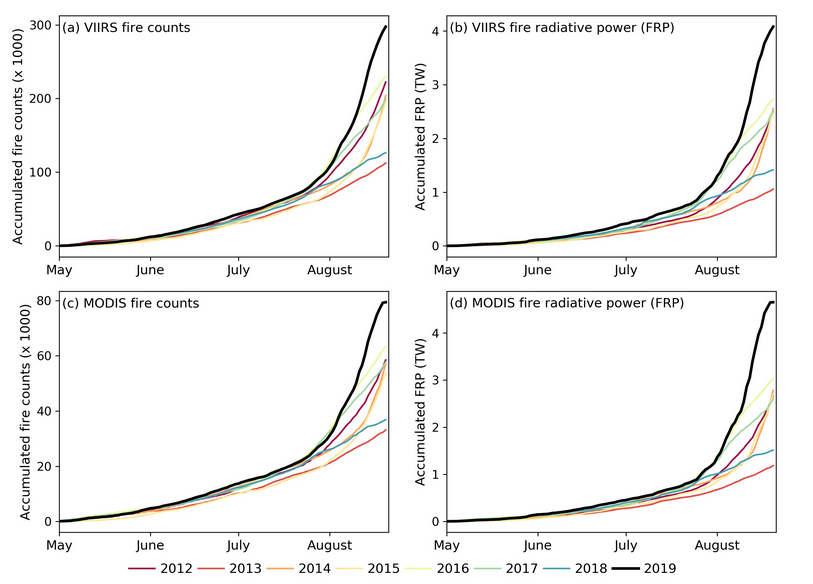
As we can see the thick black lines showing burning activity for 2019 are highly striking and certainly appear to support the media contention that 2019 is “record-breaking,” and eliminate all the doubts previously being expressed.
But on closer inspection, they have simply been constructed to make the 2019 burning look as “record” as the headlines were already claiming.
To achieve this two things have been done to the data.
1) the earlier years that are included in the other graphs from the same source, and which all had much higher burn rates than anything more recent, have been eliminated from these new graphs. The rather thin rationale for doing this is the VIIR/MODIS measure only goes back to 2012.
2) They start the sample in May rather than in January. No rationale is given for this at all, and it’s hard to see any beyond the fact that excluding the earlier months is the only way to make 2019 stand out as being “record” in line with media claims.
NASA’s website has made a similar journey over the same period.
This article, which we originally quoted, still says the burn activity in the Amazon is “close to average” and explains that a lot of farmers burn their land in the dry season.
As of August 16, 2019, an analysis of NASA satellite data indicated that total fire activity across the Amazon basin this year has been close to the average in comparison to the past 15 years. (The Amazon spreads across Brazil, Peru, Colombia, and parts of other countries.) Though activity appears to be above average in the states of Amazonas and Rondônia, it has so far appeared below average in Mato Grosso and Pará, according to estimates from the Global Fire Emissions Database, a research project that compiles and analyzes NASA data
This one, referenced by Walker and published just before his revised piece, might superficially appear to contradict the above claim, but – in a similar fashion to Walker’s piece – actually doesn’t if you look closely:
MODIS active fire detections in 2019 are higher across the Brazilian Amazon than in any year since 2010. The state of Amazonas is on track for record fire activity in 2019.
What NASA has done here in order to be able to claim a ‘record’ where previously there was an ‘average’ is simply switch from a fifteen-year analysis in the first article, to a nine-year one in the second. As I already pointed out above in relation to the revised graphs, this removes all the years of major burning this century and instantly shifts 2019 much further up toward the top of any comparative table.
Note also that NASA’s claim is not really true. Even within these somewhat distorted parameters 2019 is NOT higher than any year since 2010. As of today (August 27) 2016 is still just higher in total activity, and of course the earlier years of the 21st century were much higher again, but have been eliminated, apparently just for the purpose of making 2019 look a bit more “record-breaking”.
What we have here, in both the Sceince20.com article and in NASA’s ‘update’, is interpretation-manipulation being passed off as data-update. It’s hard to avoid the conclusion this is a direct attempt to make their pages fall in line with the current media hysteria.
Looking at the wider issue, it’s pretty clear an orchestrated campaign to create unique panic and fear about the Amazon forest fires was initiated, not because the 2019 fires were uniquely dangerous, but because public fear was perceived as useful for promoting an agenda.
What agenda? I think it’s too early to get a comprehensive answer there. Many straws blowing in the wind. It’s been suggested Bolsonaro, the new imperial puppet, may have been proving a little antsy and required pulling into line. Or that it’s a concealed attempt at strengthening his position while appearing to attack it.
There’s this little straw in the wind that shouldn’t be ignored:
#Brazil is clearly unable to be caretaker of the #Amazon rainforest as shown by the #AmazonFire. Given the ecological, medicinal and climate importance to our entire species, perhaps it’s time to place part of the Amazon rainforest under international treaty similar to Antarctica pic.twitter.com/OiLsw5hlkZ
— Matthew VanDyke (@Matt_VanDyke) August 26, 2019
An “international treaty” would certainly be a nice cover for exploitation of the Amazon’s riches. It can’t be discounted as one possible motive for fomenting a fake crisis where only an endemic problem exists.
Or this:
We have a crisis. We have a new tipping point. We have the UN climate action summit around the corner. We have a villain. Our heroine arrives in NYC soon. #NewDealForNature
The #BehaviouralEconomics of hatred. https://t.co/jleIN4m1ip
— Cory Morningstar (@elleprovocateur) August 27, 2019
Only the markets can save us.
Certification schemes. Green Bonds. A “New Deal For Nature”. We need momentum. We need that “Paris moment”. pic.twitter.com/2isJlyrFyP
— Cory Morningstar (@elleprovocateur) August 27, 2019
Or this:
The media focus on the burning #Amazon rather than Siberia’s boreal forest ‘aims to allow Europeans to control the Amazon, its minerals, its pharmaceutical treasures & its precious woods. Its purpose is to distort the problem b4 providing a false solution’https://t.co/T2OFtZgbsI
— Robin Monotti Graziadei (@robinmonotti) August 27, 2019
There are no shortage of possibilities once the question “cui bono?” is asked.
If that question isn’t asked, if it’s outlawed as “unhelpful” or “conspiratorial”, we can become trapped in a refusal to interrogate. And that can lead to disaster.
Too many of us become utterly trusting as soon as our hot button subjects are on the front pages. People who know the media is utterly corrupt can still switch off their critical thinking when it starts to venture any opinion they can agree with.
Commentators who deride the absurd media lies about the Skripals or Corbyn or Syria or Russia still share the Environment page of the BBC or the Guardian, as if somehow honesty and integrity are guaranteed there.
George Monbiot, serial liar and lunatic when it comes to Syria or western foreign policy, is trusted to be an honest broker when he talks about climate change or veganism, or saving the whales.
It’s too easy for any one of us to tell ourselves the mainstream journalist who is saying what we want to hear must have a good and honest reason for saying it.
It’s so comforting to just shut off the critical awareness and drift on the cloud of manufactured ‘popular opinion’. Seductive to be in the majority for once. Reassuring to have someone do the thinking for us so we can, just for a bit, ride easy in their wake.
But the problem is then we end up signing up for Avaaz. Or cheering on the invasion of Iraq – because of those scary WMDs, or thinking thank goodness the G7 are going to do something about those terrifying “record” Amazon fires.
Because we forgot that the mass media and the body politic serve the super-rich, the financial institutions, the intelligence agencies and no one else.
And they always lie, because they always need to hide that simple fact.
*PS – I STILL don’t support the destruction of the rain forests.
Catte Black, OffG co-founding editor. Writer. Opinionated polemicist.
Amazon Burning? – well maybe not so much
Statistics indicate this is an average year for wildfires, so why the above-average hysteria?
By Catte Black – OffGuardian – August 23, 2019
Today on Twitter OffG stepped into the current panic-inferno and thick forest of screaming hashtags that is the “Amazon Forest Fire Crisis.” The results were thought-provoking.
The mainstream media message is very simple. There are “record” numbers of forest fires currently in the Amazon basin. It’s mostly Bolsonaro’s fault. The G7 – soon to be assembling – needs to act. (Business Insider and The Guardian are also both very keen we send money to some rainforest charities)
Now, I’m not a fan of Bolsonaro personally, and that goes for all of us at OffG. I’m equally very supportive of preserving the rain forests and wild spaces of the earth. So, the broad sweep of the message is something I’m inclined to be sympathetic toward.
But something isn’t sitting right. This is the mainstream media in full and united chorus, flooding the news space with this one single message. This means there’s a fairly major agenda, and it’s unlikely to be saving the Amazon for all the little future babies.
So, we thought we’d take a deeper look and tweeted this:
How unusual/unnatural are these fires? What percentage burns naturally every year? Be nice to have data rather than hysteria. https://t.co/BDi95EXCiu
— OffGuardian (@OffGuardian0) August 23, 2019
Three people immediately unfollowed us. A couple of others responded. Here’s one:
“Hysteria?” You are being irresponsible and lazy. “Fires in the Amazon have surged 83% so far this year compared with the same period a year earlier, environmentalists blamed the sharp rise on farmers setting the forest alight to clear land for pasture” https://t.co/USit1oOL8p pic.twitter.com/pLPibygyp0
— Representative Press (@RepPress) August 23, 2019
We replied to RP with the following:
Yes, hysteria. What’s the annual variation? How do these fires compare with a 10 year average? A 50 year average? Asking for data is NEVER irresponsible. Demonising it as ‘lazy’ may well be however. Please note we aren’t claiming this isn’t a problem, just asking for context
— OffGuardian (@OffGuardian0) August 23, 2019
RP’s hostility only increased, and they retweeted the same basic claim again, apparently in the belief it was new and revelatory and an answer to our questions:
Are you incapable of doing research and of applying basic logic? You think the sharp rise in farmers setting fires is “made up?” I found this info in seconds: https://t.co/e11v2RH84r pic.twitter.com/o6RP5K83mL
— Representative Press (@RepPress) August 23, 2019
In fairness, we also got some positive response, most notably from the always rational Robin Monotti Graziadei. We recommend taking time to read the whole thread.
During the Medieval Climate Anomaly, the period most similar to recent decades, warm & dry climatic conditions resulted in peak forest burning, but severe fires favored less-flammable deciduous vegetation, such that fire frequency remained stationary:https://t.co/wTkIgCQm5h
— Robin Monotti Graziadei (@robinmonotti) August 23, 2019
Someone else then sent us a link to this article at Science20.com
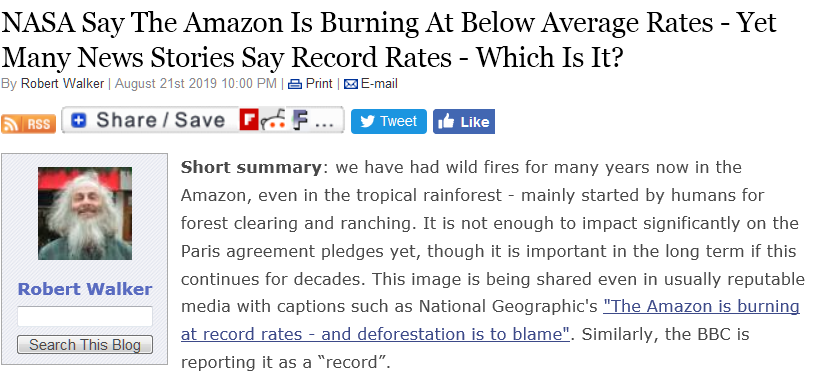
In this article you can find a quote from the Earth Observatory , which up until August 22 read as follows:
As of August 16, 2019, satellite observations indicated that total fire activity in the Amazon basin was slightly below average in comparison to the past 15 years. Though activity has been above average in Amazonas and to a lesser extent in Rondônia, it has been below average in Mato Grosso and Pará, according to the Global Fire Emissions Database”
(SIDEBAR: this text was changed on Aug 22 and now reads, significantly “As of August 16, 2019, an analysis of NASA satellite data indicated that total fire activity across the Amazon basin this year has been close to the average in comparison to the past 15 years.”, although the data on which this conclusion is based has not apparently changed. You can check the archived version for proof of the edit.)
On the same site (science20.com) you can also find this graph of “cumulative monthly fire data” for the Amazon basin (the original is at from GlobalFireData.org):
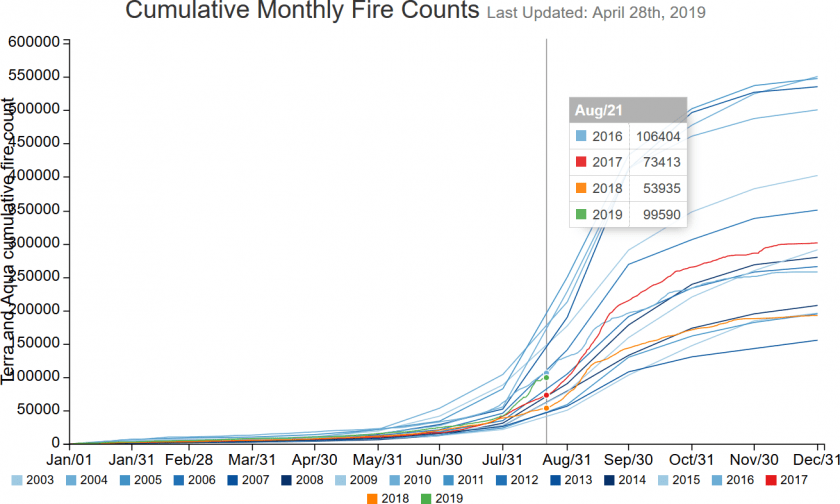
This clearly indicates that the current amount of burning in the Amazon basin in 2019 (the green line) is, as NASA originally said,somewhat below the average, and well below the previous extremes for the region.
This will be why, when you look close, the media articles are artfully talking about the number of fires, rather than the area of burning. There may well be more fires (or maybe that’s just been made up like so much else), but that’s a statistic without meaning if the total area covered is actually less than a fifteen-year average.
Now, we’re not about to take NASA as a final authority on this any more than any other single source. But given the amount of emphasis being put by the screaming media on how “unprecedented” the current burning is, and how deceptive this might turn out to be, it seemed important to us that this data was at least discussed. So we tweeted a ref to it.
Given the fact NASA has said the current total burning in the Amazon basin is slightly BELOW a 15 year average, we need to ask what the current media hysteria is aimed at achieving. https://t.co/BDi95EG1qW
— OffGuardian (@OffGuardian0) August 23, 2019
This was one response:
you can breath stats if you wish, I prefer oxygen!
Most stats are manipulated or self serving anyway!https://t.co/ZtH5IEXi2x— 💧truth-seeker (@very_grem) August 23, 2019
Here is another. Visit our timeline for more.
NASA = America = Trump = The far-right.
— Roy Underwood (@TannersCross) August 23, 2019
It turns out the messy truth behind the blaring headlines is – yes, the Amazon is burning but not as much as in many recent times, and while Bolsonaro is not a nice man accusing him of burning the world down is probably a bit premature.
To be fair a few people shared or retweeted this information. But they were very few. Most simply ignored it, intent, like Greenwald and Media Lens, Naomi Klein et al in joining chorus with the shrieking mainstream doom-sirens.
Bolsonaro is simultaneously denying the severity of the Amazon crisis and, worse, recklessly claiming environmental groups started them, because he knows the world recognizes he’s to blame. He can’t escape that responsibility, as @davidmirandario said today in Congress [English]: pic.twitter.com/CAiWKsUCEp
— Glenn Greenwald (@ggreenwald) August 23, 2019
‘The French and German leaders say the record number of fires in Brazil’s Amazon rainforest is an international crisis which must be discussed at this weekend’s G7 summit.’https://t.co/aiwzg8lJST
— Media Lens (@medialens) August 23, 2019
The world is on fire and in country after country the arsonists are ascending to the highest office. This is utter madness. We need a global #GreenNewDeal. We all need to ask ourselves: who do we trust to lead that and how will we help them? https://t.co/6gYXI1cwUG
— Naomi Klein (@NaomiAKlein) August 22, 2019
Make a note of that #GreenNewDeal hashtag. We’ll be seeing a lot of that in the next week or so.
Before the inevitable “oh so you don’t care if all the possums DIE” type comments BTL, let’s make it ultra-clear, this isn’t about disparaging environmentalism or claiming it’s fine for the Amazon to burn (though actually it is, up to a point, and is an important part of the forest’s life cycle).
It’s about the fact so many of us – even many who think of themselves as sophisticated analysts – are still as much in the grip of authoritarian story-telling as our ancestors were when they heard tales of heaven and hell and believed them.
Thank goodness for a few lone voices of sanity, like Robin again:
Media are ignoring data in order to sell the Green New Deal scam https://t.co/KJX767XS2C
— Robin Monotti Graziadei (@robinmonotti) August 23, 2019
Hmmm… is that Green New Deal the reason why this apparently fairly average year of burning has been morphed by the power of lies into the latest doomsday meme? Why exactly would so many corporate news outlets be so keen to sell us that?
Oh who cares, right? It’s hard. Memes are easy. Did you know that the Amazon produces 20% of our Oxygen? No, because it doesn’t. But that’s not stopping everyone repeating it.
A few cyberwarfare-generated hashtags, a few (sometimes misattributed) images and there is a mass belief-system unfolding before our eyes. Uncritical, rabid, rancid with fear, demanding solutions.
Just in time for the G7 summit – where I’m sure a Green New Deal “solution” will emerge right on cue, to universal cheers and a few more hashtags handed down to the proles to be spread about in the name of “standing up to the 1%”.
We have to do better, guys, or it’s over. We’re done.
Catte Black, OffG co-founding editor. Writer. Opinionated polemicist.
Fake News and Fires in the Amazon
Media outlets are supposed to be more reliable than your brother-in-law, but that seems less true every day.

By Donna Laframboise | Big Picture News | August 28, 2019
Politicians and government officials like to talk as though it’s possible to stamp out fake news. It isn’t.
Fake news is as old as humanity. After Aristotle incorrectly claimed women had fewer teeth than men, generations of highly educated people believed it.
Rajendra Pachauri was called “the UN’s top climate scientist” by the BBC – and a “Nobel laureate” by the New York Academy of Sciences magazine. Neither statement was true.
Pachauri’s doctorate wasn’t in climatology, but in industrial engineering and economics. And the fact that he accepted the 2007 Nobel Peace Prize on behalf of the UN organization he chaired doesn’t make him or any other person affiliated with that organization a Nobel laureate.
Published in 2008 and 2009, these inaccurate statements have never been corrected. In other words, we’re surrounded by fake news. And always will be. Humans are frequently mistaken. Organizations, as well as individuals, post things on the Internet before double-checking.
While media outlets are supposed to be more reliable than your brother-in-law, that seems less true every day. Over the past week, people have shared a CNN headline on Facebook that declares: “The Amazon rainforest is burning at a record rate” (see the screengrab from my own Facebook feed, at the top of this post).
If you click through to the CNN website, you’ll find a few extra words: “… research center says.” But the primary statement is misleading. Which means that millions have been alarmed unnecessarily – including a lovely, smart, young mother of my acquaintance.
Over at the website of National Geographic, a headline falsely declares: Brazil’s Amazon is burning at record rates – and deforestation is to blame. The second half of that assertion is vigorously disputed here.

On Twitter, the President of France used an image taken by a photographer who’s been dead for 16 years to represent the current situation. Let me just emphasize that point: the head of a G7 country is spreading fake news about events unfolding on another continent.

That doesn’t, for one minute, mean anyone should have the power to shut him down. Not Twitter, Facebook, the EU, the UN, or anyone in his own government.
Like it or not, we’re stuck with fake news. Our best defense is to read widely and maintain a high level of skepticism. On this question, here’s some counterbalance to the recent tsunami of alarmism:
Why Everything They Say About The Amazon, Including That It’s The ‘Lungs Of The World,’ Is Wrong
Amazon fires: how celebrities are spreading disinformation
Is Amazon Rainforest Burning At Record Rates? What Is The Way Forward?
Lies, Damn Lies, And Rainforest Fear-Mongering
Annual Amazon farmland burn sets records for international outrage
Amazon fires: What about Bolivia?
Stop Sharing Those Viral Photos of the Amazon Burning
The Three Most Viral Photos of the Amazon Fire Are Fake. Here Are Some Real Ones to Share.
What Satellite Imagery Tells Us About the Amazon Rain Forest Fires
Creator Of Global-Warming’s Infamous “Hockey Stick” Chart Loses ‘Climate-Science’ Lawsuit
By Tyler Durden – Zero Hedge – 08/27/2019
Update 1: Michael Mann disputes the notion that he lost (and more): “There have been some wildly untruthful claims about the recent dismissal of libel litigation against Tim Ball circulating on social media.”
There have been some wildly untruthful claims about the recent dismissal of libel litigation against Tim Ball circulating on social media. Here is our statement (https://t.co/8tGoBZnE3Y): pic.twitter.com/ySeJcOktX9
— Michael E. Mann (@MichaelEMann) August 23, 2019
* * *
Update 2: technology.news has a rather different take than Mann, noting that further legal steps are on their way.
Penn State climate scientist, Michael ‘hockey stick’ Mann commits contempt of court in the ‘climate science trial of the century.’ Prominent alarmist shockingly defies judge and refuses to surrender data for open court examination. Only possible outcome: Mann’s humiliation, defeat and likely criminal investigation in the U.S.
The defendant in the libel trial, the 79-year-old Canadian climatologist, Dr Tim Ball … is expected to instruct his British Columbia attorneys to trigger mandatory punitive court sanctions, including a ruling that Mann did act with criminal intent when using public funds to commit climate data fraud. Mann’s imminent defeat is set to send shock waves worldwide within the climate science community as the outcome will be both a legal and scientific vindication of U.S. President Donald Trump’s claims that climate scare stories are a “hoax.” (snip)
Michael Mann, who chose to file what many consider to be a cynical SLAPP (Strategic Lawsuit Against Public Participation) libel suit in the British Columbia Supreme Court, Vancouver six long years ago, has astonished legal experts by refusing to comply with the court direction to hand over all his disputed graph’s data. Mann’s iconic hockey stick has been relied upon by the UN’s IPCC and western governments as crucial evidence for the science of ‘man-made global warming.’ (snip)
The negative and unresponsive actions of Dr Mann and his lawyer, Roger McConchie, are expected to infuriate the judge and be the signal for the collapse of Mann’s multi-million dollar libel suit against Dr Ball. It will be music to the ears of so-called ‘climate deniers’ like President Donald Trump and his EPA Chief, Scott Pruitt.
As Dr Ball explains:
“Michael Mann moved for an adjournment of the trial scheduled for February 20, 2017. We had little choice because Canadian courts always grant adjournments before a trial in their belief that an out of court settlement is preferable. We agreed to an adjournment with conditions. The major one was that he [Mann] produce all documents including computer codes by February 20th, 2017. He failed to meet the deadline.”
Punishment for Civil Contempt
Mann’s now proven contempt of court means Ball is entitled to have the court serve upon Mann the fullest punishment. Contempt sanctions could reasonably include the judge ruling that Dr. Ball’s statement that Mann “belongs in the state pen, not Penn. State’ is a precise and true statement of fact. This is because under Canada’s unique ‘Truth Defense’, Mann is now proven to have wilfully hidden his data, so the court may rule he hid it because it is fake. As such, the court must then dismiss Mann’s entire libel suit with costs awarded to Ball and his team.
* * *
Authored by Thomas Lifson via AmericanThinker,
Michael Mann, a climatologist at Penn State University, is the creator of the “hockey stick graph” that appears to show global temperatures taking a noticeable swing upward in the era when humanity has been burning fossil fuels and dumping CO2 into the atmosphere.
The graph was first published in 1998, prominently featured in the 2001 UN Climate Report, and formed part of Al Gore’s 2006 movie, An Inconvenient Truth.

The graph’s methodology and accuracy have been and continue to be hotly contested, but Mann has taken the tack of suing two of his most prominent critics for defamation or libel.
One case, against Mark Steyn, is called by Steyn likely to end up in the Supreme Court. But another case, against Dr. Tim Ball was decided by the Supreme Court of British Columbia, with Mann’s case thrown out, and him ordered to pay the defendant’s legal costs, no doubt a tidy sum of money. News first broke in Wattsupwiththat, via an email Ball sent to Anthony Watt. Later, Principia-Scientific offered extensive details, including much background on the hockey stick.
The Canadian court issued it’s final ruling in favor of the Dismissal motion that was filed in May 2019 by Dr Tim Ball’s libel lawyers.
Not only did the court grant Ball’s application for dismissal of the nine-year, multi-million dollar lawsuit, it also took the additional step of awarding full legal costs to Ball. A detailed public statement from the world-renowned skeptical climatologist is expected in due course.
This extraordinary outcome is expected to trigger severe legal repercussions for Dr Mann in the U.S. and may prove fatal to climate science claims that modern temperatures are “unprecedented.” […]
Dr Mann lost his case because he refused to show in open court his R2 regression numbers (the ‘working out’) behind the world-famous ‘hockey stick’ graph (shown above).
Real science, not the phony “consensus” version, requires open access to data, so that skeptics (who play a key role in science) can see if results are reproducible. Of course, there are no falsifiable experimental data associated with the global warming predictions of doom, so it doesn’t really stand as science as Karl Popper defined it.
This is an important victory in the process of debunking the warmist scare.
‘Absolutely Hypocritical’: Social Media Hunt for Pro-Beijing Accounts Ignores US Influence Ops
Sputnik – August 24, 2019
In the last week, social media giants moved to silence critics of the anti-Beijing protests in Hong Kong, disabling thousands of accounts, pages and channels by claiming they’re promoting “disinformation” and “sowing discord.” But the move is deeply hypocritical, a technologist told Sputnik, because these companies do the same thing constantly.
Since Monday, Facebook, Twitter and Google have between them disabled hundreds of thousands of accounts judged to be behaving “in a coordinated manner,” as Google said, and “deliberately and specifically attempting to sow political discord in Hong Kong, including undermining the legitimacy and political positions of the protest movement on the ground,” as Twitter put it. The three tech giants noted they each relied on tips from the others and that their reasoning was identical.
“‘In a coordinated manner,’ or all these phrases that Twitter, Facebook and Google use – ‘inauthentic coordinated behavior’ – they mean whatever those companies want it to mean,” web developer and technologist Chris Garaffa told Radio Sputnik’s By Any Means Necessary Friday. “They mean absolutely nothing to the rest of us.”
“These companies are doing the bidding of the US State Department and, in general, of Western capitalism. Their previous targets have been Russian accounts, they have been Iranian accounts, they have been Venezuelan accounts,” he noted. “And also, independent accounts and news sources that report a different perspective than the mainstream Western-spaced narrative. I mean, Google has delisted RT and Sputnik from news results. Facebook and Twitter have taken down the pages of VenezuelAnalysis and, at one point, TeleSUR English, even. Those, thankfully, have been reinstated after mass outrage.”
“Even if these accounts were being planned and coordinated with their tweets and their posts, it’s absolutely hypocritical, because the US does the same thing through Voice of America and other agencies; through the National Endowment for Democracy they do that. The Israel Defense Forces have an entire social media operations wing where they have people do the same thing whenever there’s news about Israel. They actually go out and basically combat anything they see as negative about Israel.”
“First of all, we have to consider the fact that we’re giving all these companies – or, these companies have this absolute free reign to shut down accounts and to do all of these things. They’re private companies,” Garaffa noted. “They are beholden to shareholders, but they are also beholden to the interests of capital, and so is the US government as the executive, so to say, of the capitalist market.”
The technologist said our consciousness “is absolutely being manipulated” by our use of these sites.
“There are many, many studies showing how just what the results from a Google search can do to an election. You want to talk about election interference, let’s talk about the way Google manipulated search results, or the way Facebook will show you what it thinks you want to see, even if those stories are absolutely fake. They often create echo chambers,” Garaffa explained.
Featured Video

Diplomacy is Now a Crime in Britain / Ian Proud
or go to
Aletho News Archives – Video-Images
From the Archives
Genetic baloney in thick slices
MAYBE COULD BE INC.
By Jon Rappoport | No More Fake News | July 8, 2021
Gene research companies tend to come and go. They start out banging and popping like fireworks in the sky, and then they fade out—selling themselves to larger outfits who’ve hired better liars…
Once upon a time, it sounded easy. Start with a disease, find the gene responsible for the disease, and correct the problem.
Then, researchers wondered, was disease the result of one gene or a group of genes acting together?
Either way, the proof would be in devising cures for diseases using gene therapy. “Not yet, but soon…”
And regardless, the major need was: money. Lots and lots of money.
This need required good PR people. “We have to pump up the idea that we’re on the edge of tremendous breakthroughs. We’re always on that edge…”
This hype also needed to obscure the fact that there wasn’t (and isn’t) ANY gene cure for ANY disease. … continue
Blog Roll
 Aletho News
- Diplomacy is Now a Crime in Britain / Ian Proud
- UK Government Body Kept Files on People Criticizing Prevent Program
- US military withdrawal from Iraq and the collapse of US-Israeli hegemonic project in West Asia
- What does Europe want – a war with Russia?
- She Followed the Actual Data on COVID Vaccines and Masks — Her Career Took a Huge Hit
- Florida AG Sues Pfizer, Bourla Over Deceptive Marketing of COVID Vaccines
- Von der Leyen gifts her spin doctor a job for life
- 10K More U.S. Troops Deploy as Trump Weighs New Iran Strikes /Suliaman Ahmed
- Iranian crew declared Dena training vessel ‘unarmed’ to US warship before deadly torpedo strike: Report
- Iran’s NPT debate moves beyond parliament
- If Americans Knew
- Israel is squeezing the life out of Palestinians – Daily Update
- The Israeli Right Portrays Islam as Murderous. It Serves a Political Purpose
- Jordan Has Had Enough: King Abdullah’s Scathing Warning to Israel
- Israeli Colonizers (i.e. Settlers) Kill Palestinian Man Near Salfit
- New Google Maps images reveal massive scale of devastation in Gaza
- Jewish supremacy, anti-Palestinian bigotry on display in Israel – Daily Update
- Israeli Soldiers Abduct At Least 22 Across Occupied West Bank
- Eight Palestinians Killed in Israeli Attacks on Gaza
- Israeli former leaders and security chiefs threaten legal action over ‘Jewish terrorism’
- Israel map in LA Times ad includes all land from the river to the sea
- No Tricks Zone
- Green Energy Debacle: German Expert Professor Fritz Vahrenholt Warns Of Severe Economic And Social Consequences
- Two More Paleo Reconstructions Affirm Meters-Higher Sea Levels Across Ireland, Brazil 7000-6000 Years Ago
- New Study: Earth And Venus Surface Warmth Largely Explained By Convection And Lapse Rate, Not CO2 Or Radiation
- 2025 Nature Paper Claiming Worsening Global Drought Gets RETRACTED …Heavily Flawed
- New Study: ‘Global Drought Shows No Detectable Recent Acceleration Under Climate Warming’
- Economic Masterminds: German Socialists Suggest Taxing Productivity Gains Stemming From Using AI
- The South China Sea Has Not Been Cooperating With The Climate Change Narrative
- Energy Crisis: Germany Enters Heating Season With Historically Low Gas Reserve Fill Levels
- New Study: The Antarctic Ice Sheet Gained Mass From 2020-2024 Due To Staggering Snow And Ice Accumulation
- Study: Ocean Heating Rates From Thousands Of Years Ago ‘Dwarf’ Modern Ocean Heating Rates

