Imprisoned Stratfor hacker & WikiLeaks source moved to Virginia to ‘testify against Assange’
RT | September 4, 2019
Jeremy Hammond, who helped feed millions of emails from ‘private CIA’ Stratfor to WikiLeaks, has reportedly been moved to Virginia to testify before a grand jury, which he refuses to do, jeopardizing his early release from prison.
Hammond has been moved to the same Eastern District where whistleblower Chelsea Manning is currently being held for refusing to testify against Julian Assange, the Jeremy Hammond Support Committee revealed on Tuesday in a statement. While neither Hammond nor his supporters are certain of the nature of the summons, he pled guilty to hacking Stratfor in 2013 in order to avoid giving up information on his fellow activists, including those at WikiLeaks, and has no intention of doing so now.
“Jeremy pled guilty to put an end to the case against him. He pled guilty because he had no interest in cooperating with the government.”
While Hammond received the maximum 10 year sentence in exchange for his non-cooperating guilty plea, he was granted immunity from further prosecution in all other federal courts and was due to be released in December, having received a sentence reduction for participating in the Federal Bureau of Prisons’ Residential Drug Abuse Program. Transferring him from Memphis, Tennessee, where he was incarcerated, to Alexandria, Virginia, cuts short his participation in the program and guarantees he will serve at least another year in prison.
And he could be locked up much longer, given his refusal to testify, which will place him in the same legal limbo where Manning is currently entrapped. The former military analyst, imprisoned since May after having her sentence for leaking the classified military documents comprising the Iraq and Afghanistan War Logs to WikiLeaks commuted by former President Barack Obama, faces up to 18 months more prison time and nearly half a million dollars in fines for refusing to testify against Assange.
“Like brave grand jury resisters before him, including Chelsea Manning, Jeremy firmly believes that grand juries are repressive tools of the government, used to investigate and intimidate activist communities and are abused by prosecutors to gain access to intelligence to which they are not entitled,” the Support Committee’s statement continues, condemning “a clear pattern of targeting, isolating, and punishing outspoken truth-tellers and activists.”
Hammond, working with the online activist group Anonymous, hacked into Stratfor’s servers in 2011 and funneled over five million emails from the self-styled “private CIA” to WikiLeaks, including thousands which revealed details of the government’s pursuit of Assange and the organization he helped found. Assange is currently imprisoned in the UK and faces potential extradition to the US – specifically, the Eastern District of Virginia, which has never failed to convict a whistleblower. He is charged with multiple violations of the Espionage Act carrying a total of 175 years in prison.
Questions Nobody Is Asking About Jeffrey Epstein
By Eric Rasmusen • Unz Review • September 2, 2019
The Jeffrey Epstein case is notable for the ups and downs in media coverage it’s gotten over the years. Everybody, it seems, in New York society knew by 2000 that Jeffrey Epstein and Ghislaine Maxwell were corrupting teenage girls, but the press wouldn’t cover it. Articles by New York in 2002 and Vanity Fair in 2003 alluded to it gently, while probing Epstein’s finances more closely. In 2005, the Palm Beach police investigated. The county prosecutor, Democrat Barry Krischer, wouldn’t prosecute for more than prostitution, so they went to the federal prosecutor, Republican Alexander Acosta, and got the FBI involved. Acosta’s office prepared an indictment, but before it was filed, he made a deal: Epstein agreed to plead guilty to a state law felony and receive a prison term of 18 months. In exchange, the federal interstate sex trafficking charges would not be prosecuted by Acosta’s office. Epstein was officially at the county jail for 13 months, where the county officials under Democratic Sheriff Ric Bradshaw gave him scandalously easy treatment, letting him spend his days outside, and letting him serve a year of probation in place of the last 5 months of his sentence. Acosta’s office complained, but it was a county jail, not a federal jail, so he was powerless.
Epstein was released, and various lawsuits were filed against him and settled out of court, presumably in exchange for silence. The media was quiet or complimentary as Epstein worked his way back into high society. Two books were written about the affair, and fell flat. The FBI became interested again around 2011 (a little known fact) and maybe things were happening behind the scenes, but the next big event was in 2018 when the Miami Herald published a series of investigative articles rehashing what had happened. In 2019 federal prosecutors indicted Epstein, he was put in jail, and he mysteriously died. Now, after much complaining in the press about how awful jails are and how many people commit suicide, things are quiet again, at least until the Justice Department and the State of Florida finish their investigation a few years from now. (For details and more links, see “Investigation: Jeffrey Epstein” at Medium.com and “Jeffrey Epstein” at Wikipedia.)
I’m an expert in the field of “game theory”, strategic thinking. What would I do if I were Epstein? I’d try to get the President, the Attorney-General, or the U.S. Attorney for the Southern District of New York to shut down the investigation before it went public. I’d have all my friends and all my money try to pressure them. If it failed and I were arrested, it would be time for the backup plan— the Deal. I’d try to minimize my prison time, and, just as important, to be put in one of the nicer federal prisons where I could associate with financial wizards and drug lords instead of serial killers, black nationalists, and people with bad breath.
That’s what Epstein would do. What about the powerful people Epstein would turn in to get his deal? They aren’t as smart as Epstein, but they would know the Deal was coming— that Epstein would be quite happy to sacrifice them in exchange for a prison with a slightly better golf course. What could they do? There’s only one good option— to kill Epstein, and do it quickly, before he could start giving information samples to the U. S. Attorney.
Trying to kill informers is absolutely routine in the mafia, or indeed, for gangs of any kind. The reason people call such talk “conspiracy theories” when it comes to Epstein is that his friends are WASPs and Jews, not Italians and Mexicans. But WASPs and Jews are human too. They want to protect themselves. Famous politicians, unlike gangsters, don’t have full-time professional hit men on their staffs, but that’s just common sense—politicians rarely need hit men, so it makes more sense to hire them on a piecework basis than as full-time employees. How would they find hit men? You or I wouldn’t know how to start, but it would be easy for them. Rich powerful people have bodyguards. Bodyguards are for defense, but the guys who do defense know guys who do offense. And Epstein’s friends are professional networkers. One reporter said of Ghislaine Maxwell, “Her Rolodex would blow away almost anyone else’s I can think of—probably even Rupert Murdoch’s.” They know people who know people. Maybe I’m six degrees of separation from a mafia hit man, but not Ghislaine Maxwell. I bet she knows at least one mafioso personally who knows more than one hit man.
In light of this, it would be very surprising if someone with a spare $50 million to spend to solve the Epstein problem didn’t give it a try. A lot of people can be bribed for $50 million. Thus, we should have expected to see bribery attempts. If none were detected, it must have been because prison workers are not reporting they’d been approached.
Some people say that government incompetence is always a better explanation than government malfeasance. That’s obviously wrong— when an undeserving business gets a contract, it’s not always because the government official in charge was just not paying attention. I can well believe that prisons often take prisoners off of suicide watch too soon, have guards who go to sleep and falsify records, remove cellmates from prisoners at risk of suicide or murder, let the TV cameras watching their most important prisoners go on the blink, and so forth. But that cuts both ways. Remember, in the case of Epstein, we’d expect a murder attempt whether the warden of the most important federal jail in the country is competent or not. If the warden is incompetent, we should expect that murder attempt to succeed. Murder becomes all the more plausible. Instead of spending $50 million to bribe 20 guards and the warden, you just pay some thug $30,000 to walk in past the snoring guards, open the cell door, and strangle the sleeping prisoner, no fancy James Bond necessary. Or, if you can hire a New York Times reporter for $30,000 (as Epstein famously did a couple of years ago), you can spend $200,000 on a competent hit man to make double sure. Government incompetence does not lend support to the suicide theory; quite the opposite.
Now to my questions.
- Why is nobody blaming the Florida and New York state prosecutors for not prosecuting Epstein and others for statutory rape?
Statutory rape is not a federal crime, so it is not something the Justice Dept. is supposed to investigate or prosecute. They are going after things like interstate sex trafficking. Interstate sex trafficking is generally much harder to prove than statutory rape, which is very easy if the victims will testify.
At any time from 2008 to the present, Florida and New York prosecutors could have gone after Epstein and easily convicted him. The federal nonprosecution agreement did not bind them. And, of course, it is not just Epstein who should have been prosecuted. Other culprits such as Prince Andrew are still at large.
Note that even if the evidence is just the girl’s word against Ghislaine Maxwell’s or Prince Andrew’s, it’s still quite possible to get a jury to convict. After all, who would you believe, in a choice between Maxwell, Andrew, and Anyone Else in the World? For an example of what can be done if the government is eager to convict, instead of eager to protect important people, see the 2019 Cardinal Pell case in Australia. He was convicted by the secret testimony of a former choirboy, the only complainant, who claimed Pell had committed indecent acts during a chance encounter after Mass before Pell had even unrobed. Naturally, the only cardinal to be convicted of anything in the Catholic Church scandals is also the one who’s done the most to fight corruption. Where there’s a will, there’s a way to prosecute. It’s even easier to convict someone if he’s actually guilty.
- Why isn’t anybody but Ann Coulter talking about Barry Krischer and Ric Bradshaw, the Florida state prosecutor and sheriff who went easy on Epstein, or the New York City police who let him violate the sex offender regulations?
Krischer refused to use the evidence the Palm Beach police gave him except to file a no-jail-time prostitution charge (they eventually went to Acosta, the federal prosecutor, instead, who got a guilty plea with an 18-month sentence). Bradshaw let him spend his days at home instead of at jail. In New York State, the county prosecutor, Cyrus Vance, fought to prevent Epstein from being classified as a Level III sex offender. Once he was, the police didn’t enforce the rule that required him to check in every 90 days.
- How easy would it have been to prove in 2016 or 2019 that Epstein and his people were guilty of federal sex trafficking?
Not easy, I should think. It wouldn’t be enough to prove that Epstein debauched teenagers. Trafficking is a federal offense, so it would have to involve commerce across state lines. It also must involve sale and profit, not just personal pleasure. The 2019 indictment is weak on this. The “interstate commerce” looks like it’s limited to Epstein making phone calls between Florida and New York. This is why I am not completely skeptical when former U.S. Attorney Acosta says that the 2008 nonprosecution deal was reasonable. He had strong evidence that Epstein violated Florida state law— but that wasn’t relevant. He had to prove violations of federal law.
- Why didn’t Epstein ask the Court, or the Justice Dept., for permission to have an unarmed guard share his cell with him?
Epstein had no chance at bail without bribing the judge, but this request would have been reasonable. That he didn’t request a guard is, I think, the strongest evidence that he wanted to die. If he didn’t commit suicide himself, he was sure making it easy for someone else to kill him.
- Could Epstein have used the safeguard of leaving a trove of photos with a friend or lawyer to be published if he died an unnatural death?
Well, think about it— Epstein’s lawyer was Alan Dershowitz. If he left photos with someone like Dershowitz, that someone could earn a lot more by using the photos for blackmail himself than by dutifully carrying out his perverted customer’s instructions. The evidence is just too valuable, and Epstein was someone whose friends weren’t the kind of people he could trust. Probably not even his brother.
- Who is in danger of dying next?
Prison workers from guard to warden should be told that if they took bribes, their lives are now in danger. Prison guards may not be bright enough to realize this. Anybody who knows anything important about Epstein should be advised to publicize their information immediately. That is the best way to stay alive. This is not like a typical case where witnesses get killed so they won’t testify. It’s not like with gangsters. Here, the publicity and investigative lead is what is most important, because these are reputable and rich offenders for whom publicity is a bigger threat than losing in court. They have very good lawyers, and probably aren’t guilty of federal crimes anyway, just state crimes, in corrupt states where they can use clout more effectively. Thus, killing potential informants before they tell the public is more important than killing informants to prevent their testimony at trial, a much more leisurely task.
- What happened to Epstein’s body?
The Justice Dept. had better not have let Epstein’s body be cremated. And they’d better give us convincing evidence that it’s his body. If I had $100 million to get out of jail with, acquiring a corpse and bribing a few people to switch fingerprints and DNA wouldn’t be hard. I find it worrying that the government has not released proof that Epstein is dead or a copy of the autopsy.
- Was Epstein’s jail really full of mice?
The New York Times says,
“Beyond its isolation, the wing is infested with rodents and cockroaches, and inmates often have to navigate standing water — as well as urine and fecal matter — that spills from faulty plumbing, accounts from former inmates and lawyers said. One lawyer said mice often eat his clients’ papers.”
“Often have to navigate standing water”? “Mice often eat his clients’ papers?” Really? I’m skeptical. What do the vermin eat— do inmates leave Snickers bars open in their cells? Has anyone checked on what the prison conditions are really like?
- Is it just a coincidence that Epstein made a new will two days before he died?
I can answer this one. Yes, it is coincidence, though it’s not a coincidence that he rewrote the will shortly after being denied bail. The will leaves everything to a trust, and it is the trust document (which is confidential), not the will (which is public), that determines who gets the money. Probably the only thing that Epstein changed in his will was the listing of assets, and he probably changed that because he’d just updated his list of assets for the bail hearing anyway, so it was a convenient time to update the will.
- Did Epstein’s veiled threat against DOJ officials in his bail filing backfire?
Epstein’s lawyers wrote in his bail request,
“If the government is correct that the NPA does not, and never did, preclude a prosecution in this district, then the government will likely have to explain why it purposefully delayed a prosecution of someone like Mr. Epstein, who registered as a sex offender 10 years ago and was certainly no stranger to law enforcement. There is no legitimate explanation for the delay.”
I see this as a veiled threat. The threat is that Epstein would subpoena people and documents from the Justice Department relevant to the question of why there was a ten-year delay before prosecution, to expose the illegitimate explanation for the delay. Somebody is to blame for that delay, and court-ordered disclosure is a bigger threat than an internal federal investigation.
- Who can we trust?
Geoffrey Berman, U.S. Attorney for the Southern District of New York, is the only government official who is clearly trustworthy, because he could have stopped the 2019 Epstein indictment and he didn’t. I don’t think Attorney-General Barr could have blocked it, and I don’t think President Trump could have except by firing Berman. I do trust Attorney-General Barr, however, from what I’ve heard of him and because he instantly and publicly said he would have not just the FBI but the Justice Dept. Inspector-General investigate Epstein’s death, and he quickly fired the federal prison head honcho. The FBI is untrustworthy, but Inspector-Generals are often honorable.
Someone else who may be a hero in this is Senator Ben Sasse. Vicki Ward writes in the Daily Beast:
“It was that heart-wrenching series that caught the attention of Congress. Ben Sasse, the Republican senator from Nebraska, joined with his Democratic colleagues and demanded to know how justice had been so miscarried.
Given the political sentiment, it’s unsurprising that the FBI should feel newly emboldened to investigate Epstein—basing some of their work on Brown’s excellent reporting.”
- Will President Trump Cover Up Epstein’s Death in Exchange for Political Leverage?
President Trump didn’t have anything personally to fear from Epstein. He is too canny to have gotten involved with him, and the press has been eagerly at work to find the slightest connection between him and Epstein and have come up dry as far as anything but acquaintanceship. But we must worry about a cover-up anyway, because rich and important people would be willing to pay Trump a lot in money or, more likely, in political support, if he does a cover-up.
- Why did Judge Sweet order Epstein documents sealed in 2017. Did he die naturally in 2019?
Judge Robert Sweet in 2017 ordered all documents in an Epstein-related case sealed. He died in May 2019 at age 96, at home in Idaho. The sealing was completely illegal, as the appeals court politely but devastatingly noted in 2019, and the documents were released a day or two before Epstein died. Someone should check into Judge Sweet’s finance and death. He was an ultra-Establishment figure— a Yale man, alas, like me, and Taft School— so he might just have been protecting what he considered good people, but his decision to seal the court records was grossly improper.
- Did Epstein have any dealings in sex, favors, or investments with any Republican except Wexner?
Dershowitz, Mitchell, Clinton, Richardson, Dubin, George Stephanopolous, Lawrence Krauss, Katie Couric, Mortimer Zuckerman, Chelsea Handler, Cyrus Vance, and Woody Allen, are all Democrats. Did Epstein ever make use of Republicans? Don’t count Trump, who has not been implicated despite the media’s best efforts and was probably not even a Republican back in the 90’s. Don’t count Ken Starr– he’s just one of Epstein’s lawyers. Don’t count scientists who just took money gifts from him. (By the way, Epstein made very little in the way of political contributions, though that little went mostly to Democrats ($139,000 vs. $18,000. I bet he extracted more from politicians than he gave to them.
- What role did Israeli politician Ehud Barak play in all this?
Remember Marc Rich? He was a billionaire who fled the country to avoid a possible 300 years prison term, and was pardoned by Bill Clinton in 2001. Ehud Barak, one of Epstein’s friends, was one of the people who asked for Rich to be pardoned. Epstein, his killers, and other rich people know that as a last resort they can flee the country and wait for someone like Clinton to come to office and pardon them.
Acosta said that Washington Bush Administration people told him to go easy on Epstein because he was an intelligence source. That is plausible. Epstein had info and blackmailing ability with people like Ehud Barak, leader of Israel’s Labor Party. But “intelligence” is also the kind of excuse people make up so they don’t have to say “political pressure.”
- Why did nobody pay attention to the two 2016 books on Epstein?
James Patterson and John Connolly published Filthy Rich: A Powerful Billionaire, the Sex Scandal that Undid Him, and All the Justice that Money Can Buy: The Shocking True Story of Jeffrey Epstein. Conchita Sarnoff published TrafficKing: The Jeffrey Epstein Case. I never heard of these before 2019. Did the media bury them?
- Which newspapers reported Epstein’s death as “suicide” and which as “apparent suicide”?
More generally, which media outlets seem to be trying to brush Epstein’s death under the rug? There seems to have been an orchestrated attempt to divert attention to the issue of suicides in prison. Subtle differences in phrasing might help reveal who’s been paid off. National Review had an article, “The Conspiracy Theories about Jeffrey Epstein’s Death Don’t Make Much Sense.” The article contains no evidence or argument to support the headline’s assertion, just bluster about “madness” and “conspiracy theories”. Who else publishes stuff like this?
- How much did Epstein corrupt the media from 2008 to 2019?
Even outlets that generally publish good articles must be suspected of corruption. Epstein made an effort to get good publicity. The New York Times wrote,
“The effort led to the publication of articles describing him as a selfless and forward-thinking philanthropist with an interest in science on websites like Forbes, National Review and HuffPost….
All three articles have been removed from their sites in recent days, after inquiries from The New York Times….
The National Review piece, from the same year, called him “a smart businessman” with a “passion for cutting-edge science.”…
Ms. Galbraith was also a publicist for Mr. Epstein, according to several news releases promoting Mr. Epstein’s foundations… In the article that appeared on the National Review site, she described him as having “given thoughtfully to countless organizations that help educate underprivileged children.”
“We took down the piece, and regret publishing it,” Rich Lowry, the editor of National Review since 1997, said in an email. He added that the publication had “had a process in place for a while now to weed out such commercially self-interested pieces from lobbyists and PR flacks.””
The New York Times was, to its credit, willing to embarrass other publications by 2019. But the Times itself had been part of the cover-up in previous years. Who else was?
Eric Rasmusen is an economist who has held an endowed chair at Indiana University’s Kelley School of Business and visiting positions at Harvard Law School, Yale Law School, the Harvard Economics Department, Chicago’s Booth School of Business, Nuffield College/Oxford, and the University of Tokyo Economics Department. He is best known for his book Games and Information. He has published extensively in law and economics, including recent articles on the burakumin outcastes in Japan, the use of game theory in jurisprudence, and quasi-concave functions. The views expressed here are his personal views and are not intended to represent the views of the Kelley School of Business or Indiana University. His vitae is at http://www.rasmusen.org/vita.htm .
Fault Lines Radio Interview With Whitney Webb (August 30, 2019)
Fault Lines Radio | August 30, 2019
Interview begins at 2:20:21
Google’s Power to Shift Elections—Zachary Vorhies, Greg Coppola and Dr. Robert Epstein
American Thought Leaders – The Epoch Times – August 23, 2019
According to Google whistleblower Zachary Vorhies, how is Google suppressing certain viewpoints, promoting others, and altering public perception?
Is there evidence of active intent on the part of Google staff or executives?
And in the eyes of Dr. Robert Epstein, what are the broader implications of Google bias—whether intentional or unintentional—for America and beyond?
This is American Thought Leaders 🇺🇸, and I’m Jan Jekielek.
In this special episode, we sit down with Google whistleblower Zachary Vorhies, a former senior Google engineer, who recently leaked nearly 1000 pages of documents that he says suggest Google has been secretly acting as a publisher, selectively boosting or demoting content, while publicly claiming to be a neutral platform.
We sent Google some questions regarding each specific allegation that Vorhies made in our interview. Google has not responded to our requests for comments.
We also spoke to another Google whistleblower Greg Coppola, who has also called out big tech bias, and Dr. Robert Epstein, a leading expert on Google search engine bias, to get their take on the leaked documents and Vorhies’ allegations against Google.
Another Syrian Victory – and West’s Telling Silence
Strategic Culture Foundation | August 30, 2019
The liberation of Khan Sheikhoun in Idlib Province by the Syrian army and its Russian ally marks another important victory towards ending the eight-year war in Syria.
Last week saw the return to relative normalcy in the northwestern town which had been held under siege by al Qaeda-affiliated militants for over five years. Situated south of Aleppo on the road to the capital Damascus, Khan Sheikhoun was officially declared under the control of Syrian state forces on August 21 after a hard-fought battle against militants.
International journalists from Italy, Bulgaria, Greece and Russia witnessed the return of residents and efforts to resume electricity services and reopening of schools. Khan Sheikhoun was ransacked by the routed jihadi terror groups, with the typical depravity that had been seen in other liberated areas. But despite the devastation, residents were relieved to begin the task of restoration of what was previously a town renowned for its culture and beauty before the war erupted in March 2011.
The remnants left behind by the defeated militants as well as the identity of dead fighters testified to their terrorist affiliation. Many of them were foreign mercenaries. Khan Sheikhoun was a stronghold for the Hayat Tahrir al-Sham group which was formerly known as Al Nusra Front. Notwithstanding the chameleonic name, they are part of the jihadi Al Qaeda terror network which is internationally proscribed and which Western governments are officially opposed to.
The capture of the town again demonstrates the vile nature of the Syrian war as being one of foreign-sponsored aggression for regime change. In particular, the United States government and its NATO allies, Britain, France, Turkey, and others, are now known to be fully complicit in covert sponsorship of these terrorists.
Khan Sheikhoun is of particular significance because on April 4, 2017, it was dramatically reported by Western news media as being the site of a Sarin chemical weapon attack, allegedly carried out by the Syrian state forces. Three days later, on April 7, the US, Britain and France launched over 100 airstrikes on Syria in what was claimed to be “revenge” against the “Syrian regime” for allegedly committing an atrocity with chemical weapons. Syrian authorities and Russia asserted the alleged Sarin attack at Khan Sheikhoun was a false-flag provocation, fabricated by the militants with the aim of eliciting a military strike on Syria by the US and its NATO allies.
Clearly, after the liberation of the town this month, it is evident that it was a den of terrorist groups which held residents under a reign of terror. Yet for years, the Western news media had proclaimed that these fighters were “rebels” who deserved support from Western intervention. Even as Syrian forces were launching their assault on Idlib Province in recent months, the Western media were animated by shrill reports of “rebels” and civilians being killed by indiscriminate “regime” air strikes.
Tellingly, the momentous victory at Khan Sheikhoun was met with an astonishing silence among Western governments and news media.
The same duplicitous pattern has been seen before when the Syrian army and its Russian ally liberated Douma, Ghouta, Daraa, Aleppo, Maaloula and many other areas besieged by the so-called “rebels” so lionized in Western media. Syrian residents have been invariably relieved and overjoyed to have their freedom and dignity restored by the Syrian army and Russian forces. Their stories of the horror they endured under captivity are shocking from the depravity and cruelty meted out by Western-backed “rebels”.
That is why the liberation of Khan Sheikhoun, as with other locations in Syria, has had to be studiously ignored by the Western news media. Because if they really performed normal journalistic duty what the Western public would learn is that their governments and media have been complicit in huge war crimes against the Syrian nation.
It is all the more despicable therefore that the US is shifting its efforts to block the reconstruction of war-torn Syria. This week, the country is to hold the annual Damascus International Trade Fair. Delegates from some 40 nations are attending and exploring ways to regenerate the Syrian economy and to meet the challenge of reconstruction. Some estimates put minimal repair of infrastructure at a cost of $388 billion. The true figure could be in trillions of dollars.
That bill should be assigned to Washington, London, Paris, Ankara, Riyadh, Doha and Tel Aviv for the criminal aggression they collectively and stealthily inflicted on Syria.
Ahead of the Damascus trade fair, the US was warning prospective foreign investors that they could face sanctions if they did business with Syria. Russia’s foreign ministry condemned the American effort to sabotage Syria’s reconstruction.
As Russian lawmaker Valery Rashkin, who was in Syria this week, put it, the US is trying to destroy Syria through economic warfare after losing its dirty-war military agenda.
The European Union also stands condemned for continuing to impose economic sanctions on Syria. The war is over and it has been exposed as Western-backed criminal aggression. All past accusations against the Syrian state are null and void as malign propaganda. Thus, sanctions on Syria are a contemptible attack on the country by nations whose criminal complicity should actually be a matter of prosecution.
We can only wish the people of Syria well. With international solidarity from Russia, China, Iran and others, Syria will recover its former strength and pride. Syria has won a tremendous victory. The losers are the Western governments and media who have been exposed for the corrupt charlatans they are.
Film ‘Official Secrets’ is the Tip of a Mammoth Iceberg
By Sam Husseini • Consortium News • August 29, 2019
Two-time Oscar nominee Keira Knightley is known for being in “period pieces” such as “Pride and Prejudice,” so her playing the lead in the new film “Official Secrets,” scheduled to be released in the U.S. on Friday, may seem odd at first. That is until one considers that the time span being depicted — the early 2003 run-up to the invasion of Iraq — is one of the most dramatic and consequential periods of modern human history.
It is also one of the most poorly understood, in part because the story of Katharine Gun, played by Knightley, is so little known. Having followed this story from the start, I find this film to be, by Hollywood standards, a remarkably accurate account of what has happened to date–“to date” because the wider story still isn’t over.
Katharine Gun worked as an analyst for Government Communications Headquarters (GCHQ), the British equivalent of the secretive U.S. National Security Agency. She tried to stop the impending invasion of Iraq in early 2003 by exposing the deceit of George W. Bush and Tony Blair in their claims about that country. For doing that she was prosecuted under the Official Secrets Act — a juiced up version of the U.S. Espionage Act, which in recent years has been used repeatedly by the Obama administration against whistleblowers and now by the Trump administration against WikiLeaks publisher Julian Assange.
Gun was charged for exposing— around the time of Colin Powell’s infamous testimony to the UN about Iraq’s alleged WMDs – a top secret U.S. government memo showing it was mounting an illegal spying “surge” against other U.N. Security Council delegations in an effort to manipulate them into voting for an Iraq invasion resolution. The U.S. and Britain had successfully forced through a trumped up resolution, 1441 in November 2002. In early 2003, they were poised to threaten, bribe or blackmail their way to get formal United Nations authorization for the invasion. [See recent interview with Gun.]
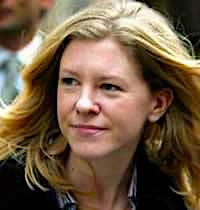
Katherine Gun
The leaked memo, published by the British Observer, was big news in parts of the world, especially the targeted countries on the Security Council, and helped prevent Bush and Blair from getting the second UN Security Council resolution they said they wanted. Veto powers Russia, China and France were opposed as well as U.S. ally Germany.
Washington invaded anyway of course — without Security Council authorization — by telling the UN weapons inspectors to leave Iraq and issuing a unilateral demand that Saddam Hussein leave Iraq in 48 hours— and then saying the invasion would commence regardless.
‘Most Courageous Leak’
It was the executive director of the Institute for Public Accuracy, where I work (accuracy.org), Norman Solomon, as well as Pentagon Papers whistleblower Daniel Ellsberg who in the U.S. most immediately saw the importance of what Gun had done. Ellsberg would later comment: “No one else — including myself — has ever done what Katharine Gun did: Tell secret truths at personal risk, before an imminent war, in time, possibly, to avert it. Hers was the most important — and courageous — leak I’ve ever seen, more timely and potentially more effective than the Pentagon Papers.”
Of course, no one knew her name at the time. After the Observer broke the story on March 1, 2003, accuracy.org put out a series of news releases on it and organized a sadly, sparsely attended news conference with Ellsberg on March 11, 2003 at the National Press Club, focusing on Gun’s revelations. Ellsberg called for more such truth telling to stop the impending invasion, just nine days away.
Though I’ve followed this case for years, I didn’t realize until recently that accuray.org’s work helped compel Gun to expose the document. At a recent D.C. showing of “Official Secrets” that Gun attended, she revealed that she had read a book co-authored by Solomon, published in January 2003 that included material from accuracy.org as well as the media watch group FAIR debunking many of the falsehoods for war.
Gun said: “I went to the local bookshop, and I went into the political section. I found two books, which had apparently been rushed into publication, one was by Norman Solomon and Reese Erlich, and it was called Target Iraq. And the other one was by Milan Rai. It was called War Plan Iraq. And I bought both of them. And I read them cover to cover that weekend, and it basically convinced me that there was no real evidence for this war. So I think from that point onward, I was very critical and scrutinizing everything that was being said in the media.”
Thus, we see Gun in “Official Secrets” shouting at the TV to Tony Blair that he’s not entitled to make up facts. The film may be jarring to some consumers of major media who might think that Donald Trump invented lying in 2017.
Gun’s immediate action after reading critiques of U.S. policy and media coverage makes a strong case for trying to reach government workers by handing out fliers and books and putting up billboards outside government offices to encourage them to be more critically minded.
Solomon and Ellsberg had debunked Bush administration propaganda in real time. But Gun’s revelation showed that the U.S. and British governments were not only lying to invade Iraq, they were violating international law to blackmail whole nations to get in line.
Mainstream reviews of “Official Secrets” still seem to not fully grasp the importance of what they just saw. The trendy AV Club review leads: “Virtually everyone now agrees that the 2003 invasion of Iraq was a colossal mistake based on faulty (at best) or fabricated (at worst) intelligence.” “Mistake” is a serious understatement even with “colossal” attached to it when the movie details the diabolical, illegal lengths to which the U.S. and British governments went to get other governments to go along with it.
Gun’s revelations showed before the invasion that people on the inside, whose livelihood depends on following the party line, were willing to risk jail time to out the lies and threats.
Portrayal of The Observer
Other than Gun herself, the film focuses on a dramatization of what happened at her work; as well as her relationship with her husband, a Kurd from Turkey who the British government attempted to have deported to get at Gun. The film also portrays the work of her lawyers who helped get the Official Secrets charge against her dropped, as well as the drama at The Observer, which published the NSA document after much internal debate.
Observer reporter Martin Bright, whose strong work on the original Gun story was strangely followed by an ill-fated stint at the Tony Blair Faith Foundation, has recently noted that very little additional work has been done on Gun’s case. We know virtually nothing about the apparent author of the NSA document that she leaked — one “Frank Koza.” Other questions persist, such as how prevalent is this sort of U.S. blackmail of foreign governments to get UN votes or for other purposes? How is it leveraged? Does it fit in with allegations made by former NSA analyst Russ Tice about the NSA having massive files on political people?
Observer reporter Ed Vulliamy is energetically depicted getting tips from former CIA man Mel Goodman. There do seem to be subtle but potentially serious deviations from reality in the film. Vulliamy is depicted as actually speaking with “Frank Koza,” but that’s not what he originally reported:
“The NSA main switchboard put The Observer through to extension 6727 at the agency which was answered by an assistant, who confirmed it was Koza’s office. However, when The Observer asked to talk to Koza about the surveillance of diplomatic missions at the United Nations, it was then told ‘You have reached the wrong number’. On protesting that the assistant had just said this was Koza’s extension, the assistant repeated that it was an erroneous extension, and hung up.”
There must doubtlessly be many aspects of the film that have been simplified or altered regarding Gun’s personal experience. A compelling part of the film — apparently fictitious or exaggerated — is a GCHQ apparatchik questioning Gun to see if she was the source.
Little is known about the reaction inside the governments of Security Council members that the U.S. spied on. After the invasion, Mexican Ambassador Adolfo Aguilar Zinser spoke in blunt terms about U.S. bullying — saying it viewed Mexico as its patio trasero, or back yard — and Zinser was compelled to resign by President Vicente Fox. He then, in 2004, gave details about some aspects of U.S. surveillance sabotaging the efforts of the other members of the Security Council to hammer out a compromise to avert the invasion of Iraq, saying the U.S. was “violating the U.N. headquarters covenant.” In 2005, he tragically died in a car crash.
“Official Secrets” director Gavin Hood is perhaps more right than he realizes when he says that his depiction of the Gun case is like the “tip of an iceberg,” pointing to other deceits surrounding the Iraq war. His record with political films has been uneven until now. Peace activist David Swanson, for instance, derided his film on drones, “Eye in the Sky.” At a D.C. showing of “Official Secrets,” Hood depicted those who backed the Iraq war as being discredited. But that’s simply untrue.
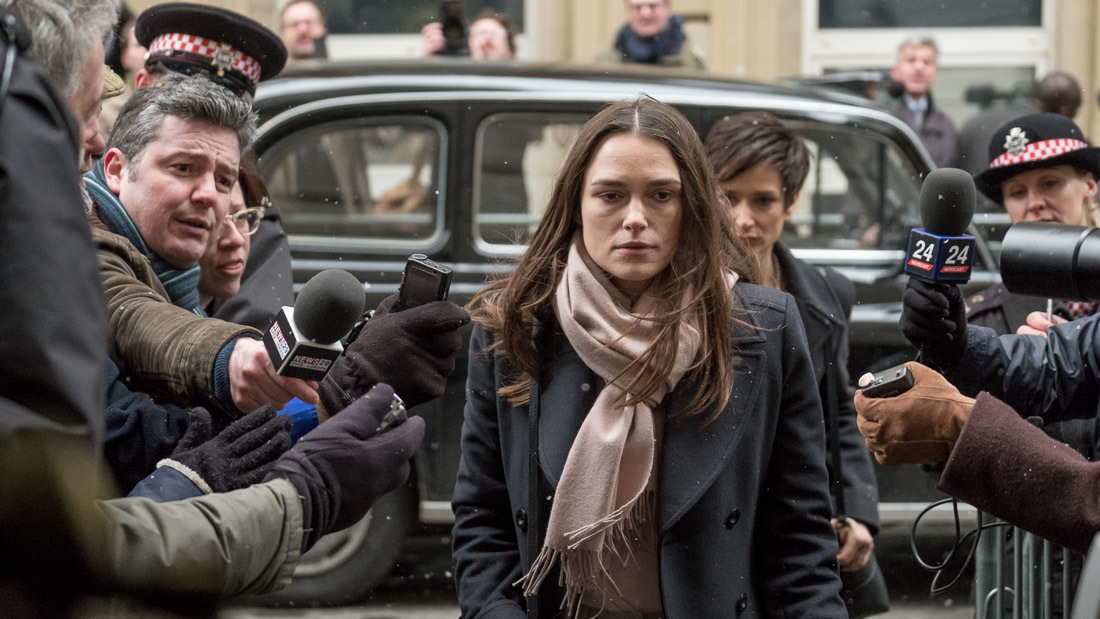
Keira Knightley appears as Katherine Gun in Official Secrets (Courtesy of Sundance Institute.)
Leading presidential candidate Joe Biden — who not only voted for the Iraq invasion, but presided over rigged hearings on in 2002 – has recently falsified his record repeatedly on Iraq at presidential debates with hardly a murmur. Nor is he alone. Those refusing to be held accountable for their Iraq war lies include not just Bush and Cheney, but John Kerry and Nancy Pelosi.
Biden has actually faulted Bush for not doing enough to get United Nations approval for the Iraq invasion. But as the Gun case helps show, there was no legitimate case for invasion and the Bush administration had done virtually everything, both legal and illegal, to get UN authorization.
Many who supported the invasion try to distance themselves from it. But the repercussions of that illegal act are enormous: It led directly or indirectly to the rise of ISIS, the civil war in Iraq and the war in Syria. Journalists who pushed for the Iraq invasion are prosperous and atop major news organizations, such as Washington Post editorial page editor Fred Hiatt. The editor who argued most strongly against publication of the NSA document at The Observer, Kamal Ahmed, is now editorial director of BBC News.
The British government — unlike the U.S.– did ultimately produce a study ostensibly around the decision-making leading to the invasion of Iraq, the Chilcot Report of 2016. But that report — called “devastating” by the The New York Times – made no mention of the Gun case. [See accuracy.org release from 2016: “Chilcot Report Avoids Smoking Gun.”]
After Gun’s identity became known, the Institute for Public Accuracy brought on Jeff Cohen, the founder of FAIR, to work with Hollie Ainbinder to get prominent individuals to support Gun. The film — quite plausibly — depicts the charges being dropped against Gun for the simple reason that the British government feared that a high profile proceeding would effectively put the war on trial, which to them would be have been a nightmare.
Sam Husseini is an independent journalist, senior analyst at the Institute for Public Accuracy and founder of VotePact.org. Follow him on twitter: @samhusseini.
Who is Woods Hole Oceanographic Institution? Oceanographer or defense contractor?

R/V Neil Armstrong arrives at Woods Hole Oceanographic … collectspace.com
By Richard Hugus | August 28, 2019
WHOI is the acronym for the ‘Woods Hole Oceanographic Institution’, based on Cape Cod, Town of Falmouth, village of Woods Hole, Massachusettts. On August 2, 2019 WHOI applied to the town of Falmouth for the clearing of 2.7 acres of woodland and the construction of a 3 story, 50,000 square foot building on what it calls its Quissett Campus, about a mile north of Woods Hole village. Woods Hole residents, the town of Falmouth, and a regulating authority called the Cape Cod Commission are now in the position of having to evaluate the proposed project and decide on approving it. Documentation and promotion of the project provided by WHOI to the Falmouth Planning Department, and summarized by the Falmouth Enterprise, says its new building — the New Quissett Facility — “is proposed as a ‘technology accelerator . . . by creating this facility the NQF will become the epicenter of autonomous vehicle, sensor, and technology innovation at WHOI and around the world and could lead to a net increase in regional economic activity.”
Mention of “autonomous vehicle and sensor technology” brings up the question of military research into and use of underwater drone and warfare technology and WHOI’s role in developing that technology. Though operating for years in the midst of a pleasant residential and tourist area, few people are aware that WHOI is a defense contractor. The Institution was created in 1930 and was devoted solely to defense work during World War II. In all available documents submitted to the Cape Cod Commission for its recent building projects, and in all currently available representations of its activities to the public, WHOI describes itself as a scientific and educational institution dedicated solely to studying the ocean. In its documentation for the Quissett project, WHOI calls itself “the world’s largest non-profit dedicated to ocean research.” The omission by WHOI of its significant military research and development amounts to deception. WHOI receives major funding from the Office of Naval Research, which “coordinates, executes, and promotes the science and technology programs of the United States Navy and Marine Corps.” These programs are highly unlikely to be peaceful and benevolent. The US Navy and Marines are, afterall, in the business of war.
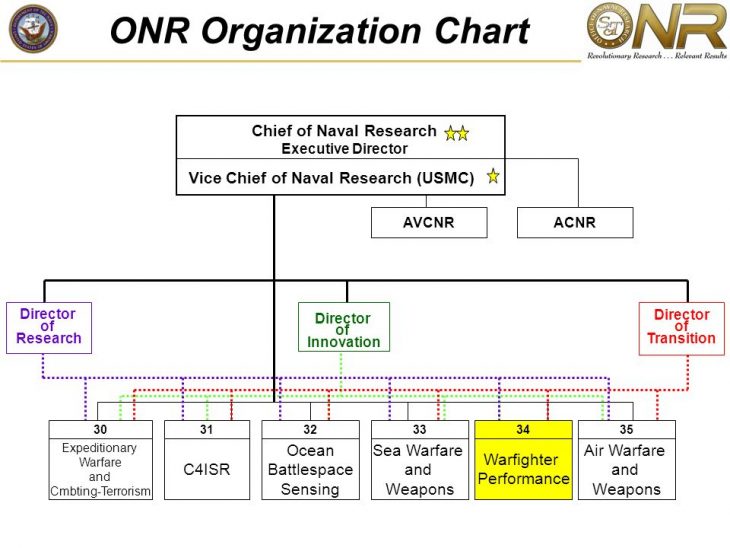
Source: slideplayer.com (C4ISR-Command, Control, Communications, Computers, Intelligence, Surveillance and Reconnaissance)
A July 20, 2018 Department of Defense listing of Navy/Office of Naval Research contracts states: “Woods Hole Oceanographic Institution, Woods Hole, Massachusetts, is awarded a $7,719,478 cost-plus-fixed-fee contract for development and demonstration of advanced ocean battlespace capabilities . . . This contract was competitively procured . . . for science and technology projects for advancement and improvement of Navy and Marine Corps operations, including Ocean Battlespace Sensing . . . The Office of Naval Research, Arlington, Virginia, is the contracting activity . . .”
Ocean Battlespace Sensing has to do with submarine and mine warfare. There is no information on WHOI’s web site about this nearly $8 million grant, or about what it is doing in the area of ocean battlespace sensing and submarine warfare. On April 7, 2016 when the new research vessel Neil Armstrong first arrived in Woods Hole, Dr. Frank Herr, head of the U.S. Navy’s Ocean Battlespace Sensing department (so-called “code 32” above), was among the notables addressing a gathered crowd. WHOI Director Mark Abbott also spoke, telling him and others, “We’re very proud to have been selected by the Office of Naval Research to operate the Neil Armstrong.” Navy-owned ships and advanced ocean battlespace work are not what we normally associate with a “non-profit organization dedicated to ocean research, exploration, and education” — WHOI’s stated activities. Defense-related activities are clearly a part of WHOI’s operations, but they are consistently edited out of the public image WHOI promotes.
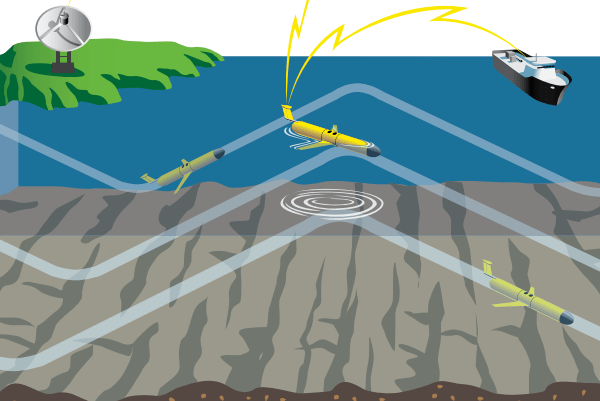
The Next Level – Drone Wars, breakfornews.com
As another example: according to an April 22, 2019 report by the DoD Defense Logistics Agency: “Woods Hole Oceanographic Institution, Woods Hole, Massachusetts, is awarded an $8,421,581 cost-plus-fixed-fee contract for the research effort entitled, “Project Sundance.” Except for the announcement of this contract, there is no information available anywhere on the web, or at WHOI’s own web site, about what Project Sundance is, leaving one to wonder if the project is classified — i.e., something the public is not entitled to know about.
Finally, in 1985, WHOI achieved fame when one of its scientists, Robert Ballard, discovered the wreckage of the Titanic. It wasn’t until years later that we got the full story. According to The National Geographic (November 21, 2017), the Titanic discovery only happened by the way in what was actually a top secret military operation to find two wrecked US Navy nuclear submarines. Remote sensing technology and an underwater submersible vehicle developed in Woods Hole and used aboard the WHOI research vessel, Knorr, was used in the discovery. National Geographic tells us the Knorr’s true mission: “the military wanted to know the fate of the nuclear reactors that powered the ships . . . this knowledge was to help determine the environmental safety of disposing of additional nuclear materials in the oceans.”
Ballard held the rank of Commander in the US Navy and was working as a liason to WHOI from the Office of Naval Research at the time of the discovery. Research on disposal of nuclear waste in the ocean is hardly in keeping with WHOI’s stated mission, “to advance knowledge about our planet, but also to ensure society’s long-term welfare and to help guide human stewardship of the environment.” Moreover, by making it look like this was just a fun adventure undertaken by WHOI to solve the mystery of the Titanic, a hoax was perpetrated on the public.
WHOI, the proponent of this new building project, is not being fully honest in the descriptions it gives of its mission and operations in Woods Hole. This calls WHOI’s credibility and full disclosure into question, and prompts further questions about the military-related role of the proposed new facility — “the epicenter of autonomous vehicle, sensor, and technology innovation.” The mentioned technology may well have uses in oceanographic research, but it may equally well have to do with “ocean battlespace sensing” — i.e., marine warfare. WHOI advertises itself as a humanitarian scientific institution without mentioning the clearly relevant fact that a significant part of its funding and research is from and for the US Department of Defense. It is not possible to fully evaluate a building proposal from an institution that is involved in secret projects because Cape Cod residents have no way of knowing if they are being given all the facts. Indeed, they have good reason to believe they are not being given all the facts,
The US military and its supporting contractors are the main source of wars of aggression and misery in the world today. It would be unethical to support expensive new facilities, paid for with our tax dollars and with what is left of our open space, for one of those contractors on Cape Cod. Yet war and militarization are so normalized in the American landscape, it is as if this is not even an issue.
Featured Video
Diplomacy is Now a Crime in Britain / Ian Proud
or go to
Aletho News Archives – Video-Images
From the Archives
Genetic baloney in thick slices
MAYBE COULD BE INC.
By Jon Rappoport | No More Fake News | July 8, 2021
Gene research companies tend to come and go. They start out banging and popping like fireworks in the sky, and then they fade out—selling themselves to larger outfits who’ve hired better liars…
Once upon a time, it sounded easy. Start with a disease, find the gene responsible for the disease, and correct the problem.
Then, researchers wondered, was disease the result of one gene or a group of genes acting together?
Either way, the proof would be in devising cures for diseases using gene therapy. “Not yet, but soon…”
And regardless, the major need was: money. Lots and lots of money.
This need required good PR people. “We have to pump up the idea that we’re on the edge of tremendous breakthroughs. We’re always on that edge…”
This hype also needed to obscure the fact that there wasn’t (and isn’t) ANY gene cure for ANY disease. … continue
Blog Roll
 Aletho News
- Diplomacy is Now a Crime in Britain / Ian Proud
- UK Government Body Kept Files on People Criticizing Prevent Program
- US military withdrawal from Iraq and the collapse of US-Israeli hegemonic project in West Asia
- What does Europe want – a war with Russia?
- She Followed the Actual Data on COVID Vaccines and Masks — Her Career Took a Huge Hit
- Florida AG Sues Pfizer, Bourla Over Deceptive Marketing of COVID Vaccines
- Von der Leyen gifts her spin doctor a job for life
- 10K More U.S. Troops Deploy as Trump Weighs New Iran Strikes /Suliaman Ahmed
- Iranian crew declared Dena training vessel ‘unarmed’ to US warship before deadly torpedo strike: Report
- Iran’s NPT debate moves beyond parliament
- If Americans Knew
- An error has occurred; the feed is probably down. Try again later.
- No Tricks Zone
- Green Energy Debacle: German Expert Professor Fritz Vahrenholt Warns Of Severe Economic And Social Consequences
- Two More Paleo Reconstructions Affirm Meters-Higher Sea Levels Across Ireland, Brazil 7000-6000 Years Ago
- New Study: Earth And Venus Surface Warmth Largely Explained By Convection And Lapse Rate, Not CO2 Or Radiation
- 2025 Nature Paper Claiming Worsening Global Drought Gets RETRACTED …Heavily Flawed
- New Study: ‘Global Drought Shows No Detectable Recent Acceleration Under Climate Warming’
- Economic Masterminds: German Socialists Suggest Taxing Productivity Gains Stemming From Using AI
- The South China Sea Has Not Been Cooperating With The Climate Change Narrative
- Energy Crisis: Germany Enters Heating Season With Historically Low Gas Reserve Fill Levels
- New Study: The Antarctic Ice Sheet Gained Mass From 2020-2024 Due To Staggering Snow And Ice Accumulation
- Study: Ocean Heating Rates From Thousands Of Years Ago ‘Dwarf’ Modern Ocean Heating Rates

