Salisbury & Amesbury Cases: Top 5 Unsubstantiated Pieces of ‘Evidence’
Sputnik – July 23, 2018
Since March the UK government has been offering up a wild grab-bag of alleged evidence of Russian involvement in the attack on the ex-GRU colonel Sergei Skripal and his daughter in Salisbury, having followed through with the same pattern in a similar Amesbury incident earlier this month. Yet, they seem to have failed to substantiate their claims.
Here are some of the most widely speculated pieces of evidence London has presented.
Photo of Amesbury Perpetrator
Earlier in the day, the police investigating the alleged poisoning of the Skripal family in Salisbury and Charlie Rowley and the now-deceased Dawn Sturgess in Amesbury have reportedly obtained the picture of a potential suspect. There’s only a slight problem – the photo in question has not been released to the public so far, albeit the investigators have purportedly shown it to the “key witnesses.”
The police have suggested that a group of four people, including a woman, who is believed to be Russian assassin ordered to poison Sergei Skripal, was behind the Amesbury attack.
Local media speculated that the police obtained those images from CCTV camera footage using facial recognition technology, which according to an investigative report by The Independent, proved to be only 2 percent effective.
Mysterious Novichok Perfume Bottle
In a desperate search for the source of contamination in Amesbury, the police declared nearly two weeks ago they had discovered a small bottle that stored the deadly nerve agent the UK authorities call Novichok.
In the meantime, British media cited Charlie Rowley’s brother Matthew as saying that the victim told him he had found “something that looked like a perfume bottle,” with his partner, Dawn, spraying the content on her wrists and then passing it to Charlie.
The object that by a twist of fate appeared in Rowley’s apartment somehow “splintered or broke in his hands,” Matthew said – and yet the police later managed to find some bottle, ostensibly containing the nerve agent.
The entire case has been largely questioned by ordinary Britons, with some highlighting that both Amesbury and Salisbury are, by an odd coincidence, located just 7-8 miles away from one of the UK’s government’s main chemical research facilities, the Porton Down lab.
A friend of the couple earlier suggested that they might have been contaminated while “dumpster diving outside of charity shops, going through the stuff they used to chuck out.”
Two Hitmen With Close Ties to Russia
Earlier this month, British media cited sources in Scotland Yard as saying that “a two-man hit team with close ties to Russia” orchestrated the alleged attack on the Skripals in March. According to the sources, the police were sure they had made a “huge breakthrough” by finding the two suspects, who had ostensibly fled the country within 24 hours of the assault.
With an accuracy of “highly likely,” British law enforcement officials reportedly said that the perpetrators are “now thought to be back in Russia and under the protection of President Vladimir Putin.”
Sergei and Yulia Skripal were found unconscious in March after allegedly being exposed to a toxin, later identified by the UK police as the lethal nerve agent Novichok, “developed in Russia.” Despite the initial claims that the two might never recover, they were discharged from the hospital, with medics saying they were no longer in critical condition.
Different City, Same Old Novichok
Immediately after the UK authorities reported that two people, later identified as Rowley and Sturgess, had been hospitalized after being exposed to an unknown substance in Amesbury, Home Secretary Sajid Javid claimed that it was the same nerve agent – Novichok – that was used against the Skripals.
“It is now time that the Russian state comes forward and explains what has gone on,” he said.
Javid was so convinced that Russia was behind the attack, that he failed to provide any evidence to support his bold accusations. He, however, added that London didn’t “want to jump to conclusions,” and that it wasn’t planning to impose additional sanctions on Moscow for the incident.
At the same time, the police said that detectives have been unable to confirm whether the nerve agent was from the same batch.
“They are unable to say at this moment whether or not the nerve agent found in this incident is linked to the attack on Sergei and Yulia Skripal. However, this remains our main line of inquiry,” the counter-terrorism office representative, Neil Basu, said early in July.
UK Government’s Skripal Slides
The UK authorities have turned to PowerPoint to make the case that Russia orchestrated the attack on Sergei Skripal – and the slideshow was leaked.
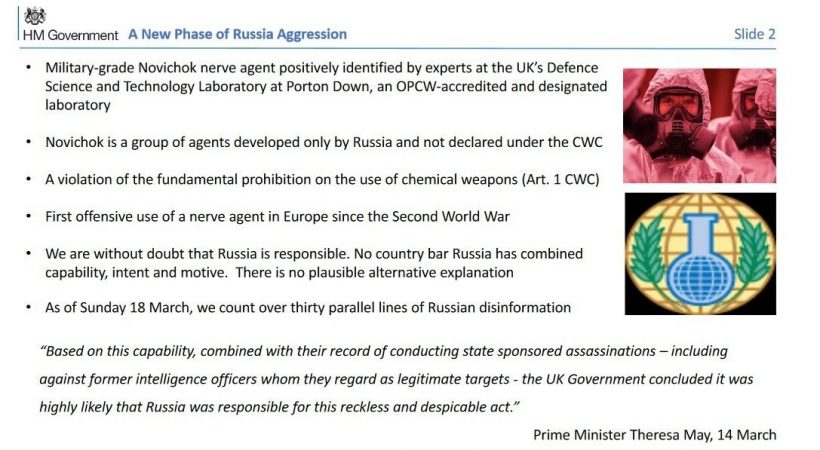
Slide Two in the UK Government’s Presentation to Foreign Governments on Sergei Skripal’s Poisoning
Instead of presenting evidence of Russia’s alleged involvement or wait until the investigation is over, the British government simply concluded that Moscow was “without doubt responsible” just because “there is no plausible alternative explanation.” Very convincing.
Moscow has on multiple occasions denied any involvement in the Salisbury and Amesbury incidents, with the Russian Foreign Ministry’s spokeswoman describing the presentation as a “massive manipulation of world public opinion” on the basis of “six pictures.”
READ MORE:
UK Investigators Reportedly Obtain Photo of Amesbury Poisoning Perpetrator
Amesbury Poisoning: Deceased Woman Reportedly Sprayed Nerve Agent on Herself
Moon-Strzok No More, Lisa Page Spills the Beans
By Ray McGovern | Consortium News | July 23, 2018
Former FBI attorney Lisa Page has reportedly told a joint committee of the House of Representatives that when FBI counterintelligence official Peter Strzok texted her on May 19, 2017 saying there was “no big there there,” he meant there was no evidence of collusion between the Trump campaign and Russia.
It was clearly a bad-luck day for Strzok, when on Friday the 13th this month Page gave her explanation of the text to the House Judiciary and Oversight/Government Reform Committees and in effect threw her lover, Strzok, under the bus.
Strzok’s apparent admission to Page about there being “no big there there” was reported on Friday by John Solomon in The Hill based on multiple sources who he said were present during Page’s closed door interview.
Strzok’s text did not come out of the blue. For the previous ten months he and his FBI subordinates had been trying every-which-way to ferret out some “there” — preferably a big “there” — but had failed miserably. It is appearing more and more likely that there was nothing left for them to do but to make it up out of whole cloth, with the baton then passed to special counsel Robert Mueller.
The “no there there” text came just two days after former FBI Director James Comey succeeded in getting his friend Mueller appointed to investigate the alleged collusion that Strzok was all but certain wasn’t there.
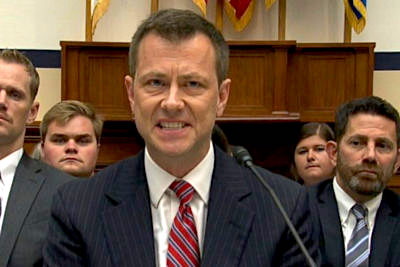
Strzok during his public testimony earlier this month.
Robert Parry, the late founder and editor of Consortium News whom Solomon described to me last year as his model for journalistic courage and professionalism, was already able to discern as early as March 2017 the outlines of what is now Deep State-gate, and, typically, was the first to dare report on its implications.
Parry’s article, written two and a half months before Strzok texted the self-incriminating comment to Page on there being “no big there there,” is a case study in professional journalism. His very first sentence entirely anticipated Strzok’s text: “The hysteria over ‘Russia-gate’ continues to grow … but at its core there may be no there there.”(Emphasis added.)
As for “witch-hunts,” Bob and others at Consortiumnews.com, who didn’t succumb to the virulent HWHW (Hillary Would Have Won) virus, and refused to slurp the Kool-Aid offered at the deep Deep State trough, have come close to being burned at the stake — virtually. Typically, Bob stuck to his guns: he ran an organ (now vestigial in most Establishment publications) that sifted through and digested actual evidence and expelled drivel out the other end.
Those of us following the example set by Bob Parry are still taking a lot of incoming fire — including from folks on formerly serious — even progressive — websites. Nor do we expect a cease-fire now, even with Page’s statement (about which, ten days after her interview, the Establishment media keep a timorous silence). Far too much is at stake.
As Mark Twain put it, “It is easier to fool people than to convince them that they have been fooled.” And, as we have seen over the past couple of years, that goes in spades for “Russia-gate.” For many of us who have looked into it objectively and written about it dispassionately, we are aware, that on this issue, we are looked upon as being in sync with President Donald Trump.
Blind hatred for the man seems to thwart any acknowledgment that he could ever be right about something—anything. This brings considerable awkwardness. Chalk it up to the price of pursuing the truth, no matter what bedfellows you end up with.
Courage at The Hill
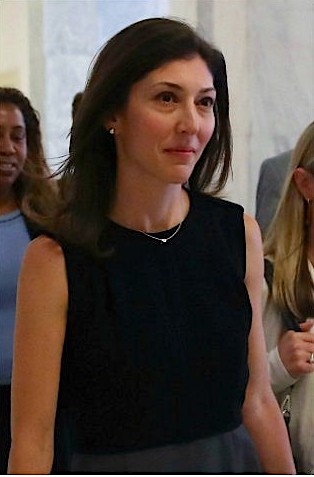
Page: Coughs up the meaning of ‘there.’
Solomon’s article merits a careful read, in toto. Here are the most germane paragraphs:
“It turns out that what Strzok and Lisa Page were really doing that day [May 19, 2017] was debating whether they should stay with the FBI and try to rise through the ranks to the level of an assistant director (AD) or join Mueller’s special counsel team. [Page has since left the FBI.]
“‘Who gives a f*ck, one more AD [Assistant Director] like [redacted] or whoever?’” Strzok wrote, weighing the merits of promotion, before apparently suggesting what would be a more attractive role: ‘An investigation leading to impeachment?’ …
“A few minutes later Strzok texted his own handicap of the Russia evidence: ‘You and I both know the odds are nothing. If I thought it was likely, I’d be there no question. I hesitate in part because of my gut sense and concern there’s no big there there.’
“So the FBI agents who helped drive the Russia collusion narrative — as well as Rosenstein’s decision to appoint Mueller — apparently knew all along that the evidence was going to lead to ‘nothing’ and, yet, they proceeded because they thought there was still a possibility of impeachment.”
Solomon adds: “How concerned you are by this conduct is almost certainly affected by your love or hatred for Trump. But put yourself for a second in the hot seat of an investigation by the same FBI cast of characters: You are under investigation for a crime the agents don’t think occurred, but the investigation still advances because the desired outcome is to get you fired from your job. Is that an FBI you can live with?”
The Timing
As noted, Strzok’s text was written two days after Mueller was appointed on May 17, 2016. The day before, on May 16, The New York Times published a story that Comey leaked to it through an intermediary that was expressly designed (as Comey admitted in Congressional testimony three weeks later) to lead to the appointment of a special prosecutor to investigate collusion between the Trump campaign and Russia. Hmmmmm.
Had Strzok forgotten to tell his boss that after ten months of his best investigative efforts — legal and other—he could find no “there there”?
Comey’s leak, by the way, was about alleged pressure from Trump on Comey to go easy on Gen. Michael Flynn for lying at an impromptu interrogation led by — you guessed it — the ubiquitous, indispensable Peter Strzok.
In any event, the operation worked like a charm — at least at first. And — absent revelation of the Strzok-Page texts — it might well have continued to succeed. After Deputy Attorney General Rod Rosenstein named Mueller, one of Comey’s best buddies, to be special counsel, Mueller, in turn, picked Strzok to lead the Russia-gate team, until the summer, when the Department of Justice Inspector General was given the Strzok-Page texts and refused to sit on them.
A Timeline
Here’s a timeline, which might be helpful:
2017
May 16: Comey leak to NY Times to get a special counsel appointed
May 17: Special counsel appointed — namely, Robert Mueller.
May 19: Strzok confides to girlfriend Page, “No big there there.”
July: Mueller appoints Strzok lead FBI Agent on collusion investigation.
August: Mueller removes Strzok after learning of his anti-Trump texts to Page.
Dec. 12: DOJ IG releases some, but by no means all, relevant Strzok-Page texts to Congress and the media, which first reports on Strzok’s removal in August.
2018
June 14: DOJ IG Report Published.
June 15; Strzok escorted out of FBI Headquarters.
June 21: Attorney General Jeff Sessions announces Strzok has lost his security clearances.
July 12: Strzok testifies to House committees. Solomon reports he refused to answer question about the “there there” text.
July 13: Lisa Page interviewed by same committees. Answers the question.
Earlier: Bob Parry in Action
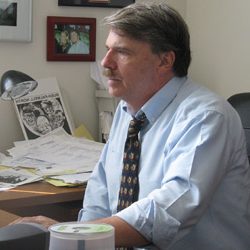
Journalist Robert Parry
On December 12, 2017, as soon as first news broke of the Strzok-Page texts, Bob Parry and I compared notes by phone. We agreed that this was quite big and that, clearly, Russia-gate had begun to morph into something like FBI-gate. It was rare for Bob to call me before he wrote; in retrospect, it seemed to have been merely a sanity check.
The piece Bob posted early the following morning was typical Bob. Many of those who click on the link will be surprised that, last December, he already had pieced together most of the story. Sadly, it turned out to be Bob’s last substantive piece before he fell seriously ill. Earlier last year he had successfully shot downother Russia-gate-related canards on which he found Establishment media sorely lacking — “Facebook-gate,” for example.
Remarkably, it has taken another half-year for Congress and the media to address — haltingly — the significance of Deep State-gate — however easy it has become to dissect the plot, and identify the main plotters. With Bob having prepared the way with his Dec.13 article, I followed up a few weeks later with “The FBI Hand Behind Russia-gate,” in the process winning no friends among those still suffering from the highly resistant HWHW virus.
VIPS
Parry also deserves credit for his recognition and appreciation of the unique expertise and analytical integrity among Veteran Intelligence Professionals for Sanity (VIPS) and giving us a secure, well respected home at Consortium News.
It is almost exactly a year since Bob took a whole lot of flak for publishing what quickly became VIPS’ most controversial, and at the same time perhaps most important, Memorandum For the President; namely, “Intelligence Veterans Challenge ‘Russia Hack’ Evidence.”
Critics have landed no serious blows on the key judgments of that Memorandum, which rely largely on the type of forensic evidence that Comey failed to ensure was done by his FBI because the Bureau never seized the DNC server. Still more forensic evidence has become available over recent months to be soon revealed on Consortium News, confirming our conclusions.
Ray McGovern works with Tell the Word, a publishing arm of the ecumenical Church of the Saviour in inner-city Washington. He was a CIA analyst for 27 years and, in retirement, co-founded Veteran Intelligence Professionals for Sanity.
One FBI text message in Russia probe that should alarm every American
By John Solomon | The Hill | July 19, 2018
Lisa Page and Peter Strzok, the reported FBI lovebirds, are the poster children for the next “Don’t Text and Investigate” public service ads airing soon at an FBI office near you.
Their extraordinary texting affair on their government phones has given the FBI a black eye, laying bare a raw political bias brought into the workplace that agents are supposed to check at the door when they strap on their guns and badges.
It is no longer in dispute that they held animus for Donald Trump, who was a subject of their Russia probe, or that they openly discussed using the powers of their office to “stop” Trump from becoming president. The only question is whether any official acts they took in the Russia collusion probe were driven by those sentiments.
The Justice Department’s inspector general is endeavoring to answer that question.
For any American who wants an answer sooner, there are just five words, among the thousands of suggestive texts Page and Strzok exchanged, that you should read.
That passage was transmitted on May 19, 2017. “There’s no big there there,” Strzok texted.
The date of the text long has intrigued investigators: It is two days after Deputy Attorney General Rod Rosenstein named special counsel Robert Mueller to oversee an investigation into alleged collusion between Trump and the Russia campaign.
Since the text was turned over to Congress, investigators wondered whether it referred to the evidence against the Trump campaign.
This month, they finally got the chance to ask. Strzok declined to say — but Page, during a closed-door interview with lawmakers, confirmed in the most pained and contorted way that the message in fact referred to the quality of the Russia case, according to multiple eyewitnesses.
The admission is deeply consequential. It means Rosenstein unleashed the most awesome powers of a special counsel to investigate an allegation that the key FBI officials, driving the investigation for 10 months beforehand, did not think was “there.”
By the time of the text and Mueller’s appointment, the FBI’s best counterintelligence agents had had plenty of time to dig. They knowingly used a dossier funded by Hillary Clinton’s campaign — which contained uncorroborated allegations — to persuade the Foreign Intelligence Surveillance Act (FISA) court to issue a warrant to monitor Trump campaign adviser Carter Page (no relation to Lisa Page).
They sat on Carter Page’s phones and emails for nearly six months without getting evidence that would warrant prosecuting him. The evidence they had gathered was deemed so weak that their boss, then-FBI Director James Comey, was forced to admit to Congress after being fired by Trump that the core allegation remained substantially uncorroborated.
In other words, they had a big nothing burger. And, based on that empty-calorie dish, Rosenstein authorized the buffet menu of a special prosecutor that has cost America millions of dollars and months of political strife.
The work product Strzok created to justify the collusion probe now has been shown to be inferior: A Clinton-hired contractor produced multiple documents accusing Trump of wrongdoing during the election; each was routed to the FBI through a different source or was used to seed news articles with similar allegations that further built an uncorroborated public narrative of Trump-Russia collusion. Most troubling, the FBI relied on at least one of those news stories to justify the FISA warrant against Carter Page.
That sort of multifaceted allegation machine, which can be traced back to a single source, is known in spy craft as “circular intelligence reporting,” and it’s the sort of bad product that professional spooks are trained to spot and reject.
But Team Strzok kept pushing it through the system, causing a major escalation of a probe for which, by his own words, he knew had “no big there there.”
The answer as to why a pro such as Strzok would take such action has become clearer, at least to congressional investigators. That clarity comes from the context of the other emails and text messages that surrounded the May 19, 2017, declaration.
It turns out that what Strzok and Lisa Page were really doing that day was debating whether they should stay with the FBI and try to rise through the ranks to the level of an assistant director (AD) or join Mueller’s special counsel team.
“Who gives a f*ck, one more AD like [redacted] or whoever?” Strzok wrote, weighing the merits of promotion, before apparently suggesting what would be a more attractive role: “An investigation leading to impeachment?”
Lisa Page apparently realized the conversation had gone too far and tried to reel it in. “We should stop having this conversation here,” she texted back, adding later it was important to examine “the different realistic outcomes of this case.”
A few minutes later Strzok texted his own handicap of the Russia evidence: “You and I both know the odds are nothing. If I thought it was likely, I’d be there no question. I hesitate in part because of my gut sense and concern there’s no big there there.”
So the FBI agents who helped drive the Russia collusion narrative — as well as Rosenstein’s decision to appoint Mueller — apparently knew all along that the evidence was going to lead to “nothing” and, yet, they proceeded because they thought there was still a possibility of impeachment.
Impeachment is a political outcome. The only logical conclusion, then, that congressional investigators can make is that political bias led these agents to press an investigation forward to achieve the political outcome of impeachment, even though their professional training told them it had “no big there there.”
And that, by definition, is political bias in action.
How concerned you are by this conduct is almost certainly affected by your love or hatred for Trump. But put yourself for a second in the hot seat of an investigation by the same FBI cast of characters: You are under investigation for a crime the agents don’t think occurred, but the investigation still advances because the desired outcome is to get you fired from your job.
Is that an FBI you can live with?
John Solomon is an award-winning investigative journalist whose work over the years has exposed U.S. and FBI intelligence failures before the Sept. 11 attacks, federal scientists’ misuse of foster children and veterans in drug experiments, and numerous cases of political corruption. He is The Hill’s executive vice president for video.
In Nicaragua, is Operation “Contra bis” failing?
By Alex Anfrus | Journal of Our Americas, Investig’Action | July 21, 2018
Thrown under the spotlight since mid-April, the homeland of Sandino is still facing an intense political crisis. From now on, the crisis seems to be approaching its final resolution. On the one hand, the Nicaraguan people are mobilizing more and more alongside the authorities to help them dismantle barricades in insurgent spots. And on the other hand, in one week two big demonstrations for peace took place. Against the wishes of an opposition camp and spokespersons of the US administration, the message of Daniel Ortega during the march for peace of July 7 in Managua was crystal clear: “Here it is the people who set the rules in the Constitution of the Republic. They will not change overnight by the will of some coup leaders. If the putschists want to come to the government, let them seek the people’s vote in the next elections. With all the destruction they have provoked, we will see what support they will have.” But these facts are minimized by the private media and major news agencies, which continue to hide the evolution on the ground and blow on the embers of the dispute. Which side will tip the scales?
A dreadful propaganda scheme
In a recent article, I examined a number of contradictions in the treatment by international media of Nicaragua. Notably, one can recognize one of the principles of war propaganda which is to reverse the aggressor and the victim. The scheme works as follows: first, an opposition sector, one that refuses dialogue with the government, plans to control some parts of the capital and other cities by means of barricades. These areas are then considered “liberated from tyranny”, and thus represent the hearth of insurgency that must recur throughout the country, to defeat the operations of “repression” of police forces. This tactic of deploying barricades has been theorized as an effective means of preventing the authorities from gaining control over the national territory, because it is “impossible for the government to have enough personnel to control every inch of the country”. The first obvious thing to emphasize is that this is not a completely spontaneous crisis that emerges from a massive popular mobilization, but that there is indeed an insurrectional plan in place capable of standing up to the authorities for months. We are witnessing the first phase in the development of an unconventional war to overthrow a democratically elected government.
Then, a number of clashes take place in these areas “liberated” by the opposition. At this point, it is not trivial to note that the activists who defend these barricades are no longer peaceful protesters that the mainstream media has portrayed. Images of hooded youths handling homemade mortars and other explosive devices are impossible to conceal. In fact, they even contribute to the creation of a “romantic” dimension of popular resistance in the context of face-to-face contact with the professional police corps. This is where the second phase of the unconventional war comes in, namely the decisive role of media corporations that contribute to the production of a dominant and one-sided narrative of the crisis. It is easier to identify with a young demonstrator who is rebelling than a young police officer compelled to use force to enforce the law. Thus, when there have been deaths around the barricades, it becomes complicated for an outside observer to know the truth.
Who is not concerned with these victims?
A simple and quick tour of private media news will make anyone realize that the idealized dimension mentioned above serves only to delegitimize government action. No one is asking themselves this simple question: “Was the victim a pro-government Sandinista helping the police dismantle the barricades, or an opponent who defended them?” Many testimonies in favor of the first version have been systematically dismissed! Indeed, the role of the private media is fundamental in order to give maximum credibility to the opposition’s side of the story. Would the latter be manipulating the victims’ memory with the complicity of some private media in Nicaragua? This is quite a strong point for us: what about the many cases of victims whose membership in the pro-government camp has been proven?
In the framework of the peace talks, the Nicaraguan government first accepted that the IACHR (Note: Inter-American Commission on Human Rights, organ of the Organization of American States (OAS)) lead a human rights observation mission. But it went on to denounce that its report does not include the description of many cases of attacks against civilian victims, including public officials, as a result of the violence unleashed by the opposition. Are the dice loaded? Here are some recent examples that illustrate a much more nuanced situation than that described by some media:
– On June 19, the authorities launch an operation in Masaya to release the Deputy Director of the National Police Ramon Avellan and his agents, who were entrenched in the police station, surrounded by barricades since June 2. Every night, protesters fired mortar at the police station, accompanied by threats: “What do you think? That there were only “güevones” (rascals) in this fight? Here again, here is my little sister… ” Then, the mortar fire would start again near the police station… Under the pretext of playful action, a video shows how protesters positioned behind a barricade sing menacing songs against General Avellan, accompanied by shots. According to the Pro-Human Rights Nicaraguan Association ANPDH organization, as a result of the police rescue operation, six people – including three whose identity remains to be verified – were murdered in several surrounding neighborhoods.
– On June 30, in the context of an opposition march, a protester was shot dead. Recorded a few minutes before the tragedy by a journalist who was there, a video shows how opposition members surround a private security officer and ask him to handover his weapon, simulating a hostage situation in order to justify their action. Then, the images show a person who stands behind the agent, points a pistol at his temple and steals his rifle. Later, the protesters will attribute the death to government repression.
– On July 3, two people were kidnapped in Jinotepe by a group of armed hooded men: police major Erlin García Cortez and Enacal worker Erasmo Palacios. Three days later, Bismarck de Jesús Martínez Sánchez, a worker from the Managua City Hall, was also kidnapped. A week later, relatives had still not received any sign of life from them.
– On July 5, the lifeless body of National Police officer Yadira Ramos was found in Jinotepe. She had been kidnapped, raped and tortured. She had been forced to get off her vehicle and her husband had been killed on the spot.
– On July 6, FSLN member Roberto Castillo Cruz was killed by opposition hoodlums who held barricades in Jinotepe. His son, Christopher Castillo Rosales had been killed just a week before him. In a video published shortly before his own murder, Castillo Cruz denounced the murderers: “This criminal gang of the right has killed my son, I only ask for justice and that peace prevails so that our children do not lose their lives!”
– On July 8, during a nighttime clash in Matagalpa, a 55-year-old man named Aran Molina was killed while rescuing Lalo Soza, a Sandinista activist who was under attack. The following day, Frente Sandinista de Liberación Nacional (FSLN) paid tribute to him through a procession. The same day, two other people were killed: social worker Tirzo Ramón Mendoza, executed by hooded people after being kidnapped, and a third victim whose identity remains unknown.
– On 9 July, the authorities dismantled the barricades that prevented free movement in the towns of Diriamba and Jinotepe. Many residents then testified about the many violent actions of the opposition, including torture against the Sandinistas. At the same time, representatives of the Episcopal Conference arrived. Citizens of Jinotepe then entered the church, where they found opposition members disguised as members of the clergy. Residents accused church officials of protecting them and not saying anything or doing anything to stop the violence unleashed in the last two months. In Diriamba, the inhabitants also discovered an arsenal of mortars hidden in the church of San Sebastian.
– On July 12, a criminal gang attacked the Morrito Town Hall in Rio San Juan. A historical Sandinista fighter, Carlos Hernandez, was kidnapped there. Seriously wounded and unable to escape, a youth Sandinista activist, two police officers and their superiors are murdered. A Sandinista activist received a bullet in the abdomen. Later, schoolmaster Marvin Ugarte Campos would succumb to his injuries. The version of the opposition? It says the massacre was … a “self-attack by paramilitaries”!
It seems that some deaths and violent acts have no value, while others are erected as martyrs for a sacred cause. In the end, does everything depend on the prism through which we look at reality? Are we already placed in a camp in a conflict without knowing it or even suspecting it? In this case, would it be a waste of time to try to form one’s own opinion from fact analysis? The search for peace and truth prevents us from succumbing to such resignation.
In a remarkable 46-page work entitled “The monopoly of death – how to inflate figures to assign them to the government”, Enrique Hendrix identified the numerous inconsistencies in the various reports presented by the three main human rights organizations, the CENIDH (Nicaraguan Center for Human Rights), the IACHR and the ANPDH. Comparing the various reports from the beginning of the crisis to the date of the last reports presented (from April 18 to June 25), he concluded that the three organizations recorded a total of 293 deaths. In 26% of cases (77 citizens), information on the deaths is incomplete and remains to be verified. In 21% of cases (60 citizens), the dead are persons murdered by the opposition, either public officials or Sandinista militants who were murdered for helping the authorities dismantle the barricades. In 20% of the cases (59 citizens), the dead were protesters, opposition members or people who erected barricades. In 17% of cases (51 citizens), the dead do not have a direct relationship with the demonstrations. Finally in 16% of the cases (46 citizens), the dead were passers-by who did not take part in the clashes.
As can be seen in this study, the balance sheets of these organizations are sorely lacking in rigor and mix all sorts of victims (fights between gangs, road accidents, murders in the context of vehicle theft, conflict between land owners, police officers, a pregnant woman in an ambulance blocked by barricades …). Conclusion: if we take into account the exact circumstances of each death, it is obvious that we cannot attribute the responsibility to the government alone. In light of these elements, we have the right to challenge the international media about their lack of objectivity. Why such an alignment with a sector of the opposition who has declared itself fiercely hostile to any dialogue?
Who is not interested in dialogue?
This propaganda mechanism is completed by the “blackout” of other information that is not considered relevant. However, while the media focuses on the clashes, other sectors of the opposition continue to participate in the various sessions of the “dialogue tables for truth, peace and justice”, organized to listen to different points of view and seek to establish responsibility in the wave of violence ravaging the country. Moreover, the final conclusions of the various human rights observation missions in the country had not yet been made, they were to be discussed and include new elements. But what can we expect from the dialogue between the two parties, when a number of observers have already decided in advance that the government alone is responsible for the violence?
All over the world, the role of the police is to repress in case of “disturbance of public order”. But we struggle to understand why the authorities would order it to attack civilians wildly and arbitrarily at the same time as the peace dialogue is taking place. On the other hand, one could expect such an attitude from those who, refusing to participate in the dialogues, would seek to sabotage it, having an interest in the derailment of this process. In this case, it is not unlikely that hooded thugs have been posing as police forces on several occasions.
In any case, it is no less credible than the version of these same hooded thugs, who say that the government of Daniel Ortega would have given the green light to disguised civilians to destroy infrastructure and kill other civilians! Still, the government did not deny that at the beginning of the crisis some police officers sometimes acted using disproportionate violence, and it responded that justice will have to determine their responsibility in actions punishable by law. The National Assembly, for its part, has launched an initiative to create a “Commission for Truth, Justice and Peace” with the aim of reporting on the responsibilities of human rights violations within three months.
But in the fairy tale that the mainstream media is manufacturing from dawn to dusk, and on the internet 24 hours a day, it is not even conceivable that the government of Nicaragua is facing difficulties whose causes would be complex and numerous. The media hype and the positions of foreign political figures serve as irrefutable proof! As has been the case in Venezuela in recent years, taking the public hostage in this way is an insult to its intelligence. Of course, not everything is explained by the tentacles of the imperialist octopus. But for those who are interested in the history of inter-American relations for the last two centuries, it is not serious to forget about its weight and consider that this influence is a thing of the past.
How to export democracy in dollars
It seems that few observers are really shocked by the rapid progression of these events, which are shaped like a breadcrumb trail towards a single objective: condemning the Ortega government and demanding early elections. That’s where the hiccup is: Latin American countries where assassinations of trade unionists, peasants and social leaders have been a common thing for years, where the peace efforts of governments are considered, at best, as totally ineffective, and at worst as non-existent, such as Colombia, Honduras or Mexico, are not at all worried about the image of their “democracies”. There is something wrong, isn’t it? To shed some light on this mystery, a reminder of the history of the twentieth century is worth the detour.
The coups and destabilizations fomented from abroad, such as in the Dominican Republic or in Guatemala, show that in the second half of the 20th century the Latin-American context was still marked by the military interventionism of the Monroe Doctrine and the “manifest destiny” of the United States. It was nothing more than an imperialist policy of controlling the resources and raw materials of Latin America, now presented as an anticommunist “crusade” in the context of the Cold War. On the other hand, the dominance of the United States would not be limited to a demonstration of force based on the “regime change” and the sending of troops on the ground, but it would also take forms of cultural domination, in particular through the so-called “development aid” policies.
In his speech in January 1949, US President Harry Truman described non-industrialized countries as “underdeveloped” countries. Thus, in 1950, the American Congress passed an Act for International Development (AID). On September 4, 1961, a US Congress law replaced the AID by USAID, which was to implement a new, more comprehensive vision of “development assistance” directed anywhere in the planet. As can be seen in the coup against Jacobo Arbenz in Guatemala in 1954, the anti-communist struggle was only a pretext. The main concern of the US government was to prevent the development of national consciousness within the armies and police of “underdeveloped countries”. That is why, from 1950 to 1967, “the United States government spent more than $ 1,500 million on military aid to Latin American countries.” (1)
After the victory of the Cuban Revolution in 1959, John Kennedy announced the Alliance for Progress in 1961. It was a similar initiative to the Marshall Plan in Europe. Between 1961 and 1970, the Alliance for Progress provided $ 20 billion in economic assistance to Latin America. One of the objectives was the stabilization of the regimes that fought against communism and the influence of Cuba.
“John F. Kennedy and his advisers are developing an action plan for the region, the Alliance for Progress, consisting of a $ 20 billion investments for economic development and massive military assistance. The decade of the sixties is marked by the formation of a new generation of Latin American military and the transfer of capital and technology from the US military to Latin America. The Pentagon and the CIA draw their strategy to halt the advance of socialism: the US Army-run Panama School trains the cadres of the Latin American armed forces “. (2)
Under the fallacious concept of “development aid policies”, the “creation of strong armies and police” and “military aid to reactionary and pro-imperialist regimes” served to offer to the monopolies “the most favorable conditions of exploitation of underdeveloped countries “. (3) In other words, this “aid” represented above all a political weapon in favor of the economic interests of the countries of the Global North. These were represented in the OECD (Organization for Economic Co-operation and Development), founded in 1961 and also known as the “Rich Country Club”. It consisted of 27 countries, mostly those of North America, Western Europe and Japan.
Resistance emerges sooner or later
But the new reality resulting from decolonization in Asia and Africa also represented an awareness: the strength of the liberated countries now resided in their unity. This would enable them to exercise some orientation on the agenda of the United Nations General Assembly, and to defend the autonomous “right to development”. Thus, in the 1970s, the United Nations Conference on Trade and Development (UNCTAD) would play an important role in defending the interests of the Group 77. Created in 1964, UNCTAD was characterized by the Common Declaration of the 77 countries as a “historic turning point”.
The invasion and the military occupation of Nicaragua by the United States makes it possible to better appreciate the historical value of the Sandinista Popular Revolution and the resistance to the interferences which it showed in the 1980s. The scandal of the financing of Contras by the CIA through the drug trade in Central America was proof that these plans are not infallible. Despite the many interferences and destabilizations suffered throughout history, the peoples of the South have an advantage over the powerful: collective memory and intelligence.
After the dictatorships’ repression, the debt crisis and the rule of the IMF in the 1970s and 1980s, Latin America was to experience many social revolts in the 1990s, paving the way for the arrival of new progressive governments in Brazil, Ecuador, Venezuela or Bolivia. The next step was to launch the Bolivarian Alliance for the Peoples of Our America (ALBA), a regional cooperation body created in 2004 to defeat the proposed Free Trade Area of the Americas (ALCA in Spanish) by the United States.
What remains today of yesterday’s meddling?
Since the 1990s, at the end of the Cold War, US aid no longer had the pretext of restraining communism. It then took the form of “counter-terrorism” or “security and anti-drug policies”. Here are the main recipients of US aid in Latin America: $ 9.5 billion for Colombia; $ 2.9 billion for Mexico; and since 2016, aid to all countries in the Northern Triangle of Central America (El Salvador, Guatemala and Honduras) has exceeded that of the first two. (4) Which explains why we systematically condemn some countries and not others… regardless of reality and the degree of violence.
Yet the Cold War is not over in the minds of some. Thus, OAS Secretary General Luis Almagro believes it is necessary in 2018 to comply with White House requirements, and to harass night and day countries such as Nicaragua or Venezuela at the risk of being ridiculed. Indeed, when in a special session of the OAS the US spokesperson has just criticized the violence in Nicaragua and attributed it exclusively to the government, can we take his word for it? It would be better to remind him that his country does not have the slightest legitimacy to talk about Nicaragua, because it invaded and occupied it militarily for 21 years, then went on to support the clan of the dictator Somoza for another 43 years!
The “conservative restoration” of recent years, with the “soft coups” to overthrow Lugo in Paraguay, Zelaya in Honduras, Rousseff in Brazil; the failure of the peace process in Colombia, the judicial persecution against Jorge Glas, Lula Da Silva and now Rafael Correa, is the ideal context for the OAS, this obsolete organization, to try to put an end to the memory of the social achievements of recent years.
Since the US did not invent hot water, to reach their ends they must use the means at hand. Unsurprisingly, Freedom House, funded among others by USAID and the National Endowment for Democracy (NED), decided to create a special task force to fight the FSLN in Nicaragua in 1988. It is always opportune to hear NED Co-Founder Allen Weinstein: “A lot of what we do today was done covertly 25 years ago by the CIA. The biggest difference is that when such activities are done overtly, the flap potential is close to zero. Openness is its own protection.”. (5)
Today, the interference keeps going through the financing of opposition movements, framed by training programs for “young leaders” ready to defend tooth and nail the values of the sacrosanct “democracy” and to overthrow “dictatorships” from their countries of origin. From 2014 to 2017, the NED has dedicated up to $ 4.2 million to Nicaraguan organizations such as IEEPP (Institute for Strategic Studies and Public Policy), CPDHN (Human Rights Permanent Commission in Nicaragua), Invermedia, Hagamos Democracia and Fundacion Nicaraguense para el Desarrollo Economico y Social. When we remind this to young opponents and their sympathisers, they pretend not to understand…
While it may have been extremely effective in some countries like Ukraine in 2014, the pattern we have described must be confronted with the reality and political traditions of each country. In Nicaragua, the FSLN is the dominant political force that has won democratically in the last three elections. It is significant that opposition sectors that rely on the support of the US, the right wing, and local employers are forced to use references to Sandinismo in an attempt to gain credibility. However, this practice goes too far when it tries to compare the Sandinista government and the dictatorship of Somoza, thus demonizing Daniel Ortega.
The march for peace convened by the FSLN on July 13, in tribute to the 39th anniversary of the historic “tactical retreat” of Sandinism in Masaya, was a new show of strength of the Nicaraguan people and its willingness to defeat the violent strategy of the opposition. Will the peoples of the world live up to the solidarity that this moment demands?
Notes
1) Yves Fuchs; La coopération. Aide ou néo-colonialisme ? Editions Sociales. Paris, 1973, pp. 55 (Cooperation. Help or neo-colonialism?)
2) Claude Lacaille; En Mission dans la Tourmente des Dictatures. Haïti, Equateur, Chili : 1965-1986. Novalis, Montreal, 2014. p 23. (In Mission in the Torment of Dictators. Haiti, Ecuador, Chile: 1965-1986)
3) Gustavo Esteva, “Desarrollo” in SachsWolfgang (coord.) Diccionario del Desarrollo, Lima, PRATEC, 1996. p. 52.
4) https://www.wola.org/es/analisis/ayuda-militar-de-estados-unidos-en-latinoamerica/
5) Washington Post, 22 September 1991.
The Salisbury Poisonings: “Novichok” – The Odourless Nerve Agent That Stinks to High Heaven
By Rob Slane | The Blog Mire | July 20, 2018
Here is a little primer for the British Government on basic logic. Actions have consequences. What this means is that consequences must stem from actions. And the two must be connected. So far so good?
Let me give an example. If I spill boiling hot coffee on my foot, it will cause me pain and possibly even a blister. To flip that over, if I have a blister on my foot, you might ask me, “Oh, how did you get that?” If I told you that I spilt hot coffee on my foot, you would probably wince and say something like, “Ouch, that must have hurt.” And the chances are that you would be satisfied with my explanation. Why? Because boiling hot coffee split on the foot is quite capable of causing a blister.
But what if, in answer to your question of how I came to get the blister, I told you that I spilt some orange juice on my hand. Would you accept my answer? Would you wince and say, “Ouch, that’s gotta hurt”? Would you go away and say to others, “Poor guy, he spilt orange juice on his hand, and now he’s got a horrible blister on his foot”? Probably not!
Your reaction would probably be more along the lines of, “Huhhh??? You spilt orange juice on your hand, and you got a blister on your foot? What are you talking about?” And the reason for this reaction is that you understand that actions have consequences, and consequences stem from actions. And we all know that whereas spilling boiling hot coffee on the foot might well cause the foot to blister, spilling orange juice on your hand will not have that effect.
This is why the Government’s explanation of the Salisbury and Amesbury poisonings is so obviously false. It fails the test of basic logic. All of the pre-2018 literature on the substance known as A-234 (one of the strains of so-called “Novichok”) states that it is lethal, and most sources tell us that it is around 5-8 times more toxic than VX. What happens if you get some of it on you? One of its creators, Vladimir Uglev, has told us what happened after he got a tiny amount of this agent on his hand:
“‘I rinsed my hands with sulfuric acid and then put them under tap water,’ he said, adding it was the only way to survive. Another researcher who was contaminated in 1987 died of multiple illnesses five years later [my emphasis].”
The only way to survive? Sulfuric acid followed by lots of running water? Has there been any confirmation that after the Skripals and DS Bailey allegedly came into contact the substance, they immediately washed their hands with sulfuric acid and water? I haven’t come across this particular detail yet, but if anybody has, do let me know. And lest anyone says that the substance that the Skripals got on their skin might have been less potent than the substance Mr Uglev got on his hand, the OPCW report of 4th May claimed that traces of the substance, allegedly on the door handle, weeks after the incident, were of “high purity”.
So they got the same substance on their hands as Mr Uglev, yet whilst for him it meant:
Sulfuric Acid + Water or Face Instant Death
For Mr Skripal and his daughter it meant:
Feeding the Ducks + Drink + Meal
Mr Uglev is no friend of the current Russian Government, but in case anyone is not satisfied with his testimony, note that it was essentially backed up recently by Alistair Hay, Professor of Environmental Toxicology at the University of Leeds, who said this in relation to the more recent Amesbury case:
“A few millilitres would be sufficient to probably kill a good number of people and you could store that in a small ampoule, or it might be in a small container like for nail varnish.”
His testimony regarding the container is particularly useful, I’m sure, and is just the sort of thing that sets Professors apart from the rest of us. I mean, who knew that liquid can be stored in a container? But it’s the other part of it that is truly fascinating. He is of course correct to say that a few millilitres of military grade nerve agent is enough to kill many people – sulfuric acid and water notwithstanding. This is what it is designed to do. So doesn’t he think it mighty odd that it somehow didn’t do this, even thought it was apparently “high purity” and “military grade”? Furthermore, doesn’t he find it odd that underneath his claim, Public Health England once again advised people who thought they might have come into contact with it to:
“Wipe personal items such as phones, handbags and other electronic items with cleansing or baby wipes and dispose of the wipes in the bin (ordinary domestic waste disposal) … Please thoroughly wash your hands with soap and water after cleaning any items.”
Wot no sulfuric acid??? Or are they now making baby wipes with traces of sulfuric acid these days? Just in case.
Coming into contact with more than a few millilitres of high purity A-234, and then going to feed ducks, have a drink and eat a meal is no more plausible than the claim that spilling orange juice on the hand leads to blisters on the foot.
But this is not all. I have consciously avoided commenting much on the Amesbury case, and this for two reasons. Firstly, because the level of disinformation and propaganda around the case means that trying to keep up with it is nigh on impossible. But more importantly, it is because the second case is being used by the authorities to shore up the first case, by a very clever sleight of hand, as if the claims made in the first case have been proven. Which they haven’t.
I’ll show you what I mean. In her statement to the House of Commons in 14th March, Mrs May said the following:
“And there were only two plausible explanations. Either this was a direct act by the Russian State against our country. Or conceivably, the Russian government could have lost control of a military-grade nerve agent and allowed it to get into the hands of others. [my emphasis]”
Since then, not only has the Government singularly failed to provide the evidence to back up either of these “plausible alternatives”, but it has become abundantly clear that there are actually a good many others. Yet on 5th July, the Home Secretary, Sajid Javid, stated the following to the House of Commons:
“The decision taken by the Russian government to deploy these in Salisbury on March 4th was reckless and callous – there is no plausible alternative explanation to the events in March other than the Russian state was responsible [my emphasis].”
See the sleight of hand? In March, there were apparently two plausible alternatives. Since then, neither of those alternatives has been backed up by any evidence whatsoever. Yet come 5th July, with the second case, the number of plausible alternatives is down to zero. There is one explanation, and one explanation alone. “Do not mistake me for a conjurer of cheap tricks,” said Gandalf to Frodo. “Do not mistake me for a person with integrity,” said Sajid Javid, conjurer of cheap tricks, to the House as he performed his sleight of hand.
Did no one in Parliament think to ask Mr Javid how the Government had managed to rule out “the other plausible alternative” between March and July? Did nobody demand to know what evidence they had discovered, which they haven’t told us about, to warrant this claim? Of course not. They never demanded to see any evidence of the two plausible alternatives back in March, and the likelihood that they might have developed some integrity and inquisitiveness in the four months following was slim. No, they accepted Mr Javid’s sleight of hand, his unsubstantiated claim dressed up as fact […]
I view the Amesbury case as a tragedy, in that Dawn Sturgess lost her life. But as far as the case itself is concerned, it seems to me to be something of a rabbit trail, with a mountain of disinformation – whether wittingly or unwittingly – which not only keeps us scratching our heads trying to figure it all out, but which is also being used to pretend that the official version of events in the first case has been proven. Which — I reiterate — it most certainly hasn’t.
Nevertheless, let’s debunk it where we can. I had understood from some of the original reports about Dawn Sturgess and Charlie Rowley, that both of them had a “high dose” of “Novichok” on just one hand. I understood this to be the case because that’s what the authorities told us, although I am of course by now well aware that Rule Number One in this case is to take everything the authorities say with a bucket of salt:
“‘This means they must have got a high dose and our hypothesis is that they must have handled a container that we are now seeking.’ It is understood the couple each had nerve agent on one of their hands.”
What is a “high dose? Is it more than the tiny amount Vladimir Uglev got on his hands, which forced him to resort to washing it off with sulfuric acid immediately? Is it more than the few millilitres Alistair Hay says, “would be sufficient to probably kill a good number of people”?
I don’t suppose it matters now, however, because the “facts” have since changed. Apparently they now didn’t get it on one hand. No, Ms Sturgess apparently sprayed it on both wrists. Wrists, not hand. Two wrists, not one hand. Got that?
“Novichok victim Dawn Sturgess died after spraying perfume laced with the nerve agent onto both her wrists, her boyfriend, who was also exposed to the deadly substance, has revealed. They are believed to have stumbled upon the same batch of Novichok used to try to assassinate Russian double agent Sergei Skripal and his daughter Yulia in nearby Salisbury in March.”
So it was the same batch of high purity A-234 that was found on Mr Skripal’s door handle – the type that Vladimir Uglev needed to cleanse immediately with sulfuric acid and water, but which sent Mr Skripal and Yulia off to feed the ducks etc? Remember the orange juice and the blister.
But there’s more. Mr Rowley’s brother, Matthew, who apparently spoke to Charlie, had this to say:
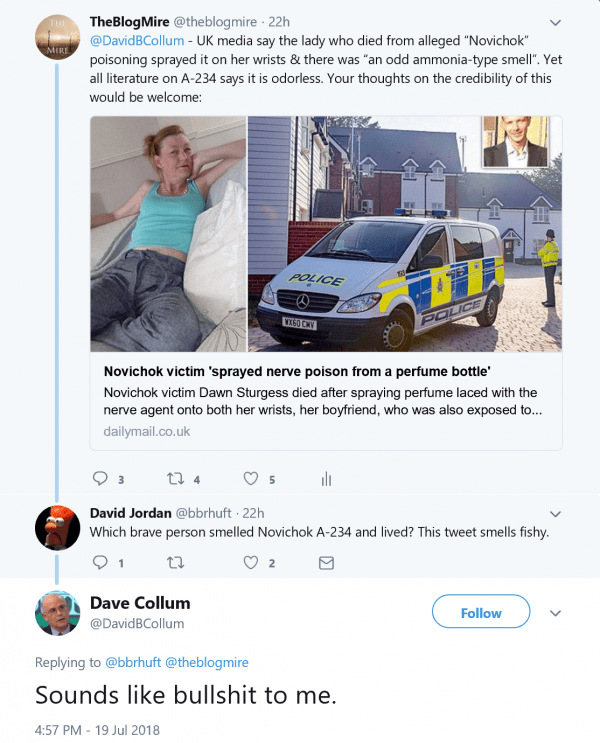
“He also mentioned that he vaguely recollects there being an odd ammonia-type smell from the perfume. We don’t know yet if he had direct contact with the nerve agent like Dawn appears to have done or whether it was after he had touched her.”
The ammonia-type smell is odd, in more ways than one. The pre-2018 scientific literature not only states that A-234 is far deadlier than VX (see here), and that its effects are rapid, usually within 30 seconds to 2 minutes (see here), but it also describes it, along with all nerve agents, as odourless (see here). But according to the latest narrative, it smelt of ammonia.
I think we have another orange juice on the hand and blister on the foot moment. If it’s odourless, it can’t very well smell of ammonia, can it? In fact, it can’t very well smell of anything, can it? It’s odourless, and odourless things don’t tend to smell of ammonia. Or anything else, come to that.
Ah, but maybe it was contaminated? Really? But didn’t the OPCW state that the stuff allegedly placed on Mr Skripals door handle – the stuff they touched before feeding the ducks, going to a pub and then going to a restaurant – was high purity? I believe they did. And this was the same batch? A batch of the stuff that certain experts were telling us could last for decades? From whence cometh the ammonia then? From the odourless “Novichok”, of course.
Folks, what we have is a substance with astonishing properties. It is lethal, but non-lethal. It is military grade, but not really military grade. It is fast acting, but slow working. It can be in the form of a gel, but morph into a liquid. It is odourless, and yet really smelly. Or are we to believe that after placing their high purity “Novichok” gel on the door handle, the assassins then spent time turning it into a liquid, which they then poured into an ammonia-laced perfume bottle? Oh, and then instead of legging it to Heathrow, they took a detour to go for a walk in the park, where they dumped the bottle of odourless but ammonia-smelling nerve agent on the floor. What do they teach them in Professional Assassin schools these days?
Hands to Wrists. Gel to Liquid. Odourless to Ammonia. Orange juice on the hand to blisters on the foot. It’s all the same to me.
From a purely logical point of view, I understand that this is all complete and utter nonsense. But I do wish I’d paid more attention in chemistry classes at school so I might at least be able to debunk it from that point of view. But alas it was not to be. However, since I know nothing about that side of things, I thought I’d ask someone who does. David Collum is a world-renowned Professor of Chemistry and Chemical Biology at Cornell University, with a PhD, MS and MA from Columbia University, and a BS from Cornell. I asked him what he thought of the claim being made in the UK media that Dawn Sturgess was poisoned by “Novichok” and this gave off an “an odd ammonia-type smell”. His answer, which I will leave you with, whilst not what you might call eloquent, was certainly to the point:
“Democratic Institutions?” – 10 Lessons from history that will destroy your trust in the CIA
Did everyone urging us to trust the CIA forget this happened? Or do they just want us to?
By Kit | OffGuardian | July 20, 2018
In the hysterical wake of the Trump-Putin Summit in Helsinki, President Donald Trump was roundly criticised in the media for taking the side of a “hostile state” over his own intelligence agencies. The Guardian referred to Mueller as a “heroic marine” who Trump disbelieved in favour of a “Russian dictator”.
In the past, when Trump has criticised the FBI, CIA or NSA he has been accused of “undermining faith in our institutions”. He’s been blamed for a collapse of trust in the government. But was this trust ever earned?
At every corner, we are urged to simply believe what we are told. Whether it is about believing Porton Down and MI6 about “novichok”, or believing the White Helmets about Sarin, or believing the FBI about “collusion”, we are presented with no facts, just assertions from authority. Those who question those assertions are deemed “bots” at best or “traitors” at worst.
Well here, fellow traitors, are the Top Ten reasons to question anything and everything the CIA – or any intelligence agency – has ever told you.
10. OPERATION PAPERCLIP – we’ll start with an oldie but a goody. In 1945, as the allies were advancing on Berlin from both sides, American Army Intelligence (this was before the CIA were founded) were “capturing” (read: recruiting) over 1,600 Nazi scientists and engineers. Most famous of them was Werhner von Braun… sorry, SS Sturmbannführer von Braun.
Whilst Allied soldiers died in the name of defeating fascism, the CIA’s predecessors were actively recruiting Nazis to come and build bombs for them.
9. OPERATION NORTHWOODS – The original, and important, precedent for accusations that the CIA et al. might engage in false-flag attacks. Operation Northwoods was a joint CIA/Pentagon proposal designed around the idea of escalating a war with Cuba by stoking public anger:
The proposals called for the Central Intelligence Agency (CIA) or other U.S. government operatives to commit acts of terrorism against American civilians and military targets, blaming it on the Cuban government, and using it to justify a war against Cuba.
The idea was vetoed by President Kennedy. Fifty years later, the CIA and Pentagon still very much exist, but there’s no longer a Kennedy there to veto their more psychopathic ideas. Funny how that worked out.
8. ALLENDE COUP – In 1970 Salvador Allende was elected to the Chilean Presidency. A Physician and dedicated socialist, Allende was the first socialist president elected in South America. The Nixon-lead government of the United States immediately implemented “economic warfare” (as they do, to this day, against Cuba, Venezuela and others). The economic warfare did not work, and in 1973 Allende’s socialist party increased their parliamentary majority.
In response, the US “assisted” (read: instructed) the Chilean military in carrying out a coup. Allende allegedly shot himself, and Augusto Pinochet was placed in power as the first dictator in Chile’s history. Pinochet was a fascist who executed Chilean “subversives” by the thousand… and was the darling of Western leaders.
7. MOSADDEGH COUP – I could just copy-and-paste the above paragraph and the change the names for this entry. In 1953, the Prime Minister of Iran – Mohammad Mosaddegh, a democratic socialist – wanted to audit the income of the Anglo-Iranian Oil Company with an eye to limiting foreign control of Iran’s oil. Within a few months, a joint US/UK operation – Operation Ajax – had removed Mosaddegh’s elected government and turned over full control of the state to the Shah. He was a brutal absolute monarch, but the question of Western control of Iran’s enormous oil reserves wasn’t raised again under his leadership.
6. OPERATION MOCKINGBIRD – A CIA operation that you could deduce existed, even if were not proven…. and it is proven. Mockingbird was the CIA project to coerce, train, control or plant CIA-friendly journalists in major news networks all across the country and in every medium. It’s existence is no longer disputed, thanks to FOIA releases of internal memos.
Mockingbird was allegedly shut down in 1976 – just after its existence was leaked – then CIA director George HW Bush claiming:
… effective immediately, CIA will not enter into any paid or contractual relationship with any full-time or part-time news correspondent accredited by any U.S. news service, newspaper, periodical, radio or television network or station.”
If you’re willing to stake anything on the word of a Bush, well, good luck with that. It’s a decision that flies in the face of historical evidence.
Remember this one when you hear about the need to trust the CIA from some pundit on CNN or MSNBC.
5. MASS SURVEILLANCE – It’s not really talked about much these days – what with the vast majority of the media and huge sections of the supposedly “anti-establishment” progressive left marching in-step with the Deep State – but the NSA spied on the whole world. The whole world. We know this to be true because an employee of the Deep State – Edward Snowden – leaked the information.
When challenged on this issue, representatives of the NSA and CIA lied. They lied to the public, and they lied to congress. When they were proven to have lied, they carefully qualified their lies.
A qualified lie is still a lie.
There is no indication they have stopped this illegal surveillance, but they may have passed laws to make it legal.
4. NAYIRAH – A classic of “atrocity propaganda”, Nayirah should be required reading material for anybody looking top hop on a pro-war bandwagon. Nayirah – who originally gave only her first name – was a fifteen year old girl who testified in front of the United States Congress. She claimed to be a volunteer from at a Kuwaiti hospital, and to be an eye-witness to Iraqi soldiers throwing Kuwaiti babies out of incubators and leaving them to die:
I volunteered at the al-Addan hospital with twelve other women who wanted to help as well. I was the youngest volunteer. The other women were from twenty to thirty years old. While I was there I saw the Iraqi soldiers come into the hospital with guns. They took the babies out of the incubators, took the incubators and left the children to die on the cold floor. It was horrifying.
It was later revealed, not only that her full name was Nayirah al-Sabah and she was the daughter of the Kuwaiti ambassador, but that she had never volunteered at a hospital and had seen no babies, soldiers or incubators. The whole thing was a fiction. A fiction paid for by the “Citizens of Free Kuwait”, an NGO (and obvious CIA front) set up to lobby the US to intervene in the Iraq-Kuwait war.
By the time this fiction was revealed it was too late, and the US had launched Operation Desert Storm…. which was, of course, the entire point of the exercise.
Remember this, when you hear about Assad gassing children or bombing kittens.
3. COINTELPRO – The FBI’s long running (and sometimes illegal) COunter INTELligence PROgram, COINTELPRO was a series of domestic projects carried out by the FBI (with cooperation from other agencies), over decades, with the aim of “surveilling, infiltrating, discrediting, and disrupting domestic political organizations”.
These political organizations included anti-Vietnam protestors, civil rights groups (including both MLK and Malcolm X), socialists, Communist Party USA, environmental groups and feminist organizations.
The brief for these “disruptions” came straight from J. Edgar Hoover who wanted the FBI to “expose, disrupt, misdirect, discredit, or otherwise Neutralize” people he perceived to be enemies of the state. The capital N in “neutralise” is no accident, as the FBI was implicated in the deaths of several Black Panther leaders, including Fred Hampton.
COINTELPRO didn’t just involve undermining left-wing groups, but also creating right-wing groups:
The FBI also financed, armed, and controlled an extreme right-wing group of former Minutemen, transforming it into a group called the Secret Army Organization that targeted groups, activists, and leaders involved in the Anti-War Movement, using both intimidation and violent acts.
Whether this was done to actually push a right-wing agenda, create a fake threat to step up police powers, or just sow division and chaos, is unclear. But it definitely happened.
Much like MKUltra (below), COINTELPRO was “officially shut down”, not long after the public found out it existed. However, the accidental outing of undercover policeman at a rally in Oakland, and recent relaxation of the laws limiting the FBI’s powers, means that COINTELPRO – or a modern successor – is very likely still a thing.
The aim of COINTELPRO was to “Neutralize” anti-establishment political figures – the vast majority of targets were left wingers – through “smearing individuals and groups using forged documents and by planting false reports in the media”. Remember that when you see Rand Paul called a “traitor” on twitter, or read about “Russian collusion”, or see Jeremy Corbyn branded an anti-Semite.
Remember that it is proven that the Deep State – our trusted intelligence agencies – pay people to plant false stories and discredit political opponents.
2. PROJECT MKULTRA – It might sound like something from a 70s sci-fi TV series, but it is unfortunately real. MKUltra was a series of (illegal) experiments carried out by the CIA from 1953 until it was *cough* “officially halted” in 1973 (just after its existence was leaked). The experiments were wide-ranging, achieved varied levels of success, but pretty uniformly brutal and unethical. They included, but were not limited too:
– Giving LSD to unsuspecting soldiers to see what happened.
– Mass hypnosis and mass suggestion
– Torture studies
– Studies on the effect of verbal and/or sexual abuse
We’ll never know the full range of studies, or how they were carried out, because in 1973 Richard Helms, then director of the CIA, ordered all MKUltra files destroyed. Only a fraction of them survive, thanks to FOIA requests, but it’s reasonable to assume they destroyed the worst parts and kept the more quote-unquote innocent files.
The CIA were not unique in this regard either, MKUltra was their baby – but there were parallel projects in other quarters of the deep state. Army Intelligence had Edgewood Arsenal, whilst the Department of Defense had Project 112. All these projects were “officially halted” in the early 70s… just around the time the public found out they existed.
The CIA (et al.) have strongly denied that these experiments and projects have ever been continued in any way, shape or form…but if you’d asked them in 1969, they would have denied they had ever taken place at all.
1. THE IRAQ WAR – This might not be the most callous, the most dangerous, the most recent, the most secret or the most insidious of the items on this list, nevertheless it is – must be – number one… because it is the most brazen.
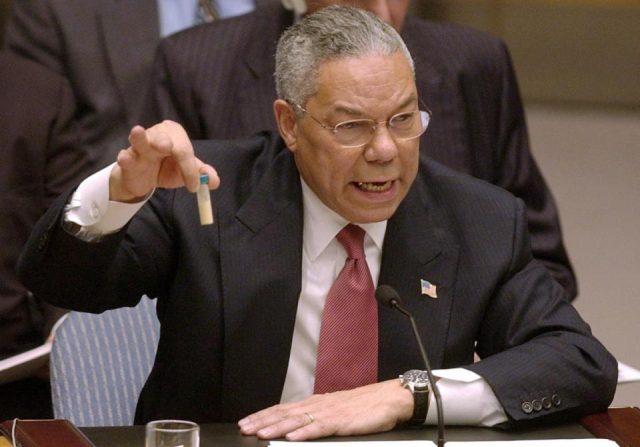
The war was started in the name of “weapons of mass destruction” that everyone – everyone – knew never existed. They all knew the truth, but they lied.
The President lied, the vice-president lied, the secretary of defence lied, the secretary of state lied. The Prime Minister lied, the defence minister lied, the foreign minister lied. They lied to the press, the people and the UN.
The CIA, the NSA, the FBI – then headed by the “heroic marine” Robert Mueller – they lied too. The press repeated these lies, without question (see: Operation Mockingbird). They weren’t “misinformed”, they weren’t “mistaken”. They lied, they lied repeatedly – and provably – and they did it in order to start a war, make money, take control, spread influence.
One million Iraqis died.
Our ruling class is peopled with psychopaths and war criminals, who have so little regard for the people they lie to they recycle the same childishly simple falsehoods to further their evil agenda again and again and again. They tried the same in Libya… it worked again. They tried again in Syria… luckily, it didn’t work there.
Our “democratic institutions” lie to start wars. There’s no reason to think they aren’t doing – or wouldn’t do – the same thing about Iran, North Korea… or Russia.
That’s our list, and there’s really only one lesson you can take away from it:
These people, agencies and institutions deserve no trust, have earned no trust and have abused every micron of trust ever placed in them. To suggest we have a duty to believe them – or that they have ever done anything to serve the public good – is to live in a dream world.
This list is not a full catalogue of Deep State crimes, it would be 1,000s of entries long if it were, but these ten are important. They’re important because they are admitted, proven and beyond debate. They are important because they show the many facets of dishonesty, hypocrisy and abuses of power that Intelligence agencies engage in, and they are important because they form the best riposte to the disingenuous clamour for “trust” in our “democratic institutions”.
Never trust the CIA, they have proved they don’t deserve it.
Here comes the Mali mission media manipulation
By Yves Engler · July 17, 2018
For the military, shaping media coverage of deployments is what roasting a marshmallow is to a summer camper’s S’mores; there isn’t one without the other.
Even before beginning a small “peacekeeping” mission, the Canadian forces have an elaborate media strategy.
At the end of June, Chief of the Defence Staff Jonathan Vance brought journalists with him on a visit to Mali. They toured the facilities in Gao where an advance team was preparing for Canada’s UN deployment to the African nation. An Ottawa Citizen headline described Vance’s trip as part of an effort at “selling the public on the Mali mission.”
The tour for journalists was followed by a “technical briefing” on the deployment for media in Ottawa. “No photography, video or audio recording for broadcast purposes” was allowed at last week’s press event, according to the advisory. Reporters were to attribute information to “a senior government” official. But, the rules were different at a concurrent departure ceremony in Trenton. “Canadian Armed Forces personnel deploying to Mali are permitted to give interviews and have their faces shown in imagery,” noted the military’s release.
None of these decisions are haphazard. With the largest PR machine in the country, the military has hundreds of public affairs officers that work on its media strategy. “The Canadian Forces (CF) studies the news media, writes about them in its refereed journals — the Canadian Army Journal and the Canadian Military Journal — learns from them, develops policies for them and trains for them in a systematic way,” explains Bob Bergen, a professor at the University of Calgary’s Centre for Military and Strategic Studies. ”Canadian journalists simply do not access the Canadian Forces in the scholarly fashion that the military studies them. There are no peer-reviewed journals to which they contribute reflections on their success or failure as an industry to cover the 1991 Persian Gulf War or the 1999 Kosovo Air War.”
While the tactics have varied based on technologies, balance of power and type of conflict, the government has pursued extensive information control during international deployments, which are invariably presented as humanitarian even when motivated by geostrategic and corporate interests. There was formal censorship during the First World War, Second World War and the Korean War. In recent air wars the military largely shut the media out while in Afghanistan they brought reporters close.
Air wars lend themselves to censorship since journalists cannot accompany pilots during their missions or easily see what’s happening from afar. “As a result,” Bergen writes, “crews can only be interviewed before or after their missions, and journalists’ reports can be supplemented by cockpit footage of bombings.”
During the bombing of the former Yugoslavia in 1999 the CF blocked journalists from filming or accessing Canadian pilots flying out of Aviano, Italy. They also refused to provide footage of their operations. While they tightly controlled information on the ground, the CF sought to project an air of openness in the aftermath of the Somalia scandal. For 79 days in a row a top general gave a press conference in Ottawa detailing developments in Yugoslavia. But, the generals often misled the public. Asked “whether the Canadians had been targeted, whether they were fired upon and whether they fired in return” during a March 24 sortie in which a Yugoslavian MiG-29 was downed, Ray Henault denied any involvement. The deputy chief of Defence Staff said: “They were not involved in that operation.” But, Canadians actually led the mission and a Canadian barely evaded a Serbian surface-to-air missile. While a Dutch aircraft downed the Yugoslavian MiG-29, a Canadian pilot missed his bombing target, which ought to have raised questions about civilian casualties.
One reason the military cited for restricting information during the bombing campaign was that it could compromise the security of the Armed Forces and their families. Henault said the media couldn’t interview pilots bombing Serbia because “we don’t want any risk of family harassment or something of that nature, which, again, is part of that domestic risk we face.”
During the bombing of Libya in 2011 and Iraq-Syria in 2014-16 reporters who travelled to where Canadian jets flew from were also blocked from interviewing the pilots. Once again, the reason given for restricting media access was protecting pilots and their families.
Since the first Gulf War the military has repeatedly invoked this rationale to restrict information during air wars. But, as Bergen reveals in Balkan Rats and Balkan Bats: The art of managing Canada’s news media during the Kosovo air war, it was based on a rumour that antiwar protesters put body bags on the lawn of a Canadian pilot during the 1991 Gulf War. It likely never happened and, revealingly, the military didn’t invoke fear of domestic retribution to curtail interviews during the more contentious ground war in Afghanistan.
During that war the CF took a completely different tack. The CF embedding (or in-bedding) program brought reporters into the military’s orbit by allowing them to accompany soldiers on patrol and stay on base. When they arrived on base, senior officers were often on hand to meet journalists. Top officers also built a rapport with reporters during meals and other informal settings. Throughout their stay on base, Public Affairs Officers (PAOs) were in constant contact, helping reporters with their work. After a six-month tour in Afghanistan PAO Major Jay Janzen wrote: “By pushing information to the media, the Battalion was also able to exercise some influence over what journalists decided to cover. When an opportunity to cover a mission or event was proactively presented to a reporter, it almost always received coverage.”
In addition to covering stories put forward by the military, “embeds” tended to frame the conflict from the perspective of the troops they accompanied. By eating and sleeping with Canadian soldiers, reporters often developed a psychological attachment, writes Sherry Wasilow, in Hidden Ties that Bind: The Psychological Bonds of Embedding Have Changed the Very Nature of War Reporting.
Embedded journalists’ sympathy towards Canadian soldiers was reinforced by the Afghans they interviewed. Afghans critical of Canadian policy were unlikely to express themselves openly with soldiers nearby. Scott Taylor asked, “what would you say if the Romanian military occupied your town and a Romanian tank and journalist showed up at your door? You love the government they have installed and want these guys to stay! Of course the locals are smiling when a reporter shows up with an armoured vehicle and an armed patrol.”
The military goes to great lengths to shape coverage of its affairs and one should expect stories about Canada’s mission in Mali to be influenced by the armed forces. So, take heed: Consume what they give you carefully, like you would a melted chocolate and marshmallow-coated graham wafer.
Iran rejects Israeli claim of stealing nuclear data as ‘laughably absurd’
Press TV – July 19, 2018
Iran has dismissed as “laughably absurd” an Israel-fabricated scenario, in which the agents with the regime’s Mossad spy agency are claimed to have spirited away loads of “secret documents” on the country’s nuclear work from a site in southern Tehran.
Alireza Miryousefi, a spokesman for Iran’s diplomatic mission to the United Nations, was responding to recent reports by The New York Times and other news outlets about the details of Mossad’s purported operation near the Iranian capital in the rather Hollywood-style scenario.
The scenario was initially unveiled by Israeli Prime Minister Benjamin Netanyahu, who is widely known to have a penchant for theatrics. Netanyahu went live on television in late April for yet another dubious show against Iran and put on display what he claimed to be records from a secret warehouse in Tehran.
Netanyahu claimed Israeli agents had managed to break into the warehouse in an overnight raid and bring back “half a ton of the material” consisting of 55,000 pages and another 55,000 files on 183 CDs.
The Israel premier’s vaudeville — which came only days before the US announced its withdrawal from the 2015 multilateral nuclear deal with Iran — was meant to persuade the world that Iran has been lying about its nuclear program, without providing even a single piece of evidence.
The New York Times published an article on July 15, in which it elaborated on the purported Mossad operation, which it claimed lasted for over six hours.
Reacting to the report, Miryousefi once again rejected Israel’s claims in a statement and said, “It’s almost as if they are trying to see what outlandish claims they can get a Western audience to believe.”
“Iran has always been clear that creating indiscriminate weapons of mass destruction is against what we stand for as a country, and the notion that Iran would abandon any kind of sensitive information in some random warehouse in Tehran is laughably absurd,” he added.
Netanyahu’s April 30 show was so cheaply theatrical that it was quickly held up to ridicule inside Iran and abroad, with observers raising serious questions about the purported Mossad raid.
Back then, Iranian Foreign Minister Mohammad Javad Zarif called the Israeli premier “the boy who can’t stop crying wolf is at it again,” recalling a similar anti-Iran rant by Netanyahu at the UN General Assembly in 2012– during which he used a cartoon bomb in an attempt to portray the Islamic Republic as a threat.
Deputy Foreign Minister Abbas Araqchi also said that Netanyahu was playing a baseless childish and naive game against Iran.
The Israeli leader was back then involved in an intense lobbying campaign aimed at dissuading Washington and the other parties to the Iran deal from supporting the landmark agreement, officially dubbed the Joint Comprehensive Plan of Action (JCPOA).
Except in the US, Netanyahu’s claims, however, fell on deaf ears.
Reacting to the show hours later, the EU’s foreign policy chief, Federica Mogherini, said on May 1 that Netanyahu’s presentation failed to question Tehran’s compliance with the 2015 nuclear deal and that any such claims should solely be assessed by the International Atomic Energy Agency (IAEA).
The IAEA — which uses strict mechanisms to monitor the technical aspect of the JCPOA’s implementation — has repeatedly confirmed Iran’s full commitment to its side of the bargain.
The latest New York Times piece comes as Iran and its other parties in the deal — Russia, China, France, Britain plus Germany — are engaged in a diplomatic process aimed at working out ways to keep the JCPOA in place despite Washington’s pullout in May.
Elections: More than Half of Americans Believe Fairy Tales are Real
By Thomas L. Knapp | The Garrison Center | July 17, 2018
According to a new poll conducted by Ipsos in partnership with the University of Virginia Center for Politics, 51% of respondents agree (15% “strongly” and 36% “somewhat”) with the statement “American elections are fair and open.”
The Ipsos headline characterizes that percentage as “only half.” That’s akin to noting that “only half” of Americans believe the Earth is a flat disc of provolone cheese, balanced atop the fingertips of seven celestial belly dancers. “Only” half?
Republicans, males, people over 55, people making more than $50,000 a year, and whites are more likely to believe this bizarre claim than Democrats, females, younger voters, the under-$50k crowd, and non-whites, but even among the latter buy-in is disturbingly high.
That over-55 demographic is plenty old enough to remember that after Ross Perot made it onto the presidential debate stage in 1992 (as an independent) and 1996 (as the Reform Party’s nominee), the Commission on Presidential Debates added a 15% polling bar to its rules to ensure that only Republicans and Democrats need apply.
Every four years, the CPD — established after the National Commission on Elections recommended “[t]urning over the sponsorship of Presidential debates to the two major parties” — makes millions in illegal in-kind campaign contributions to Republican and Democratic presidential and vice-presidential candidates, and no others, in the form of joint campaign commercials falsely advertised as “debates.”
Most disturbing: 49% of self-described “independent” voters — voters deprived of choice by a tangled web of ballot access laws expressly designed to keep third party and independent candidates off the ballot and campaign finance laws that keep them marginalized if they get over those ballot access hurdles — still believe in the Fair and Open Election Fairy.
American elections started becoming less fair and less open in the late 19th century when state governments started printing “Australian” ballots and controlling access to those ballots. Before that, American voters hand-wrote their ballots, orally dictated their ballots to election officials if they couldn’t write, or used pre-printed ballots provided to them by their parties or candidates of choice.
While movements for more fair and more open elections have made some advances since then — for example, constitutional amendment to provide for female suffrage, and partial gains versus attempts to suppress the African-American vote — we’ve still got a long way to go.
As champions of addiction recovery like to say, the first step is admitting we have a problem. Fairies aren’t real. And American elections aren’t fair and open. Yet.
Thomas L. Knapp (Twitter: @thomaslknapp) is director and senior news analyst at the William Lloyd Garrison Center for Libertarian Advocacy Journalism (thegarrisoncenter.org).
US arrest of Russian attempt to undermine Trump-Putin summit
Press TV – July 18, 2018
Russia’s Foreign Ministry says the arrest this week of a Russian national in the United States was a deliberate attempt to undermine a summit between President Vladimir Putin and his US counterpart Donald Trump in Helsinki, Finland.
Spokeswoman Maria Zakharova said Wednesday the detention of Maria Butina, which took place on Sunday, a day before the summit, had no grounds and was meant to affect the positive outcome of the summit.
Putin and Trump met in a freighted atmosphere amid criticism that Trump was approaching Russia at the expense of Washington’s allies in Europe. Trump is also accused of trying to cover up his alleged links to the Russians in the run-up to his presidency two years ago.
US authorities said Monday that they had charged Butina, 29, with conspiracy to act as an agent of the Russian government through establishing relationships and infiltrating organizations that have influence in US politics.
“Butina worked at the direction of a high-level official in the Russian government who was previously a member of the legislature of the Russian Federation and later became a top official at the Russian Central Bank,” said the US Department of Justice in a press release, adding, “This Russian official was sanctioned by the US Department of the Treasury, Office of Foreign Assets Control in April 2018.”
Zakharova dismissed the charges and said the arrest happened “with the obvious task of minimizing the positive effect” of the summit between Putin and Trump.
Both leaders have described their meeting as positive, saying it would help Moscow and Washington improve their strained relations.
The US and Russia have clashed on several issues over the past years, including Russia’s alleged interference in Ukraine, which Moscow denies, its military presence in Syria and allegations that the Kremlin meddled in the 2016 presidential election, which led to Trump’s victory.
I’m the Reporter Mentioned in Mueller’s Indictment. Why Hasn’t He Spoken to Me?
By Lee Stranahan | Sputnik | July 18, 2018
I was as surprised as anyone last Friday, when just days before US President Donald Trump’s historic meeting with Russian President Vladimir Putin, special counsel Robert Mueller dropped an indictment against 12 Russian nationals claiming that they were Guccifer 2.0, the entity that took credit on June 15, 2016, for the hack of the DNC and DCCC.
I was even more surprised to find that I was discussed in Mueller’s indictment.
Section 43c of the indictment says, “On or about August 22, 2016, the Conspirators, posing as Guccifer 2.0, sent a reporter stolen documents pertaining to the Black Lives Matter Movement. The reporter responded by discussing when to release the documents and offering to write an article about their release.”
I am that reporter.
Part of the reason I was surprised is that I have never been contacted by anyone from Mueller’s investigative team. That’s one reason I personally know that this is a shoddy investigation, but I’ll come back to that in a moment.
When I saw that I was being discussed in the indictment, I immediately mentioned it on Twitter. I also made it clear to the media that I was available for interviews. No media outlet has contacted me.
I went public because I have nothing to hide and nothing to be ashamed of. In fact, the reason that Mueller’s team knew about my contacts with Guccifer 2.0 is because I posted the direct messages we exchanged over Twitter myself a year ago.
For the record, I didn’t know who Guccifer 2.0 was at the time and I still don’t, despite Mueller’s indictment. I have never believed that Guccifer 2.0 was a Russian state actor and have seen no evidence that persuades me otherwise.
At the time of this contact with Guccifer 2.0, I was the lead investigative reporter for Breitbart News ; today, I co-host the best morning news radio show in America, Fault Lines with Nixon and Stranahan, which airs Monday through Friday, 7 a.m. to 10 a.m. Eastern Time on Radio Sputnik. Fault Lines is broadcast on 105.5 FM and 1390 AM in Washington, DC, and around the world on the Sputnik News website.
Of course, just seeing both Russian-funded Sputnik and formerly Steve Bannon-led-Breitbart News on my resume is enough to give many in the media the flutters. Never mind that I also wrote for years at the Huffington Post or did independent journalism on issues like the Syrian war, which I traveled to Beirut in 2013 to cover. All of that and more gets left out of media narrative on Russian CollusionTM!
Thus, the New York Times only mentions my work at Breitbart and Sputnik in their scarily titled article, Tracing Guccifer 2.0’s Many Tentacles in the 2016 Election. And like Mueller’s team, the New York Times also never bothered to get in touch with me for their story.
A few hours after the Mueller indictment came out, I left for my planned trip to Helsinki to cover the Trump-Putin summit for Sputnik.
A couple of days later, CNN’s Jake Tapper retweeted my initial tweet about my cameo in the indictment and added the comment “Employee for Sputnik confirms that when he was at Breitbart he was in touch with who DOJ says was Russian military intelligence masquerading as hacker Guccifer 2.0.”
I’ve spoken to Jake privately a number of times in the past. He’s praised my work on other stories. I’m easy to reach. Yet despite highlighting my contact with Guccifer 2.0, Tapper has also not reached out to interview me.
It’s almost like the media and Muller have no interest in hearing what I have to say. No, wait — it’s exactly like that, because there’s plenty that the indictment and the media leave out.
For example, when Guccifer 2.0 contacted me on August 22, 2016, Steve Bannon was no longer leading Breitbart News. Whoever Guccifer 2.0 is, they expressed no interest at all in the fact that Bannon had left Breitbart to head the Trump campaign.
Furthermore, when the indictment says I was given material on the Black Lives Matter movement, it’s not exactly accurate, something Mueller would know if he’d ever talked to me.
In fact, I was sent a file with a few documents, including one that was a memo about the Black Lives Matter movement that was sent out by the Democratic Congressional Campaign Committee (DCCC). That document sparked my interest because I’d been covering Black Lives Matter for months and had been arrested a little over a month earlier while covering the protests over the death of Alton Sterling in Baton Rouge. I was one of four journalists arrested. (All charges were dropped and we reached a very small settlement with the city.)
If the Muller investigation was legitimately trying to get to the truth, I’d think they would have asked me for this set of files, since it might contain useful information for a forensic investigation. I’d think they would also want to see my direct messages with Guccifer 2.0 for themselves.
That might not be possible now. You see, after Mueller’s indictment was released, the public Twitter account for Guccifer 2.0 was removed from Twitter. I no longer have live access to my direct messages, nor can the public see the account for themselves live on Twitter. For anyone wanting to make up his or her own mind about this facet of the Russiagate narrative, including through viewing the original information for themselves, this is an interesting development.
Luckily, researcher Adam Carter has saved screen captures of the entire account as well as Guccifer 2.0’s WordPress site on his must-read site dedicated to Guccifer 2.0.
People disinclined to simply take Mueller at his word on his unproven accusations will also want to read this article by Carter showing the contradictions between the information in the Mueller indictment and what is available already in public record.
Anyone who looks at that record for themselves can see what the media isn’t telling you — that I was far from the first journalist to talk to or interview Guccifer 2.0. It also makes clear that I did not request info from Guccifer 2.0, but was offered it.
However, as I’ve said, I did nothing remotely wrong in talking to Guccifer 2.0, no matter who is ultimately shown to be behind the account. I was following a story and working a lead. I wanted to find out who Guccifer 2.0 really was and I still do.
Robert Mueller’s investigation has now muddied that trail, and hindered the efforts of truth seekers everywhere.
The author is Lee Stranahan, co-host of Fault Lines on Radio Sputnik.
Featured Video
Anthrax War – CBC The Passionate Eye
or go to
Aletho News Archives – Video-Images
Book Review
Shattered Dreams: The HPV Vaccine Exposed (2019)
By Christina England – 30 Q&As – Book Review & Summary
Lies are Unbekoming | September 4, 2026
… Gardasil received FDA fast-track approval in 2006, Cervarix followed in 2009, and Gardasil 9 was approved in December 2014 with more than double the aluminium adjuvant content of the original. The commercial context is specific. Merck was about to lose patent protection on Zocor and faced $18 billion in Vioxx injury claims from a cardiovascular drug the company had marketed while suppressing its own data showing a five-times increase in heart attacks. Analysts projected the global HPV vaccine market at $4 billion by 2011, contingent on government-funded national programs for teenage girls. The 1986 National Childhood Vaccine Injury Act had already granted manufacturers complete liability immunity. By 2013, Japan had withdrawn its HPV vaccine recommendation after cataloguing severe adverse reactions in hundreds of girls. No Western government followed. The establishment position across the UK, US, Australia, and most of Europe held, and still holds, that the vaccines are safe and effective, that reported injuries are coincidental, and that cervical cancer prevention justifies the program. The book was published into this position, not against a vacuum.
Shattered Dreams sits alongside Mary Holland’s The HPV Vaccine On Trial and Viera Scheibner’s foundational vaccination work as part of the documented record on what has been done to a generation of teenage girls under the banner of cancer prevention. The full summary unpacks three specific findings: that Merck used the aluminium adjuvant itself as the “placebo” control in 92.5% of trial subjects, making it structurally impossible to detect excess reactions from the adjuvant; that Dr. Sin Hang Lee found HPV DNA fragments bound to aluminium in every one of sixteen Gardasil samples tested, and in the blood and spleen of a New Zealand girl six months after her third dose; and that in every country with high vaccination coverage, including Australia, the UK, Norway, and Sweden, cervical cancer rates have stopped declining and started rising specifically in the vaccinated cohort. Martínez-Lavín’s 2017 calculation puts the number needed to seriously harm with Gardasil 9 at 140, and the number needed to vaccinate to prevent one case at 1,757. Thirteen young women are seriously harmed for every one who benefits. The vaccine was approved on the basis of trials that could not detect what the trials were supposed to detect, and it is still being given to twelve-year-olds today. … Read full review
Blog Roll
 Aletho News
- The Five-Year Fuel Crisis: Why the World Economy Is Paying for a War It Thinks Is Ending
- Trump’s Big Bluff on Iran
- Swiss scammed out of millions by Ukraine-linked call centers – media
- Germany facing potential ‘violent conflict’ with Russia – spy chief
- Ukraine’s EU neighbors reject new plea from Kiev – Politico
- British Transport Police Facial Recognition Trial Scanned 926,912 People With Zero Arrests
- House Bill Would Ban Federal Use of Flock ALPR Data
- Can a Spice Rival a Drug? 10 Head-to-Head Trials Put It to the Test.
- The oil routes around Hormuz face their own chokepoints
- The Saudi-Israeli war on Yemen’s resistance: Intelligence sharing, civilian targets & sectarian propaganda
- If Americans Knew
- “We See Our Homes Now From A Satellite, Like Strangers”
- Watch “Gaza: Doctors Under Attack”, originally censored by BBC
- NAZA: Israeli embassies in UK and US promote rival documentary to challenge Gaza genocide allegations
- David Ellison appoints Israeli to lead merged Paramount-Warner studios
- Turkish Red Crescent helps elderly Gaza man walk again after Israel confiscates his prosthetic limb
- Four Palestinians Killed in Israeli Attacks in Gaza
- Two Palestinian youths killed and village razed as Israeli attacks on West Bank continue
- Two more Christian women innocent victims of Gaza raids
- Cruelty, Deprivation, Indignity: A Journalist’s 22 Months in Israeli Prison
- New IDF Website Frames Slain Gaza Journalists as Terrorists
- No Tricks Zone
- Latest European Green Energy Debacle; Portugal’s Largest Flagship Solar Park Insolvent!
- Green Energy Debacle: German Expert Professor Fritz Vahrenholt Warns Of Severe Economic And Social Consequences
- Two More Paleo Reconstructions Affirm Meters-Higher Sea Levels Across Ireland, Brazil 7000-6000 Years Ago
- New Study: Earth And Venus Surface Warmth Largely Explained By Convection And Lapse Rate, Not CO2 Or Radiation
- 2025 Nature Paper Claiming Worsening Global Drought Gets RETRACTED …Heavily Flawed
- New Study: ‘Global Drought Shows No Detectable Recent Acceleration Under Climate Warming’
- Economic Masterminds: German Socialists Suggest Taxing Productivity Gains Stemming From Using AI
- The South China Sea Has Not Been Cooperating With The Climate Change Narrative
- Energy Crisis: Germany Enters Heating Season With Historically Low Gas Reserve Fill Levels
- New Study: The Antarctic Ice Sheet Gained Mass From 2020-2024 Due To Staggering Snow And Ice Accumulation

