Another Dodgy British Dossier: the Skripal Case
In this second part of a series, Gareth Porter compares the same faulty logic employed in two purposely misleading, so-called British intelligence dossiers.
By Gareth Porter | Consortium News | April 21, 2018
The British government shared what was supposedly a dossier containing sensitive intelligence to convince allies and EU member states to support its accusation of Russian culpability in the poisoning of Sergei and Yulia Skripal in Salisbury, England on March 4.
But like the infamous 2003 “dodgy dossier” prepared at the direction of Prime Minister Tony Blair to justify British involvement in the U.S. invasion of Iraq, the intelligence dossier on the Salisbury poisoning turns out to have been based on politically-motivated speculation rather than actual intelligence
British officials used the hastily assembled “intelligence” briefing to brief the North Atlantic Council on March 15, the European Foreign Affairs Council on March 19 and the European summit meeting in Brussels on March 23.
The Need for Dramatic Claims
When Prime Minister Theresa May and Foreign Secretary Boris Johnson ordered the production of an intelligence dossier to be used to convince allies and EU member states to join Britain in expelling Russian diplomats, they had a problem: they were unable to declare that nerve agent from a Russian military laboratory had been verified as the poison administered to the Skripals. As the well-informed former Ambassador Craig Murray learned from a Foreign and Commonwealth Office source, the British government military laboratory at Porton Down had been put under strong pressure by Johnson to agree that they had confirmed that the poison found in Salisbury had come from a specific Russian laboratory. Instead Porton Down would only agree to the much more ambiguous formula that it was nerve agent “of a type developed in Russia.”

May and Johnson: Needed dramatic claims
So May and Johnson needed some dramatic claims to buttress their argument to allies and EU member states that the Salisbury poisoning must have been a Russian government assassination attempt.
A letter from British national security adviser Mark Sedwill to NATO Secretary-General Jens Stoltenberg released publicly on April 13, refers to two key claims in the dossier of a Russian program to research ways of delivering nerve agent, including smearing it on door handles, and of Russian production and stockpiling of nerve agent during the past decade.
But closer analysis of these claims, based in part on information provided by official British sources to the press, makes it clear that the government did not have any concrete “intelligence” to support those Government claims in the intelligence brief.
The Door Knob Claim
The Sedwill letter referred to a Russian “investigation of ways of delivering nerve agent, including by application to door handles” as being part of a broader alleged Russian government program of chemical weapons research and military training.” The letter was obviously implying that it had some secret intelligence on which to base the charge, and some in the British press pitched in to support the claim.
The first paragraph of a Guardian story on the intelligence dossier said, “Russia had tested whether door handles could be used to deliver nerve agent,” attributing the information to “previously classified intelligence over the Salisbury attack made public Friday.”
In another story about the evidence on the Salisbury poisoning, however, The Guardian, apparently reflecting its understanding of what government officials had conveyed, wrote, “Such an audacious attack could have been carried out only by trained professionals familiar with chemical weapons.” That statement hinted that the alleged Russian “investigation of ways of delivering nerve agents, including by application to door handles” was actually a speculative inference rather than a fact established by hard evidence.
A report in the Daily Mirror, evidently intended to support the government line, actually showed quite clearly that what was being presented as intelligence on alleged Russian research on delivering nerve agent via a door handle was in fact nothing of the sort. It quoted a “security source” as explaining how that claim in the intelligence paper was linked to the belief of counter-terrorism investigators that the Skripals first came in contact with nerve agent on the handle of Skripals’ front door.
“The door handle thing is big,” the unnamed source told the Mirror. “It amounts to Russia’s tradecraft manual on applying poisons to door handles. It’s the smoking gun.” The source was not saying that British intelligence had firsthand information about a Russian tradecraft manual; it was suggesting that one could somehow deduce from the assumed application of nerve agent to the door handle of the Skripal house that this was a sign of Russian intelligence tradecraft.
The source then appeared to confirm explicitly that this inference was the basis of the specific claim in the intelligence brief that, “It is strong proof Russia has in the last 10 years researched methods to administer poisons, including by using door handles.”
The Murder that Contradicts the Dossier
The idea that only intelligence operatives with formal training could have applied nerve agent to a door handle was not based on objective analysis. MI6, the British foreign intelligence service, knows very well that a 1995 murder committed in Moscow with a nerve agent developed by Soviet-era scientists was carried out by a private individual, not a government intelligence unit.
Court documents in the 1995 murder of banker Ivan Kivelidi, reported by the independent Russian newspaper Novaya Gazeta, show that in 1994 a Russian criminal syndicate had acquired Novichok nerve agent, which had been synthesized by Soviet scientists, and that it was used the following year to kill Kivelidi and his secretary by applying some of the nerve agent on his telephone receiver.
Boris Kuznetsov, a dissident Russian lawyer involved in the Kivelidi murder case, who fled Russia in 2007 with copies of all the relevant documents, turned them over to the British government after the Skripal poisoning. The knowledge of that episode would account for Prime Minister May’s otherwise surprising acknowledgement on March 12 of the possibility that the poisoning might not have been a Russian government action but the consequence of the Russian government allowing nerve agent to “get into the hands of others”.
An Ongoing Russian Novichok Program?
The Sedwill letter made another sweeping claim of covert Russian production of the line of nerve agent that had been dubbed Novichok. “Within the last decade,” it said, “Russia has produced and stockpiled small quantities of Novichok under the same programme.” If true, that would have been major evidence bearing on the Skripal poisoning, since such a program would be both covert and illegal under the Chemical Weapons Convention.
Sedwill: No evidence
But neither the Sedwill letter nor any other statement from the British government has referred to the possession of any evidence for that claim, even in the most generic way. In fact, Prime Minister May said merely that Russia “had previously produced Novichoks and would still be able to do so”.
In contrast to its silence about any kind of information supporting its claim of Russian production and stockpiling of Novichok program in the past decade, the Sedwill letter cited “a combination of credible open-source reporting and intelligence” on the existence of the Russian program that developed the Novichok line of nerve agents in the 1970s and 1980s.
If the UK possessed actual evidence of such a Russian nerve agent program at Shikhany, the former military chemical weapons facility, it presumably would have informed the Organization for the Prohibition of Chemical Weapons (OPCW) of the fact and presented its evidence to the 41-member Executive Council, the governing body of the organization. It clearly has not done so, and it has not suggested that it was prevented from doing so by the fear of compromising an intelligence source within the Russian government.
The British government could also demand a “challenge inspection” at the facility. Any member of the Chemical Weapons Convention can call for an immediate inspection, and Russia would have had no option but to permit it. But it has not done so, signifying that it does not have the information necessary to identify the location of the alleged production and stockpiling of such a weapon, nor does it have the name of anyone who has worked on such a project.
Suspect Intercepted Russian Communications
Another claim in the British “intelligence” dossier is an intercepted Russian communication that allegedly supports the Russian nerve gas operation accusation.
The tabloid Express reported its sources saying such an intercept had been “a key part of Britain’s intelligence evidence.” The sources revealed that on March 4, a message from Damascus to Moscow intercepted by a listening post in Southern Cyprus contained the words, “The package has been delivered.” And the same message was said to have reported that two named individuals had “made a successful egress” – meaning that they had left.
But without knowing the context in which either statement was made, such quotes are meaningless. And one must ask how often something like those exact words would be communicated to Moscow from a diplomatic or military outpost somewhere in the world every single day. Furthermore, the second message to which the dossier is said to have referred actually revealed the names of the two men who had departed, so it clearly had nothing to do with a covert operation.
The May government was able to convince 29 other states, including the United States, to take action against Russia by expelling its diplomats, representing a deliberate step toward higher tensions with Moscow. But the intelligence dossier it deployed in that effort, as reflected in the Sedwill letter and media reporting, was far from being the kind of information one might expect to provoke such a major diplomatic move. It was instead, like the original 2003 “dodgy dossier” on WMD in Saddam’s Iraq, essentially a collection of misleading claims based on politically-skewed logic.
Gareth Porter is an independent investigative journalist and historian on U.S. national security policy and the recipient of the 2012 Gellhorn Prize for journalism. His most recent book is Manufactured Crisis: the Untold Story of the Iran Nuclear Scare, published in 2014.
“Spring Arriving 26 Days Early”–BBC
By Paul Homewood | Not A Lot Of People Know That | April 21, 2018
The BBC has been up to its tricks again!

http://www.bbc.co.uk/programmes/b09yddxd
The latest edition of Radio 4’s environmental programme, “Costing the Earth”, looks at how our springs are supposedly getting earlier. (Yes, I know spring starts in March!)
The programme’s opening introduction by presenter Lindsey Chapman gives us a clue that it won’t be an objective assessment:
We’re looking for signs of how a volatile climate is shifting our seasons, and affecting both our native wildlife and migrant visitors to these shores.
Chapman, also presenter of the Springwatch TV series, then adds:
I’ve been noticing changes on my own patch, from the arrival of the first swallows to the flowering times of spring flowers over the last ten years.
At about seven minutes in though, she makes this extraordinary statement:
Spring now arrives an average of 26 days earlier each year than it did 10 years ago. We know this because of the extraordinary records kept by the public, stretching back centuries.
As Paul Matthews points out:
This statement that Spring is almost a month earlier than it was just 10 years ago is complete nonsense and fails the most elementary sanity check. It appears, yet again, that where global warming is concerned, elementary common sense and fact-checking are thrown out by the BBC, and replaced with absurd exaggeration and alarmism.
So where did Chapman get this crazy claim from?
As she goes on to explain, it is supposedly from the Woodland Trust, who run a scheme called Nature’s Calendar.
This allows members of the public to record when they first see certain events each spring, such as birds, first flowerings, butterflies and so on. In other words, phenology. During warm springs, naturally enough, these events tend to arrive earlier.
According to Woodland Trust, these first sightings have been between around one and two weeks earlier in the last three years, though some butterfly and bird arrivals were as much as three weeks early in 2017:

https://naturescalendar.woodlandtrust.org.uk/analysis/seasonal-reports/
You will notice that Woodland Trust use 2001 as a baseline, and nowhere do they claim that spring is now 26 days earlier than ten years ago.
But why 2001? In fact they have only been collecting this data since 2000, and decided to use 2001 as the base year because, they claim, weather conditions that year “closely reflected the 30-year average”.
However, on closer examination we see that it is not the current 30-year average they are talking about (ie 1981-2010), but 1961-90.

This is highly significant, because the 1961-90 period was considerably colder than both the decades that preceded and followed it.

https://www.metoffice.gov.uk/hadobs/hadcet/data/download.html
HH Lamb pointed out that the onset of spring in Oxford was 16 days later between 1963-80, compared to 1920-50:

HH Lamb – “Climate History and the Modern World” (p 274):
To a large extent therefore, the onset of spring in recent years has merely returned to earlier patterns, with the end of the colder interlude.
We can see the effect of using the two different baselines below:

https://www.metoffice.gov.uk/hadobs/hadcet/data/download.html
The 1961-90 period was 0.7C colder than 1981-2010. We can also see that, while there have been ups and downs, there is little evidence of overall change in spring temperatures since around 1990.
This is definitely not the message portrayed by the BBC programme.
We should also note that the spring of 2001 was much colder than prior years, which makes it strange that it should be used as a base year at all. The Woodland Trust recognised this same point in their Spring 2005 report:

https://naturescalendar.woodlandtrust.org.uk/analysis/seasonal-reports/?p=3
Of course, when we are talking about “early springs”, temperatures in January and February may be just as important as those in April and May.
But when we look at Jan-March, and Feb–April, we find a very similar pattern – very little change in trend since 1990:


https://www.metoffice.gov.uk/hadobs/hadcet/data/download.html
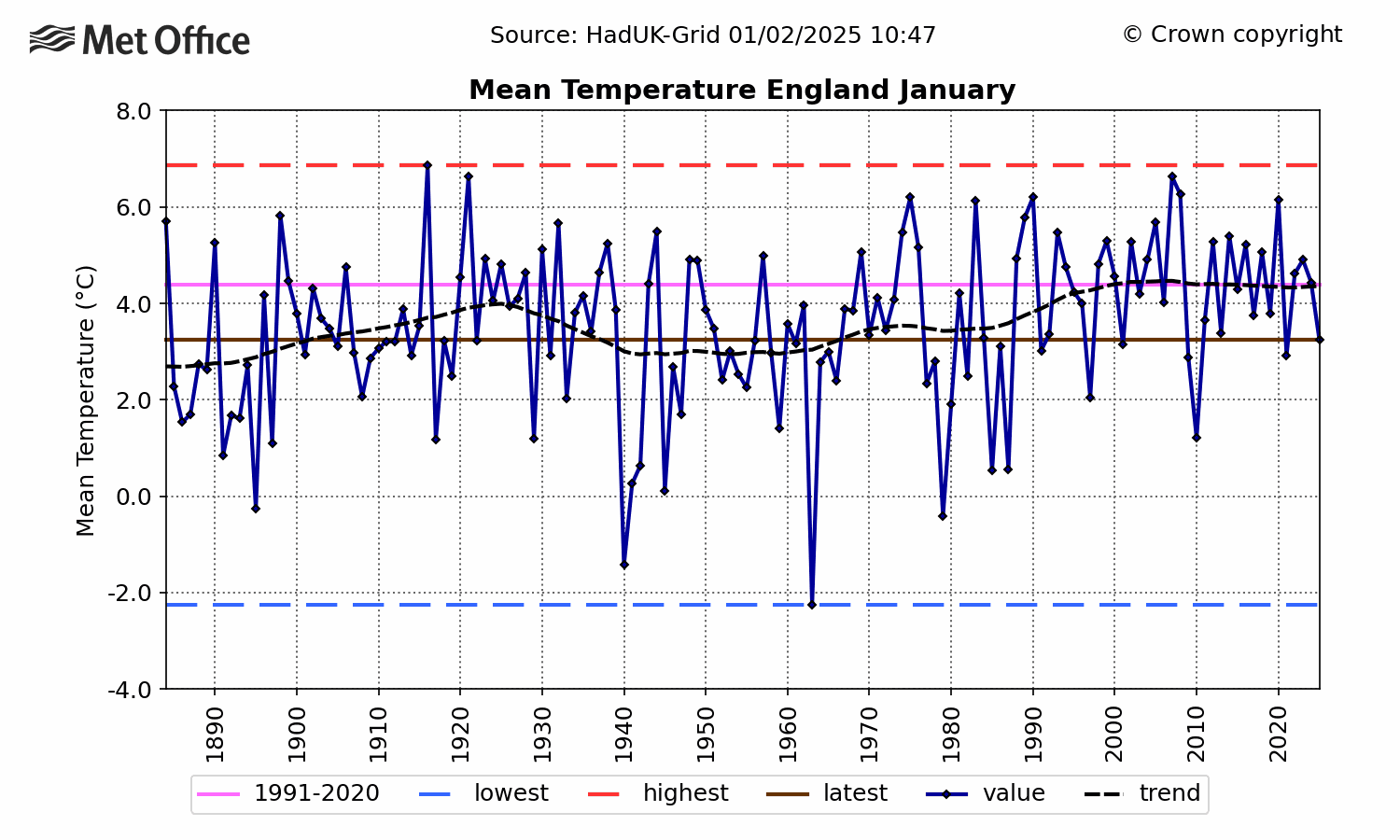
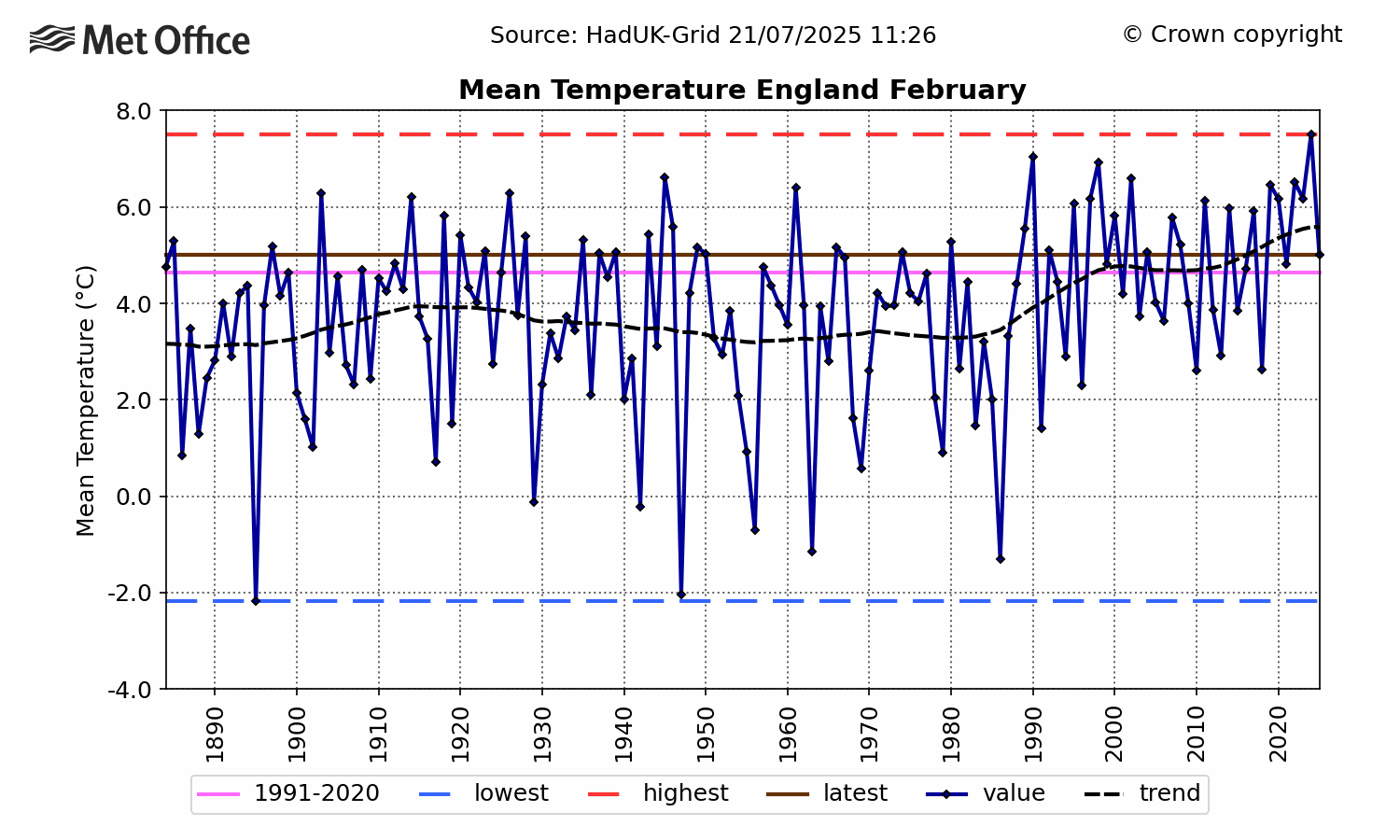
This should be little surprise, when we see that, contrary to popular myth, temperatures in January and February have changed little since a century ago.
And, as with spring temperatures, there is a noticeable dip between 1961-90:
https://www.metoffice.gov.uk/climate/uk/summaries/actualmonthly
Summary
There appears to be no evidence to back up Chapman’s claim that spring now arrives an average of 26 days earlier each year than it did 10 years ago, either in the temperature record or in the Woodland Trust surveys.
The latter are in any event misleading, and certainly not in a shape or from “scientific”. Their conclusions are obtained only by using an unusually cold year, 2001, as their base point.
There is actually nothing in the temperature record to suggest that springs are beginning any earlier than they were thirty years ago.
To be fair, one of the interviewees, Matthew Oates of the National Trust, did mention that the transition to warmer/earlier springs began several decades ago.
Nevertheless, the central theme of the programme was that the UK climate is changing rapidly, something not borne out by the data.
I have no doubt that the BBC will fall back on their regular defence of “scientists say”. However, following OFCOM’s recent ruling that the BBC should have challenged Lord Lawson on comments he made, it should surely not be acceptable for them to simply accept unscientific research from bodies like the Woodland Trust without challenging that as well.
Of course, in this instance the BBC has gone one step further. Not only have they broadcast the Woodland Trust’s findings, Lindsey Chapman has actually then presented them as an indisputable fact.
British govt must explain its behavior in Skripal case, Syria strikes – UKIP MEP
RT | April 21, 2018
Although the UK has deemed Russia responsible for the poisoning of Sergei Skripal, the public needs proof, a UKIP MEP told RT, adding that London should also justify its role in the Syria airstrikes.
Speaking to RT at the Yalta International Economic Forum in Crimea, West Midlands Member of European Parliament (MEP) Bill Etheridge said there is a lot of “murky water” in the Skripal case. “A lot of things that are unexplained, a lot of behavior that does not ring true.”
He went on to explain that “the British course of public opinion doesn’t believe it, so the behavior of our government and security services, they need to explain to us why they are so convinced that the great nation of Russia would wish to attack anyone in our country.”
Etheridge added that no one has provided any “solid proof” that Russia was behind the poisoning. “The current British government position is one where they are taking too strong a position with Russia. They should be having dialogue, they should be having conversation.”
Skripal, a former Russian double agent, and his daughter Yulia were poisoned in the UK town of Salisbury on March 4. Russia has offered its full cooperation and urged London to provide evidence, including nerve agent samples. However, it has not received any.
The Russian Foreign Ministry says the incident is “highly likely” to have been staged by British intelligence, while Russia’s envoy to the UK has expressed concern that the investigation by the Office for the Prohibition of Chemical Weapons (OPCW) lacked transparency.
Etheridge also addressed the topic of Western intervention in Syria, one week after the UK, US, and France launched airstrikes over an alleged chemical attack that the three allies have blamed on the government of Bashar Assad.
“My belief is… the Syrian civil war is one where Western intervention is not helpful… my position is that there should be no intervention and frankly by intervening in that part of the world in the past, the UK and US have made things worse. As far as I’m concerned, we should stand back from this and allow the Syrian people self-determination.”
“I expect that London will get pressure from the British people to justify themselves and if they cannot justify themselves, there will be protests from British people saying, ‘no war in our name, no conflict in our name.'”
The UK, US, and France refused to wait for the results of an official OPCW investigation into the alleged chemical attack before deciding on military action. This also came despite the Russian military traveling to the scene of the alleged attack and finding no evidence of a toxic agent.
Russia has also stated that it has indisputable evidence that the attack did not take place, with Russia’s Ambassador to the OPCW, Aleksandr Shulgin, stating that it was a “pre-planned false-flag attack by the British security services, which could have also been aided by their allies in Washington.”
Just When You Thought “Russiagate” Couldn’t Get Any Sillier …
By Thomas L. Knapp | Garrison Center | April 21, 2018
April 20 is cannabis culture’s high holiday, and the Democratic National Committee celebrated it with fervor this year: Blaze up, get silly, file a bizarre lawsuit accusing the Russian government, Donald Trump’s 2016 presidential campaign, and transparency activist group WikiLeaks of conspiring to steal an election.
The suit confirms that after more than a year, special counsel Robert Mueller still hasn’t amassed the evidence required for a successful criminal prosecution, requiring proof “beyond a reasonable doubt.” A civil suit lowers that bar to “a preponderance of the evidence.”
But even that’s a long shot. The only credible evidence produced so far implicates only the Trump campaign, not the other two defendants, and only to the same extent that it likewise implicates the Clinton campaign.
That is, both campaigns admittedly tried to tap “Kremlin-connected” sources (defined as “anyone who’s ever been in Moscow”) for dirt on their opponents. Donald Trump Jr. met with a Russian lawyer in hopes of getting the goods on Hillary Clinton. The Clinton campaign commissioned a British former spy to work his Russian regime sources for salacious tidbits on Trump the Elder.
Central to the suit’s claims is alleged “Russian hacking” of the DNC’s servers, followed by an embarrassing release of emails showing, among other things, attempts by DNC to rig the 2016 primaries in favor of Clinton and against her main opponent, Bernie Sanders. Problems with the case:
First, the DNC refused to turn those servers over to the FBI for forensic analysis, instead hiring a friendly cybersecurity firm to announce the results it wanted announced.
Secondly, metadata in the “hacked” files released by “Guccifer 2.0” indicates transfer speeds consistent with an internal source at DNC copying the files directly to a USB drive rather than an external hacker accessing the servers.
Thirdly, while the subsequent announcement by the US intelligence community of its conclusions claims methods and IP addresses “consistent with” Russian state hackers, those methods and IP addresses are also “consistent with” every other type of hacker on Earth.
Fourthly and probably decisively, the DNC makes the mistake of dragging WikiLeaks into the matter. The next time WikiLeaks gets caught making a false statement will be the first time. On the other hand, the leaked emails themselves demonstrate that the DNC lies constantly and without hesitation. When it comes to credibility, WikiLeaks is the gold standard and the DNC is something one tries to wipe off the bottom of one’s shoe before entering a respectable household. WikiLeaks says no, its source was neither the Russian government nor any other state party.
This lawsuit is simply the latest version of what the DNC has been doing since 2016: Trying to fob blame for its loss of an election it should have won in a walk off onto someone, anyone, but itself and its insanely poor choice of presidential nominee.
It’s very a risky move. In civil suits “discovery” runs in both directions. We’re about to learn a lot more about how the Democratic Party really works behind the scenes.
Trump Scores Major North Korea Points; Dems Sue WikiLeaks For Telling The Truth
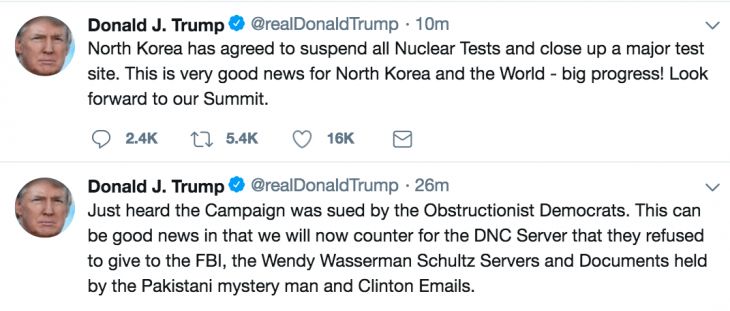
Remember these two tweets when Democrats are trying to spin their massive losses in a few months
By Caitlin Johnstone | Rogue Journalist | April 20, 2018
Damn. Democrats love losing more than Louise Mensch loves obsolete spy jargon.
Pyongyang has just announced that it is suspending intercontinental ballistic missile and nuclear tests, and is closing down a nuclear testing site as a sign of good faith. President Trump was of course quick to jump on Twitter to congratulate himself, and his supporters are all enthusiastically cheering him on.
As MIT professor Vipin Narang notes, the precise wording of the statement from the DPRK doesn’t necessarily preclude certain other types of testing. More importantly, this could all just be the first step toward Kim Jong Un winding up like another Gaddafi, who was destroyed by the western empire shortly after relinquishing Libya’s nuclear program. But neither of these things matter right now as far as public perception goes. It cannot be denied that Trump has secured major political points today.
Meanwhile what are Trump’s political opponents doing to gain momentum leading up to the 2018 midterms? Why, they’re suing WikiLeaks for telling the truth about them.
Keith, do you think “we have a right to lie without being exposed by WikiLeaks” is really a vote winner?
— WikiLeaks (@wikileaks) April 20, 2018
The Democratic party suing WikiLeaks for costing them the election is like an armed robbery convict suing a security camera company for getting him arrested. The emails it published are 100 percent authentic and entirely undisputed, and they consist of nothing other than Democratic party big wigs talking to one another.
The documents published by WikiLeaks in 2016 showed an unquestionable violation of the DNC’s Impartiality Clause in the “us vs them” tone of the conversations in the more egregious DNC leaks, the Podesta emails showing that the DNC and the Clinton camp were colluding as early as 2014 to schedule debates and primaries in a way that favored her, and then-DNC Vice Chairwoman Donna Brazile acting as a mole against the Sanders campaign and passing Clinton questions in advance to prep her for debates with Sanders. It also revealed more broadly incriminating facts about the Democratic party in general, including the Clintons taking bribes from Qatar and Morocco and knowingly accepting funds from political bodies that arm ISIS, an email showing how a CitiGroup executive was responsible for selecting Obama’s acceptable cabinet picks, and Clinton’s infamous “public position and a private position” statement.
Contrary to what their lawsuit claims, Democrats didn’t lose massively in 2016 because of a secret conspiracy between Russia, WikiLeaks and the Trump campaign to rob them of their rightful place on the throne, they lost massively in 2016 because people found out the truth about what the party is and how it operates. The fact that they are still masturbating this ridiculous delusion a year and a half later while Trump racks up a massive foreign policy win should concern everybody who understands that the Republican party is at least as evil and corrupt as the Democrats.
The Democratic party has proven beyond all doubt that it has no interest in serving the American people and at this point exists only to protect the tiny empires of its leaders. There has been far more than enough time for it to have conducted a sincere autopsy of the 2016 catastrophe, do some serious soul searching, and make the necessary changes. The fact that it has not done so by now means that it will never do so.
Leftwardly inclined Americans now have a decision to make: either (A) fully accept and support the Democratic party exactly as it is, corruption, warmongering and all so that they’ll have some small chance at beating the Republicans, or (B) let the party go the way of the Whigs and replace it with something completely different.
If there’s one thing we have learned from this administration, it’s that scandals and blunders roll off Donald Trump’s strange skin like water off a duck’s back. It is unlikely that this administration will suffer any setbacks between now and the 2018 midterms large enough to offset the political wins he’s been scoring, and if suing WikiLeaks for telling the truth is the best the Dems have to offer, America had better make sure it has a purse that looks good with red states.
On the Criminal Referral of Comey, Clinton et al: Will the Constitution Hold and the Media Continue to Suppress the Story?
By Ray McGovern | Consortium News | April 19, 2018
Wednesday’s criminal referral by 11 House Republicans of former Secretary of State Hillary Clinton as well as several former and serving top FBI and Department of Justice (DOJ) officials is a giant step toward a Constitutional crisis.
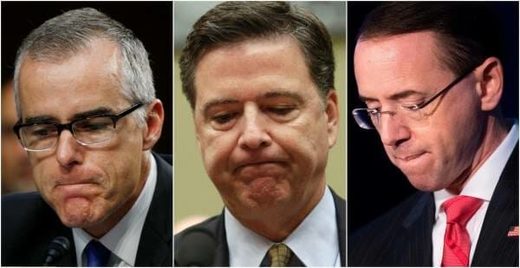
Named in the referral to the DOJ for possible violations of federal law are: Clinton, former FBI Director James Comey; former Attorney General Loretta Lynch; former Acting FBI Director Andrew McCabe; FBI Agent Peter Strzok; FBI Counsel Lisa Page; and those DOJ and FBI personnel “connected to” work on the “Steele Dossier,” including former Acting Attorney General Sally Yates and former Acting Deputy Attorney General Dana Boente.
With no attention from corporate media, the referral was sent to Attorney General Jeff Sessions, FBI Director Christopher Wray, and U.S. Attorney for the District of Utah John Huber. Sessions appointed Huber months ago to assist DOJ Inspector General (IG) Michael Horowitz. By most accounts, Horowitz is doing a thoroughly professional job. As IG, however, Horowitz lacks the authority to prosecute; he needs a U.S. Attorney for that. And this has to be disturbing to the alleged perps.
This is no law-school case-study exercise, no arcane disputation over the fine points of this or that law. Rather, as we say in the inner-city, “It has now hit the fan.” Criminal referrals can lead to serious jail time. Granted, the upper-crust luminaries criminally “referred” enjoy very powerful support. And that will come especially from the mainstream media, which will find it hard to retool and switch from Russia-gate to the much more delicate and much less welcome “FBI-gate.”
As of this writing, a full day has gone by since the letter/referral was reported, with total silence so far from The New York Times and The Washington Post and other big media as they grapple with how to spin this major development. News of the criminal referral also slipped by Amy Goodman’s non-mainstream DemocracyNow!, as well as many alternative websites.
The 11 House members chose to include the following egalitarian observation in the first paragraph of the letter conveying the criminal referral: “Because we believe that those in positions of high authority should be treated the same as every other American, we want to be sure that the potential violations of law outlined below are vetted appropriately.” If this uncommon attitude is allowed to prevail at DOJ, it would, in effect, revoke the de facto “David Petraeus exemption” for the be-riboned, be-medaled, and well-heeled.
Stonewalling
Meanwhile, the patience of the chairmen of House committees investigating abuses at DOJ and the FBI is wearing thin at the slow-rolling they are encountering in response to requests for key documents from the FBI. This in-your-face intransigence is all the more odd, since several committee members have already had access to the documents in question, and are hardly likely to forget the content of those they know about. (Moreover, there seems to be a good chance that a patriotic whistleblower or two will tip them off to key documents being withheld.)
The DOJ IG, whose purview includes the FBI, has been cooperative in responding to committee requests for information, but those requests can hardly include documents of which the committees are unaware.

Nunes: “We will put them on trial” (Photo: Win McNamee/Getty Images)
Putting aside his partisan motivations, House Intelligence Committee Chair Devin Nunes (R-CA) was unusually blunt two months ago in warning of legal consequences for officials who misled the Foreign Intelligence Surveillance Court in order to enable surveillance on Trump and his associates. Nunes’s words are likely to have sent chills down the spine of those with lots to hide: “If they need to be put on trial, we will put them on trial,” he said.” The reason Congress exists is to oversee these agencies that we created.”
Whether the House will succeed in overcoming the resistance of those criminally referred and their many accomplices and will prove able to exercise its Constitutional prerogative of oversight is, of course, another matter — a matter that matters.
And Nothing Matters More Than the Media
The media will be key to whether this Constitutional issue is resolved. Largely because of Trump’s own well earned reputation for lying, most Americans are susceptible to slanted headlines like this recent one — “Trump escalates attacks on FBI …” — from an article in The Washington Post, commiserating with the treatment accorded fired-before-retired prevaricator McCabe and the FBI he (dis)served.
Nor is the Post above issuing transparently clever warnings — like this one in a lead article on March 17: “Some Trump allies say they worry he is playing with fire by taunting the FBI. ‘This is open, all-out war. And guess what? The FBI’s going to win,’ said one ally, who spoke on the condition of anonymity to be candid. ‘You can’t fight the FBI. They’re going to torch him.’” [sic]
Mind-Boggling Criminal Activity
What motivated the characters now criminally “referred” is clear enough from a wide variety of sources, including the text messages exchange between Strzok and Page. Many, however, have been unable to understand how these law enforcement officials thought they could get away with taking such major liberties with the law.
None of the leaking, unmasking, surveillance, “opposition research,” or other activities directed against the Trump campaign can be properly understood, if one does not bear in mind that it was considered a sure thing that Secretary Clinton would become President, at which point illegal and extralegal activities undertaken to help her win would garner praise, not prison. The activities were hardly considered high-risk, because candidate Clinton was sure to win.
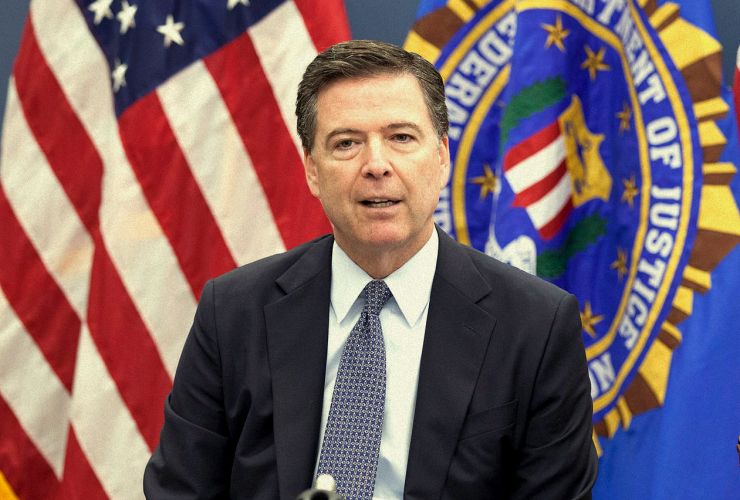
Comey: She was going to win
But she lost.
Comey himself gives this away in the embarrassingly puerile book he has been hawking, “A Higher Loyalty” — which amounts to a pre-emptive move motivated mostly by loyalty-to-self, in order to obtain a Stay-Out-of-Jail card. Hat tip to Matt Taibbi of Rolling Stone for a key observation, in his recent article, “James Comey, the Would-Be J. Edgar Hoover,” about what Taibbi deems the book’s most damning passage, where Comey discusses his decision to make public the re-opening of the Hillary Clinton email investigation.
Comey admits, “It is entirely possible that, because I was making decisions in an environment where Hillary Clinton was sure to be the next president, my concern about making her an illegitimate president by concealing the re-started investigation bore greater weight than it would have if the election appeared closer or if Donald Trump were ahead in the polls.”
The key point is not Comey’s tortured reasoning, but rather that Clinton was “sure to be the next president.” This would, of course, confer automatic immunity on those now criminally referred to the Department of Justice. Ah, the best laid plans of mice and men — even very tall men. One wag claimed that the “Higher” in “A Higher Loyalty” refers simply to the very tall body that houses an outsized ego.
I think it can be said that readers of Consortiumnews.com may be unusually well equipped to understand the anatomy of FBI-gate as well as Russia-gate. Listed below chronologically are several links that might be viewed as a kind of “whiteboard” to refresh memories. You may wish to refer them to any friends who may still be confused.
2017
Russia-gate’s Mythical ‘Heroes’ June 6, 2017
The Democratic Money Behind Russia-gate Oct. 29, 2017
The Foundering Russia-gate ‘Scandal’ Dec. 13, 2017
What Did Hillary Clinton Know? Dec. 25, 2017
2018
The FBI Hand Behind Russia-gate Jan. 11, 2018
Will Congress Face Down the Deep State? Jan. 30, 2018
Nunes Memo Reports Crimes at Top of FBI and DOJ Feb. 2, 2018
Nunes: FBI and DOJ Perps Could Be Put on Trial Feb. 19, 2018
‘Progressive’ Journalists Jump the Shark on Russia-gate March 7, 2018
Intel Committee Rejects Basic Underpinning of Russiagate March 14, 2018
McCabe: A War on (or in) the FBI? March 18, 2018
Former CIA Chief Brennan Running Scared March 19, 2018
Ray McGovern works with Tell the Word, a publishing arm of the ecumenical Church of the Saviour in inner-city Washington. He served as an Army Infantry/Intelligence officer and then a CIA analyst for a total of 30 years. In retirement, he co-created Veteran Intelligence Professionals for Sanity (VIPS).
US still paying White Helmets despite $200mn-aid freeze for Syria recovery, State Dept confirms
RT | April 20, 2018
As the US is reviewing funding aimed at helping war-ravaged Syria rebuild, it’s not neglecting the White Helmets – a controversial militant-linked group instrumental to the media campaign against Assad and Russia.
At a Thursday press briefing, journalists asked US State Department spokesperson Heather Nauert for an update on the late-March freeze of $200 million earmarked for the recovery of Syria – and if that means Washington will be withholding payments to the White Helmets.
Nauert opened her response with a gushing comment about the organization. “We recognize and appreciate and are very grateful for all the work that the White Helmets continues to do on behalf of the people of their country and on behalf of the US Government and all the coalition forces. They’re doing incredible work in rescuing in some cases, and in other cases it’s recovery efforts. They’re an incredible group of individuals,” she said.
Moreover, she said she “just exchanged emails with them the other day.” Finally cornered into giving a direct answer, she said “As far as I’m aware, all of the work still continues. Peoples’ bills are still being paid.”
The White Helmets (officially called the Syria Civil Defense), a supposedly impartial humanitarian NGO, make no secret of who pays those bills, listing the governments of the UK, Germany, and the US among others on their website. Time and again their reports from the scenes of supposed crimes against civilians by the forces of Syrian President Bashar Assad – who Washington has wanted toppled for years – have been used to justify accusations against Assad and his ally Russia. This includes the latest alleged chemical incident in Douma near Damascus, which led to a series of missile strikes by the US, UK, and France.
These allegations have now been contradicted by multiple sources, including witnesses from the scene, and even people featured in the White Helmets’ video of the “aftermath” of the “attack.”
The White Helmets rely heavily on positive publicity. They have been featured in two documentaries, one of which won an Oscar in the heavily politicized 2017 ceremony.
A recent attempt at gaining publicity and support for their cause, however, fizzled spectacularly. English singer Roger Waters, a founder of Pink Floyd, stopped his Barcelona gig for a minute last week to mention that a representative of the White Helmets wanted to come up on stage and make a statement. However, Waters had a few words of his own to say.
“The White Helmets is a fake organization that exists only to create propaganda for jihadists and terrorists,” he said.
It later turned out that in 2016, the NGO emailed Waters, trying to entice him into a dinner honoring the White Helmets, paid for by a Saudi billionaire. And just days before last week’s concert, a journalist describing himself as “a militant with the Syrian White Helmets” asked Waters for stage time to “send a message to the children of Syria.”
Waters replied to neither email, instead choosing to make his beliefs heard publicly.
“If we were to listen to the propaganda of the White Helmets and others, we would be encouraged to encourage our governments to start dropping bombs on people in Syria,” he said.
Which is exactly what happened a few hours later.
Hasbara memo: “When Israelis murder Palestinians, it’s a tragedy — for Israelis.”

© Ibraheem Abu Mustafa / Reuters
By Richard Hugus | April 19, 2018
Since the start of the latest massacre in Gaza — the killing with live fire of almost 40 and wounding of almost 3,000 unarmed Palestinian protestors during the March of Return — propaganda in service of Israel has been mobilized to cover up the blatant crime. Three days after the March began, the Jewish Community Relations Council of Greater Boston issued an unbelievably twisted statement on the attacks. What follows is their statement, with comments inserted in italics:
Jewish Community Relations Council Statement on Events Along Gaza Border
April 2, 2018
“We see the events along the Gaza-Israel border this weekend as the continuation of one of the great tragedies of our time.”
— This implies that Gaza is a sovereign country bordering Israel, not the prison for Palestinian refugees that Israel established decades ago in the south of Palestine.
“This is a situation where many are at fault, leaving individuals in impossible situations with impossible choices.”
— When someone is morally at fault, the situation is always “complicated.” As we shall see, the “many at fault” are always Palestinians, not Israelis.
“It is a tragedy for the people of Gaza that, 12 years after the complete withdrawal of Israel from the Gaza Strip, they live under such difficult conditions.”
— “Tragedy” in Greek theater held that events are written by our fate and could not have been otherwise. If Zionism had not chosen Palestine in the late 1800’s and then proceeded to steal land from Palestinians from then on, it could very much have been otherwise. There was an actor here; there was a cause, and an effect. The cause of the “tragedy” was Zionism. Ask the settlers to return to their own countries, and the “tragedy” would end.
The sentence also implies that Israel made a noble gesture when it withdrew from Gaza, and that it is the fault of the Palestinians that they did not make the best of this generous gift. In fact, Israel left Gaza because it was more expedient for Israel to administer Gaza as a prison than to occupy it. The “difficult conditions” faced by the people of Gaza are the result of Israeli control over everything and everyone that goes into and out of it. The “difficult conditions” are the result of repeated Israeli bombings of critical infrastructure, and Israel’s clear plan for the complete immiseration of Gaza’s two million people.
“It is a tragedy for the Palestinians that Gaza was taken over by Hamas, an internationally designated terrorist organization that rules in a brutal dictatorship.”
— Hamas was democratically elected by its people because it distinguished itself from the collaborationist leadership of the Palestinian Authority. Israel defines Hamas as terrorist because Hamas is determined to resist the Zionist entity. Israel’s minions in legislative bodies in other countries have been used to create the “designated terrorist” label.
“Brutal dictatorship” is a buzzword applied to all political movements asserting independence from imperialist control.
“It is a tragedy that Hamas has chosen to direct its resources to the building of tunnels and rockets, rather than building hospitals, schools, housing, and factories that would create prosperity and opportunity for the Palestinian people.”
— Are these the same hospitals, schools, housing and factories that Israel has been bombing since 2006? Are these the same tunnels that Gazans used to bring in vital humanitarian goods not allowed through Israeli checkpoints? Doesn’t Hamas have the right to its primitive rockets when Gazans are being periodically bombarded by Israel and its highly sophisticated fighter jets?
“It is a tragedy that, by squandering the opportunity to build a better future for the Palestinian people, Hamas has forced Israel and Egypt to secure their own borders with a blockade to prevent the further weaponization of Gaza.”
— For choosing resistance against the Zionist occupier, the Palestinian people were punished by the Zionist occupier and his servants in Egypt. The blockade is not just against weapons, it’s against any freedom of movement, and any importation of needed goods. Even people in need of urgent medical care are refused. The main purpose of the Israeli blockade is to starve Gaza, to “put them on a diet”, as one Israeli official said. To its everlasting shame, the West-installed political class in Egypt – not the Egyptian people – has chosen to collaborate.
“It is a tragedy that the Palestinian people of Gaza have no recourse against their leaders, living without elections or even the ability to protest those in power openly on pain of death.”
— Again, Hamas was democratically elected in 2006. One would think “the only democracy in the Middle East” would appreciate this. Stories of Hamas killing protesters have appeared only in the Israeli press – e.g., the Jerusalem Post, the Times of Israel. However, there are stories every day in the worldwide press of Israeli soldiers shooting Palestinian protestors all over the West Bank. Let’s also remember that the March of Return in Gaza is made up of protestors, and that Israel sent snipers there for the explicit purpose of killing and wounding them. This is not to mention the “recourse against” Hamas leaders employed over the years by Israel – namely, open assassination.
“It is a tragedy that they are deceived by their own leaders with the unrealistic promise of a destructive victory over the State of Israel – a victory that will never come. It is a tragedy that their own government chooses to use them as human shields, perpetuating their suffering for nefarious self-interest.”
— As the Borg said, “Resistance is futile.” Isn’t the promotion of the idea of an unconquerable Israel the worst kind of war propaganda? The “human shields” argument has been used by Israel as an excuse for intentionally killing hundreds of civilians during its repeated bombing campaigns. What is the “nefarious self-interest” of Gaza’s leadership? — liberation from Israeli torture.
“It is a tragedy that the Israeli people look at Gaza and see the end of a dream; to live in peace with their neighbors.”
— The “dream” of the majority of the Israeli people today is to remove Palestinians from all of historic Palestine, and completely erase Palestinian history. Israelis do not “live in peace with their neighbors.” They have repeatedly attacked Lebanon, Iraq, and Syria and they are the main instigators today of conflict and war with Iran.
“It is a tragedy that Israelis living near the border are terrorized by threats coming from tunnels under their homes and rockets over their schools.”
–The main tactic of this propaganda piece is to blame the victim. Thus, nothing was done through the agency of the Jewish state and its obvious goals; everything was done as a reaction to injustices committed by Palestinians. It also turns reality on its head. Homes and schools have indeed been destroyed, but by Israel.
“It is a tragedy that when Israelis do what any other nation in the world would do – protect their border from being overrun – that they endure a condemnation that no other nation would receive.”
— This is the “why pick on us?” argument. Why? Because Israel has the ugliest, most long-standing system of open colonization and oppression visible in the world today. The vast majority of the people of the world are disgusted. What Israel claims as its “borders” is stolen land.
“It is a tragedy that Israelis experience this singling out as a further example of an isolation, their status as “the Jew amongst the nations,” with only themselves to protect their inalienable rights to live in security.”
— This is the “Jew as victim” argument, made possible by unrelenting Holocaust instruction since World War II, which provides a guaranteed pass for any and all crimes committed by Jews. Since 2001, Israel, the poor victim nation, has gotten the United States to attack a long list of countries in the Middle East which Israel feels threatened by, now including Russia because Russia has thrown a wrench into Israeli plans to destroy Syria. Israel also receives massive direct funding and political cover from the United Sates.
If Israel resents its status as “the Jew amongst the nations” why does it call itself “the Jewish state”? Why does it display the Star of David on all its national symbols and armaments? This is an identity which Israelis promote – how can they now turn around and blame us for it?
“It is a tragedy because this weekend, young men and women of the Israel Defense Forces stared down the sights of their rifles and learned violence at a time when they should have been at home with their families celebrating freedom at the Passover table.”
— The idea that it is the Israeli Occupation Forces who have suffered because they have had to kill and maim defenseless Palestinians is a perfect example of what Zionist supremacy and racism is. It is a form of self-worship and psychopathy in which one is never responsible for committing any wrong — it is always the fault of the other. This sentence is reminiscent of Israeli Prime Minister Golda Meir saying: “We can forgive the Arabs for killing our children. We cannot forgive them for forcing us to kill their children.” In other words, the real crime has been committed against Jews, whose purity has been sullied by having to kill innocent people (as they were invading their land and homes).
This belief of Jewish superiority above others is at the bottom of everything Palestinians have suffered for the past 70 years.
“It is a tragedy because Palestinians need some way to express their frustrations – at Israel and at their own government after years of wasted opportunities to build a better life for the people of Gaza. Instead they experienced more manipulation, and more loss.”
–No, the ” frustration” Palestinians feel is from being consistently and sadistically blocked from life and liberty by the Israeli prison-keeper. The real manipulators are those who would have us believe the oppressive tactics of Israel are of the Palestinians’ own making, as this sentence implies.
“We see this weekend as the continuation of a tragedy that has not brought the people of Israel and Gaza any closer to a future of peace and hope for all of their children. As the Boston Jewish community continues to celebrate the Passover holiday this week, we are mindful of the lessons learned at our seders, that we do not rejoice over the tragedy of others and we are ever hopeful for peace and stability for all people.”
— Again, no recognition that this “tragedy” might be in any way the fault of Israel. Israel is supported, not by “the Boston Jewish community” but by a cynically propagandistic Washington-based lobby for Israel, the Jewish Council for Public Affairs, which provides the political line for 125 supposedly local Jewish Community Relations Councils in the US. In other words, a political lobby for a country 6,000 miles away says they speak for all Jews in Boston.
In 2016 the Jewish Community Relations Council of Boston sponsored a deceptive anti-boycott bill in the Massachusetts legislature. They were successfully opposed by a large number of Jewish activists in the state, and many others. The Council now claims to represent the Jewish community of Boston in mobilizing opposition to a motion in the Cambridge city council to boycott Hewlett-Packard. When was the vote in which “the Boston Jewish community” elected this Council? Who is the real manipulator in this scenario? Doesn’t the Jewish Community Relations Council actually represent a foreign political movement — not Cambridge, not Boston, not Massachusetts?
Israel, you can’t have it both ways. You can’t repeatedly murder people in Gaza in broad daylight and then piously claim you’re for “ peace and stability for all people.”
Russia’s OPCW envoy exposes ‘eight UK lies’ in Skripal case
RT | April 19, 2018
The UK’s narrative in the Skripal case is a “story woven with lies,” with London continuously trying to “deceive” the international community, Russia’s OPCW envoy said, highlighting eight examples of such misinformation.
“We’ve tried to show that everything our British colleagues produce is a story woven with lies,” Russia’s permanent representative to the Organization for the Prohibition of Chemical Weapons (OPCW) Aleksandr Shulgin told reporters on Wednesday, following the organization’s meeting on the Skripal case.
“And, unlike the British, who aren’t used to taking responsibility for their words and unfounded accusations, we showed specific facts why we believe our British partners, to put it mildly, are ‘deceiving’ everyone.” The official provided eight examples of UK-pushed misinformation, surrounding the March 4 events, when the former double agent Sergei Skripal and his daughter Yulia were poisoned in the town of Salisbury.
#1. Russia refuses to answer UK ‘questions’
“In reality, they’ve asked us only two ‘questions’… And both were worded in such way that the existence of an undocumented arsenal of chemical weaponry at Russia’s disposal was presented as an established fact, beyond any doubt.”
It was effectively an ultimatum, pressing Moscow to either confess that it “attacked the UK with chemical weapons,” or to admit that it had “lost control over the chemical warfare arsenal.”
Moscow answered both of these ‘questions’ immediately, stating that it had nothing to do with the Salisbury incident. Apart from that, the official emphasized, it is an established fact that Russia destroyed all its chemical weaponry stockpile ahead of schedule last year.
#2. UK abides by Chemical Weapons Convention rulebook
The OPCW procedures clearly state that if one member state has issues with another, it should send an official request, and thus the other party would be obliged to respond within 10 days, Shulgin said. However, instead, the UK allegedly “instigated by their colleagues from across the pond,” disregarded the established mechanism and came up with a dubious “independent verification” scheme, which violates those very OPCW rules.
#3. Russia refuses to cooperate
While the UK and a number of its allies accuse Russia of “refusing to cooperate to establish the truth,” the situation is exactly the opposite, Shulgin insists. Moscow is interested in a thorough investigation of the incident – especially since the victims are Russian citizens. Moscow repeatedly insisted on a joint probe and urged London to release data on the Skripal case, but all efforts were in vain. Many requests went unanswered by the UK, while others received only a formal reply.
#4. Russia invents versions to distract attention
Despite numerous speculations and allegations by questionable sources, cited by the UK’s own domestic media, it was Moscow that was eventually accused of coming up with some “30 versions” of the Salisbury events, allegedly to “disrupt the investigation,” Shulgin said.
“In reality, the picture is different. In fact, it’s the British tabloids, the so-called independent media, which is multiplying those versions,” the official stated, recalling some of the narratives, most of which entirely contradict each other.
#5. Exterminating traitors is Russia’s official state policy
“They claim that the Russian leadership has, on multiple occasions, stated that extermination of traitors abroad is a state policy of Russia,” Shulgin said. “This is slander, of course. The British cannot produce a single example of such statements, since the Russian leadership has never said anything of the kind.”
#6. Experts pin the blame on Russia
The head of the OPCW mission has clearly said that it was impossible to determine in which country the toxic substance used in Salisbury had originated. Yet the OPCW findings were once again used by the UK officials to claim Moscow was “highly likely” responsible. “Look, the head said it was impossible and they, abandoning all common sense, said ‘They’ve confirmed our evaluations that it was Russia.’ How else can you evaluate this but as a lie?” Shulgin wondered.
#7. ‘Novichok’ is a Soviet invention, so it has to be Russia
The development of the so-called Novichok family of toxic agents more than 30 years ago in the Soviet Union was one of the main cornerstones in the UK narrative, pinning blame for the Skripal incident on Russia. Publicly available sources, however, indicate that “the West has been and still is conducting research and development into such substances,” Shulgin said, giving a fresh example of such activities.
“Not long ago, namely on 1 December 2015, the US Patent and Trademark Office filed a request to its Russian colleagues asking to check patentability … of a chemical weaponry-filled bullet, which could be equipped with Tabun, Sarin or the Novichok family of agents,” the official stated.
#8. Yulia Skripal avoids contact with relatives & refuses Russian consular support
While such a statement was indeed produced by the UK authorities “on behalf” of Yulia, Moscow believes it to be false. According to Shulgin, the situation with Yulia is starting to look like a Russian citizen is effectively being “held hostage” by the UK authorities.
Featured Video
or go to
Aletho News Archives – Video-Images
Book Review
The Maidan Killings and the False-Flag Case
By Freddie Ponton | 21st Century Wire | September 5, 2026
Before the killings that helped bring down Ukraine’s president in February 2014, American diplomats were discussing who should enter its government. In a leaked telephone call, senior State Department official Victoria Nuland told US ambassador Geoffrey Pyatt, “I think Yats is the guy,” referring to opposition leader Arseniy Yatseniuk. Washington had clear preferences and was working to advance them. Later that month, Yatseniuk became prime minister.
Ivan Katchanovski’s The Maidan Massacre in Ukraine examines the violence that preceded that transfer of power. Drawing on television footage, witness testimony, forensic examinations and Ukrainian court proceedings, he argues that elements of the opposition shot protesters and police in a false-flag operation. His case centres on evidence of protesters being shot from opposition-controlled locations, including Hotel Ukraina, overlooking the killing ground. … continue
Blog Roll
 Aletho News
- The Maidan Killings and the False-Flag Case
- Georgia’s Largest Healthcare System Will Fire Employees Who Refuse Flu Vaccine
- The Five-Year Fuel Crisis: Why the World Economy Is Paying for a War It Thinks Is Ending
- Trump’s Big Bluff on Iran
- Swiss scammed out of millions by Ukraine-linked call centers – media
- Germany facing potential ‘violent conflict’ with Russia – spy chief
- Ukraine’s EU neighbors reject new plea from Kiev – Politico
- British Transport Police Facial Recognition Trial Scanned 926,912 People With Zero Arrests
- House Bill Would Ban Federal Use of Flock ALPR Data
- Can a Spice Rival a Drug? 10 Head-to-Head Trials Put It to the Test.
- If Americans Knew
- “We See Our Homes Now From A Satellite, Like Strangers”
- Watch “Gaza: Doctors Under Attack”, originally censored by BBC
- NAZA: Israeli embassies in UK and US promote rival documentary to challenge Gaza genocide allegations
- David Ellison appoints Israeli to lead merged Paramount-Warner studios
- Turkish Red Crescent helps elderly Gaza man walk again after Israel confiscates his prosthetic limb
- Four Palestinians Killed in Israeli Attacks in Gaza
- Two Palestinian youths killed and village razed as Israeli attacks on West Bank continue
- Two more Christian women victims of Israeli raids on Gaza
- Cruelty, Deprivation, Indignity: A Journalist’s 22 Months in Israeli Prison
- New IDF Website Frames Slain Gaza Journalists as Terrorists
- No Tricks Zone
- Latest European Green Energy Debacle; Portugal’s Largest Flagship Solar Park Insolvent!
- Green Energy Debacle: German Expert Professor Fritz Vahrenholt Warns Of Severe Economic And Social Consequences
- Two More Paleo Reconstructions Affirm Meters-Higher Sea Levels Across Ireland, Brazil 7000-6000 Years Ago
- New Study: Earth And Venus Surface Warmth Largely Explained By Convection And Lapse Rate, Not CO2 Or Radiation
- 2025 Nature Paper Claiming Worsening Global Drought Gets RETRACTED …Heavily Flawed
- New Study: ‘Global Drought Shows No Detectable Recent Acceleration Under Climate Warming’
- Economic Masterminds: German Socialists Suggest Taxing Productivity Gains Stemming From Using AI
- The South China Sea Has Not Been Cooperating With The Climate Change Narrative
- Energy Crisis: Germany Enters Heating Season With Historically Low Gas Reserve Fill Levels
- New Study: The Antarctic Ice Sheet Gained Mass From 2020-2024 Due To Staggering Snow And Ice Accumulation

