London systematically destroying evidence in Skripal case – Russia’s UN envoy
RT | April 19, 2018
The UK continues to conceal and destroy evidence relating to the Salisbury incident and have crossed all boundaries in their rhetoric by alleging President Putin’s personal involvement, Russia’s UN envoy Vassily Nebenzia has said.
“The British authorities are engaged in the systematic destruction of evidence,” Nebenzia told the United Nations Security Council, which held a session, called by UK on Wednesday, to discuss the OPCW report and other developments in the Skripal case.
“Skripal’s pets were killed. No samples were obviously taken. The places attended by the Skripals – a bar, a restaurant, a bench, park ground, etc – are all being cleared,” the diplomat said, pointing out that, despite some loud statements about the alleged contamination of the area, “people continue to live in Salisbury as if nothing happened.”
The envoy also reminded the council members that Sergei and Yulia Skripal, who, according to London, are now both recovering from the poisoning by a deadly military grade nerve agent A-234 (‘Novichok’), are kept hidden from the public eye ever since the March 4 incident. In the meantime, London categorically refuses to provide Russia any access to the investigation, and so far has left 45 out of 47 questions addressed to British authorities about the case unanswered.
In a summary of its report, the OPCW didn’t not independently identify the nerve agent used in the Salisbury case nor its origin, but instead only confirmed “the findings of the United Kingdom relating to the identity of the toxic chemical that was used in Salisbury.”
The conclusions made by OPCW were based on samples provided by the UK investigators and do not prove London’s claim of Russia’s involvement in the poisoning, Nebenzia noted. “The main thing that the report lacks, and what the British side was so eager to see, is the conclusion that the substance used in Salisbury was produced in Russia,” he said.
The UK Ambassador to the United Nations, Karen Pierce, however, downplayed the lack of technical evidence and urged the council members to look at “the wider picture which has led the United Kingdom to assess that there’s no plausible alternative explanation than Russian State responsibility for what happened in Salisbury.”
Extensively using the ‘highly likely’ argument, the UK envoy once again claimed in her address to the UNSC that only Russia had the “technical means, operational experience and the motive to target the Skripals.” At one point she even claimed that “President Putin himself was closely involved in the Russian chemical weapons programme.”
“London apparently thinks the Russian President has a hobby of running chemical weapons programs in his free time. I don’t know whether you appreciate that you’ve crossed all possible boundaries,” Nebenzia replied.
While the UK is yet to produce clear evidence of Russian involvement in the alleged poisoning of the former double agent and his daughter, US Ambassador to the UN Nikki Haley once again attacked Moscow during the council meeting, parroting its ally’s narrative.
“As we have stated previously, the United States agrees with the UK’s assessment that Russia is responsible for the chemical weapons in Salisbury,” Haley said. “Whether that is in their direct act, or irresponsibly losing control of the agent, which could be worse, our support for our British friends and colleagues is unwavering.”
Read more:
Lebanese Journalist Names Washington’s Goal Number One in Syria
Sputnik – April 19, 2018
Sputnik spoke to Lebanese journalist and commentator Sharmine Narwani to find out more about situation in Syria and Washington’s goals and actions there.
It has been revealed that US Secretary of Defence, James Mattis, tried to urge US President Donald Trump to obtain congressional approval before launching airstrikes on targets in Syria last weekend. According to reports, President Trump was however set on the use of military force, and overruled the Pentagon chief’s advice. In other developments, Saudi Arabia is reportedly holding talks with the United States and Egypt about sending an Arab coalition force into Syria.
Sputnik: We’re hearing news that the US is in talks with Saudi Arabia to build an Arab force and send it to Syria. Saudi Arabia’s foreign minister has said that he is in talks with US National Security Advisor John Bolton to plan building this force – what do you make of this, what do you think its purpose is?
Sharmine Narwani: Look Trump wants to clear exit the debacle in Syria and eliminate the need to spend billions of dollars a year in maintaining US forces there and participating in the war. The recent chemical weapons allegations came shortly after Trump vocalised this desire; but the likelihood of an Arab force to physically base themselves in Syria on the Syrian-Iraqi border is virtually nil. We must view this new tactic with some suspicion. The US has always trumpeted ISIS as its main goal in Syria or the elimination of ISIS. If ISIS is gone, then what’s the need to have foreign forces based on that border? It seemed clear all along that containing Iran’s access from Iran to the borders of Palestine has always been the goal. It’s not as though Saudi Arabia and Egypt have stellar or significant nation-building expertise anyway. And they have many differences – the Saudis and the UEA for instance are heavily involved militarily in Yemen and are overextended there. Egypt has shown reluctance to participate in that Arab conflict, let alone another one with a government that it has actually sort of ideologically supported in the Syrian conflict. So it’s not likely to become a reality.
Sputnik: Of course in the lead up to the Western bombing campaign on Syria the US was saying that President Bashar al-Assad had used sarin gas, but we’ve now found out that they did not have sufficient evidence of this at the time. Also, the New York Times has revealed that Defence Secretary Jim Mattis urged Trump to get congressional approval for the strikes, but the president overruled him on that – what does this all tell you about the lead up to the events of last weekend?
Sharmine Narwani: If we look at the recent events leading up to the alleged chemical weapons incident, it took place under cover of two important developments: one was Trump’s declaration of exiting Syria, and removing US troops from there soon. The second would be the Syrian army’s very rapid defeat of terrorists in Eastern Ghouta and the reclamation of that strategically vital territory around Damascus. I think the sort of bringing up Sarin, the nerve gas sarin, it’s always kind of utilised as an emotional trigger, as is the mention of chemical weapons by itself and the general assumption if we’re talking about sarin would be that only states would have access to that particular substance, and not terrorist groups and non-state actors, unlike say with a substance like chlorine that is readily available. So I think it was very deliberately invoked, meaning sarin, to create an emotional response globally.
But Sarin has been used in Iraq by insurgents since at least 2004, in the form of IEDs. Turkey for instance, in May 2013, way later during the Syrian conflict, captured 12 Nusra members, Nusra is the Al-Qaida arm in Syria, they captured 12 Nusra members with significant amounts of Sarin and that was believed to be heading toward Syria. And major US-UK risk analysis firm IHS Conflict Monitor, in 2016, told us in a report that ISIS has used chemical weapons more than 52 times in both Syria and Iraq.
Sputnik: We’ve heard today that US senators are increasingly becoming concerned at the absence of a coherent US strategy in Syria, where do you see things from here?
Sharmine Narwani: Even during Obama’s term, we talked about there being a lack of coherent strategy. I would say that there is maybe a lack of a coherent verbalised strategy, one that was disseminated to the American public and an international one. There was certainly a strategy behind the scenes, one that was not vocalised and actions speak louder than words, so when we look at the arming, training and financing of terrorists when it was clear that there wasn’t enough Syrian support to topple Assad in the way leaders had been toppled in Tunisia and Egypt. We had the arming, training & financing but there was a very clear strategy, and the goal was number one, regime change, and two, to weaken the most important Iranian Arab state ally. So that was the strategy. When people say there wasn’t a coherent one they probably mean there wasn’t a coherent vocalised one. US actions have certainly shown us that regime change and weakening Iran were in fact the strategy in Syria and this is apparent today because the escalation still continues.
Russia exposes British lies on Skripal, but trail leads to US
By M.K. Bhadrakumar | Asia Times | April 19, 2018
The sensational case of the poisoning of the ex-MI6 agent and former Russian military intelligence colonel Sergei Skripal on March 4 in Salisbury, in the UK, is becoming more and more curious. Under a blinding spotlight from Moscow, the British allegation regarding a Russian hand in the poisoning of Skripal is getting exposed. An engrossing plot in big-power politics is also unfolding. There is stuff here for a Le Carre novel.
Are we witnessing a replay of the false flag Gulf of Tonkin attack of August 1964, the imaginary “incident” concocted by the US military to provide legal and political justification for deploying American forces in South Vietnam and for commencing open warfare against North Vietnam?
To recap, Britain alleged without any empirical evidence that a military grade nerve agent of a type known as Novichok was used in Salisbury, saying it was originally developed in the former Soviet Union, and therefore, Moscow’s hand – possibly, even President Vladimir Putin’s hand – was “highly likely”.
Moscow has maintained, on the other hand, that it had destroyed all its chemical weapons and an Organization for the Prohibition of Chemical Weapons (OPCW) investigation verified and testified to that.
The British allegation quickly morphed into a large-scale expulsion of Russian diplomats (over 100 of them) by western capitals, under heavy pressure from Washington and London. The US alone expelled 60 Russian diplomats, while Britain expelled 23.
Egg on May’s face
Britain is studiously ignoring the Russian requests for samples of the chemical agent used in the Salisbury attack and for consular access to be granted to the former spy’s daughter Yulia. Meanwhile, Britain instead approached the OPCW to investigate.
The OPCW has now responded that it cannot identify the country of origin of the chemical agent used in the Salisbury attack.
There is egg on PM Theresa May’s face.
However, Russians managed to get their hands on the report prepared for the OPCW by its reputed laboratory in Spiez, the Swiss Center for Radiology and Bacteriological Analysis. According to the Swiss lab’s report, the chemical formula used in the Salisbury attack has been in service in the US, the UK and other NATO countries. Furthermore, neither the Soviet Union nor Russia “ever developed or stockpiled similar chemical weapons.”
That’s more egg on May’s face.
Now comes the bombshell. On April 18, Moscow disclosed that it has formally handed over to the OPCW proof to the effect that the Novichok agent purportedly used in the Salisbury attack actually happens to be patented as a chemical weapon in 2015 in the US and produced in that country. (By the way, unlike Russia, the US is yet to destroy its chemical weapon stockpiles, as required under the Chemical Weapons Convention of 1997.)
Now, not only the British government but Washington too has some explaining to do.
Was Skripal attack a covert op by the West?
Simply put, the Salisbury attack might even have been an Anglo-American joint covert operation undertaken with the ulterior motive to ratchet up tensions between the West and Russia. (The Washington Post reported on Monday that the former National Security Advisor HR McMaster might have hoodwinked President Donald Trump into approving the expulsion under the wrong notion that similar numbers of expulsions by European allies was in the pipeline. In the event though, the Europeans made only token expulsions.)
Britain is steadily edging away from the Skripal case, hoping, perhaps, that the matter will die down. But will Moscow let Britain off the hook?
On their part, the Russians seem to be holding back on some explosive information pointing toward the US’s direct complicity in this affair.
Indeed, if this was McMaster’s swan song, the indefatigable Russophobe probably hoped to kill two birds with one shot – push Russia’s relations with the West to a crisis point and second, scotch the prospects of an early US-Russia presidential summit (which Trump wanted.)
McMaster reportedly tried to stop Trump from congratulating Putin on his big victory in the Russian election on March 18 in a phone conversation where they discussed a possible summit meeting in a near future.
How far all this is linked to Trump’s decision on March 22, finally, to sack McMaster as his National Security Advisor is yet another template. By the standards of military people, McMaster probably has the reputation of being an “intellectual” but the man proved to be an unvarnished Cold Warrior fit for a museum.
From all accounts, Trump never trusted McMaster and the two had an acrimonious relationship. The one-star general who was overlooked for promotion by the Pentagon was Trump’s default choice following the abrupt departure of Michael Flynn.
Michael Wolff narrates a hilarious episode in his book ‘Fire and Fury’ that during the job interview for the NSA post, McMaster tried to impress Trump when he showed up in military uniform with his silver star and launched into a wide-ranging lecture on global strategy. After, Trump reportedly remarked, “That guy bores the shit out of me.”
An Alternative Explanation to the Skripal Mystery
By Gareth Porter | Consortium News | April 17, 2018
For weeks, British Prime Minister Theresa May and Foreign Secretary Boris Johnson have insisted that there is “no alternative explanation” to Russian government responsibility for the poisoning of former double agent Sergei Skripal and his daughter Yulia in Salisbury last month.
But in fact the British government is well aware that such an alternative explanation does exist. It is based on the well-documented fact that the “Novichok” nerve agent synthesized by Soviet scientist in the 1980s had been sold by the scientist–who led the development of the nerve agent– to individuals linked to Russian criminal organizations as long ago as 1994 and was used to kill a Russian banker in 1995.
The connection between the Novichok nerve agent and a previous murder linked to the murky Russian criminal underworld would account for the facts of the Salisbury poisoning far better than the official line that it was a Russian government assassination attempt.
The credibility of the May government’s attempt to blame it on Russian President Vladimir Putin has suffered because of Yulia Skripal’s relatively rapid recovery, the apparent improvement of Sergei Skripal’s condition and a medical specialist’s statement that the Skripals had exhibited no symptoms of nerve agent poisoning.
How a Crime Syndicate Got Nerve Agent
The highly independent Russian newspaper Novaya Gazeta has published a detailed account of how Russian organized crime figures obtained nerve agent in 1994 from Leonid Rink, the head of the former Soviet government laboratory that had synthesized it.
The newspaper gleaned the information about the transaction from Rink’s court testimony in the 1995 murder of prominent banker Ivan Kivelidi, the leader of the Russian Entrepreneurs’ Round Table, an organization engaged in a conflict with a powerful group of directors of state-owned enterprises.
Rink testified that after the post-Soviet Russian economic meltdown had begun he filled each of several ampoules with 0.25 grams of nerve agent and stored it in his own garage. Just one such ampoule held enough agent to kill 100 people, according to Rink, the lead scientist in the development of the series of nerve agents called Novichok (“newcomer” in Russian).
Rink further admitted that he had then sold one of the ampoules in 1995 to Artur Talanov, who then lived in Latvia and was later seriously wounded in an attempted robbery of a cash van in Estonia, for less than $1,800.
In 1995, some of that nerve agent was applied to Kivelidi’s telephone receiver to kill him, as the court documents in the murder case reveal. Police found that there were links between Talanov and Vladimir Khutsishvili, who had been a board member of Kivelidi’s bank, according to the Kivelidi murder investigation. Khutsishivili was eventually found guilty of poisoning Kivelidi, although it was found that he hired someone else to carry out the poisoning.
But that wasn’t the only nerve agent that Rink sold to gangsters. Rink admitted in court in 2007 that he had sold four of the vials to someone named Ryabov, who had organized crime connections in 1994. Those vials were said to have been seized later by Federal Security Police.
But the investigation of the Kivelidi murder found that vials had also fallen into the hands of other criminal syndicates, including one Chechen organization. Furthermore, Rink testified that he had given each of the recipients of the nerve agent detailed instructions on how it worked and how to handle it safely.
The Mystery of the Non-Lethal Nerve Agent
The newly-revealed story of how organized crime got control of hundreds of doses of lethal nerve agent from a government laboratory sheds crucial light on the mystery of the poisoning in Salisbury, especially in light of the timeline of the Skripals on the day of the poisoning and their unexpectedly swift recovery.
Reports of their activities on March 4 show that they were strolling in central Salisbury, dining, and visiting a pub for several hours before collapsing on a park bench sometime after 4 pm.
The announcements of Yulia’s rapid recovery on March 28 and that Sergei was now “stable” and “improving rapidly” about a week later appears to be in contradiction with the British insistence that they were poisoned by a Russian government intelligence team. The Novichok-type nerve agent has been characterized as quick acting and highly lethal.
But the official Russian forensic investigation in conjunction with the Kivelidi’s murder, as reported by Novaya Gazeta, concluded that the Novichok did not take effect instantaneously but generally took from one and a half to five hours.
The Russian government has now made an official issue of the fact that the nerve agent used in the poisoning proved not to be lethal. In his news conference on April 14 Russian Foreign Minister Sergey Lavrov said the Swiss Spiez Laboratory, working on the case for the Organization for the Prohibition of Chemical Weapons (OPCW), had found traces in the Skripals’ blood sample, of the nerve agent BZ, which was never developed by Soviet scientists but was in the arsenals of the United States and Britain.
Lavrov also acknowledged that the lab had in addition found traces of “A-234”–one of the nerve agents in the Novichok series – “in its initial state and in high concentration”. Lavrov argued that had the assassins used A-234 nerve agent, which he noted is at least eight times more deadly than VX nerve gas, it “would have killed the Skripals.”
But if the poisoning had been done with some of the A-234 nerve agent that was sold by Rink to organized crime figures, it probably would not have been that lethal.
Vil Mirzayanov, the counter-intelligence specialist on the team that developed Novichok and who later revealed the existence of the Novichok program, explained in an interview with The Guardian that, the agent lost its effectiveness. “The final product, in storage, after one year is already losing 2%, 3%,” Mirzayanov said, “The next year more, and the next year more. In 10-15 years, it’s no longer effective.”
Exposure to even a large dose of such a normally lethal poison more than 25 years after it was first produced could account for the apparent lack of normal symptoms associated with exposure to that kind of nerve agent experienced by the Skripals, as well as for their relatively speedy recovery. That lends further credibility to a possible explanation that someone with a personal grudge against Sergei Skripal carried out the poisoning.
An Absence of Nerve Agent Symptoms?
Also challenging the official British line is a statement by a medical specialist involved in the Salisbury District Hospital’s care for the Skripals revealing that they had not exhibited any symptoms of nerve agent poisoning.
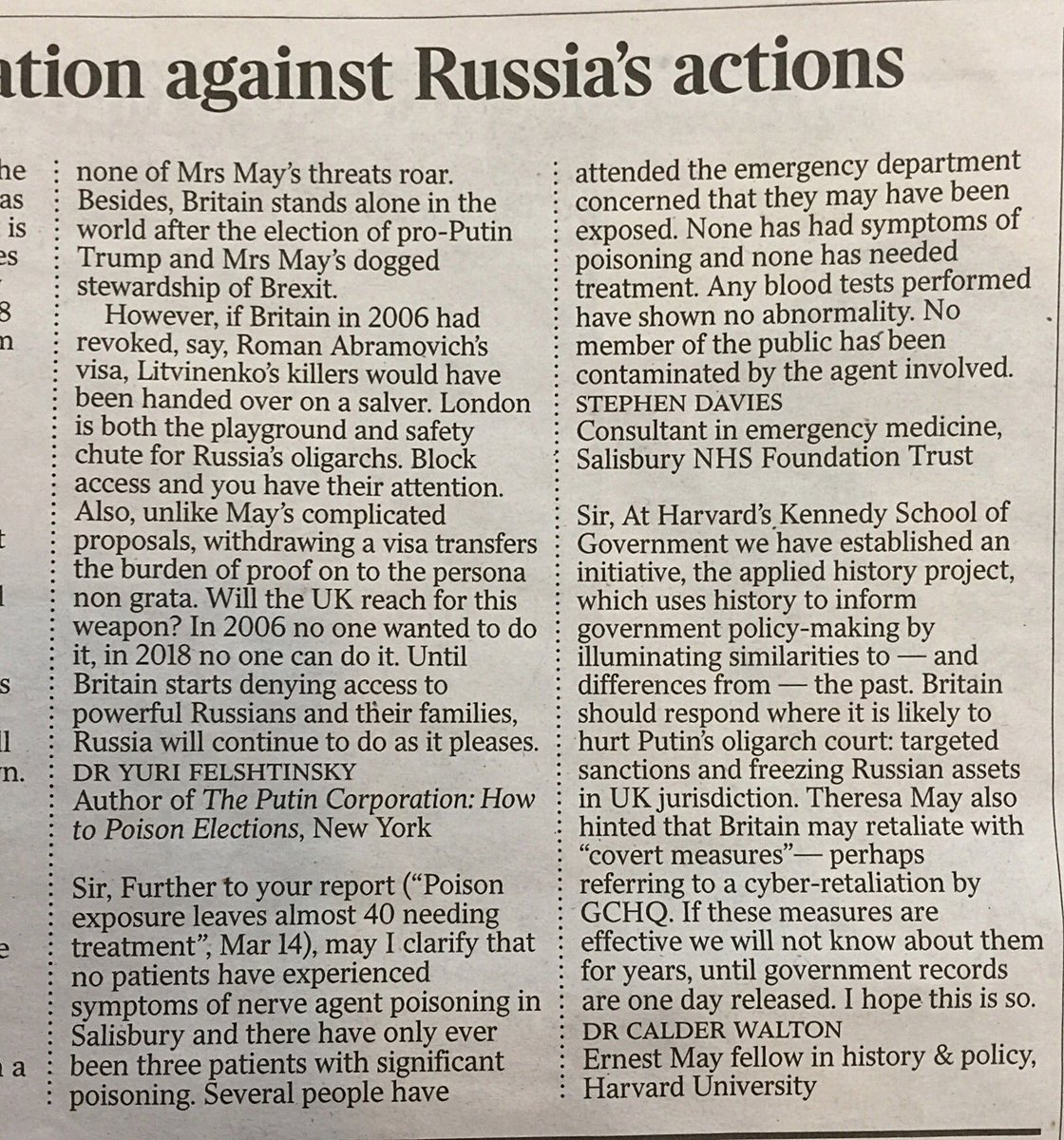
Davies: Letter to The Times
Stephen Davies, a consultant on emergency medicine for the Salisbury NHS Foundation Trust, which runs the Salisbury District Hospital, wrote a letter published in The Times on March 16 that presented a problem for the official British government position. Davies wrote,“[M]ay I clarify that no patients have experienced symptoms of nerve-agent poisoning in Salisbury, and there have only ever been three patients with significant poisoning.” Obviously, Sergei and Yulia Skripal were “patients” in the hospital and were thus included in that statement.
The Times made the unusual decision to cover the Davies letter in a news story, but tellingly failed to quote the crucial statement in the letter that “no patients have experienced symptoms of nerve-agent poisoning in Salisbury” or to report on the significance of the statement.
To rule out the possibility that Davies intended to say something quite different, this writer requested a confirmation or denial of what Davies had written in his letter from the press officer for the Salisbury NHS Foundation Trust, Patrick Butler. But Butler did not respond for a week and then refused directly to deny, confirm or explain the Davies statement.
Instead Butler said in an email, “Three people were admitted and treated as inpatients at Salisbury District Hospital for the effects of nerve agent poisoning as Stephen Davies wrote.” When he was reminded that the letter had actually said something quite different, Butler simply repeated the statement he had just sent and then added, “The Trust will not be providing any further information on this matter.”
Butler did not respond to two separate requests from the writer for assistance in contacting Davies. The refusal of the NHS Foundation Trust to engage at all on the subject underlines the sensitivity of The British government about nerve agent that didn’t work.
There are many individuals in Russia whose feelings about Sergei Skripal’s having become a double agent for Britain’s MI6 – including former colleagues of his – could provide a personal motive for the poisoning. And it is certainly plausible that those individuals could have obtained some of the nerve agent sold by Leonid Rink that entered the black market.
Neither the British government nor the Russian government is apparently eager to acknowledge that alternative explanation. The British don’t want it discussed, because they are determined to use the Salisbury poisoning to push their anti-Russian agenda; and the Russians may be reluctant to talk about it, because it would inevitably get into details of a secret nerve agent research project that they have claimed they closed down in 1992, despite Rink’s testimony in the court case that he was still doing some work for the Russian military until 1994.
Gareth Porter is an independent journalist and winner of the 2012 Gellhorn Prize for journalism. He is the author of numerous books, including Manufactured Crisis: The Untold Story of the Iran Nuclear Scare (Just World Books, 2014).
Western media cover tracks of Trump, May and Macron’s war crime in Syria
By Finian Cunningham | RT | April 17, 2018
With astounding double-think, the US and Britain accuse Russia of “tampering” with the alleged chemical-weapon attack site in Syria’s Douma – just days after the US, UK and France barraged the county with over 100 missiles.
If anyone is guilty of tampering with the alleged crime scene, it is the NATO trio who rushed to bomb Syria just as inspectors belonging to the Organization for the Prohibition of Chemical Weapons (OPCW) arrived in Syria – invited there by the Syrian and Russian governments.
The frenzied Western media campaign to find Syria and Russia guilty of a war crime involving alleged chemical weapons is further highlighted by the reporting this week by award-winning British journalist Robert Fisk.
Fisk, who has been covering Middle East war zones for nearly 40 years, went to Douma city to file his report for The Independent. Credit goes to The Independent for publishing Fisk’s investigative work.
In the aftermath of the weekend’s airstrikes, what he found from interviewing local people and medics is arresting, if not shocking. From Fisk’s witness-gathering report, there was no gas attack carried out on April 7 – in stark contradiction to what the US, British and French governments have been declaring in hysterical tones for the past two weeks.
Those declarations culminated in the US-led bombing of Syria at the weekend. What’s more, the US, British and French leaders are reserving the right to carry out further strikes on Syria – if “the regime repeats its chemical-weapons attacks on civilians.”
What Robert Fisk reports from inside Douma corroborates what the Syrian government and its Russian ally have been saying consistently since the alleged incident on April 7. The incident, they say, was staged by the so-called “first responder” group known as the White Helmets, who work hand-in-glove with notorious terrorist outfits like Jaysh al-Islam and Al-Nusra Front. The White Helmets are also on the pay roll of the American CIA, as well as British and French intelligence agencies.
Similar to Russian Foreign Minister Sergey Lavrov’s earlier claim, Fisk reports that on April 7, a panic scene was engendered in Douma’s hospital by White Helmets activists who shouted that “chemical weapons” were being deployed. These activists began dousing people with water hoses and conveniently had video cameras on hand to capture the chaotic scenes acted out by unwitting civilians. A doctor in the hospital confirmed this to Fisk.
As for the supposed dozens of dead that Western governments and media blamed on “animal Assad” and Russian complicity, there is no evidence of the alleged victims. Video footage of dead people in a war zone is hardly proof.
This means that US President Trump and his British and French counterparts, Theresa May and Emmanuel Macron, just launched a criminal aggression on Syria in grave violation of international law and the country’s sovereignty. This is exactly what many independent observers were decrying at the time of the missile barrage, warning that the presumed evidence for a chemical attack was far from substantiated.
Indeed, the suspicion is that Trump, May and Macron knew that their evidential ground for attacking Syria was impossibly thin, and that is why they rushed to bomb the country. It was a decision hastened by the arrival of the OPCW inspectors heading to Douma. The inspectors are due to start their investigative work on Wednesday – delayed apparently by security concerns.
In all probability, the Douma incident was a propaganda stunt orchestrated by Western-backed anti-government militants and their White Helmets media agents, precisely in order to provoke an external military attack on Syria by the US, Britain and France.
Several things stand out about Robert Fisk’s latest reporting. This is exactly the kind of critical journalism that other Western media outlets should have been engaged in following the alleged chemical weapon attack on April 7. Credit goes to Fisk and The Independent. But it is a shameful case of “too little, too late.”
Also, it is notable how Fisk’s reportage is being roundly ignored – at least so far – by other mainstream Western media outlets. That’s an impressive feat of self-censorship at a crucial time when the US, British and French governments should be open to accusations of committing a war crime on Syria over their latest blitzkrieg.
This is especially so, given their warnings of more to come, over “further” chemical-weapons use. The urgent concern is that these governments are giving themselves a license to act on more false flags. They should be held rigorously to account for their claims.
This disregard for international law is made possible because of the appalling willingness of Western mainstream media to regurgitate self-serving claims made by terrorist-affiliated groups in Syria and their propaganda outlets.
American, British and French mainstream media have given saturated coverage to the White Helmets and the Syrian American Medical Society, and the dodgy one-man-band operation in Coventry known as the Syrian Observatory for Human Rights. CNN, the BBC and France 24 cite these groups as if they are “authoritative” and impartial, when in fact they are all part of the regime-change campaign in Syria sponsored by the US and its British and French allies.
It is telling, too, how Robert Fisk is being assailed as a “Syrian, Russian stooge” on social media. The one Western mainstream journalist who has had the integrity to delve into Syria’s Douma to uncover a very different critical perspective – one that disproves the claims peddled by the US, British and French leaders and other mainstream media – is being vilified for principled journalism.
Western corporate media are a grotesque mockery of public information and critical, independent accounting of government power.
Apart from Robert Fisk, the few other Western journalists to have ventured into Syria to report on what is really happening are independent, “alternative” sources like Eva Bartlett, Vanessa Beeley and Patrick Henningsen. They have exposed the “Oscar-winning” White Helmets group, which is actually complicit in staging atrocities against civilians living under a reign of terror imposed by their terrorist affiliates. It is understood the White Helmets activists behind the Douma provocation on April 7 have since fled the city along with the terrorist gangs under the cover of an evacuation deal with the liberating Syrian and Russian forces, who are now in control of most of the Eastern Ghouta suburbs near Damascus.
Western media journalists, if they were really committed to principles of accuracy and critical investigation, should be poring over the rubble in Douma, interviewing local people and finding out what really happened. But they are not.
That is why, one suspects, they are not there. That is why the US and Britain are now accusing Russia of “tampering” with the site in Douma – because there is no evidence of a chemical-weapons attack, as Robert Fisk reports.
That means the US, British and French governments just committed a brazen war crime.
This would also explain why Western mainstream media have now quickly moved their focus to allegations of “Russian cyberattacks” on American and British infrastructure. This is a classic case of “keeping ahead of the story.” Western governments and their dutiful media do not have a “story” – at least not the one they claim – in Syria, so the imperative is to change to another subject as quickly as possible.
‘Russia’ Instead of ‘US’: Swedish TV Caught Peddling Fake News on Syria
Sputnik – April 18, 2018
Swedish TV-channel TV4 has sparked outrage by offering its viewers a skewed picture of reality by substituting “the US” with “Russia” in a critical news report on the US-backed attacks against the war-torn middle-Eastern country.
In a news report about the conflict in Syria by TV4, a Syrian woman was speaking about the US, which, oddly enough, was rendered as “Russia, Iran and the regime” in the accompanying subtitles. After a public outcry on social media, TV4 recognized its “mistake” while translating the woman’s outspoken message from Arabic into Swedish.
“The attack did not get enough effect, so we want to see more. We want them to avenge us. Russia, Iran and the regime must back off from here because they have stolen our country and our land,” a woman living in Douma was quoted as saying on TV4.
In reality, however, she didn’t mention “Russia” at all, not even once, which was eagerly pointed out on TV4’s Facebook page by Arab-speaking Swedish viewers.
“Why do you cheat your viewers by means of translating errors? The lady said the United States, you wrote ‘Russia, Iran and the regime,'” Katja Jakoub, an Arabic-speaking woman from Gothenburg pointed out in her post.
This post has been shared by thousands of people, including many people of Arab descent who pointed out that the woman clearly said “Amrika,” Arabic for the United States.
They also pointed out that the Syrian woman actually said that “not everything is dependent on the US” and claimed that she “once again felt hope.” It is not clear from the excerpt whether she was referring to the US-backed missile attack against the Syrian government or something else.
In response to the public uproar, TV4 acknowledged that the translation was “incorrect.”
“During yesterday morning’s broadcast, we sent out a feature from Syria in which the footage unfortunately was accompanied by the wrong text. Thus, the translation did not match what was actually said in the footage regarding this particular broadcast. This was discovered shortly afterwards and we rectified this immediately,” TV4 wrote in its reply, stressing that subsequent broadcasts featured a more consistent translation.
“Was this really a mistake from TV4? One translates the US as ‘Russia, Iran and the regime’ and lets it go on air during peak time to hundreds of thousands of viewers. Then one apologizes on TV4’s Facebook page which is only read by several hundred… Looks more like TV4 owners would like get a world war started,” user Christian Christensen wrote.
On April 14, the US, Britain and France launched 103 cruise and air-to-surface missiles at a number of government facilities in Syria, in response to the alleged April 7 chemical attack in the Damascus suburb of Douma. The airstrikes came even before the results of an ongoing investigation into the case by experts from the Organization for the Prohibition of Chemical Weapons were announced. Most of the missiles were intercepted by Syrian air defenses.
The Stockholm-headquartered TV4 is one of Sweden’s largest channels. It is fully owned by the Bonnier Group, which, in turn, is managed by the powerful media tycoon family the Bonniers [see link below], who run a network of about 170 companies in 15 countries, including Sweden’s foremost dailies such as Dagens Nyheter, Expressen and Sydsvenskan.
READ MORE:
Jewish Media Influence in Scandinavia
Sweden Starts Anti-‘Fake News’ Body for Mental Defense Against ‘Russian Threat’
‘Source Critical’ Swedish Daily Draws Ridicule by Posting Fake PM Tweet
Even western mainstream media is reporting that no chemical attack took place in Douma
Medical personnel on the ground in Syria give testimony that those videos show people suffering from hypoxia – not gas poisoning
By Frank Sellers | The Duran | April 18, 2018
On April 7th, an attack was carried out in the town of Douma, just a few kilometers out of Syria’s capital, Damascus, which was occupied by radical terrorist forces. The attack was peddled as a chemical weapons attack using chlorine gas, and it was additionally reported to have included some unknown nerve agent (which apparently the White Helmet guys who were filming the incident were somehow immune to), which was then said to have killed at least 75 people, and, according to the UK Prime Minister Theresa May, also resulted in the deaths of 500 more, all based on social media postings, based on what is being revealed to the public anyway, by groups that have known links and coincidental interests with the very radical terrorists that Western governments are claiming to be fighting.
Additionally, these media outlets and governments have been quick to thrust blame in the direction of Syrian government forces, particularly on the Syrian President Bashar al-Assad, before any independent organization has conducted an investigation to determine whether the attack was of a chemical nature or who carried out the attack in the first place.
The US, UK, and France are, however, continuing to insist that the attack was chemical in nature, and that Assad conducted the attack, of course, without having any of their own assets on the ground to conduct any observations or investigations in Douma, citing “intelligence”, which, of course, is classified, and will not be released to the public in order to bolster their “confidence” that Assad ordered a chemical attack on his own citizens “including young children” at a time when his forces were retaking the town already anyway.
In fact, the US and France have even insisted that they have “proof” that they are “highly confident that they believe in” that Assad did, in fact, conduct a chemical weapons attack on his own civilian population in Douma, once again, including women and young children. Meanwhile, the Kremlin has been warning for months that provocateurs were preparing to launch a chemical attack in Syria in order to blame their opposition, the Syrian government, and provoke a Western military response to help them in their conflict against Assad’s forces.
On the basis of this alleged chemical attack, that the West says that it is highly confident that Assad ordered, a military “precision strike” was conducted by a coalition of US, British, and French forces on the Syrian capital of Damascus, for the purpose of destroying or significantly disrupting the Syrian government’s capability to manufacture, store and employ chemical weapons, as well as to serve as a deterrent against any future chemical weapons attack, which the US ambassador to the UN Nikki Haley says will actually happen again, and which recurrence will be met with yet another coordinated response by the US and its allies.
The strike took place just hours before the UN’s Organization for the Prohibition of Chemical Weapons expert investigators were due to arrive at the scene of the alleged chemical attack to determine if reports about the suspected attack were, or are, in fact, true.
We are being told that the coordinated missile strike, included over 100 missiles, including American Tomahawks, struck chemical weapons research and manufacturing facilities in Damascus, which apparently didn’t result in any dangerous banned chemicals or nerve agents being released into the surrounding area, which would have been utterly devastating to hundreds of people in the area, if not more.
Now, all of the sudden, after conducting a few interviews with witnesses from the site of the attack, even some mainstream Western invesigative journalists are questioning the narrative that has been published about a chemical gas attack in Douma.
The world’s third largest news agency, Agence France-Presse (AFP), and a major British online newspaper, the Independent, are publishing stories which are casting doubt on the whole chemical gas attack narrative that we have been being fed since the date of the attack, and which Western governments are claiming “proof” for, which, of course, they are “highly confident” in, and which was used as a justification for a military intervention in Syria against the capital city of a government that is fighting the same bad guys that these very Western governments say they have spent, and continue to throw money at, billions on.
The AFP spoke with Marwan Jaber, a medical student who witnessed the aftermath of the alleged chemical attack, who said “Some of [the victims] suffered from asthma and pulmonary inflammation. They received routine treatment and some were even sent home, they showed no symptoms of a chemical attack. But some foreigners entered while we were in a state of chaos and sprinkled people with water, and some of them were even filming it.”:
The Syrian regime on Monday (April 16th) organized a press visit to the city of Duma in Eastern Ghouta, where an alleged chemical attack on April 7 killed at least 40 people, shortly before the regime’s forces took over the city, then held by the rebels. The team of the International Organization for the Prohibition of Chemical Weapons (OPCW) had still not been able to enter the city on Monday.
The Independent’s Robert Fisk travelled to the site in Douma, and spoke with medical personnel on the ground in the Syrian town:
It was a short walk to Dr Rahaibani. From the door of his subterranean clinic – “Point 200”, it is called, in the weird geology of this partly-underground city – is a corridor leading downhill where he showed me his lowly hospital and the few beds where a small girl was crying as nurses treated a cut above her eye.
“I was with my family in the basement of my home three hundred metres from here on the night but all the doctors know what happened. There was a lot of shelling [by government forces] and aircraft were always over Douma at night – but on this night, there was wind and huge dust clouds began to come into the basements and cellars where people lived. People began to arrive here suffering from hypoxia, oxygen loss. Then someone at the door, a “White Helmet”, shouted “Gas!”, and a panic began. People started throwing water over each other. Yes, the video was filmed here, it is genuine, but what you see are people suffering from hypoxia – not gas poisoning.”
But, just like the story with Saddam Hussein went, when these very Western governments wanted so bad to follow the American’s blood lust for war in Iraq, this government, so they say, has weapons of mass destruction, and is lead by not just any old tyrannical dictator, but a “monster” who is using these banned WMDs on his own population (apparently for the sheer sadistic pleasure of it), for no good reason. And, of course, without any verifiable intelligence resulting from any on the ground investigation by anyone trained to look for the stuff.
In fact, here we are seeing reports from journalists, western ones, I might add, that report the opposite of what we have been told for the past ten days. No use of WMDs being used in Douma, or at least, no evidence of it anyway. And, based on the fact that the US led strike on Syria’s alleged chemical weapons labs and storehouses didn’t release any of these agents into the area when the strike should have spread the stuff all over the place, it looks like Syria doesn’t have those WMDs, or, at least the West doesn’t know where they’re at, and just randomly shot off a couple of missiles to make it look like they were doing something about those WMDs.
Neutral and unbiased? Why ‘think tanks’ lobby for war in Syria
By Danielle Ryan | RT | April 17, 2018
When US President Donald Trump fired a barrage of Tomahawk missiles at Syrian government targets last week, it was a good day for defense contractors, at least.
In the aftermath of the strike, which Trump claimed was in retaliation for an alleged chemical attack by the Syrian government, stocks in Tomahawk missile manufacturer Raytheon surged. Raytheon stock has climbed more than 18 percent in 2018 so far. In fact, stocks in defense companies have been climbing in general since Trump entered office promising “historic” increases in military spending.
Almost a year ago to the day, Trump delivered another bump to the defense companies after attacking Syrian government positions for the first time – also in response to an alleged chemical attack, evidence for which remains in question.
After that strike Boeing, Lockheed Martin, Northrop Grumman and General Dynamics also rose, gaining nearly $5 billion in market value when trading began the next day, even as the wider market slumped.
Later, when Trump appointed the famously militaristic John Bolton as his national security adviser in March, guess what happened? Shares in US energy and defense companies surged yet again. It doesn’t take a rocket scientist to figure this one out: war is profitable. The more missiles Trump fires, the more money these companies make.
But where do the think tanks come in?
There is a pervasive myth that Washington DC ‘think tanks’ are neutral and unbiased players in foreign policy analysis. But where do these centers for foreign policy ‘analysis’ get their money from? You guessed it: defense companies.
There are a few think tanks which dominate in American foreign policy debates. They include the Center For European Policy Analysis (CEPA), the Atlantic Council, the German Marshall Fund (GMF), the Brookings Institution and the Heritage Foundation. All five of them receive generous donations from Lockheed Martin and Raytheon. Three of them also receive funding from the Boeing Company.
Corporations like Exxon Mobil, Northrop Grumman, BAE Systems, and Bell Helicopter are also big donors to think tanks. Bell Helicopter is a funder of CEPA, while Exxon funds Brookings, GMF and the Atlantic Council. BAE Systems donates to CEPA, while Northrop Grumman gives to the Atlantic Council. This is not to even mention the money they get directly from US government departments and NATO, which also helps explain their consistently anti-Russian analysis.
Nonetheless, these think tanks enjoy an undue air of independence. Experts who work for these defense contractor-funded institutes are quoted frequently in mainstream newspapers and invited on mainstream channels, where they are presented as independent voices. But those independent voices somehow always seem to be in favor of policies that benefit weapons manufacturers.
War profiteers are filling their coffers in return for ‘analysis’ which promotes military action and massively inflates the threat posed to America by countries like Russia, for example.
A glance at the Twitter feed of CEPA reveals almost obsession-like focus on the so-called threat from Russia. In 2016, the Lockheed and BAE Systems-funded think tank suggested in a report on information warfare that people who have “fallen victim to Kremlin propaganda” should be “deradicalized” in special programs.
The NATO-funded Atlantic Council has consistently lobbied for regime change in Syria. In the days surrounding Trump’s military actions against Syria last week, the Atlantic Council published multiple pieces of analysis and interviews with a single theme: that Trump did not or would not go far enough with one night of strikes. Earlier, when the alleged chemical attack took place, the think tank argued that Syrian President Bashar Assad was “indulging an addiction” and called on the US to take new military action against him. For some reason, diplomacy does not seem to be high on the Atlantic Council’s agenda.
It seems the more money defense contractors throw at think tanks, the more those think tanks will argue in favor of the military policies that will make those companies the most money. It’s a vicious cycle, but one which doesn’t take much think tank-style ‘analysis’ to figure out.
The sad thing for the think tank lobbyists, is that the money they make calling for war is nothing in comparison to the money Lockheed, Raytheon, Boeing and the rest make from it. Maybe they should ask for a raise.
The Skripal case & the perils of a rush to judgment
By James O’Neill | OffGuardian | April 16, 2018
The perils of coming to premature conclusions before all the facts are available has been starkly demonstrated by the latest developments in the alleged nerve gas attack upon the former Russian double agent Sergei Skripal and his daughter Yulia in the English town of Salisbury on 4 March 2018.
Followers of this particular saga will be aware that British Prime Minister Theresa May and her Foreign Secretary Boris Johnson have made a series of statements to the United Kingdom House of Commons and to the media. They alleged, without qualification, that the Skripals were poisoned with a nerve agent of the “Novichok” class, of a type “developed by Russia.”
That these statements were made before it was possible for the British chemical and biological research facility at Porton Down to have made an analysis and reached a scientifically valid conclusion did not matter. The object of the exercise was to demonize Russia in general and its President Mr Putin in particular.
As serious questions about the United Kingdom’s version of events were increasingly raised, the government’s explanations changed, along with increasingly bizarre allegations. The one common denominator to all of these “explanations” was that they were devoid of that troublesome substance known as “evidence.”
Very belatedly, and contrary to their obligations under the Chemical Weapons Convention (CWC), the United Kingdom made a request to the OPCW to conduct an independent investigation. While this investigation was ongoing, the propaganda continued unabated. One aspect of that was the United Kingdom persuading a number of its NATO and EU allies, plus Australia to expel Russian diplomats.
Australia’s Foreign Minister Julie Bishop issued a media release on 27 March that blamed the Skripal attack upon Russia, relying on
advice from the United Kingdom government that the substance used on 4 March was a military grade nerve agent of a type developed by Russia……….. The attack is part of a pattern of reckless and deliberate conduct by the Russian state that constitutes a growing threat to international security, global non-proliferation rules against the use of chemical weapons, the rights of other sovereign nations and the international rules based order that underpins them.
Russia’s denials of culpability were disregarded.
The OPCW has now issued its report dated 12th April 2018. At the time of writing (15 April) there has been no mention of this report, much less its implications, in the Australian mainstream media. The report is in two versions. The first part, headed Note by the Technical Secretariat was released for public use. The second and more detailed version was released to all nations who were parties to the CWC, which includes Australia.
Even the two page summary report contains valuable information. The first revelation is that the samples collected by the OPCW technical team that went to the United Kingdom on 21 March 2018 (17 days after the attack on the Skripals) were of a “high purity.”
The alleged significance of this is that it could only have been produced in a very sophisticated laboratory, which almost certainly rules out any resources other than those of an advanced nation state.
The second point is that a “pure toxin” is not a “military grade nerve agent.” This latter phrase is one used by the British Prime Minister and Foreign Secretary and repeated in Foreign Minister Bishop’s media release. The suggestion to the contrary by Gary Aitkenhead, the CEO of Porton Down, was therefore misleading. Mr Aitkenhead is not a scientist and may not have known better, but he was relying on a statement prepared for him. The Porton Down scientists certainly knew better.
Thirdly, the OPCW summary notes that there were no additives to the substance, which would have been necessary had the substance been applied to the Skripal’s front door handle. That particular version was seriously advanced by Boris Johnson who also claimed to have evidence that Russia had been training its agents for several years in how to apply nerve agents to door handles!
Perhaps needless to add, like most of Mr Johnson’s pronouncements on this topic, this was bereft of evidence and logic, let alone scientific validity.
One of the two most important points in the OPCW summary is that the environmental samples collected by the OPCW technical team were of “high purity” and demonstrated “the almost complete absence of the impurities.” This is literally impossible if the samples related to the time when the OPCW technical team was in the United Kingdom for that purpose. Of the various nerve agents in existence, the most durable is VX, which has a durability of 2 to 3 days, not the three weeks between the attack and the collection of the samples.
The irresistible conclusion is that the places where the samples were taken had evidence planted immediately (within a few hours at most) prior to the OPCW technical team’s arrival at the locations from where the samples were collected. It defies common sense and logic to suggest that the Russians were responsible for the planting of such fake evidence. The most logical candidate is the United Kingdom government or someone acting on their behalf.
That finding alone destroys the argument of the United Kingdom government and its acolytes in the Australian government and media. There was however, a further fatal blow to the UK government’s claims. As noted, the full OPCW report was made available to all governments who were signatories to the Chemical Weapons Convention.
There is no prohibition on any of those governments from publishing the full report or parts thereof. The Russian Foreign Minister Sergei Lavrov has released what he claims is another key finding of the report. That is, that the agent used on the Skripals was in fact a substance known as BZ (3-Quinuclidinyl benzilate). BZ is an hallucinogenic incapacitating chemical warfare agent. It afflicts both the peripheral and central nervous systems.
The signs of its use are disorientation, tremors, ataxia, stupor and coma. It is administered by an aerosol spray. These symptoms accord with the descriptions given by eyewitnesses and Salisbury Hospital as to the Skripal’s medical conditions. BZ is not produced in Russia. It is an agent that is used by the United Kingdom and the United States.
When one puts together the now known nature of the substance, its means of delivery and the symptoms that its victims exhibit, it is a further compelling inference that they were “sprayed” at some point between leaving Zizzi’s restaurant and moving to the park bench.
Given the ubiquitousness of CCTV cameras in the vicinity it should be possible to identify the actual perpetrator. One might draw further negative inferences about the UK government and the Police investigation from the fact that no details of the Skripal’s movements at this time have been released.
The British, Australian and other governments who rushed to judgement have a dilemma. Do they attempt to rebut the information that Mr Lavrov released? To try and do so would serve to highlight the revelations and any denials would be easily rebutted by the release of the full report.
On the other hand, ignoring this new evidence inevitably raises further questions about the veracity of the government’s version of events. The details outlined briefly above have already been widely disseminated on the alternative media and at least some British mainstream outlets.
The option that appears to have been taken thus far by the Australian media is to ignore Mr Lavrov’s revelations. Bishop and Turnbull, so recently and frequently condemnatory of alleged chemical warfare misbehaviour by Russia are now completely silent.
Their rush to judgement has now been exposed for the empty propaganda that it was. It is probably too much to expect an apology and a withdrawal of their false claims. Such an apology seems the very least they can do in the light of the actual evidence revealed by the investigation which stands in such stark contrast to the hyperbole and falsehoods perpetrated by the British government and their acolytes.
James O’Neill is a Barrister at Law and geopolitical analyst. He may be contacted it joneill@qldbar.asn.au
Strike on Syria legitimate as 3 UNSC members acted – Macron
RT | April 15, 2018
French President Emmanuel Macron said that the US-led strike on Syria was legitimate, but “history will judge” whether the operation was justified. He added that neither France nor its allies are at war with the country.
Macron was giving a live interview following the Saturday strike on Syria that was carried out without any resolution from the UN security council. The US-led attack, that hit three targets in Syria, a research center and military bases, was launched in response to an alleged chemical attack in Douma on April 7.
The French president defended the lack of a UN resolution before conducting the strikes against Syria, saying that it was “the international community” that intervened.
“We have complete international legitimacy to act within this framework,” Macron said in the interview broadcast by BFMTV, RMC radio and Mediapart. “Three members of the Security Council have intervened.”
Macron also alleged that he was the one who convinced US President Donald Trump to remain in Syria and that the coalition should limit their strikes to chemical weapons facilities.
“Ten days ago, President Trump was saying ‘the United States should withdraw from Syria’. We convinced him it was necessary to stay,” Macron said. “We convinced him it was necessary to stay for the long term.”
He also asserted that Assad has lied “from the beginning” about the alleged use of chemical weapons by forces under his control. Macron also reaffirmed that the French government has proof that chemical weapons, notably chlorine gas, were used in Syria, adding that the “the priority for France’s military intervention remains in the fight against ISIS” and that the “precision strikes” did not inflict any collateral damage on Russian forces.
He also accused Russia of being complicit in the alleged chemical weapons attacks carried out by pro-Assad forces by disrupting the work of the international community and the Organization for Prohibition of Chemical Weapons (OPCW) using “diplomatic channels.” He didn’t mention, however, that the strike took place hours before the inspectors of the OPCW were to start their mission at the place of the alleged attack and were guaranteed full access by the Syrian government who took control over the area this week.
The Guardian Distorts Nicaragua’s Indio Maiz Fire
teleSUR | April 14, 2018
Under the headline ‘Nicaragua fires: aid from Costa Rica rejected as blaze destroys rainforest,’ the U.K.’s Guardian newspaper has published another politically skewed report smearing Nicaragua’s Sandinista government. This time, the pretext is a devastating forest fire affecting the peripheral buffer zone of the Indio Maiz Biological Reserve. Falsely alleging that Nicaragua has rejected the offer of help from Costa Rica, the Guardian report uses the standard NATO propaganda attack recipe, blending false reports from hostile opposition media and anti-government NGOs.
The article argues that Nicaragua’s government has been negligent in protecting the Indio Maiz Biological Reserve; has not sought international help, and has deliberately facilitated invasion of the reserve by impoverished rural families seeking land.
Reality completely contradicts the report’s main assertions. The Guardian refers to a statement by the Costa Rican government saying that a unit of Costa Rican firefighters was turned away, but the Guardian report offers neither a link to the alleged statement nor any quote from it.
Here’s the Costa Rican fire service spokesman on the matter: “We are fully ready to cooperate in any other incident. From what we can see, this incident has already been controlled by the army. We were at the border and had to return. We see no problem. In the moment (we offered to help) Nicaragua they didn’t have the personnel to fight the fire; thankfully, over the last few hours, it now has the personnel to deal with this emergency and they are engaged in controlling and extinguishing the fire.”
In fact, the decision not to use the help offered by Costa Rica was taken jointly by the chiefs of the Nicaraguan and Costa Rican fire services during a meeting in Managua on April 8, when they agreed that “the realistic possibilities of controlling the fire by the firefighting services of Nicaragua and Costa Rica were limited due to the characteristics of the fire and that the effective means to control and extinguish the fire is from the air.” In any case, access to the area of the fire was impractical overland, with access being possible almost exclusively by air or sea along the region’s Caribbean coast.
Nicaragua’s Vice-President Rosario Murillo said on April 9, in relation to coordination with the director of operations of the Costa Rican Fire Fighting Service: “We have been in meetings with him all weekend, looking precisely at what is being done, the difficulty of reaching the place… There, where the fire has broken out, it’s impossible to reach with trucks or pick-ups. What’s really needed, urgently, are airplanes equipped with all the technical means to fight forest fires.”
Murillo also explained on April 10 that the Sandinista government led by President Daniel Ortega had “coordinated with Honduras, El Salvador, Panama, Mexico, the Russian Federation, the air forces of each one of these countries, requesting air resources to fight the fires.” Currently, helicopters from Mexico, Honduras and El Salvador are helping control and extinguish the fire, contradicting the impression given by the Guardian’s report that the government had not sought international help.
The Nicaraguan government has also coordinated support from U.S. authorities, with a specialist team sent from USAID’s Office of Disaster Assistance and the U.S. Forestry Service. The team leader arrived in Nicaragua on April 10. The Guardian’s April 11 report includes none of this information, which contradicts the impression that report gives by citing environmentalists calling on the government to seek international support, as if it had not already done so a week before the Guardian’s report was published.
The report quotes criticism from well-known Nicaraguan environmentalist Jaime Incer Barquero. Now in his 80s, Incer Barquero has made distinguished contributions to environmental conservation in Nicaragua. However, his pronouncements on the fire in the Indio Maiz Biological Reserve demonstrate ignorance of the measures taken by the Nicaraguan government to control the fire. The Guardian report also quotes a representative of the Fundacion Rio NGO, who noted ‘relations between the countries have not been the best’ due to a long-running border dispute. But as Costa Rica’s cooperation with Nicaragua makes clear, diplomatic relations take a back seat in the context of a major regional ecological threat like the Indio Maiz forest fire.
The Fundacion Rio NGO has solicited funds supposedly to support community authorities and firefighters in the Indio Maiz area, a function well beyond the organization’s statutory objectives. It has now been warned by the Nicaraguan government not to solicit funds for purposes it was not established to carry out: functions which are the government’s responsibility and which the government is fulfilling. The self-serving propaganda of this kind of environmentalist NGO is no doubt the basis for the Guardian’s allegation that “the fires are believed to have been started by illegal homesteaders, who were attempting to clear land for planting crops.”
In fact, the fires began in a marshland area completely unsuitable for agricultural activity, either arable farming or pasture for cattle. One of Nicaragua’s leading environmental scientists, Efrain Acuña, has dismissed the accusation that the area was set on fire so as to facilitate arable or cattle farming: “The soils in this zone do not lend themselves to those activities, among other reasons because the acidity is high, the fertility percentages for grazing are very low and so the nutritional value for cattle is insufficient.”
The Guardian quotes Gabriel Jaime of Fundacion Rio as saying that the government has encouraged rural workers and their families to encroach on land belonging mainly to the Indigenous Rama people, but gives no context to that allegation. Jaime’s solution is “removing people and telling them ‘You can’t live in a protected area.”’ Jaime also criticizes the government’s provision of health and education services in the area, as if these did not benefit the local Indigenous population. This is another example of a neocolonial NGO patronizing local Indigenous people who own their land and have a strong say in how it is used.
The same false neocolonial argument has been used to misrepresent the potential displacement of Indigenous people should Nicaragua’s interoceanic canal go ahead. The canal company HKND and the Nicaraguan authorities consulted with local Indigenous people who agreed terms for the canal’s construction across their land, but that fact has been systematically omitted or misrepresented by environmentalists in the same way as the complex issue of migration by rural workers families to areas of the Caribbean coast has been.
Western NGOs and the local organizations they fund around the world undermine the role and functions of sovereign national governments. That is why Western corporations finance them. It is also why foreign news coverage by Western corporate media systematically distorts and misrepresents the reality of events around the world. The Guardian report on the Indio Maiz forest fire categorically demonstrates that fact one more time.
Featured Video
or go to
Aletho News Archives – Video-Images
Book Review
The Maidan Killings and the False-Flag Case
By Freddie Ponton | 21st Century Wire | September 5, 2026
Before the killings that helped bring down Ukraine’s president in February 2014, American diplomats were discussing who should enter its government. In a leaked telephone call, senior State Department official Victoria Nuland told US ambassador Geoffrey Pyatt, “I think Yats is the guy,” referring to opposition leader Arseniy Yatseniuk. Washington had clear preferences and was working to advance them. Later that month, Yatseniuk became prime minister.
Ivan Katchanovski’s The Maidan Massacre in Ukraine examines the violence that preceded that transfer of power. Drawing on television footage, witness testimony, forensic examinations and Ukrainian court proceedings, he argues that elements of the opposition shot protesters and police in a false-flag operation. His case centres on evidence of protesters being shot from opposition-controlled locations, including Hotel Ukraina, overlooking the killing ground. … continue
Blog Roll
 Aletho News
- The Maidan Killings and the False-Flag Case
- Georgia’s Largest Healthcare System Will Fire Employees Who Refuse Flu Vaccine
- The Five-Year Fuel Crisis: Why the World Economy Is Paying for a War It Thinks Is Ending
- Trump’s Big Bluff on Iran
- Swiss scammed out of millions by Ukraine-linked call centers – media
- Germany facing potential ‘violent conflict’ with Russia – spy chief
- Ukraine’s EU neighbors reject new plea from Kiev – Politico
- British Transport Police Facial Recognition Trial Scanned 926,912 People With Zero Arrests
- House Bill Would Ban Federal Use of Flock ALPR Data
- Can a Spice Rival a Drug? 10 Head-to-Head Trials Put It to the Test.
- If Americans Knew
- “We See Our Homes Now From A Satellite, Like Strangers”
- Watch “Gaza: Doctors Under Attack”, originally censored by BBC
- NAZA: Israeli embassies in UK and US promote rival documentary to challenge Gaza genocide allegations
- David Ellison appoints Israeli to lead merged Paramount-Warner studios
- Turkish Red Crescent helps elderly Gaza man walk again after Israel confiscates his prosthetic limb
- Four Palestinians Killed in Israeli Attacks in Gaza
- Two Palestinian youths killed and village razed as Israeli attacks on West Bank continue
- Two more Christian women victims of Israeli raids on Gaza
- Cruelty, Deprivation, Indignity: A Journalist’s 22 Months in Israeli Prison
- New IDF Website Frames Slain Gaza Journalists as Terrorists
- No Tricks Zone
- Latest European Green Energy Debacle; Portugal’s Largest Flagship Solar Park Insolvent!
- Green Energy Debacle: German Expert Professor Fritz Vahrenholt Warns Of Severe Economic And Social Consequences
- Two More Paleo Reconstructions Affirm Meters-Higher Sea Levels Across Ireland, Brazil 7000-6000 Years Ago
- New Study: Earth And Venus Surface Warmth Largely Explained By Convection And Lapse Rate, Not CO2 Or Radiation
- 2025 Nature Paper Claiming Worsening Global Drought Gets RETRACTED …Heavily Flawed
- New Study: ‘Global Drought Shows No Detectable Recent Acceleration Under Climate Warming’
- Economic Masterminds: German Socialists Suggest Taxing Productivity Gains Stemming From Using AI
- The South China Sea Has Not Been Cooperating With The Climate Change Narrative
- Energy Crisis: Germany Enters Heating Season With Historically Low Gas Reserve Fill Levels
- New Study: The Antarctic Ice Sheet Gained Mass From 2020-2024 Due To Staggering Snow And Ice Accumulation

